
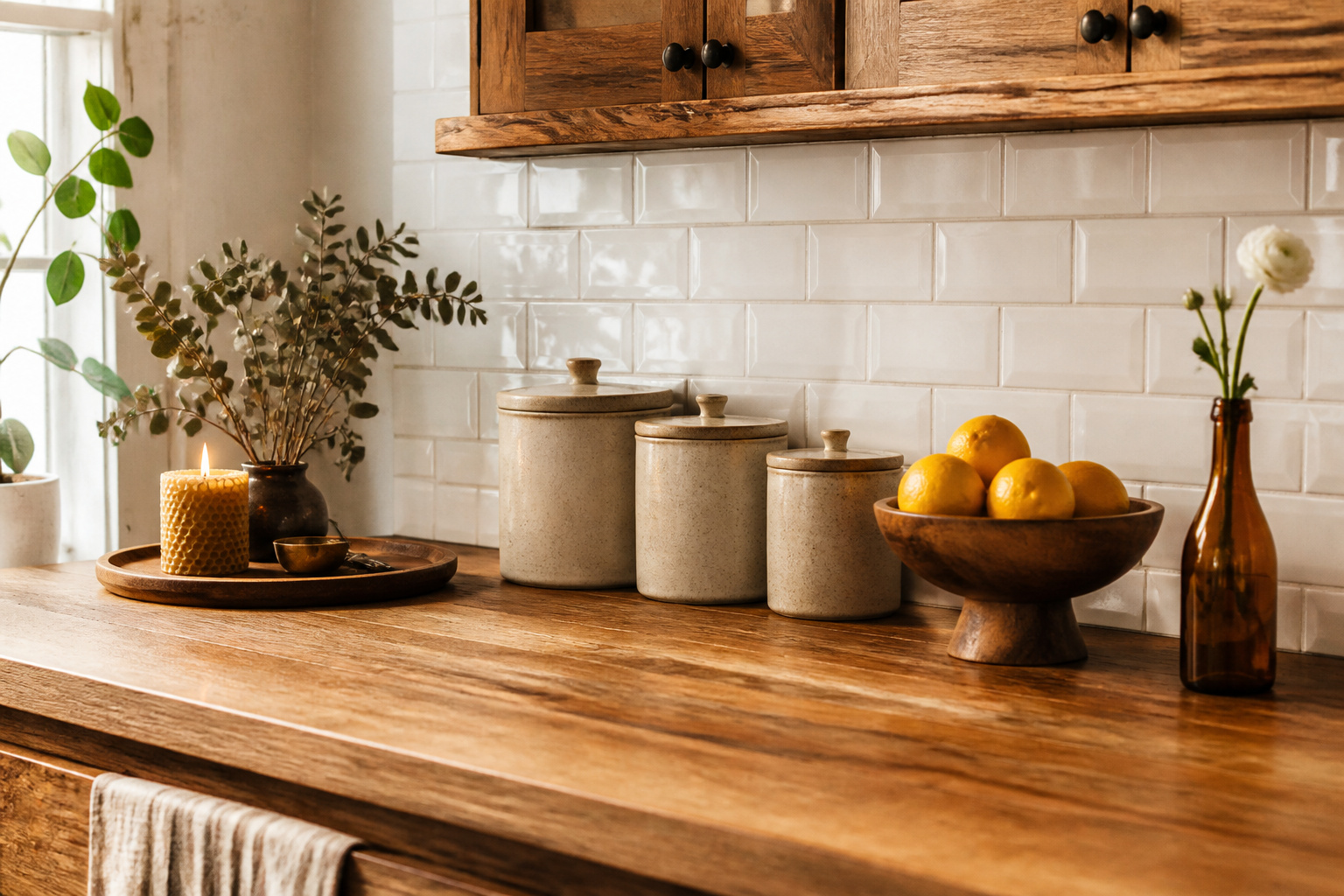
The countertop is the most-used surface in your kitchen. Yet most of us treat it as an afterthought. Instead of deliberate kitchen countertop decor, it collects things: the toaster nobody uses, the coffee machine that could live on a shelf, a stack of mail that wandered in from the hallway.
I’ve spent twelve years sourcing vintage pieces and helping people understand what actually belongs on a kitchen counter. Good counter styling isn’t about adding more — it’s about choosing very deliberately, then stopping. A single handmade pottery piece or a grouped tray of artisan oils says more than thirty objects competing for attention. If you’ve been wondering how to make your counters feel designed rather than assembled by accident, these 18 ideas are a good place to start. You might also find kitchen countertop ideas useful for broader material and surface choices.
1. A Curated Fruit Bowl That Changes With the Seasons
The fruit bowl is probably the oldest piece of kitchen countertop decor in recorded history. It may also be the most underestimated. Most people grab whatever was by the checkout, drop in some apples, and call it done. But a fruit bowl chosen carefully — in the right material, the right scale — becomes the kind of object guests actually comment on.
Choosing the Right Vessel
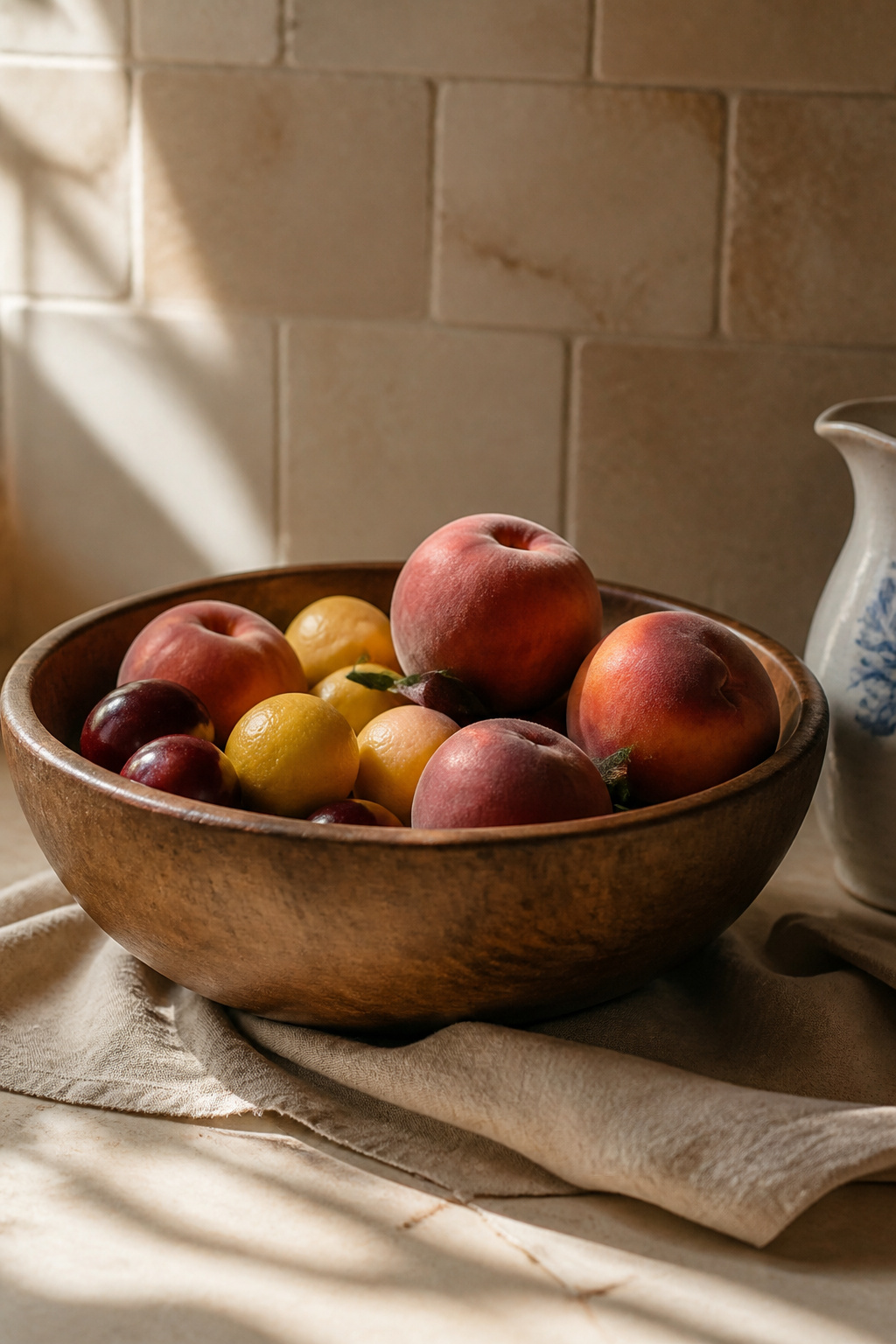
The vessel matters more than the fruit inside it. A solid turned-wood bowl — oak, walnut, or teak — develops a patina over years that a mass-market bowl cannot replicate. Architectmade’s FJ Bowl by Finn Juhl runs $95–$140 and outlasts the kitchen it sits in. For a softer look, a woven seagrass basket from World Market ($18–$30) suits farmhouse kitchens well. Estate sales regularly turn up carved wood and ceramic bowls at $5–$20 from the 1960s and 70s, when things were built to last.
Styling It Seasonally
Changing the bowl contents with the season is the simplest form of kitchen countertop decor that exists. Spring calls for lemons and small citrus. Summer suits peaches, plums, and figs. Autumn is right for apples, pears, and an occasional decorative squash. In winter, a bowl of oranges and pomelo looks spare and intentional rather than empty.
The Linen Trick
Place a folded linen napkin underneath the bowl. It prevents scratching, adds a layer of texture, and makes the whole vignette feel more considered. Change the napkin colour with the season — a dusty rose linen under summer stone fruit, an ochre cloth under autumn apples.
2. Stacked Cutting Boards as Kitchen Countertop Decor
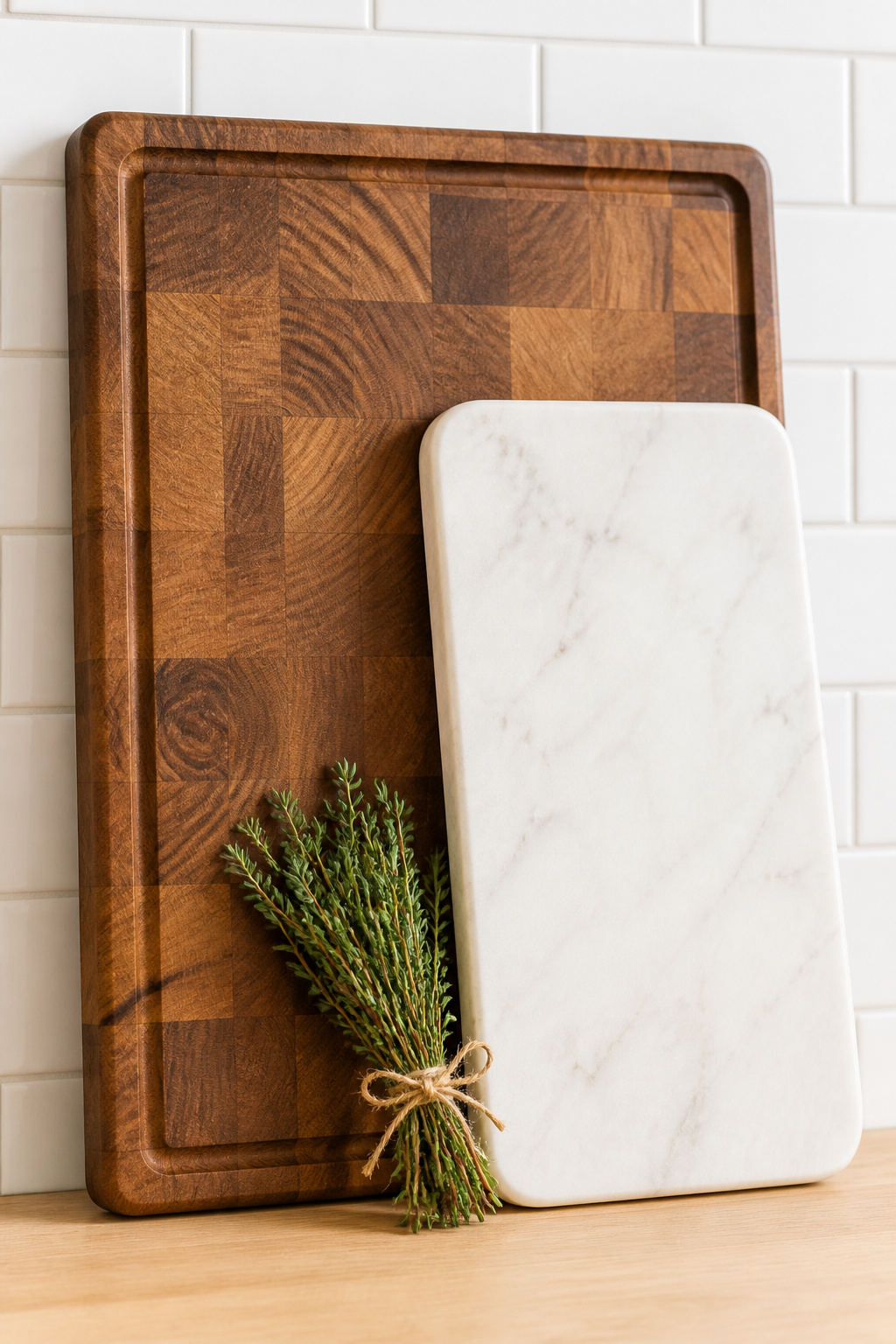
Stacked cutting boards are kitchen countertop decor that most people discover by accident. They lean two boards against the backsplash while cooking and realise it looks better than anything they planned. That accidental quality is the key to making them work. They should look casually assembled, not fussed over.
Why This Works as Kitchen Countertop Decor
Cutting boards succeed where other groupings fail because they already belong on a counter. They’re tools that happen to be beautiful. That authenticity is why they read as organised and deliberate rather than decorative for decoration’s sake. Two or three boards is the sweet spot. Four starts to read as storage. Five or more and you’ve lost the plot entirely.
Materials and the Oil-and-Lean Method
End-grain walnut is the classic choice. The cross-cut surface reveals a dense, mosaic-like grain pattern that looks striking against white subway tile. Pair it with a marble pastry board — the contrast of dark wood and pale stone works in almost any kitchen. Before displaying your boards, oil them with food-safe mineral oil. It deepens the colour dramatically. Even a cheap acacia board looks artisan when freshly oiled. Then lean the largest board against the backsplash and rest a smaller one against it at a slight angle — the angle suggests use, which is the right signal.
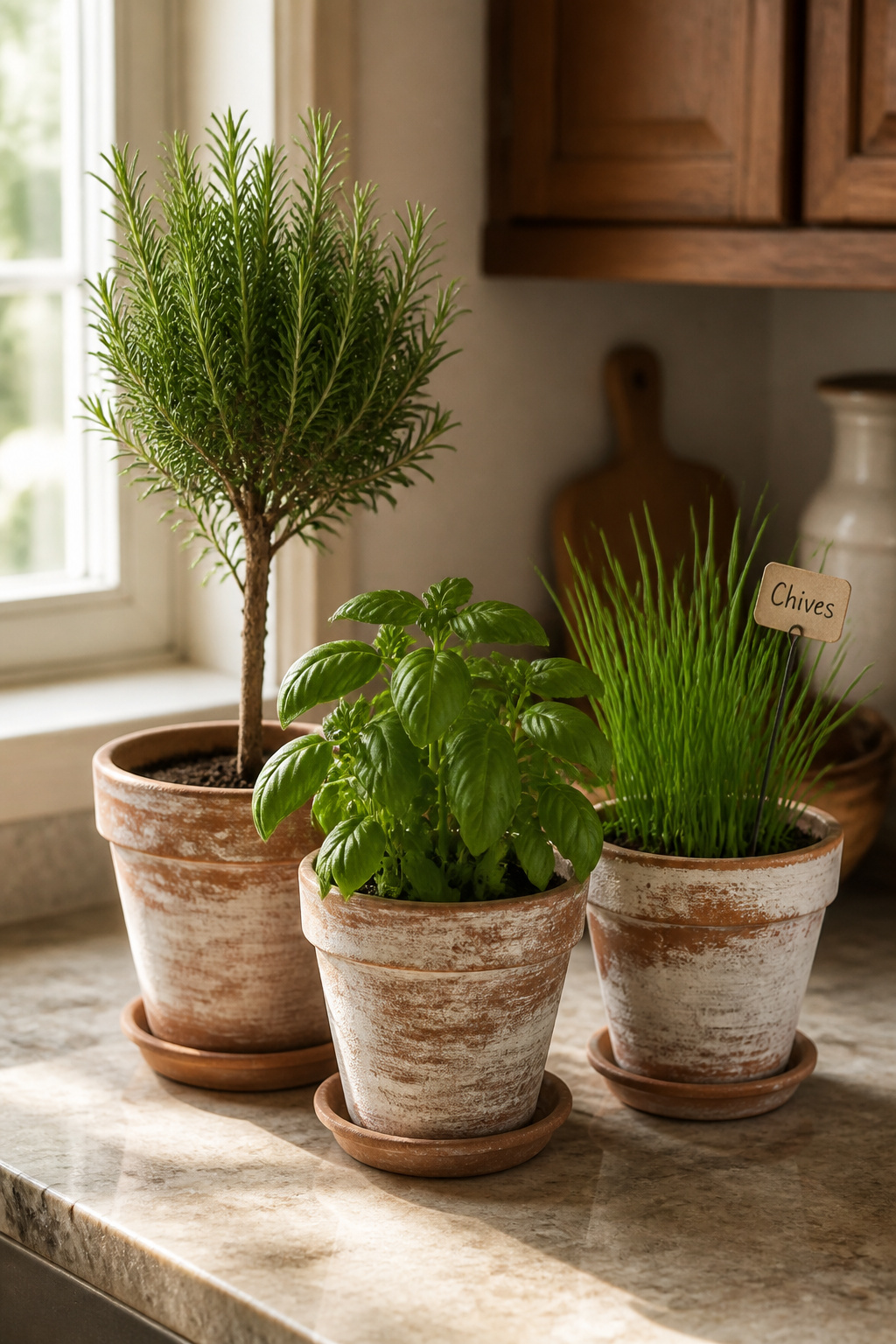
3. A Vintage-Inspired Herb Garden in Reclaimed Ceramic Pots
A live herb garden on the kitchen counter is the one piece of counter decor that actively improves your cooking. The challenge is that it often ends up looking like a jumble of sad nursery pots — functional but not decorative. The fix is almost always the container.
Choosing the Right Herbs
Basil, rosemary, chives, and mint are the best performers on a kitchen counter. They tolerate indirect light and moderate humidity. Thyme and oregano prefer more direct sun and do better near a south-facing window. Mint should be in its own pot — it will take over everything else given the chance, and aggressively so.
The Container and Drainage
Reclaimed terracotta pots from thrift stores ($2–$8 each) develop a white salt bloom as they age. This is efflorescence, caused by minerals leaching through the porous clay. It looks authentically vintage — like something from an Italian farmhouse kitchen in the 1940s. Always put a saucer underneath any pot sitting on a counter. A water stain on a wooden surface is genuinely difficult to address cleanly. For a cleaner look, use a cachepot — a decorative outer pot without a drainage hole — over the standard nursery pot, with a layer of gravel at the base.
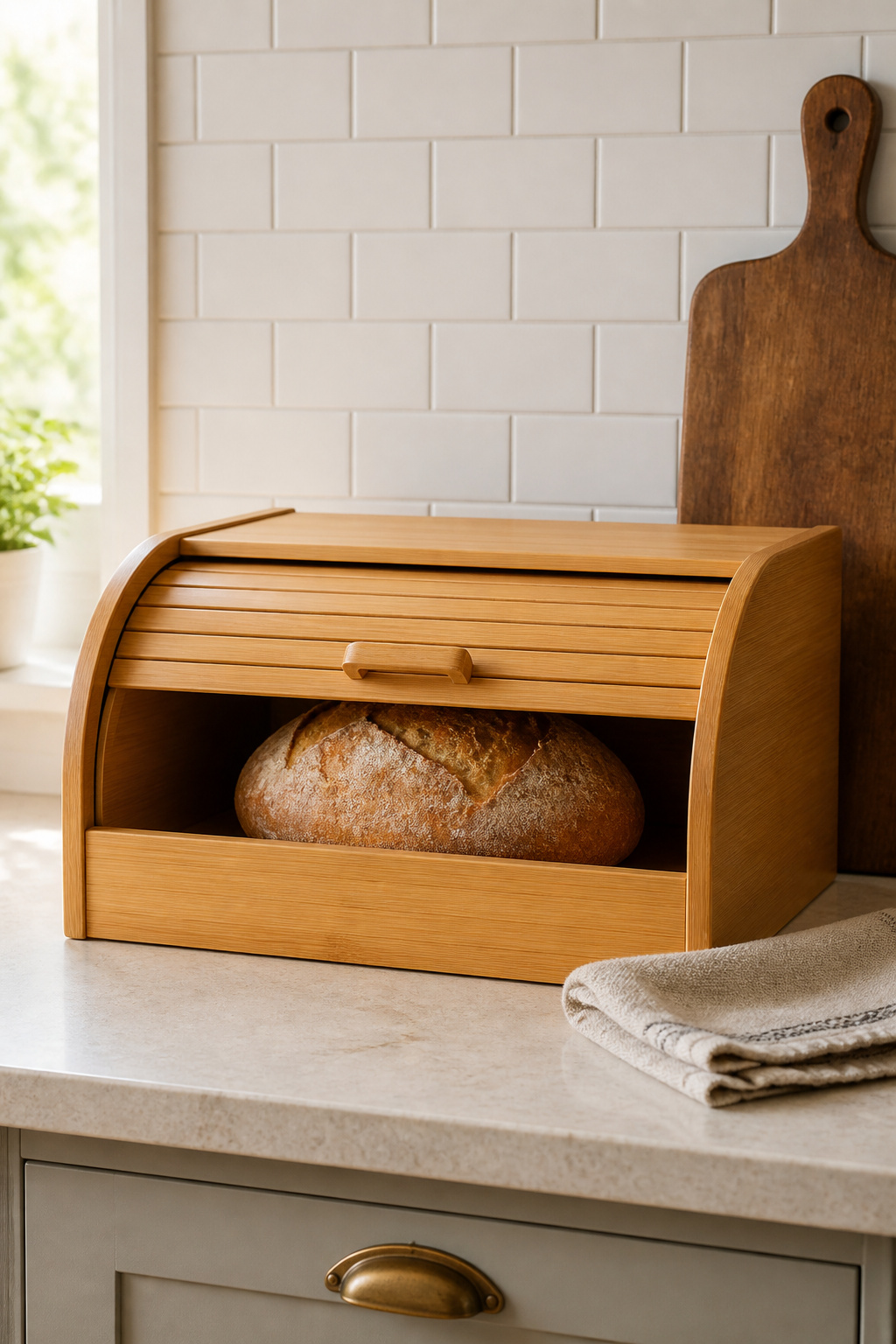
4. The Wooden Bread Box: Functional Kitchen Counter Decor
The bread box is one of those pieces of functional kitchen counter decor that went out of fashion in the 1980s and is firmly back. Not as a retro affectation — it genuinely extends bread life by two to three days. That practical function earns it permanent counter space.
Why the Bread Box Is Back
Part of the bread box revival is practical. Sourdough and artisan bread — which most of us buy more of now — go stale faster and develop mould more quickly in plastic bags. A bread box moderates humidity and slows moisture loss, which is what a dense loaf needs. But part of it is also aesthetic: a good bread box on a counter looks like someone chose it, which is the whole point of functional kitchen counter decor. For more on building a cohesive kitchen, rustic kitchen decor is a useful companion.
What to Look For
Wood species and construction quality separate a good bread box from one that warps in six months. Bamboo is lightweight and contemporary. Acacia has a more pronounced mid-toned grain for traditional kitchens. The Brabantia Classic Roll Top Bread Bin ($75–$90) is steel but comes in six colours and is built to last decades. A roll-top lid beats a lift-off lid — single-hand operation, less overhead clearance needed.
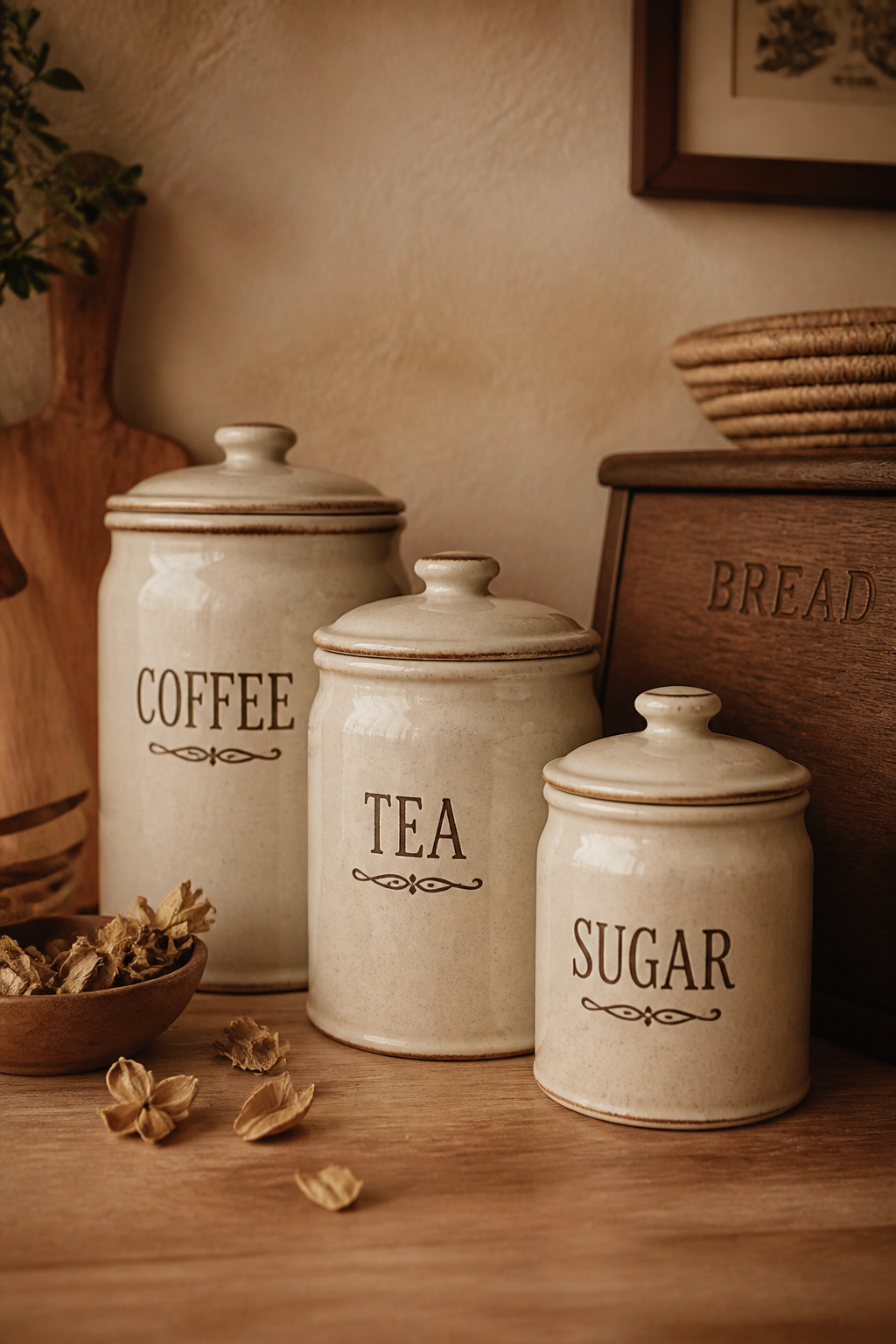
5. Vintage Canisters for Coffee, Tea, and Sugar
Three matching canisters for coffee, tea, and sugar are the fastest way to create visual cohesion on a kitchen counter. The eye reads them as a unit rather than three separate objects. That visual shorthand makes counter styling look curated rather than accumulated.
New Versus Vintage
Authentic vintage stoneware canister sets from the 1950s–1970s (brands like Ransburg, Hull Pottery, or McCoy) turn up at thrift stores regularly at $15–$45 for a set. They have a weight that modern versions rarely match. Le Creuset’s three-piece stoneware canister set ($65–$90) is handsome if you prefer new. Falcon Enamelware canisters ($35–$55) have an authentic mid-century feel — white enamel body, dark rim — that photographs beautifully.
Materials and the Label Detail
Stoneware is the most forgiving material in a kitchen. It doesn’t chip as readily as earthenware and doesn’t show grease as obviously as steel. Labels complete the look. Vintage kraft paper with twine, ceramic label clips from MUJI, or small round chalkboard labels all work. The key is consistency — use the same approach across all three canisters, or the set loses its effect.
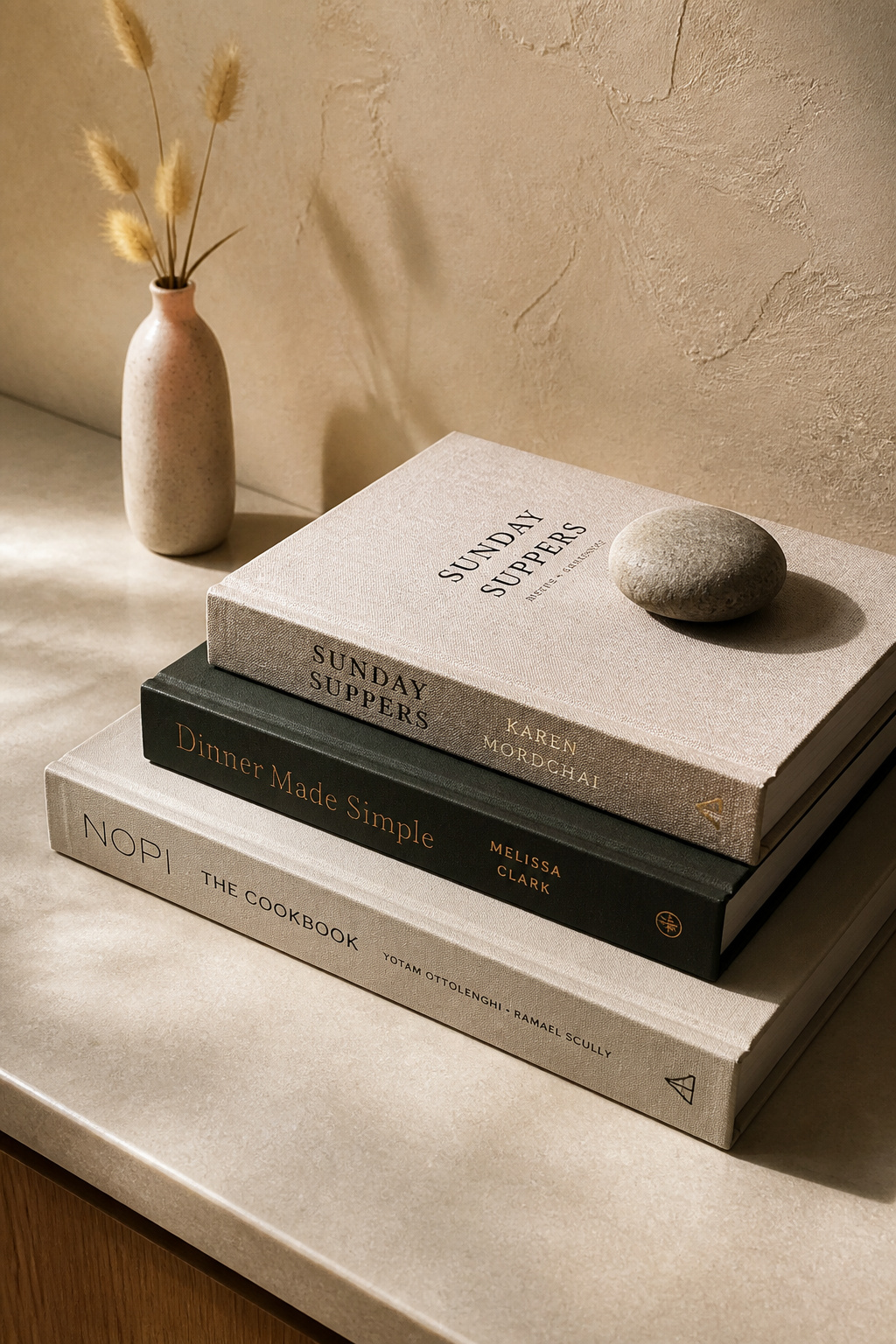
6. A Statement Cookbook Stack as Kitchen Countertop Decor
A cookbook stack is counter decor that most people dismiss as too obvious until they try it. The trick is treating it as a vignette — choosing the books deliberately, then topping the stack with a small object to complete the composition.
Which Books to Choose
Cookbook spines create the colour story. Ottolenghi’s Jerusalem and Plenty have bold graphic covers that photograph well. Skye McAlpine’s A Table in Venice has a linen-wrapped cover with beautiful typography — it looks as good as it reads. Diana Henry’s Simple has striking bold lettering. Against light cabinetry, a cobalt or forest green spine stands out without competing. For warm wood tones, brown, cream, or amber spines sit more naturally. Second-hand bookshops regularly sell beautiful old cookbooks for $1–$5. A 1970s French cookbook with an illustrated cover is a genuine design piece at that price.
Building the Stack
Place the largest book flat on the counter as a base. Lean one or two smaller books against it at a slight angle — the lean suggests use, which is the right signal. Top the stack with a small object: a smooth river stone, a dried sprig of lavender, or a small ceramic bird. That finishing touch turns a pile of books into something people notice.
7. Artisan Oil and Vinegar Bottles Arranged on a Tray
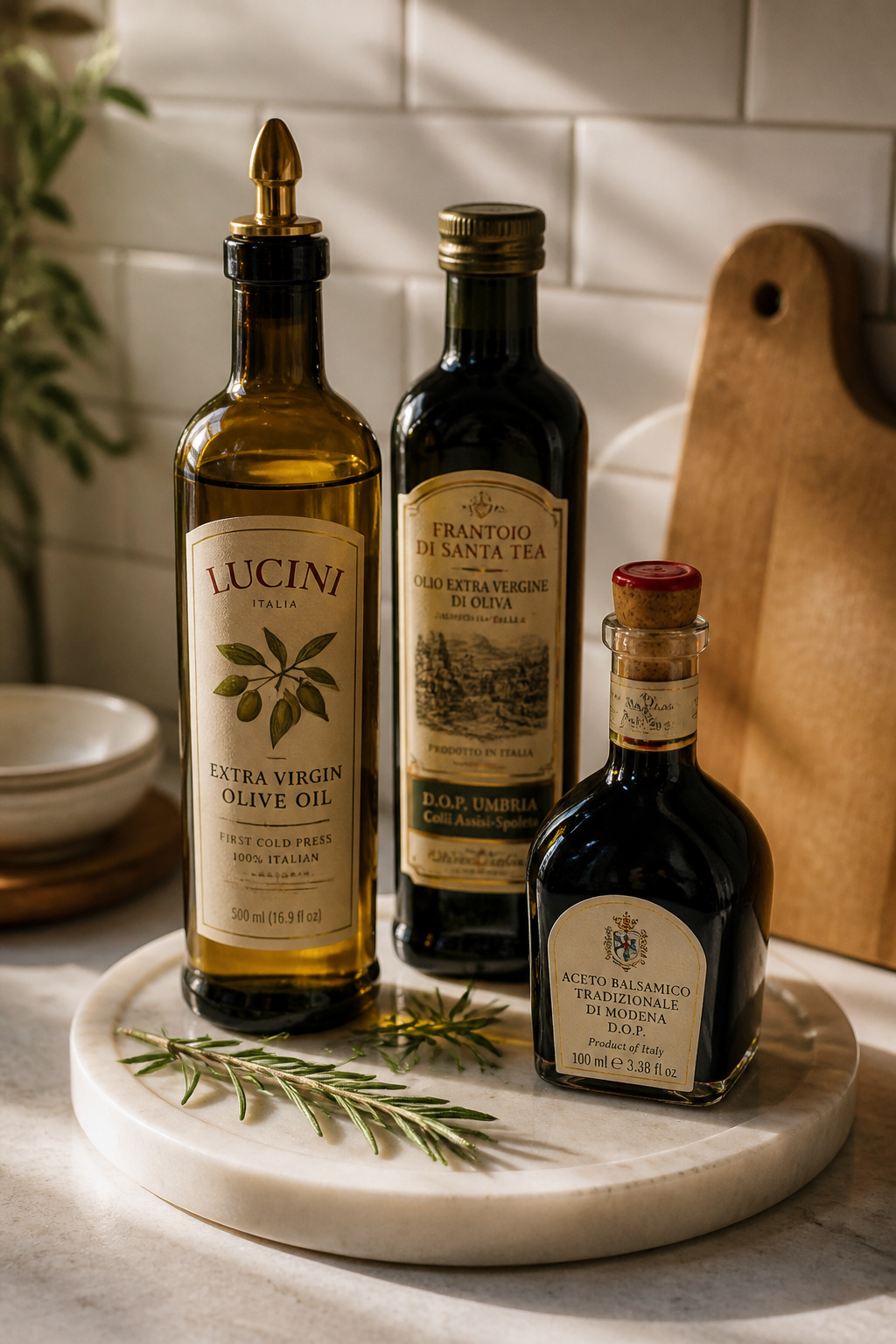
A grouped arrangement of oil and vinegar bottles on a small tray is elegant kitchen countertop decor because it makes a practical necessity look intentional. The tray is the key. Without it, three bottles are cooking supplies. With a tray underneath, they’re a vignette.
Choosing the Bottles and the Tray
Dark glass — amber or green — protects oil from light degradation and looks more artisan than clear glass. Brightland olive oil comes in tall slender amber bottles with clean label design ($37/500ml). An aged balsamic from Modena in a traditional squat glass bottle makes a beautiful display piece. An odd number of bottles — three or five — looks more natural than an even number. A marble tray in the 8″x12″ range keeps the group contained and easy to move during prep.
The Decant Solution
Decanting a cheaper everyday olive oil into a beautiful dark glass bottle is the honest budget approach. Pour from the decanted bottle daily and refill from the pantry bulk container. Good bottles can often be sourced from finished wine or bitters bottles — remove the label with cooking oil and a scrub sponge. The counter stays beautiful; your wallet stays intact.
8. A Small Potted Plant or Succulent Cluster for the Corner
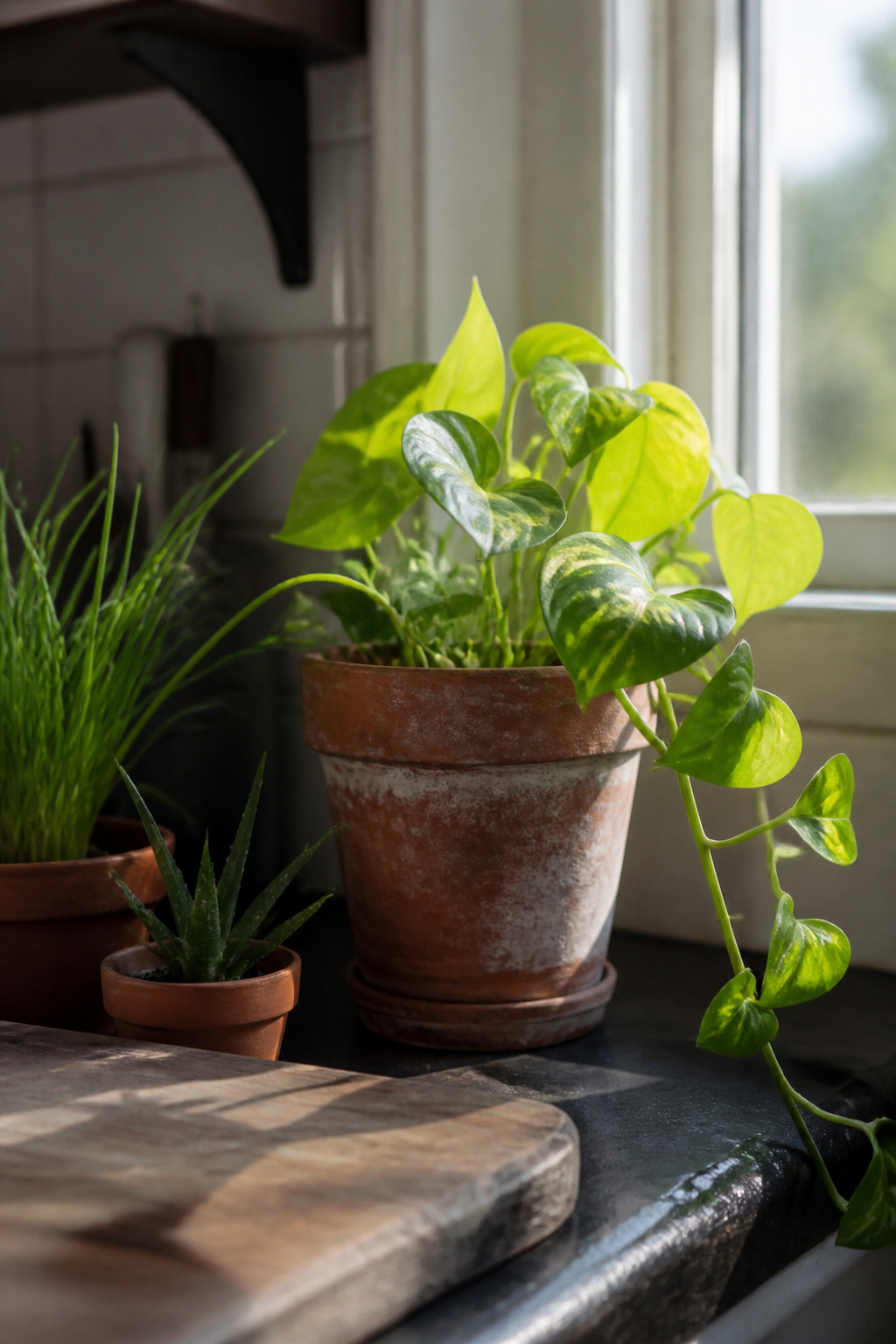
A living element on a kitchen counter changes the quality of the space in a way that objects can’t fully replicate. It doesn’t need to be large — a single 4-inch pot of golden pothos in a terracotta container does more work than a complex arrangement of ceramics. The key is choosing plants that survive what a kitchen actually gives them: inconsistent light, occasional humidity, and the casual neglect of a busy household.
Plants That Actually Work
Golden pothos handles indirect light and tolerates inconsistent watering. Snake plant manages very low light and goes weeks between waterings — ideal for a dim counter corner. Aloe vera is both decorative and functional — a broken leaf soothes a minor kitchen burn immediately. Succulents need more direct light than most kitchen counters provide. Only use them near a strong south or east-facing window.
Container and Arrangement
Aged terracotta pots from thrift stores ($1–$3 each) develop the white efflorescence bloom that looks authentically vintage. Always put a saucer under any pot on a counter. To vary the height of a group, place an upturned terracotta saucer under one pot — it lifts it just enough to create visual interest. Tallest plant at the back, smallest at the front, is the general rule.
9. Ceramic Kitchen Countertop Decor in Warm Earth Tones
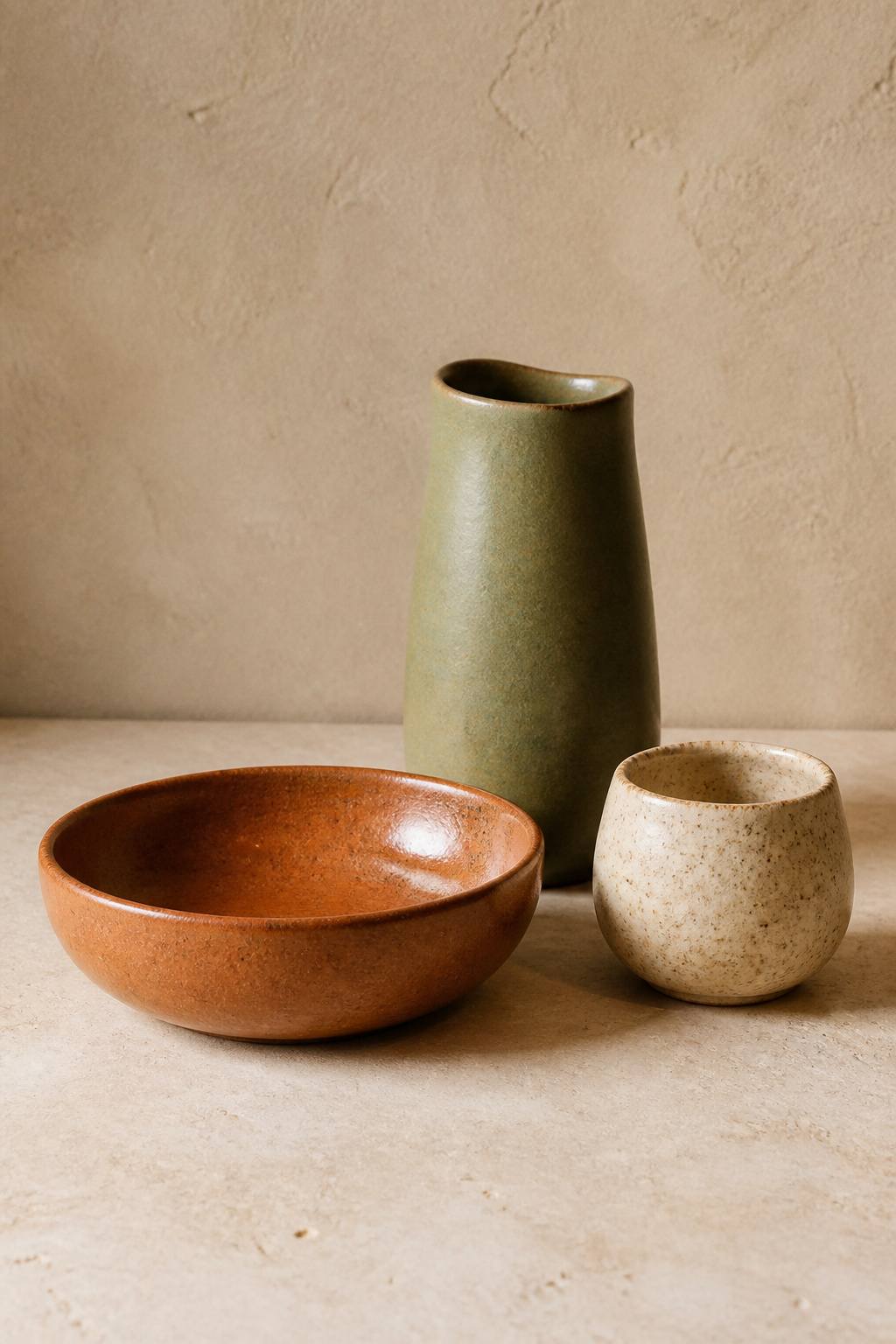
Handmade ceramics are the warmest form of kitchen countertop decor, and the one most likely to outlast every other trend on this list. A matte terracotta vase or a wide wabi-sabi bowl brings a quality to the counter that mass-produced objects don’t have — a slight irregularity in the rim, a texture in the clay, a glaze that breaks differently in different light.
Why Handmade Beats Mass-Produced
A handmade ceramic piece has something that even expensive factory ceramics lack: evidence of the person who made it. A thumbprint in the clay, a crawled glaze at the foot ring, a rim that isn’t quite level — in wabi-sabi terms, these aren’t defects. They’re the point. Matte glazes photograph better in a kitchen setting than glossy ones. They reflect less ambient light and read as more artisan. Earth tone glazes (rust, sage, taupe, cream, ochre) work against both white and dark cabinetry.
Where to Find Them
Local potters’ markets offer excellent pieces at $20–$50 for a small vessel. On Etsy, search “matte terracotta ceramic vase” and filter by price. Heath Ceramics (Sausalito, CA) is the established studio option at $45–$85 per piece — handmade in California since 1948. Group two or three pieces of different heights but keep them in the same tonal family. Mixing warm and cool ceramics in the same cluster rarely looks intentional.
10. A Retro Kitchen Scale for Countertop Styling
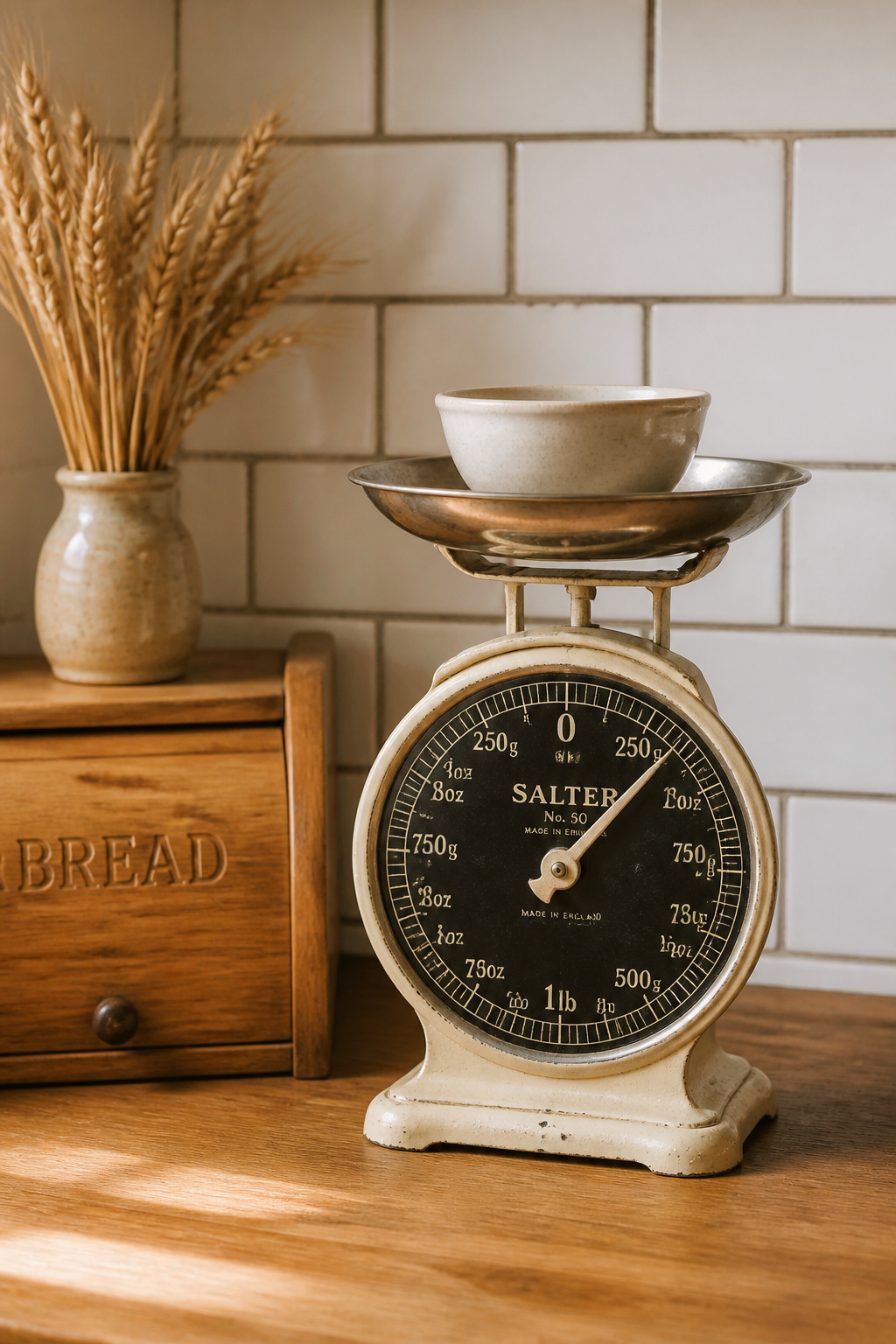
A vintage kitchen scale is my favourite countertop styling object because it looks like it belongs there and actually works. A Salter dial scale from the 1960s, in cream or pillar-box red, is a genuine design object you can use for baking. Most can be recalibrated, and the mechanism is more durable than a digital scale with a failing battery.
Authentic Versus Reproduction
Authentic vintage Salter scales from the 1950s–1970s can be found on eBay for $35–$80. Look for the circular dial face and check that the needle returns cleanly to zero. Terraillon French kitchen scales from the 1960s come in bold primary colours and are genuine mid-century design icons. Modern reproductions from KitchenCraft or Taylor cost $25–$45. The reproduction does the job, but if you want the real thing, the hunt is usually cheaper in the end. For broader kitchen styling ideas, kitchen island cabinets covers how storage and display elements work together in a cohesive scheme.
When It No Longer Works
A vintage scale that no longer calibrates accurately is still a beautiful object. Rest a small wooden bowl of flaky salt or a few lemons in the weighing pan. It looks exactly right — practical-feeling countertop styling without requiring any accuracy from the mechanism.
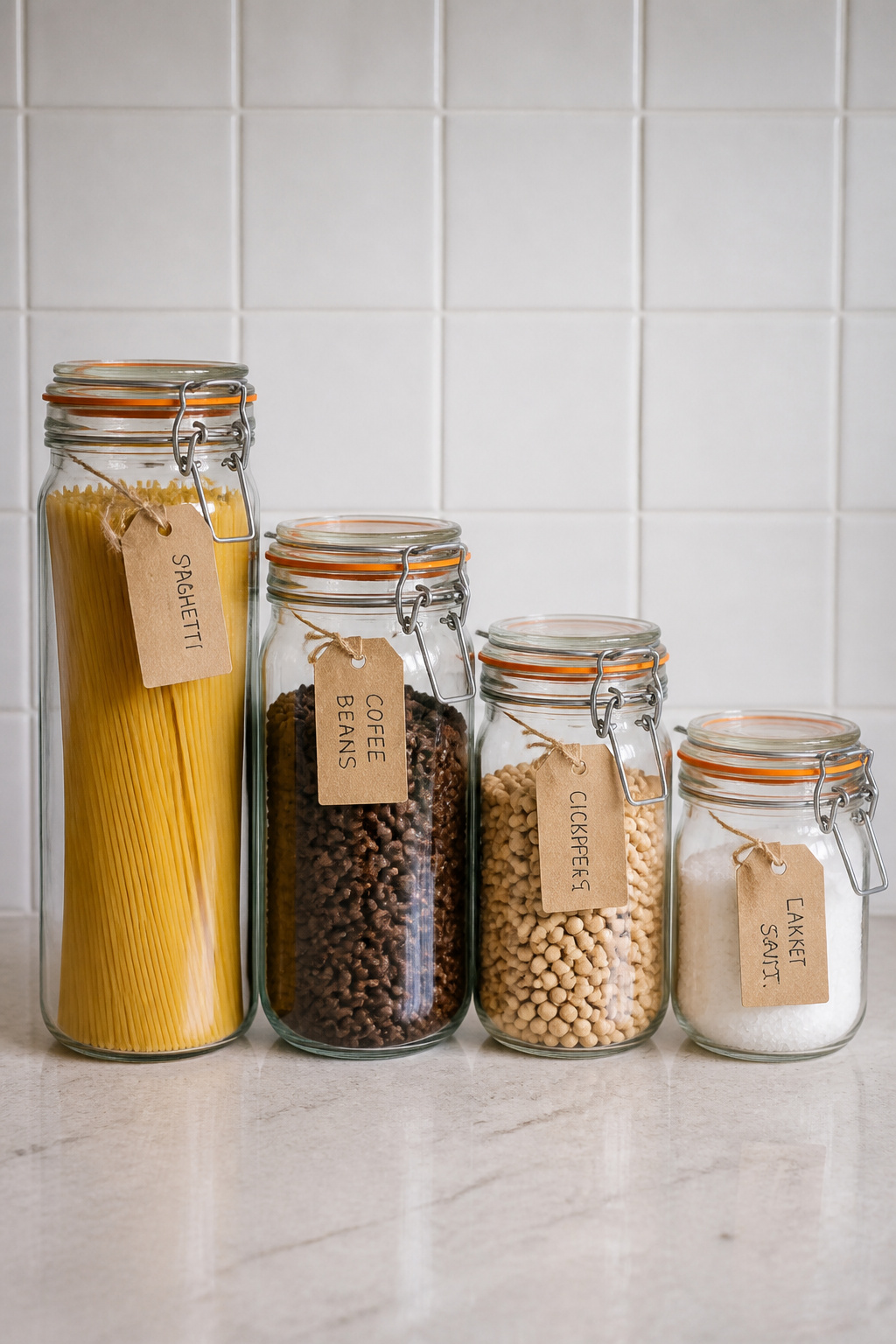
11. Glass Apothecary Jars for Storing and Displaying Pantry Items
Decanting pantry staples into glass jars is the counter decor move that people most often describe as transformative. It takes the chaos of different packaging designs and brand colours and replaces them with a single visual language. Uniform glass jars make pantry staples look like intentional ingredients rather than impulse purchases.
The Best Jars to Use
Bormioli Rocco Fido bail-top jars (Italian, made since 1825) are the gold standard for countertop pantry display — a one-litre jar costs $10–$14 and looks genuinely artisan. Kilner bail-top jars come in sizes from 250ml to three litres. The wider-mouth versions are easiest to fill and scoop from during cooking. Weck tulip jars have a beautiful wide-mouth form. IKEA Korken jars at $3–$5 each are the budget option that still looks decent in a row. Mixing different jar styles — bail-top with screw-top with a repurposed pasta sauce jar — looks like storage, not counter decor.
The Consistency Rule
Only decant ingredients you use at least twice a month. Keep the rest in the pantry in original packaging. A display of twelve perfectly chosen jars beats thirty dusty ones every time. Fresh kraft paper labels with a fine-tip marker give the display a clean, consistent finish. Replace them when they get food on them — fresh labels take two minutes and the visual effect is worth it.
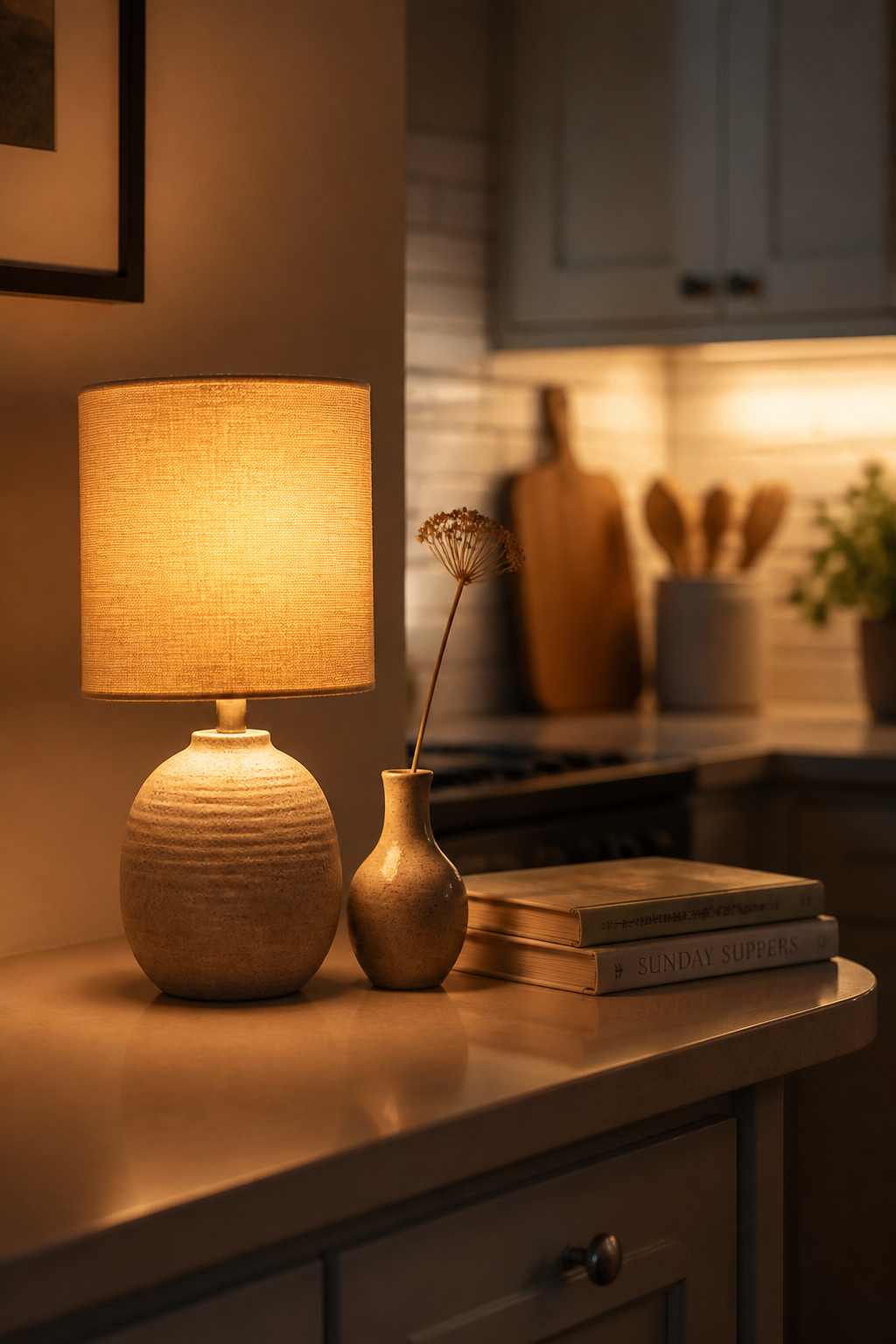
12. A Small Table Lamp to Anchor a Kitchen Counter Corner
A lamp in a kitchen is probably the most unexpected piece of counter decor on this list, and also the one that gets the strongest reactions when people see it in person. It says the space was thought about. Also, it changes the quality of light in the kitchen in the evening from flat overhead to layered and warm. The whole room feels different.
Why and Where to Place It
The practical constraint is an outlet — this works best in a counter corner near a backsplash socket, away from the sink and hob. Steam and cooking splatter damage a shade over time, so placement matters. A 40-watt-equivalent warm white LED at 2700K is ideal: bright enough to read a recipe by, warm enough to feel like a deliberate lighting choice. Small ceramic base lamps (8″–14″ total height) suit countertop use without dominating the space. Plug the lamp into a simple smart plug ($12) and set it on a timer to come on at dusk. Coming into a kitchen with a warm lit lamp in the corner in the evening is simply a different experience from a fluorescent overhead snapping on.
13. A Handmade Pottery Piece as a Kitchen Countertop Decor Focal Point
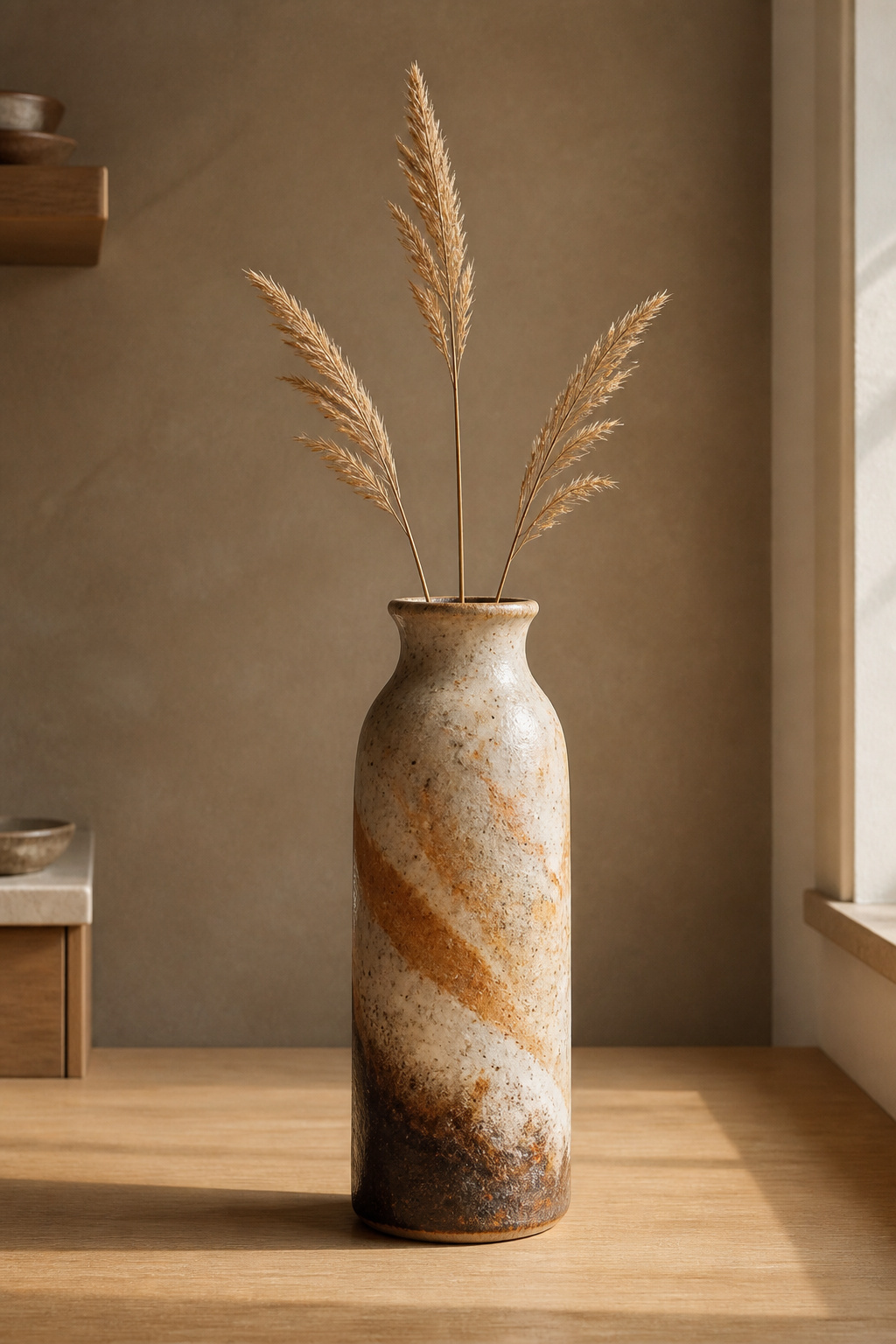
One well-chosen handmade pottery piece does more than a dozen lesser objects grouped together. It works as a focal point — a place for the eye to rest — and it brings a human quality to the space that manufactured objects rarely achieve. If I had to choose one piece of kitchen countertop decor and remove everything else, it would be a single handmade vessel.
Finding the Right Form
The most versatile kitchen pottery forms are a medium vase (8″–12″ tall) that can hold a bouquet or stand empty, or a wide shallow bowl that accepts fruit, a candle, or nothing at all. The form should feel complete in itself — not like it’s waiting for something to be added. Matte glazes are more forgiving in a kitchen environment because they don’t pick up reflections from overhead lighting the way glossy surfaces do. A piece with a speckled or layered glaze has visual depth that holds up to daily scrutiny.
Where to Buy Without Overpaying
Local craft markets and potters’ fairs offer excellent pieces at $35–$80 for a medium vessel. On Etsy, search “wheel-thrown kitchen vase” and filter by location if you want to support a local maker. East Fork Pottery in Asheville, NC, makes beautiful wheel-thrown pieces at $65–$140. If you fall in love with a piece that seems expensive, buy it. A $70 handmade pot outlasts twelve $6 vases from a superstore in every way that matters.
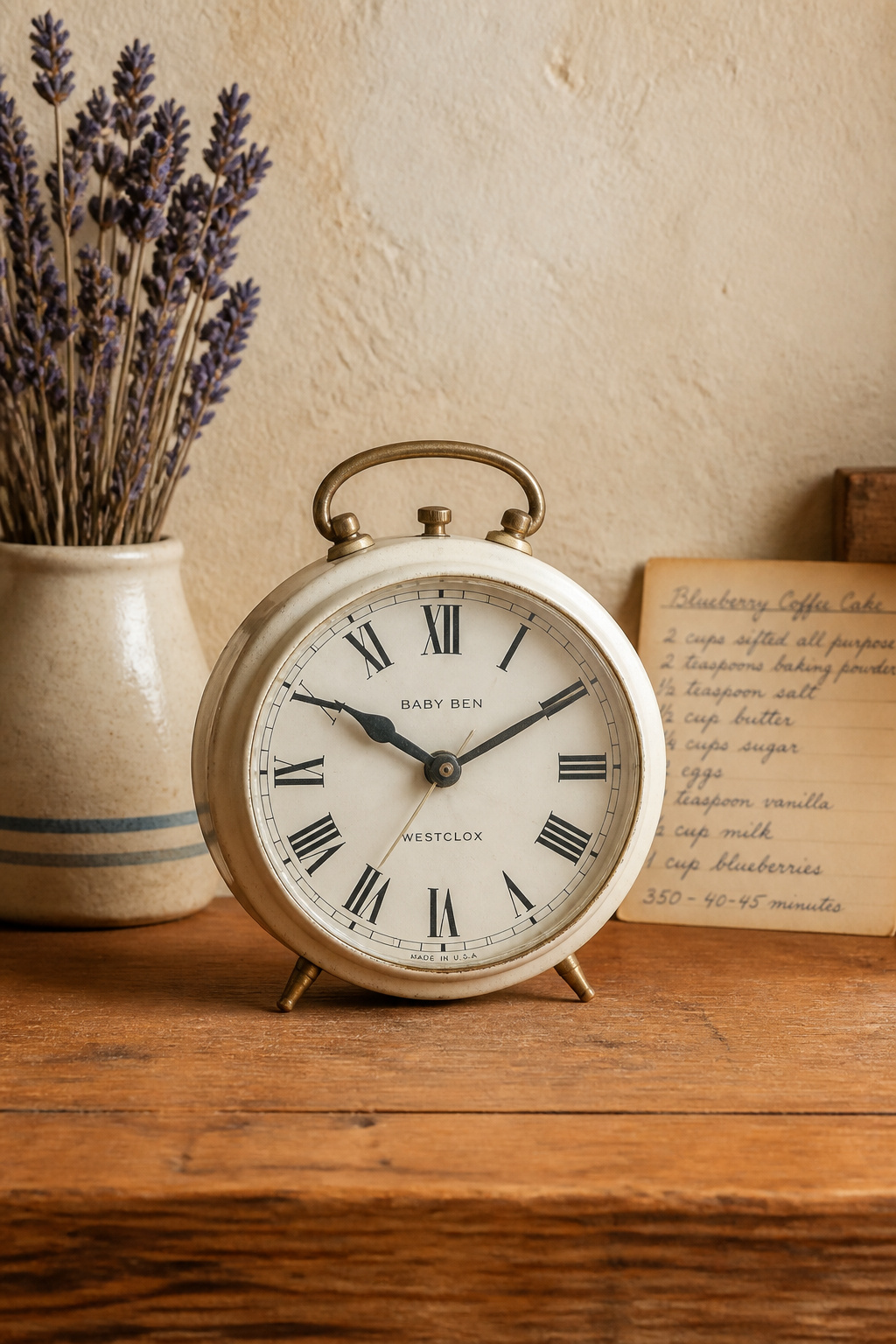
14. A Vintage-Style Clock as Kitchen Countertop Decor
A small standing clock on the kitchen counter is one of the most overlooked pieces of kitchen countertop decor, and also one of the most useful. A glance at counter-level while cooking is more natural than craning at a wall clock over the hob. Beyond function, a well-chosen vintage clock gives the kitchen counter a sense of settled permanence.
Styles and Sources
A Roman numeral face suits traditional, farmhouse, and cottage kitchens. The Westclox Baby Ben in cream or ivory is the classic option — usually $8–$30 at thrift stores or on eBay. A clean Art Deco face fits mid-century or contemporary spaces. French carriage clocks in brass with a see-through case back are genuine collector pieces at $80–$200. Modern reproductions from Karlsson (Netherlands) offer vintage aesthetics with reliable quartz movements at $35–$55. A non-working vintage clock still looks beautiful — set the hands to 10:10, the traditional watchmaker display position and the most aesthetically balanced time on any clock face.
15. A Small Chalkboard for Messages, Menus, and Recipes
A small framed chalkboard earns its counter space by doing something no purely decorative object can: it changes. A recipe for tonight, a shopping list, a short quote — a chalkboard is the only kitchen counter decor that asks for participation. That ongoing relationship keeps it from disappearing into the background the way static objects eventually do.
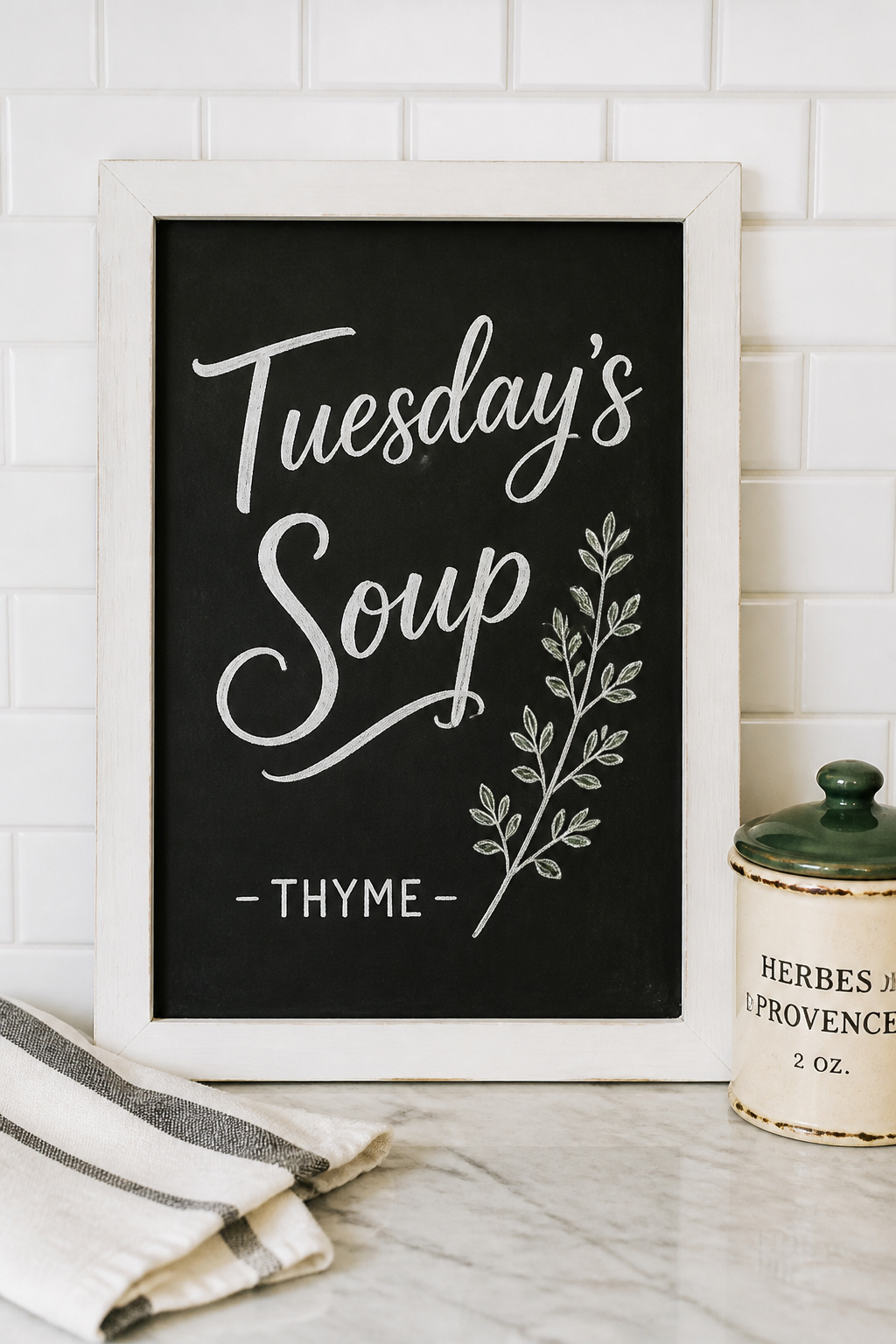
Formats and the Seasoning Step
A framed chalkboard leaned against the backsplash is the most flexible format — it can be moved or replaced without commitment. Umbra’s Note Board ($22) and Quartet’s small chalkboard easel ($14) are reliable options. A thrift store frame ($5–$15) painted with chalkboard spray paint ($8) looks custom-made for a fraction of the cost. Chalk marker gives cleaner lettering than traditional chalk and doesn’t smudge when you brush past. Before writing on a new chalkboard for the first time, season the surface: rub the side of a chalk stick over the entire face and wipe clean with a damp cloth. This prevents the first message leaving a permanent ghost in the surface.
16. A Grouped Spice Display as Kitchen Countertop Decor
A curated spice display is arguably the most practical kitchen countertop decor on this list, because it makes the things you reach for most often both accessible and beautiful. The transformation from a cluster of different commercial spice jars to a row of matching glass containers is one of the most dramatic visual upgrades you can make to a counter in an afternoon.
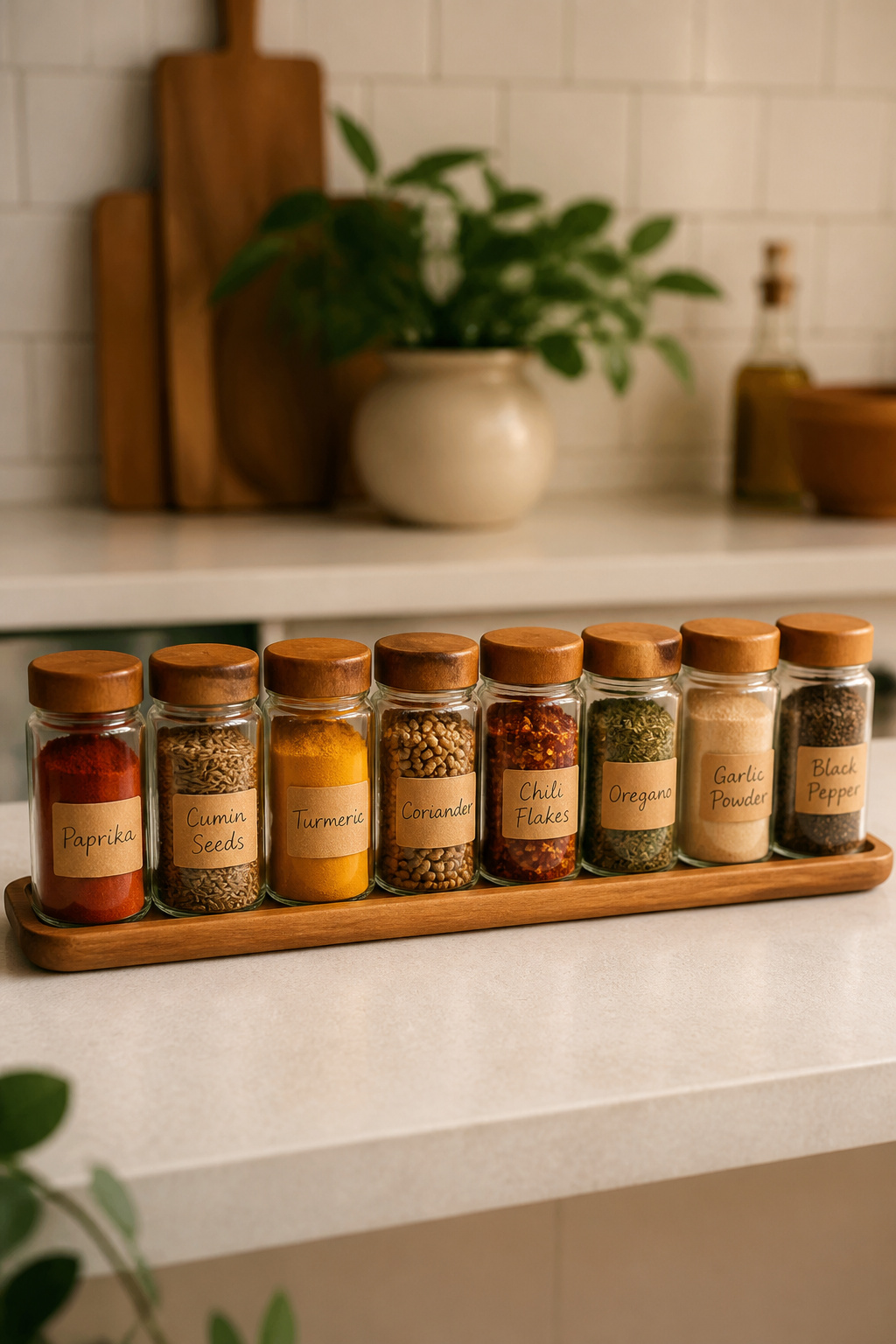
The Display, Done Right
Only decant spices you use at least twice a month. Keep the rest in the pantry. Twelve well-chosen jars beat thirty dusty ones. The Hearth & Hand glass spice jar set from Target (twelve jars with wooden lids and chalk labels, ~$22) is the fastest way to get there with minimal effort. For something more artisan-looking, Weck Mini Mold Jars ($10 for a pack of six) are a favourite among kitchen stylists. Consistent labelling matters as much as the jars themselves — handwritten kraft paper, printed adhesive labels, or chalk marker directly on chalkboard labels all work well. The kitchen backsplash design behind your spice display matters more than people expect — clean tile makes even a modest jar arrangement look considered.
17. Fresh Flowers in a Simple Bud Vase for Instant Life
A single stem in a narrow bud vase is better counter decor than a full arrangement, for the same reason a handmade pottery piece outperforms a cluster of lesser objects: it’s specific rather than cluttered. On a kitchen counter, where useful space is always at a premium, a bud vase takes up almost no room and delivers an outsized visual return.
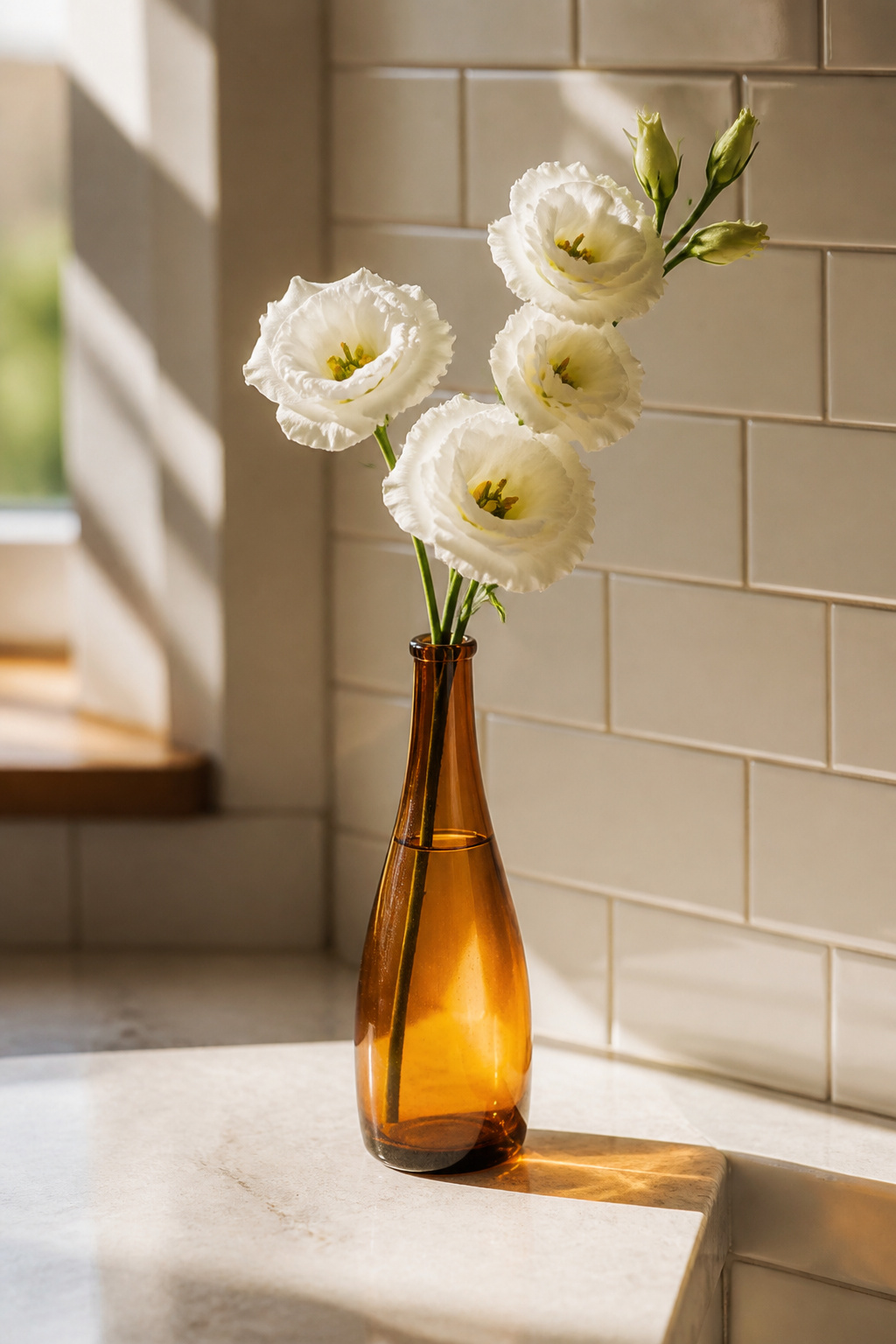
Flowers That Last and Vessels That Work
Long-lasting varieties make the weekly refresh more economical: lisianthus lasts two to three weeks, alstroemeria two to three weeks, chrysanthemum two to four weeks, spray roses ten to fourteen days. Grocery stores sell single stems for $3–$8. An amber glass bud vase glows in natural light in a way that almost any other vessel doesn’t. A repurposed wine or bitters bottle with the label removed works beautifully. Cut the stem at a 45-degree angle under running water right before placing it in the vase — this adds two to three days to the flower’s life. Dried pampas grass or preserved eucalyptus in a bud vase last months with no maintenance — the right option when a busy period makes fresh flowers more stress than pleasure.
18. A Styled Serving Tray for Grouped Kitchen Countertop Decor
A tray is the editing tool of kitchen countertop decor. It defines the boundary of a grouping and prevents objects from bleeding visually into the rest of the counter. Also, and this is the practical argument I find most convincing: a tray that lifts off the counter makes cleaning that surface trivially fast. Everything moves in one action.
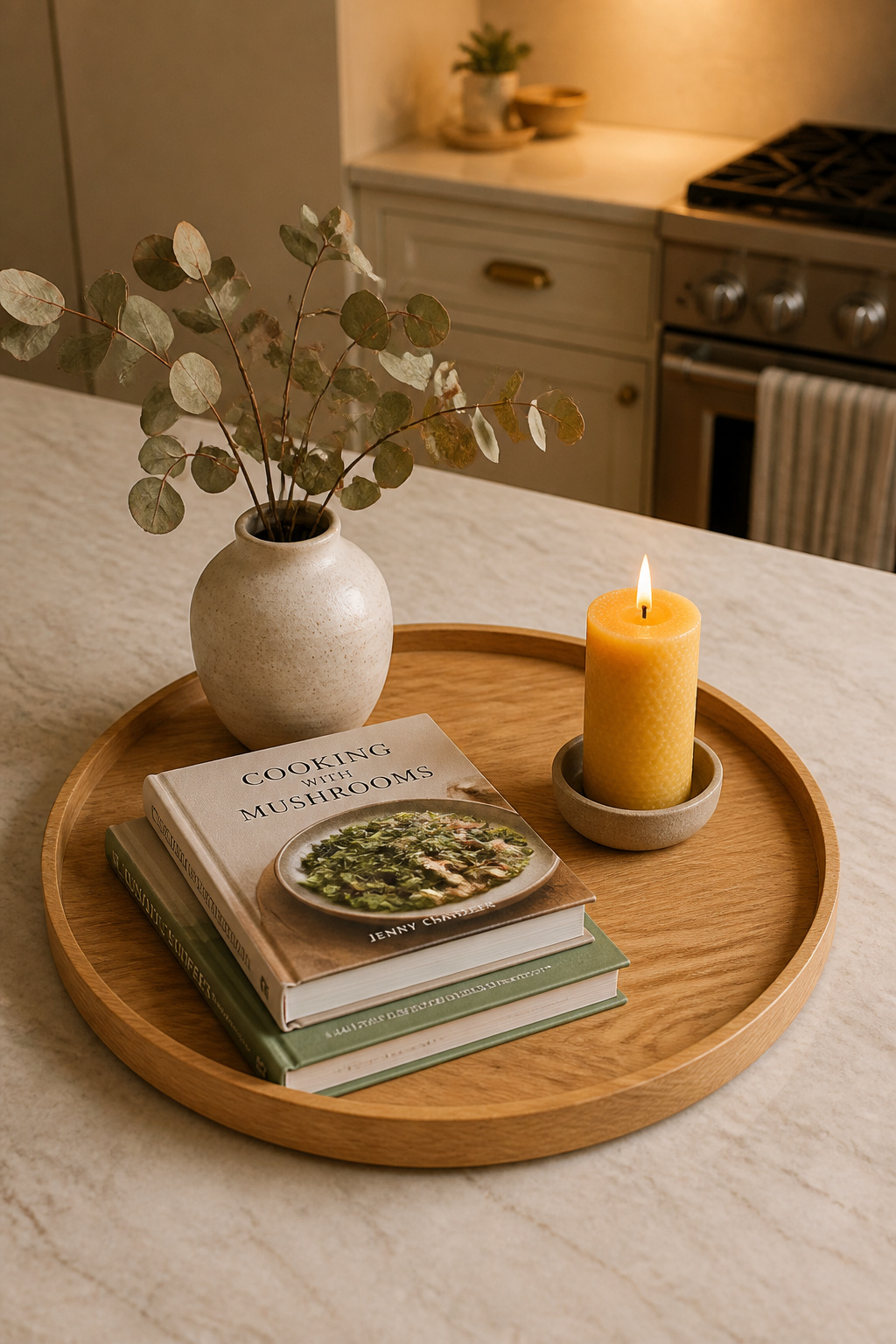
The Tray Shapes the Group
Without a tray, three objects on a counter are clutter. With a tray, they’re kitchen countertop decor. A round wooden tray (12″–16″ diameter) is the most versatile choice. Marble trays suit white or light-toned kitchens but are heavy and can crack if dropped. Rattan trays from World Market ($18–$28) add warmth without visual weight. A brass-handled butler’s tray works well in a traditional or maximalist kitchen. The Hearth & Hand round wood tray from Target ($15–$22) is the budget option that looks good without apology.
The Three-Item Rule
A tray looks best with three objects arranged in an informal triangle. A fourth works if one of them is very small — a matchbox, a small stone, a mini candle. Five or more and the tray starts to collect things rather than curate them. That’s exactly the problem it was supposed to solve.
Your Kitchen Counter Decor, Done Right
Kitchen countertop decor is, at its core, an editing problem. Most kitchens don’t need more objects — they need fewer, chosen better. The 18 ideas here aren’t meant to all live on your counter at once. Pick three to five that genuinely suit your space, your habits, and your kitchen style, then let those items do the work. A fruit bowl, a bread box, and a bud vase might be enough. A canister set, a herb garden, and a pottery vase might be the complete story. The specifics depend entirely on your kitchen and your life.
The Edit Rule
The most useful discipline for kitchen countertop decor is the one-in-one-out rule. When a new piece comes onto the counter, something else has to leave. This isn’t austerity — it’s ensuring every object on the counter is actively chosen rather than simply present. A counter where everything has been deliberately placed feels different from one that has accumulated objects over time. You can feel the difference even when you can’t immediately name it.
Getting Started
Start with a tray. Place two or three things you already own on it and see how it feels. Then work outward from there. The tray gives objects a boundary, and that boundary is the beginning of intentional counter styling. Everything else follows from that first contained grouping. The modern farmhouse kitchen guide has more on building a cohesive kitchen style if you’re working on the larger picture at the same time.