
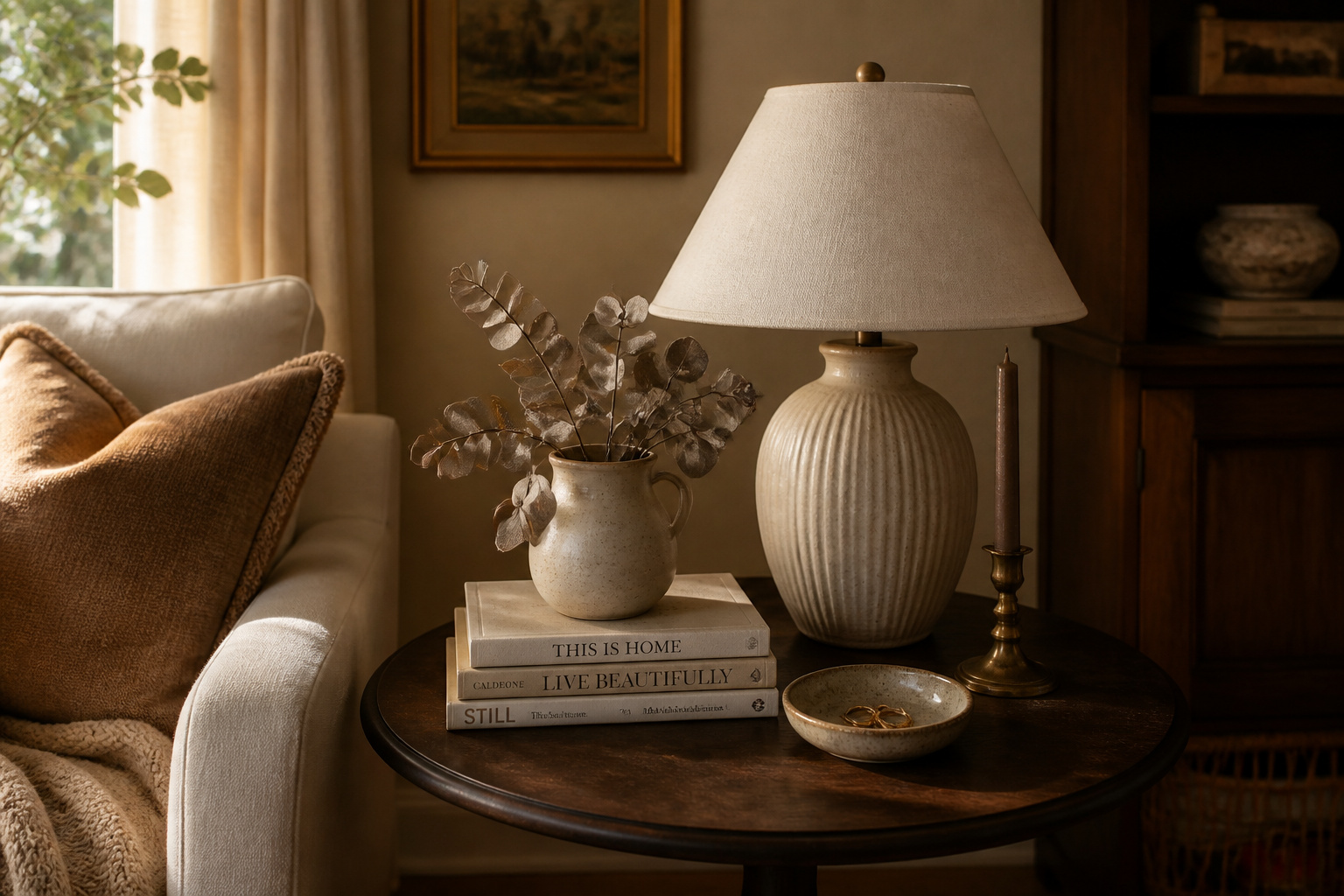
The end table might be the smallest surface in your living room, but it carries an outsized amount of visual weight. It sits at eye level when you’re seated, right beside the piece of furniture you spend the most time on. Any passer-by — including you — sees it dozens of times a day. And yet most people treat it as overflow storage for remote controls, charging cables, and last week’s water glass.
That’s a missed opportunity. The best end table decor is edited, not maximised. Over twelve years of hunting vintage pieces, I’ve learnt the secret is always the same. A few intentional objects — chosen for how they speak to each other — will do more for a room than a full shelf of unrelated things.
These 15 end table decor ideas run from the foundational — the right lamp, the right book stack — to the finishing touches like seasonal botanicals and colour-coordinated accents. Some cost nothing if you shop your own shelves first. Others are worth a deliberate investment. All of them are grounded in one principle: your end table should look like someone thoughtful lives here.
1. A Stack of Books as the Foundation for End Table Decor
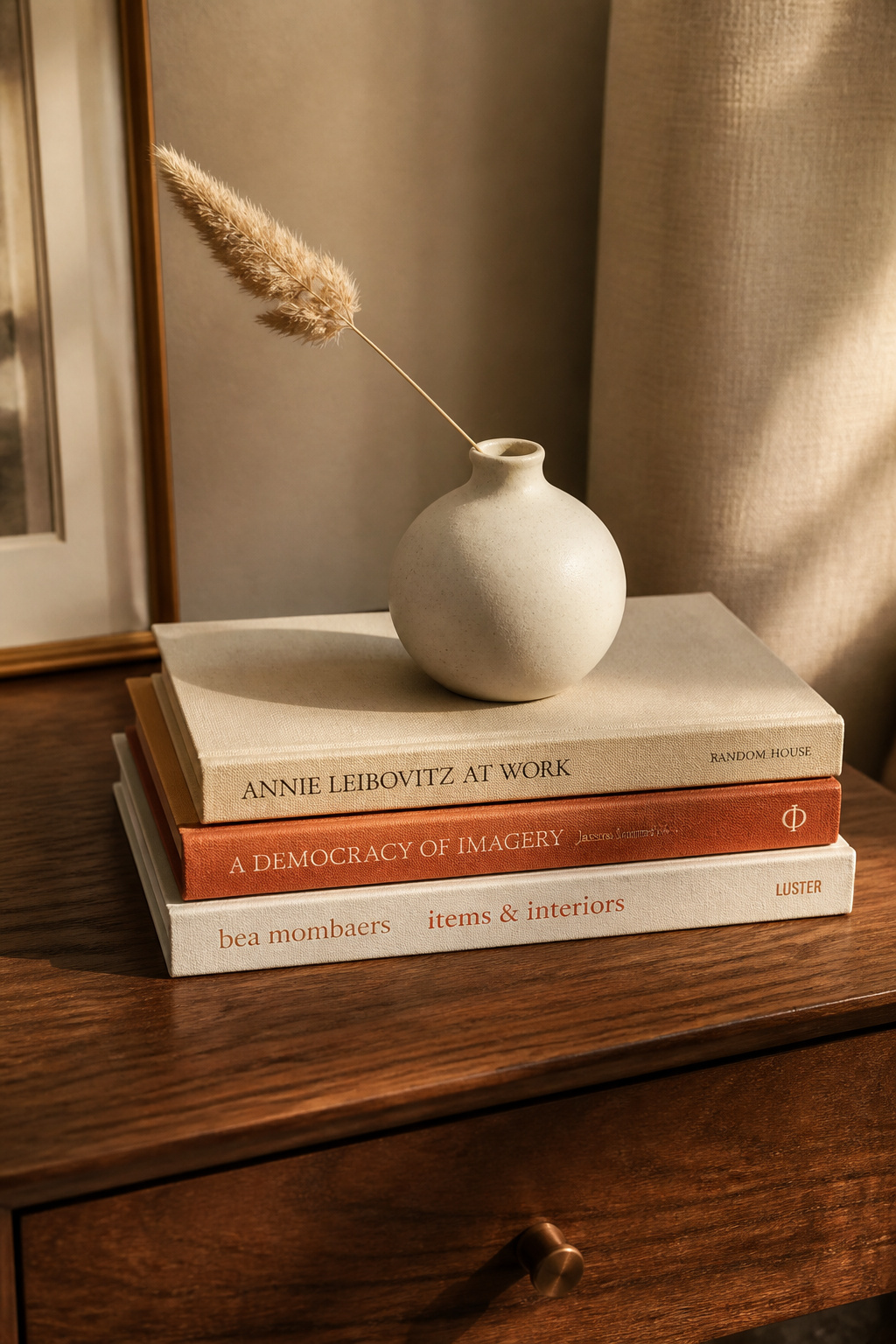
Books are the natural first layer for any end table decor arrangement. A horizontal stack of two or three hardbacks gives you height, texture, and personality in a single move. Then it provides a platform for whatever sits on top.
Why Books Anchor a Vignette
Books bring three things no purchased styling object can replicate: height, texture, and information about who you are. A stack of hardbacks communicates interests and travels. The meaning is secondary to the styling — and that combination is exactly what separates a genuinely styled surface from a dressed set.
How to Choose and Stack
Stack largest books on the bottom, smallest on top. Remove dust jackets before styling — the linen or cloth boards underneath are almost always a better colour. Coordinate spines loosely: all neutrals, all one accent hue, or two complementary tones. Two books is the minimum; three is the classic number. Add a small object on top — a crystal, ceramic figurine — and the books become a plinth.
Where to Find Them
Charity shops and thrift stores stock hardback coffee-table books at $1–$5 each. Art, architecture, and design sections are worth a systematic look. eBay lots of “coffee table books bundle” yield six to ten books for under $20. You only need three.
2. A Statement Lamp That Does More Than Light the Room
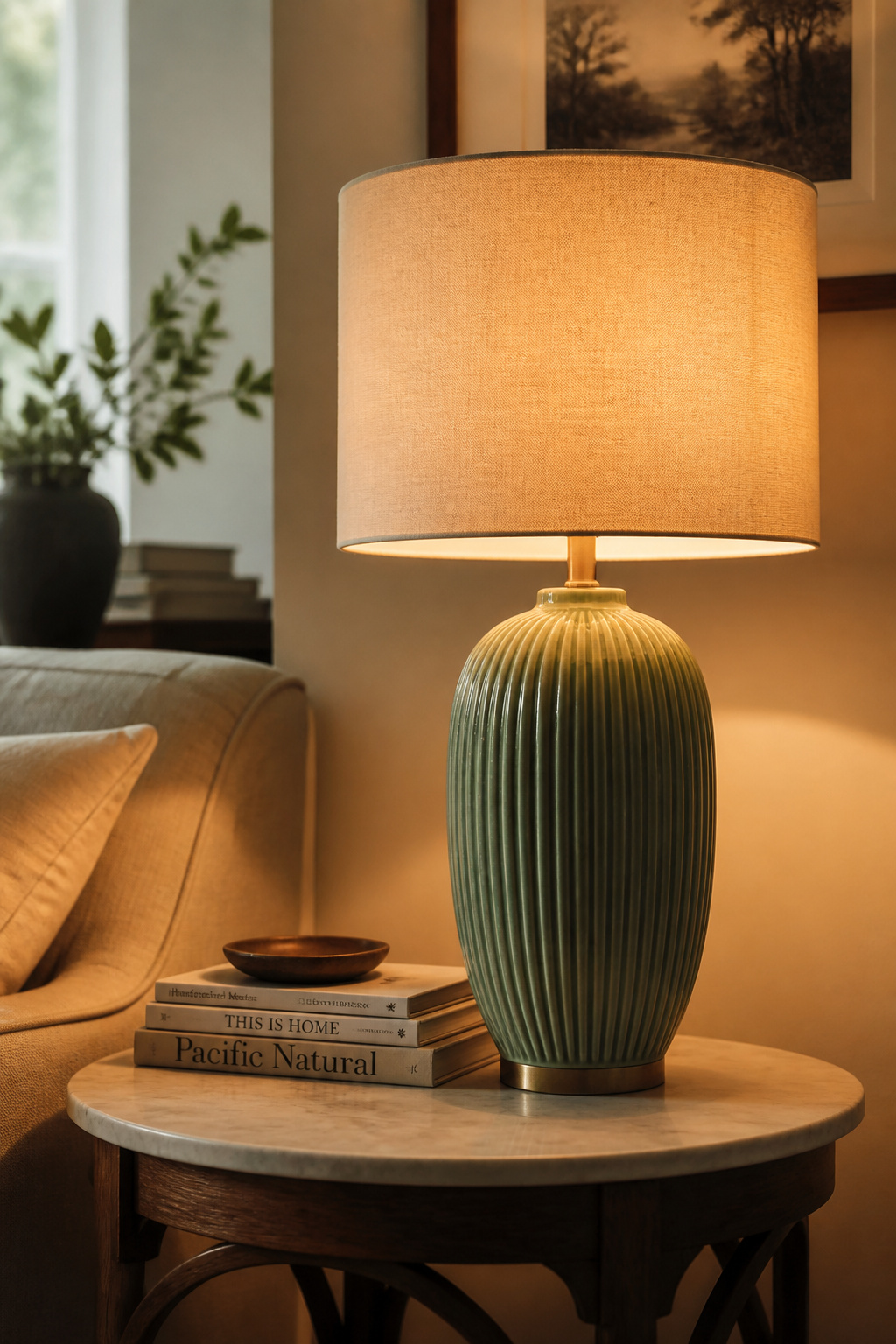
The lamp is the tallest object on most end tables. It sets the vertical scale for everything else. But beyond its practical function, the right lamp base is a sculptural statement. The wrong one can flatten even a beautifully arranged vignette.
Why the Lamp Is the Vertical Anchor
Everything else on the end table arranges in relationship to the lamp. Its form sets the aesthetic register for the whole surface. A sleek chrome cylinder reads modern; a turned wood base reads mid-century; a ribbed ceramic reads as contemporary craft. Choose your lamp base before choosing anything else.
Shade shape matters too. Drum shades spread light evenly and suit almost any aesthetic. Empire shades skew traditional. For most living rooms, the shade bottom should sit at roughly eye level when seated — around 58–64 inches from the floor. Most end table lamps should be 24–32 inches tall.
Bulb and Base
Use 2700K warm white bulbs in any atmospheric living space. Cool daylight bulbs (4000K+) belong in task lighting, not end tables. A single warm bulb in a well-placed lamp changes the room’s mood more than any overhead fixture can.
For the base: trending materials include ribbed ceramic in earth tones (sage, cream, terracotta), turned solid wood, and cast brass. Avoid chrome in vintage or transitional rooms — it pulls the aesthetic toward the generic. A thrift-store pottery base ($8) with a new linen shade ($15) beats most new lamps at the same price point.
3. Fresh or Dried Botanicals for Organic End Table Styling
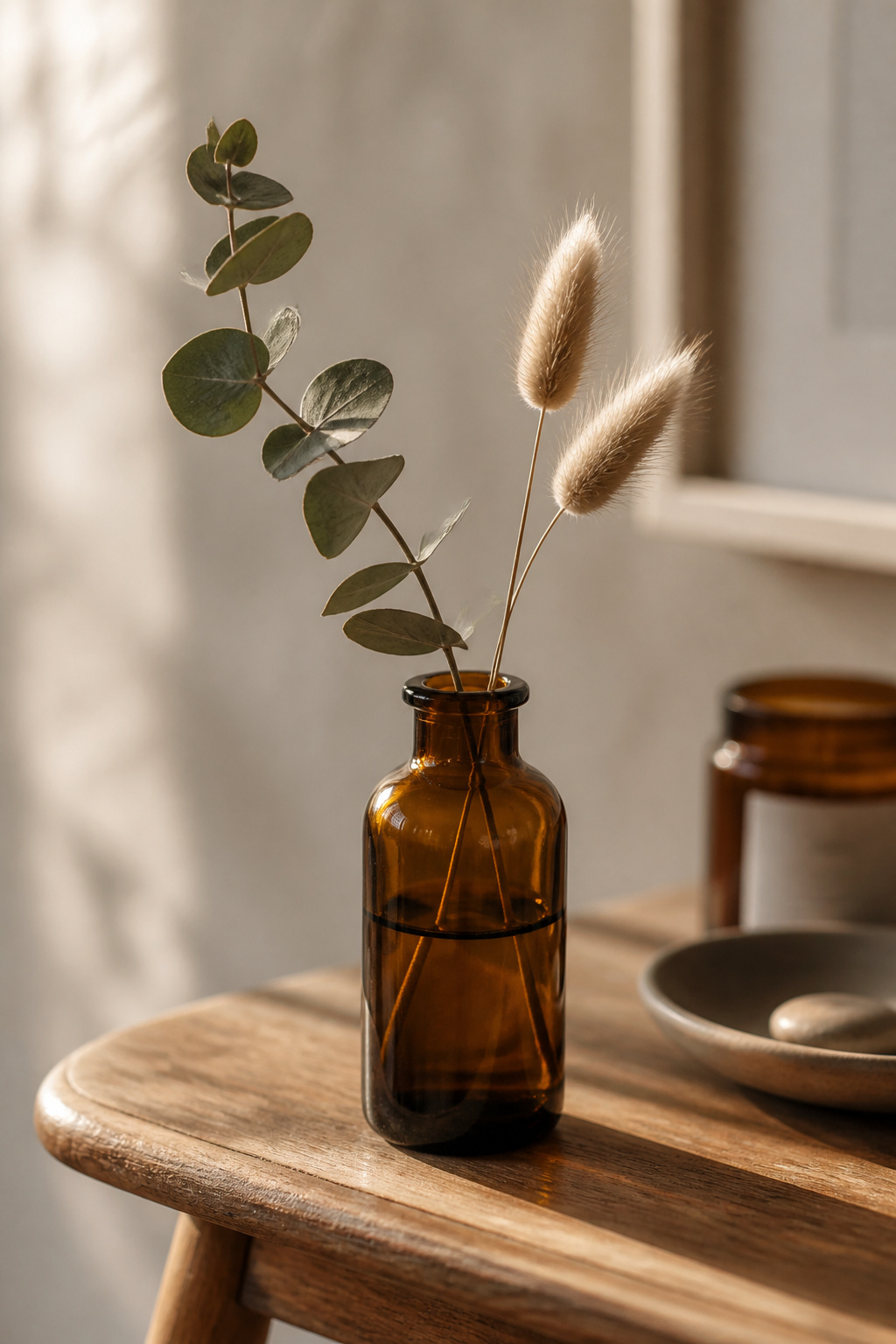
Every well-styled end table needs something organic. It could be fresh flowers, a dried botanical arrangement, or a single sprig in an amber bottle. The form matters less than the principle: end table styling without organic matter tends to feel cold, regardless of how thoughtfully everything else is arranged.
Why Organic Elements Soften a Vignette
Hard objects — ceramics, brass, books, glass — are static. Plants and flowers introduce movement and impermanence. A dried eucalyptus stem slowly shifts colour. A fresh tulip opens and eventually droops. These small changes make a room feel inhabited rather than staged.
Fresh vs. Dried
Dried botanicals last 6–12 months away from direct sunlight. Fresh flowers last 5–10 days with water changes. For minimal maintenance, dried is the practical choice. Pampas grass, bunny tail grass, cotton stems, and eucalyptus all hold their form well.
For fresh flowers, grocery store bunches are better value than florists for styling. Trader Joe’s, Aldi, and Lidl rotate seasonal bunches for $3–$7. Buy single-colour bunches and split them across several vessels around the home. Keep botanical arrangements under 12 inches tall on an end table — anything taller blocks sightlines across the room.
4. A Small Tray to Corral Your End Table Vignette
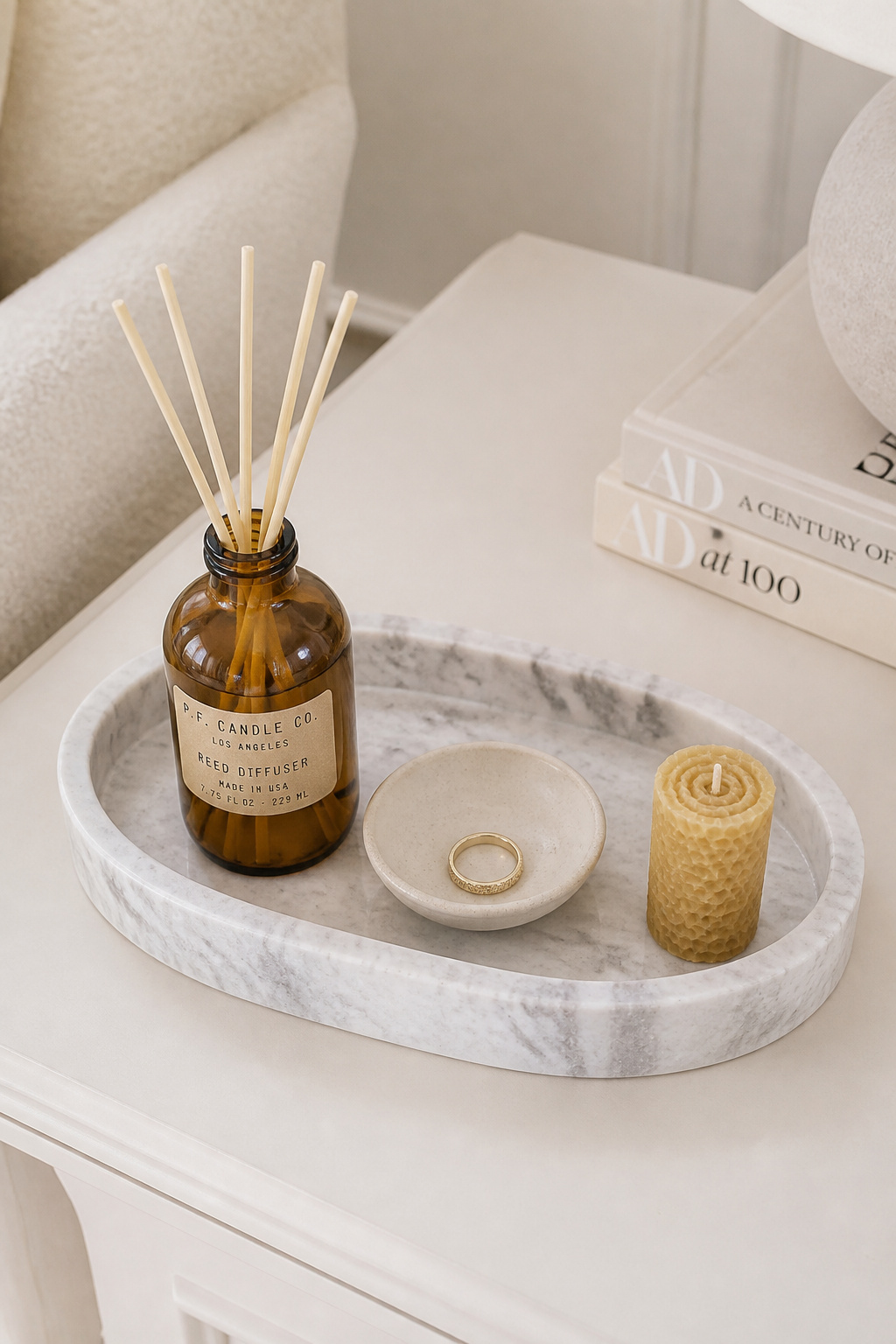
A tray on an end table is not just a practical object. It functions as an invisible boundary — a visual frame that says: these objects belong together. Without it, even a well-chosen set of end table decor items can read as accumulated stuff.
How a Tray Creates Visual Order
Objects placed inside a tray are perceived as a group, even if they’re different materials and sizes. Objects placed directly on a table surface are perceived individually. This is why a tray transforms end table decor from a collection of things into a composition.
For size, aim for a tray that covers no more than 60% of the end table surface. On a standard 22-inch round table, that’s a 12–14 inch tray.
Materials and the Three-Object Rule
Marble trays add weight and permanence. Rattan adds warmth and suits bohemian rooms. Lacquered wood is versatile. Brass skews maximalist. Affordable sources: thrift stores ($3–$12), H&M Home, and Target’s Threshold range (marble-effect trays from $15–$25).
Inside the tray: one scent object (candle or reed diffuser), one small vessel or decorative dish, and one personal object — a ring dish, a small book, a found stone. Three objects, all functional at some level, create a tray vignette that reads as purposeful. As a practical bonus: lift the tray to dust, replace it. The end table cleans in 10 seconds.
5. Vintage Brass Candleholders as Classic End Table Decor
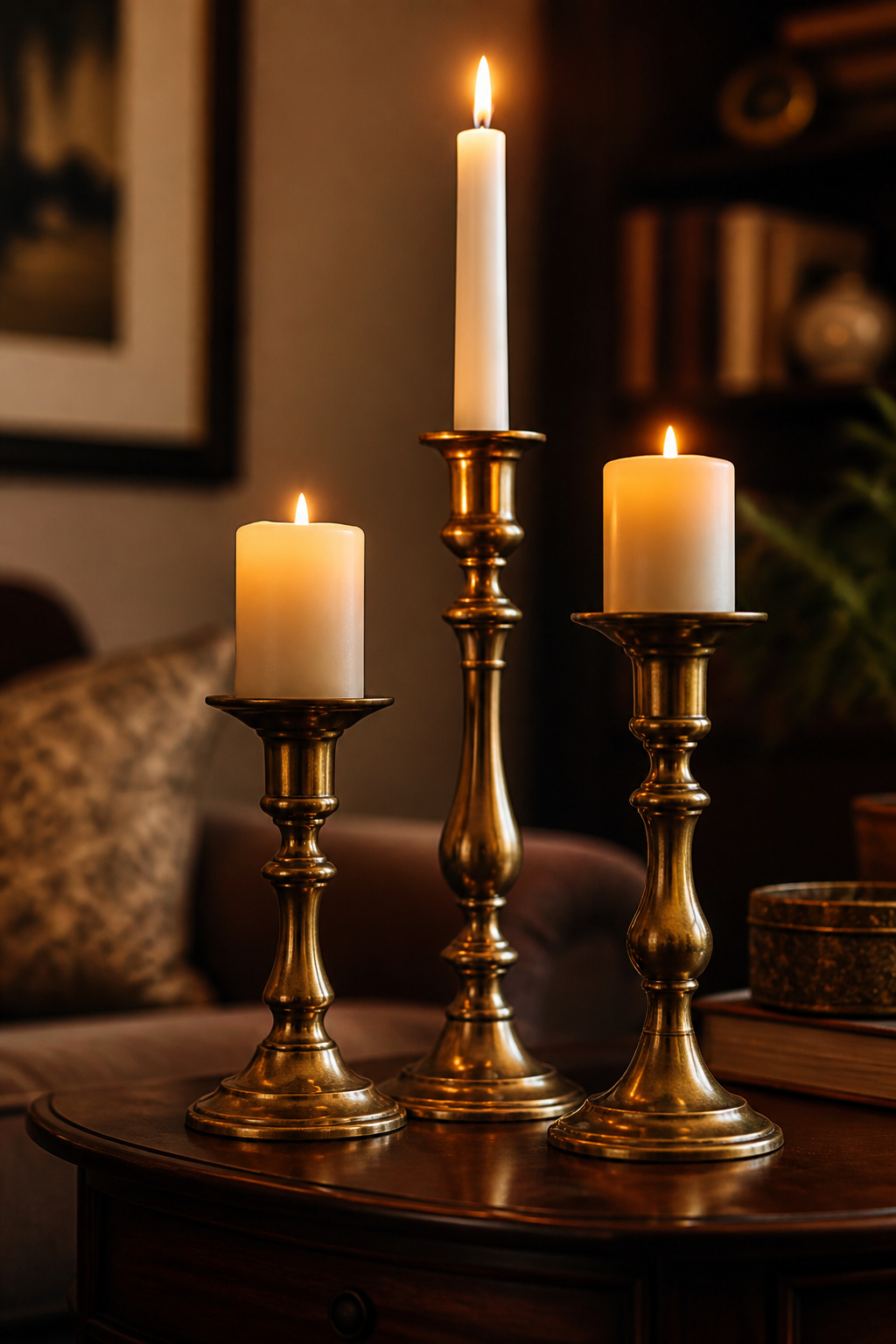
Brass has been the dominant styling metal for over a decade, and it hasn’t left because it genuinely earns its place. Unlike chrome (utilitarian and cold) or shiny gold (formal and high-gloss), aged brass occupies a warm middle ground. It pairs with wood, ceramic, linen, and stone. It suits vintage, transitional, and contemporary rooms equally.
Why Brass Endures
Real brass is heavier than brass-finish reproductions. It develops a warm golden-green patina over time. That patina is the thing — new brass-finish items age inconsistently and lose their coating. You can tell genuine vintage brass by weight, by seam lines from the original casting, and by the even quality of the patina.
Grouping and Sourcing
For end table styling, vary candleholder heights: a tealight at 2 inches, a pillar holder at 4–6 inches, and a taper candlestick at 8–10 inches. Group three together for maximum impact, or use a single taller candlestick as a solo sculptural accent.
Estate sales and church sales are the most reliable source. Thrift stores price them at $3–$10 per piece. A set of three mismatched candlesticks from different decades costs around $15 total and looks more considered than a matching retail set at five times the price. Bar Keepers Friend paste on a soft cloth restores shine in under 5 minutes.
6. A Framed Photo or Small Original Artwork for Personal Touch
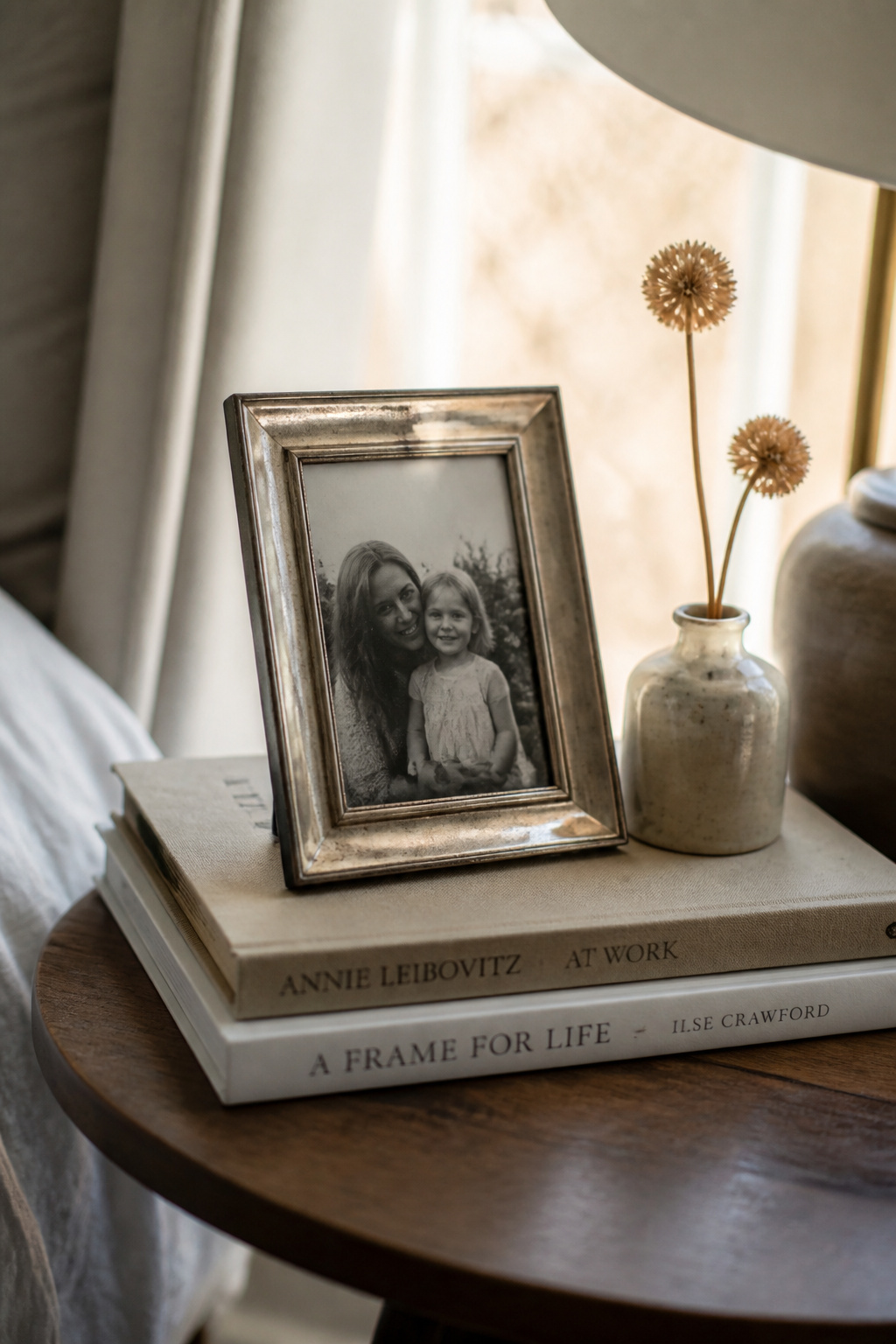
A styled end table containing only purchased objects — however beautifully chosen — can feel slightly generic. A single framed photograph shifts that entirely. It says: a specific person lives here. That specificity is more powerful than any styling technique.
Why Personal Imagery Elevates a Vignette
Interior stylists recommend leaning small frames on end tables rather than hanging them. The lean communicates ease — this was placed here thoughtfully, not installed permanently. Ideal sizes: 4×6 or 5×7 inches in portrait orientation. Anything larger overwhelms a compact surface. Black and white photography works universally because it never clashes with the room’s colour scheme.
Frame Material and Finding Art
Frame materials that suit vintage-leaning rooms: tarnished silver, aged gold leaf, raw wood, dark walnut, tortoiseshell acetate. For small original artwork, Etsy has prints and small paintings from $20–$75. Local art markets are better still — you get the story behind the piece. Alternatively, a pressed botanical or vintage illustration printed at home, framed in a $3 thrift-store frame, costs under $5 and reads as curated art.
7. Sculptural Objects That Tell a Story on Your Side Table Decor
A sculptural object on your end table has one job: stop the eye. It doesn’t need to be functional. It doesn’t need to coordinate with everything else. It needs presence — a form that earns a second look when you pass through the room.
What Makes an Object Sculptural
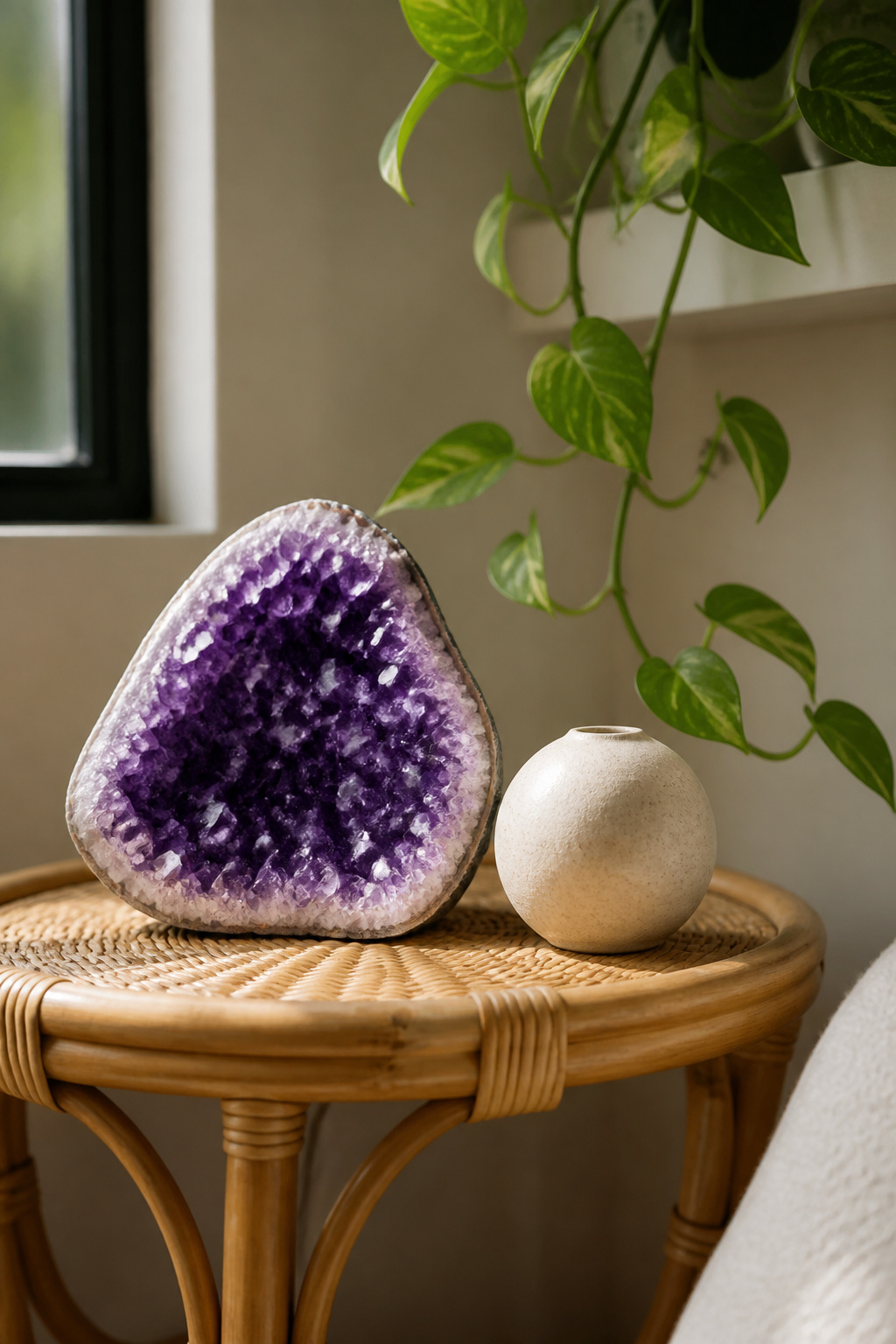
A sculptural object has a form that reads independently of its function. A ceramic mug is functional; a ceramic orb is sculptural. The distinction isn’t preciousness — it’s about whether the form itself is worth looking at when the object is empty and still.
Good categories: mineral specimens (amethyst, selenite, pyrite — $15–$80), carved wooden pieces, abstract metal sculptures, ceramic orbs or spheres ($20–$60), found driftwood or smooth river stones. The best piece is the one you found somewhere specific and remember finding. A sculptural object with a story carries visual weight that a purchased replica cannot achieve.
Scale and Placement
Sculptural pieces work best when they are either the most prominent object on the table or a deliberate low focal point beneath the lamp. One well-chosen geode does more styling work than five purchased decorative objects. For broader ideas on how to build a coherent visual narrative across every living room surface, Living Room Styling: Curate Your Home with Vintage Finds covers the whole room.
8. The Power of Odd Numbers in Accent Table Decor
If there’s one design principle that reliably improves end table styling with no budget required, it’s the rule of odd numbers. Group objects in threes rather than twos and fours. The change is subtle. The effect is immediate.
Why Odd Numbers Work
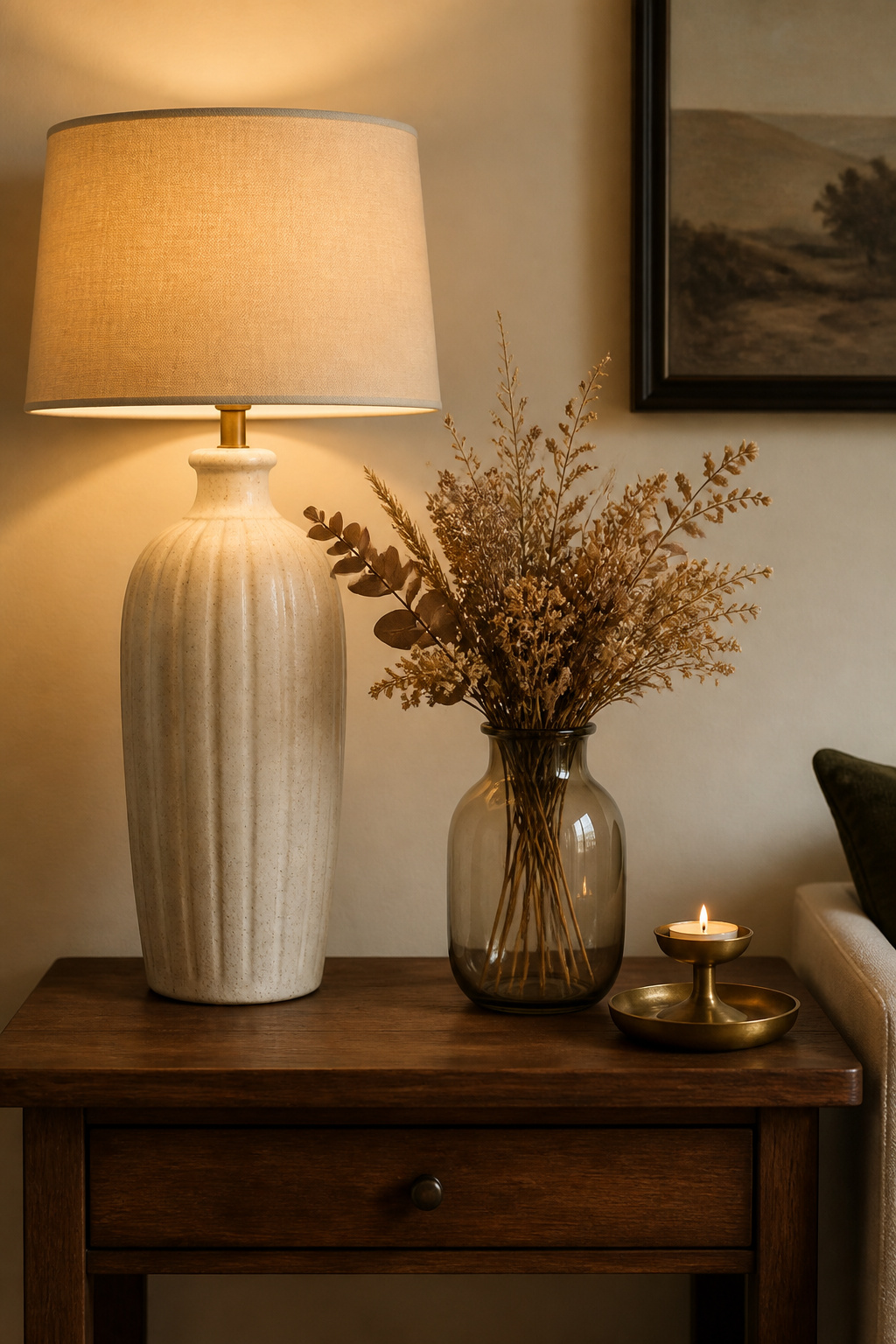
An even-number grouping triggers the brain to pair objects — this one with that one — and the eye comes to rest. An odd-number grouping prevents pairing and keeps the eye moving between all three objects, creating visual rhythm on a static surface. Three is the highest number that still reads as restrained on a compact surface. Five starts to feel crowded.
The Triangle Principle and How to Apply It
Arrange three objects so their tops form a triangle. One tall element (lamp or botanical), one medium (a vase, frame, or candlestick), one low (a candle, ring dish, or small book). The triangle gives the eye a path to follow. Also, if your accent table decor looks off and you can’t identify why, count your objects. If it’s an even number, add or remove one. Take a photo — an arrangement that seems fine in person often reveals its issues when the depth is removed.
9. A Small Dish or Decorative Bowl for Functional Beauty
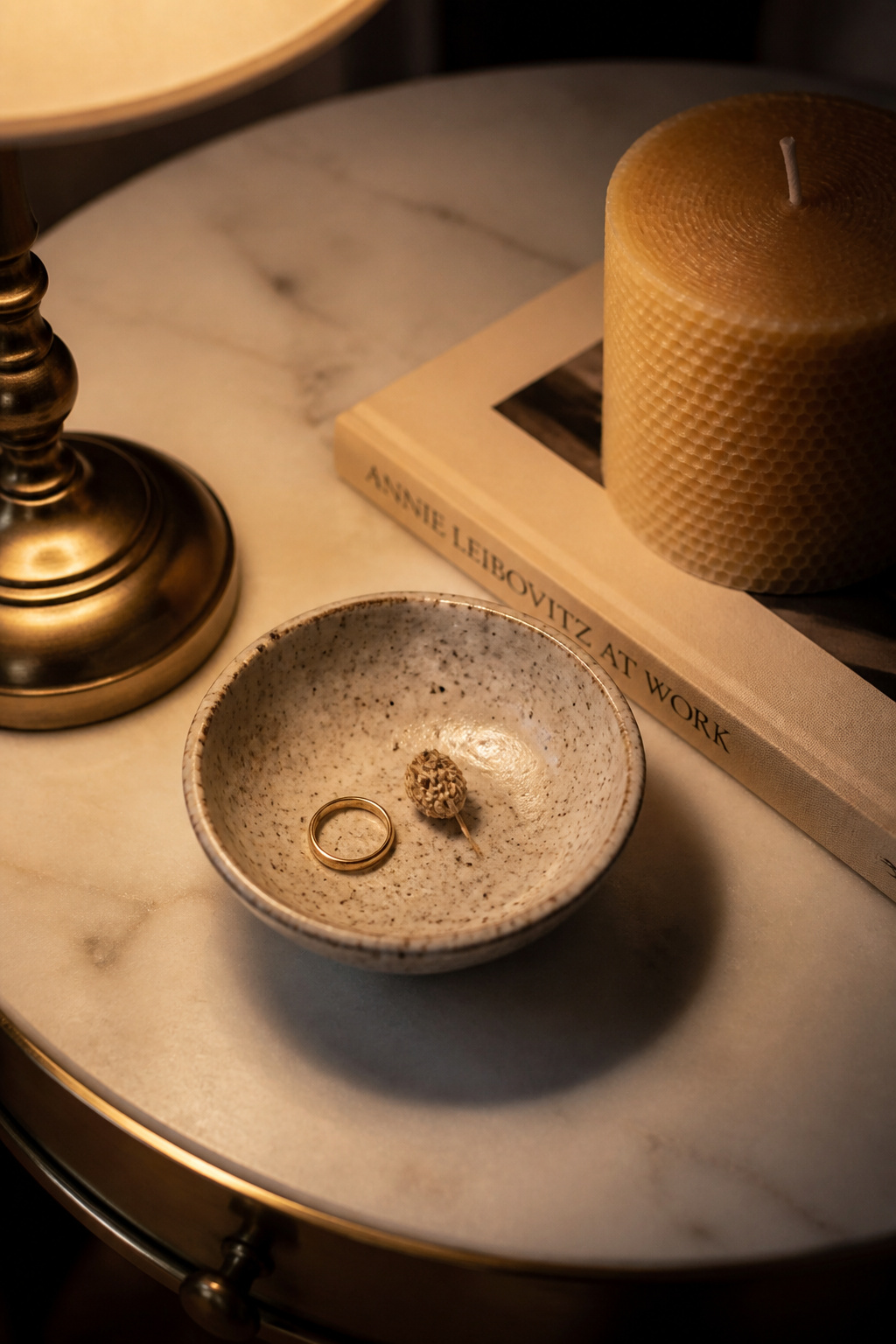
The catchall dish sits at the intersection of function and decor. It holds real objects — keys, rings, earrings — while adding sculptural form to the surface. This is the Japanese principle of *mono no aware* applied to home styling: a small dish that holds a ring or a found pebble is both beautiful and useful.
Why Functional Objects Make the Best Decor
Objects that actually belong in a room carry the energy of use. When you put a ring in a beautiful vessel, the vessel earns its place on the surface rather than existing purely for appearance. The small dish also serves as the visual anchor for the low point of the vignette triangle — the grounding element that brings the eye back down to the table surface.
Materials and Sources
Japanese-influenced wabi-sabi pottery — hand-thrown, asymmetric stoneware — is the ideal form for an end table dish. The matte surface doesn’t compete with shinier objects nearby. Prices range from $15–$40 from ceramics markets and Etsy. Alternatives: painted porcelain ($20–$60), marble catchall dishes ($25–$50), cast brass ($30–$80). A ring dish found at an antique market — one that has clearly held someone else’s rings for decades — adds a layer of history no new purchase can replicate. For similar functional-decorative principles applied to a bathroom counter, 15 Luxury Bathroom Counter Decor Ideas for a Calm Sanctuary covers the same thinking on a different surface.
10. Seasonal Greenery and Blooms for Fresh End Table Decor
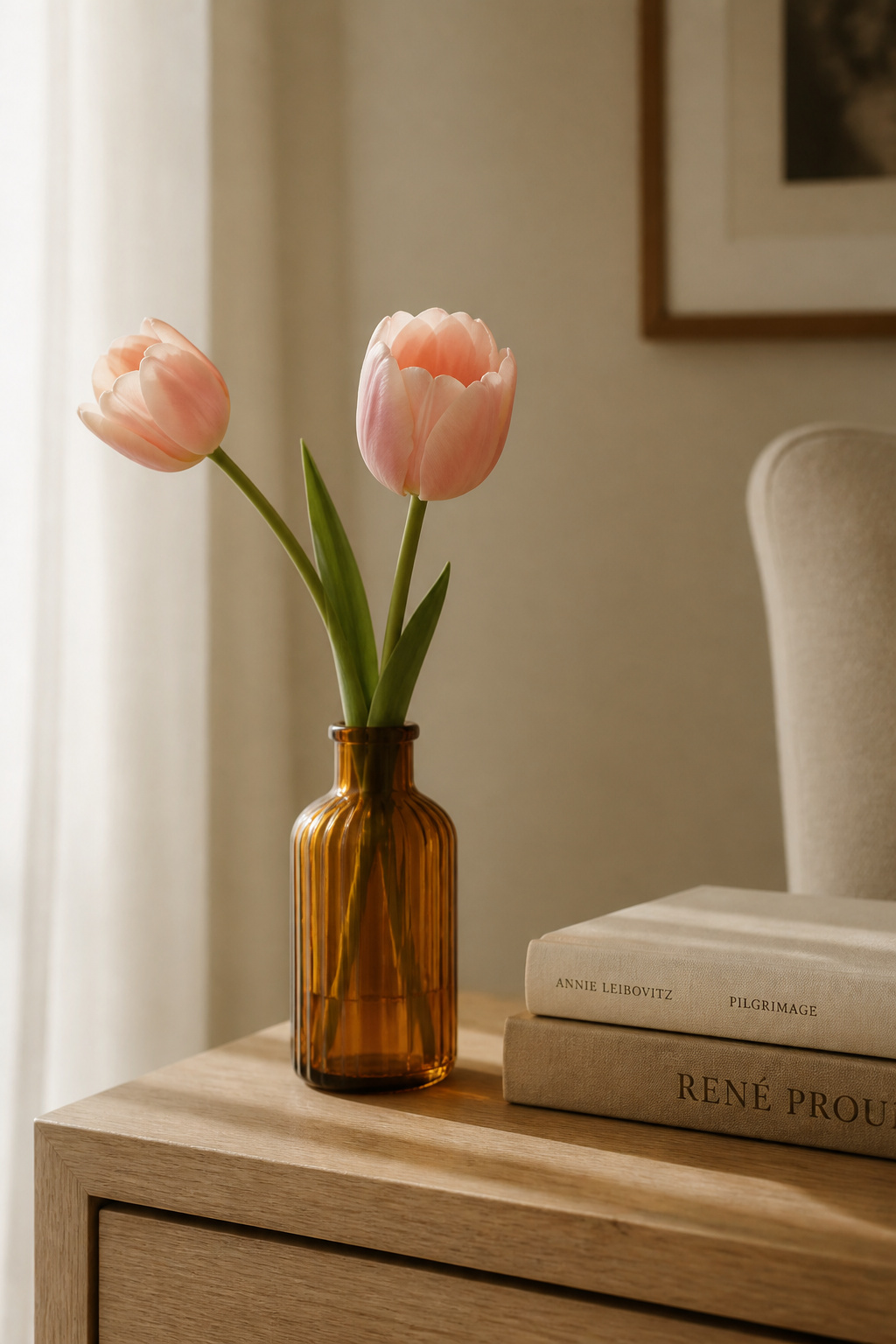
There is a Japanese practice called *ikebana* — a philosophy of arrangement that treats the space around flowers as carefully as the flowers themselves. You don’t need to study ikebana. But borrow its core insight: a single stem in the right vessel, changed with the seasons, does more for a room than any permanent artificial arrangement.
Seasonal Rotation
Changing botanicals with the seasons keeps the room feeling responsive to the natural world and forces you to reset the surface regularly. A seasonal calendar: spring — tulips, daffodils, hyacinth; summer — garden roses, sweet peas, lavender; autumn — rosehip branches, dried seed heads, copper leaves; winter — pine sprigs, dried orange slices, cotton stems.
Grocery Store Flowers and Foraging
Fresh end table decor doesn’t require florist prices. Trader Joe’s, Aldi, and Lidl rotate seasonal bunches for $3–$7. Buy single-colour bunches and split stems across several vessels around the home. Foraging is also viable in most regions — eucalyptus, rosemary, bay, and seed heads from dried wildflowers are free and carry textural complexity that shop-bought stems rarely match.
The same seasonal rotation approach applies across different table types too — 20 kitchen table decoration ideas shows how seasonal centrepieces scale up to dining and kitchen surfaces.
Drying Your Own
Hang fresh blooms upside down in a dry room for 2–3 weeks. Roses, lavender, statice, and peonies dry well. A $6 bunch of grocery-store peonies can become a dried arrangement lasting 8 months.
11. Layering Textures: Linen, Wood, and Ceramic Together
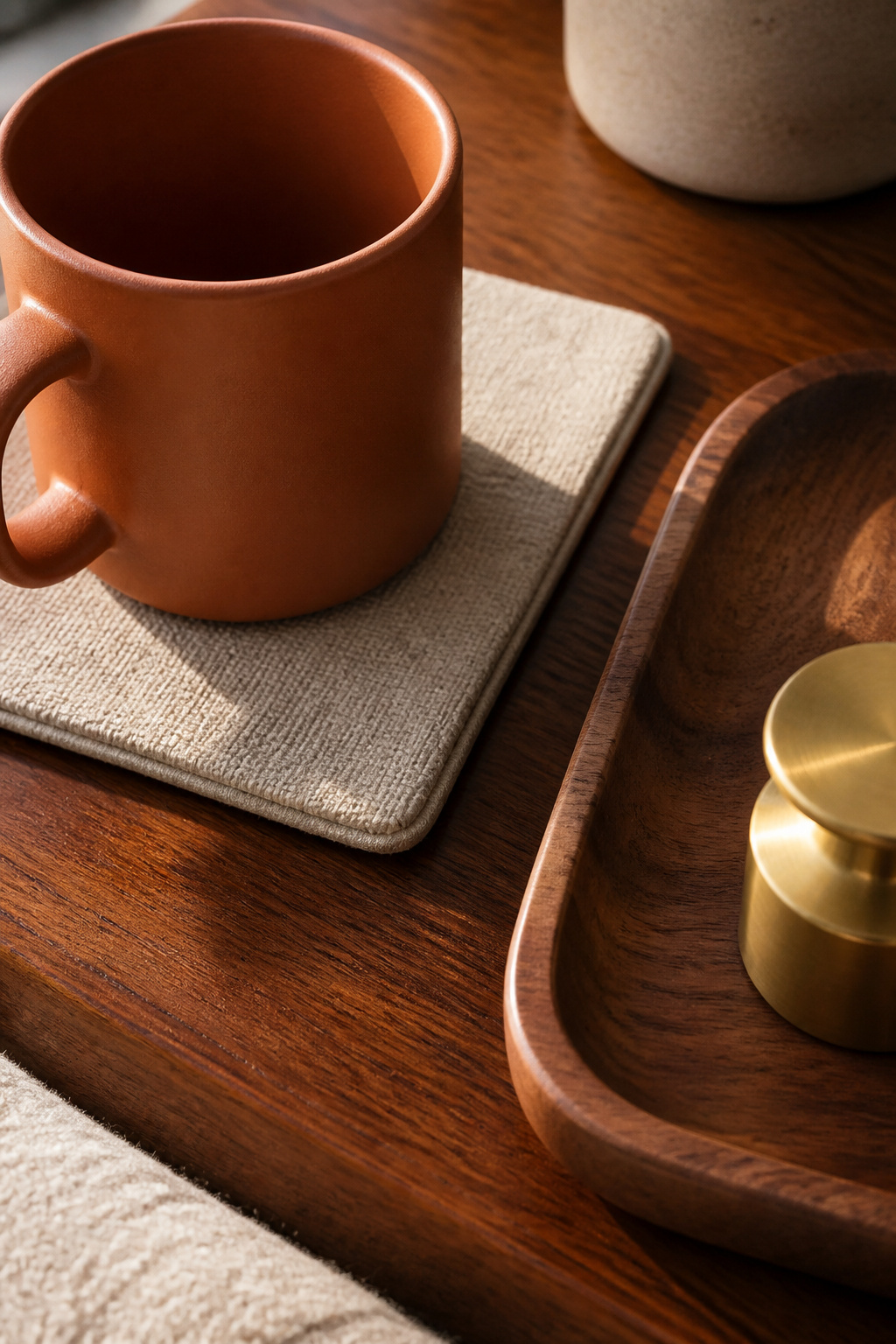
Colour coordination gets most of the attention in home styling, but texture does more of the work on a small surface. Two objects in identical colours but different textures — a matte ceramic vase and a raw linen coaster — feel more interesting than two complementary-coloured objects with the same smooth finish.
The Three-Texture Rule
On a surface as small as an end table, the eye is close enough to register texture at a level it ignores across a full room. The three-texture rule: one hard or shiny element (ceramic, glass, metal), one natural or organic element (wood, stone, wicker), and one soft or woven element (linen, cotton, jute). Any combination of these three registers as intentionally layered.
Specific Pairings
Material combinations that consistently work: matte black ceramic with pale oak wood and woven rattan; aged brass with veined marble and dark walnut; glazed terracotta with whitewashed concrete and linen. Avoid over-matching — an end table where every object shares the same material reads as a store display, not a lived space.
A $2 linen tea towel, folded once into a loose square, placed under any object on your end table adds a texture layer in 10 seconds. It’s the fastest styling upgrade with no budget required.
12. A Diffuser or Candle for Sensory End Table Styling
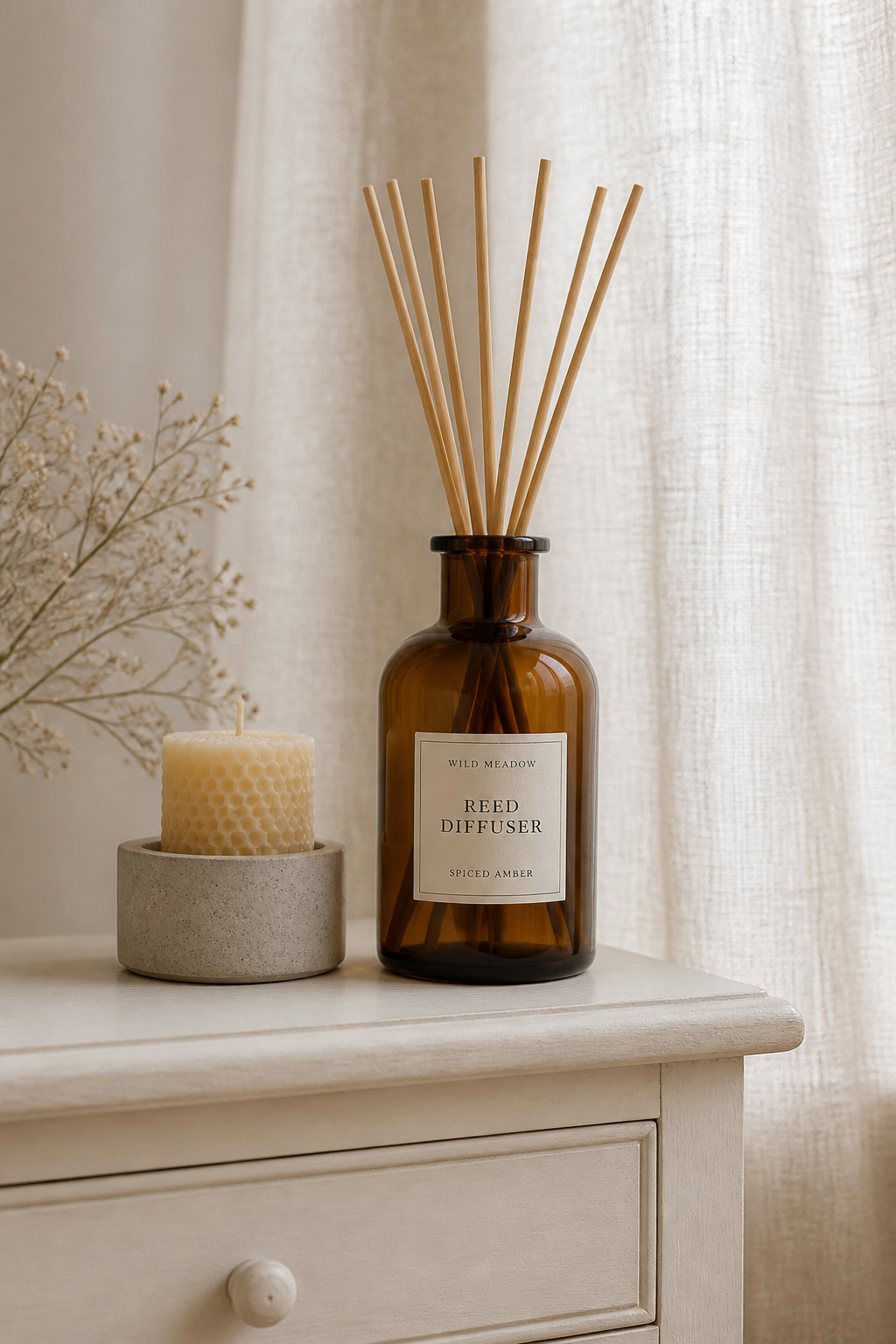
Scent is the most overlooked element in home styling. And end tables are where it matters most — you sit next to the end table, so you smell what’s on it before you see it clearly. A beautifully arranged vignette that smells of dust undermines the entire visual impression. But a subtle, grounding scent in an attractive vessel turns the end table into a sensory moment.
Reed Diffuser vs. Candle
Reed diffusers provide continuous, low-level scent without a flame. This makes them safer near sofas. The vessel is always visible, so the visual contribution is permanent. Apotheke ($52), Nest New York ($44), and affordable alternatives from MADE and H&M Home ($18–$25) all offer attractive vessels. Candles bring flame, ritual, and an empty vessel that continues to work as decor long after the wax is gone.
Scent Families by Room
Living room end tables: woody and resinous scents (cedar, sandalwood, vetiver) feel grounding. Bedroom end tables: floral or herbal notes (lavender, neroli, chamomile) support relaxation. For height, a low tealight holder grounds the vignette’s low point; a tall pillar candle (8–10 inches) adds vertical drama alongside the lamp.
13. Thrifted Treasures as Budget End Table Decor Finds
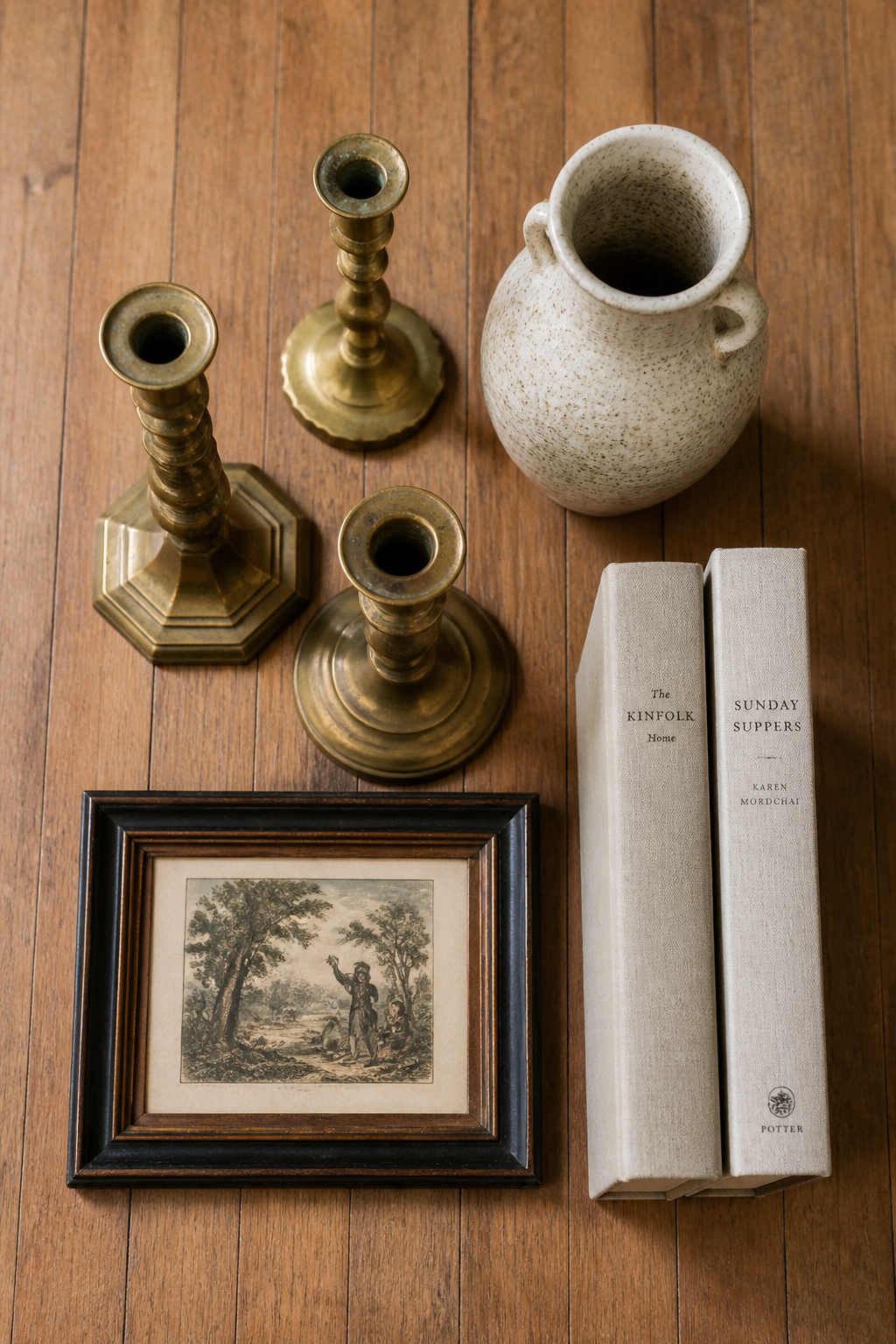
The best end table styling objects — brass candleholders, ceramic vases, art prints, vintage books, small sculptures — are all available secondhand at 10–20% of their retail price. Thrift stores are the source I return to most often regardless of budget, because secondhand pieces carry a quality new purchases rarely match: they’ve been somewhere.
Penny’s Thrift Store Checklist
When scanning thrift store shelves, I run a quick check. Ceramics: no chips at the rim or base. Brass: no white-green verdigris crust. Glass: clear and unfoggy. Wood: no water staining or warping. Anything that passes these four checks is worth considering.
Sources and Cleaning
Facebook Marketplace and eBay for vintage brass and ceramic pieces. Chairish and 1stDibs for higher-quality vintage at mid-range prices. For in-person thrifting, Tuesday through Thursday are the best days. Cleaning thrifted ceramics: warm water and dish soap, then a Magic Eraser for stubborn marks. Restoring brass: Bar Keepers Friend paste on a soft cloth removes tarnish in minutes.
Give yourself a $20 thrift store challenge: can you style an entire end table for under $20? The constraint forces creativity. The same philosophy applies to the coffee table — Sourcing & Restoring Vintage Coffee Table Furniture: The Ultimate Guide covers the complete secondhand-to-styled process for the larger surface.
14. A Trailing or Structural Plant as a Living End Table Statement
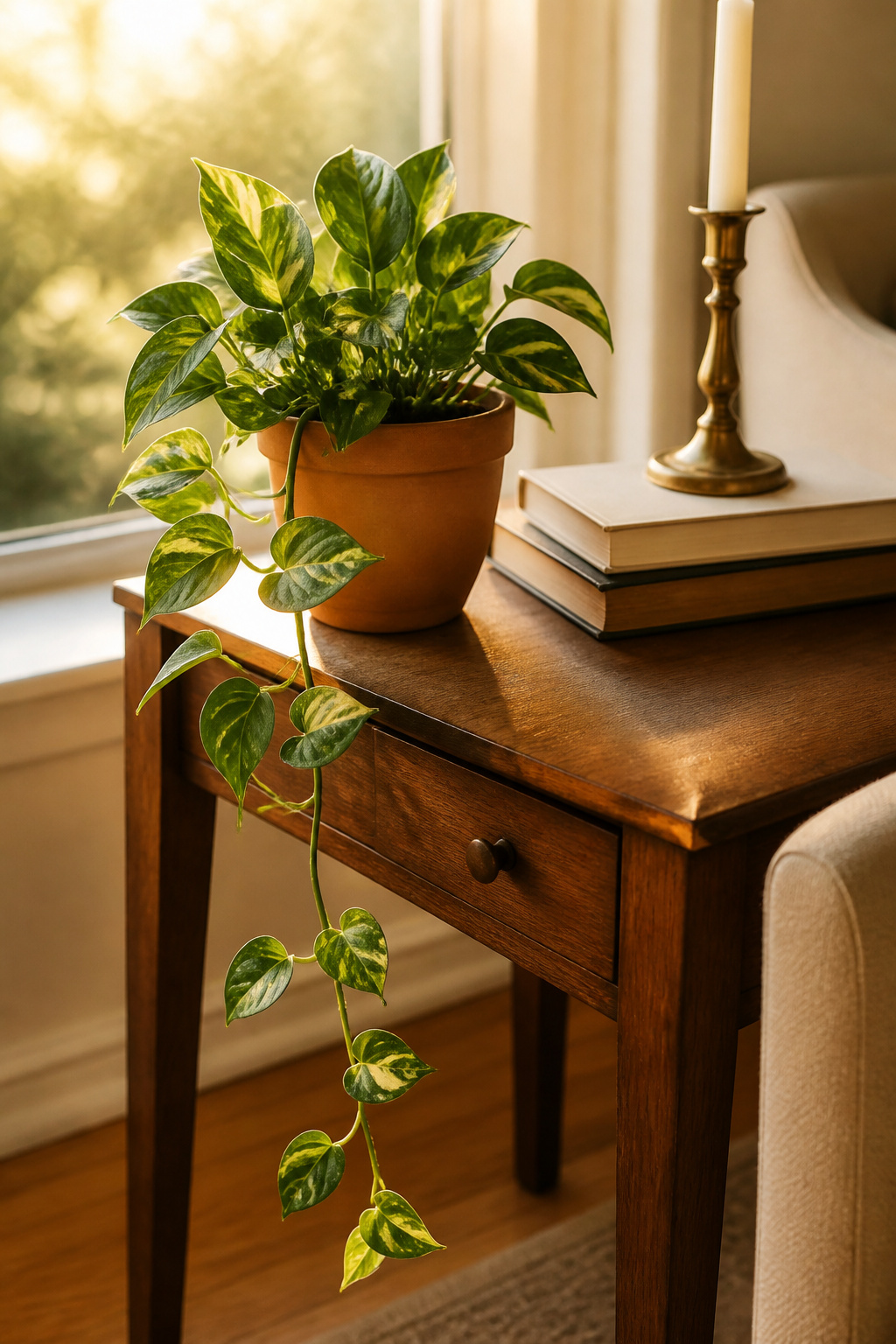
A plant on an end table does something no object of equivalent size can: it changes. It grows. It responds to the light shifting across the room. A trailing pothos will put out a new leaf every week or two. That quality of aliveness is the most important contribution a plant makes to end table decor.
Best Plants for End Table Scale
For end table scale, keep the nursery pot under 4 inches in diameter. The best low-light options — because end tables next to sofas are often away from windows — are pothos, heartleaf philodendron, nerve plant (fittonia), and ZZ plant. Air plants (tillandsia) need no soil and need only a misting twice a week.
Trailing varieties are especially effective: a pothos stem cascading down the table leg adds an organic, naturalistic quality that upright plants can’t match. Structural options — a single cactus or aloe in a concrete pot — suit minimalist rooms where trailing softness would feel wrong.
Pot Selection
A cachepot hides the plastic nursery container and is usually 1–2 inches larger in diameter. Materials: terracotta for a warm organic feel, glazed ceramic for contemporary rooms, woven rattan for bohemian styling, concrete for industrial spaces. A propagated pothos cutting in a small glass bottle of water is also a valid styling choice — and it costs nothing if you already have a parent plant. It also gives visitors something to ask about, which is itself a form of personality on the end table.
15. Colour-Coordinated Accents to Anchor Your End Table Decor
The last end table decor idea is also the most cohesive. Pull one colour already present in the room — a sofa cushion, a rug, a curtain panel — and repeat it in one or two objects on the end table. This single technique, more than any individual object, makes a room feel considered as a whole rather than assembled in pieces.
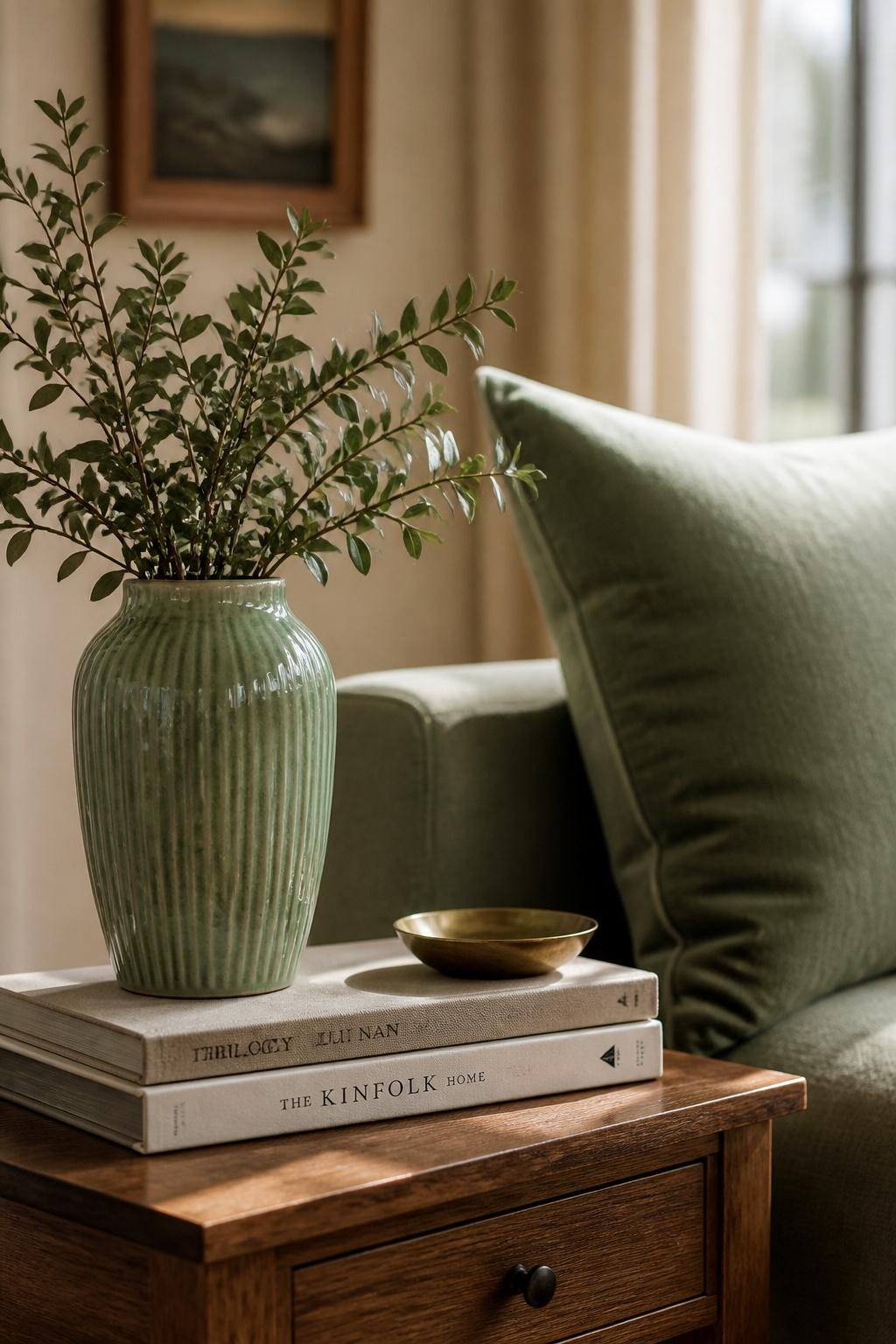
How Colour Repetition Creates Flow
Interior designers create visual flow by repeating the same colour (or close tones) across different surfaces and at different heights in a room. When the same sage green appears on the sofa cushion, the end table vase, and the lamp shade across the room, your eye reads cohesive intention. Someone made these choices together. The end table is the ideal place to introduce or reinforce a room’s colour story because it’s at eye level when seated.
When to Match and When to Contrast
Match within 2–3 tones of the main colour when you want cohesion and calm. Contrast with a complementary colour (navy in a warm amber room, for example) when you want energy and punctuation. The 60/30/10 rule gives guidance: 60% dominant colour, 30% secondary, 10% accent. The end table is the natural home of that 10% accent. For more on working colour across a full living room, 20 Mindful Principles for Your Beige Living Room Decor Sanctuary and Modern Living Room Decoration: 12 Timeless Secrets for Luxury Homes both cover colour layering in depth.
Finding Your Signature End Table Decor Style
Fifteen ideas is a long list, and the point was never to apply all of them. The point was to give you a vocabulary. Specific moves, materials, and principles you can reach for when your end table looks wrong and you can’t immediately say why.
In practice, the strongest end table decor is built from four to six objects: one lamp, one botanical, one or two books, one small vessel, and one personal accent. Everything beyond that is refinement, not requirement. And the first step before any of it is shopping your own home. Walk from room to room before you open any shopping app. You’ll almost always find what you need.
How to Edit What You Already Own
Walk through your home and collect one object from each category: a hardback book, a small vessel, an organic element, a candle or diffuser, a personal object. Arrange them using the triangle principle — tall, medium, low — and see what you have before you buy anything. The instinct to acquire is strong. But in my experience, the right objects are almost always already there. They’re just in the wrong rooms. Move things before you buy things. It’s the advice I give most often and the one people most frequently find actually works.
The One-In, One-Out Rule
Once your end table is styled in a way that feels right, apply the one-in, one-out rule. Any new object arriving on the surface must displace an existing one. This prevents gradual accumulation without requiring constant effort. The end table stays edited; the vignette stays fresh; the room stays intentional. The goal is an end table that looks like you — not like a styling guide, not like a showroom. The vintage lamp you restored, the books you’ve actually read, the ring dish from the market in Portugal — that’s end table decor with a life behind it. And that, more than any individual object, is what makes a room feel like a home.