
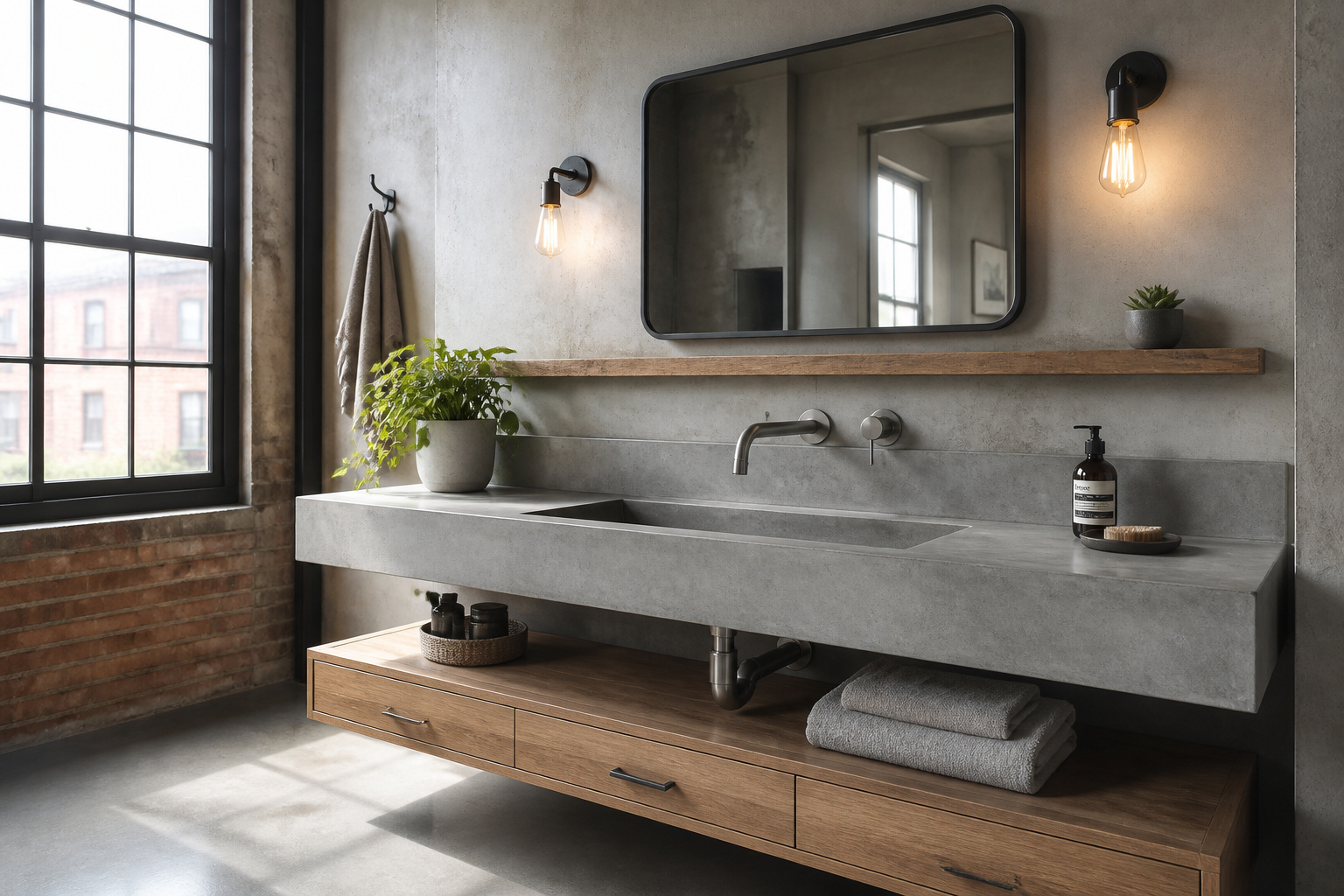

Most bathroom renovations spend their budget on tile and fixtures. The countertop becomes an afterthought. That’s a mistake. After walking through dozens of loft and warehouse-conversion bathrooms over the past decade, I’ve found one thing every time: the countertop is the surface your hand actually touches each morning. It takes more daily abuse than almost anything else in the room. These 18 bathroom countertop ideas aren’t a trend roundup. They’re the materials and details that hold up to steam, water, and constant contact without losing their character.
Some of these lean industrial: poured concrete, brushed stainless steel, large-format porcelain that mimics raw stone. Others are warmer choices, like butcher block or soapstone. I included them because durability matters as much as matching a single aesthetic. For each one, you’ll get the real installed cost, how it ages, and where it tends to fail if you skip maintenance. So by the end, you’ll know which bathroom countertop material fits your space, your budget, and how much upkeep you’re honestly willing to take on.
1. Honed Quartz: A Forgiving Bathroom Countertop Material
If you want one surface that handles a busy bathroom without much thought, start here. Engineered quartz is roughly 90 to 93 percent ground natural quartz bound with resin. That mix makes it nonporous and resistant to staining, with no sealing required at all.
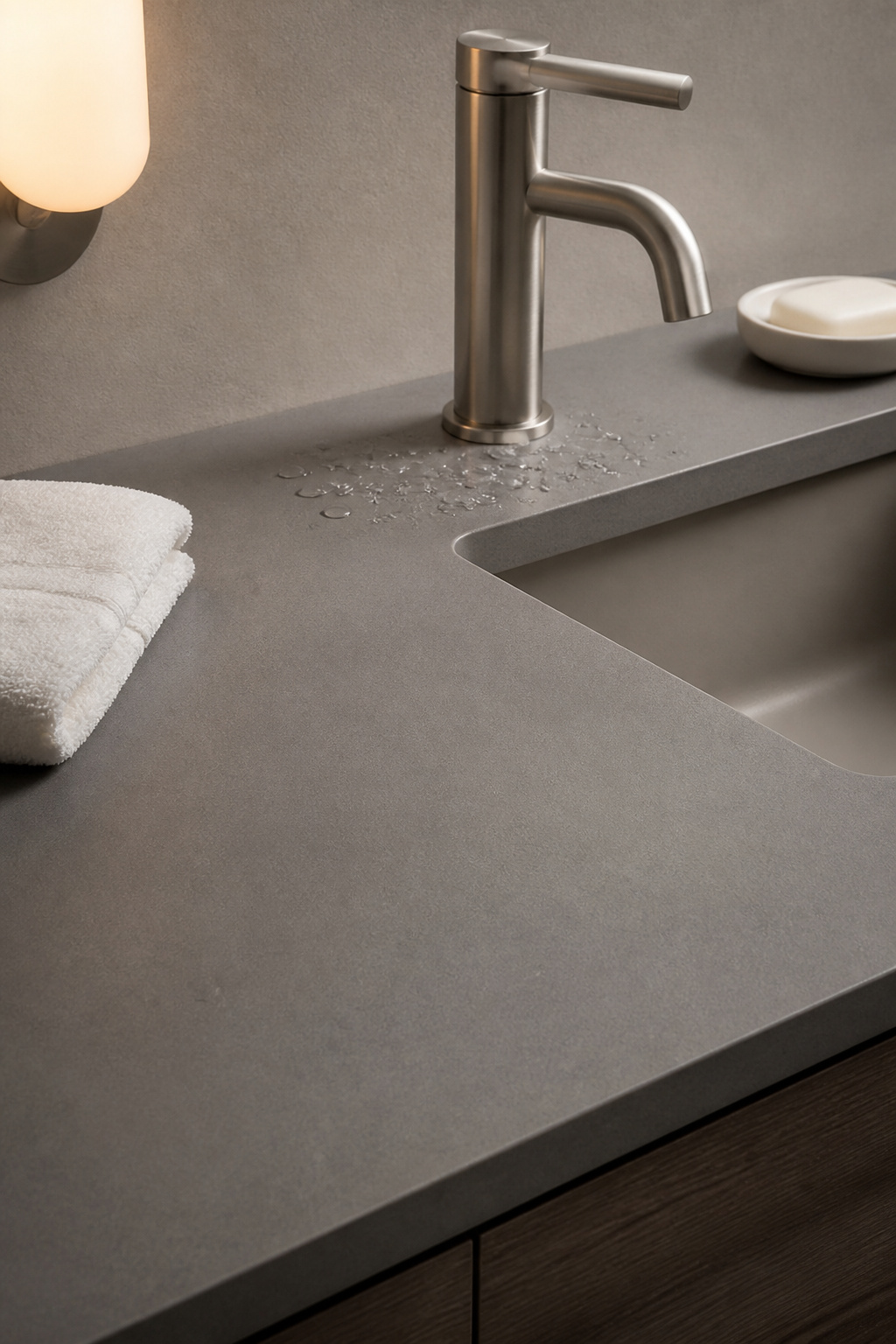
Honed, or matte, finishes run $55 to $90 per square foot installed. That’s about the same as polished quartz. Brands like Caesarstone, Cambria, and MSI’s Q Premium line all offer honed options. The matte texture shows fewer water spots and fingerprints than a polished slab. That matters more in a bathroom than a kitchen, simply because hands and toiletries touch the surface so often.
Heat and Maintenance Notes
Quartz is heat-sensitive above roughly 150 degrees at the seam. A curling iron set straight on the counter can leave a mark. Otherwise, maintenance is just a wipe-down. Ask for a honed sample under your actual bathroom lighting before you order. Warm, dim vanity bulbs make honed quartz read cooler and grayer than it does under bright showroom lights. Among all the bathroom countertop ideas here, honed quartz is the safest pick for a household that doesn’t want a maintenance routine to remember. Most fabricators keep dozens of honed colorways in stock, so lead times run shorter than custom stone orders too.
2. Poured Concrete Counters for an Industrial Bathroom
Concrete defines a loft bathroom more than any other material, and it’s the one I get asked about most. A custom poured slab is hand-troweled and finished on site, or pre-cast off site and installed later. Either way, you get a surface that genuinely can’t be replicated by any engineered product.
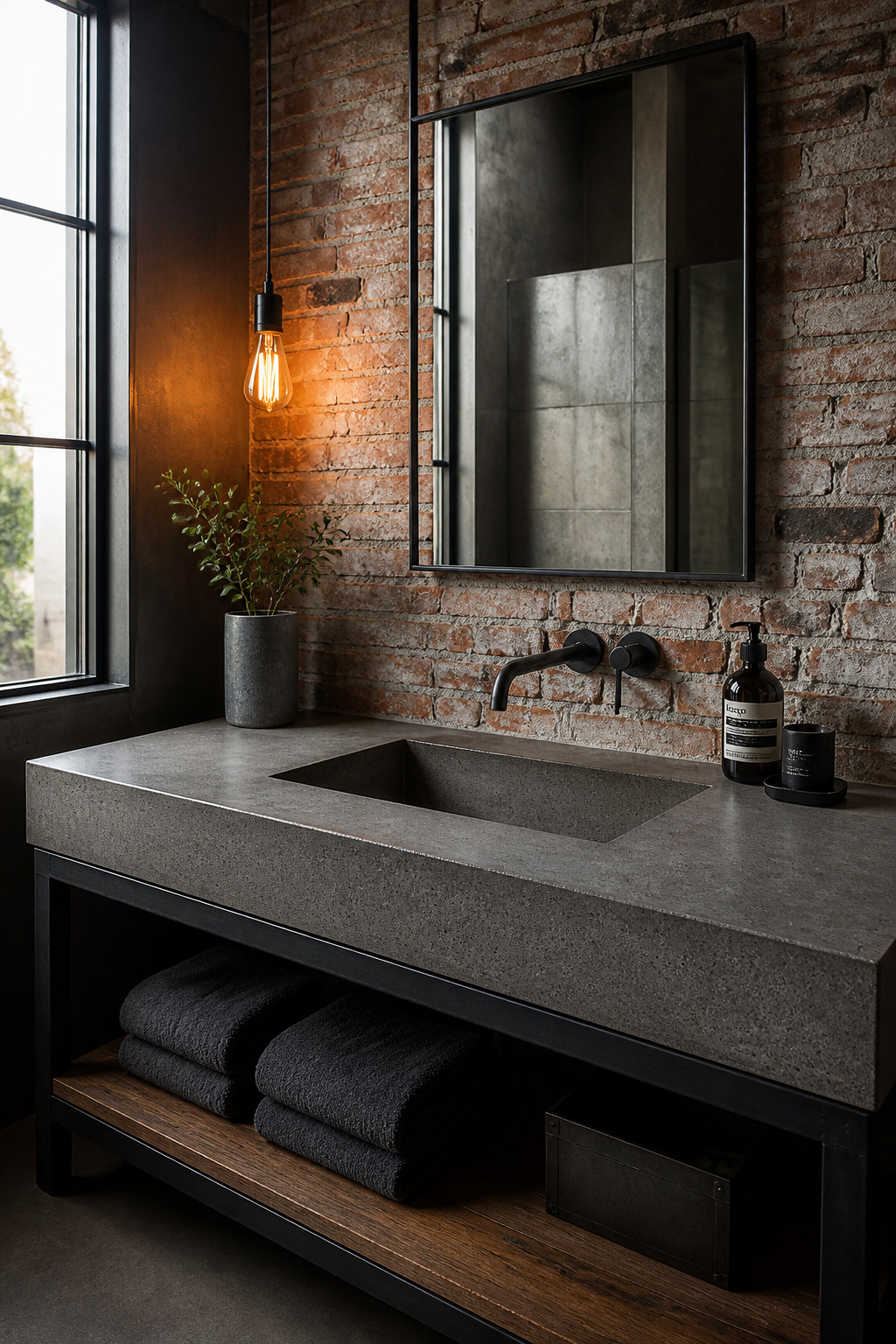
Custom concrete runs $65 to $135 per square foot, depending on pigment, embedded aggregate, and edge detail. Because every slab is poured to order, no two ever look exactly alike. Pigments and mix-ins, like glass, shell, or recycled metal, let a fabricator match almost any palette you bring them.
Sealing Is Non-Negotiable
Concrete needs a penetrating sealer reapplied every 12 to 18 months. Bathroom humidity is constant, and unsealed concrete etches easily. Before you commit, ask for a sealed sample board. Leave a few drops of an acidic cleaner on it overnight. That simple test tells you more about long-term performance than any showroom display ever will. Of all the bathroom countertop ideas on this list, concrete rewards patience the most. A freshly poured slab often looks better after a year of use, once the patina sets in. Expect occasional hairline cracking near the sink cutout; most fabricators treat it as character, not a defect.
3. Carrara Marble for a Classic Vanity Statement
Marble is the material people picture when they imagine a luxury bathroom, and Carrara remains the benchmark. Its soft gray veining against a white-to-blue-gray ground reads as classic, even after decades of trend cycles come and go.
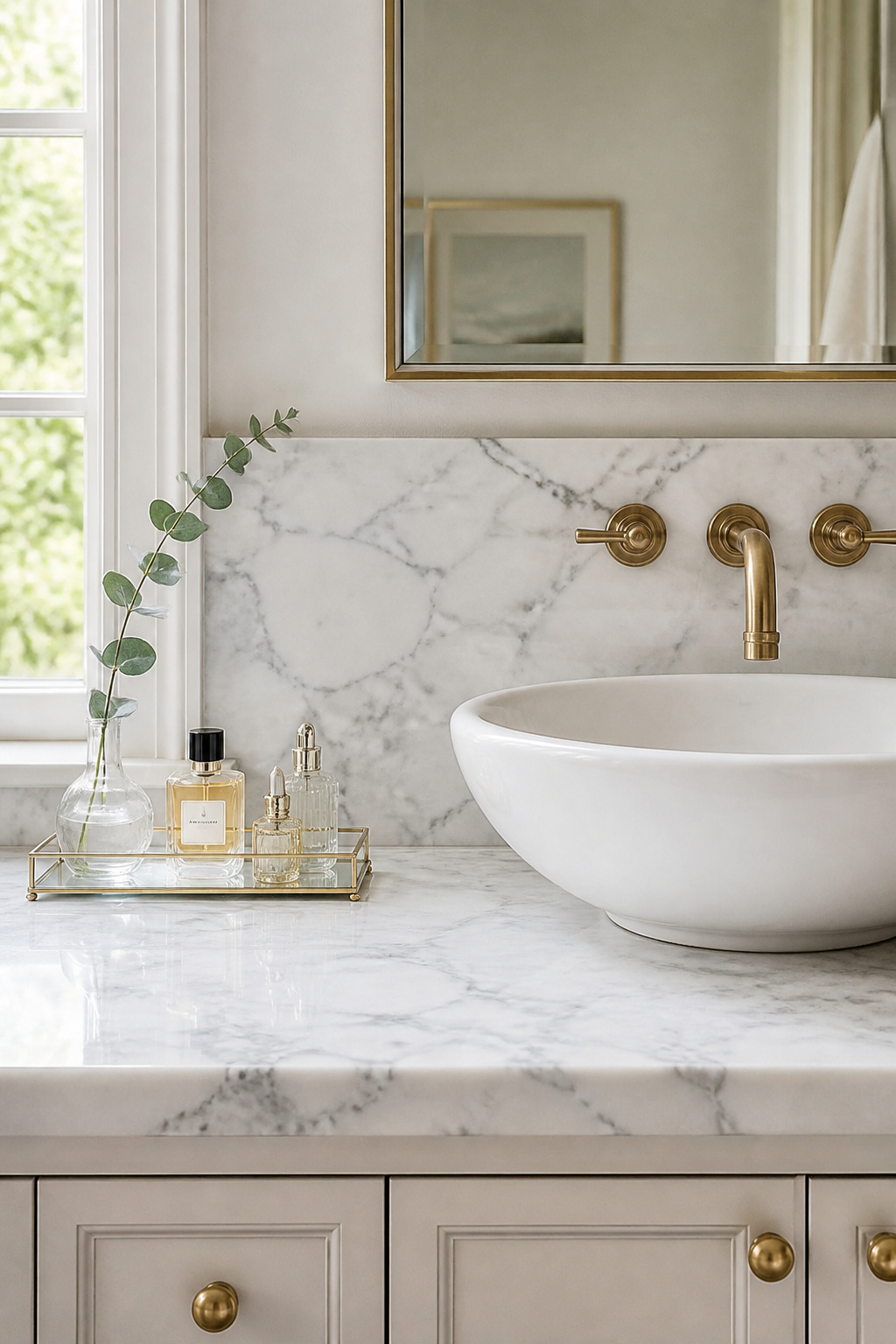
Installed, Carrara runs $75 to $150 per square foot. Bolder-veined Calacatta and Statuario slabs command more. Because marble is porous, it etches when it touches acidic products, like some toners or perfumes. The etching shows up as a dull spot rather than a stain, and you can’t wipe it away once it happens.
Living With a Porous Stone
A penetrating sealer needs reapplying every six to 12 months in a bathroom setting. A honed finish hides etching far better than a polished one does. If real marble fits the budget but the maintenance gives you pause, ask your fabricator about a honed finish paired with a color-enhancing sealer. It’s a practical middle ground. Marble remains one of the most requested bathroom countertop ideas among clients chasing a hotel-spa look. Even so, I often steer budget-conscious homeowners toward quartzite instead. Real marble does still photograph better in listing photos than any engineered alternative.
4. Butcher Block: A Warm, Budget-Smart Bathroom Countertop
Wood isn’t the obvious choice for a bathroom, but a well-sealed butcher block countertop brings warmth that stone and steel can’t match. It also happens to be one of the more affordable bathroom countertop materials on this list.
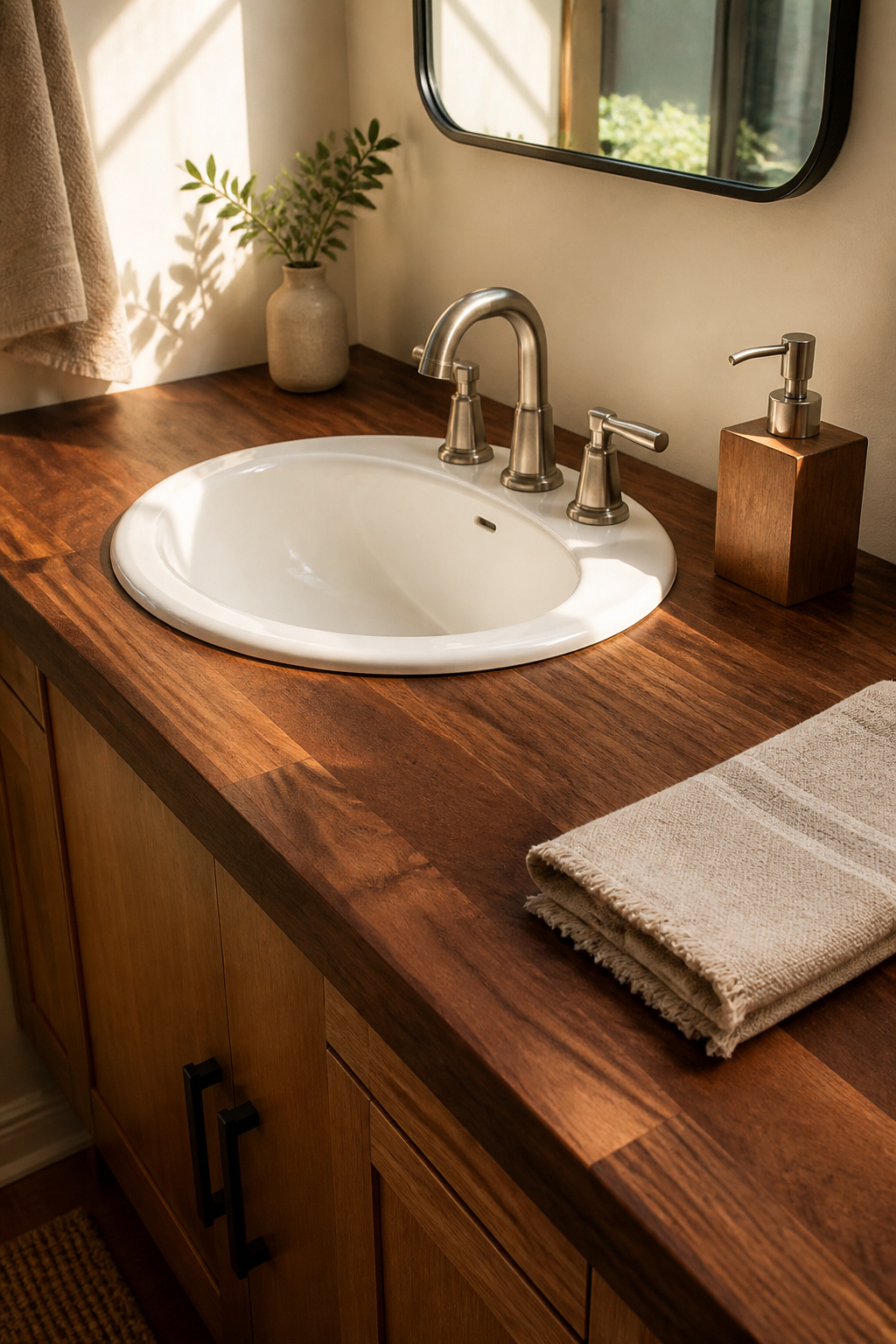
Teak and walnut run $40 to $100 per square foot, well under most stone options. Teak holds up best to moisture, thanks to its natural oils. That said, a marine-grade spar urethane or tung oil finish is essential here. The cutting-board oil you’d use in a kitchen simply won’t survive constant splashing near a sink.
Where to Place It
Reoil the area near the sink basin every three to six months, and the rest of the counter once a year. Most failures happen at the sink cutout, not the open countertop. Have your fabricator seal the underside and any cut edges, not just the visible top, before installation. Among the warmer bathroom countertop ideas in this list, butcher block pairs especially well with a vessel sink rather than an undermount. That choice keeps water away from the seam where wood meets basin. Expect small water rings near the faucet until you build a consistent oiling habit.
5. Speckled Granite for Everyday Durability
Granite has a reputation as a kitchen material. Even so, a busy, speckled granite is one of the most forgiving choices for a high-traffic family bathroom. The same qualities that hide cutting marks on a kitchen island also disguise toothpaste splatter on a vanity.
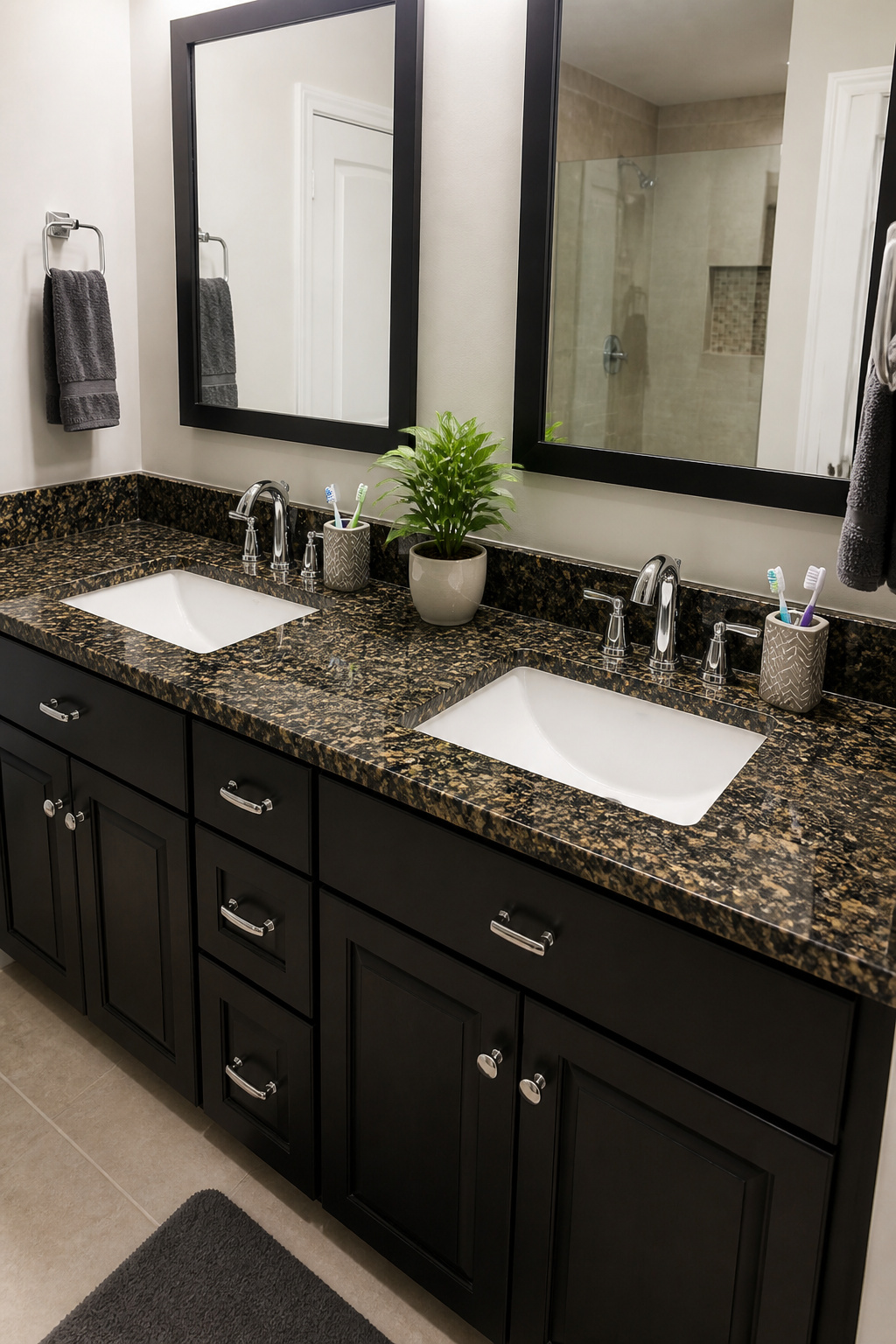
Granite runs $45 to $120 per square foot installed, depending on the rarity of the slab. It resists heat up to roughly 480 degrees, which is more forgiving than quartz for a forgotten hot tool. A bullnose edge is the easiest profile to keep clean in a small space, since it has no sharp corner to trap grime.
A Quick Seal Check
Sealing is typically needed once a year, but you don’t have to guess when. Drop a little water on the surface. If it beads up instead of soaking in within a few minutes, the seal is still doing its job. If it darkens the stone, it’s time to reseal. For a busy family bathroom, speckled granite is consistently one of the better bathroom countertop ideas, since the pattern forgives mess between cleanings. Ask your fabricator about a remnant piece first. Granite remnants left over from kitchen projects are often priced well below a full custom slab.
6. Terrazzo: A Flecked Surface With Retro Roots
Terrazzo has come a long way from the speckled floors in old municipal buildings. A modern slab version makes a genuinely striking bathroom countertop. The pattern itself does a lot of the maintenance work for you, since flecks of color hide minor scratches and water spots that a solid surface would show plainly.
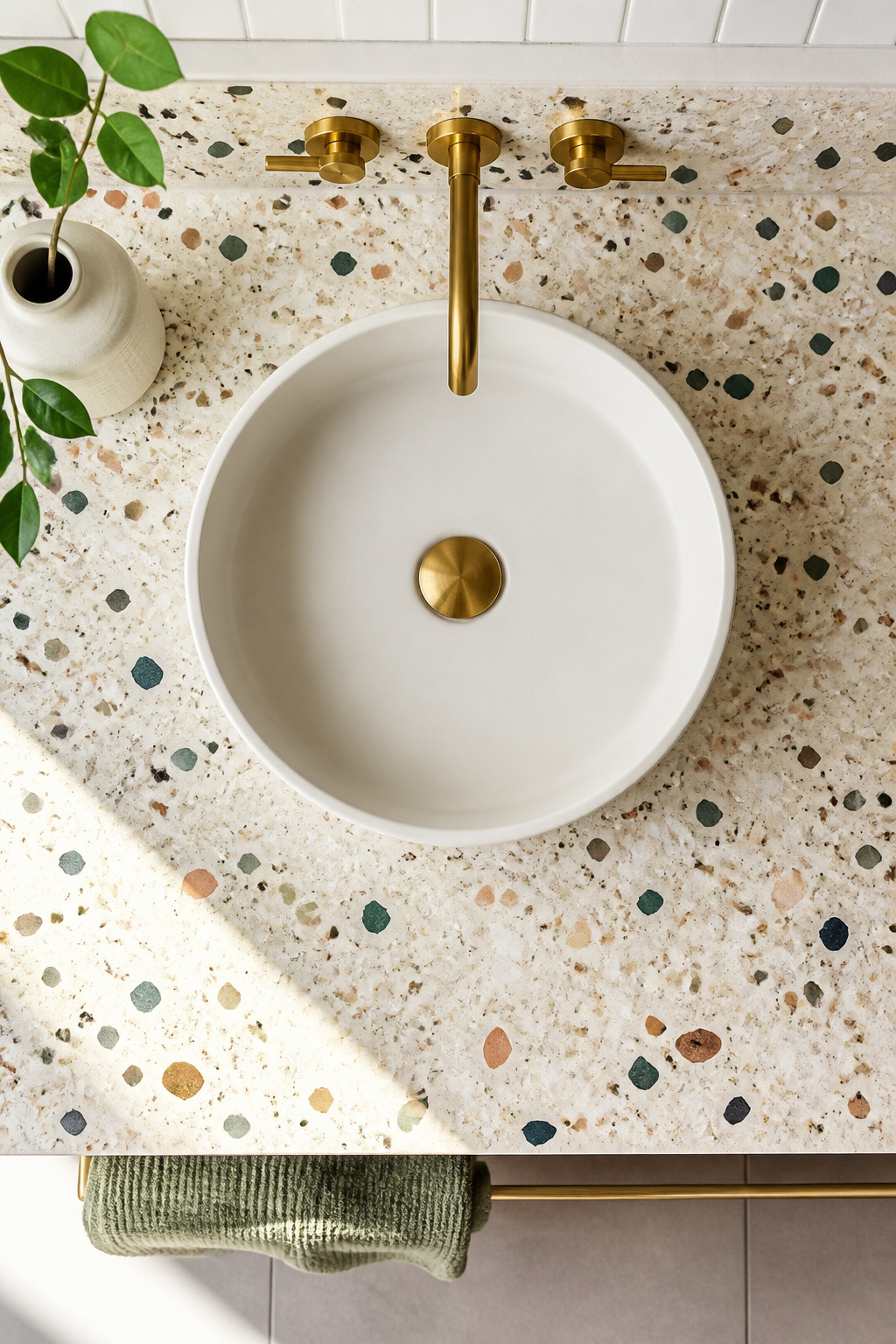
Slab terrazzo runs $70 to $130 per square foot, and poured-in-place work costs less. A resin-based mix is less porous than the traditional cement version. It needs sealing only every two to three years instead of annually. Custom aggregate, like brass flecks, colored glass, or mother-of-pearl, lets a fabricator match a specific palette instead of a standard catalog option.
Resin Versus Cement
If terrazzo is the plan for a bathroom specifically, choose the resin-based version over cement. It handles daily humidity and water exposure with noticeably less upkeep. The color also stays more consistent over time, since cement-based terrazzo can shift slightly as it ages. Terrazzo tends to surprise people browsing bathroom countertop ideas, since most associate it with floors rather than vanities. A custom aggregate mix can echo your tile or hardware finish, which makes it one of the easiest materials to tie a whole room together.
7. Solid Surface: The Seamless Bathroom Countertop for Easy Cleaning
If a grout line or seam around your sink drives you crazy, this material was built to eliminate it. Solid surface, sold under names like Corian, Avonite, and Wilsonart, is thermoformed. That process lets a fabricator integrate the sink directly into the countertop with no caulk line at all.
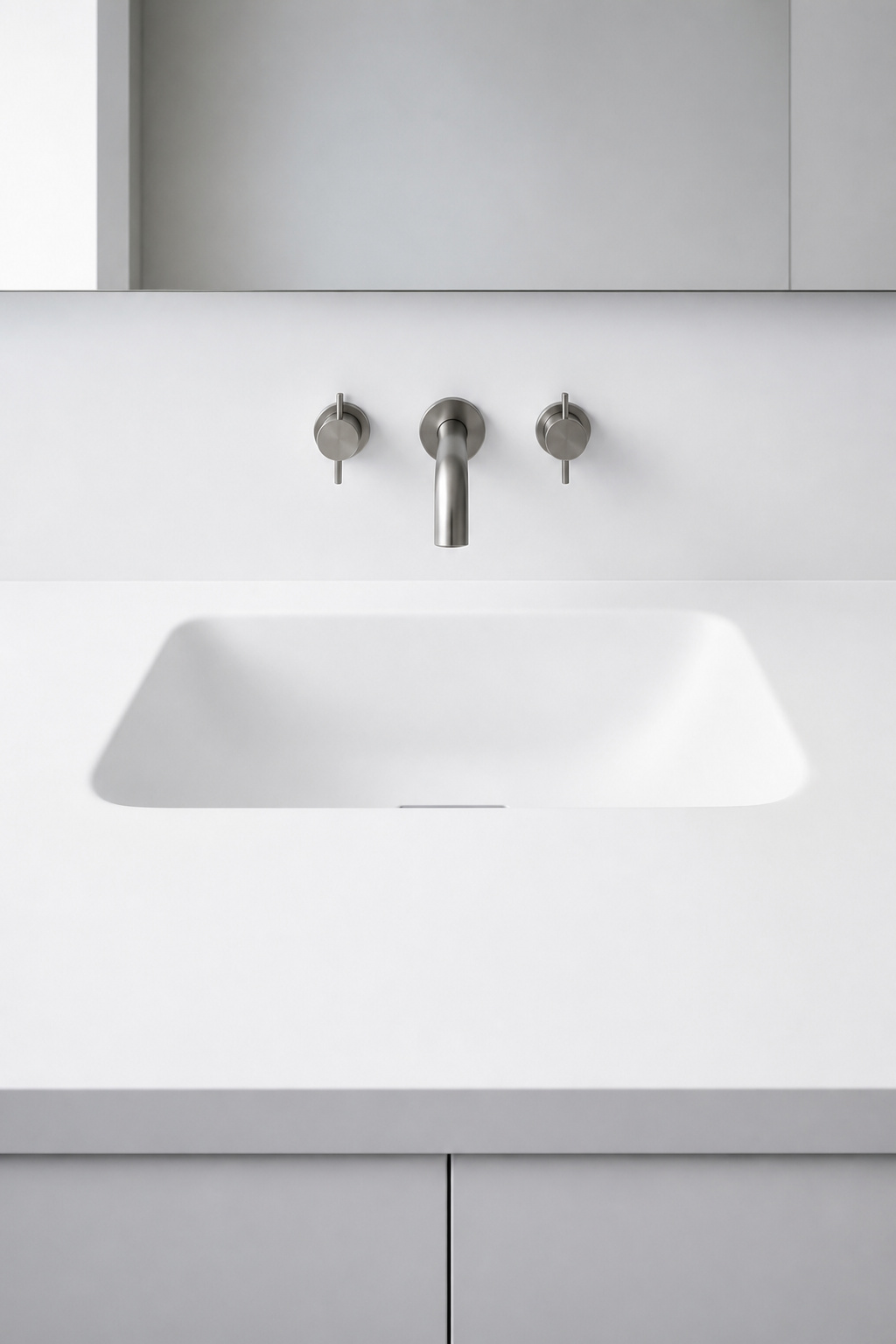
Solid surface runs $45 to $85 per square foot and is nonporous, so it never needs sealing. Because the material is solid all the way through, light scratches and small burns can be sanded out. That’s a real advantage over stone, which often needs full replacement after deep damage.
One Tradeoff to Know
It’s less heat-resistant than quartz or granite, so direct contact with a hot styling tool can scorch it. Otherwise, an integrated sink removes the exact spot where mold typically starts around a standard drop-in basin. That’s worth the modest upcharge in a humid bathroom. Solid surface rarely gets mentioned alongside flashier bathroom countertop ideas, but it deserves a serious look for a kids’ bathroom where chips and dings are inevitable. Replacement panels can also be ordered years later if a section ever needs swapping out.
8. Recycled Glass for an Eco-Conscious Surface
For anyone weighing sustainability alongside style, recycled glass countertops deserve a serious look. Brands like IceStone and Vetrazzo use 75 to 100 percent post-consumer or post-industrial glass set into a cement or resin binder. The chips catch vanity lighting in a way no other material here quite replicates.
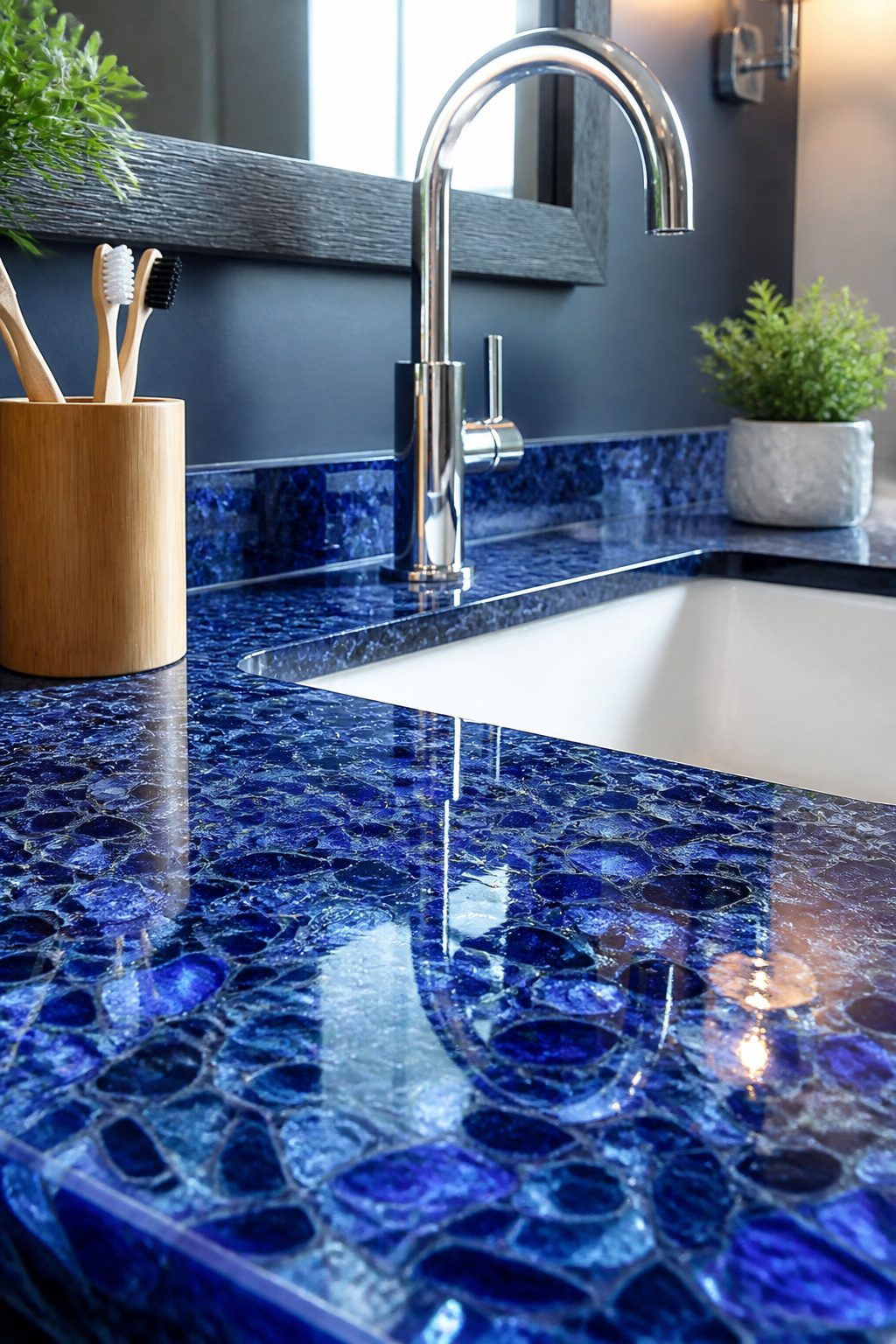
Pricing runs $60 to $120 per square foot, and the binder matters more than people expect. Resin-based versions are nonporous and skip sealing entirely. Cement-based versions need the same periodic sealing as poured concrete, since the binder behaves the same way structurally.
Match It to Quartz Performance
Ask whether your slab is cement or resin bound before buying. A resin-based recycled glass countertop performs almost exactly like quartz for scratch and heat resistance. A cement-based one needs the extra upkeep that comes with any concrete surface. If sustainability is steering the rest of your renovation too, it’s worth browsing thoughtful bathroom ideas modern wellness design demands for how that philosophy extends beyond just the countertop. Recycled glass remains one of the lesser-known bathroom countertop ideas, but it photographs beautifully under natural light. That makes it a favorite for vanities positioned near a window.
9. Soapstone for a Soft, Matte Finish
Soapstone occupies a strange middle ground. It’s softer than nearly every other stone here, yet it’s also one of the most chemically bulletproof. That combination makes it a favorite for people who want a surface that ages visibly instead of staying static for decades.
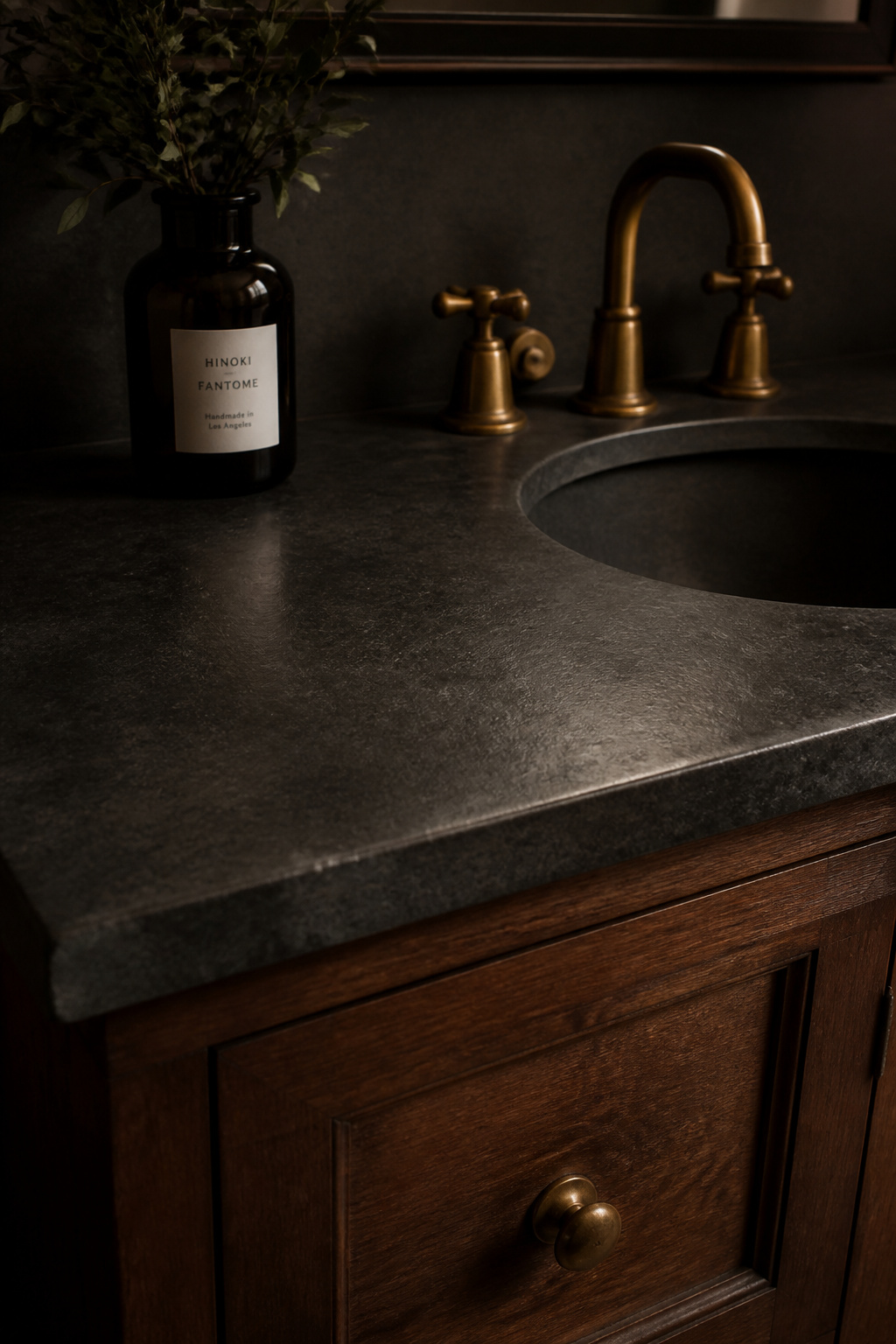
Soapstone runs $70 to $120 per square foot. Its Mohs hardness sits around 2.5 to 3.5, compared to roughly 7 for quartz, so it scratches more easily. Untreated, it starts light gray and darkens to a deep charcoal over months of mineral oil applications. That patina is the entire point of choosing soapstone, not a flaw to manage around.
Building the Patina
Apply mineral oil weekly for the first month to even out the color. After that, taper to monthly upkeep. Skip the early routine and you’ll end up with a blotchy, uneven surface instead of the deep, consistent charcoal soapstone is known for. Soapstone sits apart from most bathroom countertop ideas because it actively invites touch. The surface develops a smooth, almost soft feel as the patina builds over time.
10. Stainless Steel: An Industrial Bathroom Countertop Option
Steel is the material I reach for most often in a true loft conversion. It’s the most maintenance-free option on this list, and it ages with real character instead of just looking worn out. A custom stainless countertop, fabricated to your exact vanity dimensions, resists staining, etching, and water damage entirely.
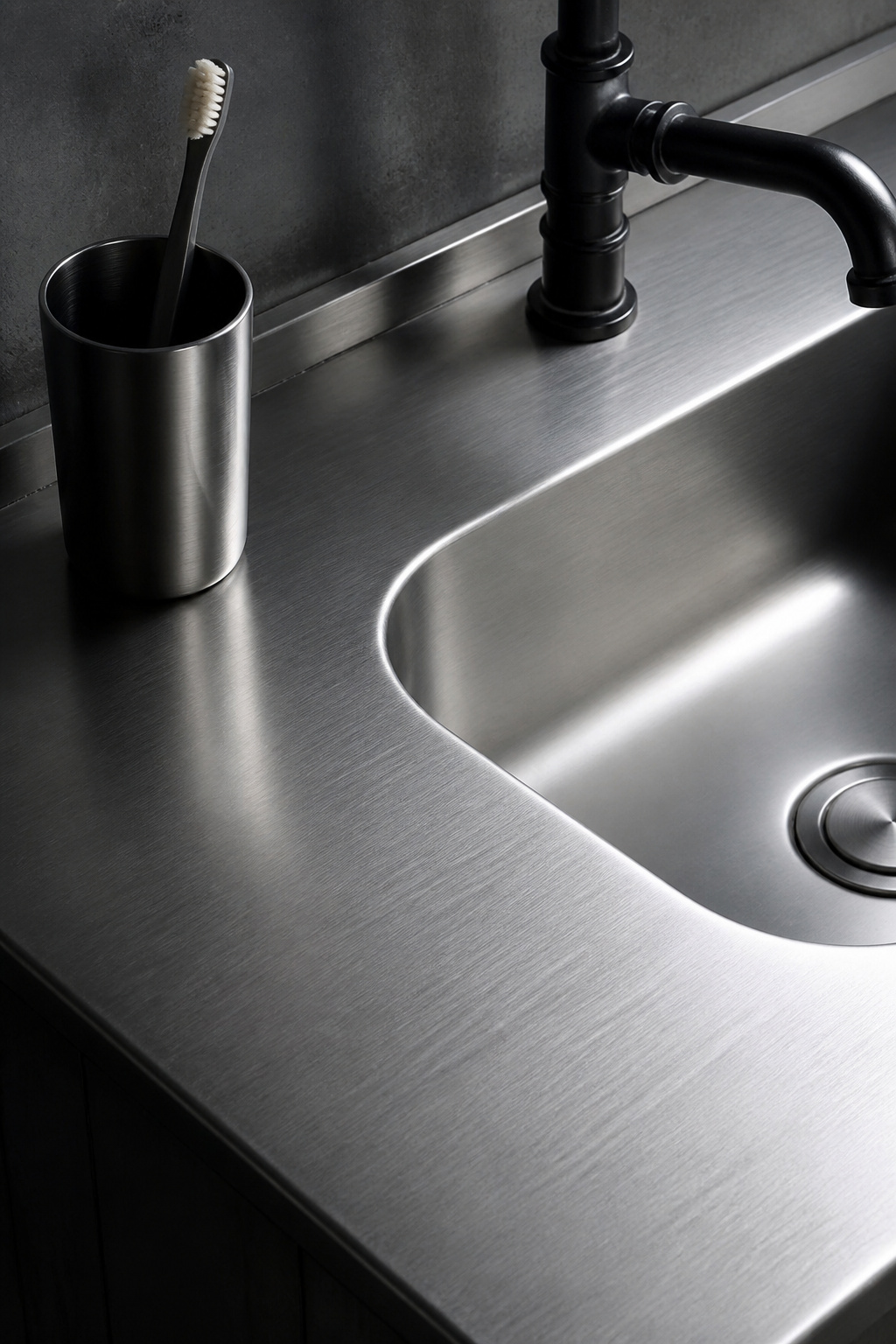
Custom work runs $75 to $150 per square foot, depending on gauge. 16-gauge is standard for residential use, and integrated sink fabrication adds to that range. The tradeoff is visible wear: fingerprints, water spots, and fine scratches show up over time. On a brushed finish, that wear reads as a living patina rather than damage.
Choosing the Right Finish
Specify a brushed finish with the grain running front to back. It disguises daily wear far better than a mirror-polished surface, and it follows the direction light naturally falls across the counter. If you’ve browsed our guide to bathroom vanity designs, you’ve likely seen steel paired with a floating vanity base for exactly this industrial look. Pair it with a matte black or unlacquered brass faucet to keep the whole vanity feeling intentional. Steel is admittedly the boldest of these bathroom countertop ideas, and it isn’t for every household. For a true industrial bathroom, though, it’s hard to beat for sheer durability.
11. Large-Format Porcelain Slabs for Durability
Porcelain has quietly become the material professionals reach for when a client wants the look of natural stone without the upkeep. Brands like Dekton, Neolith, and Lapitec produce slabs as large as 5 by 10 feet. That size means a full vanity run with zero seams.
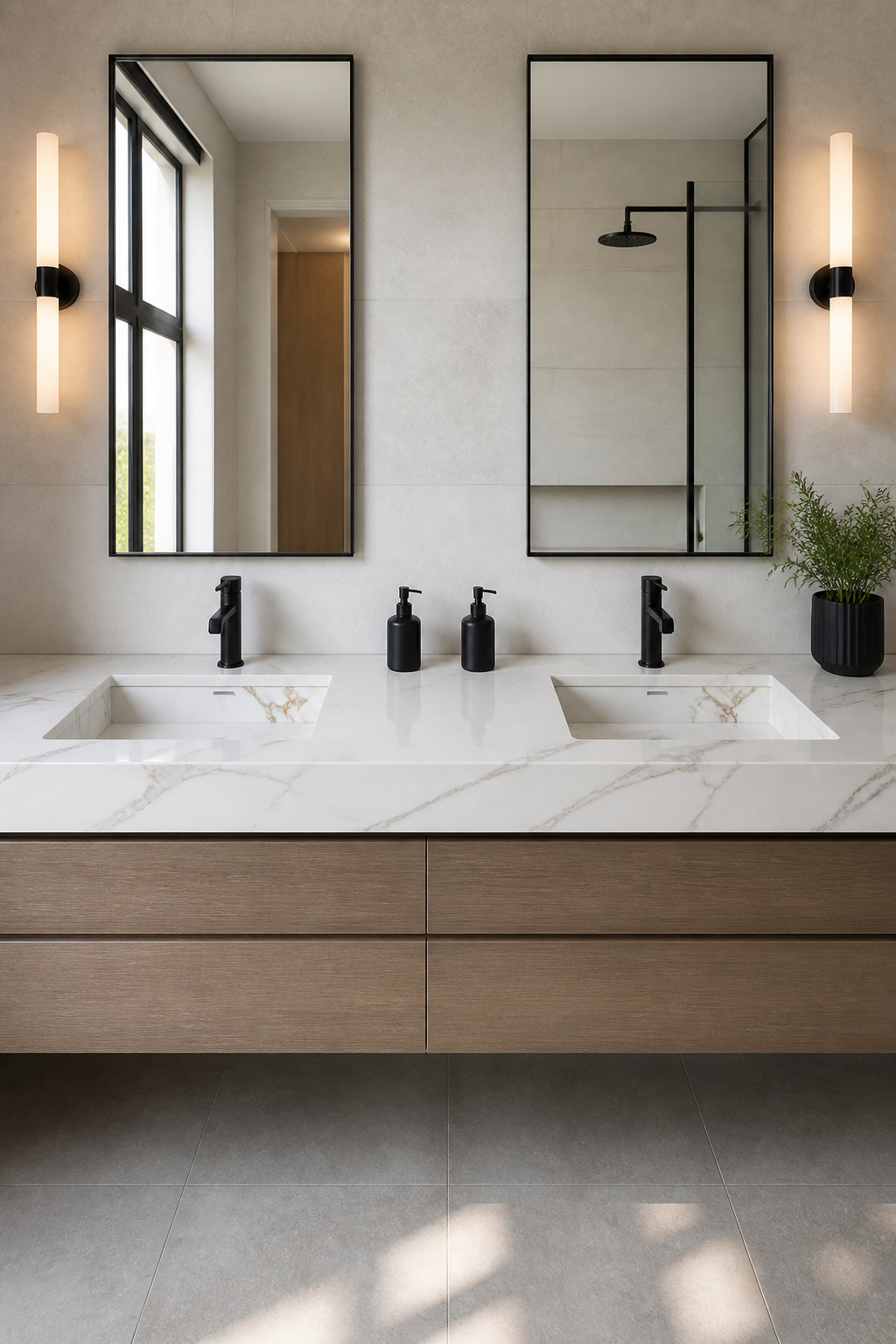
Porcelain runs $65 to $130 per square foot. Because it’s fired at extremely high temperatures, it resists etching, UV fading, and scratching better than the natural stone it’s often designed to mimic. Digital printing technology now produces veining convincing enough that most guests won’t know the difference at a glance.
A Fabrication Note
Thin slabs, typically 12 to 20 millimeters, are more brittle to cut than quartz, even though the finished surface is harder once installed. Fabrication experience matters here more than with most materials. If you’re chasing a marble look without the maintenance, see the actual slab in person rather than a photo. Digital veining can repeat itself in a way that only becomes obvious once it’s installed across a full vanity. Porcelain has become one of the most requested bathroom countertop ideas among clients who’ve already lived with a high-maintenance stone elsewhere in the house. They tend not to want a repeat experience in the bathroom.
12. Quartzite: The Natural Stone Marble Alternative
Quartzite gets confused with engineered quartz constantly, but the two have almost nothing in common. True quartzite is a natural metamorphic stone, harder than marble at roughly 7 on the Mohs scale. That extra hardness makes it far more resistant to the etching that plagues marble vanities.
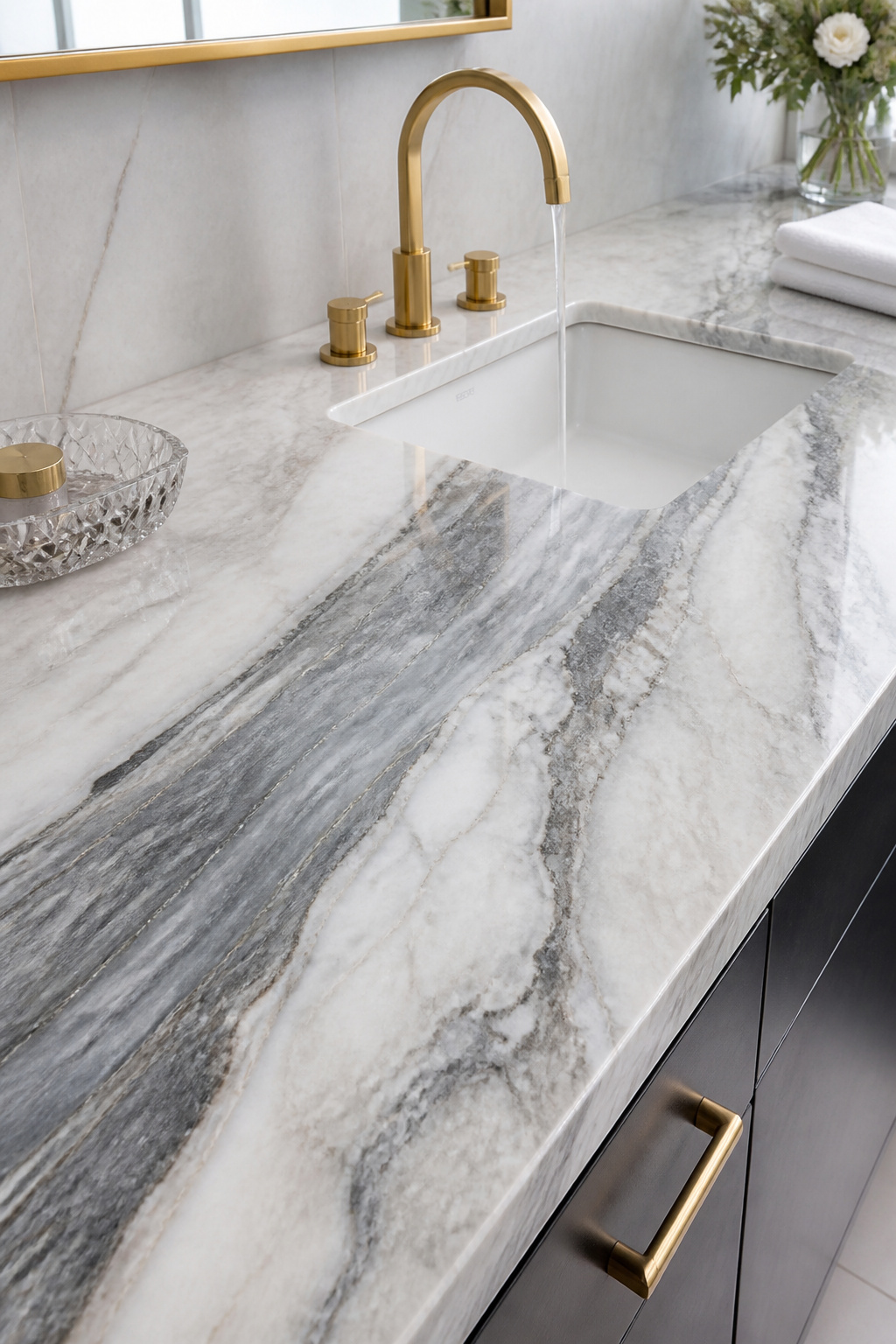
Premium veined quartzite, like Taj Mahal or Fantasy Brown, often runs $80 to $200 per square foot. That’s sometimes pricier than the marble it resembles. It still needs sealing once a year because it remains somewhat porous, just far less prone to day-to-day damage than true marble.
Confirm What You’re Buying
Some stone labeled “quartzite” at the yard is actually dolomitic marble, and it won’t perform the same way. Ask for a scratch test in an inconspicuous spot before you buy. Quartzite generally resists a knife blade where marble doesn’t. For more on pairing a vanity countertop to the rest of the room, our piece on white bathroom vanity design walks through exactly that balance. Quartzite is consistently one of the pricier bathroom countertop ideas on this list. For clients who love marble’s veining and hate marble’s fragility, though, it’s usually worth the premium.
13. Laminate: The Budget Bathroom Countertop Upgrade
Laminate doesn’t get much credit, but a modern textured version is a genuinely smart choice. It works well for a rental, a secondary bath, or any project where the budget has to stretch across the whole house. It’s also the most affordable bathroom countertop material on this entire list.
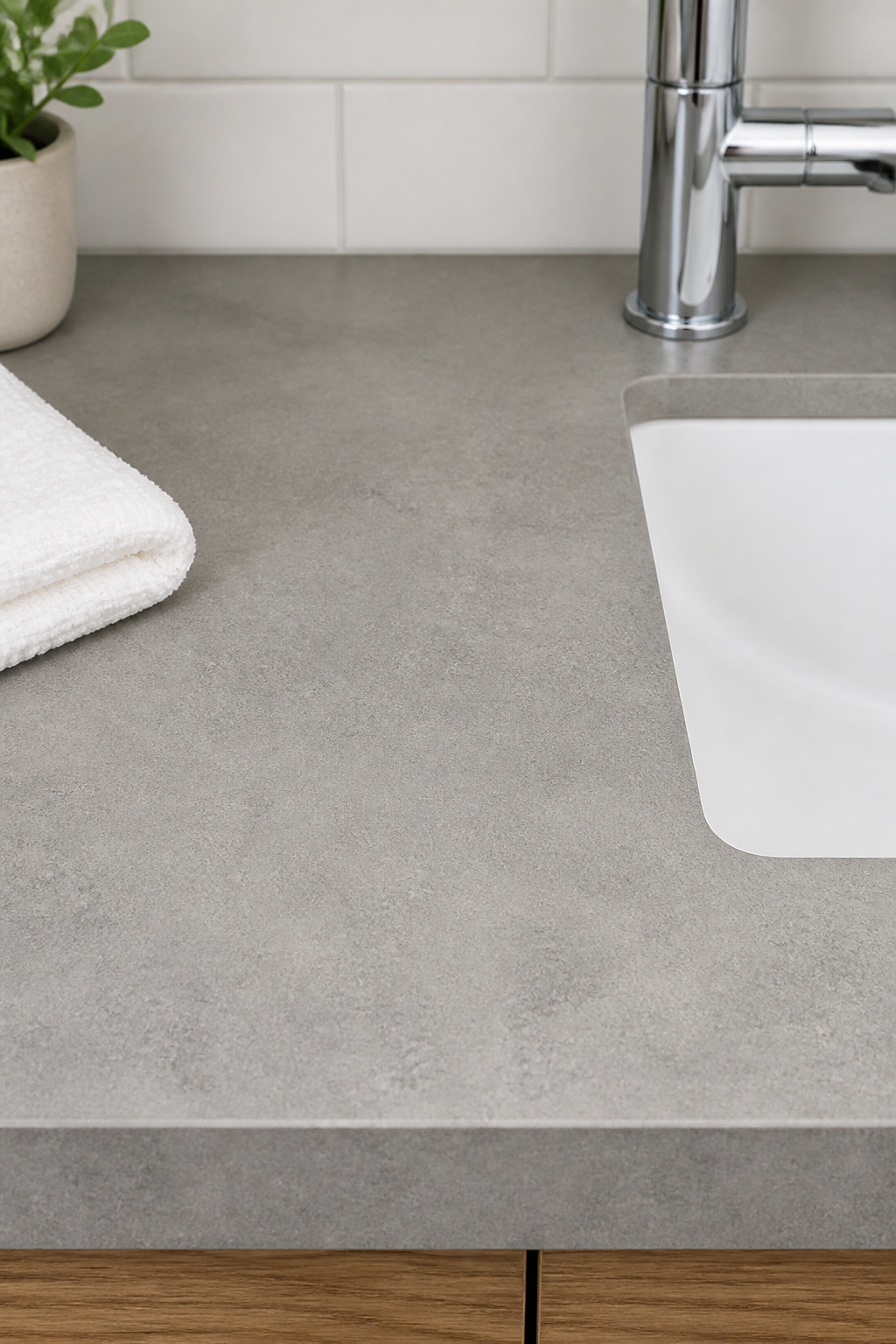
Laminate from Formica or Wilsonart runs $20 to $45 per square foot installed. Newer textured, matte finishes hide fingerprints and water spots far better than the glossy laminate from decades past. It isn’t heat- or impact-resistant, though, and a chip at the seam can’t be repaired invisibly the way solid surface can.
Where It Makes Sense
Typical lifespan runs 10 to 15 years, versus 25-plus for stone. So it’s a practical choice when a homeowner expects to renovate again within a decade anyway. Choose a matte, soft-touch finish with a self-edge rather than a metal T-molding edge. It reads far closer to solid surface, and it holds up better around water. Laminate doesn’t show up often in glossy renovation photos. Even so, it remains one of the most practical bathroom countertop ideas for anyone working with a tight timeline or budget.
14. Travertine for Old-World Texture
Travertine brings a warmth and texture that polished stone simply can’t replicate. That’s exactly why it shows up so often in spaces aiming for an old-world or Mediterranean feel. The choice between filled and unfilled travertine matters more here than with almost any other stone.
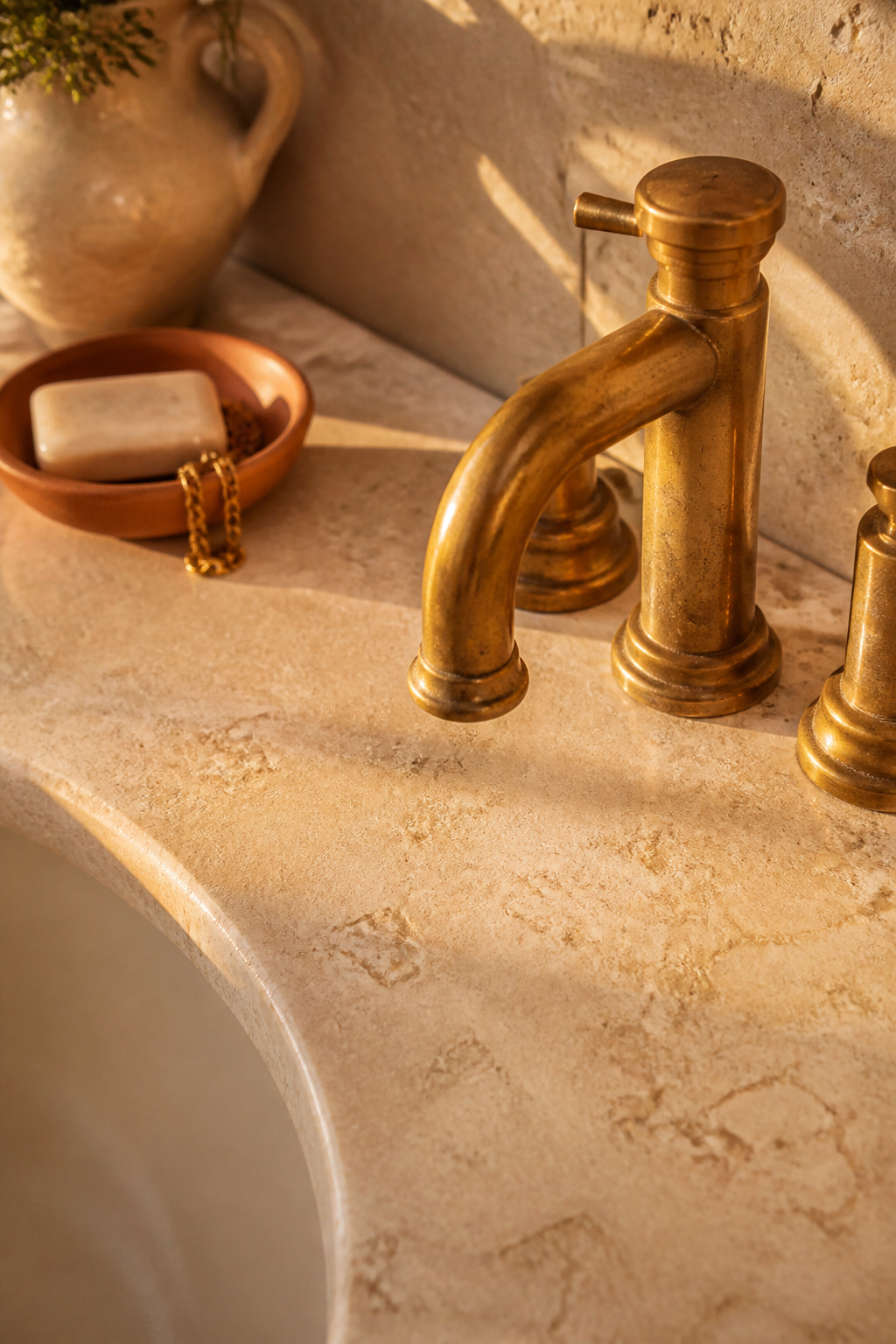
Travertine runs $50 to $100 per square foot. Filled travertine has its natural pits smoothed with resin or grout, while unfilled keeps the raw, pitted texture intact. Filled is the easier choice for a daily-use vanity, since the pits don’t trap moisture and grime the way unfilled stone does.
Pairing It Well
Sealing is needed every six to 12 months, and travertine etches with acidic products much like marble does. The warm, tan-to-ivory tones pair naturally with unlacquered brass fixtures. Those fixtures develop their own patina alongside the stone over the years, so the whole vanity ages together. Anyone weighing this against a full remodel should also look at our bathroom vanity makeover guide for sequencing the work. Travertine ranks among the warmer bathroom countertop ideas here, and it tends to age gracefully in homes that lean traditional or Mediterranean in style.
15. Black Granite or Quartz for Dramatic Contrast
Going dark on a bathroom countertop sounds high-maintenance, but in practice it’s often the opposite. Black granite, like Absolute Black, or a black quartz hides water spots and toothpaste splatter noticeably better day to day than a white or pale surface ever will.
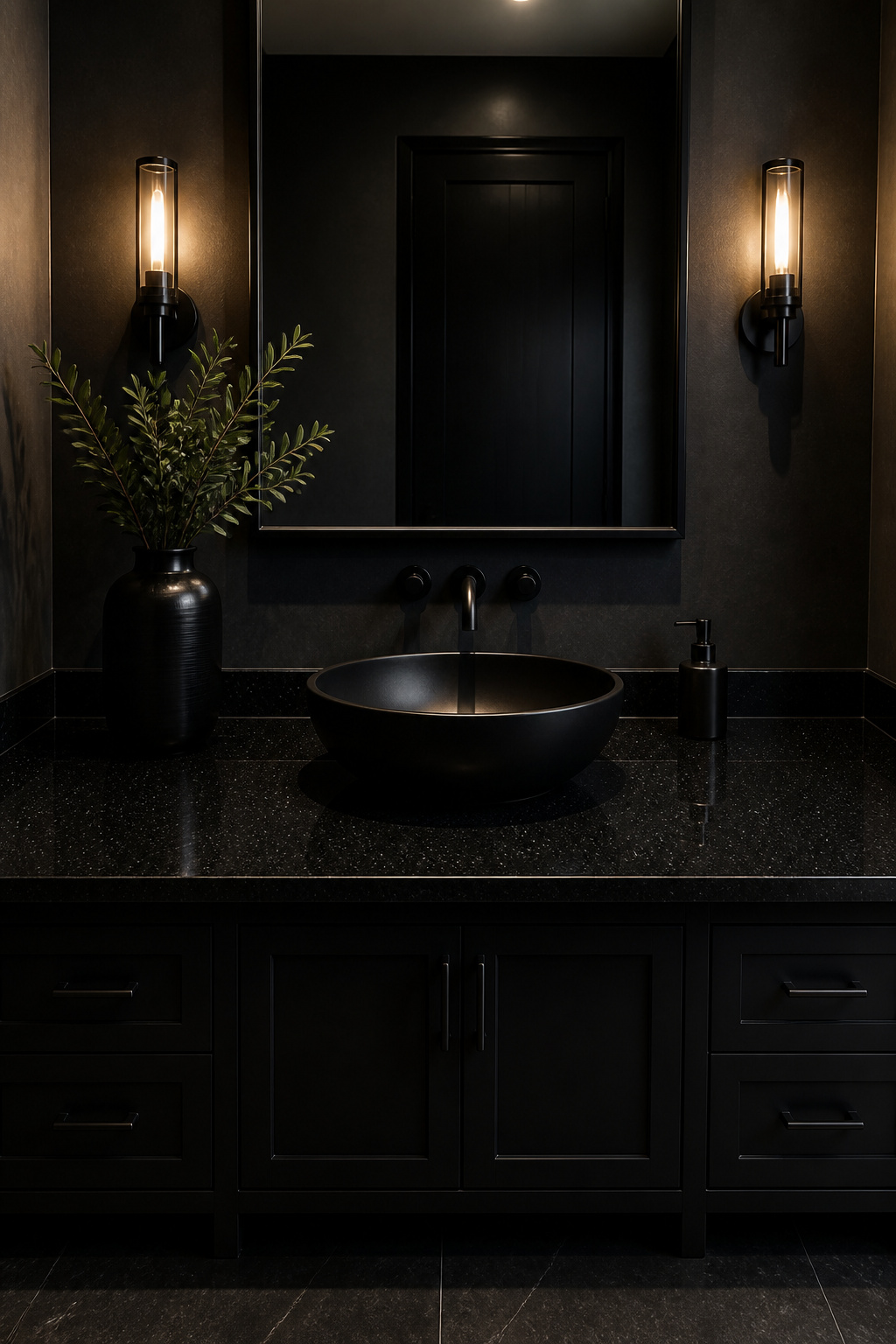
Pricing runs $50 to $110 per square foot, similar to lighter stone options. Dark surfaces do show dust and fine scratches more visibly under direct light, though. A honed rather than polished finish softens that effect considerably, and it’s worth the small upcharge.
Get the Lighting Right First
Plan a layered lighting scheme, sconces plus an overhead fixture, before committing to a dark countertop. A single overhead light alone can make a black surface read flat and cave-like instead of rich and intentional. Brass or matte black fixtures both read well against the contrast, so pick whichever matches the rest of your hardware. Dark surfaces are an underrated entry on any list of bathroom countertop ideas. Most people assume black shows everything, when in daily use the opposite tends to be true.
16. Waterfall Edge: A Dramatic Bathroom Countertop Detail
A waterfall edge wraps the countertop material continuously down the side of the vanity to the floor. It’s the single detail that turns a good countertop into a genuine focal point. It works on nearly any material here, though some handle it more gracefully than others.
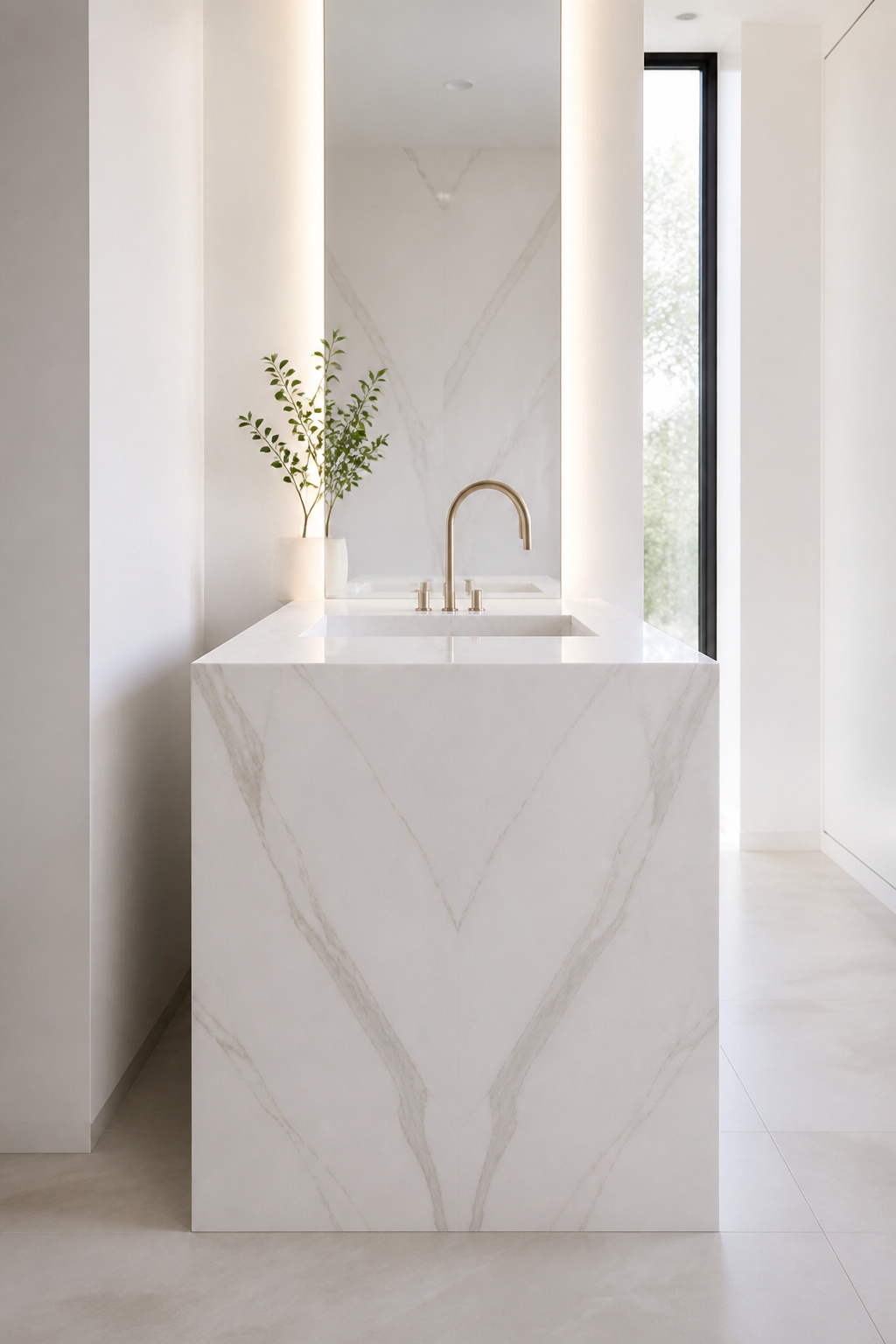
Expect a 20 to 35 percent premium over a standard edge, covering the added material and fabrication time. Quartz and porcelain are the most forgiving materials for this detail, since seams can be mitered nearly invisibly at the corner.
Worth the Splurge for Veined Stone
Natural stone like marble or quartzite can be book-matched at the seam for a mirrored vein effect. That technique roughly doubles the visual impact for a relatively small fabrication upcharge. This detail works best on a floating or furniture-style vanity, where the full vertical run stays visible instead of being tucked behind cabinetry. Of all the bathroom countertop ideas that photograph well for a renovation portfolio, a waterfall edge consistently ranks near the top.
17. Two-Tone Counters That Mix Materials
Mixing materials, a wood-topped vanity flanking a stone or concrete sink deck, lets a tighter budget stretch further than an all-stone surface. It still looks deliberate, not cobbled together. It’s a technique I use often in loft bathrooms, where a steel or concrete sink deck meets a wood-topped storage run.
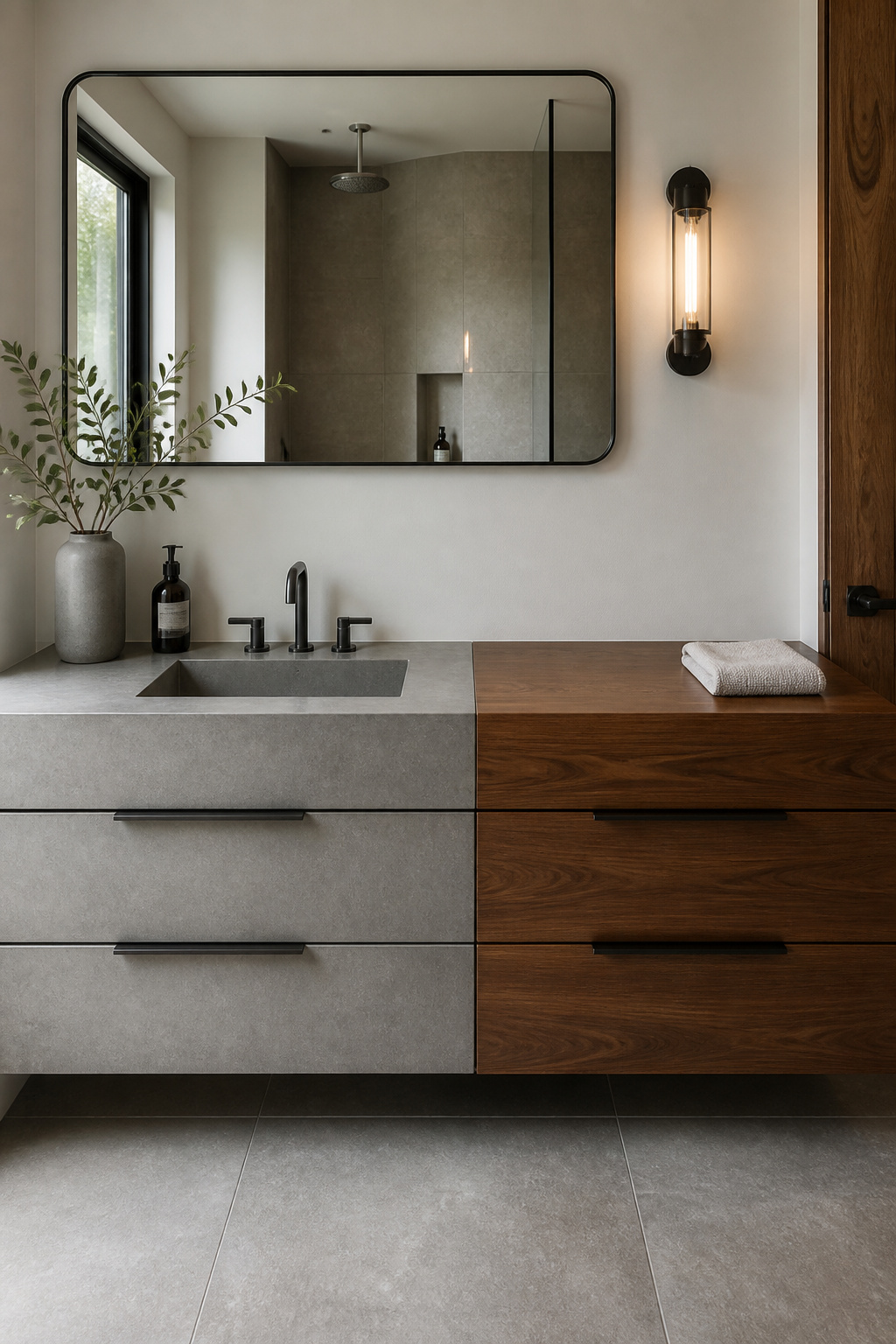
The seam between materials should land at a natural break point, typically the edge of the sink basin. Avoid placing it at the visual center of the vanity, since that reads as accidental rather than designed. Contrasting textures, matte stone against a warm wood tone, read as more intentional than pairing two finishes that feel too similar to each other.
Keep It to Two Materials
Keep the mix to two materials, not three. A third material almost always tips the look from intentional to busy, even when each individual piece is beautiful on its own. For inspiration on pulling the rest of the room together around a mixed-material counter, see our bathroom counter decor roundup. Mixed-material counters remain one of the more flexible bathroom countertop ideas for homeowners who can’t agree on a single finish. It lets two preferences coexist in one vanity.
18. Live-Edge Wood for a Sculptural Statement Piece
For a true one-of-a-kind vanity, nothing beats a live-edge slab. Walnut, maple, and cypress all show up frequently in this application. The natural, irregular edge of the tree becomes the entire design statement, so the rest of the bathroom should stay quiet around it.
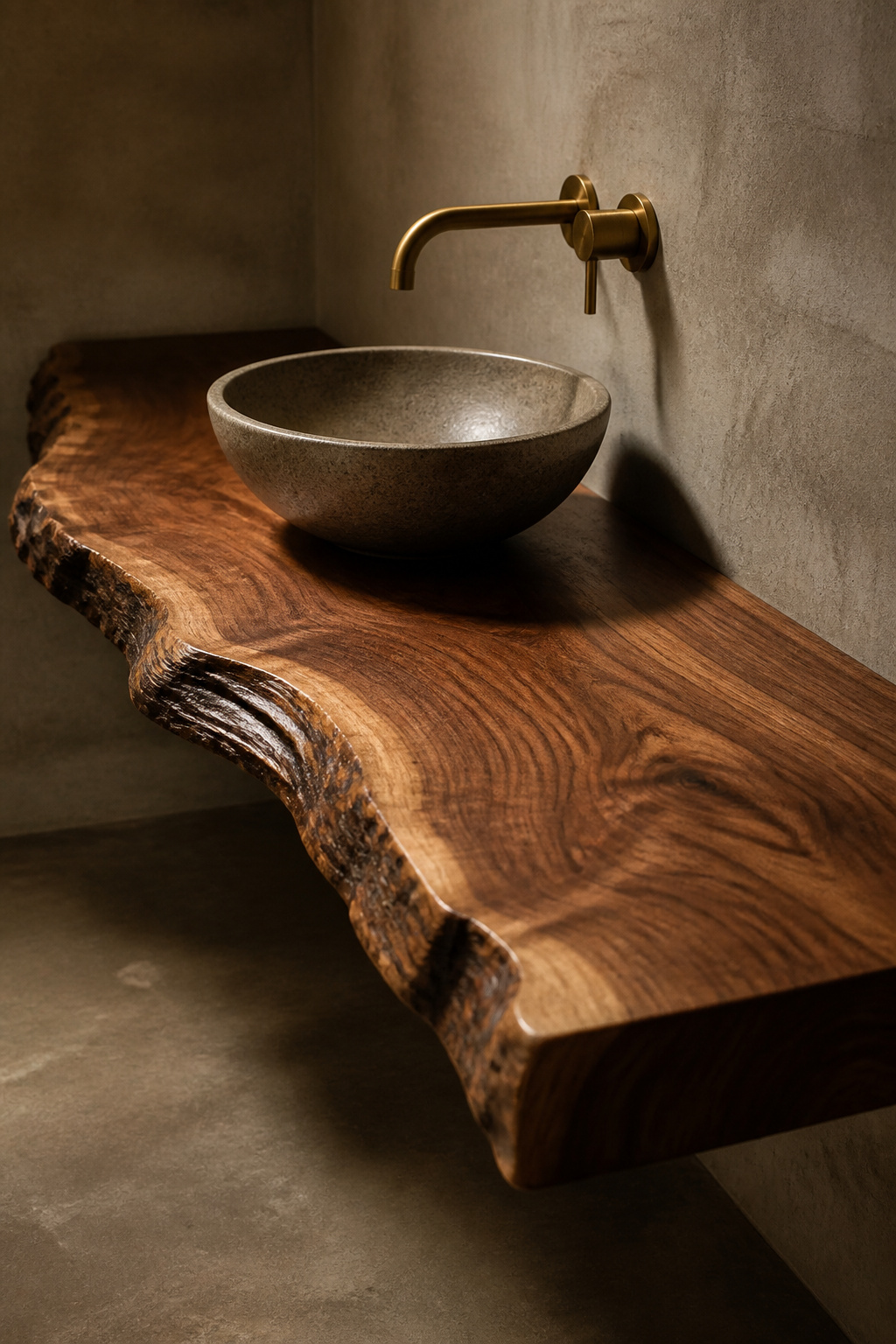
Live-edge slabs run $60 to $150 per square foot, depending on rarity and thickness. A bar-top epoxy or marine-grade resin coating is required to make the slab functional near water. A raw oil finish alone won’t hold up to daily splashing around a sink.
Sourcing It Right
Confirm the slab was kiln-dried to under 10 percent moisture content before fabrication. A green or air-dried slab keeps moving after installation and can crack right at the sink cutout. This works best as a single statement vanity rather than a long double-sink run. Across a wider span, wood movement becomes much harder to manage. Live-edge wood closes out this list of bathroom countertop ideas as the most personal option. No two slabs, and no two bathrooms built around them, ever turn out quite the same.
Choosing the Right Bathroom Countertop for Your Renovation
With 18 bathroom countertop ideas on the table, the decision usually comes down to two questions. How hard does the room actually get used? And how much upkeep are you honestly willing to do? A family bathroom with two kids brushing their teeth every morning calls for something forgiving, like speckled granite, quartz, or porcelain. A guest powder room that sees light use can carry a higher-maintenance material, like polished marble or unfilled travertine, without much trouble.
Budget for fabrication, sink cutouts, and edge profiles separately from the per-square-foot slab price. These additions add 20 to 40 percent to the total project cost in most cases. That waterfall edge or book-matched seam looks dramatic in photos, but it’s the labor, not the material, driving much of the bill.
Before you sign off on anything, order a physical sample at least 12 by 12 inches rather than a small swatch. Veining and color shift across a slab more than most people expect. A tiny chip tells you almost nothing about how a full counter will read in your space. Most stone and engineered surfaces last 20 to 30 years, while laminate runs closer to 10 to 15. Weigh the upfront cost against how long you actually plan to live with the result. Get that part right, and the bathroom countertop you choose now is one you won’t be second-guessing a decade from now. Bring home a sample, live with it under your real lighting for a week, and trust whichever material still looks right by Sunday.