
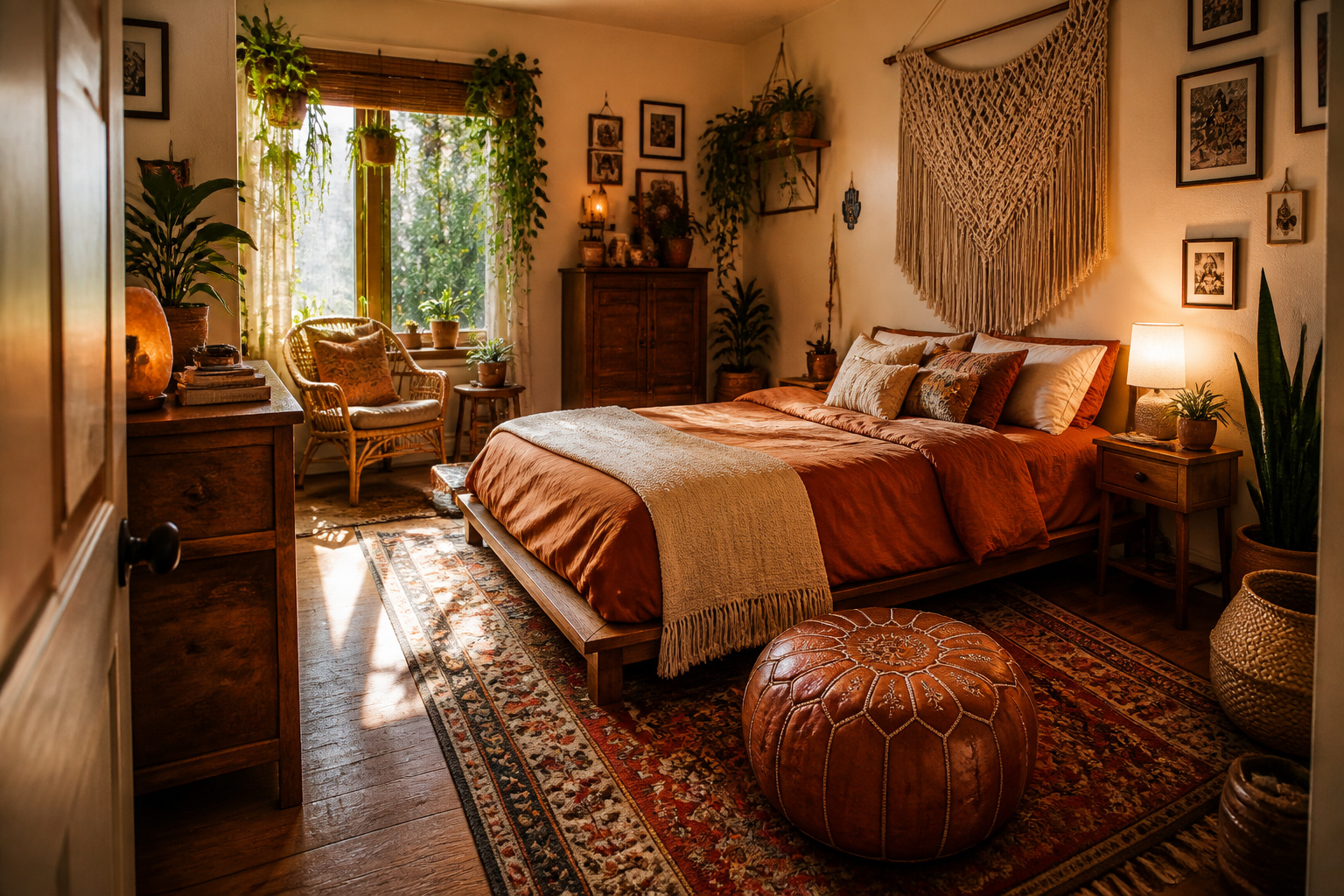

The first thing you notice is the light. It filters through a sheer muslin canopy in soft, scattered pieces. They land on a kilim rug you found folded under a plastic tablecloth at an estate sale last autumn. The air carries a trace of dried lavender hanging on the wall. Your nightstand — a stool you painted terracotta — holds a half-read novel and a brass lamp with amber glow. You haven’t spent a fortune. But you have spent time, attention, and a fair amount of weekend mornings combing through other people’s histories.
That’s what boho bedroom inspirations are really about. Not a shopping list. Not a single aesthetic you copy from a feed. They’re an invitation to collect deliberately, layer intuitively, and build a room that looks like no one else’s. After twelve years sourcing vintage textiles, restoring forgotten furniture, and helping readers create spaces with genuine soul, I’ve found one quality the best boho bedrooms share: every piece has a reason to be there.
These sixteen ideas range from a simple macramé hanging to a full kilim-layered floor situation. None require a big budget. Most require patience, a good eye, and the willingness to walk into a thrift store without a rigid plan.
1. Layered Macramé Wall Hangings as a Bedroom Focal Point
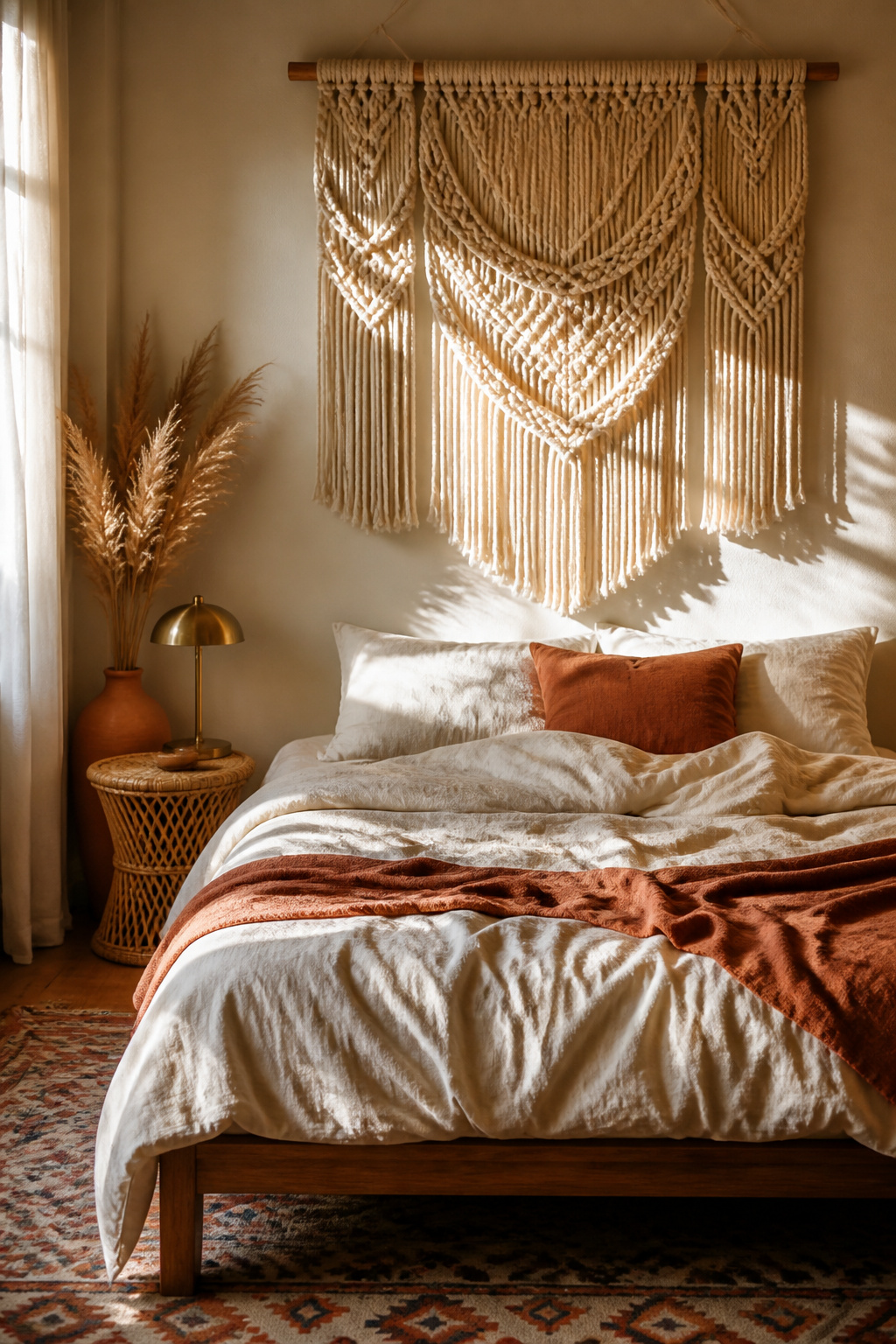
If there is a single object that says “boho bedroom” more clearly than any other, it’s the macramé wall hanging. It has been part of textile traditions from North Africa to South America for centuries. And it does something specific in a room: it adds dimension, warmth, and handmade presence without weight or bulk. A large piece above a bed replaces a headboard beautifully.
Why Macramé Works as a Focal Point
The reason macramé succeeds is textural contrast. In a room of soft bedding, woven rugs, and gathered fabrics, the knots bring a crisper, more graphic element. That contrast stops the room from feeling like a pile of fabric. A large hanging in natural undyed cotton is the most versatile choice. It works against white walls, warm ochre paint, and dark moody hues.
In practice, size matters more than most people realise. A piece that reaches from near the ceiling to roughly pillow height creates a proper focal point. Anything smaller tends to look timid. Go bigger than feels comfortable — it’s almost always right.
Sourcing Handmade Pieces vs. DIY Options
On Etsy, you’ll find genuinely handmade macramé, with pieces ranging from around $45 for a small hanging to $250–$350 for a large statement piece. If you’re confident with a basic square knot, making your own from bulk cotton rope ($18–$30 for a 500g spool) is satisfying. But don’t default to DIY just to save money — a skilled maker’s work has a quality that beginner knotting rarely matches.
2. Vintage Kilim Rugs That Ground Your Boho Bedroom Inspirations
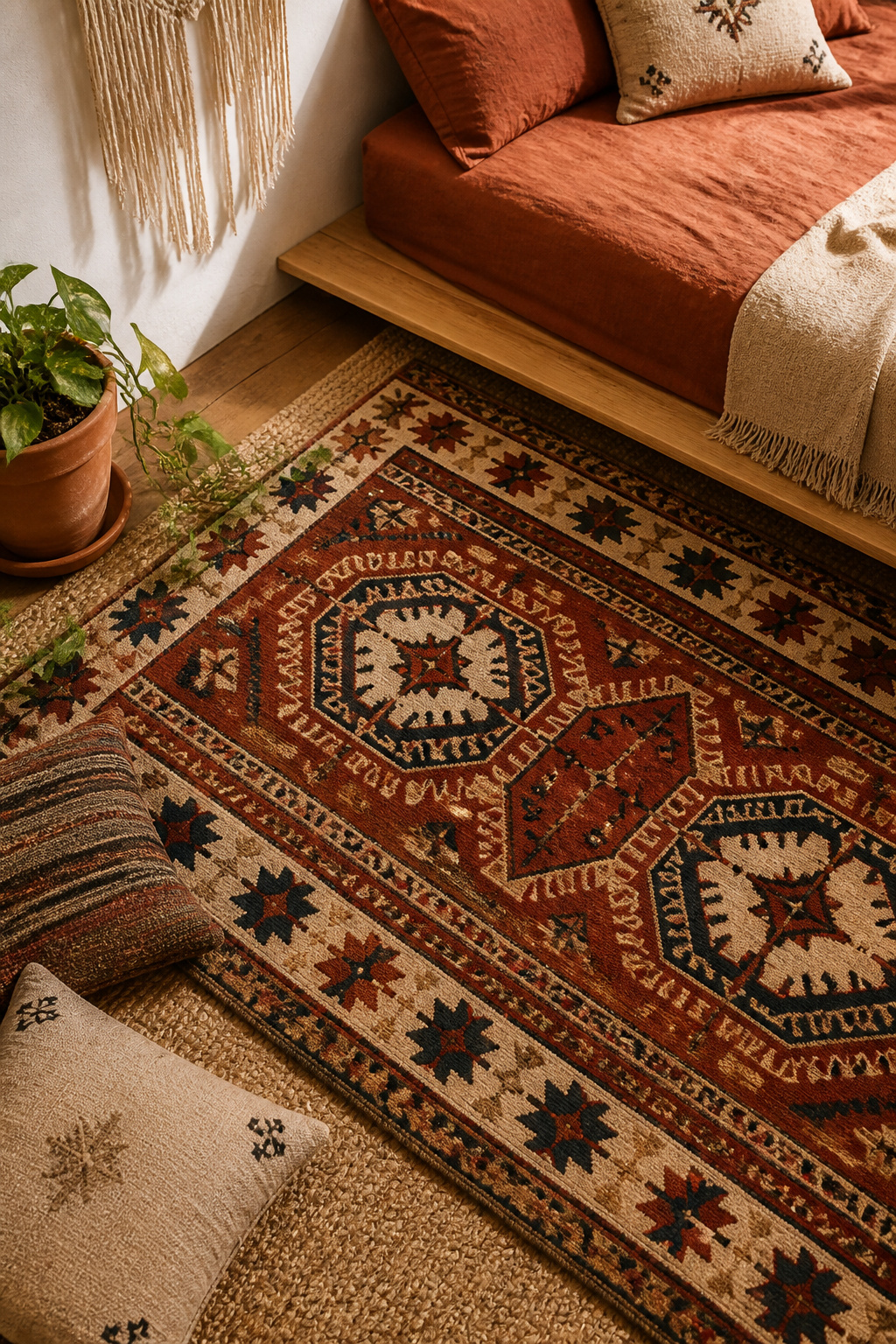
A kilim rug is one of the smartest investments in boho bedroom decor. Unlike pile rugs, kilims are flat-woven — a technique used across Turkey, Afghanistan, Iran, and the Balkans for centuries. The patterns are geometric and often symbolic, so every genuine vintage kilim carries a piece of cultural history. That history is exactly what gives a boho room its depth and authenticity.
The Appeal of Flat-Weave Tribal Patterns
In fact, part of what makes kilims so effective is contrast. In a room with soft bedding, draped fabrics, and organic wood grain, the kilim brings hard-edged geometric structure to the floor without looking rigid. The colours in vintage kilims — brick red, navy, cream, olive, and burnt orange — sit naturally alongside terracotta walls and linen bedding.
For boho bedroom inspirations that feel considered rather than hasty, the rug often ties everything together. Choose it before deciding on cushion colours or curtain fabrics. Let it be your palette reference.
Sourcing Authentic Kilims
In terms of price, authentic vintage kilims range from around $150 for a small distressed piece to $800 and above for larger, well-preserved examples. Estate sales are the best source for underpriced finds. eBay has a vast selection — search “vintage Turkish kilim” and filter by “used” to avoid the reproduction pieces that dominate the market. The key is patience. Don’t buy the first one you see.
Layering Kilims Over Sisal or Jute
Also, one of the easiest ways to achieve the layered, well-travelled look is to place a kilim over a larger natural-fibre base rug. A sisal or jute rug ($60–$120 for a 5×8) underneath lets the kilim float in the centre of the room rather than sitting on bare floor. The contrast between rough natural fibre and graphic kilim pattern is genuinely beautiful.
3. Rattan and Wicker Furniture for Earthy Organic Texture
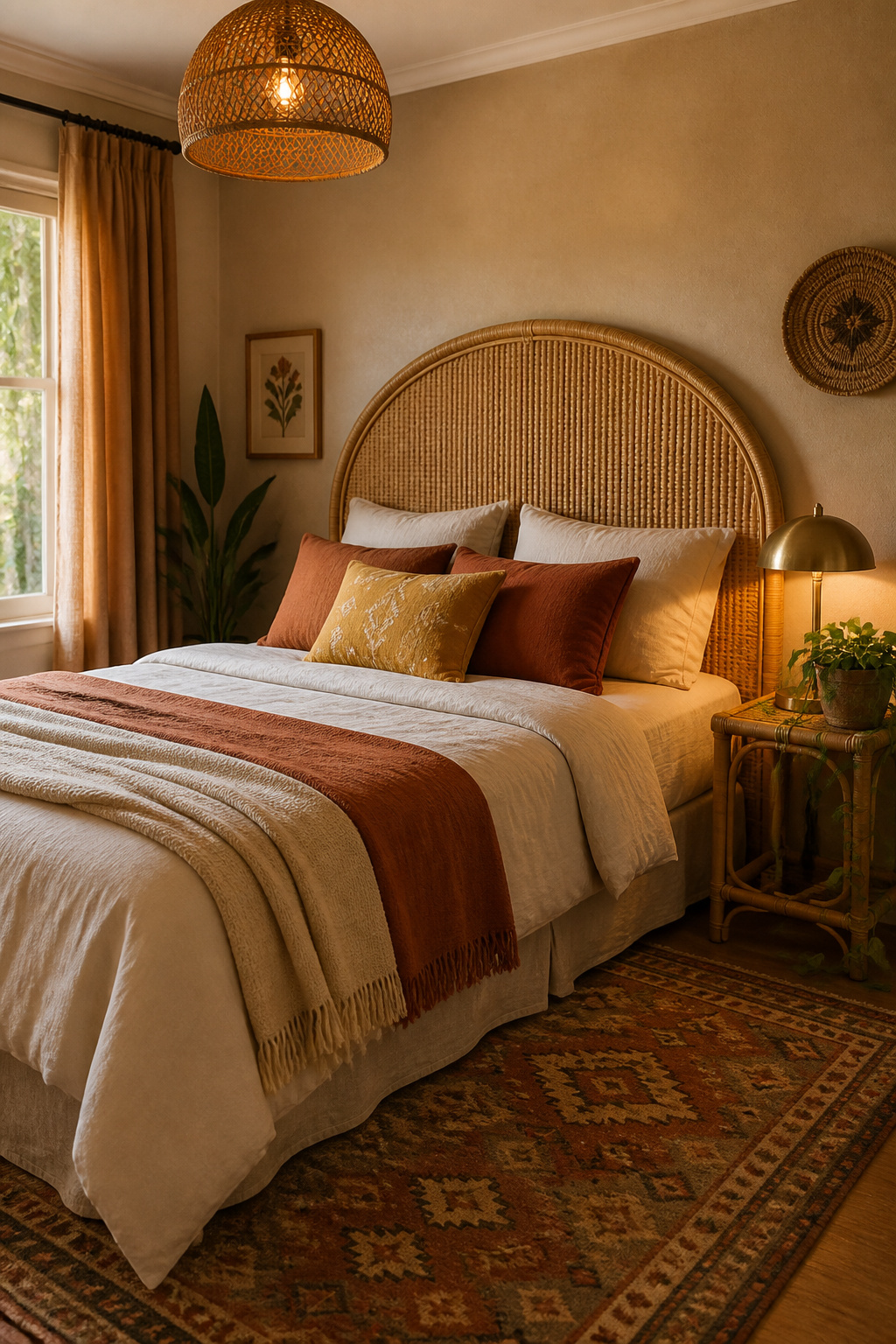
Rattan simply belongs in a boho bedroom. It’s a natural material — technically a climbing palm — with visible grain, irregular weave, and warm amber tones. It feels at home in a room full of layered textiles and indoor plants. A rattan headboard introduces texture without the visual weight of upholstered alternatives. Rattan chairs in the corner are both practical and decorative. And a pair of rattan side tables softens the geometry of a spare room.
Rattan Headboards, Chairs, and Side Tables
For starters, a rattan headboard is the most impactful rattan piece you can add. Prices range from around $120 for a simple arched headboard to $350–$500 for a more elaborate woven design. If you’re buying secondhand, a 1970s rattan headboard from an estate sale is a great find. They’re often available for $20–$60 and have the added quality of genuine age and patina.
For the corner chair, a classic peacock or papasan style works well. Both were popular in 1970s interiors and have become boho staples again. A peacock chair runs $150–$300 new; vintage examples turn up at thrift stores for under $80.
Mixing Rattan With Velvet and Linen
However, rattan’s dry, woven texture is most effective when placed beside something fundamentally different. Velvet cushions on a rattan chair, or linen bedding against a rattan headboard, create tactile contrast that makes a room feel considered. A chunky knit throw draped over a rattan chair arm also works beautifully. The rough and the soft, the structured and the loose — that tension is the whole point of a well-layered boho bedroom.
4. Eclectic Gallery Walls That Tell Your Bedroom’s Story
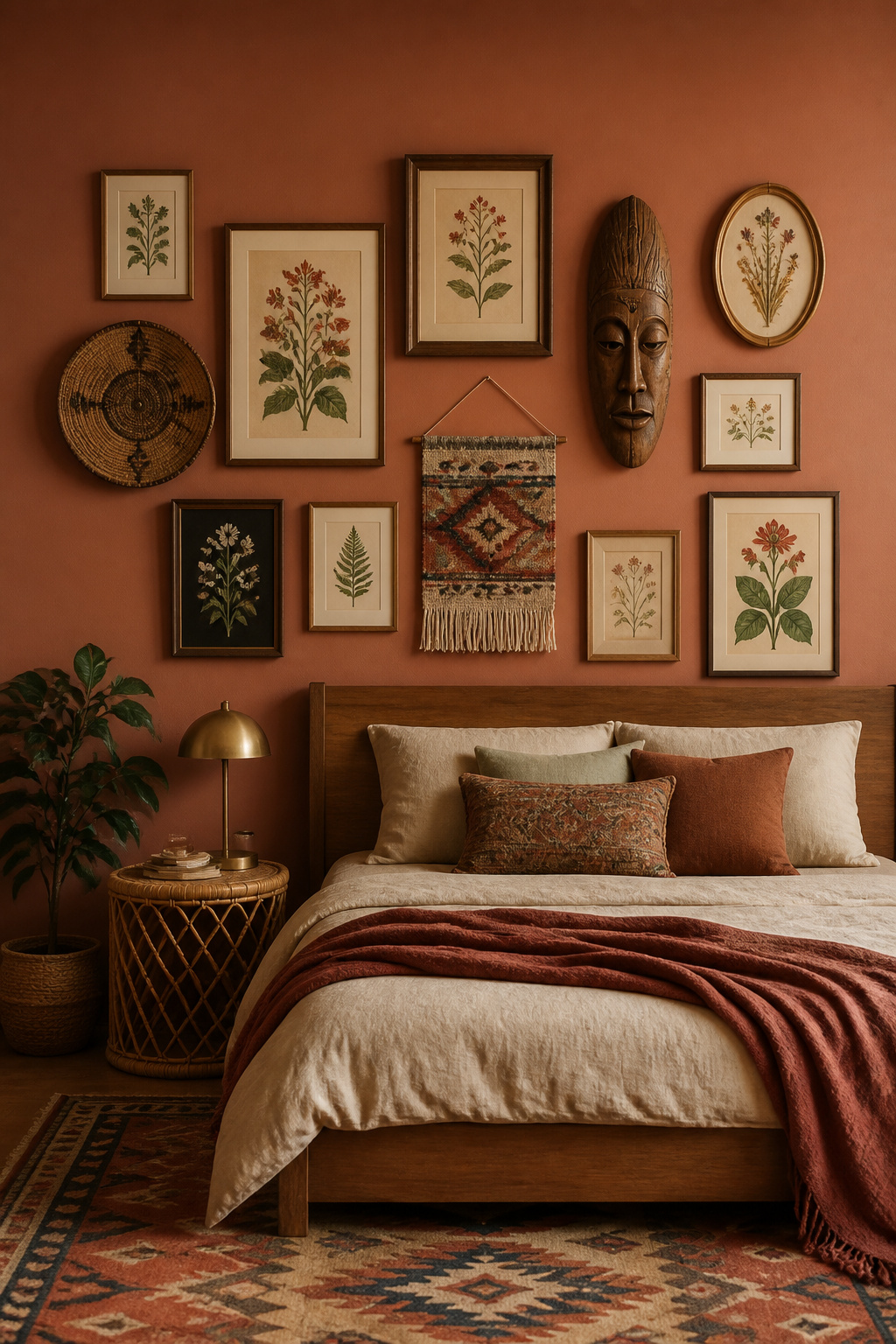
A gallery wall in a boho bedroom is nothing like the curated grid of matching frames in a Scandinavian interior. It’s a layered accumulation: vintage botanical prints found in a junk shop, a small oil painting from a street market, a woven textile piece from a craft fair. The frames don’t match. Sizes vary. Some pieces overlap. The frames don’t match. Sizes vary. Some pieces overlap. Yet the result looks more intentional than any careful grid arrangement.
Mixing Vintage Prints, Woven Art, and Found Objects
The key to a boho gallery wall that looks intentional rather than chaotic is a consistent colour palette — not consistent style. If all pieces share one or two tones — earthy neutrals, or a recurring deep rust — they’ll read as a family even when styles vary. Also consider mixing three-dimensional and flat pieces. A carved wooden mask or small ceramic wall plaque adds depth that flat prints can’t.
Sourcing Art From Thrift Stores and Markets
For example, thrift stores reliably produce framed botanical prints, small landscapes, and occasional curiosities. Budget $5–$30 per thrift find. Independent printmakers on Etsy and at local markets offer original prints with more personality than mass-produced alternatives, typically $15–$60. For textile wall art, follow independent weavers on Instagram and buy directly from them — small woven pieces start at around $35. The whole wall can be assembled for well under $300 with patience.
5. Low Floor Beds and Platform Frames for Boho Bedroom Ideas
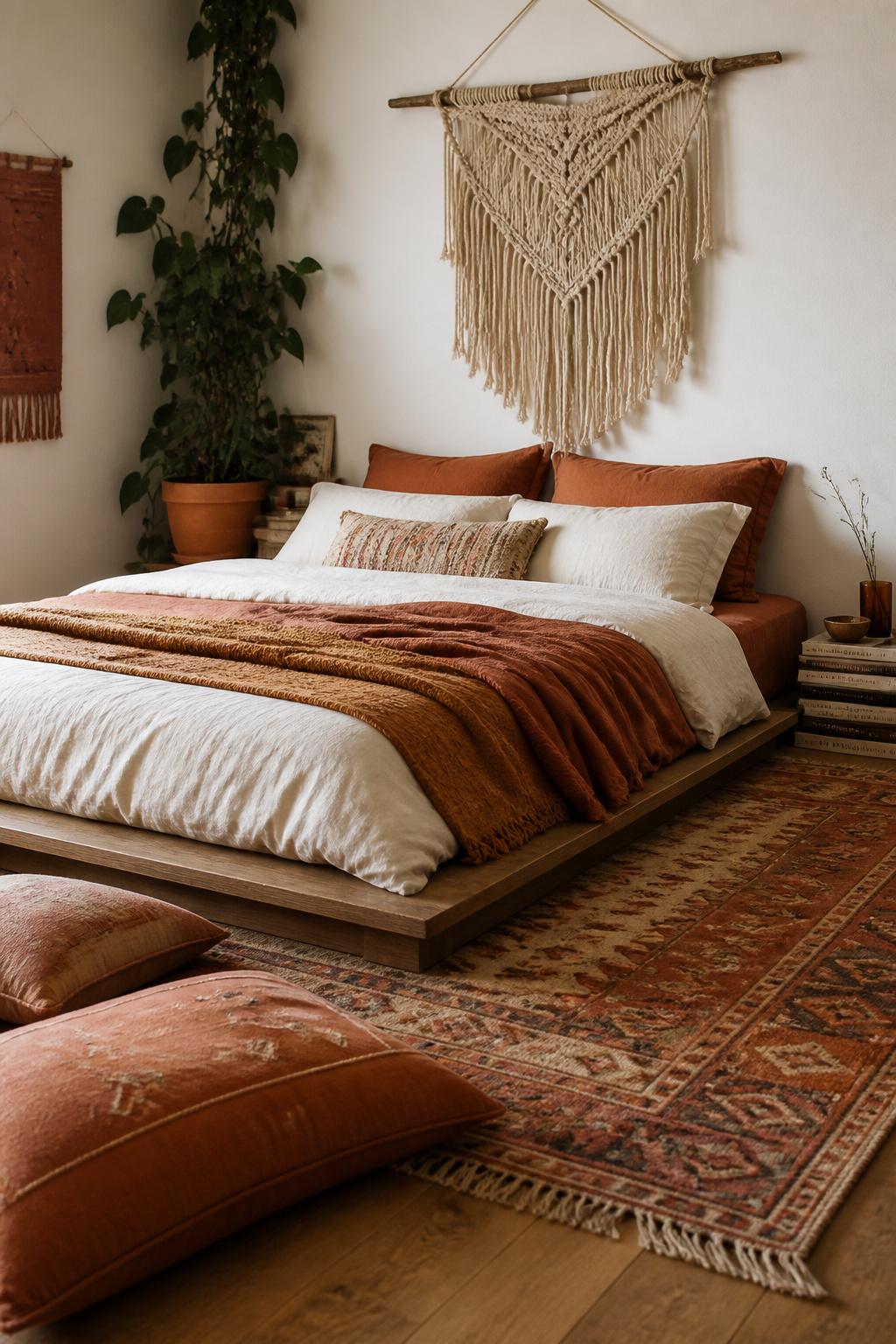
The boho bedroom has a particular relationship with the floor. It embraces it. Low platform beds, floor cushions, stacked books, potted plants at ground level — all of it is intentional. There’s something about proximity to the floor that makes a room feel more grounded, more relaxed. The aesthetic has roots in Japanese futon culture, Moroccan floor seating, and 1970s counterculture interiors that drew from both.
Why Proximity to the Floor Matters
A standard bed frame places the mattress at knee height — functional, but too formal for boho bedroom ideas. Drop the mattress closer to the floor and the room immediately feels more settled. The ceiling feels proportionally higher. The textiles around the bed become more visible and more integrated. Bed height is one of the most impactful changes you can make for the least money.
Good Low-Profile Frame Options
For budget shoppers, IKEA’s MALM at its lowest setting or the MANDAL frame are solid choices. World Market, Article, and Urban Outfitters carry characterful wooden and rattan-detailed options in the $350–$700 range. For secondhand shoppers, a 1970s teak platform bed is a serious find. These are solidly made, inherently boho, and often available for under $200.
Styling the Floor Around a Low Bed
Also, a low bed invites floor styling in a way a high frame doesn’t. Layer a large kilim or jute rug that extends well beyond the bed frame on at least two sides. Add two or three oversized floor cushions at the foot of the bed. Stack three to five books of varying sizes on one side. One or two potted plants at floor level tie the bed into the room rather than leaving it isolated.
6. Canopy Beds Draped With Gauzy Fabrics and Vintage Linen
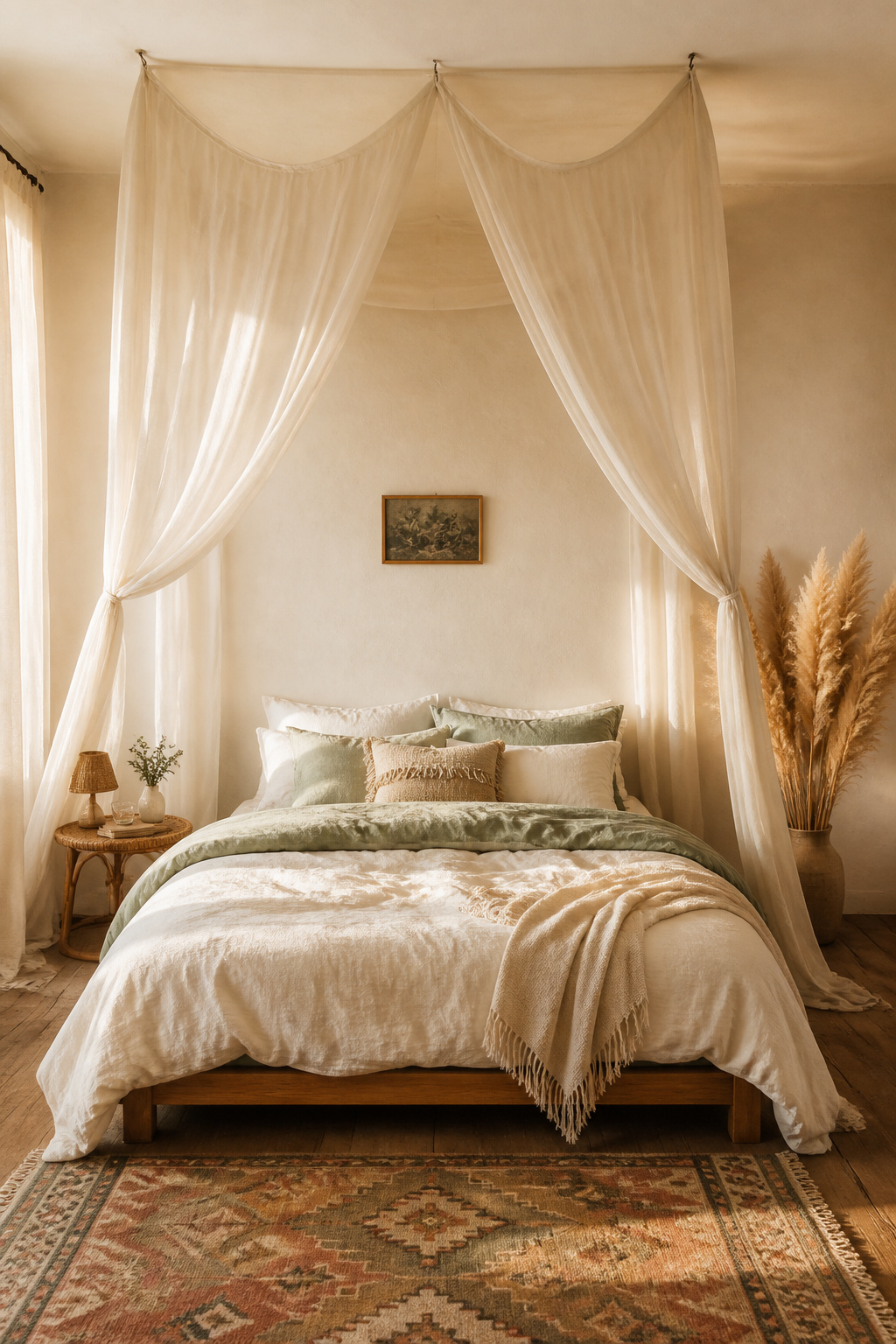
A canopy bed is the bedroom equivalent of a tent — and there’s a reason tents feel so good to sleep in. They create enclosure without walls. They soften hard lines. In a boho bedroom, a canopy doesn’t need an elaborate four-poster frame. A few ceiling hooks and lengths of sheer fabric achieve the same intimate quality for under $50.
The Romantic Quality of Boho Canopy Beds
In fact, the canopy does two things visually. First, it draws the eye upward, making even a low-ceilinged room feel more voluminous. Second, it creates a defined sleeping zone within an open room — ceremony without rigidity. That said, sheers and gauzy fabrics work best because they let light pass through. The effect is atmospheric rather than cave-like.
DIY Canopy Options
The simplest DIY canopy requires two ceiling hooks, a length of wooden dowel, and two sheer curtain panels or lengths of muslin. Fix the hooks on either side of the bed’s centre point, hang the dowel between them, and drape the fabric in a soft arc. Muslin from a fabric shop costs about $3–$5 per metre; you’ll need around 4–6 metres per panel. For something more personal, look for vintage sari fabric. The embroidered borders and woven gold thread details add richness that no generic curtain panel can replicate.
7. Moroccan Textiles as a Boho Bedroom Inspiration Cornerstone
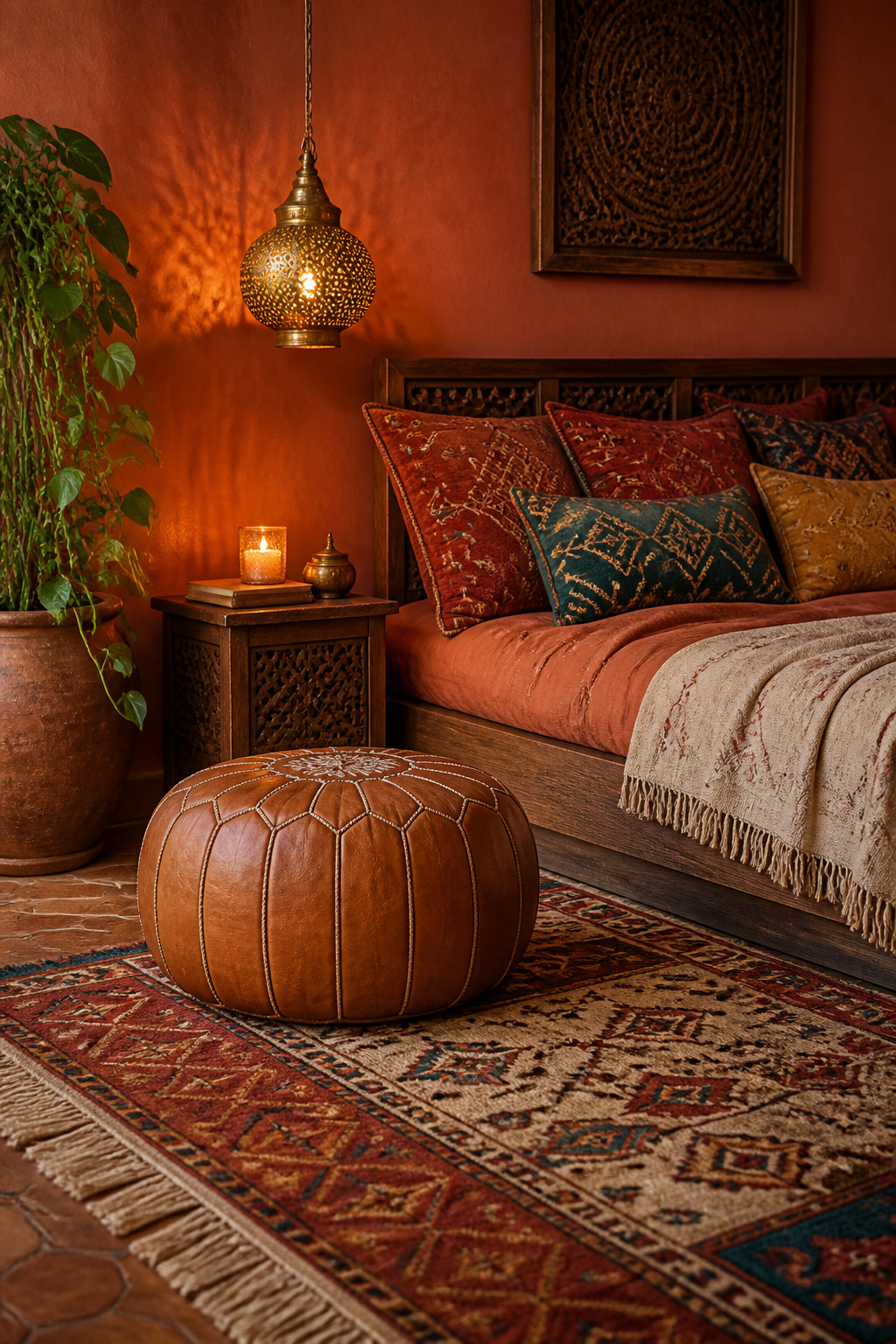
If boho decor has an ancestral home, Morocco is high on the shortlist. The country’s textile traditions form the visual backbone of what we now call “boho.” Think Berber weaving, embroidered caftans, hand-knotted wedding blankets, hammered brass work. These aren’t decorative references to another culture. They’re the real thing. A genuine Moroccan throw blanket, a leather pouf ottoman, or embroidered cushion covers bring a depth of craft that mass-produced alternatives simply can’t replicate.
The Value of Visible Human Labour
What Moroccan pieces bring that other decorative objects don’t is visible making. The symmetrical geometric embroidery on a cushion cover took someone a significant amount of time. The knotted pile of a Boucherouite rag rug represents the creative repurposing of old fabric scraps. That evidence of making is what gives a room its soul. It’s also the quality that distinguishes boho bedroom inspirations that feel genuine from those that just look good on a screen.
For instance, a leather pouf ottoman is the most practical Moroccan purchase: it works as a seat, a footrest, a side table, and a visual anchor. Good quality hand-stitched examples run $80–$180. Embroidered cushion covers are available from $15–$40 each; for the most authentic patterns, look at NOVICA, which works directly with Berber artisans. So one bold Moroccan piece is enough — pair it with plain linen and solid cotton and let it do the talking.
8. Trailing Plants and Hanging Greenery for a Living Boho Atmosphere
A boho bedroom without plants is missing something fundamental. The style is rooted in a relationship with the natural world. Found objects, organic materials, woven fibres — and living plants are the most direct expression of that relationship. The trailing varieties suit a boho bedroom best: they cascade over shelves and down walls, adding soft organic movement that no inanimate object can replicate.
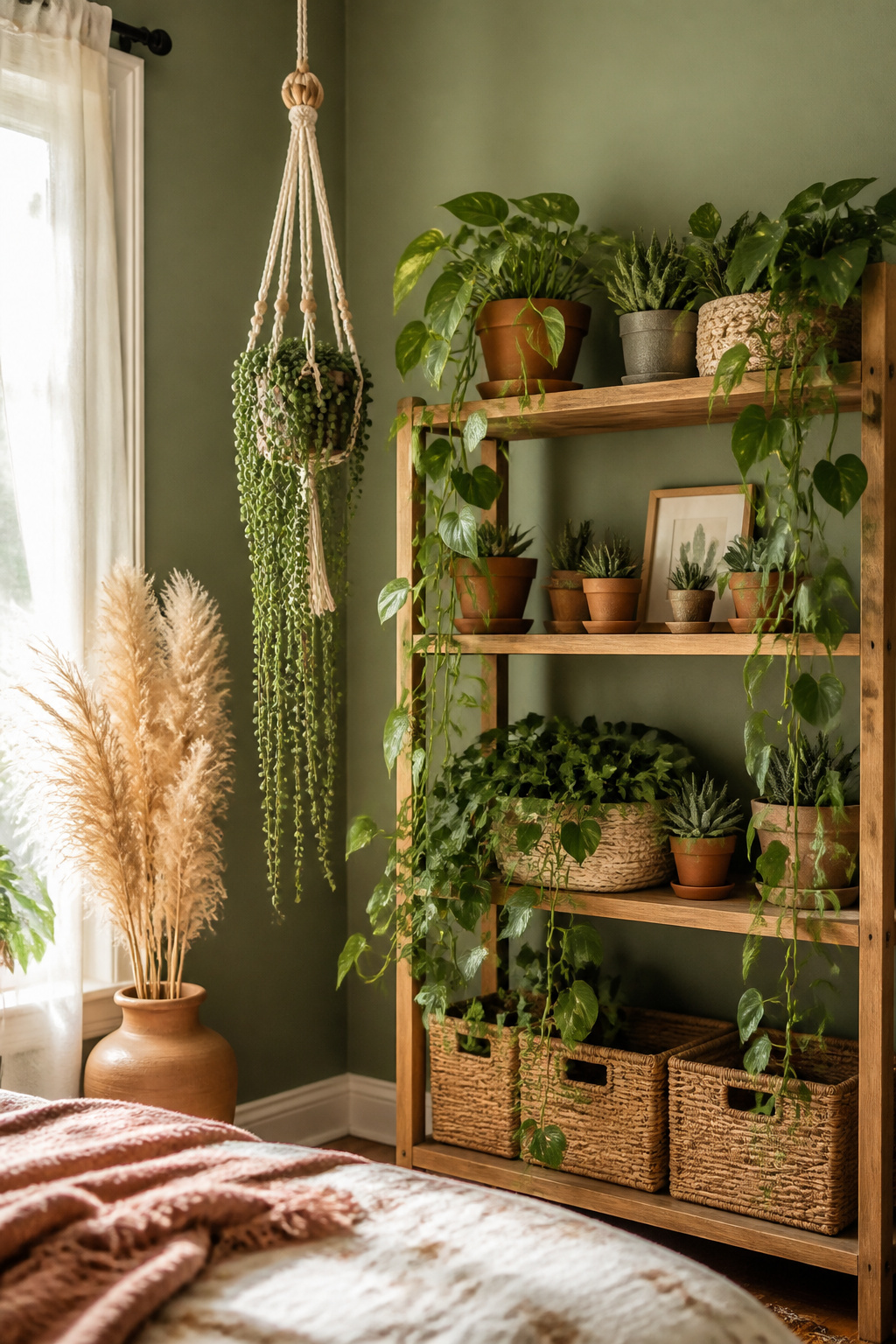
The Best Trailing Plants for Low-Light Bedrooms
For low-light bedrooms, pothos (Epipremnum aureum) is the most forgiving trailing plant available — it tolerates low light, irregular watering, and dry indoor air. A mature pothos in a hanging planter can trail 1.5–2 metres. String of pearls (Senecio rowleyanus) is more delicate but spectacular when cascading from a shelf or macramé holder. Also, tradescantia — particularly the purple-leaved varieties — is fast-growing, dramatic, and near indestructible. All three are available at garden centres for $6–$18 each.
Dried Botanicals as Low-Maintenance Alternatives
Not everyone has time for live plants. Dried pampas grass ($15–$40 for a bundle), dried eucalyptus, dried cotton bolls, and pressed botanicals in frames all offer the natural organic quality of living plants. But none of the maintenance. For example, a tall clay vase of dried pampas grass in the corner is one of those genuinely easy ideas that adds significant visual impact. Also very good: bunches of dried lavender hung upside-down from a wall hook, which add visual texture and fragrance together.
9. Mismatched Vintage Nightstands That Add Genuine Character
The matched bedside table set is a convention, not a rule. In a boho bedroom, deliberately mismatched nightstands almost always look better — more gathered, more personal, more like a room that evolved over time. The key word is “deliberately.” Choose pieces that have enough in common — similar height, a shared wood tone, a complementary colour — so they read as a considered pairing. Otherwise it just looks like an accident.
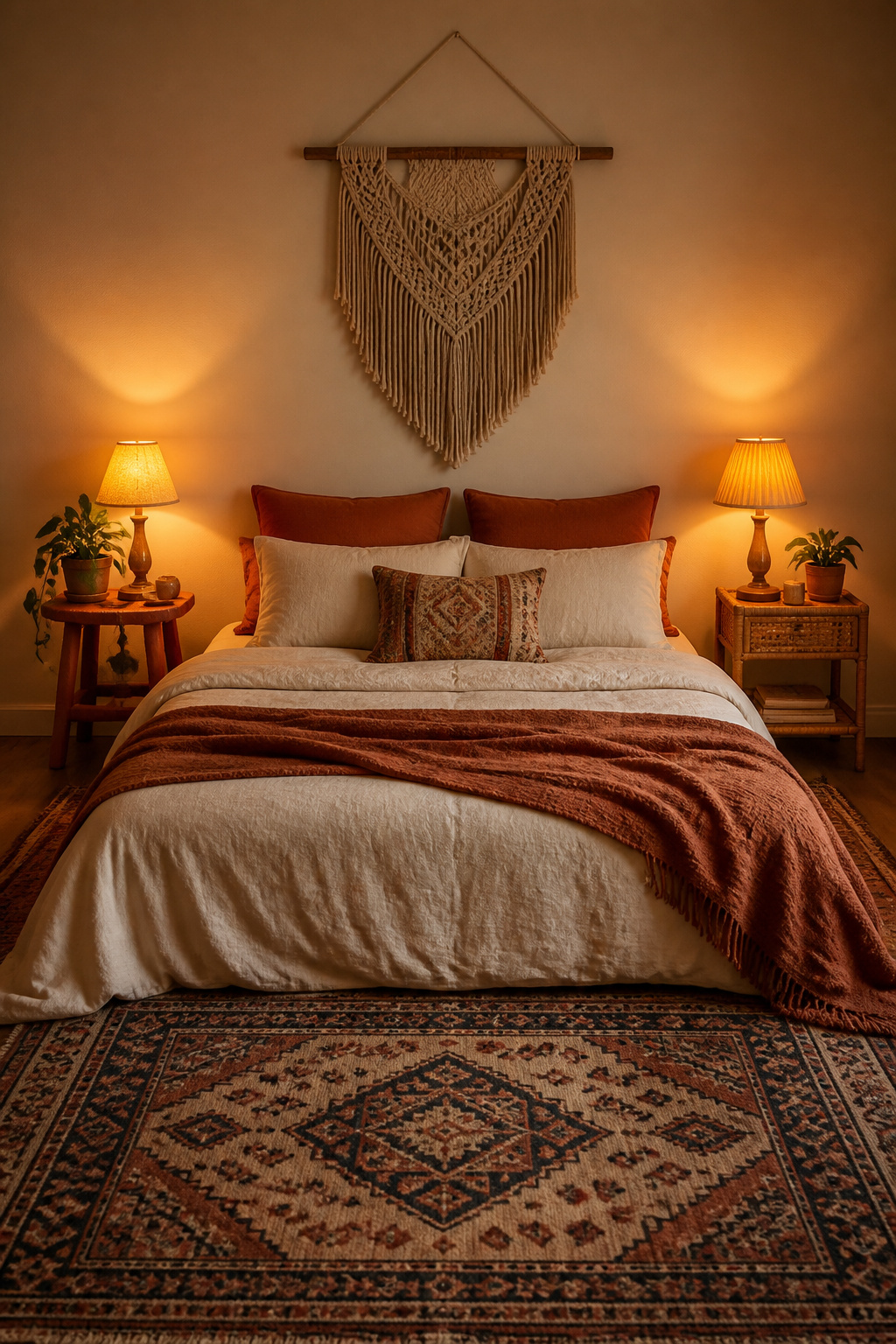
Why Deliberately Mismatched Works
When both nightstands are identical, they’re invisible — they serve a function and then disappear. When they’re different but complementary, each becomes a small statement. The terracotta-painted stool you found at a church sale. The squat rattan table you spotted on Facebook Marketplace for $15. Together they tell a story about how the room was assembled: slowly, with taste, and without a furniture store’s help.
Hunting and Styling Mismatched Nightstands
The best nightstand sources are thrift stores, Facebook Marketplace, and estate sales. You’re not looking for a specific piece. You’re looking for the right height (roughly 55–65cm), adequate surface area, and some inherent character. Small stools, wooden crates, plant stands, and upturned vintage suitcases all work.
For two very different pieces to read as intentional, they need at least one point of visual connection. Shared colour or similar scale is the simplest fix. Then mirror the styling on both tops: a warm lamp, one plant, and a small personal object. The parallel styling creates cohesion even when the furniture itself is different.
10. Earthy Color Palettes That Anchor Boho Bedroom Decor
The boho bedroom’s colour world is not pastel. It’s not grey and white. It’s warm, ochre, clay-fired, weathered — the colours of pigments dug from the earth. Terracotta, rust, raw sienna, soft sage, warm sand, deep burgundy, and sun-bleached cream: these are the tones of authentic boho bedroom decor. They work because they’re the colours that textiles and natural materials carry naturally.
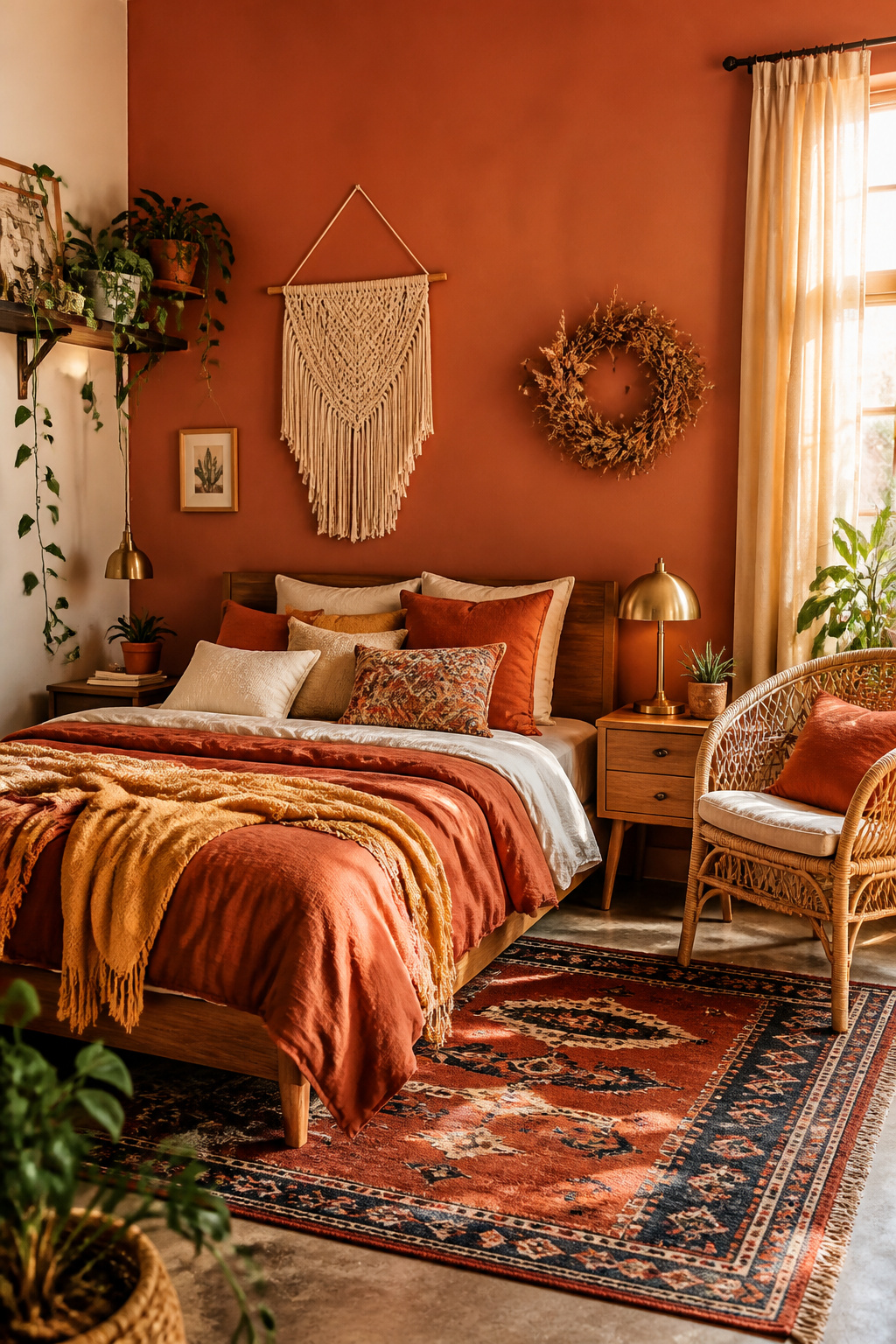
Building the Palette
For walls, Farrow & Ball’s “India Yellow” and “Dead Salmon” are among the best known earthy tones. Benjamin Moore’s “Moroccan Red” and “Pale Moon” are more accessible alternatives. For textiles, start with undyed linen in cream or oatmeal as a base, then add throws and cushions in rust, ochre, sage, and burgundy. URBANARA and Piglet in Bed carry excellent linen bedding; Moroccan and Turkish suppliers sell vividly dyed cotton that anchors boho bedroom decor beautifully.
Preventing the Palette From Feeling Heavy
However, the risk with deep earthy tones is a room that feels airless. The antidote is the ceiling: keep it white or very light, even if the walls are mid-toned terracotta. Natural light also helps enormously. Use sheer window treatments rather than heavy curtains to let light work with the colour. Also, include at least one large pale element — undyed linen bedding, a natural-fibre rug — to give the eye a rest.
11. Woven Bamboo and Seagrass Ceiling Treatments for Overhead Interest
Most people never think about the ceiling as a design surface in a bedroom. But in a boho bedroom, looking up should be as interesting as looking around. Woven bamboo panels, a rattan pendant light, dried botanicals suspended from hooks, a circular seagrass ceiling panel above the bed — any of these transforms the ceiling from a blank surface. Instead, it becomes part of the room’s texture story.
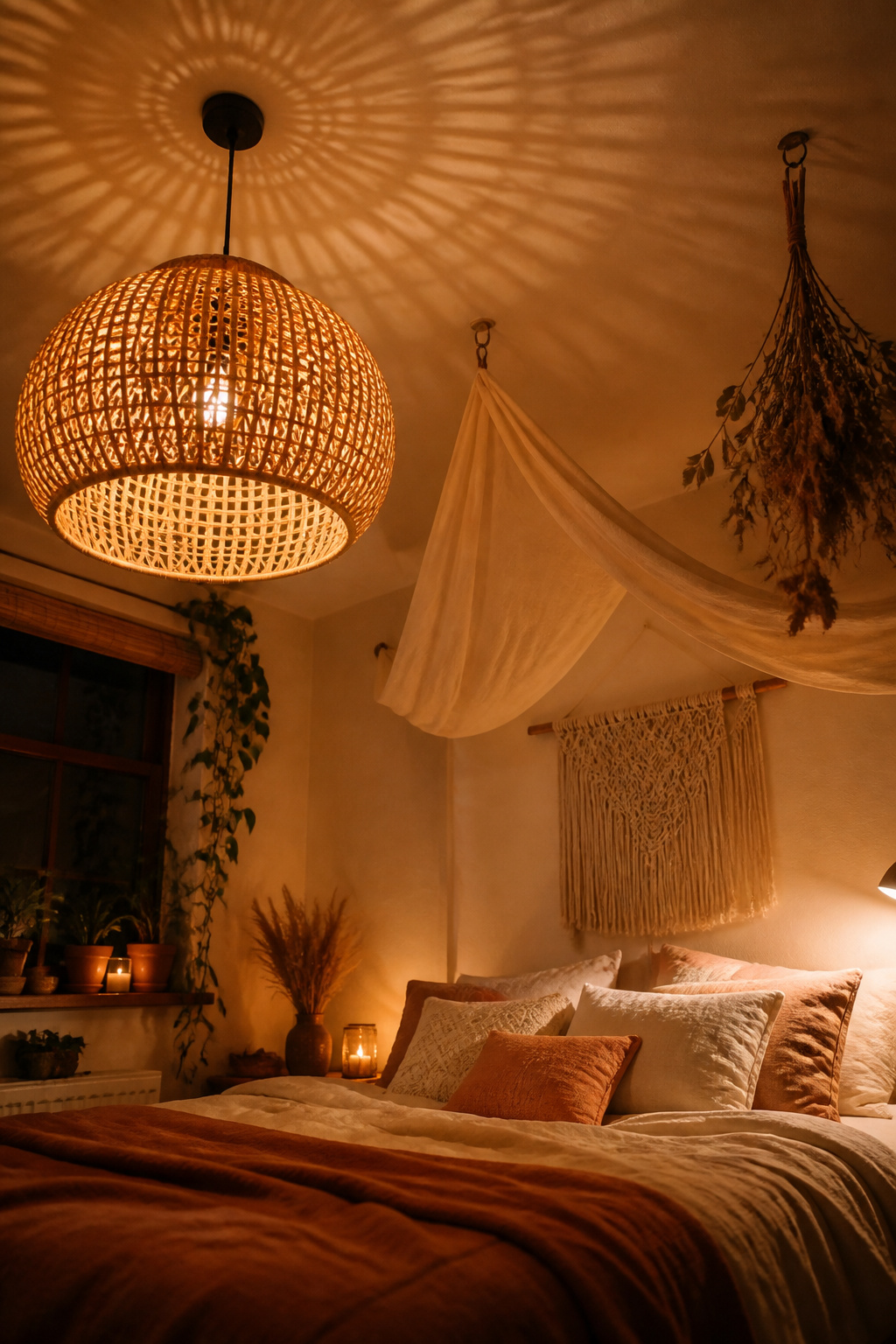
Woven Ceiling Panels and Rattan Pendants
For example, woven bamboo ceiling panels — the kind used for outdoor pergola covering — can be cut and installed inside as a ceiling feature above the bed. A 2×3 metre panel costs $40–$80 at garden centres and creates a visually rich overhead surface. Fix it with simple ceiling hooks and zip ties for a rental-friendly installation. The slight irregularity in the weave pattern throws interesting shadows when light comes from below.
Also, a rattan or wicker pendant shade is the most straightforward boho bedroom lighting upgrade. Prices range from $30 for a simple ball-shaped shade to $120 for a more elaborate sculptural form. Moreover, the warm golden light that filters through the weave at night is transformative — entirely different in character from a fabric shade.
12. Fairy Lights and Warm-Toned Bulbs for Intimate Boho Glow
Boho bedrooms aren’t well-lit rooms. They’re warmly lit rooms. The difference matters. In fact, overhead fluorescent light is the enemy of everything the boho bedroom is trying to achieve. Warm, low, layered light sources are its allies. Very small changes make a disproportionate difference here. Swapping a single cool bulb for a warm one, adding fairy lights, placing a salt lamp on the nightstand — each one shifts the room.
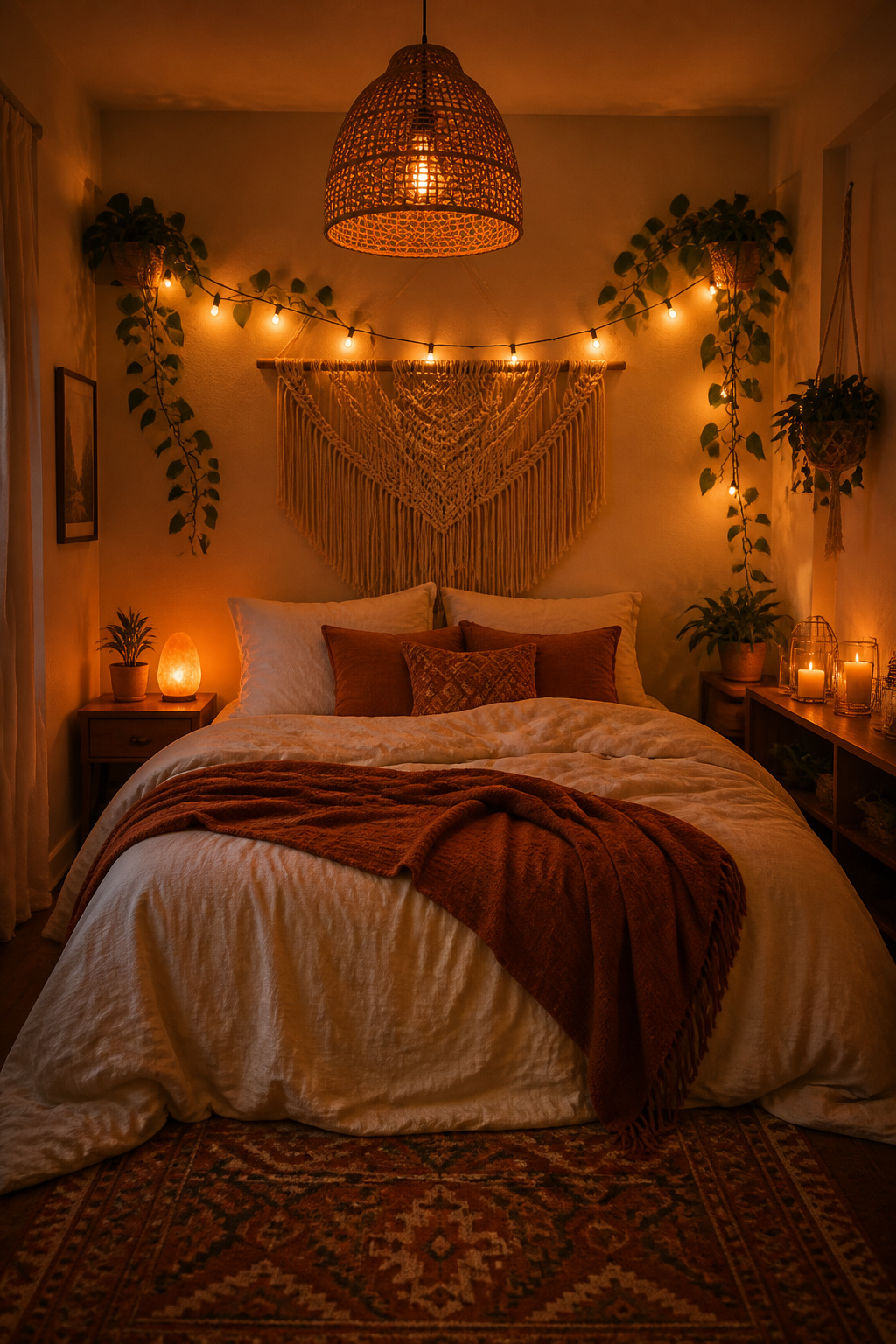
Layering Light Sources
For a boho bedroom, the lighting hierarchy runs roughly: candles at the top (most atmospheric, but needs care), copper-wire fairy lights at 2700K in second place, and Edison filament bulbs in rattan shades for ambient. Salt lamps add a gentle constant glow at the bottom of the stack. All four layers together is the ideal. All four can be set up for under $100 total. So the transformation from overhead-only lighting to this multi-source setup is dramatic. You can also draw on our guide to 12 Nurturing Cozy Bedroom Ideas for lighting inspiration — many of those ideas overlap naturally with boho principles.
Salt Lamps as Ambient Sources
The wellness claims around salt lamps are not well-supported by evidence. But the light they produce is genuinely beautiful — a soft, slightly pinkish amber that is uniquely flattering. A medium salt lamp costs $25–$45 at health food stores or online. Place it on the nightstand beside a book and a glass of water. Indeed, it becomes part of the room’s character in a way few objects do.
13. Boho Bedroom Inspirations From Thrift Store Textile Hunting
Some of my most-used boho bedroom finds cost less than $10. A large cotton tablecloth with embroidered edges, re-draped as a lightweight bedspread. Some linen curtain panels in faded rust, layered with a sheer. A velvet cushion cover with one loose thread that took ten seconds to fix. In short, the thrift store is the most reliable source of genuinely individual pieces. Nothing else produces that combination of quality, price, and unexpectedness.
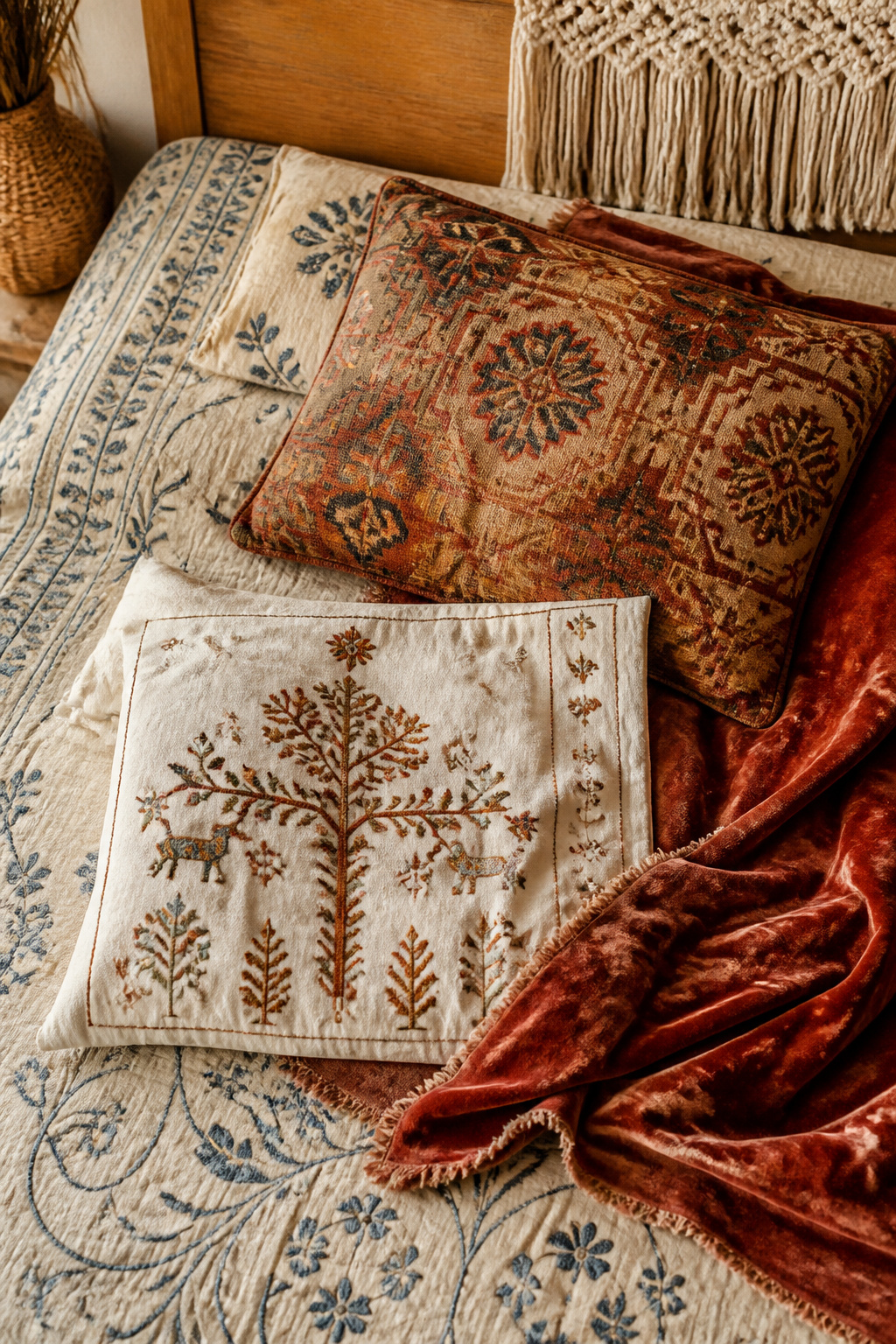
What to Look for When Sourcing Vintage Textiles
The best thrift store textiles for a boho bedroom are natural fibre pieces with surface interest: embroidery, texture, pattern, or unusual colour. Also, look at the underside of any piece — fading on one side often means the colour is well preserved on the other. Feel the weight: natural cotton and linen have a satisfying hand-feel that synthetic fabrics can’t replicate. Check wool pieces for moth damage too (a few small holes are usually fine; widespread damage means the moths are still active). A flat embroidered tablecloth in reasonable condition, re-draped over a bed, can look extraordinary — and usually costs $4–$12.
Refreshing and Repurposing Vintage Textiles
For cleaning, a 40-degree machine wash removes most storage smells and light staining from cotton and linen pieces. For delicate embroidery, a cold gentle cycle is safer. Dry flat or hang in sunlight rather than tumble drying. Indeed, most thrift store textile finds come up beautifully with a single wash.
Also, a large vintage tablecloth — particularly one with embroidered borders — makes an excellent lightweight bedspread for warmer months. A silk or cotton scarf draped over the foot of a bed adds colour and pattern without the commitment of a full throw. I once found a hand-embroidered Hungarian tablecloth at a junk sale for $7. It became the centrepiece of a client’s boho bedroom, draped at an angle over linen and anchored with a leather pouf. The whole room was built outward from that $7 find.
14. Layered Throw Pillows in Clashing Patterns for Maximum Boho Effect
The boho bedroom does not do matching cushion sets. It does an apparently spontaneous accumulation of cushions in different sizes, patterns, fabrics, and colours that somehow cohere into a unified picture. Getting this right takes more thought than it looks. There are principles at work: scale variety, a shared colour family, the rule of odd numbers. And the textile mix should include at least one embroidered, one woven, and one plain piece.
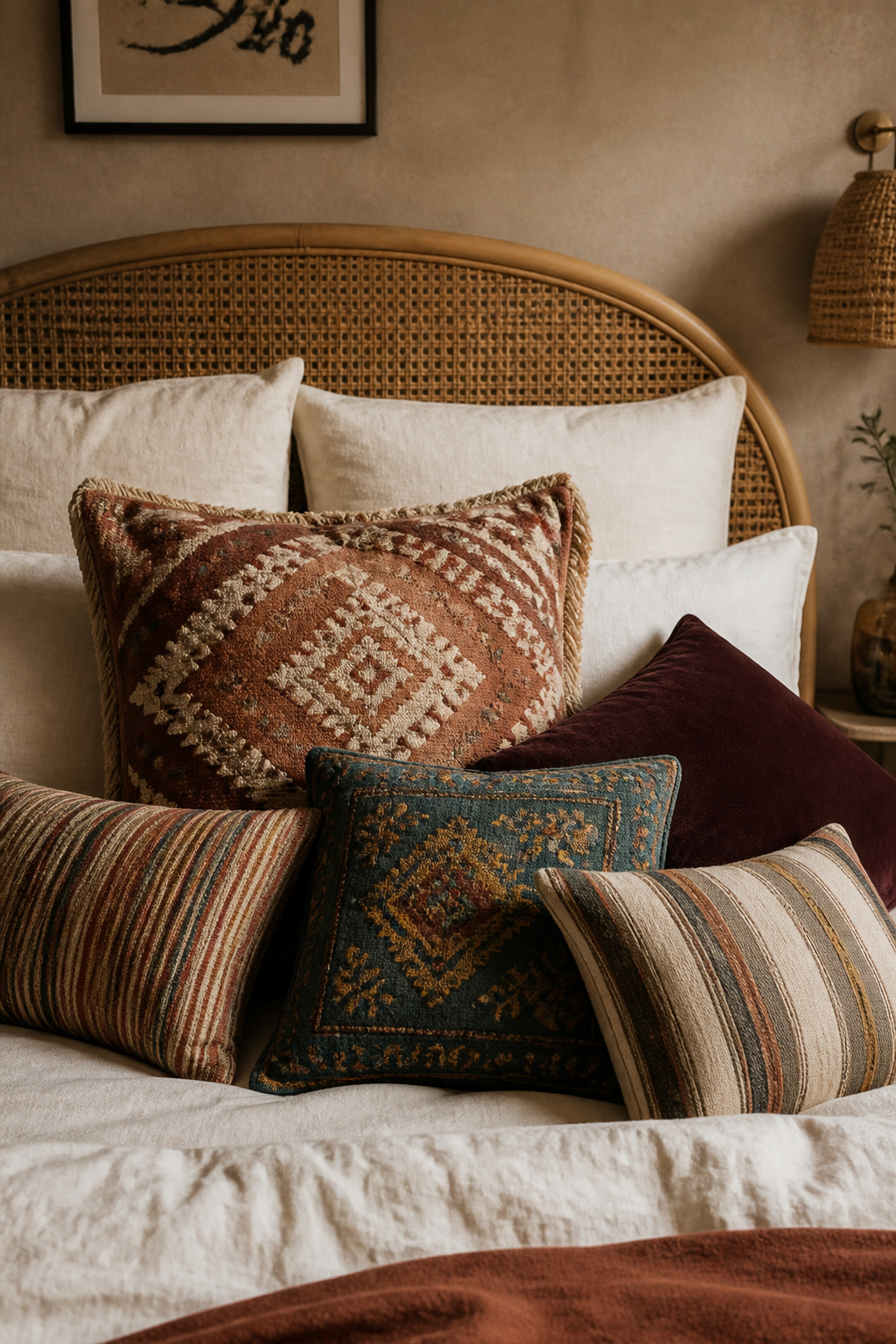
The Rule of Odd Numbers and Size Mixing
Interior designers favour odd numbers for decorative groupings, and cushion arrangements are no exception. Three, five, or seven cushions look more dynamic than even numbers. Vary the sizes significantly. Two large square pillows (65x65cm) at the back as anchors, two medium pillows (50x50cm) in the middle, and one long lumbar pillow or two smaller cushions in front. This size progression creates natural layering. The arrangement should look casual. But it needs that underlying structure to stop it collapsing into a heap.
Mixing Patterns Without Chaos
Pattern mixing follows a simple rule: if the scales are different, the patterns can coexist. A large-scale geometric Moroccan pattern beside a small-scale floral and a fine stripe reads as a collection rather than a conflict. However, where the mixing goes wrong is when two medium-scale patterns of similar visual weight compete — both fight for attention. Also, keep the colour family consistent. Warm tones together, or cool tones together, rather than a mix of both.
15. Natural Wood Furniture With Visible Grain, Knots, and Patina
There’s a particular quality of wood that suits a boho bedroom, and it isn’t smooth, lacquered, or uniform. The pieces that work best are imperfect: wood with a strong visible grain, occasional knots, some variation in colour, and ideally a patina that suggests history. Mango wood has a beautiful natural marking pattern. Acacia has a rich swirling grain. Reclaimed timber has character that no newly cut wood possesses. The imperfections are the point.
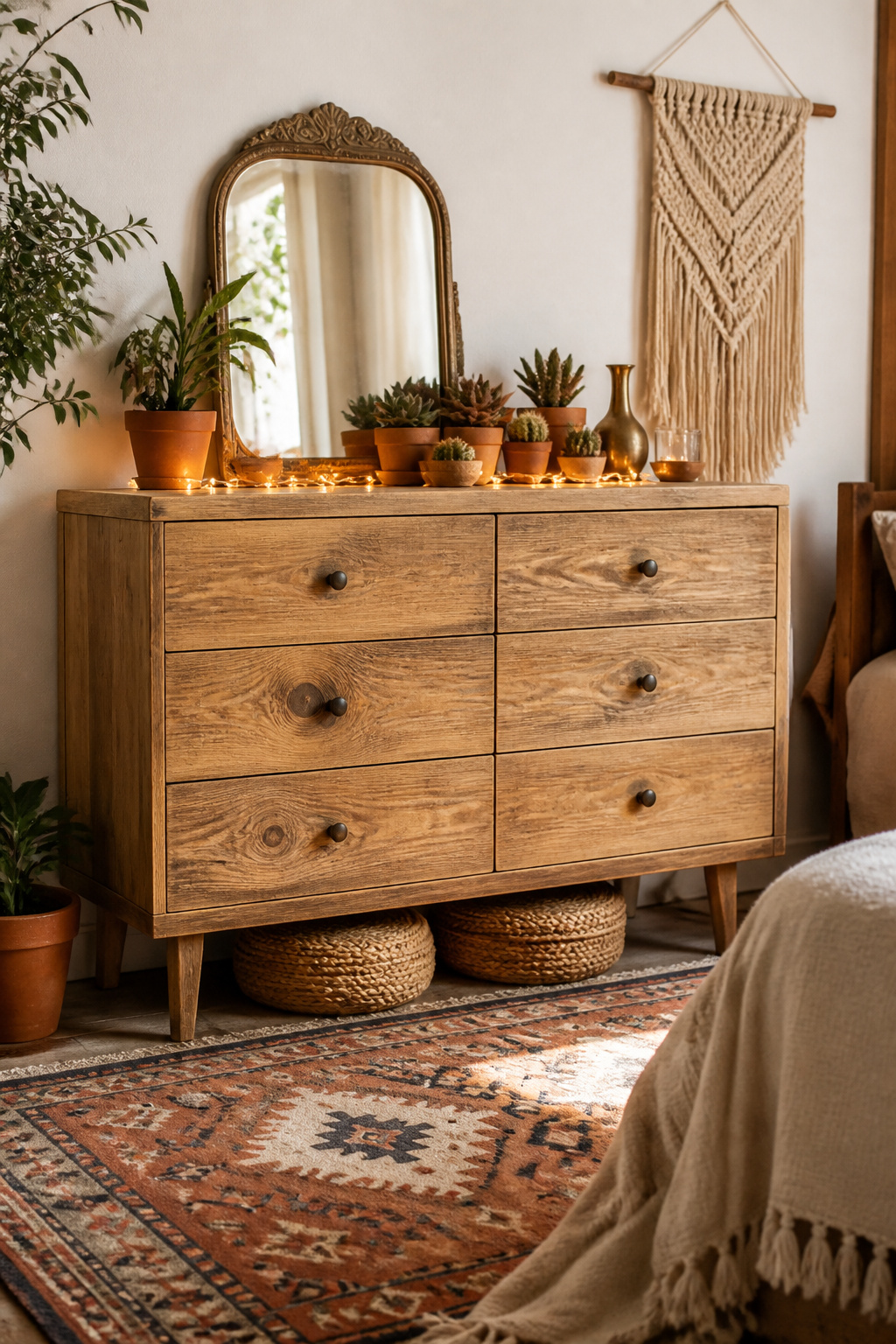
Why Imperfect Wood Works Best
Smooth, machine-finished furniture is interchangeable. A piece of mango wood with a live-edge top or a deep knot in the grain is specific — it’s that piece of wood from that tree. That specificity is what boho bedroom design is seeking. For boho bedroom furniture, imperfection is a quality marker, not a flaw.
For example, mango wood is widely available at accessible prices — CB2, World Market, and IKEA all carry mango wood pieces in the $150–$500 range. Acacia has a darker, richer colour and a swirling grain that looks more expensive than it typically costs. Reclaimed timber furniture — salvaged from old barns, factories, or demolished buildings — adds actual history to a room. Our 14 Luxury Bedroom Wallpaper Accent Wall Ideas includes several patterns that work beautifully alongside warm wood tones.
Mixing Wood Tones
In practice, mixing wood tones is rarely a problem as long as the pieces share a temperature. Warm woods — honey oak, mango, acacia, walnut — work together easily, especially when the tones vary in lightness rather than temperature. In fact, a mix of dark walnut and light mango reads as an intentional range. However, what doesn’t work is combining a cool-toned greywashed wood with a warm honey oak — the temperature difference creates visual dissonance.
16. Vintage Mirrors and Eclectic Art for Bohemian Bedroom Style
A mirror in a boho bedroom is not a plain rectangle in a thin wooden frame. It’s an arched Moroccan piece in carved dark wood, or a heavily ornate Victorian frame in tarnished gold. Or a cluster of small convex mirrors grouped on a wall. The mirror is both functional and decorative. It bounces light, makes the room feel larger, and adds a period quality that no modern piece of furniture can replicate. For bohemian bedroom style, vintage mirrors are as important as textiles.
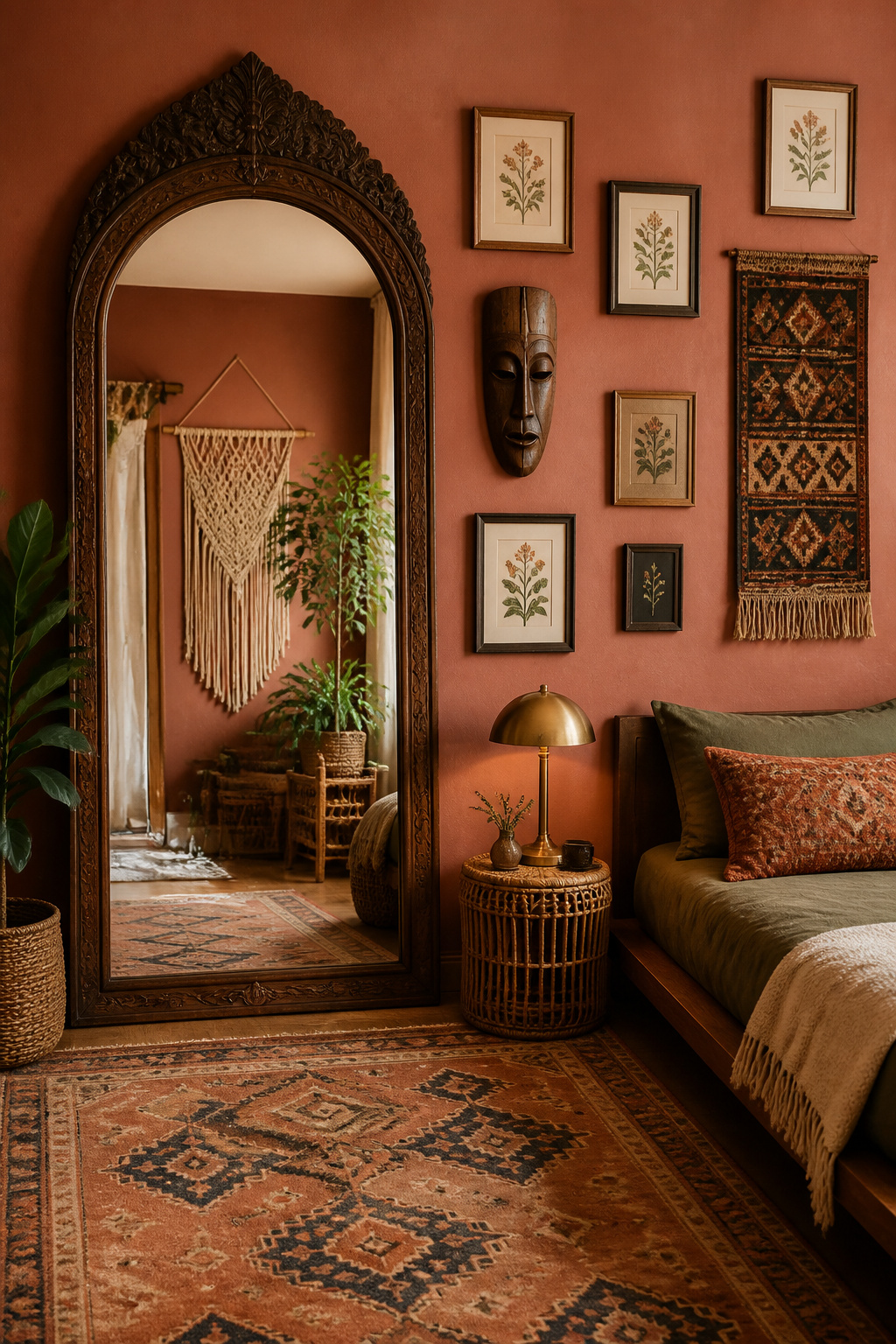
Vintage Mirrors as Statement Pieces
The most interesting mirrors for a boho bedroom are the older ones. Think Moroccan brass-framed pieces with geometric cutwork, Victorian oval mirrors in gilded frames, or early 20th-century arched mirrors with bevelled glass. Thrift stores and antique centres produce these regularly. Prices range from $30 for a plain oval vintage mirror to $200+ for something genuinely ornate. Also check the silver on the glass (darkening or spotting indicates age and adds character) and the frame condition before buying. These pair beautifully with the other recommendations across these boho bedroom inspirations because they all share the same language: old, made, found.
Leaning Mirrors and Layered Wall Compositions
Also, a leaning mirror is more in keeping with the relaxed quality of bohemian bedroom style than a mirror drilled to the wall. It suggests impermanence, like a piece that arrived and decided to stay. For best results, position a large leaning mirror against a wall that already has texture — beside macramé, or at the end of a low dresser — and it integrates naturally.
One of the most effective boho bedroom inspirations for a wall is the mirror-as-part-of-a-gallery approach. Use a large mirror as the centrepiece, then arrange smaller framed art, textile pieces, and three-dimensional objects arranged loosely around it. The mirror’s reflective surface creates depth and light that the flat pieces around it can’t match. Furthermore, this kind of layered, mixed-medium wall composition — part gallery, part collection, part accident — is the most personal result and the hardest to replicate.
Building Your Boho Bedroom One Meaningful Find at a Time
The sixteen boho bedroom inspirations in this guide share one quality: they all reward patience. None are about going to a single shop and buying the matching set. They’re about developing an eye, making thoughtful choices, and letting a room build over time into something that genuinely reflects you.
Starting With What You Already Own and Love
Before you buy anything new, look at what you already have. The boho bedroom is one of the rare styles where things you might have considered getting rid of are exactly the right raw material. A faded kilim from your grandmother. That rattan chair from a previous flat. Even a pile of vintage linen tablecloths. Start by editing your current space down to the pieces that have real meaning or quality. Build outward from those. The room will have more character for it.
If you need new pieces, begin with the floor: a good rug sets the palette and feeling of everything else. Add textiles next — throws, cushions, bedding — because they’re the least expensive way to shift the room’s colour and texture. Furniture and lighting come last. They tend to look after themselves once the textile layer is right.
The Thrifter’s Approach: Patience and Specificity
In my experience, the most successful boho bedroom builders shop from a running note of what the room needs next. “A vintage arched mirror.” “A low-light trailing plant.” “One Moroccan cushion cover in something deep red.” That specificity means you’re looking for something particular. But you’re flexible enough on where you find it. So you can recognise it when it shows up at an estate sale for $12 rather than in a boutique for $180.
For the full picture on boho bedroom decor, From Found to Fabulous: 20 Timeless Boho Bedroom Decor Ideas covers the territory in depth. And if you want to start with the furniture foundation, 14 Essential Boho Bedroom Furniture & Decor Looks has everything you need. In the end, the best version of your space is built from things you actually love. That’s the whole point.