
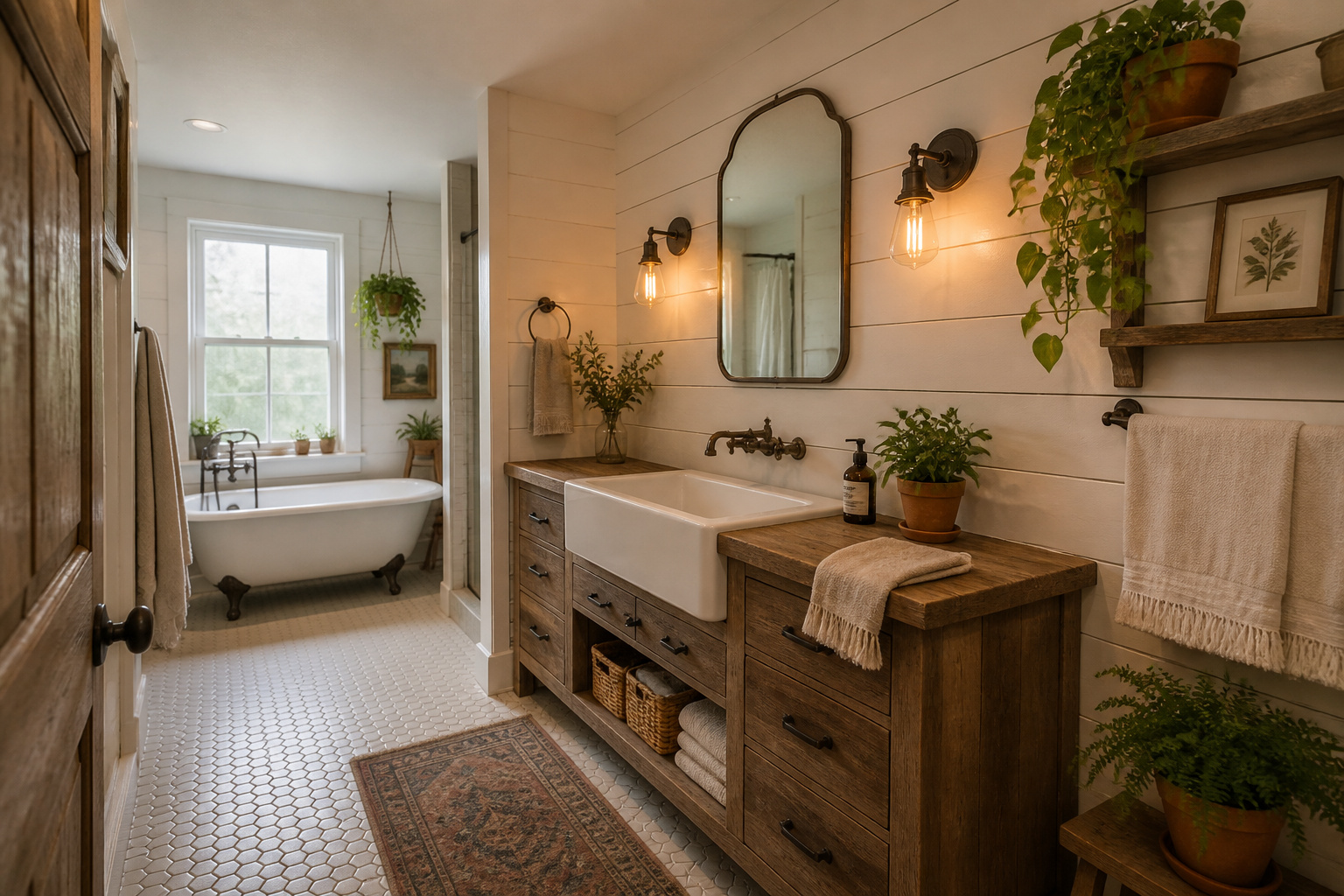

A few years ago I stood in a perfectly functional white bathroom and felt absolutely nothing. Clean grout, matching fixtures, a plain mirror from a big-box store — everything technically fine, nothing remotely memorable. Then I spent a weekend installing a single reclaimed cedar shelf above the toilet, and the whole room changed. Not the tiles, not the lighting, not the vanity. One shelf of weathered wood, and suddenly the space had a story.
That’s the thing about a rustic bathroom remodel that gets under-discussed: you don’t need to gut a room to get the look. Some of these ideas are weekend projects with a drill and a trip to the salvage yard. Others are full renovation upgrades — a clawfoot tub, a new vanity, real stone tile — that will last decades if you choose materials honestly. Here are fifteen ideas that run the gamut from one afternoon to three weekends, with real sourcing advice and cost ranges throughout.
1. Reclaimed Wood Vanity With a Farmhouse Sink for Your Rustic Bathroom Remodel
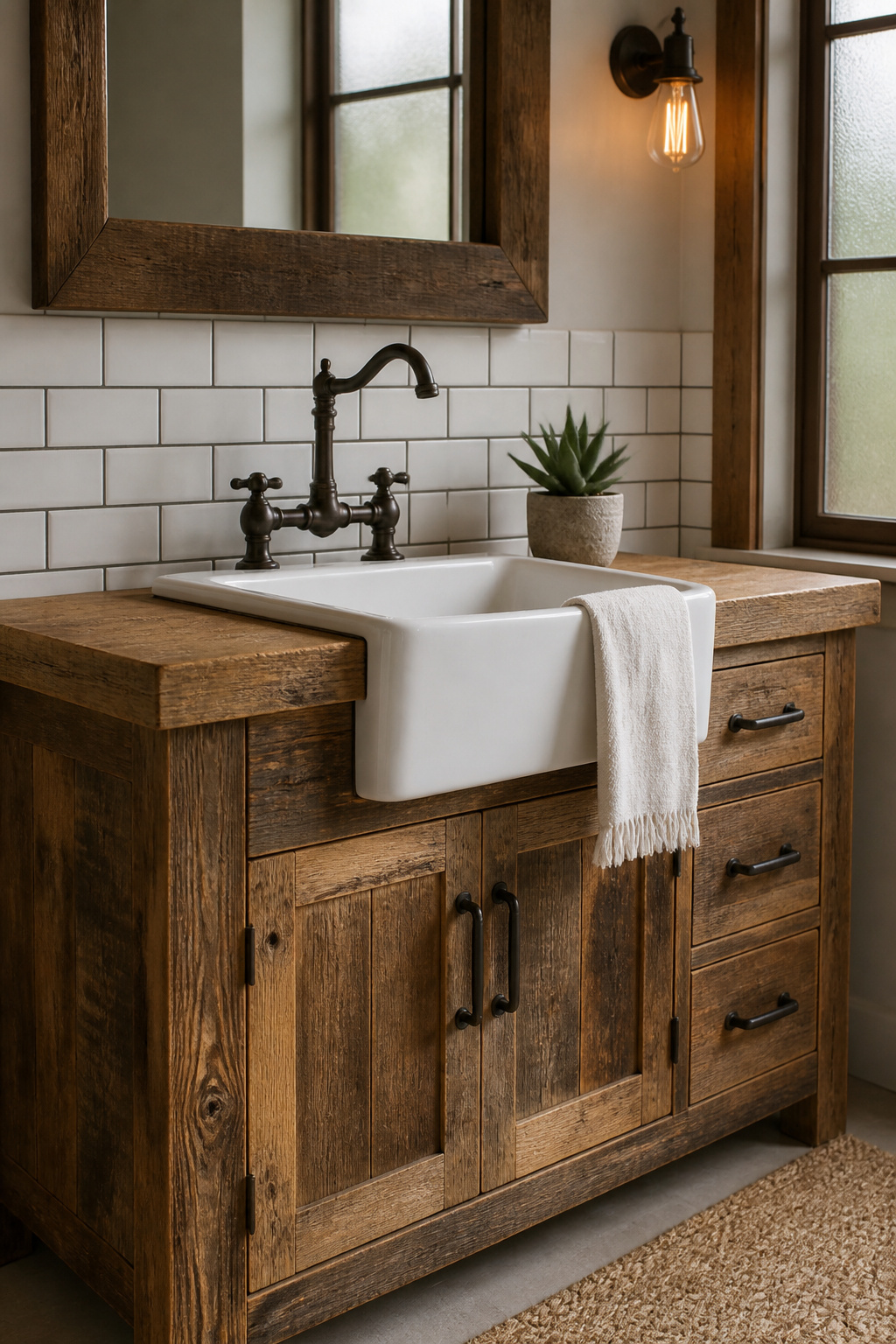
The vanity sets a bathroom’s whole tone, which makes it the most powerful single change in a rustic bathroom remodel. A reclaimed wood vanity signals craft, history, and permanence in a way that no painted MDF cabinet can replicate. And it doesn’t have to cost what a furniture store wants you to spend.
Why a Reclaimed Vanity Sets the Room’s Tone
Barn wood, fence boards, and salvaged flooring carry something new wood can’t manufacture: a record of time. The checking, the nail holes, the color variation from decades of sun — these aren’t flaws to hide, they’re the whole point. A reclaimed vanity reads as the one piece in the room that was made to last and has been proving it. If you’re building around this piece, let everything else be quieter.
Sourcing and Sealing for Bathroom Humidity
Before any reclaimed wood enters a bathroom, confirm it’s at or below 12% moisture content. Buy a cheap Wagner MMC220 moisture meter ($30) and test every board. Wood above 15% will warp once it starts cycling through steam and dry air. Once stable, seal with three coats of Waterlox Original or Rubio Monocoat. Both products penetrate the wood rather than sitting on the surface, which means they won’t chip or peel the way polyurethane eventually will. Budget $3-$8 per board foot for properly dried reclaimed wood. Pottery Barn’s Benchwright vanity ($899-$1,299) is the most honest ready-made version of the look.
Pairing With an Apron-Front or Vessel Sink
An apron-front sink is the most natural pairing — Kohler’s Whitehaven ($800) and the American Standard Country series ($350) both suit reclaimed wood well. A vessel sink also works: a hammered copper basin or white ceramic oval complement the material without competing. Avoid undermount sinks on reclaimed vanities unless you have a skilled installer; the irregular surface makes a watertight seal genuinely difficult.
Cost range: $300-$1,400 depending on DIY vs. ready-made.
2. Shiplap Accent Wall That Transforms a Plain Bathroom Into a Rustic Retreat
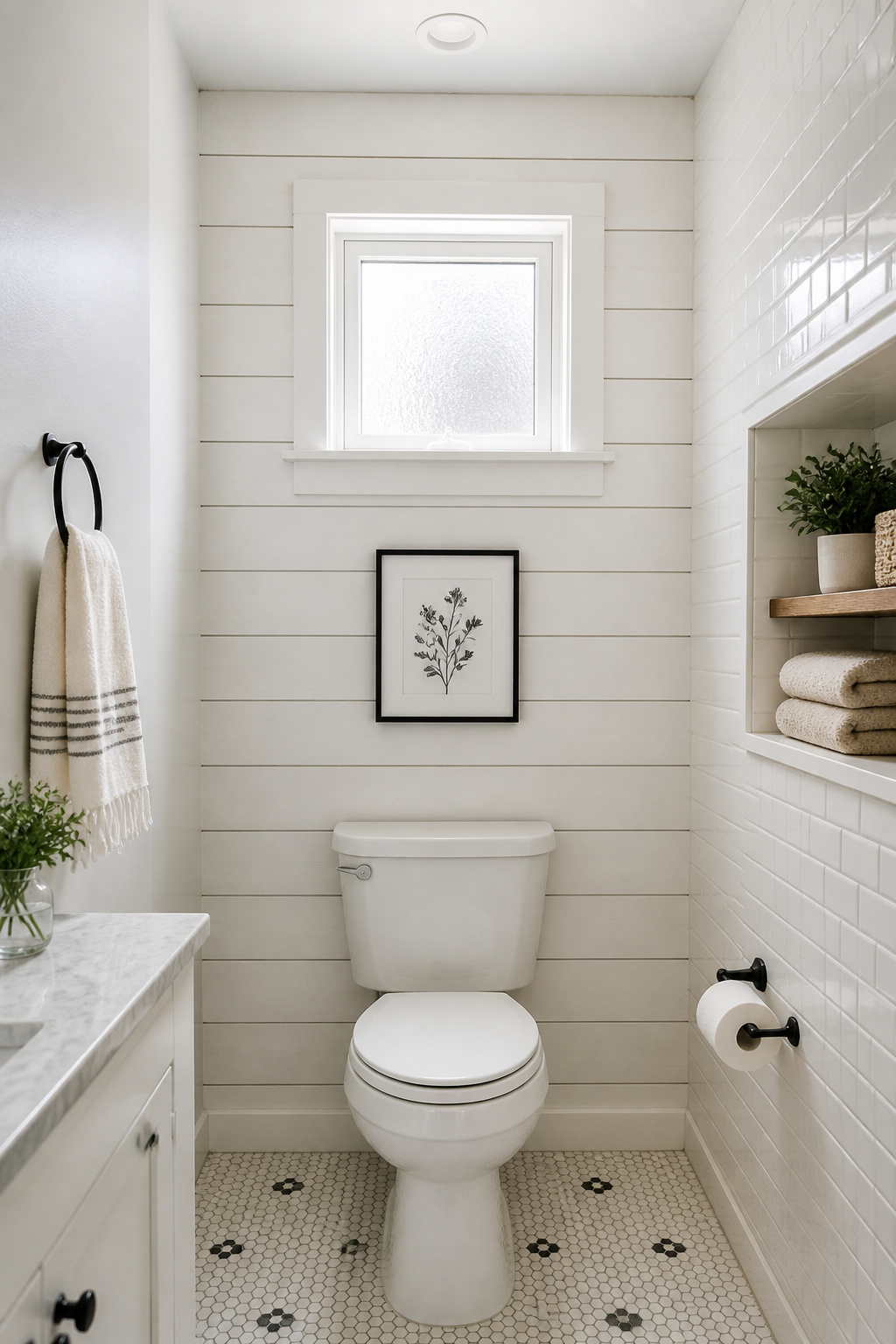
Shiplap still works in a bathroom when you use it with restraint. One wall — not four — and a finish that suits the room.
The Appeal of Shiplap in a Wet-Area Room
The reason shiplap works in bathrooms is the gap. That small reveal between boards creates shadow lines that give the wall visual depth without any additional decoration. Install it horizontally behind the vanity or toilet for maximum impact and leave the remaining walls plain. The horizontal line also makes a narrow bathroom feel wider.
Material Options: Pine, MDF, or PVC Shiplap
Standard 1×6 pine shiplap from Weaber (around $1.20/linear foot at Home Depot) is the most economical option. For a bathroom, prime carefully with two coats of Zinsser BIN shellac-based primer to block knots. PVC shiplap from RealTrim ($2.50/linear foot) is fully moisture-proof and requires no sealing. It’s the smart choice for a shower-adjacent wall or a bathroom without good ventilation.
How to Finish and Seal for Moisture Protection
For painted shiplap, finish with a semi-gloss latex bathroom-rated formula. Paint the inside of each gap the same color as the board face so it looks intentional. If leaving the wood natural, three coats of water-based polyurethane rated for wet areas will hold for several years. However, natural wood shiplap needs annual inspection for any soft spots near the shower.
Cost range: $60-$180 for materials on a standard accent wall.
3. Exposed Stone or Brick as a Feature Wall in a Rustic Bathroom Remodel
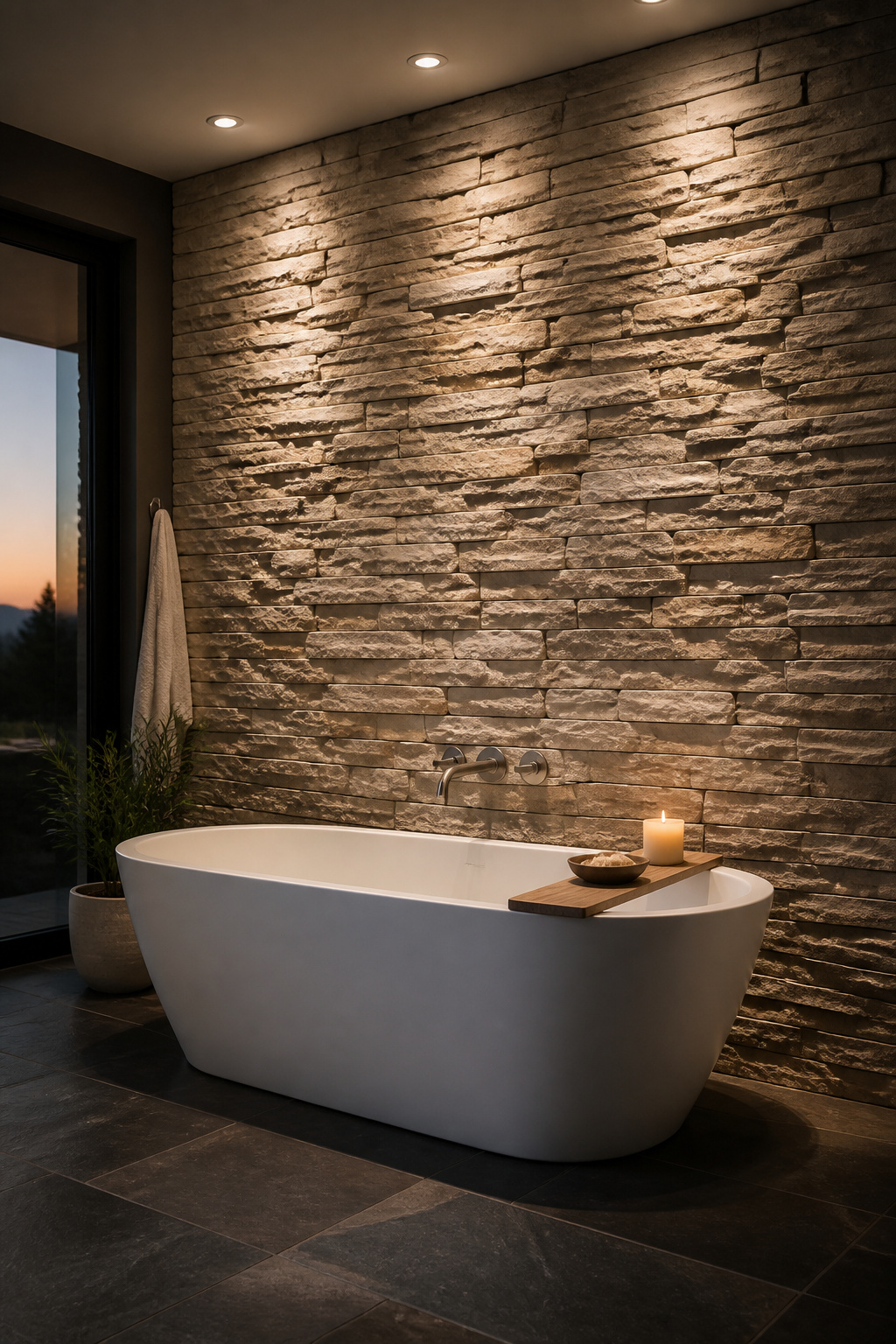
Natural stone on a bathroom wall is one of the most convincing ways to create a space that looks designed rather than assembled. Real stacked stone is beautiful. But the dimensional veneer panels available today are nearly indistinguishable from a few feet away and cost a fraction of the install price.
Why Natural Stone Reads as Authentic Rather Than Themed
Stone bypasses the “themed” quality that nautical rope accents or painted mason jars can fall into. It reads as permanent and geological regardless of what else is happening in the room. Even a single stone feature wall can anchor an otherwise plain bathroom and make the whole space feel more considered.
Real Stone vs. Stone Veneer Panels: Cost and Installation
Real stacked stone tile from Norstone runs $12-$18 per square foot and requires a mortar bed. For a 40 square foot feature wall, budget $600-$800 for materials alone. AirStone faux-stone veneer panels ($35 per 7.5 sq ft sheet at Home Depot) adhere directly to drywall with included adhesive. They weigh only 12 pounds per square foot. For most homeowners doing a rustic bathroom renovation themselves, AirStone is the honest answer.
Sealing Options to Keep Stone Looking Clean
Apply two coats of 511 Impregnator sealer to any natural stone before use and reseal every 12-18 months. For AirStone, a coat of exterior-grade matte sealer protects the aggregate face from soap scum and steam. Clean both with a pH-neutral cleaner — acidic cleaners like vinegar will etch the surface over time.
Cost range: $100-$450 for a 40 sq ft feature wall.
4. Vintage Clawfoot Tub as the Statement Piece of Your Rustic Bathroom
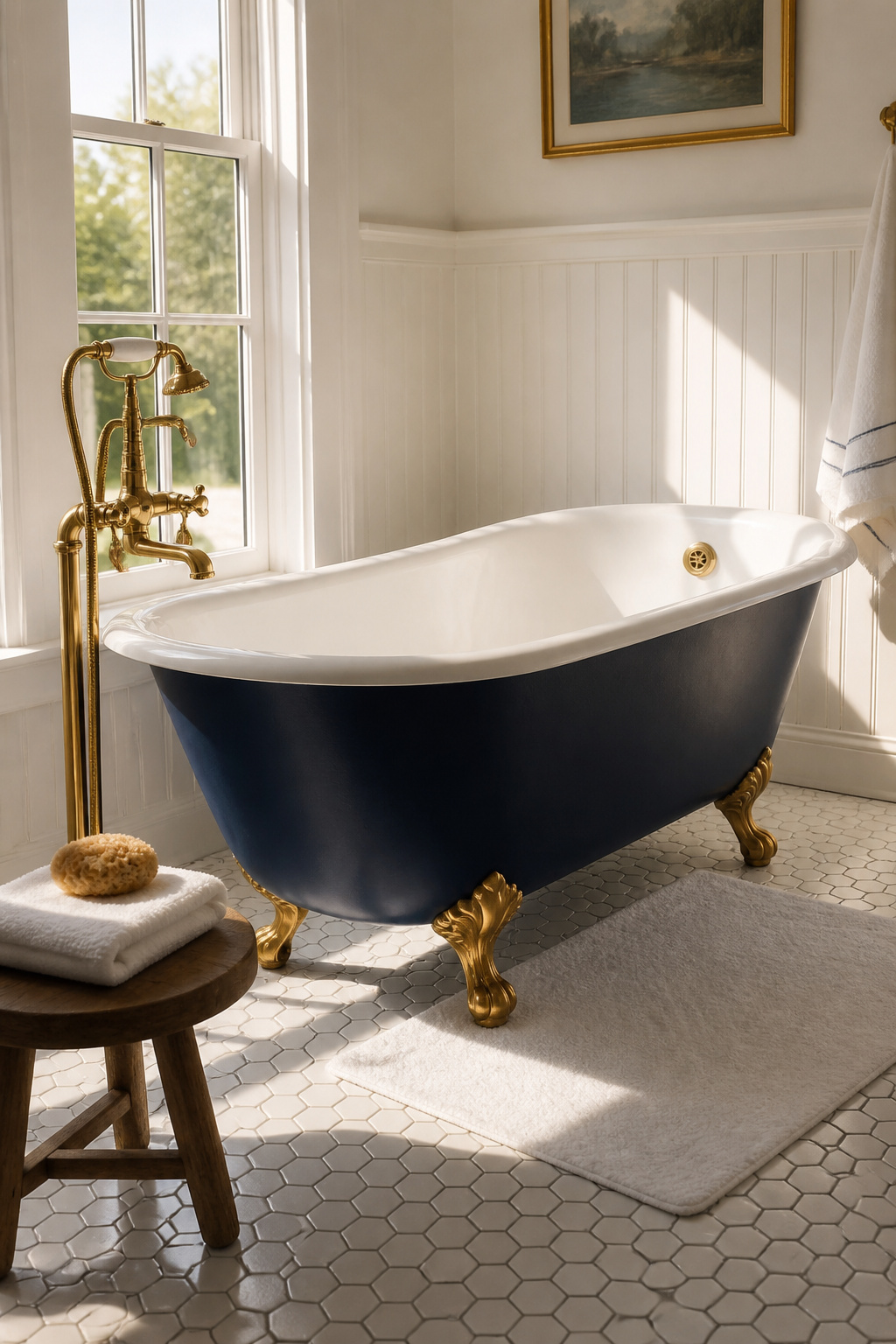
A clawfoot tub is the piece most people think of first in a vintage bathroom renovation, and for good reason. It’s freestanding, sculptural, and entirely self-sufficient as a design statement — everything else in the room can be quiet and the tub will carry the space.
Finding and Restoring a Cast Iron Clawfoot Tub
Facebook Marketplace, Habitat for Humanity ReStore locations, and architectural salvage stores are the best places to find cast iron clawfoot tubs in the $150-$600 range. Cast iron is almost impossible to damage beyond restoration. Check for cracks in the porcelain interior — run your hand along the bottom, and sharp chips indicate a problem. Also check the condition of the drain assembly. Everything else is cosmetic.
Refinishing the Exterior: Paint Options That Hold
The exterior can be painted in almost anything. Annie Sloan Chalk Paint adheres to cast iron without primer and comes in beautiful deep tones like Aubusson Blue and Graphite. Seal with two coats of Annie Sloan’s soft wax. The most popular choices right now are matte navy, forest green, and deep sage. Any of these against white walls creates an immediate focal point.
Plumbing Considerations and Freestanding Faucet Pairings
A freestanding tub needs a freestanding faucet with floor-mounted supply lines. Confirm your bathroom has structural clearance to run new supply lines before committing to the location. Kingston Brass and Premier Copper Products offer well-made freestanding faucets in the $220-$380 range. A matching hand shower is worth the upgrade — the flexibility is genuinely useful, not just decorative.
Cost range: $400-$1,100 total for a sourced, refinished, and installed tub.
5. Rustic Bathroom Remodel Lighting With Edison Bulbs and Iron Fixtures
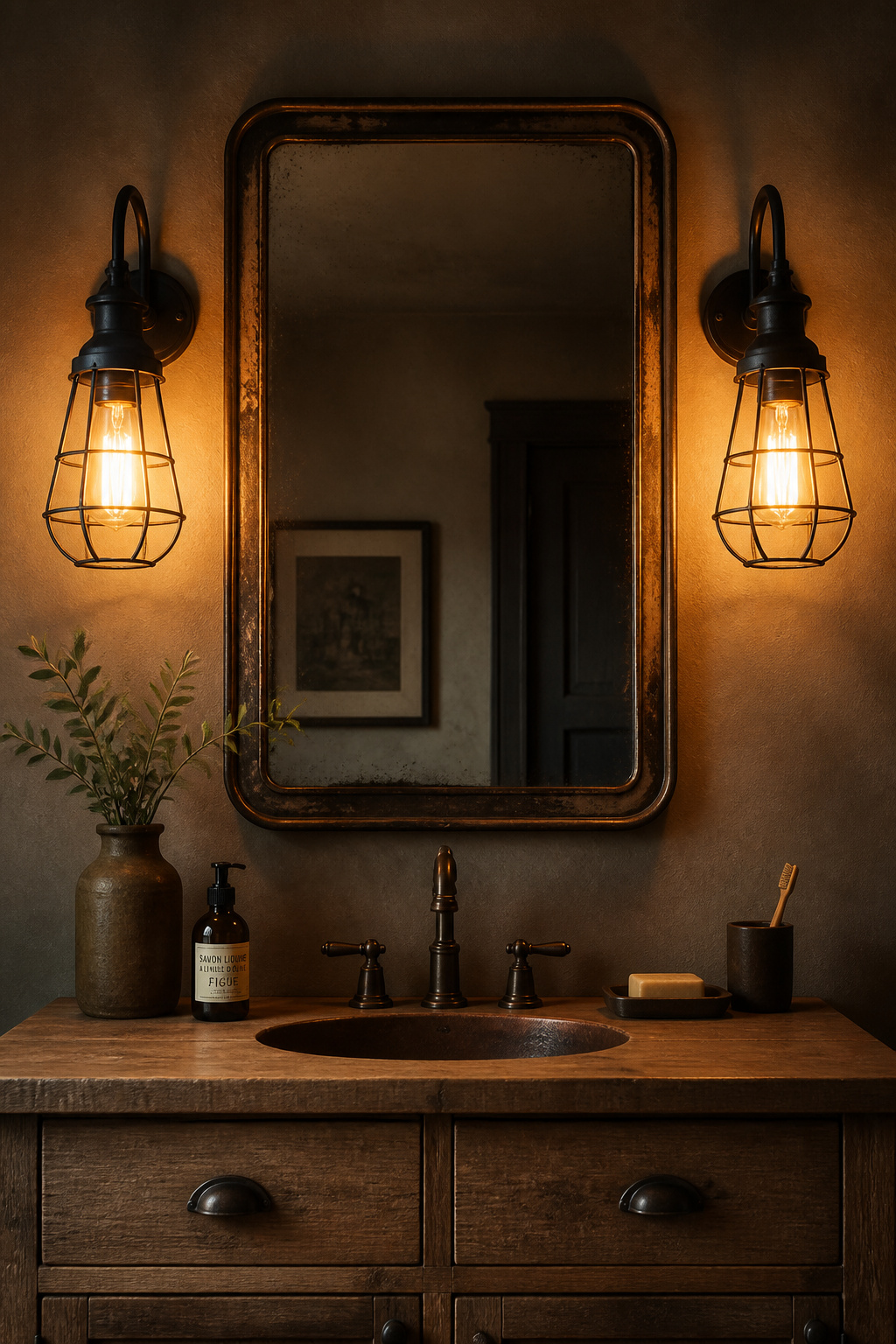
Lighting is the element most people get exactly backward. They choose fixtures last, after everything else is decided, and wonder why the room feels wrong. In a rustic bathroom, lighting is foundational. The warm amber quality of Edison bulb light is what makes wood grain glow and stone walls feel alive.
Why Bare-Bulb and Cage Fixtures Work in Rustic Spaces
The industrial simplicity of a bare Edison bulb or a cage sconce suits rustic materials because it’s visually honest. There’s no decorative shade hiding the mechanics. Cage fixtures work well because the iron echoes the hardware throughout the room — faucets, towel bars, cabinet pulls. That material thread ties the whole space together.
Sconce Placement for Flattering Vanity Lighting
Mount sconces on either side of the mirror with the center of the fixture at 60-65 inches from the floor. This puts the light source at roughly eye level, eliminating the downward shadow that a single overhead bar creates. Minka-Avery iron sconces run $55-$90 each; West Elm’s industrial sconce is $98; Rejuvenation’s Schoolhouse sconces are $195 if you want the genuine article. Ensure all bathroom fixtures are rated for damp locations.
Edison Bulb Types and Lumen Output
Color temperature matters: 2,200-2,400K gives the warmest amber glow; 2,700K is standard warm white. Install a Lutron Diva dimmer ($25) compatible with your LED choice. At low dim levels, these bulbs drop to a genuinely warm amber that transforms the room from functional to atmospheric.
Cost range: $120-$400 for two sconces, bulbs, and dimmer.
6. Subway Tile With Dark Grout for a Rustic Vintage Bathroom Look
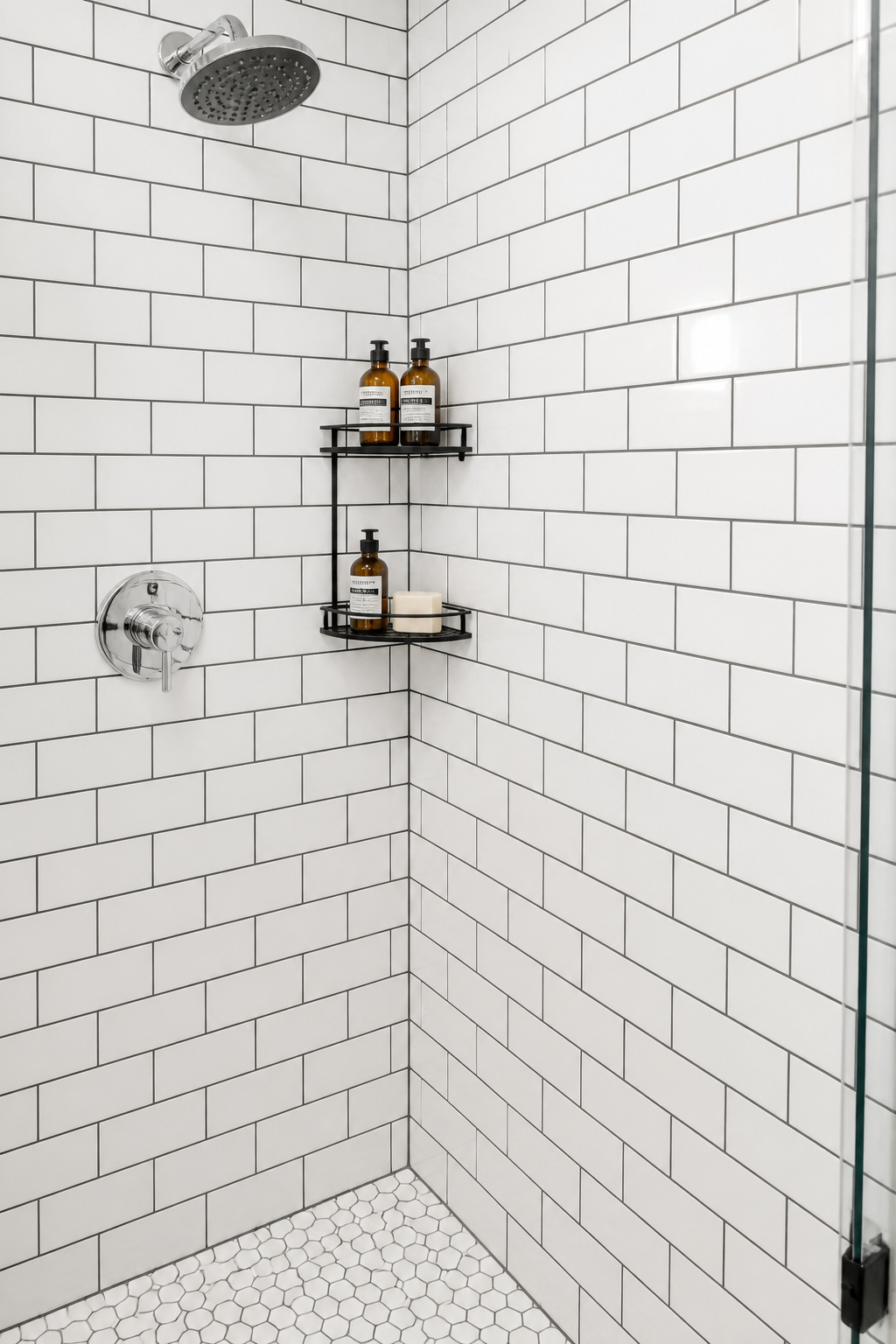
The cheapest tile in the world — plain white 3×6 subway — becomes genuinely interesting with one change: dark grout. It shifts the entire character of the tile from clinical white to vintage grid, and it costs about $15 more than standard white grout.
How Grout Color Shifts the Character of Subway Tile
White subway tile with white grout reads as contemporary and clean. The same tile with charcoal grout reads as turn-of-the-century and vintage. The tile hasn’t changed; the grout has done all the work. Dark grout also hides staining far better than white — a practical bonus on top of the aesthetic one.
Choosing the Right Dark Grout Shade
Mapei Ultracolor Plus FA in Charcoal #111 dries to a true steel gray rather than blue-black. Custom Building Products Polyblend Plus in Haystack #105 gives a warm gray-brown tone for more amber-toned bathrooms. The grout joint width matters too: a 1/8-inch joint gives the most traditional grid character. Also, dark grout on a subway wall pairs beautifully with white hex floor tile for a fully period-authentic bathroom floor.
Sealing Dark Grout to Prevent Staining
Seal dark grout within 48 hours of installation with StoneTech BulletProof Grout Sealer — apply two coats, letting the first absorb fully. Use a penetrating sealer rather than a surface sealer; surface sealers sit on top and peel off, leaving the grout darker and uneven. Reseal annually.
Cost range: $150-$400 for tile and grout on a standard shower surround.
7. Open Wood Shelving Instead of Closed Cabinets for a Rustic Bathroom Remodel
Closed cabinets disappear into the wall. Open shelves with visible wood make the bathroom feel like a thoughtfully arranged space rather than a storage unit with a mirror above it.
The Functional Case for Open Shelving
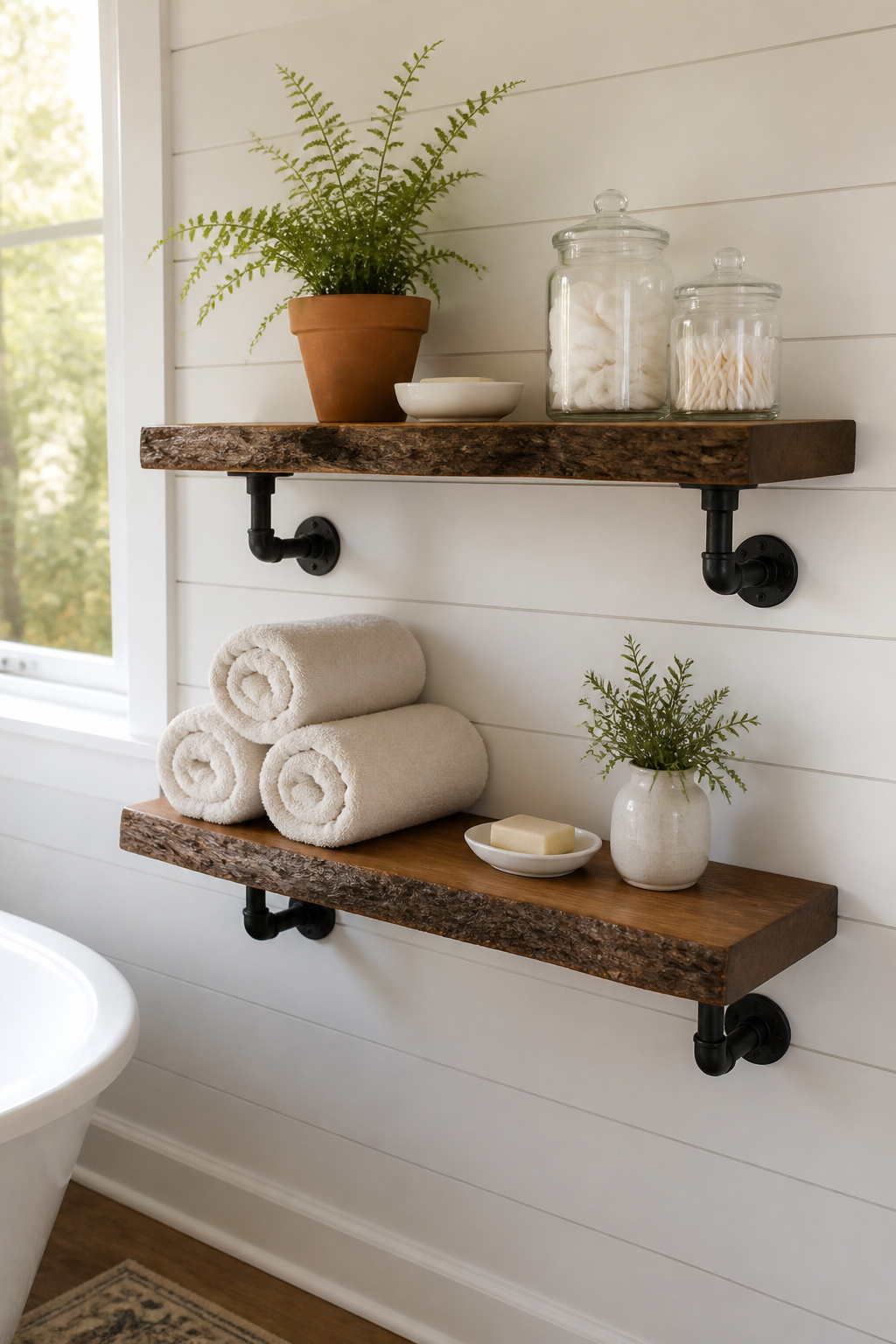
Items at the back of a cabinet get forgotten; items on a visible shelf get used in rotation. In a rustic bathroom remodel, the shelves also become part of the decor. Rolled towels, glass jars, a small plant, and honest-looking products on an open shelf create a display that would take real effort to achieve behind cabinet doors. The styling is the storage.
Floating Shelf Brackets and Live-Edge Options
Pipe brackets from PIPE DÉCOR run $25 per pair. For the shelf itself, look for live-edge walnut or maple slabs at local sawmills or Etsy sellers. Budget $30-$120 per shelf depending on width and species. The cheapest option most people miss is the rough cut bin at a local lumber yard. These offcuts from furniture projects cost $10-$30 and need only sanding and finishing. Seal with General Finishes Arm-R-Seal in matte — one of the most durable water-resistant finishes available.
Styling With Baskets, Vintage Glass Jars, and Rolled Towels
Three things make open bathroom shelves look intentional rather than cluttered: everything is in the same neutral color family, containers do the visual work rather than loose products, and there is one living thing. A seagrass basket, a clear glass apothecary jar, rolled cream-colored linen towels, and a small trailing pothos — that’s enough. Don’t add more.
Cost range: $60-$200 for two floating shelves with brackets.
8. Vintage Mirror and Antique Hardware to Complete Your Rustic Bathroom Remodel
Hardware is where most rustic bathroom remodels either come together or fall apart. New mirrors and matching hardware sets from the plumbing aisle have a flatness to them. The proportions are optimized for a neutral room, not a rustic one.
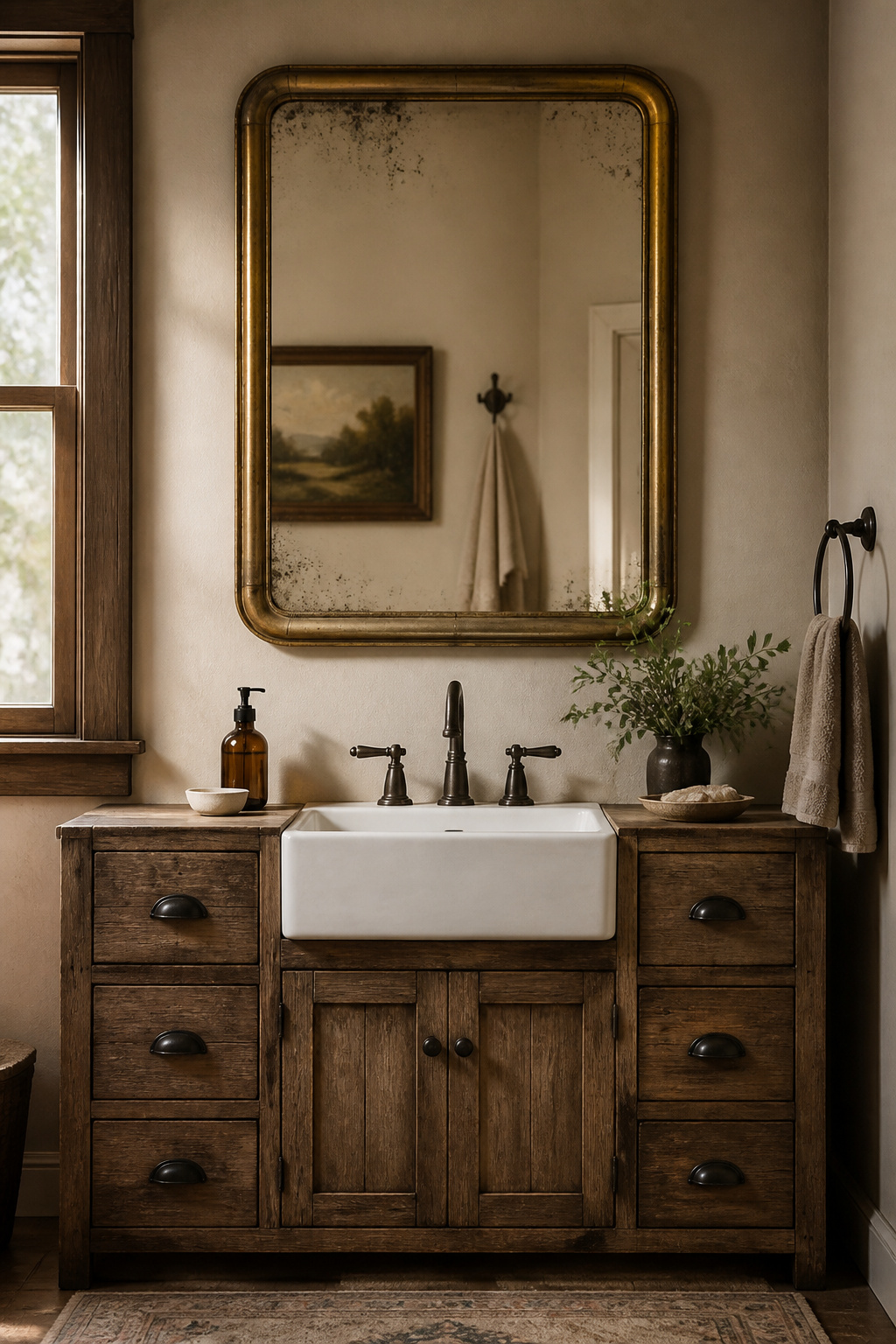
Sourcing Vintage Mirrors Without Overpaying
The best places to find real vintage mirrors: Etsy ($35-$180), Habitat for Humanity ReStore locations (often $5-$30), and estate sales where oversized mirrors are frequently undervalued. Check the silver backing — some foxing is desirable; a mirror where the backing has completely failed in large patches isn’t worth buying. For more ideas on how mirrors pair with other vintage elements, see our cottage bathroom decoration guide.
Swapping Modern Pulls for Aged Brass or Oil-Rubbed Bronze
Replacing standard chrome pulls with Amerock Blackrock oil-rubbed bronze cup pulls ($6-$12 each) or Liberty Hardware aged brass bar pulls ($8 each) takes one hour. The full vanity hardware swap costs less than $50. Measure existing holes first — standard centers are 3 inch or 5 inch, and the new hardware must match or you’ll need to fill and re-drill.
How Small Hardware Changes Read as a Full Remodel
Hardware is the room’s jewelry. When the faucet, cabinet pulls, towel ring, and toilet paper holder all share a finish family, the bathroom reads as designed from the ground up. In a rustic bathroom, oil-rubbed bronze or aged brass is the most authentic finish. Both have the warm, non-reflective quality that suits wood and natural materials without competing with them.
Cost range: $50-$250 for a mirror plus full hardware swap on a typical vanity.
9. Hex Floor Tile in Matte Black or Warm White for a Rustic Bathroom Floor
Hex tile is one of those design choices that looks like a deliberate period reference without feeling like a costume. The hexagonal floor patterns of late 19th-century American bathrooms have never really gone out of style — they just cycle in and out of mainstream popularity.
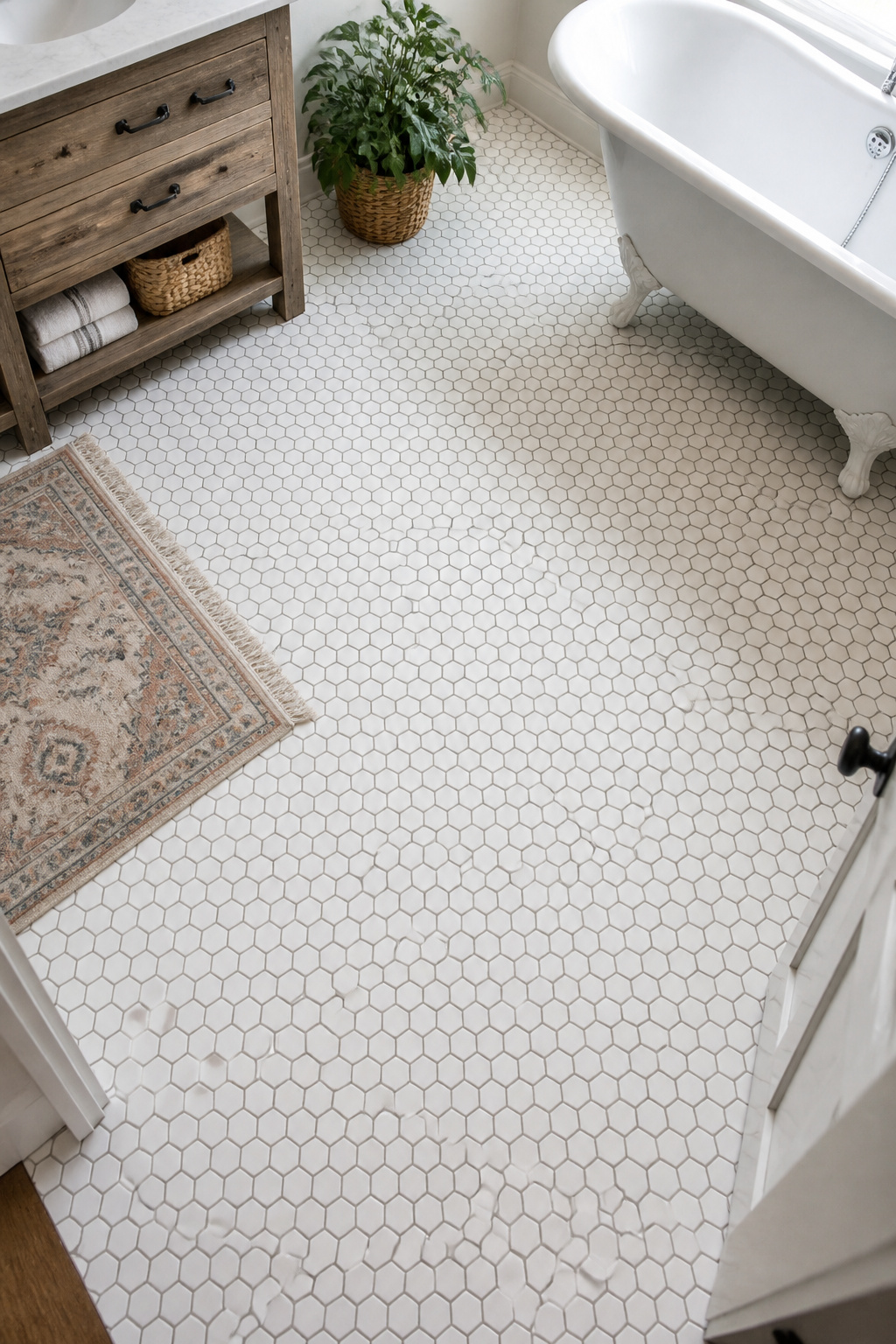
Why Hex Tile Reads as Vintage Without Feeling Dated
In matte white, hex tile reads as classic American farmhouse or Victorian cottage. In matte black, it reads as contemporary with a period reference. Both suit a rustic bathroom renovation well, depending on whether you want light and airy or bold and graphic.
Matte Finishes vs. Glazed: Slip Safety and Aesthetics
Matte porcelain hex tile has a coefficient of friction above 0.6, meeting the residential slip-resistance standard. Glazed hex tile is beautiful but frequently falls below the 0.42 threshold when wet — check the COF rating before buying. Also, matte finishes hide grout haze more forgivingly than polished during installation cleanup.
Grout Color Combinations That Reinforce the Rustic Palette
White hex with charcoal grout is the most graphic choice and suits a bathroom with dark wood and black iron hardware. White hex with warm gray grout is softer and reads more cottage-farmhouse. Plan for 15% tile overage due to cut waste at walls and around fixtures.
Cost range: $120-$350 for a standard 50 sq ft bathroom floor.
10. A Barn Door Instead of a Swing Door in Your Rustic Bathroom Remodel
A barn door is the rustic remodel upgrade that’s also a practical space-saving solution. In a small bathroom, a swing door eats 6-9 square feet of floor space every time it opens. A sliding barn door uses none. The rustic look is almost incidental — the reason to install one is that it actually improves how the room functions.
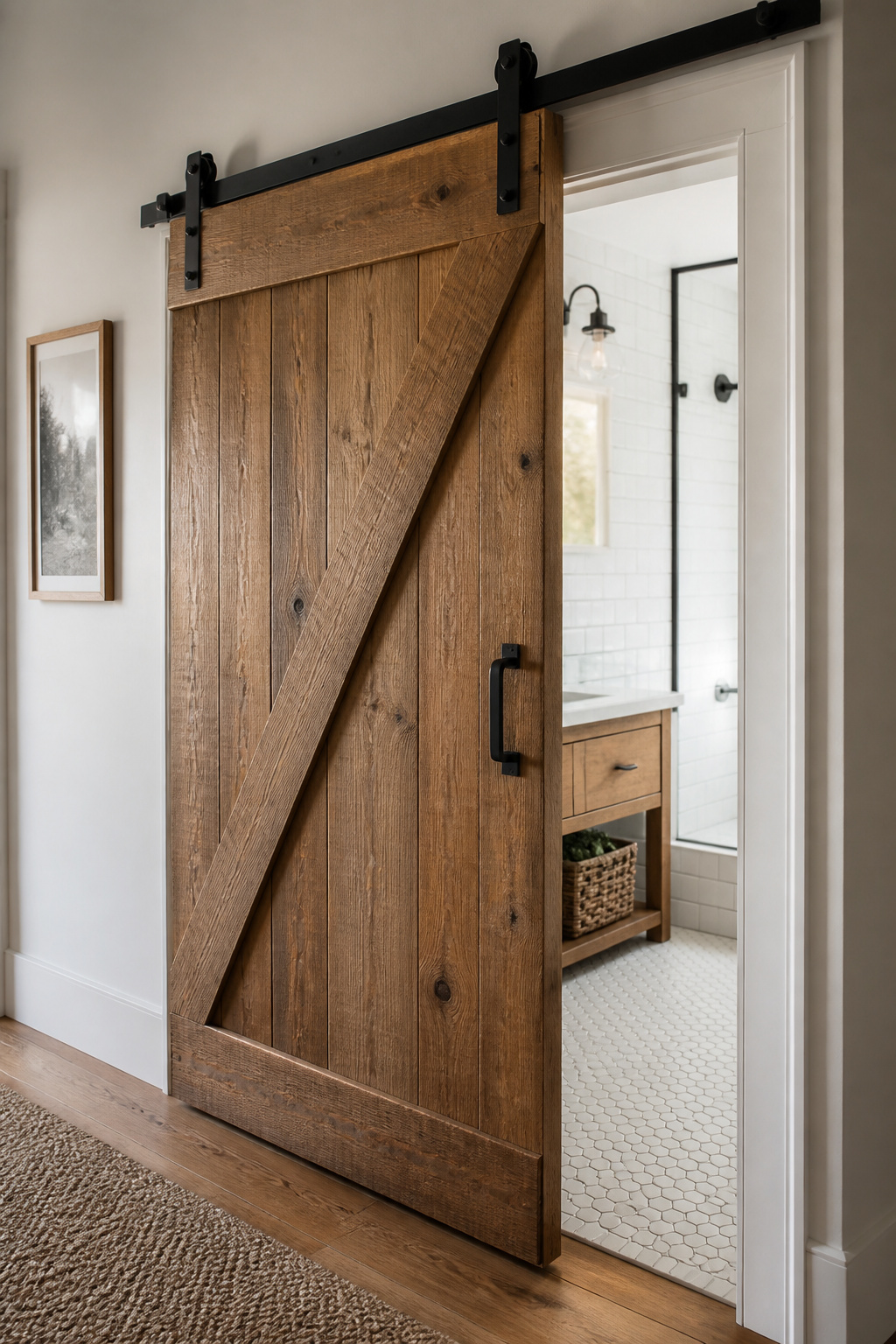
Space-Saving and Style Benefits
A standard 30-inch bathroom door swings through a 30×30-inch arc, blocking floor space and wall space simultaneously when open. A barn door slides parallel to the wall, using only the wall space it parks against. For bathrooms adjacent to narrow hallways, this is a genuine functional improvement, not just a decorative choice. A Z-brace barn door in weathered pine also looks like it belongs in the house in a way that a plain white hollow-core door never will.
Privacy and Humidity Considerations
The gap between a barn door and its frame is the one real limitation — standard hardware leaves approximately 1/2-inch at the sides. Add a door seal strip on the strike side and a door guide at the floor to reduce the gap. For the lock, a simple privacy slide bolt surface-mounted on the interior face costs $15 and solves the issue completely. Humidity is not significant for a well-ventilated bathroom; unlike a cabinet door, a barn door has enough clearance to expand and contract without binding.
Hardware Kits and Door Sourcing on a Budget
The hardware kit is the expensive part: Belleze’s 6.6-foot kit runs $65; National Hardware’s Stanley kit is $79 at Home Depot. The door itself should be the bargain. Architectural salvage stores frequently sell old solid-core interior doors for $20-$40. Add a Z-brace on the face using 2×3 lumber and carriage bolts ($15 in materials) and you have a barn door that looks genuinely aged.
Cost range: $120-$350 for a complete barn door installation.
11. Rustic Bathroom Remodel on a Budget Using Repurposed Furniture
The most genuinely rustic bathrooms I’ve seen were built around a piece of furniture never meant to be in a bathroom. An old dresser that became a vanity. A kitchen cabinet mounted as a medicine chest. A sewing machine cabinet with a vessel sink dropped in the top. The repurposed-furniture approach is not a compromise — it’s often how you get proportions and character that no purpose-built vanity can replicate.
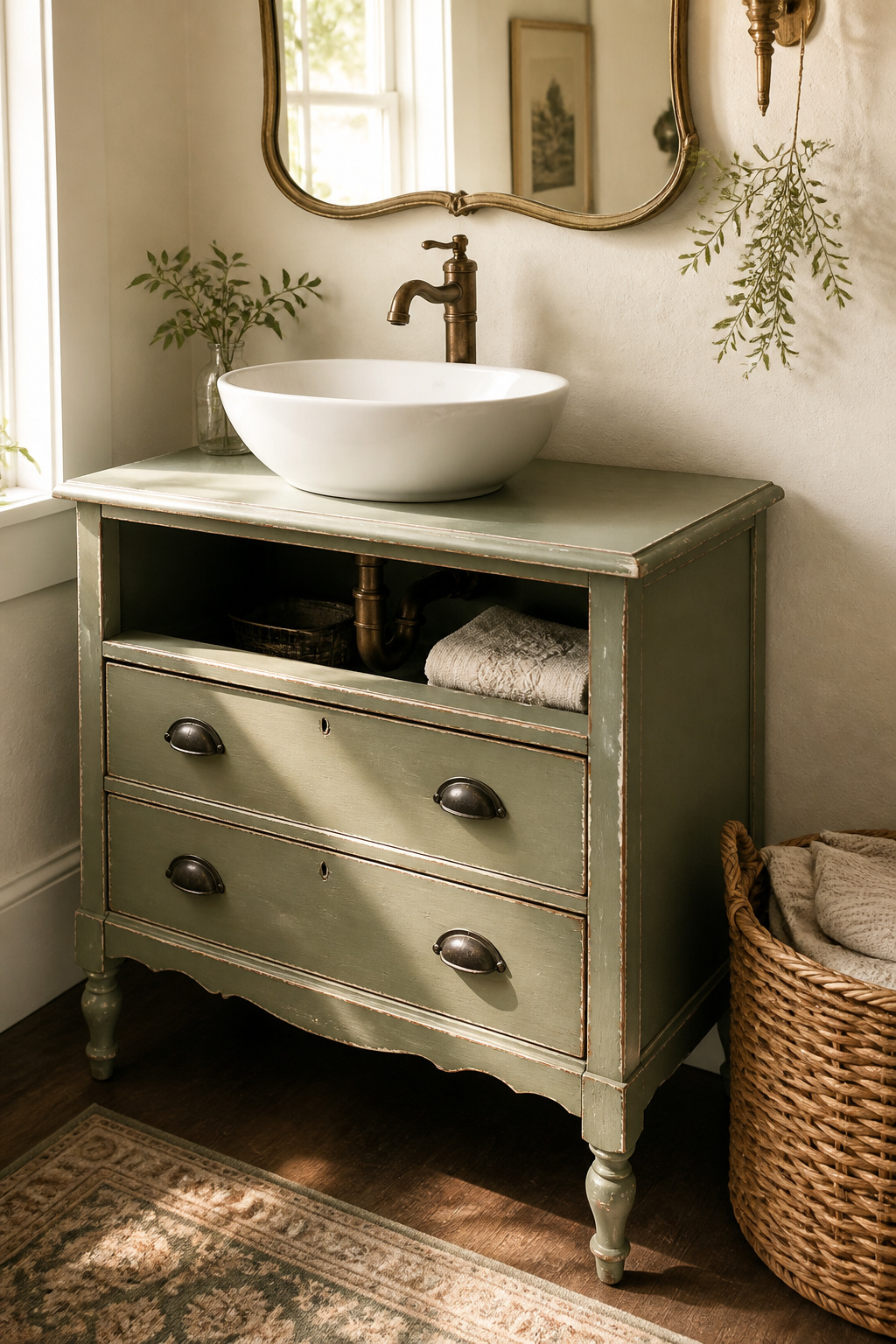
Converting a Dresser or Console Into a Bathroom Vanity
The conversion has four steps. First, remove the top one or two drawers to create plumbing clearance. Then cut a drain hole through the top surface (1.5 inches larger than the drain pipe), route supply lines through the back panel, and waterproof all interior surfaces before connecting plumbing. Use a flexible P-trap kit ($15-$25) rather than a rigid chrome trap. Seal every interior wood surface with two coats of Minwax Helmsman Spar Urethane before the plumbing goes in.
Waterproofing and Finishing
Paint the exterior with Annie Sloan Chalk Paint or Rustoleum Chalked Paint. The matte finish reads as genuinely vintage in a way that glossy enamel doesn’t. Coat the top surface with two layers of paint plus a clear wax seal; that surface will see daily water splashes and needs extra protection. For specific sourcing advice and conversion techniques, our guide to sustainable bathroom vanity makeovers walks through the full process.
Where to Find the Best Thrift-Store Candidates
Habitat for Humanity ReStore locations are the most reliable source for solid wood furniture with good bones. Look for hardwood pieces — solid wood feels heavier and cooler to the touch than particleboard. Avoid pine dressers for vanity conversions; the wood is too soft and will swell. Older hardwood dressers from the 1950s-1970s are ideal candidates.
Cost range: $75-$350 total for a complete dresser-to-vanity conversion.
12. Wainscoting and Beadboard Panels That Add Instant Rustic Character
Beadboard wainscoting is one of the oldest bathroom finishing techniques in American residential design. It’s been on bathroom walls since the late 1800s because it works. The vertical grooves add texture, the paneling protects the wall, and the chair rail creates a horizontal line that makes low-ceilinged bathrooms feel taller.
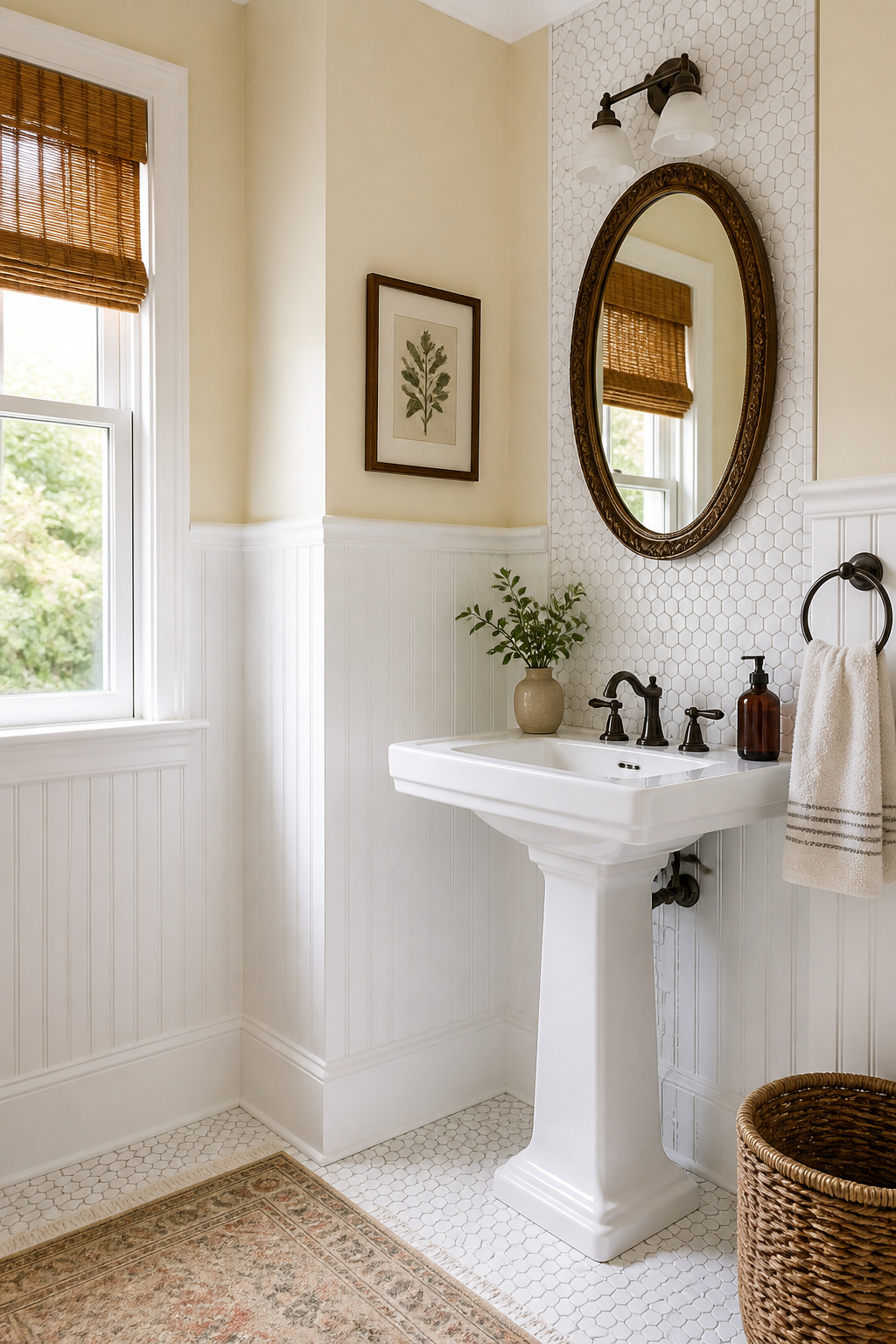
The History of Beadboard in American Farmhouse Bathrooms
Beadboard panels were first used in farmhouse bathrooms in the late 19th century as a practical wall covering. The painted boards resisted moisture better than bare plaster and cleaned more easily. The vertical grooves were a manufacturing artifact, not an aesthetic choice. That practicality-first origin is part of why beadboard reads as authentic in a rustic design: it arrived in these rooms for reasons, not for decoration.
Height Decisions: Chair Rail vs. Full-Wall
Chair-rail height (32-38 inches) is the most proportionally balanced choice and leaves the upper wall free for paint or wallpaper. Full-wall beadboard works beautifully in very small bathrooms — a powder room done entirely in beadboard, painted one color, is a classic look that consistently works. The decision comes down to ceiling height: under 8 feet, stop at chair rail; 9 feet or higher, full-wall reads better.
Paint Colors That Work With Natural Wood Tones
Benjamin Moore HC-172 Revere Pewter is the most versatile upper-wall color against white beadboard and natural wood. Sherwin-Williams SW 7012 Creamy is the warmest white available. Paint the beadboard a slightly deeper shade than the walls above — even 10% more pigment creates definition that looks professionally designed.
Cost range: $80-$250 for a full bathroom beadboard installation.
13. Copper or Bronze Faucets as Finishing Details in a Rustic Bathroom Remodel
Faucet finish is where a rustic bathroom remodel either feels considered or feels generic. Chrome and brushed nickel are the default finishes because they match everything and cost less. But both have a clinical brightness that works against the warm, textured quality of a rustic room.
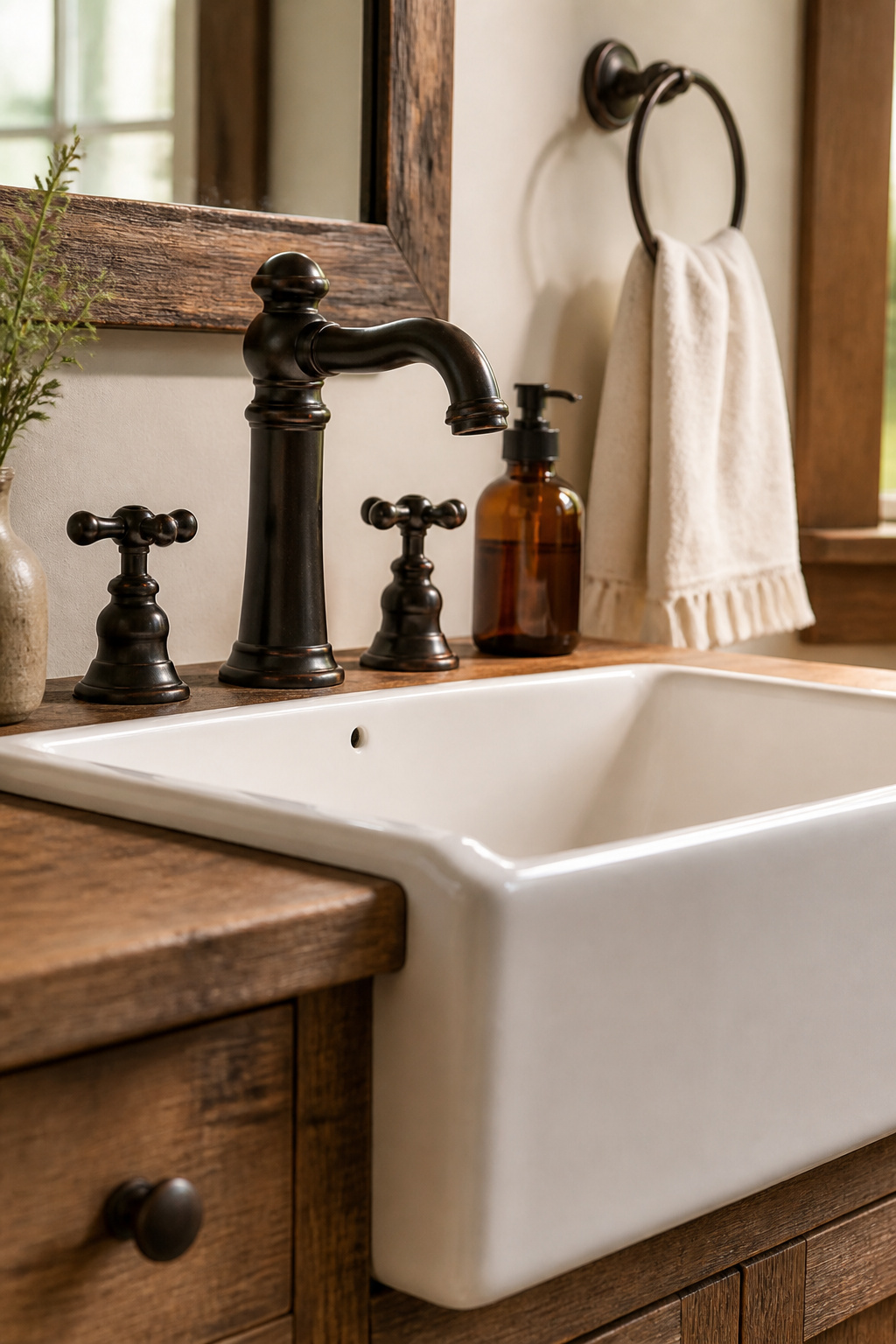
Unlacquered Brass and Living Finishes That Develop Patina
Unlacquered brass is the most interesting finish choice because it changes over time. The brass reacts with air and water to develop a warm, irregular patina — the same process that gives antique hardware its depth. Slow the oxidation by sealing with Briwax or Renaissance Wax annually; let it run its course if you prefer the more aged look. Native Trails makes excellent unlacquered copper sinks and faucets; Kingston Brass is the most accessible option for oil-rubbed bronze ($90-$130).
Matching Faucet Families Across Sink, Tub, and Shower
Match your faucet finish to your shower fixtures from the same manufacturer if possible. Finish codes vary between brands — what looks identical in a showroom can read differently under warm bathroom lighting. Delta’s Cassidy in champagne bronze, Moen’s Weymouth in brushed gold, and Kohler’s Artifacts in brushed moderne brass all offer coordinated collections. Each covers sink, shower, tub filler, and accessories from a single finish family.
Maintenance and Cleaning for Metal Finishes
Wipe all metal finishes dry after each use to prevent mineral deposits. For cleaning, use a damp cloth and mild dish soap; avoid abrasive cleaners on any coated finish. Unlacquered copper and brass can be gently cleaned with Barkeepers Friend to restore brightness, or left alone to continue aging naturally.
Cost range: $90-$500 depending on finish and collection.
14. Woven Baskets and Natural Textiles for Rustic Bathroom Remodel Storage
The styling layer of a rustic bathroom remodel is where you can make up for money spent elsewhere. A well-styled open shelf with honest materials — seagrass baskets, linen towels, terracotta — does more for the room’s atmosphere than another hardware swap.
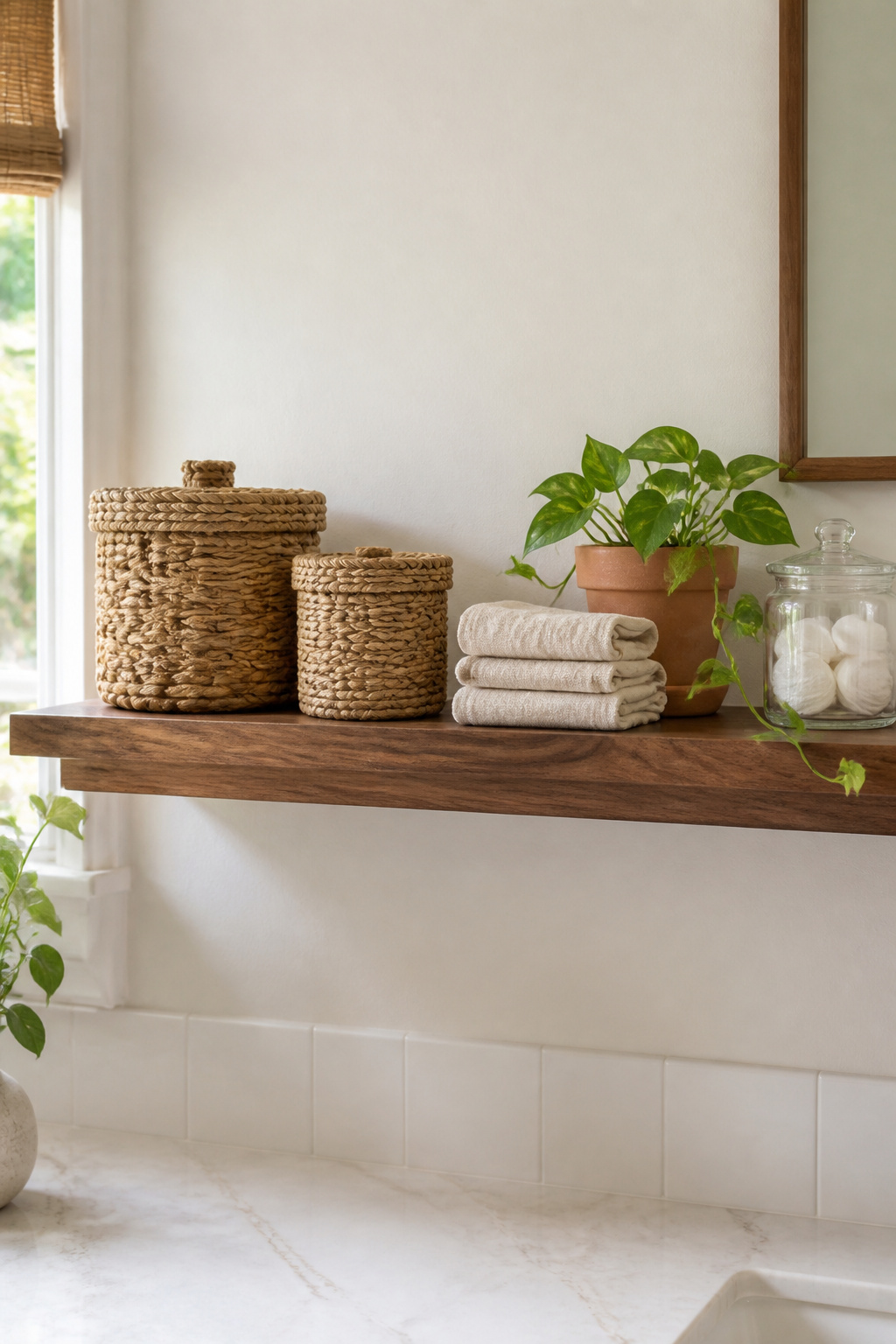
Using Seagrass and Water Hyacinth Baskets for Practical Storage
Both seagrass and water hyacinth are naturally mold-resistant in well-ventilated bathrooms and hold their shape for years. IKEA’s NIPPRIG seagrass baskets ($8-$20) are the most accessible option; World Market’s water hyacinth baskets ($15-$45) have slightly more weave variation that reads as more artisan. Avoid bamboo baskets in high-humidity rooms — they crack as humidity cycles. Also, nest three baskets together when not in use: a cluster reads as intentional, scattered individual baskets read as clutter.
Linen Hand Towels and Cotton Bath Mats That Reinforce the Palette
Linen hand towels absorb more slowly than cotton but dry faster, making them more hygienic in a busy bathroom. Cultiver’s linen hand towels ($29/set) and Parachute’s bath mats in stone ($39) both hold their texture through many washes. Choose one neutral — cream, natural, stone — and use it across all textiles in the room. Committing to one shade reads as deliberate; mixing three different beiges reads as unsure.
Layering Textures Without Cluttering a Small Bathroom
The useful rule: five objects maximum on an open shelf. Two baskets, one plant, one glass or ceramic jar, one stack of folded towels. More than five and the shelf starts reading as a cluttered surface. For more styling frameworks that work in rustic rooms, take a look at these country bathroom decor ideas.
Cost range: $50-$150 for a full basket and textile refresh.
15. Potted Plants and Natural Elements That Make a Rustic Bathroom Remodel Feel Alive
Every rustic bathroom renovation I’ve worked on that felt genuinely complete had one thing the others were missing: something living. A plant, a piece of driftwood, river stones in a dish, an air plant tucked into a reclaimed wood frame. Natural objects provide the organic irregularity that no styled surface can replicate.
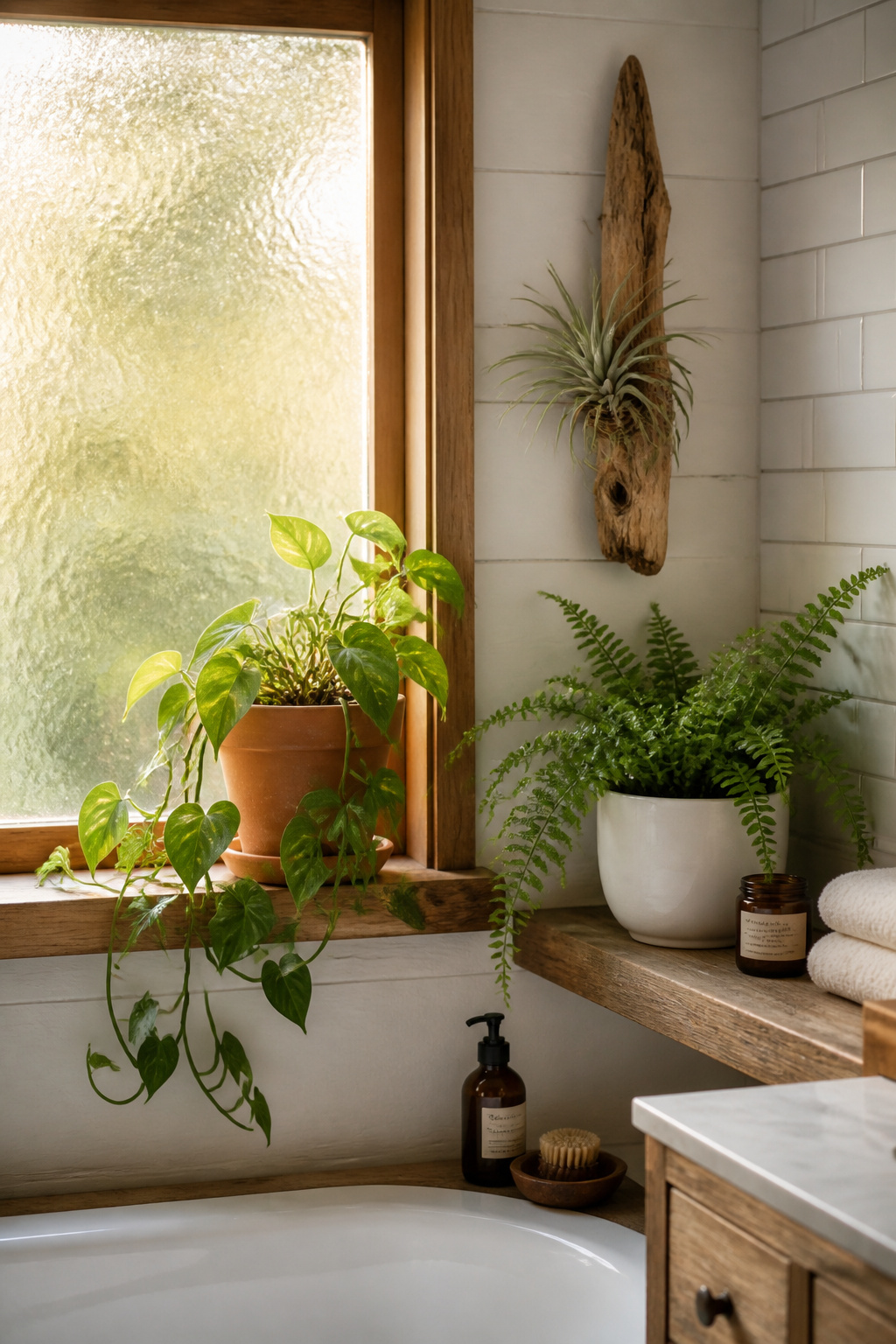
Best Plants for Low-Light, High-Humidity Bathrooms
Pothos (Epipremnum aureum) will survive conditions that would kill most houseplants — near-zero natural light, irregular watering, and temperature swings. It trails beautifully from a shelf and grows fast enough that you’ll feel like you’re actually succeeding. Boston ferns thrive specifically in bathroom humidity and prefer indirect light — a good-sized fern near a frosted window will look spectacular year-round. Snake plants tolerate neglect and very low light but rot in standing water; use well-draining soil and a pot with drainage.
Driftwood, River Stones, and Foraged Elements as Decor
An air plant (Tillandsia) mounted on driftwood with copper wire does more for a rustic bathroom atmosphere than any framed print or decorative tray. Mist air plants twice a week with room-temperature water. River stones in a small dish beside the sink, a dried eucalyptus bundle hung on the shower head, a piece of raw birch bark on the shelf — all cost almost nothing. Together they provide the organic irregularity that makes a room feel assembled by someone with genuine taste. For more ideas on extending natural materials across the whole room, these wooden bathroom ideas are worth a look.
Terracotta Pots and Vintage Planters That Suit the Rustic Look
Plain terracotta pots from Target (4-inch for $1.49, 6-inch for $2.49) are one of the few things that cost almost nothing and look genuinely good. The warm earth color works with wood, stone, bronze, and linen — essentially everything in a rustic bathroom palette. Vintage cast iron planters, small galvanized tin buckets, and old ceramic crocks from thrift stores also make excellent bathroom plant containers.
Cost range: $20-$80 for a plant and natural elements setup.
How to Plan Your Rustic Bathroom Remodel From First Idea to Finished Space
The most consistent mistake in rustic bathroom projects is spending money in the wrong order. The vanity goes in first. Then a tile decision gets made that doesn’t quite suit it. Then the mirror choice feels slightly off because the faucet finish hadn’t been picked yet.
Start with the floor — tile is the most labor-intensive and expensive thing to change, and it affects every other decision in the room. Then the vanity, because it determines the scale and material story. Then the lighting, because it changes how everything else looks once it’s installed. Hardware, mirrors, and styling come last because they’re fast to swap and cheap to change if your first choice doesn’t work.
Prioritizing Projects by Budget and Impact
If budget is the constraint, the four highest-impact low-cost changes in order are: swap the hardware ($50), install a barn door ($150), add shiplap to one wall ($100), replace the light fixtures ($150). Those four changes for under $500 will transform the room’s character more thoroughly than a $500 box-store vanity. For a deeper look at sequencing heritage-material decisions across a full renovation, our guide to traditional bathroom remodels walks through the whole process.
Where to Source Reclaimed and Vintage Materials Without Getting Burned
The rule with reclaimed wood: always measure moisture content before you buy. The rule with vintage fixtures: always check for cracks before you pay. The rule with architectural salvage: buy more than you need, because the source won’t have it again. Habitat for Humanity ReStore, Facebook Marketplace, local salvage yards, and estate sales are the four most reliable sourcing channels. Etsy is excellent for finished vintage pieces but rarely the cheapest option.
The most important thing you can do in a rustic bathroom renovation is resist the impulse to finish it all at once. Live with the reclaimed wood vanity for a month before committing to tile. Let the salvaged shelf sit in the space for a week before deciding where to hang it. The best rustic bathrooms feel like they were assembled over time because, in the good ones, they actually were.