
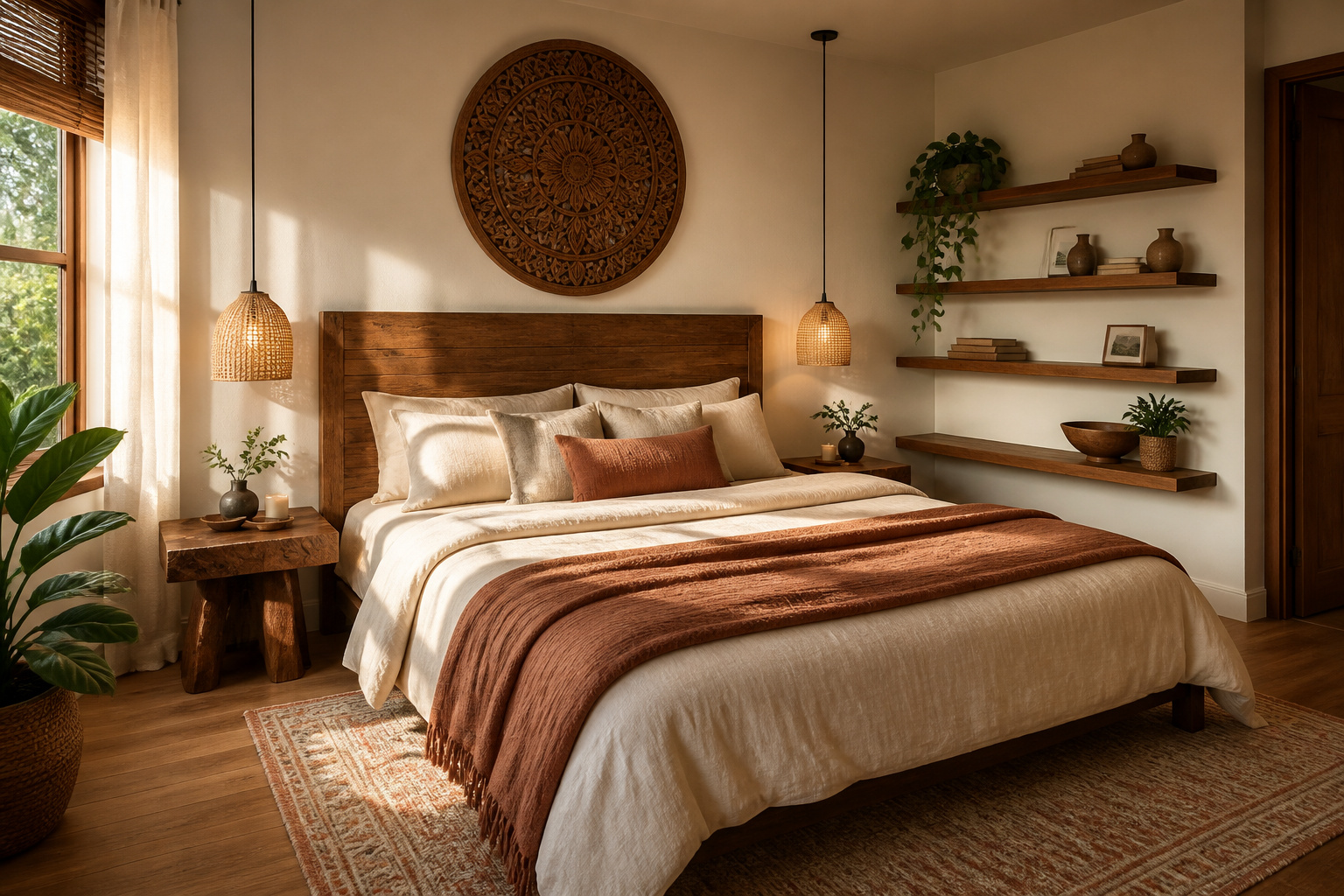

There’s a moment I keep coming back to from early in my restoration work. I had just moved into a flat with white walls, grey carpet, and zero personality. The room was fine — but it felt like sleeping in a catalogue. Then I picked up a reclaimed oak headboard from a demolition salvage yard — rough-hewn, full of nail holes, streaked with grey weathering — and everything shifted. That single piece of wood changed the energy of the room completely. The white walls stopped reading as clinical and started reading as calm.
Wood does that. It carries warmth in a way that metal, glass, or painted surfaces simply cannot. There’s also something about the variation in natural grain — the fact that no two pieces of timber look exactly the same — that makes a room feel personal rather than assembled. A bedroom with good wood in it looks like someone chose those pieces with care, even when the process was as simple as a lucky find at an estate sale.
Over twelve years restoring and sourcing vintage pieces, I’ve worked with barn oak, teak, walnut, bamboo, and everything in between. I know which bedroom wood ideas make a genuine difference and which ones only look good in photos. This list covers eighteen specific approaches — from headboard statements and furniture anchors to small styling moves that quietly transform a bedside. There’s something here for every budget and every size of bedroom.
1. Reclaimed Wood Headboard as the Bedroom’s Anchor Piece
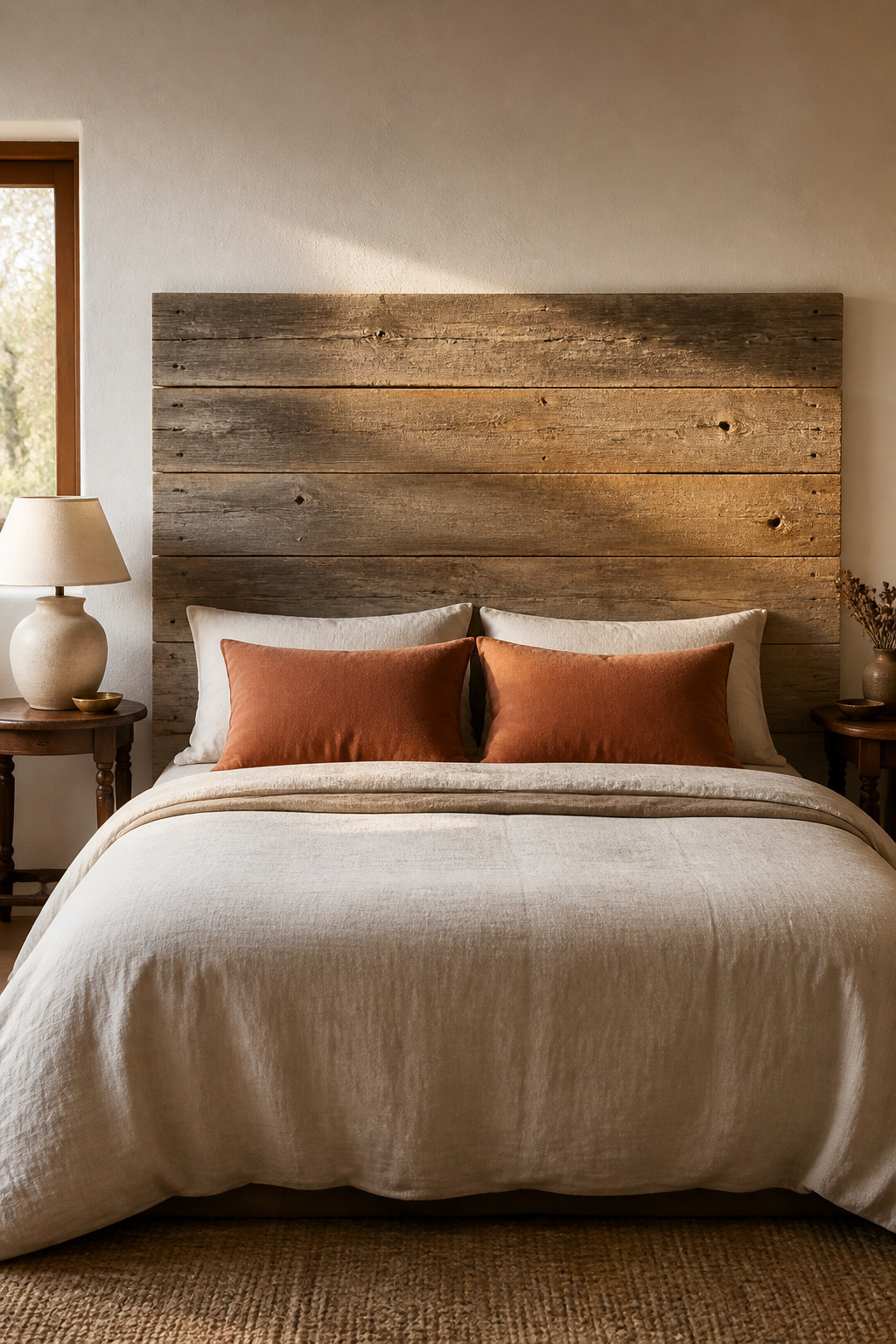
A reclaimed wood headboard is the single most impactful natural element you can add to a bedroom. It reads as a full wall element even though it’s one piece of furniture. Every knot, saw mark, and nail hole tells you this wood has a history, which gives a room depth that new materials can’t fake.
Why It Defines the Whole Room
The headboard is what you see first when you walk through the door. It’s the backdrop for every other decision in the room. A reclaimed wood piece gives you a natural palette to work from — honey, grey, and warm brown tones pull your eye toward linen, terracotta, and sage in a way that feels intuitive.
Choosing the Right Wood
Barn oak runs warm with honey-grey streaks and suits most bedroom palettes. Reclaimed pine is lighter and more knotty. Vintage maple shows a denser grain and suits refined spaces. West Elm’s reclaimed headboards start at $499; Etsy artisans offer custom sizing for $300–$700.
Pro Tip: Spotting Genuine Pieces
Real reclaimed wood shows uneven weathering and wear on the back face. Ask sellers for provenance. Genuine pieces are typically 1.5–2 inches thick; imitations are often 0.75-inch veneer over MDF, which you can feel immediately when you knock on the surface.
2. Floating Wood Shelves for Bedroom Storage With Character
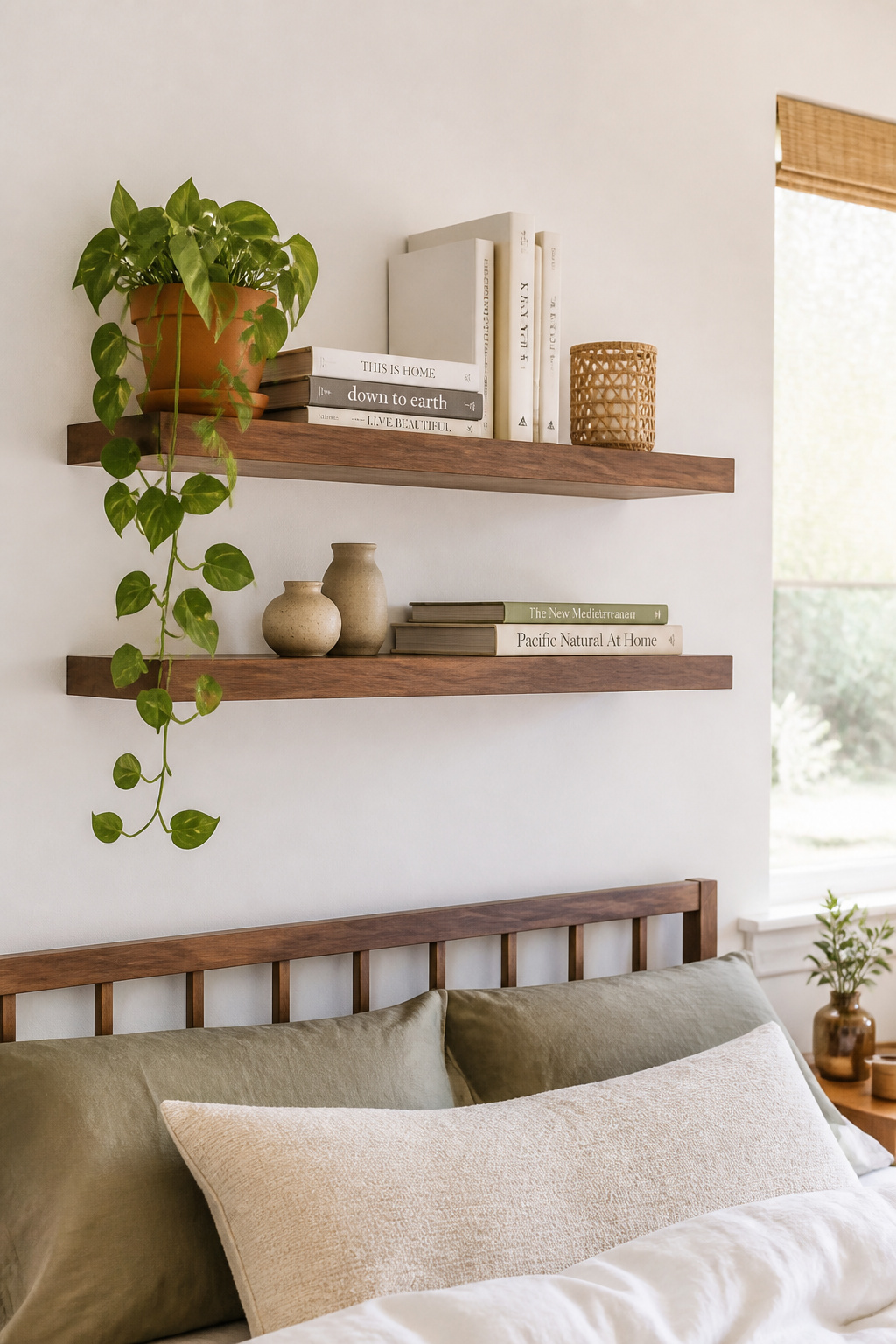
Floating shelves in solid wood are among the most underrated pieces of wood bedroom decor. Open shelving adds warmth to a wall that would otherwise sit bare. Unlike a bookcase, floating shelves don’t visually divide a room or make it feel smaller.
Why Open Shelving Works
Open shelving lets you style the space rather than just store in it. The objects you love — a favourite book, a trailing plant, a ceramic from a market — become part of the room. Three to five well-chosen objects per shelf beats twelve cramped ones every time.
Wood Options and Installation
Walnut is the premium pick. Ash suits Scandinavian-influenced rooms. Pine is the most affordable solid wood option at $30–$80 per shelf. IKEA BERGSHULT boards ($25–$45) with hidden brackets are a reliable budget choice. Apply two coats of Rubio Monocoat for a matte finish that protects without changing the wood’s character. Standard 3/4-inch shelves with two anchored brackets hold 25–35 lbs per linear foot — plenty for books, ceramics, and plants.
3. Wood Bedroom Decor Through Vintage Nightstands With Story
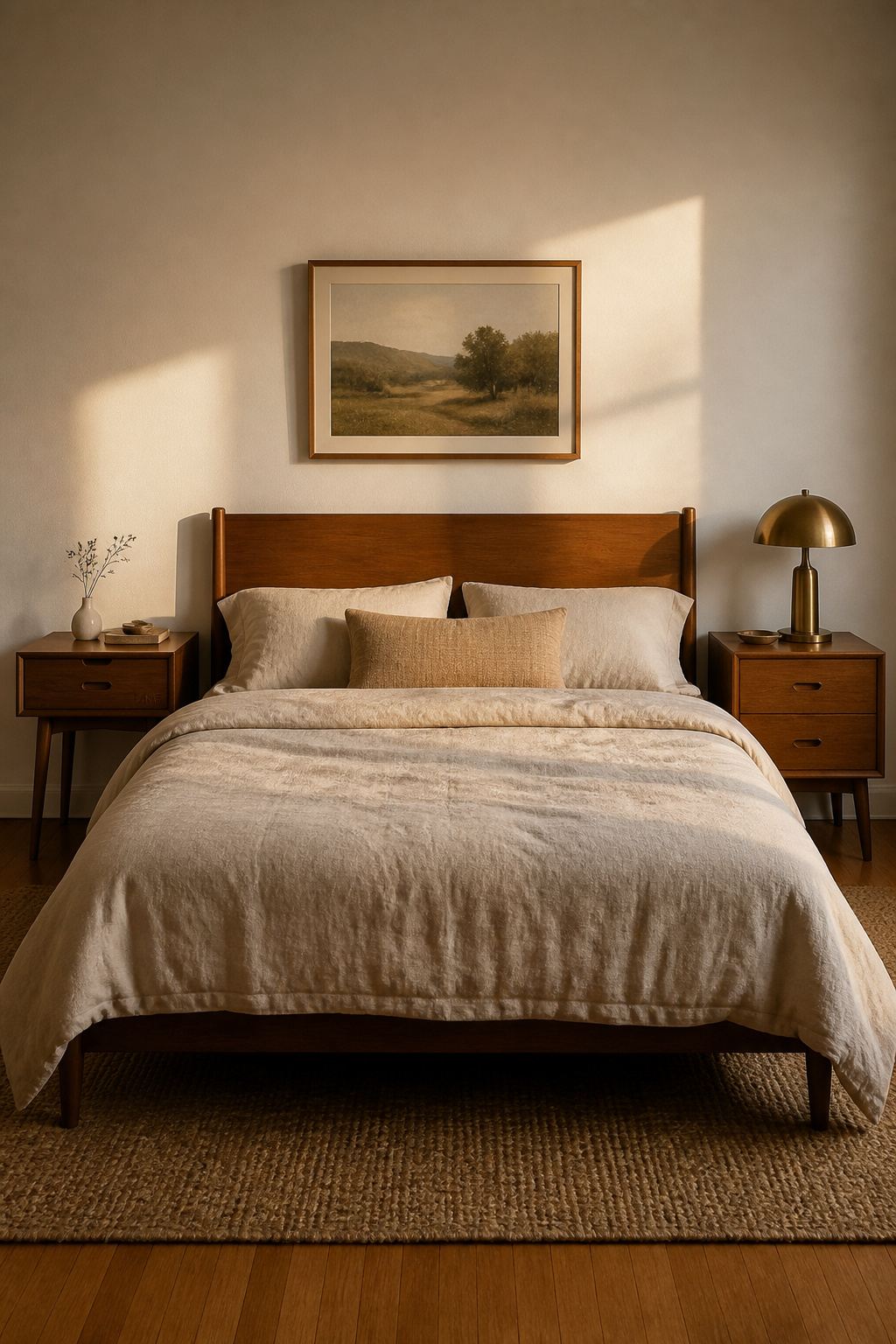
Mismatched vintage nightstands work better than matching sets. Matching sets signal a budget was spent. Mismatched vintage pieces signal taste. The key is finding two pieces that share a common thread: a similar wood tone, a comparable era, or an overlapping height. Once those boxes are ticked, the variation between them reads as intentional.
What to Look for When Shopping
Mid-century modern nightstands on Facebook Marketplace run $50–$200 for genuine 1950s–1970s pieces. Lane, Broyhill, and Bassett are the reliable American MCM brands to spot at auction. Check the back of drawers for the original manufacturer’s label. A dovetail joint at the drawer corners signals quality; stapled box corners do not.
Restoration Basics
Howard Feed-N-Wax ($12 for 16 oz) removes surface grime and nourishes dry wood in one step. For pieces needing more depth, Briwax Original ($20 for 400g) is the restoration go-to. Hardware swaps can completely change the feel of a tired piece. Brass pulls from D. Lawless Hardware ($2–$8 each) or Rejuvenation ($12–$35) are worth every penny.
4. Live-Edge Wood Slab Side Table as a Sculptural Statement
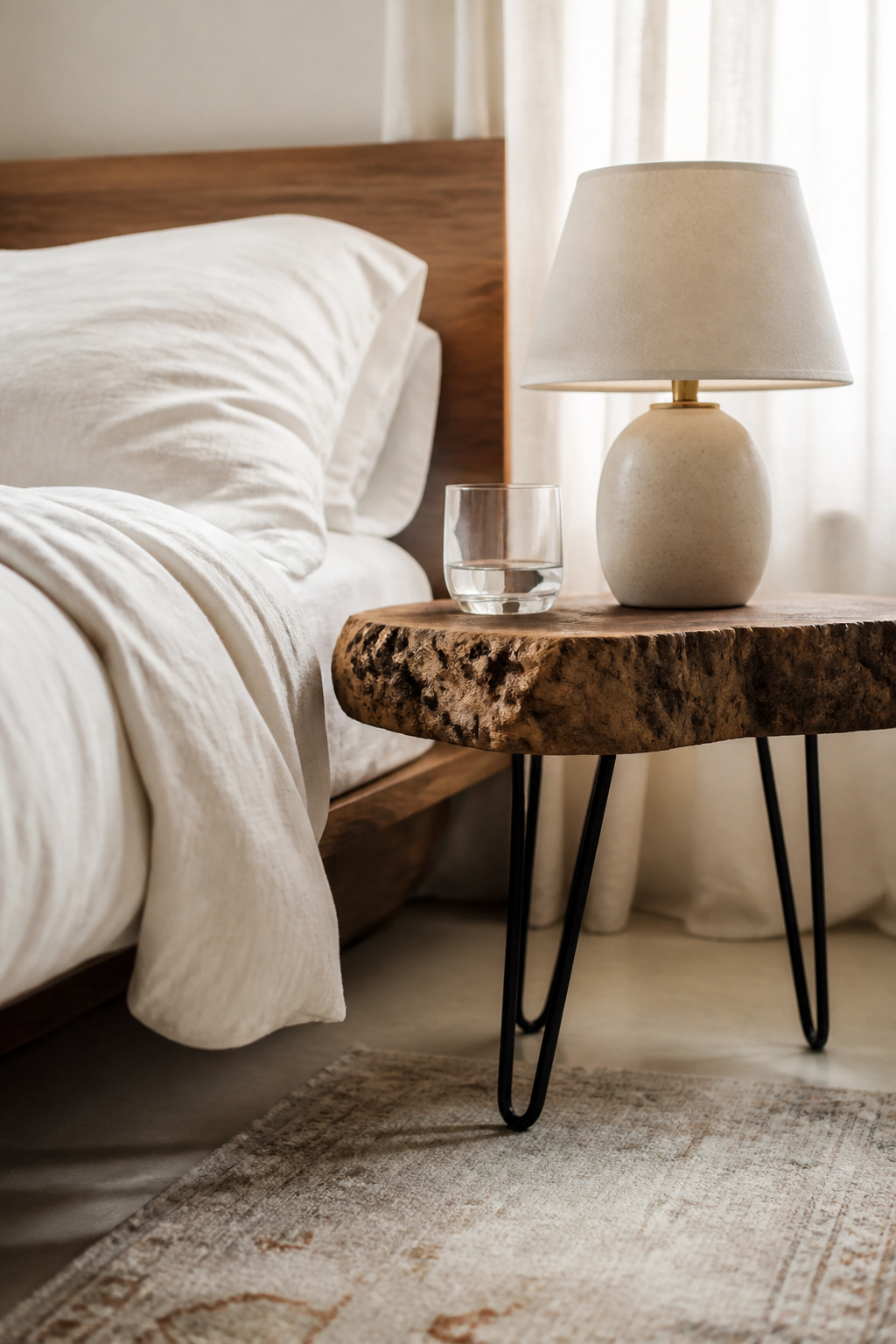
Live-edge furniture sits at the intersection of woodworking and sculpture. Because the slab edge follows the natural outer boundary of the tree — irregular, organic, sometimes dramatically curved — no two pieces are alike. As wood bedroom decor goes, a live-edge side table brings organic life without adding plants or textiles. It simply looks like something that grew there.
Choosing Your Piece
Live-edge walnut slabs for nightstand-height pieces run $200–$600. Mango wood is the most affordable at $80–$200 and is widely available at HomeGoods. Maple shows dramatic grain movement; cherry darkens richly with age. For bed compatibility, the table should sit within 2–3 inches of your mattress top. Place felt pads under the slab to protect hardwood floors. Check for loose bark on the natural edge — it needs removing before the piece goes into regular use.
Pro Tip: Epoxy and Cracks
Some live-edge slabs have natural cracks or voids filled with clear or pigmented epoxy. This is not a defect — it’s a common technique that stabilises the wood and adds visual interest. Black-tinted epoxy fills are particularly dramatic against walnut. However, if you’re buying a slab with epoxy fills, check that the epoxy is fully cured and flush with the wood surface. Uncured or raised epoxy can flake over time, especially in a bedroom with temperature fluctuations. Ask the maker how long the piece has been curing before purchase.
5. Wood Bedroom Decor With a Woven Rattan Bed Frame
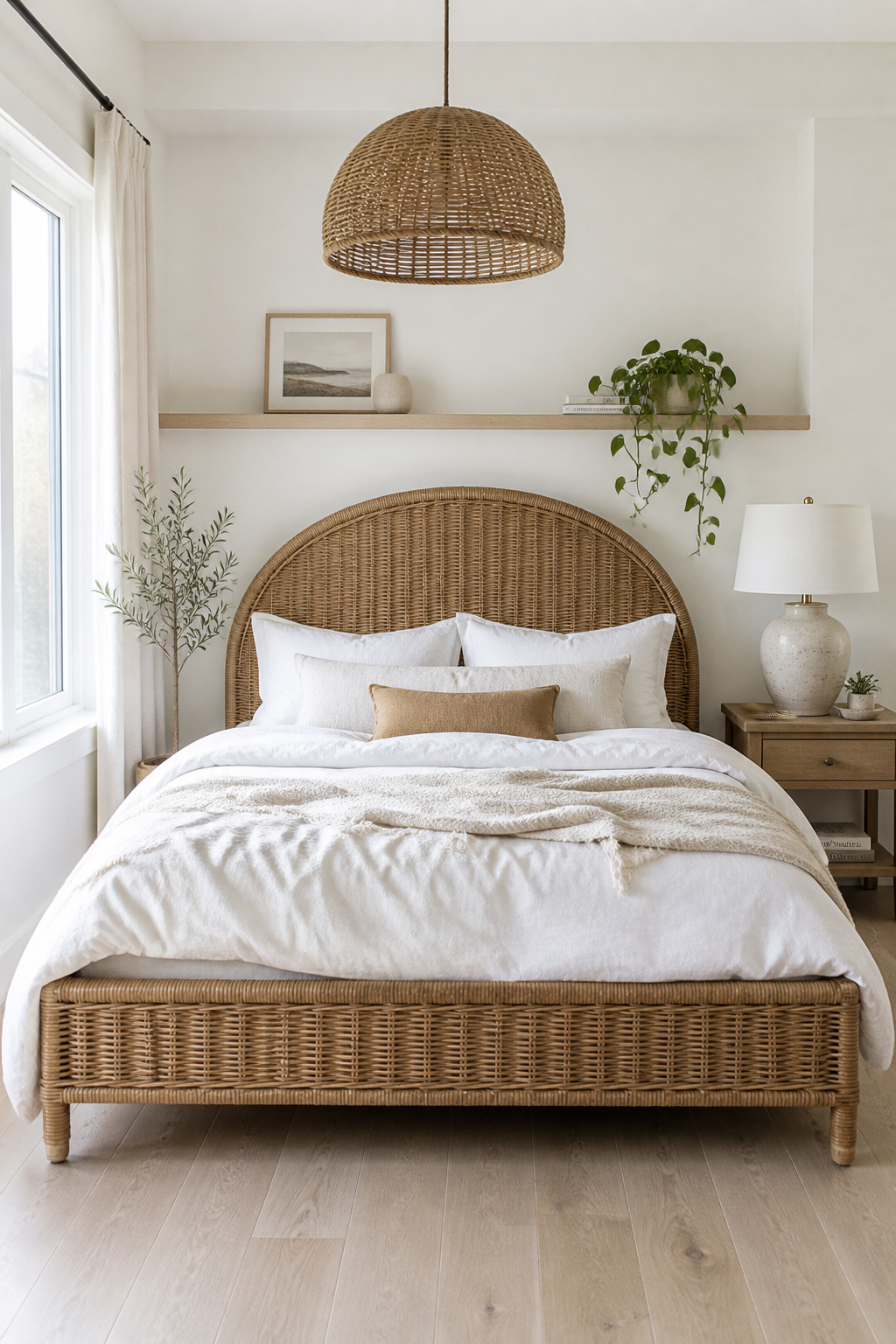
Rattan and wood are natural partners in a bedroom — both carry warmth, both have texture that catches light, and both come from plant-derived materials. A woven rattan bed frame brings a lightness that solid wood frames can’t always achieve. The open weave structure means you see through it, so the frame doesn’t visually dominate even when it’s the largest piece in the room.
Frame Styles and Price Points
Serena & Lily’s rattan frames ($2,195–$3,495) are the benchmark for quality. World Market offers budget-friendly options at $399–$799, and boho bedroom decor pairings work especially well with their natural-finish styles. Pottery Barn’s Havana rattan bed sits at $999–$1,299 for a queen. In humid climates, rattan can soften over time — a bedroom dehumidifier helps. Oil the rattan joints lightly with linseed oil once a year to prevent brittleness.
6. Wooden Picture Ledges for a Gallery Wall That Evolves
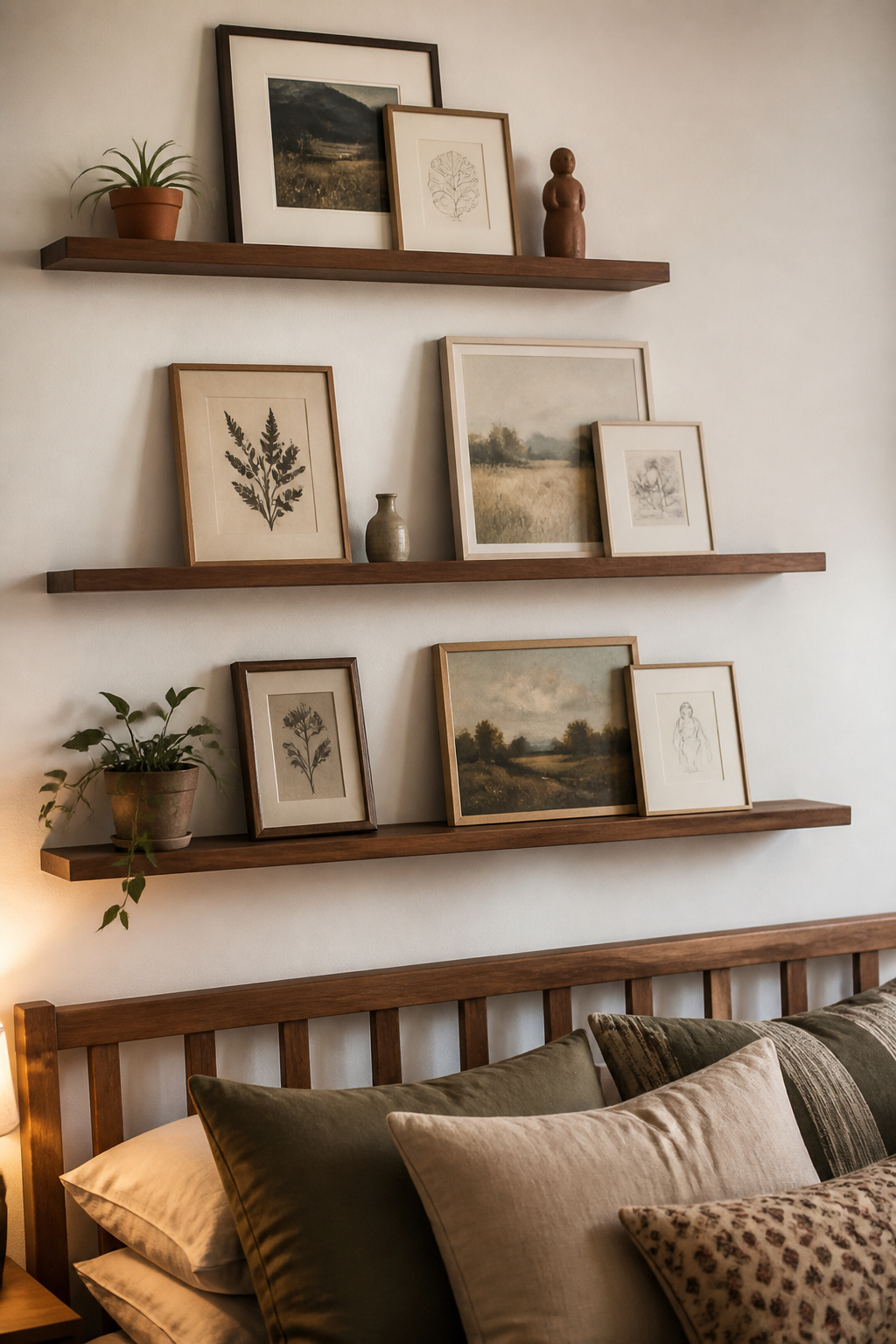
Fixed hooks make gallery walls permanent. Picture ledges keep them alive. A wooden ledge means you can rotate art, adjust compositions, add a plant between frames, or swap the whole arrangement on a Sunday afternoon — without drilling new holes. For anyone who collects art slowly over time, this approach is genuinely practical as well as beautiful.
Wood Options and Styling Depth
IKEA MOSSLANDA ledges ($12.99 for 55 inches) are the most widely used budget option. Solid walnut ledges from Etsy run $45–$120 for a 36-inch piece with a deeper lip. A 2-inch lip handles frames up to 8×10 and small ceramic objects. Two or three staggered ledges create enough visual weight to read as a feature without overwhelming the wall. Add small non-slip rubber dots to the back of frames — they prevent the slow creep and tilt that happens over time and keep the arrangement looking intentional.
7. Reclaimed Wood Accent Wall Behind the Bed
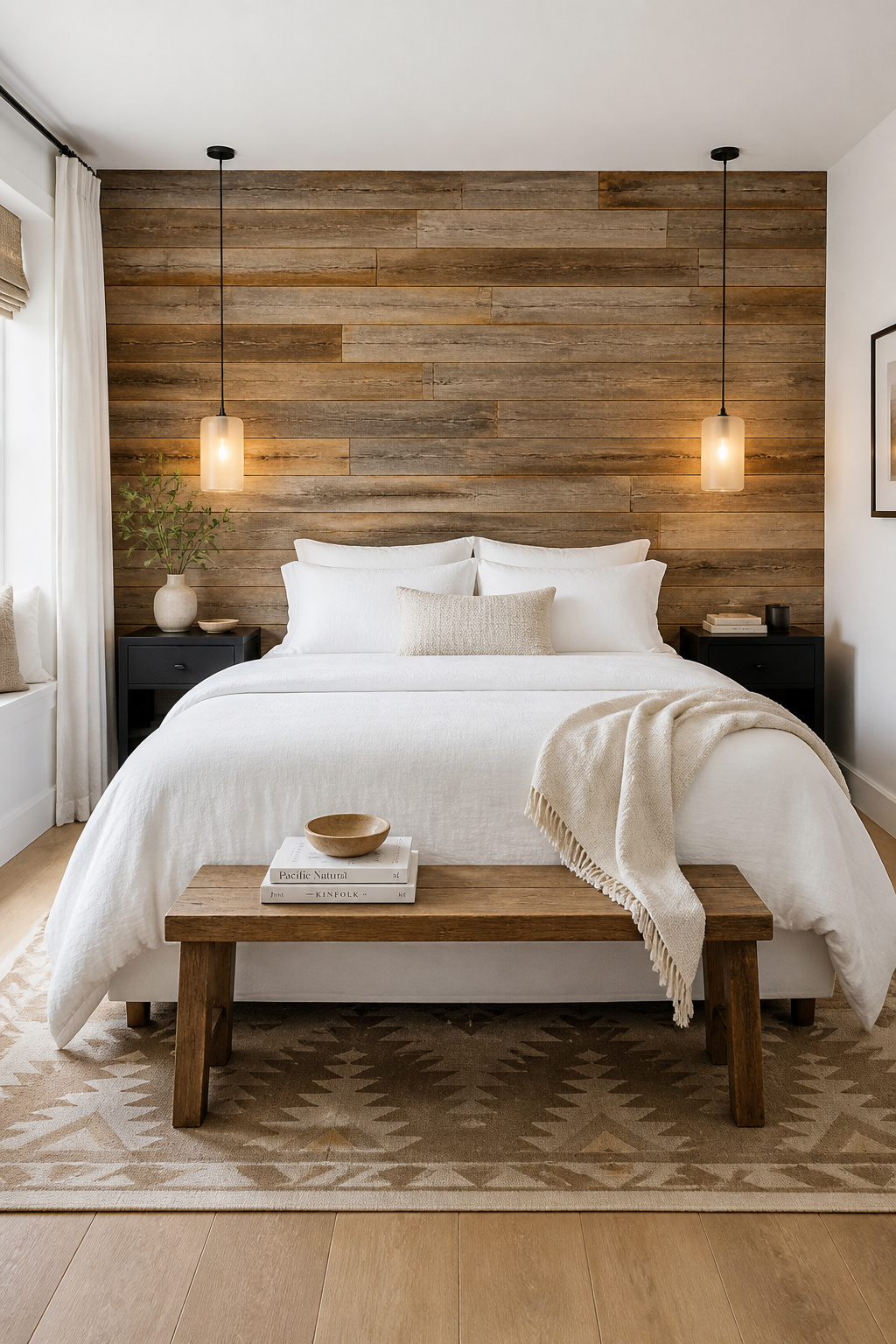
A wood accent wall is the biggest commitment on this list and also the one with the most dramatic return. Running reclaimed planks behind the headboard turns an ordinary bedroom wall into something architectural. The key is restraint: one wall, not all four. This approach gives the room a clear focal point without changing the floor plan, the furniture, or the light.
Plank Styles and Installation
Horizontal shiplap is the easiest to install. Vertical tongue-and-groove reads slightly more formal. Herringbone is the most dramatic but requires more cutting skill. Stikwood peel-and-stick panels ($10–$12 per sq ft) are the renter-friendly option — they go on a sheet of plywood leaned behind the bed rather than adhered to the wall. Traditional nail-up installation runs $3–$8 per sq ft in materials. A typical queen headboard wall needs roughly 17 square feet, so materials run $50–$140. Before installing planks to drywall, apply a light coat of Killz primer. It prevents off-gassing and seals moisture that could warp thin planks over time.
8. Mid-Century Wood Dresser as Wood Bedroom Decor Cornerstone
There’s no wood bedroom decor investment that pays off over a longer timeline than a genuinely good mid-century dresser. A Lane or Broyhill piece from the 1960s is more solid today than most new furniture will be in thirty years. The construction standards of that era — proper dovetail drawers, solid hardwood carcasses, carefully fitted joints — reflect a time when furniture was built to outlast the people who bought it.
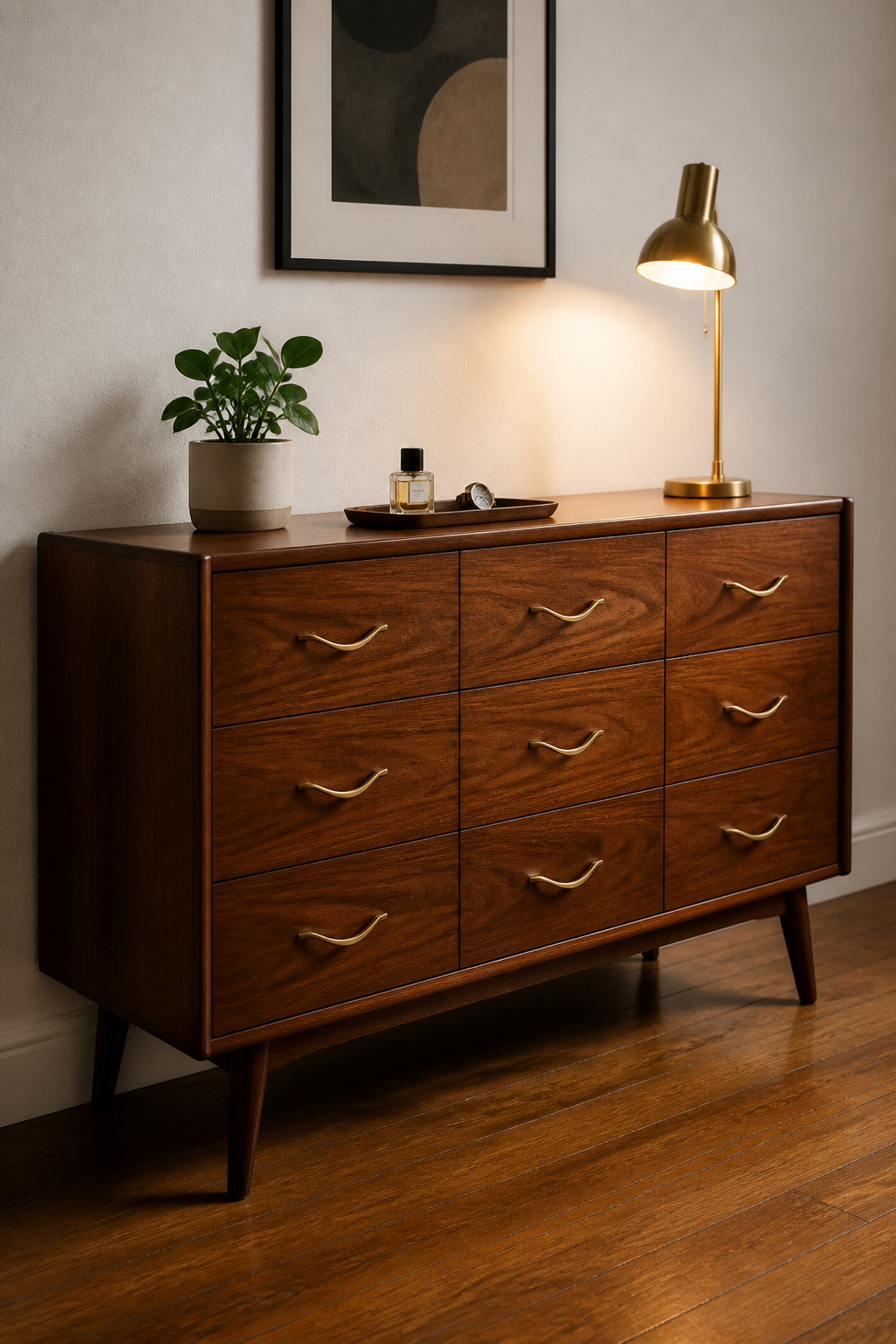
Identifying and Updating Genuine Pieces
Lane, Broyhill Brasilia, and Bassett are the most reliable MCM brands at estate sales. Lane nine-drawer walnut dressers sell for $250–$600; Broyhill Brasilia pieces run $300–$800. Dovetail joints at drawer corners indicate quality; stapled corners do not. For hardware updates, bedroom furniture decor styling principles apply here: the hardware should complement the wood tone. D. Lawless Hardware stocks vintage-compatible styles at $2–$8 per pull; Rejuvenation offers premium brass at $15–$35.
9. Wood Bedroom Decor With Sustainable Bamboo Furniture
Bamboo is technically a grass, not a tree — but it machines, finishes, and performs like hardwood. More importantly, it matures in 3–5 years compared to 50–100 years for most hardwoods. If sustainability matters to how you buy, bamboo bedroom furniture delivers the warm, natural look of wood without the harvesting timeline attached to most timber.
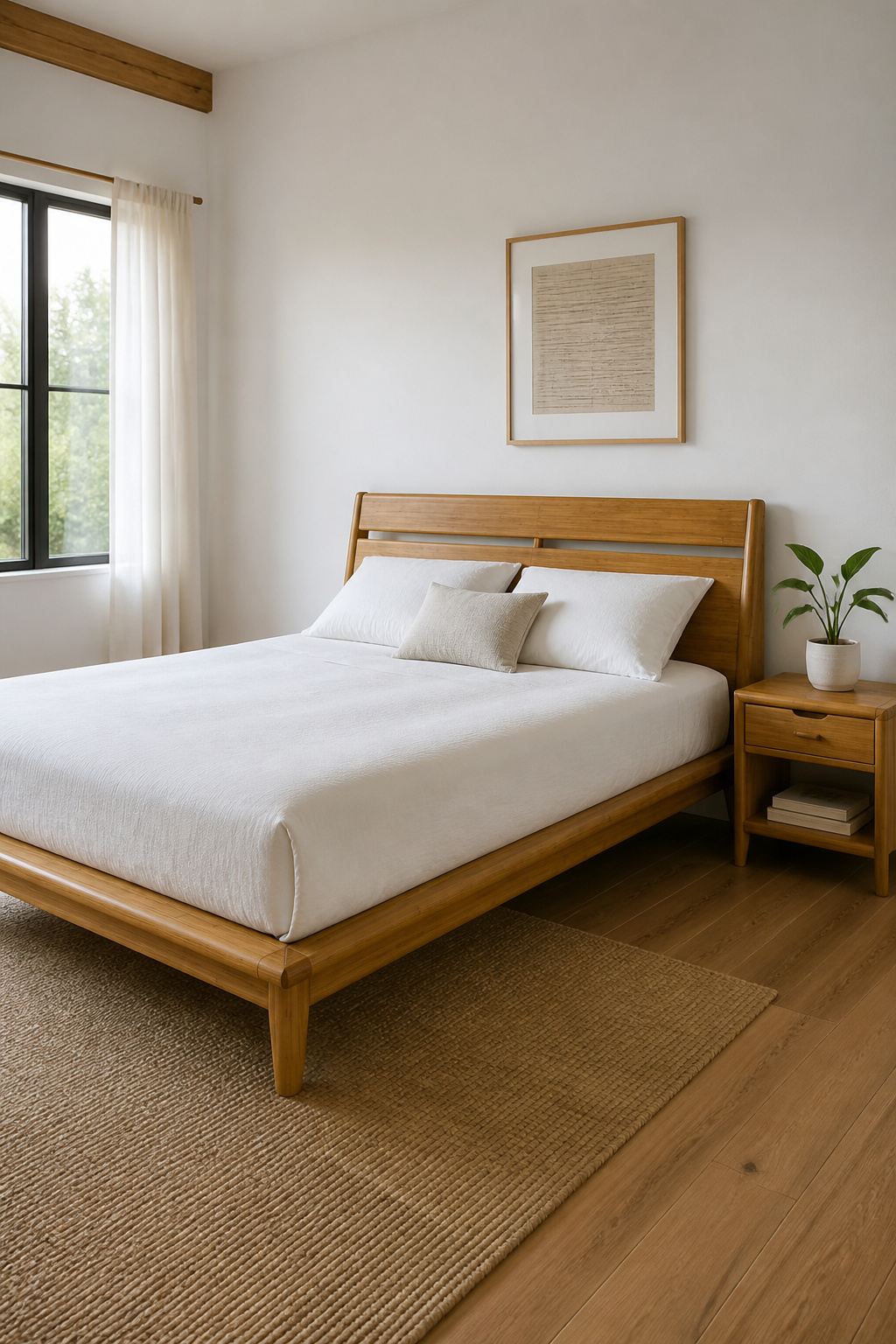
Choosing Quality Bamboo
Greenington is the benchmark for high-design bamboo bedroom furniture. Their dressers run $499–$899 and beds $699–$1,299. IKEA NORDKISA ($249) is an accessible entry point. Look for products specifying E1 or E0 emission standards or CARB Phase 2 compliance — this confirms low formaldehyde in the adhesives, which matters for a room you spend eight hours a night in. For a bedroom that embraces natural materials throughout, cozy bedroom ideas that pair bamboo furniture with organic cotton textiles work particularly well.
10. Carved Wood Wall Art for Texture Above the Headboard
Wall art in wood is not the same category as framed prints. Carved wood panels and relief sculptures bring dimension to a wall that flat art can’t — they create shadows, catch light differently at different times of day, and read as three-dimensional objects. Placed above a headboard, a carved wood piece works as a visual anchor without the rigidity of a canvas.
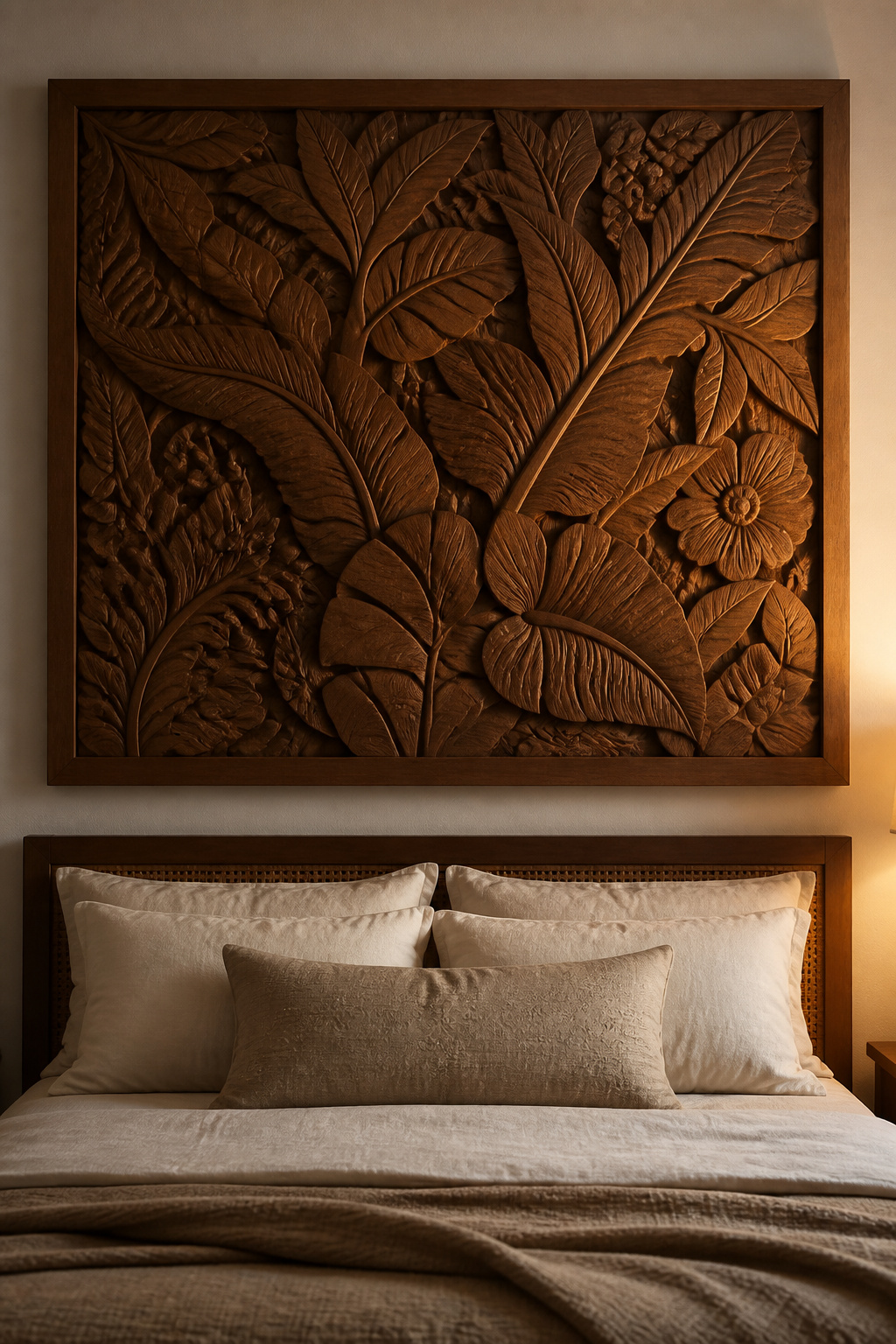
Types, Scale, and Hanging
Relief panels in botanical or geometric patterns work in almost any bedroom style. Wooden medallions and sunbursts suit bolder spaces — 24–36 inches in diameter is the right scale for a queen bed wall. Abstract shapes in raw or lightly oiled wood are the most contemporary option and suit minimal bedrooms particularly well. World Market, Anthropologie, and TJ Maxx all stock carved wood wall art; prices run $40–$200 for most pieces and $80–$400 for larger medallions. For heavy pieces over 5 lbs, use a French cleat system or hanging strips rated for the weight. Also consider your lighting: under warm Edison-style bulbs, teak reads as golden and rich. Under cool LEDs, the same piece reads grey-brown and flat. Test under your actual bedroom light before committing to a large piece.
11. Wood Bedroom Decor Through Exposed Ceiling Beams or Beam Wraps
Ceiling beams change a bedroom’s proportions in a way that floor-level furniture cannot. They pull the eye upward and give the ceiling a surface with texture and warmth. This approach to wood bedroom decor works especially well in rooms with plain white ceilings that feel unfinished without some kind of vertical resolution. You don’t need structural beams to get there.
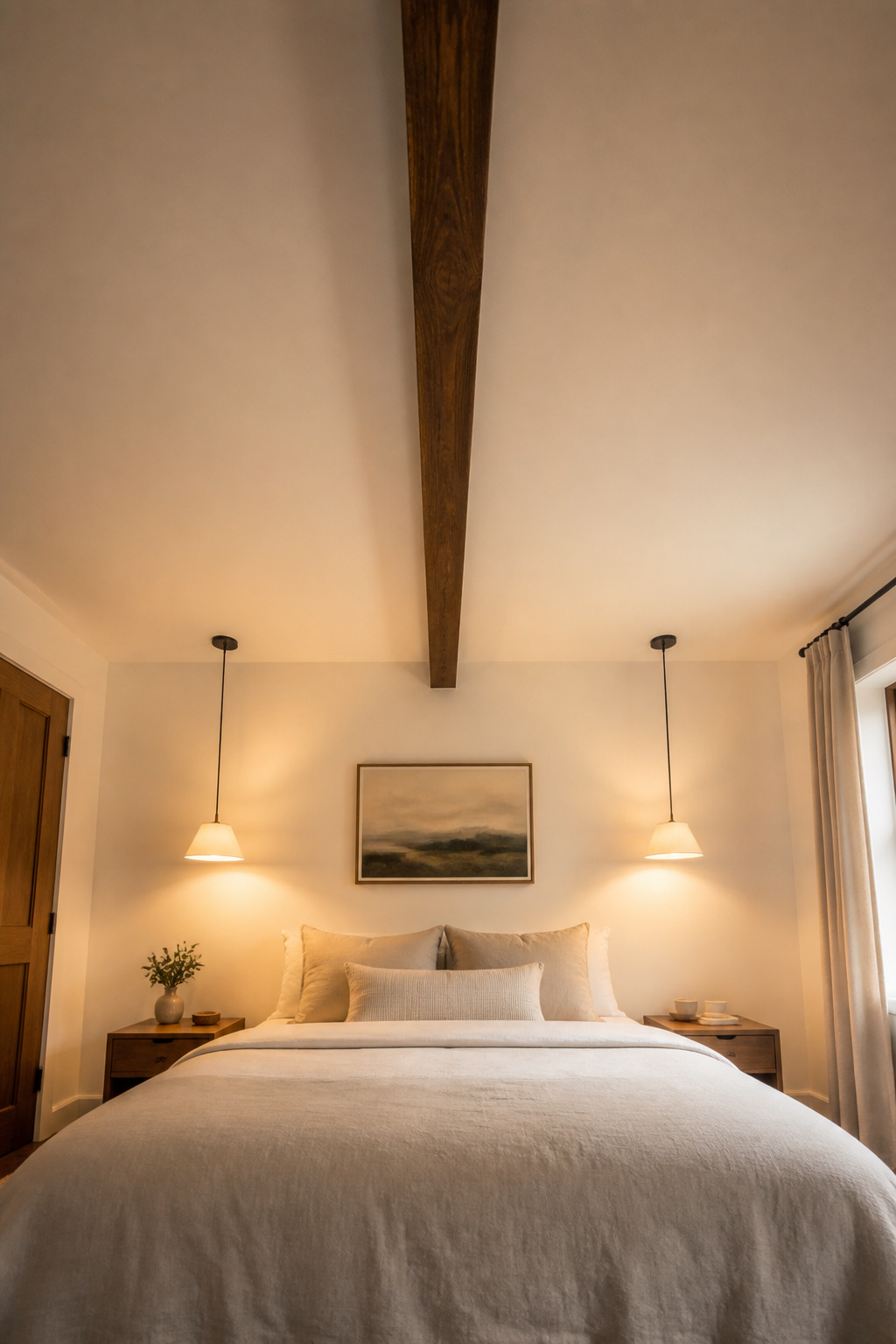
Faux Beam Wraps: What to Know
Barron Designs and Volterra both manufacture hollow beam wraps at $12–$25 per linear foot. A 10-foot wrap runs $120–$250 in materials and installs in a few hours. The wraps mount to a 2×4 nailer screwed into ceiling joists — find joists with a stud finder before starting. A single central beam makes a cleaner statement than three parallel beams and doesn’t visually lower the ceiling. Before mounting, paint the hollow interior flat black. This stops the hollow look from showing at angles where light might catch the inside edge and makes the installation look completely convincing.
12. Solid Wood Bench at the Foot of the Bed
A bench at the foot of the bed seems like pure luxury until you have one. Then you can’t imagine a bedroom without it. It’s where you sit to put shoes on, where a folded blanket gets draped at night, and where things land without going on the floor. In solid wood, it also anchors the lower third of the room and gives the bed a visual base that makes the whole composition feel complete.
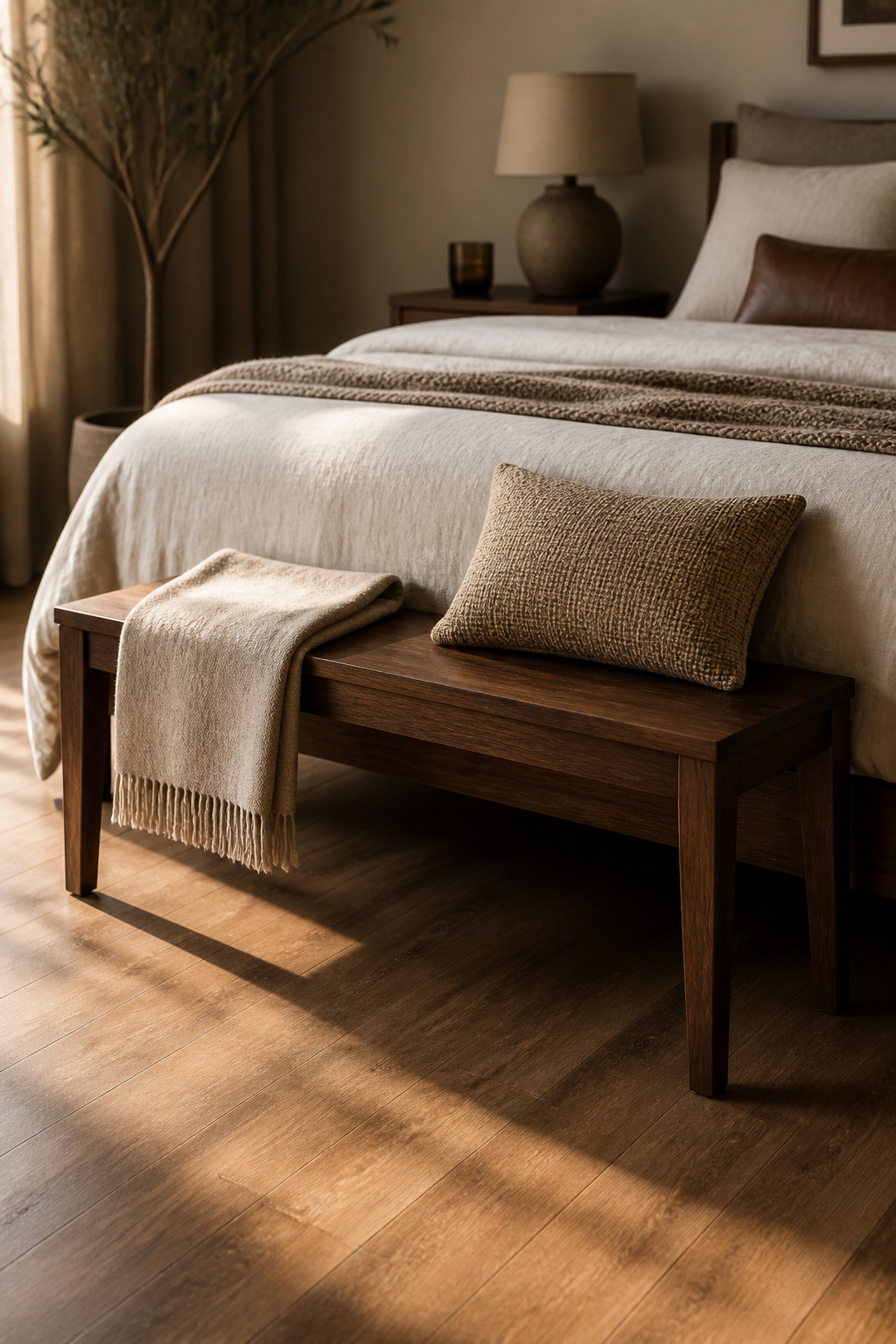
Proportions and Options
Ideal bench height is 16–18 inches for a standard platform bed. A 47–54 inch bench on a queen bed (60 inches wide) leaves 3–6 inches of visual space on each side — centred and intentional. Going wider than the bed looks awkward; under 36 inches looks undersized. CB2’s Armen solid acacia bench ($299 for 47 inches) suits contemporary spaces. Article’s Culla white oak bench ($399 for 54 inches) is a strong mid-range option. For more bedroom furniture comparisons, modern bedroom furniture covers solid wood benches worth considering alongside bed frames and nightstands.
13. Wood Bedroom Decor With a Vintage Ladder as a Display Piece
A vintage wooden ladder is one of the easiest pieces of wood bedroom decor to add to a room that already feels finished. It doesn’t require a wall bracket or a drill. You lean it in a corner, drape throws over the rungs, and it becomes a styled moment the room needed without you realising. For small bedrooms especially, it adds vertical interest without taking up floor space.
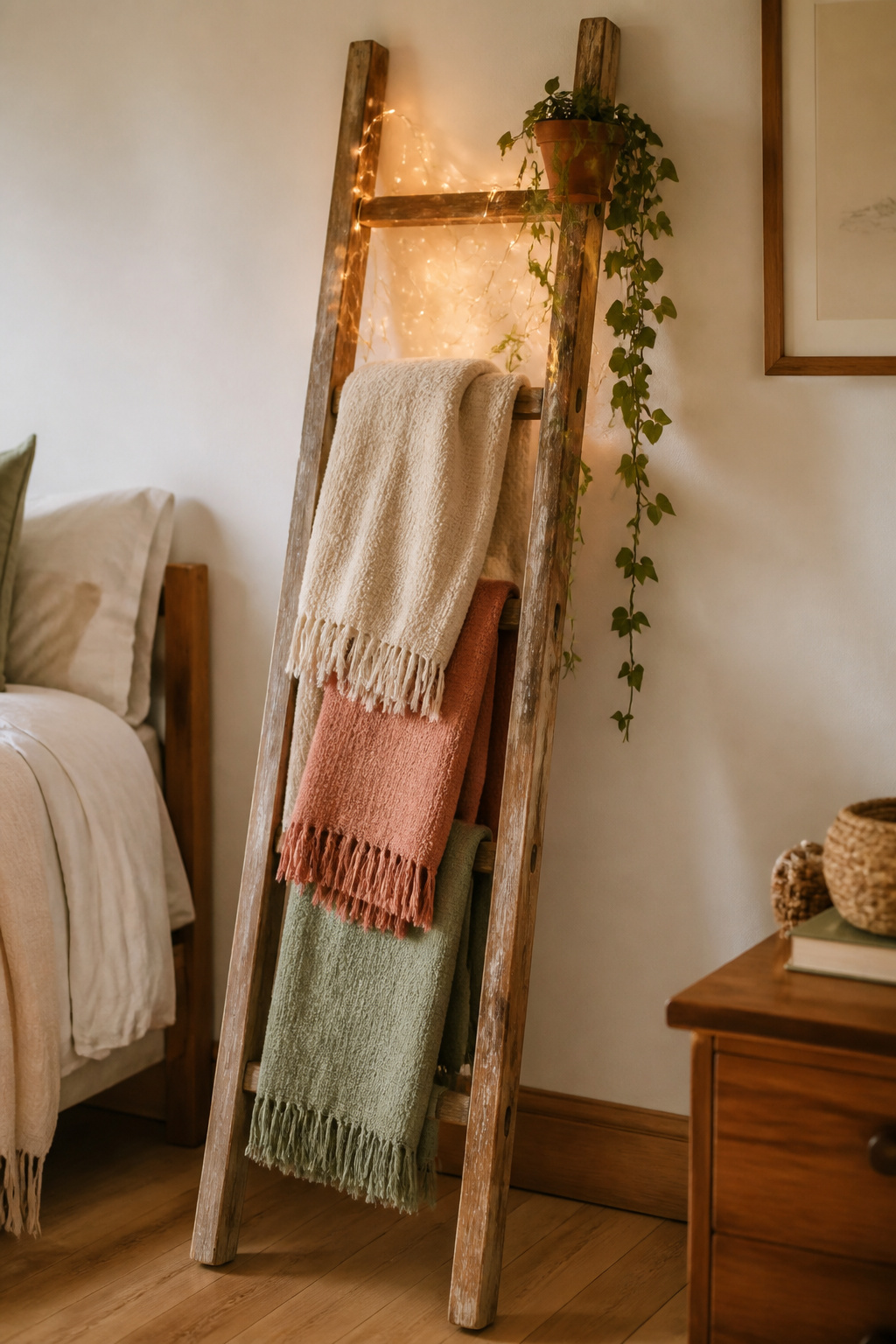
Sourcing, Checking, and Anchoring
Barn sales and Facebook Marketplace offer genuine vintage ladders at $20–$80. Check every rung by wiggling it — loose rungs indicate moisture damage. Also inspect for pest evidence: small holes or fine sawdust signal wood-boring beetles. Treat suspect pieces in a sealed bag with a pest strip for 72 hours before finishing. Modern replicas at Target ($35–$65) avoid these concerns entirely. To anchor: add a small eyebolt into a wall stud and loop a short length of wire to a hook on the ladder’s back. This invisible anchor stops the ladder shifting when you rearrange items on the rungs.
14. Wooden Tray on the Dresser for Organized Bedroom Styling
The dresser tray is the most accessible bedroom styling piece on this list — and also the most underestimated. A wooden tray does something specific: it takes objects that would read as scattered and groups them into a composed still life. The wooden frame creates a visual boundary that makes the arrangement feel deliberate even when it isn’t particularly planned.
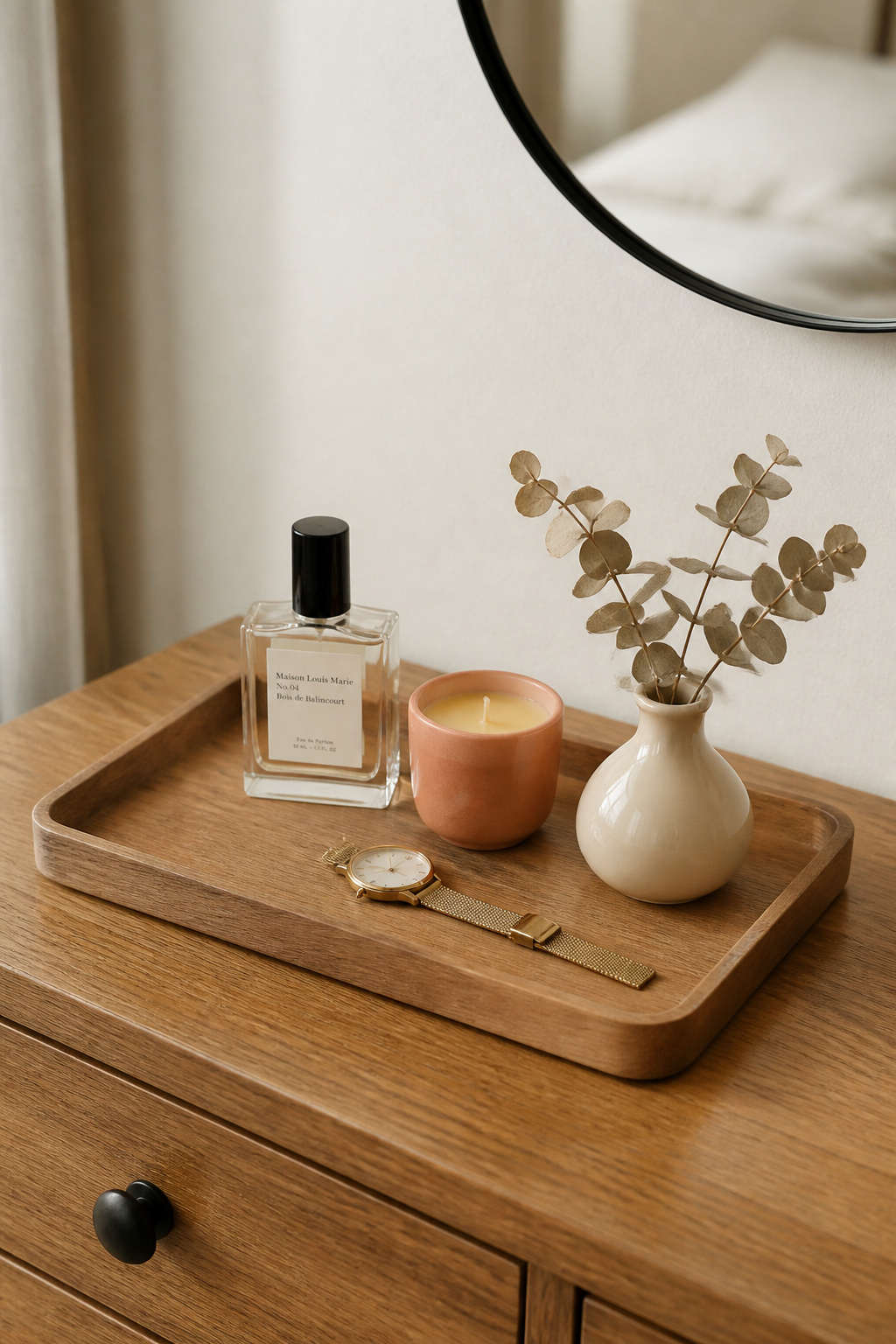
Choosing and Styling the Tray
Hearth & Hand with Magnolia (Target) acacia wood trays run $18–$30 in various sizes. Pottery Barn’s Williams tray in whitewashed mango wood is $59–$79 and suits lighter palettes. Lip height should be 1–1.5 inches: deep enough to contain items, not so deep it blocks sightlines. The tray should hold no more than five to seven items, and the wood surface should still be visible between objects. If you can’t see the tray, there’s too much on it. The same principle applies when tray-styling in wooden bathroom ideas — negative space is as important as the objects themselves.
15. Wood Bedroom Decor With a Solid Walnut Bed Frame
Walnut is the premium wood choice for bedroom furniture, and the reasons go beyond appearance. Its Janka hardness (1010 lbf) sits at the right point — harder than cherry (950), softer than oak (1290) — so it resists everyday dents while remaining workable to craft into refined forms. A solid walnut bed frame is wood bedroom decor that gets better looking over years of use rather than worse.
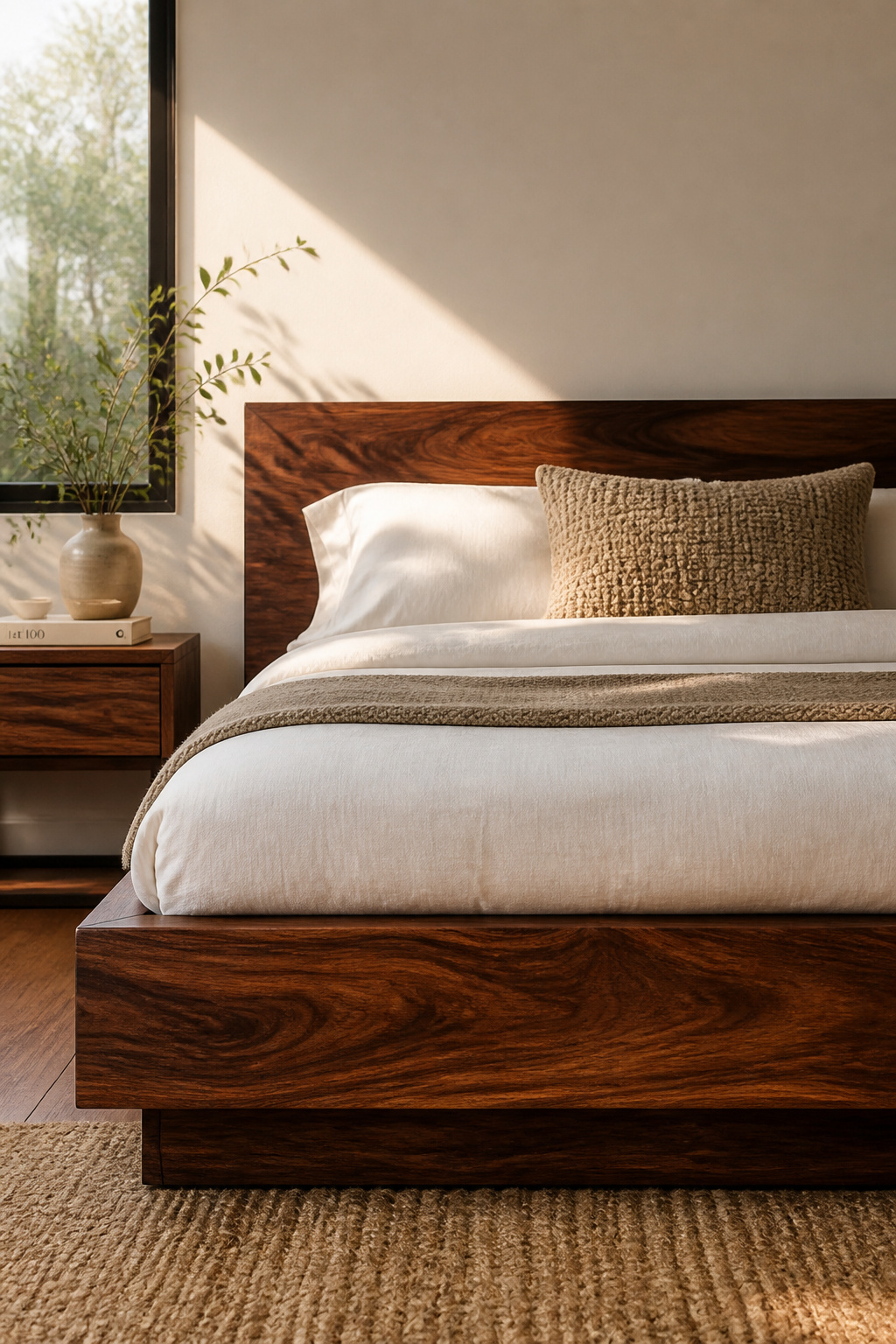
Brands and Care
Floyd’s walnut frame is $895 for a queen with tool-free assembly. Thuma’s The Bed is $1,095 for a queen with a puzzle-joint system and no box spring required. Medley builds solid walnut beds from $1,400 to order. For care: don’t use standard furniture polish on an oil-finished walnut surface. It creates a waxy build-up that clouds the grain. A slightly damp cloth handles everyday cleaning. Rubio Monocoat oil hardens inside the wood rather than forming a surface coat, keeping the tactile warmth. The grain deepens over the first three to five years, becoming richer than it looked when the bed arrived.
16. Wooden Candle Holders and Trinket Boxes for Bedside Styling
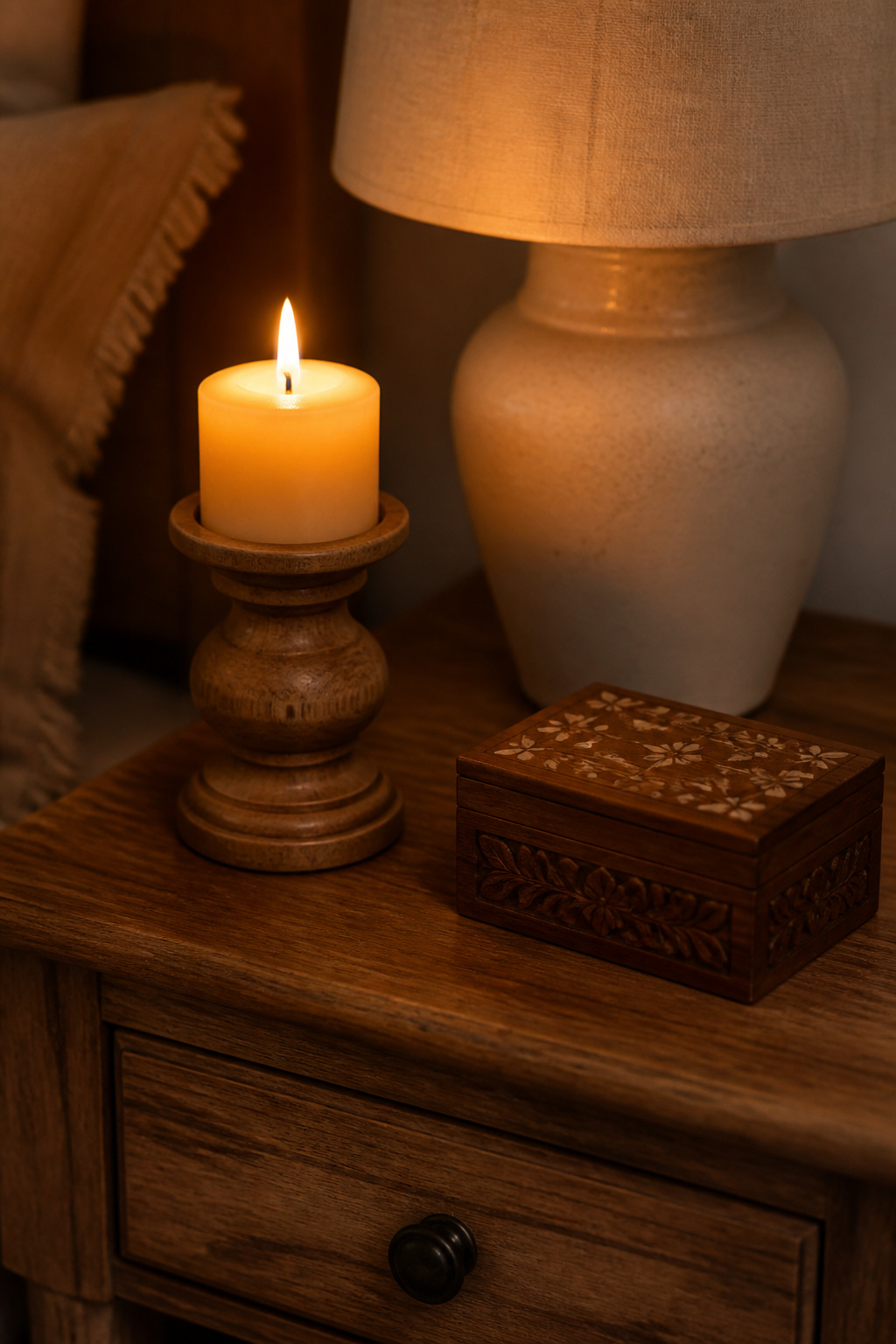
Not all wood bedroom decor needs to be furniture-scale. Some of the most effective moments in a bedroom are small. The turned wood candle holder beside the lamp, the carved trinket box that holds a watch and a ring — these pieces tie the room’s natural material language together at the detail level. In a bedroom that already has wood in the larger elements, small wooden accessories create coherence rather than looking like an afterthought.
Scale, Mix, and Safety
The candle holder should be no taller than two-thirds the height of the lamp base beside it. H&M Home turned mango wood holders run $8–$22; Pottery Barn olivewood holders are $24–$45. Trinket boxes from Anthropologie, World Market, and Etsy run $20–$60. Mix turned (smooth, lathe-shaped) with carved (textured, patterned) wood to create visual rhythm. Keep wood tones within a related family — warm golds and honeys work together naturally. For fire safety, apply a thin coat of paste wax to raw wood candle holders before first use. It creates a barrier that lets wax drips wipe away cleanly. Also leave at least 12 inches between a lit candle and any flammable item on the nightstand.
17. Wood Bedroom Decor Through a Plywood Platform Bed DIY
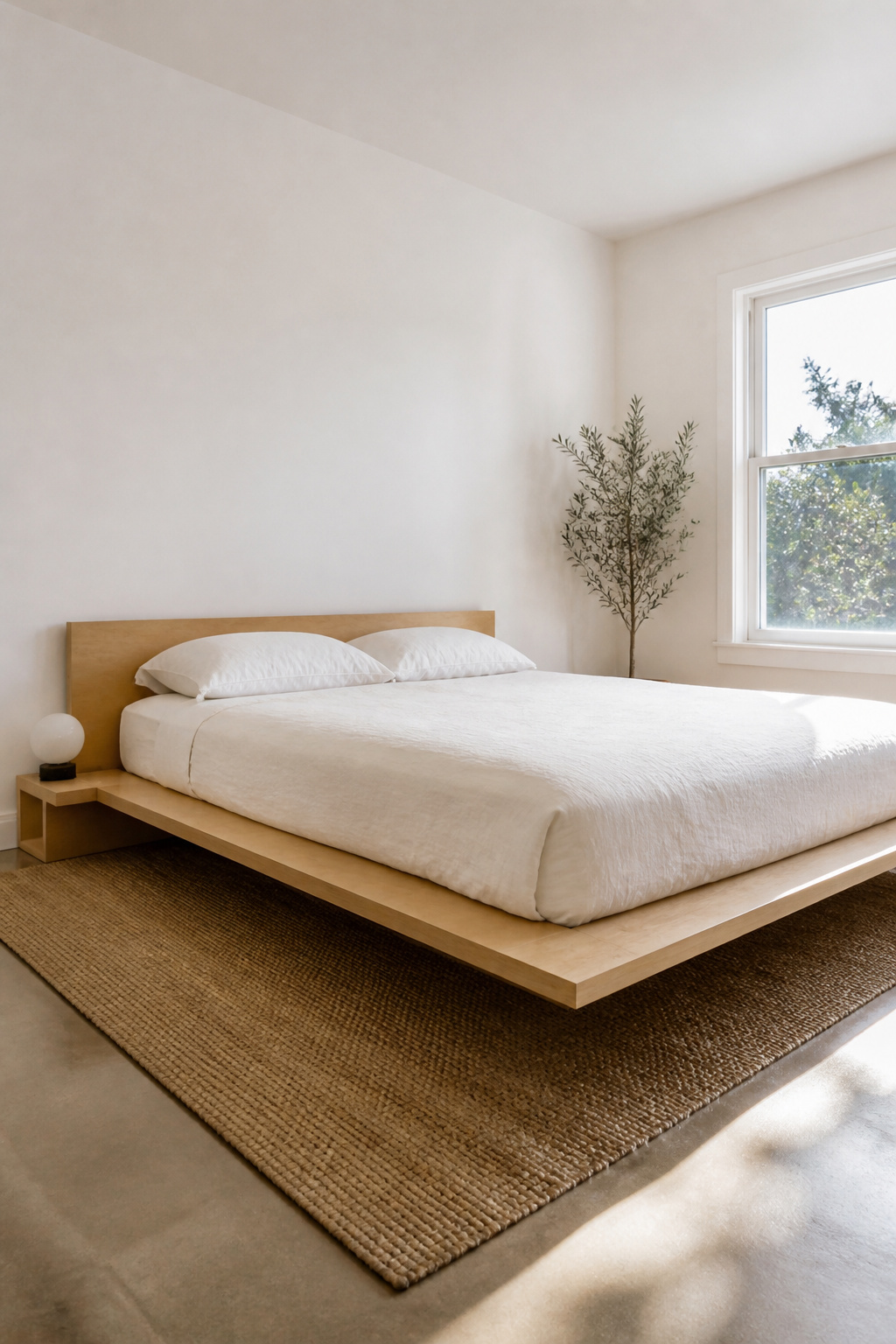
Plywood has a reputation problem. Most people hear the word and picture construction sites. But Baltic birch plywood — the void-free, multi-layer type used in fine cabinetry — is genuinely strong, workable, and beautiful when finished well. A DIY plywood platform bed built correctly is often stronger than furniture store alternatives at three times the price.
Build and Finish
Baltic birch runs $80–$120 per 4×8 sheet in 3/4-inch thickness. A queen bed typically needs four or five sheets. Total material cost runs $150–$280 depending on plywood type and finish. Use pocket screw joinery (a Kreg Jig) — no mortise-and-tenon skills required. Minimum platform thickness is 3/4 inch; use 1 inch for heavier mattresses. For the finish: sand edges to 220 grit and fill edge grain with wood filler. This gives a near-solid-wood appearance at the cut edges and avoids the laminated look that reads as obviously DIY from across the room. Danish oil is my go-to — it keeps the birch warmth without adding gloss.
18. Reclaimed Wood Nightstand Crafted From a Vintage Crate
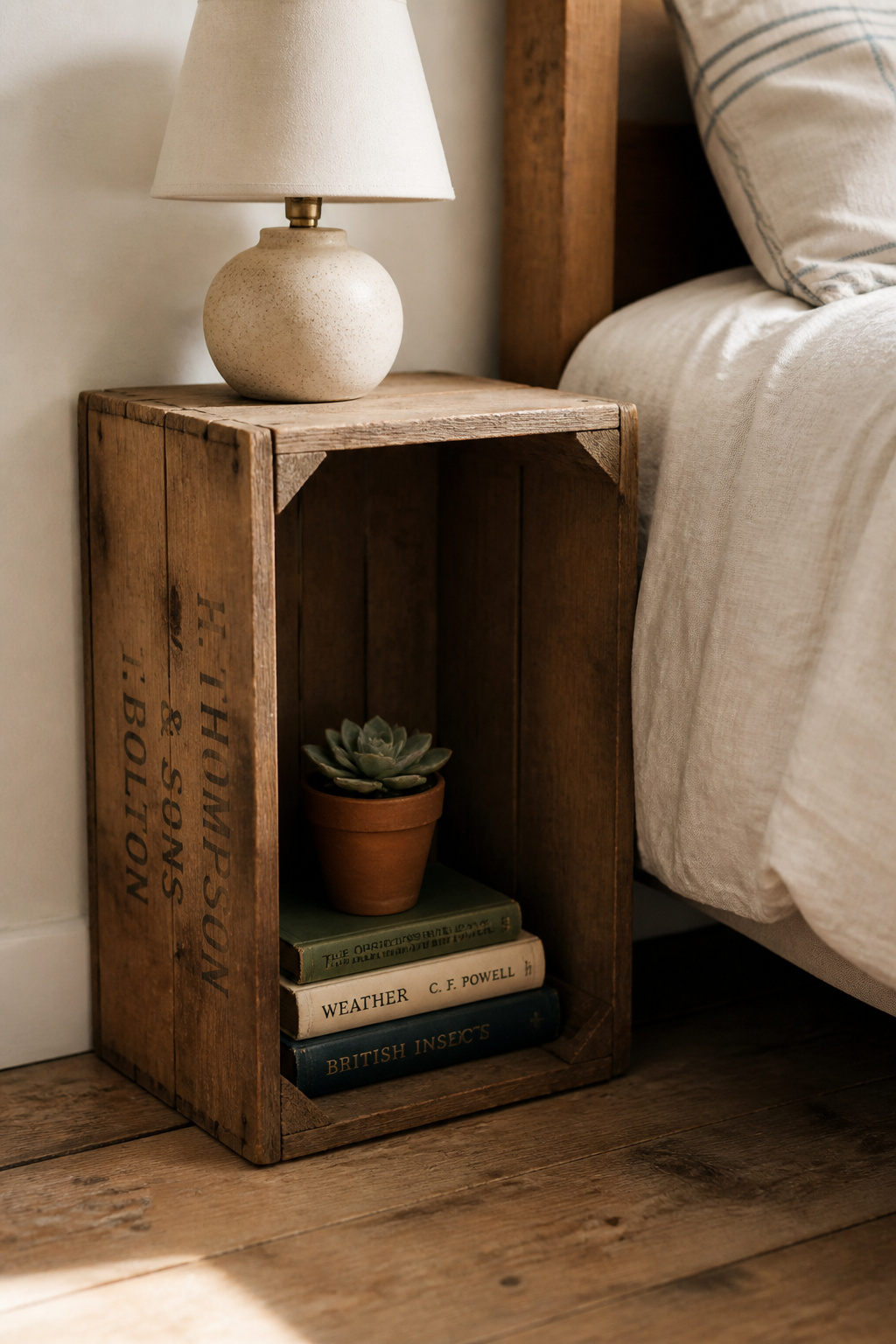
The vintage crate nightstand is the most budget-accessible idea on this list — and done well, one of the most charming. A genuine wooden apple crate, wine crate, or shipping crate brings texture, character, and provenance to a bedside that no retail piece can replicate. The grain is worn where hands once gripped it. The wood has a depth that new materials don’t develop for decades.
Sourcing, Preparing, and Finishing
Farmers markets, antique malls, and estate sales offer vintage crates at $15–$60. Modern replicas at Hobby Lobby ($12–$25) are consistent and easier to work with but carry less authentic patina. Before bringing any vintage crate indoors, check for pest evidence: small holes, fine sawdust, or insect casings. Seal any suspect piece in a plastic bag with a pest strip for 72 hours. Stand the crate upright (open face as the front, creating natural shelving) and add a 3/4-inch plywood base inside the bottom for weight distribution. Lockable casters ($8–$15 for a set of four) make it mobile — genuinely useful in smaller rooms. For finish, a light sand and thin coat of beeswax preserves the patina while sealing the surface. This same approach to repurposed wood is worth exploring in rustic living room decor if you want to carry the character across rooms.
How to Layer Wood Bedroom Decor Without Overwhelming the Space
The question I hear most from people who love natural wood is this: how do you know when you have enough? Wood bedroom decor is addictive. Once you have one warm wood element, you want another — and another — until one day you’re standing in something that feels like a cabin.
The practical answer is the one-third rule. Wood elements — headboard, nightstands, shelving, furniture, wall panels, accessories — should cover roughly one-third of the room’s visual surfaces. That includes floor coverage (a wood floor counts heavily) and wall coverage (planked walls count entirely). Staying under 40% total keeps the room feeling warm and natural without tipping into heavy.
Mixing Wood Tones
The persistent myth is that all wood in a room must match. It doesn’t. In fact, a room where every piece is the same medium-oak stain tends to look flat — like someone ordered the whole ensemble from a single catalogue. Mixing works when you keep tones within a related family: warm golds and honeys work together; cool grey-browns work together. So a reclaimed oak headboard with a walnut nightstand and a pine floating shelf all work in the same room. A light birch frame beside a dark ebonized dresser beside a red-orange cherry bench probably does not.
Where to Start
Pick your anchor — the largest wood element, usually the bed frame or headboard — and source that first. Everything else should respond to it in tone, scale, and character. If your anchor is reclaimed and rustic, the smaller pieces can be more refined. If your anchor is sleek and contemporary (a solid walnut platform bed), let the accessories bring in texture. Work outward from the centre and stop a step before you think you need to. The space between wood elements is where the warmth has room to breathe.
The most common mistake is buying everything at once from the same store. It produces a coordinated room rather than a personal one. Instead, start with the bed frame or headboard, live with it for a month, and let the next purchase respond to what you see. A live-edge slab you find at a market three months later will always look more at home than the matching set of five pieces you ordered in a single session. That’s the thing about natural materials: they reward patience. The pieces that take time to find are almost always the ones that make the room.