
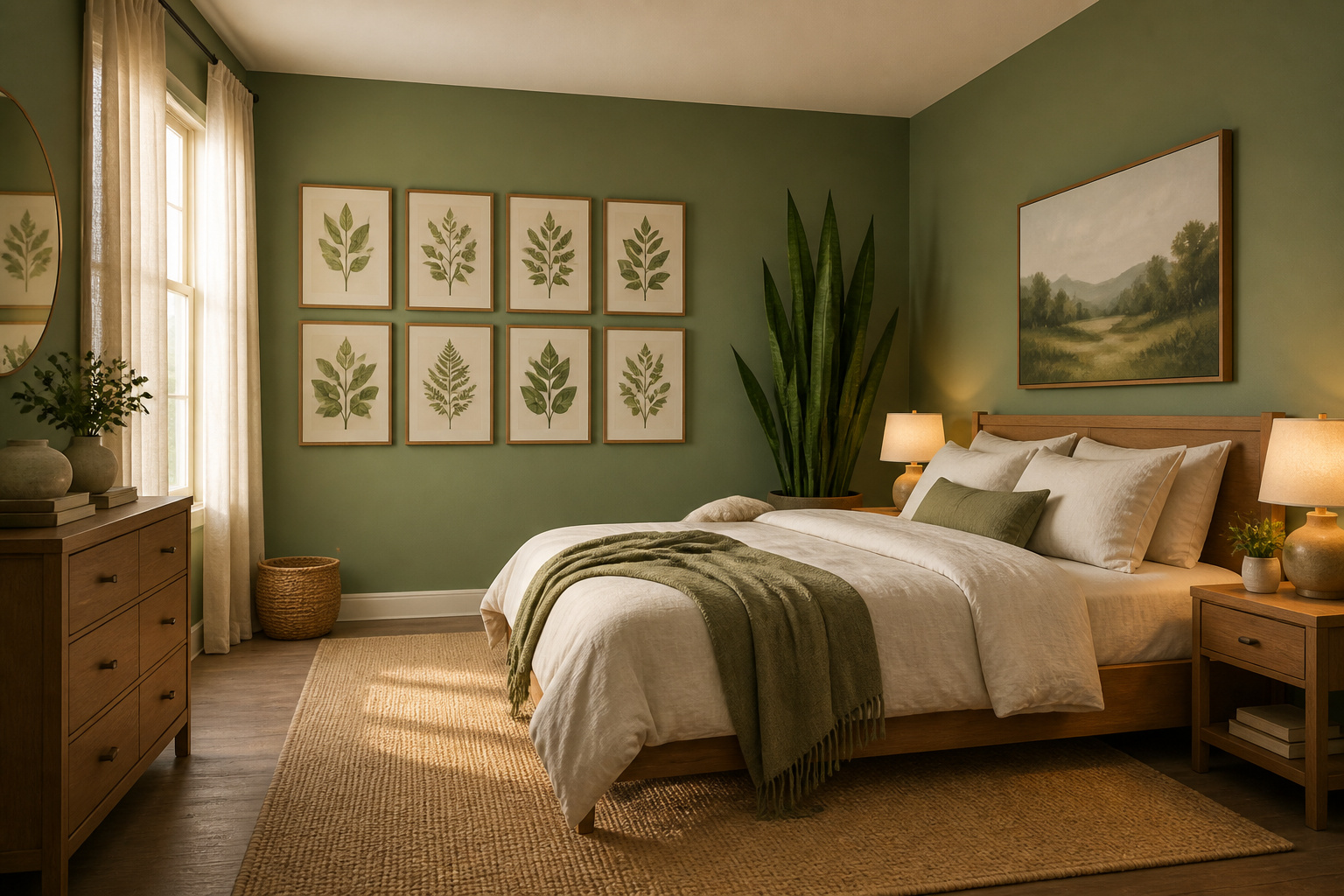

There is a particular kind of calm that settles over you in a green bedroom. Not dramatic — more like exhaling. More like stepping out of a busy street into a garden. Green bedroom ideas have been at the centre of my wellness design practice for years, and the science behind that instinctive relief is real. Studies in environmental psychology link green wavelengths to parasympathetic nervous system activation: lower cortisol, slower heart rate, deeper sleep. The colour connects us to forests, plants, living things. Our bodies recognise it, even indoors.
Whether you are drawn to soft sage or dramatic bottle green, to botanical wallpaper or a single trailing pothos on a shelf, there is a version of green bedroom design that works for your space. These 18 ideas range from full wall colour transformations to gentle textile swaps. Take what resonates — the goal is a bedroom that genuinely supports your rest.
1. Sage Green Walls for a Grounding, Restorative Bedroom
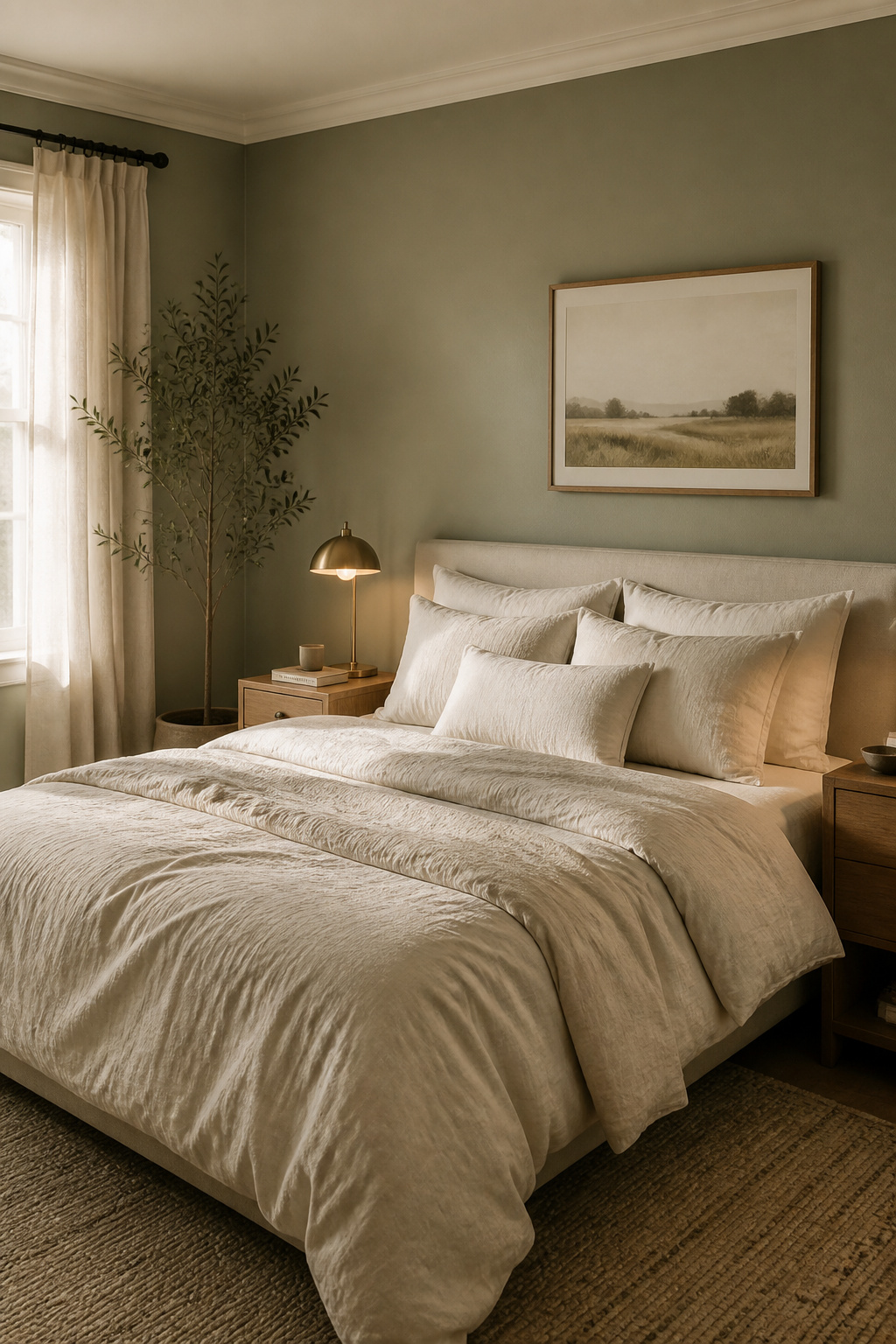
Sage green is the single most universally flattering bedroom wall colour. It occupies a soft middle ground — not so pale it disappears, not so saturated it overwhelms — and it has a quality of stillness that almost no other colour matches. The grey-green wavelength activates the parasympathetic nervous system. The calming effect is physiological, not imagined.
Choosing the right sage undertone for your light
Sage greens divide into two families: warm-bias (yellow undertone) and cool-bias (grey undertone). Warm sages like Sherwin-Williams Clary Sage (SW 6179, ~$72/gallon) and Farrow & Ball Mizzle (No. 80, ~$120/litre) work in north-facing rooms because they hold warmth in weaker light. Cool sages like Benjamin Moore’s Saybrook Sage (HC-114, ~$65/gallon) suit south-facing rooms — the grey undertone stops them reading yellow in bright sun. Behr’s Weathered Moss (N390-3, ~$36/gallon) is a reliable budget warm sage.
Paint finish and testing tips
Use eggshell finish in bedrooms — easier to clean than flat matte, less glare than satin. Paint 12-by-12-inch test patches on different walls and observe throughout the day. Sage greens shift noticeably from morning grey light to warm evening lamp glow.
Pro tip: Paint the ceiling two shades lighter in the same green family. It creates an enveloping cocoon effect without making the room feel smaller.
2. Forest Bathing Green Bedroom Ideas for Immersive Rest
The Japanese practice of shinrin-yoku — forest bathing — is well-supported in the research literature. A 2009 study by immunologist Qing Li found two hours among trees boosted natural killer cell activity by up to 50%, reduced blood pressure, and lowered cortisol. You cannot spend every night in a forest. But deep forest green walls are one of the most effective ways to borrow from that experience.
Deep forest greens that work on walls
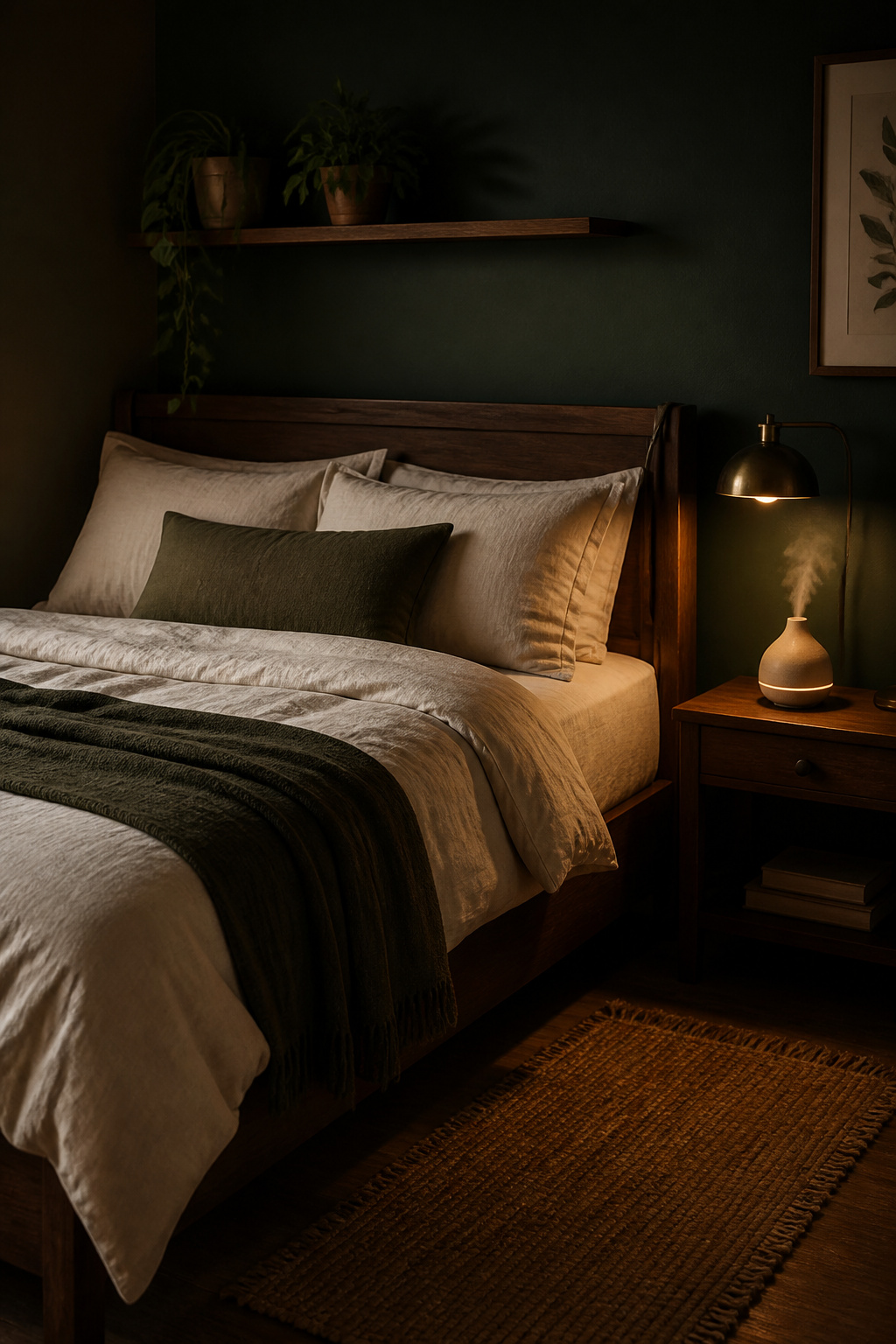
Farrow & Ball’s Studio Green (No. 93) is the benchmark — rich, dark, botanical, with warm undertones that look even better in person than in photos. At ~$120/litre it is expensive, but a tin goes further than expected. Benjamin Moore’s Newburyport Green (HC-136) is ~$65/gallon and performs well. Choose greens with brown or yellow warmth in the base — purely cool greens can read stark at deep application.
Layering for the full forest effect
Forest green walls work hardest when surrounding materials reinforce the theme. Warm walnut or oak wood tones are natural partners. Jute rugs, unbleached linen bedding, and raw brass hardware all support the palette without competing. Add a small essential oil diffuser with cedarwood or pine oil. The shinrin-yoku research shows scent is the primary trigger for the relaxation response — colour and smell together are more powerful than either alone.
3. Emerald Velvet Bedding for a Rich Green Bedroom Focal Point
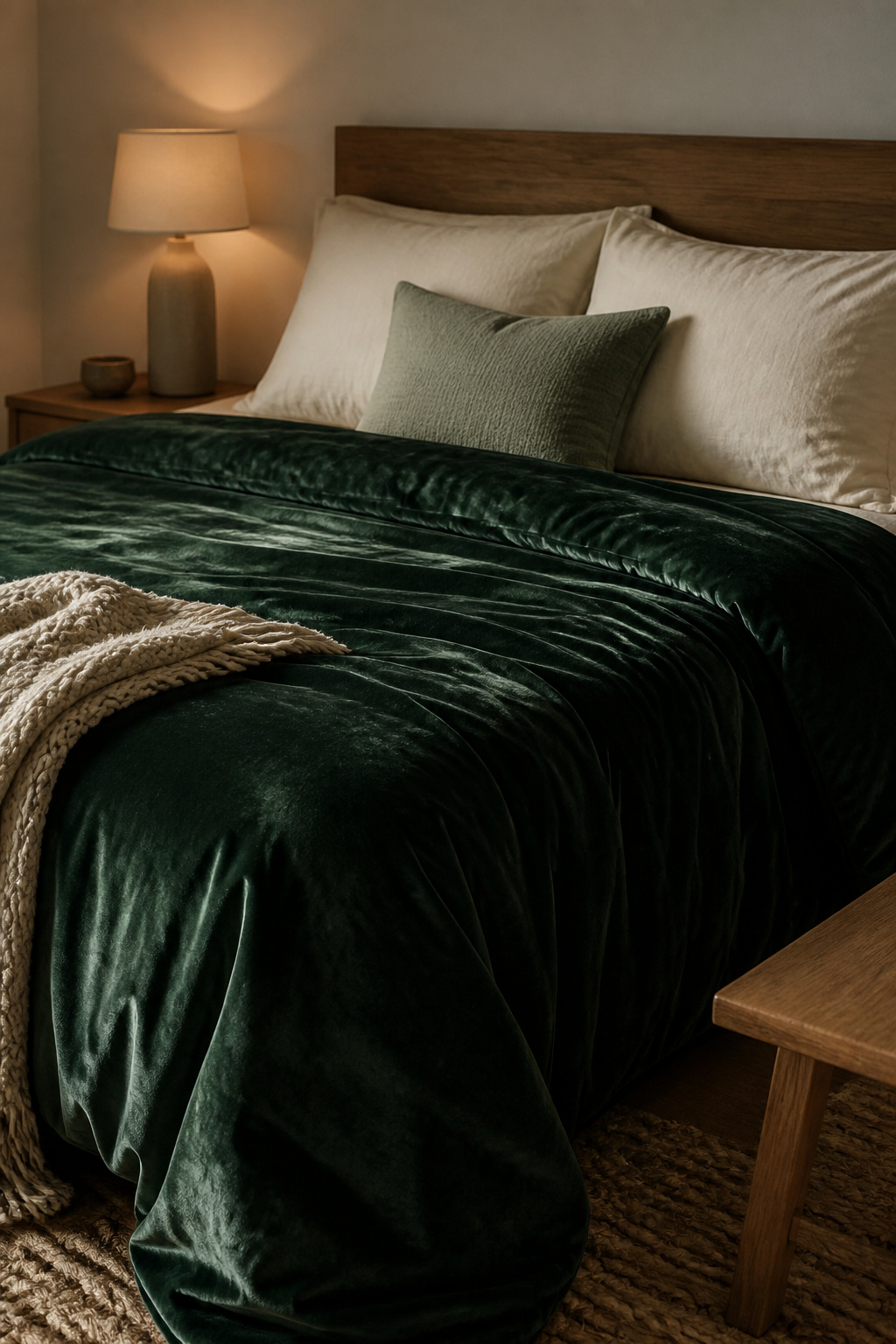
Emerald green is having an extended moment in bedroom design. Unlike earthy greens — sage, olive, forest — emerald has a jewel-like quality that transforms even a plain white bedroom into something genuinely considered. The best vehicle for emerald is velvet bedding.
Why emerald velvet works
Velvet reflects light directionally, so emerald velvet shifts between deep teal and rich forest green depending on angle and light. That dynamic quality makes a plain bed look considered and alive. You do not need green walls — emerald bedding against white walls is one of the most accessible green bedroom ideas at any budget. Anthropologie’s Freya Velvet Duvet Cover runs ~$228 for a queen; H&M Home offers one for ~$89; Parachute’s velvet comes in at ~$269.
Styling and care
Pair emerald velvet with cream pillowcases rather than green — the contrast is more sophisticated. Add one natural-textured throw at the foot of the bed to interrupt the richness. Wash velvet cold on a delicate cycle, avoid the dryer entirely — heat mats the pile permanently. After washing, brush with a soft clothes brush to restore the pile direction.
4. Botanical Wallpaper as a Transformative Green Accent Wall
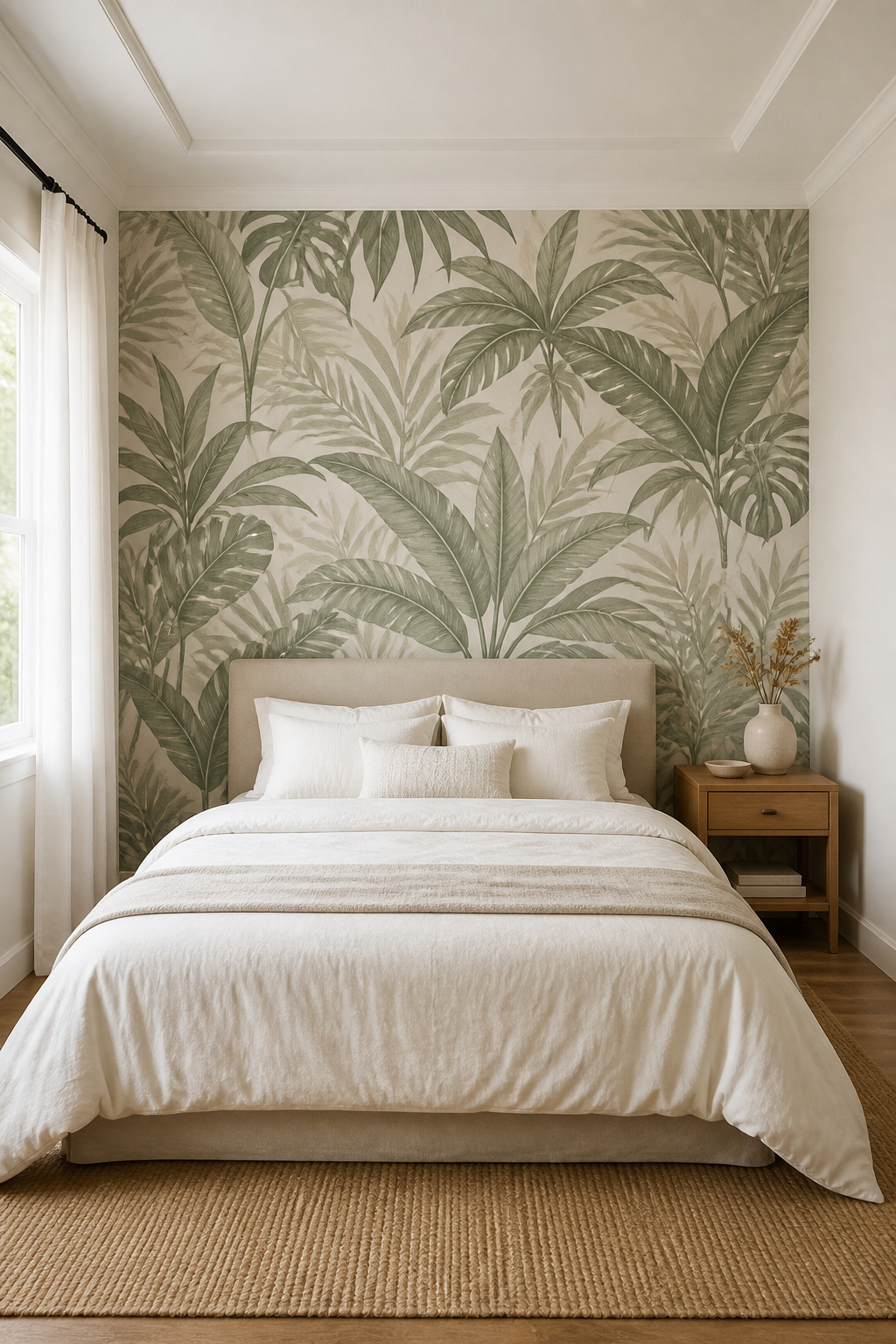
Botanical wallpaper is the fastest way to add green bedroom character without committing to paint. One accent wall behind the bed can shift the entire room’s atmosphere. The difference between immersive and chaotic is almost entirely scale selection and colour restraint.
Scale and format
Small bedrooms need smaller-scale repeats — prints with individual leaves under 8 inches read cleanly in compact spaces. Large rooms can handle oversized tropical leaves. For peel-and-stick, check walls are flat and painted — textured plaster reduces adhesion. Rifle Paper Co.’s Garden Party (~$198/double roll) is an investment-level option. Chasing Paper’s tropical leaf peel-and-stick runs ~$48/panel. Spoonflower allows custom scale adjustment from ~$38/panel.
Connecting the wallpaper to the bedding
Pull one leaf colour from the wallpaper and echo it in a single textile — a throw cushion or blanket. The goal is a deliberate conversation between wall and room, not an exact match. For renters, most peel-and-stick wallpapers remove cleanly without damaging paint. See also the 14 Luxury Bedroom Wallpaper Accent Wall Ideas for more accent wall approaches.
5. Eucalyptus Green Linen for a Breathable, Wellness-Focused Bed
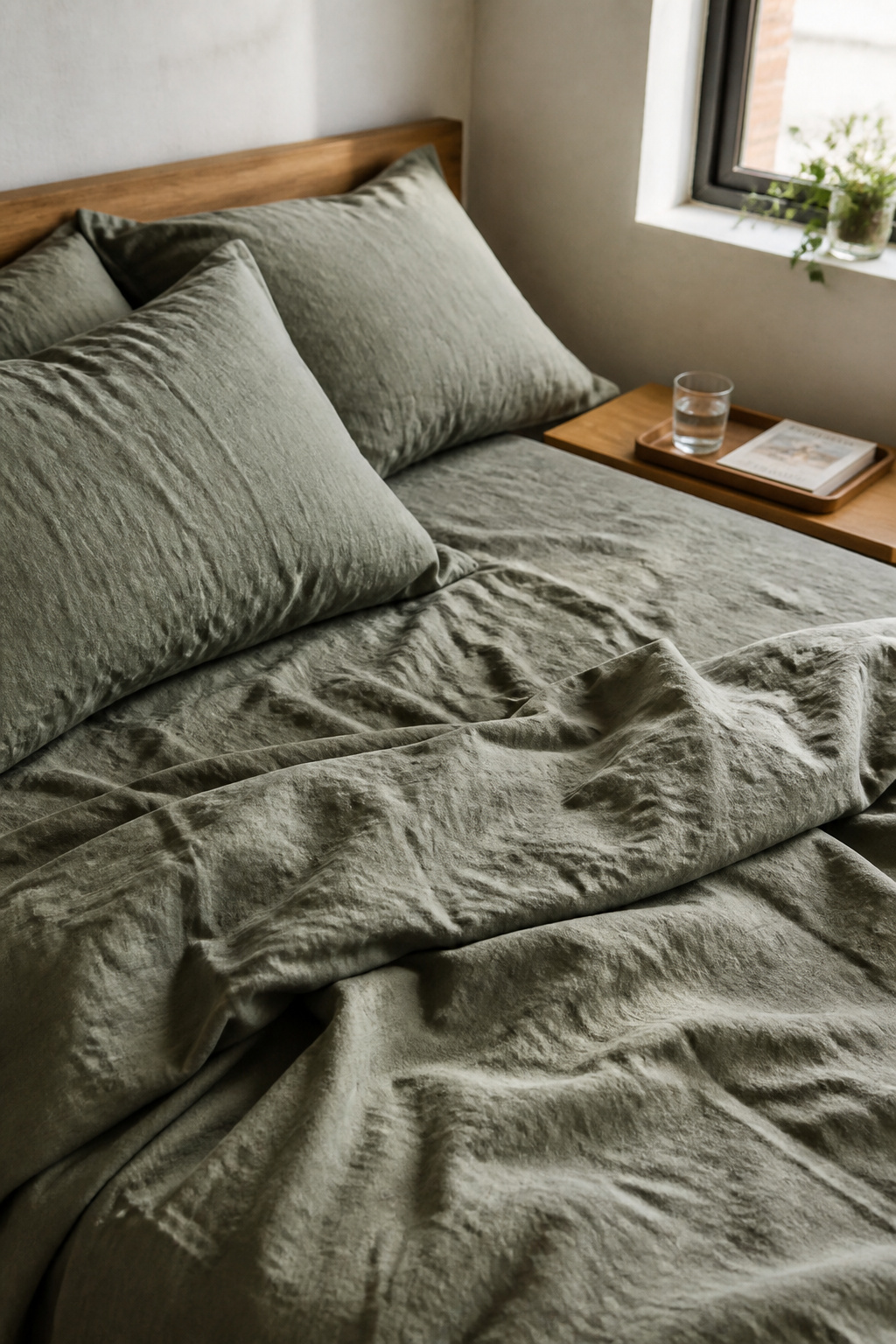
If you are investing in one change for a healthier bedroom, linen bedding in a eucalyptus or sage green is among the highest-value options. Linen is naturally thermoregulating, moisture-wicking, and hypoallergenic. It gets softer with every wash. In green tones, it is one of the most naturally beautiful bedroom materials available.
Choosing linen bedding in green tones
Linen does not use thread count — look for GSM weight instead. Between 170 and 230 GSM is ideal for bedding. Eucalyptus green in linen reads slightly warmer than cotton because the natural flax fibres have a golden undertone. Cultiver’s Sage flat sheet set runs ~$295. Brooklinen’s Linen Core Sheet Set is ~$249. Quince’s European Linen Sheet Set at ~$149 is genuinely impressive for the price. Wash before first use — the fibres soften significantly with each cycle.
Pro tip: Linen is made from flax, which requires no irrigation and minimal pesticides. It is one of the most sustainable textile options — that matters in a wellness-focused bedroom.
6. Green Bedroom Ideas Using Terrariums and Living Plant Displays
Plants are the most direct route from green bedroom ideas to green bedroom feeling. Living plants change air quality, humidity, and the entire quality of the space in a way no paint or textile can replicate. The question is not whether to include plants, but how to arrange them so they feel considered rather than chaotic.
Plants that improve bedroom air quality
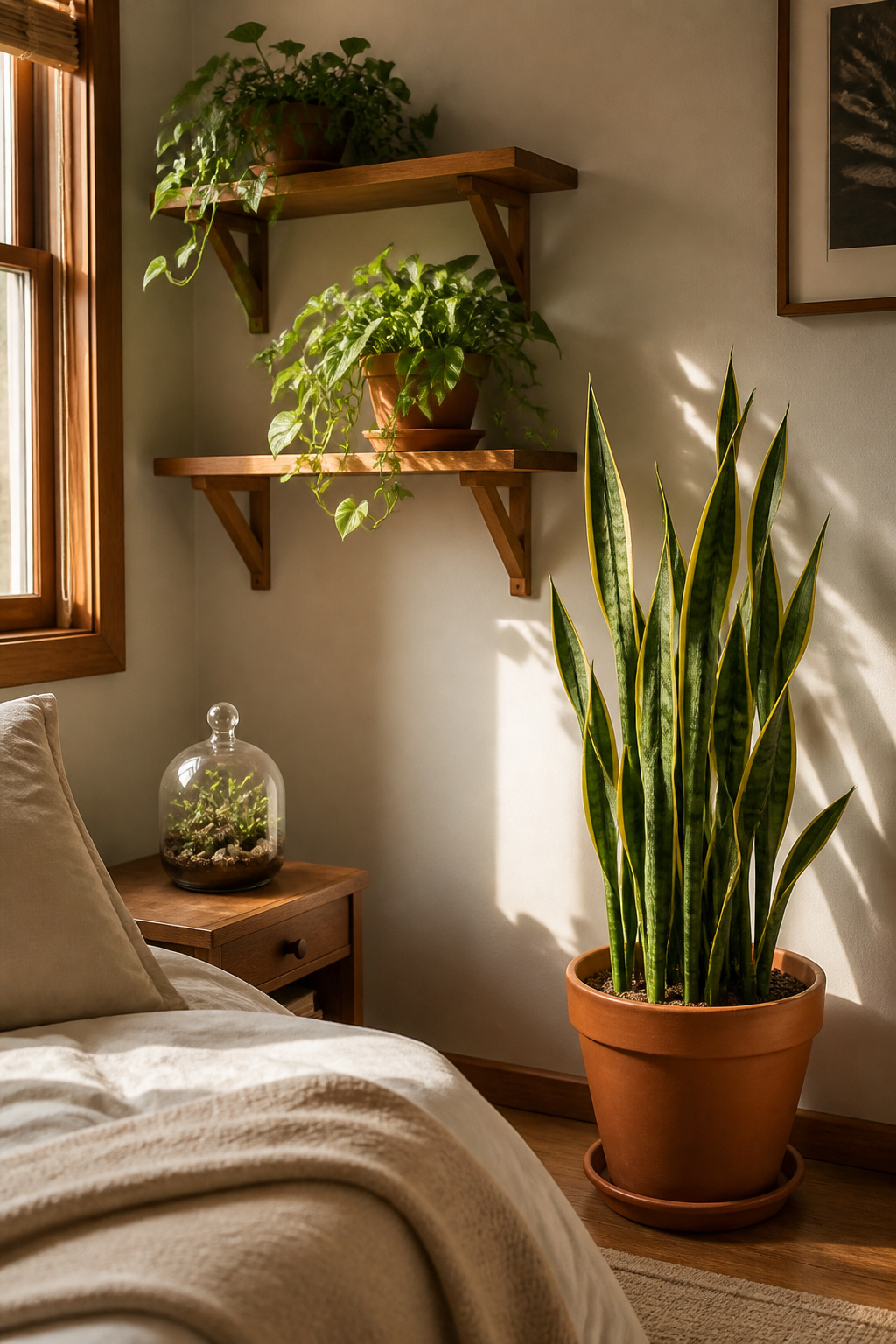
The NASA Clean Air Study top performers for bedrooms: snake plants (Sansevieria trifasciata) release oxygen at night and remove formaldehyde; pothos (Epipremnum aureum) reduce CO2 effectively and tolerate low light well. Peace lily scores highly for purification but is toxic to pets — choose spider plant or snake plant for pet owners. For genuinely low-light bedrooms, ZZ plants and green Aglaonema varieties are near-indestructible.
Arrangement for visual impact
Group plants in odd numbers and vary heights using plant stands or tiered shelves. A glass terrarium on the bedside table (~$15 on Amazon), a trailing pothos on a high shelf, and a floor-standing snake plant in the corner creates a layered arrangement with minimal effort. IKEA’s SOCKER greenhouse cabinet at $49.99 is an easy way to create a compact display that looks deliberately designed.
Pro tip: A small humidifier near a plant cluster creates a self-sustaining micro-climate. The plants benefit from the moisture, and the humidifier supports sleep by preventing airways from drying overnight.
7. Olive Green Furniture for an Earthy, Grounded Bedroom Feel
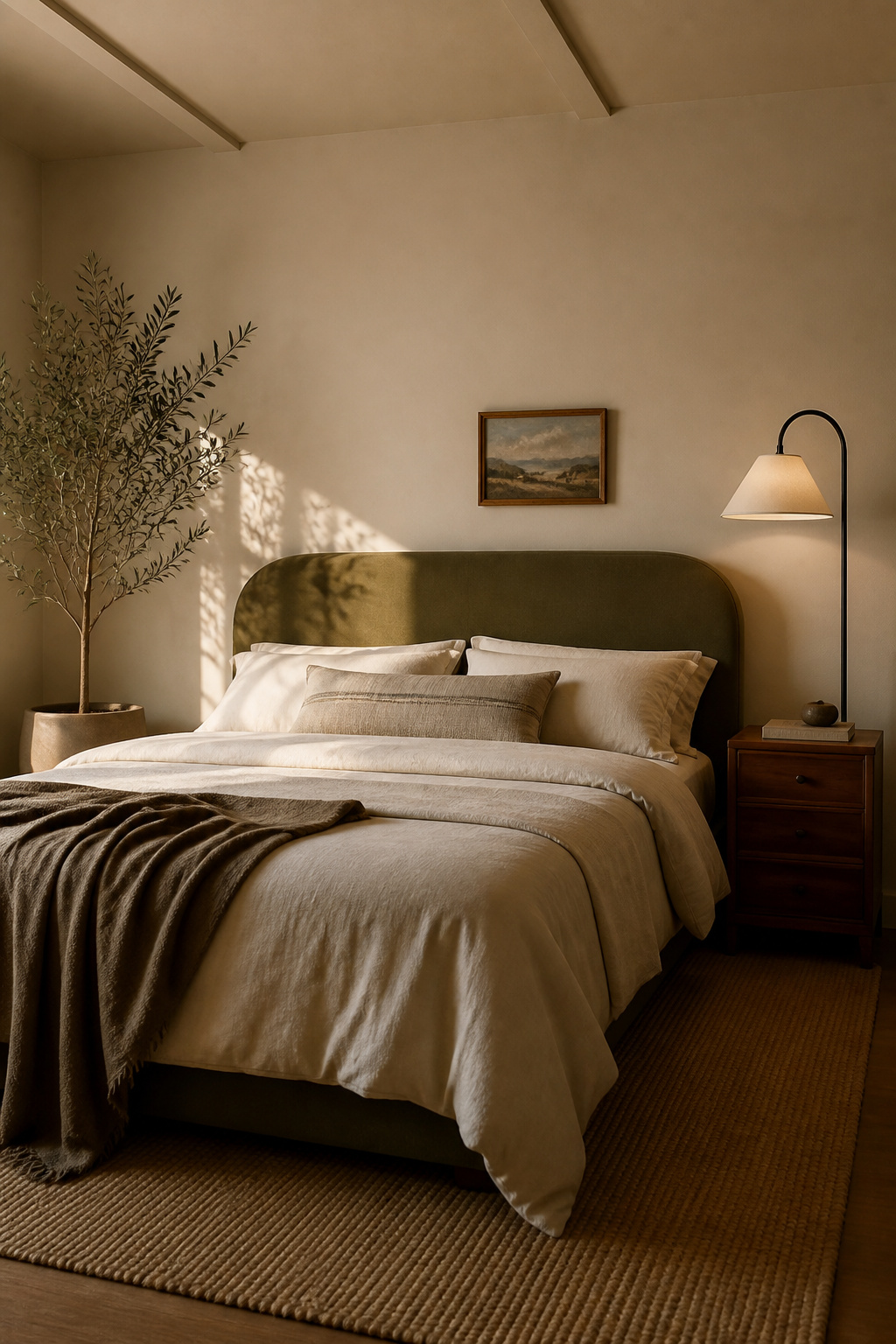
Olive green is the most underrated colour in bedroom furniture. It is warm without going yellow, earthy without going brown, and sophisticated without going cold. An olive velvet armchair or upholstered bedhead can anchor an entire bedroom palette in a way that a neutral piece cannot.
Why olive reads as sophisticated
Olive is a yellow-forward green with warm, slightly brown undertones that prevent it from ever reading clinical. In velvet upholstery, the directional sheen creates depth that shifts between gold-green and forest-green in changing light. West Elm’s Plow Upholstered Headboard in Velvet Olive runs $399–$599. CB2’s arched linen headboard in olive is ~$499. For a budget approach, vintage olive velvet armchairs from the 1960s and 70s are widely available at thrift stores for $40–$200.
Wood pairing
Olive pairs best with walnut or medium oak. Avoid stark white — the contrast reads too sharp, almost clinical. Off-white and cream are better companions. Know your undertone before committing: tobacco olives lean yellow-brown, grey-green olives lean cooler — mixing them in the same room creates tension.
8. Hanging Plants and Biophilic Ceiling Design for Green Bedrooms
Ceiling-mounted plants are one of the more unusual green bedroom ideas, but also one of the most effective for creating a truly immersive biophilic atmosphere. When plants hang above the bed and trail downward, the room stops feeling like a container and starts feeling like a living space.
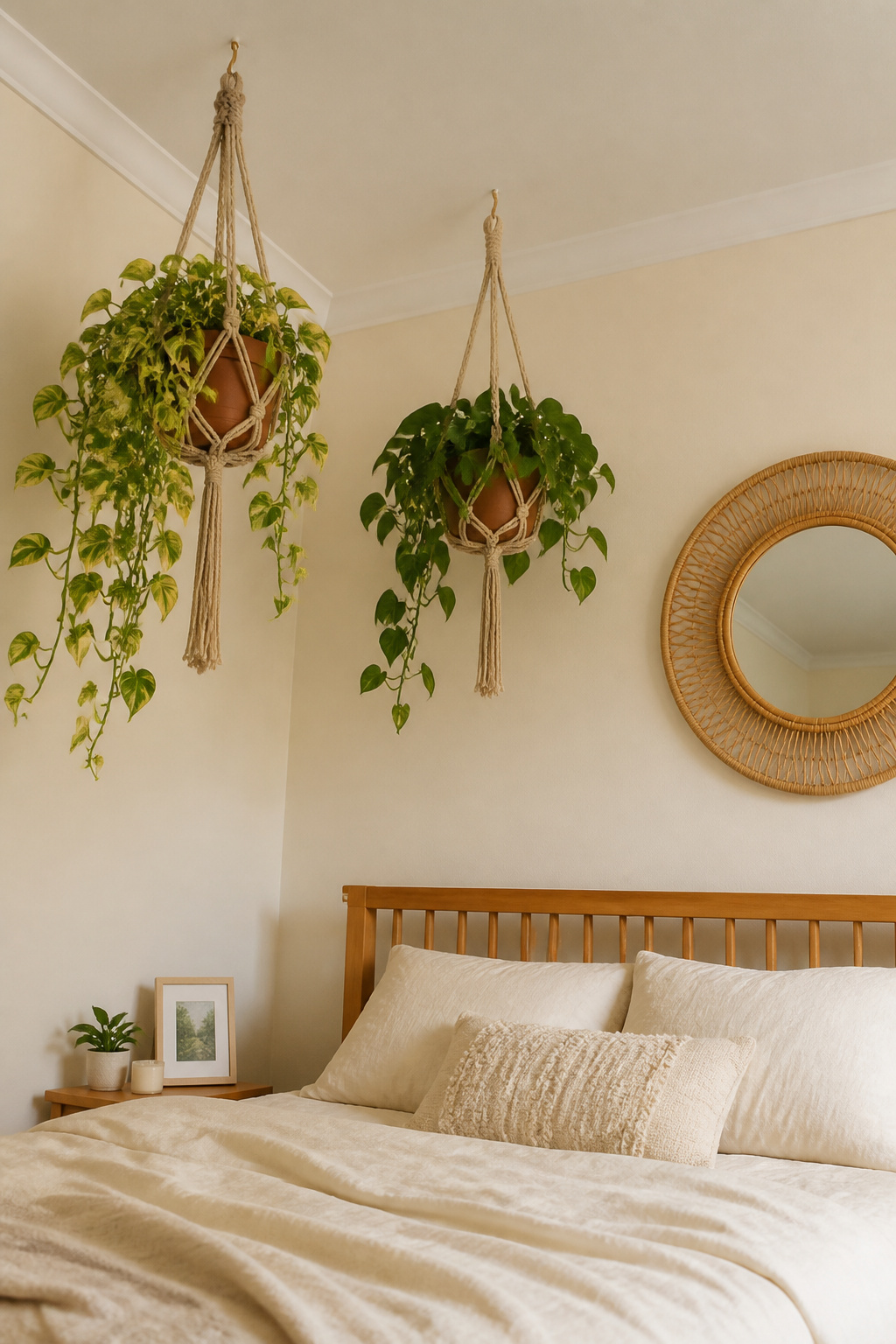
Mounting and species
A swag hook in a ceiling joist holds up to 50 lbs — far more than most plant hangers need. Adhesive ceiling hooks rated 10–15 lbs work for lighter clay pots. For renters, a wooden curtain rod mounted near the ceiling creates a plant-hanging rail with no ceiling holes. Golden pothos, marble queen pothos, heartleaf philodendron, and spider plant are the most reliable trailing species — forgiving about irregular watering and tolerant of lower light. Mkono macramé hangers are ~$15 on Amazon; Anthropologie’s woven hangers run $28–$48.
Pro tip: Use a long-spout watering can and place a saucer inside the pot hanger, or use self-watering inserts. One messy incident is usually enough to convince anyone.
9. Mossy Green Textiles to Warm a Nature-Inspired Bedroom
Mossy green sits at the intersection of sage and olive — warm enough to feel natural, soft enough to avoid overwhelming. In textiles especially, it has a quality that reads genuinely organic rather than artificially colour-saturated. A mossy green throw on a neutral bed adds immediate warmth.
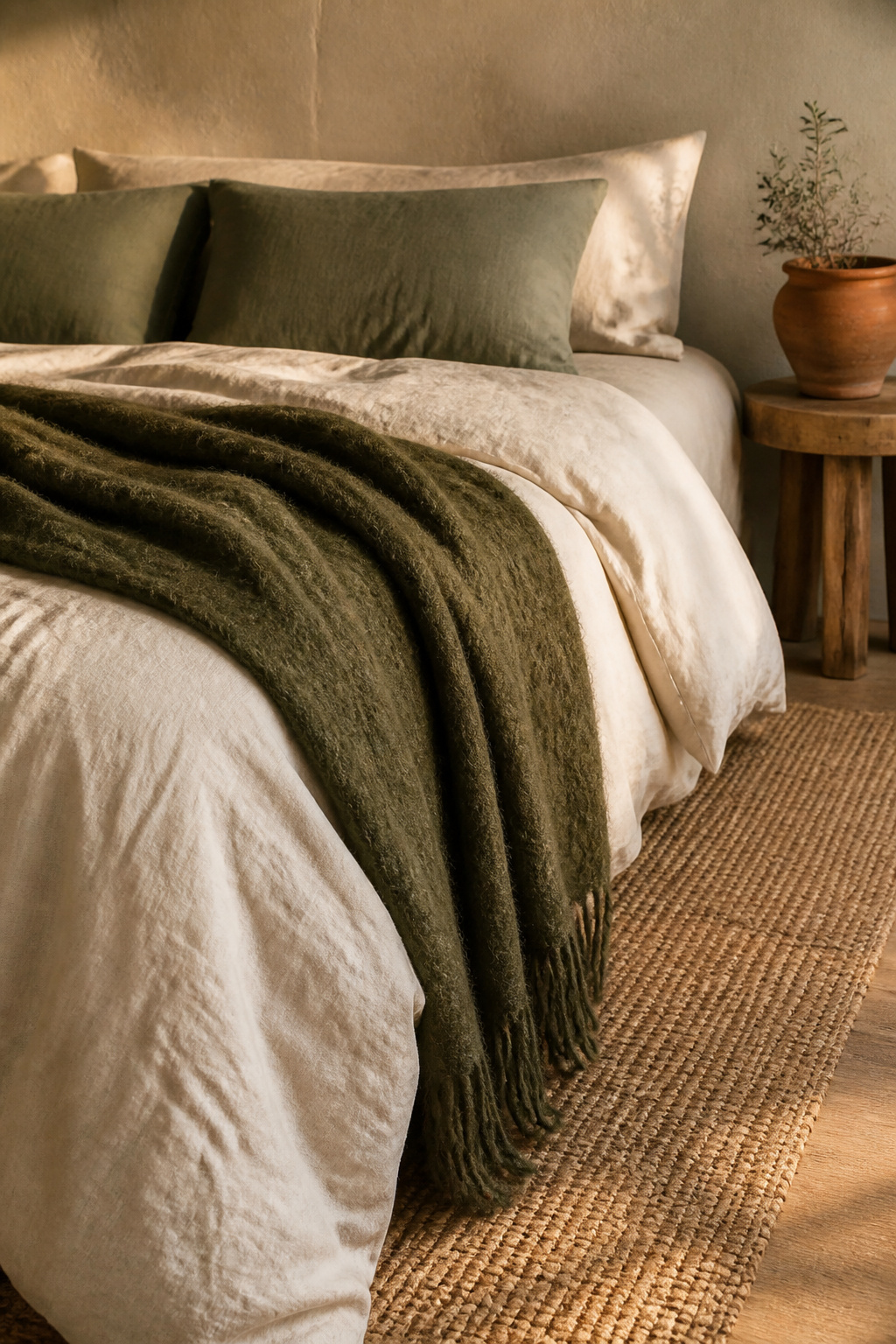
Why mossy green works in textiles
Bright greens can read harsh or artificial in fabric. Mossy tones — desaturated, complex, with warm brown undertones — look genuinely organic. Wool takes mossy greens beautifully: natural fibre variation creates depth that synthetics cannot replicate. Faribault Woolen Mill’s Noreaster Throw runs ~$130 and is US-made from pure wool. Pendleton’s National Park Throw is ~$119. IKEA’s OFELIA wool-blend throw at ~$25 is a reliable budget start.
Colour pairing and layering
Mossy green pairs well with cream and terracotta — a combination grounded and warm, inspired by actual forest floors. A mossy green throw on a cream linen bed with a terracotta pot plant is one of the simplest effective green bedroom ideas. Start with a neutral base, then layer two or three mossy green pieces in different scales: a large rug, a medium throw, and small cushions. Vary the textures — wool, linen, and cotton all read differently, and the contrast creates visual richness.
10. Mint Green Bedroom Ideas for a Fresh, Light-Filled Retreat
Mint green is the lightest, most reflective of the bedroom greens — LRV of 65–80, which means it bounces back most of the light hitting it. In a bedroom with good natural light, that quality creates a freshness that deeper greens cannot match. The risk is that cool, blue-leaning mints read clinical or institutional. The solution is warm-bias mints paired carefully.
Choosing the right mint
Cool, blue-bias mints lean toward hospital green. The ones that work in bedrooms have a warm, slightly yellow-forward base. Behr’s Mint Condition (M400-2, ~$36/gallon) is reliable. Benjamin Moore’s Hint of Mint (2034-70) is softer and slightly more grey — good for a subtler effect. Farrow & Ball’s Pale Powder (No. 204) is barely mint, but its delicate green-grey quality works beautifully in light-filled rooms. Mint works best in south-facing bedrooms — in north-facing rooms, a warmer sage is more reliable.
Warming the palette
Wood, wicker, and warm brass prevent a mint bedroom from reading cold. Use cream textiles rather than stark white — the subtle warmth sits better against mint’s coolness. Because mint has such a high LRV, it is one of the few greens that works on all four walls of a small bedroom — it reflects so much light that it tends to make rooms feel larger, not smaller.
11. Dark Bottle Green Walls for a Moody, Restorative Cocoon
The most common objection to dark bedroom paint is that it will make the room feel small. This is worth addressing directly: dark colours do not make rooms smaller — they remove the corners visually, making the space feel like a contained, intentional world. Bottle green walls, done well, create one of the most restorative bedroom atmospheres possible.
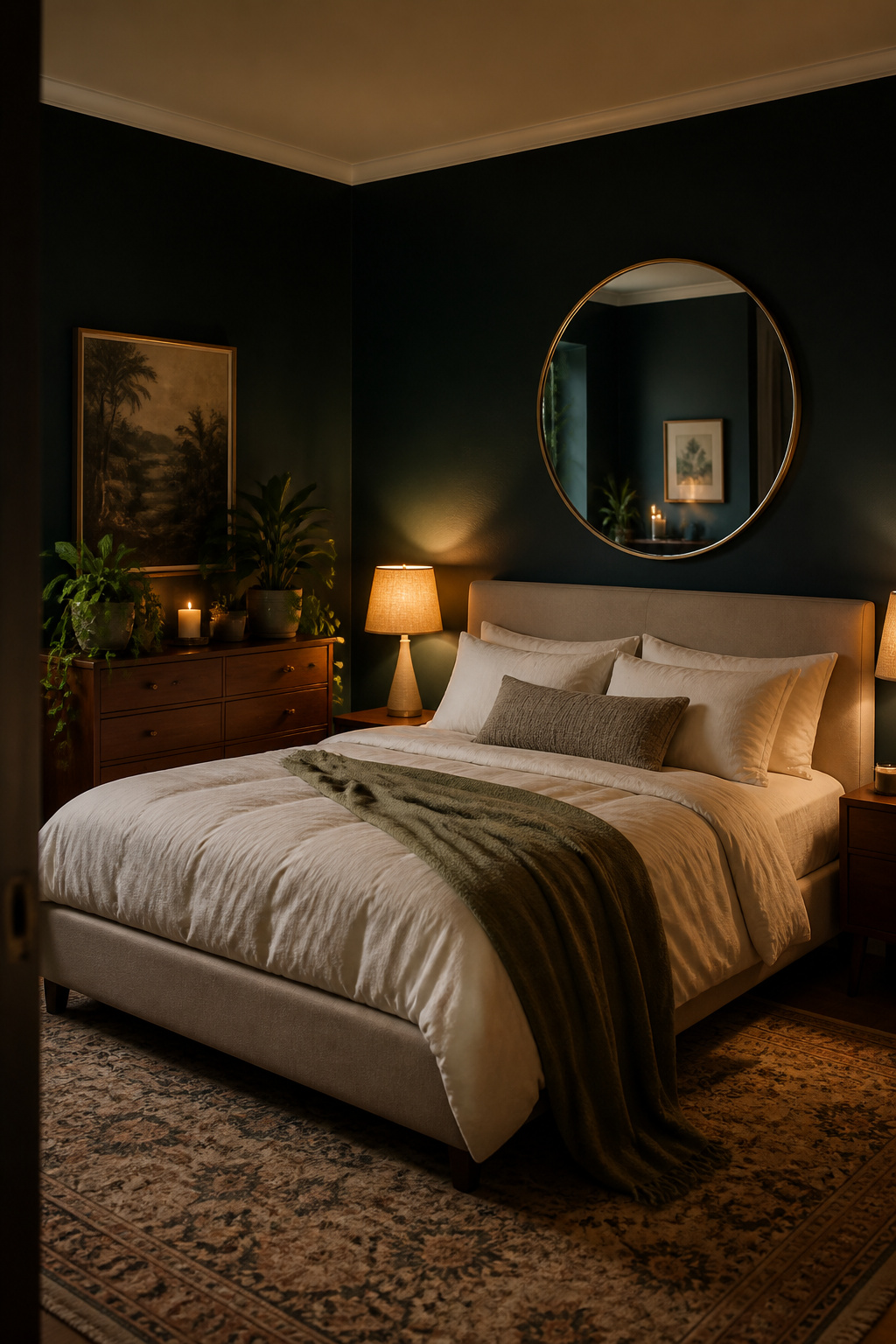
Paint picks for bottle green
Farrow & Ball’s Studio Green (No. 93) is the benchmark: complex, warm-dark, with enough brown to prevent it reading cold. At ~$120/litre it is an investment, but the colour is distinctive enough to justify it. Benjamin Moore’s Newburyport Green (HC-136) is ~$65/gallon and performs well. Sherwin-Williams Aloe (SW 6464) is slightly lighter — good if you want deep green without full bottle intensity. Valspar’s Woodland Sage is a budget option at ~$35/gallon.
Lighting and mirror strategy
Dark walls require more intentional lighting. Table lamps and floor uplights matter more than in a pale room. A large mirror opposite a window doubles natural light during the day and reflects lamp warmth at night. If you are new to dark walls, paint the ceiling white — it prevents the room from feeling oppressive. Painting ceiling and walls the same bottle green is dramatic but requires excellent lighting to pull off.
Pro tip: Hang large painted sample boards (at least 18 by 24 inches) on opposite walls and observe over three or four days. Bottle green shifts dramatically from morning to evening — you need to see both.
12. Natural Wood and Green Tones for a Scandinavian Biophilic Bedroom
Scandinavian design defaults to forest greens for a reason: the Nordic landscape is filled with pine, birch, and spruce, and that palette of natural green and pale wood is embedded in the design tradition. Light wood and natural green together also activate the same restorative response as being among trees — one of the most effective biophilic strategies available.
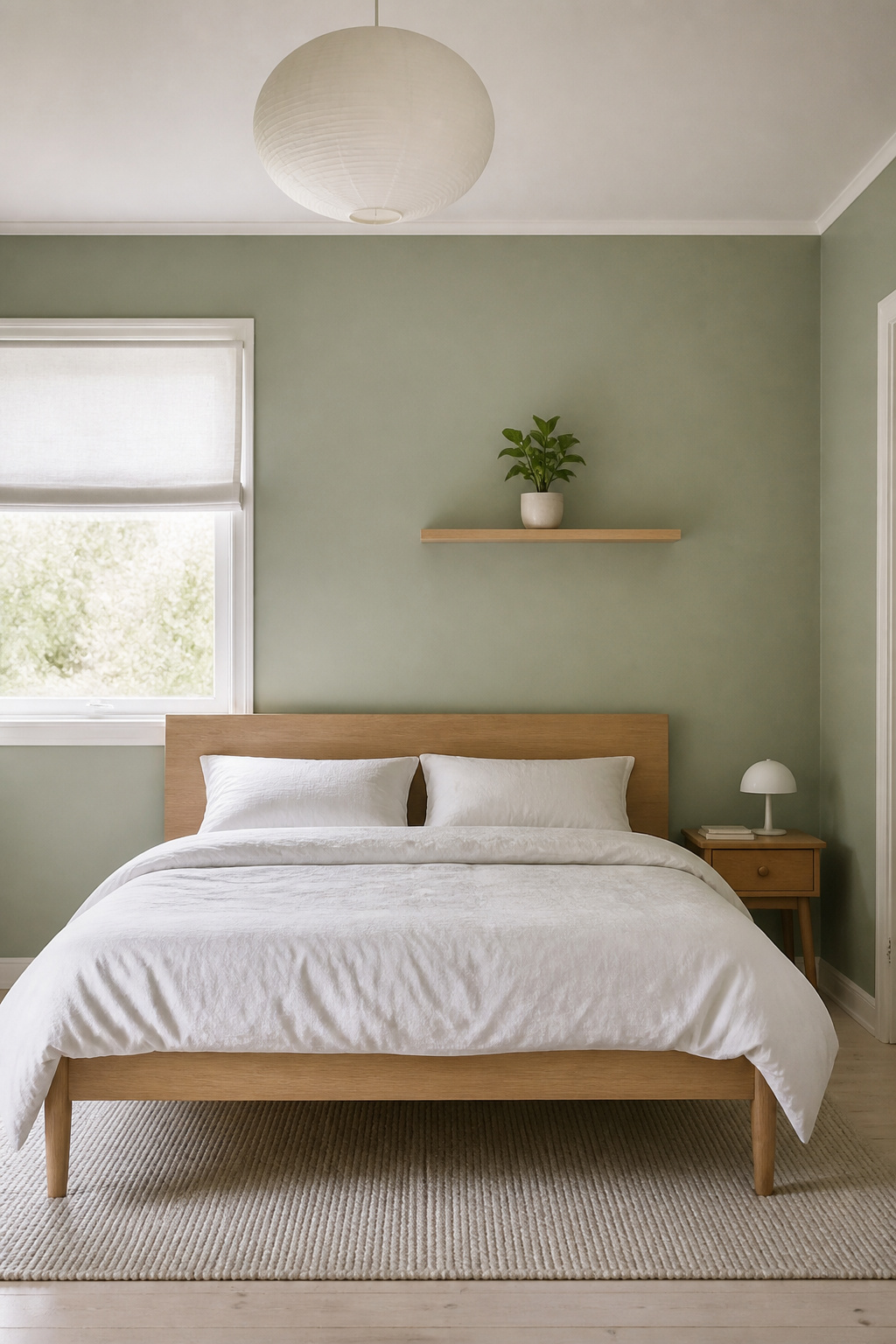
Wood tones and furniture choices
Light wood species — ash, birch, beech, and light oak — work with greens from sage to forest. Choose wood with a warm, honey undertone rather than a grey or cold one. IKEA’s HEMNES range in light brown ash is the most accessible option; HAY and Muuto offer premium Scandi pieces in ash and oak for longer-term investments. The palette ratio for a Scandi green bedroom is roughly 60% neutral, 30% green, and 10% natural wood accents.
Keeping it minimal
In a Scandi green bedroom, the temptation to add more should be resisted. Choose one statement green element — a feature wall, a large plant, a green velvet bedhead — and let everything else remain calm and neutral. Two statement elements usually compete. One statement element with everything else in service of it creates the quiet clarity that makes Scandi design so liveable.
13. Vintage Green Furniture Pieces That Add Bedroom Character
Vintage green furniture is one of the most character-rich ways to bring green into a bedroom, and often the most affordable. The 1960s and 70s produced upholstered chairs, ottomans, and side tables in avocado, olive, and mossy green at a scale and quality that is hard to find in new furniture today. Those pieces show up regularly at thrift stores, estate sales, and on Facebook Marketplace — often for $40–$200.
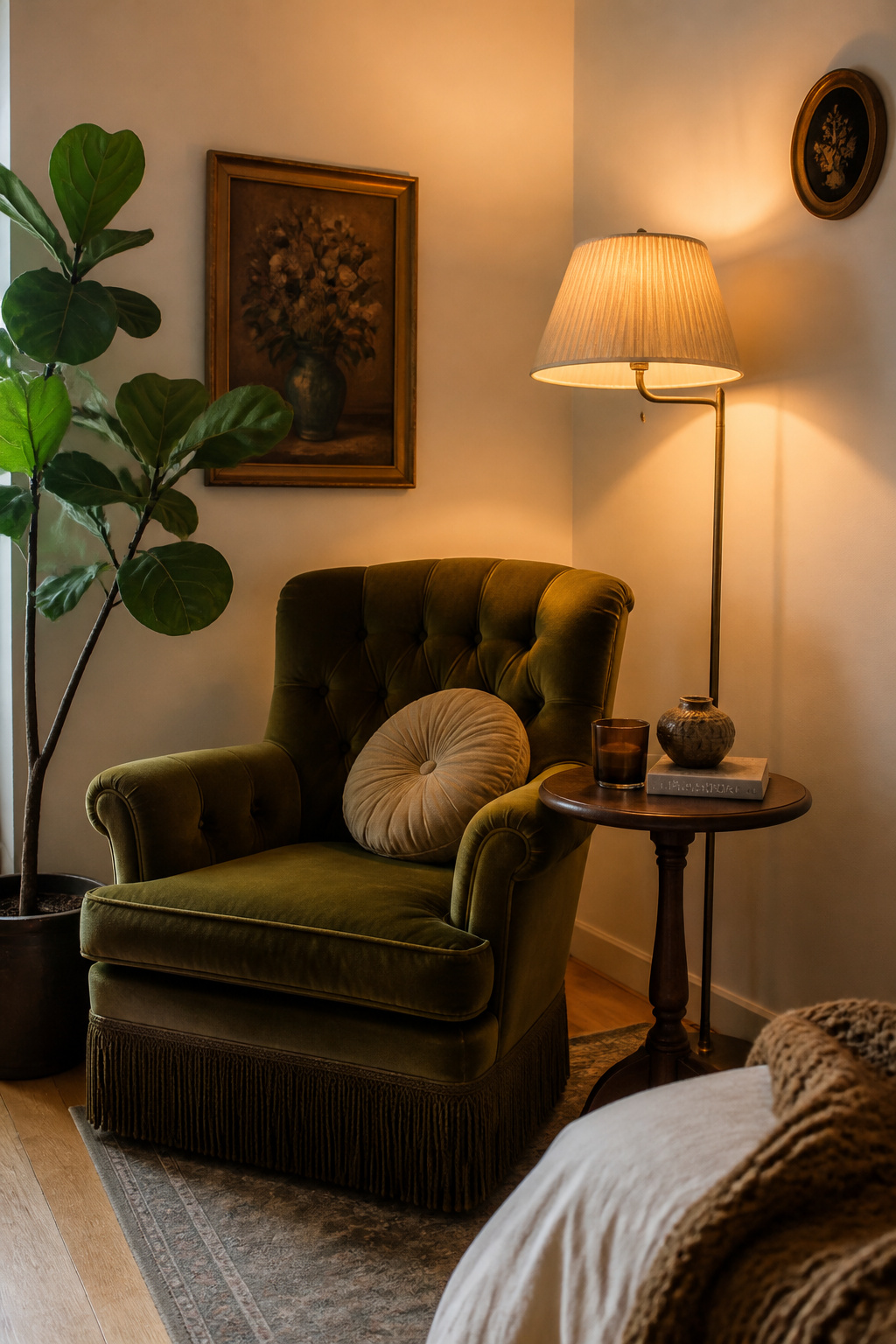
What to look for and where to find it
The best vintage finds are upholstered pieces — chairs, ottomans, and headboards — in olive, avocado, or mossy green from the 1960s to the 1980s. Also worth hunting: vintage painted wooden furniture in soft greens, sage, or pale celadon. Facebook Marketplace and Craigslist are the fastest sources; Etsy’s vintage category is excellent for painted furniture shipped nationally. See 20 Timeless Boho Bedroom Decor Ideas for more on mixing vintage finds with contemporary decor.
Restoration and refreshing
If a piece has good bones but dated fabric, two options exist. A DIY slipcover in linen or cotton velvet ($60–$150) is the easiest transformation. Professional reupholstering costs $200–$600 for an armchair — worth it for a structurally sound vintage piece with excellent lines. Clean vintage upholstery first with diluted mild dish soap; for deep cleaning, an upholstery steam cleaner rents for $50–$80.
14. Monochromatic Green Bedroom Ideas in Layered Tonal Shades
A monochromatic bedroom — using multiple shades of one colour family — creates a calm that no multi-colour palette can match. The eye has nowhere to snag. The room feels unified and deliberate. For green bedroom ideas, the monochromatic approach is especially effective because green spans such a wide tonal range: from the palest celadon to the deepest bottle green.
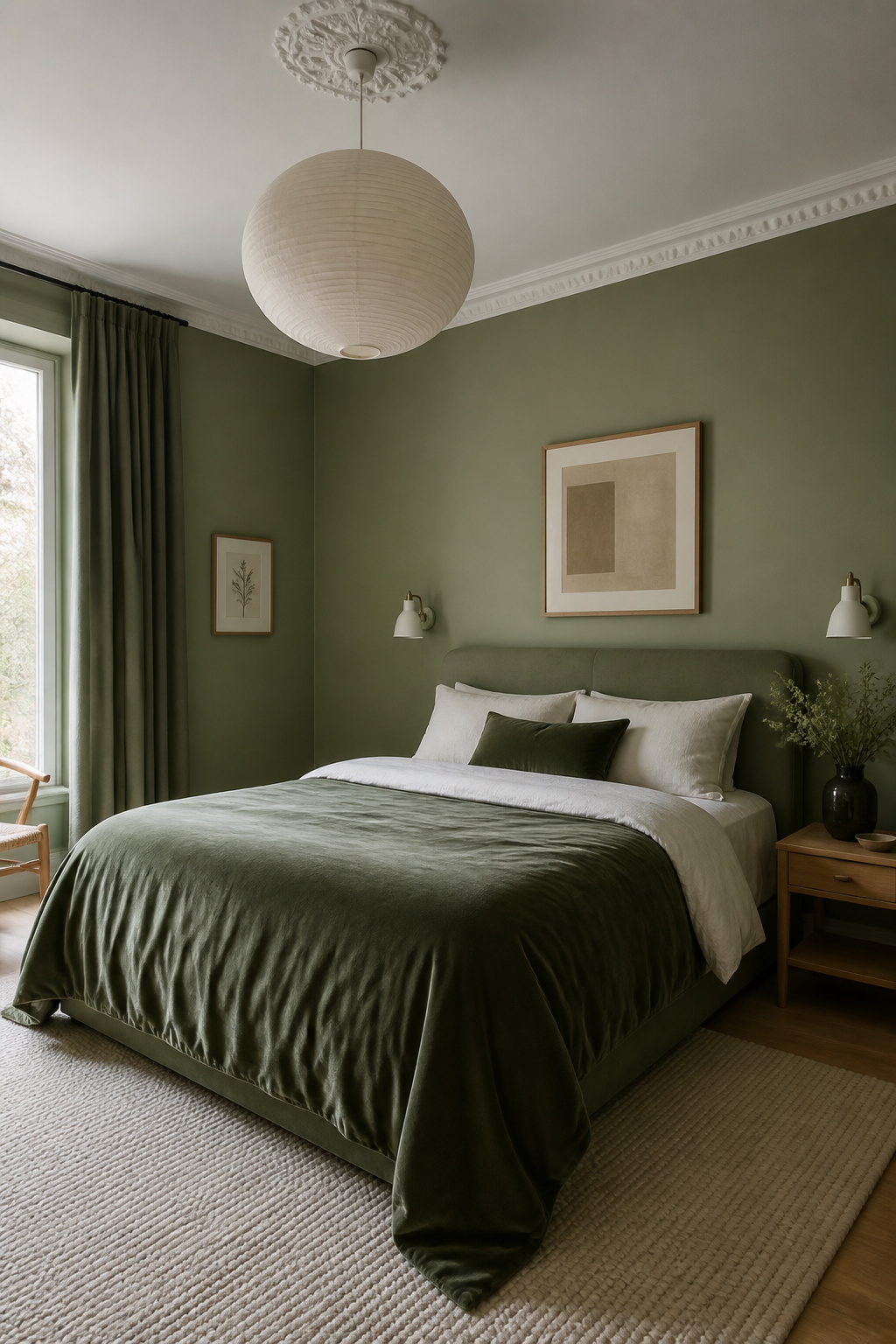
Building a three-tone palette
Three tones is the right number: a light (walls or ceiling), a mid (bedding or dominant textile), and a deep (accent cushion or throw). Examples that work: sage walls, eucalyptus linen, and forest velvet cushion; mint ceiling, sage bedding, and dark green rug; celadon walls, moss throw, and bottle green statement cushion. Specific shades matter less than the principle — light, mid, and deep, in roughly a 60/30/10 ratio.
Texture as the differentiator
Without texture variation, a monochromatic green room can look flat and institutional. The matte finish of painted walls, the directional sheen of velvet, the roughness of jute or rattan, and the softness of washed linen all read differently even when they share the same colour. Combine at least three distinct textures. Pattern can also enter — botanical prints, jacquard weaves, or subtle geometric rugs within the green family add complexity without disrupting tonal unity.
Pro tip: Add one warm neutral anchor — a cream bedside lamp, a raw wood frame, or a jute rug. It stops the scheme from reading like a themed room and keeps it feeling like a real, lived-in home.
15. Sage and Cream: A Soft Green Bedroom Color Combination
The most universally reliable green bedroom colour combination is sage and cream. Both colours share warm undertones — sage’s grey-green warmth and cream’s yellow-white warmth align so naturally they never clash, regardless of light conditions or specific shades. This pairing has appeared in well-designed bedrooms for decades and continues to feel fresh because it is fundamentally right, not fashionable.
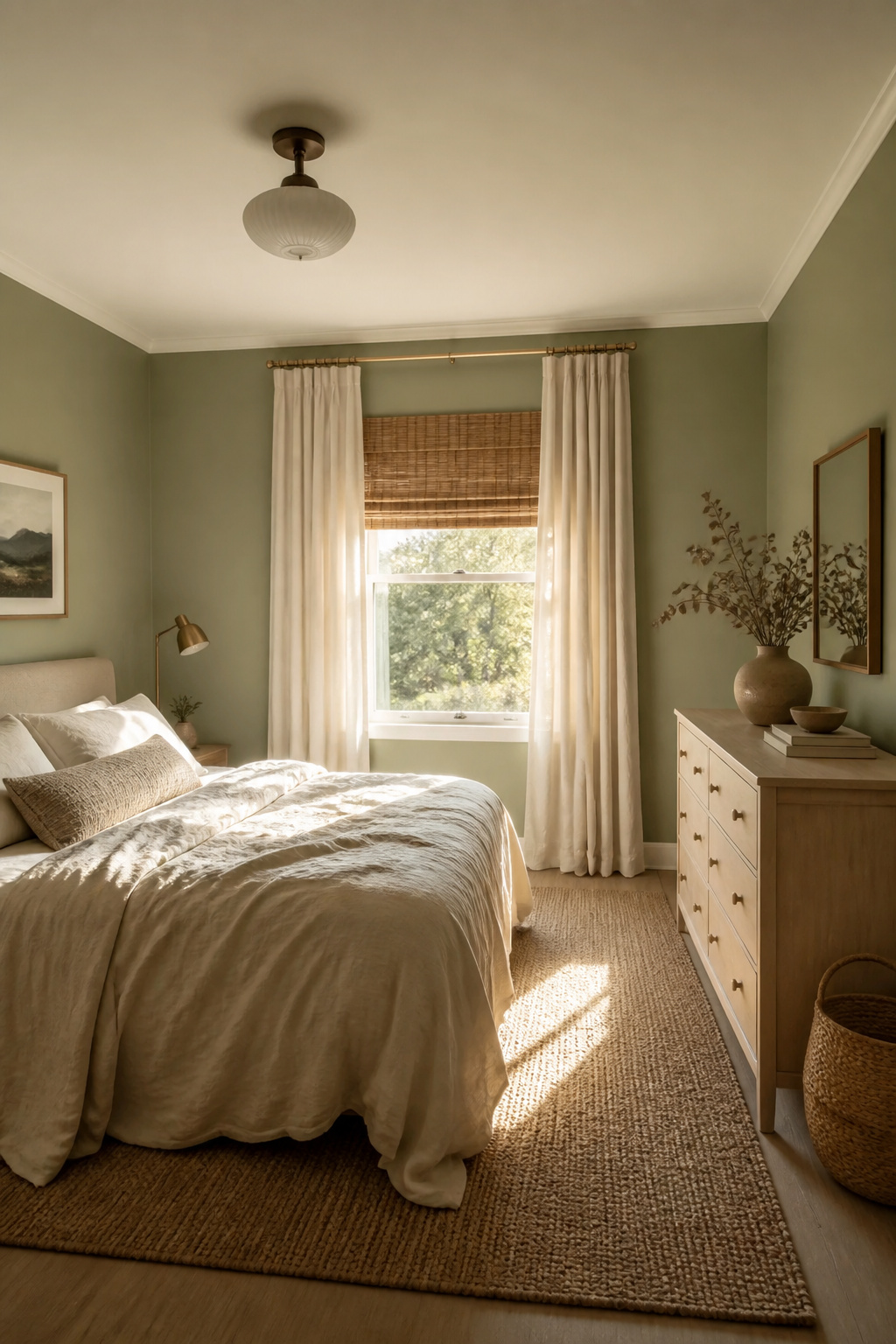
Applying the combination
Sage walls with cream bedding and light natural wood furniture is the simplest and most effective starting point. Brooklinen’s Classic Core Sheet Set in Ivory is ~$149; Cultiver’s Washed Linen in Parchment is ~$285; IKEA’s OFELIA cream duvet cover is ~$40 and works well against sage. Add warmth through accessories: brass bedside lamps, a jute or sisal rug, and woven rattan trays. The combination takes accent colours beautifully — dusty rose and terracotta both integrate without disrupting the core serenity. For more bedroom colour approaches, 20 Serene Blue Bedroom Decor Ideas covers the sister wellness palette in detail.
Trim and ceiling colour
Use warm white rather than bright white on trim and ceiling when walls are sage. Sherwin-Williams Alabaster (SW 7008) and Benjamin Moore White Dove (OC-17) both have just enough warmth to sit harmoniously beside sage. Bright white trim creates unnecessary contrast that makes sage look harsher than it is.
16. Botanical Prints and Green Art for Nature-Inspired Bedroom Walls
Botanical wall art is one of the most accessible and cost-effective green bedroom ideas available. A well-chosen botanical print gallery does the same visual work as bold paint or expensive wallpaper — filling a wall with natural green imagery and creating a connection to the living world — but can be done for almost nothing if you know where to look.
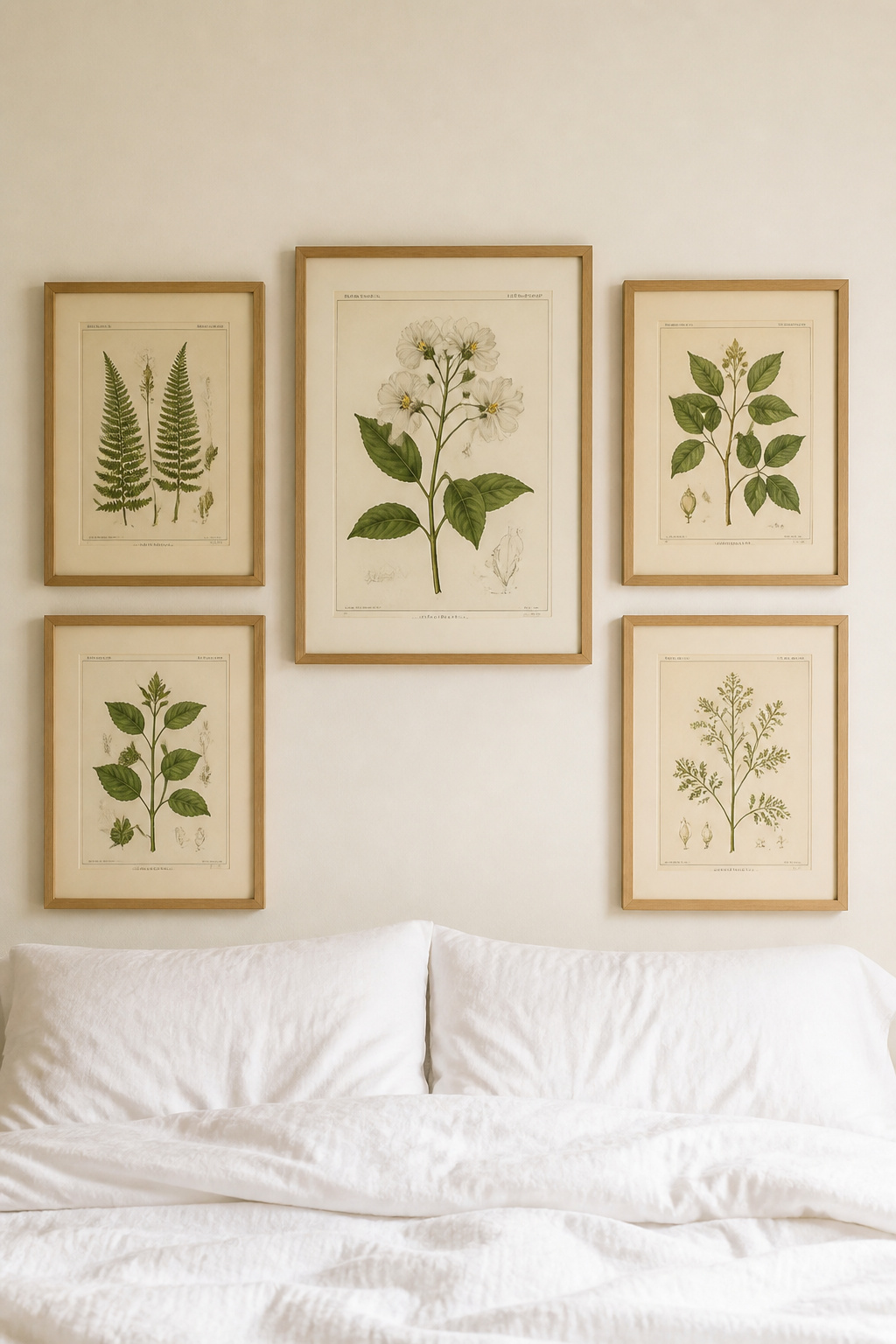
Free and affordable print sources
The Biodiversity Heritage Library (biodiversitylibrary.org) contains thousands of public domain botanical illustrations from historic scientific texts — genuinely beautiful and free to download. The New York Public Library Digital Collections is another excellent free source. On Etsy, sellers like BlackbirdPrintHouse and TheVintagePaperShop offer digital downloads from ~$5 and printed options from $15–$30. Download five or six prints, print them at Staples for $2–$4 each, frame them in IKEA RIBBA frames ($9–$25 each), and hang in a tight grid. A full gallery wall costs under $80.
Arrangement and framing
Lay all frames on the floor before marking walls — establish the layout visually first. Leave 2–3 inches between frames and start from the centre, working outward. Matching frames create immediate cohesion. Style options range from vintage Audubon-style engravings to modern minimal line drawings — choose one aesthetic rather than mixing.
17. Rattan and Sage Green Bedroom Ideas with Boho Spirit
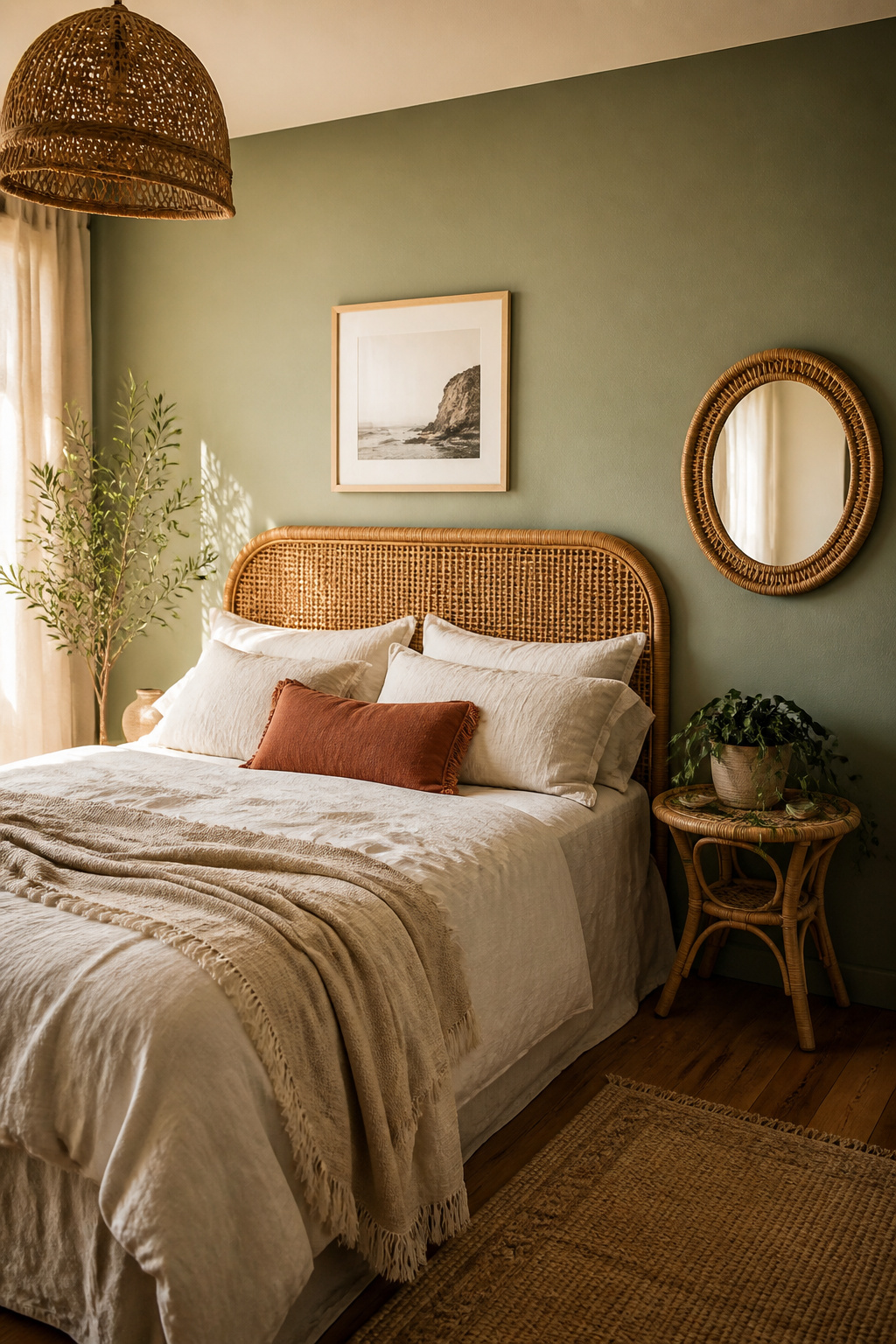
Rattan and sage green are, fundamentally, the same material translated into two different forms — one organic structure, one organic colour. They belong together. The combination activates the biophilic instinct in a way that feels warm and grounded rather than decorated. A rattan headboard beside sage green walls is one of the most effortlessly cohesive green bedroom ideas you can assemble.
Rattan pieces worth investing in
World Market’s Ari Rattan Queen Headboard is ~$199. Anthropologie’s Laetitia Rattan Headboard is ~$798 — more visual presence and detail for a long-term investment. Amazon carries budget rattan headboards from ~$89. For bedside tables, World Market’s round rattan side table is ~$79. A round rattan mirror (24–30 inches) adds a boho focal point for $30–$150. For complementary approaches to creating a warm, personal bedroom, 12 Nurturing Cozy Bedroom Ideas is worth exploring.
Preventing clutter in a boho-green bedroom
The failure mode of boho design is overcrowding. Choose rattan pieces with clean profiles rather than ornate weavework. Limit patterns to one textile and keep the rest plain. Sage green, rattan, cream, and one terracotta accent is the most versatile and grounded boho bedroom palette.
Pro tip: Rattan headboards work better against a plain painted wall than botanical wallpaper — the organic weave can compete with a busy botanical print. Keep the wall behind the headboard simple.
18. Green Candles, Crystal Accents, and Wellness Rituals for Your Bedroom
The physical environment is only half the equation for a restorative bedroom. The other half is ritual — the repeated, intentional behaviours that signal to the nervous system that it is time to shift from activation to rest. Green candles, crystals, and plant scents are not magic objects. But used consistently as sensory anchors, they become genuine sleep cues.
Green candle scents for sleep
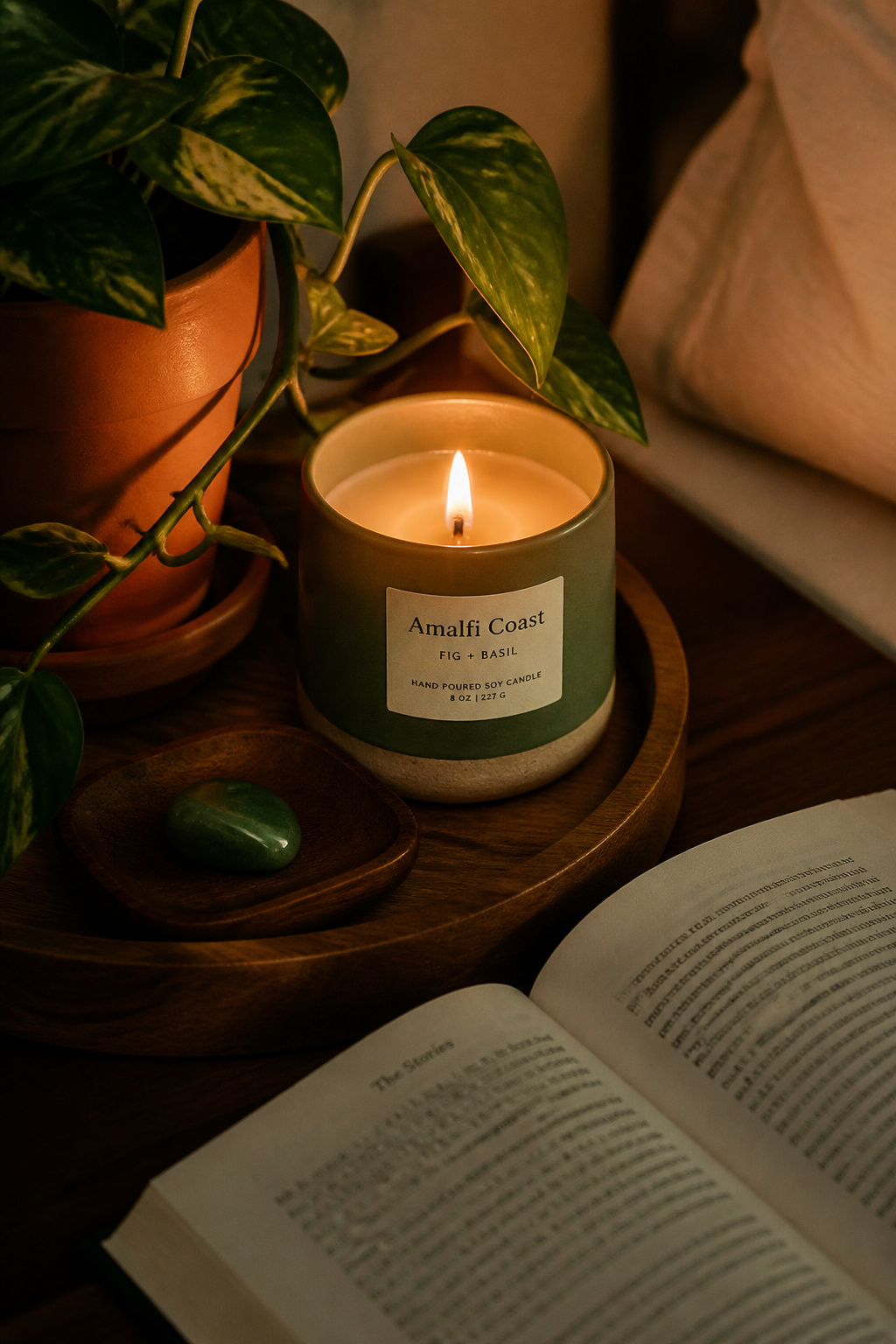
The most effective candle scents for bedroom relaxation are grounding aromatics: cedarwood, eucalyptus, pine, green tea, and vetiver. P.F. Candle Co.’s Golden Coast (~$24) has cedar and eucalyptus notes that are genuinely beautiful and not overpowering. Voluspa’s Eucalyptus and White Sage (~$20) is a strong option with good throw. Paddywax’s Cypress and Fir (~$18) is warmer and woodier.
Crystals and ritual design
Green aventurine is associated with calm; jade with balance; malachite with transformation; moss agate with grounding. Whether you hold to these traditions or not, a small beautiful stone on a bedside table is a lovely object that connects the bedroom to the natural world. Beyond symbolism, the act of placing a crystal on the table, lighting a candle, and doing five minutes of slow breathing is clinically shown to improve sleep onset when practiced consistently. A ceramic dish or wooden tray grouping candle, crystal, and a small plant creates a deliberate sanctuary corner.
Pro tip: The ritual matters more than the objects. Choose one sensory anchor — a specific scent, a specific weight in your hand — and use it every night. The brain learns to associate that sensory cue with relaxation. Within two weeks, simply smelling that candle will begin to lower your heart rate.
Choosing the Right Green Bedroom Ideas for Your Space
Green bedroom ideas span an enormous range, and the right choice depends on your room’s specific conditions as much as your personal aesthetic. The most important variable is light — your room’s orientation determines whether sage or forest green, mint or bottle, works best.
How to match green shade to your light conditions
South-facing rooms with strong natural light support the full range — pale mints come alive and cool grey-greens hold their clarity. North-facing rooms need warmth to compensate — choose sages and forest greens with yellow or brown undertones, and avoid blue-bias greens that will read grey. East-facing rooms get warm morning light and cool afternoon light; warm sages perform well. West-facing rooms suit deeper greens that come into their own under lamp light in the evenings.
Buy two or three sample pots and paint large test patches on different walls. Observe them in the morning, at noon, and in the evening under lamp light. The right colour looks consistently good across all conditions.
Starting small: one element that changes everything
You do not need to paint the walls to begin. A single well-chosen element can shift the atmosphere of a room significantly. An emerald velvet duvet, a large snake plant, a botanical gallery wall, or a sage green throw and cushion combination can all introduce the green bedroom feeling without commitment. Start there. Also see 18 Secrets to the Ultimate Green Bedroom Aesthetic for a deeper exploration of what makes green bedrooms work at every scale.
Building toward your full green bedroom vision
Most successful green bedrooms are built incrementally — a wall colour first, then bedding, then plants, then textiles layered over time. Each addition can be assessed against what is already there. Rushed rooms completed in a single decorating session often miss the depth that comes from accumulation. Give your green bedroom time to develop. Change one thing, live with it, then add the next. The result will feel considered and personal — which is exactly what a restorative bedroom should be.