
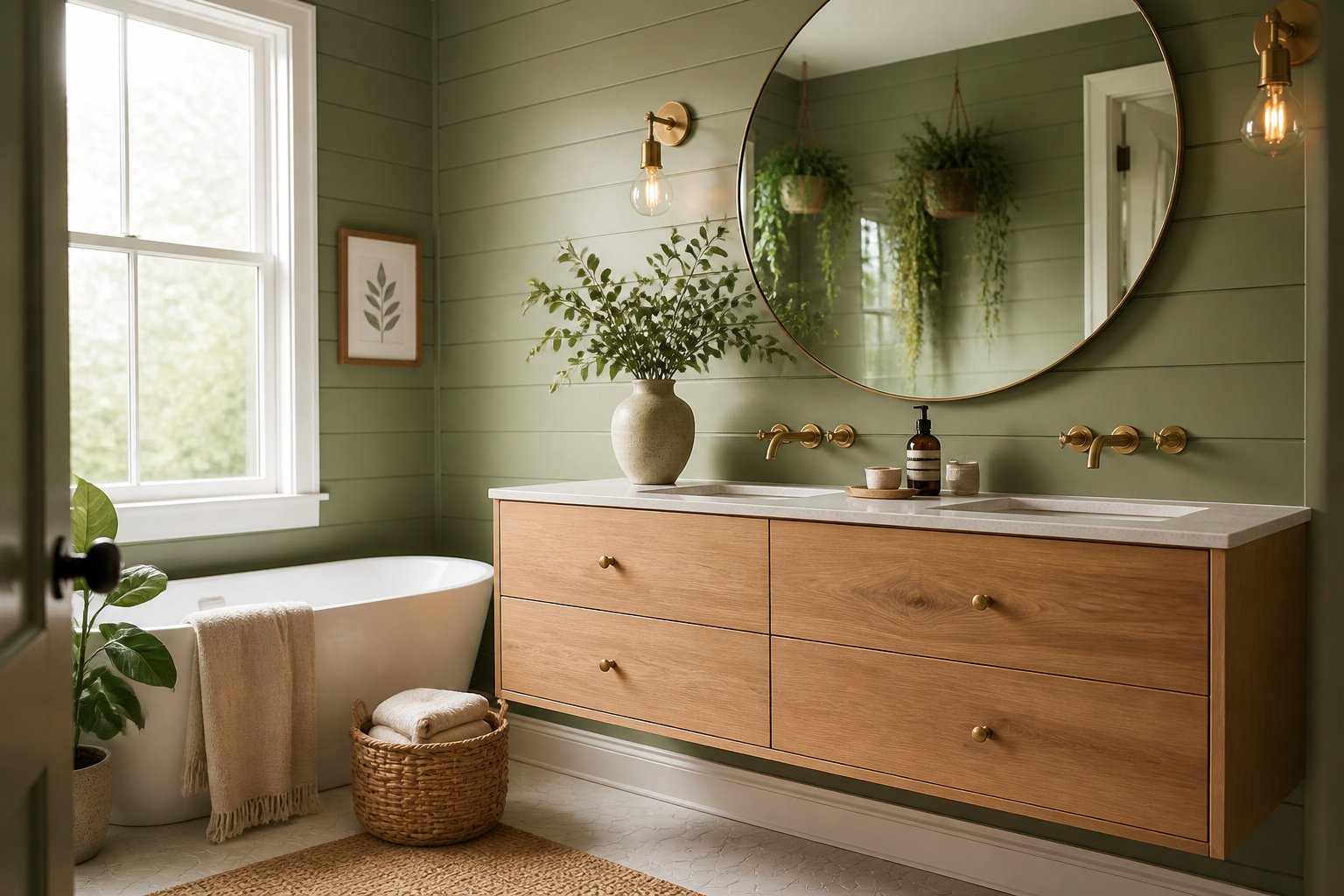

Step into a green bathroom and your shoulders drop. Your breath slows. Green is the colour the human eye processes with least effort, and in a room built for unwinding, that matters. It signals safety, nature, and rest in a way that white walls and chrome fixtures rarely achieve.
I have spent years helping people transform bathrooms into genuine sanctuaries, and green keeps delivering. Not because it is fashionable — though it is — but because it actually changes how the room feels. Whether you are drawn to dusty sage, rich forest green, or gentle pistachio, there is an idea here to suit your home and your budget.
These 18 green bathroom ideas span every shade, style, and commitment level. Some require renovation. Others need only a tin of paint and a Saturday afternoon. All of them are grounded in what works in a real bathroom, not just what photographs well.
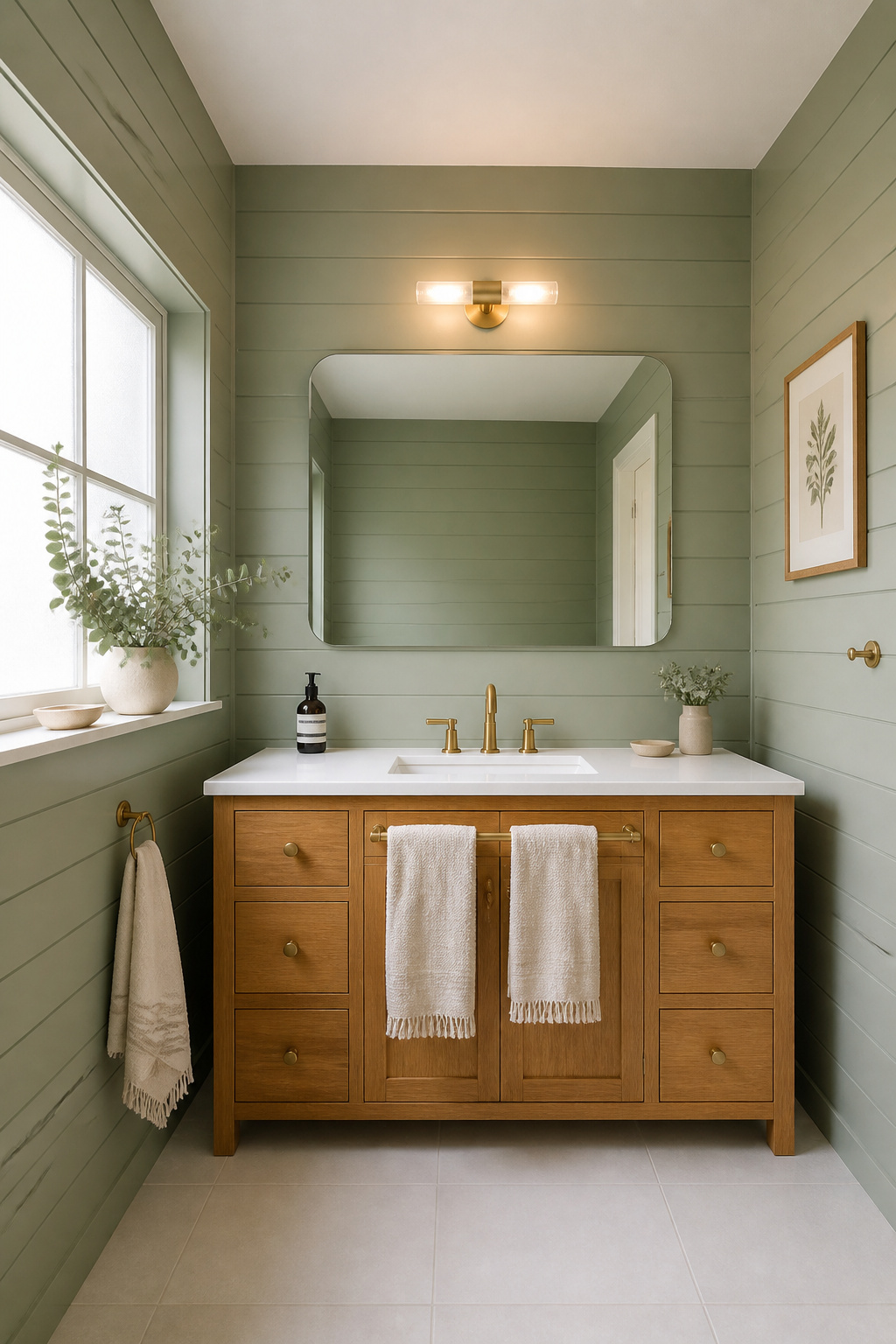
1. Sage Green Shiplap Walls with Warm Wood Details
Sage green is the most forgiving shade you can choose. In certain lights it reads almost as a neutral — closer to grey-green than botanical — which means it works with fixtures you already own. Add shiplap cladding and a warm wood vanity, and the bathroom feels like a weekend retreat without a full renovation.
Why Sage Green and Wood Are Grounding
The pairing works because sage sits in the cool-warm middle ground of the colour spectrum while wood introduces warmth that stops the room from feeling clinical. Together they reference bark and leaf — which is why the combination triggers calm that plaster-and-chrome bathrooms rarely achieve.
Sage also shifts under different light. It reads cooler and more grey in the morning, warmer and more green by lamplight. That quality keeps the room from feeling static.
Executing Shiplap in a Humid Bathroom
Standard pine needs sealing before it goes anywhere near a bathroom. Use a moisture-resistant primer, then two coats of specialist bathroom paint. Farrow and Ball’s Mizzle (No. 274) and Sherwin-Williams Clary Sage are both excellent options. Moisture-resistant MDF tongue-and-groove panels are an easier alternative to cut and paint cleanly. Run boards horizontally to make a narrow room feel wider. Budget around £30–45 per square metre for materials.
Choosing the Right Sage Tone
Always test paint under your bathroom’s artificial light before committing. Many sage greens that look beautiful in daylight shift noticeably yellow under warm LED bulbs. If your room has limited natural light, lean toward cooler sage formulas. Benjamin Moore’s Pale Sage (HC-110) holds its green character well under most interior lighting conditions.
2. Forest Green Tiles as a Statement Green Bathroom Wall
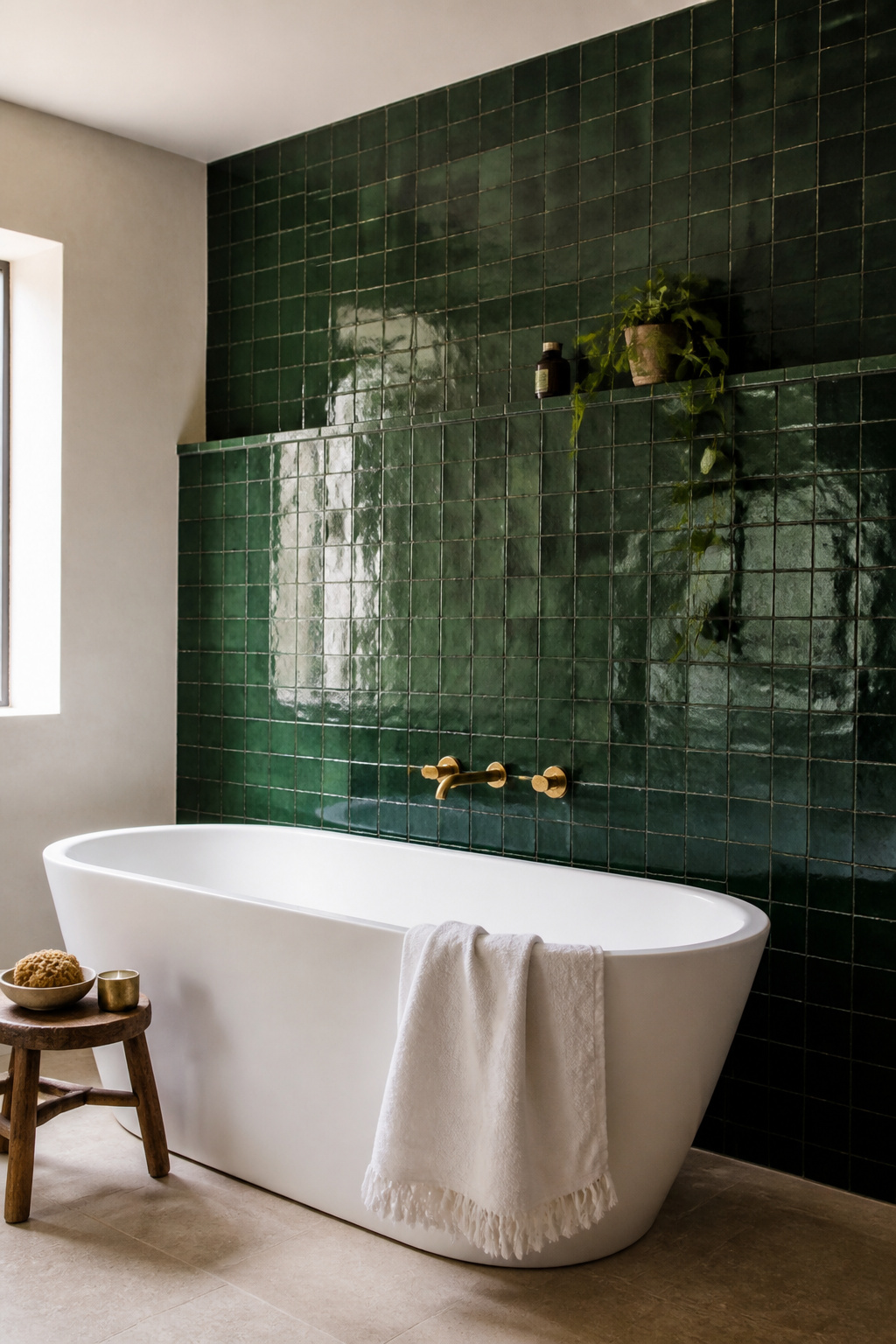
A single tiled feature wall in forest green transforms a bathroom faster than almost any other intervention. You do not need to tile the whole room. One wall behind the bath or around the shower is enough to shift the entire character of the space. Forest green zellige tiles carry a depth and movement that flat paint cannot replicate.
Why One Feature Wall Works
The visual logic is simple. One strong focal point reads as intentional design. Four fully tiled green walls can feel overwhelming. By concentrating the forest green on a single wall, you get maximum impact with minimum risk. The rest of the room — white plaster, pale grout, simple fixtures — lets the tile do the work.
Feature walls also keep costs manageable. They typically cover 4–8 square metres, compared to a full tile job at 30 square metres or more.
Tile and Grout Choices
For forest green, zellige-style tiles in a brick bond create the most rewarding result. The colour variation across individual tiles produces natural depth that uniform porcelain cannot match. Fired Earth’s Moroccan Zellige starts around £95 per square metre. Topps Tiles’ Artisan Bottle Green sits closer to £55.
For grout, go warm. A pale buff or putty grout softens the contrast and gives the wall a more organic feel than bright white grout would.
Pairing With Warm Metals
Aged or unlacquered brass is the natural partner for forest green. The warmth of the metal stops the green from reading as cold, and the tone variation in aged brass echoes the variation across the tile surface. Matt black works too — but it sharpens the contrast rather than softening it.
3. Olive Green Vanity Cabinet with Brass Hardware
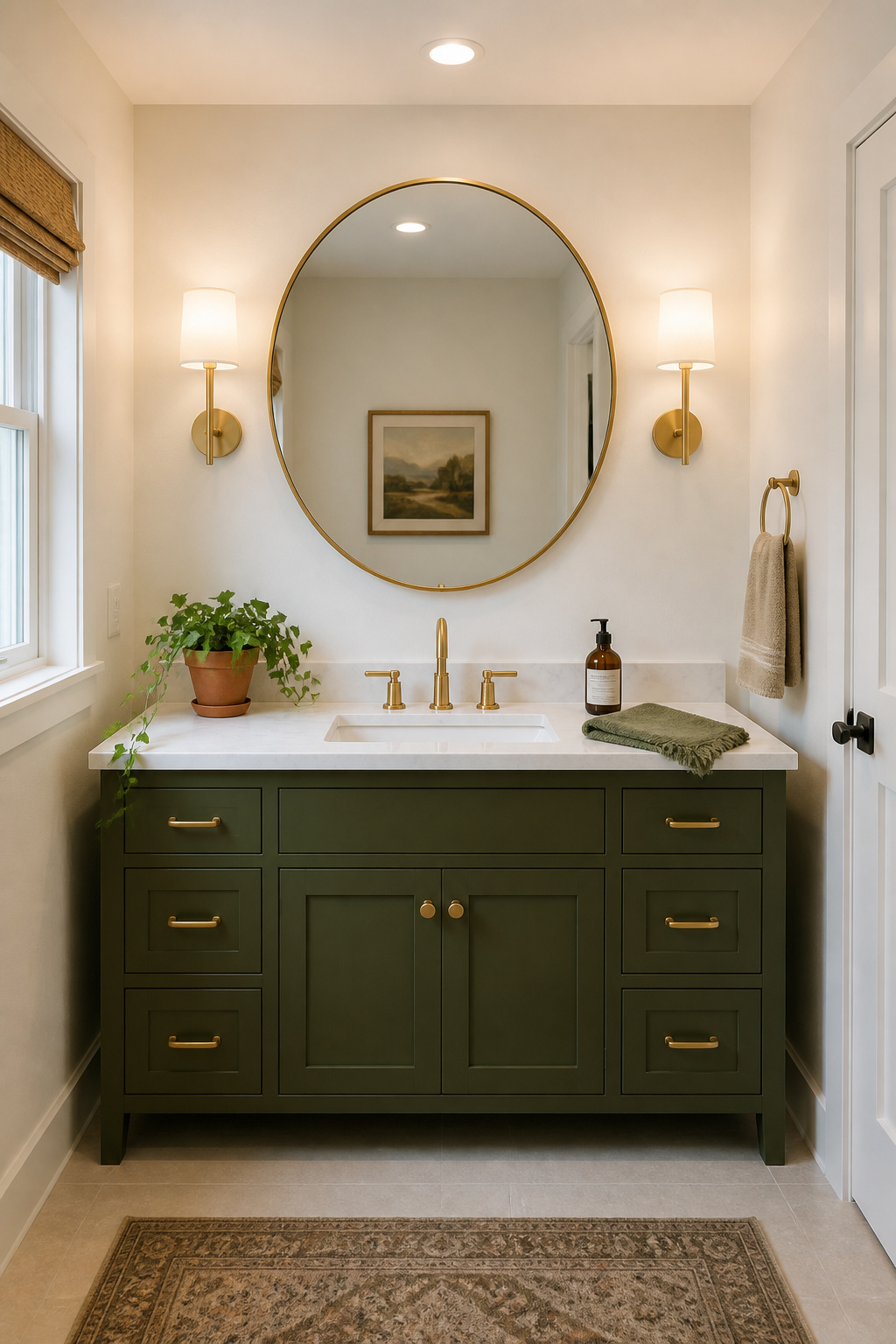
An olive green vanity requires no tiling, no specialist contractor, and no permanent commitment to a wall colour. The vanity becomes the room’s anchor — earthy, grounded, and surprisingly sophisticated — while the surrounding walls stay neutral. Also, if you rent, it is one of the few green bathroom ideas you can take with you when you leave.
The Appeal of Olive Green
Where sage sits in cool-grey territory and forest green leans dramatic, olive occupies a warmer, earthier register. It reads like a green that has been sun-warmed — closer to dried herbs than fresh foliage. That warmth suits bathrooms with limited natural light, since olive does not rely on bright conditions to look its best.
How to Paint or Source an Olive Vanity
Strip and lightly sand the surface, apply a bonding primer, then finish with two coats of furniture paint. Annie Sloan Chalk Paint in Olive requires minimal preparation and covers well in two coats. For a new vanity, IKEA’s HEMNES and GODMORGON ranges take paint well. Several suppliers, including Victorian Plumbing, also offer factory-finished olive and sage options. For a full guide on preparation and finish options, bathroom vanity makeover ideas covers everything in detail.
Brass: Lacquered vs. Unlacquered
Standard lacquered brass stays consistent but can look flat over time. Unlacquered brass develops a living patina — darker in recessed areas, brighter on high-touch surfaces. For an olive vanity, unlacquered brass is the better long-term choice. It looks increasingly interesting with age rather than simply worn.
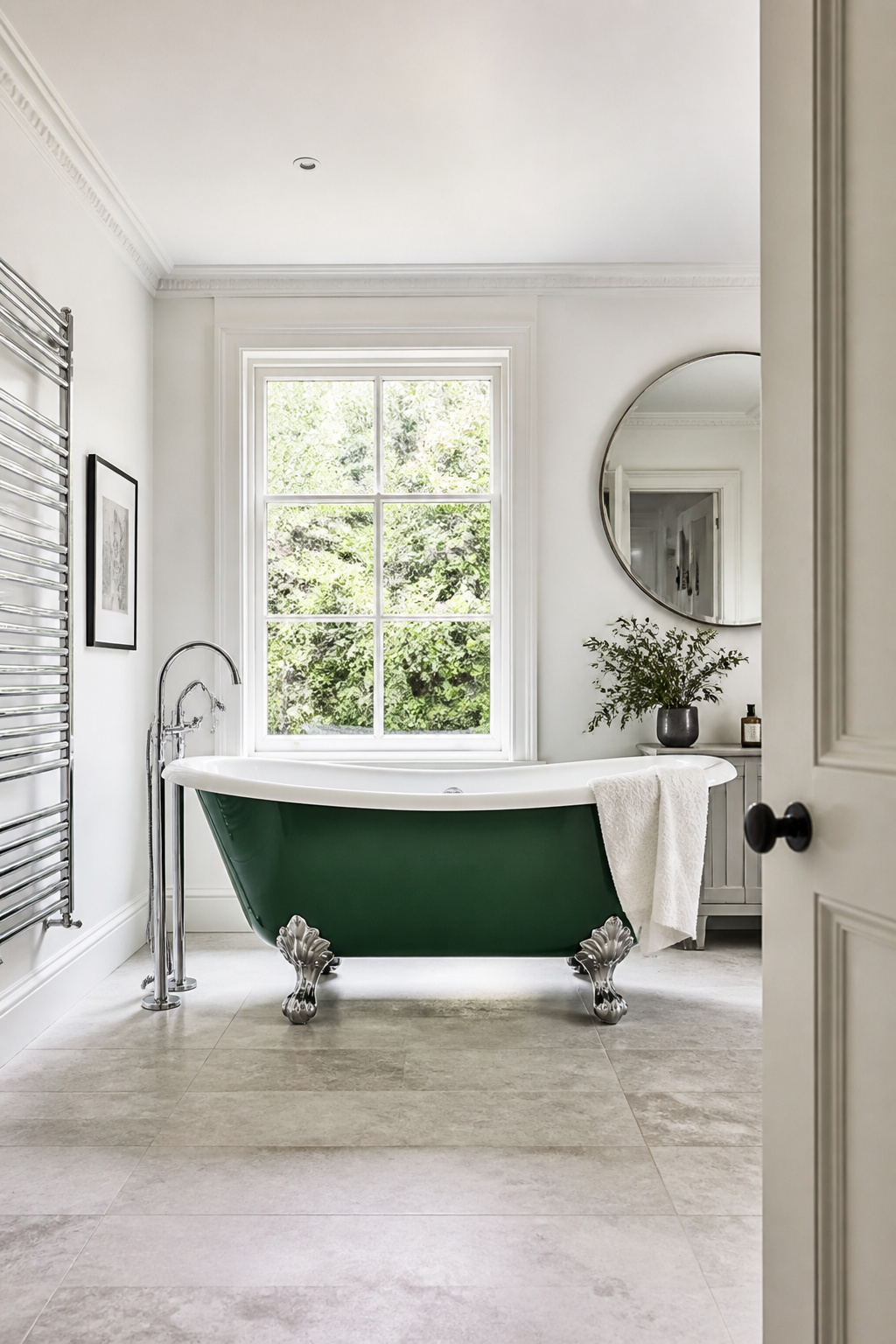
4. Emerald Freestanding Tub: A Bold Green Bathroom Idea
A freestanding bath in deep emerald is not a background element. It is the room’s sole reason for existing, and every other decision should support it rather than compete. This is the green bathroom idea with the highest visual return per intervention — but it asks you to commit to one strong statement and leave everything else alone.
Why One Coloured Bath Changes Everything
A coloured freestanding bath works on the same principle as a statement sofa in a living room. One strong object sets the room’s emotional tone, and everything else is chosen in relation to it. Emerald carries associations with luxury, depth, and botanical richness. In a bathroom, it transforms a functional space into something closer to a private spa. Because the bath is freestanding rather than built-in, none of the surrounding structure needs to change.
Sourcing and Surrounding
BC Designs offers one of the widest coloured ranges in the UK market. Their Victrion and Arroll baths come in forest and emerald tones from around £1,400. Clearwater and Hurlingham both produce coloured options closer to £900. Keep the surroundings quiet: pale grey or white stone-effect floor tiles, plain white walls, chrome or brushed nickel fixtures. Resist adding green accessories — with an emerald bath in the room, you already have everything you need.
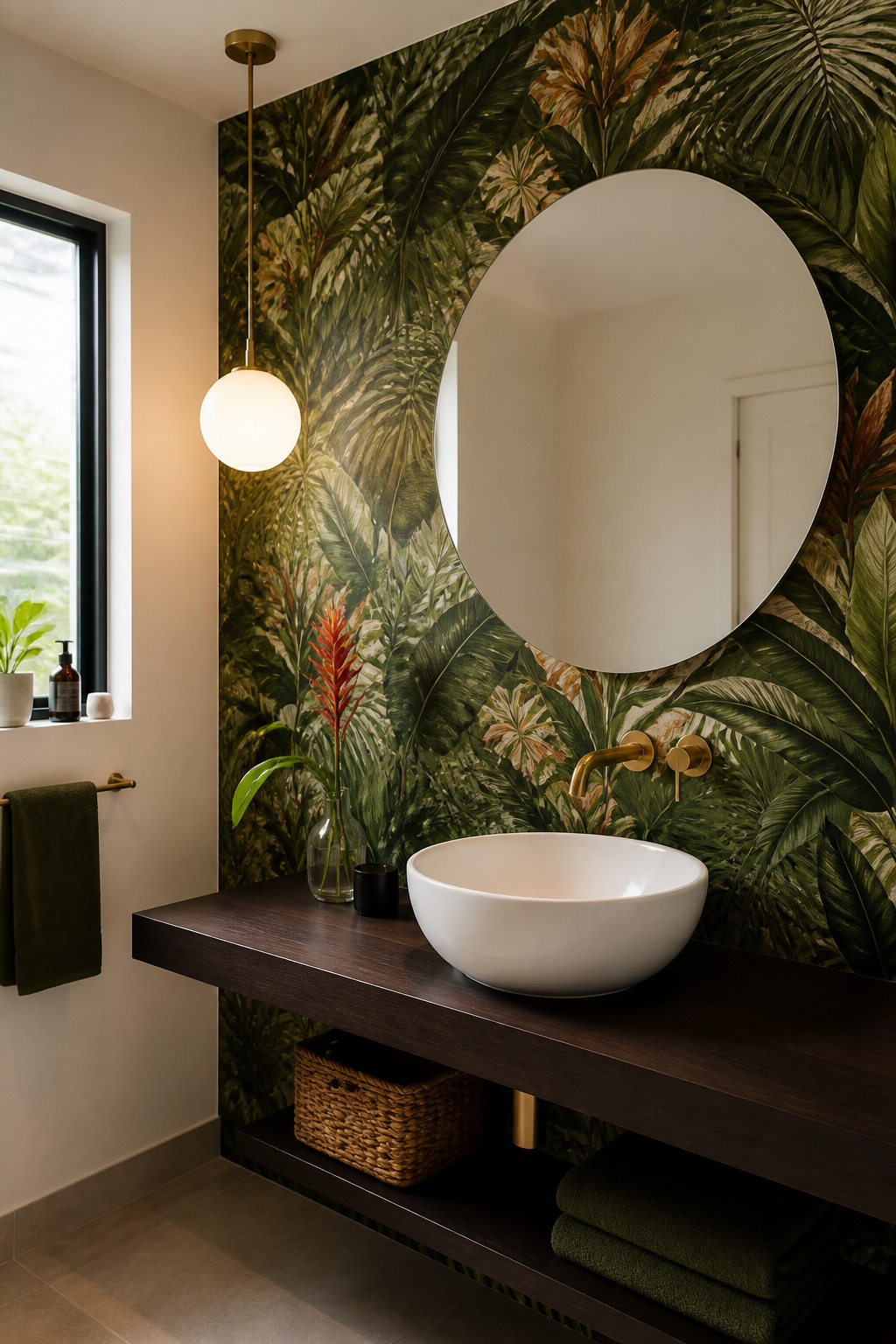
5. Botanical Wallpaper for a Garden-Inspired Green Bathroom
Botanical wallpaper gives you lush, immersive green without permanently altering the bathroom’s structure. It is also reversible — something worth remembering if you rent or simply change your mind. As green bathroom ideas go, this is among the most immediately transformative and the easiest to undo.
Why Botanical Prints Work in Bathrooms
Research on biophilic design consistently shows that even representations of nature — leaves, ferns, tropical fronds — trigger measurable relaxation responses. In a bathroom, this effect amplifies. You are already in a contemplative, body-focused routine. Surround that routine with green foliage and the space starts to function more like a restorative ritual.
Choosing Moisture-Resistant Wallpaper
Standard wallpaper will not survive bathroom humidity. Look specifically for vinyl-coated or vinyl-backed options, which resist moisture and wipe clean. Graham and Brown, Cole and Son, and Sanderson all produce botanical designs in bathroom-grade vinyl finishes, with prices typically from £70–£140 per roll. Cole and Son’s Palm Jungle and Sanderson’s Glasshouse range are both widely used by interior designers for this purpose.
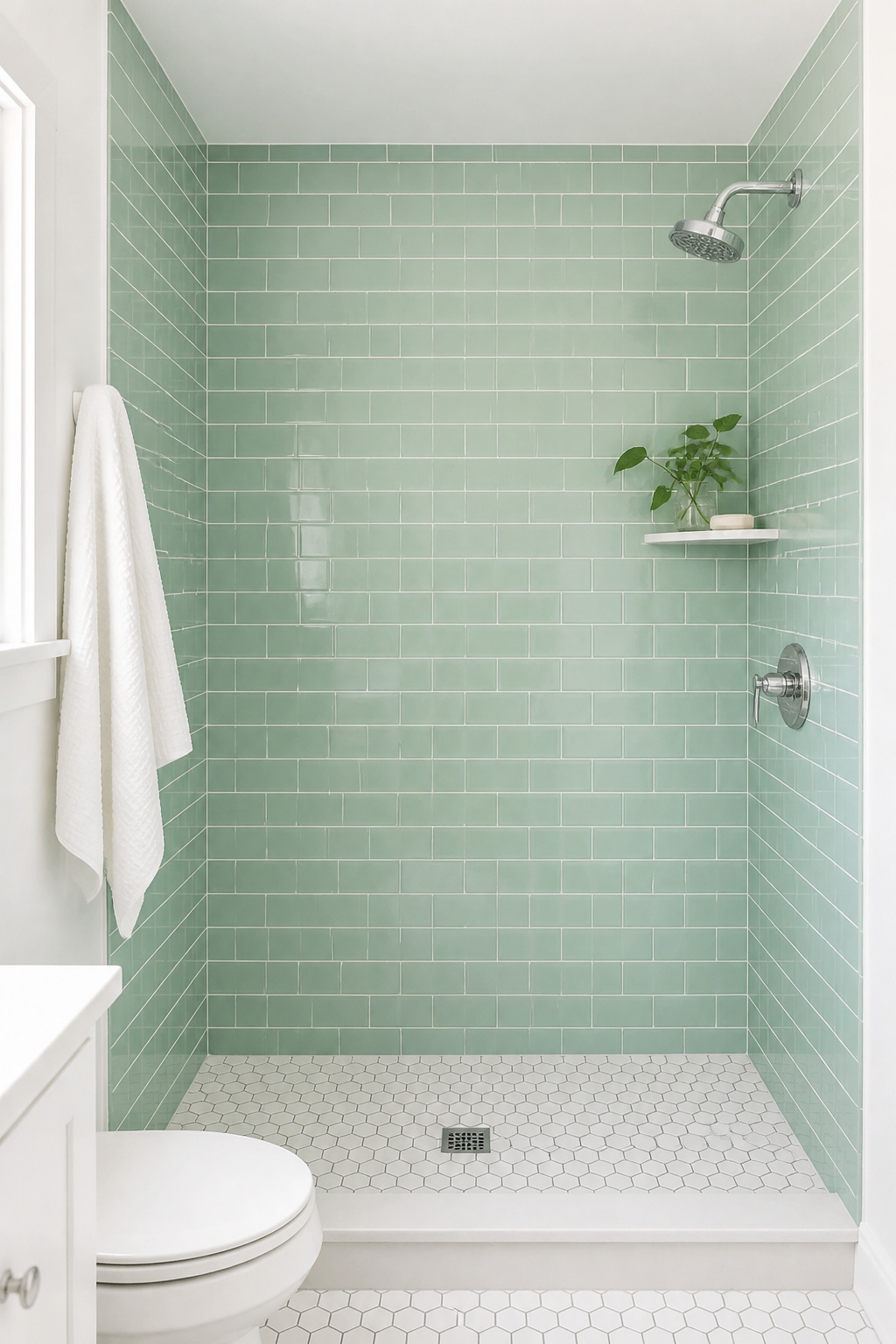
6. Mint Green Subway Tiles in a Classic Grid Pattern
Mint green subway tiles sit at the intersection of practical and charming. They are robust, easy to clean, widely available, and capable of making a utilitarian bathroom feel considered. The colour references 1950s American diners, early-century European hospital tiling, and mid-century domestic bathrooms — it feels simultaneously retro and fresh.
Why Mint Is Having a Revival
Mint fell out of fashion in the 1980s and 1990s as the industry moved toward white and grey as the default safe palette. Its current revival is partly a reaction to that long period of neutrality — people are ready for colour again. Mint also photographs warmly and suits a wide range of interior styles, from cottagecore to Scandinavian modern.
Grout and Sourcing
White grout makes mint tiles feel lighter and emphasises tile shape. Charcoal grout introduces graphic contrast and a more urban quality. For vintage-influenced bathrooms, a warm cream grout references the slightly aged quality of original Victorian tiling.
Tile Giant’s Vintage Sage range sits around £22 per square metre. Topps Tiles’ Aqua Metro comes closer to £35 for a more substantial glazed finish. Trade-sale websites regularly carry discontinued mint ranges at significant discounts, since mint green goes in and out of production frequently.
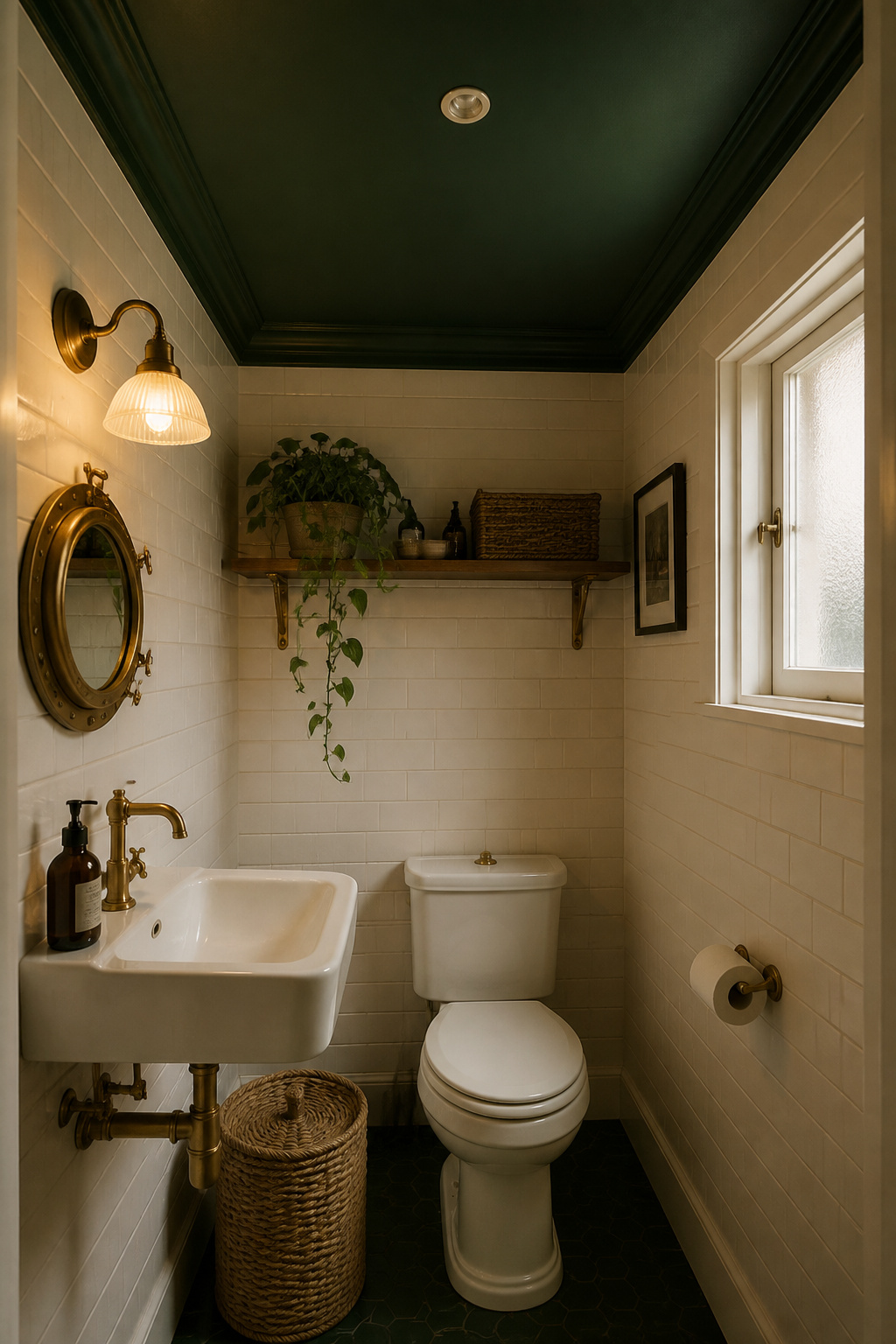
7. Deep Hunter Green Ceiling for a Cozy, Enveloping Bathroom
The ceiling is the most underused surface in bathroom design. Most people paint it white without a second thought — reasonable, but a missed opportunity. A deep hunter green ceiling changes the entire atmosphere of a bathroom, creating a cocooning intimacy that white simply cannot produce.
Why the Fifth Wall Matters
Colour on the ceiling lowers the perceived height of a room. In a bathroom, that creates intimacy rather than claustrophobia. The effect is similar to drawing curtains around a four-poster bed — you feel held rather than confined. Deep green on the ceiling also plays well with warm artificial light in the evenings, absorbing and reflecting it in a way that white cannot.
Paint and Coordination
Use a specialist bathroom ceiling paint or add a moisture-resistant additive to your chosen colour. Farrow and Ball’s Calke Green in Modern Emulsion handles bathroom conditions well. For a deeper hunter tone, Little Greene’s Invisible Green is worth testing.
Keep the walls pale — white, off-white, or very light grey. Use white sanitary ware. Introduce warmth through metal finishes rather than additional colour. Brass wall lights and warm white bulbs prevent the dark ceiling from feeling heavy.
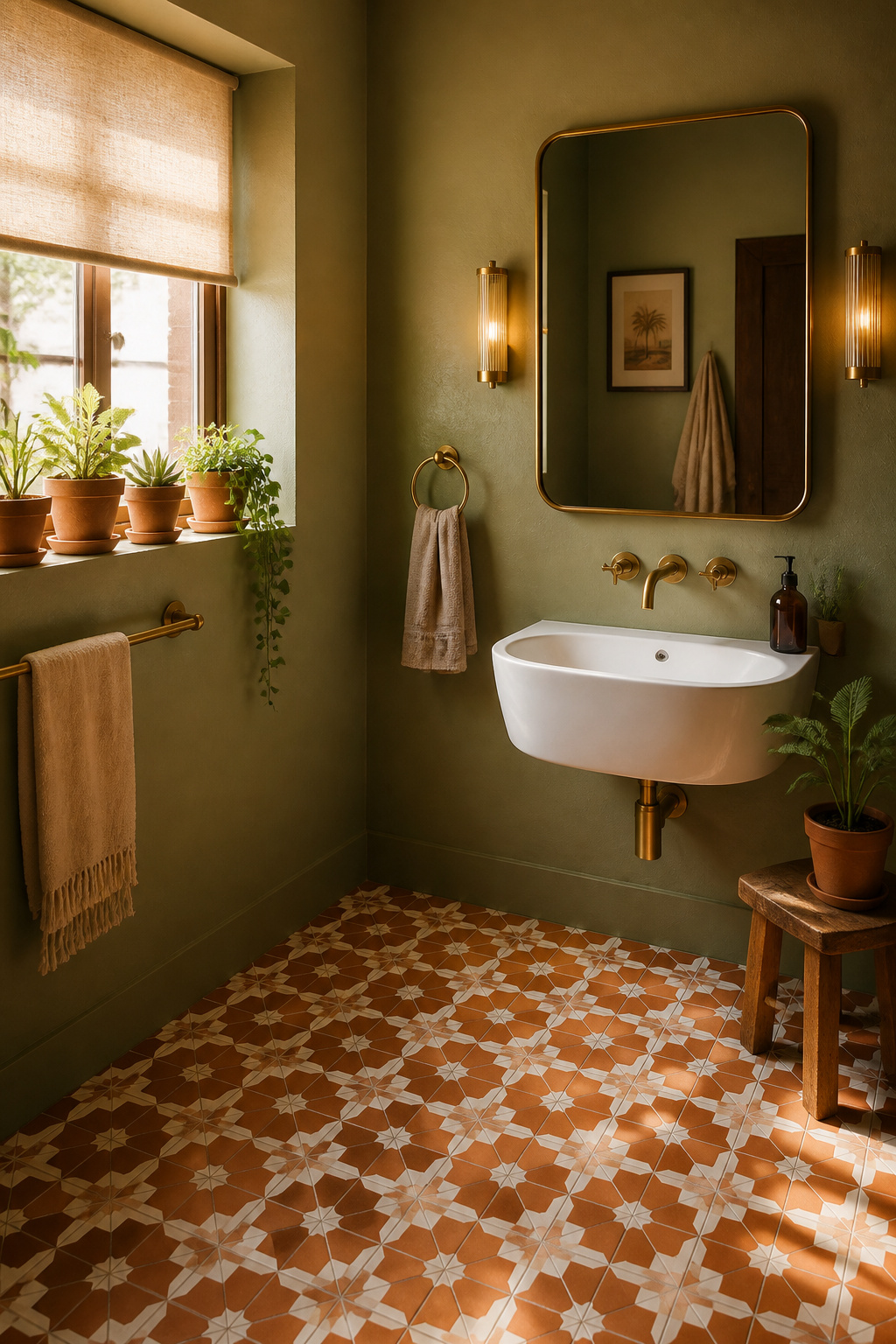
8. Sage Green and Terracotta: A Warm Color Pairing
Sage green and terracotta share a common ancestor. Both are desaturated, earthy tones that reference clay soil, dried herbs, and warm stone. When they appear together in a bathroom, the result is a warmth and richness that neither colour achieves alone. This is one of the green bathroom ideas that rewards full execution — it looks better as a complete scheme than as a halfway measure.
Why the Pairing Works
Both tones are desaturated — they have had some of their chromatic intensity removed — which means they sit comfortably together without competing. The contrast between cool sage and warm terracotta creates a visual dynamic that feels resolved. The room is balanced, not static.
Cover the majority of wall surfaces in sage green and the floor in terracotta. This creates a cool-dominant room that is calm and easy to live with. Keep accessories neutral: white, cream, aged brass, and natural wood sit comfortably between the two anchor colours.
For the floor, encaustic cement tiles from Bert and May give the most character. Plain terracotta porcelain from Topps Tiles works well at a lower price point. On the walls, Crown’s Pressed Sage and Dulux’s Copper Shadow — which reads as a warm sage despite the name — are both worth testing.
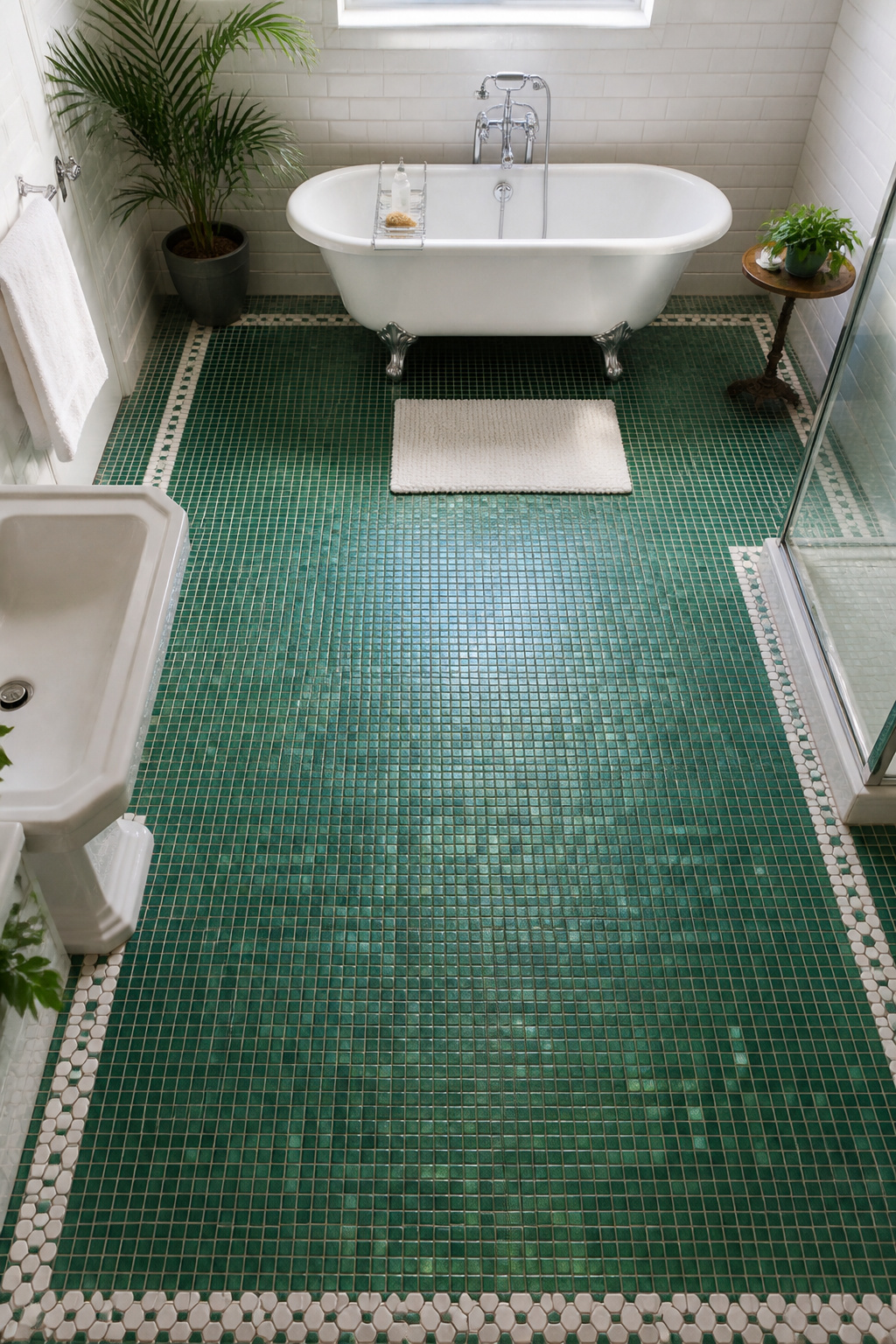
9. Green Mosaic Tiles for a Vintage Green Bathroom Feel
Mosaic tiles are labour-intensive and more expensive per square metre than standard tiles. However, the results are genuinely distinctive. A green mosaic floor or shower wall creates visual texture that reads as considered craftsmanship rather than off-the-shelf decoration. For a bathroom with heritage or vintage aspirations, mosaic is among the most historically authentic options available.
The Appeal of Mosaic
Mosaic has been used in bathrooms since Roman times — not simply for practicality but because small glazed tiles interact with water and light in ways larger tiles do not. In a green bathroom, the colour shifts subtly across the surface as the light changes, giving the impression of depth and movement. Modern mosaic tiles come on mesh-backed sheets, which simplifies installation significantly.
Colour Families and Sourcing
Three main families appear most often. Jade — a rich, slightly warm mid-green — suits bathrooms with warm artificial lighting. Celadon — pale and grey-green — is the quietest and most refined option. Seafoam — brighter and more blue-green — works best in rooms with strong natural light and cooler finishes.
For context on how mosaic compares with other character-rich floor materials, bathroom flooring options covers the full range in detail. Original Style’s Mosaic collection and Claybrook’s handmade glass range cover all three colour families from around £80 per square metre.
10. Soft Eucalyptus Linens and Greenery Styling
This is the green bathroom idea that costs the least and needs no tools. Eucalyptus-toned towels, a bundle of fresh stems hung from the shower head, a trailing pothos on the windowsill — these small changes shift the atmosphere of a bathroom more significantly than most people expect. Also, if you are testing whether green works in your space before committing to paint or tiles, this is where to start.
Why Textiles and Plants Punch Above Their Weight
A bathroom is made almost entirely of hard, reflective surfaces: tiles, glass, chrome, porcelain. Towels, mats, and plants are the only truly soft elements in the space — which is precisely why they carry disproportionate visual weight. Swap white towels for eucalyptus-toned ones and the whole room shifts toward green. Not aggressively, but noticeably.
Best Plants and a Cost-Effective Approach
Pothos (Epipremnum aureum) is the most reliable plant for bathrooms: it tolerates near-darkness and trails beautifully from shelves. Boston fern loves humidity and produces a lush, forest-like effect. Spider plants are nearly indestructible and produce trailing offshoots that look intentional.
For the fresh eucalyptus stem trick: hang a bundle from your shower head. Steam from your shower releases the essential oils in the leaves, and the bathroom smells genuinely wonderful for days. Start with eucalyptus-toned towels from The White Company or Piglet in Bed, add one or two plants in terracotta pots, and introduce green glass accessories to the countertop. The cumulative effect reads as intentionally designed for well under £100.
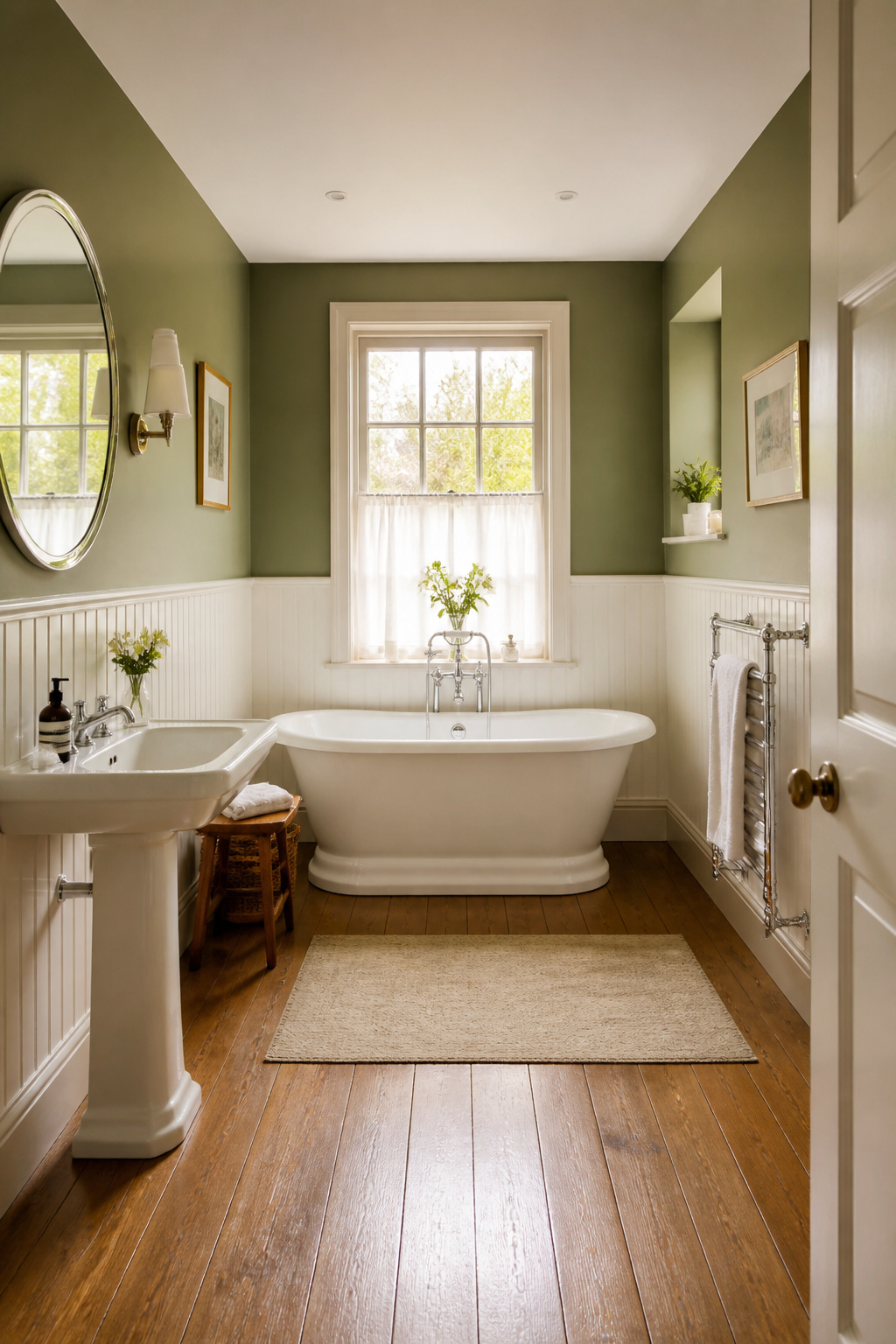
11. Olive Green Bathroom Ideas with Classic White Wainscoting
A bold upper-wall colour above traditional wainscoting is one of the most architecturally satisfying bathroom treatments available. Olive green above a white-painted dado rail creates a room that is both cosy and polished — grounded by the colour, structured by the panelling, brightened by the white below. These olive green bathroom ideas have the longest track record in British domestic interiors of anything on this list.
How Wainscoting Adds Structure
Wainscoting does two things simultaneously: it protects the lower wall from water splashes, and it introduces a horizontal datum line that gives the room a sense of proportion. In a bathroom with standard 2.4m ceilings, a dado rail at 900–1000mm creates a visual split that makes the room feel more considered and spacious. Wainscoting also carries period associations — Victorian, Edwardian, Arts and Crafts — that pair naturally with the earthy depth of olive green.
Height, Finish, and Paint
In a standard-height room, 900–950mm looks most natural. Above 2.7m, raise the rail to 1100–1200mm for better proportional balance. Use tongue-and-groove MDF for the panelling — more moisture-resistant than solid timber and easier to install. Apply an eggshell or satin finish on the wainscoting below and a matte or soft sheen on the olive green above. Crown’s Pressed Olive and Dulux’s Fennel Green are both reliable for the upper wall section.
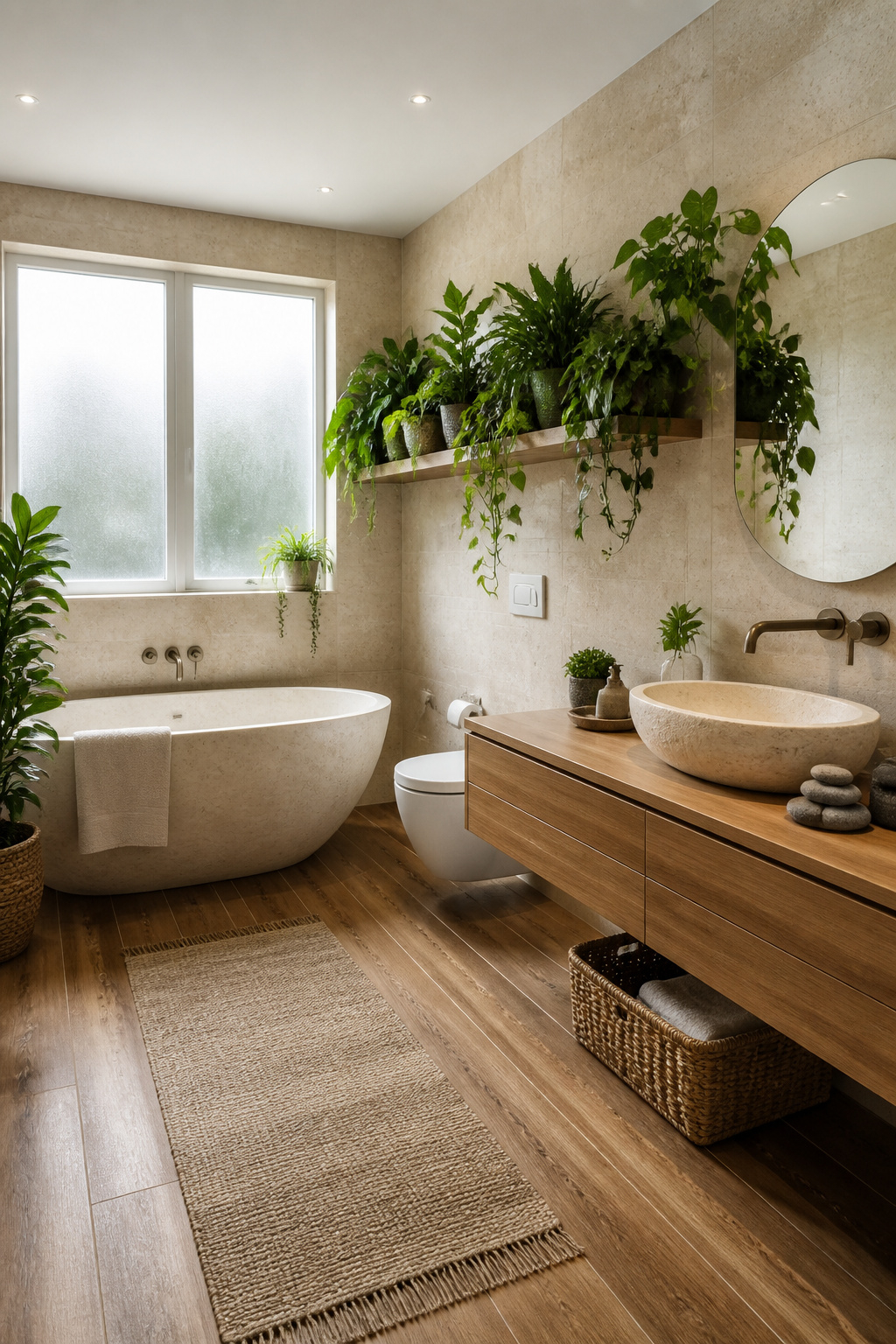
12. Biophilic Green: Plants, Stone, and Living Materials
A biophilic green bathroom takes the idea seriously. Rather than relying on colour alone, it brings living plants, natural stone, organic textures, and genuine materials into the space. Decades of environmental psychology research show that connection to nature reduces stress, lowers blood pressure, and improves cognitive function. So this is the green bathroom idea that functions most actively as a wellness environment.
What Biophilic Design Means in Practice
In a bathroom, biophilic design translates to: natural light wherever possible, living plants in sufficient quantity to read as meaningful rather than decorative, natural stone or stone-effect materials for floors and walls, and wood or wood-effect surfaces for the vanity.
The green colour story comes from the plants themselves, from the veining in stone tiles, and from any painted surfaces — rather than from a single bold statement element.
Natural Materials and Plant Setup
Travertine is the natural partner for a biophilic bathroom. Its warm ivory tones, broken by natural voids and veining, reference the earth without demanding attention. For complementary natural floor and wall combinations, wooden bathroom ideas covers biophilic material pairings in detail.
A single shelf at high level, planted with trailing pothos and hanging ferns, creates a convincing plant presence without requiring a structural planted wall. Choose plants with contrasting leaf shapes — fine ferns alongside broad tropical leaves — to create visual richness without crowding the space.
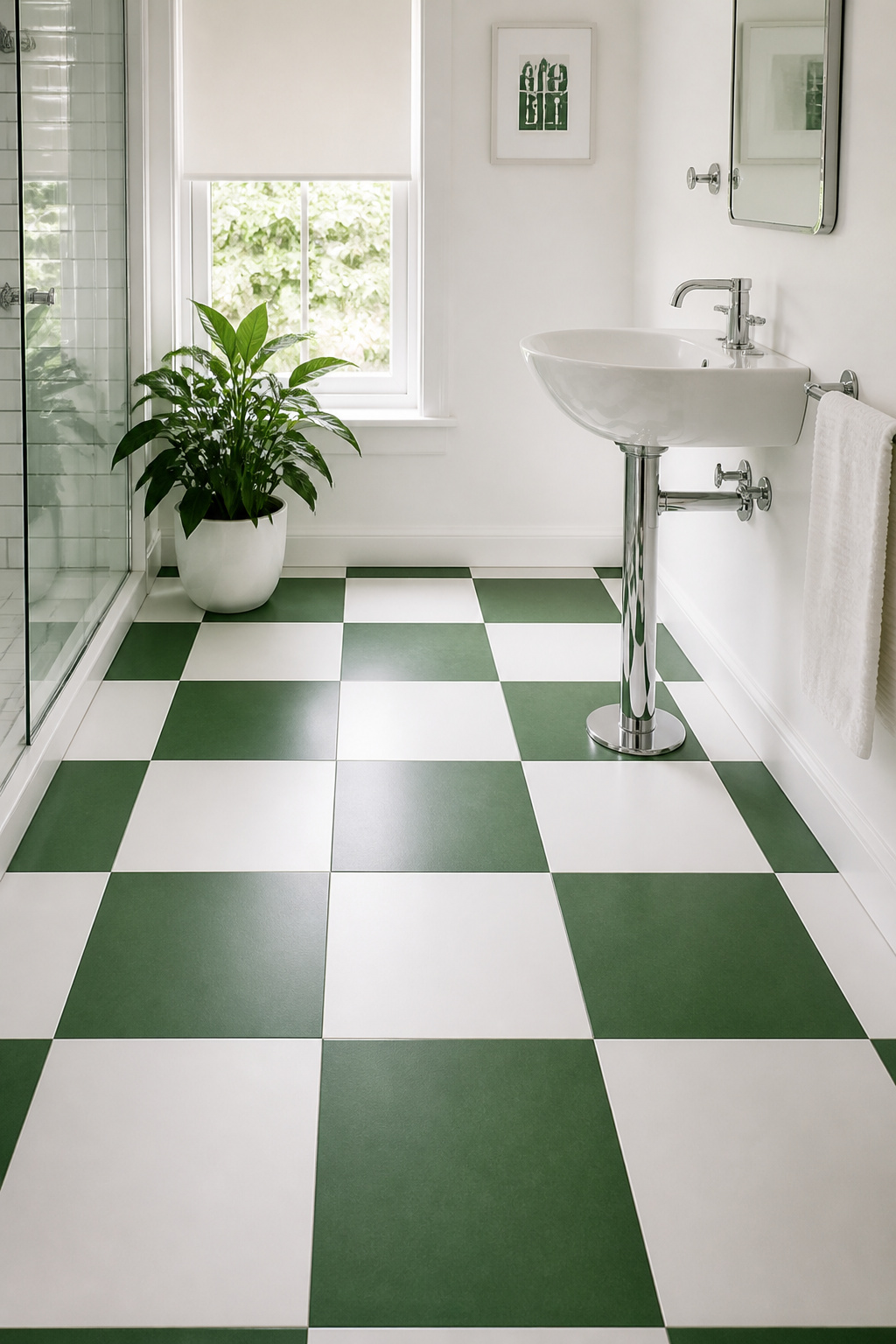
13. Green and White Checkerboard Floor Tiles
Checkerboard floors are having a well-deserved moment, and the green-and-white version is among the most satisfying iterations. The geometry is crisp and graphic without being aggressive. The colour combination is fresh without being loud. The result is one of those rare bathroom floors that manages to be both playful and elegant at once.
Why Checkerboard Works and How to Specify It
The repetition is orderly. The eye follows the grid naturally, which reads as calm rather than busy. In a green-and-white version, the colour alternation introduces warmth and character to what would otherwise be a plain tiled floor.
Standard 300mm × 300mm checkerboard tiles suit most bathroom sizes. In larger bathrooms above 6 square metres, oversized 600mm checks look more architecturally impressive. Mandarin Stone and Tile Mountain both carry green-and-white checkerboard options from around £45–£80 per square metre. For grout, match the white tile as closely as possible — this makes the grid lines nearly invisible and keeps the visual focus on the alternating colour blocks.
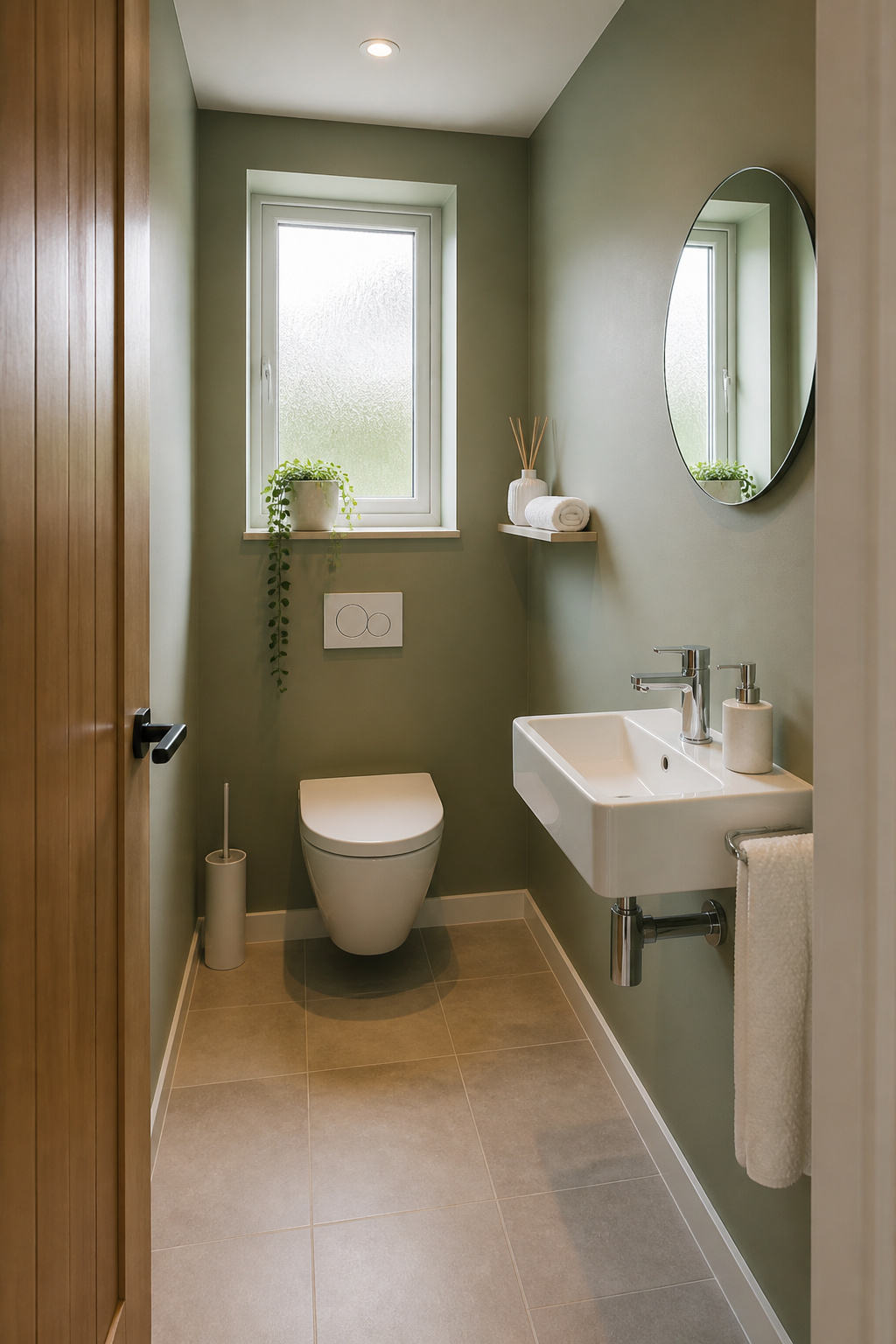
14. Muted Sage Green Bathroom Ideas for Small Spaces
Small bathrooms present a specific challenge: strong colours can feel oppressive when you are surrounded by them at close range. Muted sage — desaturated, dusty, closer to grey-green than leaf green — is the answer for anyone who wants green bathroom ideas without the risk of the room feeling smaller. Used thoughtfully, it reads as an extended neutral rather than a bold colour choice.
For anyone working within a small layout, small bathroom remodeling covers spatial strategies that pair well with these colour choices.
Why Muted Greens Suit Small Bathrooms
Saturated colours absorb light. In a small space, that can make the room feel like it is closing in. Muted greens reflect more light and sit closer to neutral on the perceived colour temperature scale. The result is a room with colour interest and character, but without the claustrophobia that deep saturated tones can cause. Muted sage is also forgiving of mismatched fixtures — it is unlikely to clash with existing white fittings, chrome taps, or flooring you inherited.
Maximising the Sage Effect
A large round mirror directly above the basin reflects the sage colour back into the room, creating the impression of more green and more space than the painted area alone would suggest. Warm white bulbs add a spa-like quality that cool white LEDs cannot achieve. For paint, Farrow and Ball’s Mizzle, Benjamin Moore’s Lichen, and Little Greene’s Pearl Colour are all excellent muted sage options.
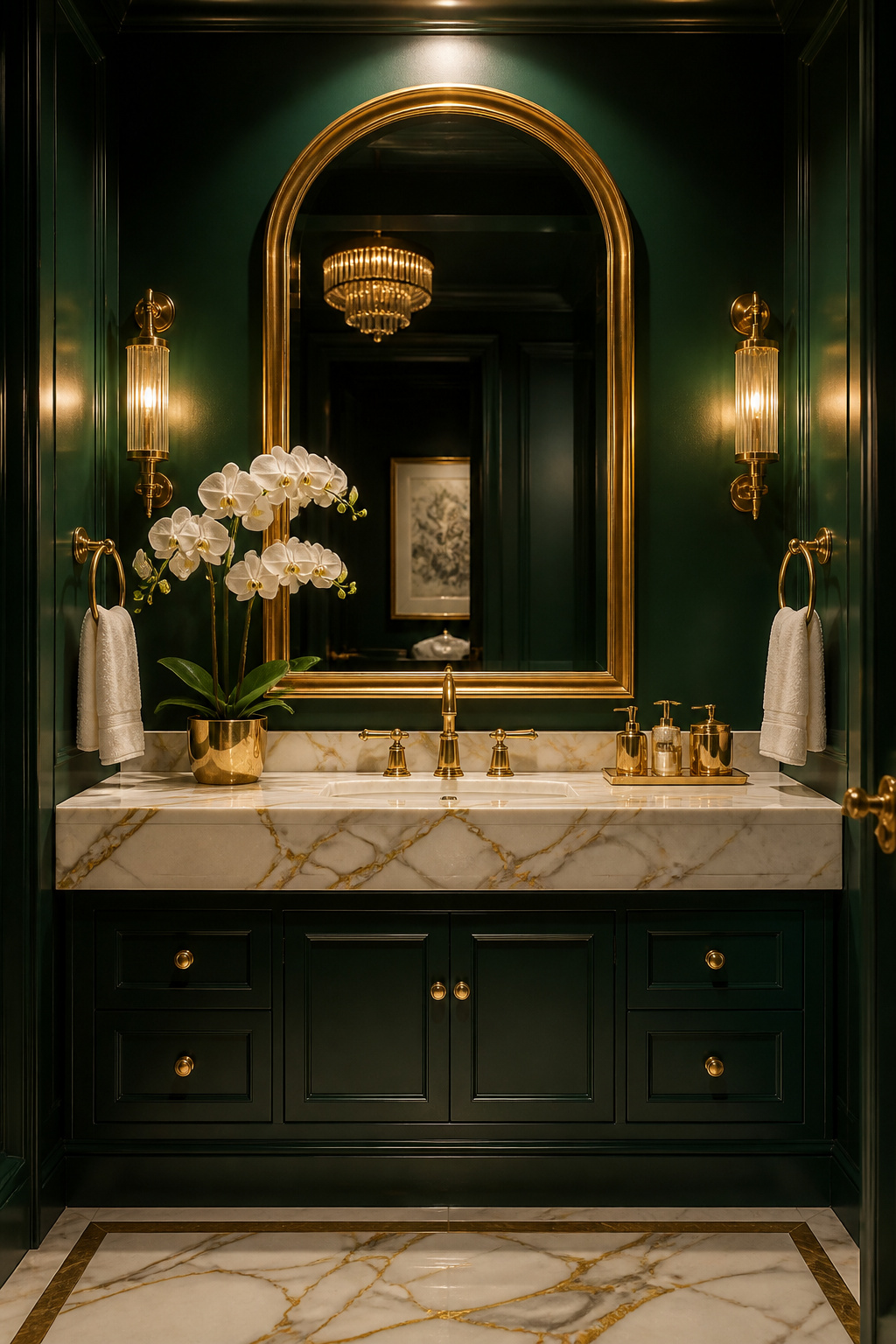
15. Jewel-Tone Emerald Green with Gold and Marble
This is the maximalist version of the green bathroom — and in the right hands, one of the most genuinely luxurious things you can do with a domestic space. Deep, saturated emerald paired with gold fixtures and white marble creates a jewellery-box effect. Rich, layered, and unambiguous about its intentions. It is not a quiet room, and it is not meant to be.
The Opulence Logic
Emerald green has centuries of association with wealth and luxury. In a bathroom, it activates that association immediately. The depth of the colour, combined with the warmth of polished gold and the cool veining of white marble, creates something genuinely rich. The key is restraint in accessories. The colour and the materials do the work. Over-accessorising breaks the spell.
Calacatta Gold — white base marble with warm gold veining — is the natural partner for emerald green. The veining echoes the brass fixtures without competing with the wall colour. Avoid heavily grey or black marbles alongside emerald green, which tends toward sombre. For tap brands, Vado’s Heritage Gold range and Crosswater’s MPRO in Brushed Brass are both widely used in high-end bathroom design and hold up well in daily use.
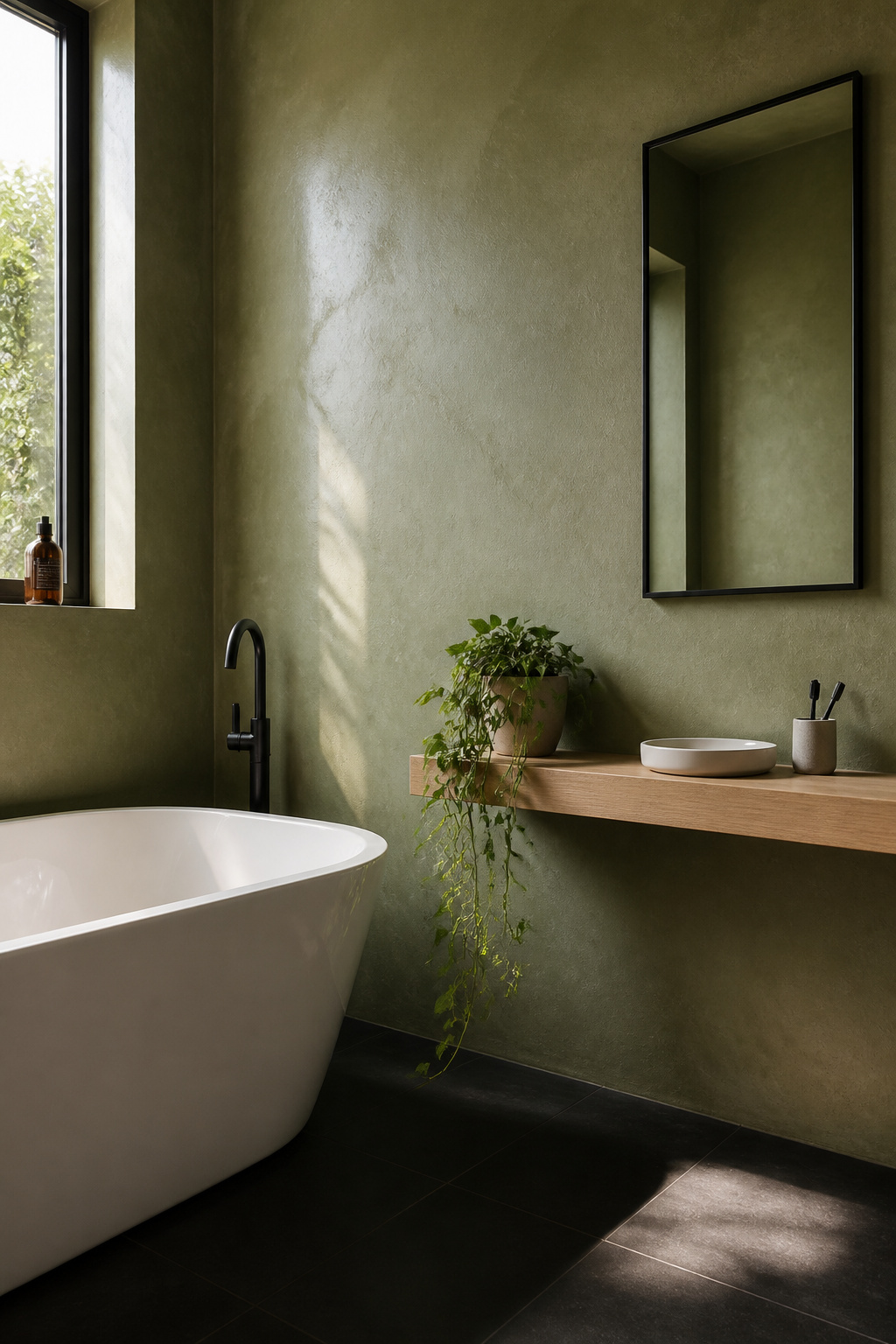
16. Sage Green Limewash Walls for a Textured, Organic Look
Limewash paint is not simply a finish — it is a material in its own right. Unlike standard emulsion, which sits on the surface as a uniform film, limewash penetrates into the plaster and creates a naturally varied, layered effect. No two applications look identical. In sage green, the result is a bathroom wall that seems to have developed its colour over time — organic, imperfect, and impossible to replicate exactly.
What Limewash Does That Emulsion Cannot
Standard emulsion creates a uniform colour field. Limewash reintroduces tonal variation and depth to interior walls. The surface responds differently to light at different times of day. From a wellness perspective, environments with natural variation — wood grain, stone texture, irregular plaster — are physiologically less tiring than uniform surfaces. The eye moves across them more naturally, finding the variation restful rather than demanding.
Application, Sealing, and Brands
Modern limewash formulas from Portola Paints and Bauwerk use modified binders that suit humid spaces better than traditional formulas. Even so, apply a breathable sealer after the limewash has fully cured — typically 30 days — to extend the finish life in a high-humidity environment. In a direct shower surround, limewash is not appropriate. It works best on walls that receive steam rather than direct water contact. Portola Paints’ Lime Wash in Sage and Bauwerk’s Colour Wash range are both widely used. For a more affordable option, Frenchic’s chalk-based paint applied with a dry brush and partially wiped back creates a convincing effect at a lower price.
17. Dark Green Bathroom with Terrazzo Accents
Dark green and terrazzo is one of the more unexpected combinations on this list — and one of the most visually exciting. Terrazzo, with its aggregate of marble chips and glass fragments set in cement, carries fragments of colour that can be chosen to reference almost any surrounding palette. A warm-toned terrazzo floor against dark green walls creates a layered, sophisticated bathroom that reads as modern and classic simultaneously.
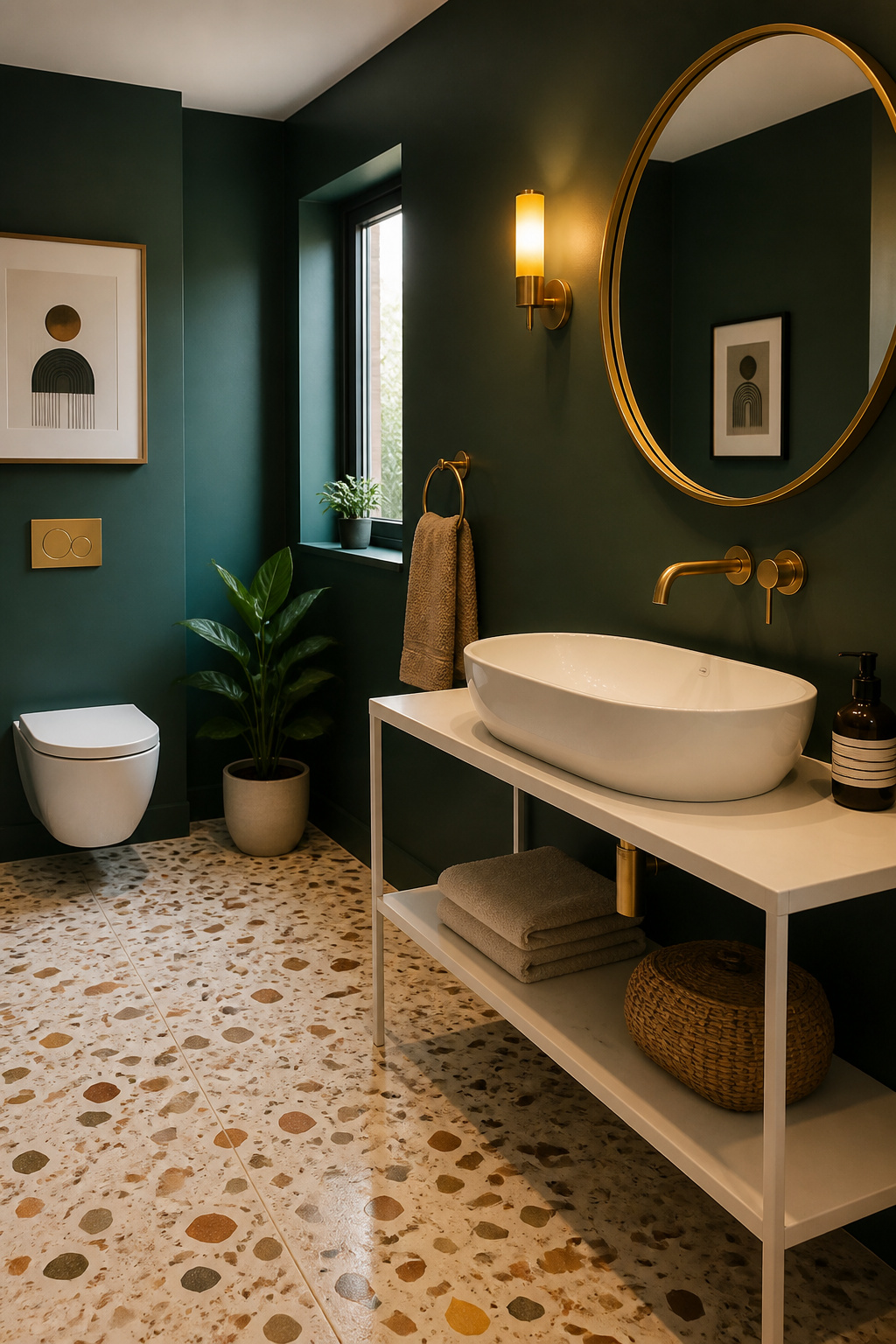
Why Terrazzo and Dark Green Work Together
The dark wall provides a strong, unified background against which the fragmented, multi-tonal terrazzo reads as animated and rich. The terrazzo’s warm aggregate chips — cream, blush, gold, or terracotta fragments — pull warmth from the dark green, preventing it from feeling cold. This pairing scales well too. In a small bathroom, the dark walls and busy floor balance each other. In a large bathroom, the combination has the visual weight to fill a generous space without feeling sparse.
Sourcing and Lighting
Bert and May’s terrazzo range is among the most respected in the UK market, with warm-aggregate options that pair naturally with dark green. Mandarin Stone’s Terrazzo Classico is more accessible in price. Also worth exploring alongside this approach are the sage green bathroom ideas in our sanctuary guide, which covers several complementary green shades and finish combinations.
Dark walls absorb light, so artificial lighting needs to work harder. Wall-mounted sconces at mirror height provide the most flattering and functional light. Install them on a dimmer to allow the warm, atmospheric quality of dark green walls to come through fully in the evenings.
18. Pistachio: The Softest Green Bathroom Ideas for a Light, Airy Feel
Pistachio is the green that almost everyone can agree on. It is pale enough to feel safe, warm enough to feel inviting, and distinct enough from mint and sage to occupy its own clearly defined territory. In a bathroom, pistachio creates a gentle warmth that lifts the room without committing to anything bold — the colour equivalent of a perfectly calibrated background.
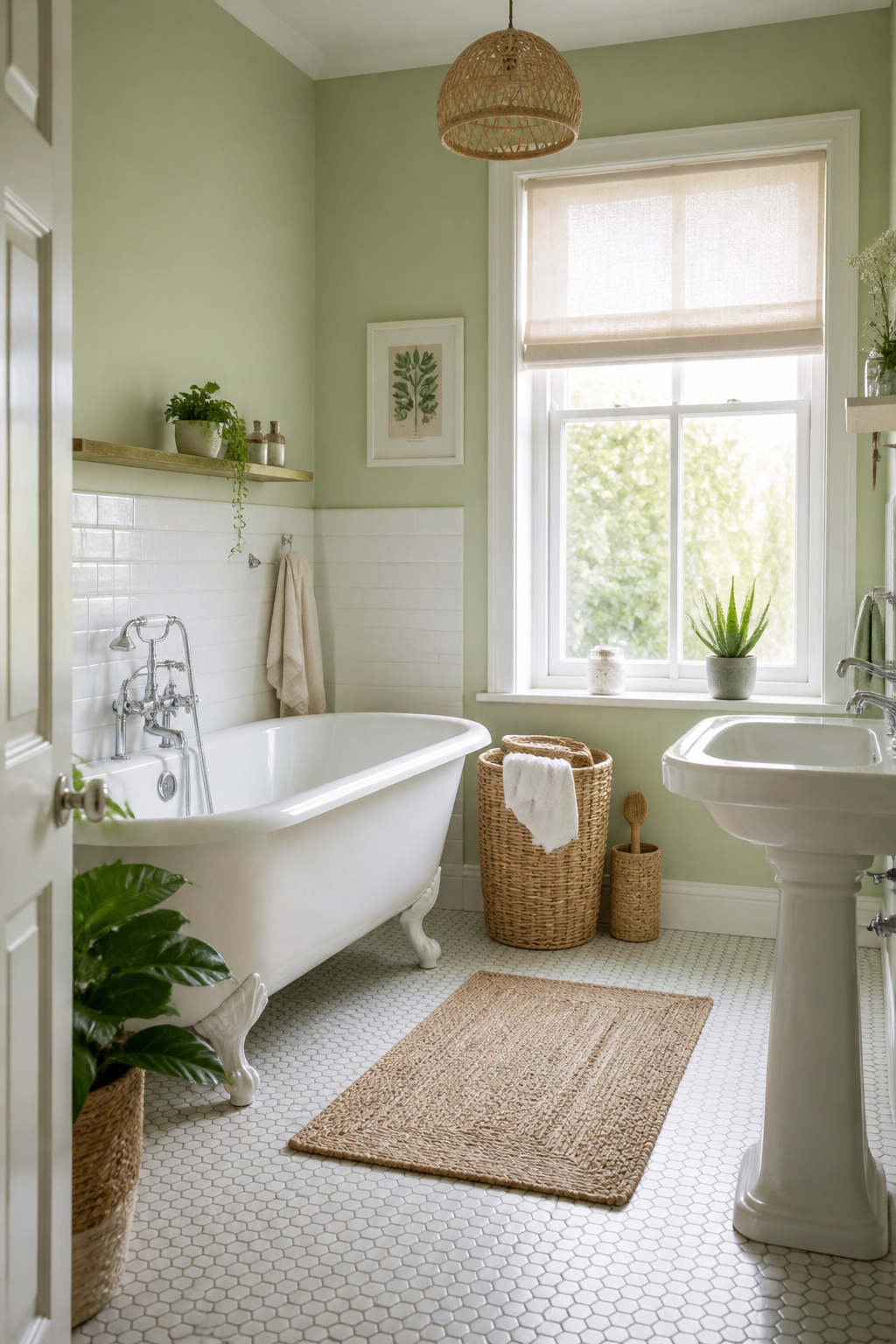
How Pistachio Differs From Mint and Sage
The three pale greens are often confused, but the differences matter. Mint has a cool, blue-green quality — it references the seaside and menthol. Sage sits in grey-green territory, warm but dusty with brown undertones. Pistachio is the warmest of the three, with more yellow in its mix. Under artificial light, pistachio retains more of its green character than sage and reads warmer than mint. That stability makes it the most predictable choice for bathrooms with variable light conditions.
What to Pair With Pistachio
Pistachio works with crisp white, but it works better with cream or off-white — the slight warmth of both reinforces each other. Rattan in towel baskets, mirror frames, and brush holders is the natural accessory material, because the warm gold of woven rattan echoes the yellow in the paint. Chrome is the most natural metal finish alongside pistachio. Brushed nickel works equally well. For paint, Dulux’s Pistachio Whip and Little Greene’s Aquamarine are both reliable options worth testing.
Which Green Bathroom Ideas Are Right for Your Space?
The right green bathroom idea is the one that fits the room you actually have — not the aspirational version in your head. Before you choose a shade or a material, spend a day observing how light moves through your bathroom. Does it get direct sun in the morning? Does it rely almost entirely on artificial light? Is it north-facing and cool? These questions matter more than any trend, because green responds to light conditions more dramatically than almost any other colour.
How to Choose Based on Light and Room Size
A small, north-facing bathroom almost always benefits from the lighter end of the green spectrum: pistachio, muted sage, soft mint. Saturated deep greens absorb light and can make confined spaces feel smaller. They can work beautifully, but they need both generous square footage and strong lighting to do so.
Large, south-facing bathrooms can carry the full range — from pale sage to deep forest to jewel-tone emerald. Also consider your existing fixtures. White sanitary ware is neutral enough to pair with any green. Cream or biscuit-toned fixtures harmonise most naturally with warmer greens: olive, sage, pistachio.
Starting Small: One Change That Makes an Immediate Difference
If you are uncertain, start with the simplest intervention first. Swap your towels for eucalyptus or sage-toned alternatives, add a large round mirror to reflect more of the room, and introduce one or two humidity-loving plants. This costs under £100 and takes an afternoon. It gives you an accurate preview of how green reads in your specific space.
If the effect pleases you — and in most bathrooms, it will — you will have the confidence to commit to paint, tiles, or something more structural. Green is the most restorative colour you can bring into a home, and the bathroom is where restoration matters most.