
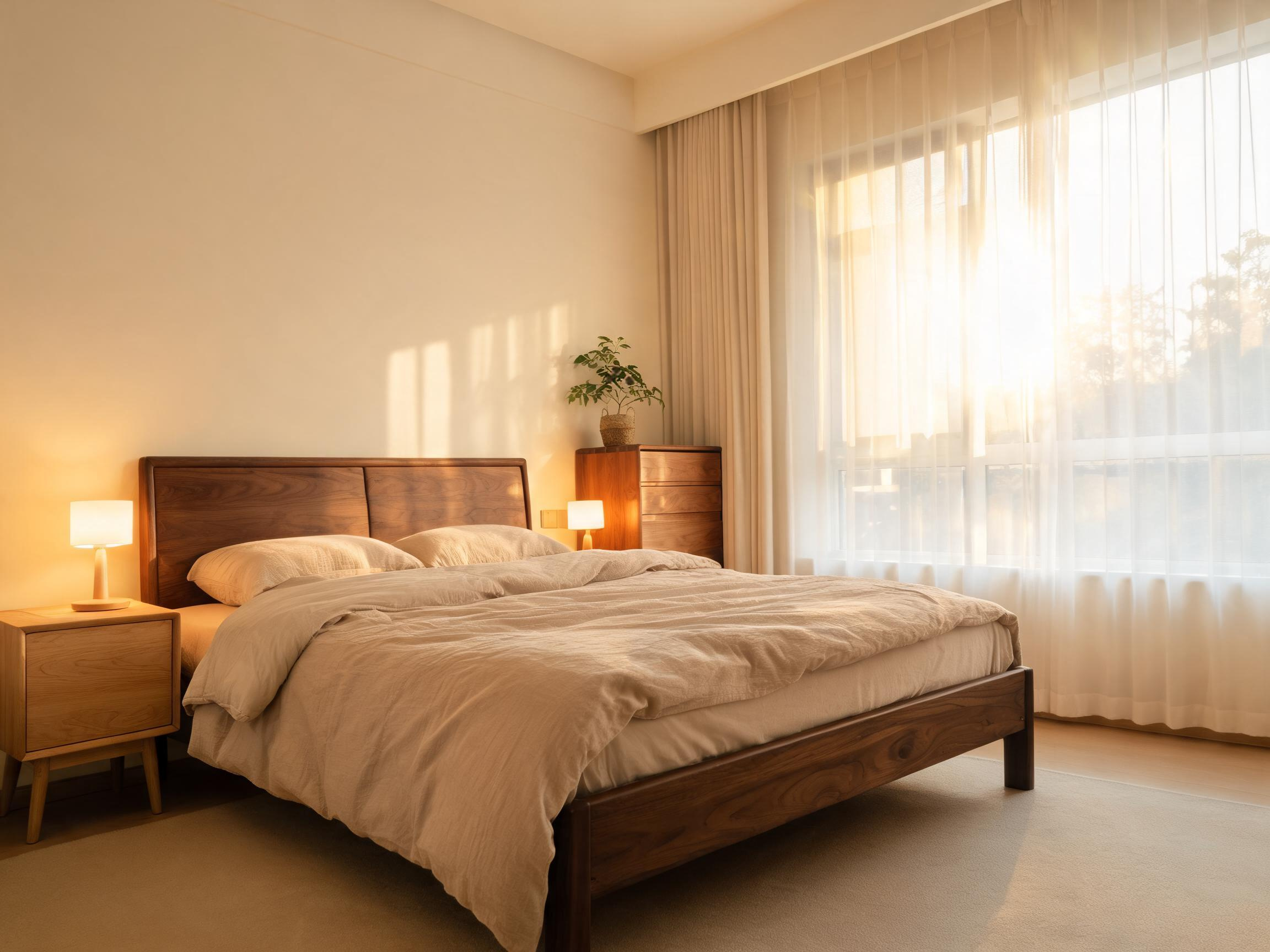

Wood has furnished bedrooms for thousands of years, and the reason isn’t nostalgia. Real timber — solid oak, walnut, cherry, teak — carries grain patterns and warmth that no laminate panel can replicate. Yet so much of what passes for “wood” bedroom furniture today is MDF with a photographic timber film over it. The difference matters. A solid wood piece bought well will outlast you. Flat-pack equivalents last about a decade before the drawer bottoms fail and the veneer peels.
I’ve spent twelve years hunting, restoring, and styling solid wood bedroom furniture. The range I’ve covered goes from $40 thrift-store walnut nightstands to custom live-edge headboards. So this guide gets specific: real prices, named brands, and the pro tips I’ve learned the hard way. Whether you’re starting from scratch or rescuing a vintage find, there’s something here for you.
1. Solid Oak Bed Frame — The Anchor of Any Wood Bedroom Furniture Collection
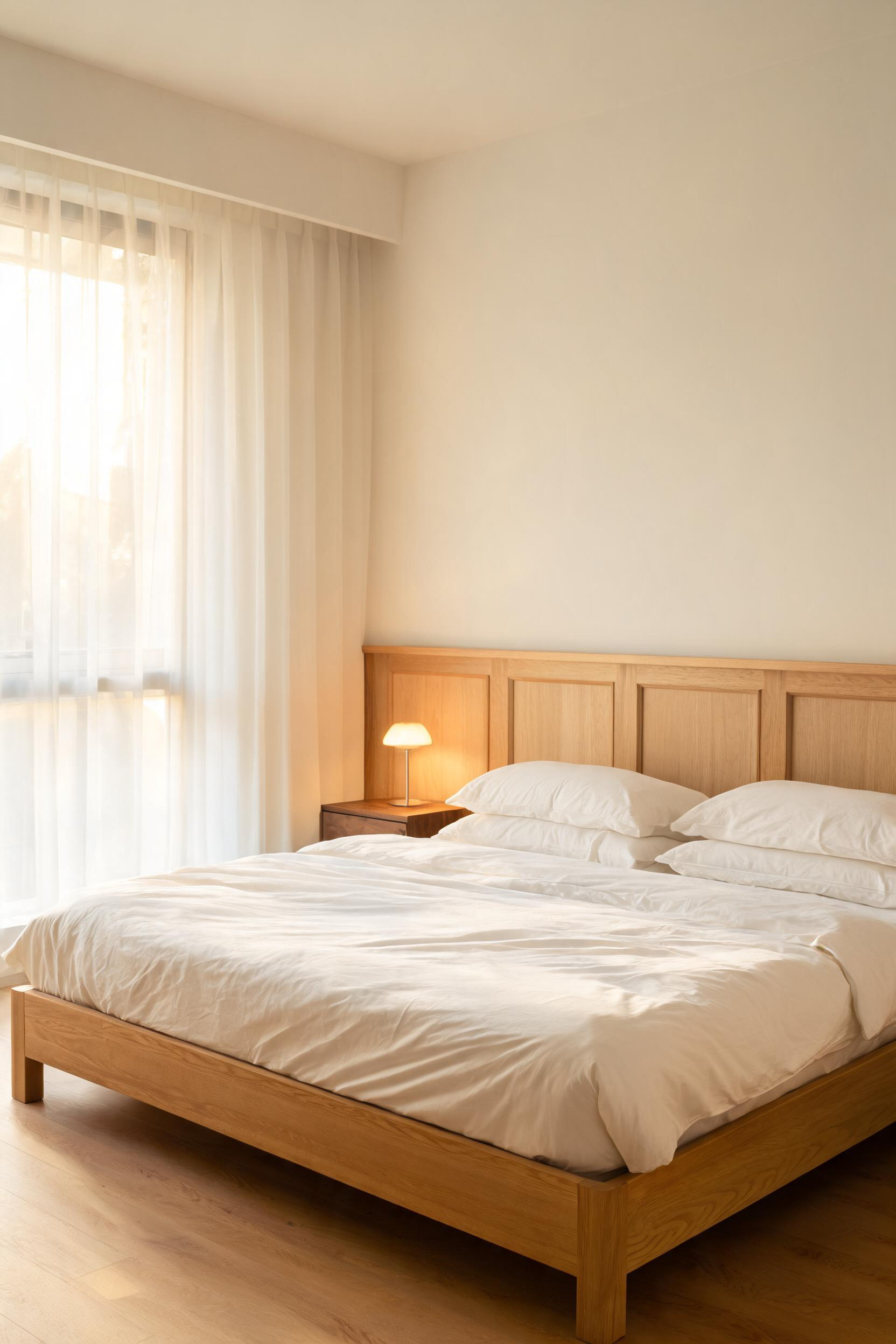
A solid oak bed frame is the most sensible first investment in a wood bedroom. Oak is dense — white oak sits at around 45 lb/ft³. It resists dents, moisture fluctuation, and the daily punishment a bed frame takes far better than pine or engineered alternatives. Also, because solid oak ages well rather than ageing badly, a good frame only gets more characterful with time.
Choosing the Right Style
The main frame styles are platform (no box spring needed), panel (a flat headboard), spindle (classic but busier), and slatted (casual, airy). For most bedrooms, a platform or panel design in white oak gives the cleanest result. White oak’s ray fleck — silver-grey lines in the grain — gives it a more refined look than red oak, and it ages to amber rather than orange.
What to Check Before You Buy
For new beds, look for mortise-and-tenon or bolted steel bracket joinery rather than cam-lock connections. The Pottery Barn Benchwright frame in white oak is reliable at $1,299 for a queen — proper joinery, heavier than it looks. The Floyd Platform Bed in solid birch is a modular option at $895. For vintage oak frames, press each corner post firmly. A loose joint re-glues with wood glue and bar clamps overnight for $10, and the repair is permanent.
Pro Tip
Slat spacing matters more than most guides mention. Slats should be no more than 6 cm apart and at least 2.5 cm thick. Wider than that and a foam mattress will sag between them over time.
2. A Walnut Dresser With Dovetail Joints Worth Every Penny
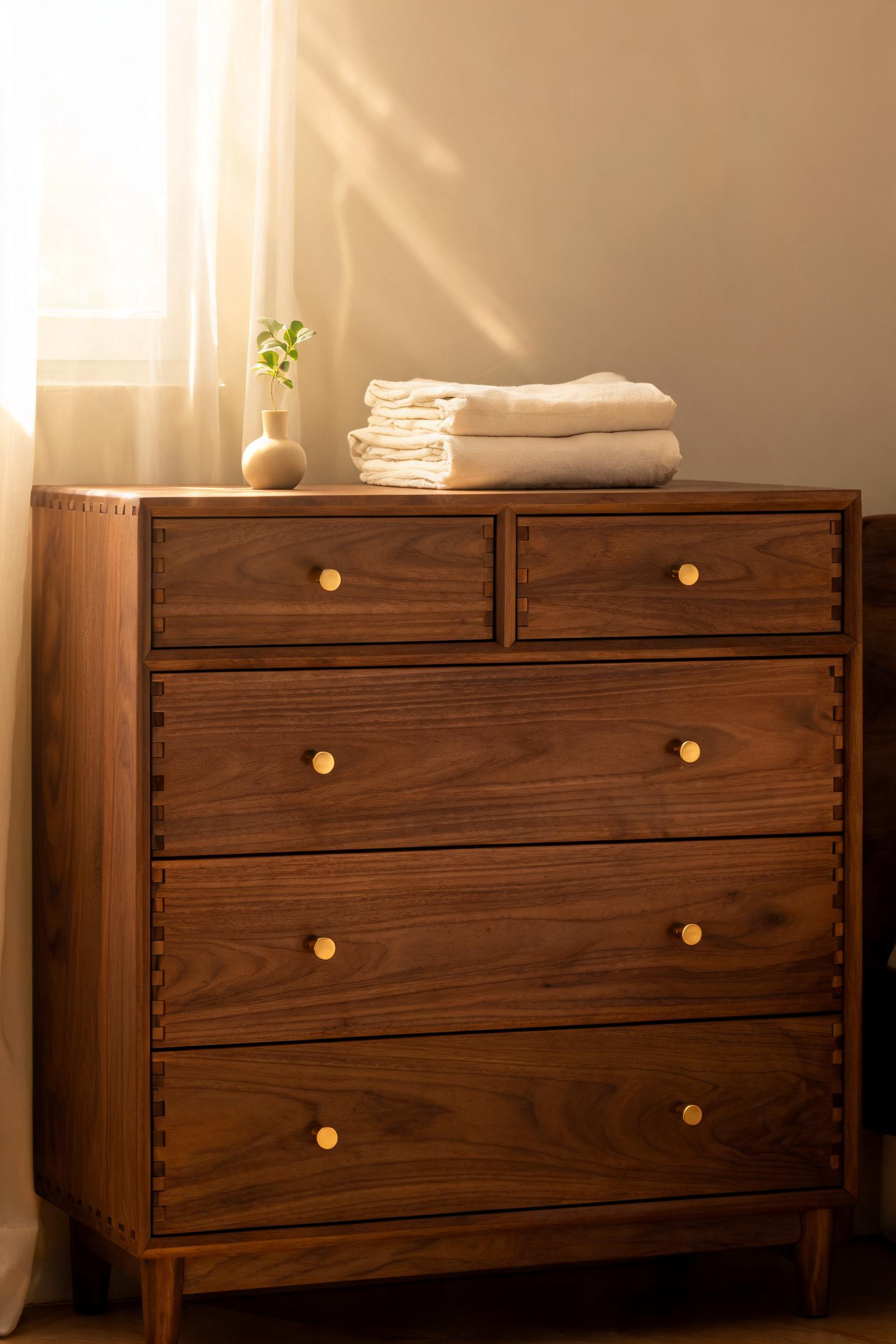
American black walnut has a Janka hardness of 1010 lbf and a chocolate-brown grain that ages towards amber over time. If there is one piece of wood bedroom furniture that rewards a serious investment, a solid walnut dresser with proper joinery is it. However, the gap between a good one and a disappointing one is easy to navigate once you know what to look for.
Identifying True Dovetail Construction
Open the top drawer and look at the corner where the drawer front meets the side panel. Hand-cut dovetails have slightly irregular spacing — each pin and tail a fraction different from the next. Machine-cut are perfectly uniform. Both are strong, but hand-cut signals a piece made with care. Cam-lock or dowel construction means assembled furniture, not genuinely crafted.
The Broyhill Brasilia Opportunity
The Broyhill Brasilia line (1962–1975) is the most widely collected mid-century walnut bedroom furniture in North America. A 9-drawer Brasilia dresser sells for $900–$2,200 at estate sales and on Chairish — solid walnut, proper dovetails, and built to last another century. New solid walnut custom work from Vermont Woods Studios starts at $1,600. The West Elm Mid-Century 6-Drawer Dresser at $799 is a reasonable entry point — walnut veneer over a solid core, with drawer fronts that are solid and joinery that holds.
Pro Tip
When you find a 1960s walnut dresser with oxidised hardware, resist replacing the pulls. Soak them in white vinegar for 30 minutes and polish with Bar Keepers Friend. The original patina that re-emerges is exactly what makes the piece feel authentic rather than assembled.
3. Reclaimed Wood Headboard — Where Character Beats Perfection
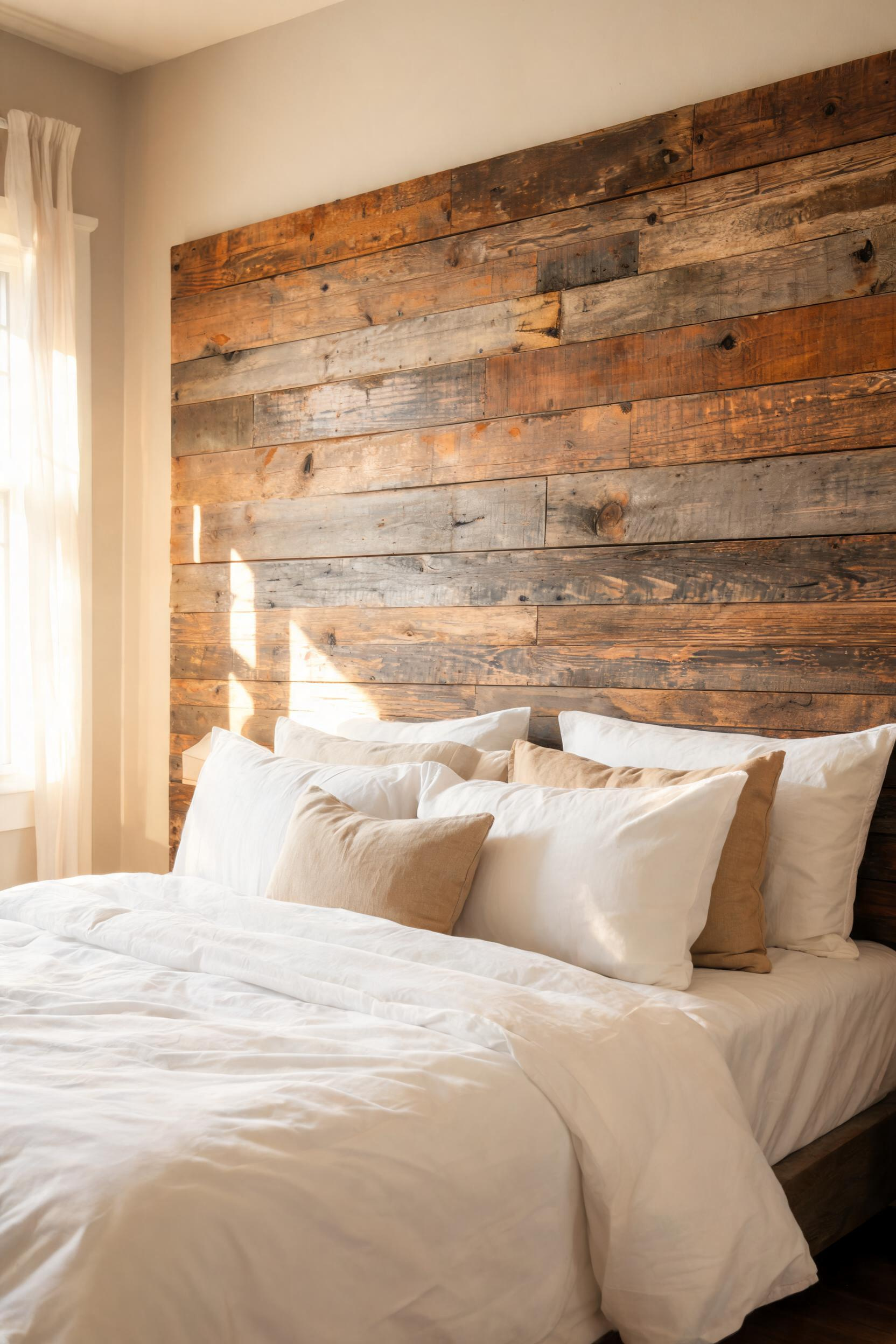
A reclaimed wood headboard is the most efficient way to add genuine character to a bedroom that currently has none. Reclaimed barn wood — usually Douglas fir, pine, or elm — has been drying for 50 to 100 years. It’s more dimensionally stable than any new-cut timber and carries grain, colour variation, and weathering marks that no new board can reproduce.
Sizing and Placement
A standard queen headboard runs 62 inches wide and between 48 and 58 inches tall. For bedrooms with 9-foot or higher ceilings, a full-height floor-to-ceiling headboard creates a dramatic, architectural effect that anchors the room. For lower ceilings, keep the headboard at 48–54 inches — taller than the bed but not competing with the ceiling.
Sealing Without Killing the Patina
This is where most reclaimed wood headboard projects go wrong. Polyurethane gives wood a plastic sheen that reads as fake the moment anyone looks closely. Instead, apply one thin coat of Rubio Monocoat Oil Plus 2C — zero VOC, saturates the fibre rather than sitting on top. The surface stays matte and tactile but resists moisture from pillows. Etsy makers charge $300–$650 for a custom version; Restoration Hardware’s reclaimed pine headboard retails at $1,295.
Pro Tip
Before buying or using reclaimed pallet wood, check for an HT stamp (heat-treated) on the board end. Avoid MB stamps — that stands for methyl bromide, a pesticide treatment that off-gasses indoors. HT-stamped pallet wood is safe; unstamped wood is a gamble.
4. Teak Wardrobe From the Mid-Century Era — A Lasting Investment
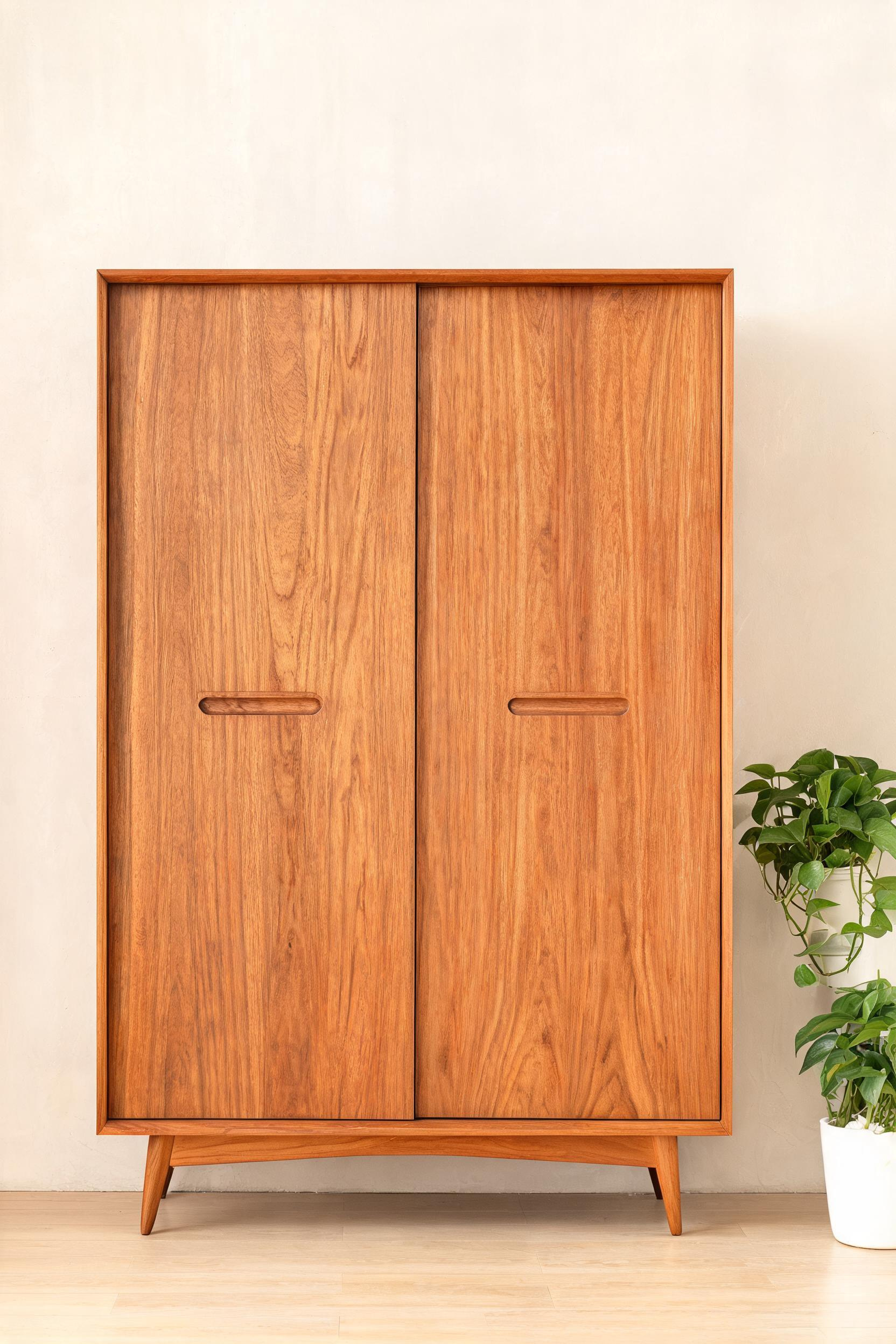
Teak is an unusual wood in bedroom furniture because it contains natural silica and rubber that make it self-oiling and dimensionally stable through humidity changes. A well-made teak wardrobe from the 1960s has already proved its structural stability over sixty years of seasonal movement. It will likely last another sixty. That’s not a claim you can make about any new piece of furniture.
Spotting Authentic Danish Pieces
The most reliable Danish teak wardrobes were made by Hundevad, Lübke, and A. Younger between 1955 and 1975. Authentic pieces have sliding doors with recessed finger pulls, legs that taper to a point, and internal shelving in solid teak or teak-veneered plywood. To check whether a piece is solid teak or teak veneer on particleboard: tap a knuckle on the side panel. Solid teak sounds dull and dense; veneer on particleboard sounds hollow with a slight resonance.
Finding Them
Chairish, 1stDibs, and eBay are the main platforms. Expect $600–$2,000 depending on size and condition. Local estate sales occasionally surface pieces below market value — a $300 teak wardrobe is not unusual if sellers don’t know what they have. European prices (Germany, Denmark) are often lower, and shipping flat-packed teak is more affordable than most people expect.
Pro Tip
Skip commercial teak oil — it builds up into a tacky, orange-tinted layer over time. Instead, clean, lightly sand with 150-grit along the grain, and apply one coat of Osmo Polyx-Oil in satin. It absorbs cleanly and gives a natural, dry-to-touch finish that lasts two to three years.
5. White Oak Bedroom Furniture for a Calm Scandinavian Scheme
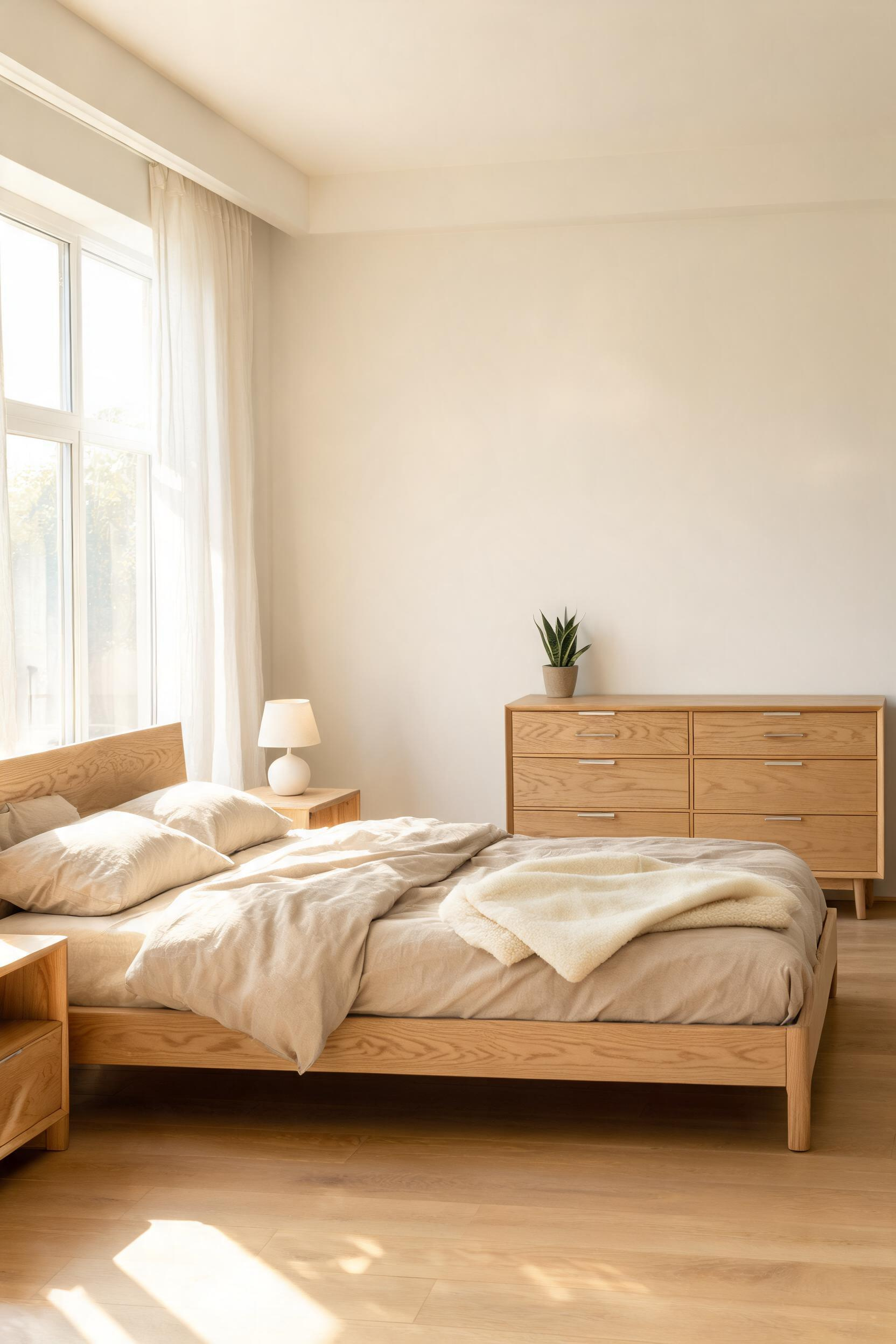
White oak is having a moment in bedroom design, and it has earned it. The quarter-sawn cut reveals medullary rays — silver-grey streaks running perpendicular to the growth rings. This gives white oak a calm, linear texture that no other species replicates. Its colour shifts to a gentle amber over five to ten years — one of the few furniture materials that looks better, not worse, as it ages.
Building a White Oak Bedroom
The core three pieces are a low-profile bed frame, two matching nightstands, and a long 6-drawer dresser sitting no higher than 30 inches. This horizontal arrangement reads as intentionally Scandinavian. Crate & Barrel’s Atwood Bed in white oak costs $1,099 for a queen. Article’s Tessera dresser at $899 uses white oak throughout — long and low, with clean-lined fronts. For pairing ideas, bedroom furniture decor is worth browsing.
Protecting White Oak
In very humid climates, white oak can swell at drawer joints. In very dry winter rooms, it shrinks. The answer in both cases is a room humidifier set to 40–50% RH. This isn’t overcaution. It genuinely extends the life of all solid wood bedroom furniture and prevents small cracks that start in stressed joints and grow over years.
Pro Tip
When buying white oak furniture, ask whether the boards are quarter-sawn, rift-sawn, or flat-sawn. Quarter-sawn and rift-sawn cuts show the best ray fleck and are more dimensionally stable. Most mass-market furniture uses flat-sawn boards — fine for the price, but worth specifying when you’re ordering from a custom or mid-level maker.
6. Pine Chest of Drawers With Painted Period Hardware
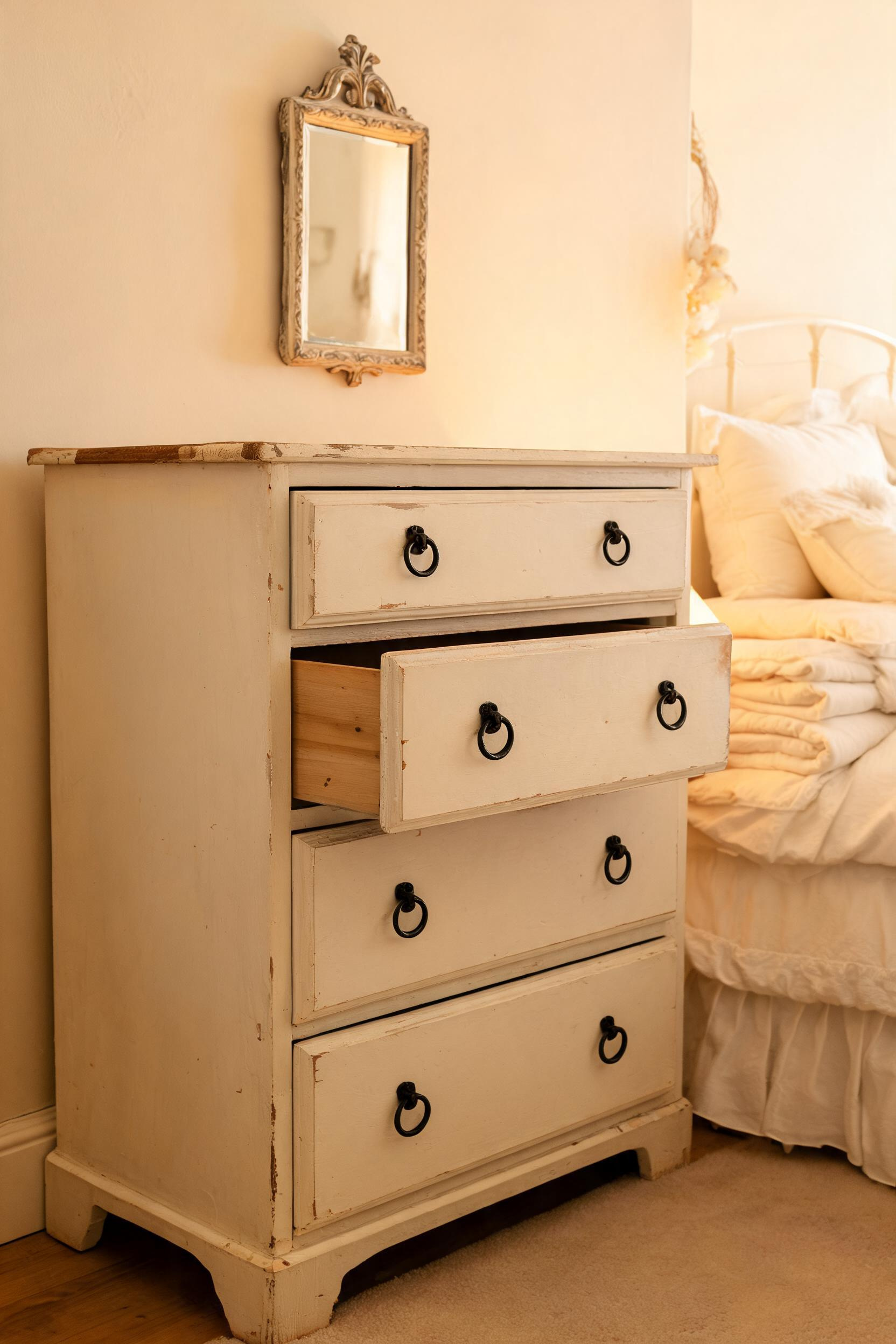
Solid pine is the most underrated entry point into wood bedroom furniture. It is genuinely solid timber, not engineered. At $180–$450 for a new 5-drawer chest, it costs a fraction of what equivalent oak or walnut pieces demand. Pine’s softness (Janka hardness around 870 lbf) does mean it dents, but in a painted finish with period hardware that wear becomes character rather than damage.
Hardware Makes the Piece
The most effective upgrade for a basic pine chest is replacing the hardware. Cast-iron ring pulls from D. Lawless Hardware cost $3.50 each — for a 5-drawer chest that’s $35 total. Hand-forged cup pulls run $12–$18 each and look exceptional on painted pine. These small details matter more than most decorating decisions at ten times the price.
Painting Pine Properly
Annie Sloan Chalk Paint adheres to pine without priming and gives a matte, chalky finish that ages gracefully. Apply two thin coats, then finish with Annie Sloan Clear or Dark Wax buffed in with a cloth. The wax creates a patina that improves with handling — exactly right for a piece opened daily.
Pro Tip
Pine knots bleed through water-based paint over time, creating yellow-brown stains that reappear no matter how many coats you apply. Before painting any pine piece, apply a single coat of Zinsser BIN shellac-based primer over any knotty areas. It blocks the resin permanently. This is a five-minute step that saves hours of frustration later.
7. Live-Edge Wood Bedroom Furniture — A Nightstand That Stops People
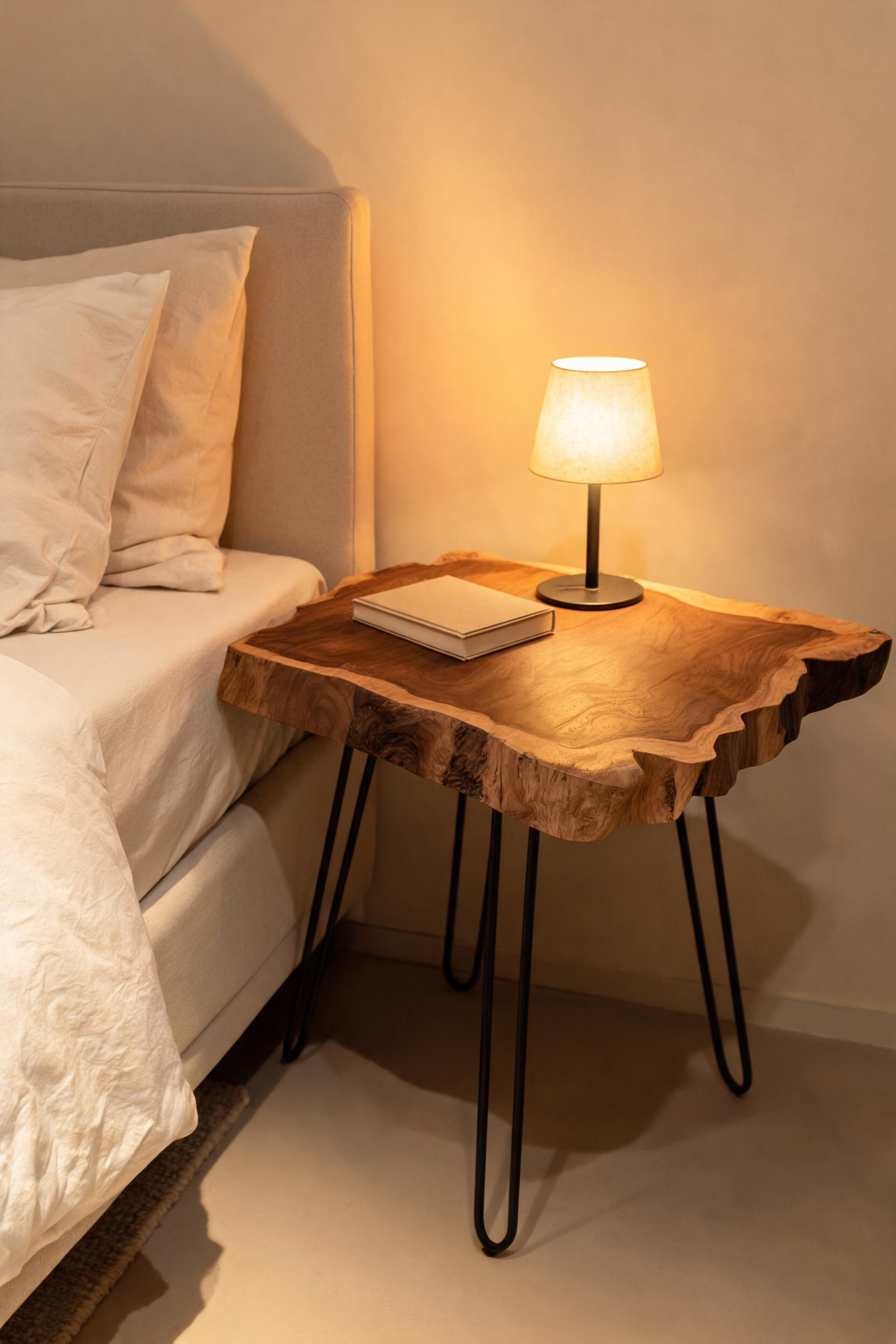
A live-edge slab preserves the natural outer contour of the tree — the irregular, flowing edge that no machine cut produces. As a nightstand, a live-edge slab on hairpin legs functions as both furniture and object, and consistently generates more questions from guests than any other piece in the room. It’s also one of the most affordable ways to bring genuinely distinctive solid timber into a bedroom.
Species to Look For
Black walnut is the most popular choice — dramatic grain figure, chocolate-brown colour against almost any bedding palette. For variety, maple burl, cherry, or black locust offer genuine alternatives. Etsy makers charge $220–$420 for a live-edge walnut slab on hairpin legs. Custom orders from local sawyers start around $180 and give you control over slab dimensions.
The Moisture Content Rule
This is the most important detail for any live-edge purchase — and the one most sellers skip. The slab’s moisture content must be below 8% before finishing and delivery. Wood above this threshold will crack as it dries in a heated bedroom. A basic pin-type moisture meter costs under $20 on Amazon. It checks any piece in 10 seconds and is worth owning if you buy wood furniture regularly.
Pro Tip
Pair a dramatic live-edge nightstand with a simple, flat-fronted bed frame — an upholstered or plain panel design. When two visually complex pieces compete in the same eyeline, both lose. The live-edge only reads as confident when everything around it is calm.
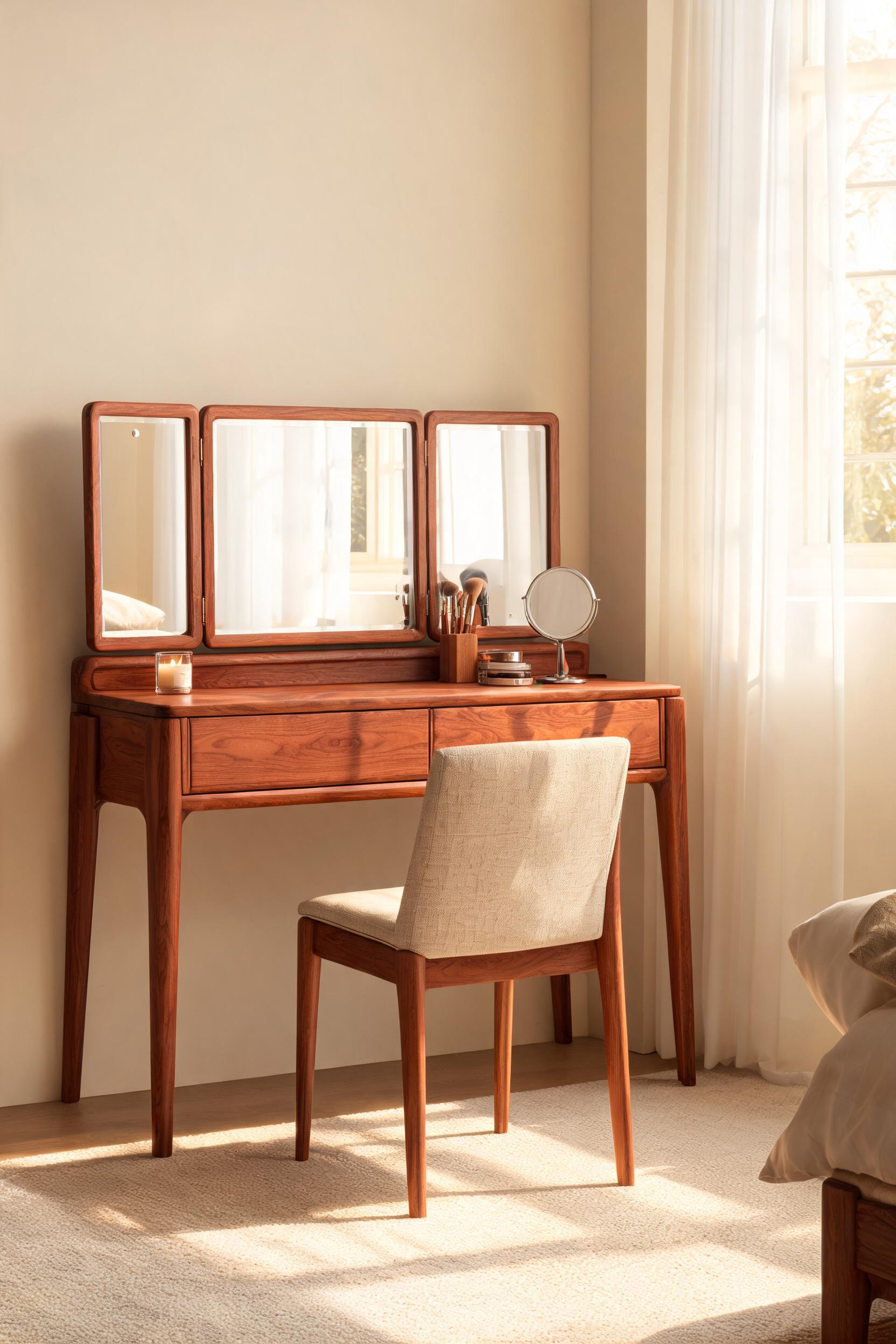
8. Cherry Wood Vanity Table — A Bedroom Centrepiece Worth the Investment
American black cherry starts as pale salmon-pink and deepens to rich reddish-brown over one to three years of UV exposure. Furniture makers call this “cherrying out.” It makes cherry uniquely rewarding to own — the piece keeps changing and improving in ways walnut and oak simply don’t. In a bedroom vanity, where the piece sits at the centre of daily ritual, that quality of change makes a real difference.
Vanity Configurations and Sources
The classic configurations are a triptych mirror (three hinged panels, $120–$250 vintage), a single swivel mirror, or wall-mounted. Knee clearance of 26–27 inches and a top height of 28–30 inches are the functional targets. Vintage Ethan Allen Heritage cherry vanities show up at estate sales for $350–$700. New solid cherry from Stickley starts at $2,400. For combining species and finishes in a bedroom, modern bedroom furniture is a useful reference.
Pro Tip
Place a new cherry vanity where it receives at least two hours of natural light per day. The photochemical reaction that deepens cherry’s colour requires UV exposure. A piece kept in a dark corner stays pale for years. Near a window — or a spot with good ambient daylight — the change begins within weeks.
9. Bamboo Bedroom Furniture — Sustainable Wood Bedroom Furniture Done Right
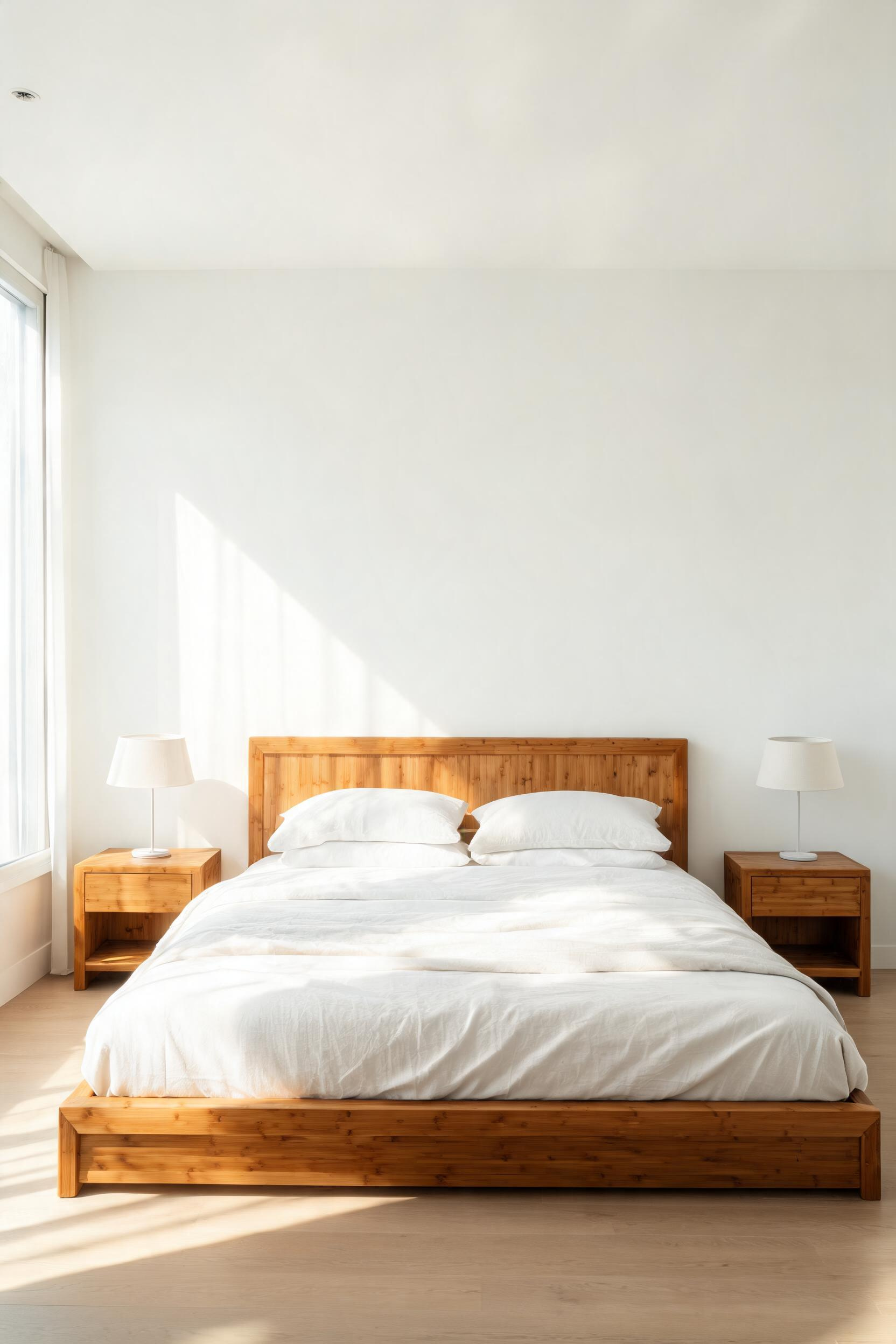
Bamboo is technically a grass. But Moso bamboo processed into strand-woven panels behaves like premium hardwood. It outperforms hardwood on sustainability — harvestable in five years versus 30 to 80 years for most hardwoods. Strand-woven bamboo hits a Janka hardness of 3,000+ lbf — harder than red oak or maple. The finished furniture is available at prices that make solid wood alternatives look expensive.
Bamboo Species and Finishes
Natural bamboo is a pale blonde, similar to ash or light maple. Carbonised bamboo — heat-treated during manufacture — develops a warm caramel tone close to teak. Greenington (California) makes full bedroom sets in solid Moso bamboo: a platform bed at $649 for a queen and a 7-drawer dresser at $899 in carbonised finish. These are real pieces designed for long use, not novelty sustainability products.
What to Check
The key quality marker for bamboo furniture is the adhesive bonding the bamboo strips. Look for CARB Phase 2 compliant labelling — this certifies that formaldehyde emissions from the adhesive meet California’s strict air quality standards. Any bamboo furniture imported into the US and sold through established retailers should carry this, but it is worth confirming.
Pro Tip
Like solid hardwood, bamboo furniture needs stable humidity. Strand-woven bamboo can develop hairline surface cracks in rooms that drop below 40% humidity for extended periods. Running a room humidifier during winter heating season keeps bamboo in perfect condition. It’s the same advice for any solid-wood piece, and it costs almost nothing.
10. A Timber Bed Frame With Upholstered Headboard Insert
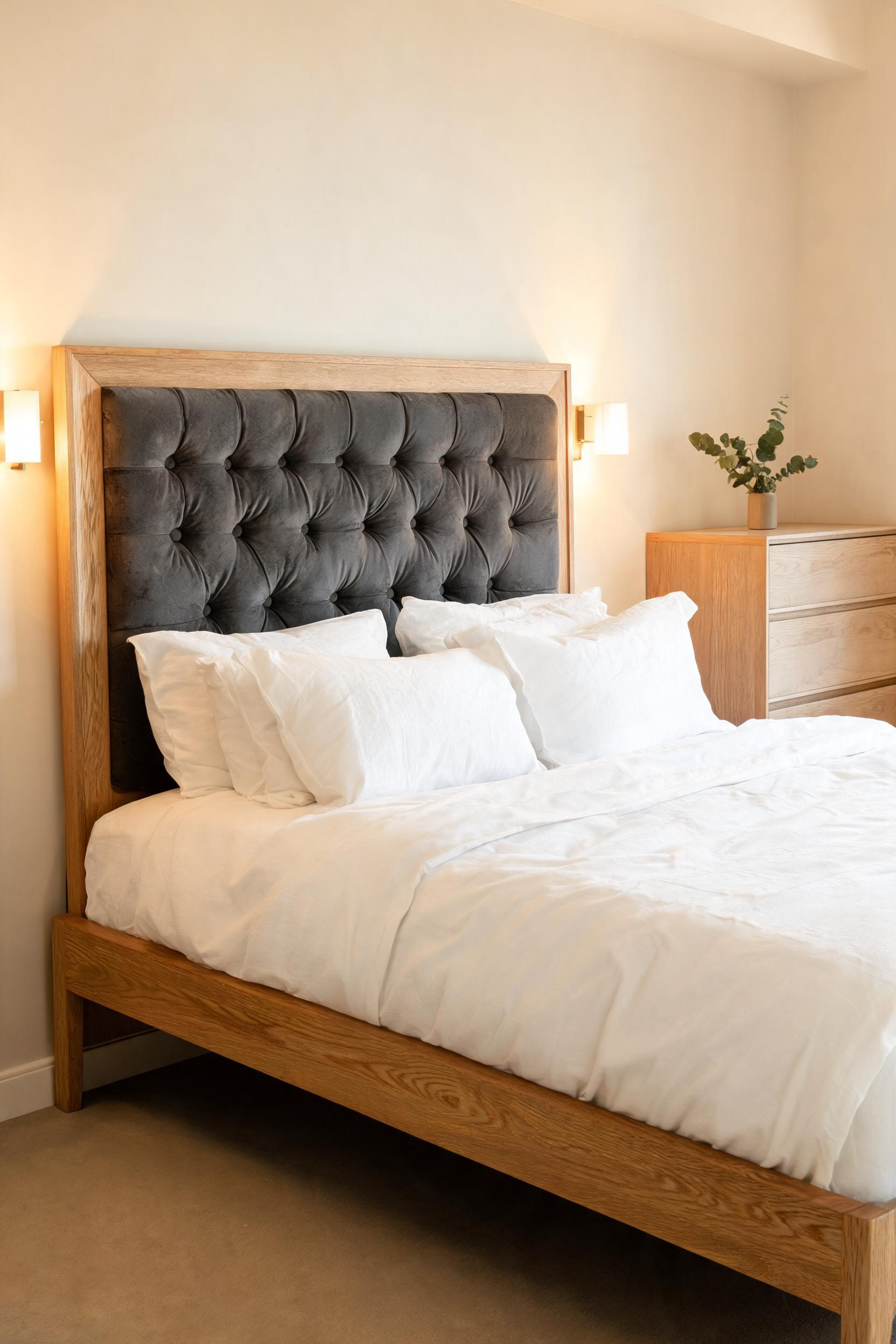
The timber-and-upholstered hybrid bed frame solves a common tension in bedroom furniture. You want the warmth of wood. But you also need softness when sitting up in bed reading. These frames use solid timber — usually oak or beech — for the side rails, legs, and outer headboard structure. A separate upholstered panel fills the headboard section. The result gives you both materials in the proportions that work best.
Choosing the Right Fabric
Durability matters more than looks. Performance velvet at 50,000 double-rubs (Martindale test) will outlast your interest in the colour. Bouclé looks excellent against timber but grades at 15,000–20,000 rubs — fine for a bedroom, just worth knowing. Linen-cotton blends are the practical classic: durable at 25,000–40,000 rubs, they breathe well and age with character.
Construction to Verify
The timber sections should be mortise-and-tenon jointed or bolted via steel brackets — not just glued dowels. Article’s Swen Bed in solid oak with upholstered headboard at $999 for a queen is a reliable example of this construction done well. West Elm’s Andes Bed at $1,099 is another strong option. Both allow the insert to be removed for reupholstering when the fabric dates — and it will, eventually, while the timber frame will not.
Pro Tip
When the upholstery looks tired, remove the insert panel and take it to a local upholsterer. Reupholstering a headboard panel typically costs $80–$180. In practice, this makes the timber frame a 30-year investment and the fabric a revolving detail.
11. Built-In Wood Wardrobe System — Maximum Storage With Natural Warmth
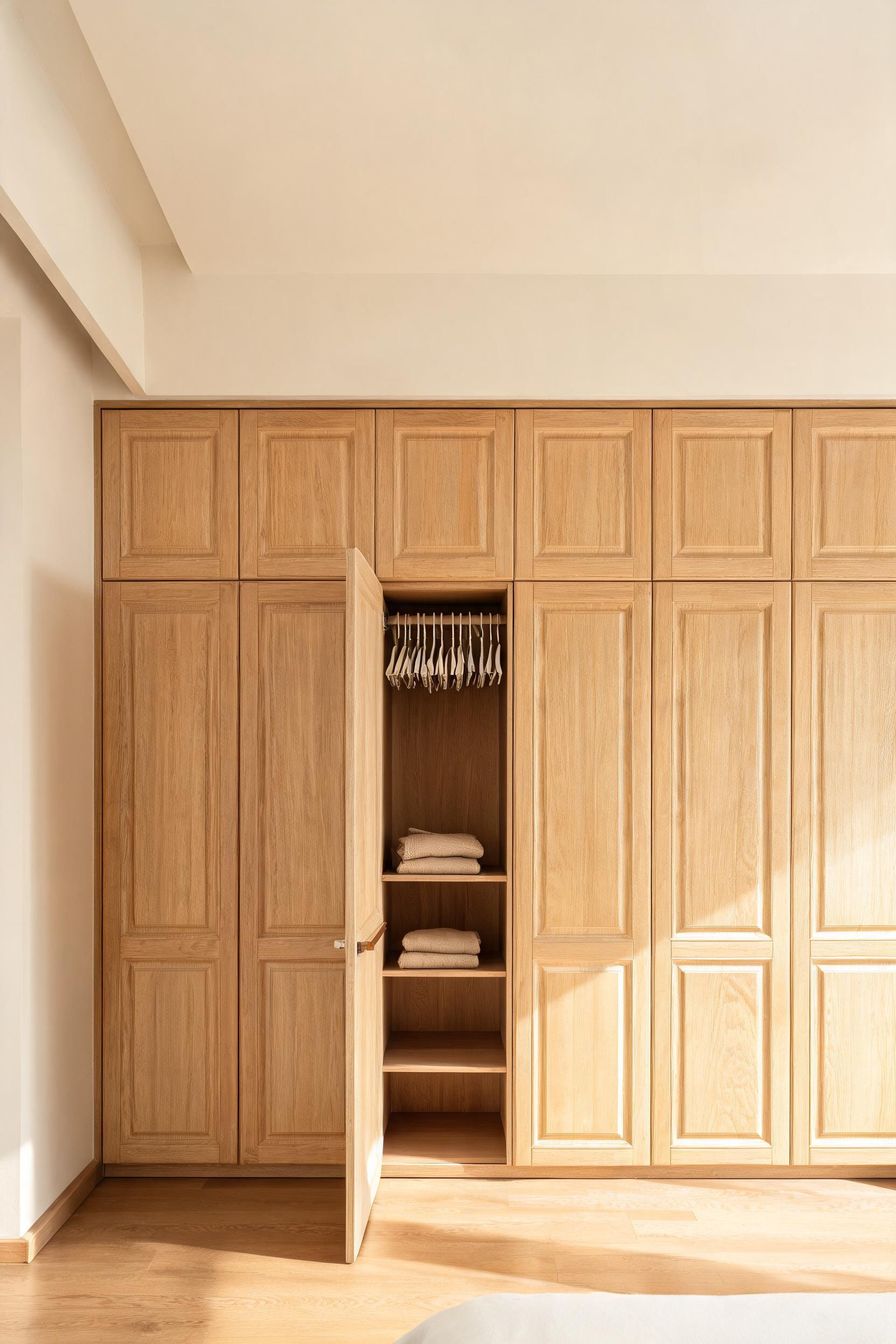
A built-in wood wardrobe is the single piece of wood bedroom furniture that adds the most value — in daily use and in property value alike. The difference between a built-in that looks custom and one that looks flat-pack lies almost entirely in two things: the door species and the crown moulding at the top.
Carcass vs Door Material
Baltic birch plywood (18mm) is the cabinet maker’s choice for the interior carcass — void-free, stable, strong enough for floor-to-ceiling wardrobes. Solid wood doors are then mounted to it, giving the appearance of all-solid construction at a fraction of the weight. The IKEA PAX carcass with Semihandmade shaker-style oak fronts ($60–$120 per door) is the most cost-effective route — a full bedroom wall costs $900–$2,000 installed. For interior fittings, a pull-down hanging rail ($85–$120) brings high sections into reach, pull-out shoe racks ($40–$80) improve floor storage, and velvet-lined drawer inserts ($20–$50) protect fine items. Just as wooden bathroom ideas show how timber works in humid spaces, the same moisture principles apply here — ventilation gaps at the back keep air moving around the wardrobe’s interior.
Pro Tip
Crown moulding is the detail that makes a PAX hack look custom. A $4/ft softwood profile, painted to match the ceiling, closes the gap between wardrobe top and ceiling and reads as purpose-built. Cut at 45 degrees at each end, nail to the wardrobe top, fill the join, and paint. Total cost for a 3-metre wardrobe: under $60.
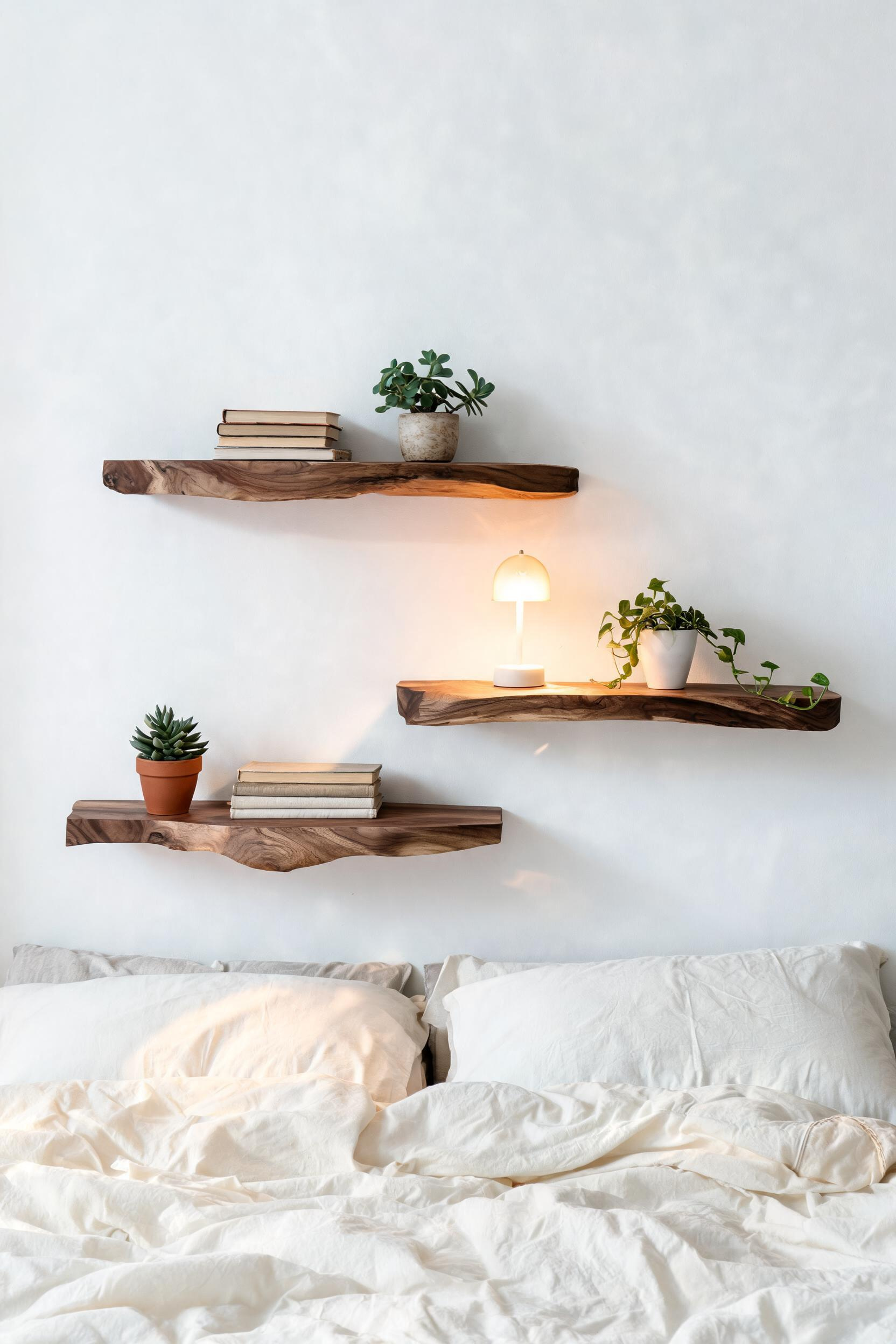
12. A Floating Wood Shelf Arrangement as Bedroom Wall Furniture
Floating shelves in a bedroom serve double duty. They provide surface space for a lamp, phone, and book while also functioning as a display layer above the bed or dresser. For visual return on investment, floating shelves offer the lowest entry cost of almost any bedroom upgrade. Especially above a bed, where a large piece of wall art would otherwise need to go.
Sizing and Species
A solid oak or walnut shelf at 30mm thick can safely span 900mm without visible deflection under normal bedroom loads. For spans over 1,200mm, go to 45mm. Species to consider: white oak for Scandinavian rooms, walnut for warmer palettes, pine for cottage-style spaces. Etsy makers cut and finish solid walnut floating shelves to custom lengths for $85–$180.
Making the Arrangement Work
Avoid hanging shelves in a uniform horizontal row. Instead, stagger the heights — one shelf at 300mm above the bed, one at 450mm, one at 600mm. The irregular vertical rhythm looks collected rather than installed. Vary object heights too: a taller vase on the lowest shelf, flat books on the middle, small pieces at the top.
Pro Tip
Install floating shelves into wall studs, not just drywall anchors, any time you plan to hold more than 5kg. A stud finder takes 60 seconds to locate the timber behind the wall. Drive 3-inch screws at a slight downward angle through the bracket into the stud. Drywall anchors rated at 20kg fail unpredictably under sustained weight — studs do not.
13. Vintage Wood Bedroom Furniture From the Thrift Store — How to Find It
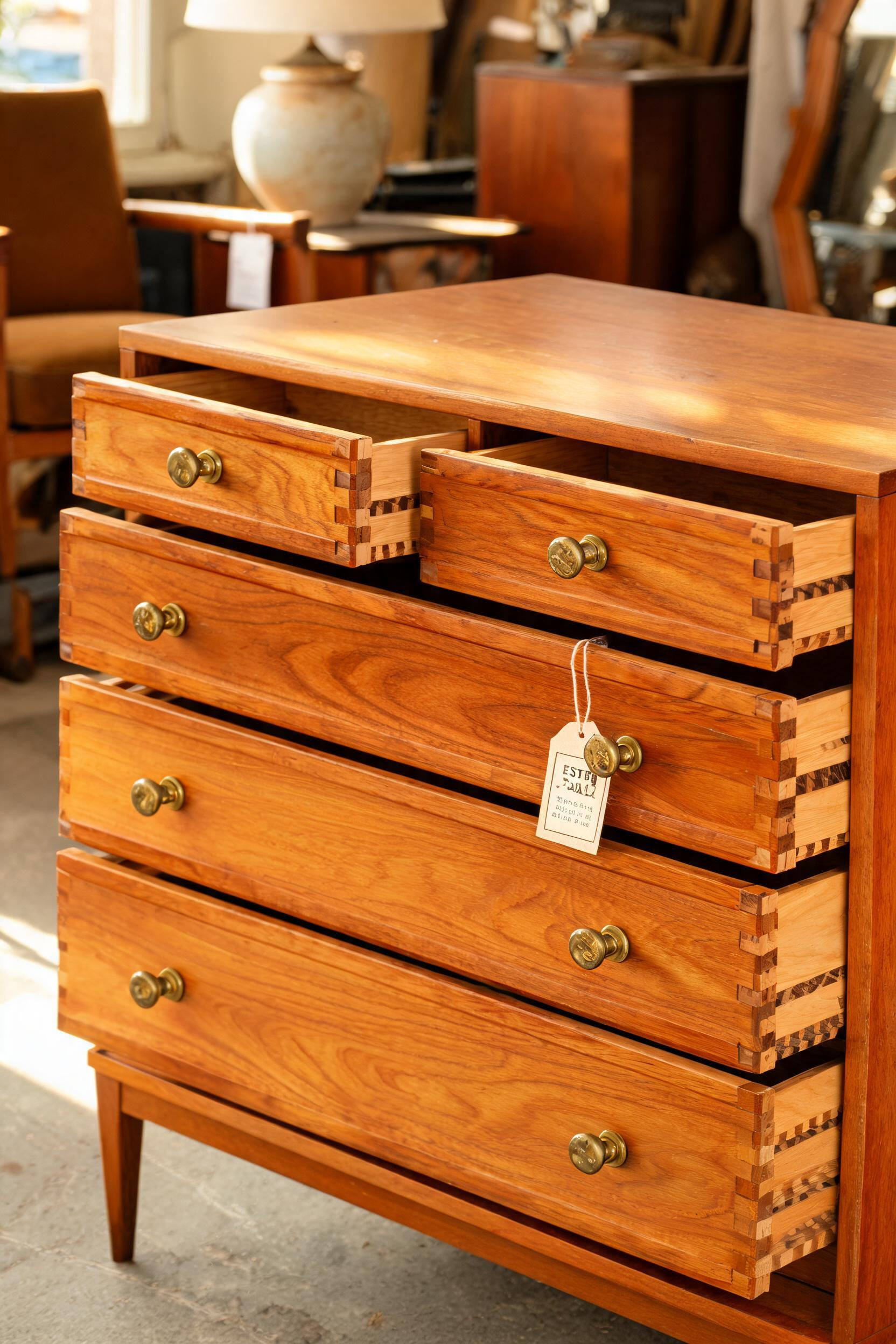
Some of the best wood bedroom furniture available today has already lived one life in someone else’s home. Those decades produced vast quantities of genuinely solid pieces — dressers, nightstands, bed frames, chests — built to last and priced today at a fraction of new solid wood costs. Knowing what to look for turns a thrift store visit from a gamble into a reliable sourcing strategy.
The Solid Wood Test
Look at a drawer side, not the front. Solid wood shows end grain at the cut edges — visible growth rings in cross-section. Particleboard shows a uniform grey-brown dusty texture. Veneer on solid substrate shows a thin coloured layer over end grain beneath. Once you can read this in 10 seconds, no seller can mislead you.
Best Eras and Sources
The most productive eras: 1960s–1970s Danish teak, 1940s–1950s American solid mahogany (often underpriced), and 1970s–1980s solid oak (undervalued, with the mid-century premium yet to reach it). Facebook Marketplace has the most volume; EstateSales.net has the best quality. For how thrift pieces integrate into a fully styled, layered room, boho bedroom furniture ideas are worth looking at.
Pro Tip
Bring a small flashlight to estate sales and thrift stores. Hold it at a low, raking angle across the top surface of any dresser or chest. This side lighting reveals dents, repairs, veneer lifting, and watermarks that disappear completely under the overhead fluorescent lighting of a thrift store. It takes five seconds and saves you buying something that only looks acceptable in the shop.
14. Dark-Stained Mahogany Bedroom Pieces for a Moody Retreat
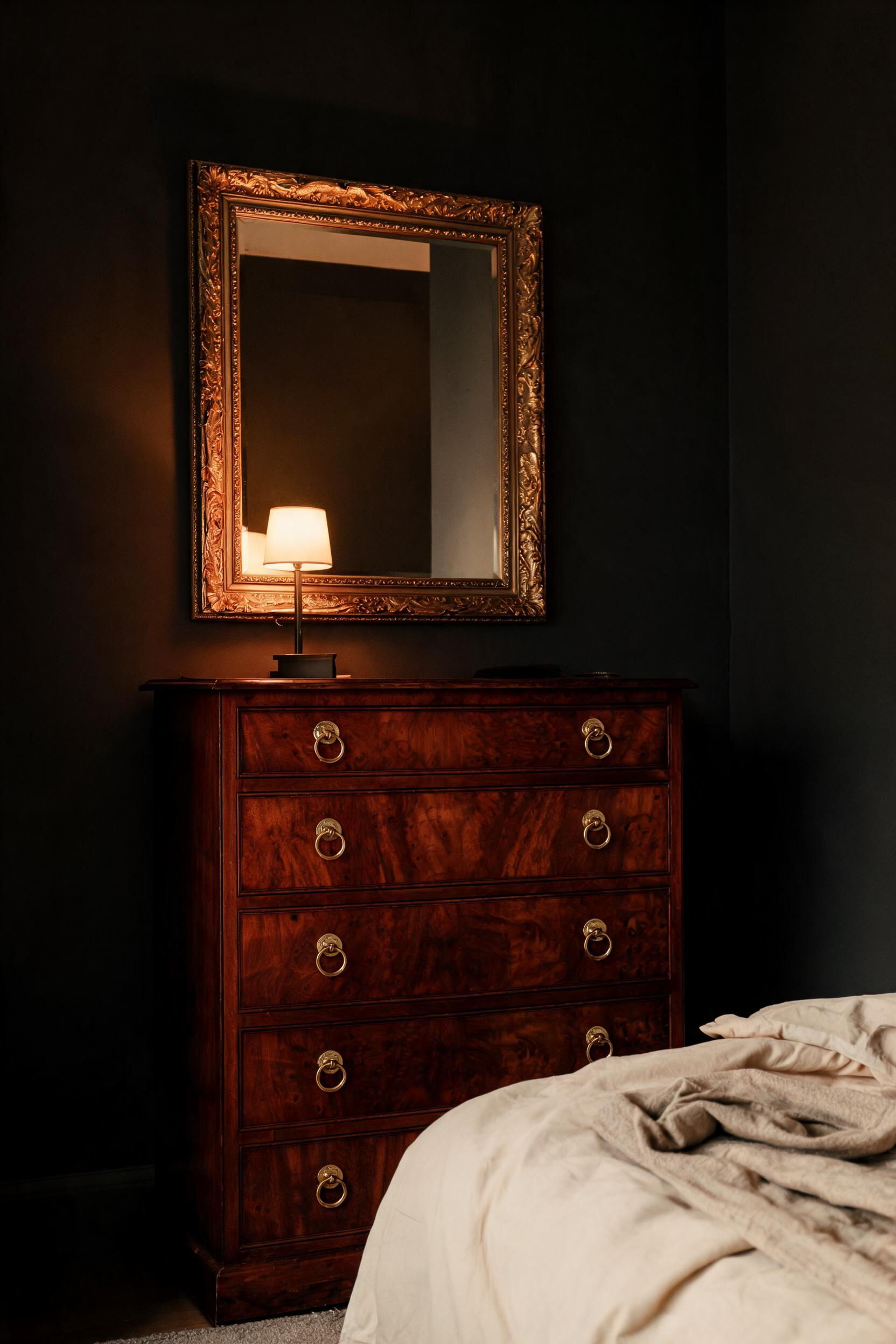
Mahogany has furnished bedrooms since the Georgian era. It remains one of the finest cabinet woods available — fine, even grain, moderate hardness (Janka 900 lbf), and a deep red-brown colour. In a bedroom, that depth creates visual richness without requiring heavy fabrics or elaborate layering. A dark mahogany bedroom done well reads as quietly sophisticated rather than gloomy.
Working With Mahogany Tonally
The common mistake with dark mahogany is pairing it with other medium-brown pieces. The result looks like mismatched brown furniture rather than a curated dark palette. Instead, go for real tonal contrast. Pair dark mahogany with very light elements — oyster linen, white walls, bleached oak shelving. The depth of the wood reads as intentional when the surroundings are genuinely pale. One bleached oak bench or set of light ash shelves gives the eye somewhere to rest in an otherwise dark register.
Finding Antique Mahogany
Victorian and Edwardian mahogany sets sell for £180–£450 at UK auction houses like Sworders and Duke’s. Shipping flat-packed pieces runs $150–$300 and is worth it at these prices. In North America, Ethan Allen British Classics mahogany pieces from the 1970s–1980s come up regularly on Facebook Marketplace for $200–$600.
Pro Tip
If you want the dark mahogany look but can only find pine or oak, try General Finishes Antique Walnut Water-Based Stain ($18 per quart). Sand to 150-grit, apply two coats with a foam brush, finish with clear matte water-based poly. The result reads as genuine dark wood from any distance.
15. Bedside Table Wood Options — Getting the Nightstand Choice Right
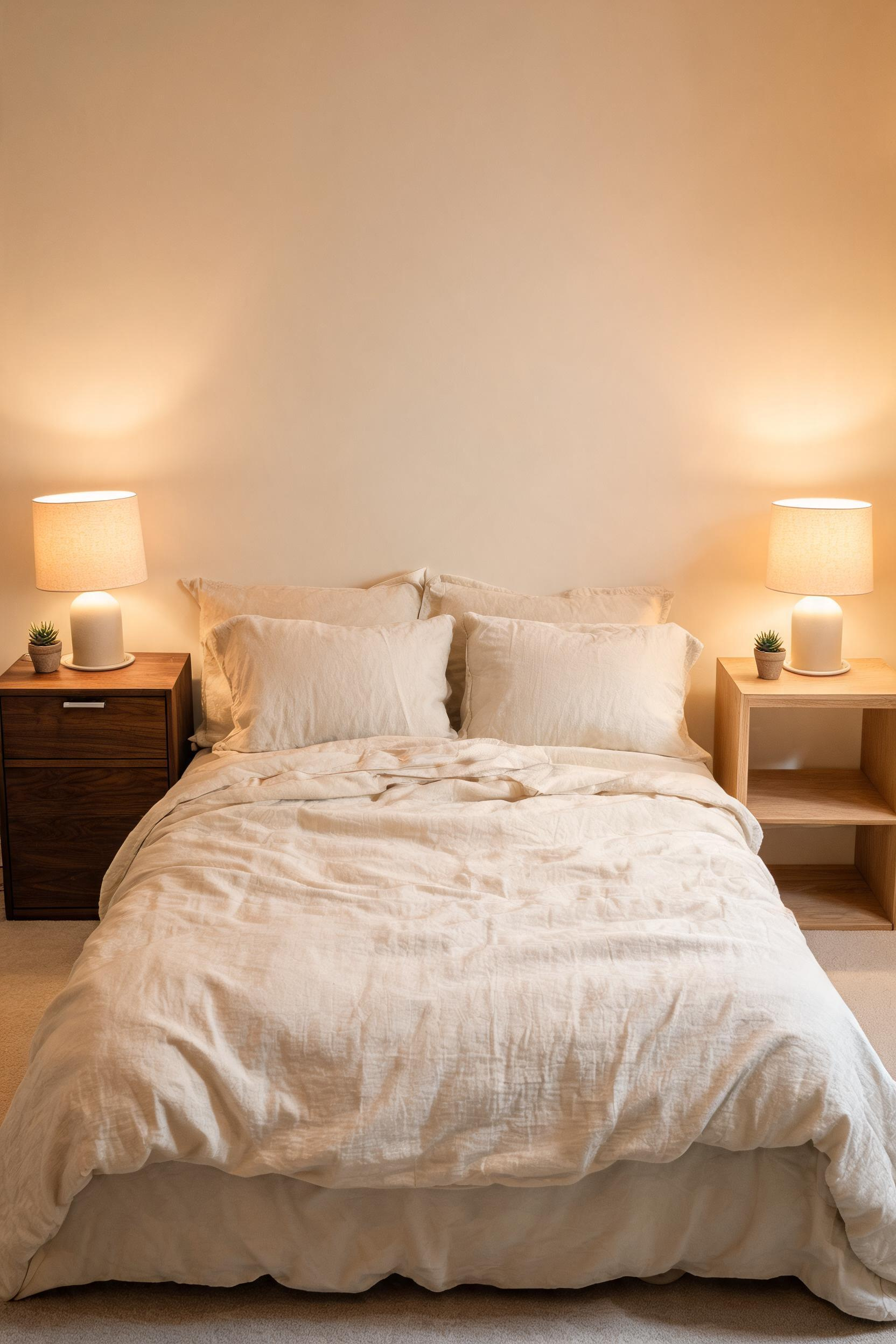
A nightstand is the most frequently used piece of wood bedroom furniture in the room. It gets opened and closed hundreds of times per year, holds items at arm’s reach all night, and sits in eyeline every time you’re in bed. Despite this, most bedroom decorating guides treat it as an afterthought. Getting it right — in both function and species — is worth actual thought.
The Functional Basics
Standard nightstand height is 24–28 inches, matching or within 2 inches of your mattress top. Depth of at least 16 inches is essential — shallower and a lamp overhangs the edge. A 18 × 18 inch surface is the practical minimum. Drawers beat open shelves because they keep items out of eyeline.
Matching Species to the Room
Walnut nightstands bring warmth to neutral rooms. White oak works for Scandinavian and coastal palettes. Cherry suits transitional and traditional rooms. Pine fits cottage and farmhouse spaces. It’s also the most budget-friendly in solid wood. IKEA’s Hemnes Nightstand in solid pine at $89 is genuinely one of the best-value bedside options available at any price.
Pro Tip
When running two nightstands of different wood species, keep their silhouettes identical. Same height, same leg profile, same approximate mass. When the shapes match, the different woods read as curated. When shapes also differ, the pair reads as accidental.
16. Solid Wood Bedroom Sets vs. Mixing Individual Pieces of Wood Furniture
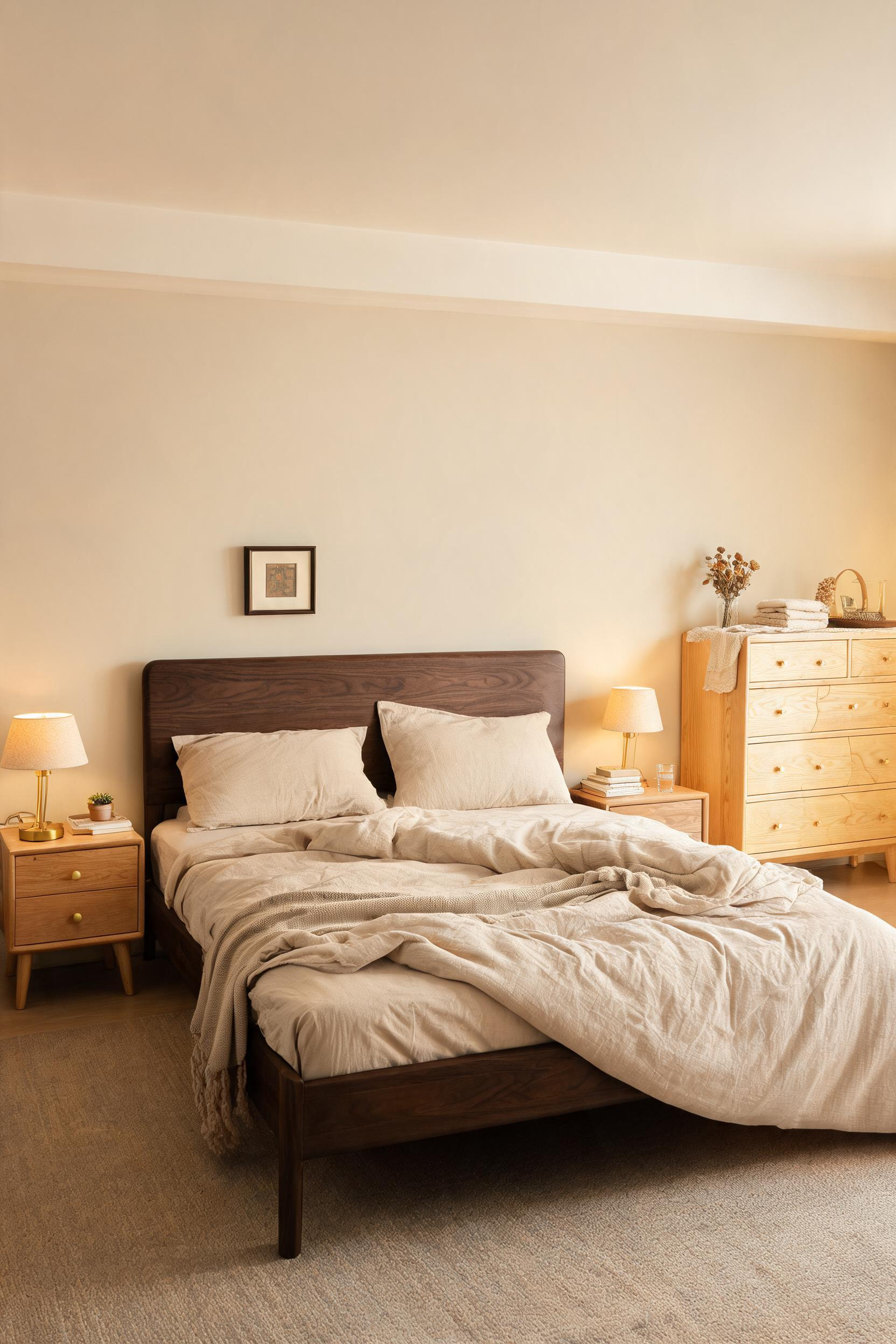
The matched set vs. individual pieces question comes up in almost every wood bedroom furniture conversation. The answer depends entirely on what you value: immediate cohesion, or a room that looks collected and personal over time.
When a Matched Set Makes Sense
For those who want immediate visual cohesion, a matched set delivers it. Restoration Hardware’s Salvaged Wood Set in oak starts around $3,400; Stickley’s cherry bedroom sets from $5,200 are heirloom pieces. A cozy bedroom built around a matched set also removes the sourcing uncertainty of hunting for compatible individual pieces over time.
The Rules for Mixing Wood Tones
The most reliable approach is the 2+1 rule: two pieces in the same wood tone as the dominant, one deliberate contrast. The real governing principle is tonal value, not hue. Dark walnut and light oak work because they differ in value (dark vs light). Oak and pine often muddle because they’re both light, just with different undertones. Dark and light creates clarity; two mid-tones creates confusion.
Pro Tip
When building a mixed-wood bedroom from scratch, start with the bed frame — it’s the dominant piece and sets the species baseline. Then choose one other piece in the same species. Treat everything else as accent or contrast. That 2:1 ratio gives variety without visual noise and works regardless of which species you start with.
17. Reclaimed Barn Wood Accent Pieces — Texture Without Commitment
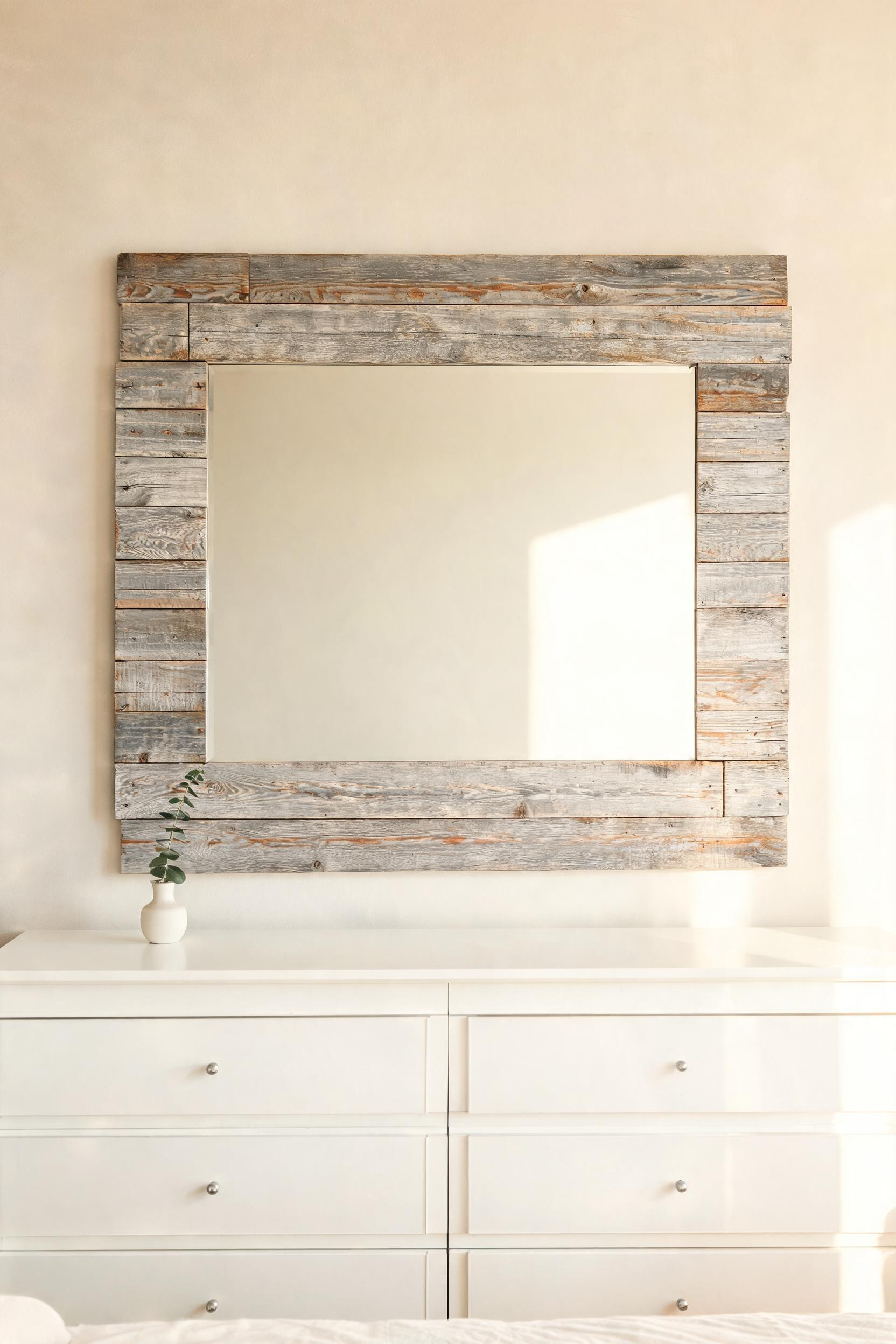
Not every wood bedroom furniture project needs to be a whole dresser or bed frame. A reclaimed barn wood piece — a mirror frame above the dresser, a foot-of-bed bench, a small side table — brings the texture and history of reclaimed timber without the commitment of a full furniture piece.
The Best Barn Wood Accent Pieces
A reclaimed wood mirror frame above a dresser is probably the most high-return single accent piece you can add to a bedroom. The weathered grey-silver surface that barn wood develops reads as expensive and considered even when it cost $140 from an Etsy maker. Also worth considering: a reclaimed wood bench at the foot of the bed ($180–$400) and a small bedside table with a natural-edge reclaimed top.
Moisture Content and Acclimation
Barn wood for indoor use needs moisture content below 19%. Anything higher shrinks as it dries, opening gaps and causing cracks within weeks. Ask any seller for the reading before buying. If you source your own, let it acclimate loosely stacked in the room for two weeks. This one step prevents most cracking.
Pro Tip
A Klein Tools ET140 moisture meter costs $25. Take it to markets, estate sales, and salvage dealers — it pays for itself the first time it stops you buying a wet piece. Anything above 15% needs more drying time; above 19% isn’t ready for indoor use.
18. How to Care for Your Wood Bedroom Furniture Through Every Season
Wood bedroom furniture is not low-maintenance. But the care it needs is simple and seasonal — the same satisfying routine as caring for leather or wool. A solid wood piece looked after properly will outlast everything else in the room. A piece neglected for ten years of dry radiator heat can develop cracks that take years to repair.
Humidity Is the Most Important Variable
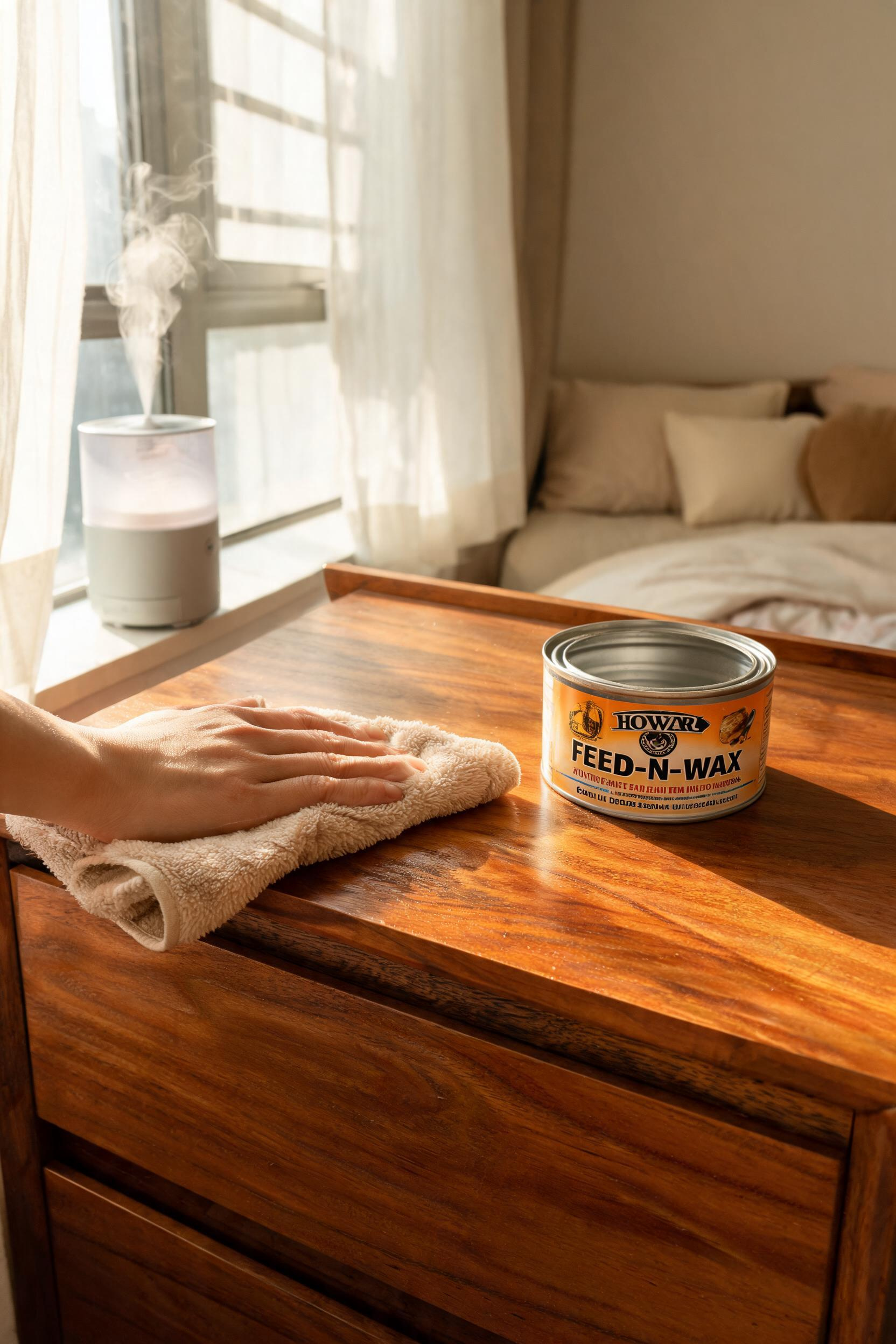
The ideal indoor humidity for solid wood is 40–55% RH. Below 35%, fibres contract and checking (hairline cracks) starts around joints and knots. Above 65%, drawers stick and joints fail. A room humidifier set to 45% prevents most of this.
Cleaning and Re-finishing
For oiled surfaces (Danish oil, Rubio Monocoat): dust with a barely-damp microfibre cloth, never a spray cleaner. Re-oil every 12–18 months or when water stops beading. For waxed surfaces: re-wax every 6–12 months with Howard Feed-N-Wax ($8) or Osmo Wax, buff after 20 minutes. If white haze appears on lacquer, rub a little mayonnaise into the spot and leave for an hour — it pulls trapped moisture out of the finish.
Pro Tip
The single most damaging thing for wood bedroom furniture is a heating vent blowing directly onto a piece. If your dresser or nightstand sits near a floor or wall vent, redirect the vent cover or place a magnetic vent cover over it in winter. Six months of direct dry heat causes more structural damage than 20 years of normal use — it’s an easy fix that most wood care guides don’t mention.
Choosing the Right Wood Bedroom Furniture for Your Space and Budget
The most effective approach to a wood bedroom is patience and sequence. Start with the bed frame, then choose one other piece in the same species. Everything after that can mix, contrast, or fill in gradually.
The Investment Hierarchy
Bed frame first. Then a dresser with real joinery — you use it every day, and quality matters more here than almost anywhere. Nightstands are third — solid pine IKEA options hold their own against $300 alternatives. Accent pieces (shelves, mirrors, benches) come last, sourced from thrift stores and Etsy without sacrificing quality.
Where to Shop at Every Budget Level
At the low end ($0–$200): thrift stores, EstateSales.net, and Facebook Marketplace. Mid range ($200–$800): Article, Crate & Barrel, and West Elm carry solid or solid-core pieces worth considering. At the investment level ($800+): Stickley, Restoration Hardware, and Vermont Woods Studios make pieces that stay in families. Chairish and 1stDibs fill every vintage gap. For combining budget finds with new pieces, bedroom makeovers on a budget has practical strategies.
The right wood bedroom furniture isn’t the most expensive or the most on-trend. It’s the piece that still looks right, still works perfectly, and still tells a good story in twenty years.