
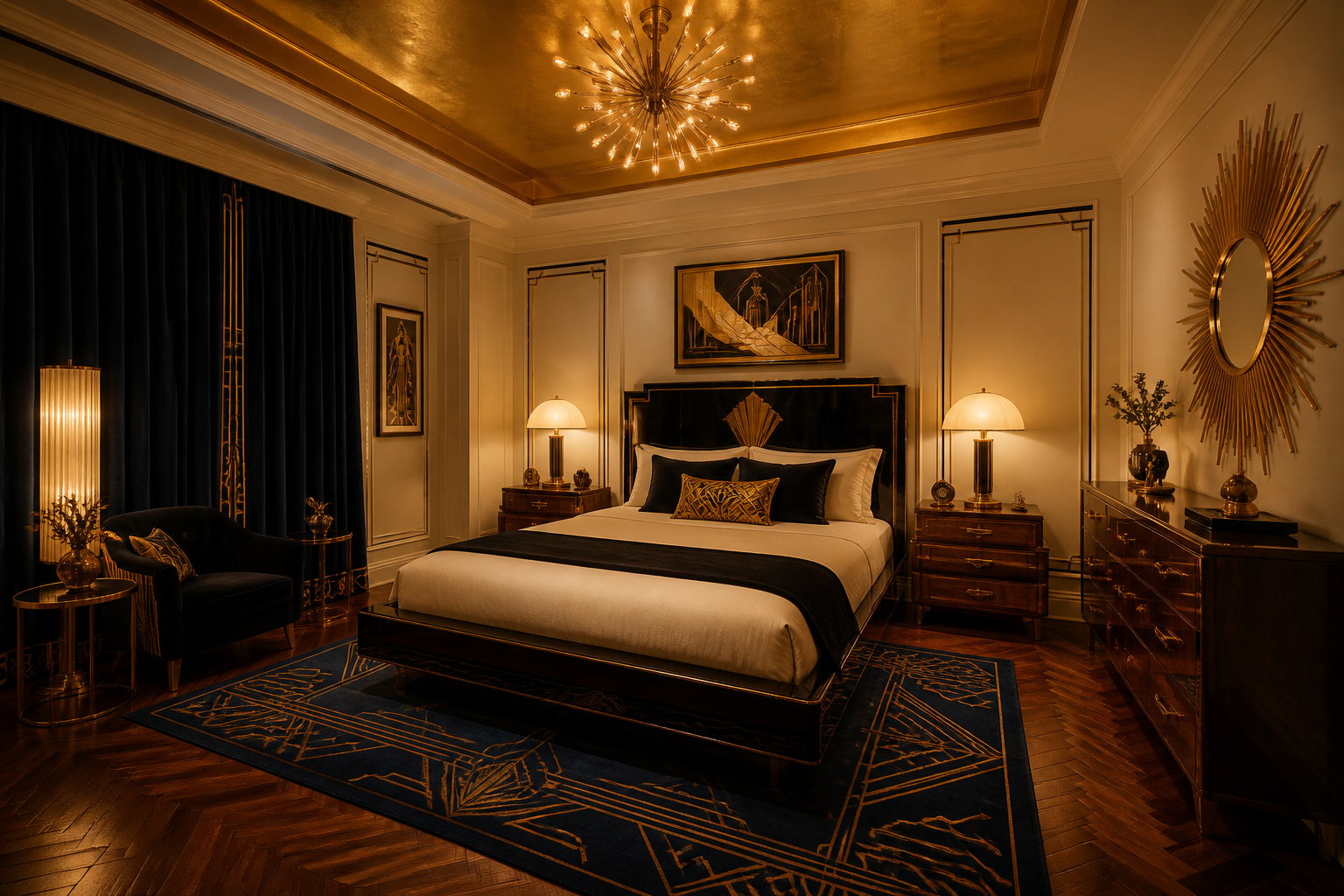
The year is 1925. The Exposition Internationale des Arts Décoratifs et Industriels Modernes has just opened in Paris. Geometric shapes replace flowing curves. Gold and black stand in for pastel softness. Nearly a century later, the art deco bedroom remains one of the most magnetic design movements in history. It understood something that contemporary trends forget: rooms should feel like they mean something.
What I love about Art Deco is that nothing was accidental. Every piece of furniture, every curtain, every hardware pull was chosen with seriousness of purpose. If you’ve been circling the style without knowing where to start, these 18 art deco bedroom ideas give you a clear path — from the dominant colour palette down to the drawer handles.
1. The Classic Art Deco Bedroom Color Palette: Gold and Black
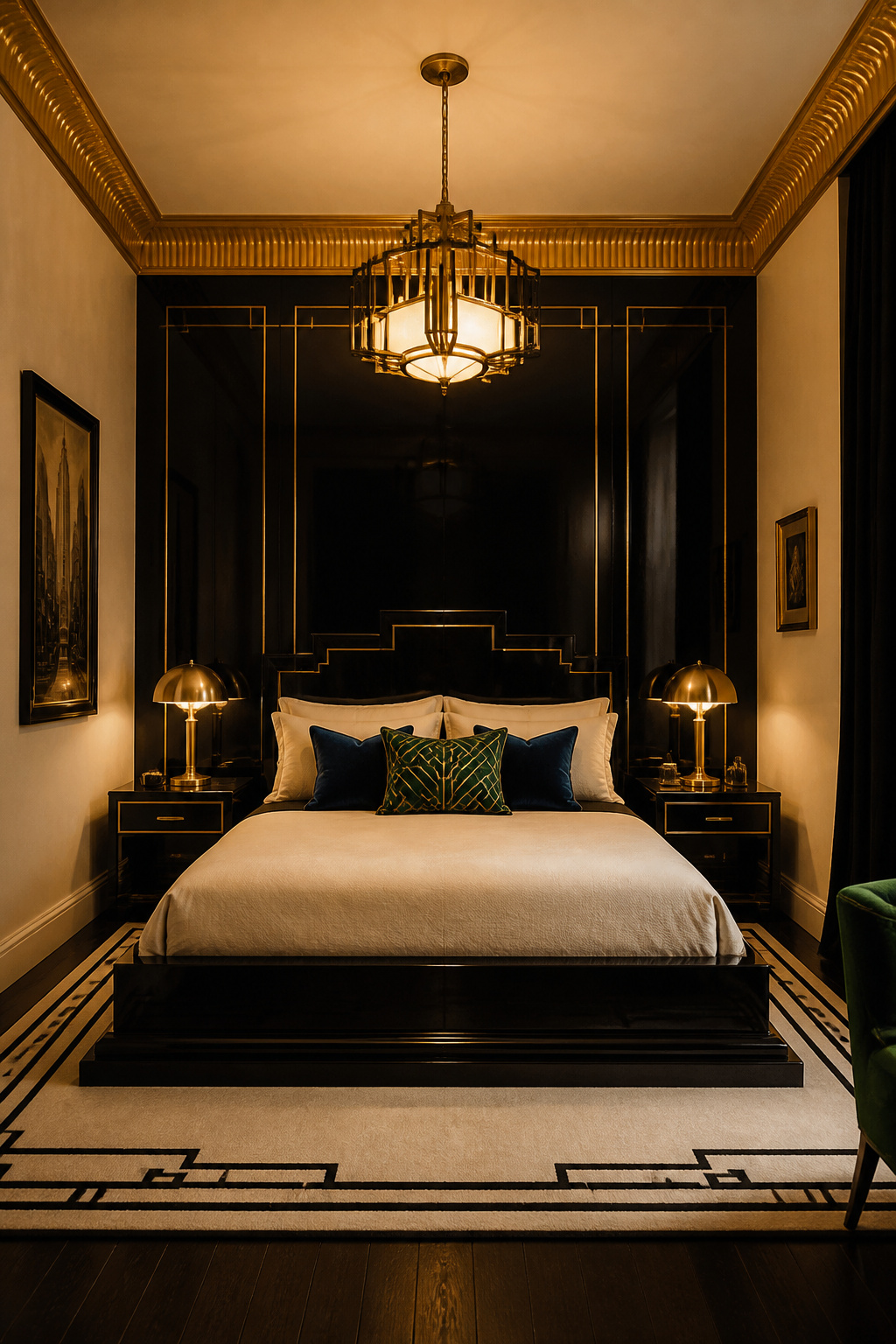
When Émile-Jacques Ruhlmann built furniture for Paris’s great houses in the 1920s, he reached for two anchors every time: ebonised macassar ebony and gilded bronze mounts. The gold-and-black combination isn’t just visually bold — it carries historical weight, connecting your bedroom to one of the most intentional eras in decoration history.
Why Gold and Black Became the Defining Combination
Gold referenced the precious metalwork of Egyptian antiquity. Black referenced lacquered Japanese furniture. Together, they made a room feel simultaneously ancient and startlingly modern. The Egyptian connection intensified after Tutankhamun’s tomb discovery in 1922, which flooded Western design with solar and pharaonic imagery.
How to Balance These Bold Tones
Use black on one surface maximum — the headboard wall works best. Reserve gold for smaller elements: hardware, lamp bases, frame mouldings, and accent cushions. Farrow & Ball ‘Pitch Black’ (No. 256, £59/2.5L) has a warm undertone that prevents the wall from reading as flat. Sherwin-Williams ‘Antique Gold’ (SW 6394) on a picture rail is enough to register the colour without overpowering the room.
Adding Ivory as a Softening Third
Every serious Art Deco interior has a third tone to prevent the primary two from fighting. Benjamin Moore ‘Ivory White’ (OC-17) on the remaining walls reads warm against a black accent, never clinical. For a budget fix: black chalkboard paint on the back of an open shelving unit reads as intentional Deco drama for under £15.
2. Geometric Wallpaper Patterns: Fan, Chevron, and Sunburst
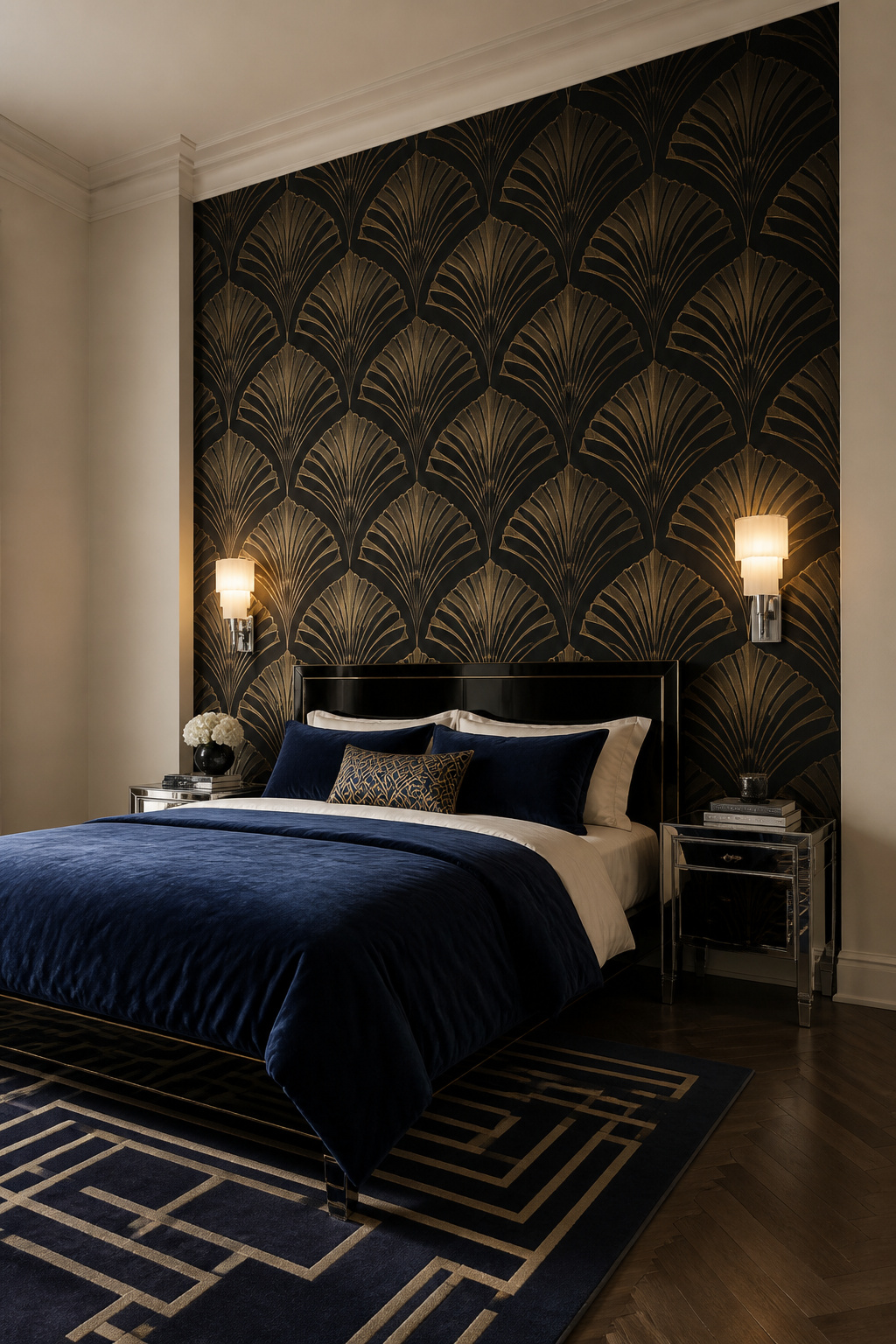
Walk through any serious Art Deco interior and you’ll find a wall that tells a story. Fan patterns came from Japanese woodblock prints filtering into European design studios. Chevron designs brought military precision into domestic interiors. Sunburst motifs drew directly from Egyptian solar iconography after Tutankhamun’s 1922 discovery. None of these were decorative choices made lightly — each carried cultural weight that designers chose deliberately.
Accent Wall vs. All-Four-Walls
One feature wall — the headboard wall — delivers full impact without turning the room into a graphic overload. Cole & Son’s ‘Deco’ collection has museum-quality designs from around £95 per roll. Graham & Brown’s ‘Jazz Age’ runs £18–£35 per roll, which is more practical for full-wall coverage. For renters: Brewster Home Fashions peel-and-stick Art Deco geometric at $32 per roll comes down cleanly when you move.
Sourcing Vintage-Faithful Wallpaper
Budget is usually the constraint. NLXL’s ‘Graphic World’ collection at €45 per roll sits in the middle tier. If you want the real thing, estate auction houses sell original 1930s wallpaper rolls regularly. I’ve seen original French fan papers go for under £30 a roll at specialist auctions. It takes patience, but the result is genuinely irreplaceable.
3. Velvet Headboard for Your Art Deco Bedroom
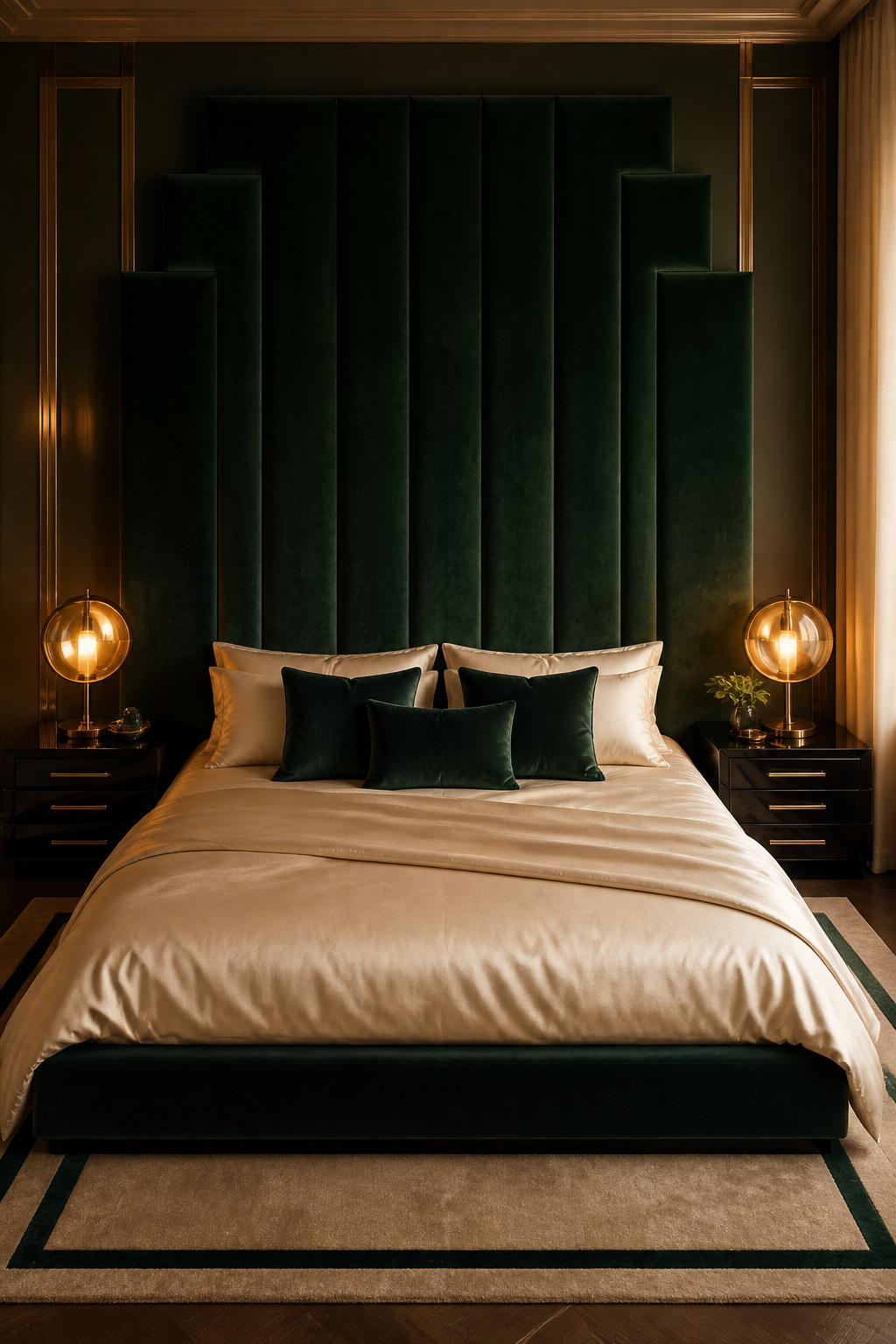
Silk velvet was the prestige textile of the interwar period. French velvet was status-coded — to have it on your headboard in 1925 was to make a direct statement about where you stood. The silk-backed velvet of the era was expensive to produce and maintain, so its presence meant something. That seriousness of purpose is why velvet headboards remain the most reliable single investment in an art deco bedroom today.
Choosing the Right Shape
Art Deco headboards are rectangular with a flat or stepped top. Avoid curved profiles, which read as contemporary romantic rather than Deco. The stepped profile is most period-accurate: a low outer panel stepping up to a taller central section. West Elm’s ‘Haven’ velvet headboard starts at $699 for a queen. The Wayfair ‘Langley Street Colebrook’ in gold velvet runs $340–$480 with a pronounced stepped profile for lower-ceilinged rooms.
Colors That Read as Authentically Art Deco
Deep jewel tones are most faithful to the period: sapphire blue, forest green, and bordeaux. Avoid white or blush velvet, which reads as contemporary glamour rather than Deco. A standalone headboard bolted directly to the wall lets you pair it with an existing black or walnut platform bed without replacing the entire frame.
4. Mirrored Furniture for Gatsby-Era Glamour
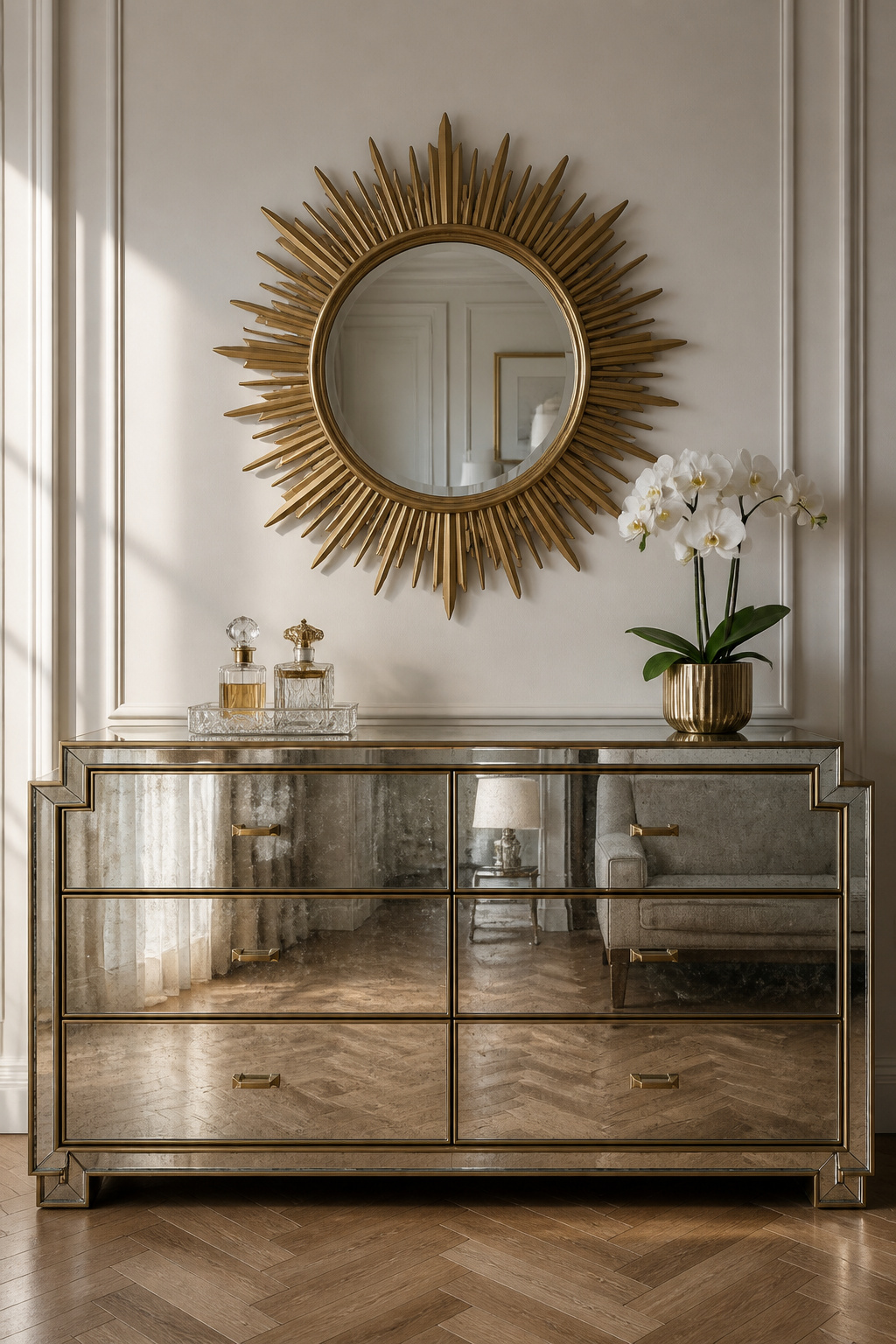
Mirrored furniture became a Hollywood staple in the 1930s, amplified by boudoir scenes in films like ‘Grand Hotel’ (1932). Designer Donald Deskey brought mirrored surfaces into Radio City Music Hall at grand scale. The logic was practical as well as aesthetic: mirrors made rooms feel larger and more luminous at a time when prosperity needed to look certain.
Which Pieces to Mirror
Choose one mirrored piece per room. A pair of mirrored nightstands (Pottery Barn ‘Hayworth’, $429 each) or a single mirrored dresser (Furniture of America ‘Carrese’, $579) is the right scale. Covering every surface in mirror tips the room toward 1980s disco-era glamour, which is a different thing entirely.
Mixing Mirrored With Wood
The best combination is antique or foxed mirror with dark wood — walnut veneer, ebonised oak, or lacquered black. For a budget approach: antique mirror adhesive film runs around £15 per roll on Amazon and applies cleanly to IKEA flat-front drawer faces. The effect is convincing at a fraction of the cost of purpose-built mirrored furniture.
5. Statement Chandeliers and Geometric Wall Sconces
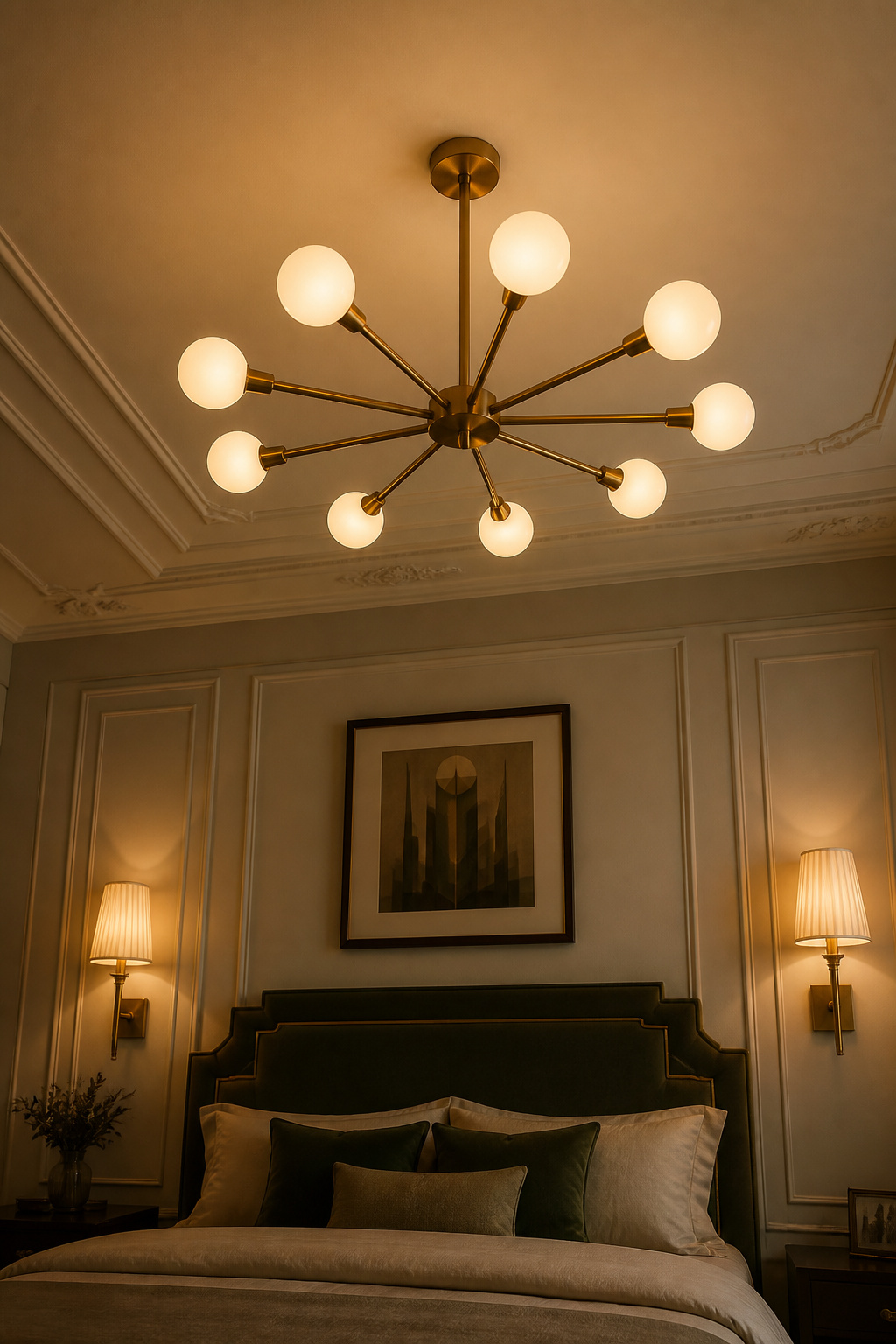
Electric lighting was still a novelty in the 1920s, and Art Deco designers treated it with theatrical intent. René Lalique’s glass chandeliers, René Prou’s wrought-iron sconces, and the geometric frosted-glass pendant became defining forms of the era. The goal was to make electric light feel as opulent as candlelight had always been.
Choosing Between a Flush Fixture and a Drop Chandelier
For rooms with 8ft (244cm) ceilings, a semi-flush or flush mount is the safer choice — a drop chandelier needs at least 9ft (274cm) to hang correctly. Jonathan Y’s ‘Gatsby’ sputnik chandelier at $299–$399 adjusts for either ceiling height. Kichler’s ‘Brinley’ frosted glass semi-flush at $249 reads just as convincingly Art Deco from below.
Pairing the Ceiling Fixture With Sconces
The most authentic approach pairs the ceiling fixture with wall sconces flanking the headboard at 150cm height. This creates three-point lighting that eliminates single-overhead glare — the most common bedroom lighting problem. Use warm white bulbs throughout (2700K), not cool daylight. A vintage Deco sconce from an antique fair, rewired by an electrician, often costs £100–£180 total and is more authentic than most reproductions.
6. Lacquered Bed Frame That Defines an Art Deco Room
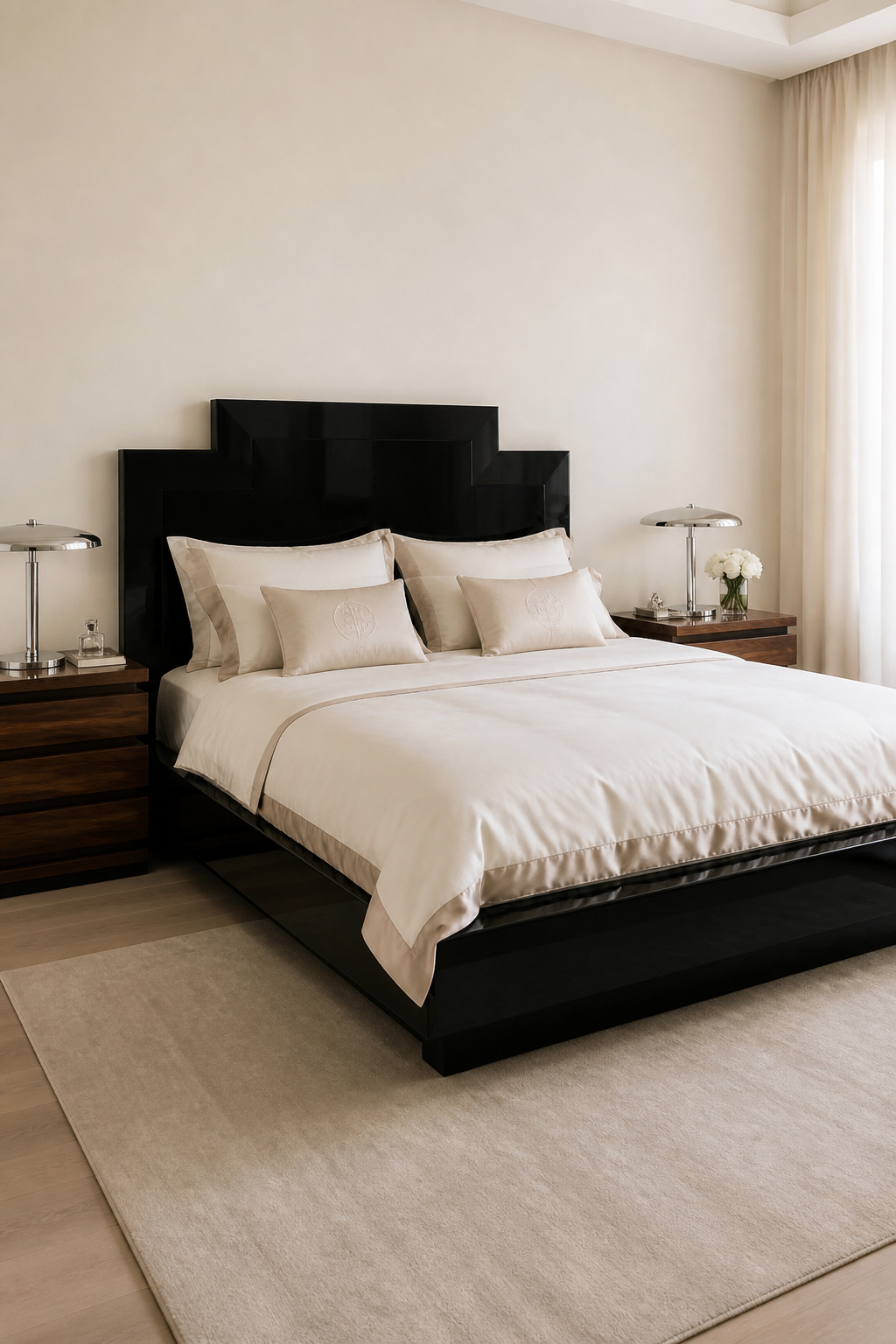
The lacquering tradition in Western furniture came through French fascination with Japanese craft. Ruhlmann and Paul Iribe adopted the technique for their most important commissions, producing high-gloss ebonised finishes with inlaid ivory and shell. In the 1920s, a lacquered bed frame was the most expensive piece in the room. Today, it’s one of the most achievable.
Picking the Right Finish
A true lacquered finish is high-gloss and slightly reflective. Avoid matte black, which reads as modern industrial rather than Art Deco. Article’s ‘Culla’ platform bed in black lacquer runs $799–$999 for queen/king. CB2’s ‘Calypso’ at $1,199 is the premium option with a more pronounced stepped headboard. Also, a plain wooden bed frame can be lacquered at home: sand smooth, prime with shellac, then apply 3–4 coats of piano lacquer spray (Rust-Oleum) for under £60.
What Bed Frame Profiles Read as Authentically Art Deco
Three elements matter: clean geometric lines with no curves or turned legs, a stepped headboard rather than a curved or arched one, and a high-gloss finish that reflects light. Anything with a button-tufted headboard is reading as Hollywood Regency — adjacent to Deco but a genuinely different design language.
7. Jewel-Tone Accents: Emerald, Sapphire, and Ruby
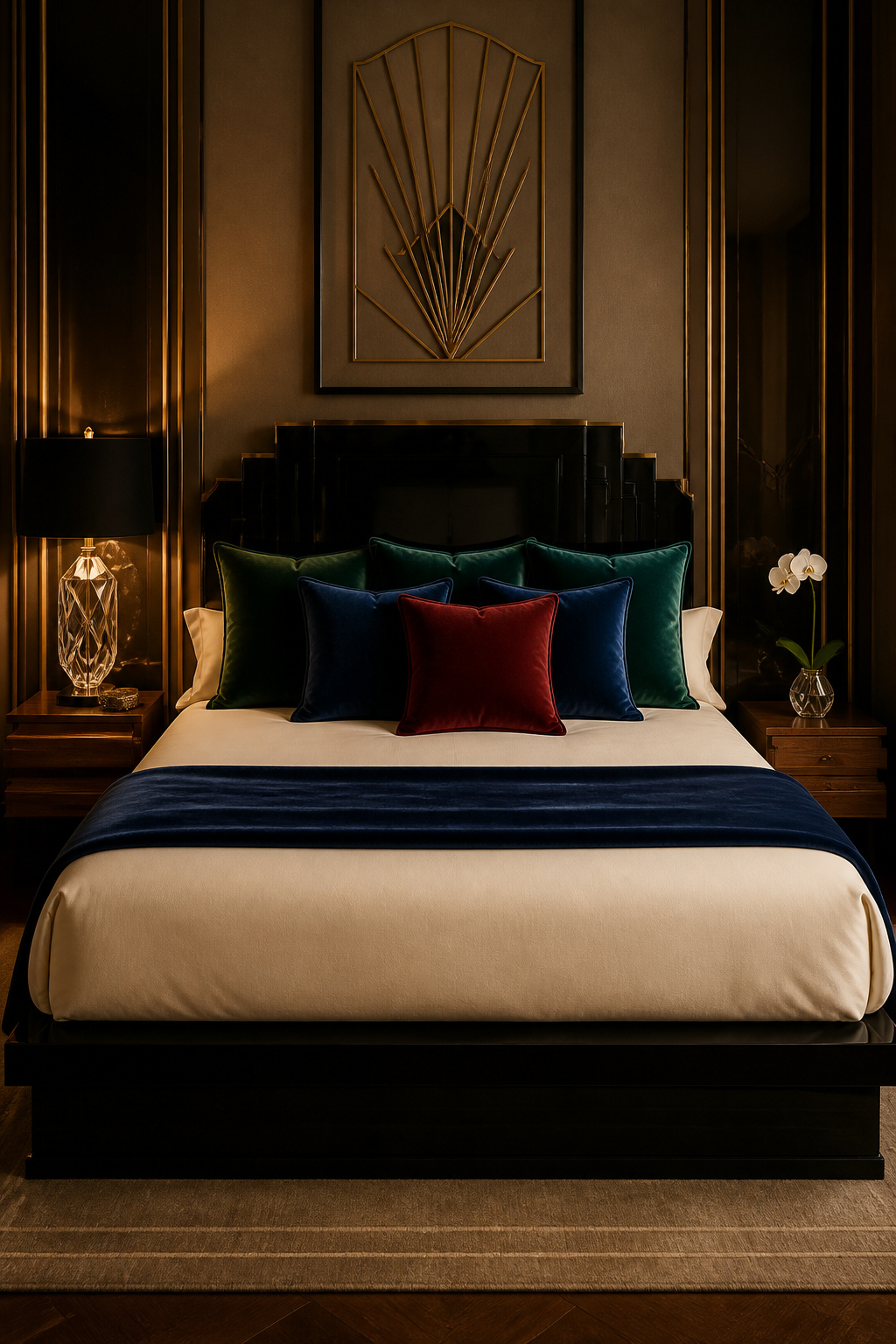
Art Deco didn’t borrow jewel tones from nature — it borrowed them directly from the jewellery houses of Paris. Cartier, Van Cleef & Arpels, and Boucheron were using emerald, sapphire, ruby, and onyx in geometric settings throughout the 1920s. Interior designers adopted that same colour language to translate the vocabulary of jewellery into rooms. Keep that in mind when you choose accents: you’re not picking a sofa cushion, you’re selecting a gemstone.
The Easiest Places to Introduce Jewel Tones
Start with cushions and throws — they’re reversible decisions. A set of three emerald velvet cushion covers (Zara Home, £55 for a three-piece set) against ivory bedding is the lowest-risk, highest-impact entry point. Then move to a single decorative vase in cobalt or ruby glass on the nightstand. Only after those feel right should you commit a jewel tone to a larger surface like a headboard or accent wall.
Mixing Three Jewel Tones Without a Clash
The 70-20-10 rule works reliably here. Choose one primary jewel tone and use it in 70% of accent pieces. Add a second in 20% — one sapphire vase against predominantly emerald cushions. Reserve the third (ruby) for a single accent object. Buy cushion inserts once (IKEA FJADRAR, £6.99 each) and swap only the covers as your preferences change. For more on building a bedroom around layered textiles and rich colour, the cozy bedroom ideas on this site show how cushion and throw combinations work across different styles.
8. Parquet and Herringbone Flooring Under the Bed
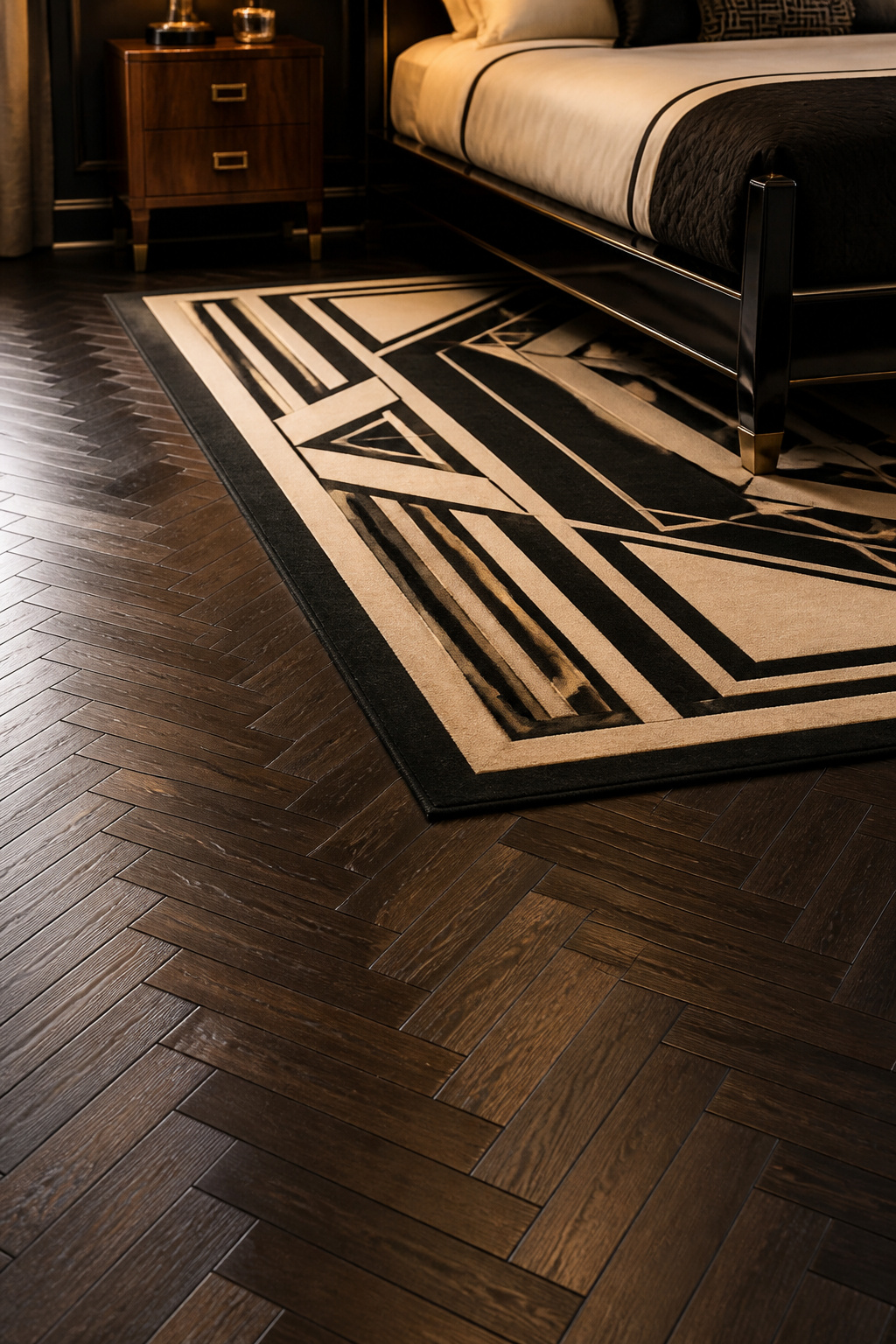
Parquet de Versailles — the interlocking oak squares named for the palace floor — was revived during the Art Deco period as a symbol of French luxury. Herringbone parquet was common in Paris’s Haussmann-era apartments being renovated through the 1920s. Both patterns signalled European sophistication. When you lay herringbone in a bedroom today, you’re connecting to a very specific tradition of design confidence.
Real vs. Engineered Parquet
Solid oak herringbone runs £68 per square metre (Woodpecker ‘Woodford’). Engineered herringbone runs £42–£68 (Karndean ‘Korlok’). Laminate herringbone (Quick-Step ‘Impressive Patterns’) comes in at £28 per square metre. For a bedroom without heavy moisture, laminate herringbone in a dark stain is a credible option at 40% of the solid wood cost. A dark ebony or walnut finish is more authentically Art Deco than natural blonde wood.
Herringbone Rugs as a Practical Alternative
For renters: a large herringbone-pattern rug under the bed creates the same visual effect as flooring. Ruggable makes a washable version in 8x10ft for $189. The rug should extend at least 50cm beyond each side of the bed. Anything smaller looks like an afterthought rather than a design decision.
9. Bold Geometric Wall Art and Prints
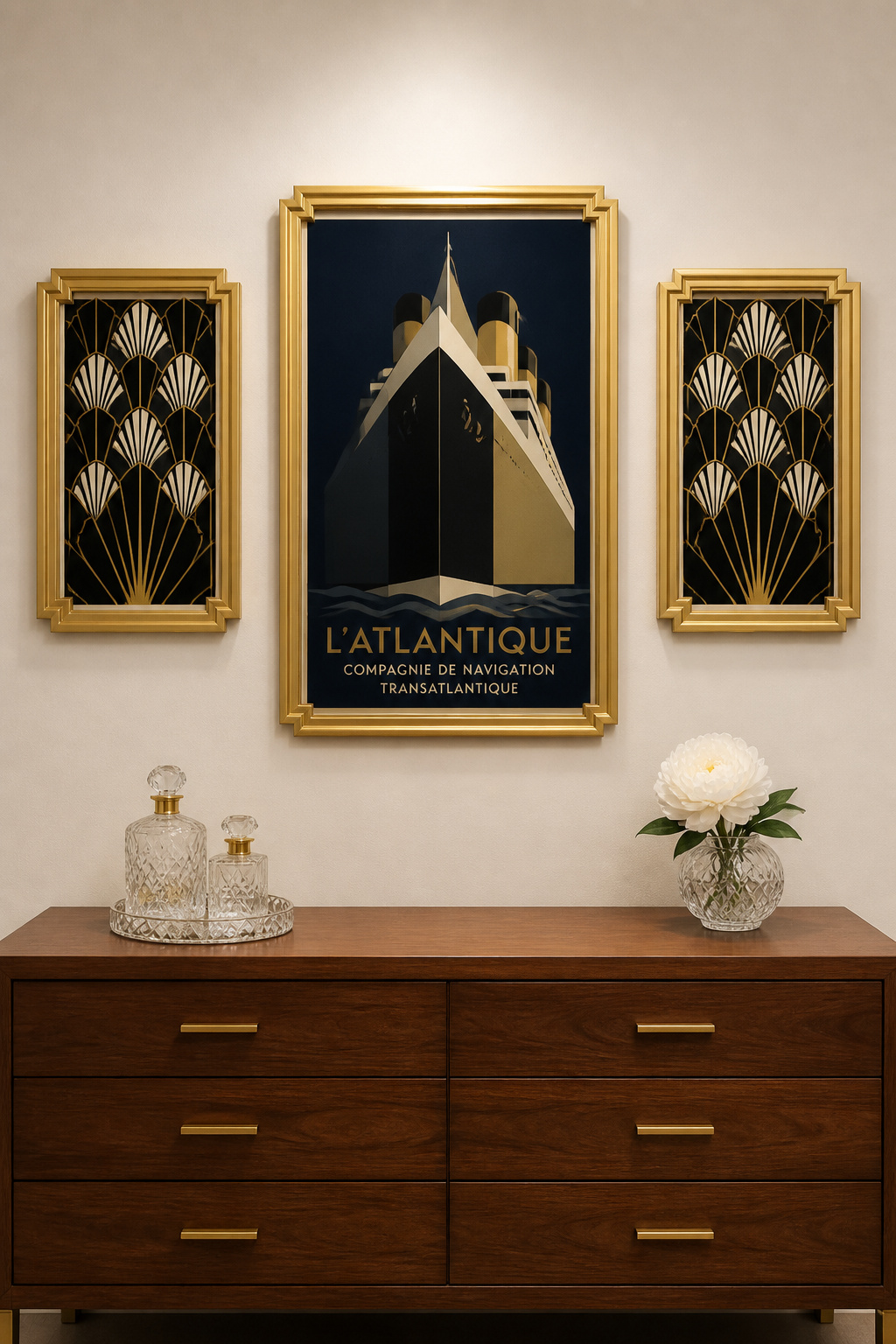
Tamara de Lempicka (1898–1980) is the defining Art Deco painter. Her cool, stylised figurative work appeared in Harper’s Bazaar and in the homes of wealthy Europeans throughout the 1920s and 1930s. The travel poster tradition — Cassandre’s ‘Normandie’ and ‘L’Atlantique’ — brought graphic Deco into commercial printing. Erté’s fashion illustrations set the graphic standard for an era that treated the poster and the print as genuine art forms.
Framing Choices That Honour the Era
The frame is half the decision. A plain black or white frame puts an Art Deco print in contemporary context. A stepped gold-leaf frame puts it in its original context. Look for moulding profiles with a visible step or tier. A single large-format Cassandre travel poster (60x80cm) in a stepped gold frame over the dresser does more compositional work than six small prints spread randomly around the room.
Building a Gallery Wall That Reads as Curated
For a gallery wall above a dresser, odd numbers work best: three or five prints in a horizontal arrangement. Centre the group at 165cm from the floor. Keep spacing tight — 5–7cm between frames — which reads as deliberate rather than cautious. Avoid mixing Art Deco prints with unrelated artwork on the same wall. Period specificity depends on consistency.
10. Stepped Bedside Tables: A Hallmark of Art Deco Decor
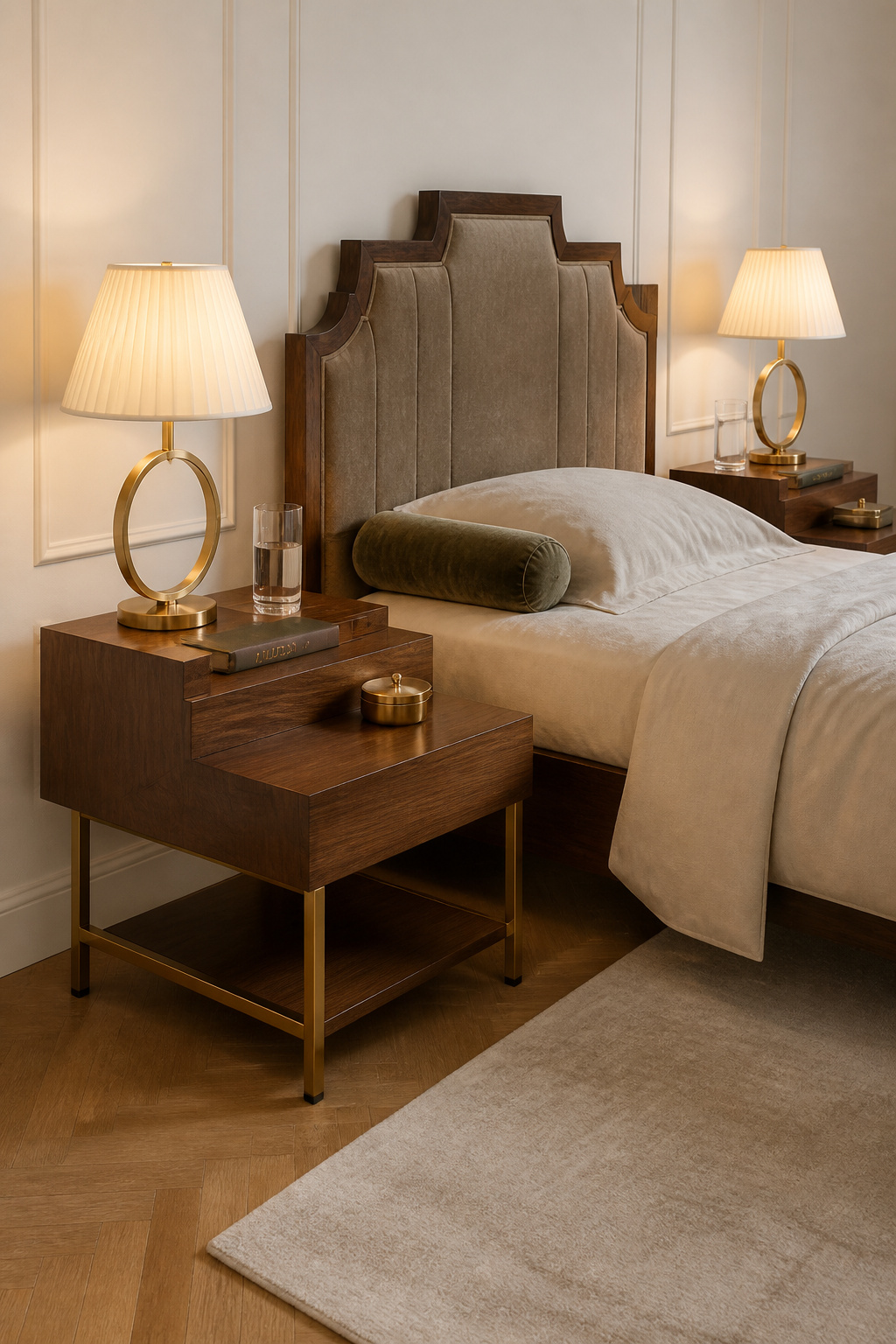
Two sources converged in the early 1920s to produce the stepped or ziggurat silhouette: Aztec temple architecture, which fascinated European designers, and the stepped crown of the Chrysler Building (completed 1930). Horizontal banding and geometric profiles of Art Deco furniture directly echoed these architectural forms. Art deco decor at its most characteristic has a vertical rhythm of steps and tiers — and nowhere does this appear more naturally than in the bedside table.
Materials That Read as Authentically Art Deco
The most period-accurate materials for a stepped nightstand are walnut veneer, lacquered wood in black or cream, and brushed or polished brass. A marble top — either original or as an aftermarket replacement slab — is also deeply Deco. Etsy sellers cut marble to custom dimensions for £40–£90. CB2’s ‘Tiered’ side table in brushed brass at $299 is the most recognisably Art Deco piece in that price range. Made.com’s ‘Olsson’ tiered table in brass and glass runs £229.
Styling the Nightstand Surface
The Art Deco nightstand surface was never empty but never cluttered. One lamp (brass base, pleated ivory shade), one book facing away, one small decorative object. Two mismatched Art Deco nightstands in the same material family — both lacquered, or both walnut — read more interesting than a perfectly matched set. The slight asymmetry feels curated.
11. Art Deco Vanity and Dressing Table
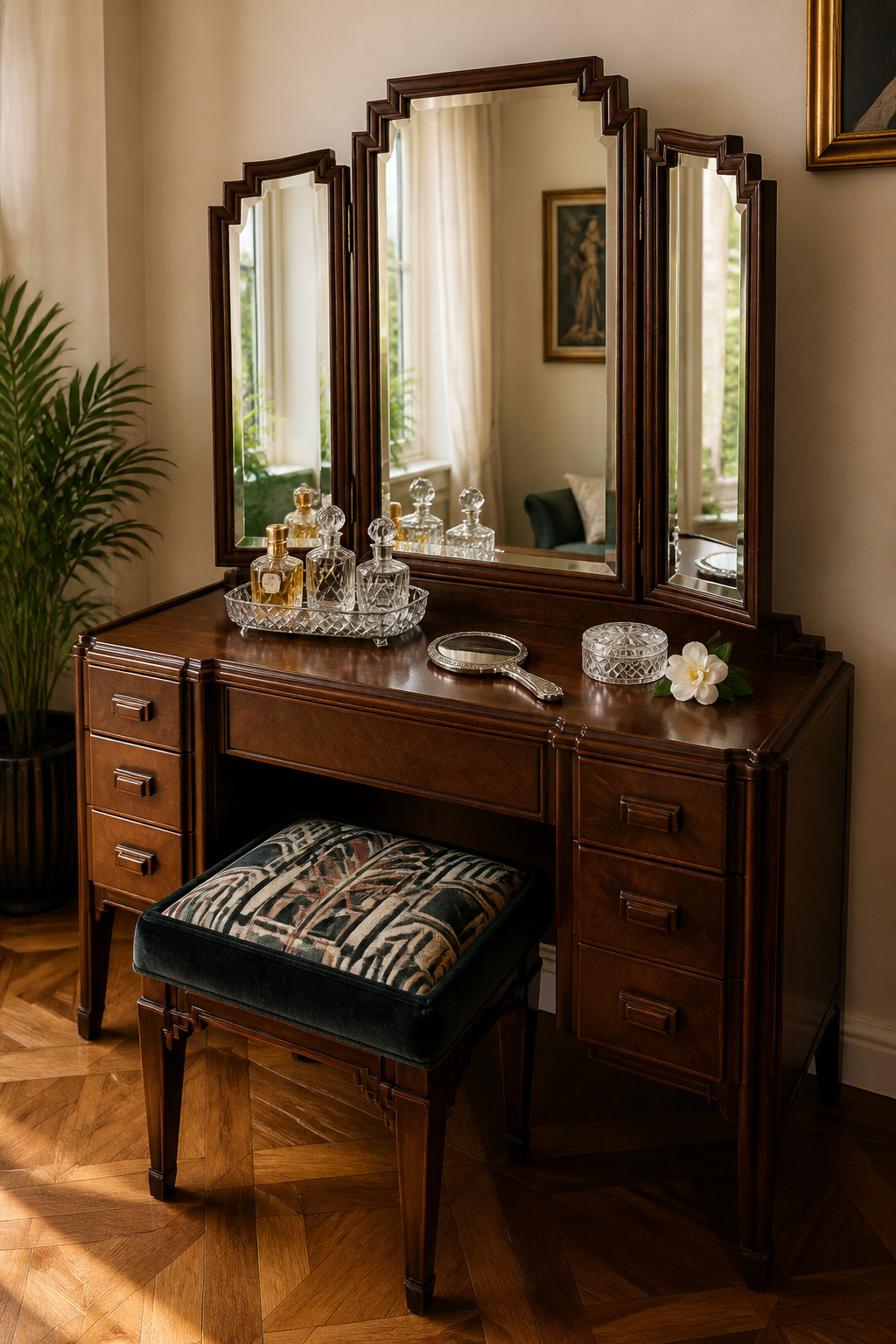
The dressing table was the centrepiece of the Art Deco boudoir. Ruhlmann’s ‘Maharajah’ dressing table (1920) — with its rosewood veneer, silvered fittings, and carefully proportioned mirror — is among the most recognisable pieces of furniture design in the twentieth century. The morning ritual was elevated to theatre. Getting ready wasn’t incidental; it was the performance of a considered self.
Original Vintage Finds vs. Reproduction Pieces
Look for the triptych mirror specifically when sourcing — it’s the most recognisable Art Deco vanity feature. Original 1930s dressing tables appear at estate sales, charity shops in suburban areas, and eBay UK for £150–£600. A charity shop 1940s dressing table for £80 plus Rust-Oleum satin black spray (£12) and new velvet fabric (£15/m) produces a beautiful result for under £120. The joinery on originals is often better than reproductions at twice the price.
How to Style the Vanity Surface
The Art Deco dresser surface had clear hierarchy: a tray held the perfume bottles (three maximum, different heights); the mirror had a small collection of daily objects; the remaining surface stayed clear. Clutter on the vanity is a contemporary problem. The 1920s understood that restraint in display was itself a form of abundance.
12. Sunburst Mirrors and Clocks as Focal Points
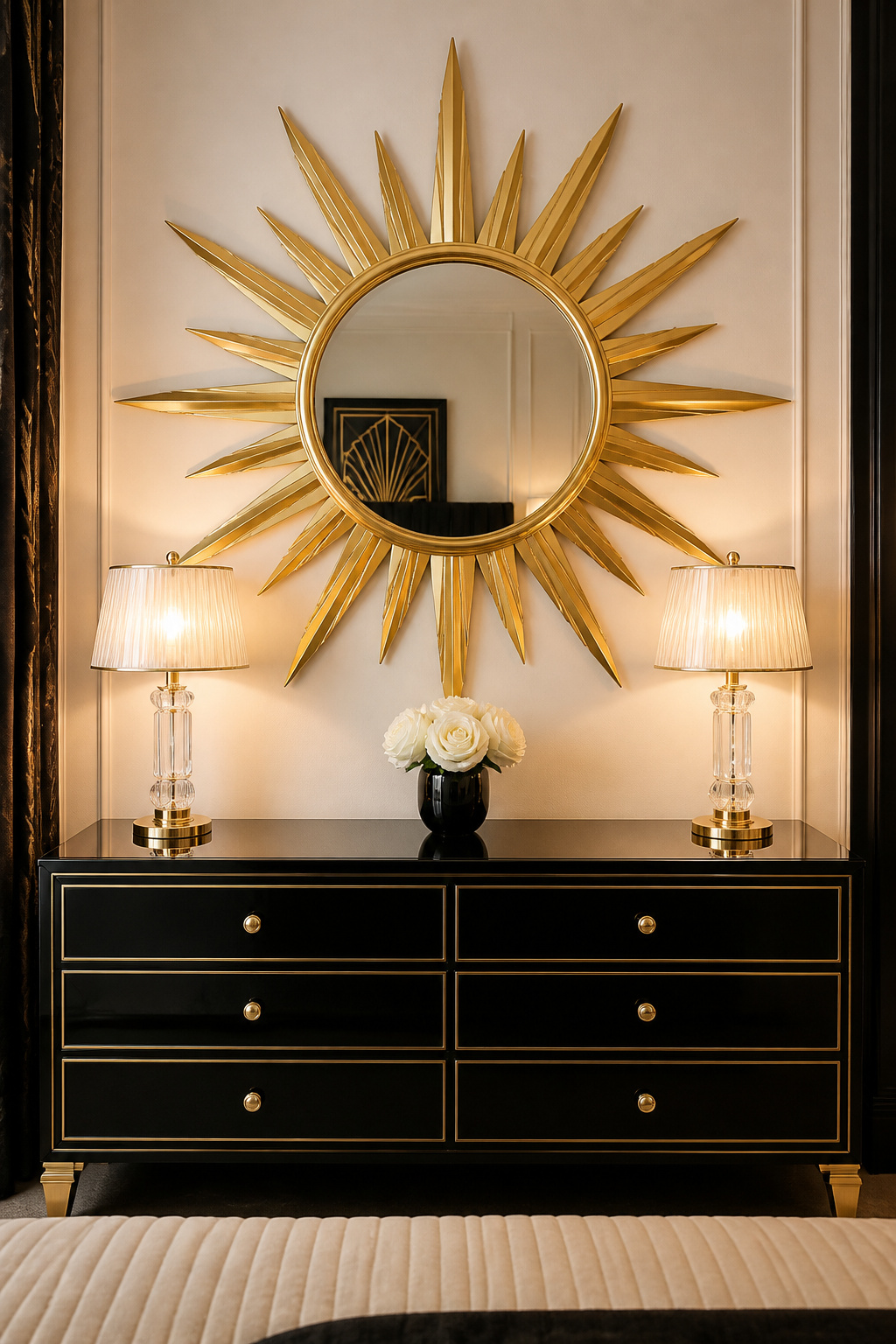
Howard Carter opened Tutankhamun’s tomb in November 1922, and within eighteen months, Egyptian solar imagery had flooded Western design. The sun disc of Aten — a radiating gold circle with extended rays — translated directly into the sunburst mirror. By 1925, it was the single most recognisable Art Deco motif: above fireplaces, on hotel lobby walls, in theatre foyers. It connected contemporary design to four thousand years of solar symbolism.
Over the Bed vs. Over the Dresser
For maximum impact, a sunburst mirror needs to be at least 60cm (24 inches) in diameter. Below that size, it reads as decorative rather than architectural. Anthropologie’s ‘Rini Sunburst’ at 91cm and £299 is the premium option. Umbra’s 24-inch version in brass runs $89–$119 and works well for smaller rooms. A sunburst mirror above the dresser is historically more accurate than above the bed — mirrors belonged with grooming furniture in the Deco boudoir.
Combining a Sunburst Mirror With a Matching Clock
The Art Deco interior used repetition as a design tool — the same motif at different scales creates coherence. One sunburst mirror (large, primary wall) and one sunburst clock (smaller, secondary wall) is the right ratio. More than two instances tips from purposeful into theme-park territory. Howard Miller’s ‘Medallion’ wall clock in brushed gold at $129 is a credible companion piece.
13. Rich Silk and Satin Window Treatments
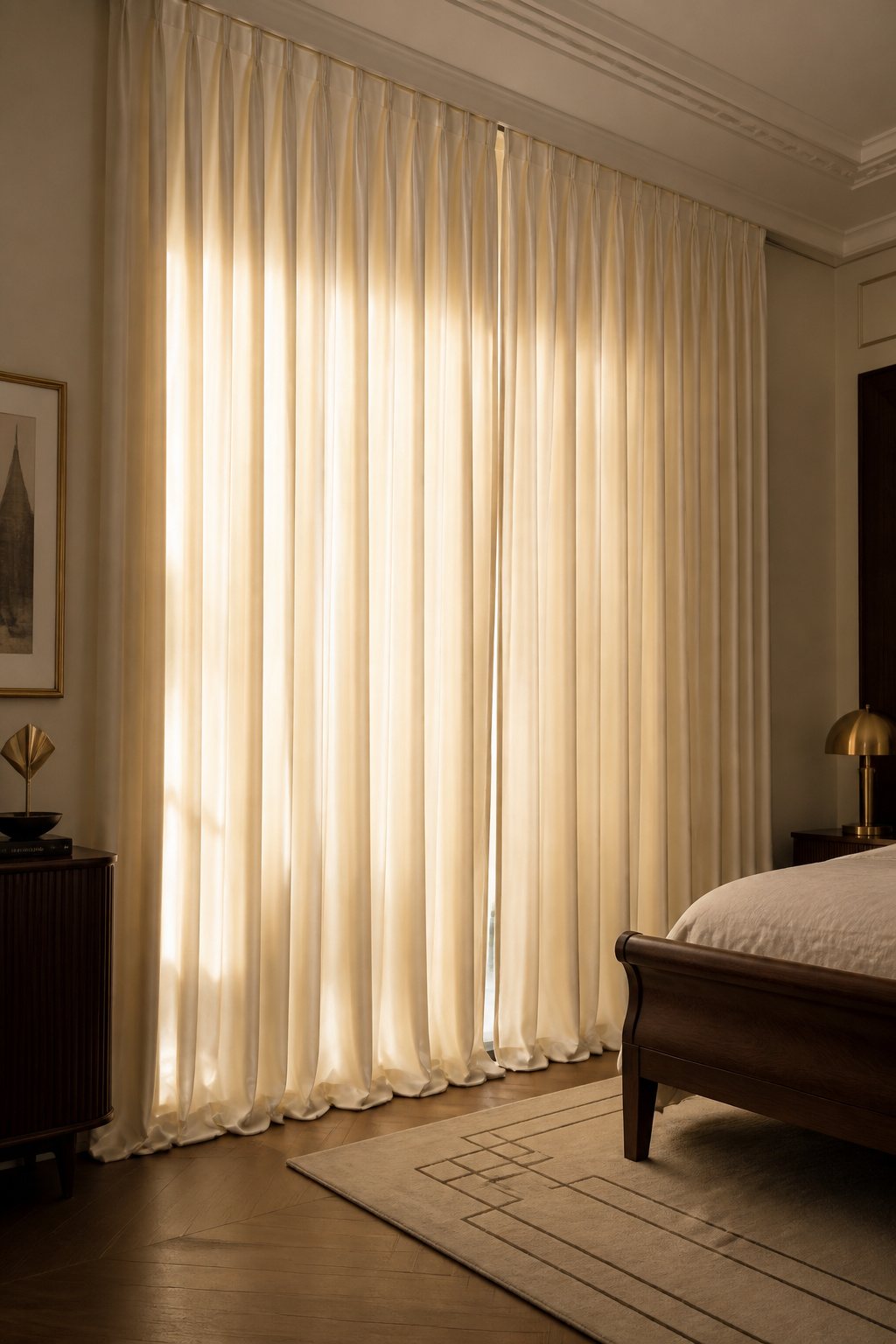
Hollywood cinema of the 1930s established the iconography of the glamorous bedroom. Every great bedroom scene featured floor-to-ceiling drapes in ivory, champagne, or deep wine. The curtains weren’t just window coverings; they were the room’s most theatrical element. They controlled the light, altered the acoustics, and made the room feel complete in a way that furniture alone couldn’t achieve.
Floor-to-Ceiling vs. Cornice Box
Hang the rod or track 10–15cm above the window frame, or as close to the ceiling as possible. Bring the curtains to just touch the floor — this creates the illusion of taller windows. Pottery Barn ‘Emery Linen Blend’ drapes in 96–108 inch lengths (£189/panel) give the right drop for most UK rooms. For a more affordable version: Dunelm ‘Halo’ faux silk eyelet curtains at £49.99/pair read convincingly from across the room. John Lewis ‘Paloma’ satin panels at £120/panel are mid-tier and worth considering for light-filled rooms.
Budget Alternatives to Real Silk
Faux silk has improved significantly in the past decade. The key test is the drape: real silk falls in smooth, heavy vertical folds; good faux silk does the same. Also, lining any satin or faux silk curtain with blackout lining (£4/m from John Lewis) makes the fabric hang better with the added weight and substantially extends the curtain’s lifespan.
14. Geometric Rugs in Earthy and Jewel Tones
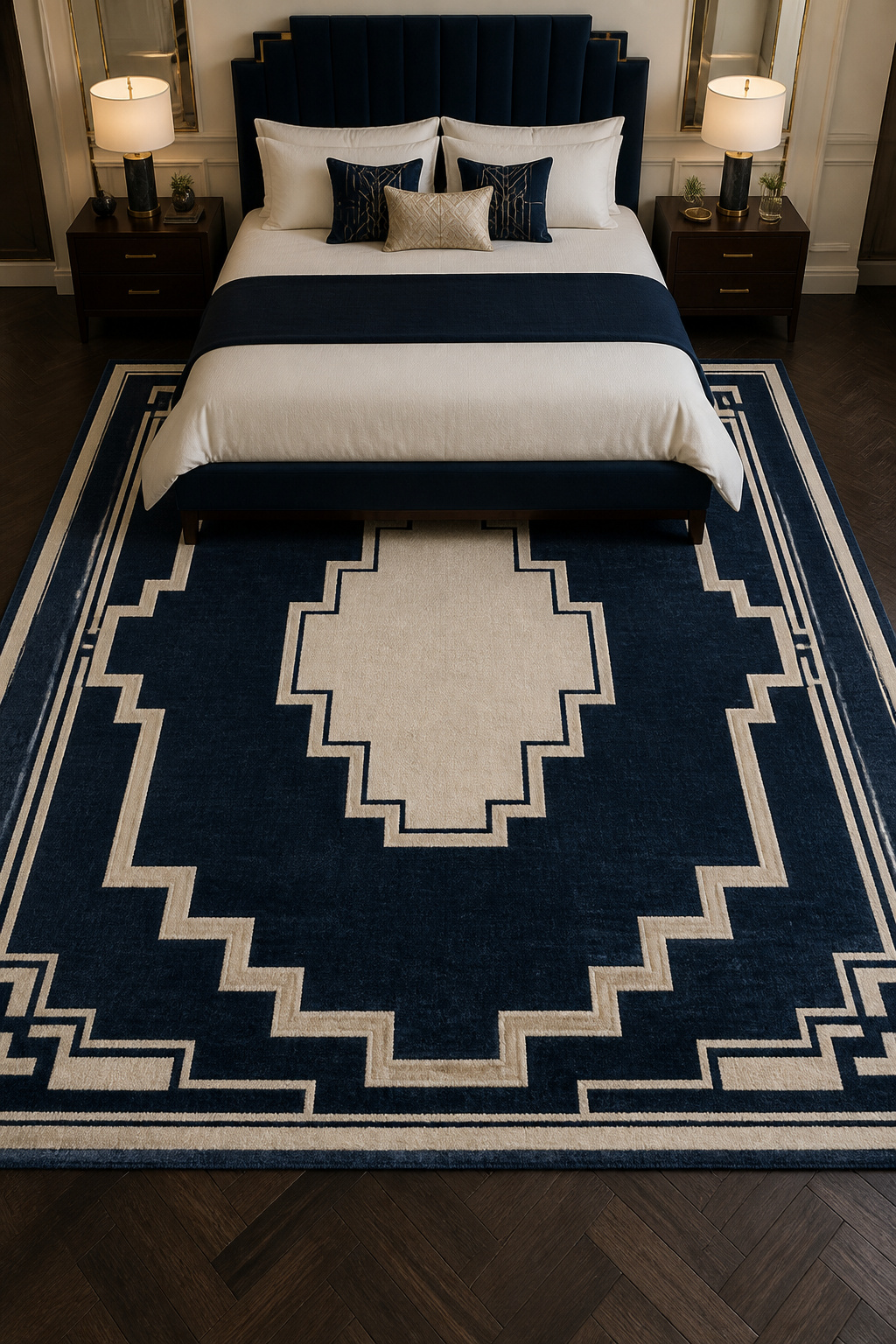
Art Deco rug design drew from two traditions Paris designers encountered through ethnographic exhibitions: the bold geometric Kilim rugs of the Near East, and the stepped rectilinear patterns of Aztec and Egyptian motifs. Ivan da Silva Bruhns created defining Art Deco rugs of the 1920s. His work was so distinctive that pieces now sell at major auction houses for tens of thousands. The accessible version of his tradition is available at very reasonable prices.
Getting the Size Right
For a king bed, the rug should extend at least 50cm beyond each side and fully under the nightstands. A 270x370cm (9x12ft) rug is usually the minimum for a standard UK king bedroom. The most common sizing mistake is an undersized rug that floats in the centre of the floor without anchoring anything. If you’re drawn to darker floor treatments, the ideas in 20 Revelations for Embracing the Elegant Drama of Black Bedroom Walls show how a rug and floor work together as a system.
Material Considerations
The most authentic material choices for a period-accurate rug are wool or natural-fibre pile constructions. Ruggable’s washable geometric at $299 for 8x10ft is practical and machine washable — a real advantage in a bedroom. A non-slip rug pad under any flatweave is essential on wood floors (around £60 for a 9x12ft under-rug).
15. Velvet Drapes That Complete an Art Deco Bedroom
Velvet curtains served a dual function that silk curtains couldn’t match: they blocked light completely and they transformed the acoustics and thermal feel of the room. Real silk velvet at 600g per square metre absorbs sound perceptibly. The room becomes quieter, warmer, and more enclosed — exactly the qualities that defined the luxurious bedroom as a sanctuary. If you’re going to make one fabric investment in an art deco bedroom, velvet drapes are the priority.
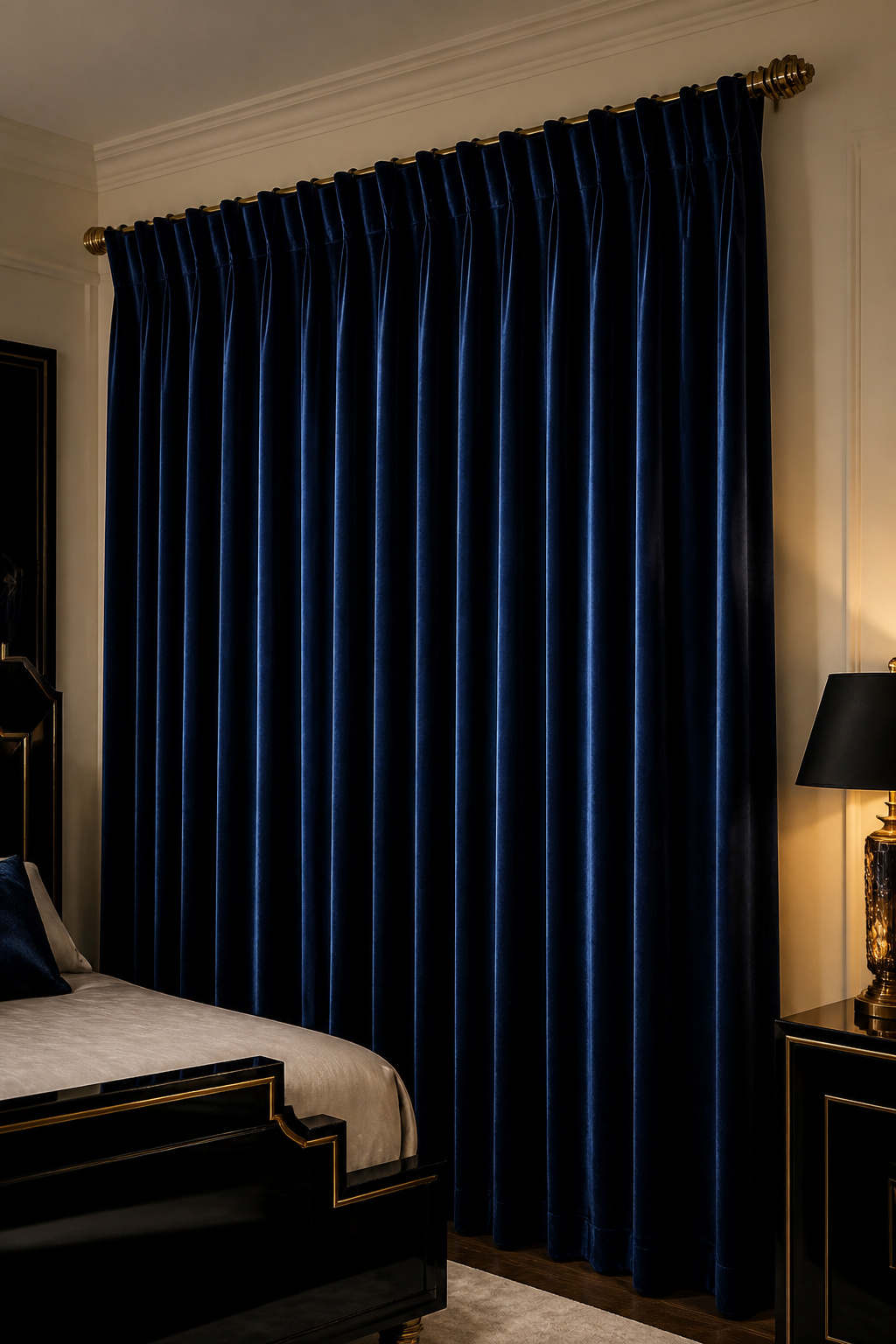
The Right Length, Header Style, and Hanging Height
Eyelet headers are the most widely available but the most contemporary-reading. Pinch-pleat or goblet-pleat headers look more period-accurate and create the vertical folds that show velvet’s texture at its best. Hang from ceiling height, not the window frame. H&M Home ‘Velvet’ blackout curtains in midnight blue run £79.99/pair. Made.com’s ‘Zadie’ velvet curtain in deep teal at £149/pair has better quality and the right weight. John Lewis velvet blackout panels at £149/panel are the premium option.
Layering Velvet Over a Sheer
Layering an ivory sheer behind the velvet gives you light control during the day while the velvet provides full blackout at night. This is the most practical approach for an art deco bedroom that also needs to function in daylight. For more ways to combine heavy fabrics and bold pattern, the luxury bedroom wallpaper accent wall ideas show how velvet and geometric wallpaper work together.
16. Chrome and Brass Hardware in Your Art Deco Bedroom Style
Chrome plating became commercially viable in the 1920s, and Art Deco designers adopted it immediately. It was the material equivalent of a manifesto: modern, progressive, not interested in looking backward. Brass, by contrast, signalled continuity with the nineteenth century — but updated through streamlined, geometric forms. Having both in a room was deliberate. It stated that you were standing at the junction of tradition and modernity. That tension is exactly what makes an art deco bedroom style feel alive rather than archival.
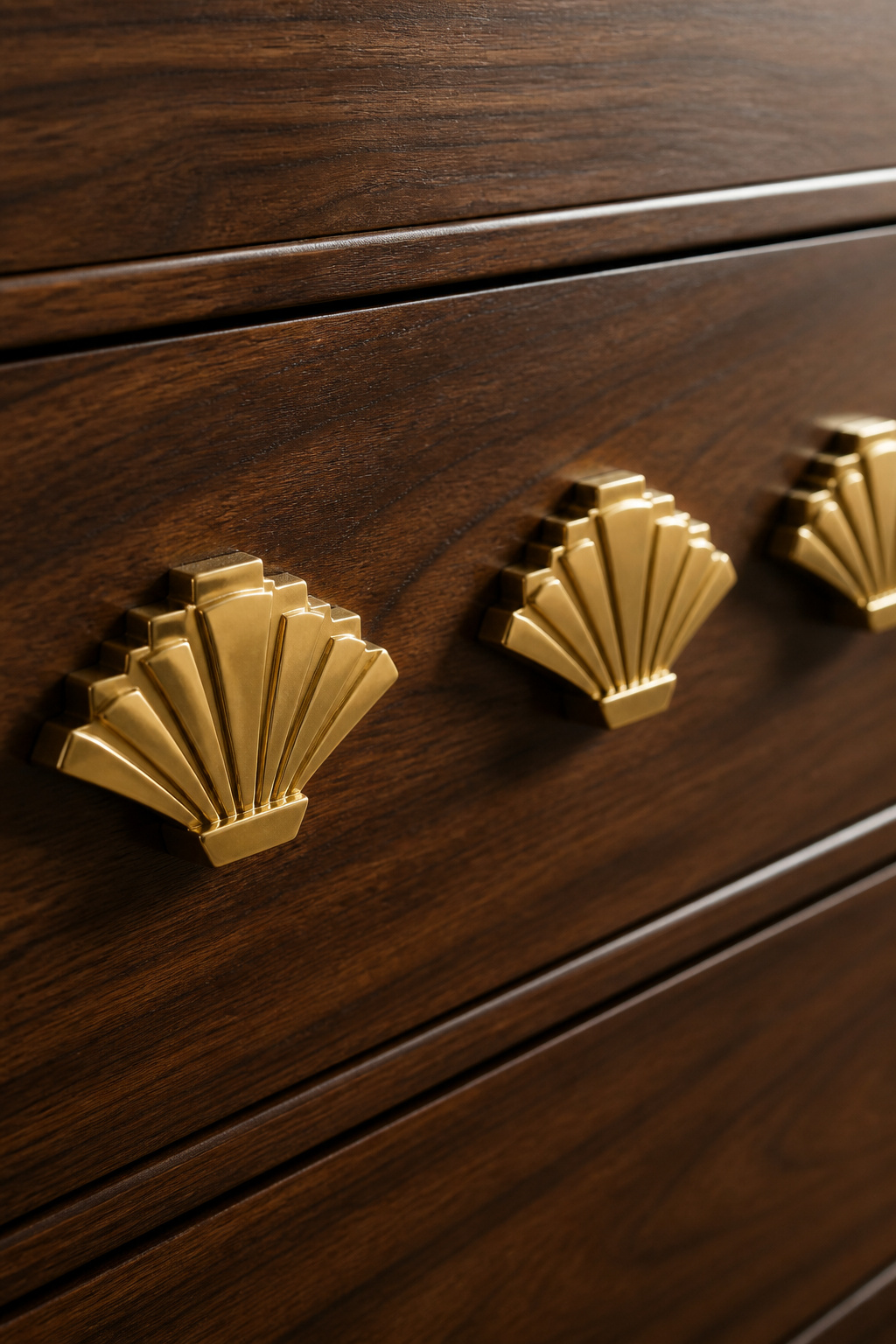
Swapping Out Hardware for Period Pulls
This is the highest-impact, lowest-cost Art Deco upgrade available. Standard square or cylindrical drawer pulls read as generic. Fan-shaped or stepped geometric pulls read as deliberately Deco. Replacing 12 pulls on a dresser and wardrobe costs approximately £36 at £3 each from Amazon, and takes forty minutes with a screwdriver. The visual transformation is disproportionate to the effort. From a black bedroom inspiration perspective, hardware is often the detail that separates a confident dark bedroom from a flat one.
Mixing Chrome and Brass Intentionally
Don’t mix chrome and brass on the same piece of furniture — but you can use different metals on different pieces. Chrome hardware on the dresser, brass on the nightstands. The contrast reads as intentional curation when you commit to one metal per piece. Mixing both metals on the same drawer front reads as indecision rather than sophistication.
17. Decorative Ceiling Treatments: Coved, Tray, and Coffered
Art Deco architects regarded the ceiling as a fifth design surface — not a white rectangle to be ignored. The Chrysler Building lobby ceiling (1930) has geometric triangular skylights in Nirosta steel. The Radio City Music Hall ceiling (1932) features a sunburst pattern in gold leaf. In domestic interiors, the coved ceiling was the most common residential treatment. That curved transition from wall to ceiling softened the right angle at the top of a room in a way that felt both modern and classically proportioned.
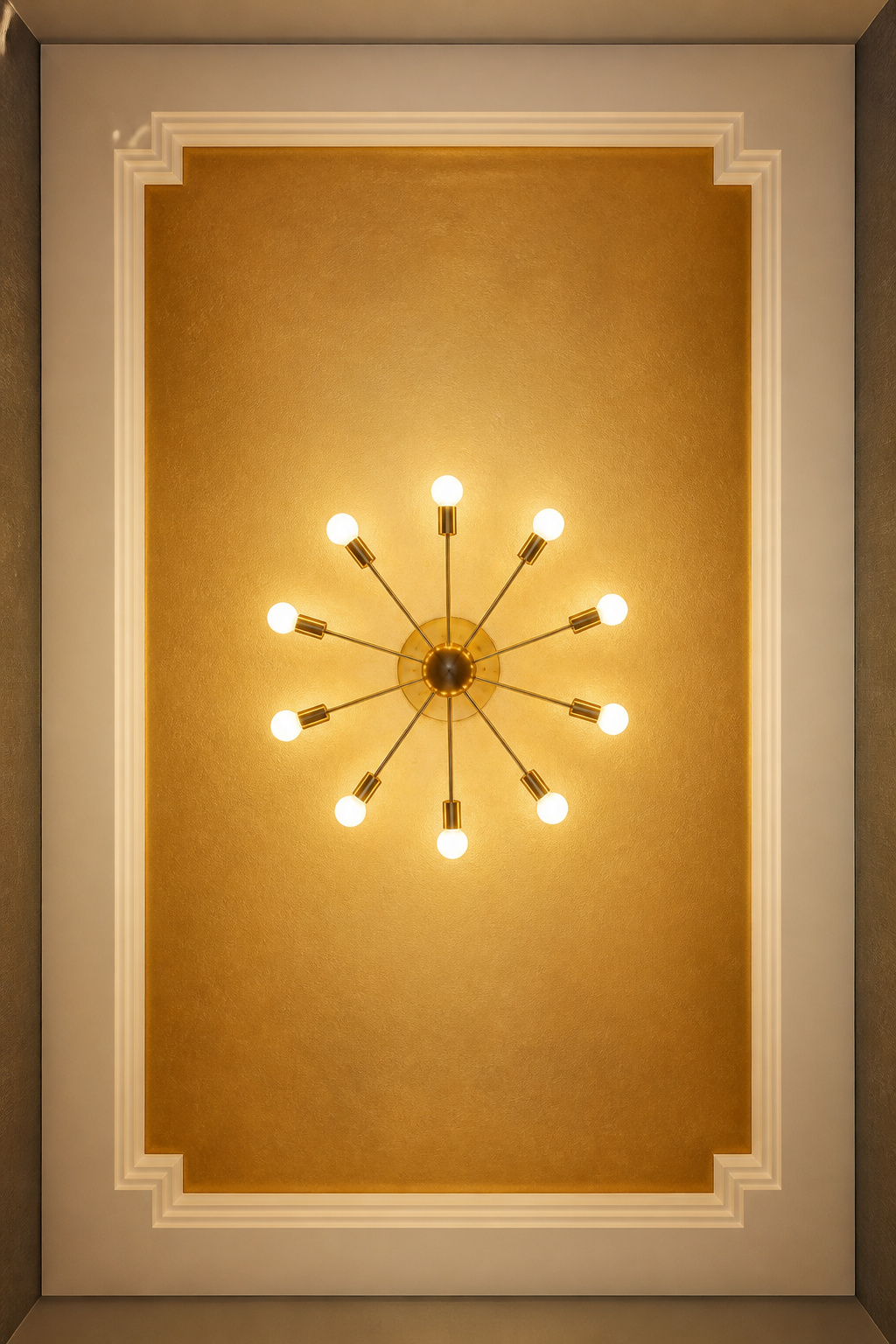
DIY Cove Moulding vs. Professional Tray Installation
Cove moulding is the most accessible intervention. Orac Decor’s CX123 cove moulding at £12.50/m installs with adhesive and a mitre saw. Standard Gyproc coving at £8.99/4m is the budget option. A complete installation on a 4x4m bedroom takes two people and four hours. A tray ceiling requires more work: timber battens, plasterboard for the tray surface, filling, and sanding. However, when the inner panel is painted in matte gold, the result is genuinely transformative.
Using Ceiling Paint Colour to Enhance Architectural Detail
The fastest Art Deco ceiling upgrade: Dulux ‘Gold Effect’ satin (£24/tin) on the inner panel of a tray ceiling against ivory outer surfaces. Total material cost is under £40, and the effect reads as expensive. For rooms without a tray ceiling: a broad cove moulding painted in the wall colour (not white) blends ceiling and wall. That technique increases apparent room height and reduces the visual interruption at the ceiling junction.
18. Lacquered Wardrobes and Statement Storage
The Art Deco wardrobe — the armoire de chambre — was conceived as furniture of architectural scale. Paul Iribe and Ruhlmann designed wardrobes that read as monuments within the room: exotic veneers, lacquered panels, and bronze hardware. The wardrobe wasn’t an afterthought in the bedroom; it was the second most important piece after the bed. Storage that looks reluctantly chosen undermines every other Art Deco element in the room.
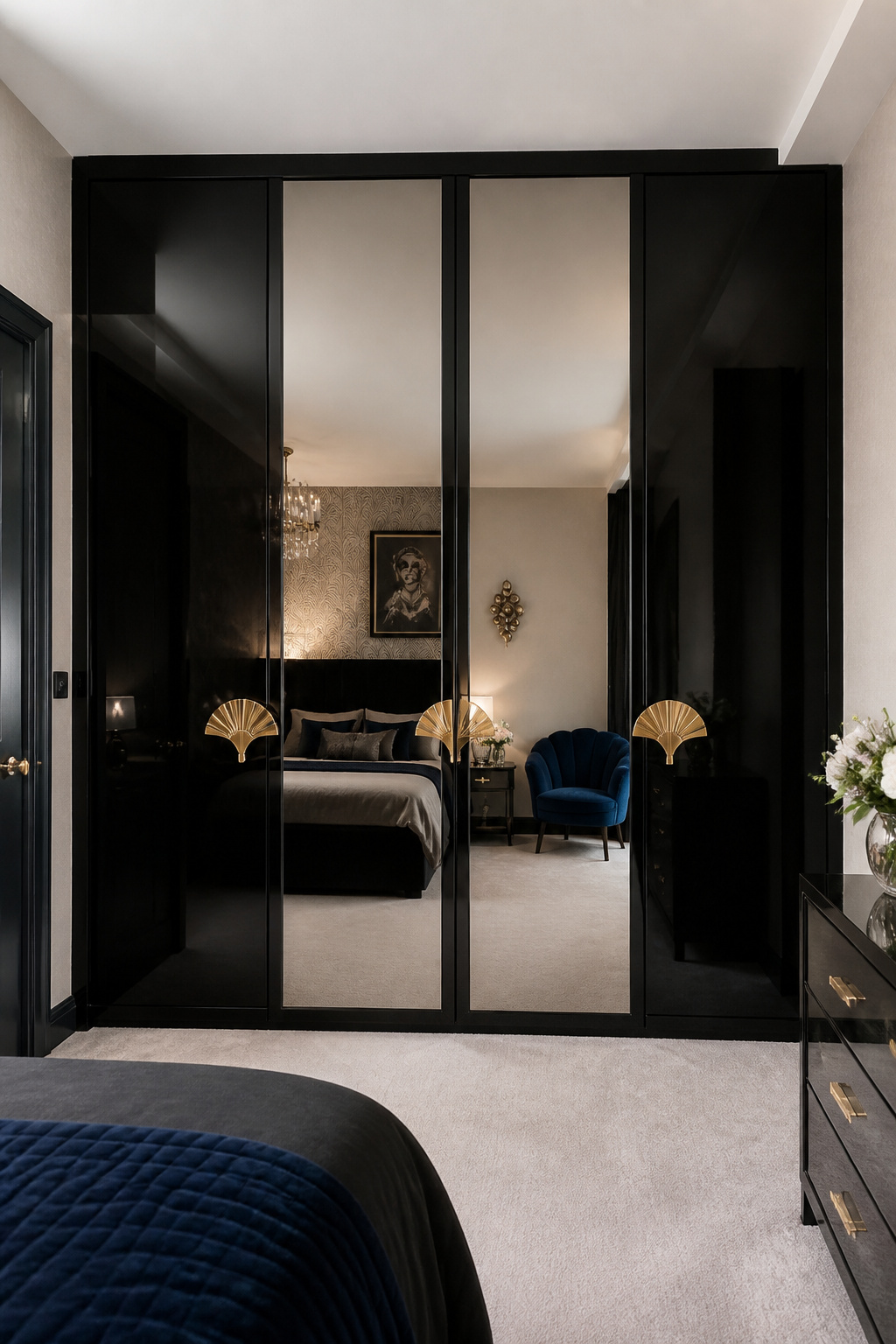
Built-In vs. Freestanding Art Deco Wardrobe Options
The Deco wardrobe was designed to fill an architectural space entirely — floor to ceiling, wall to wall — so it read as built-in even when it wasn’t. A freestanding wardrobe that stops short of the ceiling says “this is furniture”, not “this is architecture.” The Swoon ‘Dauphine’ wardrobe in lacquered solid oak (£1,299) has the right proportions. Wayfair’s ‘Willa Arlo Brea’ in black gloss ($899) is the mid-range freestanding option. Also, an IKEA PAX with fan-pull brass handles, mirrored door panels (glazier-cut, £40–£80/panel), and piano lacquer spray on the frame runs £600–£800 from scratch. Most guests can’t distinguish it from mid-range reproductions at £1,500+.
Hardware, Fittings, and the Practical Interior
The interior of an Art Deco wardrobe was as considered as the exterior. Hanging rails at two heights, a central section with shelves and drawers, a designated space for accessories. The hardware inside — drawer runners, rail brackets, shelf pins — should be brass or chrome to match the exterior pulls. Organising the interior with cedar lining for the hanging section and velvet-lined jewellery drawers is a detail that makes the wardrobe a pleasure to use, not just to look at.
How to Build Your Art Deco Bedroom: From Concept to Completion
Every art deco bedroom I’ve put together over twelve years has followed the same sequence. Start with one anchor piece, and let everything else respond to it. The anchor is usually the bed: its finish, its silhouette, its height above the floor. If you start with a lacquered black platform bed, you know the nightstands need walnut or brass, the walls need ivory or a deep jewel tone, and the ceiling needs a cornice or tray. Each decision falls into place once the anchor is right.
Starting With One Anchor Piece and Building Outward
Resist buying everything at once. An Art Deco bedroom built gradually — one well-chosen piece per month — looks more considered than one assembled in a weekend from the same store. The anchor piece sets the finish language: if it’s lacquered, the rest follows in gloss. If it’s walnut, the rest follows in warm wood and brass. Then add one textile layer (the headboard or the curtains), then the lighting, then the accessories. That sequence prevents the accumulation of mismatched elements.
Where to Source Authentic and Reproduction Art Deco Pieces
For originals: 1stDibs and Pamono have authenticated 1920s–1940s pieces at premium prices. eBay UK and Etsy have a wider range, from £40 for smaller pieces to several hundred for furniture. For reproductions: Article, CB2, West Elm, and Swoon produce the most credible Art Deco-inspired furniture at accessible prices. Don’t overlook charity shops in older suburban areas. The 1940s and 1950s pieces that show up there are one step removed from the Art Deco period. A can of lacquer spray and new hardware transforms them in an afternoon. The blue bedroom decor palette on this site shows how jewel-toned repaints of found pieces can anchor an entire room.
The Three Elements That Make or Break an Art Deco Bedroom
After everything I’ve observed and lived with, it comes down to three things. First: surfaces have to be high-quality — lacquer on furniture, velvet or satin on textiles, polished metal on hardware. Art Deco was specifically about material quality, not quantity. Second: the geometry has to be consistent — if the headboard is stepped, the nightstands should be too. Third: the lighting has to be warm. Cool LEDs undo every other Art Deco element in the room, because the aesthetic was built for warm incandescent light. Use 2700K bulbs throughout, use multiple light sources, and make sure every lamp is beautiful in its own right rather than just functional.
The art deco bedroom isn’t a style that tolerates indifference. But if you engage with it seriously — sourcing the right pieces, getting the palette right, treating the ceiling as a design surface and the hardware as a statement — it rewards that engagement with a room that feels genuinely unlike anything a catalogue can produce.