
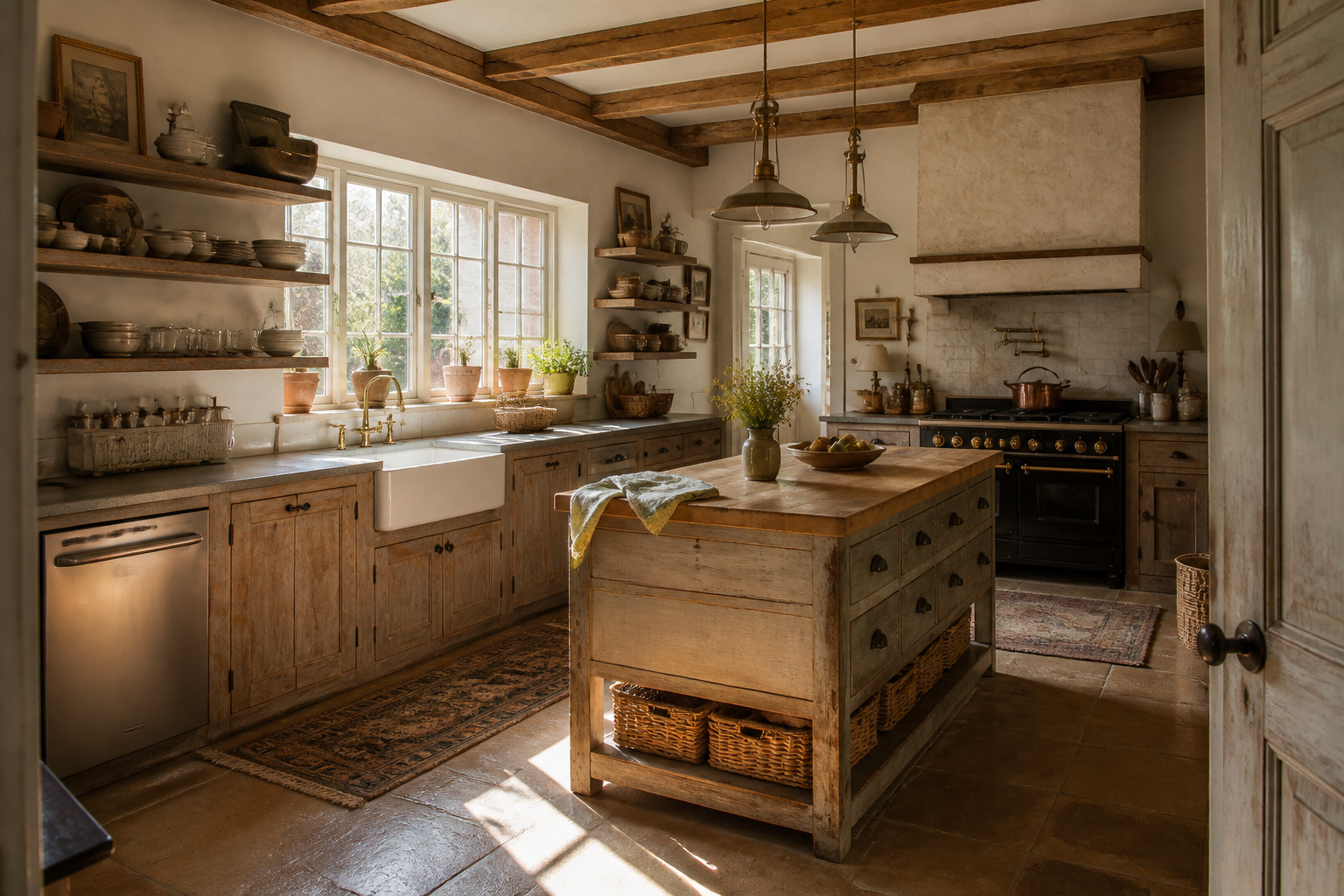
I was standing in a friend’s kitchen last spring. Brand-new renovation, forty thousand pounds of quartz and handleless cabinetry. Something felt wrong. It was beautiful the way a hotel lobby is beautiful: polished, impersonal, and cold. She’d stripped every trace of history from the room and replaced it with surfaces that reflected light but nothing else.
Walking home, I kept thinking about the kitchens I love most. The ones with a battered wooden worktop worn smooth by decades of bread-making. A shelf of mismatched ceramics collected from three counties. A pendant light that came from a factory sale in 1962. Those kitchens feel lived in, because they are.
Rustic kitchen ideas aren’t about manufacturing a look. After twelve years sourcing reclaimed materials and restoring vintage pieces, I’ve learned the difference. Some kitchens have genuine warmth. Others just have the props. The rustic kitchen ideas below draw from real projects — salvage yard finds, farmhouse restorations, and careful upcycling. Every one of them earns its place through function as much as beauty.
1. Reclaimed Wood Open Shelving With Forged Iron Hardware
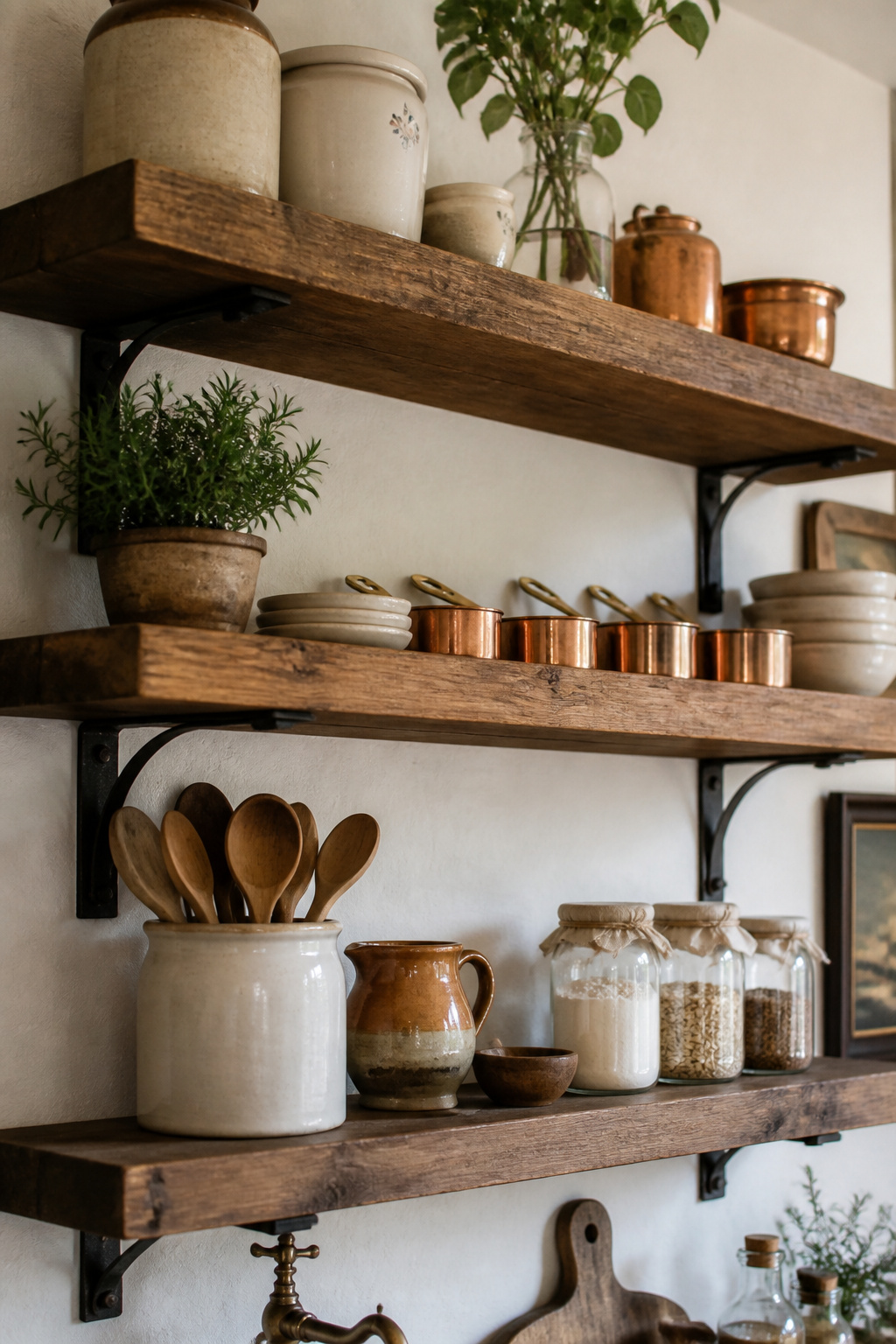
There’s a quality to salvaged wood that no new board can replicate: it has already done the work of existing. Barn oak pulled from a mid-century agricultural building carries grain patterns shaped by decades of humidity changes. That variation is precisely what gives open shelving its soul.
Why Salvaged Wood Beats Factory “Rustic” Boards
The home centre sells wood labelled “weathered barn board” that has been machine-distressed and smells of polyurethane. It looks fine in a showroom and flat in a kitchen. Genuine salvaged timber comes from a specific place and carries marks from that place. Source from local architectural salvage yards first. They often have barn oak, pine boards, and worktop off-cuts cheaper than new timber. Reclaimed Wood Exchange and Longleaf Lumber both ship verified reclaimed stock if local sourcing isn’t available.
Sizing, Spacing, and Load-Bearing Basics
Run shelves 10 to 12 inches deep for most kitchen storage. Space them 14 to 16 inches apart vertically so taller items have room. For structural brackets, forge-iron L-brackets must anchor into wall studs — no exceptions. A 3-inch-thick oak shelf at 36 inches wide holds significant weight, but only if the brackets hit solid wood or masonry.
Styling the Shelves: What to Display and What to Hide
Display things you use every day; put everything else behind a door. A shelf crowded with objects you never touch looks chaotic within a week. The working shelves in my clients’ kitchens hold three or four ceramic pieces in a related colour family. One or two purely beautiful objects. And the daily working items — oil, salt, a jar of wooden spoons. That mix of beauty and use is what keeps open shelving intentional.
2. Exposed Brick Backsplash: A Rustic Kitchen Ideas Classic
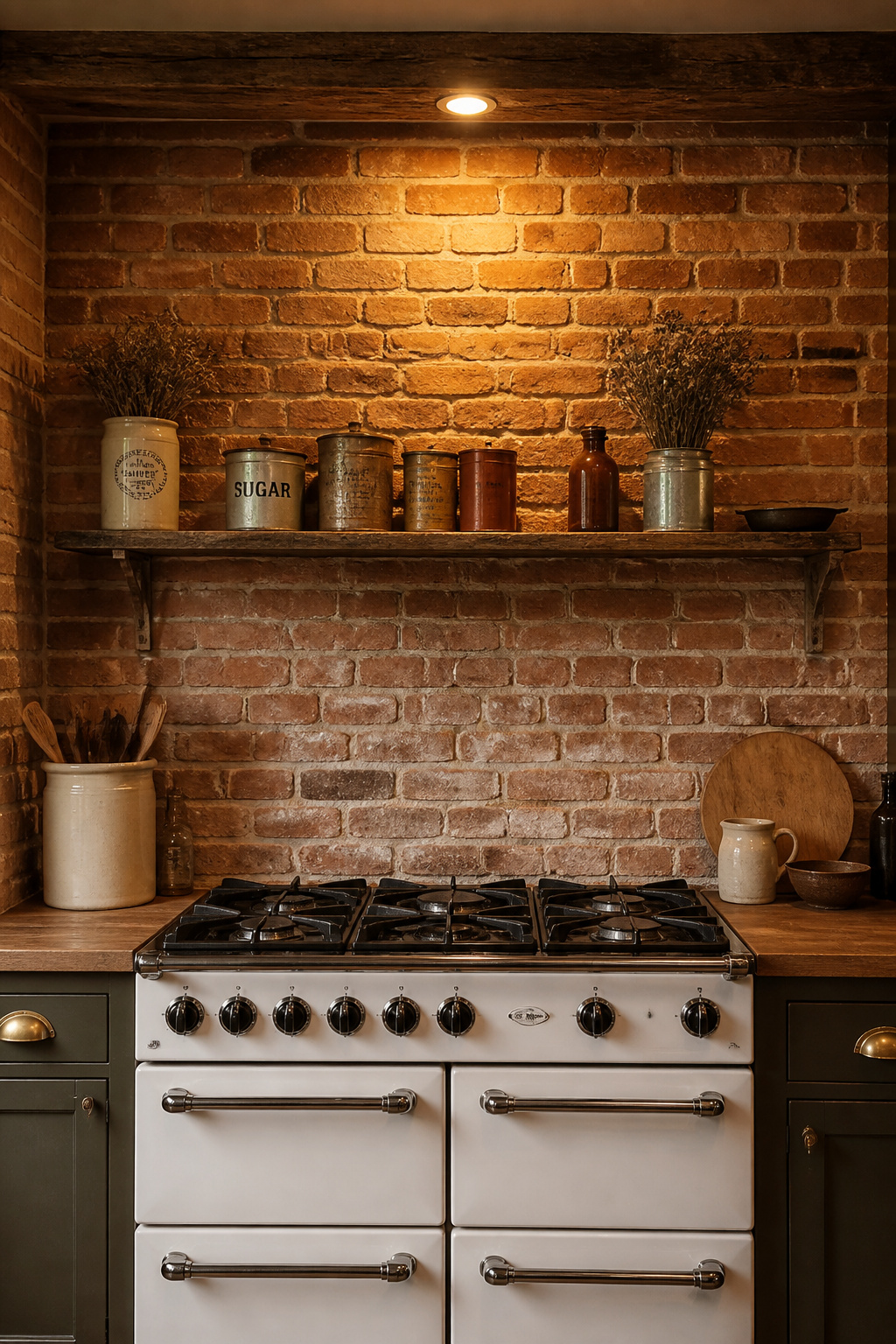
Few materials anchor a rustic kitchen as reliably as exposed brick. It brings warmth through colour: amber, ochre, and dusky red tones no paint can reproduce. Also, texture through the variation in each individual unit. In kitchens built before the 1970s, genuine brick often sits behind plaster, waiting to be uncovered.
Real Brick vs. Brick Veneer in a Kitchen
If your kitchen has original brick beneath plaster, remove a test section near the range to assess condition. Solid brick just needs cleaning with a diluted masonry wash. For kitchens without existing brick, thin brick veneer (half an inch thick) adheres directly to cement board. American Olean and Belden Brick both make credible veneers with regional colour variation. Also, Kitchen Backsplash Design: 12 Timeless Ideas for Your Home covers the installation sequence if you’re planning tile alongside the brick.
Sealing and Day-to-Day Cleaning
Unsealed brick above a cooking surface absorbs grease and steam, which darkens the mortar permanently. Apply two coats of a penetrating masonry sealer before the kitchen goes into use. Miracle Sealants 511 Impregnator is the standard recommendation. Re-apply every three years. For day-to-day cleaning, a mild degreaser in warm water with a stiff natural-bristle brush is sufficient.
Colour Families That Complement Exposed Brick
Brick has its own palette: warm ambers, dusty reds, and faded ochres. Cabinet colours that sit best alongside brick are soft whites (Farrow & Ball All White, Benjamin Moore Chantilly Lace), sage greens, and warm creams. Avoid cold greys — they fight the brick’s warmth.
3. Butcher Block Countertops for Warmth and Honest Material
Butcher block is one of the few kitchen surfaces that improves with use. The surface carrying six months of chopping and kneading has a depth that a brand-new board can’t replicate. A single run of end-grain walnut along the perimeter can transform a kitchen that’s otherwise unremarkable. It’s one of the most accessible rustic kitchen ideas to execute.
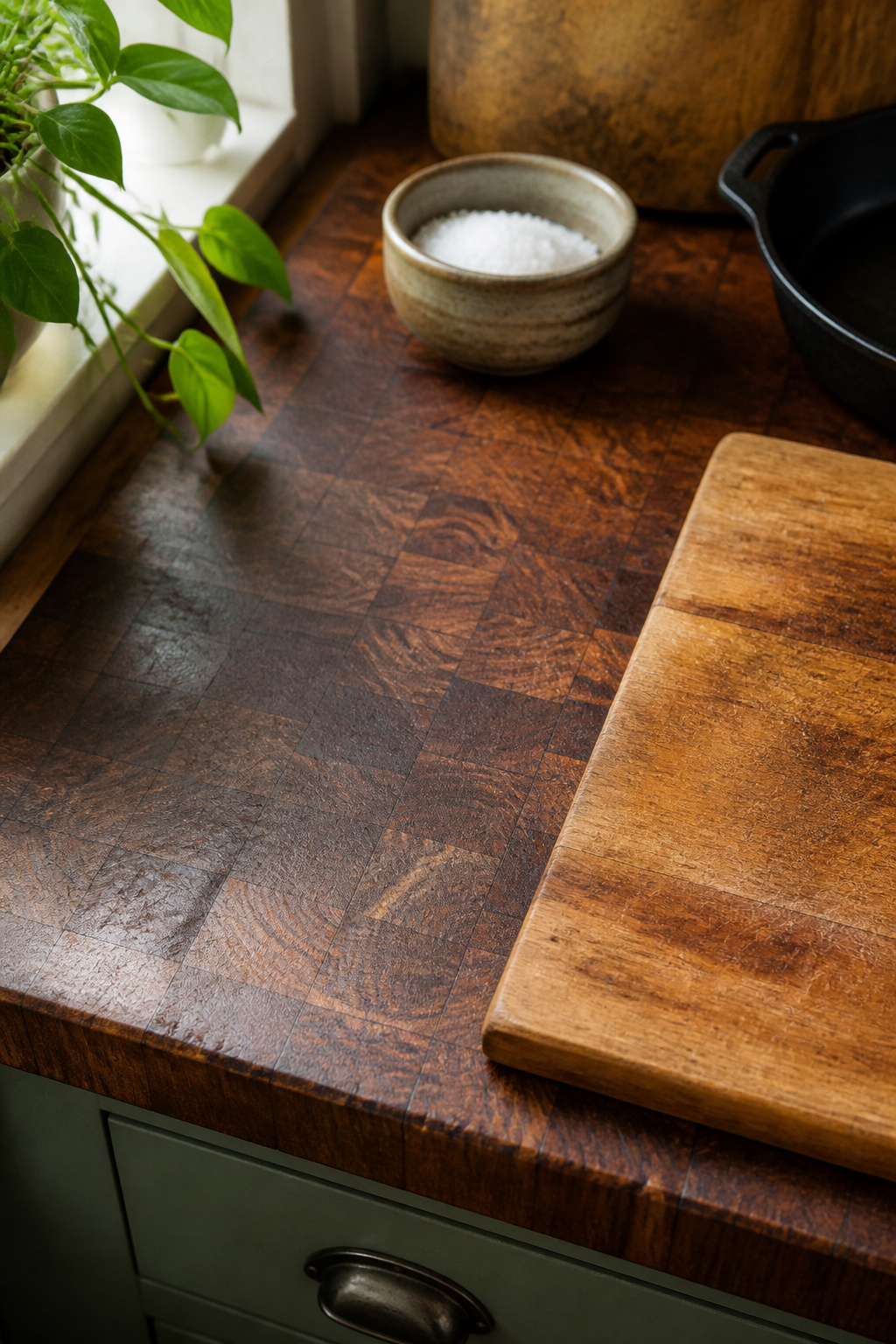
Hard Maple vs. Walnut vs. Acacia
Hard maple (Janka hardness 1,450 lbf) is the traditional professional choice — durable, tight-grained, and light in colour. Walnut (1,010 lbf) is softer and shows knife marks faster. But its warm chocolate tones make it the visual choice for most rustic kitchens. Acacia, widely available at IKEA, sits between the two in hardness. John Boos makes the benchmark for quality in both species; IKEA’s SKOGARP and Lumber Liquidators offer credible budget alternatives.
Oiling and Long-Term Care
Condition new butcher block before installation. Flood with food-safe mineral oil or Howard Butcher Block Conditioner. Let it soak for 20 minutes, wipe the excess, and repeat three times across three days. After installation, oil monthly for the first year, then quarterly. When the wood looks pale or dry, it needs oil. Also, explore 20 Magnificent Kitchen Countertop Ideas for the material combinations that work best alongside butcher block.
Mixing Butcher Block With Stone
One of the most successful techniques in contemporary rustic kitchens is the mixed-counter approach. Butcher block on an island or prep section, stone on the perimeter. The warmth of wood against the coolness of stone creates real material contrast. It makes a kitchen feel considered rather than assembled from a single catalogue order.
4. Farmhouse Sink as the Rustic Kitchen Ideas Anchor Piece
Before there were kitchen trends, there was the farmhouse sink. Wide, deep, front-facing, and built for a time when you washed everything by hand. The apron-front sink survives because it still solves a real problem. It’s a deep basin that accommodates large pots without the awkward tipping that standard sinks require. It also gives the room a focal point that reads as both functional and beautiful.
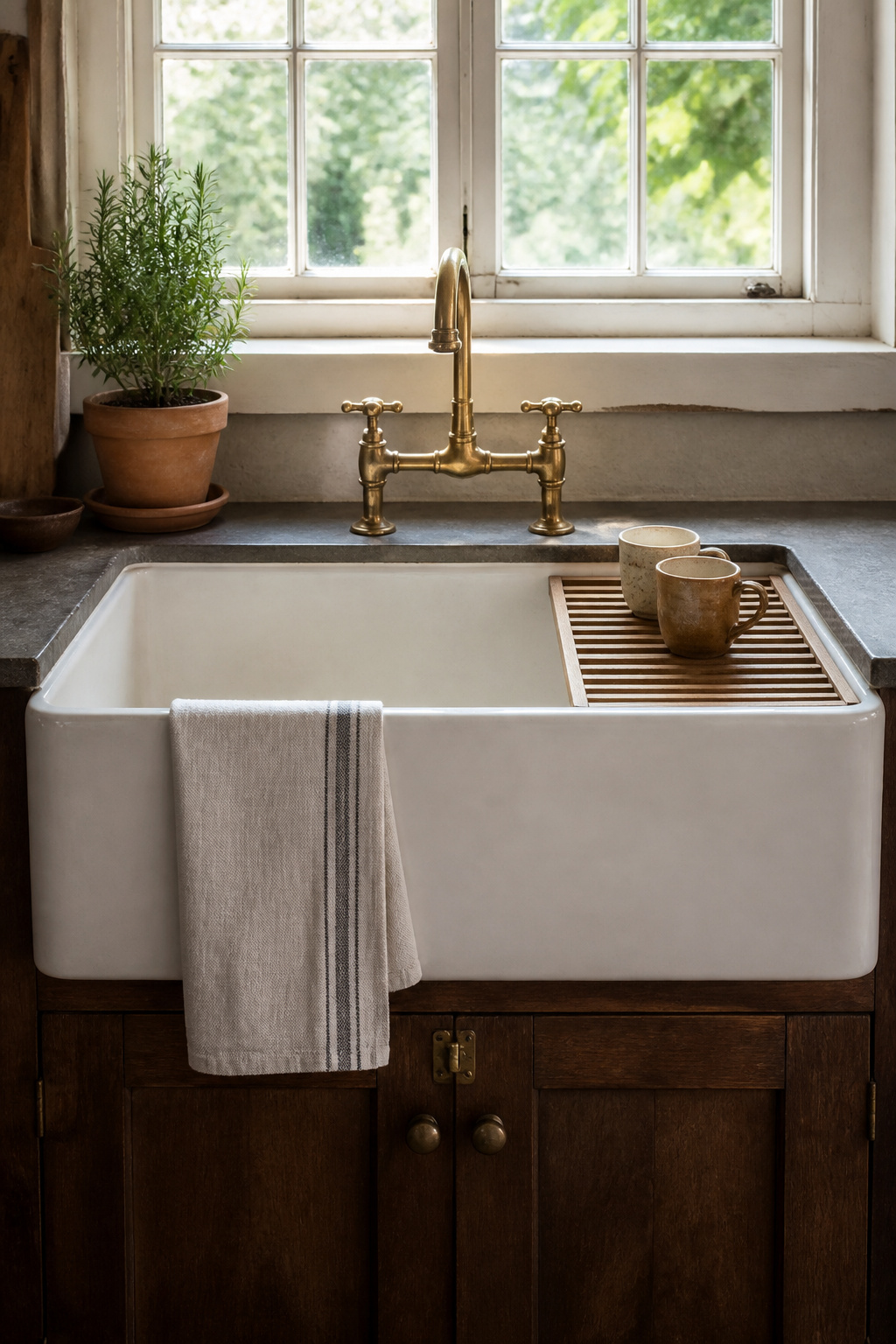
Fireclay vs. Cast Iron vs. Stainless
Fireclay (fired at over 2,000°F) is dense, non-porous, and resistant to chips — Kohler’s Whitehaven and Rohl’s Shaws are the benchmarks. Cast iron apron sinks are heavier and require reinforced cabinet bases, but their enamel surface has a depth fireclay can’t quite match. Stainless apron fronts are the most budget-friendly option — IKEA’s Domsjö at around £275 is popular. They wear extremely well, though they read as less distinctly rustic.
Cabinet Modifications and Scale
Standard base cabinets need modification for an apron-front sink. The front panel is typically removed and the face frame adjusted to accommodate the exposed apron. Most cabinet manufacturers offer a specific “farmhouse sink base” — worth ordering this rather than modifying a standard cabinet. The proportion that matters most is between the apron height and the cabinet door height below. The apron should be visible but not overwhelming. Most fireclay sinks sit about 8 to 10 inches proud of the cabinet face.
5. Shaker Cabinets Painted in Earthy, Heritage Tones
The Shaker cabinet is the honest backbone of the rustic kitchen. It was developed in the 18th century by a community that believed function and beauty were inseparable. Its flat centre panel and clean proportions have outlasted every cabinet trend of the past 200 years. In a rustic kitchen, Shaker doors in the right earthy tone become the architectural logic that holds everything else together.
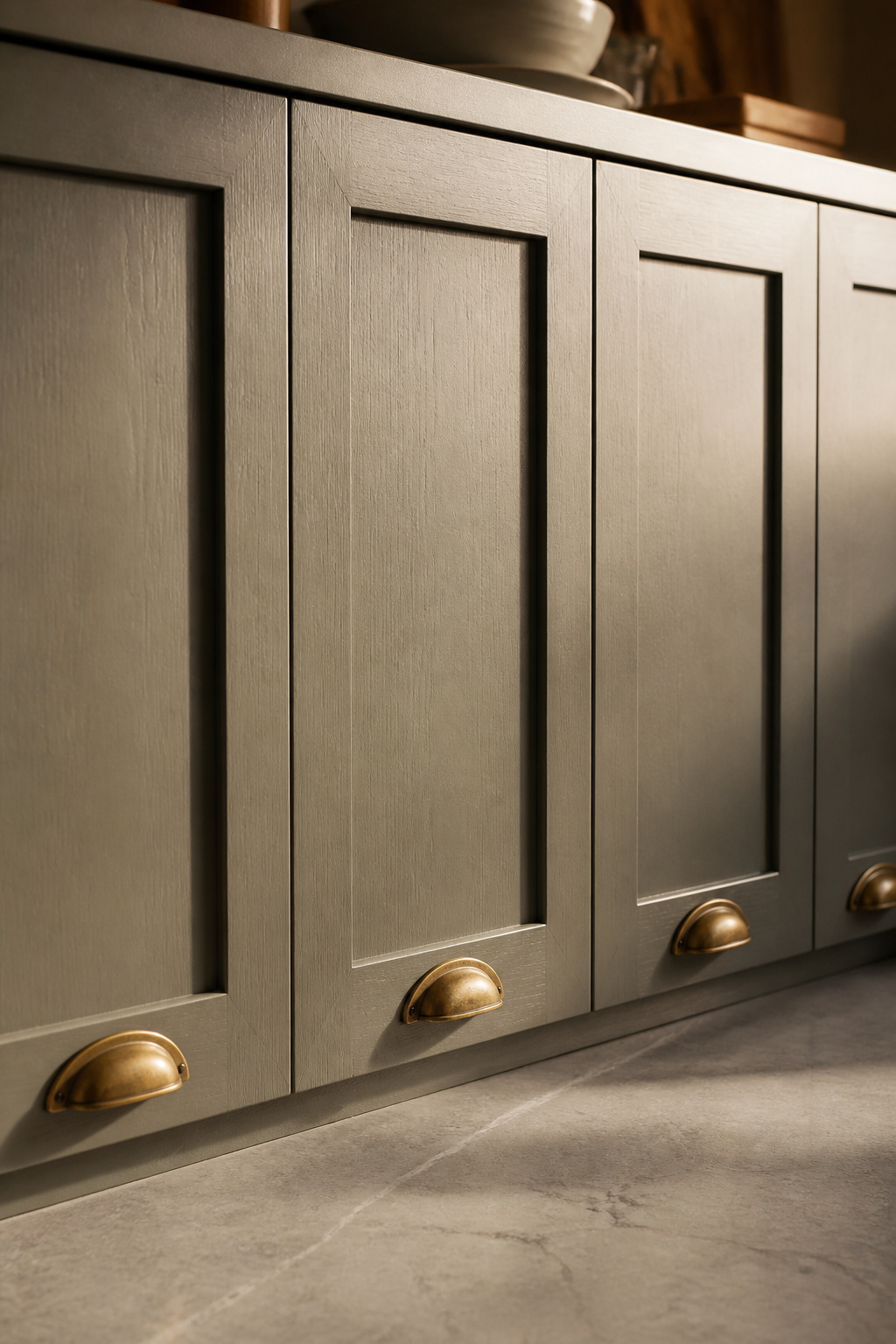
Why Shaker Construction Works for Rustic Kitchens
The Shaker door’s strength is its restraint: no ornamentation that dates, no routed profiles that trap grease. This simplicity means the door recedes visually, letting the materials around it take centre stage. In rustic kitchens where several competing textures coexist, that restraint is a genuine asset. IKEA’s SEKTION boxes with third-party Shaker fronts from Semihandmade or Reform give you the look at a manageable budget.
Heritage Paint Colours and Hardware
Farrow & Ball’s Mole’s Breath, Pigeon, and Clunch are the three I return to most often. Benjamin Moore’s Revere Pewter (HC-172) is a similar warm greyed tone for North American projects. These colours work because of their complex undertone. They shift in different lights, reading warmer in morning sun and cooler in the evening. For hardware, mix bin pulls on drawers with simple knobs on doors. That combination holds visual interest without becoming busy.
6. Vintage-Inspired Pendant Lights Over the Island
Lighting is the element most often underestimated in rustic kitchen ideas. A single pendant with the right profile and the right bulb shifts the mood of a kitchen from competent to atmospheric. Vintage-inspired pendants work in rustic kitchens because they have visual weight. The schoolhouse globe, factory shade, and wire cage all carry material honesty that contemporary slim-profile pendants lack.
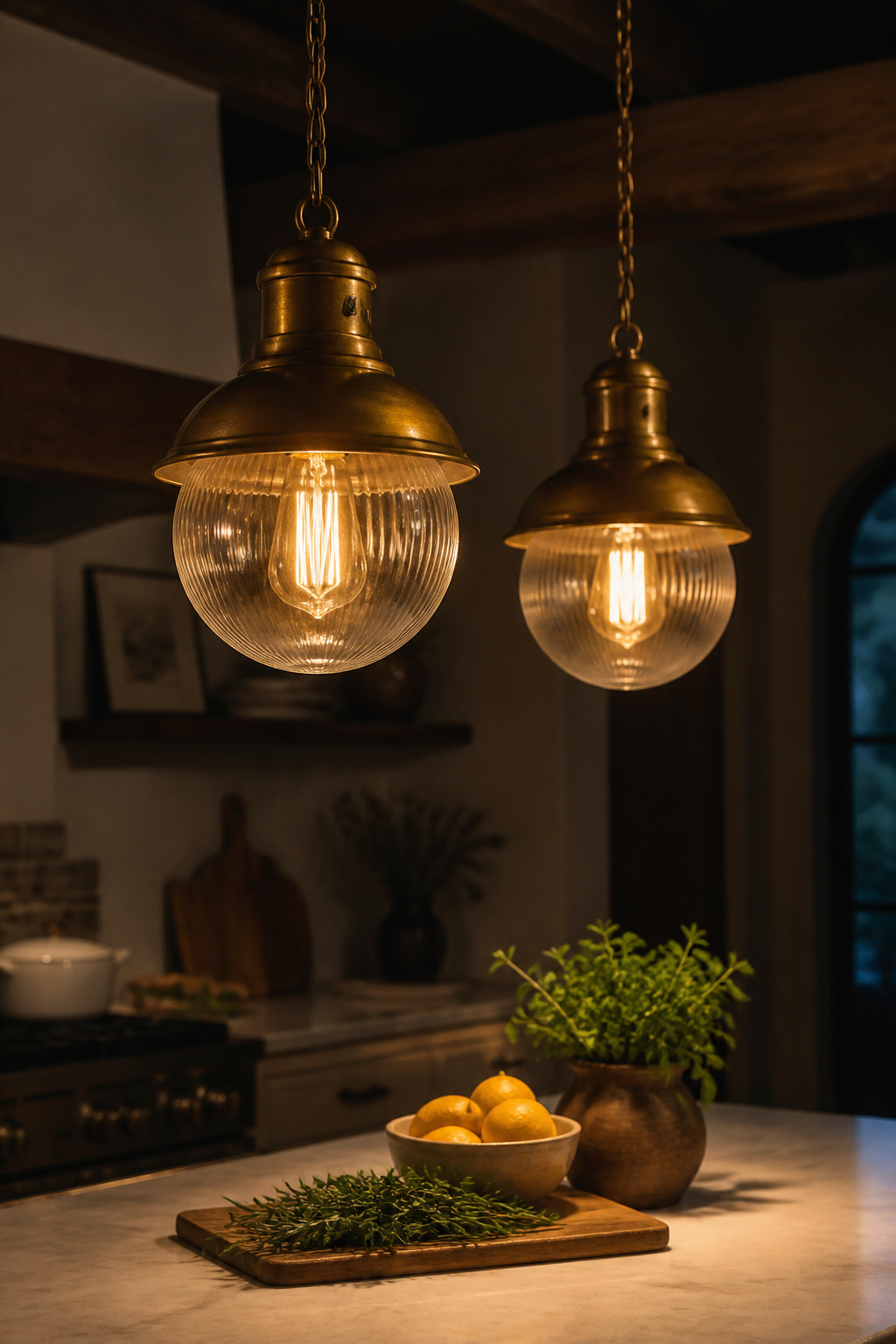
Profiles, Hanging Height, and Bulb Choice
Industrial pendants (wire cage shades, enamel factory domes) suit kitchens with concrete, steel, or raw reclaimed wood. Farmhouse pendants (schoolhouse globes, lantern shapes) suit painted Shaker cabinets and apron sinks. The standard hanging height is 30 to 36 inches between the bottom of the shade and the counter surface. For islands over 48 inches long, use two pendants. Space them one-third of the island length from each end for a more balanced look than a single central pendant. For bulbs, LED filament at 2,200K to 2,700K gives true warmth without incandescent running costs.
Where to Source
Schoolhouse Electric and Rejuvenation make the most faithful US reproductions in unlacquered brass and antiqued bronze. For genuinely vintage originals, Etsy sellers specialising in pre-1970 industrial lighting often match reproduction prices but arrive pre-aged. In the UK, Fritz Fryer and Industville are credible sources. The advantage of authentic vintage is that it arrives with its patina already earned.
7. Antique Brass and Matte Black Hardware for Rustic Kitchen Depth
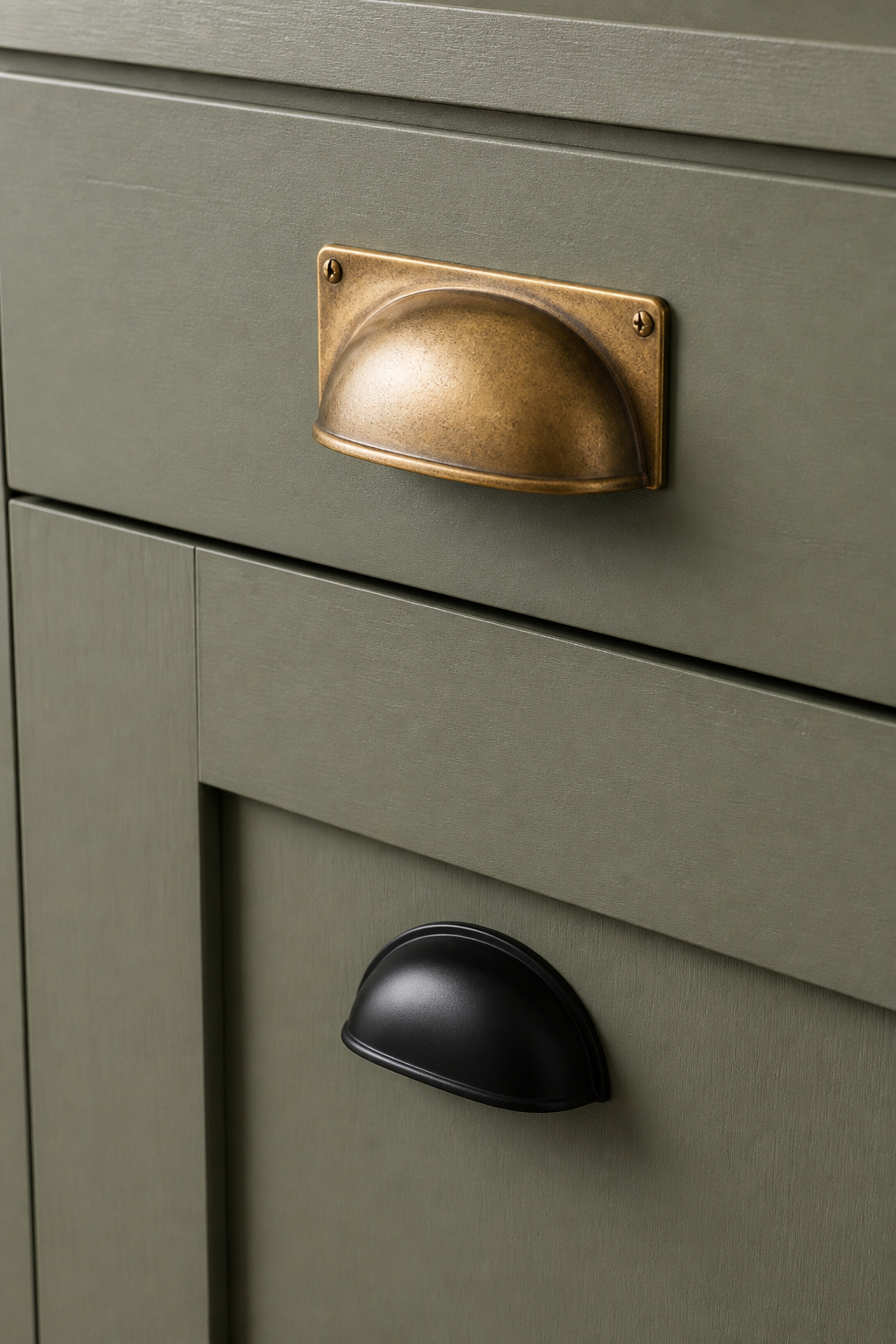
Matching hardware — every pull identical, floor to ceiling — reads as a showroom decision. Rustic kitchens feel most authentic when they suggest that some things were chosen together and others were added later. Mixed metals achieve this naturally. Antique brass and matte black is the pairing I return to most often. The warmth of aged brass against the directness of flat black creates depth without visual noise.
The Mixed Metal Principle
Keep mixed metals to two finishes, not three. Let one dominate — roughly 70% of the hardware — while the second accents. Matte black as the dominant, unlacquered brass as the accent, is the combination with the most range across rustic kitchen sub-styles. Rejuvenation and House of Antique Hardware sell unlacquered brass pulls; expect £8 to £25 per piece. Patina develops within three to six months in a kitchen environment. The result looks like hardware in place for decades.
Where to Place Each Finish
Matte black works best on upper cabinet knobs and door hardware, where its flatness reads as deliberate against lighter cabinet colours. Unlacquered brass pulls work best on drawers — the high-touch location where patina develops fastest and most attractively. For a kitchen with a range hood, the hood’s trim handles are a good place to introduce a third metallic note — copper or aged iron — without breaking the two-finish rule on the cabinetry.
8. Exposed Wood Ceiling Beams for a Barn-Inspired Feel
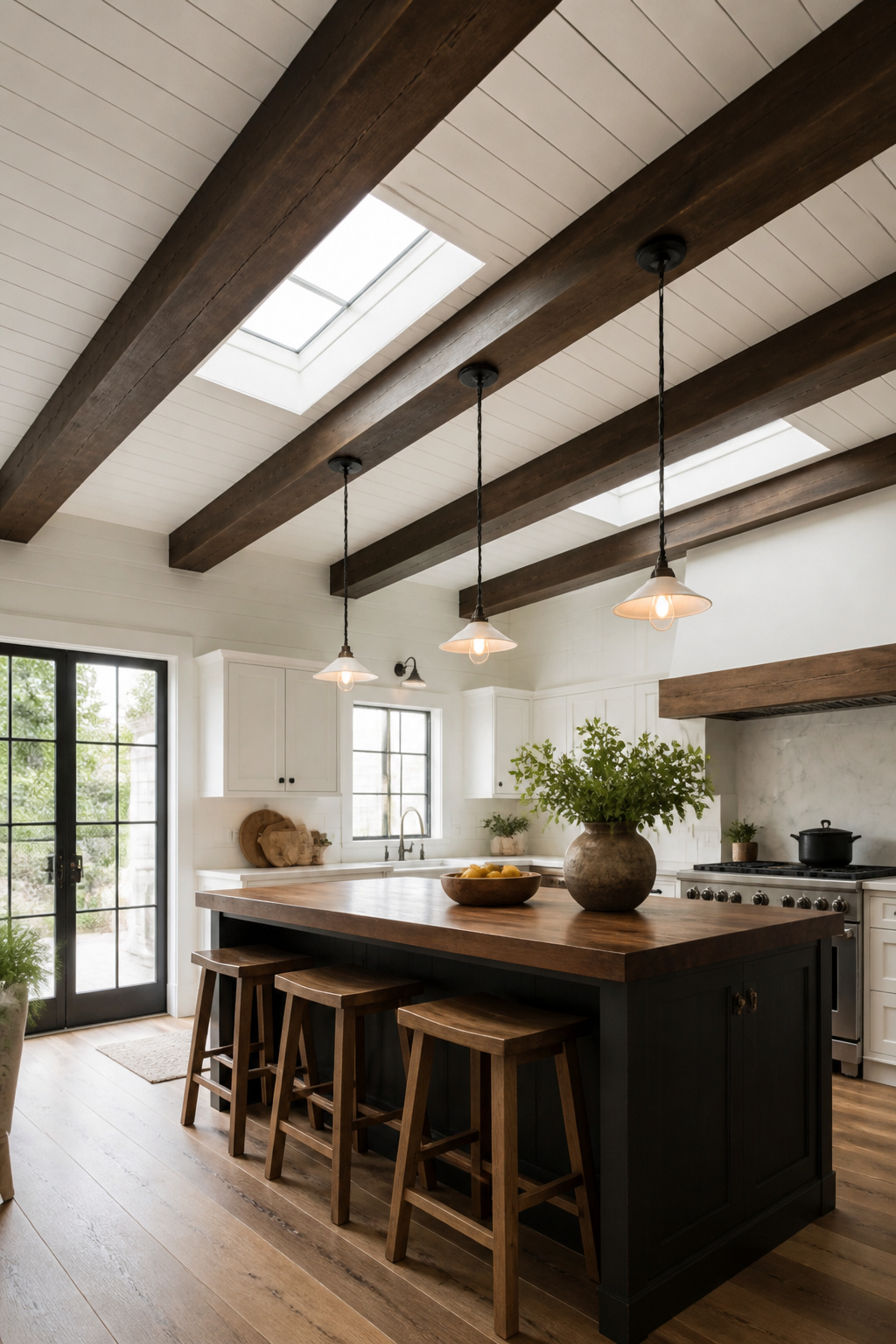
Ceiling beams change the proportion of a room. They pull the eye upward and create rhythm across the ceiling plane. In a rustic kitchen, few elements do more to establish character. The question isn’t whether to use beams, but which kind. Structural beams that are genuinely load-bearing, or decorative hollow beams that wrap existing structure.
Structural vs. Faux Beams
Genuine structural beams are worth celebrating if your building already has them. If your ceiling is flat plasterboard, adding structural beams requires engineering and significant cost. Decorative faux beams mount onto the ceiling with hidden brackets at a fraction of the cost. They come as hollow shells of real wood, or high-quality polyurethane with realistic grain. Barron Designs makes polyurethane beams convincing at normal ceiling height; Timber Beams International supplies real-wood hollow beams built to specification.
Sizing and Finishing
The proportion rule: beam depth should be roughly 1 inch per foot of ceiling height. Beam width should be 1.5 to 2 times the depth. A standard 8-foot ceiling calls for beams approximately 8 inches deep and 12 to 16 inches wide. Space beams 36 to 48 inches apart. For finishes, wire-brushing opens the grain and adds texture that works well with pale surfaces. Dark stain (Minwax Jacobean or Ebony) creates the highest contrast against a white ceiling. Reserve it for kitchens with ample natural light, where the darkness reads as dramatic rather than oppressive.
9. Open Plate Rack Displaying Heirloom and Collected Ceramics
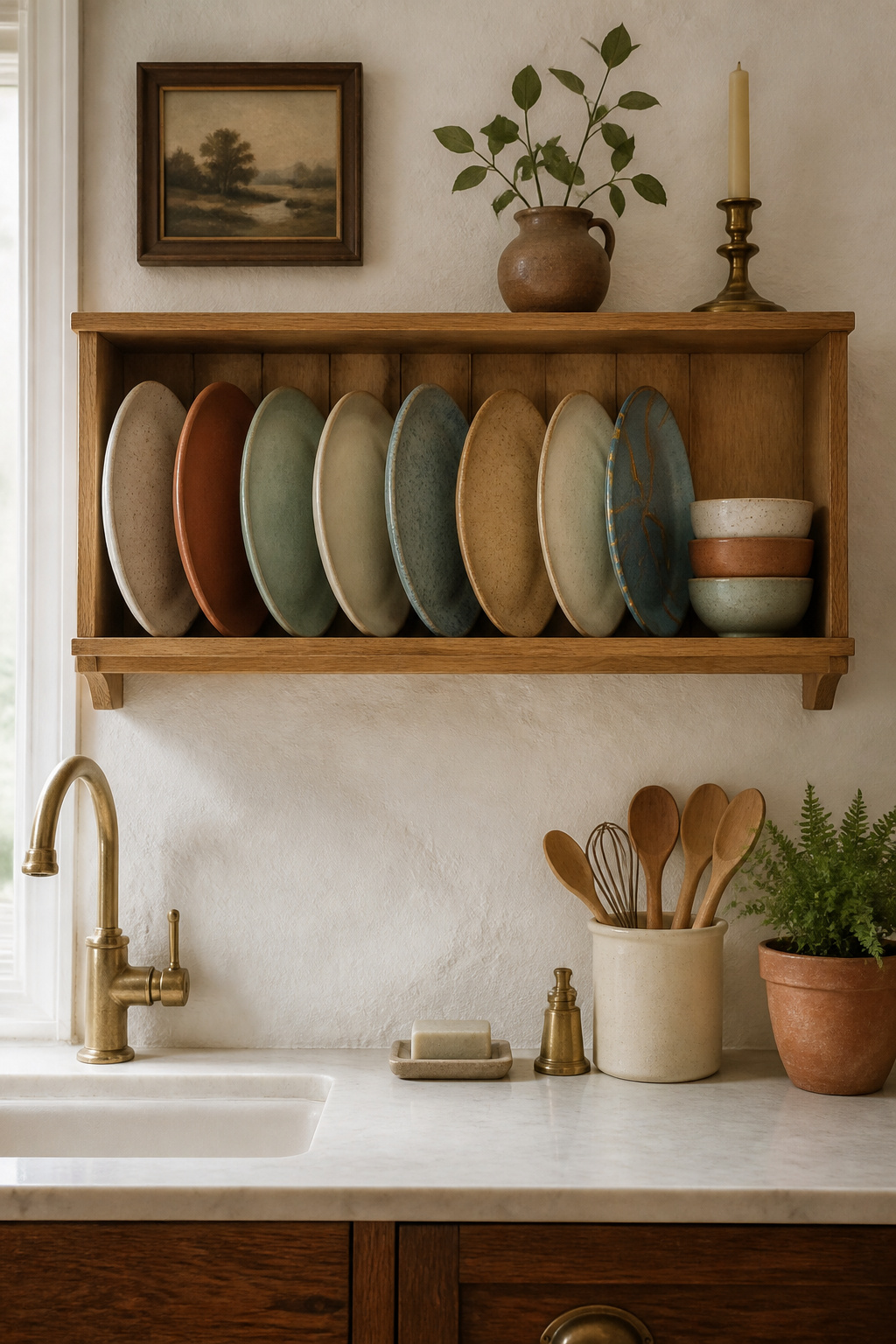
The plate rack works as storage and display simultaneously — which is exactly why it belongs in this list. A well-curated rack tells the story of collected taste. The dinner plates from a French market. The bowls from a craft fair potter. The pieces gathered over years. It’s also practical. Vertical plate storage is more space-efficient than stacking, and retrieving a single plate from a rack is faster than dismantling a pile.
Building, Buying, and Curating
Standard groove spacing is 1.5 inches for dinner plates up to 11 inches in diameter. Cut at a slight backward angle so plates lean against the back rail. Pottery Barn and Williams-Sonoma sell solid wood wall-mounted racks that are well-made; a local joiner can build to your specific size in a day. For curating mixed ceramics, choose pieces that agree on tone rather than colour — earthenware in warm tones (cream, terracotta, ochre, sage) hangs together visually even when glazes and forms vary. Authentic Rustic Kitchen Decor: Embracing Reclaimed Wood and Patina explores how patina and wear in ceramics add to their visual value rather than diminishing it.
Keeping It Looking Intentional
The clearest indicator of a plate rack working: there’s space between the plates. Plates crammed into every groove look like overflow storage rather than display. Leave two or three grooves empty, or use them to hold a single decorative piece that interrupts the regularity. Also, keep the surface below the rack cleared — a rack above a counter covered in appliances reads as the top of a pile rather than a deliberate display.
10. Wide-Plank Distressed Wood Floors That Tell Their Story
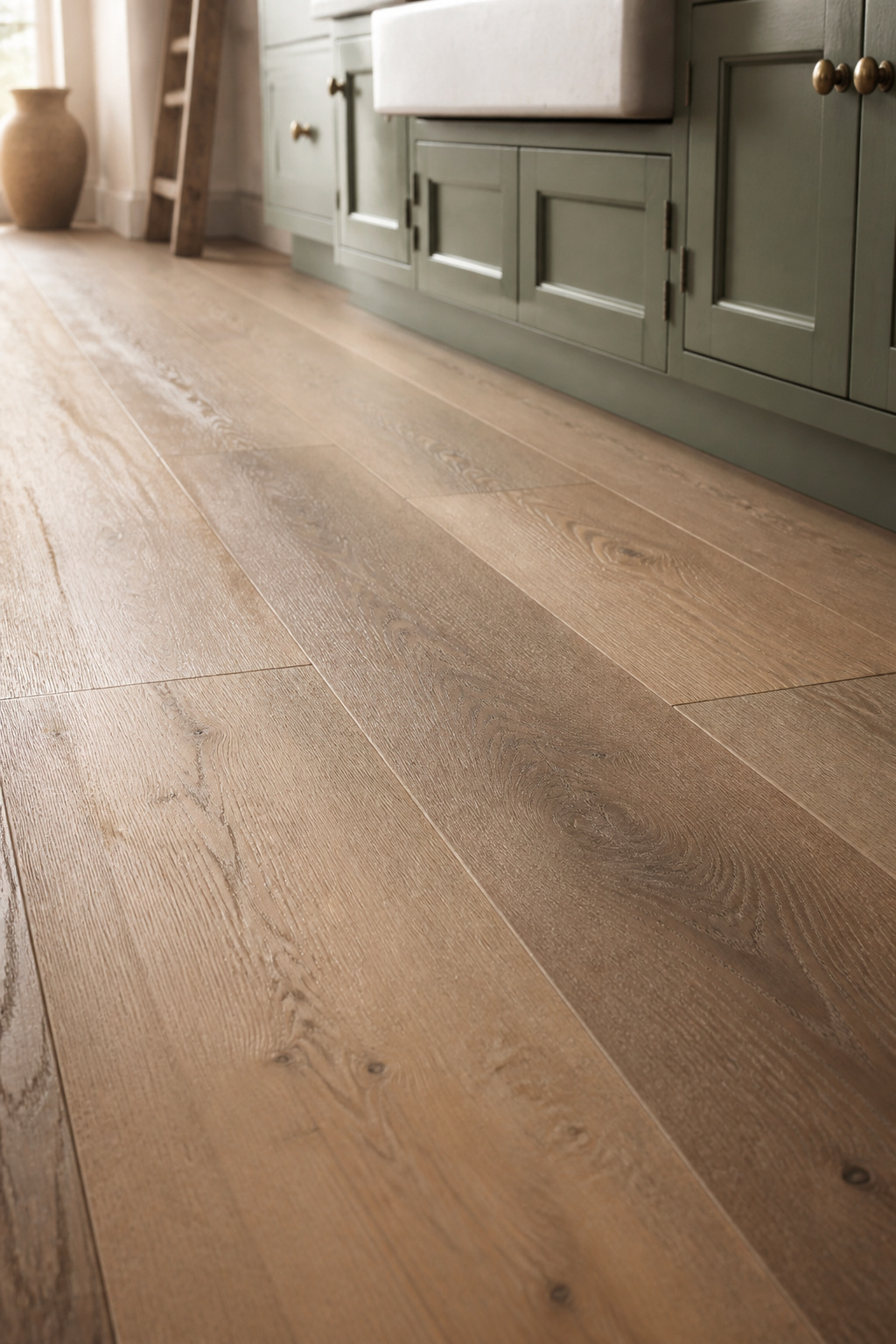
If there’s a single material decision that does the most work in establishing a rustic kitchen, it’s the floor. Wide-plank wood floors — boards six inches or wider — create a visual rhythm that narrow strip flooring can’t replicate. A distressed or wire-brushed finish ensures the surface reads as aged rather than new. The floor is the room’s foundation in every sense, and getting it right rewards every other rustic kitchen idea placed on top of it.
Finish Options
Wire brushing runs a rotating steel brush along the grain, opening the softer early-wood and leaving the harder late-wood proud — the most tactile option, and it hides small marks well. Hand-scraping uses a cabinet scraper pulled across the grain to create subtle surface irregularities. Skip planing leaves visible planer marks for a cleaner rustic look. For kitchens, wire-brushed is the most practical choice.
Species and Sealing
White oak (Janka hardness 1,360 lbf) is the right choice if the floor needs to hold up to daily kitchen life for thirty years. Pine (870 lbf) is historically accurate for farmhouse kitchens and develops a beautiful amber patina, but it shows dents. Carlisle Wide Plank Floors and Reclaimed Wood Exchange supply wide-plank stock in both species. For sealing, use a penetrating oil — Rubio Monocoat or Osmo Polyx-Oil — rather than polyurethane, which gives floors a plastic sheen that destroys the rustic look.
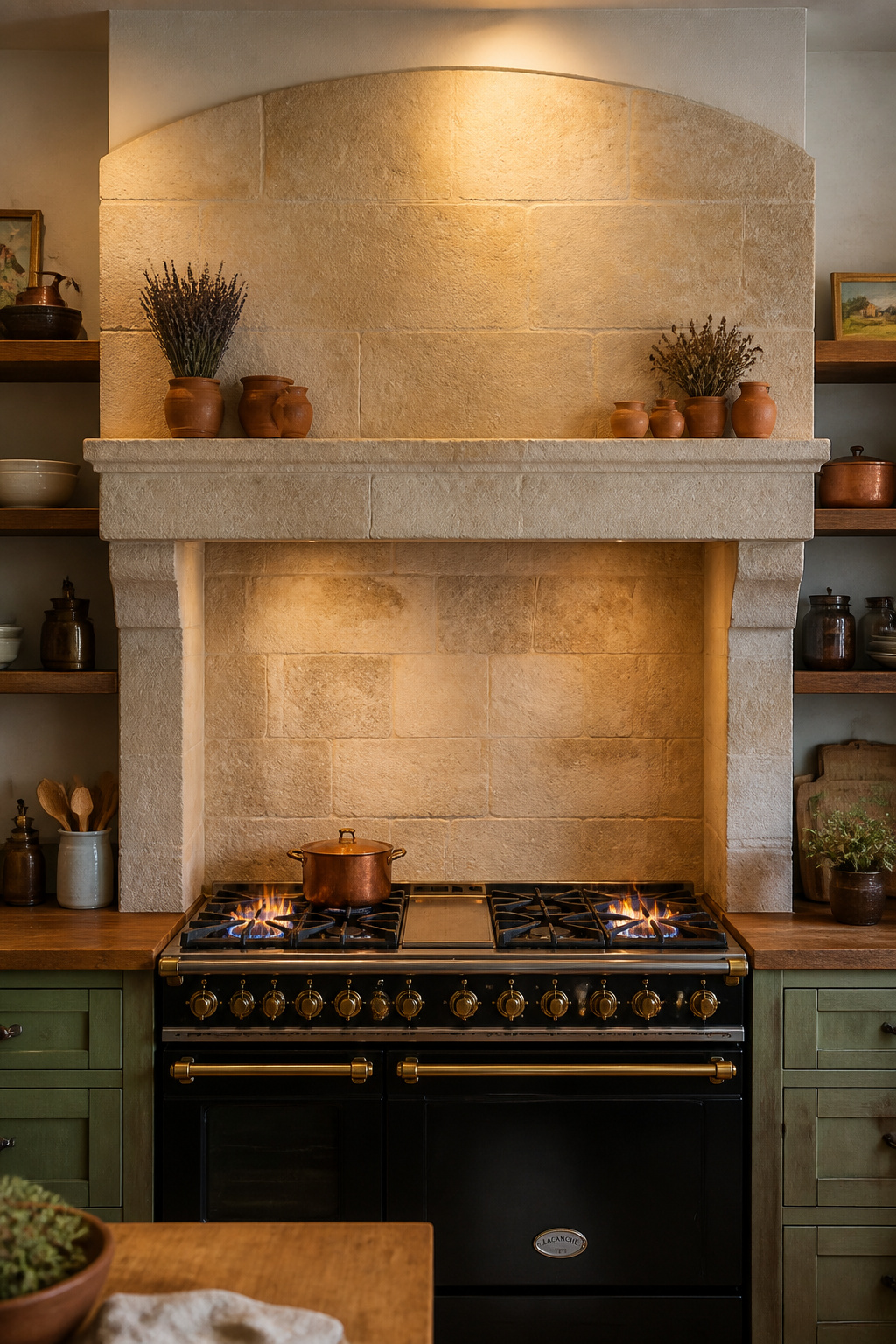
11. Stone Range Hood as a Rustic Kitchen Ideas Statement
The range hood is the architectural centrepiece of the cooking wall. In a rustic kitchen, a stone-clad or plaster hood gives the cooking wall a presence that stainless steel cannot. A well-designed stone hood looks as though it was built when the house was built — as if the kitchen grew around it. It’s one of the rustic kitchen ideas that requires the most investment but delivers the most fundamental visual change.
Cladding Options
Limestone and travertine (warm cream tones from Arizona Tile and Walker Zanger) suit Provençal and Italian farmhouse styles. Rough-cut fieldstone reads as more American rustic — barn-influenced and raw. Smooth plaster is the most flexible option: it can be repainted if the kitchen changes direction, and it suits both French farmhouse and minimal rustic styles. Brick cladding is the most affordable option and, if matched to the backsplash brick, creates a continuous masonry narrative across the cooking wall.
Sizing and Integration
The hood should be at least as wide as the cooktop, and ideally two to four inches wider on each side. Standard installation height is 24 to 30 inches above the cooking surface. For ventilation, a standard four-burner range needs a minimum of 200 CFM; a professional-style 36-inch range needs 400 to 600 CFM. Modern Farmhouse Kitchen Design: 15 Tips for Timeless Style covers how to build material consistency across a kitchen — directly relevant to integrating a statement hood with the rest of the room’s palette.
12. Wicker Baskets and Woven Storage for Rustic Texture
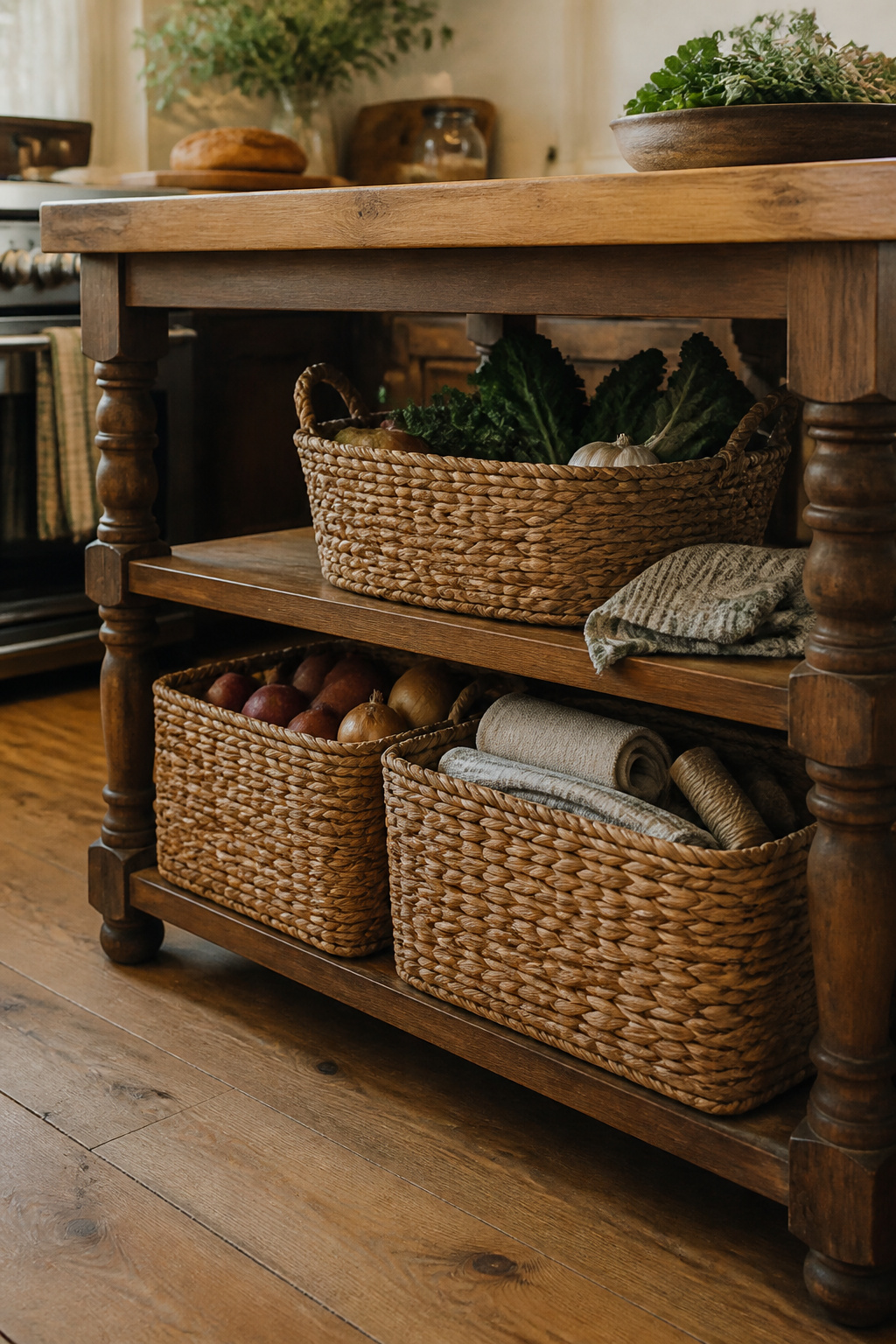
Woven natural materials are the detail layer of rustic kitchen ideas — the texture that fills gaps between harder surfaces and brings a breath of the outside in. Wicker, rattan, seagrass, and water hyacinth baskets are inexpensive, durable, and improve with age in a way that plastic organisers never will. They’re also one of the few rustic kitchen ideas that can be added incrementally — start with two baskets and build from there.
Placement and Materials
Large baskets (18 inches or wider) work under islands for root vegetables, table linens, and weekly items. Medium baskets (10 to 14 inches) sit well on open shelves, holding dry goods and baking supplies in a way that’s warm but accessible. Seagrass develops a golden deepening over time. Water hyacinth has a finer weave, good for smaller baskets. Rattan is the most durable for high-traffic use. Terrain, Serena & Lily, and World Market all carry reliable selections; for the most characterful pieces, hunt at estate sales where 1970s baskets turn up regularly at low prices.
Labelling Without Losing the Aesthetic
Write on small pieces of linen tape in a fine-tip black pen and tie around the handle. This avoids the clinical look of printed labels while staying legible. Alternatively, small chalkboard tags on jute string can be updated easily. Avoid branded label holders, acrylic tags, and anything that looks like a corporate stationery order.
13. Copper Accents and Patina-Rich Metals in the Kitchen
Copper has been in kitchens since before the word “design” existed. Victorian sculleries had copper pots on iron racks. French farmhouse kitchens lined their walls with hammered copper batterie de cuisine. In contemporary rustic kitchens, copper earns its place not as a trend but as a material with centuries of credibility in exactly this context.
Where Copper Makes the Most Impact
The three locations that deliver the most visual return: a pot rack above the island or range (largest surface area, most visible); a copper apron-front sink from Native Trails (the statement piece that becomes the room’s most memorable detail); and a copper liner for the range hood interior (creating a warm firelit glow behind the flame). Beyond these, copper measuring cups and copper-bottomed cookware on open shelving add warmth at lower investment.
Living Copper vs. Lacquered Copper
Unlacquered copper develops a natural patina — the darkening and greening that happens over months of exposure to air and moisture. This patina is protective and beautiful. If you want living copper, leave it unlacquered and allow the patina to develop naturally. Lacquered copper maintains a consistent bright finish but will eventually chip, requiring professional re-lacquering. For kitchen use, living copper is the more honest and ultimately more beautiful choice.
14. Rustic Kitchen Island Built From Repurposed Furniture
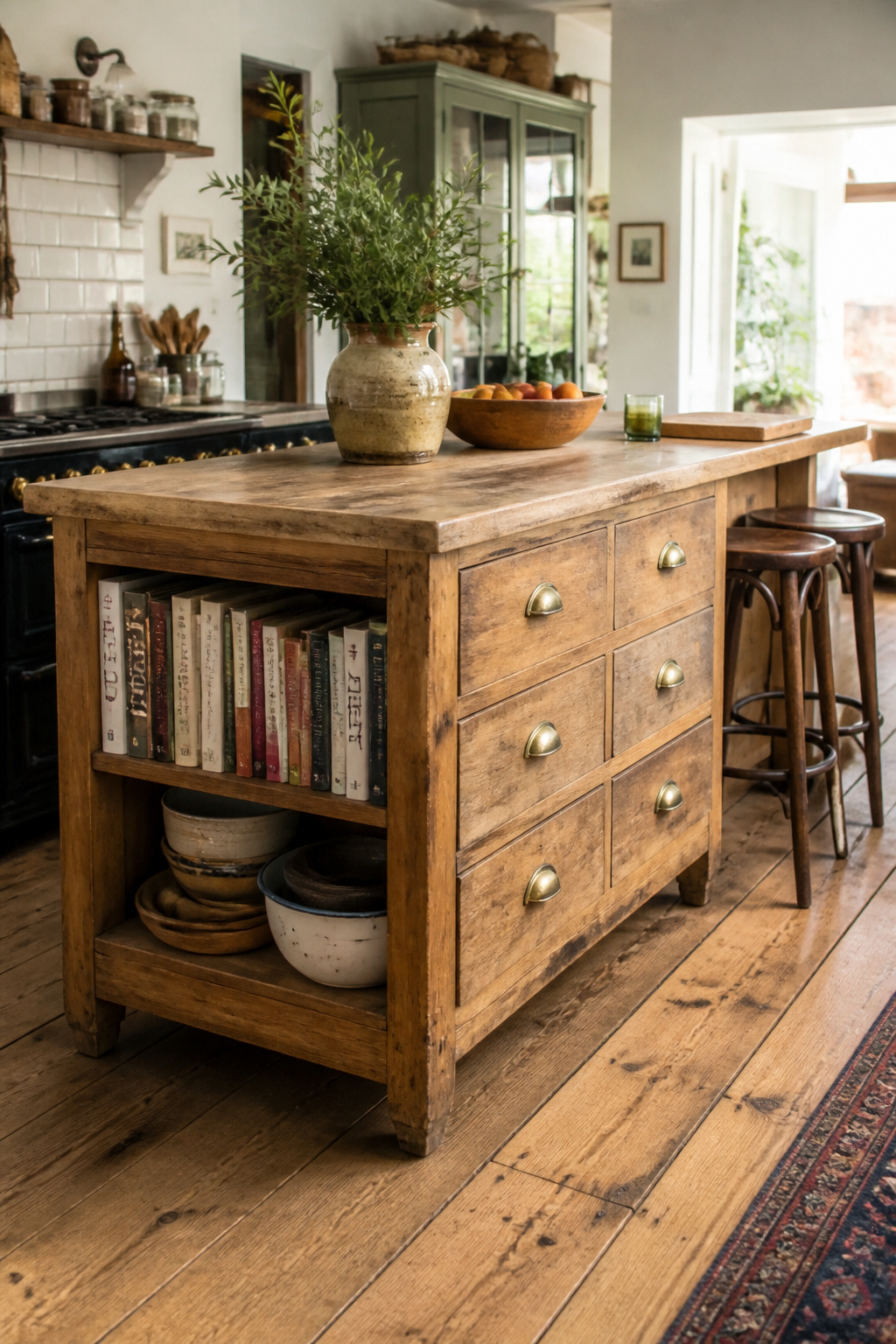
Of all the rustic kitchen ideas here, a repurposed-furniture island delivers the most singular result. A Victorian pine dresser with its drawers still intact, a French baker’s table with flour-dusted history in the wood grain, an old library table with a new butcher block top — any of these becomes a kitchen island with more personality than anything from a catalogue. Optimize Kitchen Island Cabinets for Storage & Design covers the functional planning worth reading before you commit to a piece.
Sourcing and Structural Checks
The best candidates have drawers or shelving already built in, a solid wood frame, and dimensions that fit your footprint. Standard kitchen counter height is 36 inches. Most Victorian dresser bases (without the upper section) sit at 34 to 36 inches — add a 1.5 to 2-inch butcher block top and you land within range. Source from Craigslist, Facebook Marketplace, local auction houses, and Habitat for Humanity ReStores. Before committing to a piece, test joints by pushing corners and check for woodworm — small round holes and fine dust beneath are the giveaway.
Modifications and Seating
Modifications typically include: removing the upper dresser section (usually bolted at the base of the upper frame), adding blocking inside the base to support the new top, and fitting butcher block with figure-eight clips to allow for seasonal wood movement. For seating, standard counter-height stools (seat height 24 to 26 inches) work if the converted piece sits at 36 inches with its new top.
15. A Living Herb Ledge: Rustic Kitchen Ideas Meet the Garden
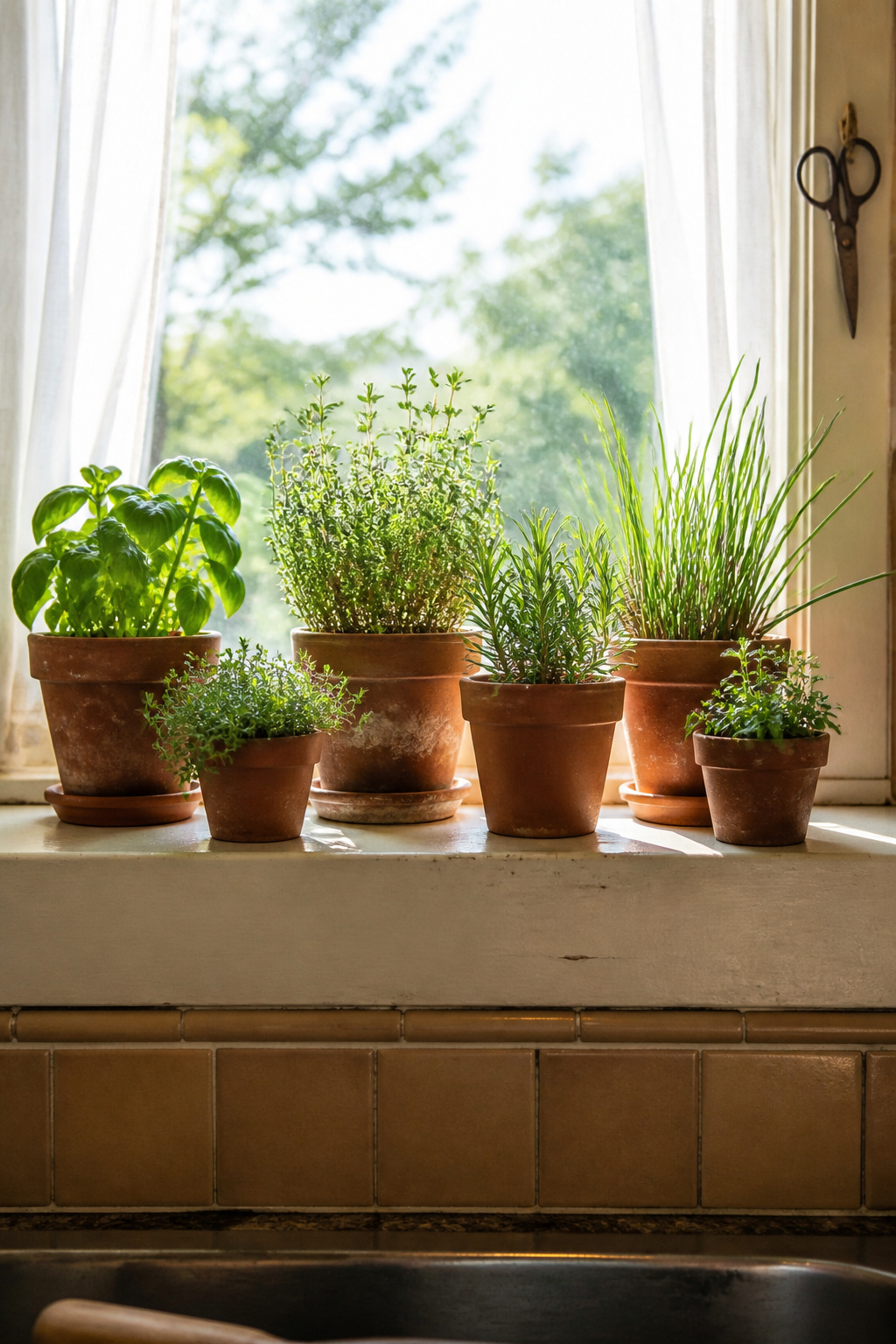
Every rustic kitchen should have something living in it. Not a succulent on a windowsill by accident, but a deliberately considered herb ledge — a shelf or windowsill planted with the herbs you actually cook with, in containers that fit the same material conversation as the rest of the kitchen. Terracotta, enamel, and aged tin are the materials. Basil, thyme, rosemary, and chives are the practical starting points. The herb ledge is one of those rustic kitchen ideas that delivers on three fronts: visual warmth, everyday practicality, and a connection to the garden.
Light, Containers, and Seasonal Care
Most culinary herbs need six hours of direct sunlight daily. South-facing and west-facing kitchen windows provide this reliably; north-facing windows do not. If your kitchen window faces north, a dedicated shelf under a low-profile grow light (Sansi and GooingTop both make credible options) is a better solution than struggling with inadequate light. For containers, standard terracotta (£1.50 to £8 per pot from any garden centre) is the default for good reason — it breathes, it ages beautifully, and its warm orange-red sits naturally in the rustic kitchen palette. Reclaimed tin cans and vintage enamel milk pans work equally well.
Basil is the most demanding windowsill herb: it needs warmth, consistent moisture, and full sun, and it collapses within days if neglected or chilled. In winter, replace it with hardier herbs — thyme, rosemary, and sage all survive lower temperatures. Chives die back in winter but regrow from the bulbs in spring; pot them up from the garden in autumn before the first frost.
How to Bring These Rustic Kitchen Ideas Together Without Starting Over
The most common mistake I see when people approach rustic kitchen ideas is trying to do everything at once. A full renovation is a significant project and a significant investment. But it’s not the only way to arrive at a kitchen with genuine warmth and character.
The Layering Sequence
Start with the elements that have the most impact per pound and require the least structural intervention. Open shelving instead of upper cabinets: removable, affordable, and immediately transformative. Hardware replacement on existing cabinets: a Sunday afternoon, £150 in unlacquered brass and matte black pulls, and the kitchen reads differently by dinner. Lighting — replacing whatever came with the house with vintage-inspired pendants — is the single highest-impact change for the investment. A butcher block surface or repurposed island adds natural wood warmth without touching fixed elements. These four moves cost a fraction of a renovation and achieve most of the visual result.
When you’re ready for the structural layer — the flooring, the cabinetry, the stone hood — you’ll have lived with the lighter changes long enough to know exactly what the room needs. The rustic kitchen ideas that hold up over time are built from genuine material choices rather than trend-chasing, and the sourcing approach matters as much as the design decisions themselves.
Sourcing Sustainably
The rustic kitchen’s material language — reclaimed wood, aged metals, worn ceramics — is also an argument for sustainable sourcing. Salvage yards (Lassco in London, Renovation Angel in the US) carry architectural elements that would otherwise be landfill. Estate sales and auction houses surface furniture pieces, lighting, and ceramics that have already proven their quality through decades of use. Habitat for Humanity ReStores offer building materials at reduced prices. Sourcing this way is slower than ordering from a catalogue. But the pieces you find have already existed somewhere — in someone else’s kitchen, workshop, or house — and they carry that history into yours. That history is, ultimately, what rustic kitchen ideas are actually about.