
Your cabinets are the first thing anyone sees in your kitchen. They cover more surface area than any other element — more than the floors, more than the walls. And yet most renovation guides treat them as an afterthought. That is exactly backwards.
After twelve years restoring vintage kitchens and sourcing sustainable cabinet materials, I believe kitchen cabinets ideas are the strategic decision that determines everything else. Get the cabinets right and the rest falls into place. Get them wrong and no amount of beautiful tile or statement lighting will save the room.
These 16 kitchen cabinets ideas cover every budget, every style, and every kitchen size. Some are big investments that hold their value. Others are weekend projects that cost less than a new appliance. All of them have survived real kitchens with real families. None of them will look embarrassing by 2030.
1. Two-Tone Kitchen Cabinets That Balance Contrast With Cohesion
Two-tone kitchen cabinets ideas have been predicted to peak and fade for four years running. They haven’t. There’s a solid reason: the two-tone approach solves a genuine design problem. A single cabinet color across an entire kitchen creates a flat, uniform look. It makes the room feel like a showroom rather than a home.
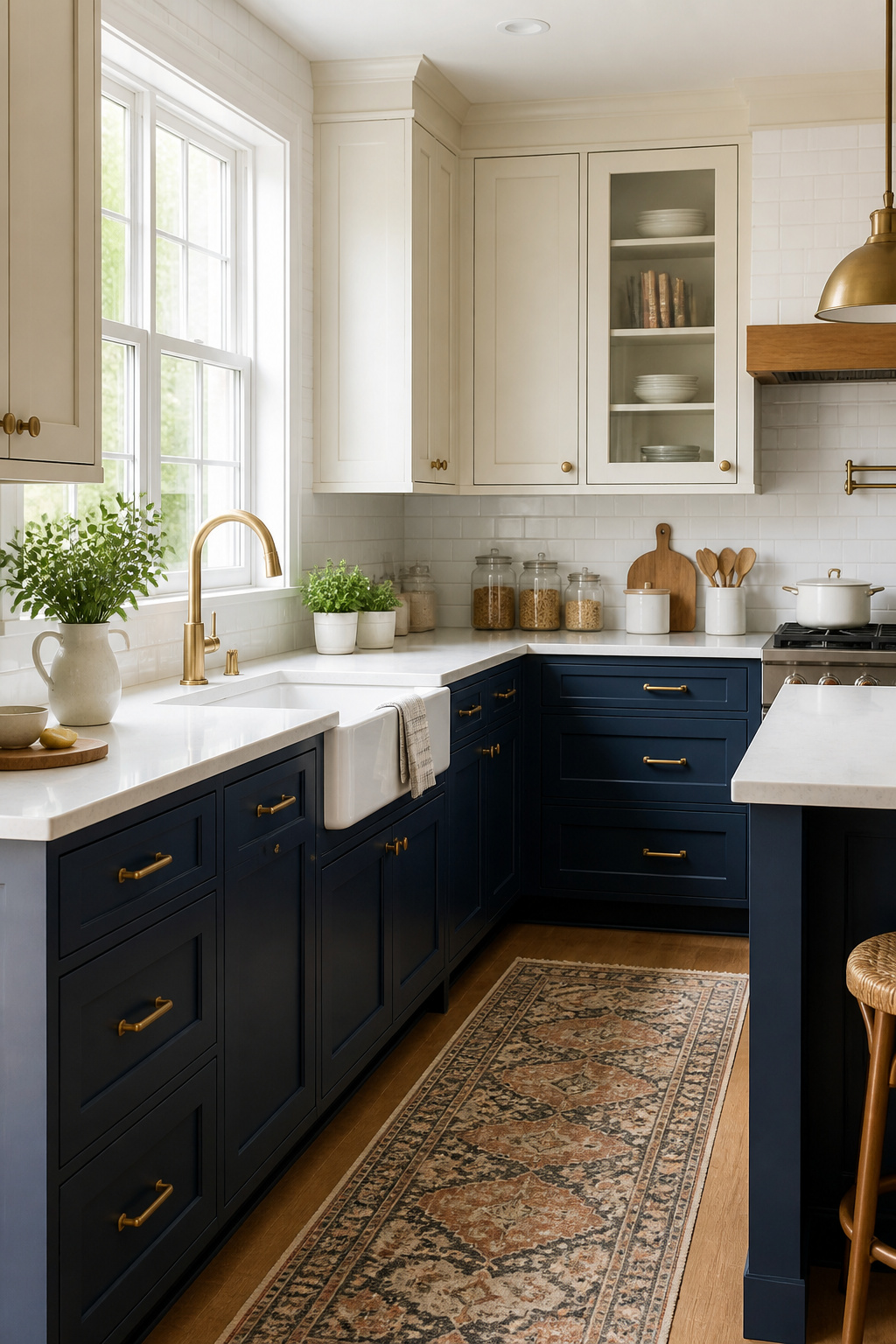
Darker lowers ground the space the same way a dark sofa anchors a living room. Lighter uppers lift the eye and keep the room feeling open. The most successful combinations I’ve seen use navy lower cabinets with Benjamin Moore Alabaster uppers, or forest green lowers with a warm cream.
Why Color Pairing Matters More Than the Shade
The mistake most people make is choosing colors they love individually and assuming they’ll work together. They often don’t. Both colors need to sit in the same temperature family — same warm or cool undertone — even if they differ dramatically in value. Benjamin Moore Hale Navy HC-154 and Sherwin-Williams Alabaster SW 7008 work because both lean slightly warm. Mixing a cool grey upper with a warm navy lower reads as muddy.
Hardware That Ties the Two Together
Brushed brass bridges most two-tone combinations well. It adds warmth to cool colors and complements warm ones without dominating either. Budget $200–$600 for a full hardware replacement on a standard kitchen. Buy slightly more than you need — discontinued finishes are hard to match later.
One interior trick worth knowing: paint the inside of your upper cabinets the same color as the lower doors. When someone opens an upper, they get a cohesive reveal. The whole two-tone scheme reads far more intentional.
2. Shaker Style Kitchen Cabinets Ideas for Timeless Character
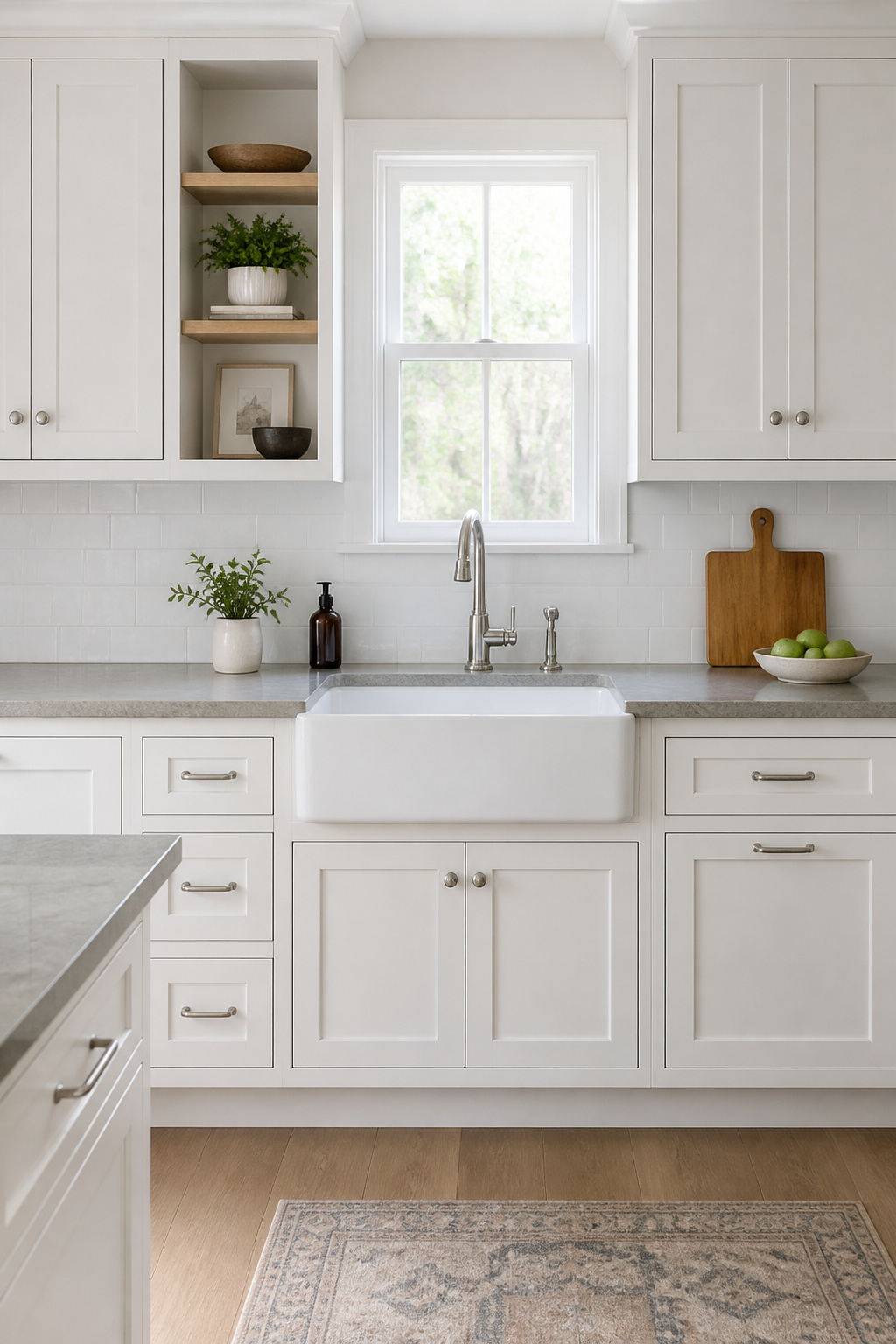
Shaker-style cabinets account for roughly 75% of new kitchen cabinet sales in the US, according to the National Kitchen and Bath Association. The profile — a flat center panel with a square-edged frame — was developed by Shaker craftspeople in 18th-century New England. It has outlasted every style movement since because it works with almost everything. Farmhouse, contemporary, transitional, and traditional kitchens all absorb shaker doors without looking forced.
Why the Shaker Profile Keeps Winning
The shaker door avoids two failure modes: it isn’t plain enough to look cheap and it isn’t detailed enough to look fussy. That middle ground is genuinely hard to find. Painted shakers in white or cream remain the most versatile option. Stained shakers in walnut or white oak skew contemporary and pair naturally with flat-front drawer faces.
Sizing Details That Separate Good Shaker From Bad
The rail-and-stile reveal — the frame width around the center panel — should sit between 1.75 and 2.25 inches. Wider reveals feel heavy and old-fashioned. Also avoid shaker doors with a routed inner bead on the frame edge — that detail tips the look toward ornate.
IKEA’s AXSTAD door runs $20–$55 per door. CliqStudios’ Dayton Shaker, at $150–$250 per linear foot installed, offers 60+ finish options. Home Depot’s Hampton Bay Shaker at $65–$130 per linear foot covers the middle ground well.
One Pro Tip That Changes the Look
Pair painted shaker doors with a slightly glossier finish on the kitchen walls. The door’s flat finish against a satin wall creates just enough contrast to make the cabinet profile pop. It’s a subtle difference, but it pushes the result from basic to genuinely polished.
3. Open Shelving Mixed With Closed Cabinets for an Airy Kitchen Feel
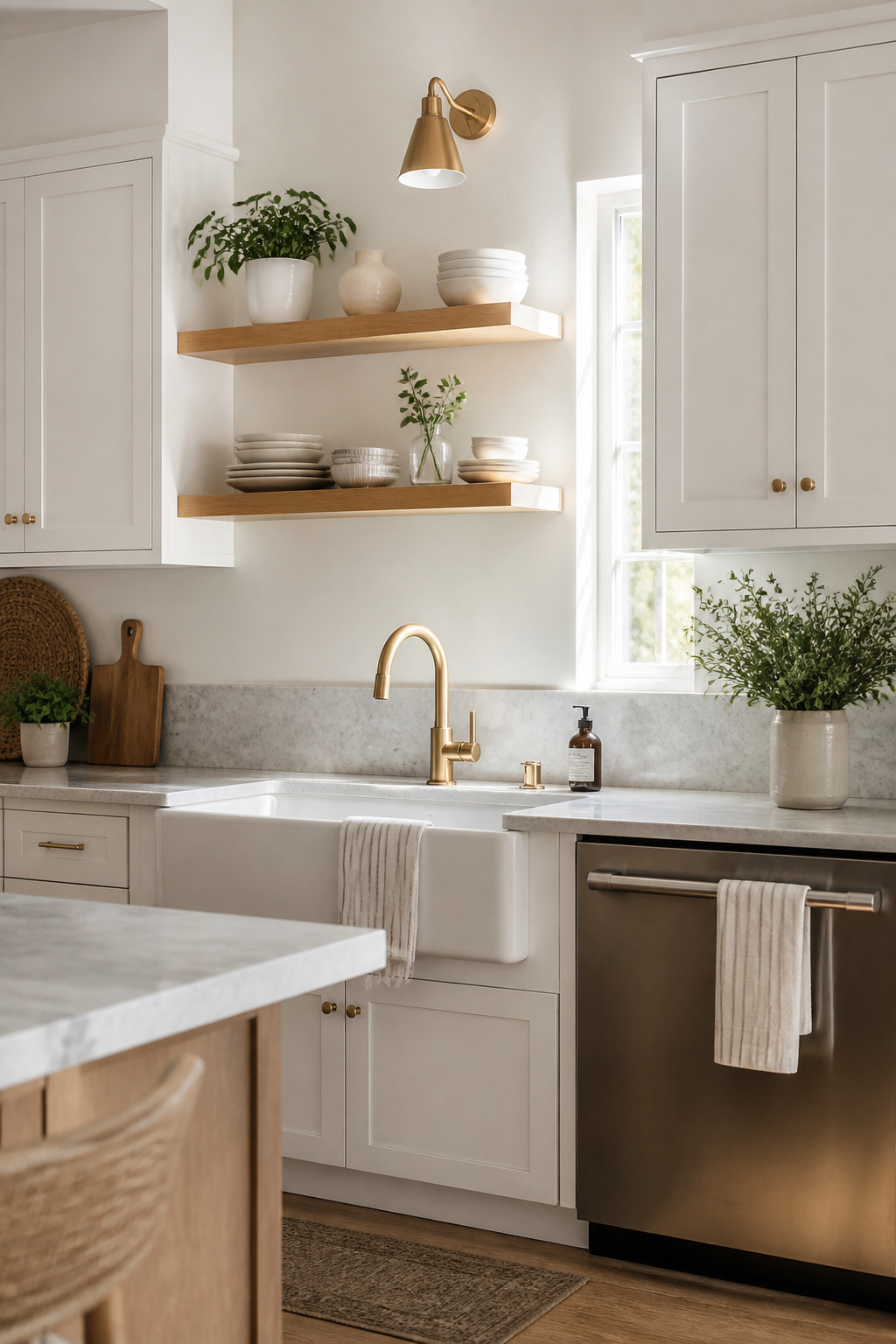
Full open shelving has many advocates and very few long-term fans. Most of us don’t own dishes that look good on display every day. But mixed layouts — roughly 20–30% open shelf, the rest behind doors — are the version that actually works in real kitchens.
Where to Open Up
The two best locations for open shelving are above the sink and at the end of a cabinet run. The sink wall is already a visual focal point. Removing uppers there increases the sense of headroom over the workspace. The end of a run — where a cabinet meets an open wall or window — is the other natural break. Avoid opening up above the stove, where grease splatter is a real problem for displayed items.
Shelf Materials and Depth
Twelve-inch deep shelves handle standard dinner plates and most kitchen items. Ten-inch works better for a spice or small-item display. Solid wood (white oak, maple, walnut) holds up better than MDF in kitchen humidity. IKEA’s BERGSHULT shelves run $30–$80 each. For something with more character, Rejuvenation’s reclaimed fir shelves at $120–$280 bring genuine warmth.
The Styling Secret Most People Miss
Paint the wall behind the open shelves a shade slightly deeper than the adjacent wall. It gives displayed items a defined backdrop and makes the shelving look intentional. This works especially well when your kitchen objects are a mix of whites and naturals.
4. Glass-Front Cabinet Doors as One of the Best Kitchen Cabinets Ideas for Display
Glass-front cabinet doors fix a frustration that many cooks recognize but rarely name: you know you own the serving platter, but you can’t find it. Closed cabinets turn storage into a guessing game. Glass fronts solve that without sacrificing the tidiness of having things behind doors.
Tempered, Reeded, or Frosted: Choosing the Right Glass
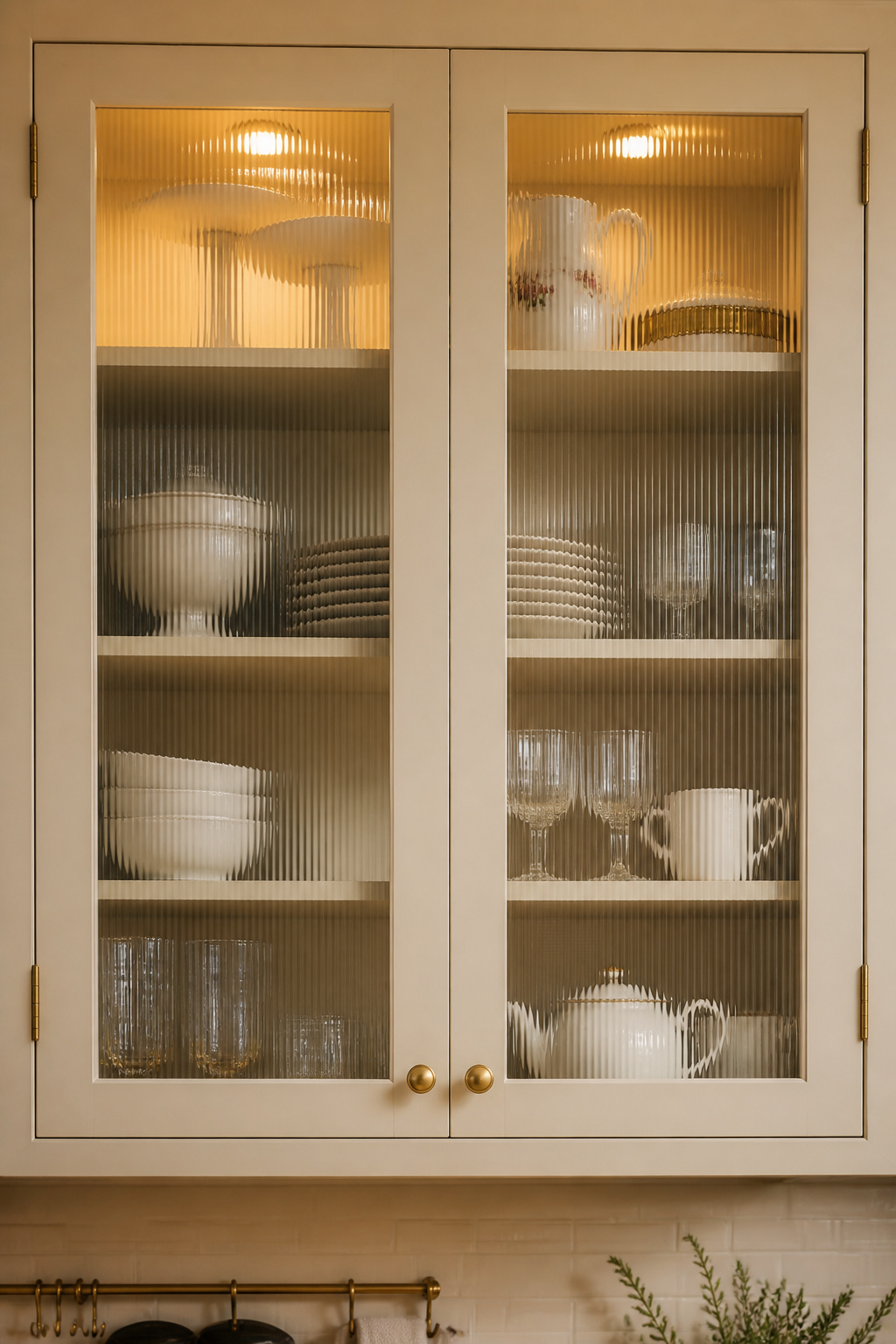
Tempered glass is the safety standard for any kitchen cabinet door — regular glass shatters dangerously if impacted. Beyond safety, the choice depends on what you’re storing. Clear glass demands organized, color-coordinated contents. Reeded (fluted) glass is more forgiving — it diffuses the view so minor disorganization reads as textured mystery rather than clutter. Frosted glass obscures almost entirely. It works as a hybrid between closed and open.
What to Display and What to Hide
Glass-front cabinets work best for items that share a visual family: matching dish sets, clear glass collections, vintage ceramics with similar palettes. Mismatched everyday crockery tends to look chaotic behind clear glass. For most kitchens, converting just two or four upper doors to glass gives the curated effect without requiring a perfectly organized kitchen.
Interior Lighting That Makes the Difference
Battery-powered LED puck lights inside glass-front cabinets cost $25–$45 each (Kichler makes a reliable version). No wiring required. Positioned at the top of the cabinet interior, they cast warm light down over displayed items. The cabinet glows softly in evening light — a practical storage decision that becomes a genuine design feature.
Retrofitting existing doors with glass inserts costs $85–$175 per door with a Rejuvenation kit, or $35–$65 for IKEA’s JUTIS frosted glass doors if you’re working with a SEKTION system.
5. Vintage-Inspired Cabinet Hardware That Changes the Whole Kitchen
Here’s the highest-ROI update in any kitchen: hardware replacement. Spend $100–$400 swapping every handle, pull, and knob, and the before/after looks like a renovation. The cabinets haven’t changed — but hardware is the first thing a person’s eye reaches for. If it reads “contractor special,” the whole kitchen reads that way.
The Honest Hardware Matching Guide
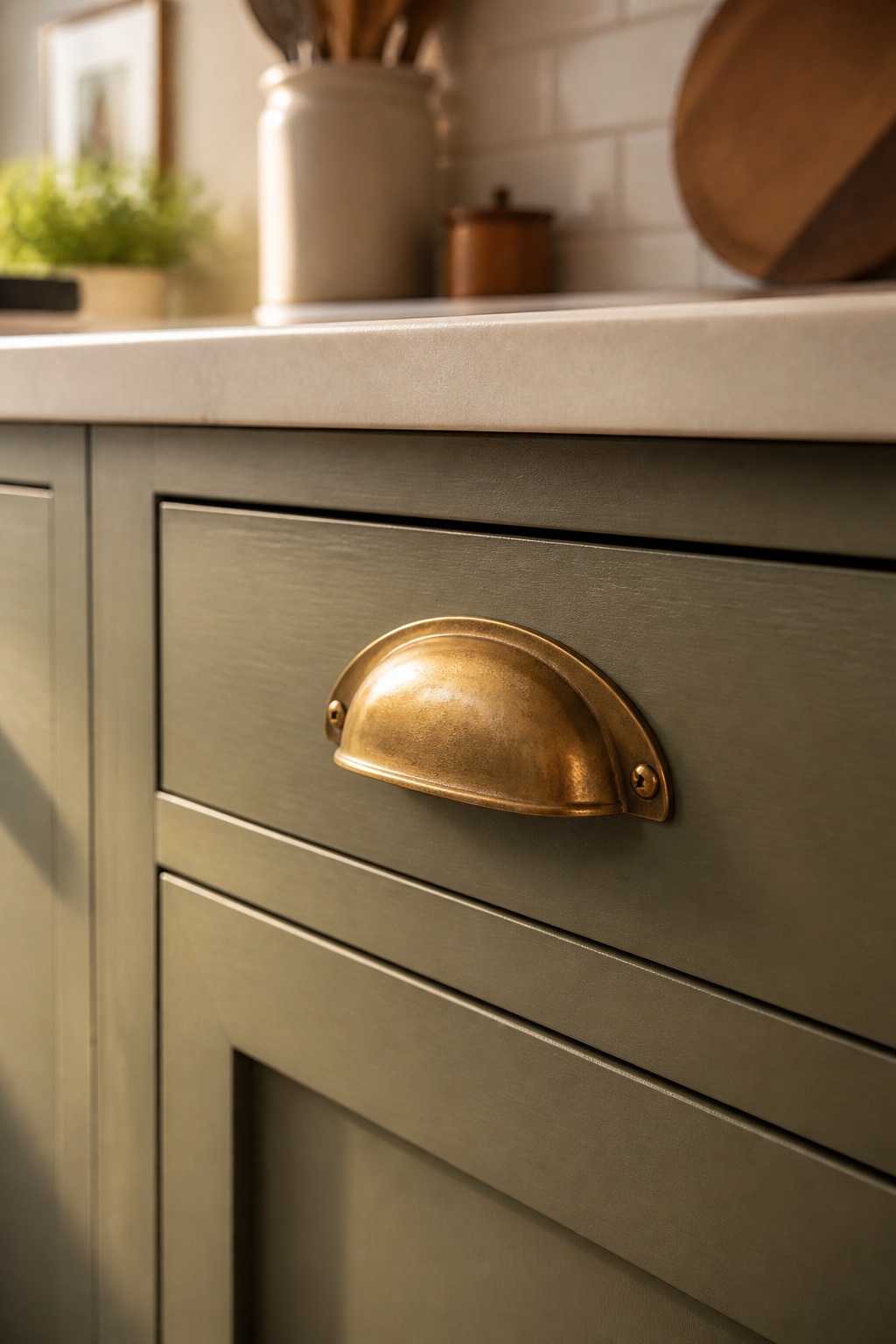
Unlacquered brass is the finish I recommend most for the vintage kitchen feeling. Unlike lacquered brass, which stays permanently shiny, unlacquered brass oxidizes into a warm, uneven patina over months of use. It darkens at the touch points and holds its brightness in the recesses — exactly how antique hardware looks. Rejuvenation’s Schoolhouse cup pull at $18–$28 per pull is my starting point for vintage kitchen projects.
Black iron pulls have surged since 2022 as the farmhouse-industrial crossover has grown. They’re forgiving in terms of finish consistency. They also make a strong statement against both white and colored cabinets.
Knobs vs. Pulls: The Practical Rule
Knobs work best on doors. Bar pulls and cup pulls work best on drawers — they give you something to grip in a single motion without pinching or twisting. Mixing the two reads as considered rather than inconsistent.
Where to Source Genuine Vintage Hardware
Etsy sellers listing bulk vintage hardware lots are the best source for genuine period pieces at $3–$8 per pull. Always request the center-to-center measurement first. Standard contemporary pulls run 3-inch and 3.75-inch between screw holes. Vintage lots often vary. Drilling new holes into painted cabinet faces is a nuisance worth avoiding.
Full kitchen hardware replacement — typically 20–30 pieces — runs $100–$600 depending on source and finish.
6. Dark Kitchen Cabinets Ideas With Moody Jewel-Tone Finishes
Dark cabinets get discussed as if they’re a brave choice for large kitchens only. That’s outdated. The issue was never square footage — it was lighting. A 100-square-foot kitchen with good under-cabinet task lighting and a light countertop surface can absolutely carry dark cabinets. A badly lit 200-square-foot kitchen with the same finish will feel oppressive regardless of size.
Which Dark Tone Suits Which Kitchen
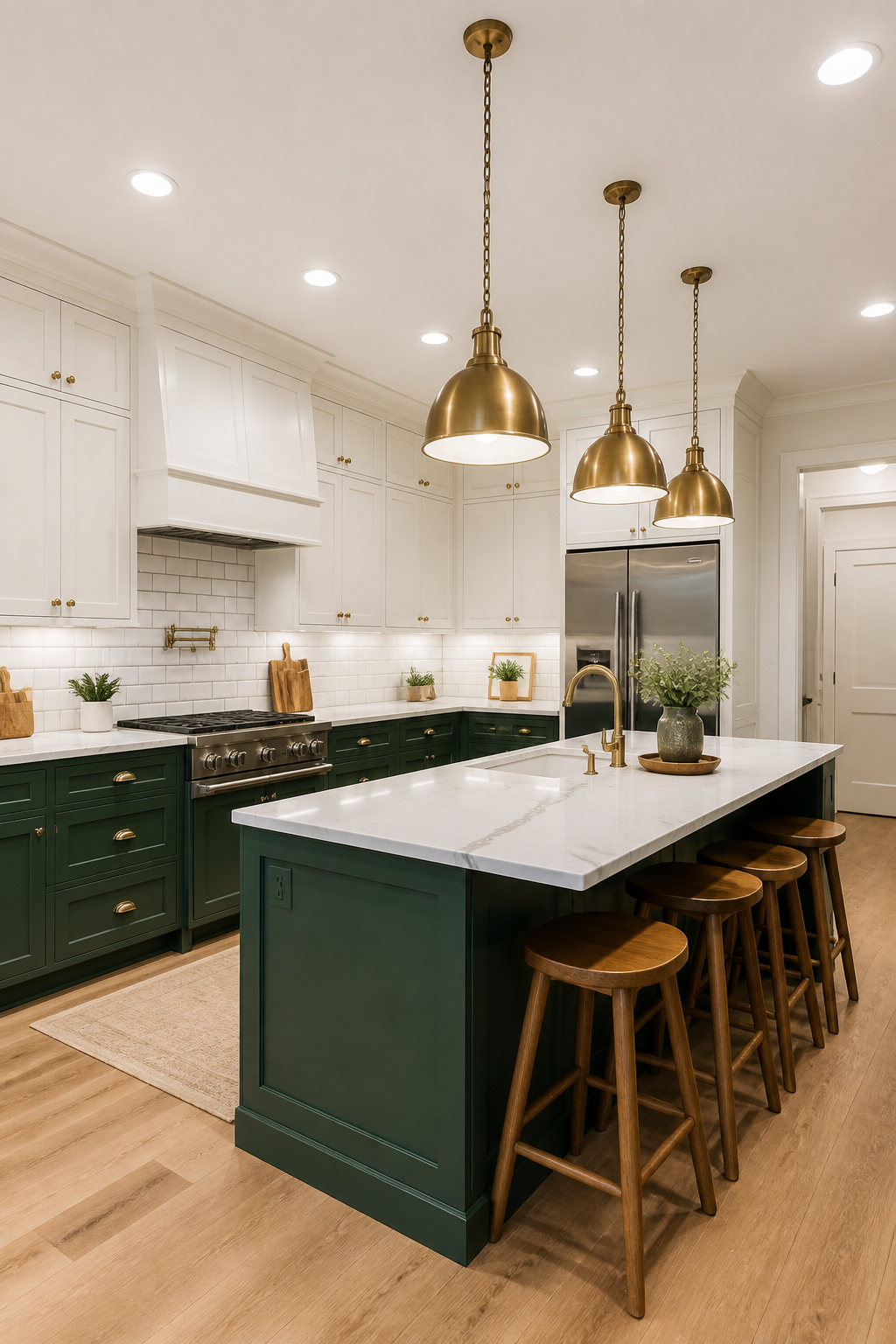
Forest green (Farrow & Ball Studio Green No.93 at $120/gallon) works best in kitchens with warm natural wood elements — wood stools, a butcher block section, or rattan pendants. Charcoal and deep navy (Benjamin Moore Hale Navy HC-154 at $70/gallon) are more versatile and work in both warm and cool kitchens. True black (Sherwin-Williams Tricorn Black SW 6258) is a full commitment. Go all in or don’t go there.
Lighting Adjustments Dark Cabinets Require
Under-cabinet LED strip lights are non-negotiable with dark cabinets. Without them, work surfaces sit in shadow and the overall effect is oppressive rather than moody. Budget $30–$80 per linear foot for quality under-cabinet LED installation.
Countertop Pairings That Keep Things Balanced
White Calacatta marble or quartz countertops are the most reliable pairing for dark lower cabinets. The high contrast breaks the room visually and stops the lower half from closing in. Light countertops also make scratches far less visible than dark-on-dark surfaces.
7. White Kitchen Cabinets Ideas That Still Feel Fresh in 2025
White cabinets remain the top choice in 55% of new kitchen renovations, according to Houzz’s 2025 Kitchen Trends Survey. That sounds like a safe, boring statistic — until you look at how many of those kitchens feel genuinely warm and how many feel sterile and cold. The difference comes almost entirely from which white you choose. Our modern farmhouse kitchen guide covers the pairing decisions in more detail if you’re going down that path.
The Warm White vs. Cool White Decision
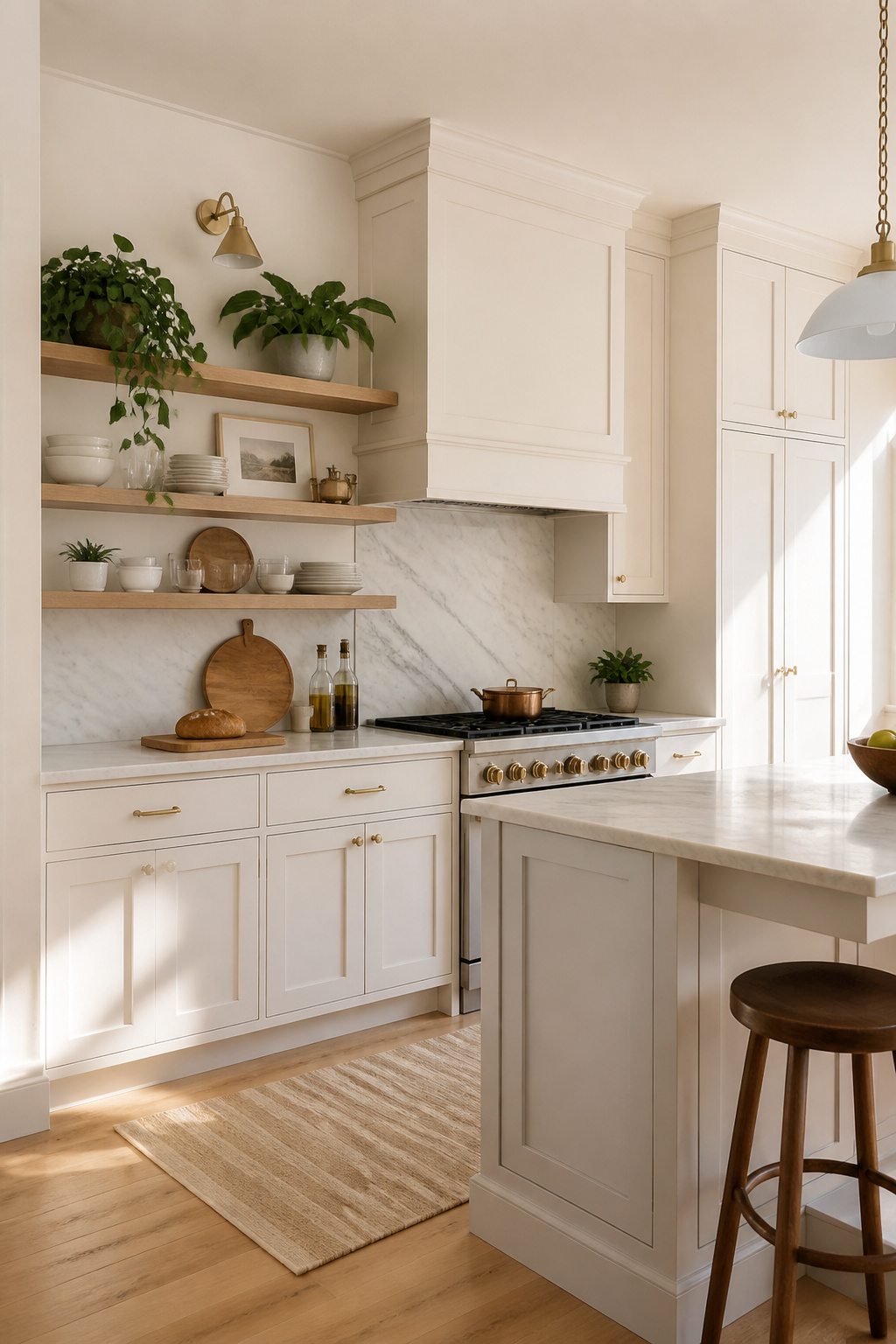
Benjamin Moore Chantilly Lace (OC-65) is a true bright white with a cool undertone. It looks extraordinary in well-lit south or west-facing kitchens. But it can read grey and dingy in a north-facing room. Benjamin Moore White Dove (OC-17) is the most popular white cabinet color in the US — its warm undertone reads as white in photographs but feels genuinely warm in person. It flatters almost any light direction. Sherwin-Williams Alabaster (SW 7008) leans even warmer. It’s the better choice with brass hardware and wood elements.
How to Prevent the Sterile Look
The sterile white kitchen comes from too much of the same finish: white cabinets against white walls under white countertops with stainless appliances. The fix is texture and material contrast. Natural wood elements — open shelves, a butcher block section, or a wooden cutting board on display — break the monotony and make the room feel inhabited.
The Light Test That Saves Expensive Mistakes
Before committing to any white, paint a 12×12-inch sample directly on a cabinet door. Live with it for 48 hours across different times of day and different lighting conditions. Whites shift dramatically under different light, and the small chips that come with paint pots are far too small for an accurate read.
8. Upcycled and Repainted Cabinet Ideas That Save Money Without Cutting Corners
Cabinet replacement is the most expensive single item in most kitchen renovations — $5,000 to $25,000 or more for new cabinetry. Painting existing cabinets costs $200–$450 in materials for a DIY project, or $1,200–$3,500 professionally. When the boxes are structurally sound, painting is not the cheap shortcut. It’s the intelligent decision.
Assessing Whether Your Cabinets Are Worth Painting
Solid wood or plywood boxes in sound structural condition are excellent candidates. Doors that swing cleanly, drawers that slide without catching, joints that are still tight — those are the signs. Particle board that’s swelling at the corners or MDF that’s delaminating around the door edges is not worth painting. That money is better applied to replacement.
The Prep Work That Determines the Outcome
A professional cabinet painter spends 40–60% of project time on prep. That means removing all hardware and doors, degreasing surfaces with TSP or a dedicated degreaser, sanding for adhesion, and applying a bonding primer. Skip any of those steps and the paint will chip within months — regardless of topcoat quality.
Paint Choices That Hold Up in a Kitchen
Sherwin-Williams Emerald Urethane Trim Enamel ($95/gallon) is my top DIY recommendation. It self-levels well, resists chipping, and is washable once cured. Benjamin Moore Advance Interior Alkyd ($85/gallon) is what most professional painters use. It cures to an exceptionally hard finish over 30 days. Prime with Zinsser BIN shellac primer ($45/quart) for the best stain-blocking adhesion base.
The technique tip that separates good results from mediocre ones: remove every door and paint them flat and horizontal in a separate space. Brush drips are gravity’s revenge on vertical painting.
9. Kitchen Cabinets Ideas Using Reclaimed Wood for Warmth and Texture
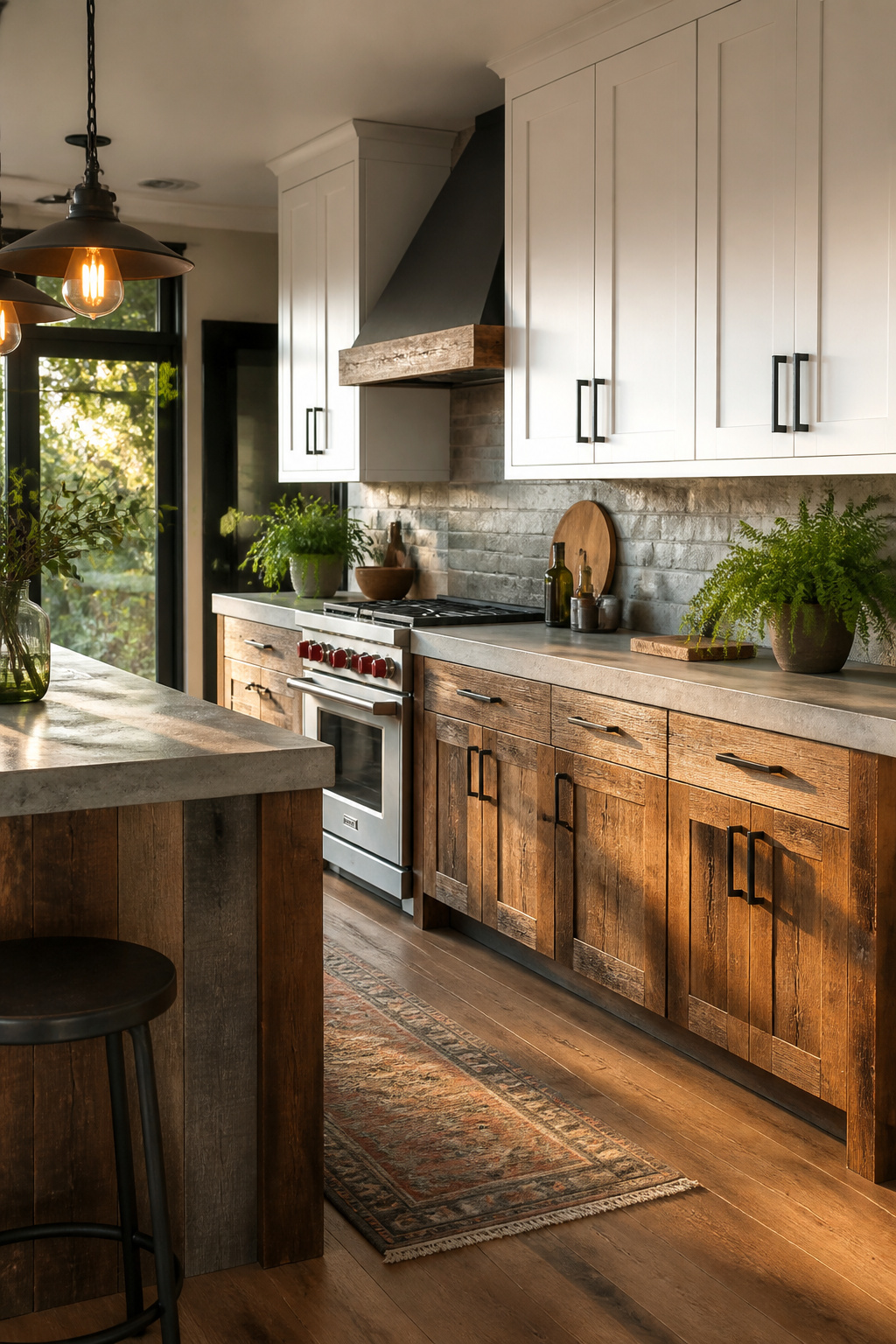
Reclaimed wood cabinet fronts create more conversation per dollar than almost any other kitchen upgrade. Every piece has a history — old-growth pine from a 19th-century barn, Douglas fir from a factory floor, oak from a demolished school gymnasium. That history reads in the grain, the nail holes, and the color variations. New wood cannot replicate it. If you’ve already explored authentic rustic kitchen decor and want to take that aesthetic further, reclaimed cabinet fronts are the next step.
Sourcing Wood That’s Safe for Kitchen Use
Not all reclaimed wood is kitchen-ready. Lead paint and chemical treatments from industrial sources are real concerns. Buy from reputable suppliers — Elmwood Reclaimed Timber ships nationally and provides certified material history. Expect $180–$320 per door for custom-cut cabinet fronts.
Sealing for the Kitchen Environment
Reclaimed wood in a kitchen must handle steam, grease, and frequent cleaning. Rubio Monocoat Oil Plus 2C ($80–$120 per set) is the finishing product most suppliers recommend. It’s a penetrating oil that cures food-safe and provides good water resistance without the plastic look of polyurethane.
Pairing Reclaimed Fronts With Modern Appliances
The contrast works when you commit to it. A reclaimed wood door next to a stainless refrigerator reads as intentional. The same door next to ornate traditional hardware looks confused. Keep the hardware simple — black iron flat bar pulls — and the juxtaposition reads as sophisticated.
10. Floor-to-Ceiling Kitchen Cabinets Ideas for Maximum Storage Impact
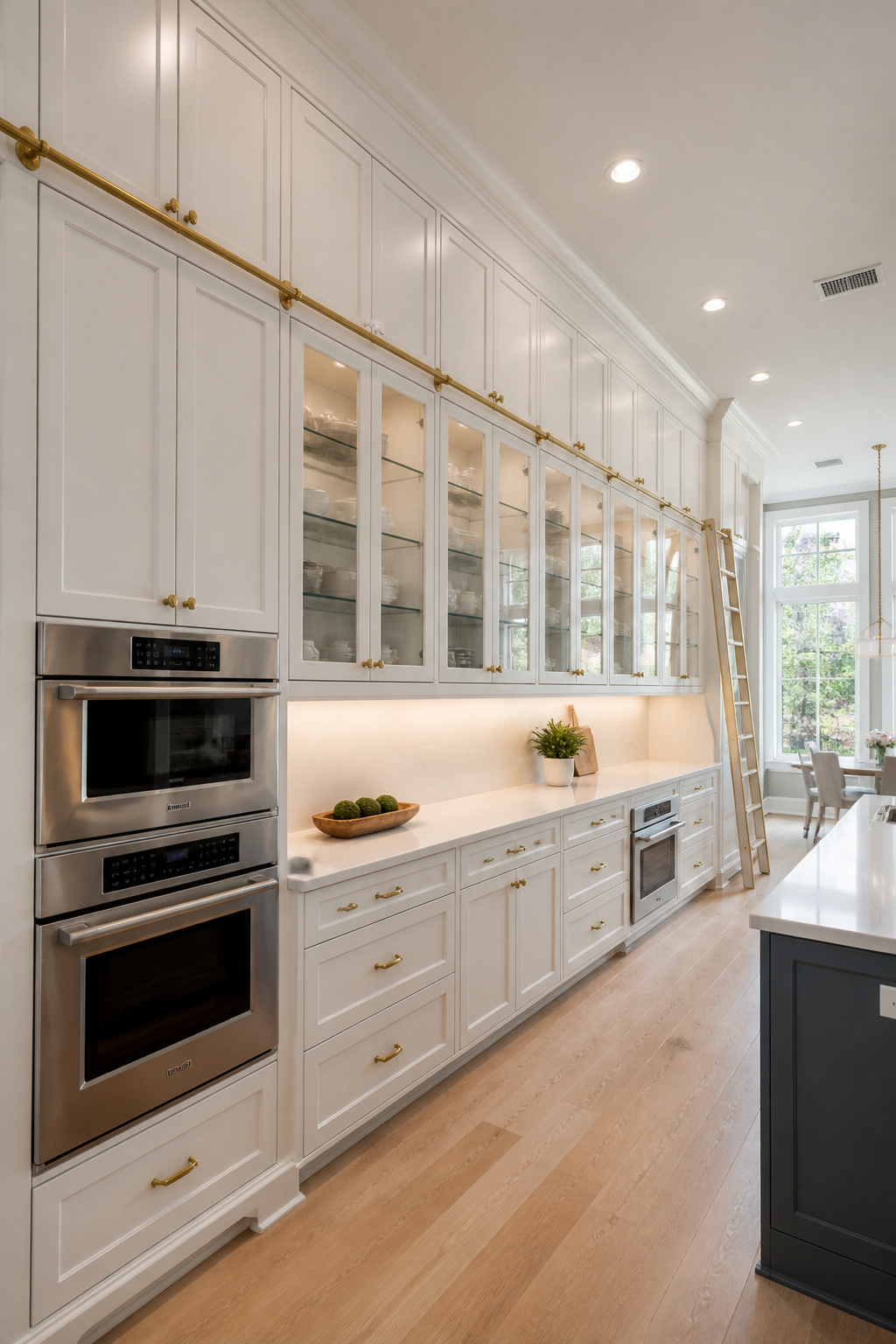
Standard kitchen design leaves 12–18 inches of empty space between the top of the upper cabinets and the ceiling. In a typical kitchen, that’s 15–25 square feet of storage potential sitting unused overhead. Floor-to-ceiling cabinets convert that dead zone into practical storage and change the architectural feel of the room entirely.
Why Vertical Storage Changes the Room
A standard 8-foot kitchen with 30-inch upper cabinets ends the cabinet line at around 84 inches — leaving a 12-inch gap to the ceiling. Filling that gap adds storage. But it also makes the kitchen feel taller. The eye follows the cabinet line, and a line that reaches the ceiling reads as architecturally resolved.
What Goes Up There and How to Reach It
Store rarely used items in the top 18 inches: holiday serving pieces, overflow pantry stock, extra appliances. IKEA’s SEKTION high cabinet frame ($180–$260 per frame) stacks with standard boxes to reach most ceiling heights. For kitchens above 9 feet, a Rev-A-Shelf pull-down shelf kit ($250–$450) brings the entire shelf down to counter level at the touch of a finger.
Integrating Tall Cabinets With Standard Runs
The transition between standard upper cabinets and a taller adjacent pantry run needs a consistent horizontal line — usually crown moulding at the top of the shorter cabinets. Without that detail, the mixed heights read as a planning mistake rather than a design choice.
11. Sage Green Kitchen Cabinets Ideas That Work in Both Old and New Homes
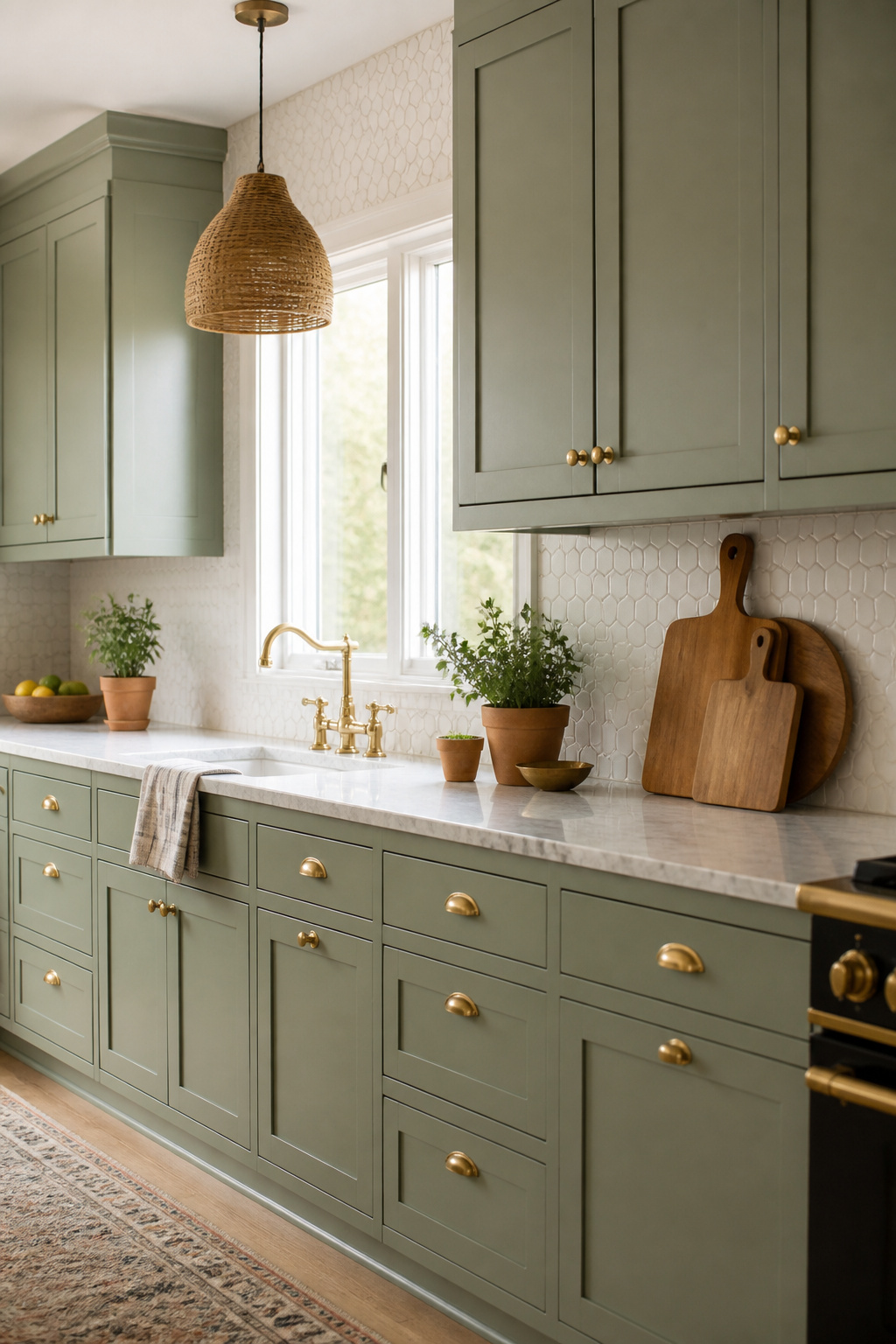
Sage green overtook navy blue as the most-searched kitchen cabinet color on Pinterest in 2024. It has held that position through 2025. The reason is simple: sage is bold enough to feel like a real decision and quiet enough to live with easily. It bridges the bold-color movement that forest green kicked off and the quieter, nature-adjacent palettes that followed.
Warm Sage vs. Cool Sage: Getting the Undertone Right
Benjamin Moore Saybrook Sage HC-114 ($72/gallon) is the warm version — a yellow-green undertone that responds beautifully to afternoon light in south and west-facing kitchens. Farrow & Ball Mizzle No.266 ($120/gallon) is the cool, more complex version. A grey-green with exceptional depth, it works particularly well in north-facing kitchens where warm colors can read muddy. Sherwin-Williams Retreat SW 6207 sits in the middle and is the safest choice when your light direction is hard to determine.
Why Sage Works in Historic and New Homes
Sage green crosses design periods because it references natural plant pigments. In a Victorian terrace kitchen, it connects to the original painted kitchen furniture of the era. In a contemporary open-plan kitchen, it grounds the cabinetry in a natural palette that softens hard materials like concrete and steel.
The 48-Hour Sample Rule
Sage green is arguably the color most affected by surrounding materials and light. Paint a 12×12-inch sample on the actual cabinet door — not a white piece of paper. Live with it for two full days before committing. Sage looks entirely different on a cabinet face surrounded by your existing tile and countertop than it does on a plain white sample card.
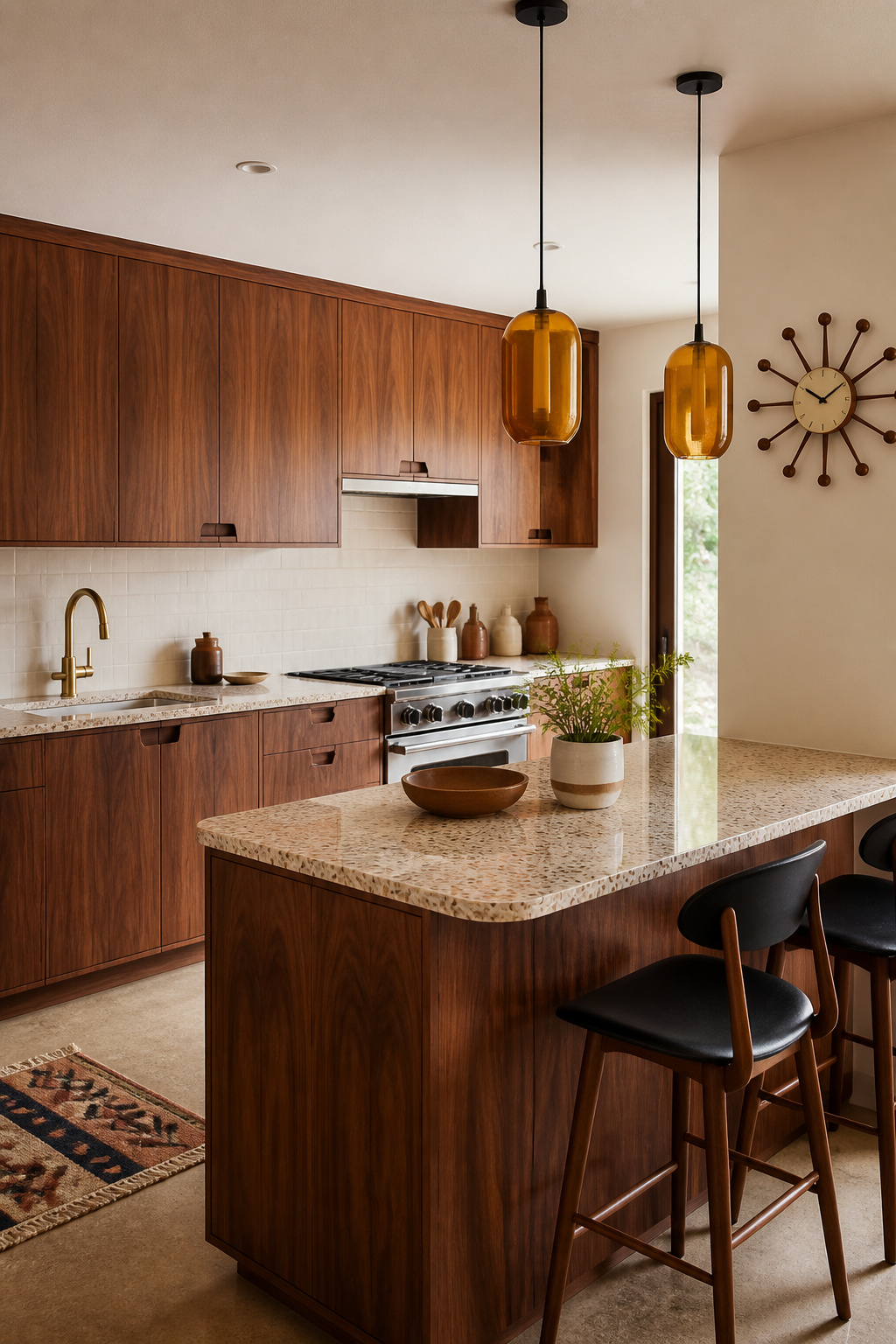
12. Mid-Century Modern Cabinet Ideas With Clean Lines and Warm Wood
Mid-century modern kitchen cabinets are the renovation that keeps paying forward. The style — flat-front doors, minimal hardware, warm walnut or teak tones, clean horizontal lines — looks just as current in 2025 as it did in 1965. The design is built on proportion and material honesty rather than decoration. So there’s no ornamentation to date it.
The Defining Details of Authentic MCM
Genuine mid-century modern cabinet design uses three elements: flat slab or very shallow routed doors (no shaker frame), warm wood in walnut or white oak finish, and slender hardware — a narrow D-pull slot, a thin bar handle, or no hardware at all. Anything with raised panels or decorative carving moves immediately into traditional territory.
Wood Species for the Contemporary Kitchen
Teak was the prestige wood of the original era, but it’s largely unsustainable now. Walnut — both solid and veneered — captures the same warm, dark richness. IKEA’s VOXTORP door in walnut effect ($35–$80 per door) is the most accessible entry point. Semihandmade’s flat-front walnut veneer doors ($120–$240 per door) are genuine wood veneer cut to fit IKEA or standard RTA cabinet boxes — about 40% less than custom cabinetry.
The Island Leg Trick
Add tapered furniture legs to the base of your kitchen island using adjustable legs from IKEA or solid wood options from Osborne Wood ($8–$18 per leg). It reads immediately as mid-century modern without replacing a single cabinet box. The island lifts visually, the floor reveals beneath it, and the character of the kitchen changes for under $100.
13. Handleless Kitchen Cabinets Ideas for a Sleek Contemporary Finish
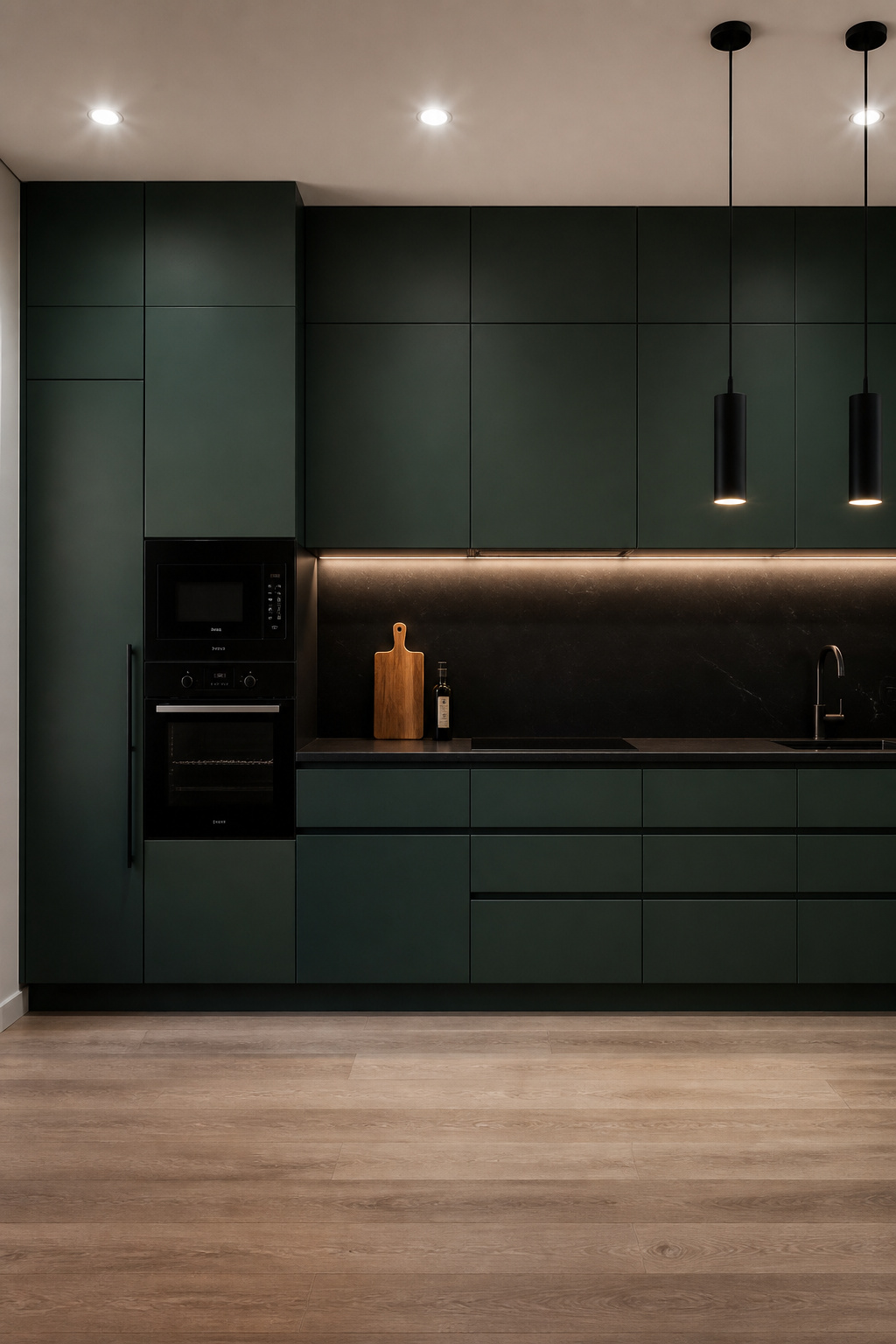
Handleless kitchen cabinets peaked in the 2010s, when high-gloss white push-to-open kitchens became the symbol of contemporary aspiration. That specific version now reads as dated. But the handleless concept itself hasn’t aged. In 2025, handleless kitchens in matte lacquers and textured laminates look fresh again. For more kitchen cabinet color ideas across different styles, our kitchen backsplash design guide covers the material pairings that work best with each finish direction.
J-Pull vs. Push-to-Open: Choosing the Right Mechanism
The J-pull is a routed groove cut into the top edge of a cabinet door. You hook your fingers in and pull. It works on any door material and any cabinet box. No mechanism to fail. Push-to-open (Blum Tip-On is the standard at $18–$35 per door) uses a spring mechanism. Push gently and the door springs open. Some people find this intuitive. Others find it tedious after the tenth time opening a cabinet.
Where Handleless Works and Where It Frustrates
Push-to-open works well when you have clean, dry hands. It’s frustrating when you’re opening a cabinet with wet hands from the sink or dirty hands from handling raw food — the mechanism doesn’t function reliably with slippery fingers. The J-pull is more practical for heavy kitchen use.
The Finish That Makes Handleless Work in 2025
Fenix NTM matte laminate ($90–$140 per door custom) is the material that has refreshed this concept. Its anti-fingerprint surface resists marks and has a soft, tactile quality. The lack of hardware reads as a considered choice rather than a cost-saving measure.
14. Small Kitchen Cabinets Ideas That Make Every Inch Count
The mistake most people make in a small kitchen is trying to make it look bigger. That leads to design decisions aimed at creating the illusion of space — light colors, no clutter, minimal decoration — and the result often reads as empty rather than efficient. The better goal is to make the kitchen feel smarter.
Layout Decisions That Actually Expand Storage
The most underused storage space in any kitchen is the 18-inch zone between the countertop and the bottom of the upper cabinets. Mount a rail system on the backsplash for utensils, oils, and frequently used tools. That move clears two or three full drawers in the base cabinets. Add a magnetic knife strip to the same zone and you eliminate the knife block that takes up 12 inches of counter space.
Cabinet Interior Systems That Double Usable Space
Pull-out drawer organizers transform base cabinets from black holes into accessible storage. Rev-A-Shelf’s pull-out base organizers ($80–$220) fit 9–21-inch-wide cabinets and extend fully so you can see everything inside. The Häfele Cornerstone magic corner unit ($280–$450) converts the dead corner base cabinet — the most wasted space in almost every kitchen — into a functional pull-out system.
Color Strategy for Small Kitchens
Light uppers with slightly darker lowers give a small kitchen a more layered look without the visual weight of dark cabinets. Also, our guide to kitchen island cabinets covers specific storage strategies for compact kitchens where adding an island is part of the plan.
15. Kitchen Island Cabinet Ideas for Extra Storage and Style
The kitchen island is where the most interesting kitchen cabinets ideas tend to happen. It sits at the center of the room. Everything is visible. And it’s the one area where designers routinely give themselves permission to do something different from the perimeter cabinetry.
Island Cabinet Design vs. Perimeter Thinking
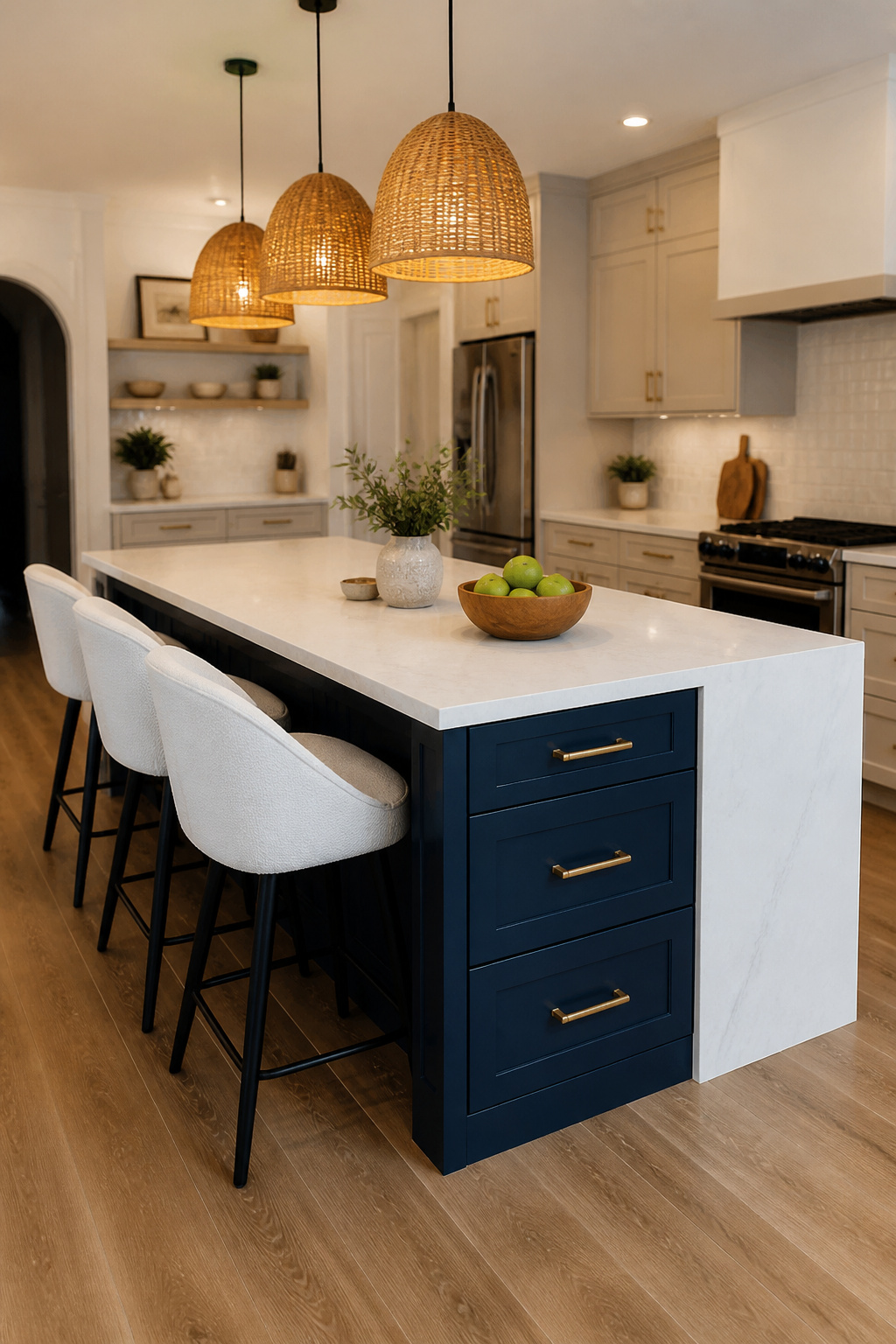
Perimeter base cabinets are optimized for countertop workspace. Island cabinets serve two-sided function — storage and seating — and their layout should reflect that. The seating side typically runs without cabinet doors, leaving knee clearance for stools. The working side carries the full cabinet and drawer configuration. An island designed to look exactly like the perimeter cabinets from every angle misses the architectural opportunity.
Contrasting the Island: When It Works
A contrasting island — darker than the perimeter, or in a different finish — is the most popular kitchen design element in 2025 NKBA data. It works when you repeat the island color somewhere else: a pendant shade, a stool finish, or an accent tile. That repetition is what separates intentional contrast from an afterthought.
Built-In Features Worth Planning Now
Wine racks, open shelving for cookbooks, a built-in trash pull-out, and an appliance garage are the four most useful island cabinet features. All of them are far easier and cheaper to plan at the design stage than to retrofit later. Plan the island first. Add the countertop second. Everything else follows.
16. Budget Kitchen Cabinets Ideas That Look Custom Without the Cost
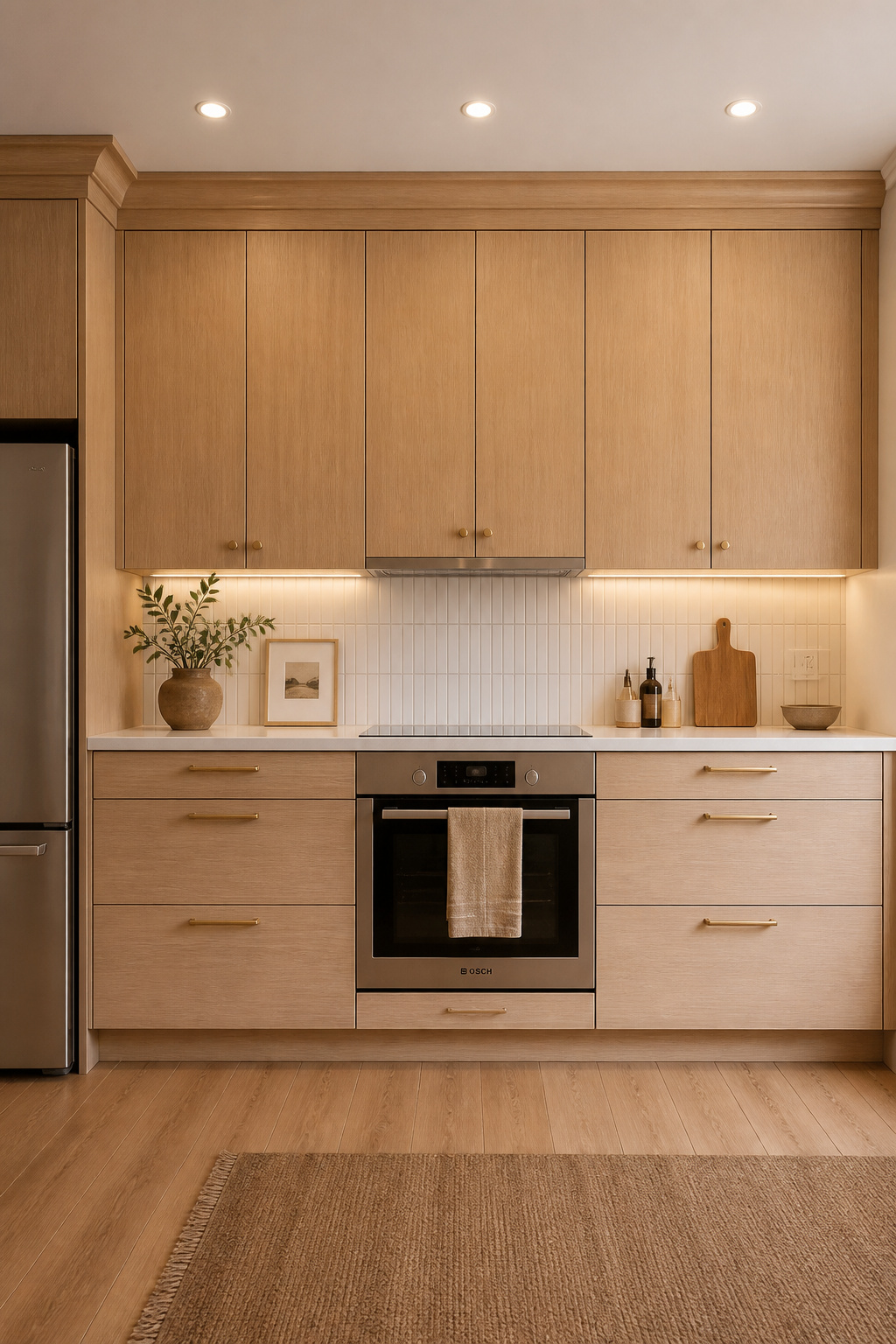
The custom kitchen cabinet look is not reserved for custom budgets. IKEA’s SEKTION system starts at around $150 per linear foot installed. Semi-custom kitchens from mid-tier brands start at $400 per linear foot. The gap between those numbers is where intelligent sourcing lives.
The IKEA SEKTION Modification Strategy
The SEKTION box is well-constructed — plywood sides, solid shelf pins, reliable soft-close Blum hinges. What makes it read as a stock cabinet is the stock door front. Replace those doors with custom-cut fronts from Semihandmade or Kokeena and you get door quality that competes with $600-per-linear-foot custom cabinetry on a flat-pack box. A full 10×10 kitchen comes in at $3,500–$7,000 installed. That’s genuinely custom-looking at a fraction of the cost.
Crown Moulding and Furniture Feet
Adding crown moulding to the top of standard upper cabinets is a $200–$500 investment that reads as a $2,000 upgrade. It fills the gap between cabinet top and ceiling, creates a finished architectural detail, and makes basic stock cabinets look designed for the space. Similarly, adding bun feet to the base of lower cabinets — Osborne Wood sells pre-drilled feet for $8–$18 each — eliminates the visual cue that identifies stock cabinetry immediately.
RTA Brands That Punch Above Their Price Point
For better than IKEA boxes without full semi-custom pricing, ready-to-assemble brands like Lily Ann Cabinets (York Antique White, $1,800–$3,500 for a full kitchen) offer solid wood face frames and plywood box construction. The learning curve is assembly time. The quality payoff is real. And for the countertop pairings that complete these budget kitchen cabinets ideas, our guide to kitchen countertop ideas gives you the material decisions from the surface side.
How to Choose the Right Kitchen Cabinets Ideas for Your Home
You’ve seen sixteen different approaches to kitchen cabinetry — from a $100 hardware swap to a floor-to-ceiling custom build. The right choice depends on three things: the architecture of your space, the budget you’re working with, and the sequence in which you make decisions.
Matching Cabinet Style to Your Kitchen’s Architecture
A Victorian terrace kitchen with period plaster cornicing and original timber floors wants painted shaker doors, brass hardware, and a color that references the era — sage green, duck egg blue, or a warm cream. For a 1980s open-plan kitchen with low ceilings, handleless or minimal-hardware doors in a light matte finish make the most sense. Contemporary apartments with poured concrete floors and steel windows can carry dark cabinets, open shelving, and a contrasting island. The cabinets should feel like they belong to the building as well as the owner.
Budget Frameworks: Where to Spend and Where to Save
Save on the cabinet boxes. IKEA SEKTION, solid RTA brands, or repainting existing boxes if they’re structurally sound — all are legitimate choices. Spend on the doors, the hardware, and the countertop. Those are the elements people touch, look at closely, and photograph. A genuinely beautiful door on a flat-pack box outperforms a mediocre door on expensive joinery every time.
The Decision Sequence That Prevents Costly Mistakes
Plan the kitchen cabinets ideas first. Then choose the countertop. After that, select the backsplash to work with both. Finally, choose the hardware to tie all three together. Most renovation mistakes I’ve seen happen because someone fell in love with a countertop and then tried to find cabinets that worked around it. Compromise at every stage. Cabinets are the largest surface area in the kitchen — they go first, and everything else follows from there. When you get that sequence right, the whole kitchen makes sense.