
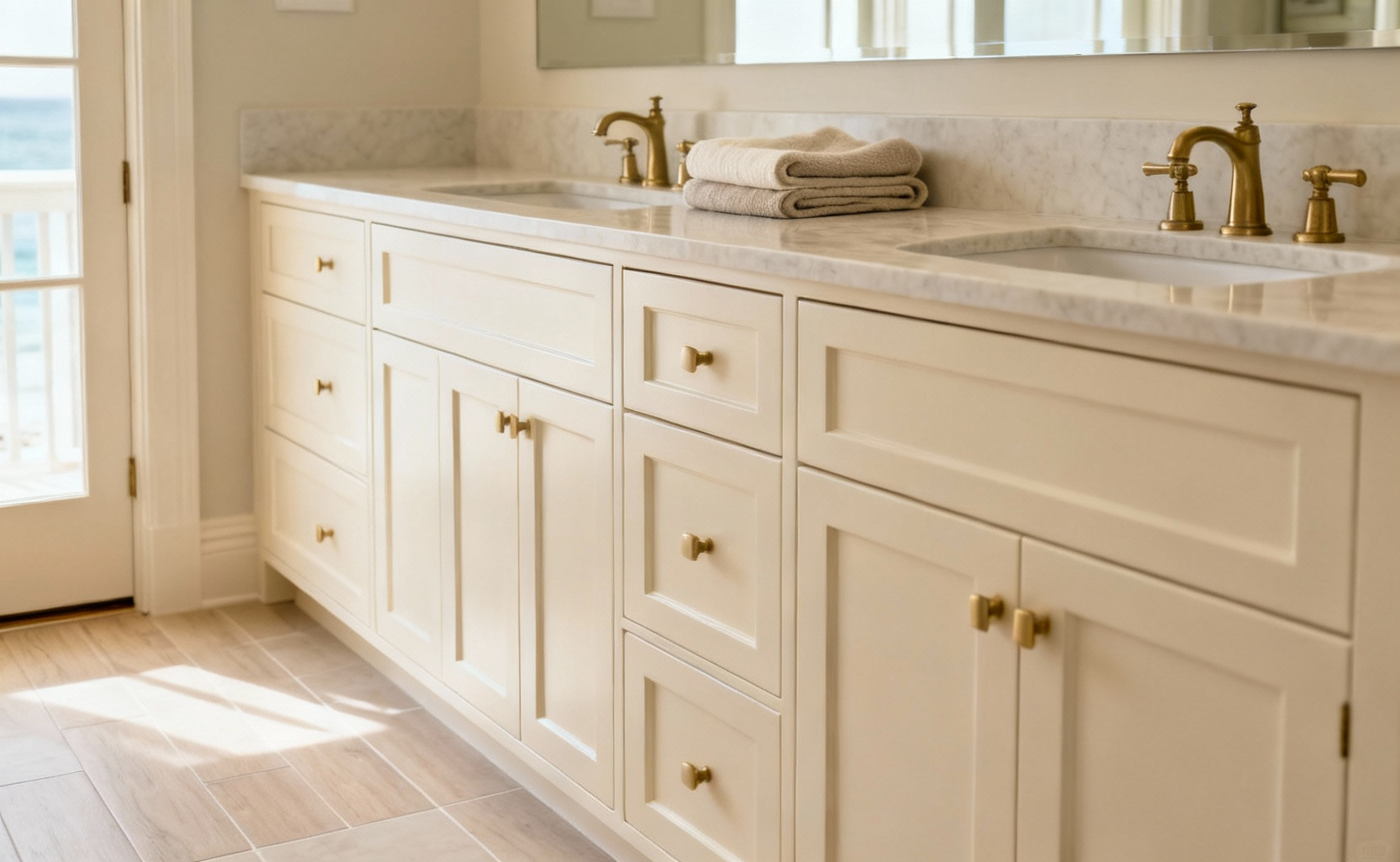

Let’s be honest: the white bathroom vanity often suffers from a reputation problem. It is frequently dismissed as the “safe” choice, the hallmark of a generic spec home, or a placeholder waiting for a future renovation. I recall a recent project in Montauk where a client begged for anything *but* white cabinetry, fearing their master bath would feel sterile rather than serene. However, they were missing the bigger picture. A crisp white vanity isn’t a lack of imagination; it is the ultimate power move in coastal design when executed with intention.
Think of the vanity as the calm within the storm of texture. In a sophisticated seaside retreat, your eye craves a clean, bright place to rest against the organic movement of nature. The secret lies in elevating the form. We aren’t talking about flat, boxy cabinets here. Instead, we focus on furniture-style silhouettes and floating designs that instantly signal custom luxury. When you pair that pristine finish with the warmth of unlacquered brass or the tactile grit of woven rattan, the standard white bathroom vanity stops looking cheap and starts looking curated.
Forget the kitschy anchor motifs and seashells. True coastal elegance demands a balance of the raw and the refined. In this guide, I will show you how to surround your vanity with architectural richness, from vertical shiplap to warm wood accents that prevent the room from feeling cold. We will explore how to turn this standard staple into a deliberate focal point. Your white vanity is ready to anchor a sophisticated retreat; it just needs the right supporting cast.
Why Coastal Designers Prioritize the Crisp White Bathroom Vanity
True coastal sophistication draws a hard line between “crisp” and “sterile.” To avoid a clinical, hospital-like atmosphere, steer clear of high-reflectance, blue-tinted whites. Instead, select vanities with warm, creamy undertones—think Benjamin Moore’s White Dove—that mimic the softness of natural linen. Furthermore, prioritize matte or subtle satin finishes over high-gloss options. I once walked into a client’s oceanfront renovation where the glossy cabinets created a blinding glare against the morning tide; we immediately refinished them to a matte texture, instantly softening the room and highlighting the quality of the millwork.
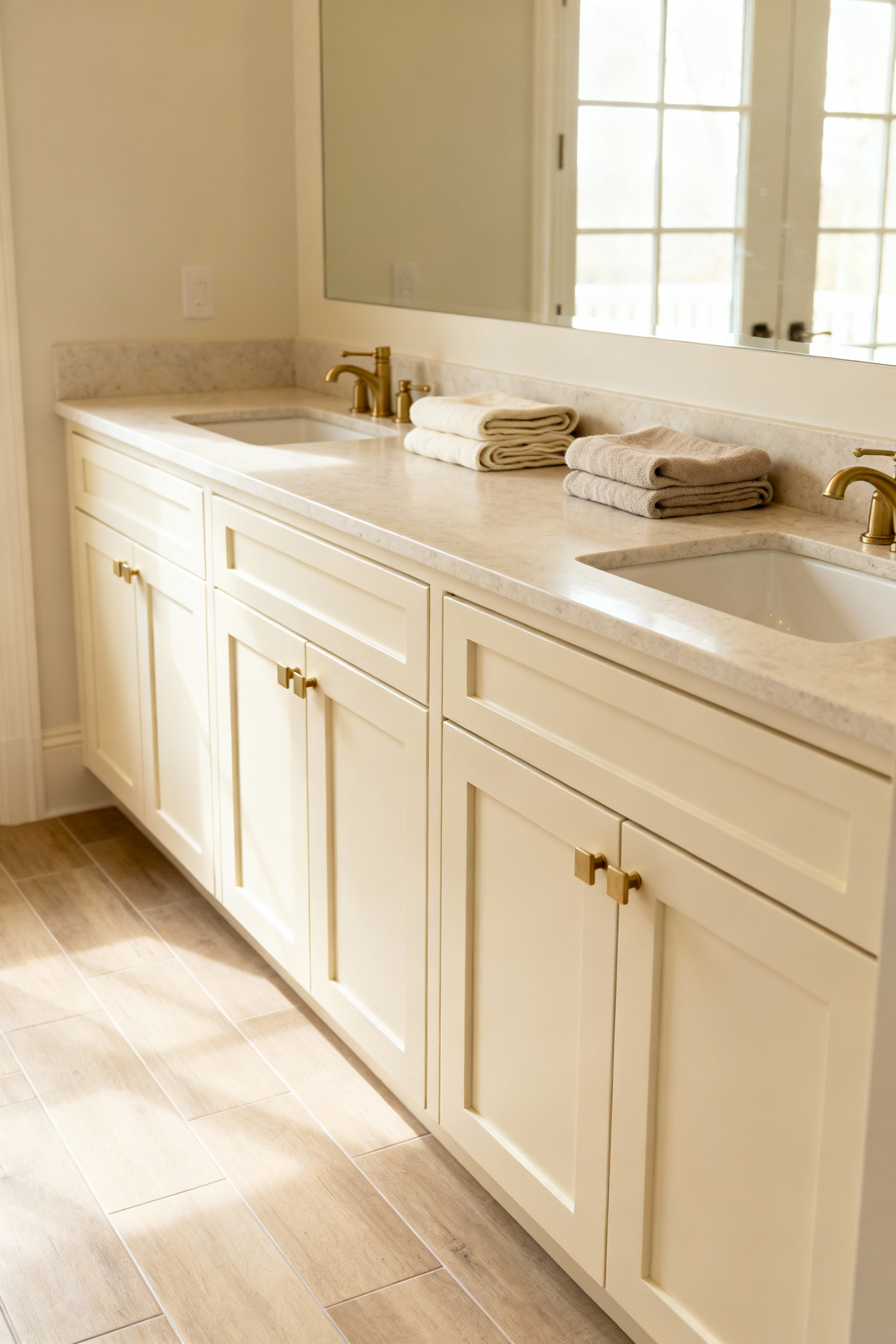
Once the foundational color and texture are set, you must break the visual monotony of a large white unit with intentional contrast. A white vanity without contrast risks disappearing entirely into the background. Ground the piece using these essential design layers:
- Select aged hardware: Swap standard chrome for antique brass, aged nickel, or woven leather pulls to add warmth and history.
- Demand movement: Choose countertops featuring natural stone or quartz with visible warm veining, such as Calcutta Gold, to prevent flatness.
- Balance the palette: Let the taupe or gray streaks in the stone bridge the gap between the creamy cabinetry and the hardware.
The White Spectrum: Distinguishing between stark Arctic white and soft Dove white for lighting balance.
Treat white as a spectrum rather than a single shade. An Arctic White vanity carries blue undertones like glacial ice, so counteract that coolness with LED lighting in the 3000K to 3500K range. This essential step prevents the room from feeling sterile or clinical. Conversely, Soft Dove White holds a creamy warmth. Neutralize this heat with clean, 4000K lighting. I once rescued a client’s seaside powder room where warm bulbs washed over a warm vanity, making the walls look nicotine-stained rather than sun-bleached. We swapped in neutral 4000K bulbs, and the “dingy” yellow instantly vanished.
Furthermore, manipulate texture and contrast to define the space. Arctic White thrives in high-gloss finishes, maximizing light diffusion in windowless corners much like the sun hitting wet sand. However, avoid monochromatic fatigue with the softer Dove shades. Never pair a warm vanity with matching warm tiles. Instead, create sophisticated friction:
- Anchor the room with a matte Dove White vanity.
- Top it with a crisp, Arctic White marble counter.
- Result: Visual separation that feels curated, not accidental.
Materiality & Resilience: Why marine-grade engineered wood outlasts solid pine in high-humidity zones.
Living by the coast teaches you that humidity is a relentless guest. While solid pine offers a romantic, natural narrative, it acts like a sponge in a steamy bathroom, absorbing moisture until joints fail and pristine white finishes crack. Conversely, marine-grade engineered wood remains stoic. Its resin-bonded layers reject humidity, maintaining a swell ratio under 5% where raw pine expands by nearly 20%. I’ve seen too many beautiful single white bathroom vanities ruined by seasonal warping, so I now exclusively recommend high-density, multi-ply cores like birch or okoume for seaside homes.
To ensure your vanity outlasts the elements, prioritize these structural details over aesthetic labels:
- Inspect the Core: Ignore “solid wood” marketing hype; choose engineered stability to prevent structural shifting.
- Seal the Edges: Verify that plumbing cutouts and corners are fully sealed to block capillary action.
- Protect the Finish: Avoid abrasive cleaners that strip the lacquer and wipe away standing water immediately.
Texture as Color: Using beadboard and shiplap detailing to create shadow lines without adding pigment.
A pure white bathroom offers a serene canvas, yet it risks feeling clinical without the right tactile elements. In my own seaside projects, I skip the obvious nautical décor and let light do the heavy lifting. Install beadboard or shiplap behind a flat-front vanity to introduce immediate depth. The grooves naturally catch the sun, creating consistent shadow lines that read visually as soft gray tones. This architectural trick provides essential contrast without adding a single drop of pigment. Consequently, the space remains airy and sophisticated rather than sterile.
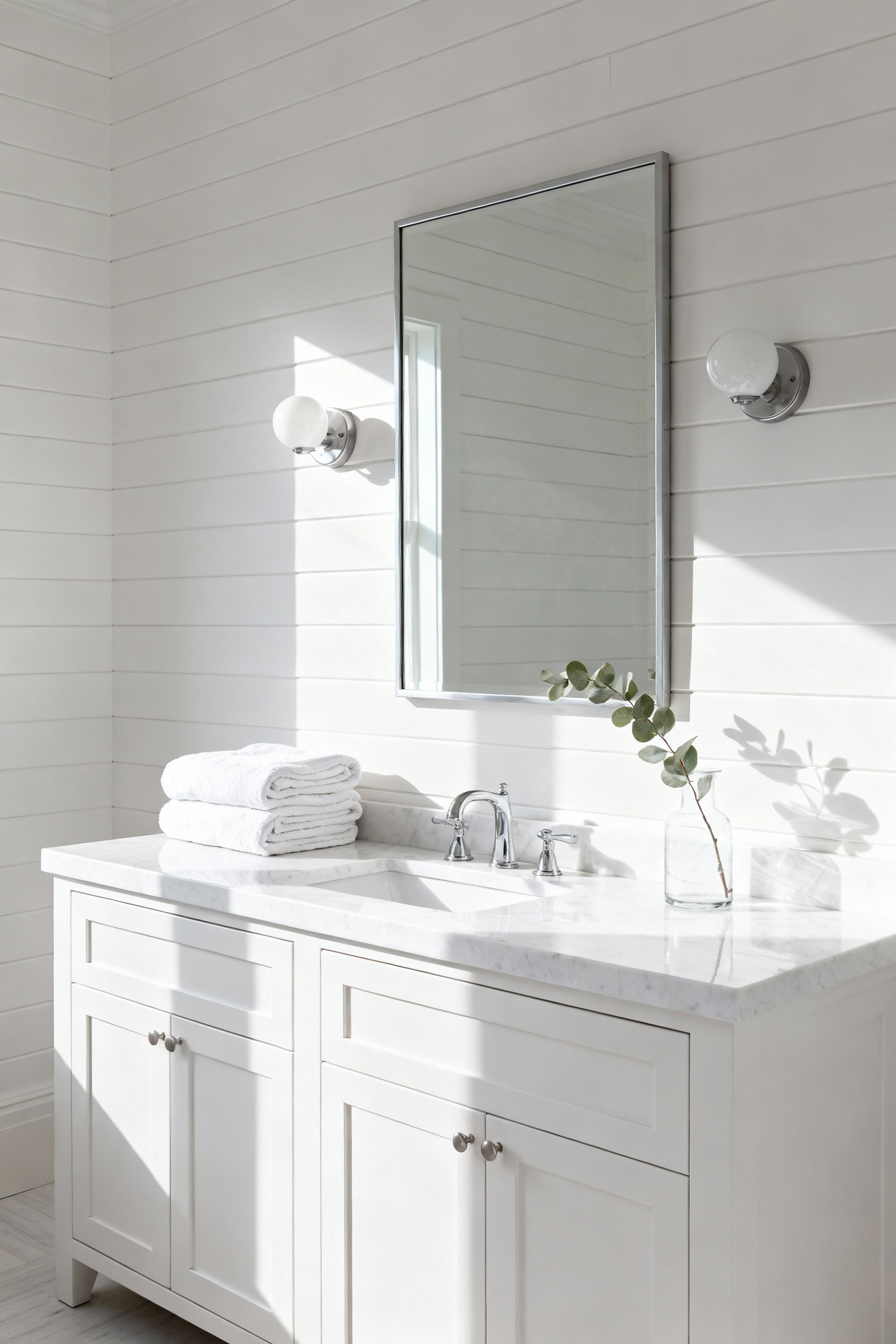
To truly master this “texture as color” approach, you must direct the eye intentionally. Position sconces or recessed fixtures to graze the wall surface, instantly deepening those shadow lines for a dynamic effect. Furthermore, manipulate the room’s perceived proportions with these targeted applications:
- Expand the Space: Install horizontal shiplap to visually stretch the width of a compact powder room.
- Create Separation: Use vertical wainscoting to prevent a white vanity from merging into a white wall.
- Elevate the Furniture: Select cabinetry with routed vertical grooves to mirror the wall treatment, adding high-end custom detail to the furniture itself.
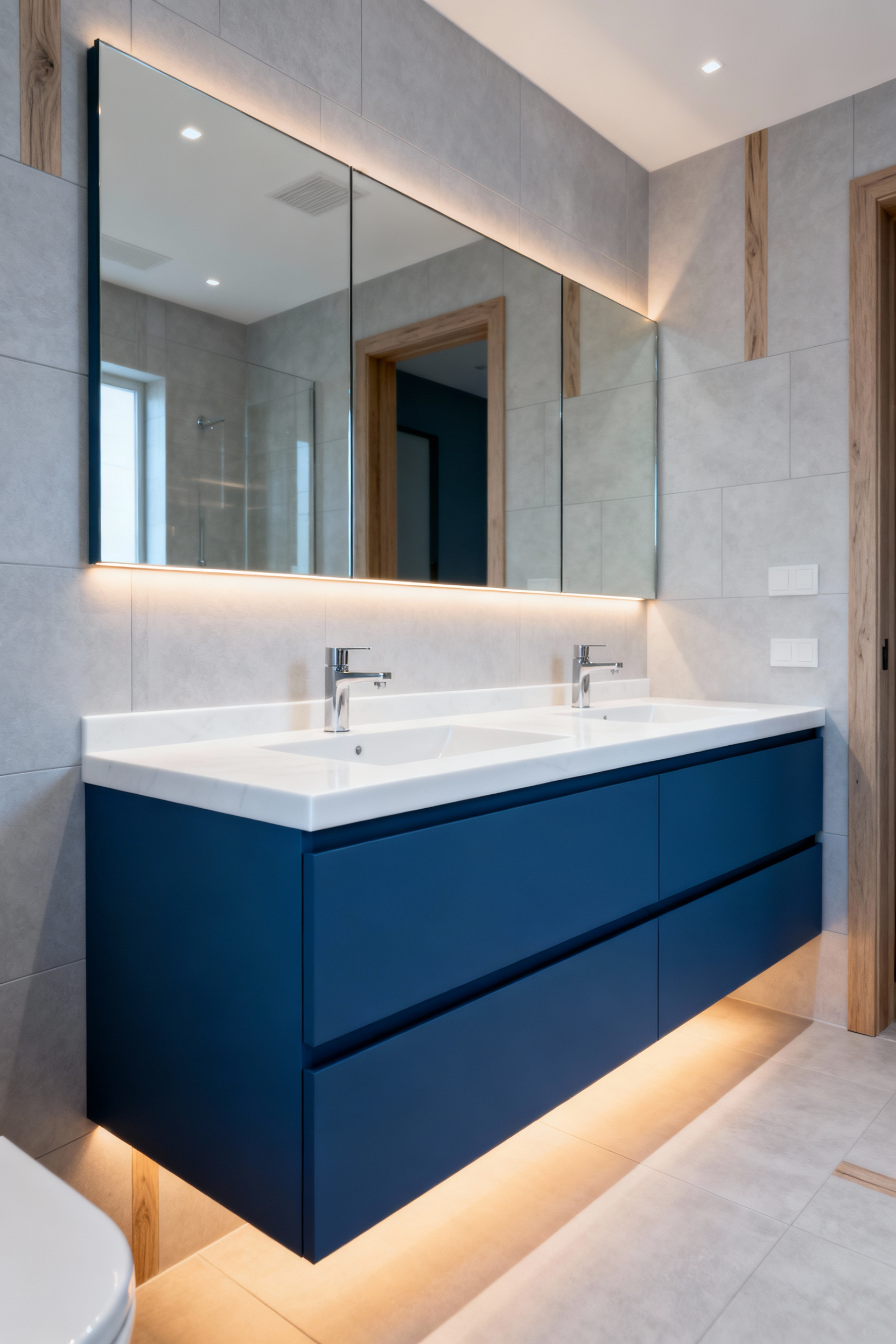
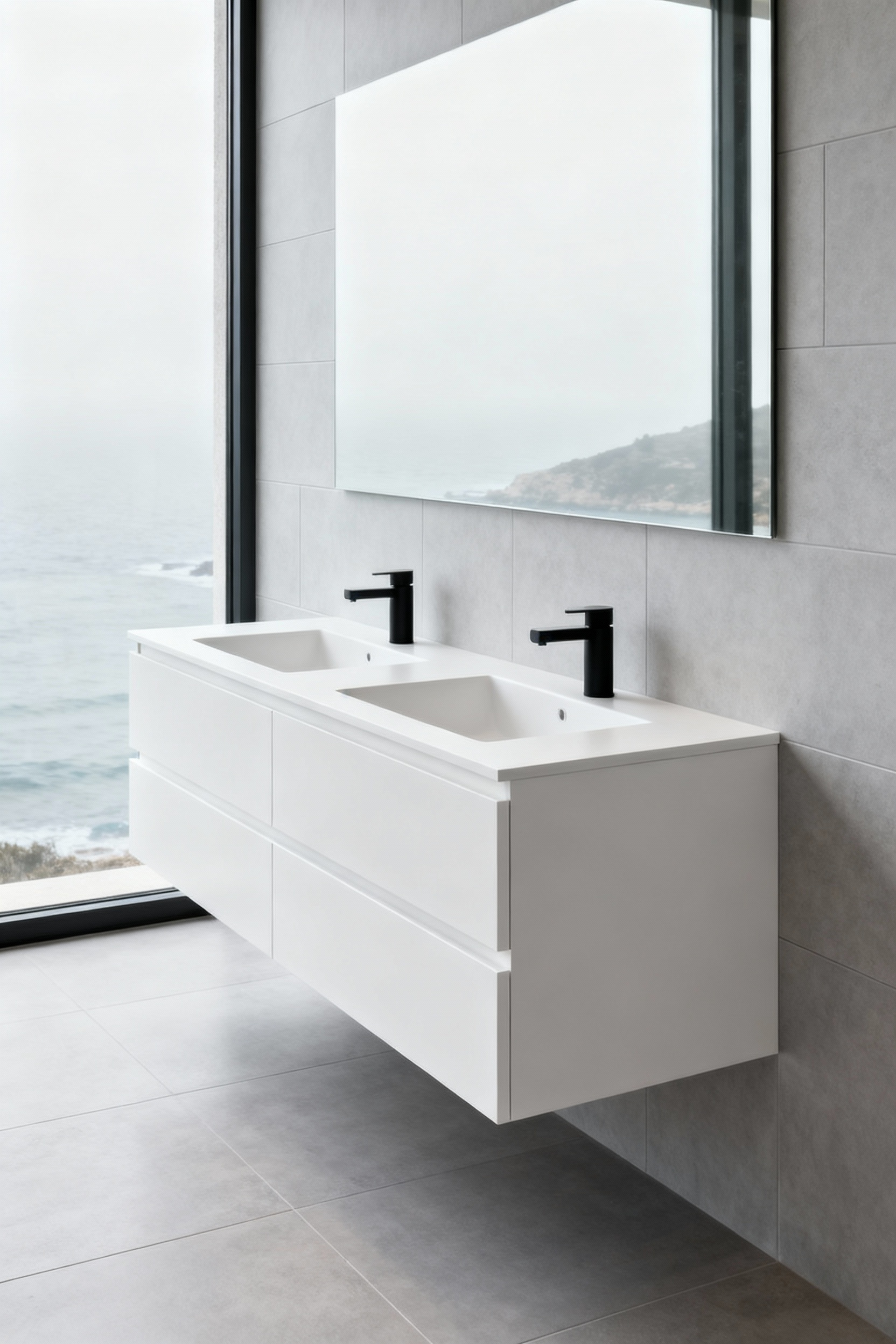
The Floating Silhouette: creating visual breeziness and floor visibility with wall-mounted designs.
Anchor your design with air, not weight. By mounting a matte or high-gloss white vanity against a matching wall, you force the heavy furniture to visually recede. In my own seaside projects, I often use this “disappearing act” to mimic the openness of the horizon. Consequently, the room breathes, and the focus shifts instantly to the uninterrupted floor, making even compact powder rooms feel vast. This approach delivers the sophistication of a high-end spa while maintaining the relaxed ease of coastal living.
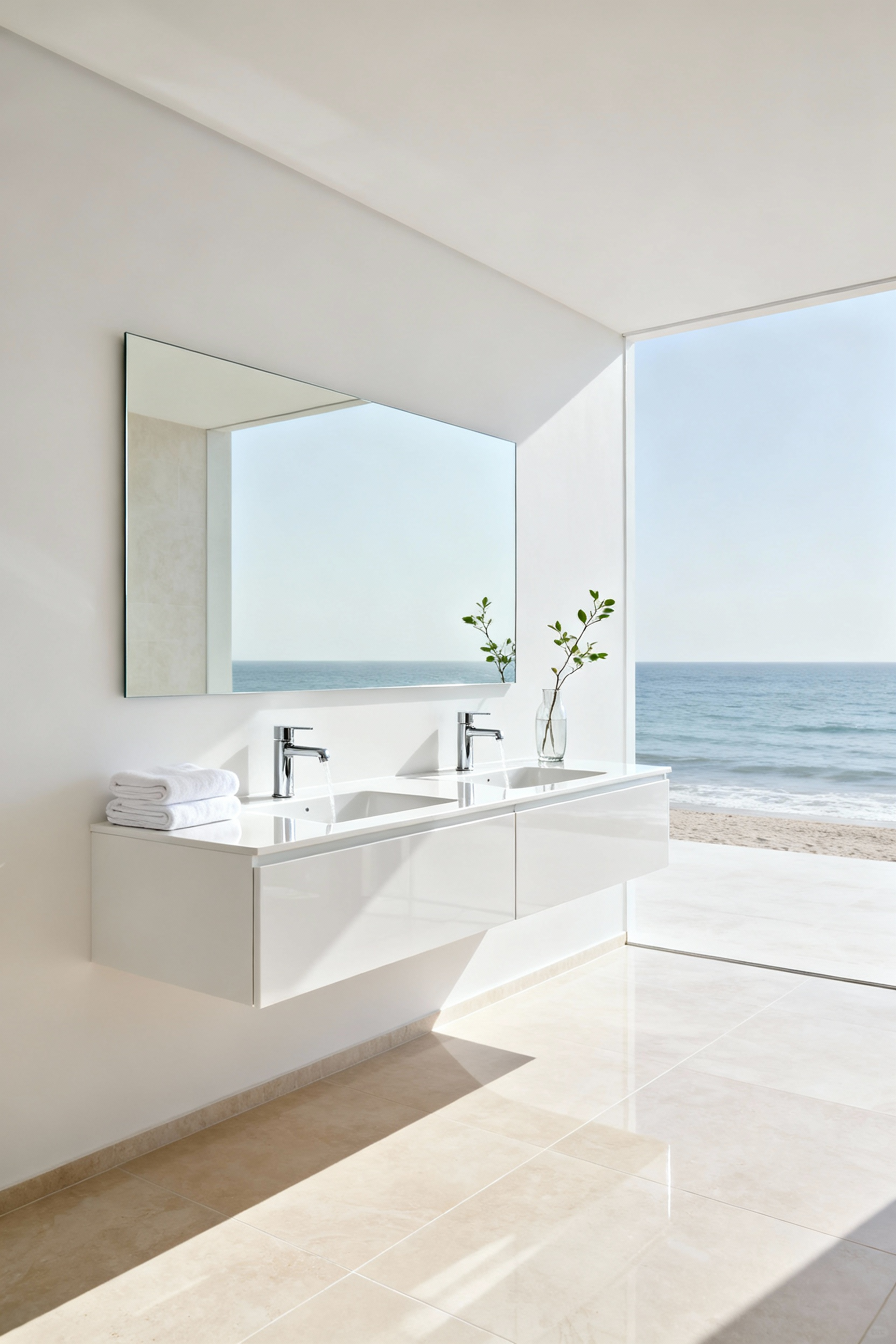
Furthermore, you must treat the floor as a continuous canvas. Because the vanity hovers, the ground plane remains fully exposed. This setup not only simplifies sweeping up the inevitable tracking of sand but also maximizes visual flow. To achieve the ultimate floating effect, apply these design rules:
- Extend the material: Run large-format tile or terrazzo unbroken beneath the cabinet to eliminate visual stops.
- Illuminate the void: Install a warm LED strip underneath to highlight the shadow line and provide soft evening ambience.
- Trim the profile: Select a vanity depth of 18 inches or less to physically reduce mass and keep the walkway clear.
Countertop Contrast: Pairing white cabinetry with durable quartz that mimics the movement of sea foam.
White cabinetry feels classic, yet it often drifts into clinical sterility. To anchor the space, select quartz that mimics the organic movement of sea foam. I always hunt for slabs with swirling, wispy gray or light blue veining rather than sharp, distinct lines. This subtle texture prevents the design from looking flat and adds critical depth. In my own seaside projects, I use this pairing to capture the ocean’s energy without resorting to kitschy nautical décor or obvious clichés.
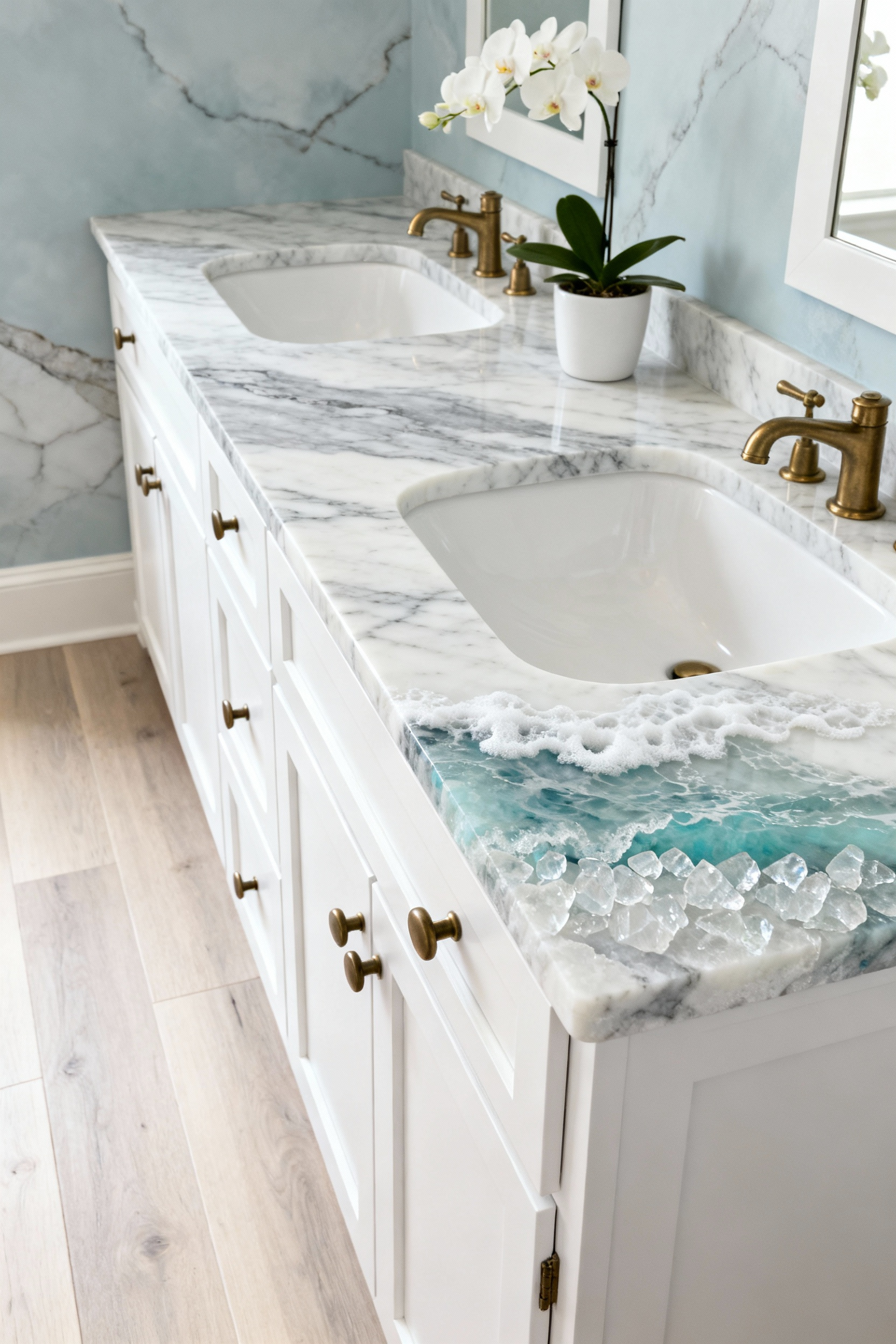
Furthermore, true coastal luxury relies on effortless living. Quartz outperforms natural marble because its non-porous surface resists makeup and hair dye stains without requiring sealant. To fully realize this breezy aesthetic, follow these styling rules:
- Select cool hardware: Polished chrome or brushed nickel enhances the stone’s airy undertones.
- Adjust the light: Install 4000K–5000K LEDs to highlight the quartz’s translucent depth.
- Avoid warm metals: Brass often clashes with the cool, aquatic palette inherent in sea foam veining.
Hardware Alchemy: Warming up cool white surfaces with unlacquered brass or oil-rubbed bronze pulls.
White bathroom vanities often risk feeling sterile, akin to a winter fog that refuses to lift. Counteract this chill by swapping standard chrome for “living finishes” like unlacquered brass (ULB) or oil-rubbed bronze (ORB). I personally adore how ULB deepens after a season of salt air; that evolving patina adds a curated history that static, lacquered metals simply cannot mimic. Alternatively, utilize the deep chocolate tones of ORB to anchor weightless white cabinetry and establish a necessary visual rhythm with dark grout or timber floors.
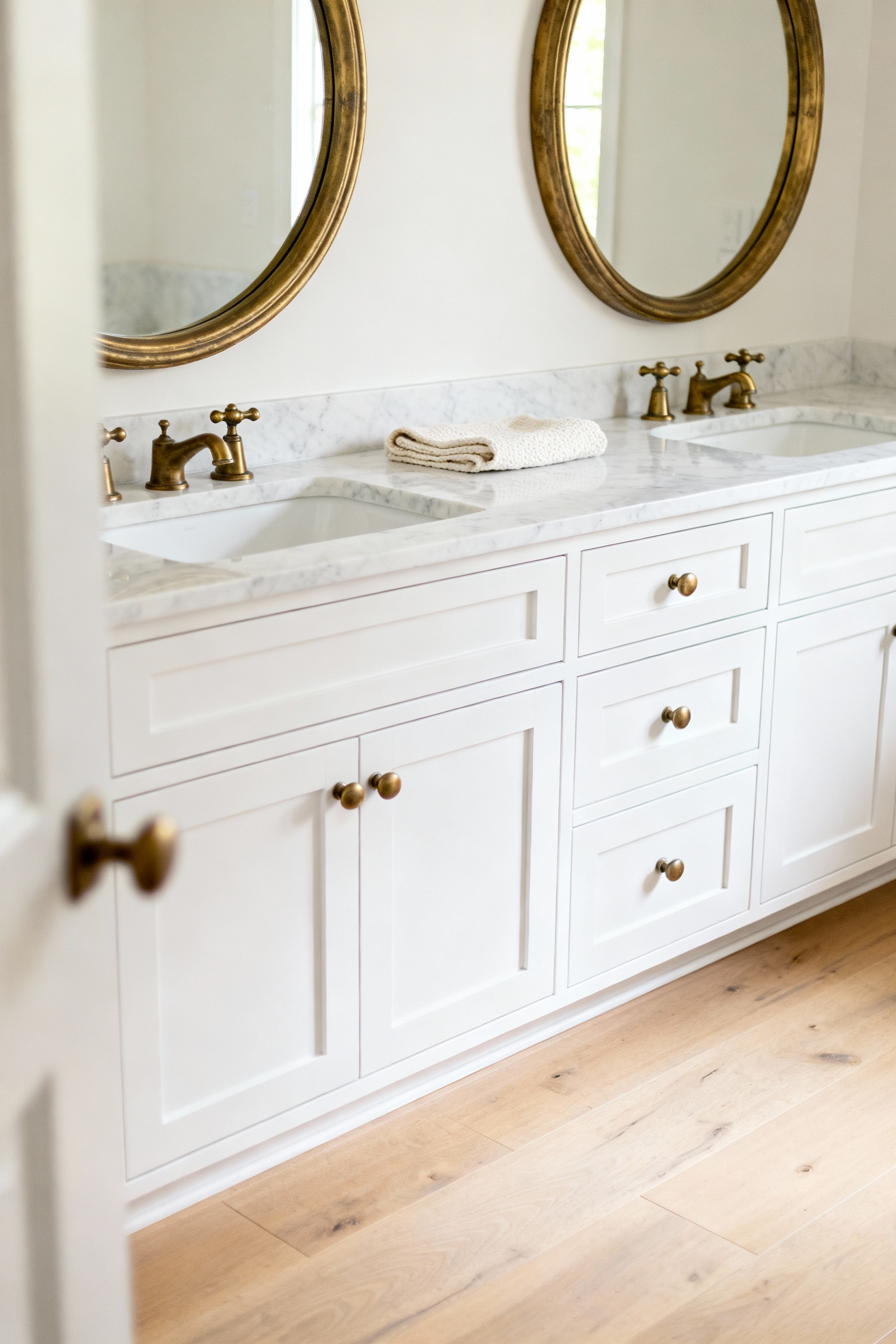
To ensure these warm metals truly sing, avoid stark, blue-based paints that feel clinical. Select creamy off-whites to embrace the hardware’s heat rather than fight it. Furthermore, prevent your hardware from looking stranded by applying the “Rule of Three Warmth.” Create a cohesive loop by repeating the finish in at least two other areas:
- Mirror Frames: Encircle the reflection in matching bronze or brass to draw the eye up.
- Lighting: Coordinate your vanity pulls with a nearby sconce or pendant.
- Architectural Accents: Echo the warmth in a shower fixture or a natural wood floating shelf.
The Vessel vs. Undermount Debate: Choosing between sculptural modernity and seamless hygiene.
For seamless hygiene, the undermount sink reigns supreme. This installation eliminates the exposed rim, preventing grime buildup and allowing you to sweep water directly into the basin. Consequently, your crisp white vanity remains pristine. Furthermore, undermounts maximize usable counter space—a luxury in compact coastal baths—and offer universal resale appeal. In my own home, I prioritized this seamless flow to manage the inevitable tracking of fine sand; one quick swipe and the surface is spotless.
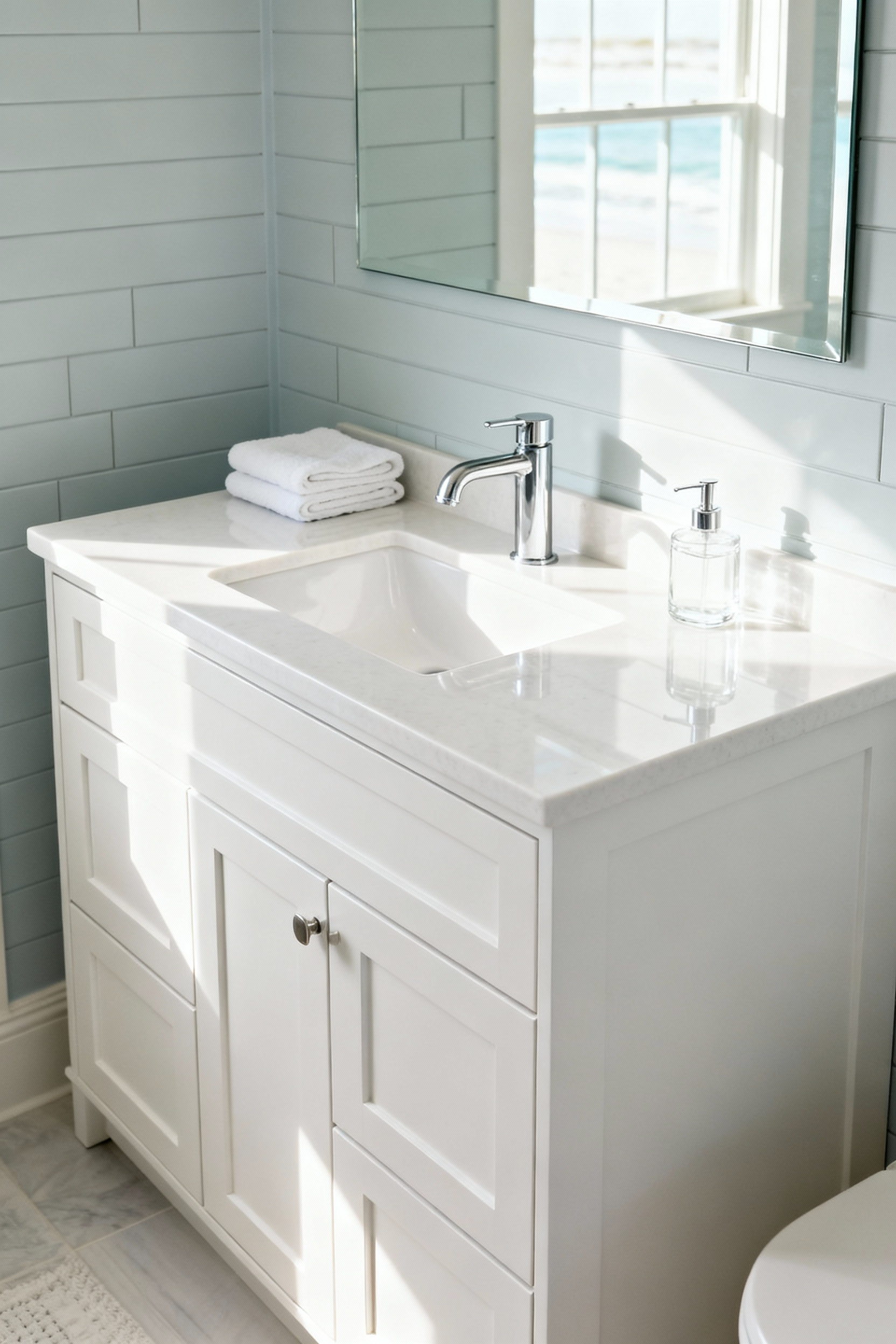
Conversely, choose a vessel sink to introduce high-impact sculpture. Select materials like textured stone or matte black ceramic to boldly break the monotony of a white countertop. However, function must partner with form. Since vessel sinks dramatically raise the usage height, you must install a vanity cabinet that is 4–6 inches shorter than standard. Without this adjustment, daily washing becomes an ergonomic strain. Opt for this style if you desire:
- A dramatic focal point.
- Modern artistic flair.
- Material contrast against white lacquer.
Reflecting Light: Selecting mirrors that enhance the vanity’s brightness without creating glare.
Living near the coast teaches you to respect the sun’s intensity; you want brilliance, not blindness. Standard mirrors often dampen a room with a subtle green tint, stealing the vibrancy you need. Instead, invest in low-iron or HD glass. This simple swap removes impurities and boosts reflectivity to nearly 98%. Consequently, you achieve true color accuracy and a crisp, airy atmosphere that mimics the clear morning light off the water.
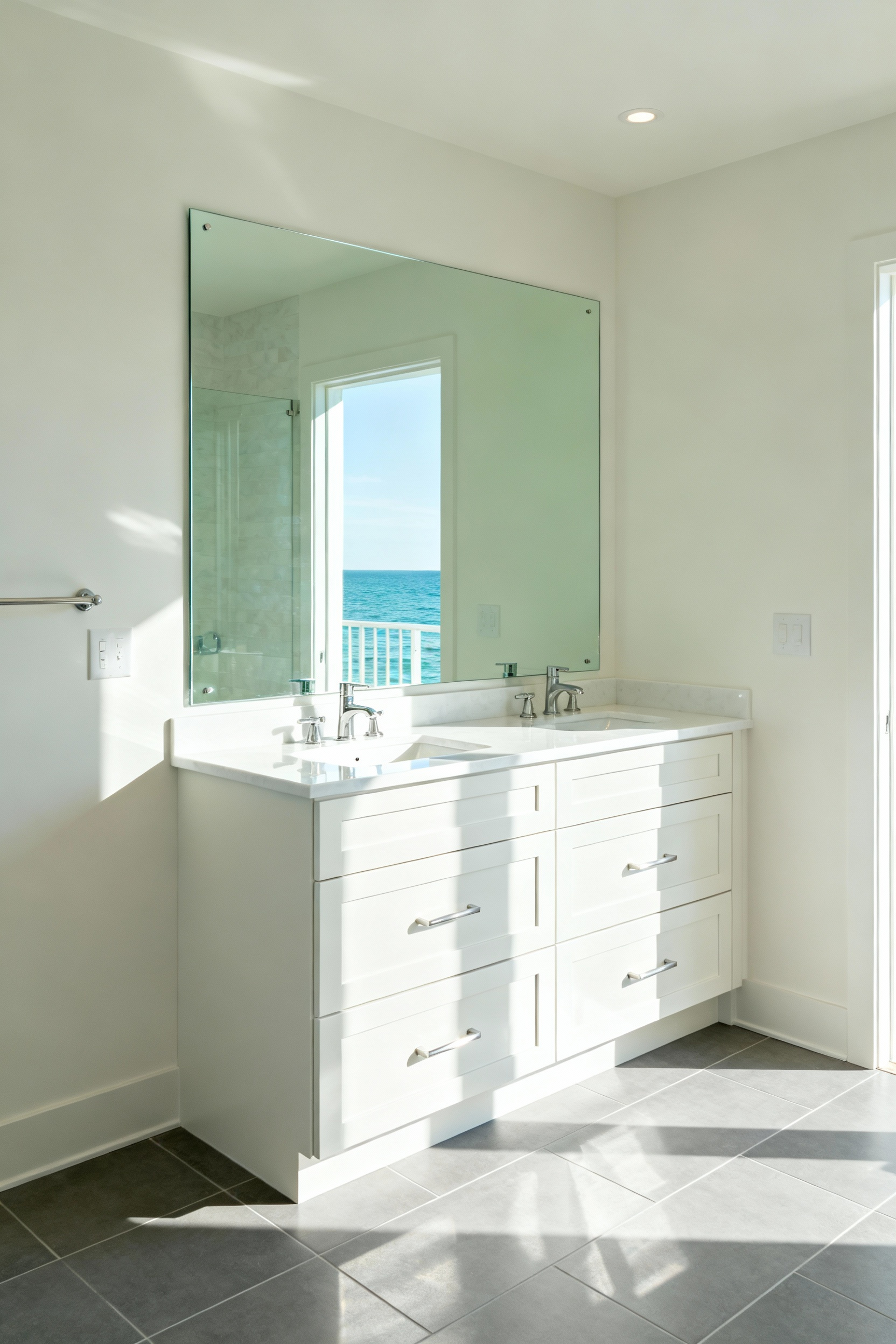
Furthermore, you must manage the glow to avoid harsh hot spots. Since a white vanity already amplifies brightness, your mirror should act as a diffuser rather than a magnifier of glare. Follow these steps for a serene, sophisticated reflection:
- Choose backlit options: Select mirrors with LEDs hidden behind frosted glass to ensure soft, even illumination for grooming.
- Maximize width: Match the mirror size to the vanity width. A larger surface spreads ambient light and dilutes the intensity of reflections.
- Position carefully: Angle the glass to reflect neutral walls or the ceiling rather than exposed bulbs.
Backsplash Integration: Grounding the white vanity with textured handmade subway tiles.
A crisp white vanity often feels untethered in a bright room, risking a sterile appearance. Ground that starkness using the organic surface of handmade subway tiles. In my own seaside projects, I rely on Zellige-style options because their undulating surfaces catch light like ripples on water. This shadow play adds essential visual weight. These deliberate imperfections—uneven edges or subtle crackles—counteract sleek, engineered countertops and inject warmth without forcing a dark color palette.
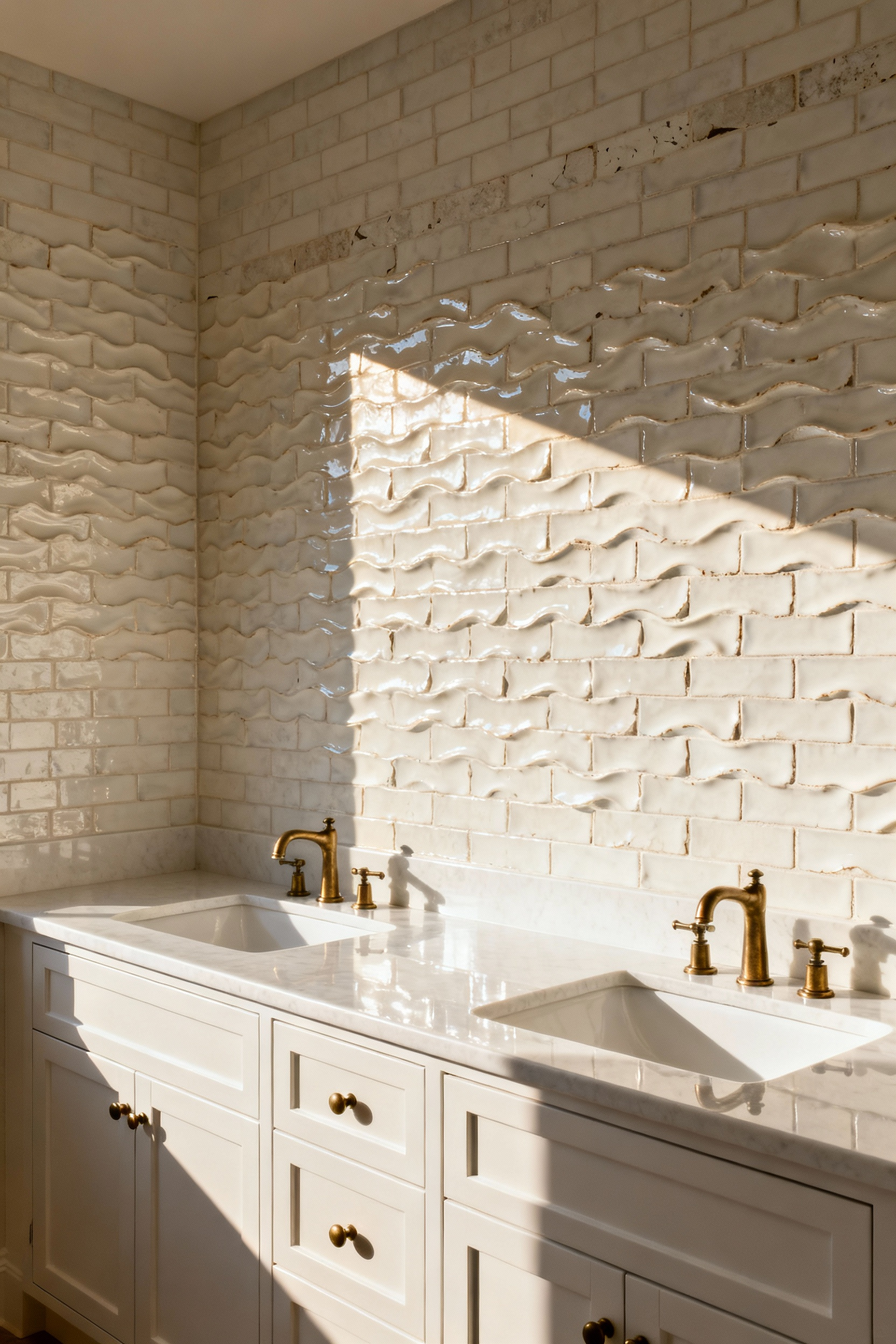
To truly define the space, skip the white grout. Instead, select a warm gray or light mushroom tone to outline each tile’s unique shape. This contrast creates a distinct horizon line, preventing the backsplash from vanishing into the wall. Follow these steps for a balanced, sophisticated finish:
- Install a low profile: Limit the height to 4-6 inches to anchor the vanity while keeping the upper walls airy.
- Embrace the organic: Let the uneven artisan glaze mimic natural weathering.
- Highlight the texture: Position lighting to wash over the tiles, emphasizing the tactile difference between the rough clay and smooth vanity.
Organizational Serenity: Internal drawer systems that maintain the minimalist exterior aesthetic.
True coastal elegance relies on an unbroken horizon, and your bathroom vanity should reflect that calm. Keep the façade as smooth as sea glass by selecting push-to-open hardware or integrated channel handles. This invisible access preserves the minimalist white aesthetic, ensuring visual silence. Inside, refuse to surrender storage to plumbing. Install U-shaped drawer inserts that glide effortlessly around the sink’s P-trap. Consequently, you convert frustrating dead zones into efficient compartments for daily essentials. This is key to maximizing the usefulness of your white bathroom vanity storage.
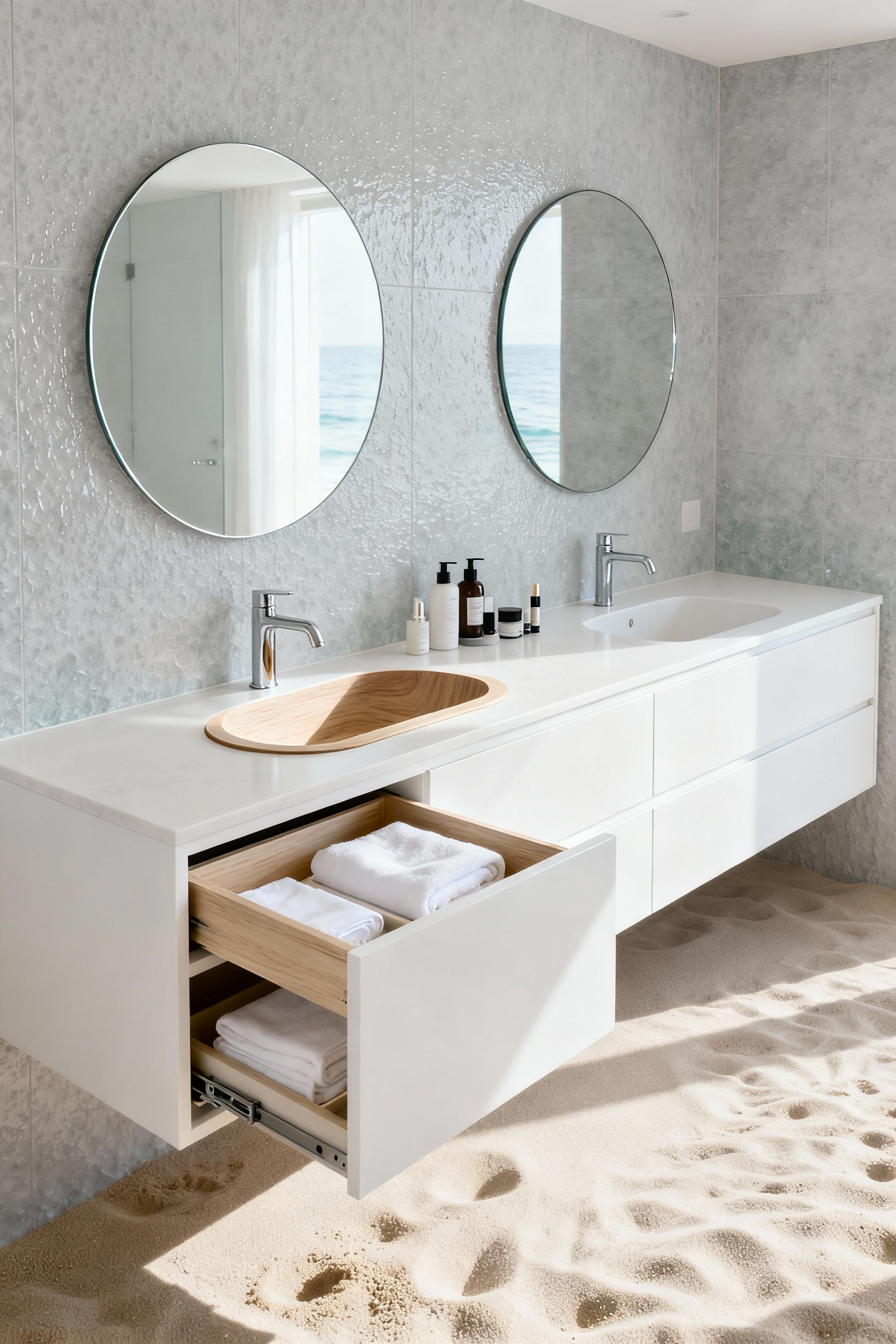
Internal chaos inevitably seeps into your morning peace. I often remind clients that a clutter-free countertop starts with a dedicated home for everything below the surface. Designate a deep drawer for vertical tool storage, incorporating heat-safe liners and integrated power strips to stow hair dryers immediately after use. Finally, curate the interior layout for instant clarity:
- Select pale bamboo dividers to add warmth and sharply define zones against the white finish.
- Use clear acrylic organizers to boost visibility for small items like floss or jewelry.
- Implement tiered trays to prioritize daily reach items.
This systematic approach ensures your routine flows as naturally as the tide, keeping the exterior pristine.
Lighting the Focal Point: Sconce placement strategies to eliminate shadows on white surfaces.
White surfaces amplify light like the midday sun on the water. Without control, this intensity casts harsh, unflattering shadows across your face. I learned this lesson the hard way renovating a Montauk cottage; the client’s original clear bulbs over white quartz created a glare that felt aggressive and clinical. We immediately softened the space by embracing cross-illumination. You want light that wraps around you, much like a morning mist, rather than striking you directly.
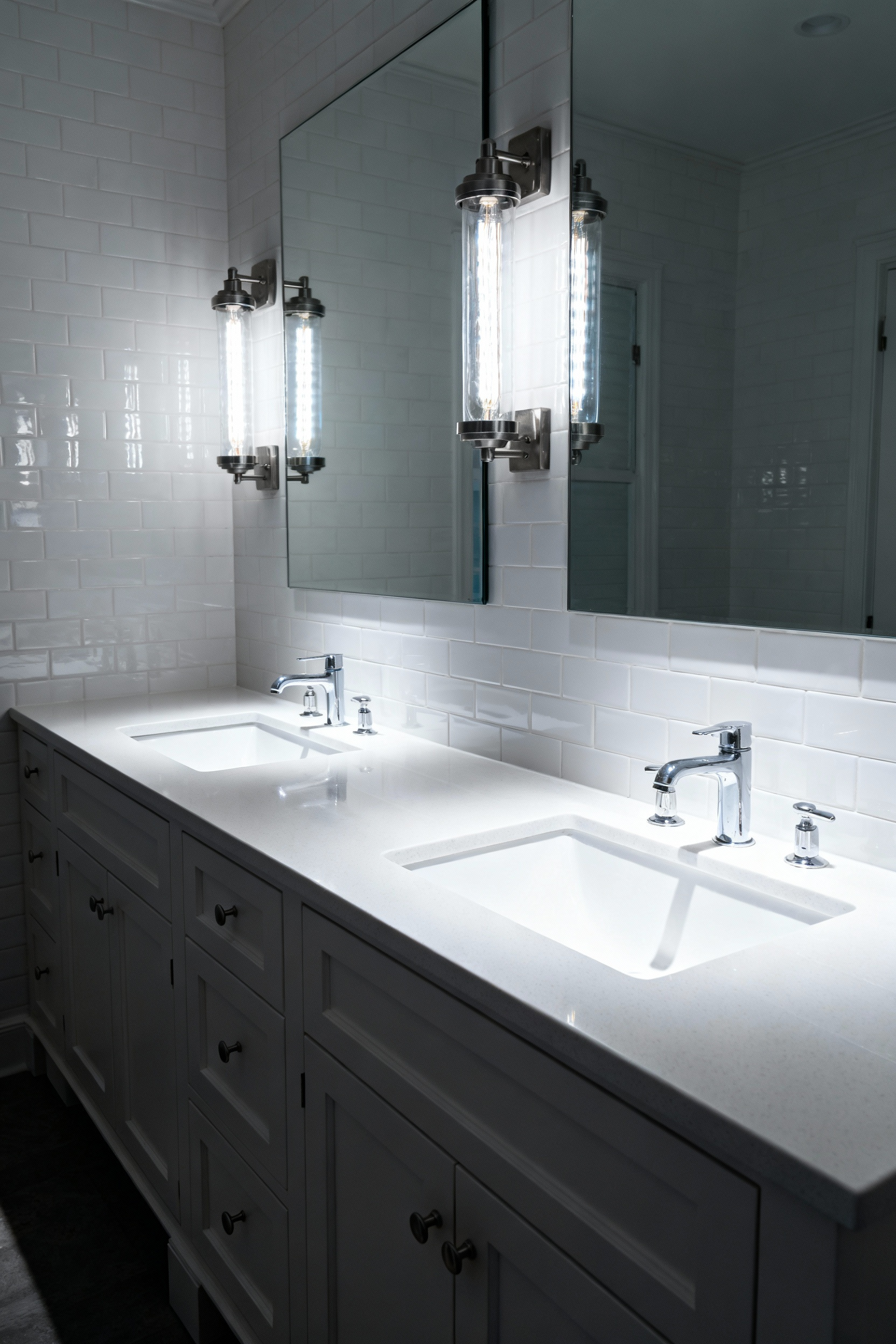
Therefore, precision is key to mastering this balance. Follow these placement rules to achieve an effortless, shadow-free glow:
- Find the right height. Mount the center of the sconce 60 to 66 inches from the floor. This positions the light directly at eye level, effectively filling in shadows under the brow and chin.
- Mind the gap. Space fixtures 36 to 40 inches apart. This specific distance ensures beams overlap across the mirror, eliminating dark “dead zones.”
- Choose vertical diffusion. Select tall, linear fixtures with opal or frosted glass. Vertical lines wash the face evenly, while the milky glass diffuses the beam for a flattering, sophisticated finish.
Styling the Surface: Curating a tray of essentials to prevent the ‘cluttered counter’ syndrome.
A crisp white vanity reflects the coastal morning light beautifully, but it also highlights every bit of clutter. To anchor this visual vastness, introduce a high-contrast tray. Avoid white-on-white styling; instead, select dark walnut, teak, or polished brass to add essential warmth and texture. I often liken this to finding a piece of dark driftwood on pristine sand—it provides necessary grounding and defines a clear boundary. This simple addition creates a designated “zone” for organization, effectively stopping the spread of mess before it starts.
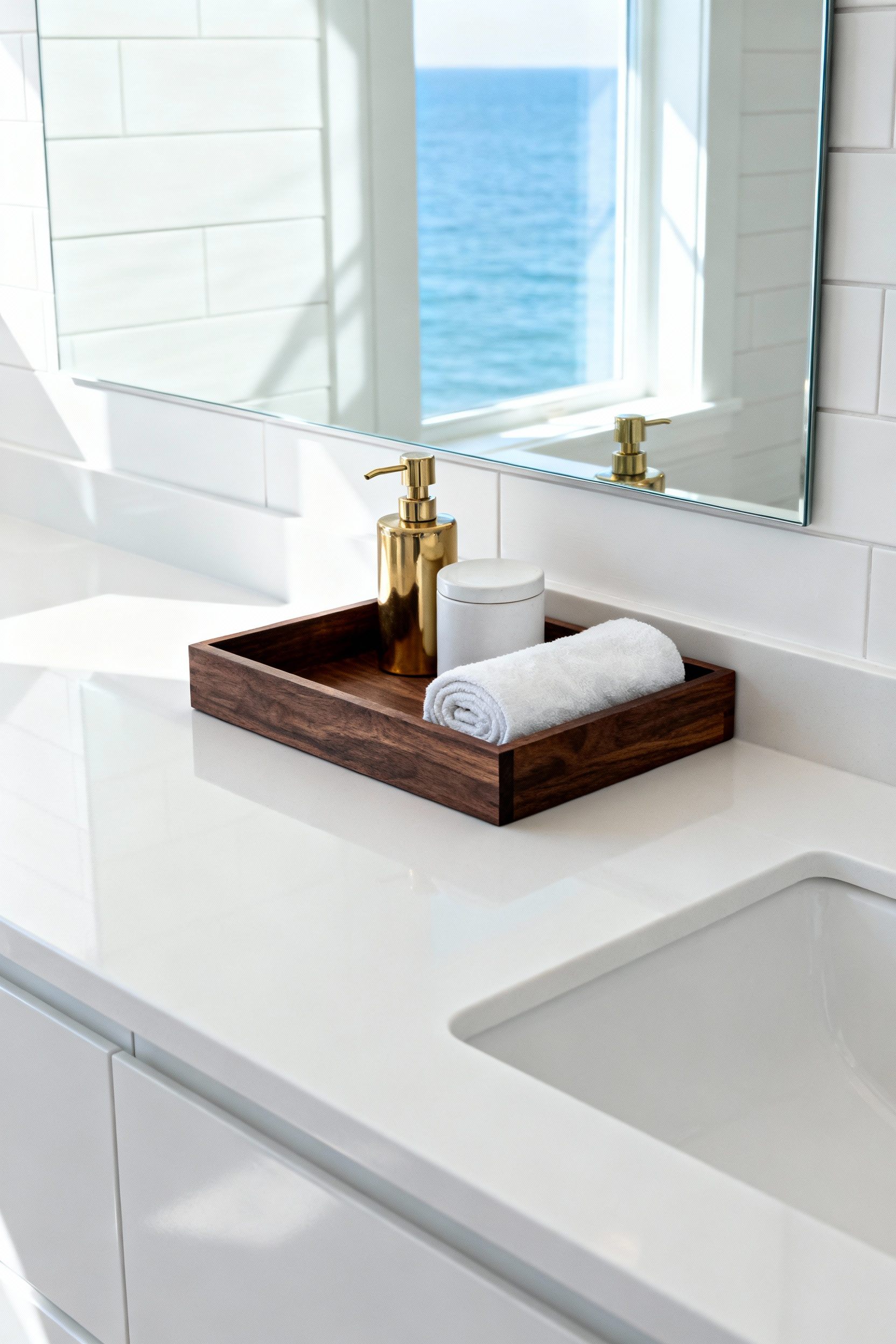
Once the tray is set, curate the contents with ruthless intention. Keep utilitarian items like toothbrushes hidden inside drawers to maintain a serene, spa-like atmosphere. Treat the tray strictly as a stage for “counter jewelry” using these styling principles:
- Follow the Rule of Three: Group items in odd numbers (three or five) to create effortless visual balance.
- Play with elevation: Mix a tall perfume bottle with a low ceramic dish and a mid-sized candle to keep the eye moving.
- Upgrade the vessels: Decant store-bought cotton swabs into crystal apothecary jars for immediate sophistication.
Conclusion: Transforming a white vanity from a blank canvas into a timeless maritime statement.
A crisp white vanity offers a fresh start, yet it requires the right details to truly belong by the sea. Elevate the piece by swapping generic fittings for heavy polished brass or aged bronze that warms over time. Furthermore, ground the bright white with moody wall colors like deep navy or charcoal to mimic the ocean’s depth. These intentional choices shift the look from a standard showroom purchase to a bespoke coastal retreat.
True maritime style whispers rather than shouts. Instead of relying on kitschy décor, layer in organic elements like weathered wood mirrors or woven seagrass baskets to soften hard lines. Finish the transformation with lighting that subtly nods to ship fittings, such as caged industrial sconces. These tactile details forge a connection to the water that feels authentic, sophisticated, and distinctly anti-cliché.
Your bathroom should serve as a sanctuary, calm as a morning tide. By blending sturdy hardware, deep contrast, and natural textures, you create a space that transcends fleeting trends. Look at your white bathroom vanity today and choose one element to upgrade immediately. Let the enduring spirit of the coast guide your design, creating a home that feels both timeless and effortlessly fresh.