
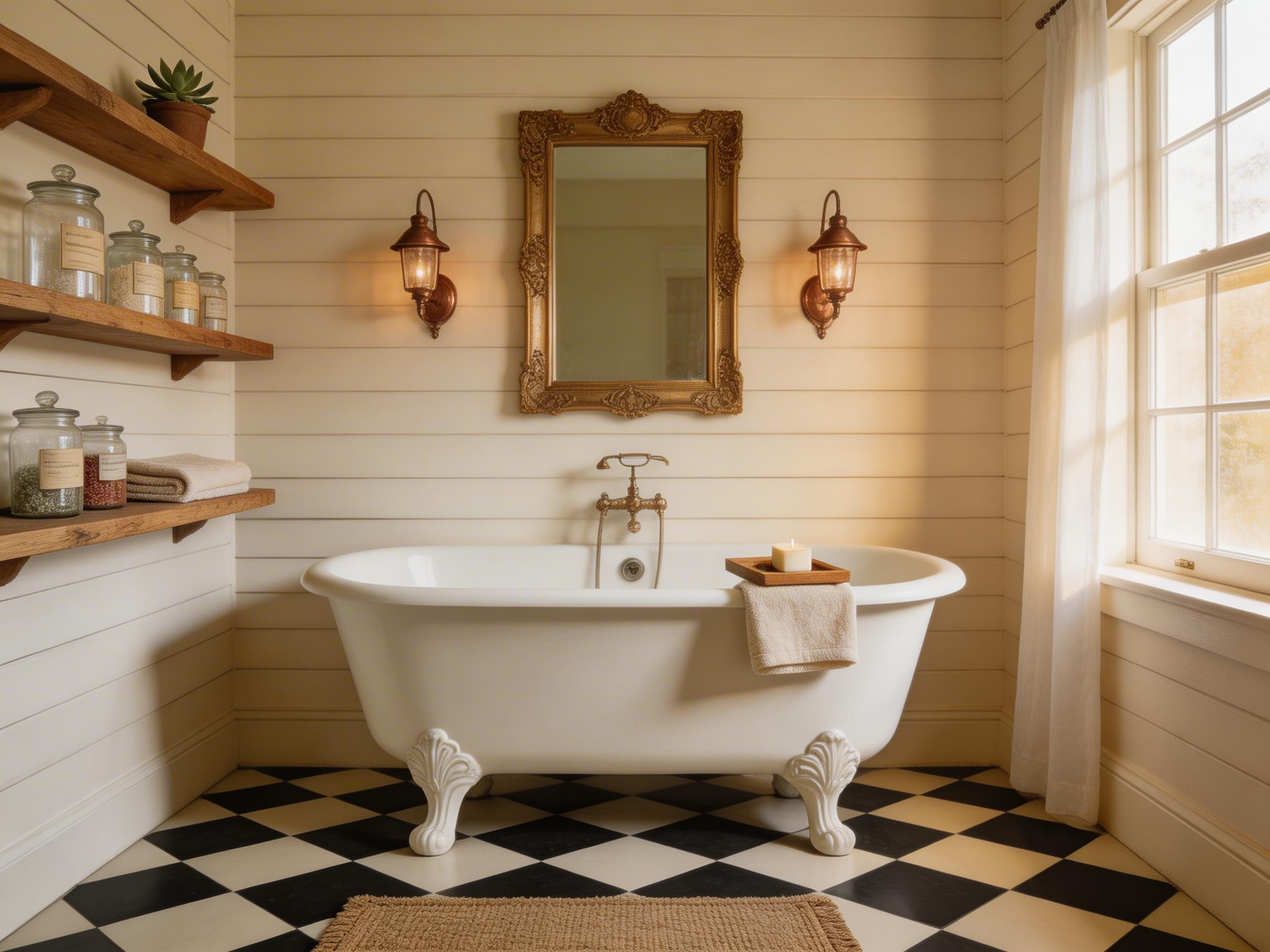
The cottage bathroom has a longer memory than any other room in the house. Its design language comes from generations of practical, beautiful living. Think of the scrubbed stone floors of a Devon farmhouse, the beadboard walls of a New England summerhouse, the claw-foot tubs that working families once heated with kettles carried up narrow stairs. These cottage bathroom ideas don’t follow trends. They follow something older and more durable. The belief that a bathroom should feel like it belongs to you and to the house — not like a showroom floor that happens to have plumbing. I’ve spent twelve years finding, restoring, and styling these spaces. What I keep learning is that the cottage bathroom rewards patience and penalises shortcuts. Get the bones right — the surface, the hardware, the colour — and the room will be beautiful for decades.
1. Shiplap Walls for That Honest, Hardworking Aesthetic
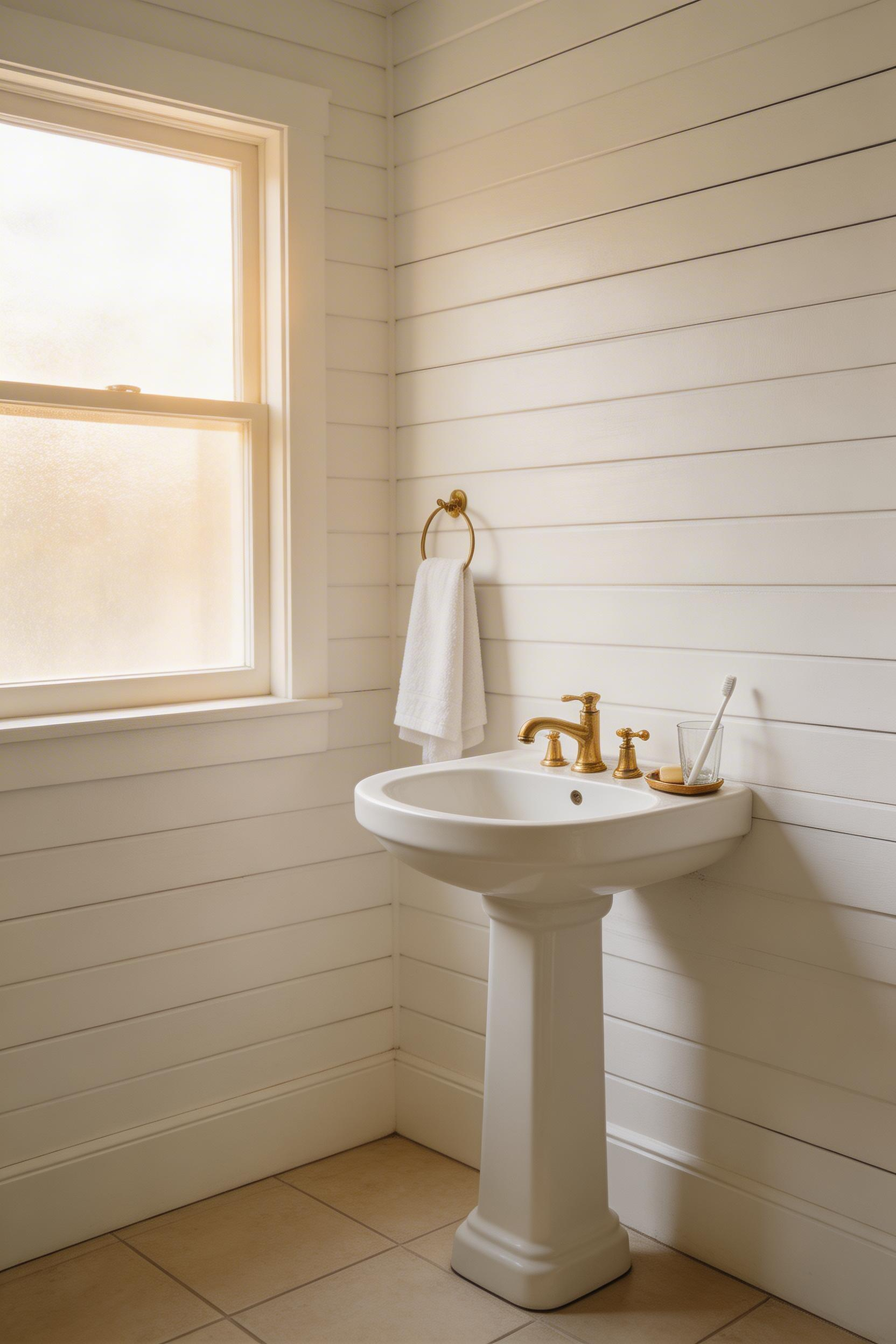
Shiplap started its life on the outside of farm buildings, not inside bathrooms. So the cottage bathroom ideas that centre on shiplap bring an exterior material inside — and that’s exactly why it works. The boards are honest about what they are: overlapping planks with a simple reveal between them. They need no specialist fitting and no ornate moulding to justify their presence.
Choosing the Right Board Width and Material
For a genuinely cottage result, use 5-inch-wide boards rather than the 6-inch boards that define the farmhouse aesthetic. MDF shiplap works well in ventilated bathrooms when you prime and caulk all joints properly. Solid pine shiplap is more authentic, but it needs sealing at every cut edge. Products like Metrie’s pre-primed MDF panels ($1.80–$2.40 per sq ft) give you a bathroom-ready surface without the prep work of raw timber.
The paint finish matters as much as the board. A matte or eggshell sheen keeps the texture readable. Gloss flattens the shadow line between boards and makes the whole wall look plastic. My preference is to paint the shiplap the same colour as the trim and door frame — one enveloping tone rather than an accent wall. That single decision separates cottage from farmhouse showroom.
Going floor-to-ceiling adds perceived height to a low-ceilinged room. But half-height shiplap with a contrasting top rail reads as more period-authentic if your ceilings are already generous. According to Houzz’s 2024 Bathroom Trends Report, shiplap appears in 34% of cottage and farmhouse bathroom renovations on the platform. It’s widely used, so the execution details are what make any cottage bathroom ideas feel personal rather than generic.
2. A Claw-Foot Tub as the Room’s Centrepiece
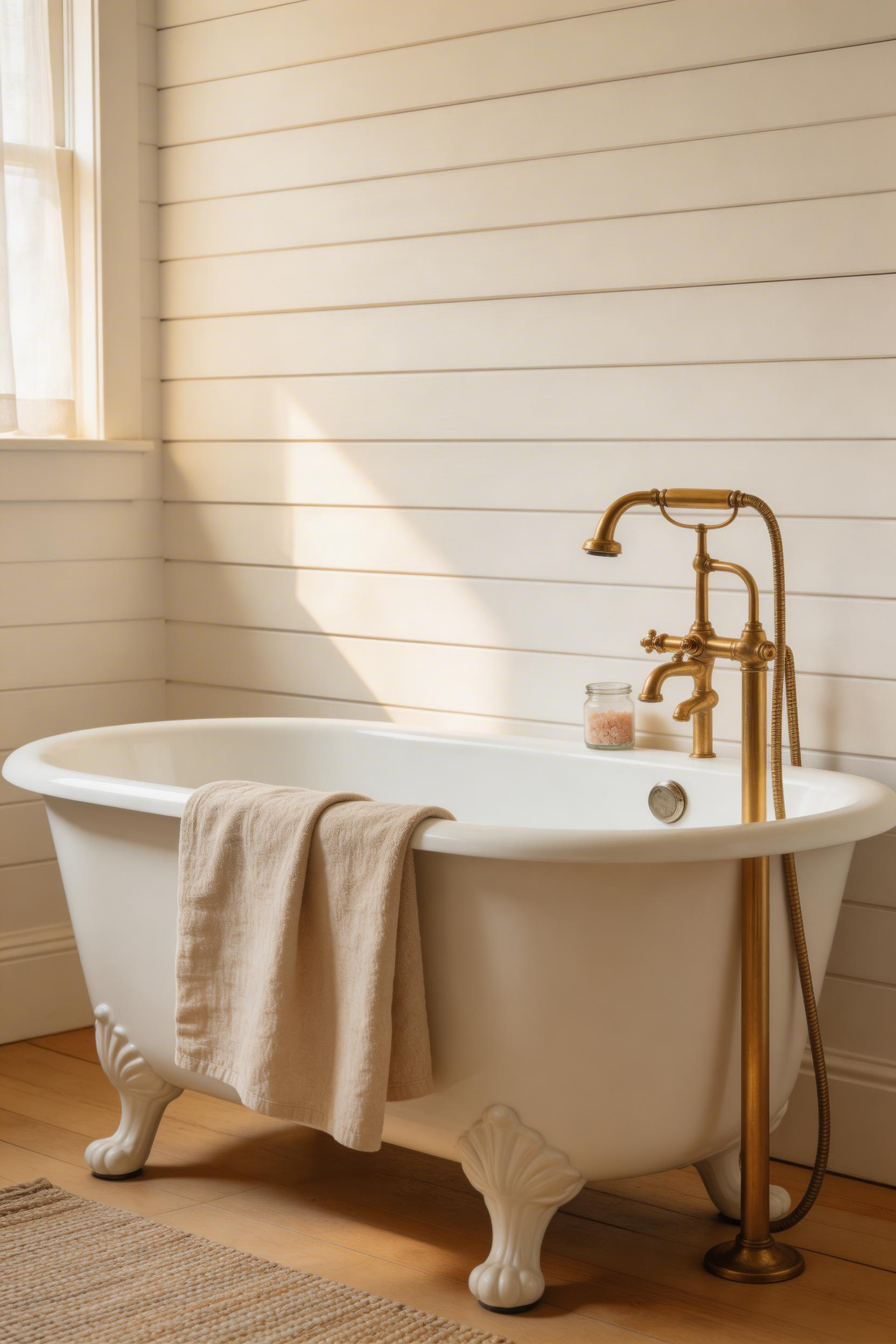
Of all the cottage bathroom ideas in this list, the claw-foot tub is the one that changes a room most completely. It’s not an accessory or a finish — it’s a statement about what kind of bathroom this is and what it’s for. When you walk into a room centred on a claw-foot tub, you understand immediately what this space is for.
Vintage Original or Quality Reproduction?
A restored original Victorian cast iron tub costs $800–$3,000 from specialist dealers like Vintage Tub & Bath. A quality reproduction from Barclay Products starts at $1,800. Both are cast iron and both will last another century if treated correctly. The differences are aesthetic: original tubs have a specific weight and age to their enamel that no reproduction entirely matches. There’s also a logistical difference, since an original needs structural floor assessment. Cast iron plus water plus person equals 700 lbs or more.
Acrylic claw-foot tubs start at $600 and weigh 60–80 lbs. That’s genuinely practical for an upper-floor bathroom. However, they flex slightly underfoot, which bothers some people more than others. I’d suggest going upstairs with cast iron only if your floor joists are confirmed solid. Choose acrylic when they’re not — it’s not a lesser option, just a different one.
Place the tub along the longest wall and centre it. Don’t push it into a corner. The feet need to be fully visible from the doorway for the proportions to read correctly. A National Kitchen & Bath Association survey from 2023 found freestanding tubs command an 8–12% perceived value premium in traditionally styled homes. But that premium only applies when the tub is placed with intention.
3. Beadboard Wainscoting Below the Dado Rail
Beadboard is the most forgiving wall treatment in the cottage bathroom toolkit. It covers imperfect plaster and provides genuine moisture resistance when painted properly. It also gives the room a visual horizon line. That makes the space feel resolved rather than in-progress. For cottage bathroom ideas on a limited budget, this is where I’d put the money first.
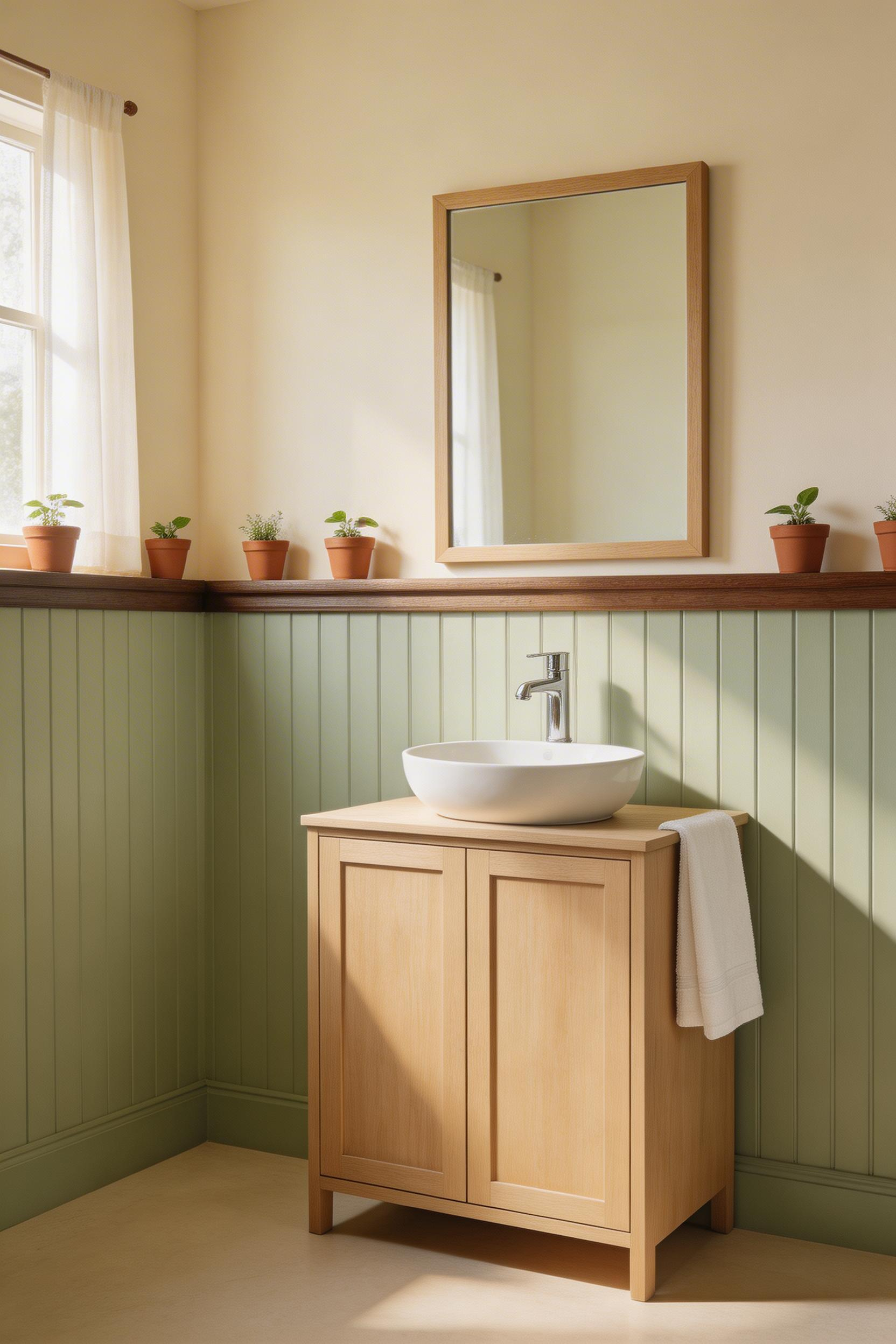
Height, Paint, and the Single-Colour Rule
Traditional dado rail height sits at 32–36 inches from the floor — roughly one-third of an 8-foot ceiling. In low-ceilinged cottages, 30 inches is the maximum before the room starts to feel capped. The most historically accurate option is moisture-resistant MDF beadboard in 4×8 panels. Look for routed bead grooves; Alexandria Moulding sells these at $28–$35 per panel.
The paint finish should be eggshell rather than semi-gloss: it holds up in damp conditions, wipes clean, and doesn’t look clinical. For colour, Farrow & Ball ‘Wimborne White’ and Benjamin Moore ‘White Dove’ are both warm off-whites that read as period-correct.
However — and this is the advice I give most often — paint the beadboard and the wall above it the same colour. Most cottage bathroom ideas in magazine spreads show a two-tone scheme with the dado rail as the colour break. But that approach is dated. A single enveloping tone, with only the cap rail moulding as a structural interruption, is far more authentic to how these rooms originally looked.
4. Vintage Freestanding Vanities from Dressers or Commodes
The Victorian practice of using a washstand or commode as the bathroom’s functional centre predates plumbed bathrooms entirely. Converting a genuine antique piece for modern plumbing use is not a trend — it’s a return to the original arrangement. And as bathroom vanity makeover projects go, this one offers the most character per pound spent.
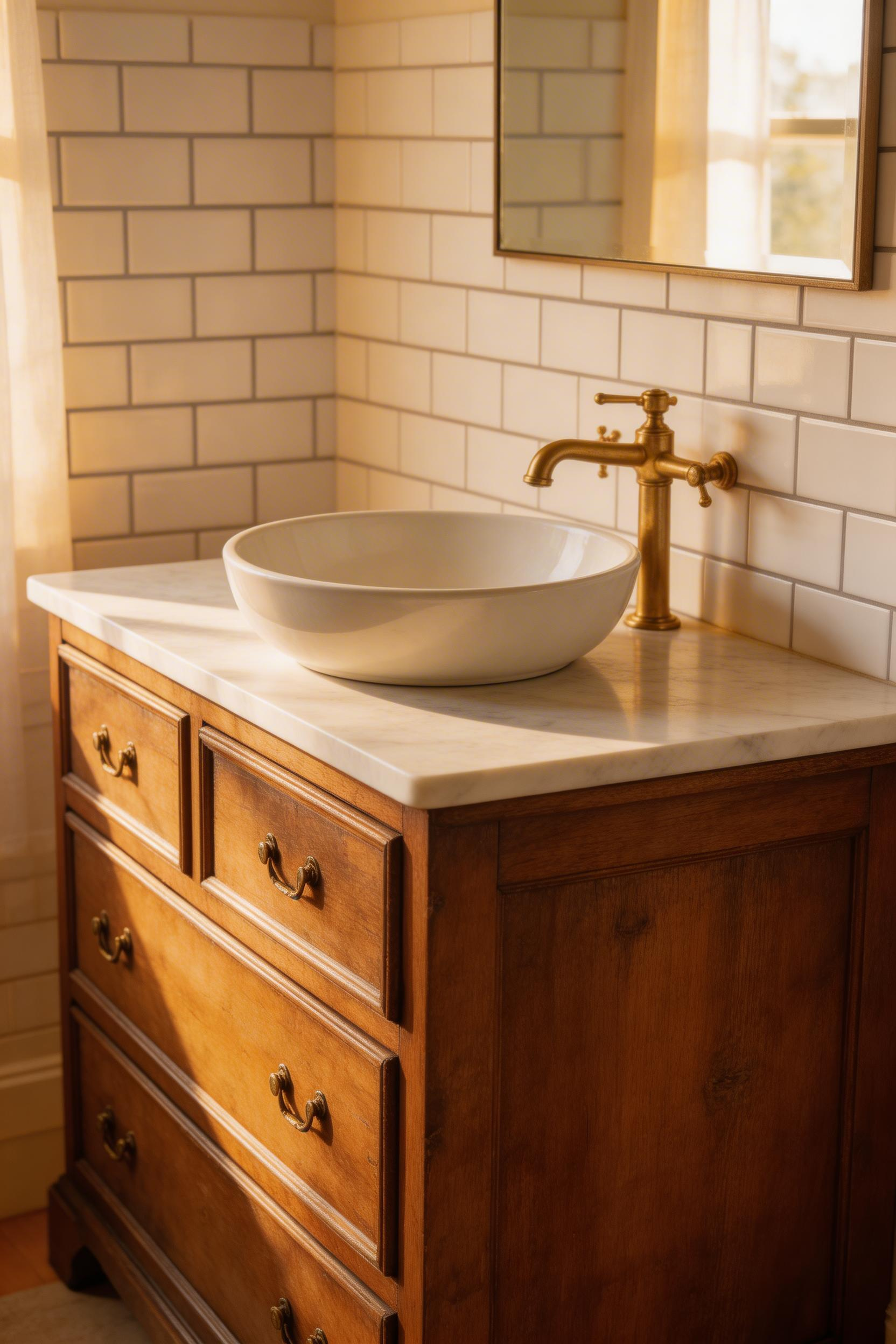
What to Look For and What the Plumber Will Cost
The conversion process is more straightforward than most people expect. You need a P-trap, supply lines, and shutoff valves — a two-hour job for a plumber at $150–$300 in labour. The preparation work (cutting the top for the sink, sealing the interior) is a weekend DIY project, provided you use the right products.
Here’s where I have to be direct: seal the dresser interior with oil-based primer followed by epoxy paint. Not standard latex. The moisture that collects under sinks is persistent and concentrated. I’ve seen beautifully converted vintage dressers turn into warped disasters because the inside was left unprotected. Oil-based primer, then epoxy. Two coats of each. Non-negotiable.
Look for dressers with dovetail joints — they survive humidity cycles better than butt-jointed MDF furniture. Also check that drawer stops won’t block pipe routing, and that the top is flat and at least 18 inches deep. Victorian dressers with original marble tops are perfect candidates. The marble needs no modification for a vessel sink set onto its surface. Cost comparison: a new pre-made vintage-style vanity runs $800–$2,500. The converted dresser route costs $150–$600 total. An Apartment Therapy reader survey from 2024 found 78% of people who converted vintage furniture to bathroom vanities said they’d do it again.
5. Soft, Chalky Colour Palettes That Earn Their Quietness
Colour is where many cottage bathroom ideas fail. The palette is right in theory — sage green, duck egg, warm cream, dusty pink. But the execution is wrong because the tones chosen are too bright, too saturated, or too new. Authentic cottage colour is quiet. It’s quiet not because it lacks character but because it comes from a tradition of mineral pigments that weren’t capable of the brightness we now take for granted.
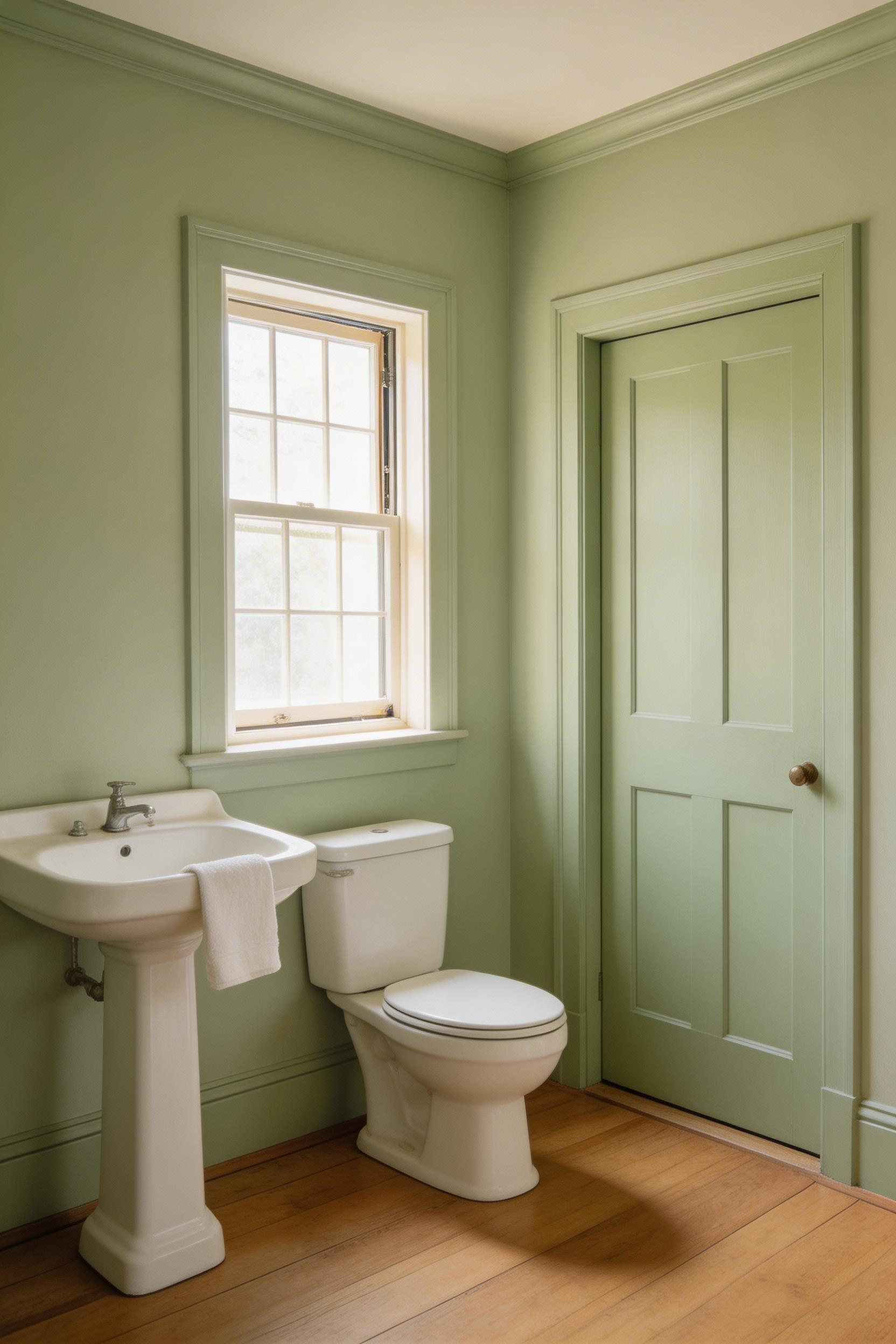
The Colour References That Actually Work
Duck egg blue reads as authentically cottage when desaturated — Farrow & Ball’s ‘Borrowed Light’ (No. 235) is the standard reference. Sage green works in both north- and south-facing bathrooms because it contains yellow and grey in its base. Pure greens without that grey component can look murky in poor light. Benjamin Moore’s ‘Quiet Moments’ (AF-780) is a budget-accessible alternative to Borrowed Light with a very similar undertone.
Warm cream walls (not stark white) with darker trim — dove grey or charcoal rather than white — is the most historically accurate cottage palette. It mimics limewashed plaster over timber framing, which is precisely what the original cottage bathroom walls were made of. The reversal of the modern expectation is the key to authenticity.
One practical note: in small bathrooms with no natural light, go one shade lighter than your instinct. Paint samples dry 15–20% darker on a full wall than they appear on a chip or A4 test card. Test with large cards left for 48 hours before committing. And avoid greige — it has no historical reference point in cottage design and reads as decorator’s shorthand rather than considered choice.
6. Exposed Timber Shelving Instead of Built-In Cabinets
Built-in bathroom cabinetry reads as renovation rather than character. Open timber shelving is one of the most practical cottage bathroom ideas — it removes visual weight from a room that is often quite small, and it lets you show the things worth seeing while hiding everything else.
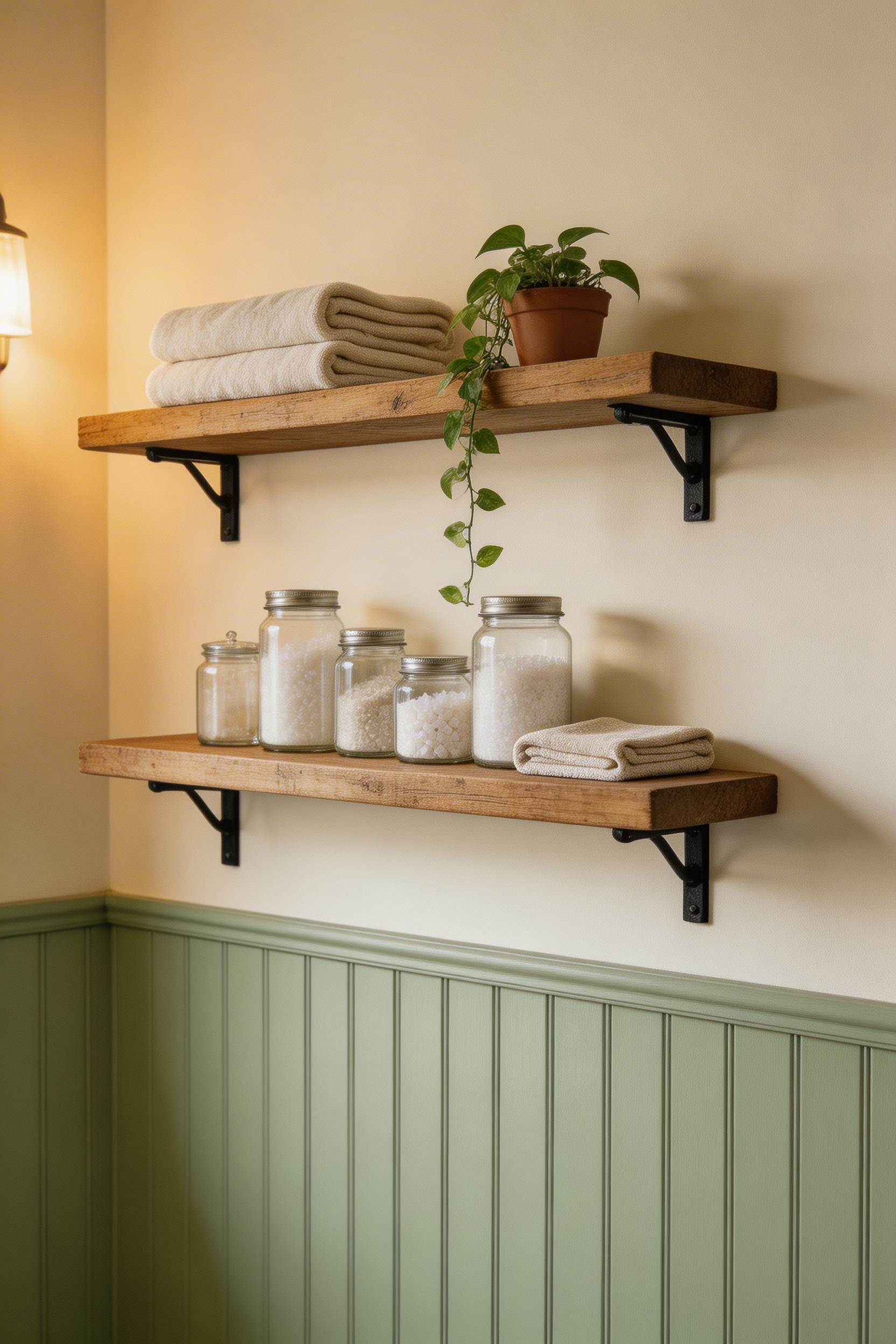
Wood Species, Bracket Style, and the Golden Rule of Three Items
Douglas fir, white oak, and reclaimed pine are the three species that cope best with bathroom humidity cycles. Reclaimed pine is pre-dried and dimensionally stable — it won’t warp as humidity rises and falls the way new-growth pine sometimes will. Finish all bathroom shelves with hard wax oil (Osmo Polyx or Rubio Monocoat) rather than polyurethane varnish. Wax penetrates the grain and doesn’t peel. Varnish sits on top and eventually lifts.
Bracket choice is where the shelf communicates its register: a two-inch-thick shelf on heavy iron brackets reads as rustic. A one-inch shelf on slim brass brackets reads as refined cottage. A study by NKBA (2023) found that open shelving appeared in 41% of bathroom renovation plans, up from 22% in 2019. It’s clearly the direction the cottage bathroom style is moving.
The golden rule: resist filling every shelf. One bar of handmade soap, a small plant, and two folded linen towels on a shelf is intentional. Eight products arranged neatly is still clutter. The restraint is the point — in a cottage bathroom especially, what you choose not to display matters as much as what you show.
7. Subway Tile with Handmade Variation for Visual Texture
The 3×6 inch subway tile is so fundamental to cottage and traditional bathroom ideas that it’s almost invisible when done well. That’s the goal — tile that supports the room rather than announcing itself. However, there’s an enormous quality difference between factory-perfect subway and handmade-look tile, and that difference shows more on a full wall than in any tile catalogue.
The Case Against Bright White and Factory Flat
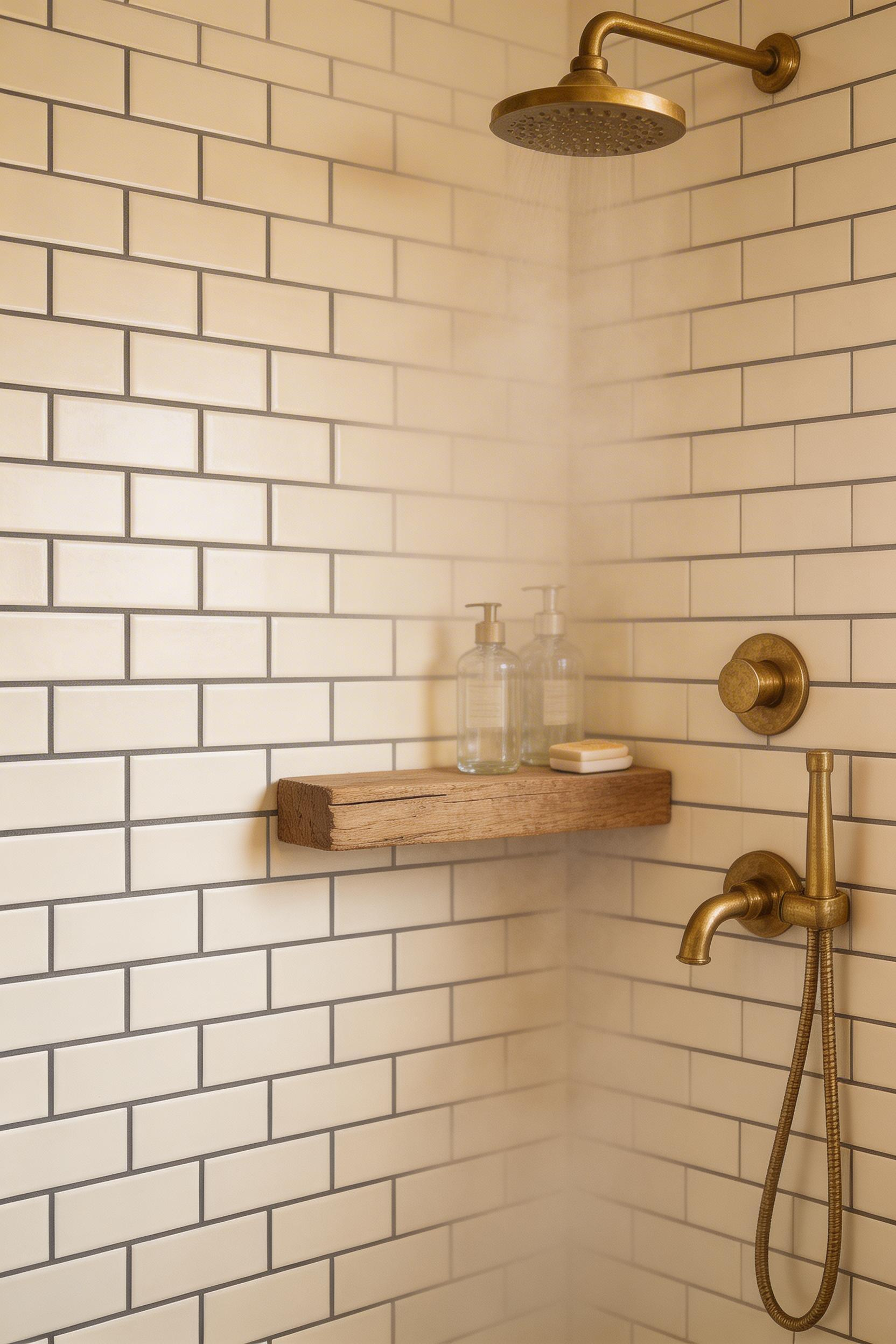
Factory subway tile has perfectly flat faces and uniform glaze. It reads as clinical in a cottage context regardless of the grout colour. Handmade-look tiles (Fireclay Tile’s ‘Crafted’ series at $18–$22 per sq ft, or genuine handmade tiles from Heath Ceramics at $28–$35 per sq ft) have slightly uneven faces and variable glaze thickness. The glaze catches light from different angles. So the wall reads as textured, living material rather than flat surface.
Grout colour is the next most important decision: white grout disappears into tiles for a clean, modern read. Grey grout emphasises the grid. Charcoal grout makes each tile look individual and artisanal — the most cottage-appropriate choice for a wall with handmade-look tile. If budget forces you toward factory tile, charcoal grout is the upgrade that salvages the result.
Also: ask specifically for ‘warm white’ or ‘off-white’ subway. A very stark, blue-white tile looks clinical regardless of grout colour. Fireclay’s ‘Whisper White’ and Heath’s ‘Chalk’ are the standard references. Tile of Spain export data shows demand for handmade and artisan-look ceramic tiles grew 23% globally between 2021 and 2024. The market has caught up with what cottage bathroom enthusiasts already knew.
8. Vintage Brass and Unlacquered Hardware That Patinas Naturally
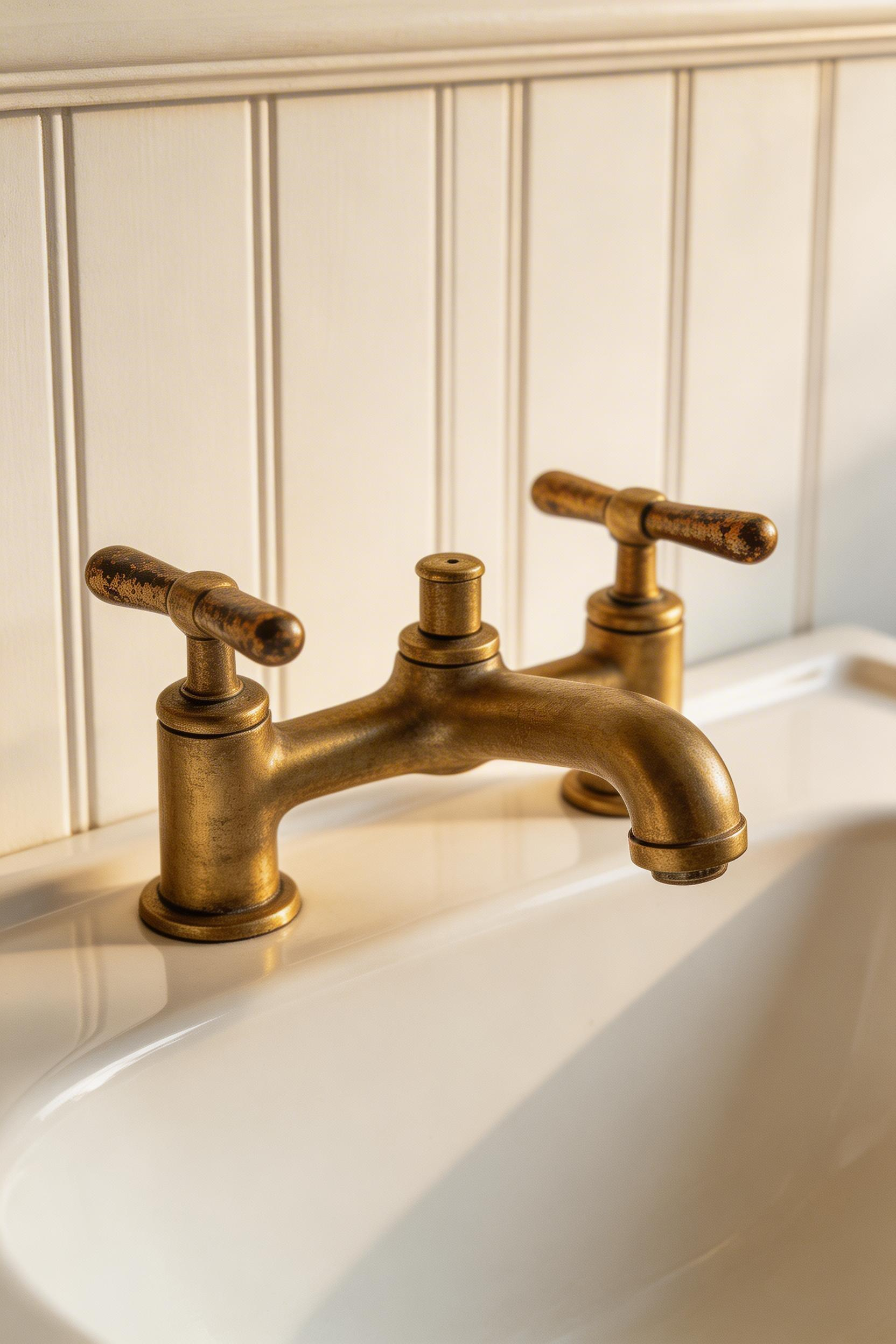
Polished brass that’s been lacquered is a trap. The lacquer keeps it bright for a year or two. But when it chips — and it always chips, because taps and fittings are touched constantly — the exposed brass tarnishes in patches around the damage. The result looks neglected rather than aged. Unlacquered brass, by contrast, is designed to change. It patinas evenly, developing a warm, antiqued surface. That surface tells the truth about how long it’s been there and how often it’s been used.
What to Buy New and What to Hunt Secondhand
Perrin & Rowe’s Edwardian Bridge Mixer Tap ($680–$950) in unlacquered brass is the reference product. It’s a genuine Edwardian design made in the UK that looks immediately correct in a cottage bathroom context. For the rest of the hardware — towel rail, toilet roll holder, robe hooks — Smedbo’s Loft collection in solid brass ($45–$65 per piece) offers a lower price point without abandoning quality.
eBay and Etsy are excellent sources for original Victorian and Edwardian brass tap sets. They can be re-washered and re-seated for under $50 in parts — far cheaper than new reproductions and genuinely more beautiful. The thing to check: make sure the thread size matches modern valves, or budget for an adapter.
One rule: buy the tap first. Everything else in the room’s hardware should reference it. A 2024 report by the Plumbing Products Industry Association found that unlacquered brass finishes grew from 8% to 19% of bathroom hardware sales between 2020 and 2024. Supply has expanded, which means more options at more price points. But quality varies. Feel the weight before buying; solid brass is heavy. Hollow brass-coloured metal is not the same product.
9. Linen and Waffle-Weave Textiles That Improve with Every Wash
A plush hotel-style towel is not a cottage bathroom towel. That’s not a criticism — it’s simply the wrong register, in the same way that a chandelier is wrong for a room with a 7-foot ceiling. The best cottage bathroom ideas work because every element is honest about what it is and where it comes from. A high-thread-count Egyptian cotton towel that looks like it arrived from a five-star minibar cart undermines a room that took real effort to feel genuinely lived-in.
Why Waffle Weave and Linen Work in This Context
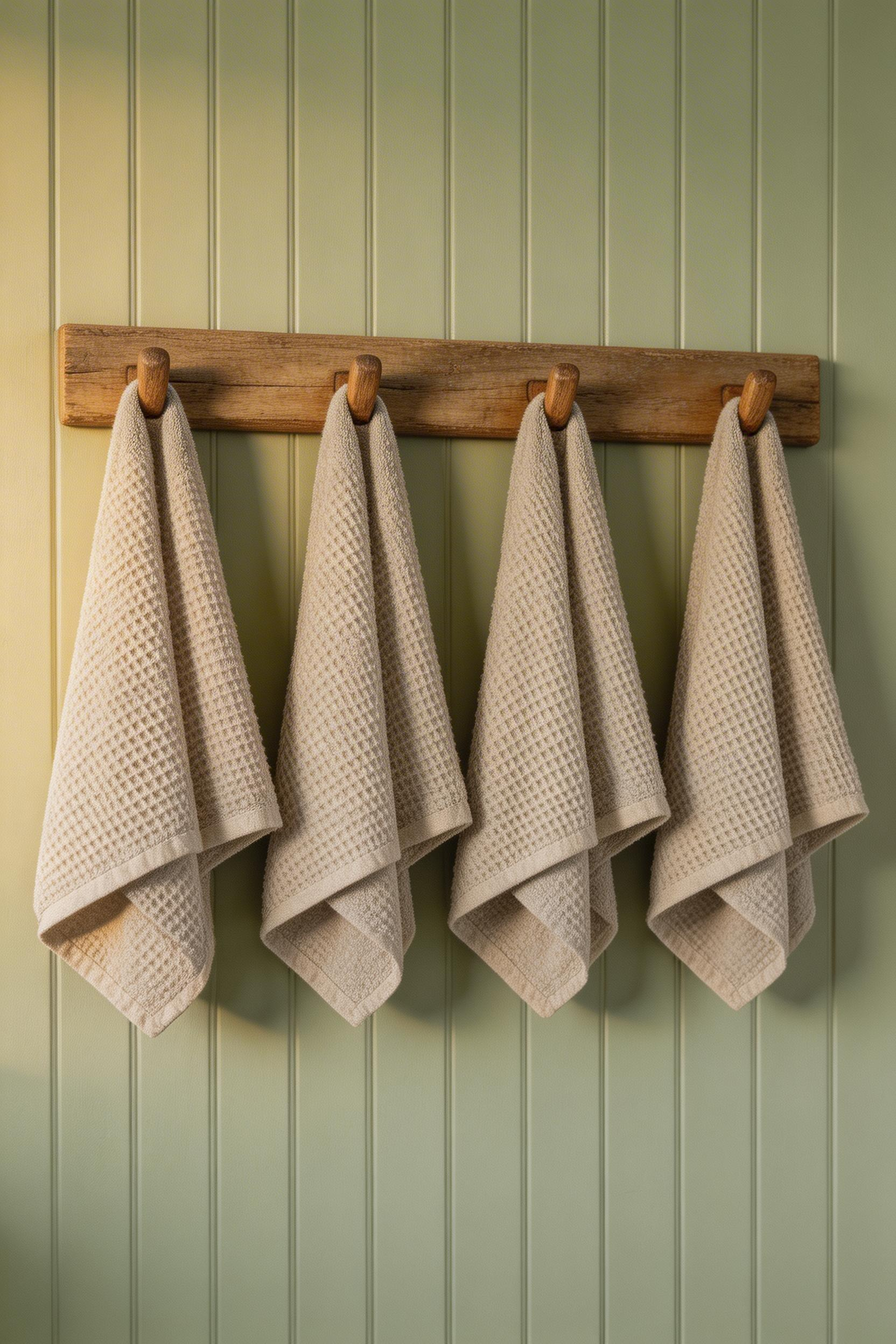
Waffle weave (honeycomb texture) has a larger surface area than flat-woven towel fabric. It’s highly absorbent despite its lightweight appearance. It also dries faster than pile terry, which matters in a cottage bathroom without mechanical ventilation. Turkish linen-cotton blends — 40–60% cotton for softness and 40–60% linen for durability — offer the best middle ground. They’re absorbent from the first wash and develop a characteristic relaxed drape over time. Coyuchi’s Organic Turkish Waffle Towel ($32–$48) and Libeco’s Belgian Linen Bath Towel ($68–$90) are both excellent options in the natural and stone colour ranges.
The hanging arrangement matters as much as the product itself. Four good linen towels on a wooden peg rail reads as intentional. Eight mediocre towels on a heated chrome rail reads as a linen closet transplanted without context. A peg rail — simple turned oak or ash pegs on a painted board — is period-accurate, cheap to make, and genuinely practical. Consumer data from Wayfair’s 2024 home textiles category shows waffle-weave and linen-blend towels grew 67% year-over-year. The market has figured out what cottage bathroom style demands.
10. Vintage Mirror Frames: Salvage vs. Reproduction
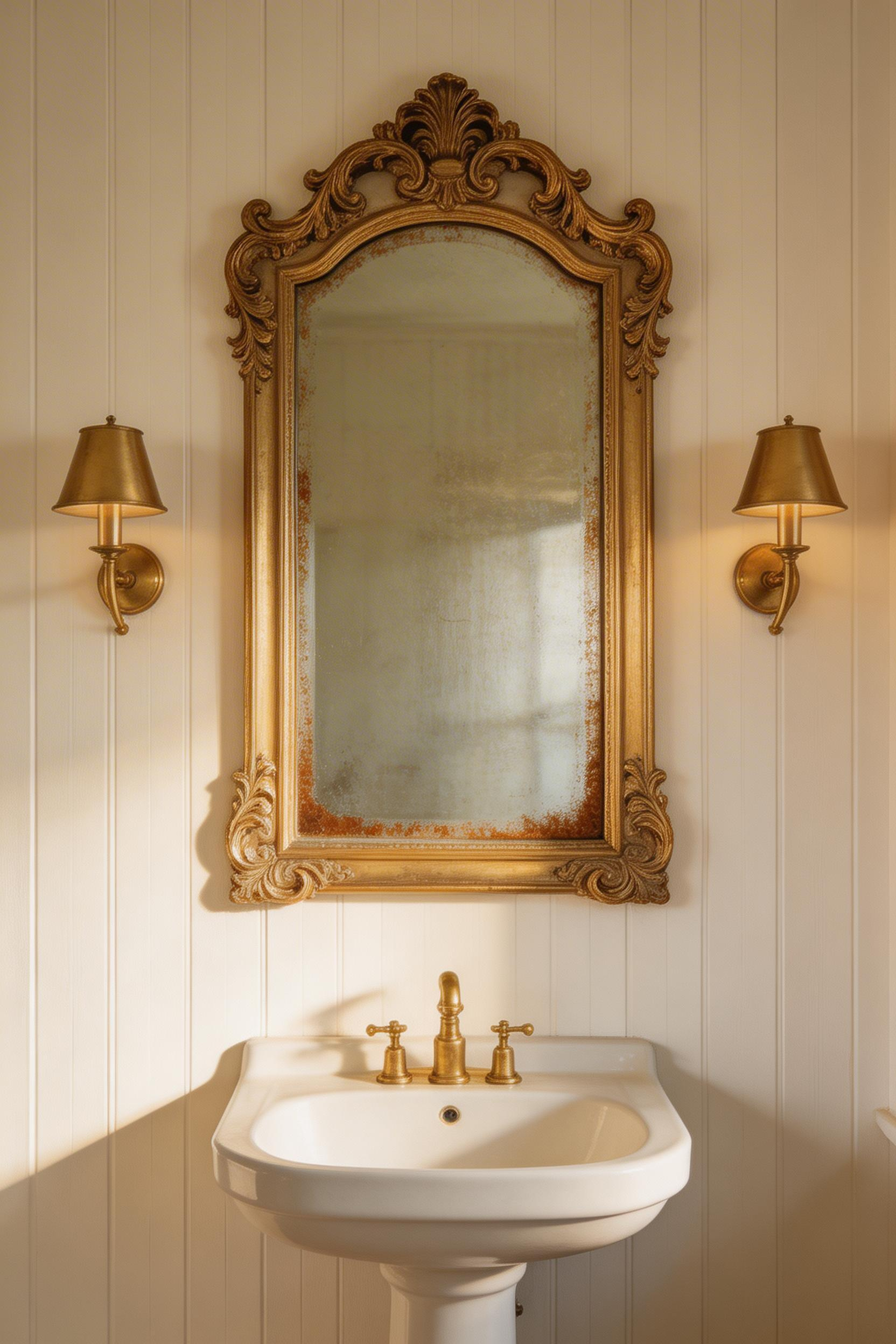
A mirror in a cottage bathroom should look as though it was always there — as though someone brought it up from the drawing room a hundred years ago and never moved it. The most versatile shape for this purpose is an overmantel mirror. Originally designed for above a fireplace, these 36–48 inch wide pieces with ornate gilt or painted frames create an immediate period atmosphere above a vanity.
How to Distinguish Genuine Salvage from Good Reproduction
Original mercury glass has a depth and warmth that modern float glass can’t replicate. Small dark spots at the edges are age patina, not damage — they add rather than detract. The test for genuine gilded frames versus printed film gilding: tilt the piece at an angle. Real gold leaf shifts and shimmers as the angle changes; printed film stays flat. Reproduction gilded frames from online retailers almost always fail this test on close inspection.
Good salvage sources include Chairish ($280–$800 for curated vintage pieces), SALVO (UK salvage database), Architectural Salvage (US chain), and regional estate sales where competition is lower and prices reflect it. A mirror 3–4 inches wider than the vanity below creates proper visual balance. A narrow mirror on a wide vanity looks unfinished regardless of how good the mirror itself is.
Before hanging: paint the back of the wooden frame (not the glass) with two coats of exterior primer. The back of a frame in a bathroom is exposed to concentrated steam. An unprotected Victorian frame will warp in 18–24 months. This is the step that turns a rescued antique into a lasting investment. eBay data from 2024 shows ‘antique bathroom mirror’ is the fastest-growing search term in their vintage home furnishings category — up 44% since 2022. Competition for the best pieces has increased, but supply has too.
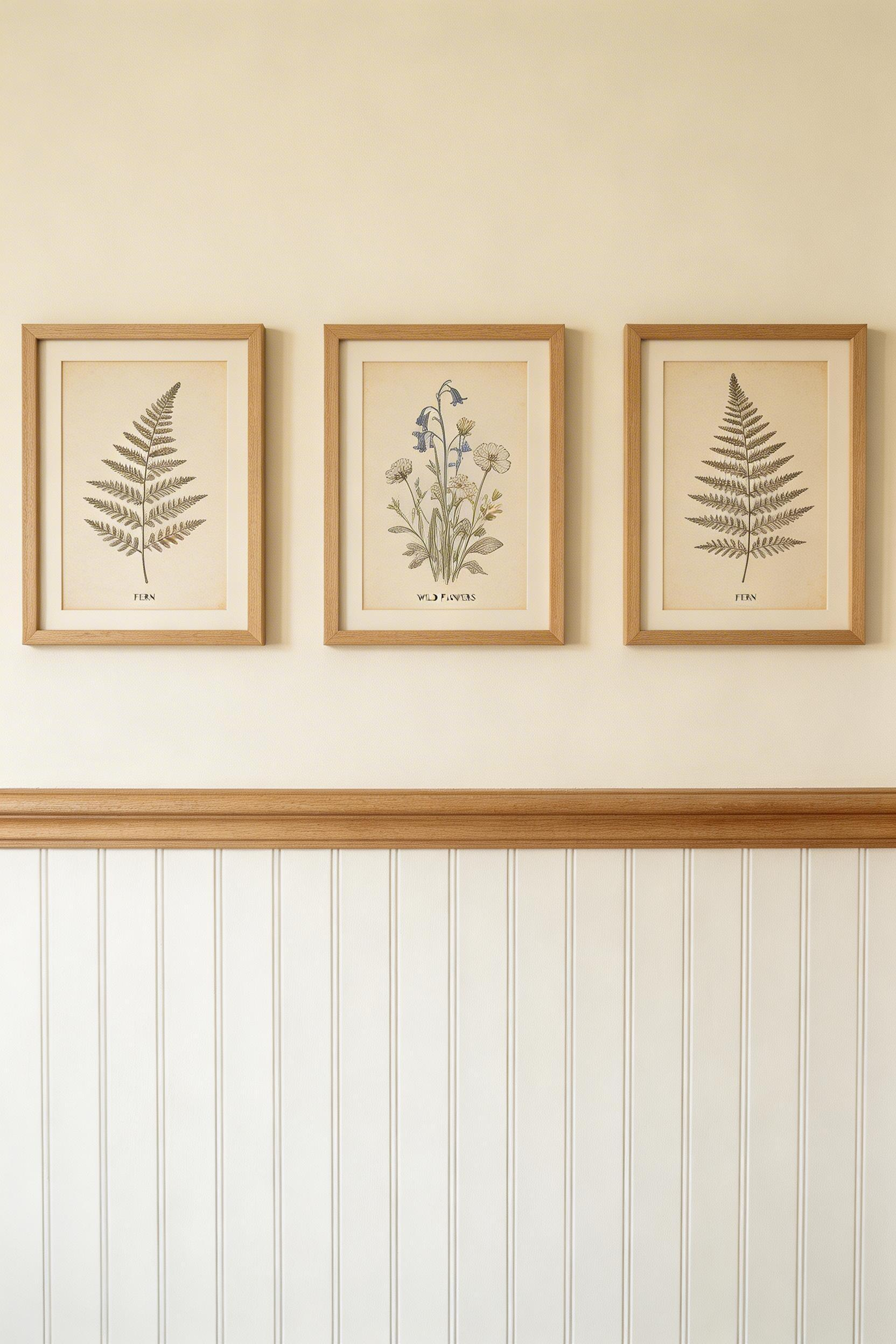
11. Botanical Prints and Pressed Flower Art on Damp-Proof Backing
Bathroom art has a reputation for being an afterthought — a print in an IKEA frame hung above the toilet as a concession to the idea that bathrooms should have character. Good cottage bathroom ideas treat wall art with the same intention as the tile and the hardware. It should have a reason to be there, and it should be able to survive the environment.
Where to Source Art and How to Make It Last
The Biodiversity Heritage Library (biodiversitylibrary.org) holds thousands of public-domain botanical illustrations. It includes the full run of Curtis’s Botanical Magazine, published since 1787, available for free download in high resolution. Print on 300gsm cotton rag paper at a local print lab ($8–$25 per print), mount with acid-free materials, and use conservation glass. The result is genuinely beautiful and costs a fraction of any framed print retail.
The enemy of bathroom art is condensation on the back of the frame. It causes mould and warps the print over time. The solution: use acid-free foam backing rather than cardboard, leave a 1/4 inch air gap between the print and the glass, and seal the back of the frame with artist’s tape before hanging. For reclaimed wooden frames — the kind you’d find at an antique fair with a worn gilt edge and original glass — seal the back with exterior primer as described for mirrors.
Frame arrangement: three prints in identical frames stacked vertically reads as formal cottage. A loose cluster of mixed sizes reads as more relaxed. Both work — the choice depends on whether the rest of the room is formal or easy. Pinterest reports that ‘botanical bathroom art’ generates 4.1 million monthly impressions, consistently ranking in the top 10 bathroom decor searches. Pressed flower pieces in hermetically sealed glass frames are also worth considering for a cottage bathroom. The organic material is fully dried, so moisture is not an issue.
12. A Roll-Top Shower Enclosure or Clawfoot Shower Curtain Rig
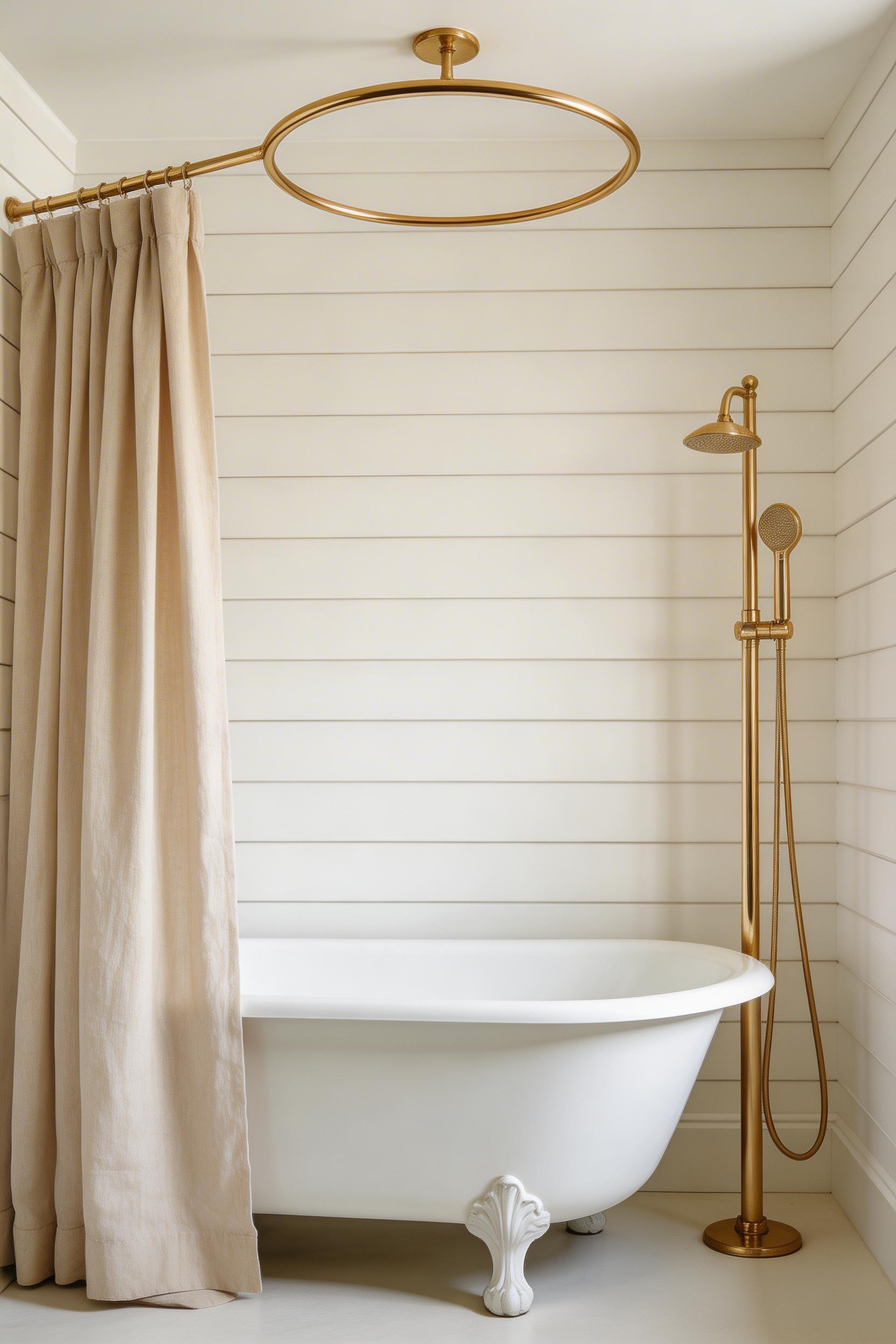
The question everyone asks about a claw-foot tub is: but can you have a shower? The answer is yes. The freestanding oval shower curtain ring — which suspends from the ceiling above the tub — is both the most practical and the most period-appropriate solution. It adds a shower without permanently altering the tub or requiring a glass screen that would cage the room.
The Hardware That Makes It Work
A freestanding oval shower curtain ring from Signature Hardware ($320–$450) fits a standard 5 ft or 6 ft tub. It mounts to the ceiling with lag screws into a joist — hire a joiner for a plaster ceiling if you’re not confident with the structural element. Hang the curtain at ceiling height rather than at the standard 7 ft. Even in a modest cottage bathroom, the extra 12 inches of curtain makes the room feel taller in a way that visitors notice without identifying.
For the shower supply itself, a thermostatic tub and shower combo replaces the standard tub filler and adds a handshower on a wall-mount bracket. Rohl makes one ($680–$1,100) in an aged brass finish that looks right in this context. The linen shower curtain matters too: a Fog Linen Work curtain ($85–$120) drapes properly and washes well. A cheap patterned plastic curtain does not. These cottage bathroom ideas only cohere when every element is genuinely considered, and the shower curtain is often the last thing treated with seriousness. Signature Hardware’s 2024 sales data shows clawfoot tub shower conversion kits with a 38% year-over-year sales increase.
13. Reclaimed Wood Flooring or Encaustic Tile Patterns
The floor of a cottage bathroom is doing more work than it looks like. It’s the surface that grounds every other decision in the room — the one that makes the claw-foot tub look right or wrong, makes the beadboard feel period or pastiche. For small bathroom remodeling projects especially, the floor is often the highest-leverage investment. The same principles apply if you’re approaching this as a traditional bathroom remodel rather than starting from a blank slate.
The Two Routes and When Each Works Best
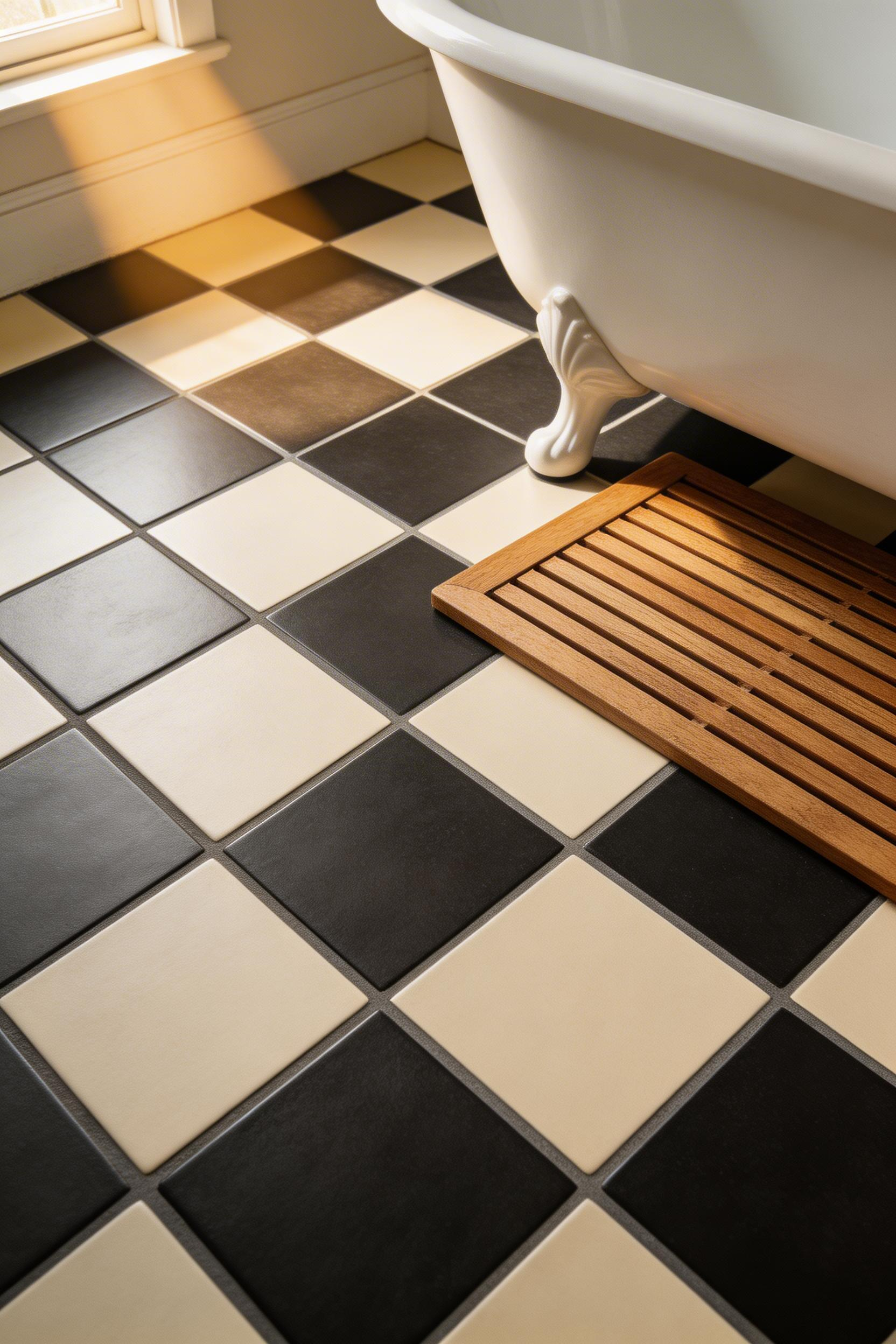
Reclaimed wide-plank white oak or old-growth Douglas fir flooring ($8–$22 per sq ft) is the choice for warmth and texture. But it needs full sealing on every surface of every plank before installation. It also works best in bathrooms with traditional radiators rather than underfloor heating. Wood over UFH tends to dry and crack as the heat cycles. Tile handles it far better.
Encaustic cement tiles ($12–$35 per sq ft from Clé Tile or Original Style in the UK) are the historical reference for Victorian cottage bathrooms. The checkerboard pattern — slate and cream, or black and white — is the most period-accurate. A critical installation note: seal the tiles before grouting, not only after. The cement surface is porous and will absorb grout colour if you apply it unsealed — a common and irreversible error. Use a penetrating impregnator sealer (not a topcoat), grout, then seal again. US Census Bureau trade data shows encaustic cement tile imports grew 31% between 2021 and 2024. The supply chain is better established now, which means prices have moderated.
14. Vintage Glass Bottles and Apothecary Jars as Storage
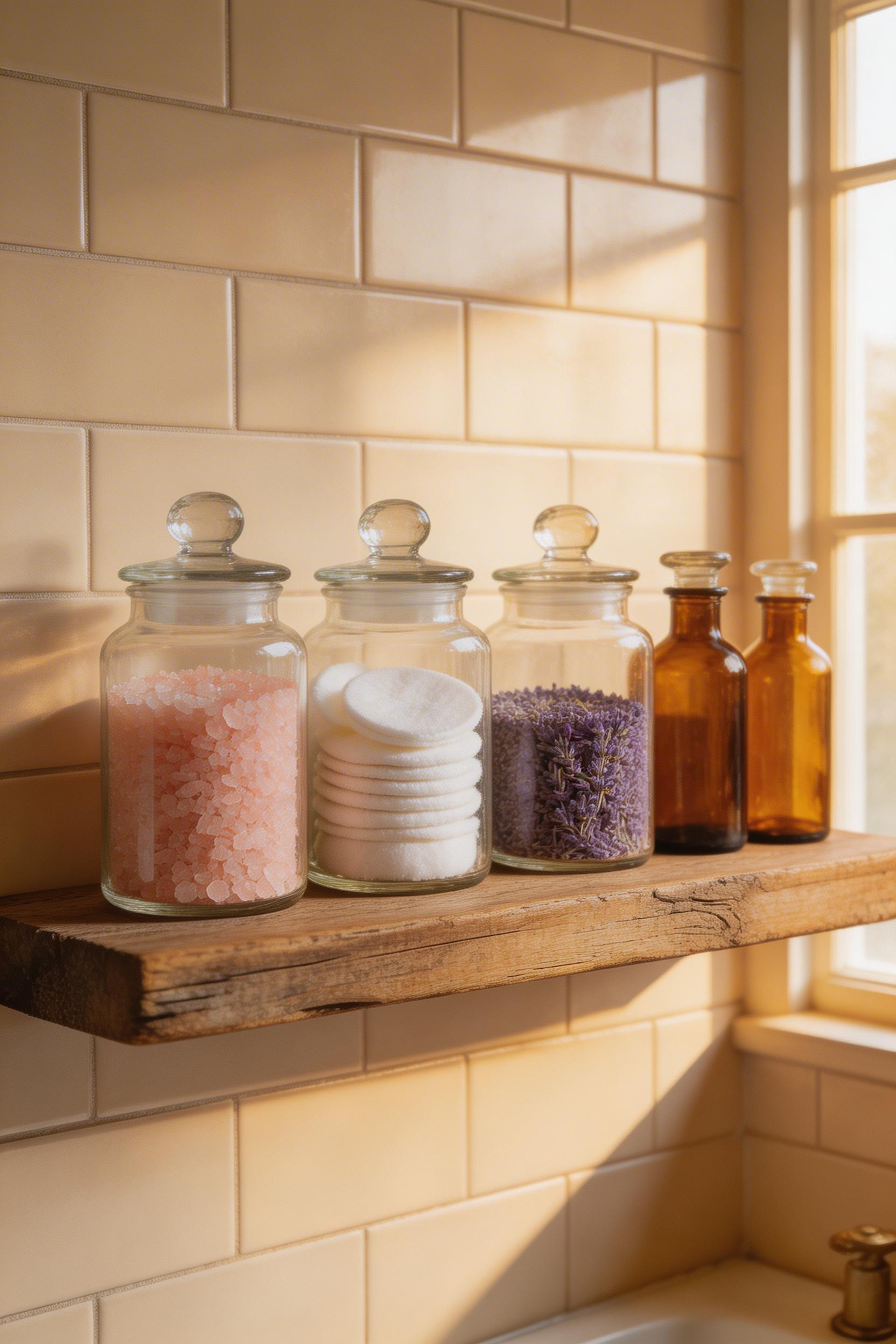
Victorian bathrooms used apothecary jars and chemist’s bottles for everything from bath salts to toothbrush holders — it’s historically accurate cottage bathroom storage, not decorative nostalgia. And for wooden bathroom ideas that incorporate open shelving, these glass pieces are the natural pairing: they let the shelf be useful rather than purely visual.
What to Fill, What to Display, and Where to Find the Jars
The organising principle is straightforward: if it’s worth seeing, it goes in glass; if it’s not worth seeing, it goes in a closed cabinet. Bath salts, cotton rounds, a bar of handmade soap, and dried lavender deserve to be visible. Spare razors, headache tablets, and first-aid supplies do not. This rule alone transforms the look of open shelving from a bathroom counter to a considered display.
Wide-mouth jars with ground-glass stoppers suit bath salts and cotton rounds. Tall chemist’s bottles with narrow necks work for decanted liquid soap. Small amber bottles (amber glass blocks UV) are right for skincare products. eBay (search ‘Victorian apothecary bottle’ or ‘chemist’s storage jar’) and Hamilton Vintage Bottles are good sources for originals. Etu Home makes well-proportioned reproductions ($85–$140 for a set of four with ground glass lids).
Label the jars with handwritten paper labels cut with a straight edge — the slight imperfection reads as intentional in a cottage bathroom. A 2024 Etsy marketplace report cited ‘apothecary bathroom storage’ as one of the top-20 fastest-growing home organisation searches, with 190,000 average monthly searches. The market has arrived where cottage bathroom collectors were five years ago.
15. Aged Copper or Pewter Lighting for Evening Atmosphere
Lighting is the detail that separates a cottage bathroom that looks right from one that feels right. A room can have perfect tile, ideal hardware, and correct colour. But it can still feel wrong in the evening because the overhead light is too white, too flat, or too bright. Aged copper and pewter fixtures approximate the warmth of candlelight that original cottage bathrooms were designed for, without the fire risk.
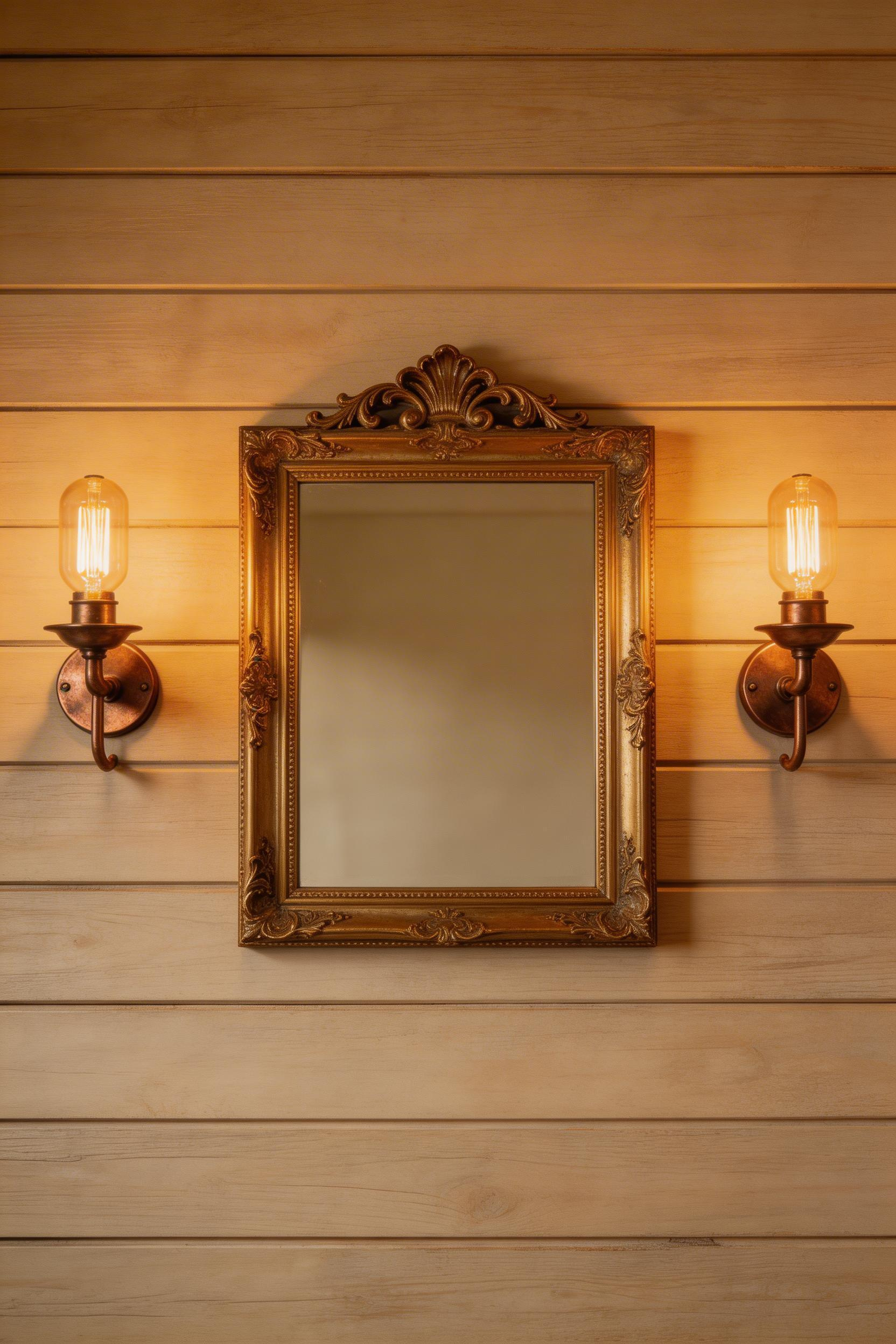
Copper, Pewter, and the IP Rating That Actually Matters
Copper develops a natural verdigris patina in a bathroom environment within 1–3 years. Like unlacquered brass, this is the intended result rather than a maintenance failure. Davey Lighting’s ‘Harbour’ wall sconce ($180–$280) is made in the UK, IP44-rated (required for Zone 2 bathroom use), and uses a copper globe with a genuine period reference. Mullan Lighting’s ‘Chelsea’ pendant from Ireland ($140–$220) is an alternative for rooms where a single central pendant suits the ceiling height better than flanking sconces.
Wall sconces flanking a mirror use more cable and more installation labour than a ceiling pendant. But they cast more flattering light on the face, which matters if the bathroom is used for makeup application. Always have bathroom lighting installed by a qualified electrician. UK Part P regulations and US NEC codes are explicit, and the consequences of a DIY error in a wet environment are serious.
Use an LED filament bulb at 2200K colour temperature — 4–6W equivalent to a 40W incandescent — in any visible globe fitting. Davey Lighting’s 2024 sales data shows copper and aged brass fixtures now represent 62% of their bathroom range sales. They’ve overtaken polished chrome for the first time in the company’s history. The aesthetic shift toward naturalistic, aged materials is confirmed. The question is no longer whether this direction works but how to execute it with intention.
Finding Your Way into the Cottage Bathroom
These cottage bathroom ideas are not a checklist to work through in order. But they do have a natural sequence. Start with the surfaces: floor, walls, and ceiling tone. Get those right, and every fitting and fixture you add afterward has a context that makes it easier to judge. A claw-foot tub in a badly floored, harshly lit room doesn’t read as cottage — it reads as a tub in a bad room. But the same tub on encaustic tiles, under aged copper sconces, against a wall of properly painted shiplap — it reads exactly as it should.
The specific recommendation I’d make to anyone starting their cottage bathroom ideas from scratch: spend the planning budget on the floor and the tap. These are the two most expensive and most permanent decisions. They set the aesthetic ceiling for everything else. Then build upward — beadboard, open shelving, vintage mirror, linen towels, apothecary jars. Each layer rewards the last. The cottage bathroom doesn’t require a complete renovation budget, but it does require patience and a clear idea of which details earn their cost. The rooms that stay beautiful for decades are the ones where every decision was made with purpose, not momentum.