
After twelve years of working with vintage materials and reclaimed surfaces, I keep returning to the same truth: no single decision shapes a kitchen’s character more than the pairing of kitchen countertops and backsplashes. Cabinets set the tone. Flooring anchors the room. But countertops and backsplashes are where light, texture, and daily life converge — where you see and touch the kitchen every single day. When these two elements work together, the kitchen feels complete. When they don’t, even expensive renovations look like they came from a catalogue. These fifteen pairings offer a practical, honest guide to the materials that define the space.
1. White Quartz Countertops with Classic Subway Tile Backsplash
White quartz is engineered stone — about 93% ground quartz crystals bonded with 7% polymer resins. It’s the most practical countertop material for most households. Unlike marble, it never etches from lemon juice or wine. Unlike granite, it never needs sealing. It scores 7 on the Mohs hardness scale, and its non-porous surface resists staining from coffee, cooking oils, and most things that land on a kitchen counter.
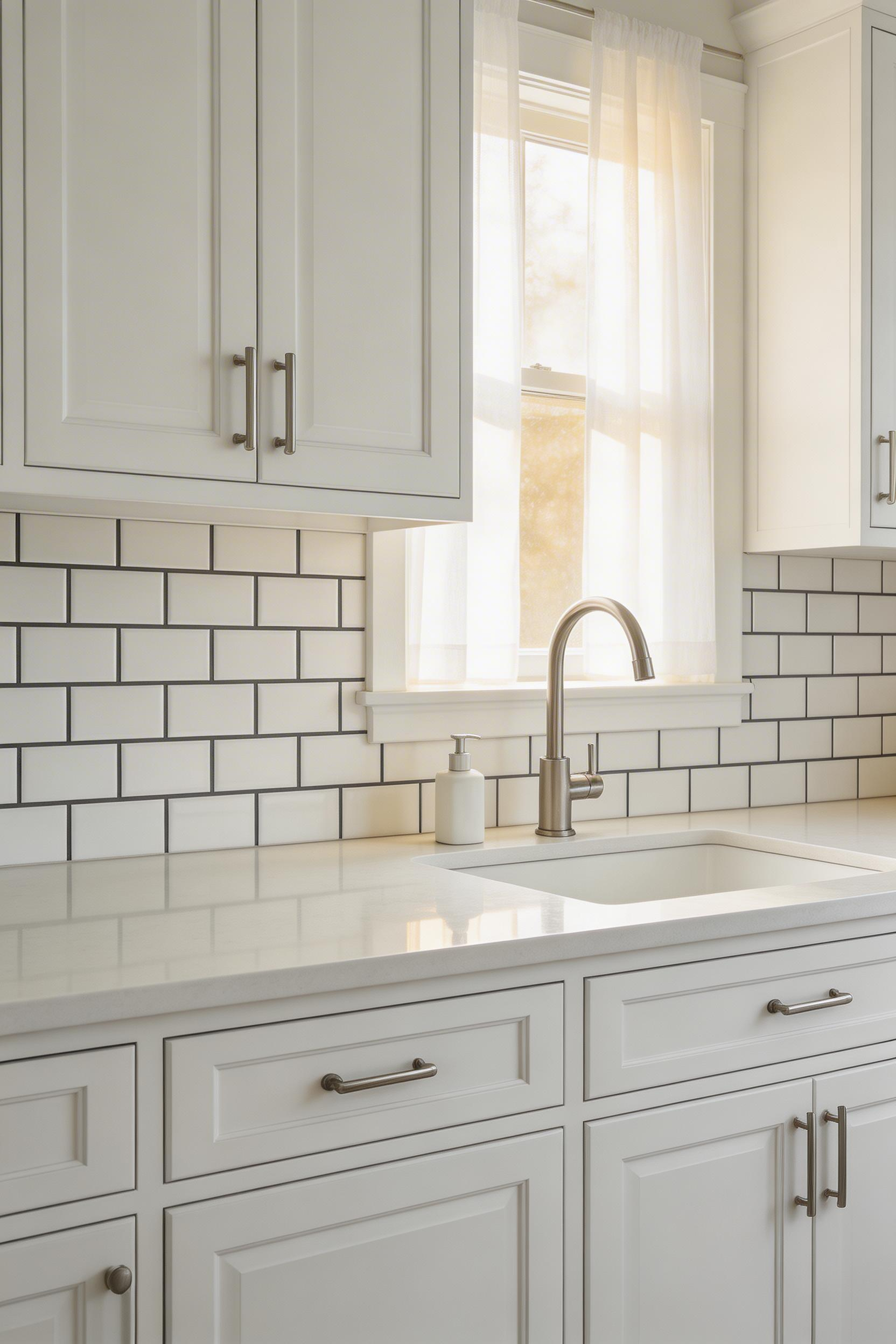
The subway tile backsplash has been standard in kitchens for 120 years, and for good reason: the 3×6-inch format is genuinely versatile. The secret to keeping it from looking generic lies in two decisions — grout colour and installation pattern. Charcoal or black grout turns white subway tile from basic to graphic. A vertical stack-bond installation makes the same tile read as contemporary rather than nostalgic. These are free changes that entirely transform the result.
What to Watch For
The most common mistake with this combination is mismatching undertones. White quartz comes in cool white (blue or grey undertones, like Caesarstone Pure White 1141) and warm white (cream or beige undertones, like Silestone Iconic White). White subway tile has the same variation. When you mix a cool-toned quartz with warm-toned tile, the clash is visible — not dramatic, but persistent. Always bring quartz samples to your tile showroom. Or borrow tile samples and view them together in your kitchen’s actual lighting before committing. This is the most useful thing I can tell you about choosing kitchen countertops and backsplashes for a white kitchen. Caesarstone Pure White 1141 runs $60-80 per square foot installed; Fireclay Tile’s 3×6 subway in Bright White is around $12-18 per square foot.
2. Butcher Block Countertops with Hand-Painted Zellige Tile Backsplash
This is the combination for people who want a kitchen that looks assembled over decades rather than ordered in a single Saturday showroom visit. Butcher block countertops — specifically end-grain cut, where the cross-sections of the wood face up — have been used in working kitchens for centuries. The end-grain surface is harder-wearing than edge-grain. Small knife cuts close as the wood fibres compress back into place.
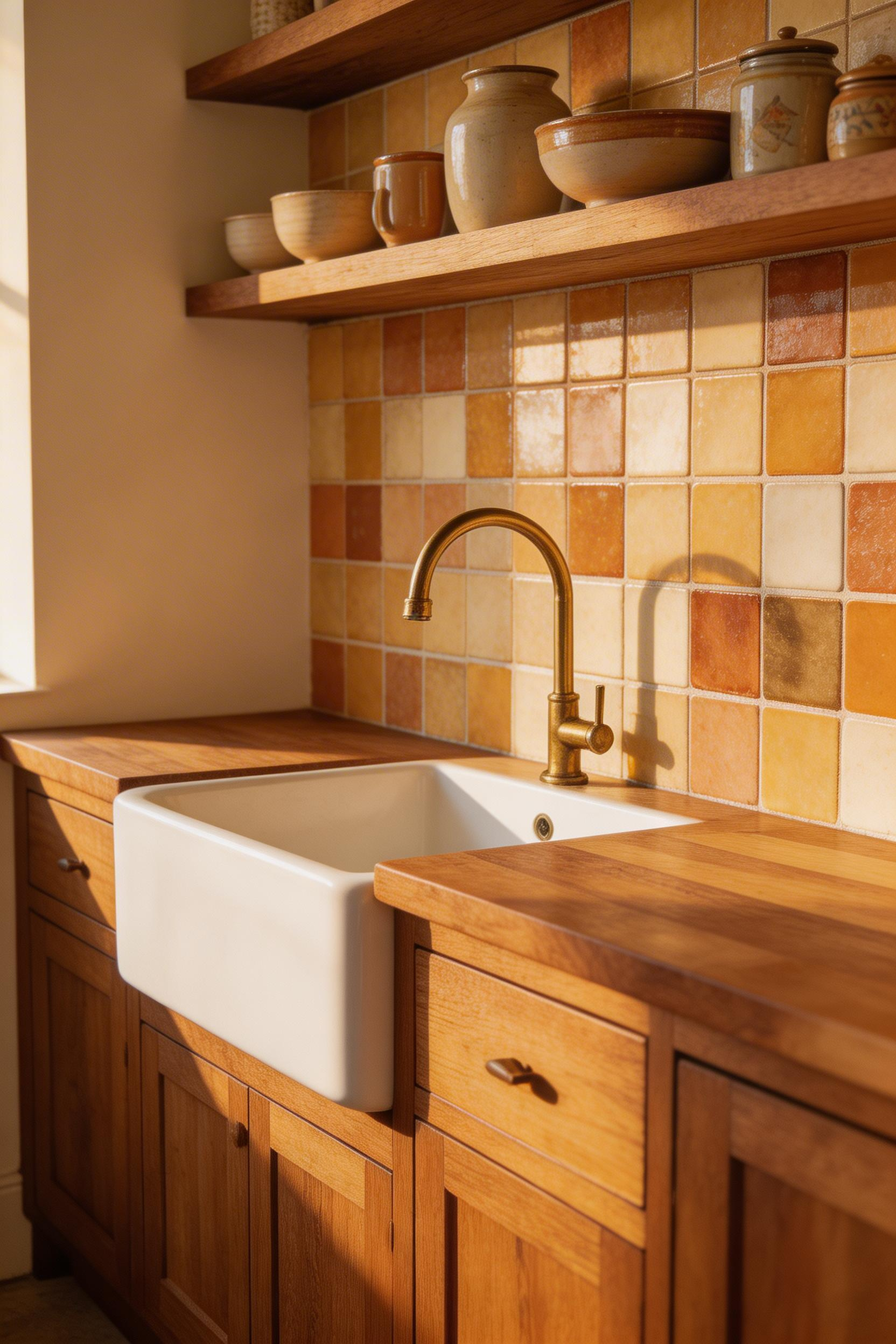
Zellige tile is hand-cut from fired Moroccan clay in the workshops of Fez. No two tiles are identical. The variation in colour saturation, surface texture, and edge profile is authentic — it’s the result of human hands, not a manufacturing defect. The combination of warm wood and artisan tile creates kitchen countertops and backsplashes that feel genuinely collected. It looks like someone who cared about materials chose them one at a time over years.
Practical Considerations for Wood Countertops
Butcher block needs regular oiling, particularly in the first year. Howard Butcher Block Conditioner (a mineral oil and carnauba wax blend, about $12 at hardware stores) is the standard recommendation. Apply it monthly for the first year, then quarterly after that. Near the sink, walnut and teak hold up better than maple because their natural oils provide more moisture resistance. For zellige installation, use grey or unsanded grout rather than white. White grout against zellige’s warm palette creates a jarring contrast that undoes the tile’s character. Armac Martin walnut edge-grain countertop runs $80-120 per linear foot; Cle Tile zellige in their Flea Market colourway runs $28-45 per square foot.
3. Honed Black Granite Countertops with White Arabesque Marble Backsplash
Drama done correctly is about contrast, and this pairing delivers it without excess. Honed black granite — specifically Absolute Black — is the most uniformly dark countertop surface available. Unlike most ‘black’ granites, which reveal green, brown, or gold undertones in sunlight, Absolute Black stays true. The honed finish creates a velvety matte surface that conceals fingerprints and water spots far better than polished granite.
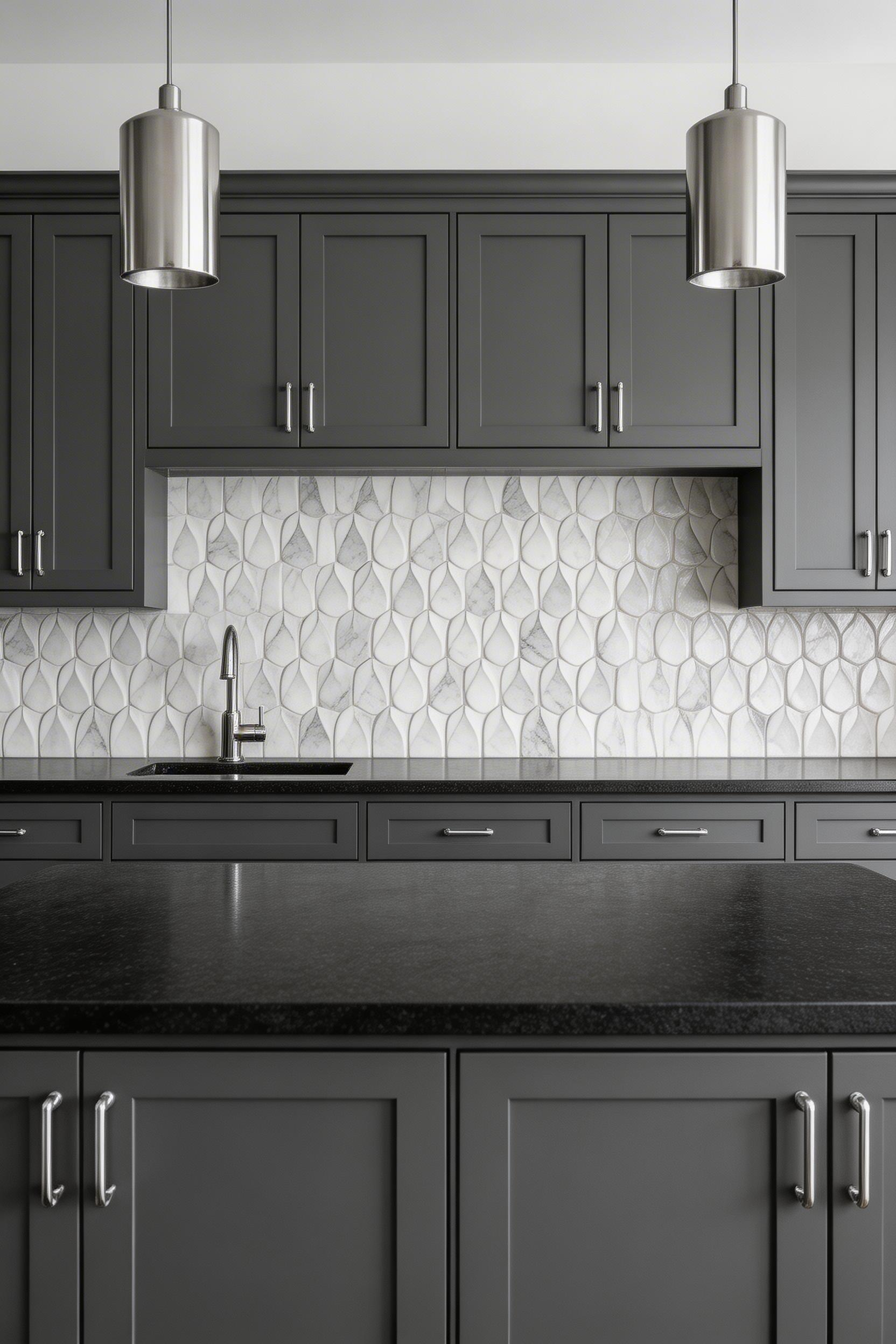
The arabesque tile format — the teardrop-shaped mosaic — provides the visual counterpoint to the solid black counter. White marble arabesque with natural grey veining against honed black stone creates the kind of contrast interior designers reach for when they want a kitchen to feel expensive without being literally expensive. Arabesque tiles in natural marble run $18-35 per square foot. Absolute Black granite honed runs $45-65 per square foot installed.
The Subtle Detail That Matters
There’s a fabrication detail that determines whether this combination looks professional or amateur: the reveal. Where the black granite meets the white backsplash tile, a small 1-inch section of tile runs along the back of the countertop before the main backsplash begins. This transition prevents the dark stone and white tile from butting directly against each other at a seam. Any fabricator worth hiring will know this, but it’s worth specifying in writing. Getting it wrong is visible from across the room. This kitchen countertops and backsplashes pairing saw a 22% increase in specification among design professionals in 2023-24, according to NKBA trend data.
4. Calacatta Marble Countertops with Unlacquered Brass Accents and Simple Grout Tile
Calacatta marble comes from a specific quarry near Carrara, Italy. It’s rarer and more expensive than the standard Carrara marble most people know. The distinction is in the veining: Carrara has soft, feathery grey veins on a grey-white background. Calacatta has bold, dramatic veining — gold, grey, or violet depending on the variety — on a brighter white background. Calacatta Borghini has gold veining; Calacatta Viola has purple-grey; Calacatta Macchia Vecchia shows earthy brown movement. All of them are genuinely beautiful and genuinely demanding.
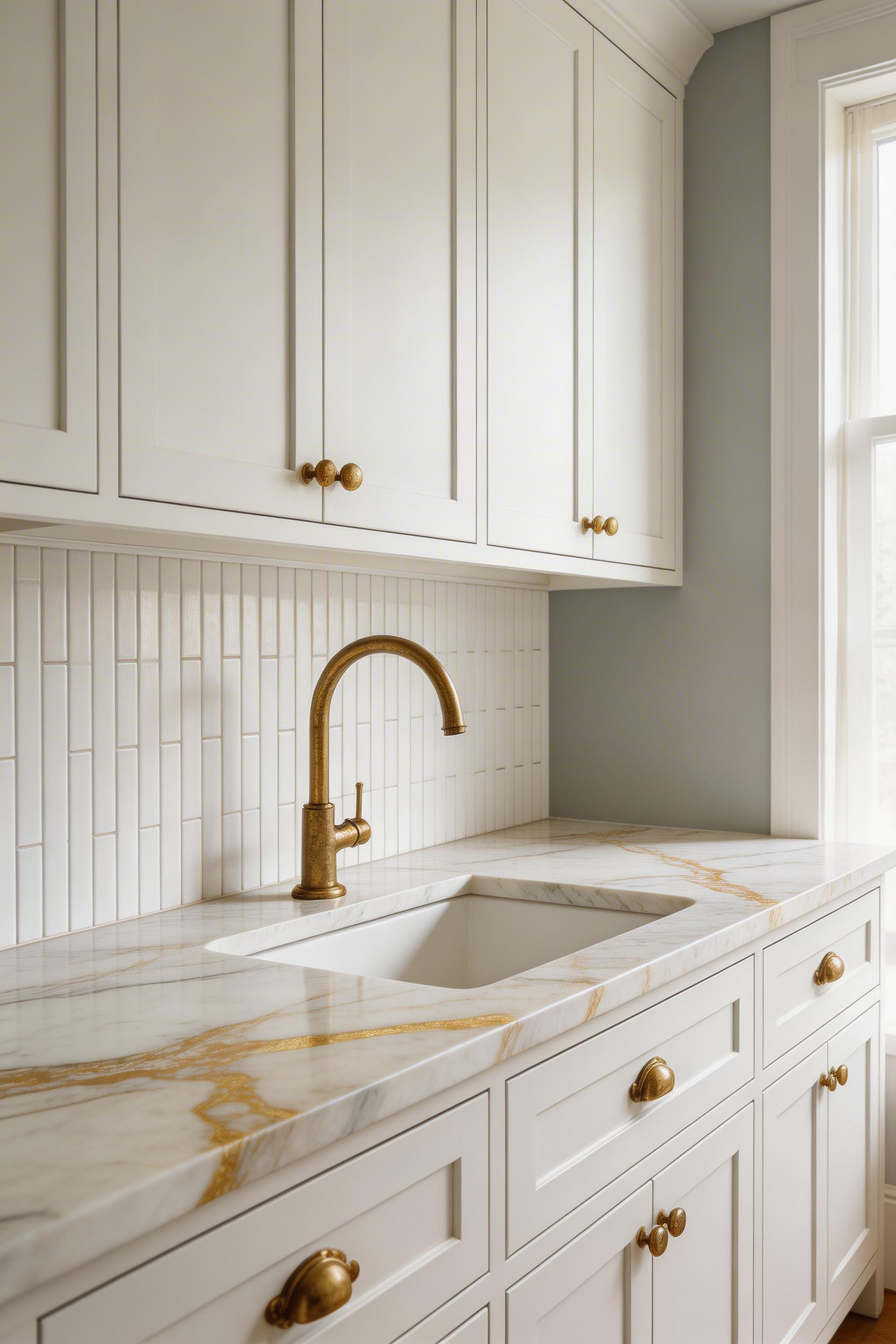
Marble countertops etch — this is the unavoidable truth. Calcite reacts with acids: lemon juice, wine, and vinegar will leave dull marks within minutes if not wiped. The practical solution is to choose a honed finish rather than polished. Etchings are far less visible on a matte surface. Also, commit to the patina mindset: the marks, the rings, and the gradual softening of the surface are the point, not failures. The backsplash here is intentionally quiet — a simple 2×10 inch white tile kept plain so the countertop remains the room’s focus. Unlacquered brass hardware from Rejuvenation ($18-28 per knob) develops a natural patina over 3-6 months, aging alongside the marble.
When Marble Makes Sense
Calacatta marble at $120-250 per square foot installed is a significant investment. It makes sense in kitchens used primarily for coffee and light cooking. It also suits households where the aesthetic matters more than zero-maintenance function. For everyone who wants the look without the sealing and annual maintenance: Caesarstone makes a quartz called Calacatta Nuvo at $65-85 per square foot installed. It’s a very good simulacrum.
5. Concrete Countertops with Raw Brick Backsplash
I’ll be honest about this pairing: these are my favourite kitchen countertops and backsplashes to work with, and also the ones I’d least recommend to someone who wants a low-maintenance kitchen. Concrete and raw brick are both honest materials. They age openly. They crack, they patina, they tell you what’s happened in the kitchen. If you find that appealing — and a certain kind of homeowner absolutely does — there’s nothing better.
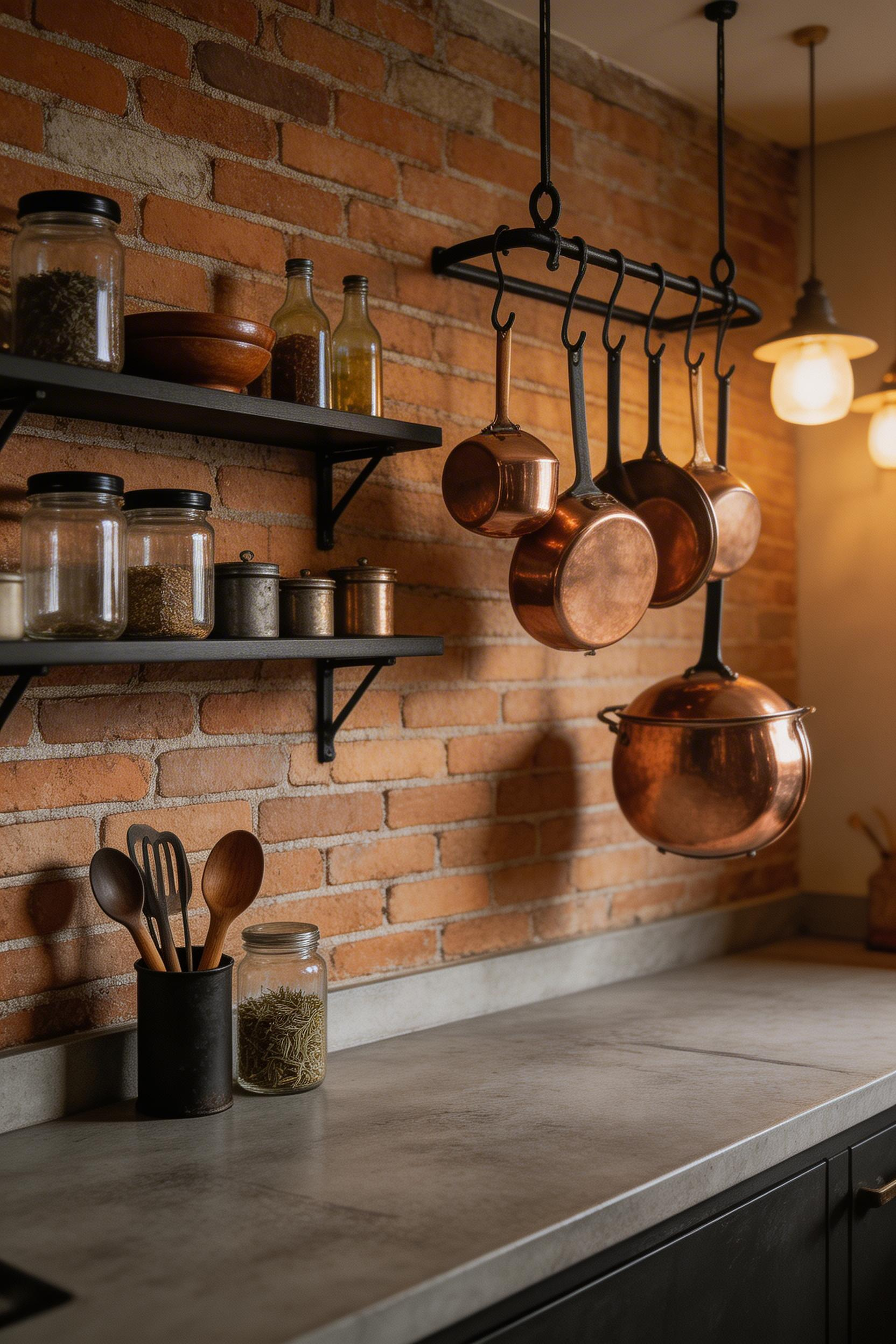
Concrete countertops are made either cast-in-place (poured directly onto the cabinets) or precast (fabricated off-site and installed). Precast offers better quality control. Cheng Concrete Design Studio makes a professional-grade mix available to homeowners; their casting systems run $8-15 per square foot in materials. However, professional fabrication and installation typically brings the total to $75-150 per square foot. Raw brick veneer comes in two forms: reclaimed (salvaged from demolished buildings, with genuine history and colour variation from pale sand to deep rust) and new brick tumbled to simulate age. Norwood Brick’s reclaimed thin brick slices run $12-20 per square foot and come with a certificate of origin.
Care Requirements for Concrete Surfaces
Concrete is porous and must be sealed with an impregnating sealer followed by a topcoat of paste wax applied annually. Without this, cooking oils stain permanently. Also, concrete countertops can crack — especially along the edges of integrated sinks. A good fabricator will reinforce with stainless steel armature and advise on joint placement. But cracks happen eventually. If you’d call the fabricator in distress at the first crack, concrete is not your material. But if you’d photograph it and appreciate a material showing its age, welcome to the most rewarding kitchen you’ll ever have.
6. Soapstone Countertops with Handmade Heath Ceramics Tile Backsplash
Soapstone is the most underrated countertop material in residential design. I’ll defend that claim with one fact: it doesn’t react with acids. Lemon juice, wine, and vinegar don’t etch it. Soapstone is composed primarily of talc, which makes it physically soft (Mohs hardness of 1-2) but chemically inert. It’s why chemistry laboratories use soapstone worksurfaces — not because it’s hard, but because nothing reacts with it.
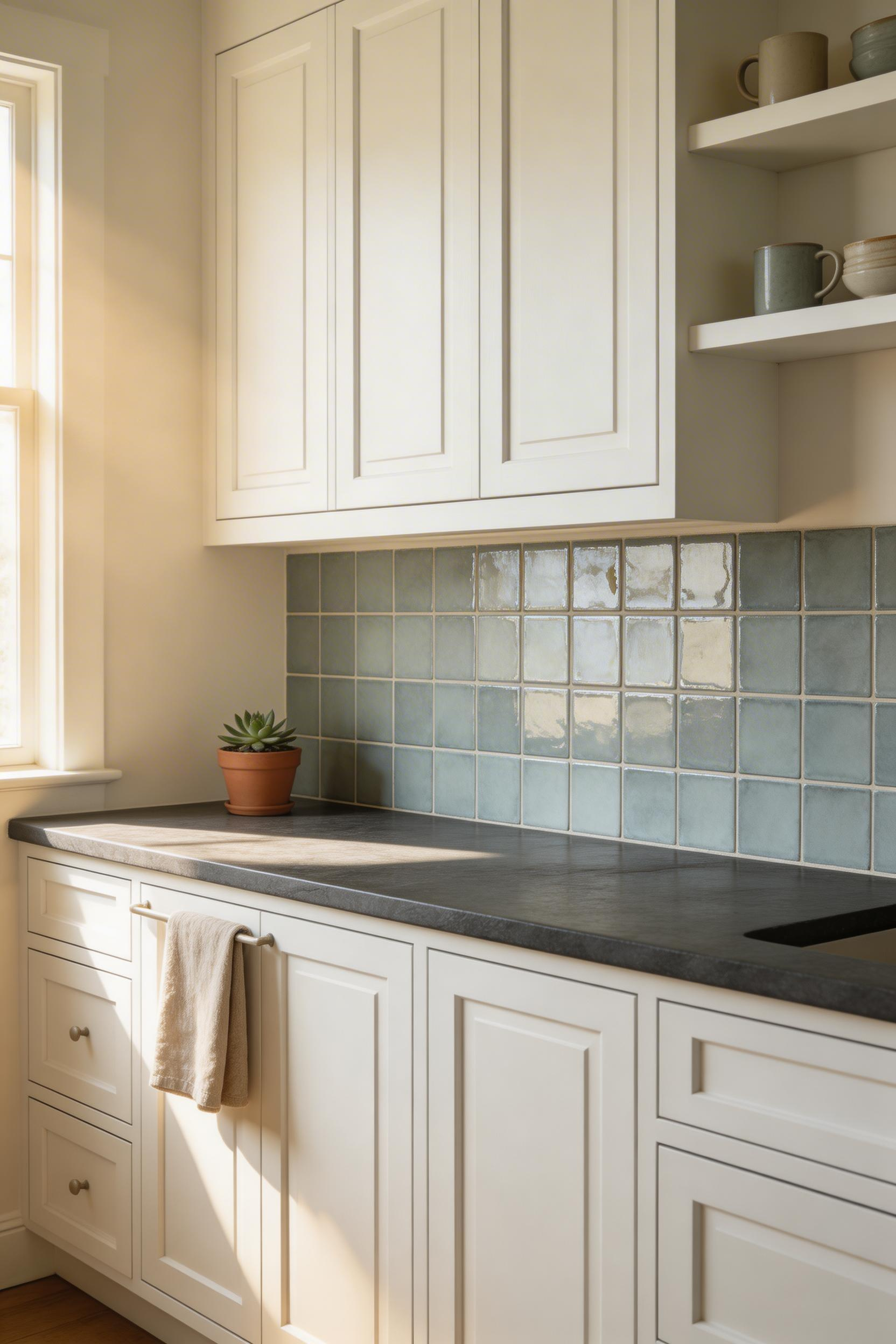
Scratches in soapstone are fixable with 220-grit sandpaper and a wipe of mineral oil. It’s a countertop where you can literally sand out damage that would require full resurfacing on marble or quartz. Soapstone bleaches and lightens as it dries; regular mineral oil restores and deepens the colour. The bleached patches aren’t damage — they’re just dry stone. Heath Ceramics tiles are made in Sausalito, California using a slip-casting process Edith Heath developed in 1948. The company still uses the same process today. Their tiles have a characteristically thick, matte glaze that pools at edges and corners — a crawl effect that gives each tile depth no mass-manufactured tile comes close to replicating.
Why This Combination Works Sustainably
Both soapstone and Heath Ceramics tiles represent the sustainable approach to kitchen countertops and backsplashes: materials made to last indefinitely, in the United States, using processes that haven’t changed because there was never a reason to change them. Alberene Soapstone from Nelson County, Virginia has been quarried since 1884 and runs $70-95 per square foot installed. Heath Ceramics tiles in their coastal colour range (Mist, Riptide, Coast — blues and greens that complement soapstone’s grey) run $18-28 per square foot. If you’re spending serious money on a kitchen renovation, this is the combination that will still look exactly right in 30 years.
7. Recycled Glass Countertops with Penny Round Mosaic Backsplash
Recycled glass countertops were invented by IceStone in Brooklyn in 1996. The category has grown steadily since — not because glass countertops are cheap (they’re not) but because they deliver on both the sustainability claim and the aesthetic result simultaneously. Each square foot of IceStone countertop contains roughly 6 pounds of post-consumer recycled glass: bottles, windshields, stained glass studio offcuts. The glass is embedded in a white Portland cement binder and the final surface is ground smooth and sealed.
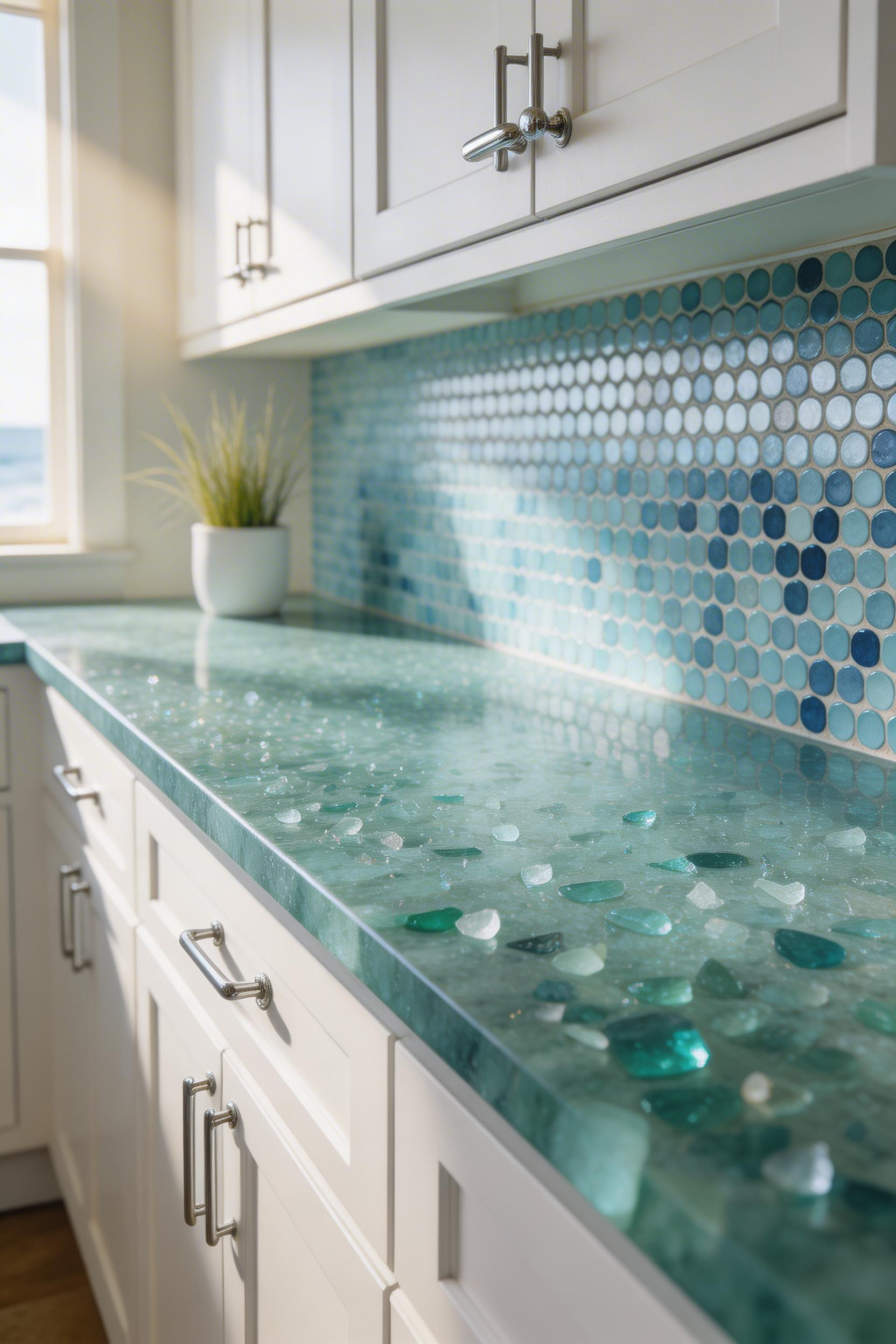
The surface of a recycled glass countertop reflects light differently from stone. The glass aggregate catches and refracts light, creating a shimmer that changes as you move around the kitchen. Penny round mosaic tile — 1-inch diameter circles on mesh backing — echoes this play of light at backsplash level, with each tile catching light at a slightly different angle. IceStone countertops in White Flurry or Sea Glass Blue run $95-140 per square foot installed. Daltile Keystones 1-inch penny round tile in Sea Glass runs $7-12 per square foot — one of the more affordable backsplash options that pairs with a premium countertop.
Practical Notes on Recycled Glass Surfaces
Glass countertops are non-porous, don’t etch, don’t stain, and don’t harbour bacteria — genuinely maintenance-free once sealed at installation. Clean with mild dish soap and water; avoid abrasive cleaners that scratch the sealer. Penny round porcelain tile is far more practical in a kitchen than glass penny rounds — porcelain is harder and the glaze surface shows water spots less. For those with genuine environmental commitments who also want kitchen countertops and backsplashes that look intentionally beautiful, this combination is the one I recommend first. IceStone has diverted over 40 million pounds of glass from landfill since 1996.
8. Quartzite Countertops with Vertical Stacked Stone Veneer Backsplash
Quartzite is the stone that confuses everyone, partly because its name sounds like engineered quartz and partly because many sellers mislabel marble as quartzite since quartzite commands a premium price. Quartzite is a genuine natural stone — metamorphic rock formed when sandstone is subjected to extreme heat and pressure. It’s significantly harder than marble (Mohs 7) and more acid-resistant. This makes it one of the best natural stone options for active kitchen countertop use.
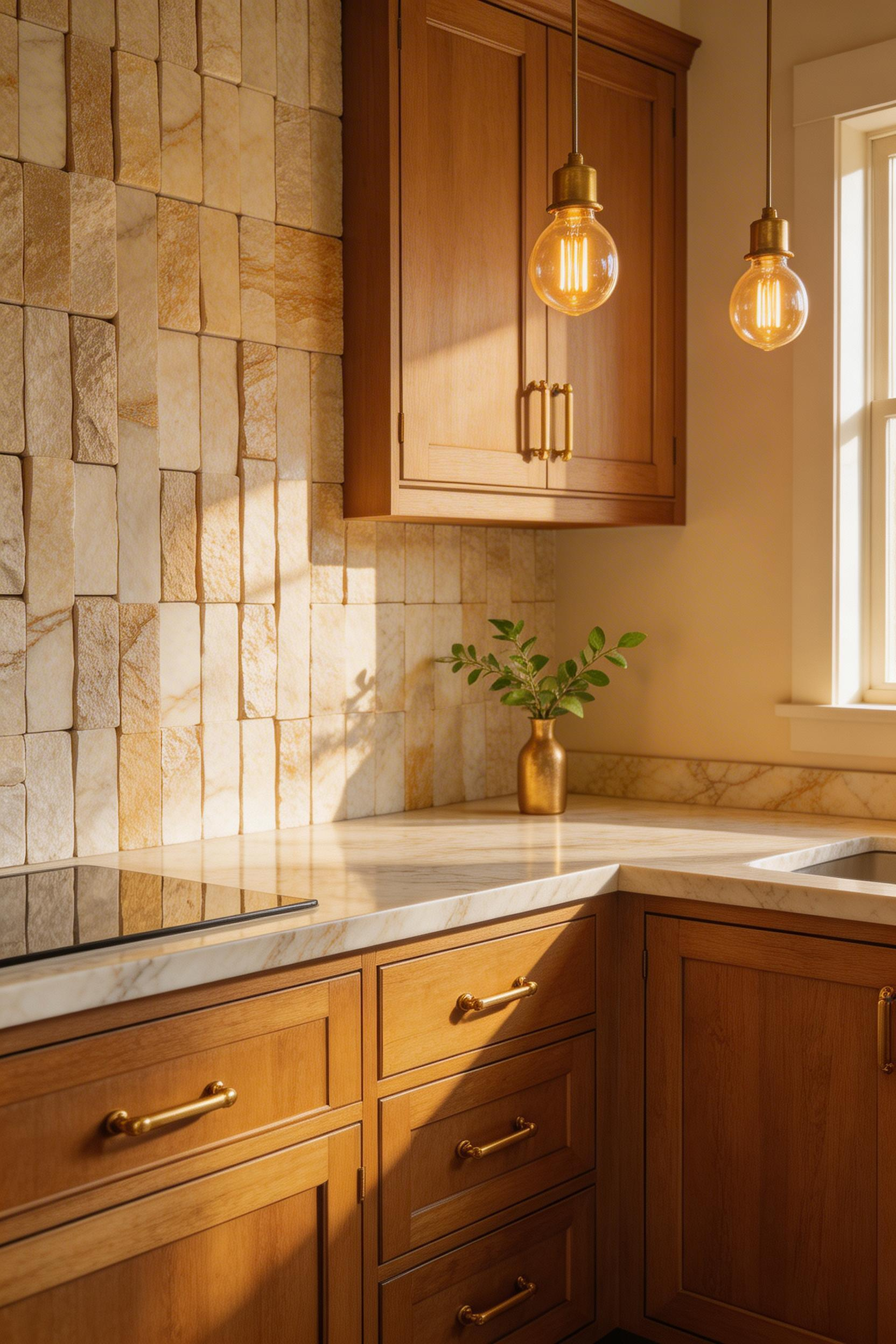
Taj Mahal quartzite (Brazilian origin, cream-gold tones) runs $80-120 per square foot installed. Super White quartzite (cool white with soft veining, often confused with marble in photos) runs $75-110 per square foot installed. For the backsplash, Norstone Standard Series White Splitface natural quartzite stacked stone panels run $22-32 per square foot. The scale contrast between the smooth slab countertop and the fine, irregular texture of stacked stone creates visual richness without pattern chaos.
Verifying Your Quartzite Is Actually Quartzite
Before committing to a quartzite slab, ask your stone yard to perform an acid test on an off-cut. Apply a drop of muriatic acid. Genuine quartzite barely reacts — a very slight fizz at most. Marble fizzes immediately and visibly. Any reputable stone yard will do this without hesitation. If they refuse or deflect, buy from someone else. This is the most important thing I know about kitchen countertops and backsplashes made from natural stone: the market has a mislabelling problem, and the acid test is the only way to verify what you’re buying. Quartzite specification has grown 45% in five years among design professionals, according to Architectural Digest Pro Network data from 2024.
9. Leathered Finish Granite Countertops with Large-Format Porcelain Slab Backsplash
Leathered granite is standard granite stopped partway through the polishing process. Diamond-tipped brushes run across the surface to create a textured, matte finish that opens the stone’s natural pores slightly. The result is velvety and tactile rather than mirror-smooth. Leathered granite hides fingerprints and water spots better than any other granite finish because the matte texture diffuses light rather than reflecting it. Also, the same slab looks noticeably deeper and richer in colour with leathered finish. Blue Pearl granite — which has iridescent blue-grey flecks — is genuinely striking in this treatment.
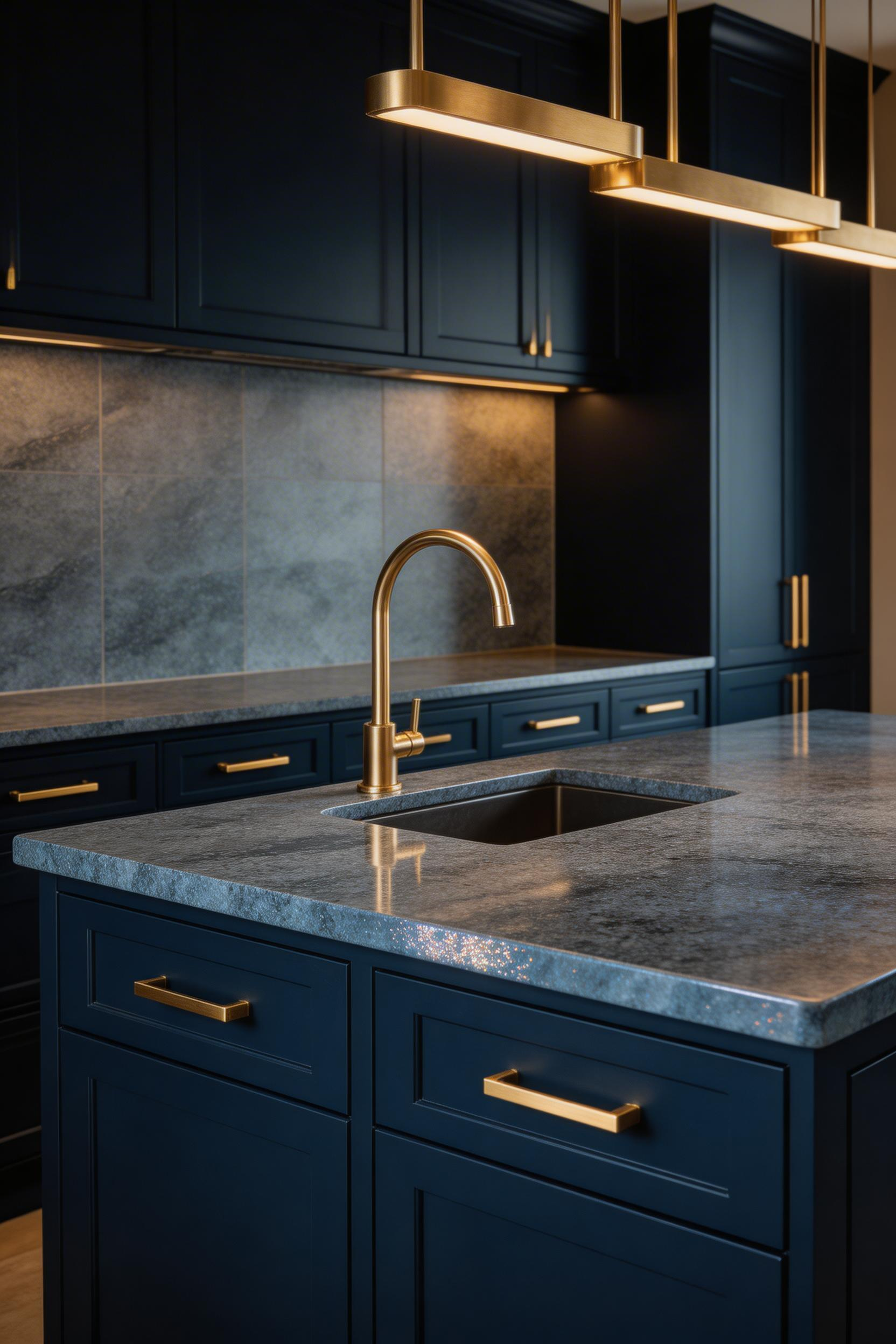
Large-format porcelain slab backsplash (60×120 inches or larger) is one of the fastest-growing specification choices in residential kitchens. The Tile Council of North America reported 67% growth in large-format porcelain installations between 2020 and 2024. Very few grout lines mean fewer places for grease to collect. The continuous stone-look pattern reads as architecture rather than tile. Atlas Concorde’s Marvel Stone range and Porcelanosa’s Urbatek line offer quality at $18-35 per square foot. When the porcelain echoes the granite’s movement in the same material family, the backsplash amplifies the counter rather than competing with it. This is how high-end kitchen designers approach kitchen countertops and backsplashes as a system — you notice the effect (the kitchen feels expensive) without spotting the mechanism.
Installation Requirements for Large-Format Tile
Large-format porcelain requires a flat, rigid substrate with a Ditra or similar membrane to prevent cracking. Standard drywall is not adequate. Use a large-format notched trowel (1/2 x 1/2 inch) to ensure full adhesive coverage under large tiles. Voids beneath large-format tile create hollow spots that crack under point loads. Leathered granite countertops are more porous than polished; seal with an impregnating sealer twice at installation, then annually. Blue Pearl granite in leathered finish runs $55-80 per square foot installed.
10. Waterfall Edge Marble Island with Glossy Metro Tile Backsplash
A waterfall edge countertop continues the countertop material vertically down one or both ends of an island, creating the appearance of a continuous slab. In Statuario Extra marble — bold grey veining on brilliant white — the effect is genuinely sculptural. However, this is a design feature that photographs beautifully and requires careful evaluation in person. In smaller kitchens, a dramatic waterfall edge can feel overwhelming. In open-plan spaces where the island is visible from the living area, it works as the centrepiece it’s intended to be.
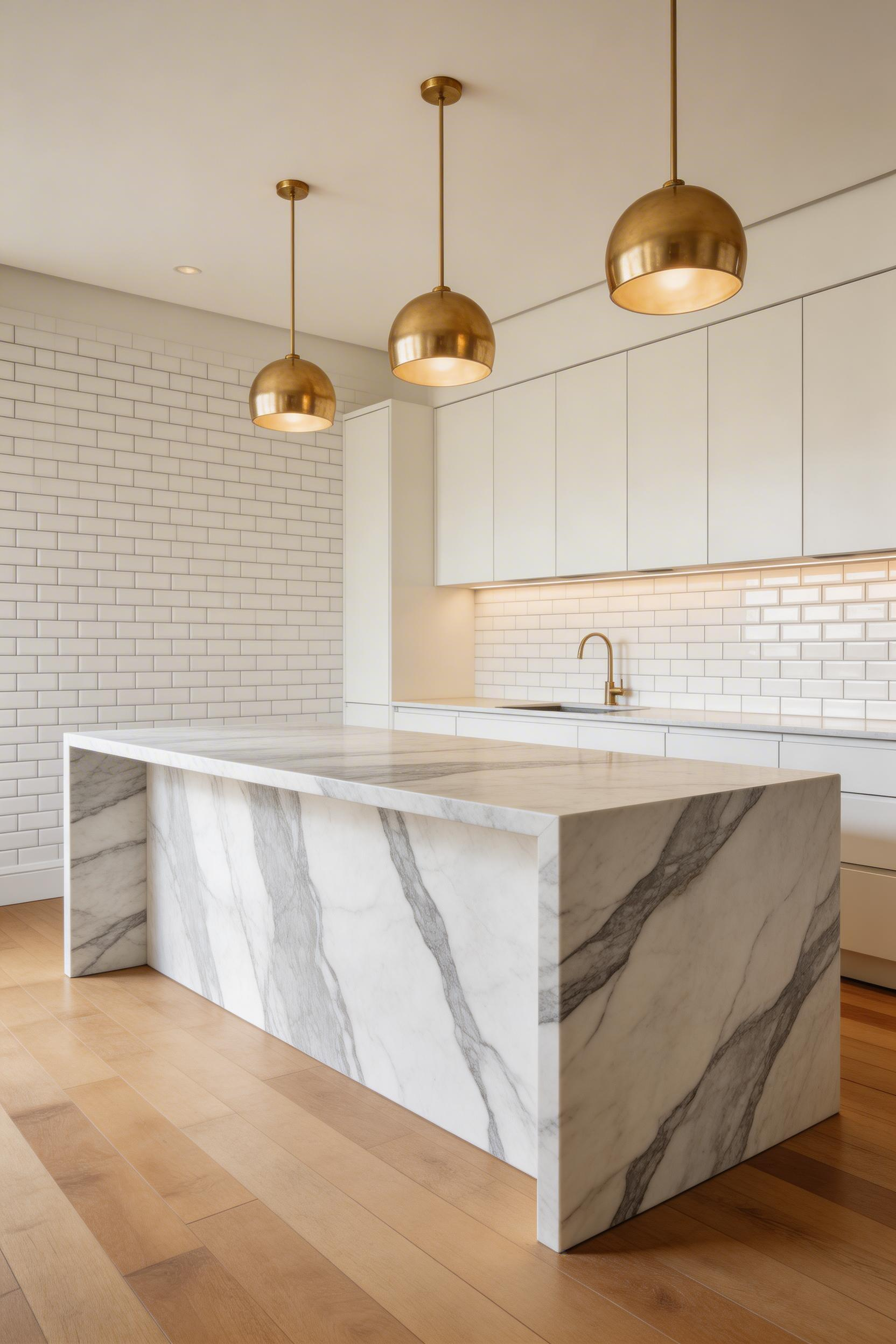
Matching the veining across the horizontal surface and the vertical drop requires book-matching: purchasing two consecutive slabs from the same quarry block and mirroring the veining pattern at the corner. This requires coordination with the stone yard before slabs are separated — once consecutive slabs are split up, the book-match opportunity is gone. The fabrication premium for a waterfall edge with book-matched veining is 20-30% above a standard countertop. For those wanting the marble aesthetic at lower risk, Calacatta Laza quartz from Caesarstone at $85-120 per square foot is engineered with a pattern consistent enough to simulate book-matching.
The Role of the Metro Tile Backsplash
Glossy metro tile in the perimeter backsplash serves one function here: it keeps the rest of the kitchen quiet. British Ceramic Tile Metro Gloss White in 10x20cm format ($6-10 per square foot) has a true glossy glaze that reflects light without adding pattern or colour. The marble island is the room’s speaker; the glossy metro tile is the room’s listening. Installed vertically in a stacked-bond pattern, metro tile looks contemporary enough to match a marble waterfall island’s quality. Houzz renovation cost studies find that kitchen islands with waterfall edges add 5-8% to overall renovation budgets but contribute disproportionately to perceived quality and resale value.
11. Dekton Ultra-Compact Surface Countertops with Cement Tile Backsplash
Dekton is made by Cosentino in Spain and most homeowners outside the design world haven’t heard of it. That’s a genuine oversight. It’s a sintered stone manufactured by compressing glass, porcelain, and quartz under extreme heat and pressure. The result is a surface with scratch resistance up to 7,500 PSI, zero porosity (no sealing required), heat resistance to 1,256°F, and UV stability that prevents outdoor fading. These are documented performance specifications, not marketing claims.
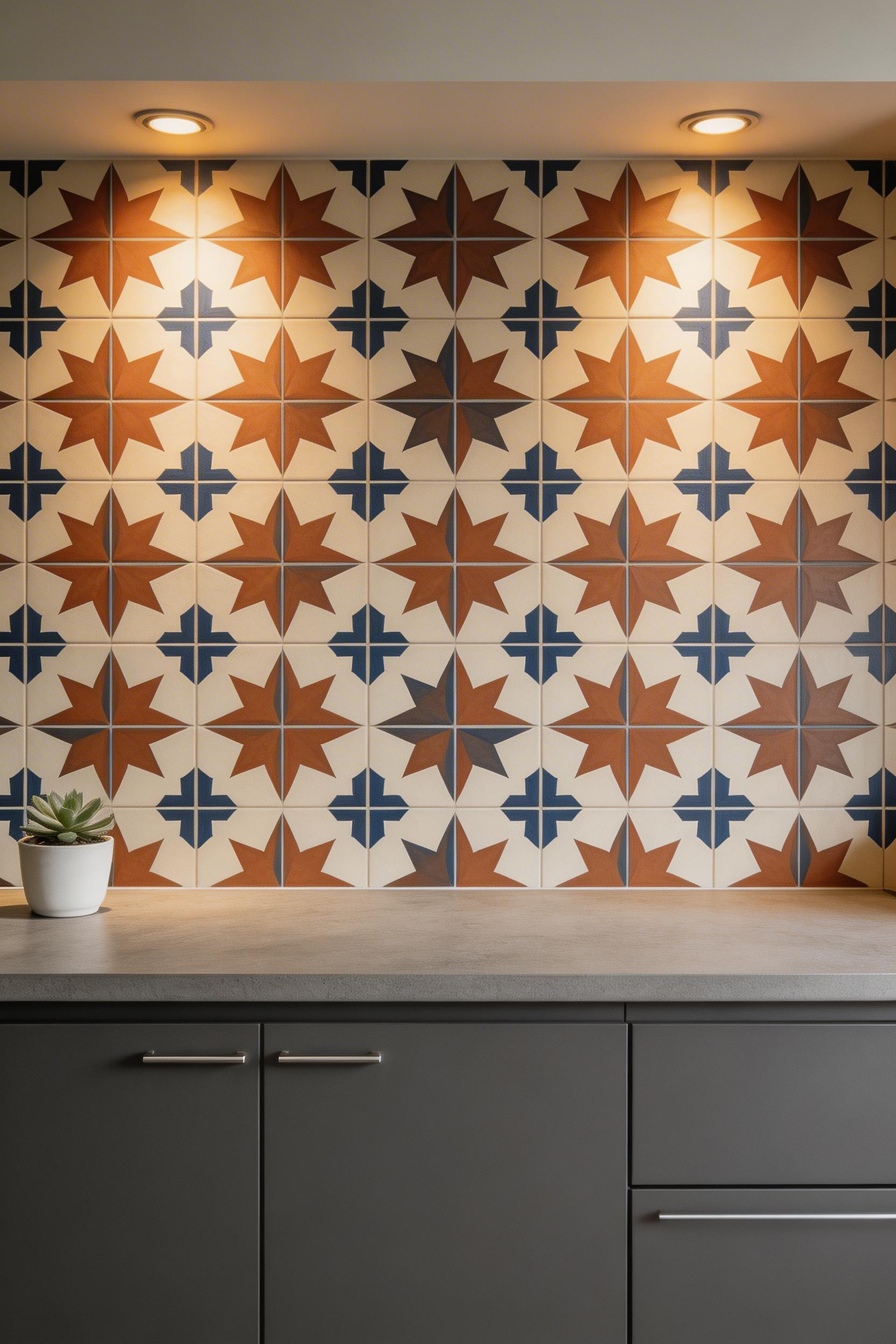
Dekton in the Rem or Sirius colourways (concrete-look matte surfaces) runs $90-130 per square foot installed. Because the countertop surface is visually restrained — matte, neutral, textural without being patterned — it creates the ideal foundation for a backsplash that carries the room’s character. Encaustic cement tile is handmade by pouring pigmented cement into metal moulds. Because the tiles aren’t kiln-fired, the colour penetrates through the full depth of the tile. Mosaic House cement tiles in geometric patterns run $14-22 per square foot; Villa Lagoon Tile offers custom colour matching at $18-35 per square foot with 6-10 week lead times. This pairing is what I recommend to clients who want kitchen countertops and backsplashes with serious personality but need them to survive heavy daily use. Dekton absorbs the practicality requirement so the cement tile can be chosen purely on aesthetic grounds.
Cement Tile Installation and Care
Cement tile is highly porous and must be sealed before installation and again after grouting. Unsealed cement tile permanently stains from thinset mortar before you’ve even finished laying it. Use Miracle 511 Penetrating Sealer before grouting; seal again after and allow 48 hours cure before water contact. Clean with pH-neutral cleaner only. Acidic or bleach-based cleaners will damage the surface. The maintenance is real but manageable, and the reward — a backsplash that looks genuinely handmade because it genuinely is — is substantial.
12. White Carrera Marble Countertops with Antique Mirror Backsplash
Antique mirror backsplash is the material I reach for when a client’s kitchen is dark and faces north. Antique mirror — standard glass treated to create oxidised, cloudy patches across the surface — reflects light differently from standard mirror. Instead of blasting light back at full intensity, the foxed surface borrows light and returns it softly. In a kitchen where you’re cooking under artificial light much of the day, that distinction matters enormously. You can find a wide range of approaches in any guide to backsplash design, and the options for brightening a dark kitchen are genuinely wider than most people realise.
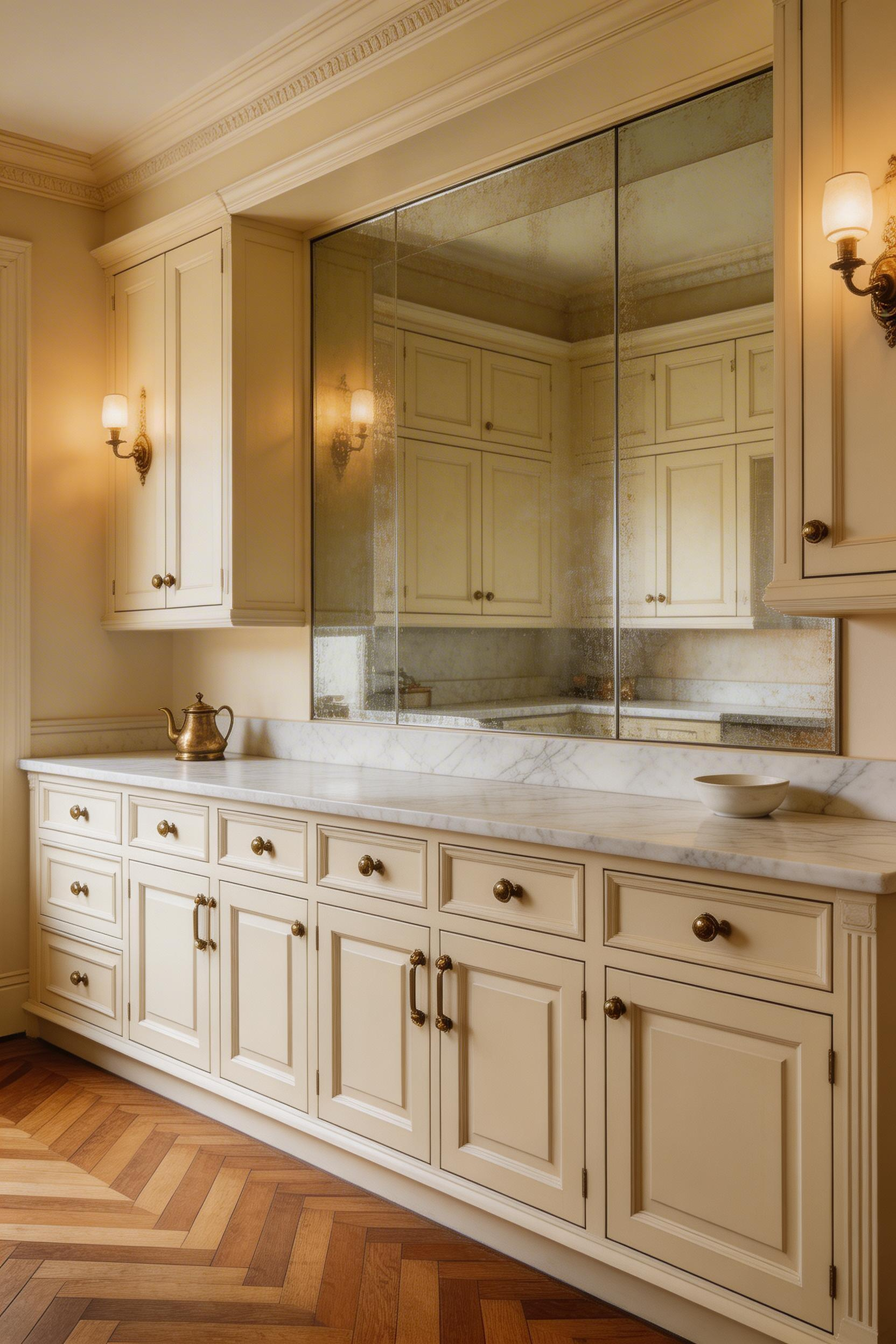
The combination of white marble and antique mirror has genuine historical precedent. It was a signature element of 1920s Parisian kitchens and 1930s Hollywood interiors, where both materials represented accessible luxury. Carrera marble (Bianco Carrara) is the most widely available Italian marble at $55-80 per square foot installed. Its softer grey veining suits the vintage quality of antique mirror better than bold Calacatta veins would. Antique Mirror Tile Company’s 4×12 subway-format mirror tile runs $28-40 per square foot. Mirror tile and glass backsplash materials have seen a 35% increase in residential specification over the past three years, particularly in smaller urban kitchens. For anyone with a north-facing or basement kitchen, I’d consider this before spending money on recessed lighting.
Antique Mirror Installation Notes
Antique mirror must be adhered with 100% silicone adhesive — not standard tile adhesive, which etches the mirror backing. Apply silicone in continuous beads rather than dots and leave a 1/8-inch gap at all edges for a movement joint. Never use epoxy adhesive; off-gassing from epoxy damages mirror backing permanently. The primary maintenance consideration is grease: cooking grease collects on the surface and requires regular wiping with a soft cloth and mild glass cleaner. This is a kitchen backsplash for people who love beauty and accept that beautiful things require care.
13. Honed Limestone Countertops with Terracotta Tile Backsplash
This combination requires patience during installation and rewards you with a kitchen that looks genuinely old in the best possible way. Limestone countertops in honed finish — specifically Jura Grey (cool buff with visible fossils) or Jerusalem Gold (warm cream-gold tones) — have a quality that no engineered surface replicates. These stones were formed over millions of years, and they look it. They’re softer than granite and reactive to acids. But the honed surface develops a natural patina over years that polished limestone doesn’t allow, and the result is a surface that improves with age rather than simply wearing.
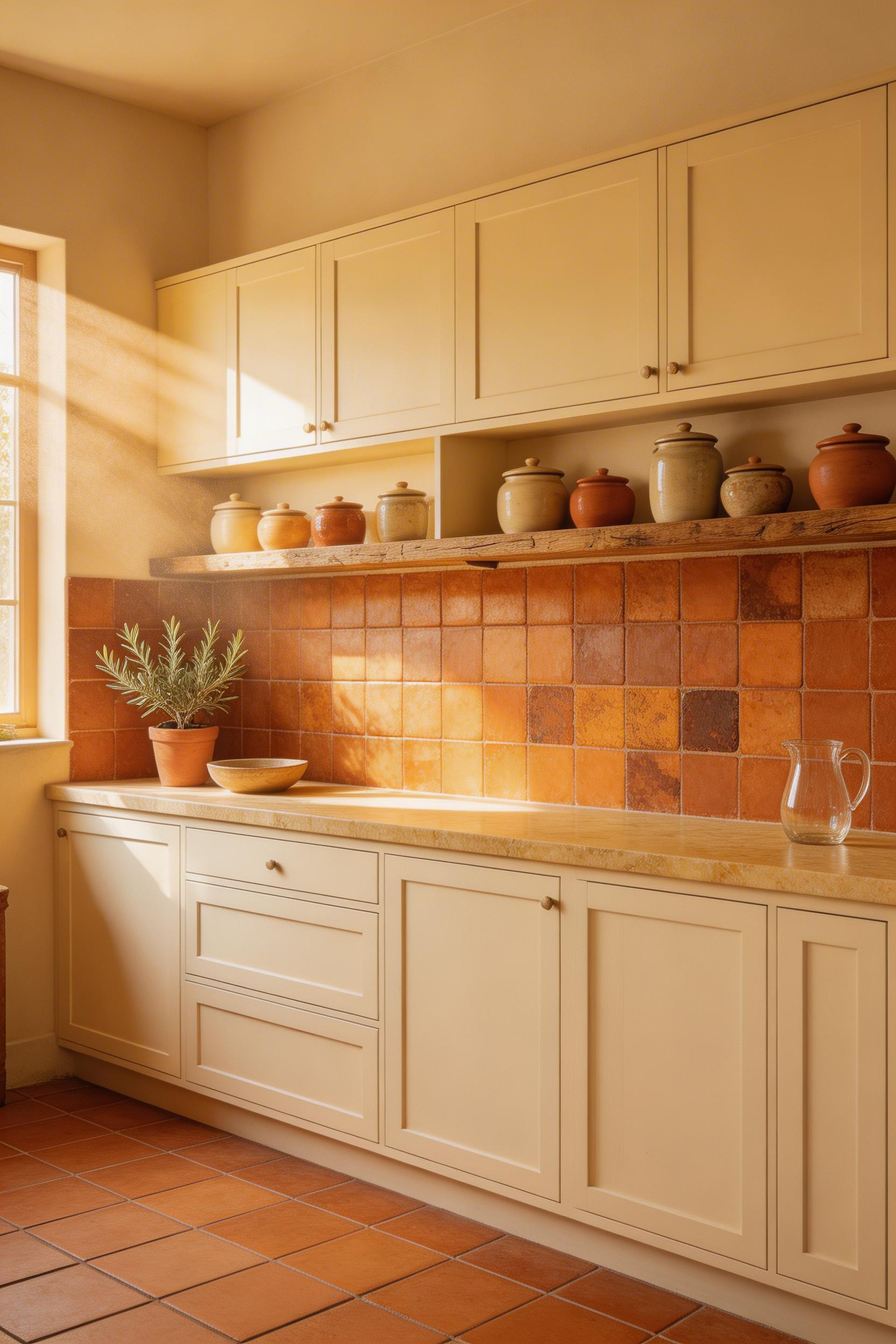
Terracotta tile is fired clay without glaze. Traditional Mexican Saltillo tile is the most common format in North America. Saltillo Imports 12×12 handmade tiles run $5-9 per square foot — one of the most affordable backsplash materials with genuine character. The key to getting terracotta right is the grout colour: always specify warm, ochre-buff grout, never white. White grout against terracotta makes the tile look installed last week. The right grout colour makes it look like it’s been there for decades. Jerusalem Gold limestone runs $50-70 per square foot installed. Mediterranean-style kitchen design has seen a 28% resurgence in professional specifications since 2022, according to NKBA Style Trend data. If you’re considering kitchen countertops and backsplashes in this style, the terracotta-limestone pairing is the most authentic starting point.
Sealing Requirements for Both Materials
Both honed limestone and unglazed terracotta are porous and require sealing. For the limestone: seal with a 15-year impregnating stone sealer immediately after installation and wipe all acidic spills promptly. For terracotta: the tiles must be saturated with penetrating sealer from the back before installation, then sealed twice after grouting. This pre-sealing step is frequently skipped by installers unfamiliar with terracotta. The result is permanent mortar staining on tile surfaces that were carefully chosen. Specify in your installation contract that terracotta tiles will be pre-sealed before installation. It’s a small detail that prevents an irreversible problem.
14. Stainless Steel Countertops with Full-Height Glass Backsplash
Most residential clients avoid stainless steel countertops because they associate them with restaurant kitchens. The truth is that restaurant kitchens use stainless because it’s the most practical countertop surface that exists. That practicality translates directly to home use. Stainless steel is non-porous, antibacterial (the chromium oxide layer is self-healing), heat-resistant, and will last indefinitely with basic care. For anyone who actually cooks heavily, I recommend stainless steel countertops without hesitation. You can also compare many more kitchen countertop ideas to weigh these options side by side. The visual adaptation to the industrial aesthetic takes about a week; after that, the practicality is simply there.
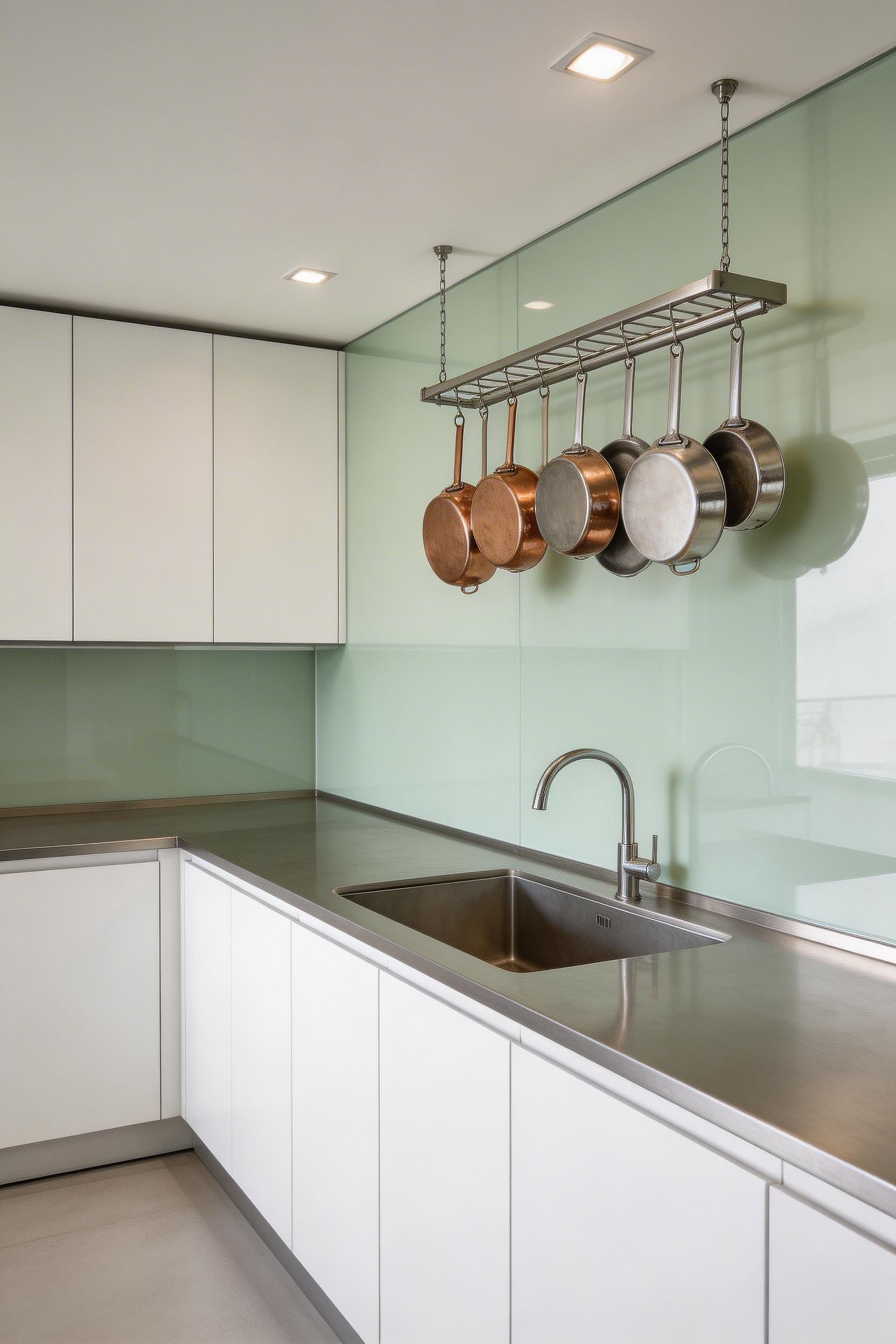
Full-height glass backsplash runs from countertop to the underside of the upper cabinet in a single panel of toughened glass. No grout lines. No tile joints. Nothing for grease to collect in. The Splashback Company makes custom panels at $35-55 per square foot; local glass fabricators can source tempered glass panels at $25-45 per square foot. Custom stainless steel countertops from local sheet metal fabricators run $75-120 per square foot fabricated and installed. The combination of these two seamless surfaces creates the cleanest possible kitchen to maintain — a genuine benefit for households that cook seriously every day. Stainless steel countertop specification grew 18% between 2022 and 2024, according to Kitchen Design Network data.
Stainless Steel Specifications for Home Use
Residential stainless countertops are specified in 14, 16, or 18 gauge (lower number = thicker steel). 16-gauge is standard for home use. Brushed finish with consistent grain direction is standard; mirror polish shows every scratch and is impractical for kitchen use. Grade 316 stainless (marine-grade, with molybdenum addition) is worth specifying for coastal homes — it’s more corrosion-resistant than standard 304-grade at a modest cost premium. For kitchen countertops and backsplashes that need to perform without compromise, this combination consistently delivers.
15. Two-Tone Countertops: Contrasting Perimeter and Island Materials
Using different materials for the kitchen island versus the perimeter countertops is the advanced move in kitchen design. The principle is straightforward: kitchen islands and perimeter counters serve different functions and different visual roles. So they can reasonably be different materials. What makes this work is choosing materials that contrast in type — natural stone versus engineered surface, or stone versus wood — rather than simply choosing two different stones that look similar in photos. You’ll find strong inspiration in any guide to kitchen backsplash ideas once the counter pairing is settled. Also, thinking through luxury kitchen surfaces as a whole helps clarify the investment hierarchy when planning for multiple materials.
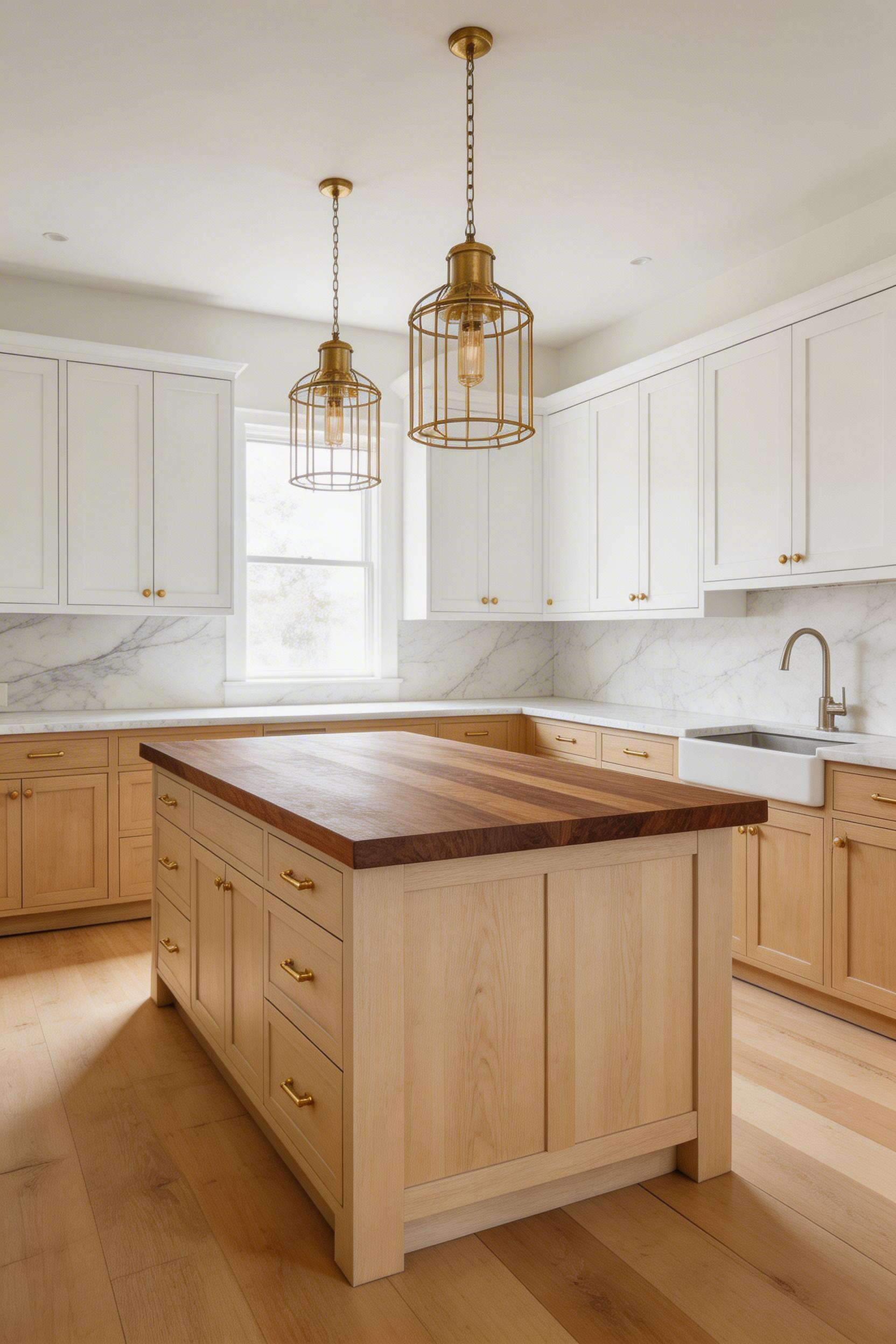
The most successful two-tone pairings contrast material types as well as colours. Strong combinations include: white quartz perimeter plus walnut butcher block island; white quartz perimeter plus soapstone island (the sustainable choice with strong material contrast); and Absolute Black granite island in leathered finish plus light grey quartz perimeter (works best with white or light grey cabinetry). The island should always be the statement material. It’s the most visible surface from the living area in an open-plan kitchen. The perimeter countertop is quieter, lower maintenance, and chosen to complement rather than compete. Two-tone or mixed-material kitchen countertops and backsplashes appeared in 34% of featured kitchen renovations in Architectural Digest in 2024, up from 12% in 2019.
The Design Logic Behind Two-Tone Surfaces
The most common mistake here is choosing materials of equal visual weight — two different dark stones, or two different light ones — and wondering why the result looks busy. For two-tone kitchen countertops and backsplashes to work, one material needs to speak and one needs to listen. Design the island first. Choose a backsplash that supports the island material. Then select a perimeter countertop that ties the two together without grabbing attention. Hardware connects the two surfaces: brass handles on both perimeter and island cabinets unify the materials visually, even when the surfaces themselves are clearly different. This detail distinguishes a deliberately designed two-tone kitchen from one that simply has two countertop samples in it.
Choosing Your Kitchen Countertops and Backsplashes
After twelve years of working with materials from reclaimed stone to hand-fired ceramic, my honest advice on kitchen countertops and backsplashes comes down to this: start with your actual lifestyle, not the photographs. The kitchens that look right in magazine spreads and also work right five years later are the ones where the materials were chosen for how the household actually uses the kitchen.
If you cook heavily and daily, engineered surfaces (quartz, Dekton) or stainless steel remove the maintenance variable. If you love the character of natural materials and accept they require attention, marble, limestone, soapstone, and butcher block reward you with a kitchen that develops genuine personality over time. If sustainability matters to you, recycled glass countertops, soapstone, reclaimed brick, and American-made tile from manufacturers like Heath Ceramics are the honest choices.
The backsplash should respond to the countertop rather than competing with it. When the countertop has strong pattern and movement (marble, quartzite), the backsplash should be quieter. When the countertop is restrained (white quartz, concrete, stainless), the backsplash can carry the room’s character. This is the logic behind every pairing in this list, and it’s the framework I’d apply to any kitchen countertops and backsplashes combination you’re considering.
My specific recommendation for most households: white quartz perimeter countertops paired with a handmade zellige or Heath Ceramics tile backsplash. The quartz removes every maintenance concern; the artisan tile provides everything the quartz can’t — character, craft, and a surface that rewards close looking. It’s not the most dramatic option here. But it’s the combination I’ve recommended most and heard the least regret about, which counts for something.