
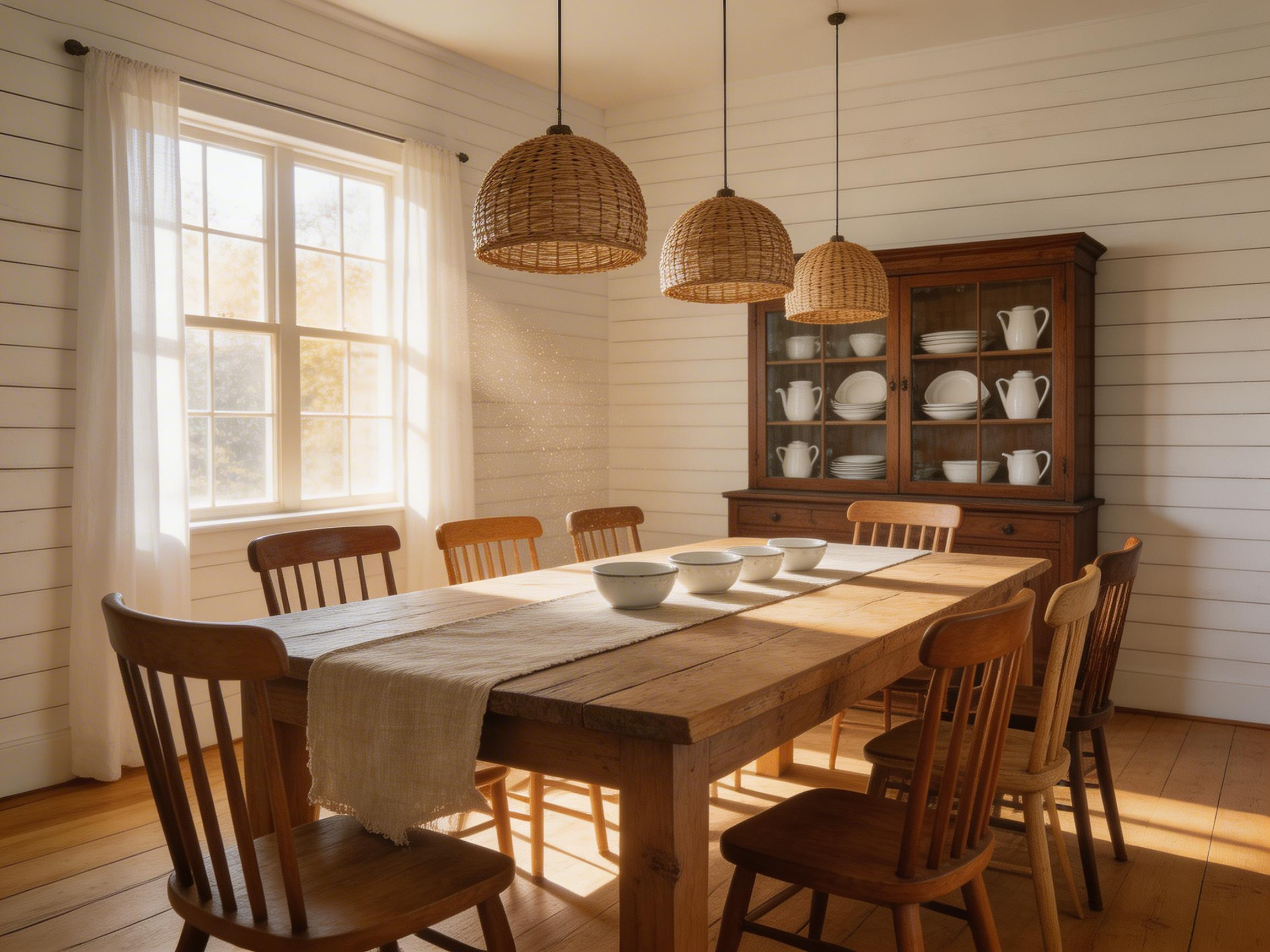
There’s a particular dining room I think about when I’m at estate sales. Worn pine table. Mismatched chairs that somehow all belong together. Shelves lined with ironstone that was never bought as a set. That feeling is what farmhouse dining room decorating is really chasing — and yet most farmhouse dining rooms end up looking like a catalog page. Everything matching. Everything brand-new. Every surface too clean to suggest anyone has lived there.
After twelve years of sourcing vintage pieces and restoring furniture, the difference always comes down to the same few decisions. The right table. The right lighting. Textiles that look collected rather than coordinated. These sixteen farmhouse dining room decorating ideas cover both the foundational pieces and the finishing touches that give a room genuine warmth.
1. Reclaimed Wood Dining Table as the Anchor of Your Farmhouse Dining Room Decorating
The table is the room. Everything else orbits around it. If the table is wrong — too new, too uniform — no amount of shiplap will save the space. A reclaimed wood dining table sets the tone before a single chair is pulled up.
Why Reclaimed Wood Creates Instant Authenticity
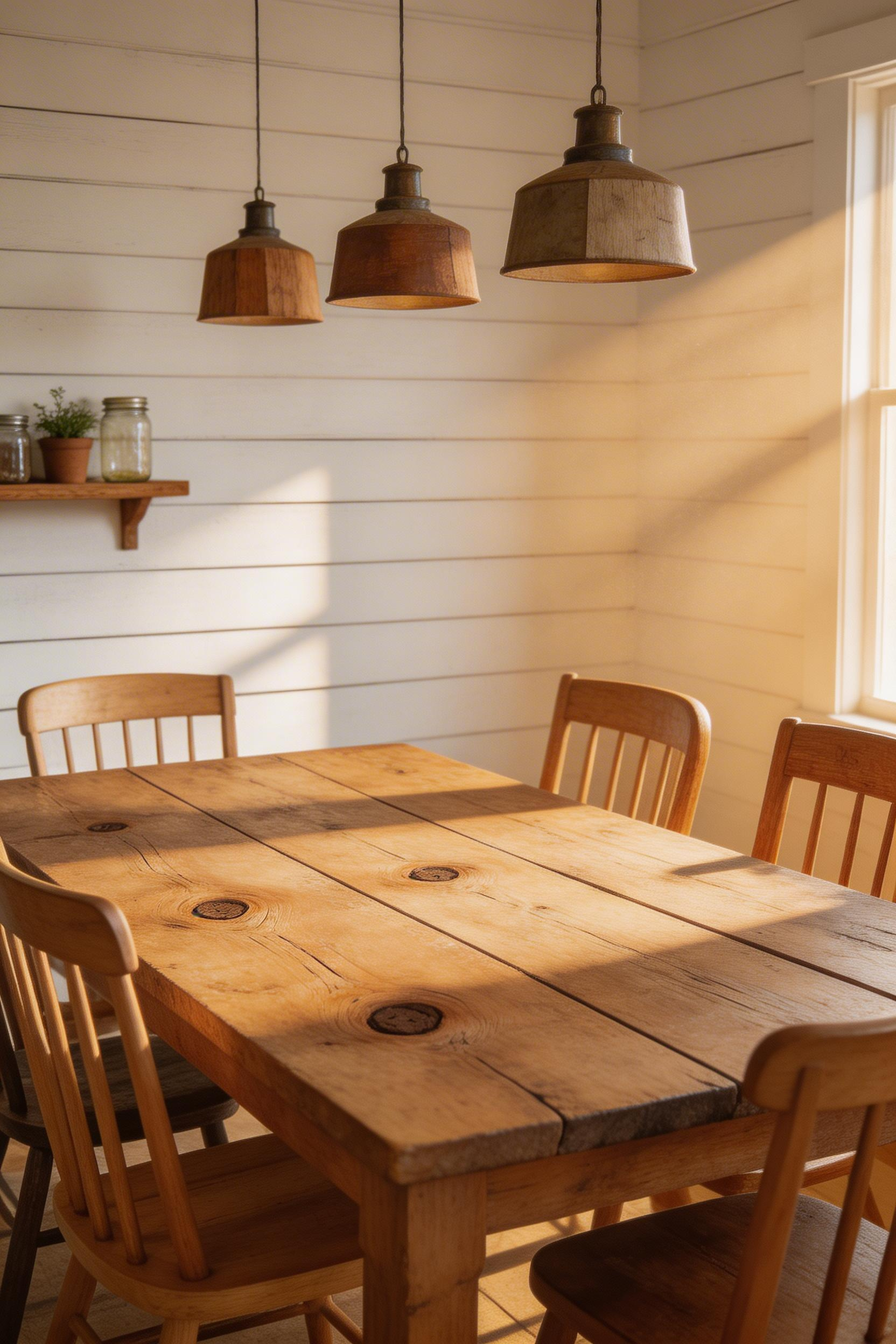
New wood, even well-stained new wood, has a uniformity that reads as manufactured. Reclaimed wood — old-growth pine from demolished barns, elm from factory floors, oak from century-old homes — carries physical history in its grain. The knots, nail holes, and color variations aren’t flaws. They’re evidence of a life before the dining room, and that’s exactly what farmhouse style values.
What to Look For: Thickness, Patina, and Joinery
Aim for a tabletop at least 2.5 inches thick. Thinner tops flex and lack the visual weight that makes reclaimed wood satisfying. Look for even aging rather than one dramatic patch of wear surrounded by fresh-looking wood — that’s artificial distressing. Check the joinery: mortise-and-tenon construction signals real craftsmanship that will outlast anything built with pocket screws.
Sourcing Reclaimed Tables on a Real Budget
World Market’s Emmerson reclaimed pine table ($699–$999) is an honest option if you need reliability. For more character, Etsy woodworkers building custom reclaimed elm or oak tables run $600–$1,800. But the best finds come from salvage yards and estate sales, where unfinished slab tables start around $200. Budget $50–$100 for Rubio Monocoat or Osmo Polyx-Oil to finish it.
2. Shiplap Accent Wall Behind the Table for Instant Rustic Depth
Before you reach for wallpaper, consider shiplap. A single wall of horizontal pine boards behind the dining table adds texture, visual depth, and that farmhouse quality that wallpaper tends to simulate rather than deliver. It’s also a weekend project at around $200 in materials.
Why Shiplap Works Better Than Wallpaper for Farmhouse Dining Rooms
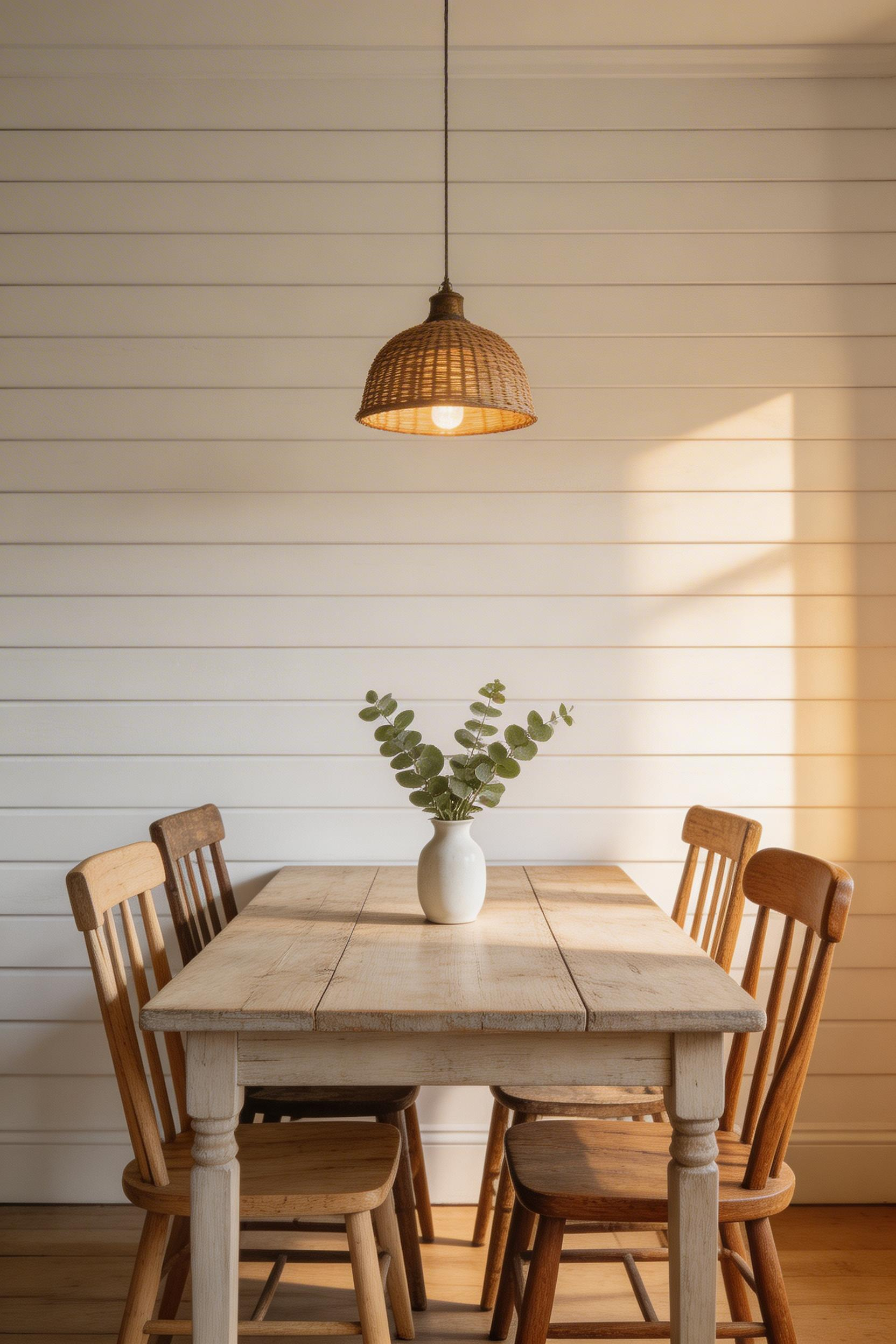
Wallpaper gives you pattern and color but stays flat. Shiplap adds actual dimensional texture. The shadow lines between boards change with the light throughout the day, giving the wall a living quality that flat surfaces can’t match. It also reads as structural, which suits farmhouse style’s honest-materials ethos. When the wall gets bumped or splashed over the years, shiplap handles that with grace.
White vs. Natural Wood Shiplap: Choosing the Right Tone
White shiplap (Benjamin Moore White Dove OC-17 or Sherwin-Williams Alabaster SW 7008) reads brightest and works in smaller dining rooms where you need reflected light. Natural-toned shiplap — oiled pine with minimal stain — brings more warmth and suits rooms that already have a lot of white elsewhere. Avoid gray stains, which tend to read as dated within a few years.
DIY Shiplap Installation Tips for Weekend Warriors
Standard 1×6 pine boards from the home center cost $1.50–$2.50 per linear foot. A nickel coin makes a perfect gap spacer. Prime before painting, and use a finish nailer into studs — dining rooms get humid and adhesive alone won’t hold long-term.
3. Woven Rattan or Wooden Pendant Lights Over the Dining Table
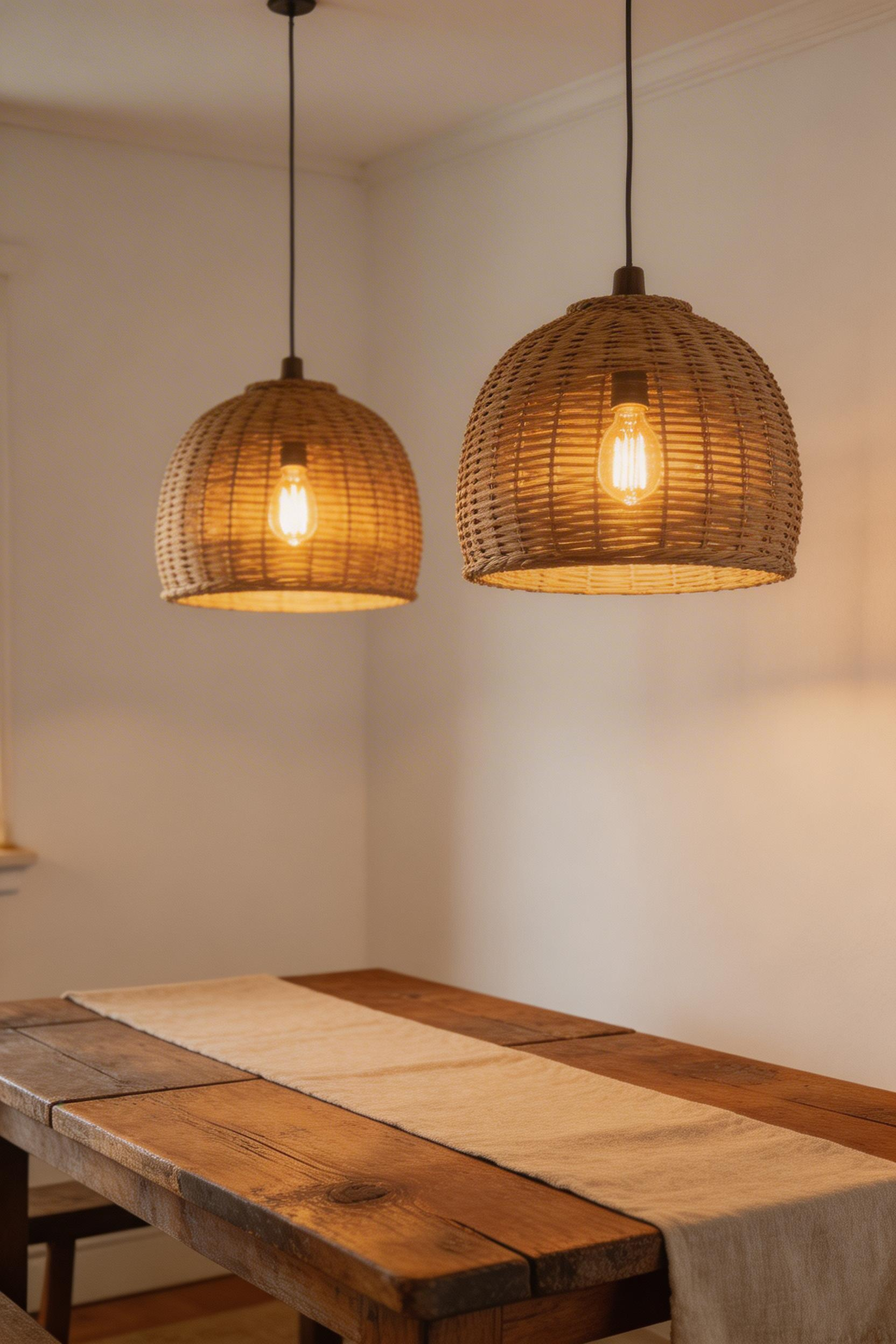
Overhead can lights illuminate the table and completely fail the atmosphere. A woven rattan or wooden pendant brings warmth and filters light in a way overhead fixtures never do. It also introduces natural texture from above — one of the areas most dining rooms forget to address.
How Pendant Height Changes the Mood of the Whole Room
Hang pendants 30–36 inches above the tabletop. Higher than 36 inches and the light spreads too diffusely. Lower than 28 inches and it’s intrusive — people have to duck around it. For 8-foot ceilings, this typically means the pendant shade hangs around 66 inches from the floor.
Rattan vs. Wood vs. Metal: Which Reads Most Farmhouse
Rattan and seagrass read warmest and most organic, filtering light beautifully through their weave and casting a dappled glow. Wooden pendants add more architectural weight and suit rooms with heavier furniture. Metal shades also work but read more industrial than farmhouse — better for spaces that lean farmhouse-meets-loft.
Specific Pendant Lights Worth Buying Under $150
The Stone & Beam Woven Rattan Pendant on Amazon ($79–$129) is genuinely good for the price. IKEA’s KNIXHULT bamboo pendant at $25 is a solid starter piece. The Rejuvenation Morris Pendant ($195, woven paper) is the most refined option in this category and will look right in the room for decades.
4. Mix-and-Match Chairs for Farmhouse Dining Room Decor That Feels Collected
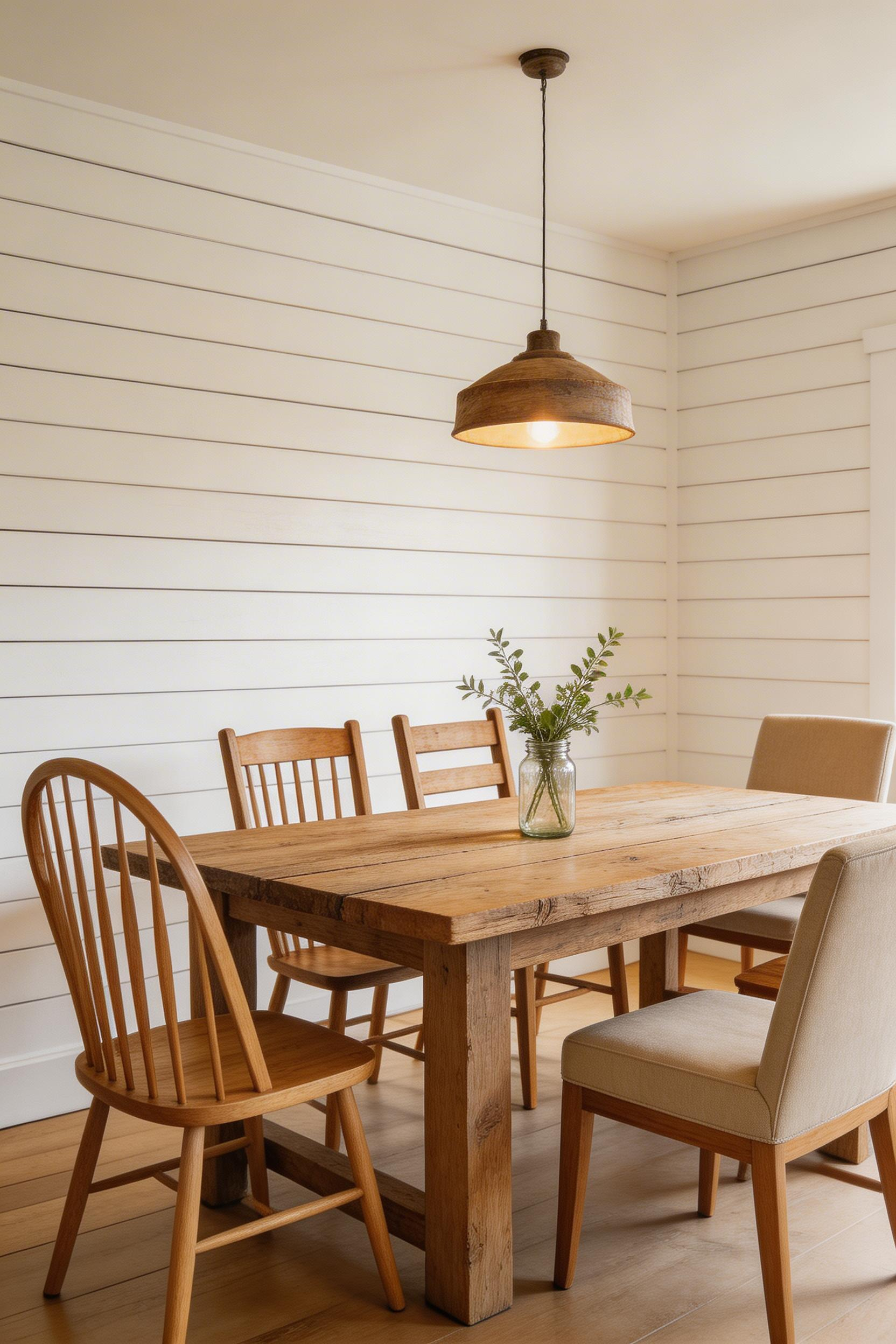
A matching set of six chairs is the easiest way to make a farmhouse dining room look designed rather than lived-in. Real farmhouse spaces accumulate chairs one at a time, from different sources, united by something other than a set number. The mix-and-match look takes some restraint to do well. But it’s more achievable than most people think.
The Rule for Mixing Chairs Without It Looking Chaotic
Two styles maximum for side chairs, with identical end chairs as bookends — that’s the formula. The end chairs anchor the table and provide visual repetition that prevents the whole thing from reading as accidental. Your side chairs can differ from each other in style as long as they share something: seat height, wood tone, or a unifying paint color. Keep all chairs within a 2-inch seat height range of each other (17–19 inches).
Which Chair Styles Work Together
Windsor chairs (Target Threshold at $89; antique originals at $60–$200) pair with almost everything because their spindle construction is visually light. Ladderback chairs add horizontal rhythm and work especially well with darker, heavier tables. Tolix-style metal chairs introduce a touch of industrial edge that keeps farmhouse dining room decor from feeling too precious. A bench along one side instead of chairs adds flexibility and a soft counterpoint to all that wood.
Thrift Store Chair Finds and How to Unify Them
A coat of Rust-Oleum Chalked Paint in Aged Gray or Charcoal ties mismatched wooden chairs into a single visual family. You don’t need to strip the old finish — just clean, lightly sand, and paint. The chalky matte finish reads as vintage rather than painted-over. For chairs with removable seats, recover them all in the same linen or ticking-stripe fabric.
5. Galvanized Metal Accents That Add Industrial Edge to Rustic Spaces
A farmhouse dining room that’s all soft wood and linen risks feeling one-dimensional. Galvanized metal — zinc-coated steel with a matte silver-gray finish — adds a harder edge that keeps the space from sliding into pure cottage sweetness. Galvanized steel was the workhorse of the actual farm: buckets, troughs, watering cans. So, it belongs here on historical grounds as much as aesthetic ones.
Where Galvanized Metal Fits in a Farmhouse Dining Room
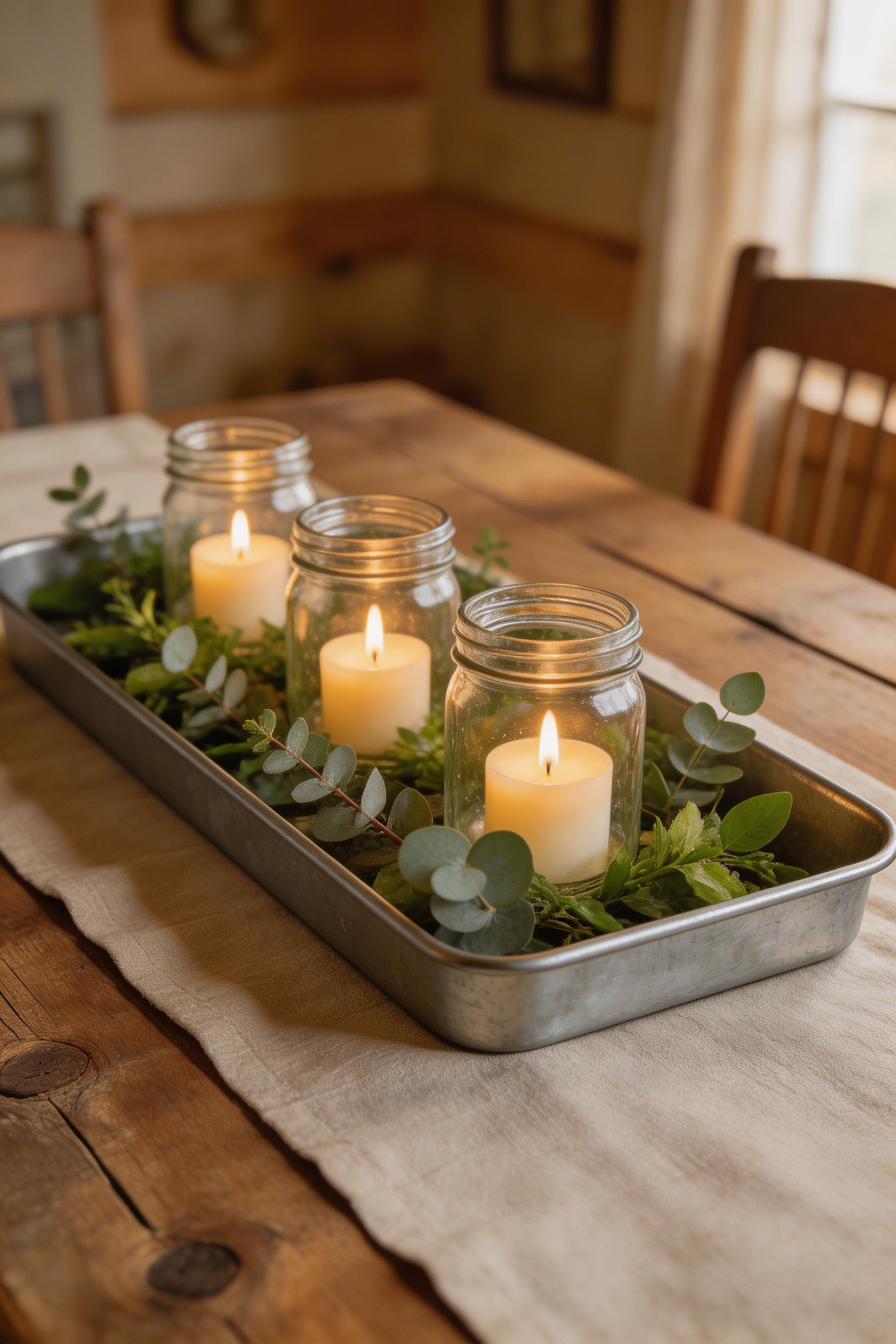
The most effective use of galvanized metal in a dining room is on the table — a large tray that corrals the centerpiece elements (candles, small vessels, herbs) and gives the arrangement a ground plane. A galvanized pendant over the dining area (Barn Light Electric, $150–$250) is a more considered approach than scattering individual pieces.
Trays, Buckets, and Pendants: The Most Useful Galvanized Pieces
A galvanized serving tray from Pottery Barn ($49) or Target ($24) is the entry point and the most flexible piece. Fill it with mason jars, pillar candles, and a handful of greenery. That centerpiece problem is solved for less than $60 total. Vintage galvanized watering cans ($15–$40 at antique markets) make excellent vases — the spout adds visual interest that a plain bucket never achieves.
Mixing Galvanized With Wood So Neither Overwhelms the Other
The ratio matters. Galvanized should be the accent — roughly one-third metal to two-thirds wood and textile. When galvanized dominates, the room reads industrial rather than farmhouse. Aged, darker wood (reclaimed oak) pairs better with galvanized’s coolness than honey-toned pine, which has enough warmth already.
6. Natural Linen Table Runner and Layered Textiles for a Lived-In Look
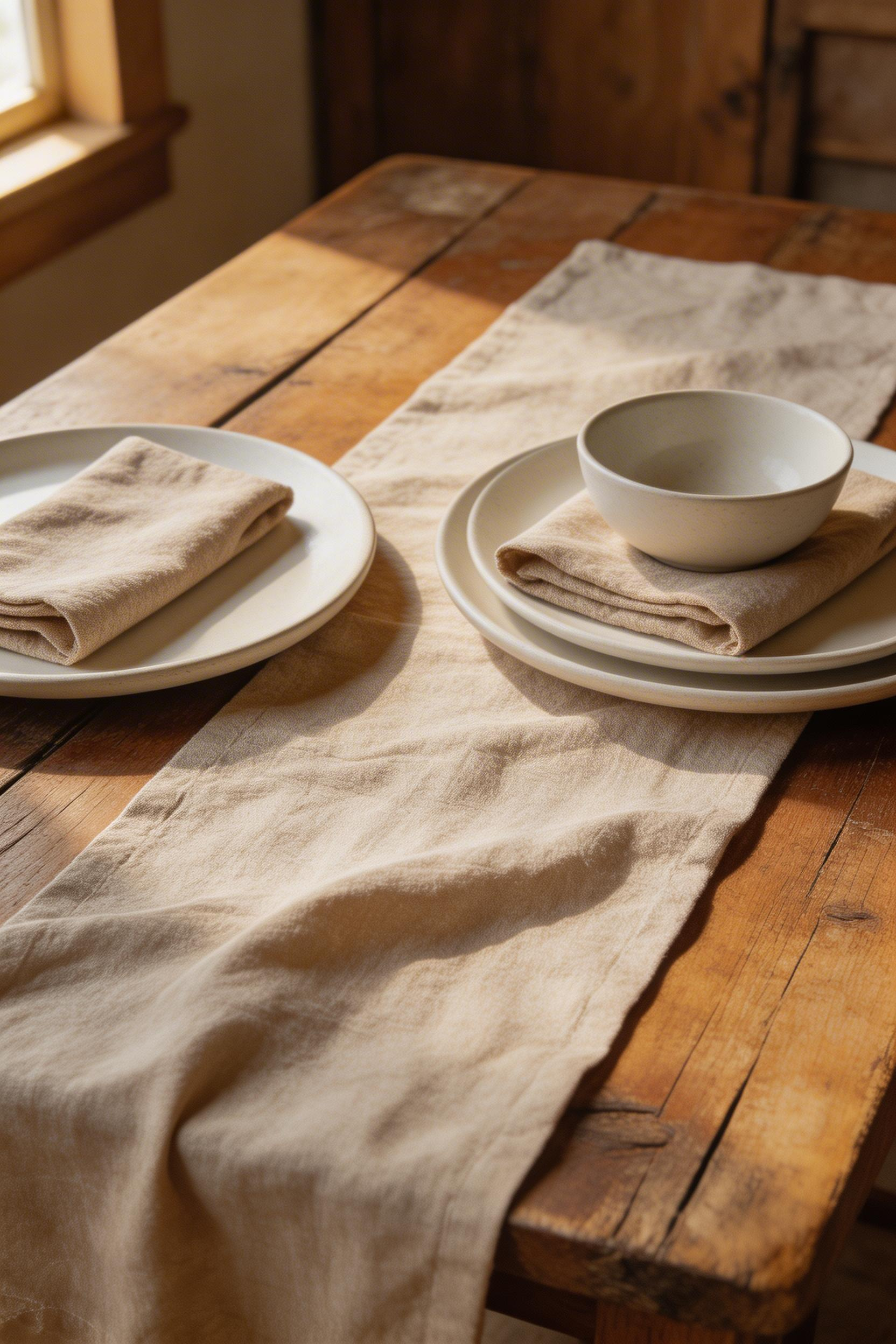
The difference between a farmhouse dining room that looks styled and one that looks lived-in often comes down to textiles. Specifically: the quality and relaxed handling of what’s on the table. A stiff polyester-blend runner works against the aesthetic. Natural linen — slightly rumpled, softened by washing, with the matte warmth of plant-based fiber — works for it.
Why Linen Reads More Authentic Than Cotton in Farmhouse Settings
Cotton is softer, but it has a flat, pressed quality that reads as domestic rather than farmhouse. Linen — with its visible slub texture and tendency to rumple beautifully — signals natural fiber and age in a way cotton never achieves. Also, linen gets better with use: after a dozen washes, a runner that started out slightly rough becomes something you keep forever.
How to Layer Runner, Placemats, and Napkins Without Looking Fussy
Start with a bare wood table — not a tablecloth — so the reclaimed grain stays visible. Lay the runner down the center, slightly off-center if the table is narrow. Add placemats only at the settings themselves. Choose a tone-on-tone approach: natural linen runner, off-white placemats, linen napkins in the same neutral family. Mixing two or three slightly different textures in the same range reads as depth rather than coordination.
Caring for Natural Textiles So They Age Beautifully
Wash in cold water with a gentle detergent. Tumble dry on low or line dry — never high heat, which weakens linen fibers. Pull the runner straight while slightly damp and let it air-dry flat for a naturally relaxed finish. Rough Linen’s Orkney runners ($65–$85) are built to outlast trends.
7. Farmhouse Dining Room Decorating With an Antique Hutch or Buffet
Few single pieces of furniture change a dining room as completely as a hutch. A good antique hutch does three things at once: adds storage, creates a display surface, and fills vertical space in a way that keeps the eye moving upward. For farmhouse dining room decorating, a hutch is the piece I’d save the budget for above almost anything else.
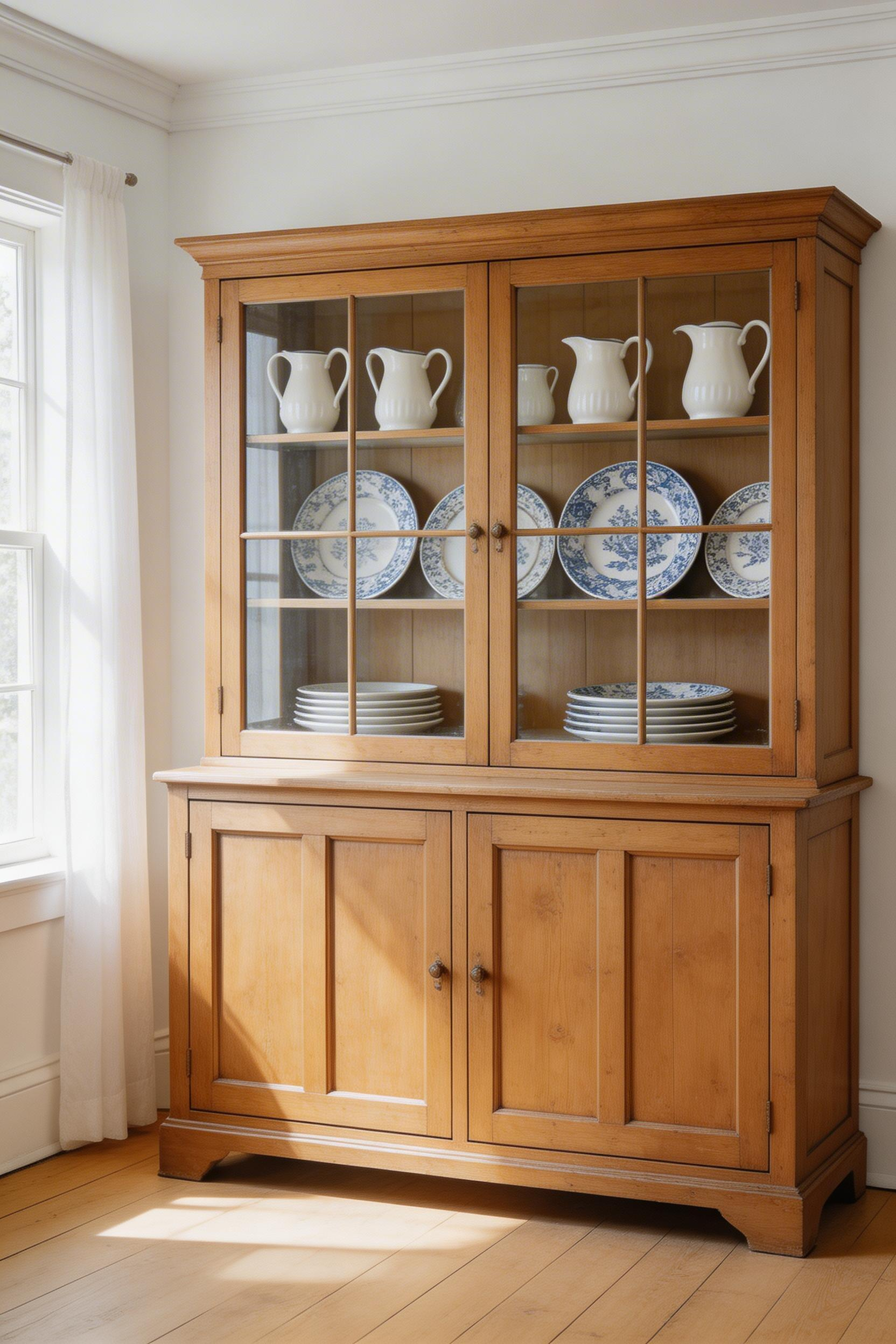
How a Hutch Transforms a Dining Room’s Storage and Character
A hutch with glass-fronted upper cabinets lets you display your good pieces without them gathering dust. Below, closed cabinet doors hide the things you need but don’t want to look at — extra placemats, serving dishes, the overflow of daily life. The result is a wall that’s both practical and visually rich, two qualities that rarely coexist in modern furniture.
What to Display on Hutch Shelves
White ironstone is the classic farmhouse hutch content. It’s durable, visually cohesive, and looks better in a collection than individually. Start with a large platter as the back anchor, add a few pitchers of varying heights in front, and fill in with smaller bowls and plates. Blue and white transferware plates add pattern without introducing too much color. Tuck a small trailing pothos or ivy along the edge of a shelf — the living green softens what could otherwise look like a still life.
Finding and Restoring Antique Hutches for Under $300
Estate sales are the best source. Original pine hutches with hand-cut dovetail joints regularly appear for $150–$300. Ignore the finish — chalk paint (Annie Sloan Old White) transforms them completely in a weekend. Hand-cut dovetail joints indicate pre-1900 craftsmanship, which is what you’re looking for.
8. Barn Door as a Dining Room Divider or Statement Wall Feature
Barn doors have been overused in design for the past decade. I’ll still recommend a barn door — when it’s well-placed. In farmhouse dining room decorating, a barn door that appears because it’s trendy looks trendy. But one that solves a real problem — dividing the dining room from a hallway without a permanent wall — looks inevitable.
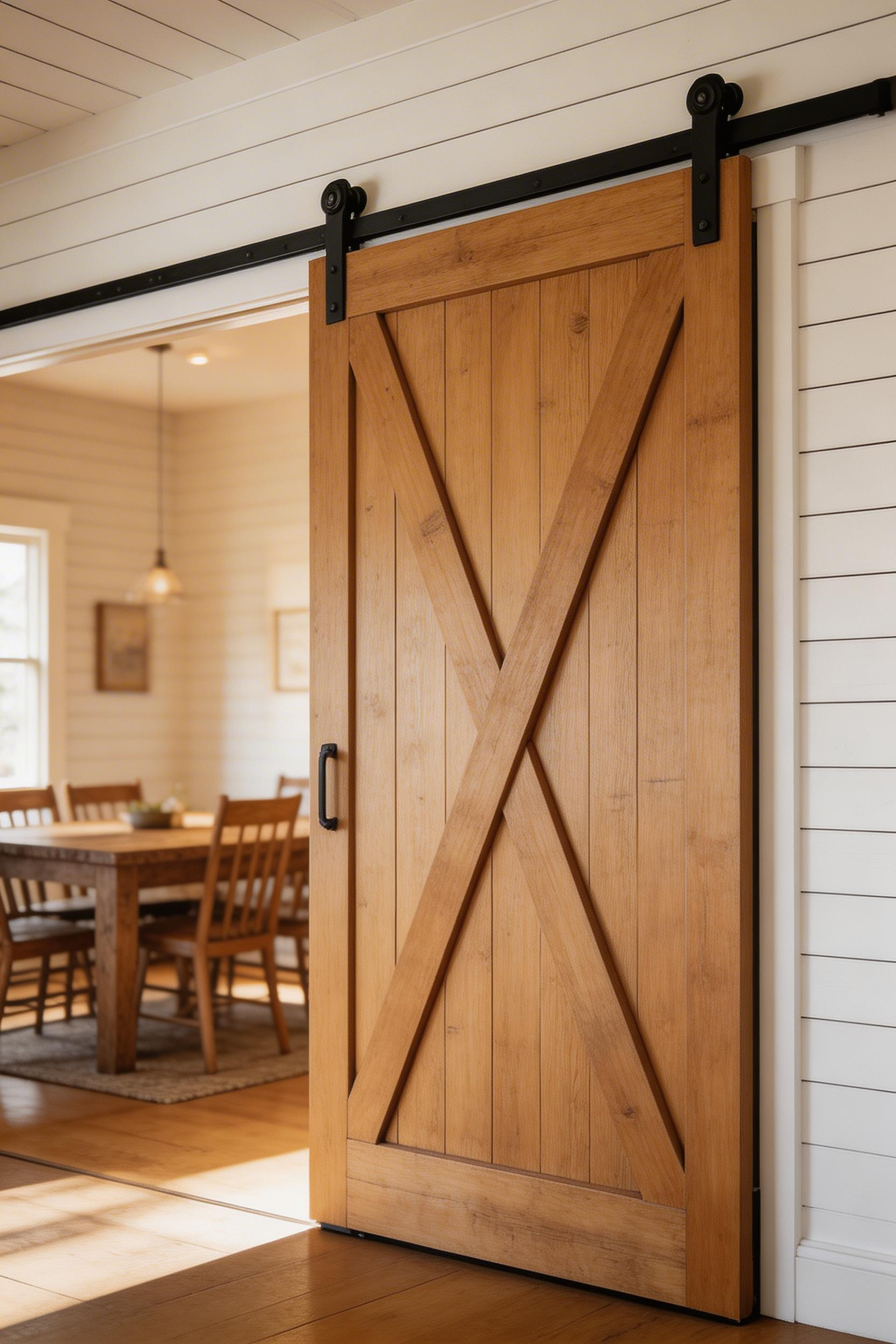
When a Barn Door Makes Sense vs. When It’s Just a Trend
A barn door earns its place when a hinged door would swing into the dining room traffic flow, or when you want to occasionally close it off without a permanent partition. It also works on a long blank wall that needs a visual anchor. What it doesn’t do well: acting as a purely decorative element with nothing behind it — that reads as set dressing.
Hardware Options and Track Systems Worth the Investment
Winsoon makes the most reliable track hardware at an honest price ($80–$150 for a standard kit). The track needs to extend 1.5 times the door width to one side when the door is fully open. Account for that wall space before purchasing. Matte black is the most versatile hardware finish for farmhouse rooms. Budget at least $200 for hardware alone. Cheap track systems develop wobble within a year.
Painting and Finishing a Barn Door for a Dining Room
The simplest and most authentic barn door is a Z-brace design built from 1×6 pine boards — about $60 in materials. The diagonal Z-brace prevents racking, and that structural honesty is part of the appeal. Leave it in natural pine with a coat of Rubio Monocoat, or paint it in a deep contrasting tone (Farrow & Ball Mole’s Breath, Benjamin Moore Black Forest Green) to make it a statement.
9. Open Shelving Displaying Vintage Ironstone and Transferware Collections
Open shelving done well — floating shelves with a curated ironstone collection — is one of the most characterful things you can do to a farmhouse dining room wall. Done carelessly, it becomes a cluttered surface that requires constant maintenance. The same collected aesthetic also extends naturally to the adjacent kitchen; our guide on modern farmhouse kitchen design covers how to carry the look through both spaces.
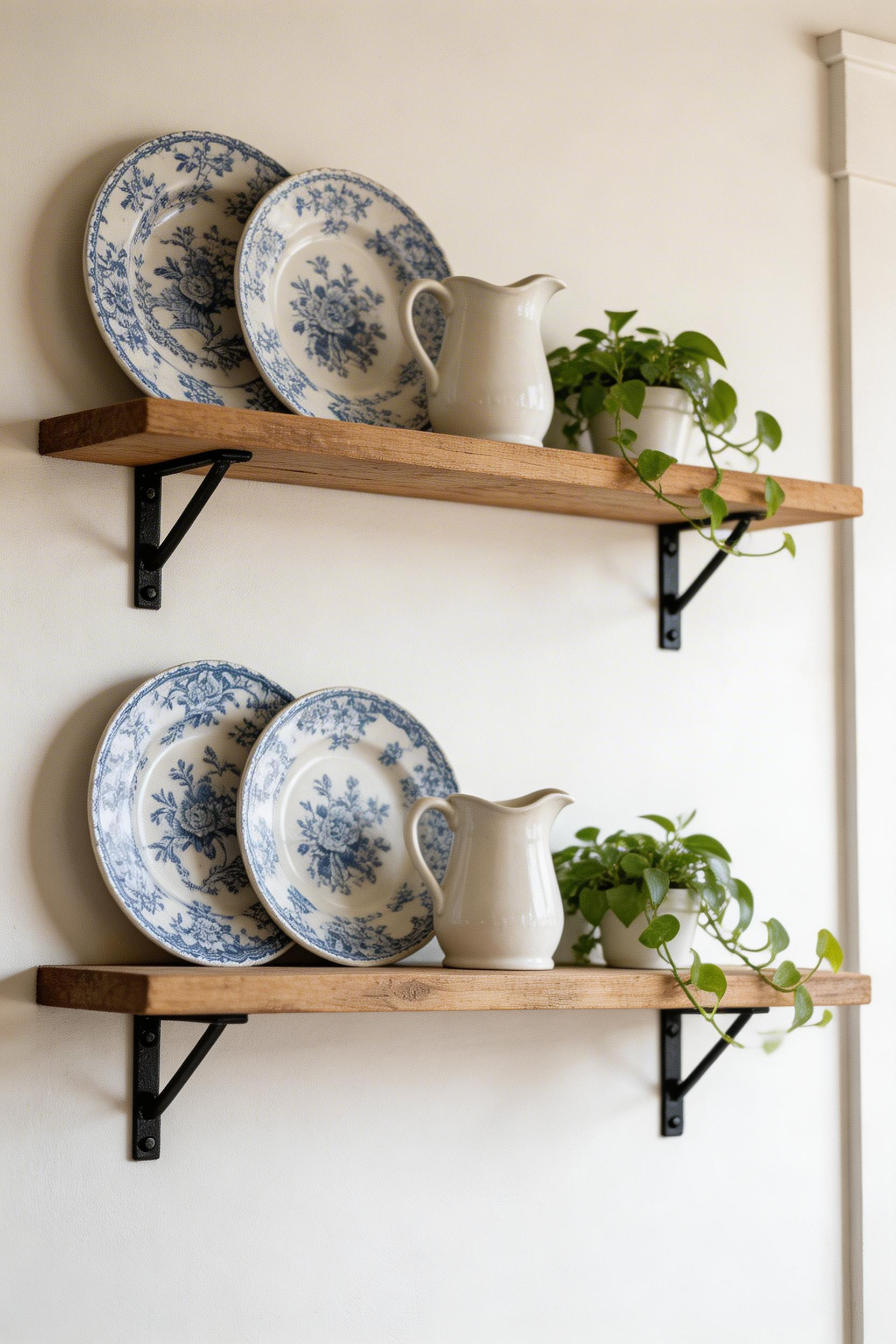
How Open Shelving Works in a Small Dining Room
In smaller dining rooms, a single shelf at 66–72 inches height with a meaningful collection reads as art rather than storage. For larger dining rooms, two shelves spaced 14 inches apart give you room for taller pitchers on the lower shelf and flat plates leaning against the wall above.
The Art of Ironstone Displays: Grouping, Height Variation, Layering
Work in odd numbers. Three pitchers of different heights — a tall one at back, medium at mid, small at front — creates a natural triangular composition. Lean plates against the wall rather than displaying them flat; the angle adds depth. Tuck a small plant into any display. The organic material anchors the ceramics in a living context and prevents the arrangement from looking like a museum exhibit.
Where to Source Vintage Ironstone on a Thrift Budget
eBay’s ironstone category is the fastest way to build a collection — search “antique ironstone pitcher” and sort by price plus shipping. Estate sales yield better finds in person because you can check for chips and assess patina directly. BRIMFIELD Antique Flea Market (Massachusetts, three times a year) is the destination for serious collectors. Budget $10–$30 per piece for good-condition examples.
10. Farmhouse Dining Room Decorating Ideas Using Botanical Wallpaper
If shiplap is the structural choice for farmhouse walls, botanical wallpaper is the expressive one. A single accent wall of botanical print — particularly behind a hutch or buffet — adds the kind of pattern complexity that makes a room feel layered and considered. The trick is choosing the right print and scale, because botanical wallpaper can easily cross from charming into overwhelming.
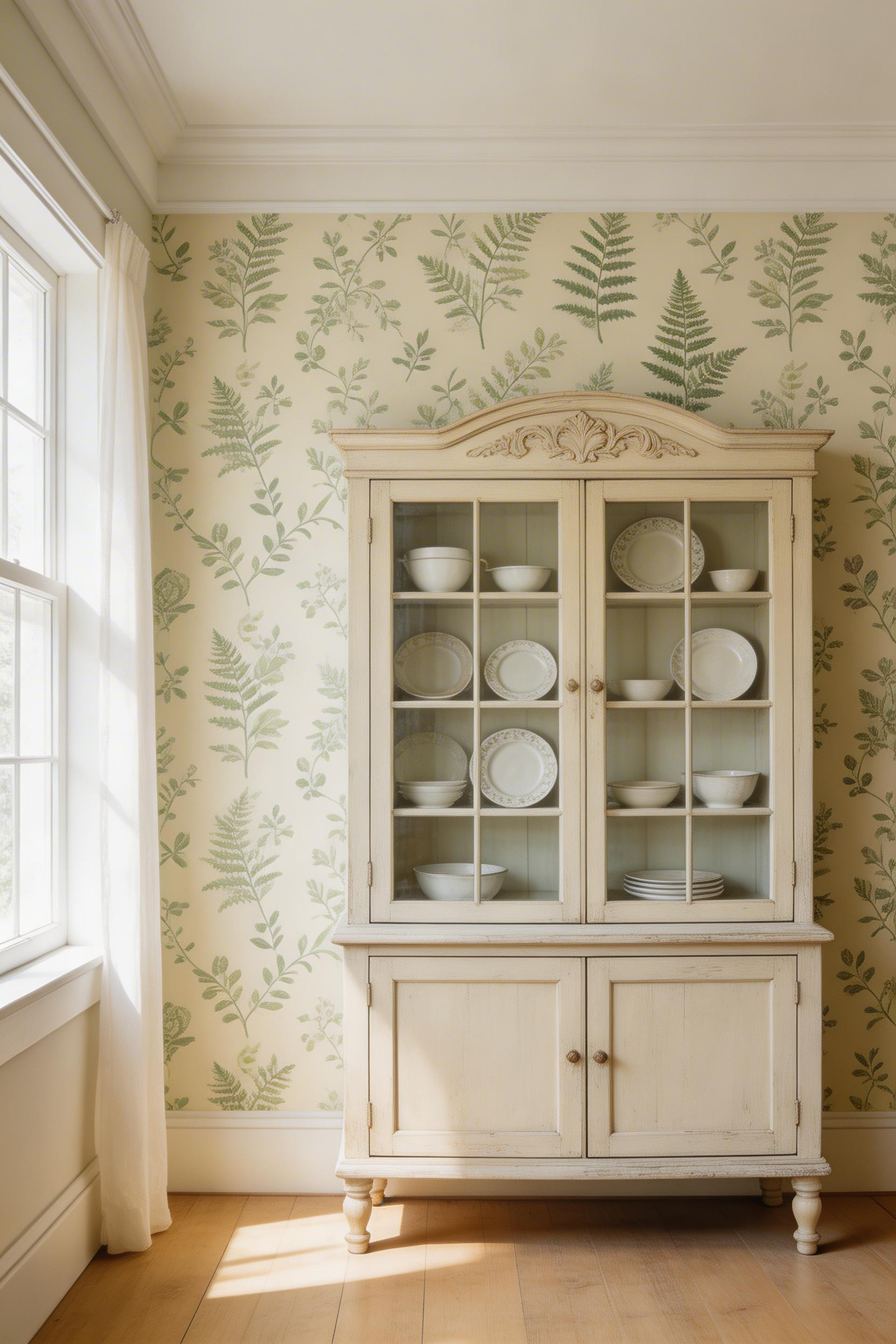
Botanical vs. Stripe vs. Toile: Which Patterns Suit Farmhouse Rooms Best
Botanical prints work because they reference nature — central to farmhouse identity — while remaining timeless enough to avoid trend fatigue. Ticking stripes are equally at home and more forgiving to hang. Toile is beautiful but leans French Country rather than American farmhouse. For farmhouse dining room decorating with wallpaper, botanical prints on cream or off-white backgrounds with soft muted tones (sage, slate blue, terracotta) are the most reliable choice.
One Accent Wall vs. All Four Walls
For most dining rooms, one accent wall behind the main display piece creates a focused backdrop without the paper dominating the whole room. Four walls works in large rooms with high ceilings; in smaller spaces it fails visually. If your dining room and rustic living room decor are visible from each other, the wallpaper palette should harmonize.
Removable Wallpaper Options for Renters
Peel-and-stick wallpaper technology has improved dramatically. NuWallpaper’s Farmhouse Floral at $39/roll and Brewster’s vintage botanical peel-and-stick at $45/roll both adhere cleanly to smooth walls and remove without damage. They’re not recommended for textured walls. But for a dining room accent wall, they’re a genuine option — and if you change your mind in two years, it’s a Saturday afternoon to remove.
11. Painted Wainscoting and Beadboard Walls for Classic Farmhouse Structure
Wainscoting is one of those architectural details that makes a room feel built rather than decorated. It adds molding, dimension, and a sense that the walls have layers. For farmhouse dining rooms, beadboard wainscoting with a painted chair rail at 32–36 inches is the most historically appropriate version. It’s also the most forgiving for DIY installation.
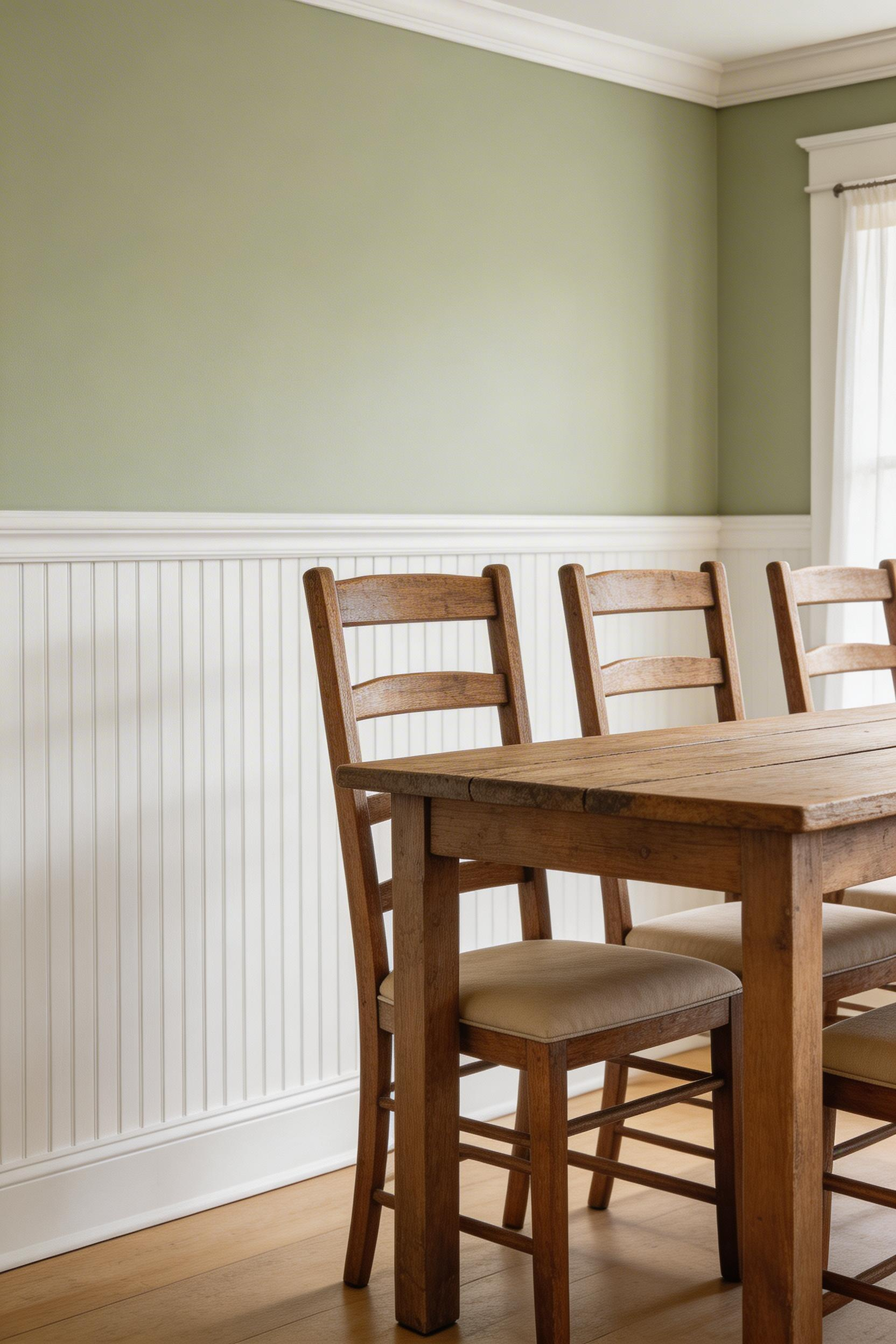
The Ideal Wainscoting Height for Dining Rooms
In most rooms, 32 inches is the standard chair rail height. In dining rooms, push it to 36 inches — slightly higher than the seat back of most chairs. This creates a practical buffer between the wall and chair-back scuffing. It also gives the wainscoting panel enough visual presence to read as a real architectural element. Below 30 inches, it looks like a baseboard variation. Above 42 inches, it feels oppressive in rooms with 8-foot ceilings.
White vs. Soft Greige vs. Painted Color for Wainscoting
White wainscoting (Benjamin Moore Chantilly Lace OC-65 or Sherwin-Williams Extra White) works with virtually any wall color above it. For something more layered, try painting both the wainscoting and the trim the same warm tone rather than making the chair rail and baseboards stand out distinctly. The most successful farmhouse dining rooms often use a single muted tone on all the architectural woodwork, then distinguish the upper wall with a soft color: sage, blue-green, or warm taupe.
DIY Beadboard Paneling: The Easiest Version of This Project
Beadboard panel sheets (4×8 feet, $24–$35 each at Home Depot) are far easier to install than individual tongue-and-groove boards. Apply with construction adhesive, add finish nails into studs, then apply chair rail molding along the top edge. Caulk every joint with paintable latex caulk before painting — uncaulked seams telegraph every imperfection once the paint goes on.
12. Fresh Herb or Wildflower Centerpiece Instead of Formal Arrangements
The farmhouse dining table centerpiece is easy to overthink. Formal floral arrangements work against the aesthetic rather than for it. The most convincing farmhouse centerpieces look gathered rather than designed — achievable for less than $20.
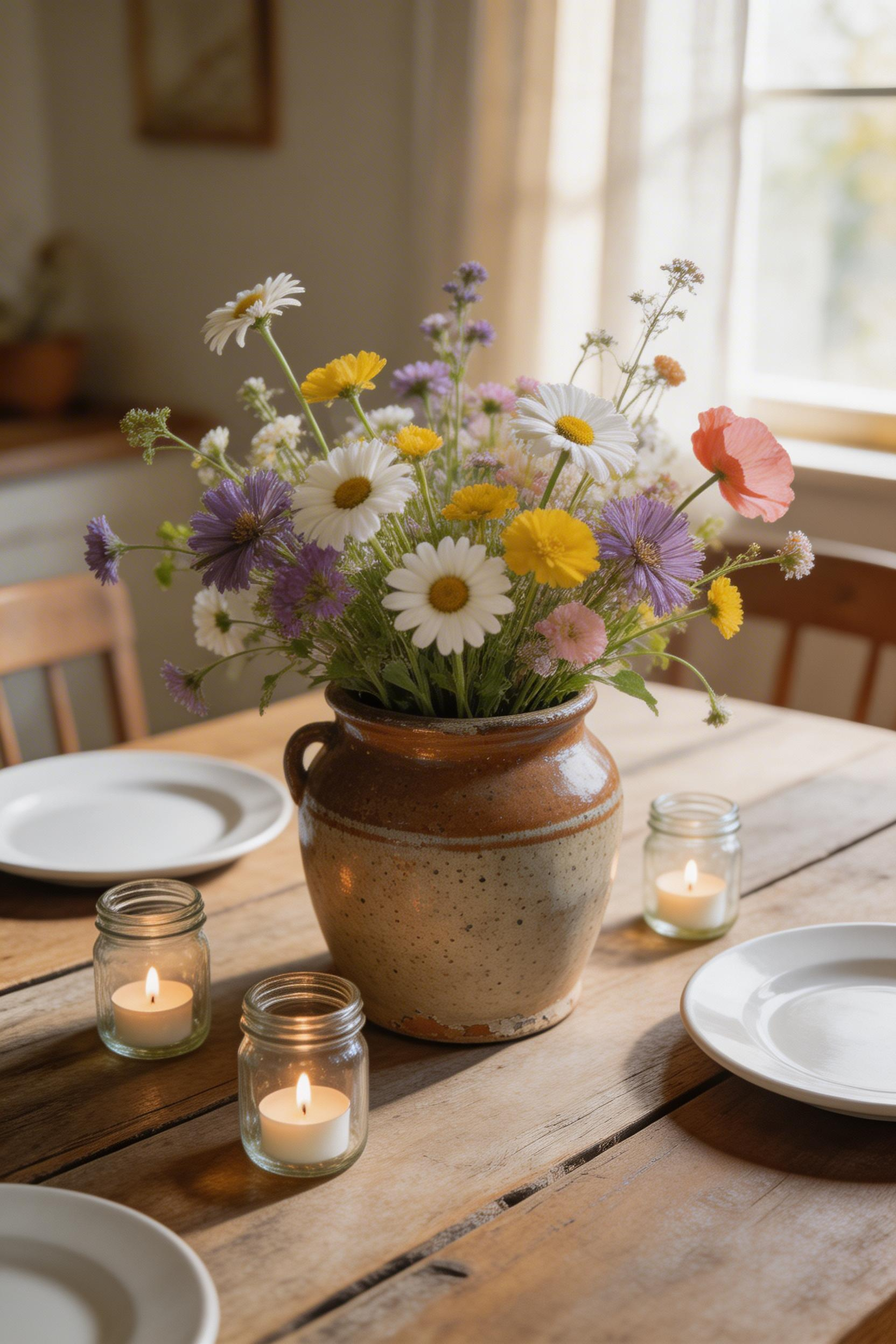
Why Wildflowers and Herbs Outperform Grocery-Store Bouquets
It’s not about cost or effort — it’s about scale and intention. A formal grocery-store bouquet with its tight arrangement and variety-pack flowers signals retail rather than home. A handful of lavender in a mason jar, or sunflowers in a vintage crock, signals someone’s garden. The same applies to herbs: a small pot of rosemary or a bundle of thyme in water looks like it belongs on a farmhouse table in a way that a florist arrangement doesn’t.
Vessels Worth Using: Mason Jars, Crocks, Vintage Pitchers
The vessel matters as much as the contents. A Ball mason jar is the most honest container for a farmhouse table. For more presence, an antique stoneware crock ($15–$40 at antique markets) or a white ironstone pitcher brings material weight. Group three vessels of different heights rather than one: a small jar, a medium jar, and a taller pitcher.
Keeping a Simple Centerpiece Looking Good All Week
Cut flower stems at a 45-degree angle and change the water every two days. For herbs, place the whole small pot on the table — wrap the nursery pot in burlap or tuck it into a crock — and it’ll last weeks rather than days. Dried arrangements (pampas grass, lavender bundles) are the maintenance-free version. A bundle of dried lavender in a tall jar requires essentially no upkeep and smells right.
13. Vintage Farmhouse Dining Room Decor With a Chalkboard Wall or Panel
A chalkboard in a dining room earns its place differently from other decorative elements: it serves a function while looking deliberate. A seasonal menu written in chalk, a simple botanical drawing, a family saying — any of these transforms a blank wall into a surface with something to say. The key is committing to the idea and actually using it. A blank chalkboard wall is worse than no chalkboard at all.
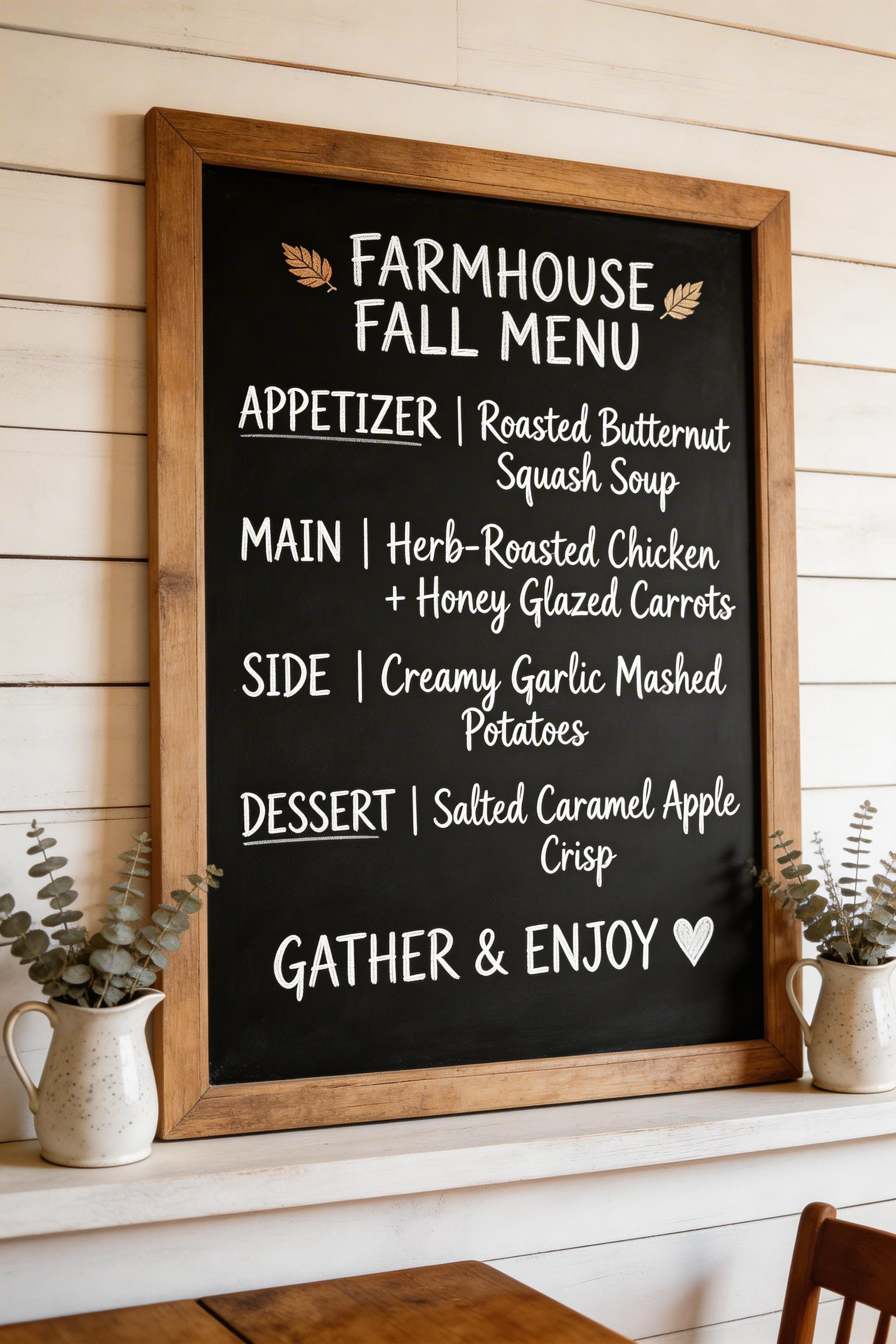
A Chalkboard Adds Function That Other Accent Walls Can’t Match
The menu idea — writing what you’re serving for dinner parties or seasonal meals — is genuinely useful and creates a moment for guests. Beyond menus, a chalkboard is the most flexible surface in farmhouse dining room decorating: change it with the season, use it for family notes, draw something botanical that stays for months. That flexibility justifies the effort. It also distinguishes a chalkboard from every other wall treatment in this list.
Full Wall vs. Framed Panel: Sizing It Right
A full chalkboard wall works in dining rooms with high ceilings and substantial furniture. For most dining rooms, a large framed chalkboard panel (36×48 inches minimum) above a buffet is more controllable. You can build a frame from reclaimed lumber for $50–$100, apply Rust-Oleum Chalkboard Spray ($10–$13 per can) inside it, and have a finished piece in a weekend.
Making Chalkboard Look Intentional, Not Like a Classroom
Chalk pens (Chalk Couture markers, $9–$15) give a far cleaner line than regular chalk. They don’t smear when touched — crucial for a dining room where people brush against walls. Use them to write in a consistent style: a single botanical drawing, a simple script quote, or a minimal seasonal menu with a few line-drawn herb illustrations.
14. A Jute or Wool Rug That Defines the Dining Area and Adds Warmth
Every dining room needs a rug, and most dining rooms have the wrong size rug. This is the single most common mistake in farmhouse dining room decorating: beautiful table, good chairs, and a rug that’s 6×9 when it should be 8×10. Chairs fall off the edge every time someone sits down. The rug both defines the dining zone and needs to be large enough to do the job practically. Both requirements matter equally.
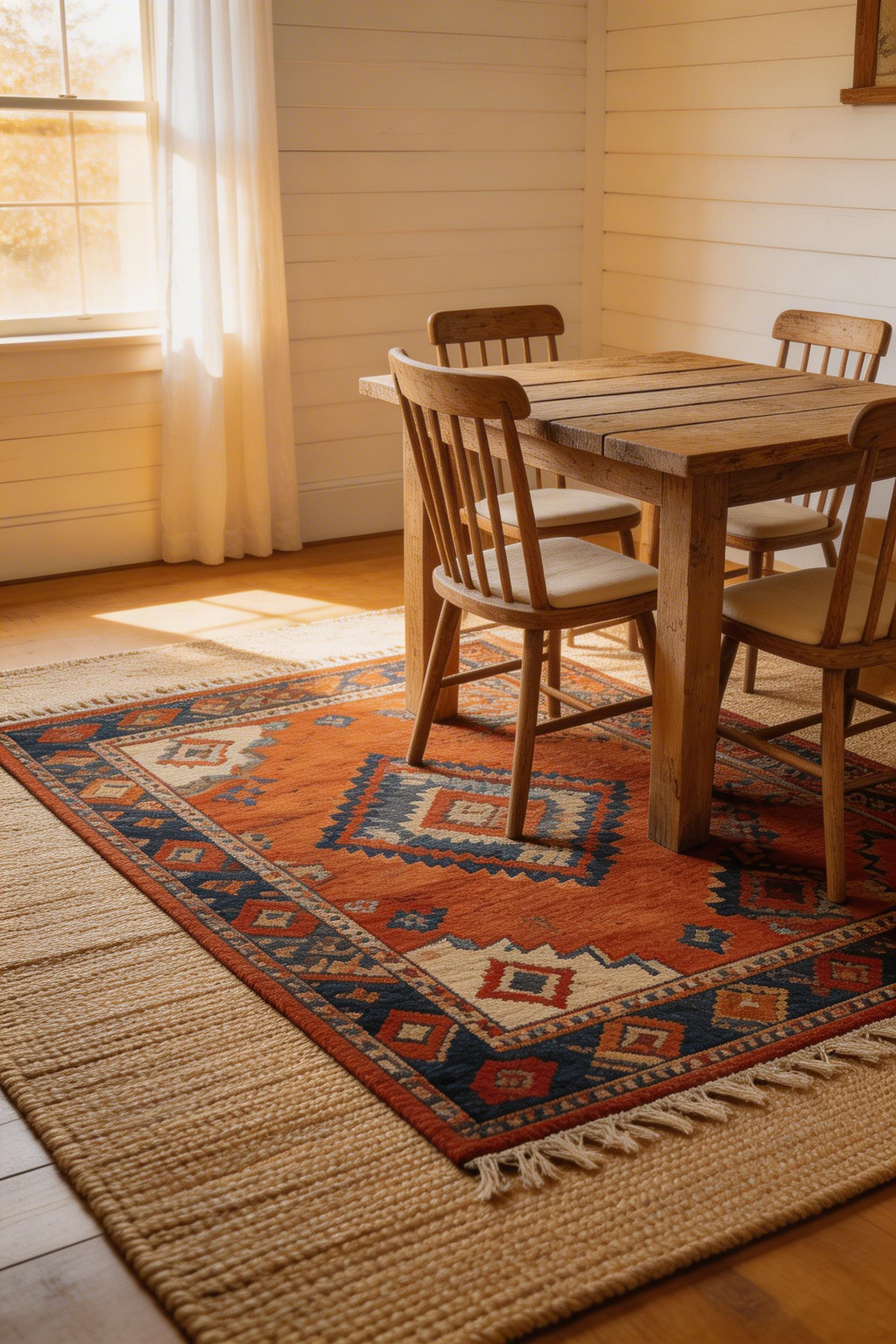
Why Rug Size Is the Single Most Important Decision
The rule: measure your table, then add 48 inches to both dimensions (24 inches on each side). That’s your minimum rug size. For a 72×36 inch dining table, you need a 9×12 rug. When you go smaller, chairs drag half-off the rug every time someone gets up — it looks wrong and the chair legs catch on the edge constantly. Buy the right size first. Choose the material second.
Jute vs. Sisal vs. Wool: Which Actually Survives Dining Room Use
Jute is the farmhouse standard: affordable (Safavieh 8×10 at $150–$250), natural, and visually warm. Its weakness is moisture — it doesn’t clean easily when wet, and food spills need immediate attention. Wool rugs are more durable and clean better. Loloi’s Layla line ($350–$500 for 8×10) is worth the premium for heavy-use dining rooms. For low-maintenance rug options in country-style spaces, the country living room guide covers several materials that also work well in farmhouse dining rooms.
Layering a Smaller Vintage Rug Over a Larger Jute Base
Start with a large jute rug as the base layer — the correct size. Layer a smaller vintage kilim or wool rug over the center. The vintage rug adds pattern and character; the jute provides the right overall size and absorbs floor scuffs. A vintage Turkish kilim on eBay runs $200–$400 for a 5×7, making the total for both layers under $500.
15. Antique Mirror or Vintage Artwork as the Dining Room Focal Point
A dining room wall without a focal point is just a surface. The traditional approach — a large framed piece hung centered on the primary wall — is traditional because it works. For farmhouse dining rooms, this means choosing between an antique mirror (which bounces light and expands the room) or vintage artwork (which adds narrative depth). Both are excellent choices.
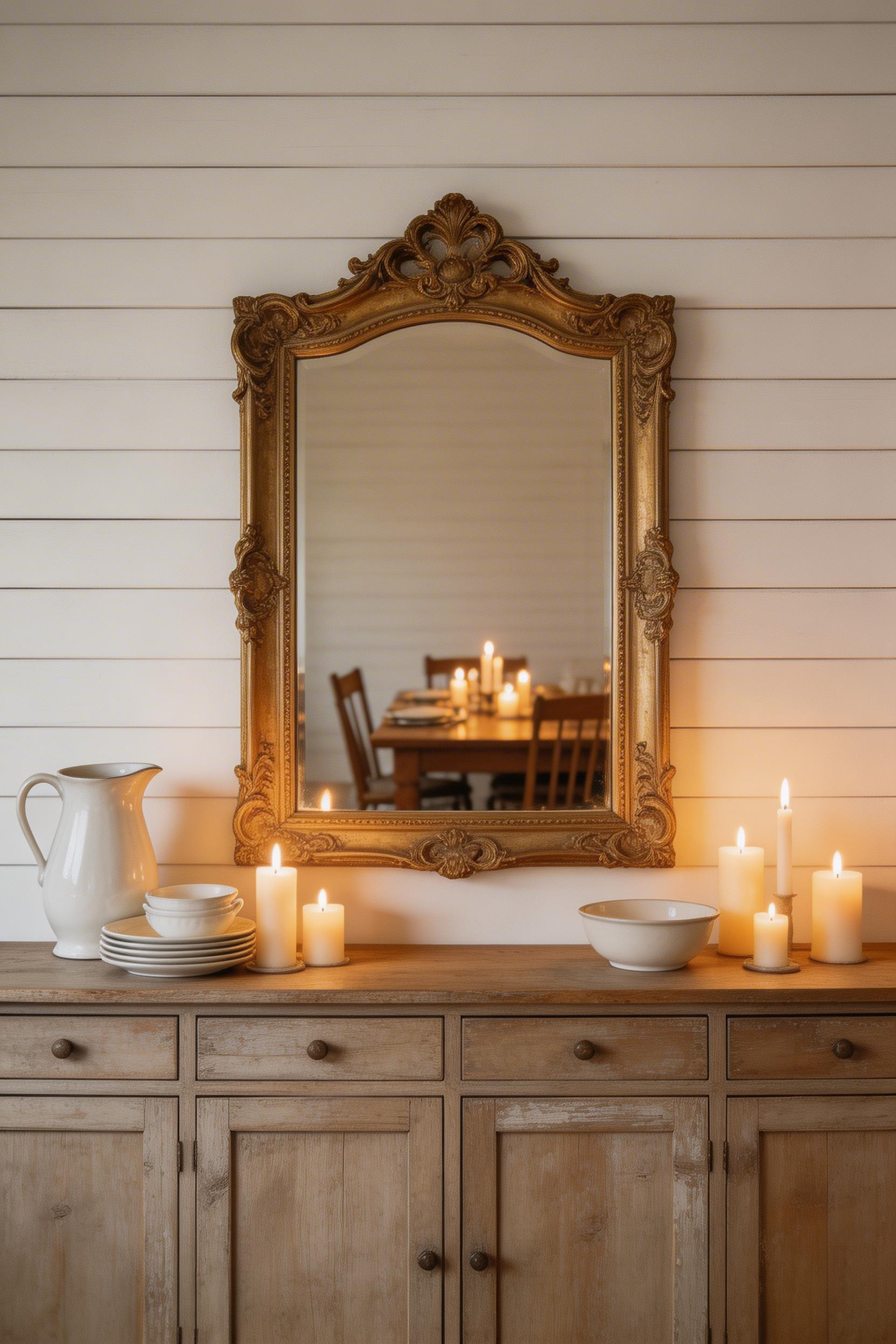
How a Large Mirror Makes a Small Dining Room Feel Twice the Size
A mirror at least 24×36 inches, hung so its center is at 57–60 inches from the floor, opens up a dining room in a way that no amount of light-colored paint achieves. The reflection bounces both natural and candlelight around the room. Antique mirrors — with their slightly foxed, mercury-toned glass — add atmosphere that new mirrors can’t replicate.
Vintage Oil Paintings and Botanical Prints as Farmhouse Wall Art
If the mirror feels too formal, vintage oil landscape paintings from eBay or estate sales ($40–$200) bring a different kind of depth: narrative rather than spatial. A small pastoral landscape above the hutch, or a series of framed botanical prints above the chair rail, suggests a room that has been lived in. For botanical prints without estate-sale hunting, Etsy digital downloads ($15–$25) printed on heavyweight matte paper work well.
Gallery Wall vs. Single Statement Piece: When Each Approach Wins
A single large piece wins in dining rooms with high ceilings and substantial furniture. A gallery wall wins in longer, lower rooms where one piece wouldn’t span the visual real estate. For farmhouse style, the gallery wall should feel accumulated rather than designed: mixed frame sizes, some botanical prints, a small mirror, a vintage photo or two. It’s a good approach if you’re also working on rustic living room decoration elsewhere in the house and want an aesthetic thread connecting the spaces.
16. Farmhouse Dining Room Decorating With Candles and Candlestick Clusters
If there’s one finishing element that separates a farmhouse dining room that photographs beautifully from one that actually feels wonderful to eat in, it’s candles. Not the formal candelabra kind — the clustered, varied-height, slightly mismatched kind that suggests someone gathered them from different rooms because dinner called for it. Candlelight at the dinner table changes everything. And it costs almost nothing.
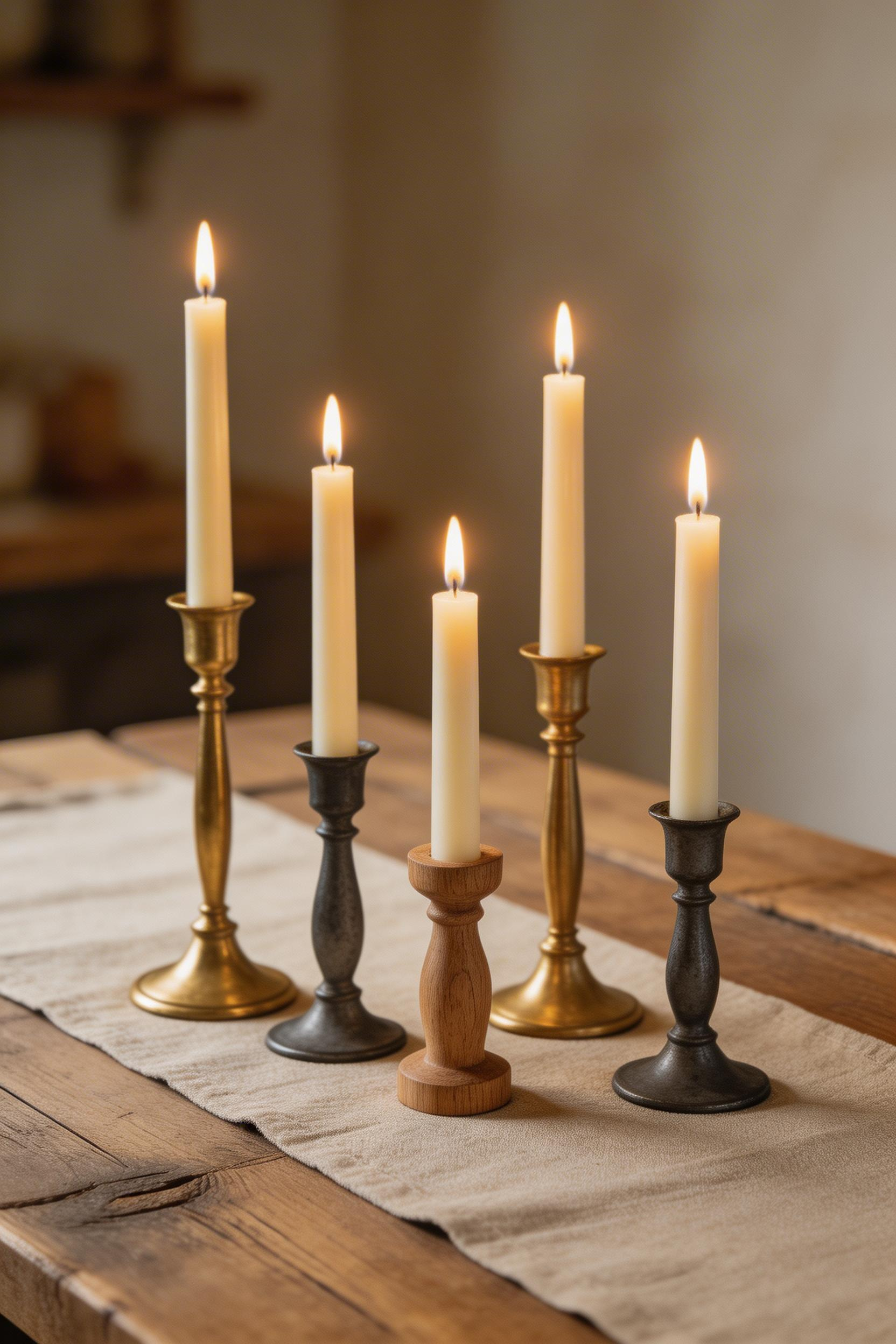
Why Candles Beat Electric Lighting as a Finishing Touch
Overhead pendant lights set the general mood. Candles set the intimate one. Candlelight flickers, concentrates, and illuminates the space between faces rather than the walls. For farmhouse dining room decorating, candles are also the most historically authentic choice — farmhouses relied on tallow candles and oil lamps long before electricity.
Candlestick Heights and Clustering for a Natural Arrangement
Use odd numbers: three or five candlesticks. Vary the heights significantly — aim for at least a 4-inch difference between adjacent holders. A cluster might include a 4-inch low brass holder, an 8-inch iron holder, and a 14-inch wooden candlestick. Group them off-center on the table rather than precisely centered — the slight asymmetry reads as natural rather than arranged.
Safe Candle Placement and Modern Alternatives
Keep taper candles away from overhead fabric pendants (minimum 12 inches clearance) and never leave them unattended with children or pets. Luminara’s flameless ivory taper candles ($30–$60 per pair) use realistic flickering LED and real wax exteriors — most guests won’t notice the difference in evening light. Use the same clustering and height-variation principles either way.
Where to Start With Your Farmhouse Dining Room Transformation
Sixteen ideas is a lot. Farmhouse dining room decorating doesn’t require tackling all of them at once — the spaces that feel most genuinely collected are usually built over several years, one good piece at a time.
The Three Changes That Make the Biggest Difference Per Dollar
If you’re starting from a blank room, these three choices move the needle most: the table, the lighting, and the textiles. A reclaimed wood table with genuine patina sets the aesthetic direction. A woven pendant changes the room’s atmosphere in a way that no amount of accessorizing replicates. And a natural linen runner signals an understanding of what farmhouse dining room decorating actually is: an appreciation for natural materials, real craftsmanship, and things that have lived before.
Building the Look Gradually Without Waiting for a Full Renovation
The shiplap and wainscoting will still be worth doing in two years. The antique hutch might turn up at a local estate sale next spring. Farmhouse dining room decorating built gradually — one find at a time, one correctly chosen lighting fixture, one linen runner that improves with every wash — builds a more convincing result than anything bought all at once. Start with the table. Add the pendant. Dress the table with linen. Then hunt: estate sales, antique markets, thrift stores. The pieces that carry real history are the ones that make the room feel lived-in rather than styled. See also our piece on rustic living room decor if you’re building an authentic farmhouse aesthetic throughout your ground floor.
That’s the whole point. The best farmhouse dining room decorating doesn’t look finished. It looks found.