
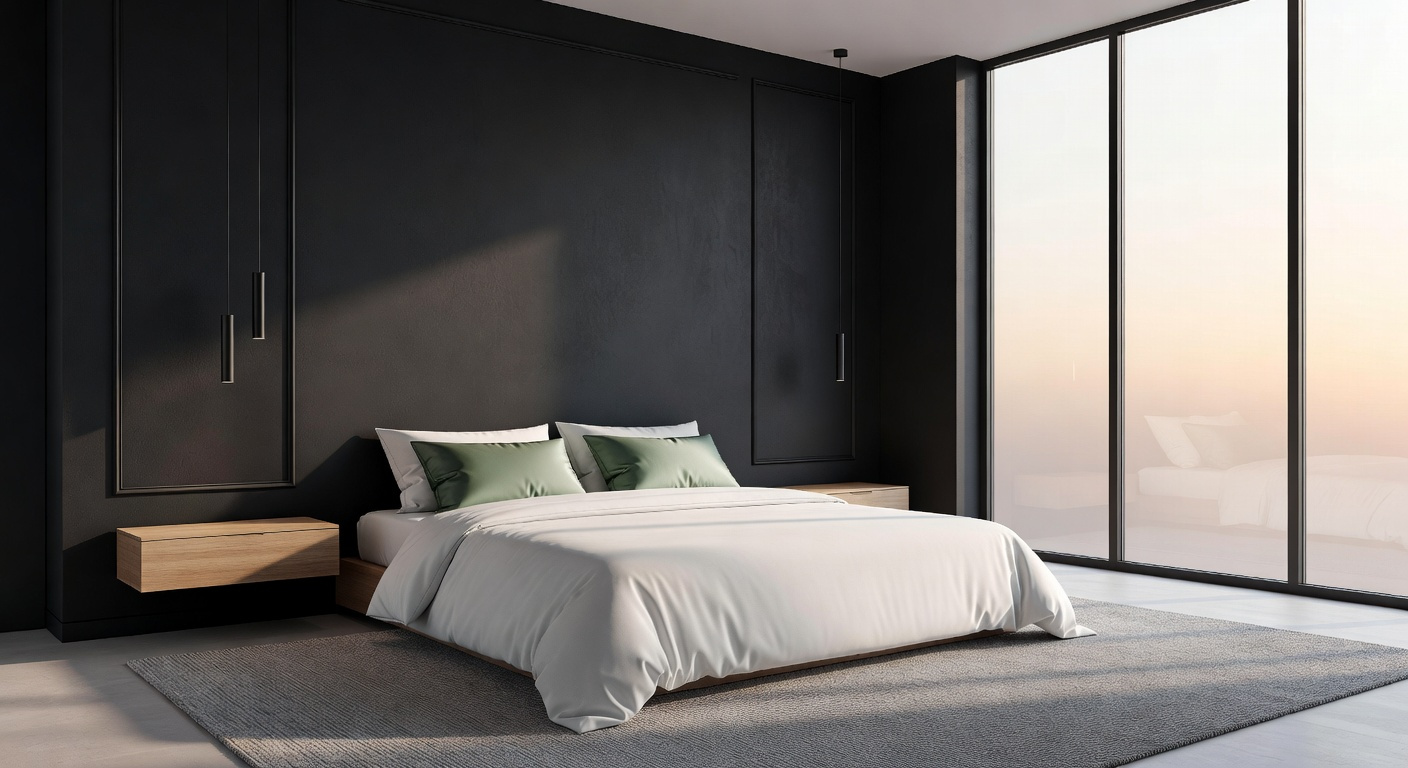

Many assume a modern bedroom must be a sterile, white box. This “Cold Modern” myth suggests that sleek design requires abandoning soul. Sadly, these spaces often feel clinical rather than restful. Yet, true modernism is actually a humanistic evolution of warmth. When exploring modern bedroom wall decor ideas, it is vital to remember architect Alvar Aalto’s argument: homes should “greet the body like a handshake.” Indeed, his legacy proves that design can be both functional and inviting. By selecting pieces that reflect a curated sanctuary, you transform a sleeping area into a bespoke retreat.
Furthermore, science now validates the need for sensory depth in our sleeping quarters. Research shows that cold, high-gloss finishes can negatively impact cortisol levels. Integrating tactile elements is not just aesthetic; it is biological. Historically, tapestries insulated cold walls. Today, similar textures provide essential acoustic warmth. Thus, a lived-in atmosphere fosters better rest than a perfect, empty showroom.
This guide reveals how to infuse your bedroom with intentional history and sustainable comfort. We will examine the “Truth of Materials” through reclaimed timber and exposed brick. Additionally, we explore lighting techniques that highlight texture rather than flattening it. Ultimately, you will discover how to create a timeless sanctuary that feels deeply personal.
Phase 1: The Curated Surface (Accessible Updates)
“Phase 1: The Curated Surface” shifts focus from structural changes to high-impact visual transformations. Here, the bedroom wall becomes a “performance surface.” Specifically, the wall behind the headboard acts as the room’s “visual anchor.” While some homeowners gravitate toward luxurious bedroom wallpaper ideas for immediate texture, others suggest eliminating “visual staleness” by lowering heart rates with matte pigments. Consider replacing builder-grade beige with deep, retreat-based palettes like charcoal or sage. In fact, research shows these cool tones signal restoration to the brain, improving sleep hygiene and refined aesthetics.
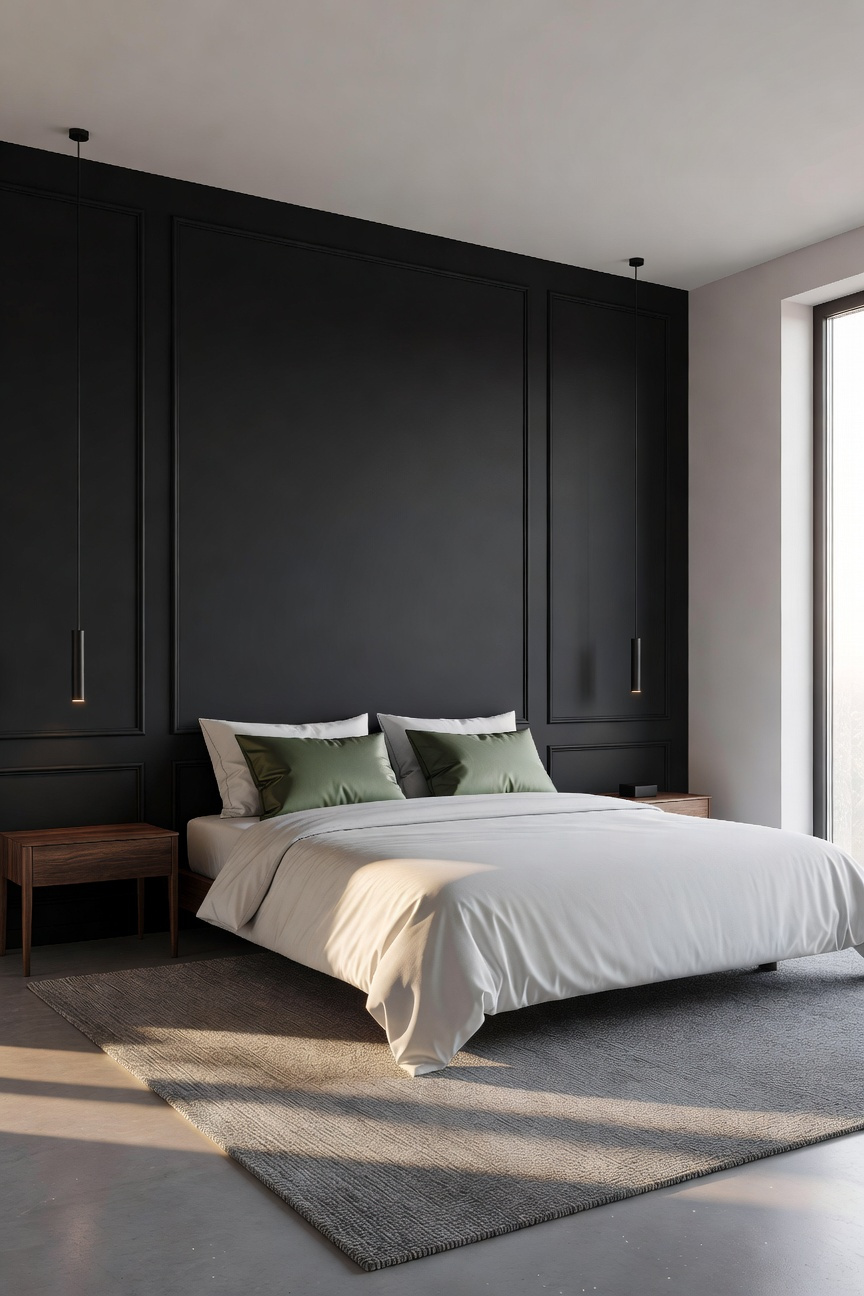
Next, we address architectural details through “surface artifice.” This approach supports a “hybrid” design stance where minimalist bedroom design principles meet heritage textures. Modern, removable updates enable vintage styling with zero commitment, providing a perfect backdrop for modern bedroom furniture. This serves as a low-risk “proof of concept.” If a dark accent wall feels oppressive, you can easily change it before buying furniture.
Finally, successful execution requires a “ruthless editing” strategy. Instead of a cluttered gallery, designers advocate for the “One Hero” rule. Specifically, a single, large-scale art piece creates luxury appeal and reduces cognitive load. Using “adhesive infrastructure” allows you to rotate art, preventing visual boredom. To add depth, mix finishes by pairing matte paint with glossy sconces. Moreover, incorporating soft textures like felt panels improves acoustic comfort, turning the room into a true sanctuary.
1. The ‘Anti-Grid’ Gallery Wall: Mixing Eras with Intentional Asymmetry
The “Anti-Grid” gallery wall represents a sophisticated departure from rigid, minimalist layouts. Instead of seeking perfection, this approach prioritizes visual tension and intentional asymmetry. The result is a bedroom atmosphere that feels authentically “collected over time” rather than bought from a showroom.
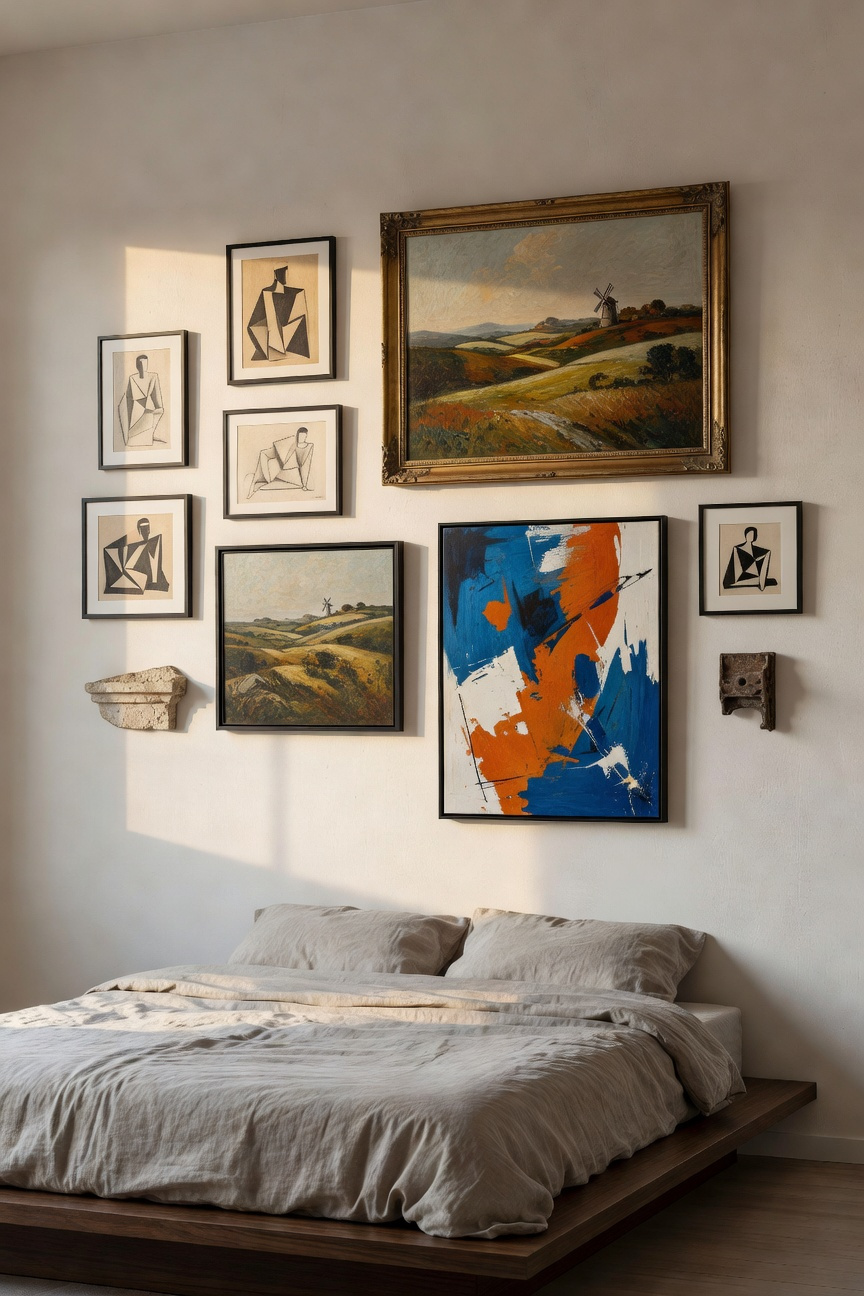
Psychologically, this layout engages the mind in a unique way. While humans naturally crave symmetry, expert designers argue that asymmetry compels us to do “spatial math.” Your brain actively calculates the balance between negative space and visual weight. As a result, the room feels more personal and alive, transforming a sterile wall into an organic environment.
Historically, this concept traces its roots back to the 17th-century French “Salon Hang.” In those days, art was densely packed from floor to ceiling to maximize limited space. Today, however, we reinterpret this density to bridge centuries of design history. You might pair a sleek mid-century geometric print with a weathered 19th-century oil portrait.
To maintain cohesion within this chaos, professional decorators often apply the 80/20 rule. Ideally, 80% of your wall should reflect one primary style, such as modernism. Conversely, the remaining 20% should introduce unexpected vintage accents or family heirlooms. Incorporating tactile elements creates necessary rhythm. For instance, mixing flat prints with sculptural ceramics adds physical depth. Ultimately, these imperfections help soften the “fresh out of the box” feel common in new furniture. In fact, the slight patina of a vintage frame provides a visual “hug,” adding warmth to the modern bedroom.
2. Oversized Canvas Rescue: Upcycling Thrifted Art with Modern Color Blocking
Large canvases often carry hefty price tags. Thrift stores, however, are full of discarded, mass-produced prints. By rescuing these pieces, you engage in a sustainable act of “re-modernizing.” Historically, color blocking stems from the De Stijl movement. Yet, for a bedroom, we soften this radical geometry. Instead of harsh primary colors, opt for a “New Neutral” palette. Think sage greens or creamy terracottas.
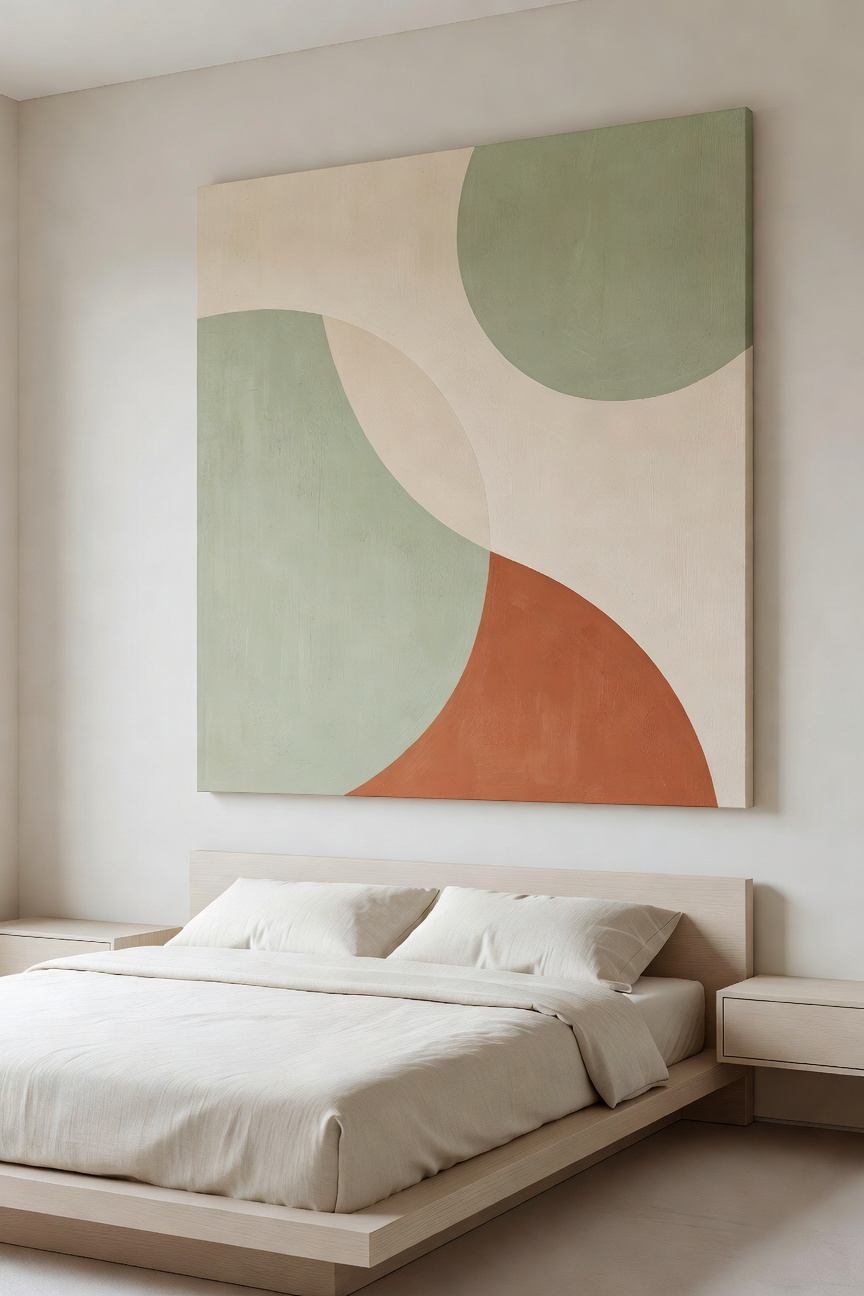
Success relies on proper surface preparation. Therefore, begin by sanding the existing artwork with 150-grit paper. This crucial step removes the glossy seal. It creates a “tooth” for the new paint to grip. Next, apply three coats of heavy-body acrylic gesso. To hide the old image effectively, use a directional cross-hatch method. First paint vertically, then horizontally.
Interestingly, total smoothness isn’t always the goal. Embracing the “ghost texture” adds temporal depth. Allowing the original ridges to remain creates a unique “wabi-sabi” effect. It signals the piece’s history beneath its modern face.
When painting your blocks, precision is paramount. Use the “lock-in” method with high-quality tape. Simply paint the base color over the tape edge first. This prevents bleeding, ensuring crisp lines. Finally, finish with a matte varnish. Since high-gloss finishes create distracting glare from bedside lamps, a matte sheen remains superior. It allows the art to feel like a grounded architectural element.
3. Vintage Textile Hangings: Softening Clean Lines with Heritage Weaves
Modern bedroom design often relies on hard surfaces like polished concrete or glass. These sleek materials create acoustic challenges, specifically high-frequency noise bounce. To combat this, vintage textiles function as a sophisticated “soft system.” Heavy wool Kilims or multi-layered Kantha quilts act as natural sound absorbers. In fact, hanging these pieces slightly away from the wall maximizes this dampening effect, effectively “shushing” the room’s rigid geometry. The organic irregularity of hand-loomed weaves visually breaks harsh 90-degree angles. This Wabi-sabi imperfection signals a “human touch,” triggering a psychological sense of safety.
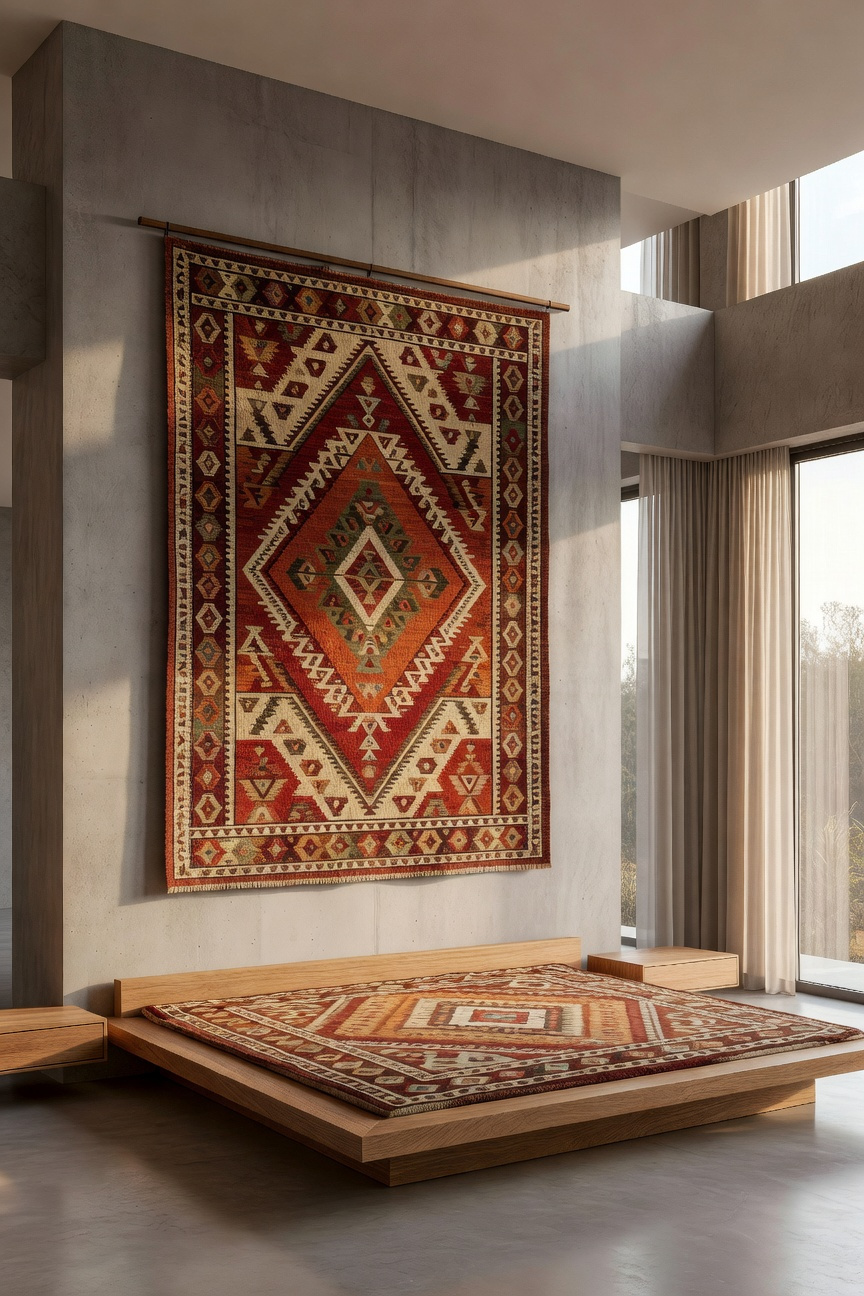
Beyond utility, specific weaves introduce deep cultural narratives. Uniquely, nomadic Kilims feature “geometric prayers” rather than mere decoration. Historically, placing a Kilim with protective motifs above a headboard served as a talisman for the sleeper. Similarly, Kantha quilts repurpose old saris into “visual diaries” through simple running stitches. Choosing these textiles adds heirloom-level intimacy to a space.
Displaying these treasures, however, requires a curator’s eye to ensure preservation. For heavy pieces, museum conservators generally recommend the “Velcro method.” By sewing soft Velcro to a cotton backing, the textile’s weight distributes evenly along a wooden batten. This technique prevents the sagging often caused by rod pockets. Finally, maintain visual balance by adhering to the “negative space rule.” Surrounding a textile with neutral wall space ensures the piece anchors the room without overwhelming it.
4. The Floating Shelf Edit: The Art of Negative Space and curated Objects
The modern floating shelf functions as a cantilever beam, a concept popularized by designer Magnus McCormick. This 1950s innovation originally solved tight urban living constraints. Now, it serves as a lightweight alternative to bulky nightstands. Specifically, understanding the physics is vital for safety. Because torque increases with distance, you should place heavier ceramic items near the wall. Professionals adhere to a strict 50-pound limit per stud to prevent structural failure.
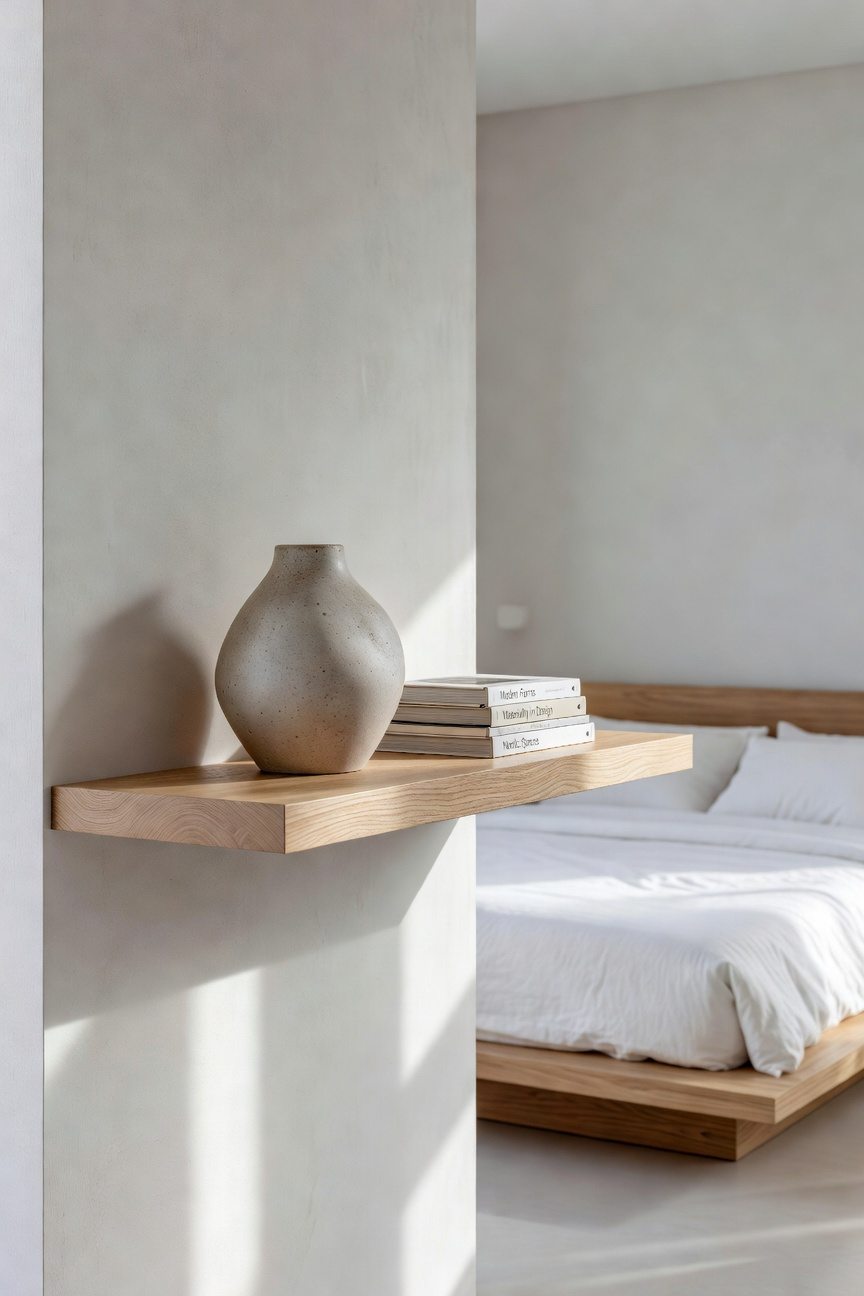
Beyond engineering, the “edit” plays a psychological role in the bedroom. Research indicates that cluttered surfaces signal “unfinished business” to the brain. This raises cortisol levels right before sleep. To combat this, experts suggest a 60/40 ratio. Keep 40% of the shelf as negative space to create “visual quiet.”
Furthermore, curation involves texture and history. Consider the “backward books” trend where spines face inward. Surprisingly, 17th-century librarian Thomas Bodley originally shelved books this way. A modern compromise is “pedestal stacking.” Simply stack a few books horizontally to elevate a vintage vase or stone diffuser. In addition, mixing materials adds necessary warmth. Pair smooth marble bookends with the rough grain of reclaimed wood.
Finally, lighting transforms the shelf from storage into an architectural feature. Installing LED “wash” lighting behind the shelf eliminates harsh shadows. This creates a soft halo effect perfect for evening relaxation. Ultimately, a well-edited shelf balances structural integrity with a serene sensory experience.
5. Geometric Mirrors: Expanding Space with Mid-Century Silhouettes
To master modern bedroom design, view geometric mirrors as architectural tools rather than simple reflective surfaces. These mid-century silhouettes reflected post-war optimism, designed to physically “open” the home. Therefore, they work exceptionally well in smaller sleeping quarters to create an illusion of depth.
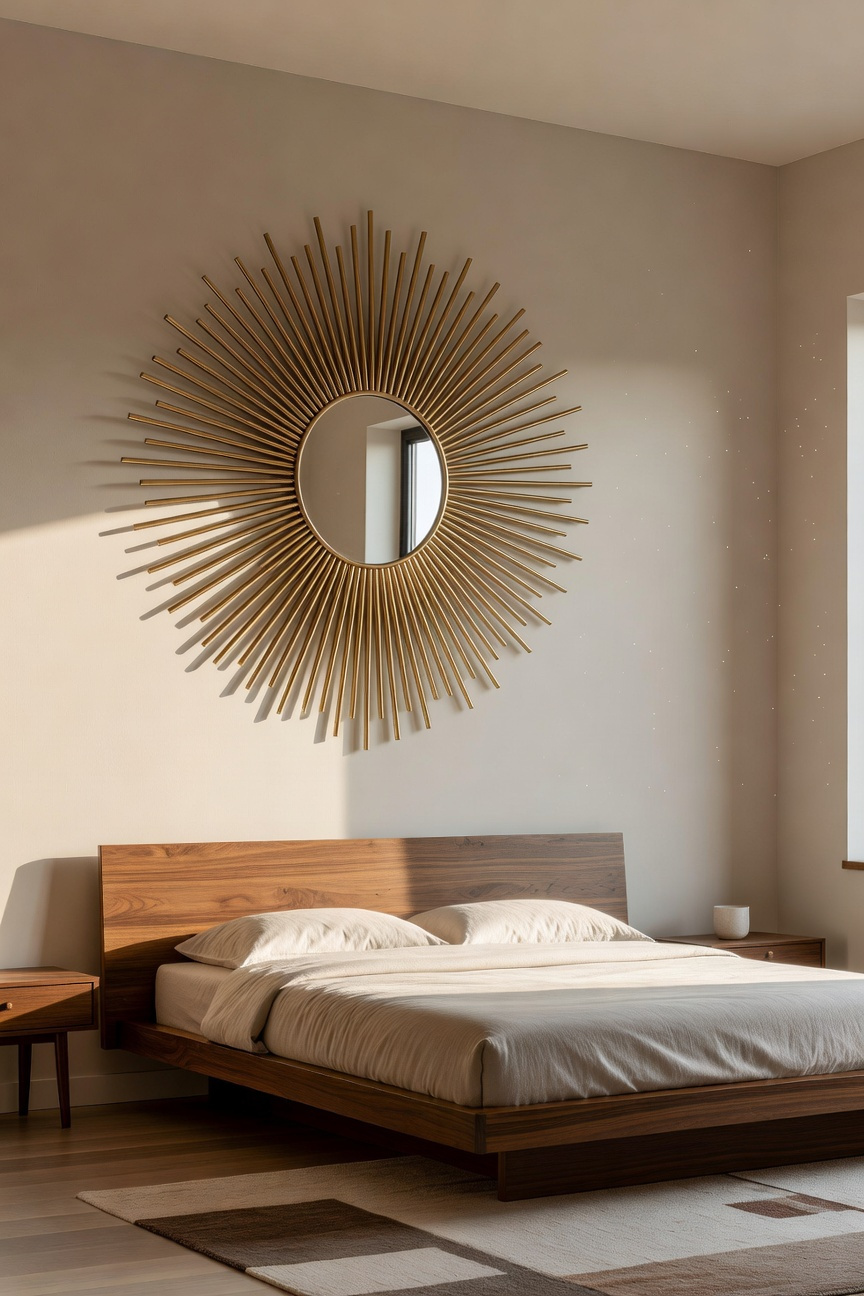
Consider the iconic sunburst mirror first. This “Atomic” design utilizes radial balance to draw the eye outward. Unlike a flat, passive window, the radiating rays actively stretch the wall surface visually. The room feels like it possesses an internal light source. Alternatively, look to Italian master Gio Ponti for a softer approach. His “aerodynamic” designs often lack sharp, clinical angles. They provide modern structure without the visual noise that disrupts sleep.
The materials dictate the atmosphere. A hallmark of this era is “Material Alchemy,” pairing organic teak with industrial brass accents. This combination anchors the piece in earthy comfort while reflecting light. Experts note that a strategically placed hexagonal mirror can increase perceived space by roughly 20%. Because these shapes have diagonal edges, they catch light at varied angles of incidence. As a result, they create a diffused glow rather than a harsh glare.
Finally, consider the trend of asymmetrical “Italian” mirrors. Unlike formal symmetry, these organic, puddle-like shapes feel relaxed and sensual. They break up the rigid lines of boxy dressers, making the bedroom feel fluid and expansive.
Phase 2: Texture and Dimensionality (Intermediate Applications)
Walls have evolved beyond simple backdrops for art. In Phase 2, they become the art itself through tactile intervention. Historically, wainscoting served to protect plaster from daily wear. Today, this concept shifts toward parametric design. Sustainable bamboo panels or wood slats create organic “visual flow.” These algorithmic patterns make compact bedrooms feel expansive.
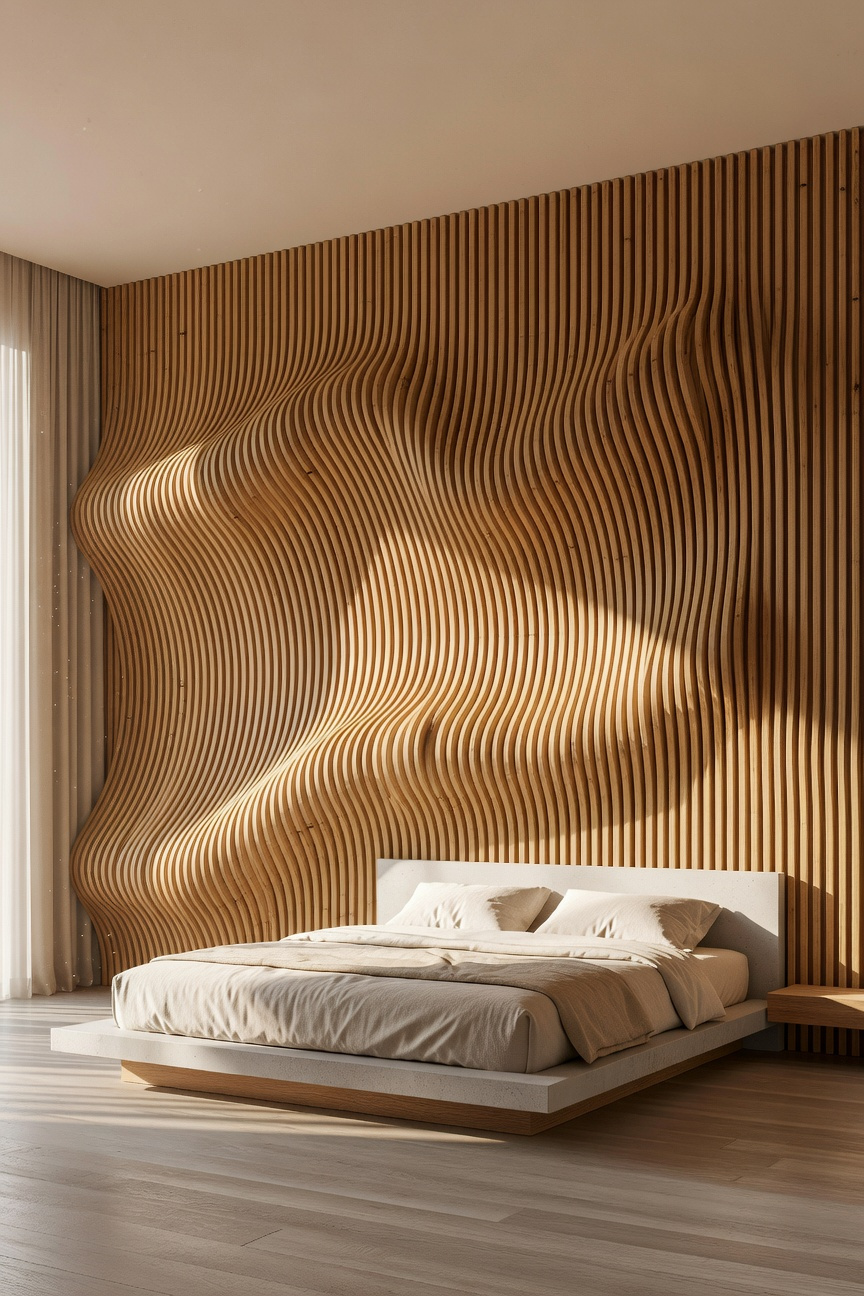
This dimensionality acts as “sound armor.” Acoustic wood walls can absorb nearly 90% of ambient noise. Thus, they cure the “flutter echoes” common in modern, minimal rooms. This creates the “psychological quiet” essential for a restorative sanctuary.
Beyond wood, plaster offers a “living” finish. Limewash creates a soft, matte surface using ancient mineral blends. It absorbs light, producing a cloud-like atmosphere ideal for sleep. Conversely, Venetian plaster mimics cool, polished stone. It requires skilled burnishing with a steel trowel to reflect light. Ultimately, lighting remains the critical catalyst. “Grazing light” from acute angles highlights these peaks and valleys. Therefore, proper illumination reveals the surface’s true narrative.
6. Sustainable Slat Wood Paneling: Adding Warmth and Verticality
Modern slat wood paneling offers more than just texture; primarily, it serves as a sophisticated architectural tool. These panels utilize verticality to manipulate the visual volume of a bedroom. The gaze is directed upward, creating an immediate perception of increased ceiling height. Unlike solid walls, the rhythmic negative space between slats provides structure without feeling heavy. Designers often recommend extending panels from floor to ceiling to establish a sense of classical stability as an architectural focal point.
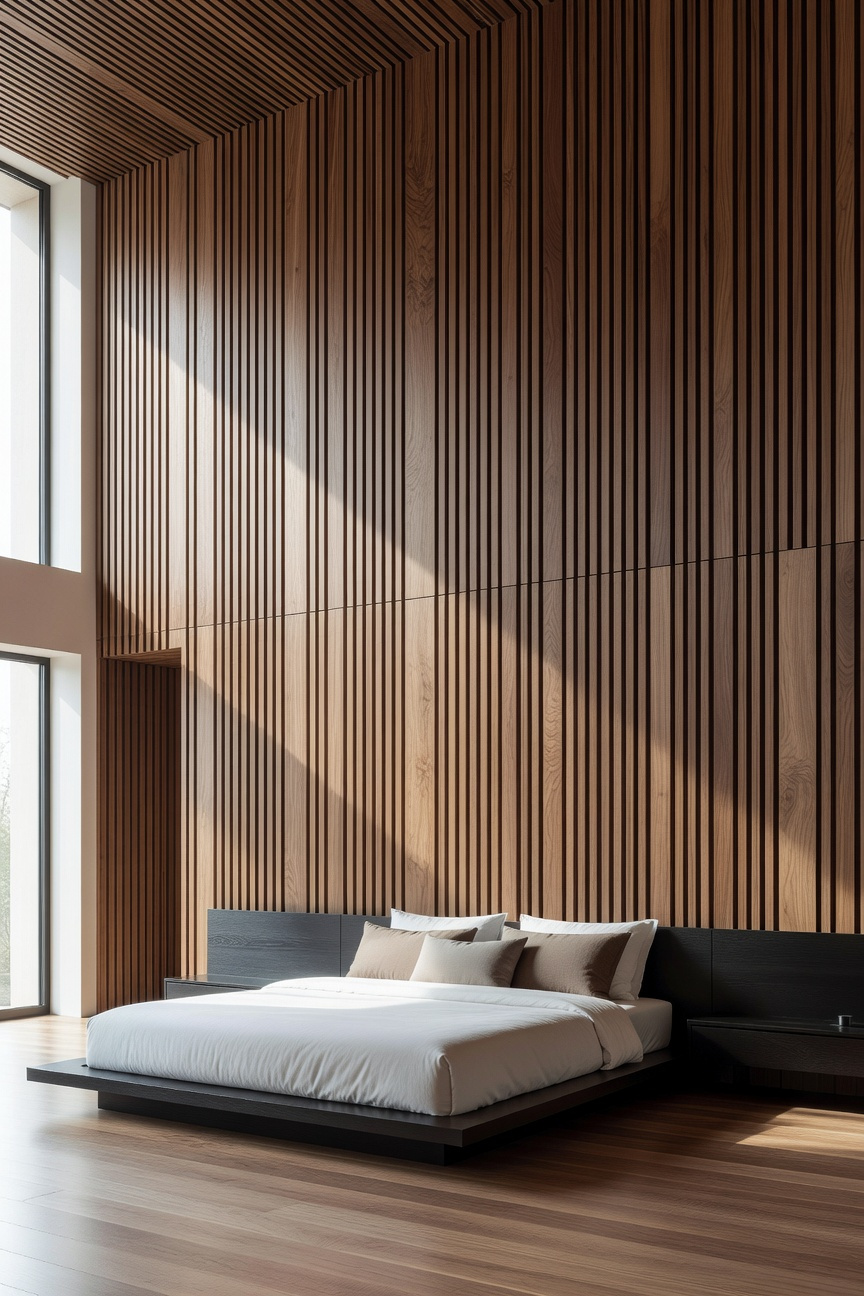
Beyond aesthetics, this material significantly improves sleep hygiene through acoustic control. Standard drywall typically reflects noise, creating subtle echoes that can disrupt rest. In contrast, quality slat panels often feature a recycled PET felt backing designed for absorption. Technically, this combination raises the Noise Reduction Coefficient considerably. Thus, sharp, incidental noises are blunted rather than amplified. This reduction in reverberation supports a smoother transition into deep sleep cycles.
The choice of material impacts both sustainability and psychological wellness. Frequently, manufacturers utilize wood veneers over stable cores to maximize the yield of slow-growing timber species. This approach prevents the warping common in solid wood while maintaining eco-friendly standards. Moreover, the presence of natural wood triggers a biological relaxation response. In fact, research suggests wood surfaces can lower blood pressure. Ideally, covering roughly 45% of the room creates a comforting, stress-reducing atmosphere without feeling claustrophobic.
Finally, you can use these panels to define specific zones within the space. Slats can replace a traditional headboard to visually anchor the bed. Additionally, integrating LED lighting between slats emphasizes the grain depth. The wall becomes a dynamic feature that supports evening wind-down rituals.
7. Framed Wallpaper Panels: Preserving Retro Prints as Art
Framed wallpaper panels represent a significant shift from simple wall-covering to deliberate wall-curation. This technique bridges the gap between maximalist patterns and minimalist restraints. The concept evolves from the 18th-century “Print Room” tradition where art was pasted directly onto walls. Modern design, however, reverses this dynamic by elevating utility backgrounds into fine art foregrounds. Vintage patterns from the 1960s are re-contextualized as collectible artifacts rather than dated decor.
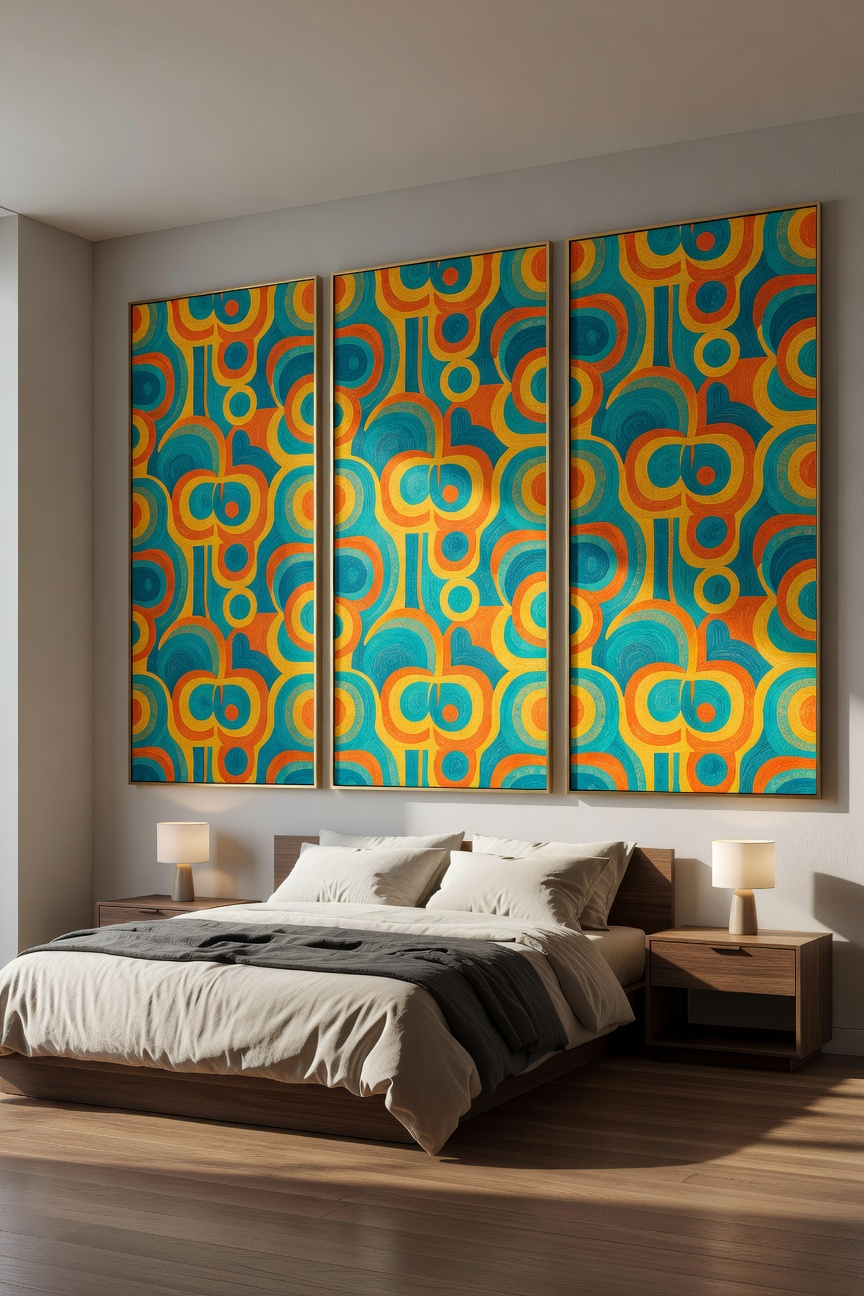
Preservation requires museum-quality standards due to the fragility of original rolls. Unfortunately, standard backings often contain lignins that eventually burn old paper. Restorers use acid-free foamcore to neutralize pH levels and prevent brittle edges. Additionally, retro inks are highly photosensitive. Thus, UV-protective glass is necessary to prevent the “washed out” fade often seen in 1970s prints.
Aesthetically, the choice of print dictates the bedroom’s narrative. Art Deco motifs in lacquered black frames evoke structured luxury. Alternatively, mid-century botanical prints framed in warm walnut support a biophilic retreat atmosphere. Framing these bold designs creates a “contained explosion” of color. This approach provides a strong focal point without the visual clutter of a fully papered room.
Finally, this method solves architectural voids in modern builds. A large horizontal panel can effectively serve as a surrogate headboard. Moreover, it offers valuable portability for renters. Ultimately, framing allows you to carry design history with you when you move.
8. Sculptural Sconces: Lighting as the Primary Wall Jewelry
In modern bedroom design, lighting has evolved far beyond simple utility. Sculptural sconces now function as the room’s primary artistic anchor within bespoke interiors. This approach mirrors the “jewelry first” philosophy often found in high fashion. Designers choose fixtures that demand attention rather than blending into the background. Historically, mid-century icons like Serge Mouille pioneered this dramatic shift. They treated light as an architectural material, not just a bulb holder. Therefore, a fixture with spindly arms adds kinetic energy to a static wall. It effectively replaces the need for traditional headboards or large paintings.
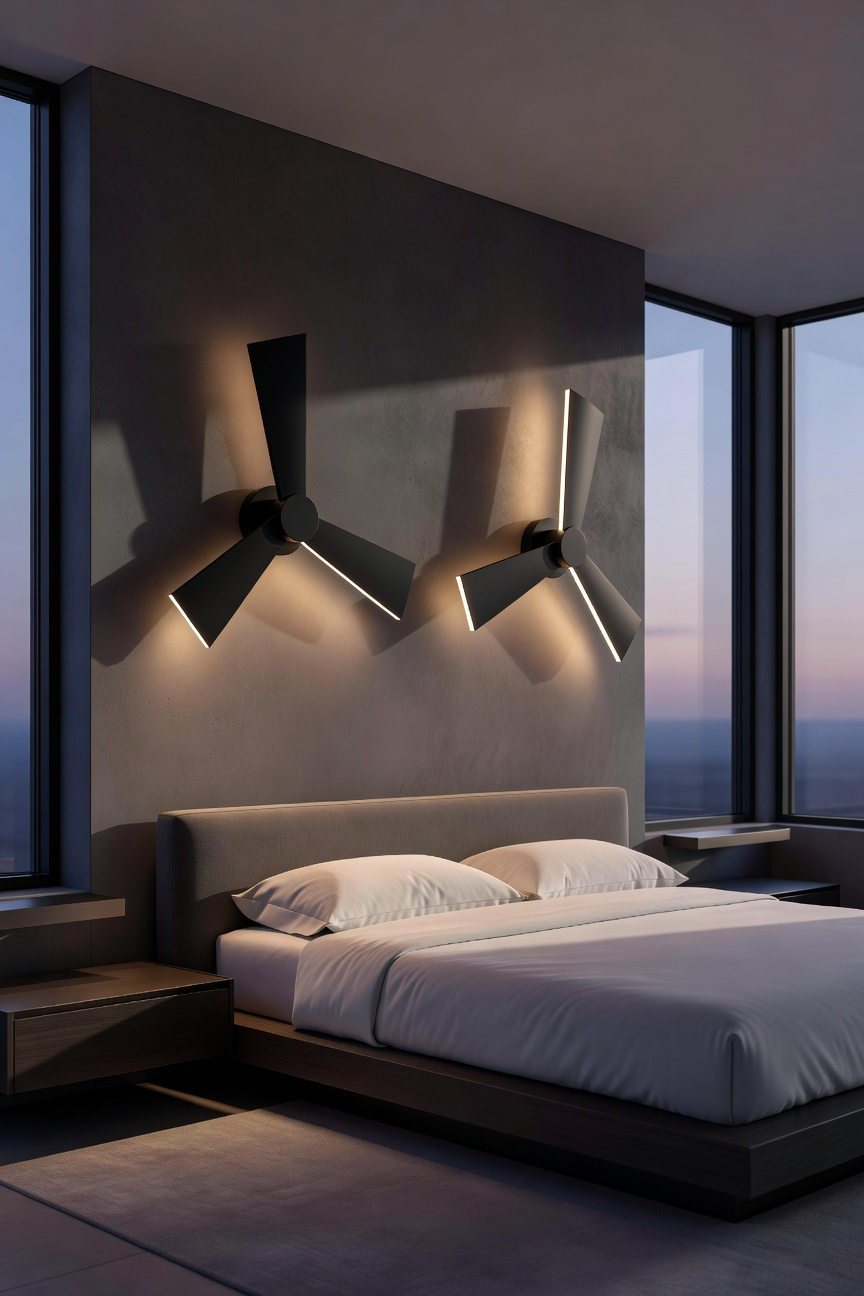
Material honesty plays a crucial role in this sophisticated aesthetic. Designers favor alabaster and hand-blown glass for their rich, tactile qualities. During the day, unlit alabaster resembles a carved stone sculpture. At night, it transforms into an ethereal, glowing orb. Additionally, the shadow serves as a silent partner to the physical fixture. Asymmetrical silhouettes create “shadow-scaping” across plain drywall surfaces. The wall becomes a canvas for shifting light patterns.
Proper scale is essential for achieving a curated, expensive look. A common mistake involves selecting sconces that appear too small for the space. Instead, opt for oversized, dramatic pieces to define the bedside zone. Ideally, a sconce should be one-third the height of nearby furniture. This proportion ensures the fixture acts as a spatial anchor. Ultimately, a single statement piece eliminates the visual clutter of multiple small frames.
9. The Living Wall: Biophilic Integration for Modern Wellness
Although vertical gardens seem like a contemporary trend, they originated with Stanley Hart White’s 1938 “Botanical Bricks.” The modern focus has shifted from architectural spectacle to intimate biophilic design. These installations now serve as active organs for the bedroom, repairing the psychological toll of urban living. Unlike passive potted plants, advanced wellness walls often utilize active biofiltration technology. Integrated fans draw air through the root zone to scrub harmful VOCs like formaldehyde.
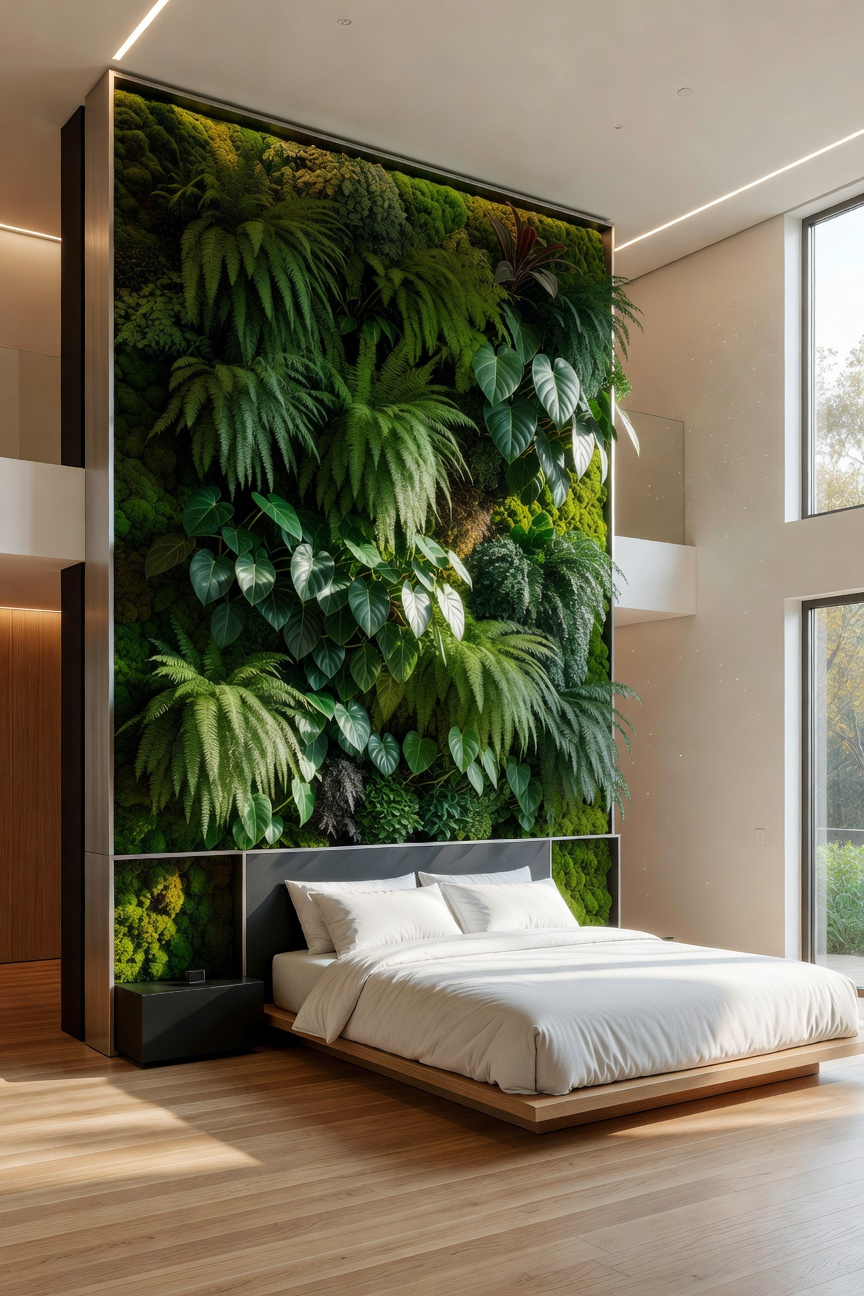
To maximize sleep quality, designers prioritize CAM plants like *Sansevieria* or *Aloe Vera*. Notably, these species release oxygen at night rather than consuming it, creating a superior respiratory environment. Beyond air quality, these living structures function as a sophisticated acoustic cocoon. With a Noise Reduction Coefficient of 0.85, the lush foliage significantly dampens high-frequency street noise. Consequently, the room becomes quieter than one insulated with traditional drywall.
Additionally, the wall acts as a natural evaporative cooler for dry spaces. It maintains humidity between 40–60%, which is the ideal range for human respiratory health. To ensure safety, contemporary designs largely reject soil-based systems. Instead, they favor clean hydroponic felt or rockwool to strictly prevent mold and allergens. A vapor barrier is installed to protect the structural walls from moisture. Ultimately, this technology transforms a decorative element into a functional tool for restorative rest.
10. Woven Fiber Installations: Reimagining 70s Macramé for the 21st Century
The 1970s often evoke images of earthy kitsch and simple plant hangers. However, 21st-century woven fiber installations have radically departed from these crafty origins. Today, artists treat knotting as a sophisticated architectural element rather than a hobby. The “macraweave” hybrid blends traditional knots with loom-weaving and tufting. This creates high-low textures unlike the uniform patterns of the past. These pieces serve as “soft architecture,” often mimicking organic forms like coral reefs or clouds.
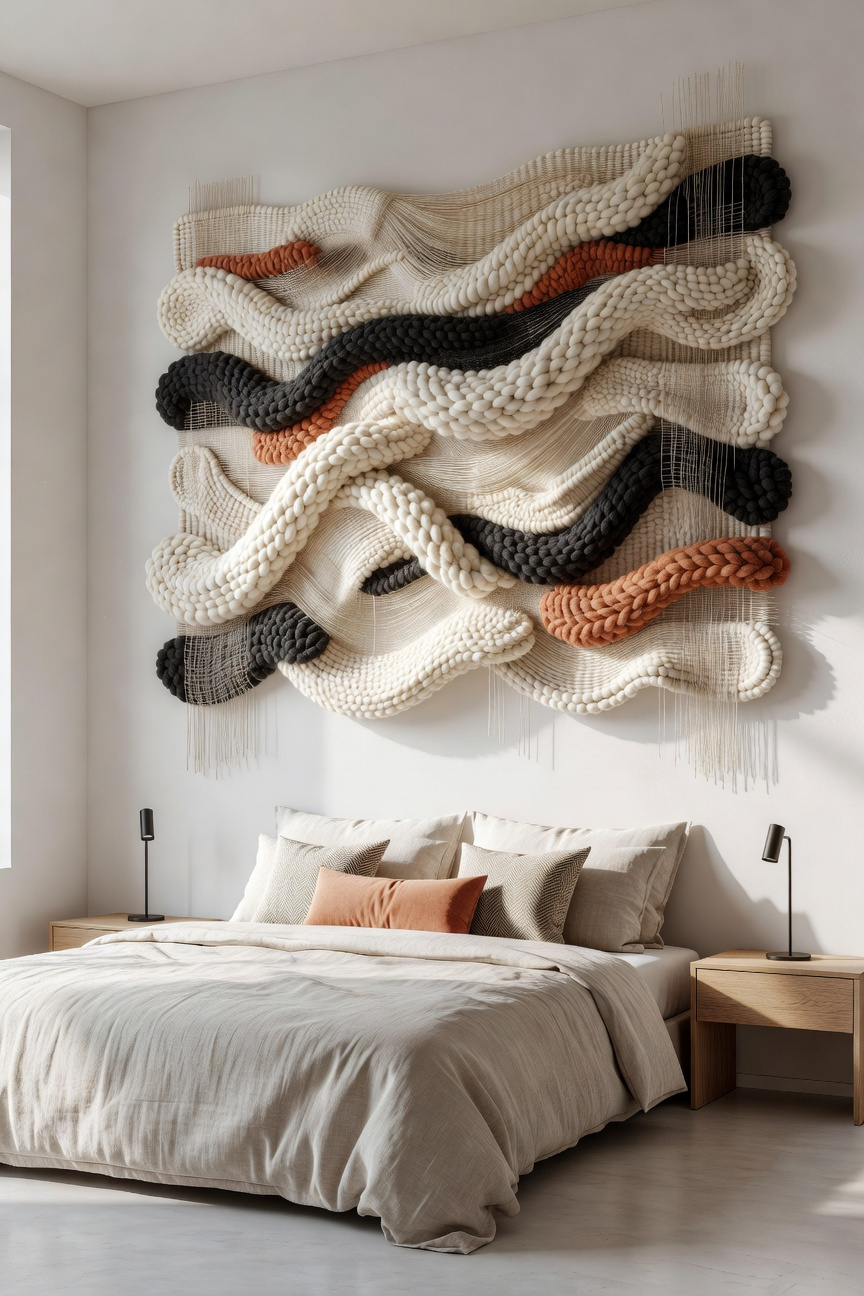
These installations solve a common problem in minimalist bedrooms: acoustic harshness. Modern spaces frequently feature hard surfaces like polished concrete and glass. Therefore, dense, irregular surfaces of wool and cotton act as organic acoustic panels. Effectively, they catch sound waves to reduce echoes, creating a quiet “cocooning” effect. Beyond acoustics, research in neuro-aesthetics suggests our brains crave this “tactile hug.” Soft, natural textures stimulate receptors that trigger relaxation.
Modern designers prioritize unbleached, organic fibers over the synthetic nylons of the 70s. Thus, the work grounds the sleeper through a strong biophilic connection. Finally, consider reimagining the headboard with a wall-to-wall installation. Often mounted on driftwood or matte black steel, these pieces offer a dynamic focal point. High-relief textures interact with light to cast shifting shadows, encouraging mindfulness before sleep.
11. Color-Blocked Arches: Defining Sleeping Zones with Paint
Color-blocked arches have transitioned from simple trends into sophisticated design tools. They utilize geometry to alter a room’s architectural feel. Historically, arches signified strength and structural transition. In modern spaces, however, a painted arch acts as a “phantom” element. It creates illusionary depth in otherwise flat, boxy rooms.
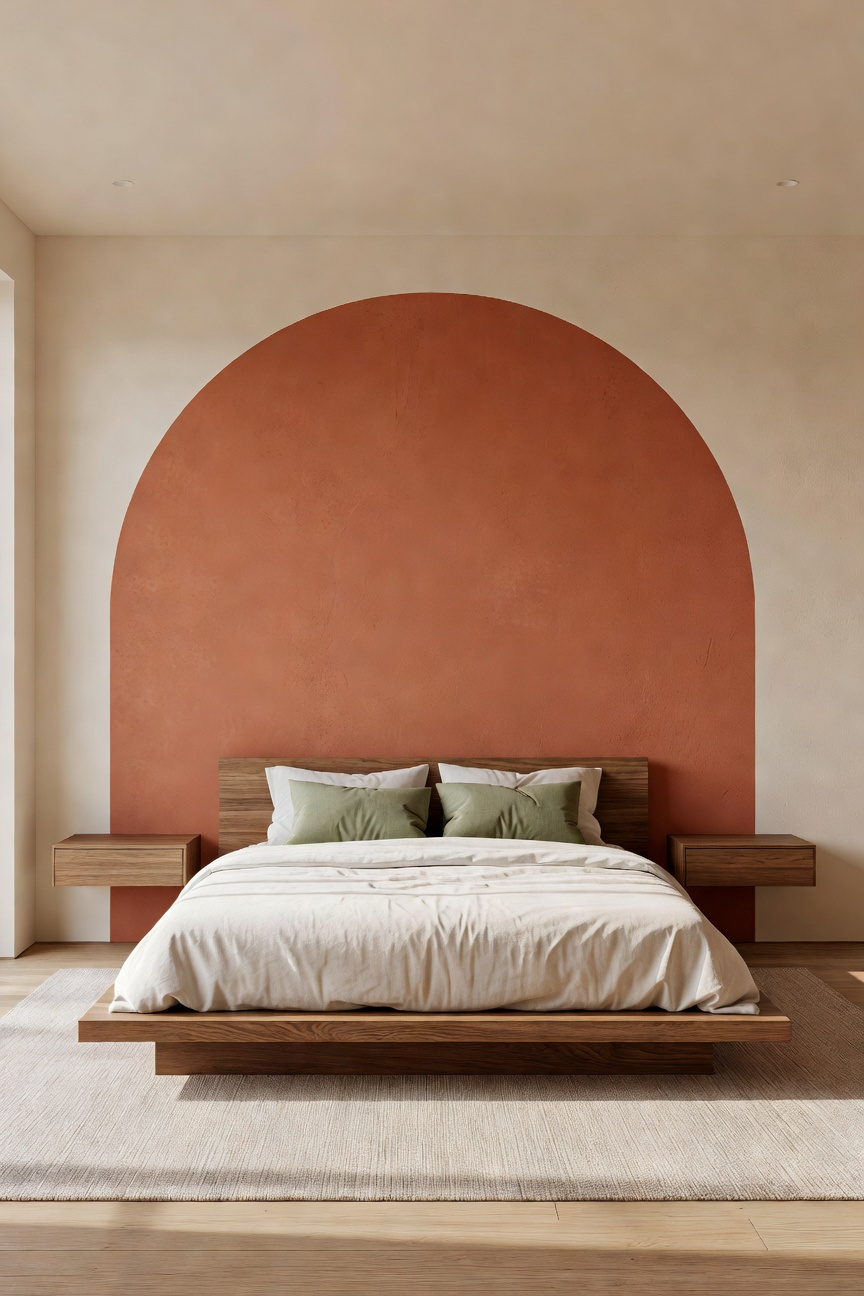
Designers use these shapes to trick the eye. By painting a wide arch behind a headboard, you simulate a protective alcove. This triggers a psychological sense of “refuge.” Furthermore, modern bedrooms often suffer from linear overload caused by sharp angles. Neuro-architecture studies suggest that curves lower physiological arousal. Therefore, distinct soft geometry signals to the brain that the sleeping zone is safe.
To update this look, avoid high-contrast colors. Instead, embrace tonal layering by choosing a shade slightly darker than the main wall. Textured finishes like limewash can enhance this tactile, “cocooning” effect. For execution, rely on the classic “compass method” using string and a pencil. Finally, peel the tape while paint is tacky to ensure crisp, professional edges.
Phase 3: Architectural Integration (Advanced Mastery)
True architectural integration transitions from decorating surfaces to sculpting the space itself. This advanced mastery treats walls as fundamental structures that communicate with light and sound.
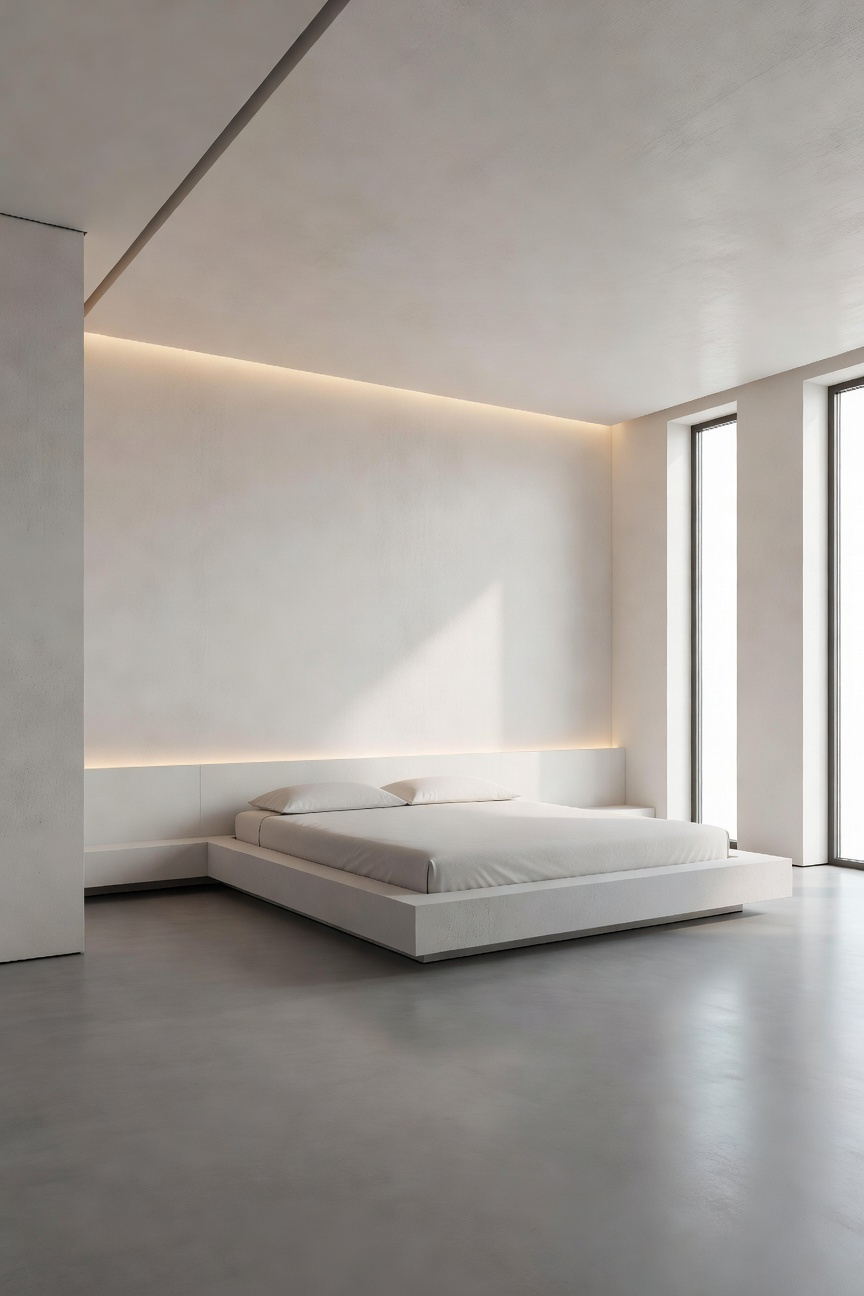
Advanced design often begins with the “shadow gap.” Unlike traditional moldings that add visual clutter, this subtractive technique creates a precise, recessed void. Therefore, the wall appears to float weightlessly above the floor. Historically, this method echoes mid-century masters like Mies van der Rohe. Integrated LED profiles within these gaps emit a soft glow, diffusing light to support natural circadian rhythms.
Similarly, high-end integration dissolves functional elements into the architecture. For instance, concealed doors utilize invisible pivot hinges to maintain an unbroken material plane. This removes visual noise, effectively turning the bedroom into a curated sanctuary. However, visuals are only half the experience. To combat “sonic glare,” designers employ acoustic plaster. This microporous material absorbs sound energy while appearing perfectly smooth. As a result, the room becomes an acoustic cocoon, essential for restorative sleep.
Finally, the wall and furniture often merge completely. Integrated headboard systems can wrap the room, creating a psychological sense of security known as “refuge.” Ultimately, this approach embraces the concept of “Ma,” or the beauty of emptiness. By rejecting the gallery wall, we create a profound focal point for stillness.
12. Limewash and Plaster: Creating Depth Through Old-World Textures
Limewash offers more than just a trendy, cloudy aesthetic. Specifically, it creates unique visual depth through ancient science. As the finish cures, it forms tiny calcite crystals. These crystals scatter light rays instead of absorbing them. Thus, the walls appear to possess a soft, ethereal glow. Furthermore, lime plaster acts as a “hygrometric lung.” Due to its high porosity, the material absorbs excess humidity. This stabilizes the bedroom’s micro-climate for healthier sleep. Additionally, this alkaline surface naturally resists mold without toxic chemicals.
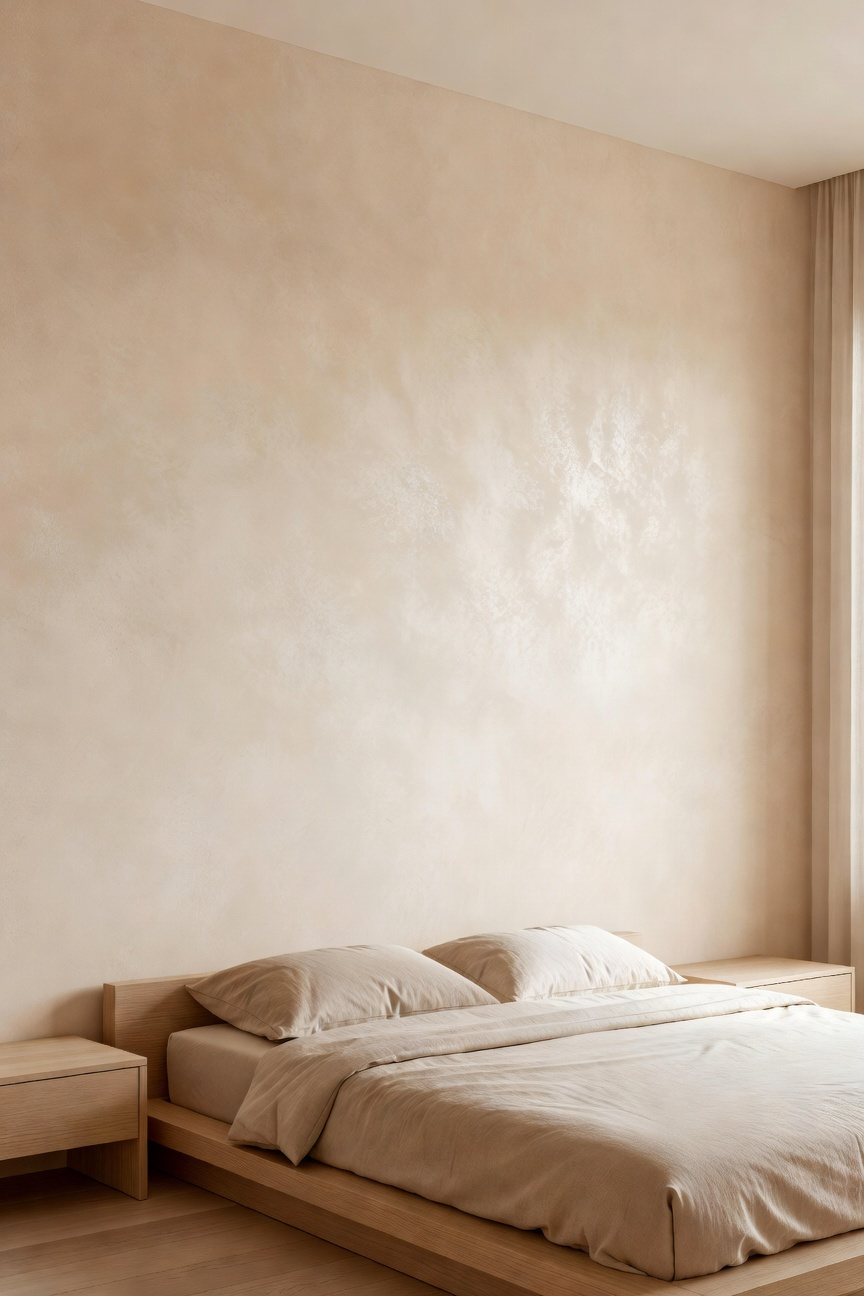
Achieving this look requires specific application methods. Artisans never use standard paint rollers. Instead, they apply the wash using sweeping “M” or “S” brush patterns. This distinct technique prevents harsh, linear marks. Moreover, it creates a seamless, tactile texture. Unlike modern paint, this finish does not peel or fade. In fact, it develops a rich patina over time. Ultimately, this approach honors the Wabi-Sabi philosophy of beauty in imperfection. By choosing these materials, you create a grounded, breathable sanctuary.
13. Integrated Headboard Walls: The Seamless Hotel-Style Transition
The concept of the bedroom is undergoing a significant architectural shift. We are moving from collecting separate furniture pieces to curating cohesive environments. This design approach, often called the “Hotelification of the Home,” anchors the current “Quiet Luxury” movement. The bed becomes a spatial anchor rather than just a standalone object. Designers note that extending headboards from wall-to-wall eliminates visual clutter. This creates a “Cocoon Effect,” signaling to the brain that the transition to sleep is absolute and uninterrupted.
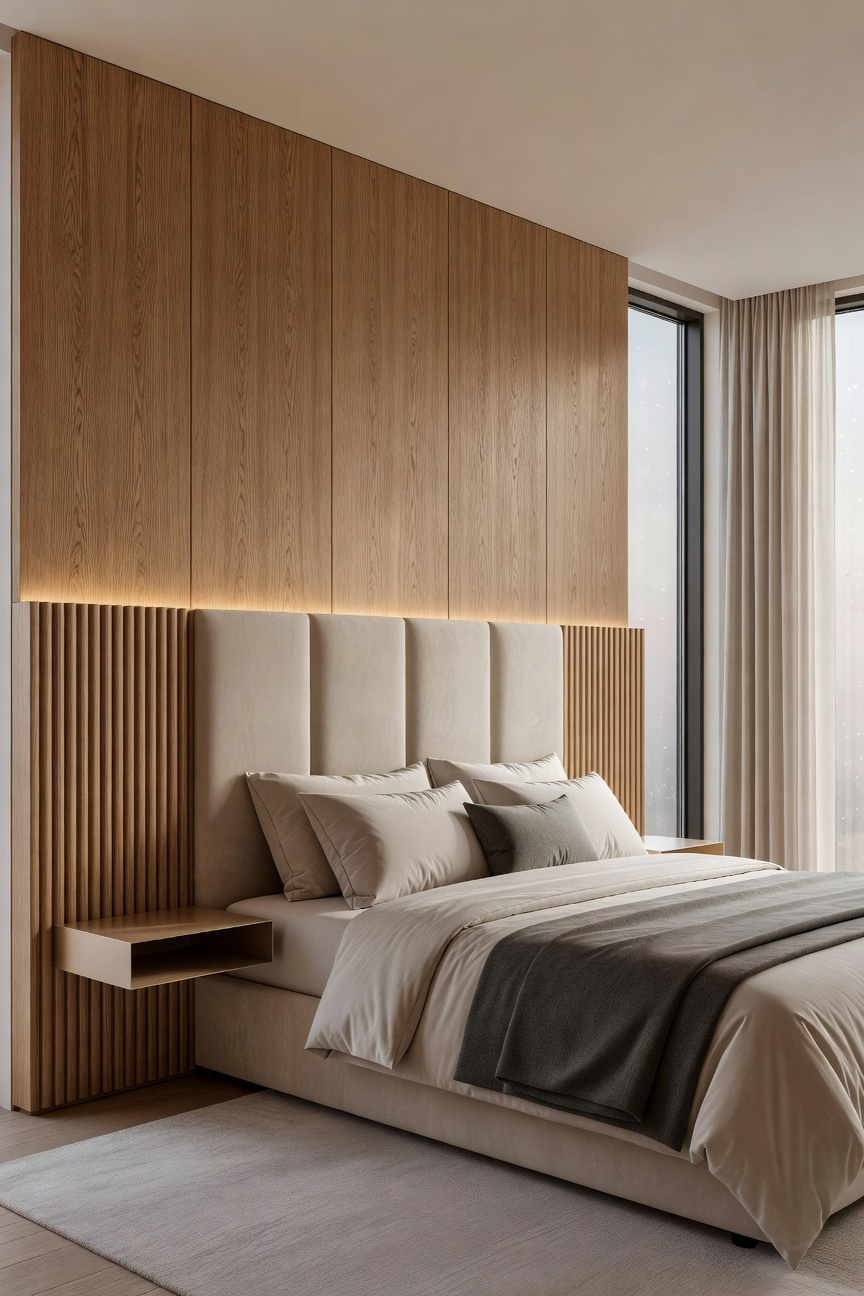
Beyond aesthetics, true luxury lies in “invisible” infrastructure. Professionals often use hidden French cleat systems to hang large panels securely. This method ensures a seamless, flush-to-wall look while maintaining a slim profile to save space. Furthermore, integrated walls frequently incorporate floating nightstands. By lifting furniture weight off the floor, small bedrooms instantly feel larger and airier. Additionally, lighting plays a crucial role in this setup. Recessed LED strips or integrated reading lamps create layers of warmth, effectively supporting natural circadian rhythms.
Material choices are equally important for creating this sanctuary feel. Currently, the design consensus favors tactile layering over simple flat paint. For example, pairing mid-century walnut slats with soft bouclé panels creates a sophisticated balance of hard and soft textures. Moreover, these layers offer hidden technical benefits. Acoustic backings can significantly reduce ambient noise from adjacent rooms. This turns the feature wall into a sound barrier, improving sleep quality. Finally, designers are embracing “living finishes” like unlacquered brass or reclaimed oak. These natural elements ground the high-tech aesthetic, ensuring the space remains timeless and restorative.
14. Architectural Salvage: Mounting Historical Elements as Modern Sculpture
Moving architectural salvage into the bedroom requires a deliberate shift in perspective. This practice relies on a concept known as “defamiliarization.” You take a functional object, like a weathered roof finial, and recontextualize it as standalone art. Consequently, the viewer focuses on form and geometry rather than the object’s original utility. In a modern space, this forces the eye to slow down and appreciate the craftsmanship.
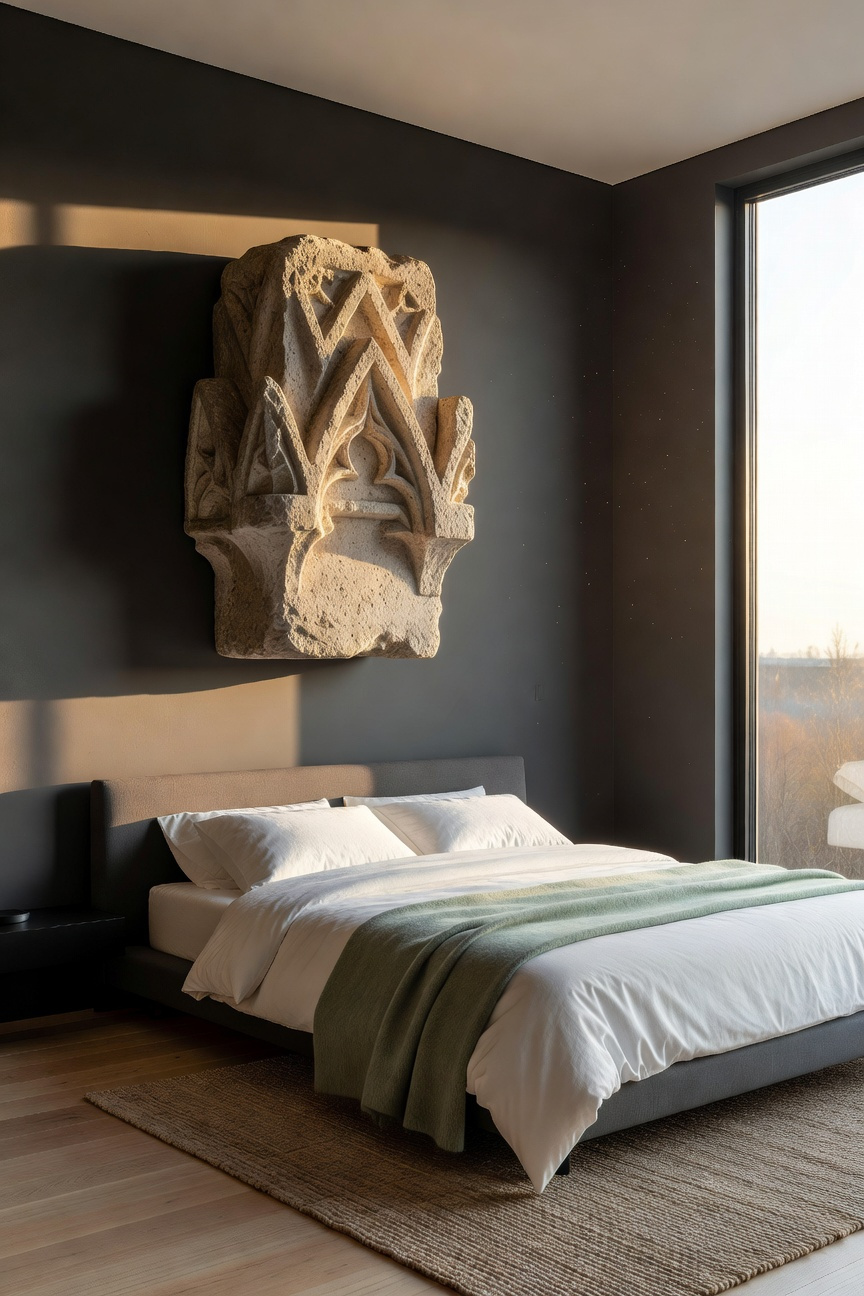
These pieces introduce a vital “haptic” or tactile dimension to a room. Modern bedrooms often feature smooth, sterile drywall surfaces. Therefore, adding a weathered frieze creates a necessary sensory contrast. Research suggests that these authentic, storied textures actually help lower cortisol levels. Unlike “faux” vintage items, real salvage carries a psychological weight that the brain recognizes as safe.
To elevate these finds, professional installation technique is critical. Using acrylic standoffs allows a fragile piece to “float” slightly off the wall. This protects the original patina while integrating the item seamlessly into a contemporary palette. Additionally, hidden LED backlighting can turn a wrought-iron grate into a dramatic light sculpture. This method emphasizes hand-hewn imperfections that mass-produced decor lacks.
Ultimately, this approach honors a history of design activism rooted in the 1970s. Choosing salvage is a firm rejection of planned obsolescence. Thus, you are not just decorating; you are curating a “biography in three dimensions.” By preserving these fragments, you ground the room in history while maintaining a modern aesthetic.
15. The Audiophile’s Ledge: Curated Vinyl Displays as Visual Art
In the hierarchy of bedroom decor, the vinyl ledge represents a significant conceptual shift. Historically, records were merely utilitarian objects hidden in plain paper sleeves. However, Alex Steinweiss revolutionized this by introducing illustrated covers, effectively birthing album art. Modern displays honor this legacy, treating the 12-inch sleeve as a legitimate canvas. Instead of hiding spines on a bookshelf, the audiophile’s ledge embraces a “Curator’s Mindset.” This involves selecting three to five rotating albums that visually dialogue with one another.
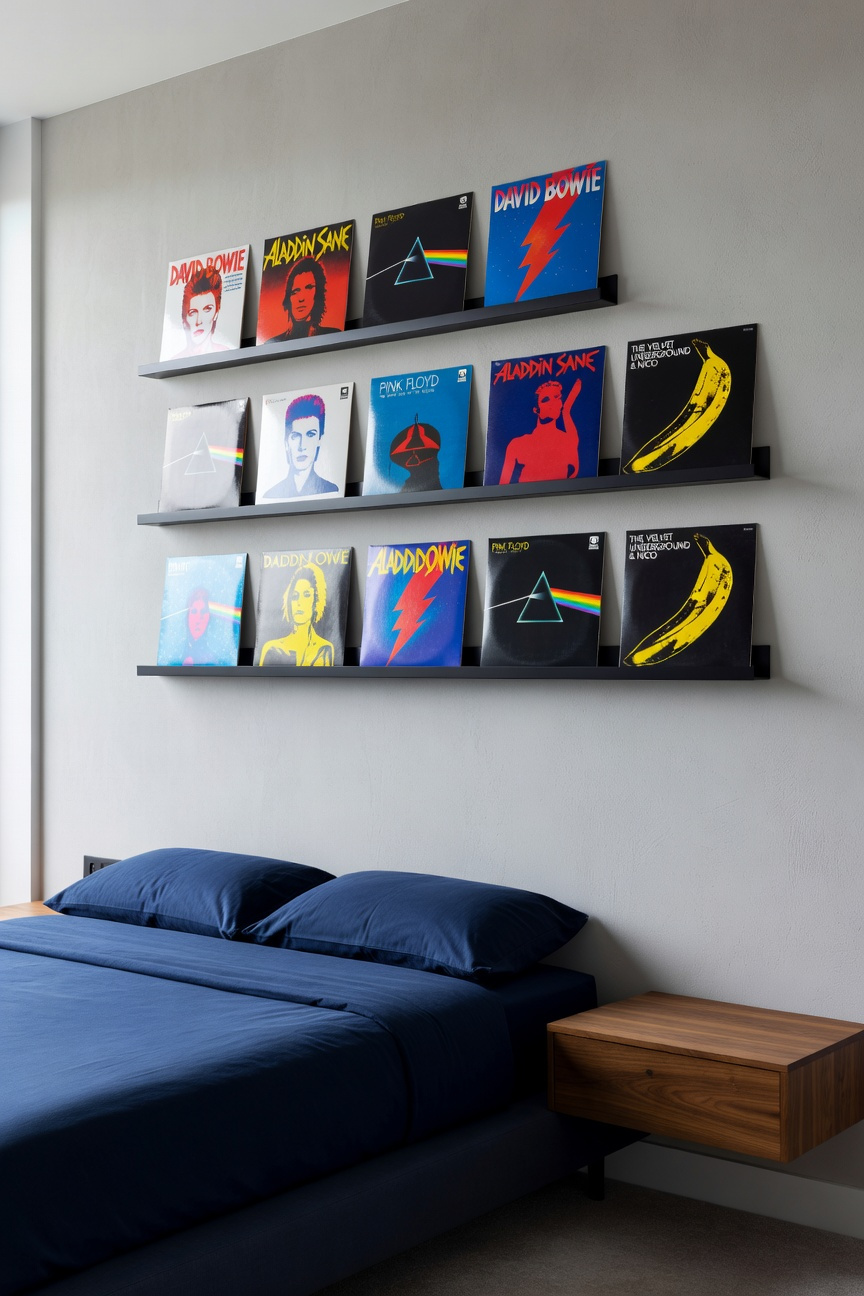
To achieve a timeless aesthetic, materiality is critical. Solid walnut or powder-coated steel offers a sustainable, high-end profile. Furthermore, these materials provide the necessary stability to keep records vertical, preventing warping. Ideally, mount the ledge so the record’s center sits 57 to 63 inches from the floor. This aligns with gallery standards, ensuring the art is viewed comfortably without neck strain. Additionally, maintain two to five inches of negative space between covers to prevent visual clutter.
Beyond structure, proper lighting defines the atmosphere. Standard bulbs often create harsh glare on glossy sleeves. Therefore, use warm-white LEDs with a high Color Rendering Index to preserve color fidelity. Wall-grazing lights positioned at a 30-degree angle reduce reflections on protective plastic. Finally, this setup supports the psychology of “Slow Living.” Unlike passive digital streaming, selecting an album becomes a tactile, mindful ritual. Thus, the wall becomes a living gallery, bridging acoustic passion with visual tranquility.
16. Custom Asymmetrical Molding: A Contemporary Take on Traditional Trim
Traditional molding typically implies stability through strict symmetry and classical proportions. Custom asymmetrical molding acts as a deliberate architectural rebellion within the bedroom. This design choice introduces spatial tension, moving the wall from a passive container to an active participant. Specifically, this style borrows from the De Stijl movement to create “dynamic balance” rather than chaos. Even if lines cluster on one side, negative space elsewhere maintains visual equilibrium.
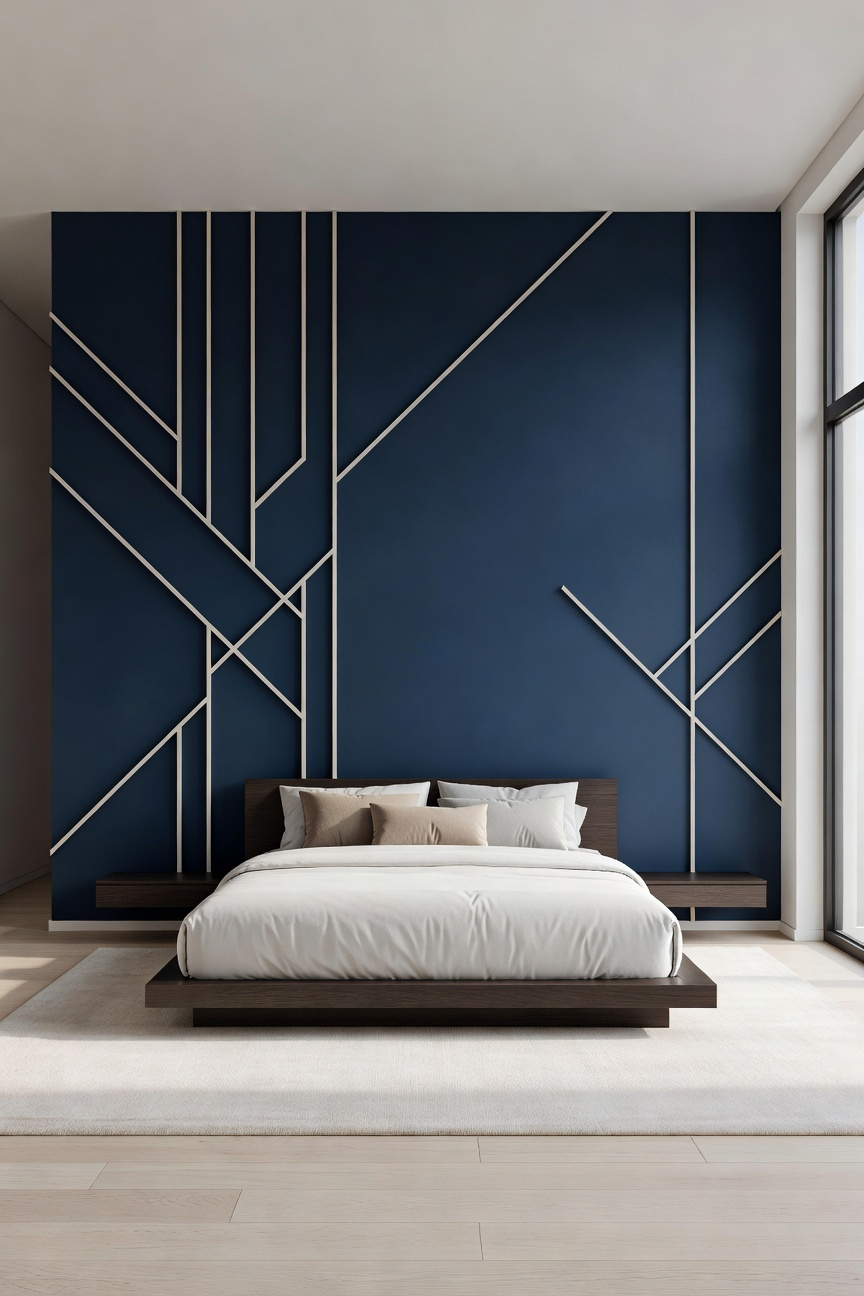
The materials have shifted from ornate curves to minimalist, square-edge profiles. Ideally, you should paint these flat strips the same matte color as the wall. As a result, the decor relies on *chiaroscuro*, revealing itself through the depth of shadows rather than color contrast. As the sun moves, the wall’s texture shifts, creating a “living” surface. For a modern functional twist, consider routing the trim’s back to house LED tape lights. Ultimately, this transforms the molding from simple decoration into a source of soft, ethereal illumination.
Frequently Asked Questions
How do you make a modern bedroom wall feel cozy?
Integrating cozy bedroom ideas into a modern space involves layering textures. Use soft materials like wool tapestries, velvet panels, or limewash paint to soften hard architectural lines and create a warmer, more inviting atmosphere.
What is the most popular modern wall decor for 2026?
The current trend focuses on “dimensional minimalism.” This includes vertical slat wood paneling, large-scale sculptural sconces, and integrated headboard walls that merge furniture with the room’s architecture.
Can I use large-scale art in a small modern bedroom?
Yes. In fact, a single oversized art piece can make a small room feel larger by creating a strong focal point and reducing the visual clutter that often comes with several smaller frames.
Conclusion: The Philosophy of ‘Slow Decorating’ and Timeless Evolution
Adopting the philosophy of slow decorating fundamentally shifts how we view our private sanctuaries. Instead of rushing to fill every void, we learn to appreciate visual quiet. The bedroom becomes a curated collection of memories rather than a temporary showroom. This approach favors material honesty and patience over fleeting trends. In fact, allowing negative space to exist creates a restful atmosphere essential for sleep. Finding the right modern bedroom wall decor ideas is an investment in your long-term well-being and the narrative of your home.
This method also promotes sustainability by rejecting the disposable nature of modern decor. Therefore, choose organic materials that develop a rich patina over time. The goal is to build a space that ages gracefully, not one that expires. Furthermore, this practice turns decoration into an ongoing journey of discovery rather than a race. Begin by auditing your current space for items that truly hold personal meaning. Remove what distracts, and then patiently wait for the right piece to arrive.