
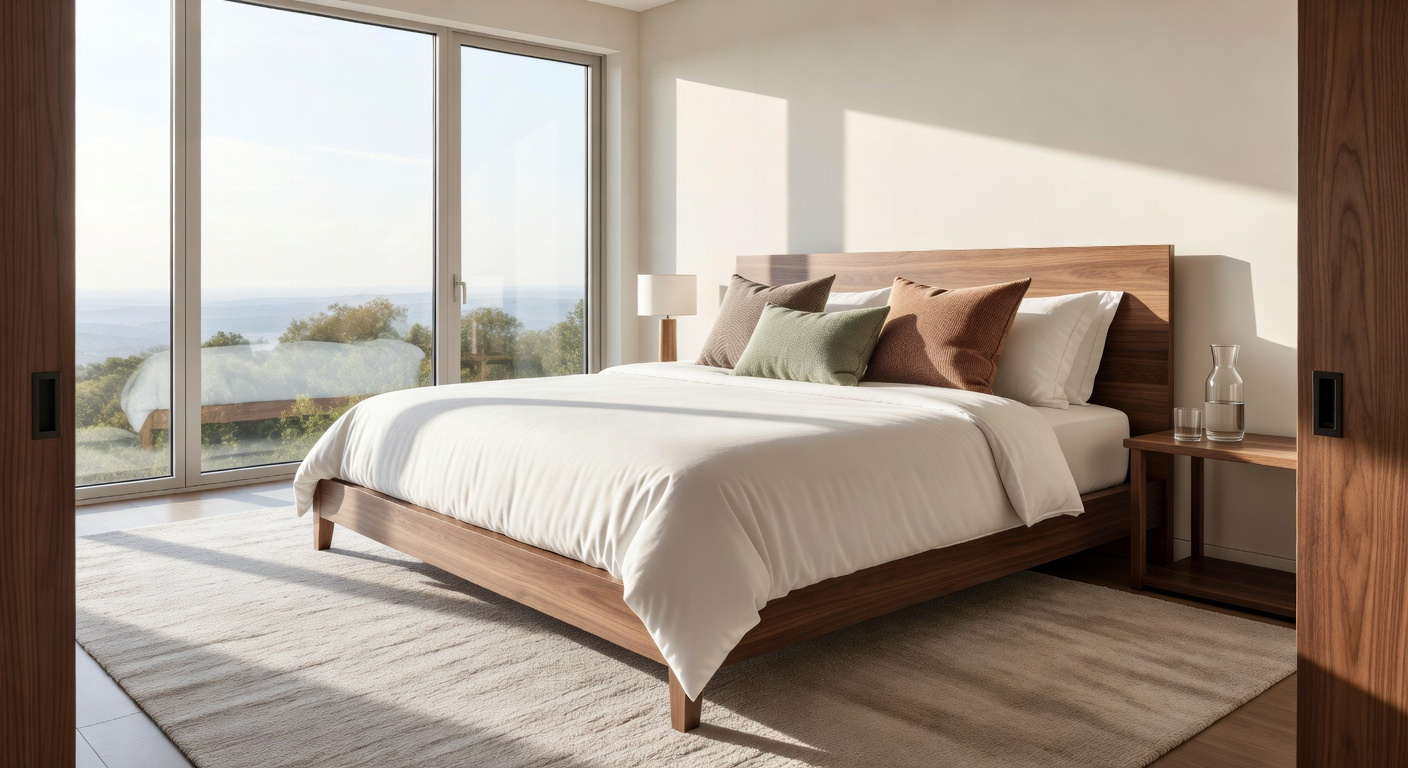

Too often, homeowners view the bedroom as a static box for furniture. They prioritize decorative aesthetics, focusing primarily on how the room looks. However, this superficial approach ignores the environment’s profound impact on human biology. To truly elevate a home, you must realize that bedroom furniture decor isn’t just about style. It is a vital component of environmental psychology. When these elements are misaligned, the space fails to support the physiological needs required for true recovery.
Conversely, viewing the bedroom as a “vessel for restoration” shifts the focus toward holistic wellness. In this context, the room acts as a “second body” for its inhabitant. Here, Modern Bedroom Furniture serves as the foundation for health. It actively regulates the nervous system and manages hormonal cycles. Therefore, design becomes a tool for well-being rather than just display. For instance, removing sharp angles can lower cortisol. Indeed**, organic forms signal safety to the subconscious.
This guide explores the transition from decorative sleeping quarters to a functional sanctuary for cellular repair. We will examine the science behind materials like Swiss Pine and their effect on heart rates. Next, we analyze the shift from public chambers to private retreats. Finally, we discuss practical strategies for circadian design and visual hygiene.
Section 1: Grounding the Spirit (The Bed & Placement)
The bed serves as the energetic and structural anchor of your home. Therefore, its placement is critical for grounding the spirit. Specifically, you should utilize the “Command Position.” Ideally, place the bed diagonally across from the door. This allows you to view the entrance without aligning directly with it. This arrangement satisfies a primal instinct for safety. In fact, psychologists suggest this lowers baseline cortisol by providing a secure vantage point. Conversely, facing the door directly—the “Coffin Position”—symbolizes vital energy draining away.
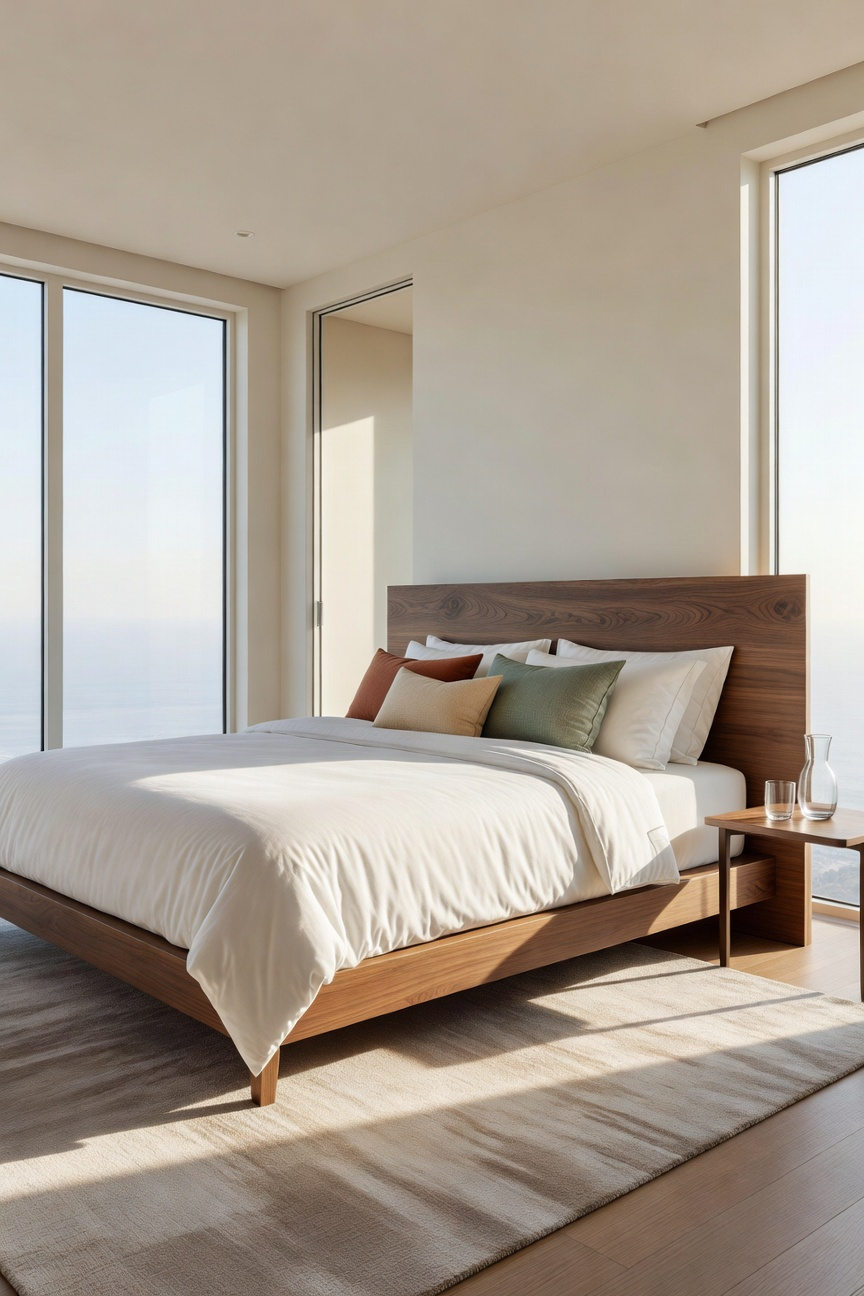
Furthermore, the bed frame itself requires thoughtful selection. Ideally, select a solid headboard to act as a symbolic “mountain.” This provides a sense of unconditional support for your vulnerable state during sleep. Additionally, solid wood creates a “quiet zone” by absorbing acoustic vibrations. Metal frames, by contrast, can conduct electromagnetic fields. Thus**, natural materials like oak or walnut are superior for insulation.
Finally, consider the bed’s height and surroundings. Lower profiles often signal stability to the primal brain. However, ergonomics remain important. Ensure your feet touch the floor comfortably when sitting. Moreover**, flank the bed with symmetrical nightstands. This creates a visual “bracket,” anchoring the space against the void. Ultimately, these elements combine to transform a simple room into a nurturing sanctuary by following 12 Nurturing Cozy Bedroom Ideas for personal wellness.
1. The Psychology of the Headboard: Selecting Solid Forms for Symbolic Support
Fundamentally, a headboard serves as a critical psychological anchor. In environmental psychology, this function connects directly to Prospect-Refuge Theory. Specifically, humans possess an innate desire to see their surroundings while keeping their backs protected. A solid form satisfies this primitive need for safety. As a result, the brain reduces nighttime vigilance. This allows the nervous system to shift into a restorative state. Without this solid backing, sleepers may subconsciously feel vulnerable to the open space behind them.
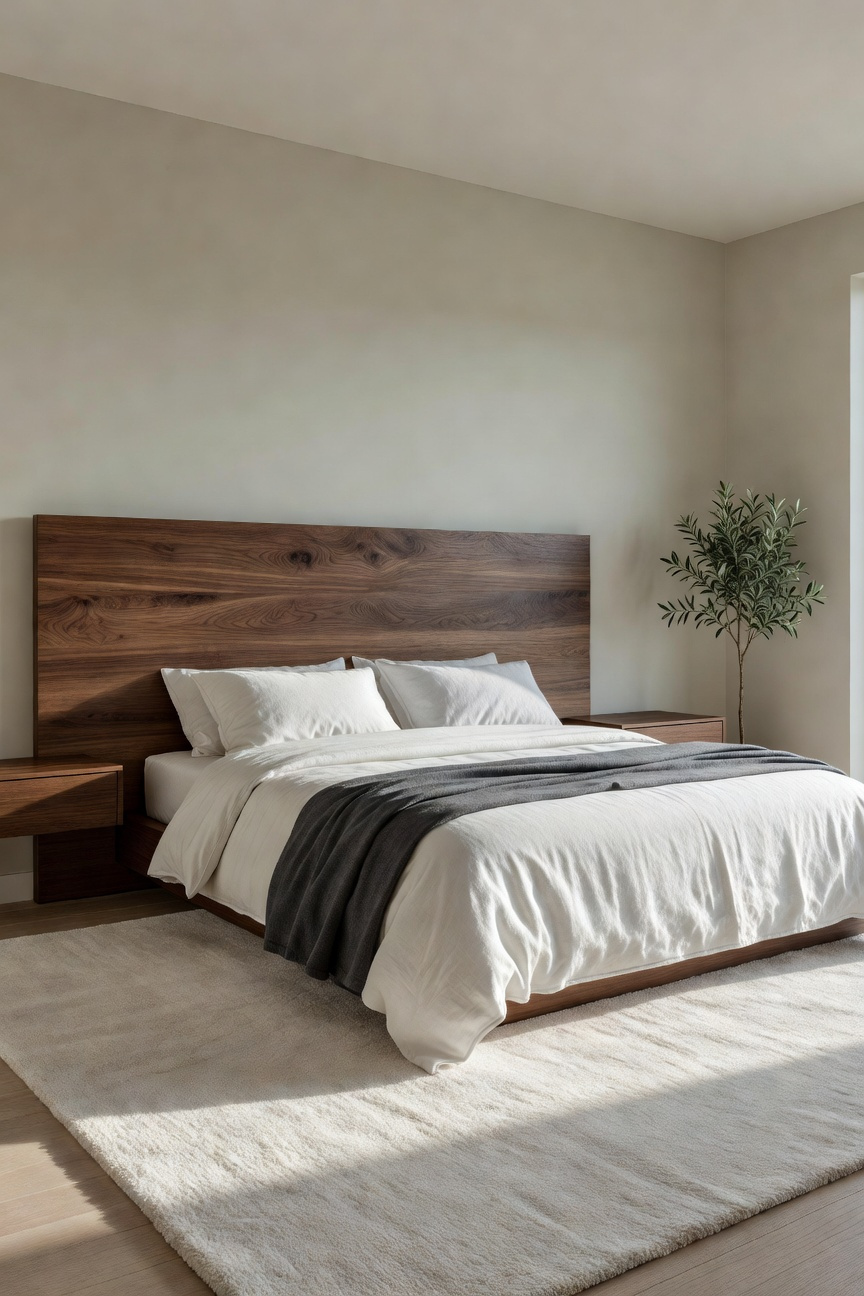
Beyond structure, material choice acts as a sensory shield. For instance, solid wood represents stability and permanence. In Feng Shui philosophy, this mimics the grounding energy of a supportive mountain. Alternatively, upholstered headboards offer necessary acoustic insulation. They dampen ambient noise, effectively creating a “quietude bubble” for the sleeper.
The headboard also functions as a cognitive “Event Boundary.” It visually separates the sleeping area from the room’s other activities. Therefore, it helps the mind disengage from work or chaos. Even the shape communicates subconscious messages. Notably, rounded designs often feel nurturing, mimicking a protective embrace. Selecting a solid headboard provides symbolic support, grounding us in an increasingly untethered world.
2. Mastering the ‘Command Position’: Furniture Layouts for Subconscious Security
In holistic design, the “Command Position” is a critical spatial strategy rather than a mere preference. Fundamentally, this layout aligns with the “Prospect-Refuge Theory,” validated by modern psychology. This concept suggests that humans possess an innate need for environments offering both visibility and concealment. Positioning your bed diagonally from the door satisfies ancient survival mechanisms mapped within the brain. Specifically, this placement soothes the amygdala, your internal alarm system. When you can see the entry without being in direct line of it, your nervous system shifts from vigilance to deep rest.
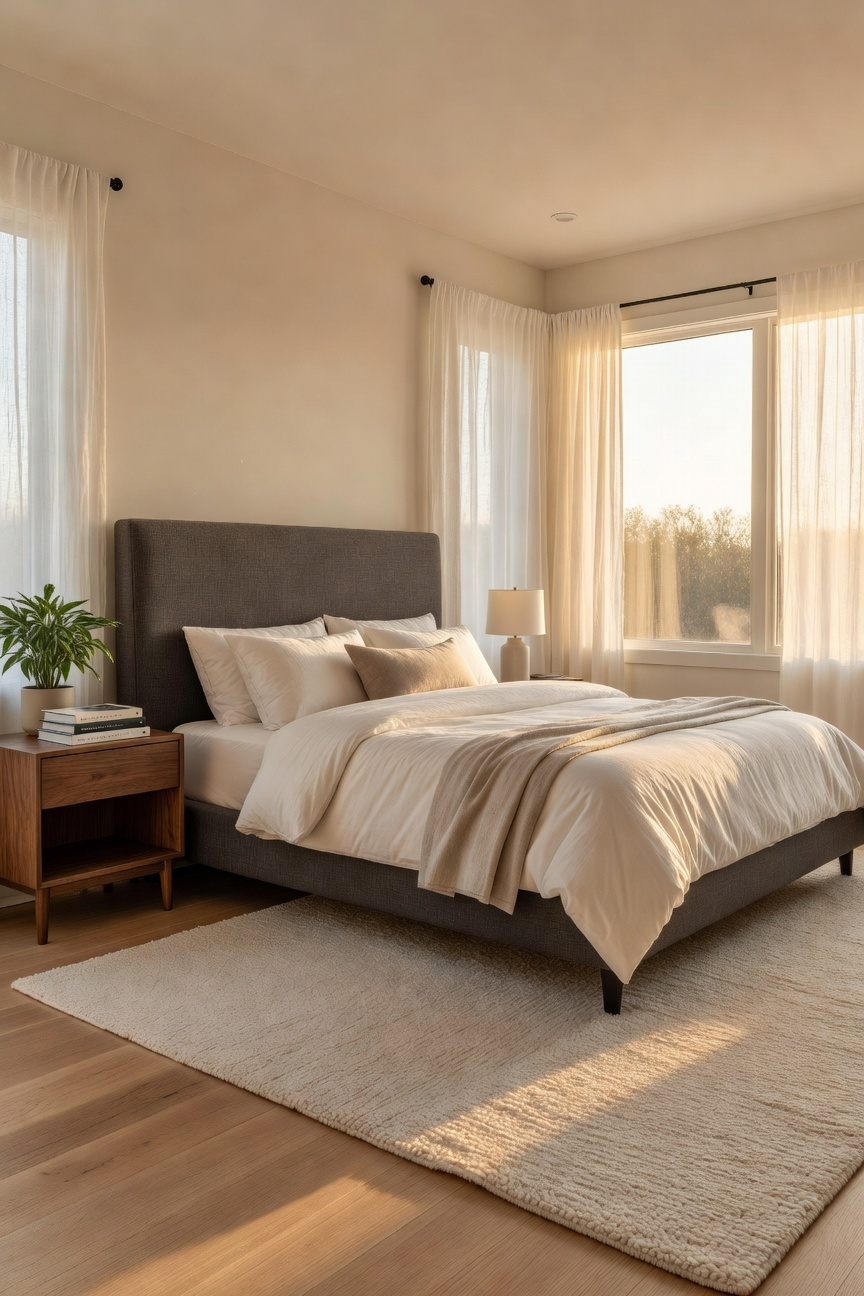
To achieve this empowered state, apply the 45-degree rule. Ideally, place the bed in the corner furthest from the entrance. In contrast, you must rigorously avoid the “Coffin Position,” where your feet point directly out the door. Historically, this alignment creates a “path of vulnerability.” It leaves the sleeper exposed to incoming energy or drafts. Furthermore, a proper layout requires a solid headboard against a sturdy wall. This acts as a symbolic “mountain” at your back, providing subconscious support unlike open metal bars or windows.
However, modern floor plans often complicate these ideal arrangements. Fortunately, simple design “cures” can restore a sense of security in awkward spaces. If your bed must face away from the door, install a strategically placed mirror. This reflection restores your line of sight, effectively tricking the brain into feeling safe. Alternatively**, place a sturdy bench at the foot of the bed. This buffer acts as a shield, protecting you from the room’s flow and creating a boundary for restorative sleep.
3. Low Profile vs. Lofted: How Bed Height Influences Grounding and Airflow
Bed height significantly influences the psychological “frequency” of your rest. Specifically, low-profile beds tap into a primal sense of stability known as “grounding.” In fact, sleeping closer to the floor often creates a subconscious feeling of tactile safety. However, this earthy position presents specific challenges regarding air quality.
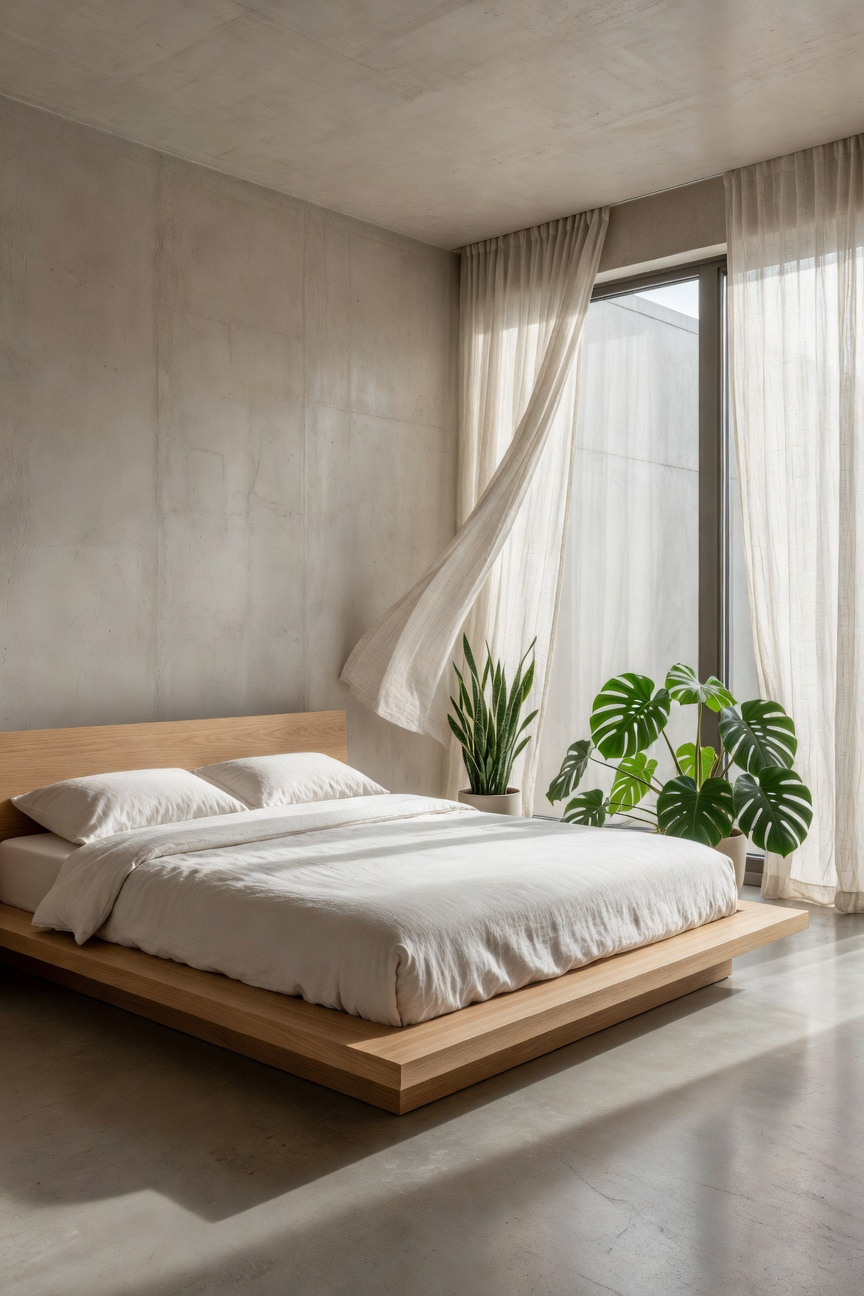
Technically, the floor is where indoor air becomes most stagnant. Therefore, CO2 levels are often highest at this lowest point due to thermal stratification. Dust and allergens follow gravity, settling heavily within the first 18 inches above the floor. Consequently, allergy sufferers may struggle with a low-profile setup. Conversely, lofted beds benefit from the “chimney effect.” By raising the mattress, you allow air to circulate underneath, preventing moisture and mold. Thus, elevation naturally places you in a cleaner, more breathable zone.
Visually, the choice dictates the room’s “weight.” A low bed acts as a solid anchor, making a space feel settled. Alternatively, lofted frames on slender legs create negative space. This visual gap allows the eye to travel, making small rooms feel larger. Ultimately, the right height balances physical health with the desire for a nurturing sanctuary.
4. Organic Foundations: Why Untreated Woods and Natural Fibers Lower Cortisol
Choosing untreated wood is not merely an aesthetic preference. In fact, it serves as a powerful physiological intervention. Touching raw surfaces triggers a neurological phenomenon called “physiological relaxation.” Specifically, tactile interaction with materials like white oak calms the prefrontal cortex. This brain area governs executive function and typically remains hyper-active during stress. Furthermore, unsealed wood acts as a passive delivery system for phytoncides. These natural compounds actively lower cortisol levels when inhaled. Conversely, heavily lacquered furniture traps these beneficial scents behind synthetic barriers.
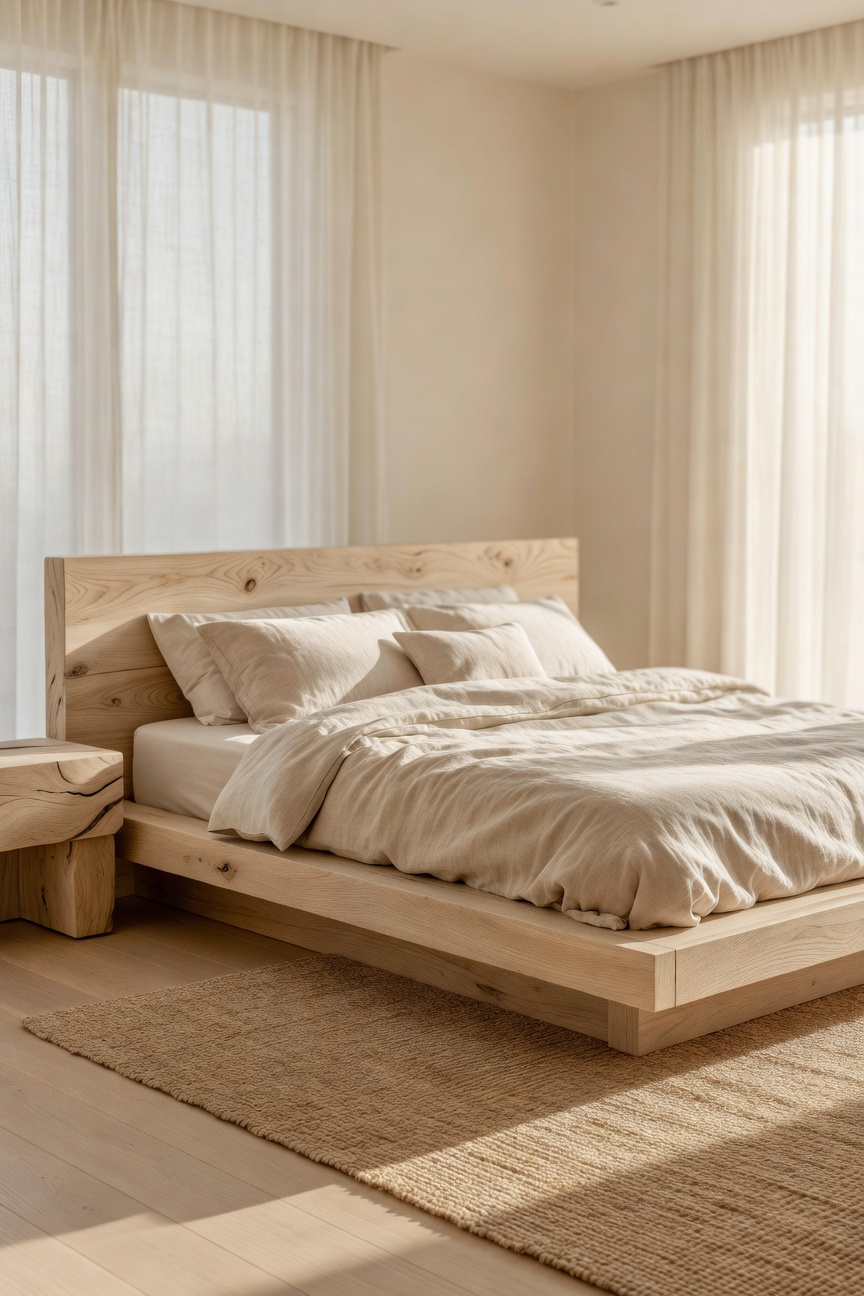
Additionally, synthetic finishes often off-gas volatile organic compounds, or VOCs. Unfortunately, these invisible stressors keep the body in a state of low-grade inflammation. Therefore, removing them allows the endocrine system to fully reset overnight. Instead of processing toxins, your body focuses on deep restoration. Finally, organic fibers like flax-linen play a crucial role in thermal hygiene. Unlike hydrophobic polyesters, natural textiles breathe to regulate body temperature. Thus**, they prevent the heat-induced micro-wakeups that trigger adrenal spikes. These organic foundations create a sanctuary that truly nurtures restorative sleep.
Section 2: Achieving Visual Silence (Storage & Clarity)
Visual silence goes far beyond simple minimalism. In reality, it acts as environmental engineering for the nervous system. Specifically, “visual noise” creates a heavy cognitive load before sleep. Consequently, a cluttered nightstand often signals an “unfinished task” to your resting brain. To counter this, modern design favors the complete erasure of hardware. For instance, push-to-open drawers transform distinct furniture objects into seamless, calming surfaces. This eliminates the distracting “micro-shadows” typically cast by knobs or handles.
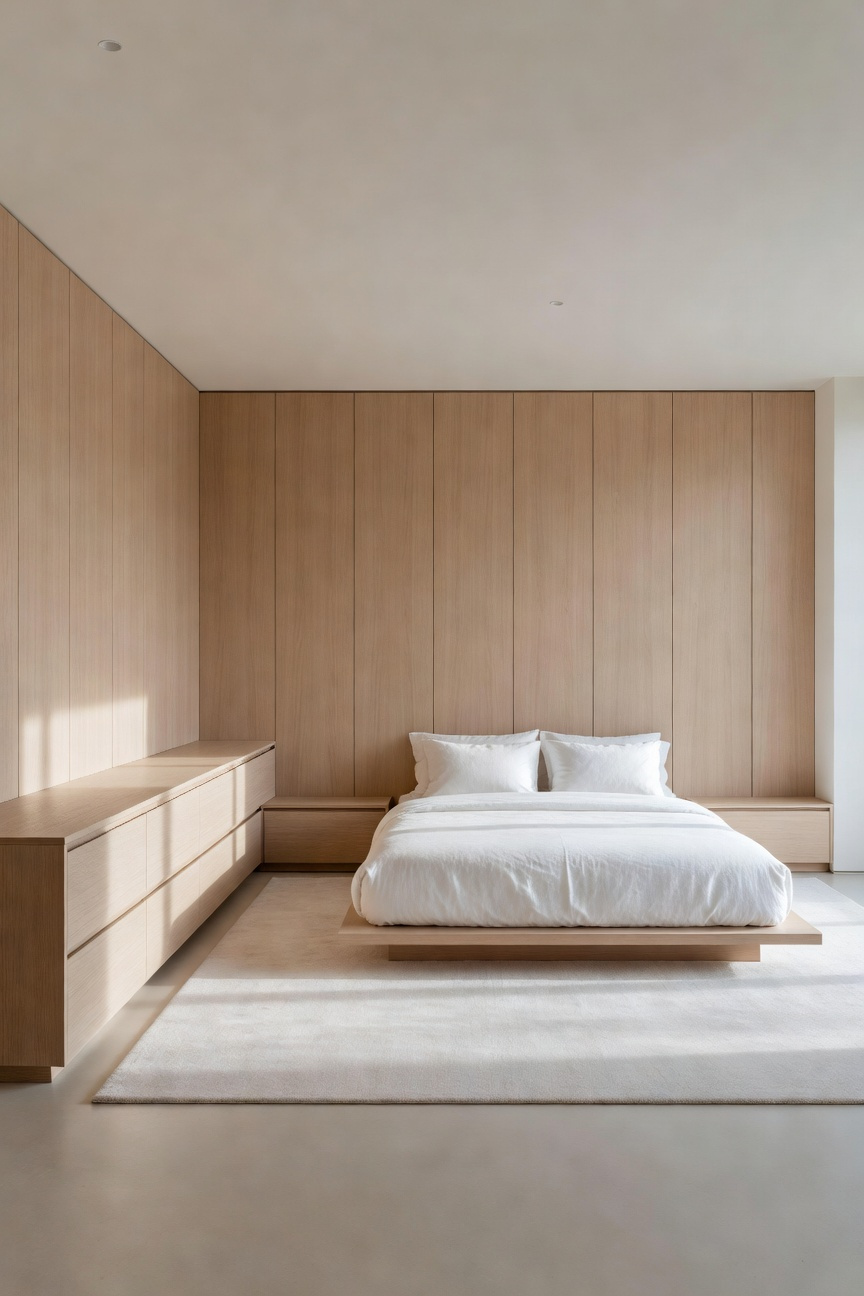
Furthermore, the specific finish of the wood matters immensely. Ideally, choose matte or brushed textures over high-gloss lacquers. High-gloss surfaces create sharp, bright reflections, whereas matte materials softly diffuse light. Therefore, the furniture seems to recede, effectively quieting the room. Additionally, consider the structural footprint of your pieces. Floating nightstands, for example, reveal the floor underneath. Psychologically, seeing uninterrupted floor space signals safety and clarity to our primal instincts. Moreover**, strive to maintain a consistent “horizon line” with your furnishings. When the dresser and nightstand align in height, your eye glides effortlessly across the room, perhaps anchored by Luxurious Bedroom Wallpaper Ideas that emphasize texture over busy patterns. Ultimately, these choices transform a bedroom from a storage space into a true decompression chamber.
5. The Dresser as a Canvas: Implementing the ‘Visual Silence’ Protocol
Your bedroom dresser is more than storage; it is a critical tool for neurological recovery. Specifically, environmental psychology suggests that visual clutter triggers immediate cortisol release. When covered in mail or keys, the brain perceives these items as unfinished tasks. Consequently, this accumulation creates “micro-stressors” right before you attempt to sleep. To counter this, we implement the “Visual Silence” protocol.
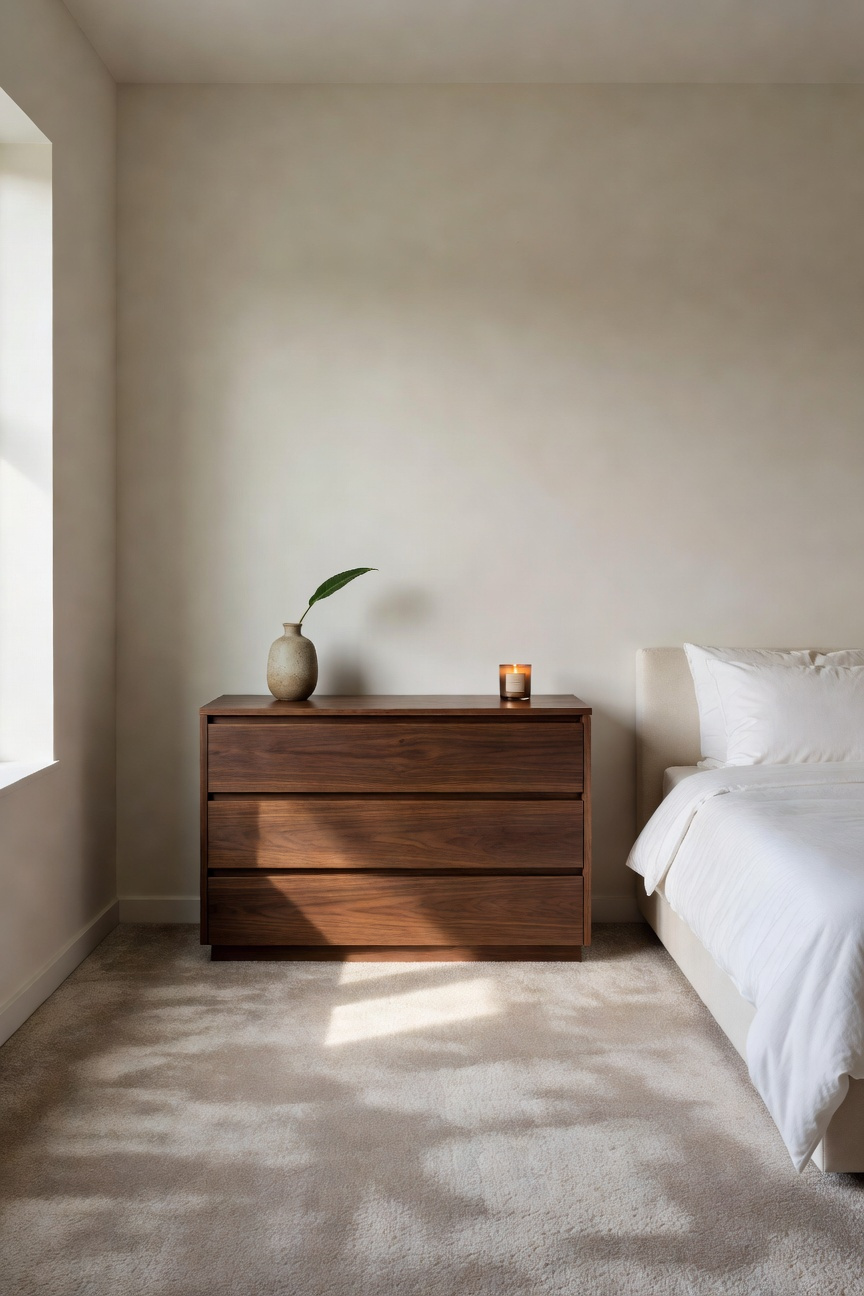
Essentially, this philosophy shifts the dresser from a horizontal utility to a curated canvas. Designers often advocate for the “70/30 Rule” to achieve this balance. Here, 70% of the surface remains deliberately empty to reduce cognitive load. This negative space, known as *Ma* in Japanese aesthetics, allows the eye to rest. Furthermore, the remaining space utilizes an “Anchor, Bridge, and Breath” composition.
Typically, a large round mirror serves as the anchor to ground the vignette. Therefore, avoid sharp angles that increase visual aggression. Additionally, incorporate “bridge” items like a monochromatic vase to connect elements smoothly. Conversely, avoid high-gloss surfaces that reflect distracting light. Instead, choose matte finishes like honed stone or raw wood. In fact, these textures provide a “haptic reset” essential for relaxation. Ultimately, this approach transforms your dresser into a boundary between daily chaos and sleep.
6. Nightstand Minimalism: Curating the ‘Last Sight’ for Sleep Hygiene
In environmental psychology, the nightstand represents the critical “Last Sight” before sleep. Unfortunately, clutter on this surface is never neutral. Research indicates that visual disarray triggers cortisol, the body’s primary stress hormone. Consequently, a messy table creates a high cognitive load. Your brain perceives objects as unfinished tasks or “visual noise.” Therefore, minimalism acts as essential nervous system care. It signals safety to the amygdala, allowing cortisol levels to drop significantly.
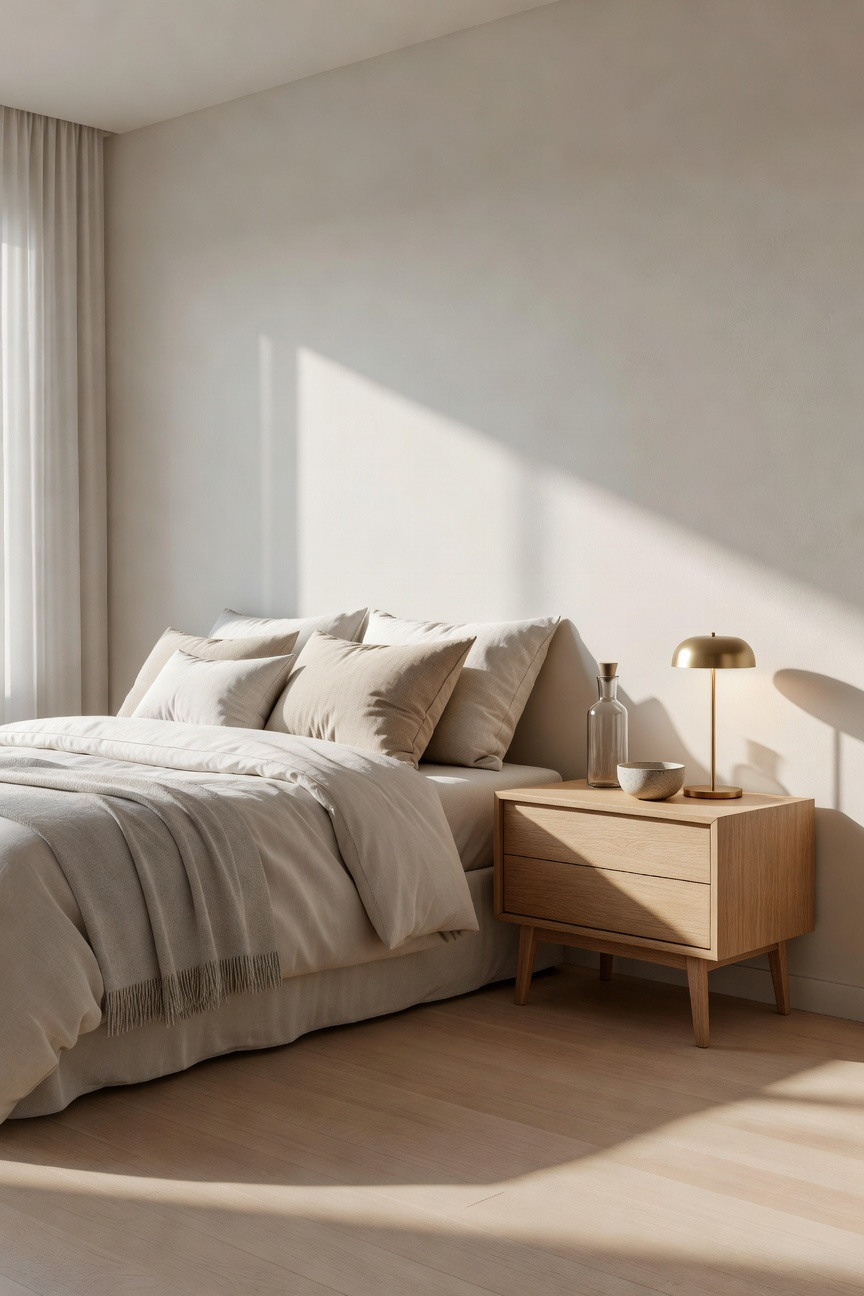
Beyond decluttering, lighting placement dictates biological rhythm. Specifically, overhead lights strike the lower retina, suppressing melatonin production. To counter this, position a single light source low on the nightstand. Ideally, maintain brightness below 50 lux, similar to candlelight. Furthermore, select warm bulbs under 2700K. This mimics the amber tones of a setting sun. Thus, you effectively hack your circadian rhythm for deeper rest.
However, total emptiness can feel cold or sterile. Instead, aim for a “Sensory Signature” to provide psychological safety. For instance, include one tactile object, like a matte ceramic carafe or a small plant. Notably**, natural materials absorb light, whereas glass reflects startle-inducing glare. Ultimately, keep 90% of the surface empty. This negative space visually represents a mind cleared for the night.
7. Wardrobe Wisdom: Integrating Mirrors Without Disrupting Restful Energy
Integrating mirrors into bedroom cabinetry requires a delicate balance between spatial expansion and biological necessity. While reflective surfaces make rooms feel larger, they can inadvertently disrupt a sanctuary’s calm. Biologically, this disruption is significant.
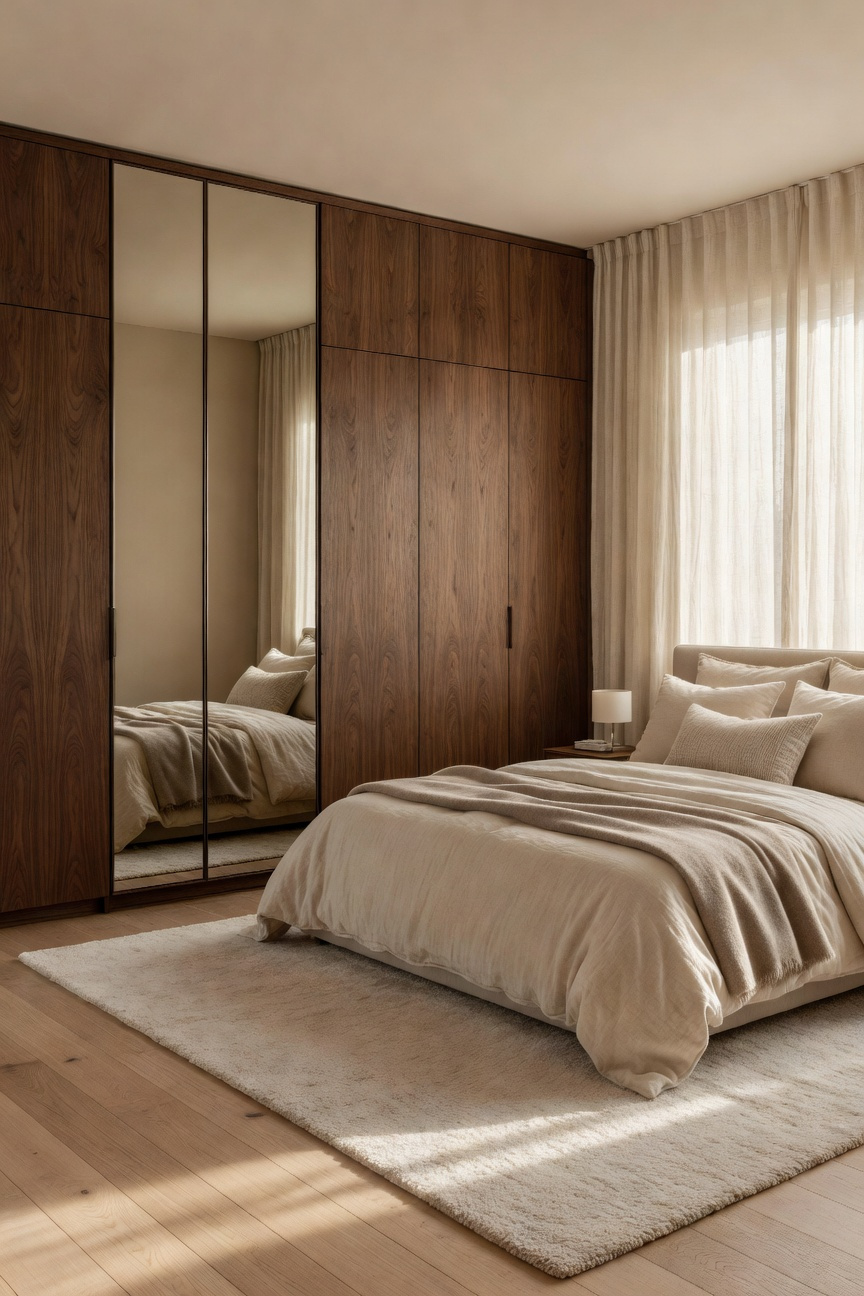
Specifically, the human brain is hard-wired to detect movement in peripheral vision. Consequently, a mirror positioned opposite the bed can trigger “micro-awakenings” whenever you toss or turn. Furthermore, mirrors double the light intensity in a room, potentially suppressing melatonin production. From a Feng Shui perspective, this creates active “Yang” energy. Therefore**, instead of settling, the room’s “Qi” bounces frenetically, hindering deep rest.
To solve this, holistic design often employs “invisible architecture.” Ideally, position the mirror on the interior side of the wardrobe door. This “inner-leaf strategy” keeps the reflective surface concealed while you sleep, effectively “turning off” its energy. However, if external mirrors are preferred, standard clear glass is not your only option.
Instead, consider sophisticated finishes that dampen visual noise. For instance, smoked or bronze-tinted glass absorbs light rather than reflecting it entirely. Similarly, acid-etched “satin” finishes offer a soft, blurred reflection. These textures maintain the feeling of openness but eliminate the jarring “peripheral startle” effect. Ultimately, these choices shift the focus from vanity to well-being, prioritizing a restorative sleep environment over conspicuous display.
8. The 60/40 Rule: Balancing Furniture Mass with Negative Space for Mental Clarity
The 60/40 Rule serves as a foundational principle for establishing interior harmony. Specifically, this guideline dictates filling approximately 60% of a room with furniture while leaving 40% entirely clear. Interestingly, this balance is a functional simplification of the Golden Ratio. Therefore, it provides the human eye with a sense of inherent correctness and calm.
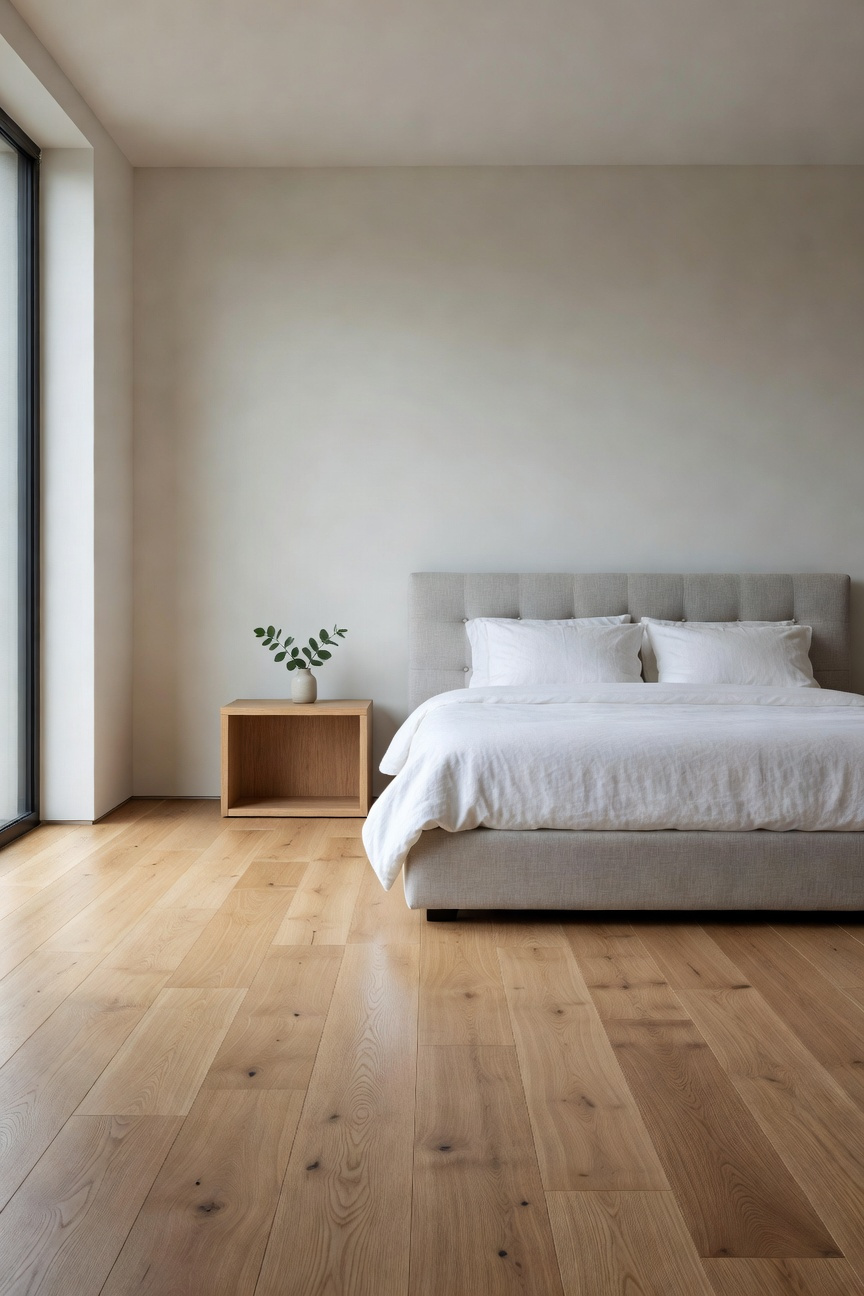
In a bedroom context, this ratio acts as a powerful psychological tool. Consequently, the 40% of negative space creates what psychologists call the “Breathing Room Effect.” Neuro-aesthetic studies suggest this visual void significantly reduces cognitive load. In fact, excessive visual clutter keeps the brain on high alert, scanning for order. Thus, empty space signals your nervous system that it is safe to decompress.
To achieve this authoritative look, focus on mass and sightlines. For instance, ensure the bed acts as a stable visual anchor without dominating the entire floor plan. Furthermore, aim to leave 24 to 42 inches of clear space on either side of the bed. This unobstructed path prevents physical micro-frustrations during your nightly routine.
Ultimately, the goal is balancing physical gravity with visual air. The furniture provides stability, while the negative space offers necessary expansion. By mastering this ratio, you transform a simple sleeping area into a curated vessel for mental clarity.
Section 3: Circadian Rhythms & Sensory Design
While soft blues seem psychologically soothing, they present a biological paradox. Specifically, our circadian sensors are highly sensitive to blue light wavelengths. Consequently, a cool-toned room might trigger alertness rather than rest. To counter this, opt for matte, low-reflectance finishes. These chalky textures absorb ambient light instead of bouncing it into your eyes. Thus, you maintain a “melanopically” dark environment essential for deep sleep.
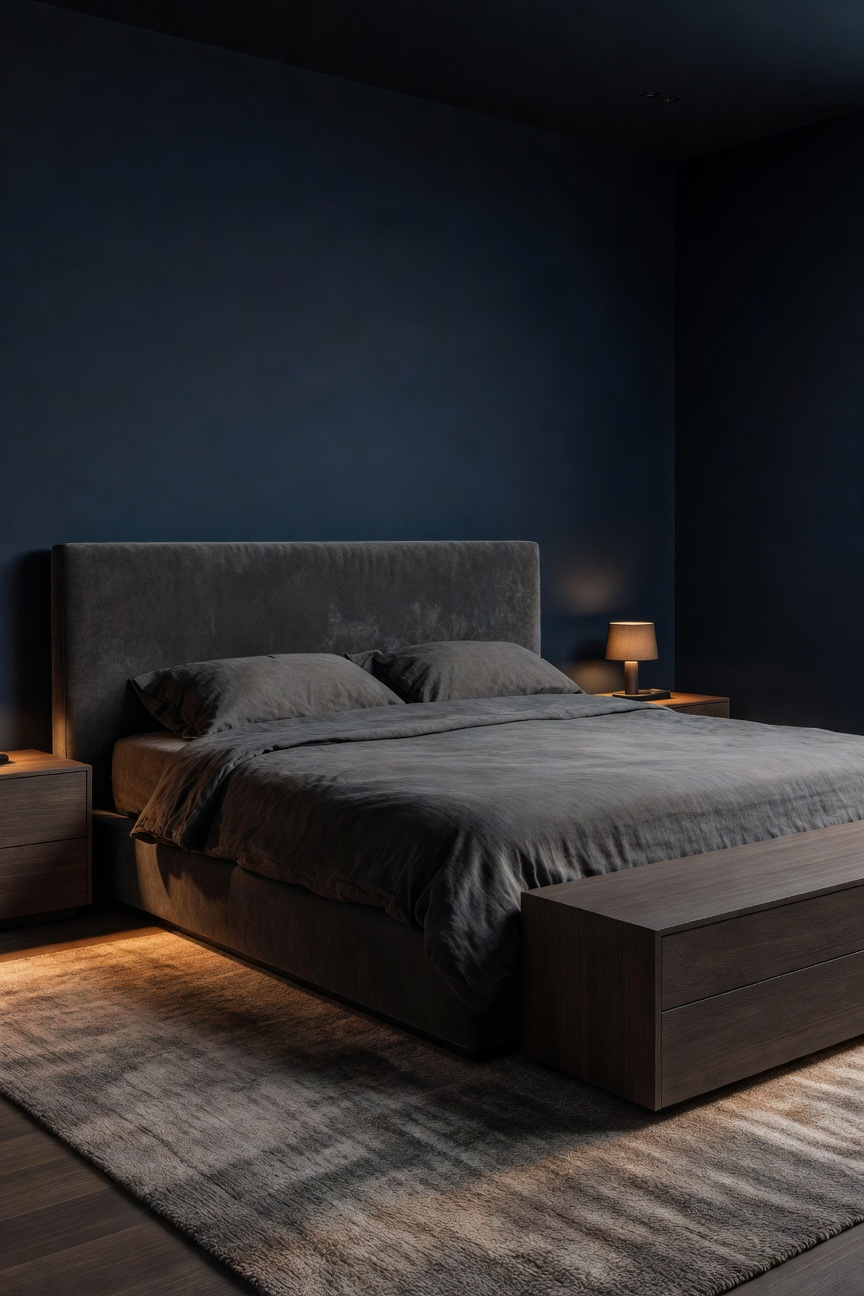
Sensory design also extends to what we touch. Surprisingly, the brain processes tactile stimuli even during slumber. Therefore, the “visual temperature” of materials matters. Smooth, glossy surfaces often feel cold or sterile to the nervous system. In contrast, textured materials like bouclé, jute, or unvarnished wood create warmth. Furthermore, these “grounding” elements lower heart rates by signaling environmental safety.
Finally, consider the acoustic architecture of your furniture. Hard surfaces amplify sudden noises, potentially causing cortisol spikes. Alternatively, upholstered headboards and felt-lined wardrobes act as sound barriers. Ideally, orient your bed toward East-facing windows to capture morning light. However, ensure distinct zones exist. Specifically**, place a reading chair away from the bed to preserve the sleeping area’s sanctity.
9. Lighting Hardware: Choosing Dimmable Sconces to Simulate Sunset
Selecting bedroom sconces involves much more than simply adjusting brightness levels. In fact, true well-being requires orchestrating a “circadian transition.” Standard LED dimming often merely reduces intensity, creating a static, gray effect. Consequently, this disrupts the feeling of comfort defined by the Kruithof Curve. To fix this, you must specify “Dim-to-Warm” technology. Specifically, these fixtures shift from a crisp 3000K down to a candlelight-like 1800K as they dim. This drastic drop mimics the natural “golden hour.” Therefore, it signals the pineal gland to begin melatonin production.
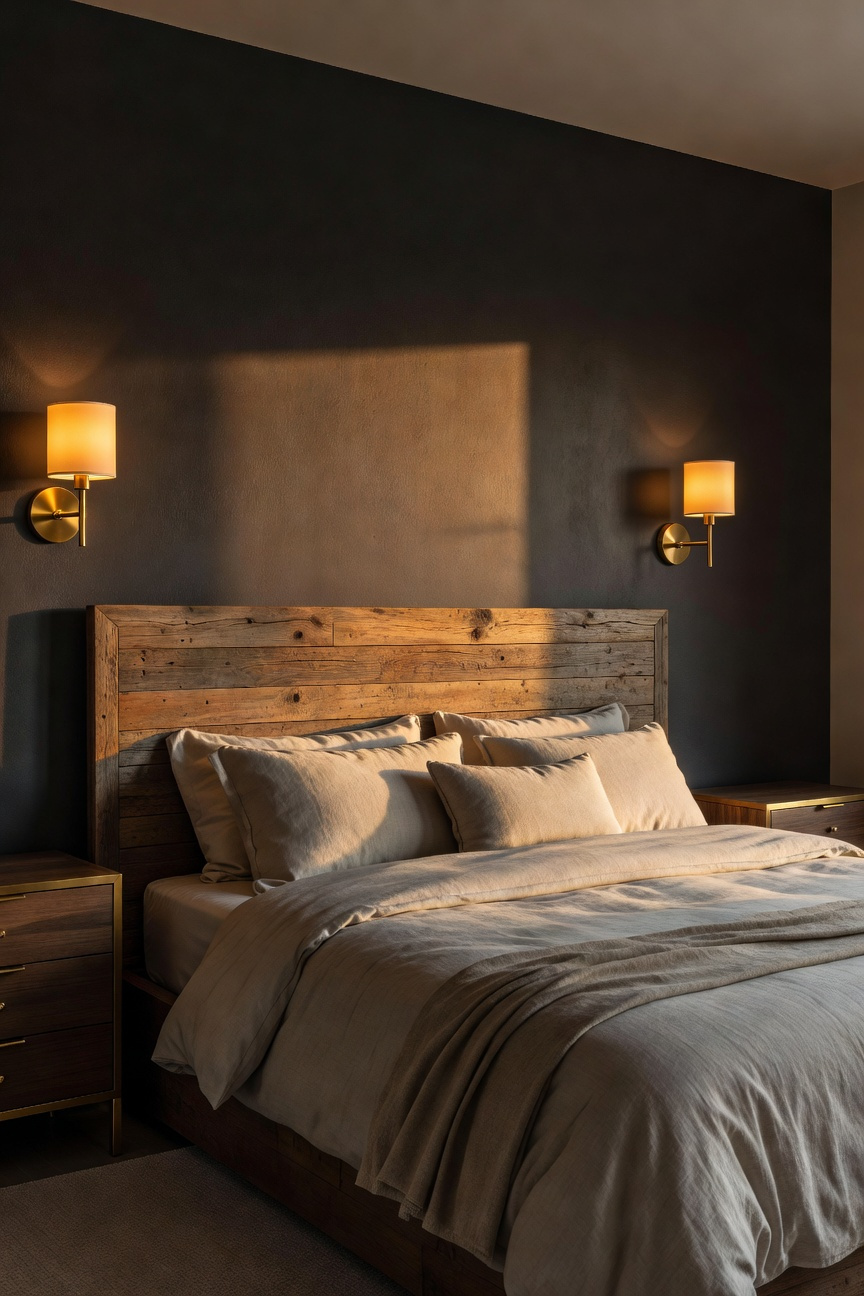
Beyond the bulb, the fixture’s material acts as a critical filter. For instance, unlacquered brass or polished copper interiors serve as warm secondary reflectors. When light hits these metals, it picks up soothing orange hues before reaching the room. Additionally, many designers utilize smoked or amber Murano glass. These materials act as diffusers, transforming sharp beams into a hazy, atmospheric glow. Ultimately, this softens the illumination to resemble sunlight filtering through atmospheric dust.
Finally, consider how the light interacts with your room’s surfaces. As rooms darken, our eyes shift sensitivity via the Purkinje Effect. To counteract this, position sconces for indirect wall-washing rather than direct down-lighting. By bouncing warm light off a textured wall, you create a radiant surface area. However, ensure you install ELV dimmers to prevent flickering at low levels. Reliable systems like Lutron allow for a smooth logarithmic fade. Thus**, you create a seamless, flicker-free transition into a restorative night’s rest.
10. Analog Pause Points: Incorporating a Reading Chair for Digital Detox
In modern bedroom design, the bed has unfortunately become a multi-use hub for digital consumption. Consequently, this habit creates “Sleep-Wake State Confusion,” where the brain associates the mattress with stimulation rather than rest. To counteract this, we introduce the reading chair as a deliberate “Environmental Anchor.” Specifically, moving just 48 inches away from the bed creates a vital neurological boundary. This separate seating area acts as a “decompression chamber” between the high-velocity digital day and restorative sleep.
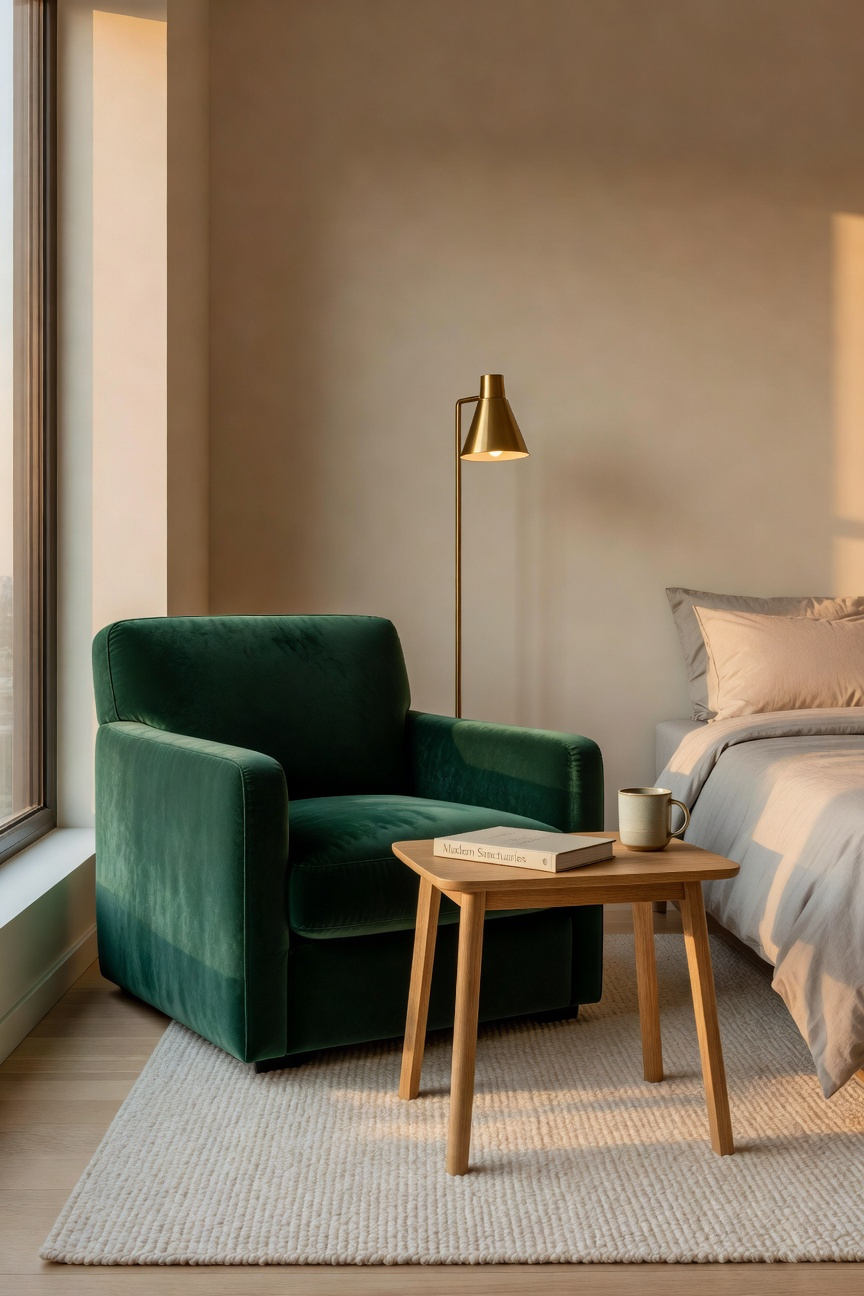
However, selecting the right furniture requires an understanding of “Active Ergonomics.” Unlike the living room sofa, which encourages slumping, a bedroom chair should support focused relaxation. For instance, the historical Wingback chair is ideal because its sides physically block peripheral distractions. This structure creates a sensory cocoon, shielding your eyes from the glow of charging devices.
Furthermore, the “Digital Detox” experience relies heavily on tactile feedback. Unlike the cold, flat glass of a smartphone, we prioritize “Haptic Contrast” through texture. Therefore**, designers often specify rich fabrics like bouclé or tweed to provide necessary “sensory grounding.” This tactile richness combats digital fatigue by rooting the user in the physical world.
Finally, lighting defines this analog space. Instead of brightening the whole room, utilize a dedicated lamp to create a warm “pool of light.” Ideally, this light should be in the low-Kelvin range to protect your circadian rhythm. Ultimately, this visual isolation invites deep focus, allowing the “Analog Self” to return before sleep.
11. Tactile Therapy: Layering Bouclé, Linen, and Wool for Parasympathetic Activation
In the modern bedroom, “Tactile Therapy” functions as a deliberate neurobiological intervention. Specifically, designers layer bouclé, linen, and wool to create a “sensory safety net.” This strategic combination actively signals the brain to shift states. We transition from high-alert sympathetic stress to parasympathetic rest.
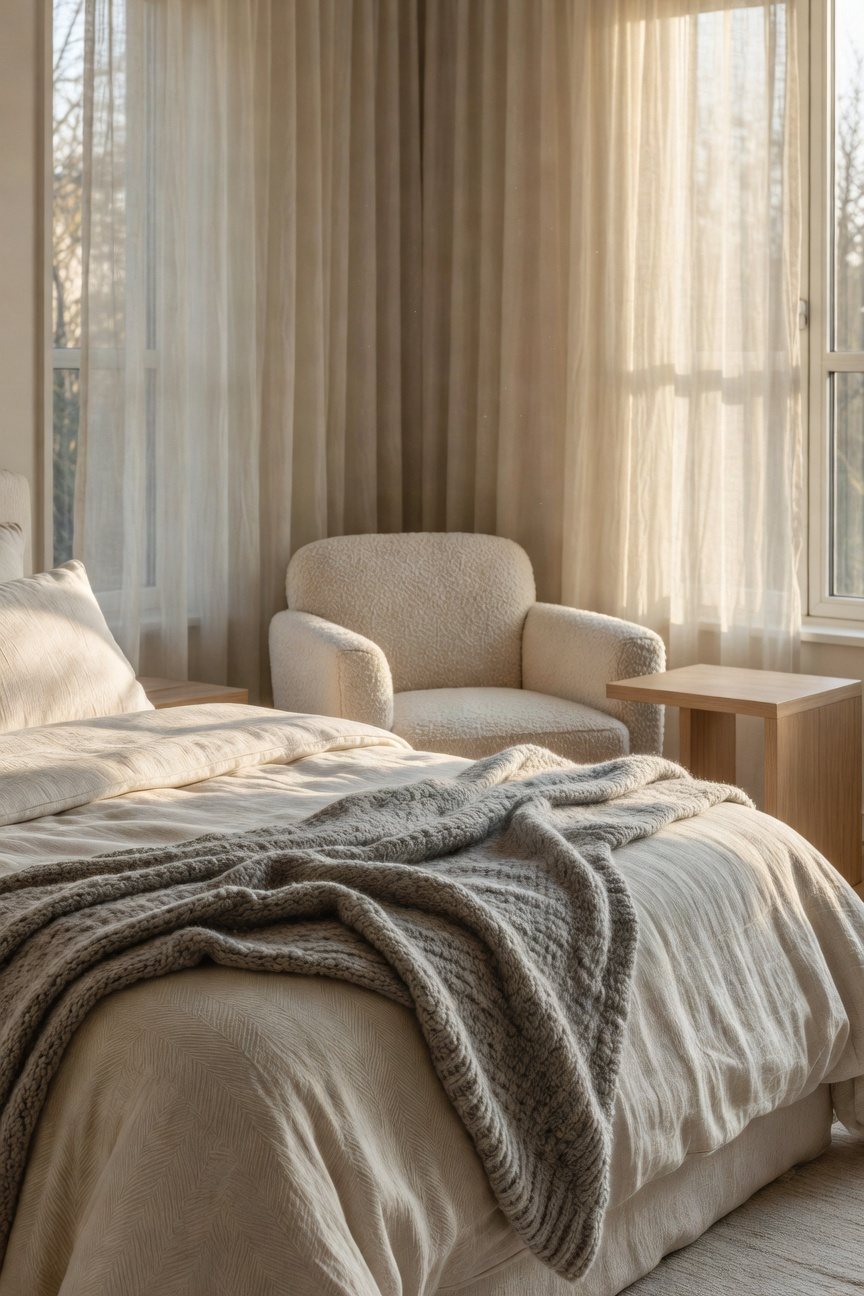
The science lies in our skin’s mechanoreceptors. When we touch the irregular nodules of bouclé, we stimulate the vagus nerve. Consequently, this interaction lowers heart rate and blood pressure. Furthermore, heavy wool provides Deep Pressure Stimulation (DPS). Similar to a weighted blanket, this “physical anchor” boosts serotonin and oxytocin. It mimics the “womb effect,” offering a psychological sense of being cocooned.
Interestingly, the visual impact is equally potent. Unlike shiny synthetics, matte textures like wool and bouclé absorb light. Therefore, they reduce “visual noise” and glare. This softness signals to the circadian rhythm that the environment is quiet. Thus, the analytical mind can finally shut down.
However, texture must not compromise thermal regulation. Heavy fabrics can sometimes trap too much heat. Ideally, you should layer crisp linen directly against the skin. Linen’s hollow flax fibers wick moisture effectively. By placing wool or bouclé on top, you maintain a breathable microclimate. This creates a thermal equilibrium around 65°F. Ultimately, this mix blends “high-fashion” heritage with elemental comfort, keeping the body grounded in a peaceful present.
12. Acoustic Softening: Using Rugs and Upholstered Benches to Dampen Sound
Rugs and upholstered benches serve a vital purpose beyond simple aesthetics. In fact, they are essential tools for “acoustic softening.” Specifically, this design strategy targets the psychoacoustics of your sleeping environment to foster tranquility. When sound waves strike hard surfaces, they typically bounce back instantly, creating echoes. Conversely, porous materials like wool trap these vibrations within a labyrinth of fibers. Consequently, kinetic energy converts into microscopic thermal energy, effectively silencing the noise.
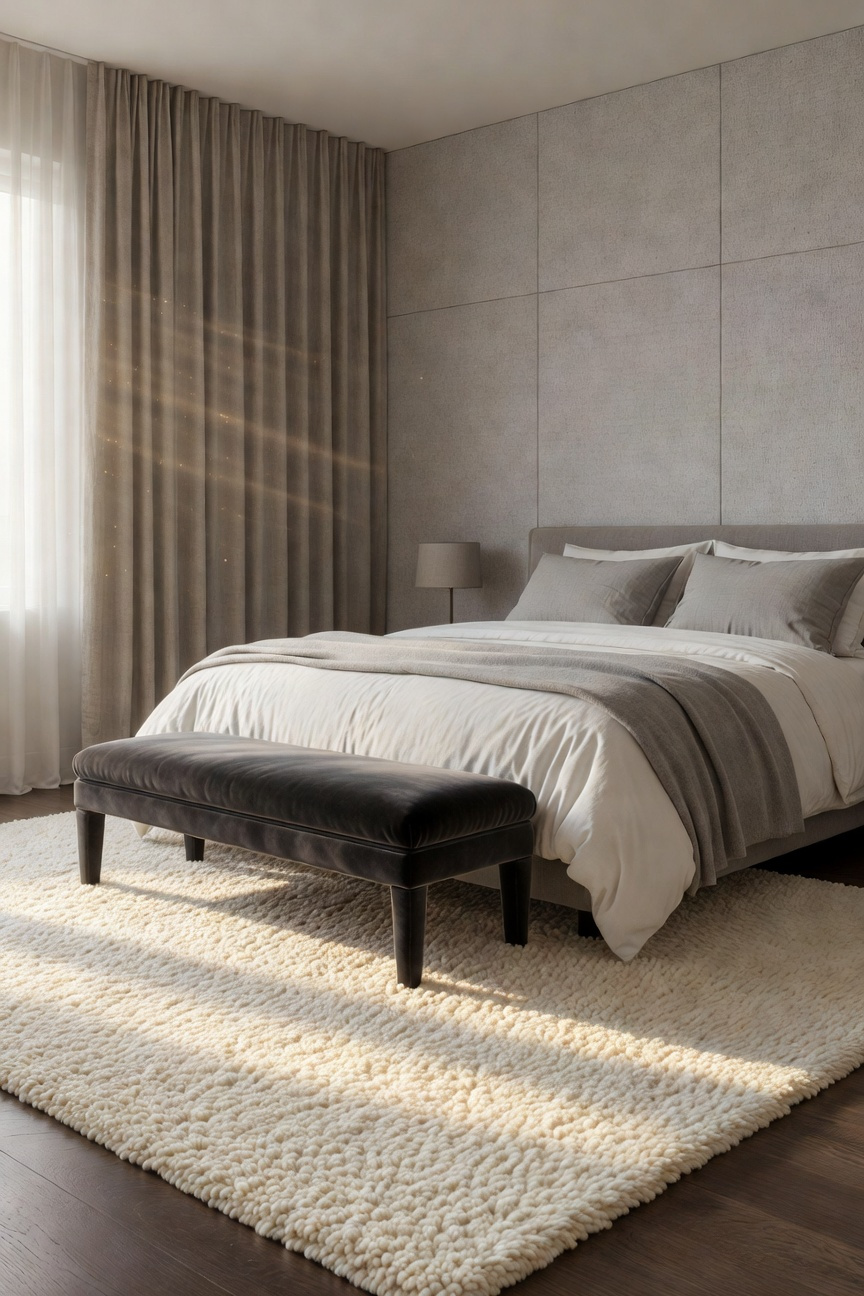
To achieve true restorative silence, you must address two distinct types of disturbance. For instance, a high-pile rug manages impact noise by decoupling footsteps from the floor structure. Meanwhile, an upholstered bench at the foot of the bed tackles airborne frequencies. Essentially, these pieces act as “mass-loaded barriers” that absorb speech or hallway sounds before they reach you. Furthermore, hollow storage benches can even function as accidental bass traps for low-frequency hums.
Ultimately, layering these textures reduces the room’s reverberation time. As a result, the space feels intimate and safe rather than hollow. Scientifically, this “dry” acoustic environment significantly lowers cortisol levels. Therefore, soft furnishings are not just decor; they are instruments for deep, restorative sleep.
Section 4: Biophilic Integration
Biophilic integration extends far beyond simply placing a potted plant on a nightstand. In reality, it involves aligning your bedroom decor with your body’s evolutionary biology. Consequently, this thoughtful approach turns furniture into a restorative tool.
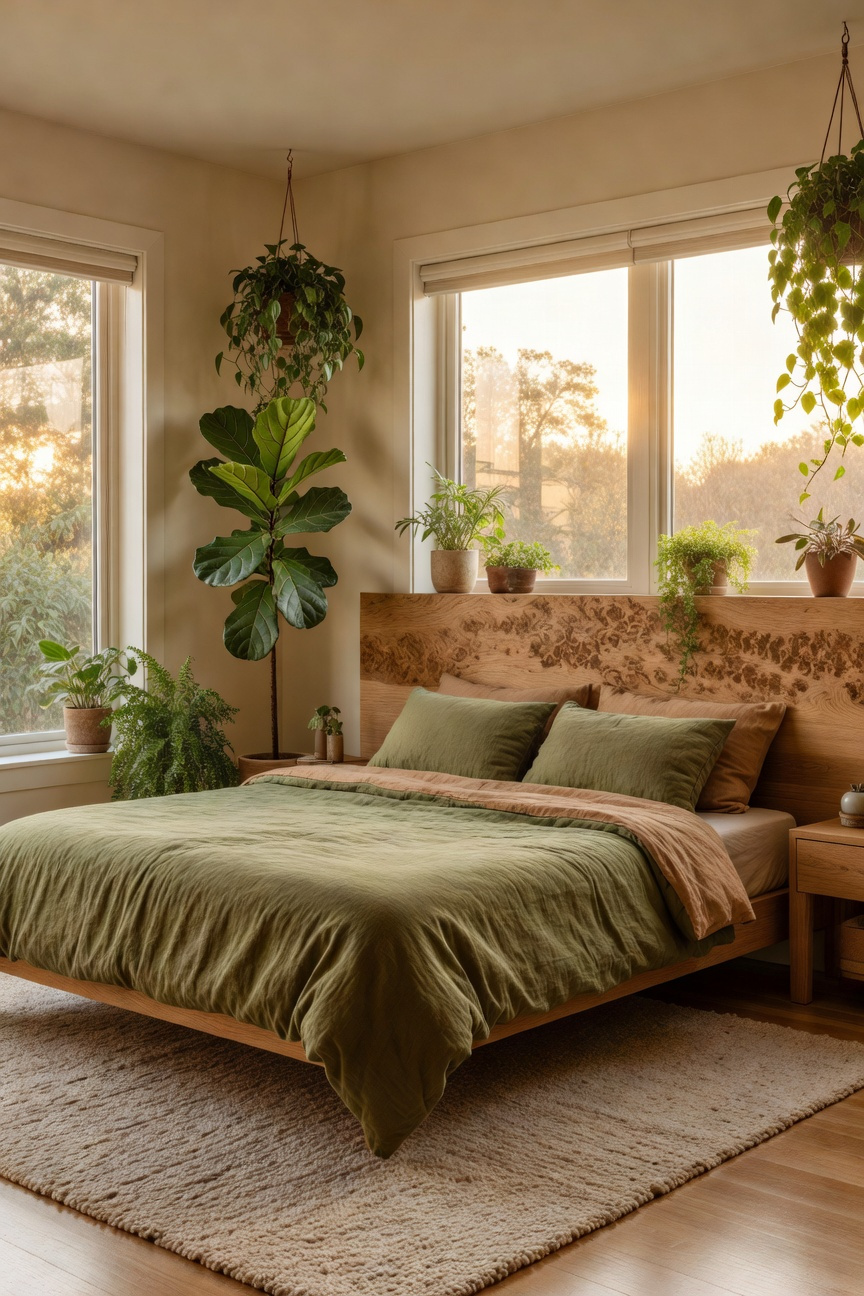
Specifically, the human eye craves “fractal fluency.” For instance, the complex grain of an oak headboard mimics natural patterns like clouds. Remarkably, seeing these organic textures can reduce physiological stress by up to 60%. Therefore, select furniture with visible, intricate wood grains rather than flat, synthetic finishes. As a result**, your brain naturally enters a relaxed alpha state.
Furthermore, the total volume of wood matters immensely. According to research, increasing wood coverage to 90% significantly lowers heart rates. Essentially, drowning the space in timber mimics a calming “forest bath.” Thus**, consider adding wood paneling alongside your bed frame for total physiological downshifting.
Simultaneously, your bed must serve as a primal sanctuary. Historically, humans seek “refuge,” or spaces where they feel hidden yet safe. To achieve this, choose high-back or winged upholstered headboards that wrap slightly around the sleeper. Instantly, this signals safety to the brain’s fear center, allowing for deeper rest.
Finally, prioritize “circadian choreography” through lighting placement. Ideally, use low-Kelvin, amber lamps on nightstands to mimic the soothing tones of a sunset. Conversely**, position the bed to catch natural morning light. Ultimately, these choices synchronize your internal clock for optimal sleep health.
13. The Oxygenated Corner: Styling Plant Stands for Air Quality and Calm
Designing an “Oxygenated Corner” transforms greenery from simple decor into functional sleep architecture. In fact, this approach regulates your nervous system through deliberate styling choices. Specifically, consider the unique biological “night shift” of CAM plants like Sansevieria. Unlike most species, these plants keep their stomata open to release oxygen after dark. Therefore, position a multi-tiered walnut stand at headboard height. Consequently, you create a direct “breathe zone” for this biological air exchange.
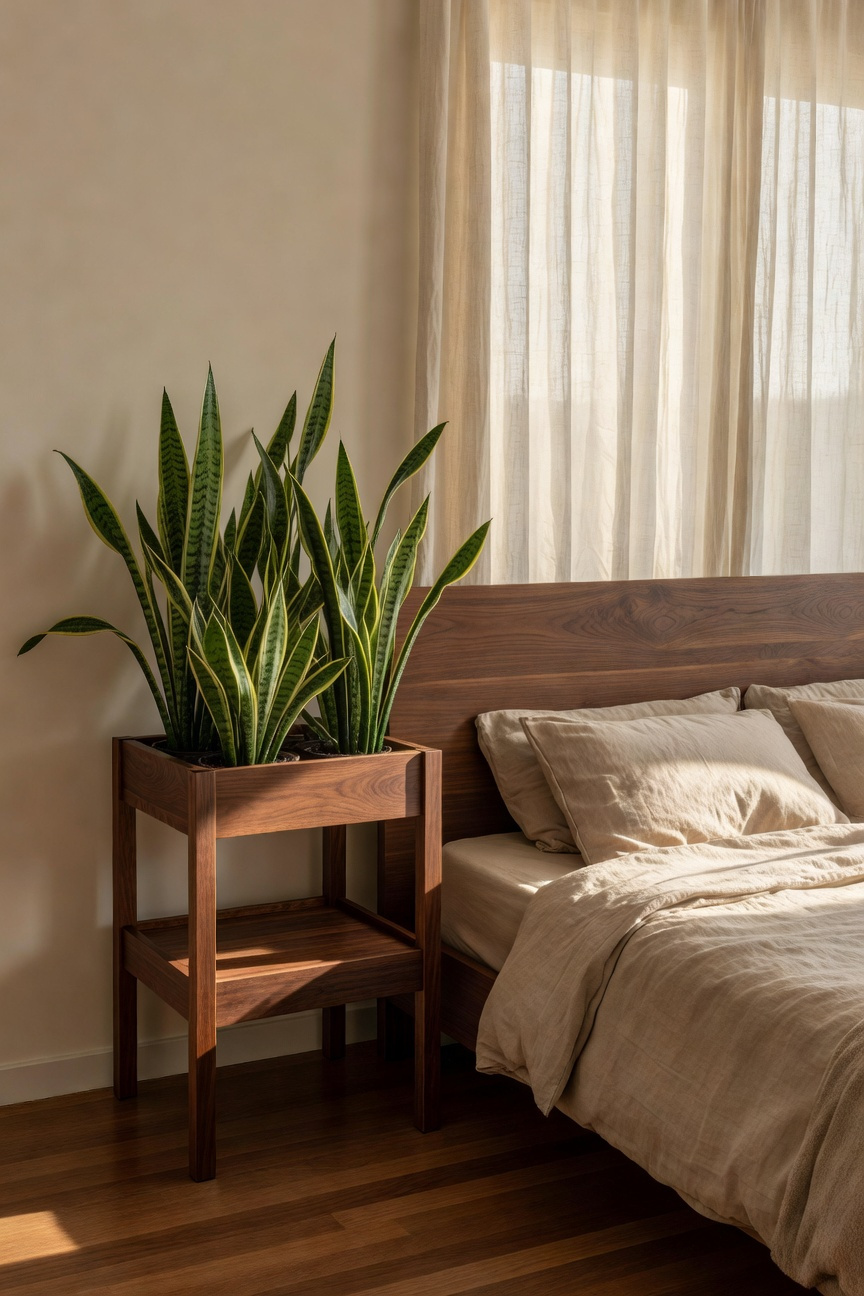
Moreover, this arrangement utilizes “soft fascination” to soothe the mind before sleep. Gazing at the natural fractal patterns of leaves effectively lowers cortisol levels. To enhance this, pair a tactile rattan stand with waxy Rubber Tree leaves. This sensory contrast invites the eye to linger without causing mental fatigue. Historically, Victorians used stands to protect ferns from coal soot. Today, however, we require protection from digital pollution. Thus**, a minimalist metal stand creates a necessary visual buffer against blue light.
Additionally, you should address the olfactory dimension of sleep hygiene. Place a Jasmine plant on a low marble pedestal. Because Jasmine releases scent cyclically at night, it promotes deep, restorative sleep. Furthermore**, place these plants on a pebble tray filled with water. As the water evaporates, it creates a micro-climate of beneficial humidity. Ultimately, these layers turn a simple corner into a holistic sanctuary.
14. Natural Geometries: Introducing Curved Furniture to Soften Architectural Angles
Modern life is often defined by rigid, boxy environments. Consequently, integrating curved furniture acts as a deliberate “de-programming” of this architectural harshness. Surprisingly, this preference for softness is biologically hard-wired. Specifically, neuro-aesthetic studies show that sharp angles activate the amygdala, the brain’s threat detector. Conversely, curvilinear forms naturally activate our internal pleasure-processing centers. Thus, a rounded headboard signals to the nervous system that the space is safe. This biological response allows cortisol levels to drop, efficiently easing the transition into sleep.
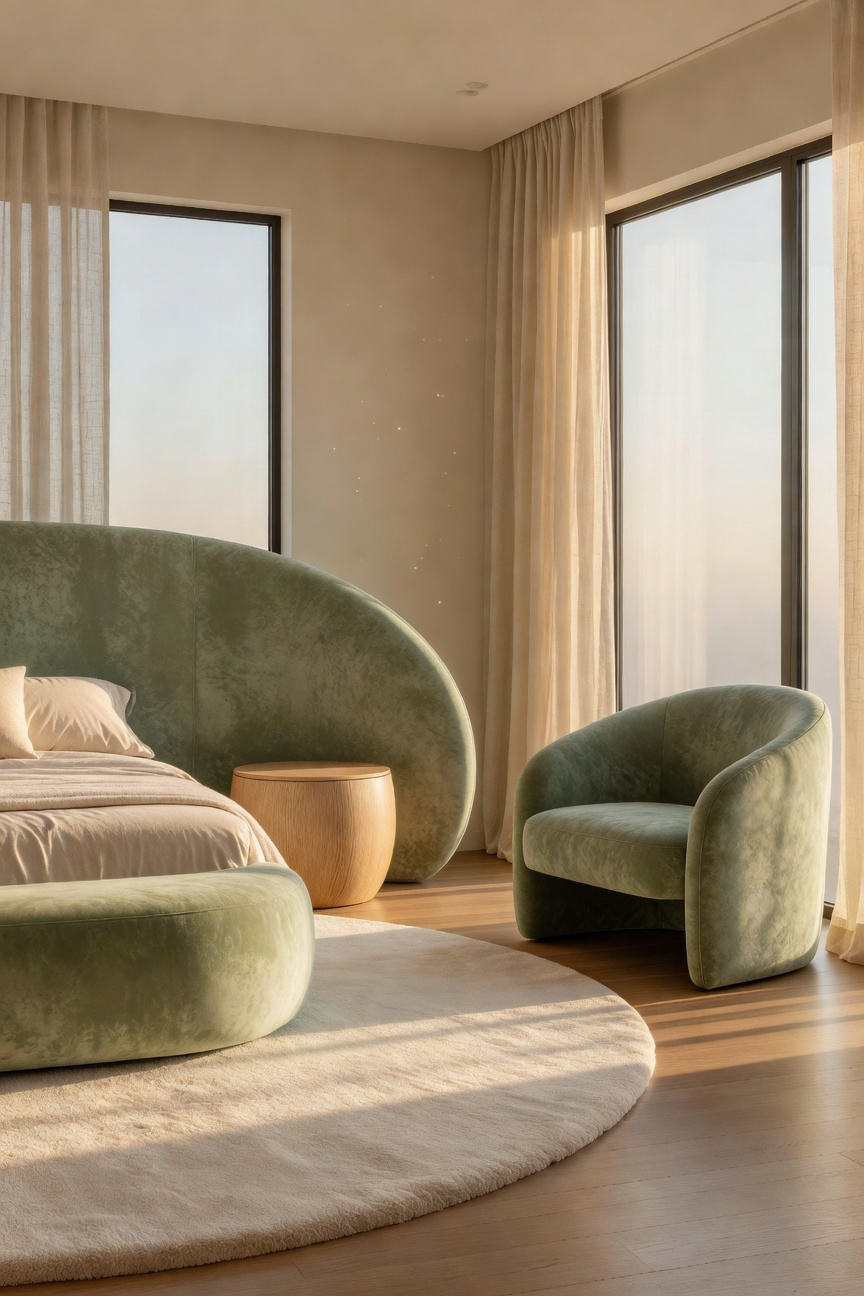
Beyond biology, the craftsmanship itself contributes to this sense of calm. For instance, steam-bent wood preserves the continuous grain, creating silhouettes that are physically strong yet visually fluid. Furthermore, these smooth surfaces are perceived as “thermally warmer” than flat materials, inviting soothing tactile exploration.
However, successful design requires careful calibration to avoid visual chaos. Therefore**, experts typically recommend a strict 60/40 balance. Essentially, keep sixty percent of the room linear to provide necessary architectural stability. Then, introduce soft, organic geometries with the remaining forty percent. Ultimately, this dynamic tension transforms a mere sleeping area into a restorative psychological sanctuary.
15. Chromotherapy Anchors: Selecting Furniture Tones that Support Melatonin Production
Chromotherapy treats furniture as a “spectral anchor.” It physically dictates the light quality reflected into your eyes before sleep. Interestingly, a nuance exists regarding the color blue. While blue light actively suppresses melatonin, blue pigments in furniture often lower heart rates. However, not all blues act the same. Specifically, designers favor muted, desaturated shades like slate or indigo. These tones function as a “sink.” They effectively absorb high-energy photons from ambient sources instead of reflecting them. Consequently, they support the brain’s master clock better than bright, saturated hues. For those seeking drama and depth, a Black Bedroom Aesthetic can provide a powerful anchor for melatonin production when executed with matte finishes.
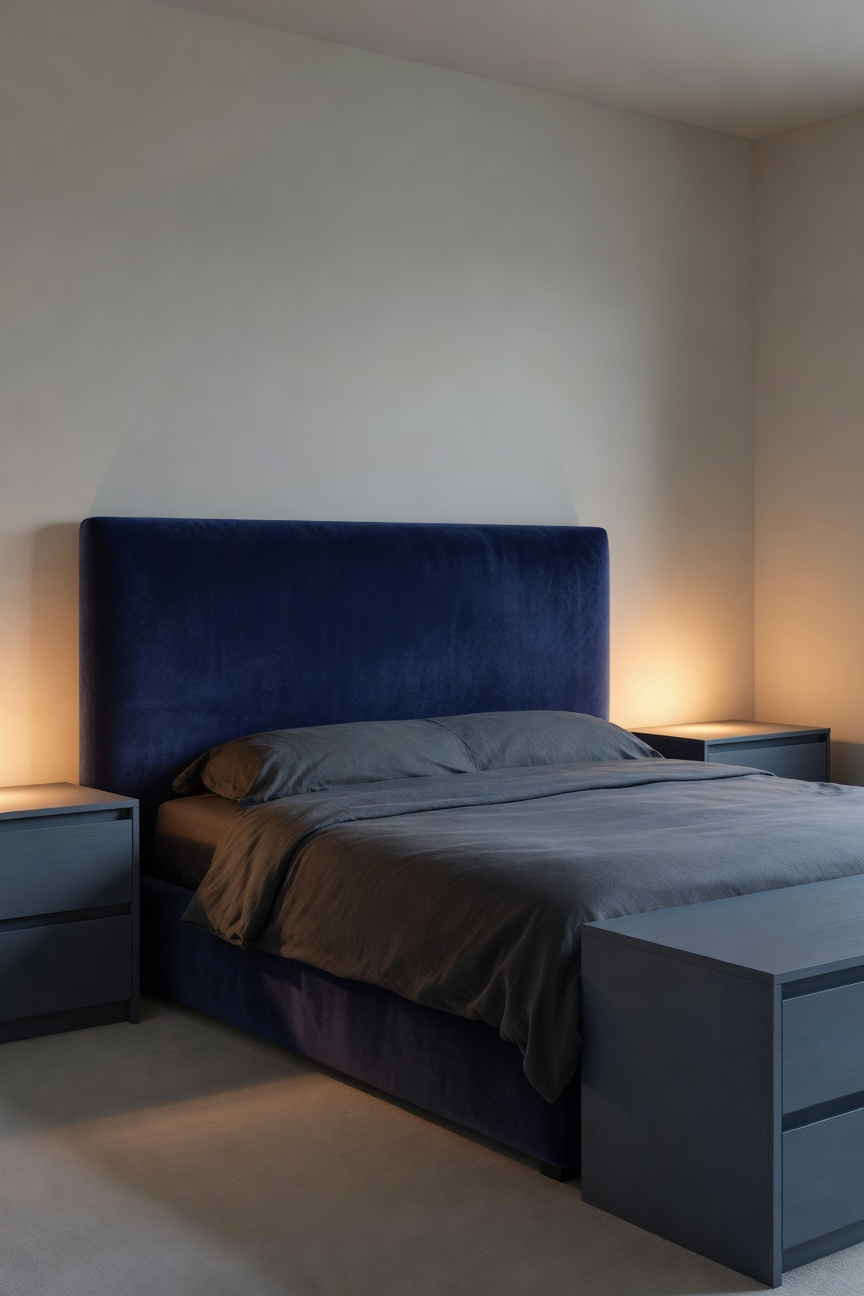
Furthermore, your choice of wood acts as a light-absorption filter. Darker woods, such as walnut or mahogany, serve as excellent biological anchors. Historically, these were favored in the 19th-century for their high absorption of blue-green wavelengths. By reflecting only warm, amber tones, they nurture the body’s sleep signals. Conversely, lighter woods like oak are biologically “alerting” due to higher reflectance. Therefore**, if you prefer light wood, always select matte finishes. Unlike high-gloss lacquers that mirror disruptive light, natural waxes scatter light diffusely, preventing sharp glares.
Finally, texture enhances this effect through “tactile chromotherapy.” Upholstered items, particularly headboards in terracotta linen or sage velvet, provide essential sensory grounding. Because the irregular fabric surface traps photons, it dampens visual energy. This “visual weight” helps the brain transition from active scanning to passive rest. Ultimately, selecting a low-energy anchor signals safety to the parasympathetic nervous system, allowing melatonin production to flourish naturally.
Frequently Asked Questions
How do I choose bedroom furniture decor for better sleep?
To optimize sleep, focus on “visual silence.” Choose furniture with matte finishes and integrated storage to reduce clutter. Prioritize natural, untreated woods and organic fibers which lower cortisol levels and support a restorative environment.
What is the best layout for luxury bedroom furniture?
The “Command Position” is widely considered the best layout for security and rest. This involves placing the bed diagonally across from the door. Ensure a solid headboard is against a sturdy wall. This allows a clear view of the entrance without being directly in its path.
How do natural materials affect bedroom atmosphere?
Natural materials like oak, linen, and wool introduce “fractal fluency” into the room. This has been shown to reduce physiological stress by up to 60%. These materials also manage thermal regulation and acoustic vibrations better than synthetic alternatives.
Conclusion: From Sleeping to Restoring – The Holistic Shift
Ultimately, the bedroom has evolved beyond a mere functional compartment. In fact, it is now an active instrument for physical recovery. We no longer simply decorate for aesthetics; rather, we design for nervous system regulation through high-end bedroom furniture decor. By layering tactile materials and biomorphic forms, we signal deep safety to the brain. Therefore, the modern sanctuary transforms from a passive space into a dynamic healing environment. This holistic shift bridges the gap between sophisticated design and essential biology.
Looking ahead, your home must serve as an antidote to daily overstimulation. Consequently, future choices should prioritize the nervous system over fleeting visual trends. Imagine a space that actively orchestrates your rest through light, sound, and touch. To begin, audit your current environment for sources of hidden “visual friction.” Specifically, assess whether your textures soothe or if lighting disrupts your natural rhythm. Finally, embrace this era of “restoring” to cultivate a home that truly nurtures you.