
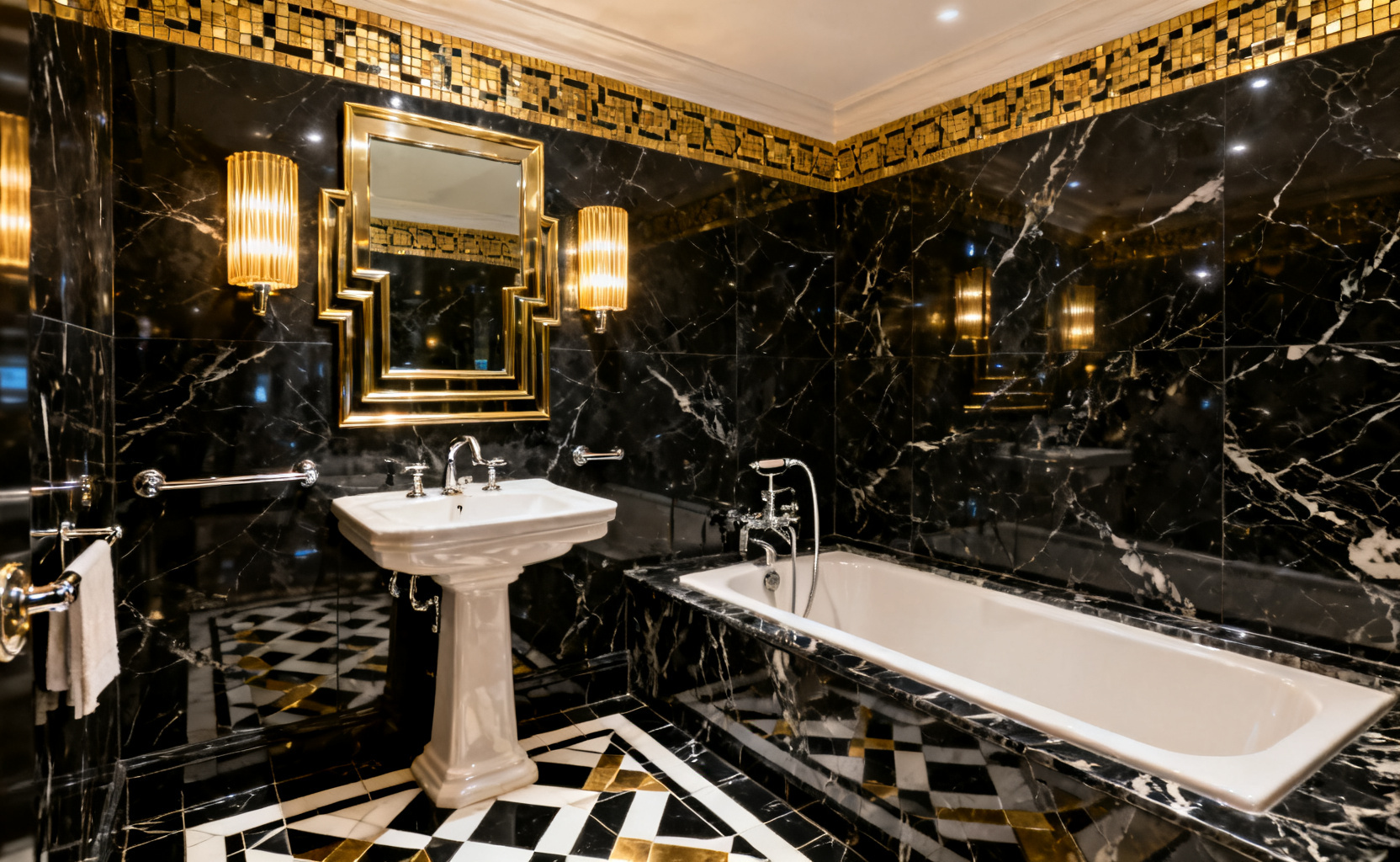
Design wisdom often insists bathrooms must remain understated. For decades, minimalism dominated with plain white tiles and neutral palettes. Consequently, this created sterile spaces devoid of character. However, a significant cultural shift is now dismantling this restrictive belief. The pursuit of sophisticated luxury finds its perfect expression in the revival of the art deco bathroom. This powerful design philosophy replaces reserved safety with unapologetic glamour. Indeed, it transforms the space into a true sanctuary of indulgence.
The Art Deco style is returning as a powerful force. This revival mirrors the profound optimism of the original Roaring Twenties. It effectively replaces ‘greige’ safety with distinct joy. Furthermore, this approach transforms the bathroom into a sanctuary of true indulgence. The style relies on high-shine materials to create necessary drama. For instance, polished chrome and luminous marble replace flat, matte finishes. Additionally, theatrical lighting acts as architecture rather than simple utility. Therefore, this look demands a fearless rejection of the ordinary.
This guide explores the essential components of this opulent resurgence. First, we analyze the sensory impact of contrasting black and gold palettes. Next, we detail how to utilize geometric lines for controlled ornamentation. You will learn to integrate sunburst motifs and stepped forms effectively. Moreover, we discuss the transition from traditional nickel to modern stainless steel. Furthermore, we explain how symmetry prevents the design from becoming chaotic. Finally, this article demonstrates how to embrace maximalism with elegant precision.
Philosophy: Why ‘Too Much’ is Never Enough in Art Deco
The maxim “too much is never enough” sits at the heart of Art Deco design. However, this approach is not about creating haphazard clutter. Instead, it signifies a “controlled abundance” rooted in historic optimism. The style rejected Victorian fussiness in favor of a sleek, wealthy future. Therefore, every surface in an Art Deco bathroom must gleam with intention.
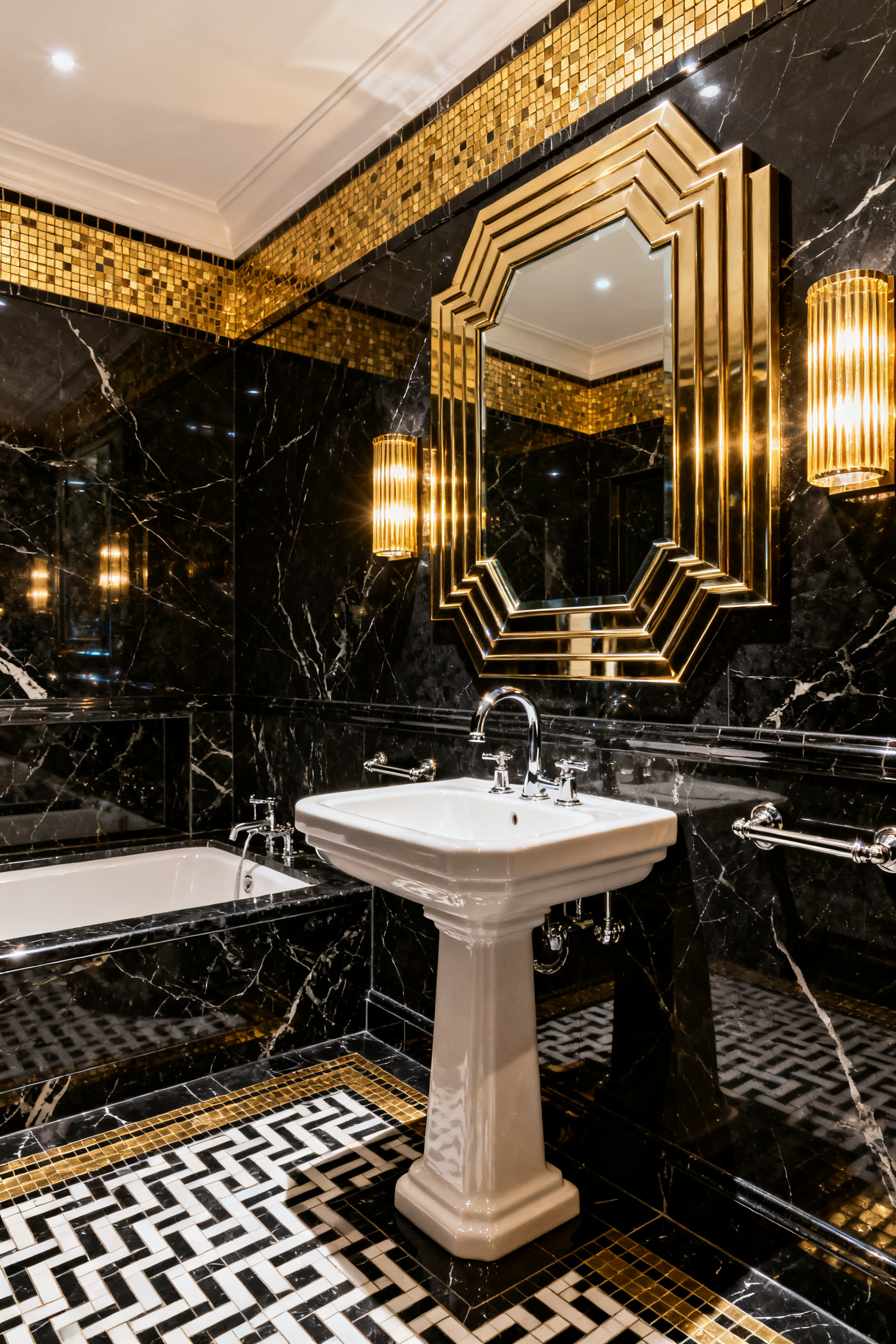
Specifically, true opulence emerges from a daring contrast of materials. Designers fearlessly blend industrial machine-age chrome with exotic, rare textures like shark skin or deep lacquered ebony. Consequently, a simple vanity cabinet transforms into an exquisite jewel box. Furthermore, mirrors act as essential architectural tools. By utilizing reflective glass and polished metals, the space visually doubles its own glamour. Thus, the room becomes a dazzling environment that spotlights the owner’s taste.
In addition, this philosophy fundamentally redefines the bathroom’s purpose. It is no longer just a utility space. Rather, it becomes a theatrical sanctuary for personal rituals. For instance, luxury layouts might include a comfortable chaise-lounge. Moreover, lighting acts as the dramatic centerpiece. Crystal chandeliers scatter light across bold emerald tiles to create high drama. Finally, geometric repetition ties these lavish elements together. Layered sunbursts ensure the excess feels engineered and perfect. Ultimately, this structured maximalism proves that more is indeed more.
1. The Sunburst Motif: Wallcoverings That Demand Attention
The sunburst motif transcends simple pattern. In fact, it functions as a concentrated symbol of the Art Deco era’s philosophy. Fundamentally, these radiating lines represent energy, vitality, and modern dynamism. Historically, this design echoes the grand scale of architecture, such as the Chrysler Building’s iconic crown. Therefore, introducing this motif transforms a functional space into a theatrical statement.
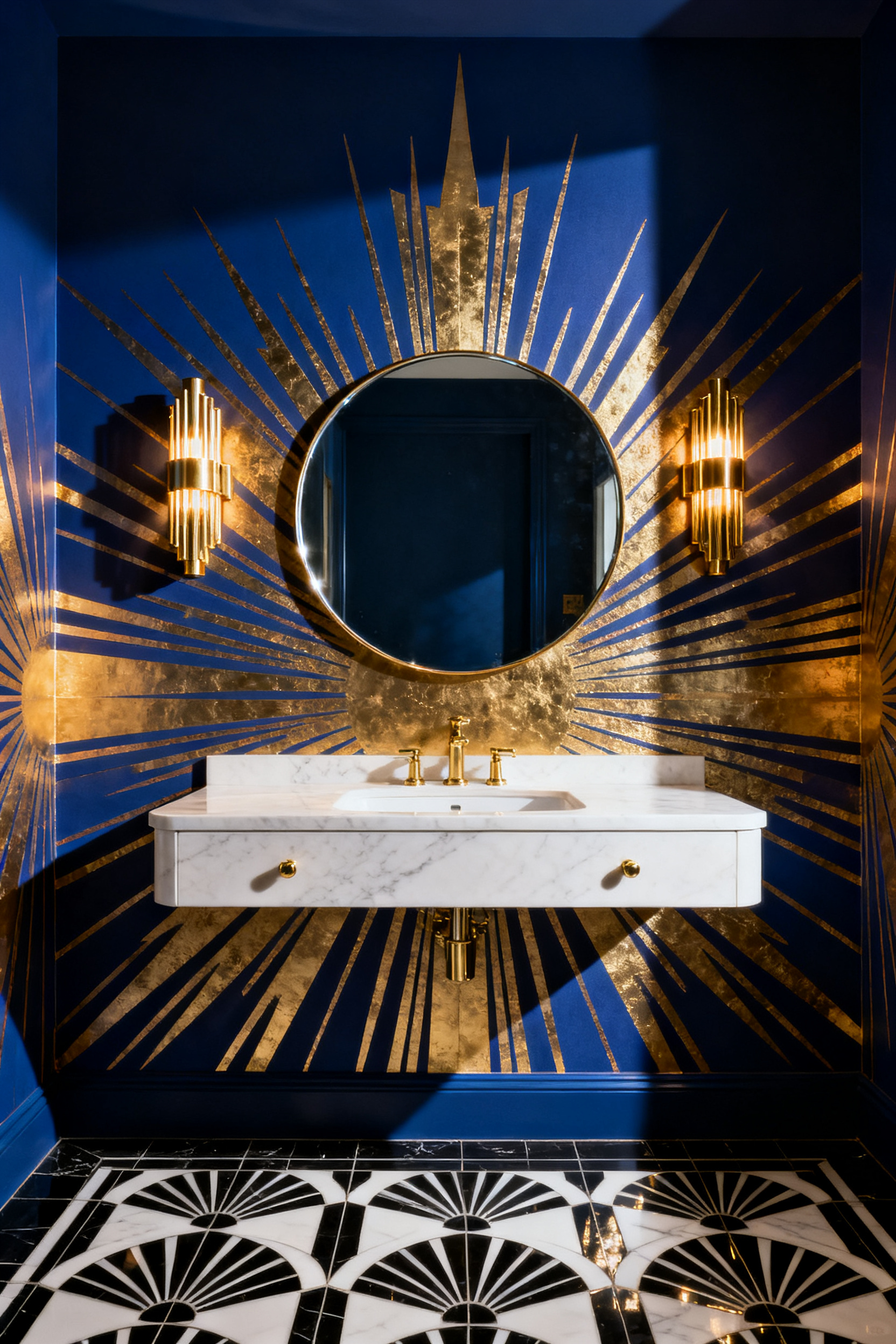
Moreover, the visual impact relies heavily on materiality. Specifically, these wallcoverings often utilize specialized metallic inks. Consequently, the metallic rays catch and fragment light from wall sconces. This interaction creates a dynamic focal point that suggests expansion. Indeed, this interplay makes typically small interiors feel significantly more dramatic.
Additionally, utilizing such intricate wallcoverings is an act of calculated extravagance. During the 1920s, the bathroom evolved into a symbol of personal style. Thus, selecting a sumptuous sunburst print prioritizes glamour over strict utility. Fortunately, moisture-resistant vinyls now allow for this fearless mix of pattern. Ultimately, the sunburst motif turns a daily routine into a celebration of luxury.
2. High-Contrast Drama: Mastering the Black and White Chevron
The black and white chevron pattern acts as a calculated design statement. In fact, it encapsulates the Jazz Age’s obsession with speed. Unlike the staggered herringbone, the chevron features sharp, unbroken points. Consequently, these repeated V-shapes suggest forward motion. This directional energy effectively mimics the era’s fascination with fast trains.
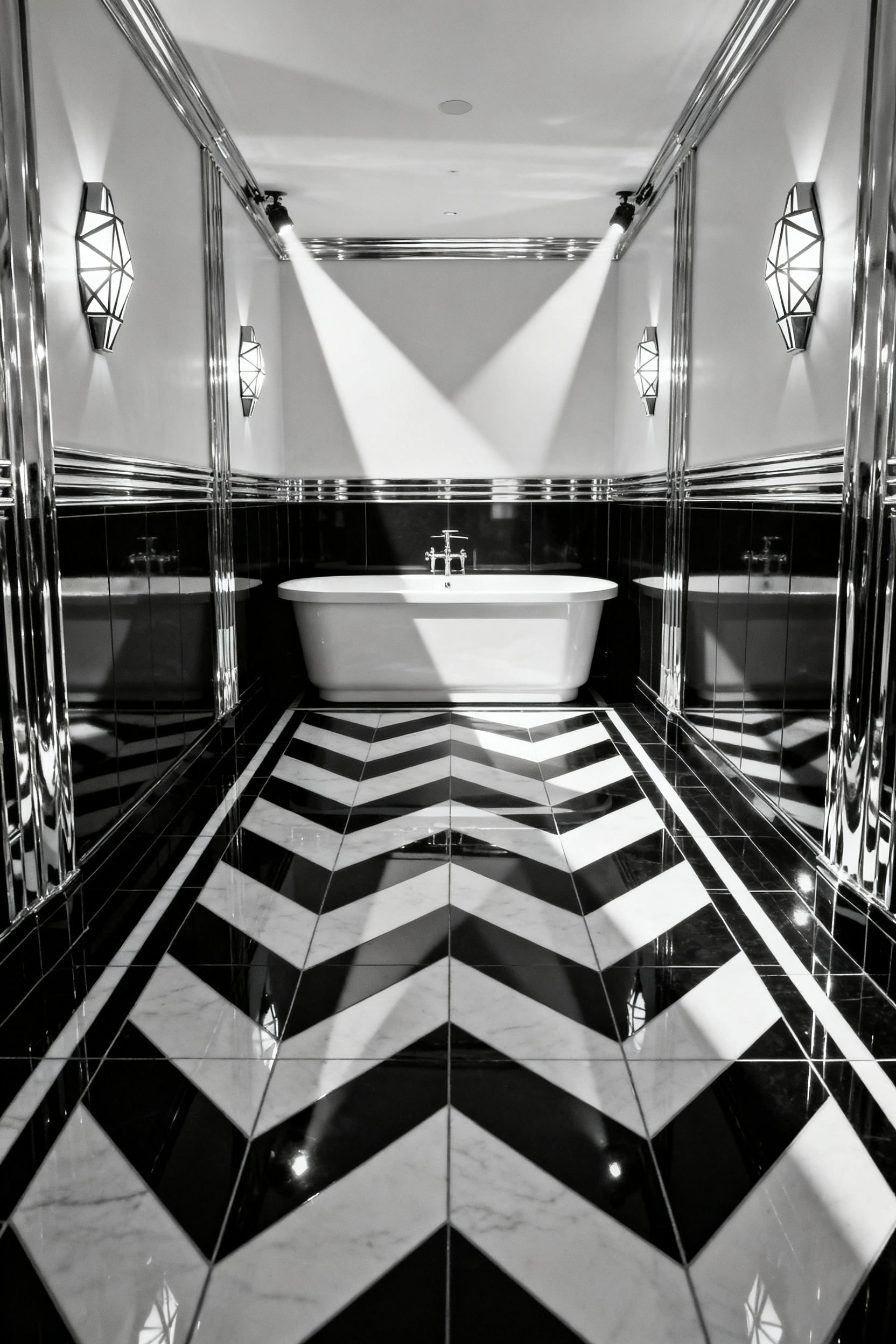
Furthermore, the high-contrast palette creates maximum visual impact. Black absorbs light, while white reflects it. Therefore, this stark juxtaposition sharpens the pattern’s edges. It ensures the graphic boldness remains immediate and undeniable. Additionally, black serves as a dramatic backdrop for essential luminosity.
Beyond aesthetics, this motif masterfully manipulates perception. Specifically, the converging lines generate a powerful illusion of depth. This optical trickery causes compact bathrooms to feel significantly more expansive. Moreover, the rhythmic pattern pulls the eye toward focal points like a pedestal tub. Historically, this look draws from the glamour of ocean liners. Ultimately, applying this dynamic geometry transforms a surface into opulent art.
3. Floor-to-Ceiling Veining: Treating Marble Slabs as Art
Art Deco bathrooms function as private sanctuaries of glamour. Therefore, the materials used must transcend mere utility. Specifically, floor-to-ceiling marble installations treat the stone as a grand mural. The primary technique for achieving this artistry is bookmatching. Here, fabricators place adjacent stone slices side-by-side to mirror one another perfectly. Consequently, chaotic geological veins transform into disciplined, symmetrical compositions.
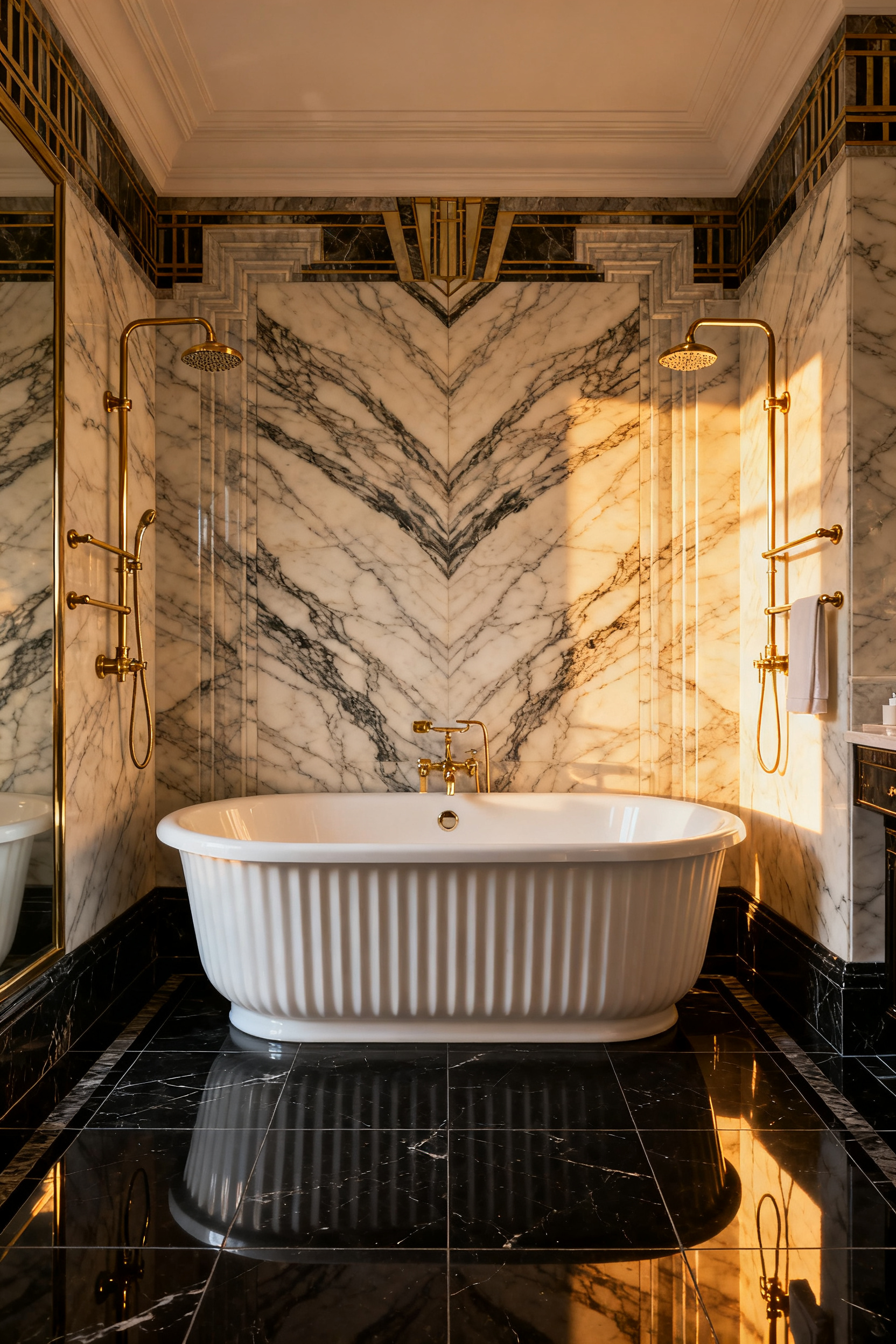
This mirror effect creates dramatic shapes. Thus, the stone’s organic flow aligns with Art Deco’s strict geometric principles. Moreover, using large slabs reduces visual clutter by minimizing intrusive grout lines. This creates a monolithic canvas that feels expansive. For complex areas, skilled craftsmen utilize precise miter cuts. As a result, the veining wraps continuously around corners.
Material selection is equally critical for this opulent aesthetic. For instance, high-contrast stones like Nero Marquina offer bold drama. Alternatively, translucent Onyx acts as a luminous accent wall. Ultimately, these massive slabs serve as exclusive commissioned art. They signal a level of personalized luxury that standard tile cannot replicate.
4. Terrazzo Reinvented: Embedding Brass into Stone Flooring
The inclusion of brass in terrazzo flooring represents a perfect marriage of utility and glamour. Historically, these metal strips served a purely structural purpose. Specifically, they functioned as control joints to prevent cracking. However, Art Deco artisans quickly reimagined this necessity as an artistic element. Consequently, the brass became the outline for stylized foliage and zig-zags.
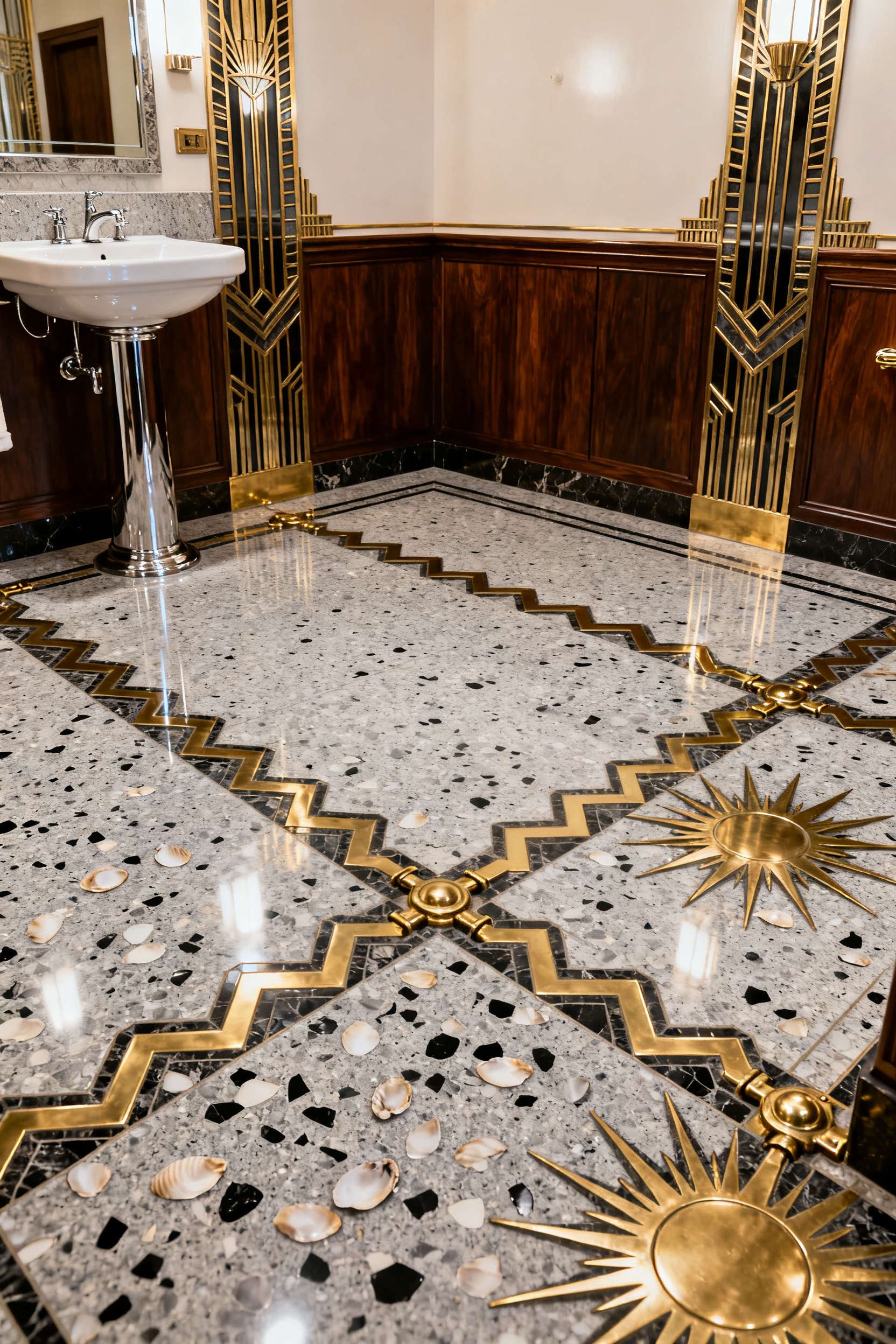
Visually, the golden warmth of brass provides a striking counterpoint to cool stone. Furthermore, this pairing creates an atmosphere of sophistication essential for luxury. Today, modern reinterpretations utilize CNC technology to cut these inlays with precision. In fact, pre-cast options now allow for complex patterns to be inlaid directly.
Yet, this opulence requires careful technical execution. For instance, the copper component within brass can react chemically. Unfortunately, this reaction causes a greenish-blue stain known as “bluing.” Therefore, installers must strictly verify resin compatibility before pouring. Ultimately, the finished product offers a seamless surface. Once polished, the floor becomes a reflective masterpiece that anchors the room.
5. The Jewel Box Palette: Saturating Walls in Emerald and Sapphire
Transforming a utilitarian bathroom into a luxurious retreat begins with the “Jewel Box” palette. Historically, this aesthetic emerged from the exuberant optimism of the 1920s. In fact, it represented a direct rejection of previous austere trends. Instead of neutral tones, designers embraced hyper-pigmented hues like emerald green. However, color alone does not create true opulence. To truly emulate a gemstone, the surface texture is critical.
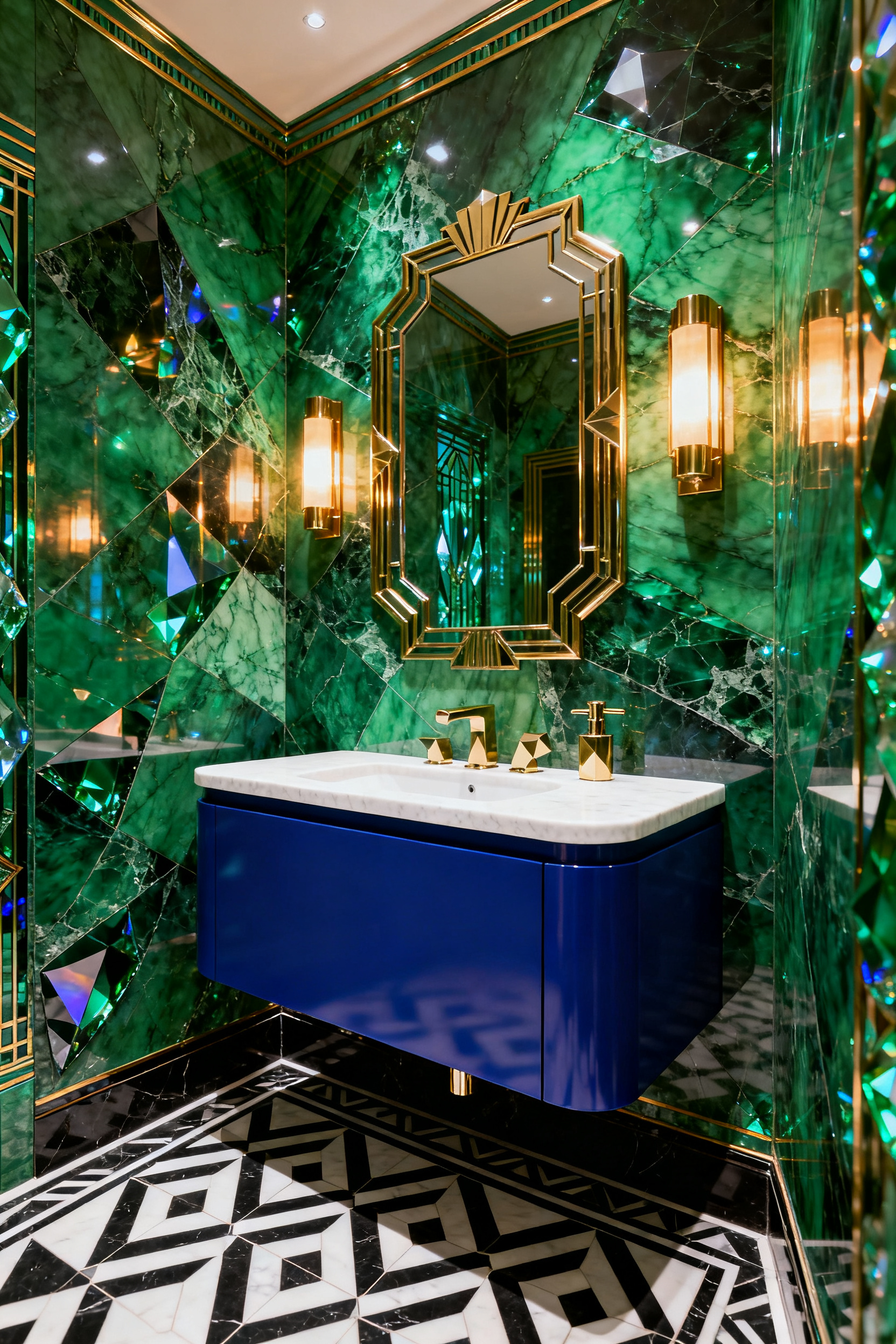
Specifically, high-gloss ceramic tiles or lacquered finishes are essential. These materials allow light to penetrate and bounce. Consequently, the walls shimmer with an inherent, liquid-like sheen. Furthermore, these deep tones are never used in isolation. Adhering to the Art Deco “rule of three,” designers pair saturated walls with metallic accents.
For example, brass hardware introduces warmth, while chrome offers modern contrast. This interplay mimics fine jewelry, where white metals amplify precious stones. Finally, strategic lighting activates this entire reflective matrix. Sconces positioned at eye level catch the high-polish surfaces. Ultimately, the design engulfs the user in a mood of sophisticated abandon.
Materiality: The Texture of Luxury
The “Texture of Luxury” in Art Deco bathrooms relies heavily on deliberate juxtaposition. Fundamentally, this style marries industrial modernity with ancient opulence. For instance, designers often paired cool chrome with warm, veined marble. Consequently, this interplay creates a sophisticated sensory experience. It transforms a utilitarian space into a glamorous sanctuary.
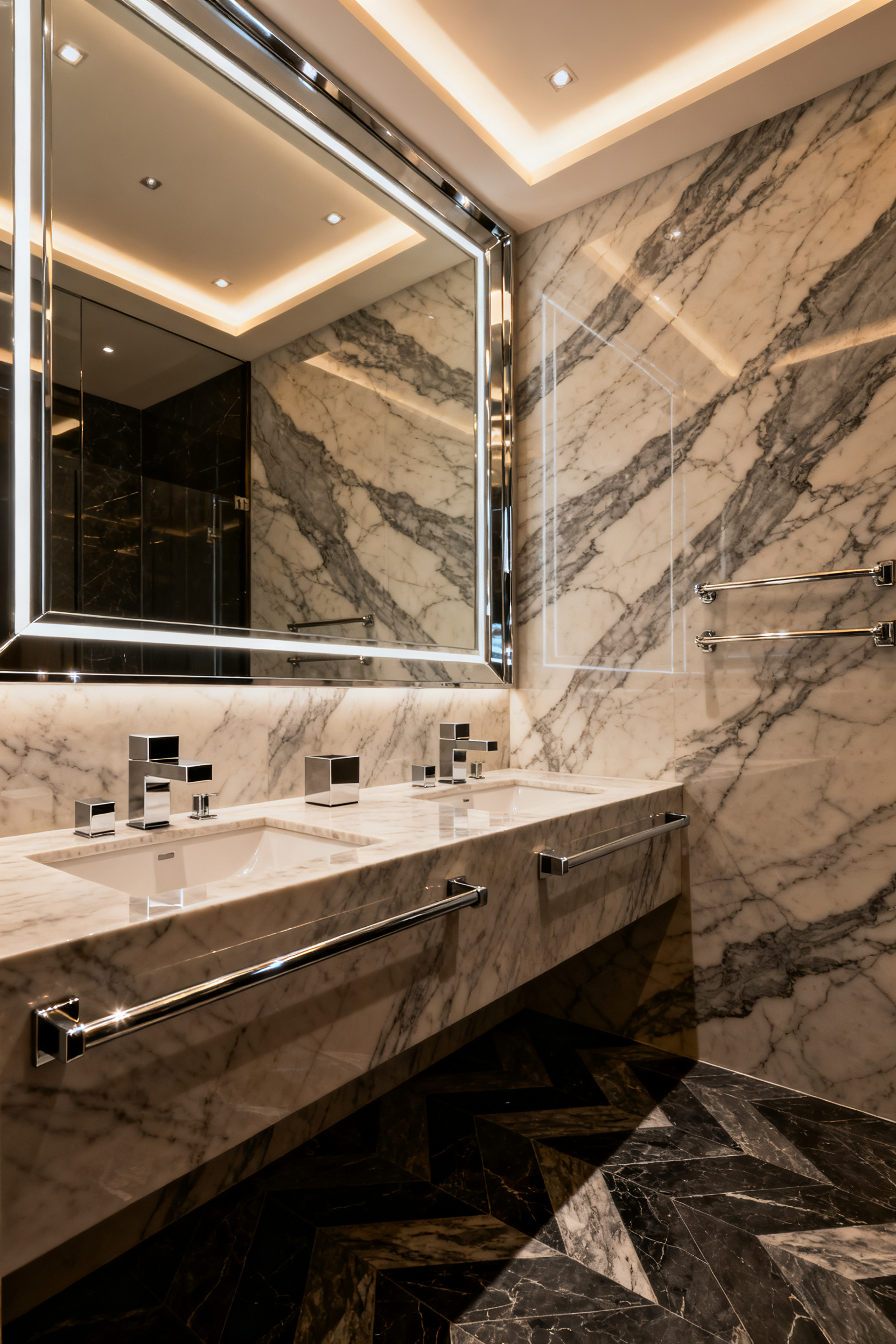
Specifically, large-format stones like Statuario provide a natural foundation. Their intricate veining acts as an organic counterpoint to rigid geometry. Conversely, the introduction of polished chrome offers a stark, man-made texture. Therefore, the sensory friction between a cool faucet and warm marble signifies true luxury. This dialogue effectively bridges the gap between old-world grandeur and the Machine Age.
Moreover, materiality interacts dramatically with light to create optical depth. High-gloss finishes are essential for this cinematic effect. In fact, these reflective surfaces expand the perceived volume of small spaces. Additionally, textured elements like reeded glass diffuse light into a flattering glow. Finally, geometric tile work introduces rhythmic energy through hard textures. Thus, repeating patterns add visual weight without overwhelming the room.
6. Fluted Glass Sconces: Diffusing Light with Vintage Elegance
Fluted glass sconces represent much more than simple bathroom lighting. Fundamentally, they embody the core Art Deco philosophy of geometric precision. Specifically, the repeated vertical ribs echo the soaring lines of 1930s skyscrapers. Consequently, this design introduces a sense of upward movement. Unlike the organic curves of Art Nouveau, these crisp lines establish a rational order.
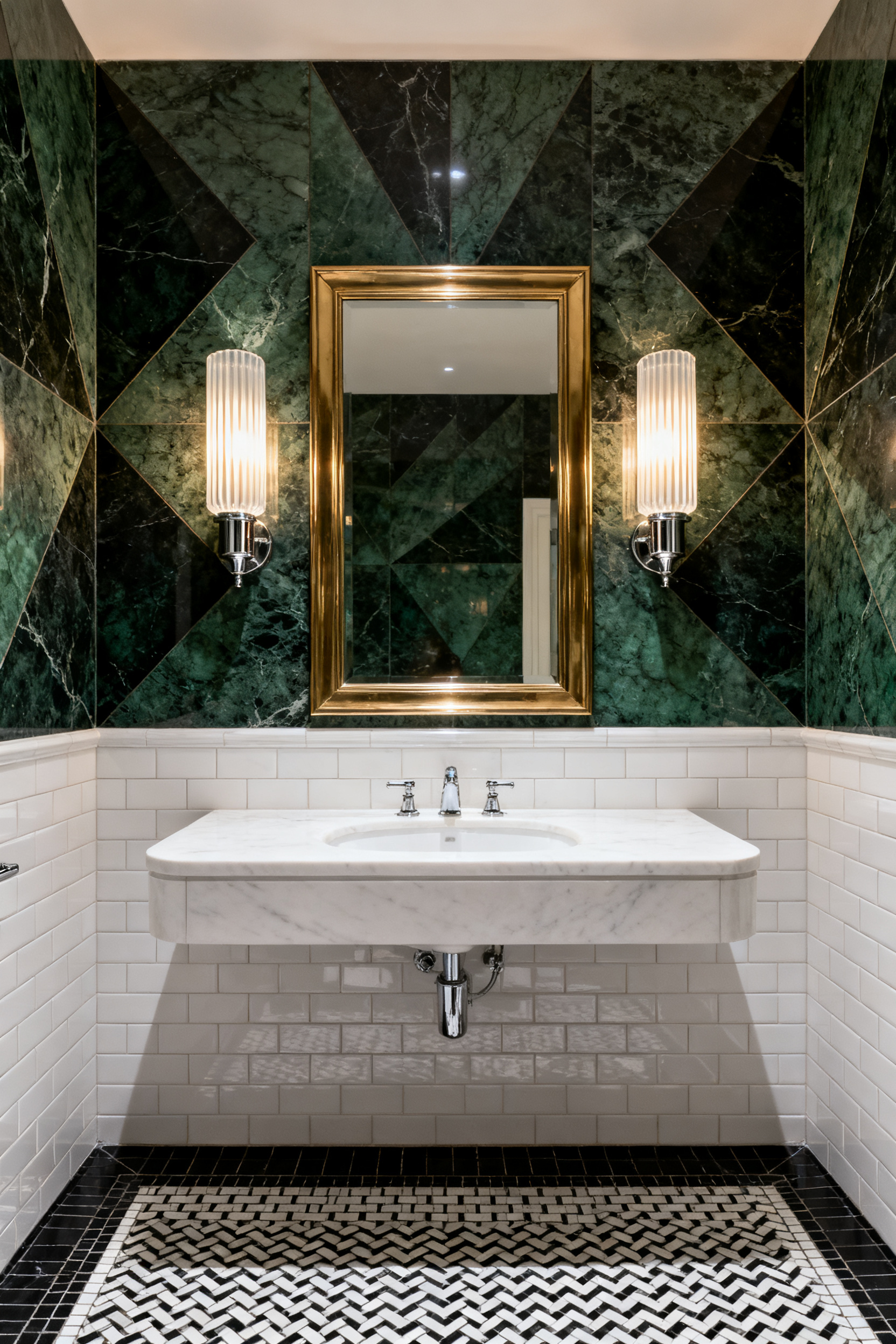
Beyond their architectural symbolism, these fixtures serve a crucial practical function. Uniquely, the ribbed glass acts as a prism to scatter light. Therefore, it eliminates the harsh shadows often found in standard lighting. Instead, the sconces cast a soft, “Hollywood” glow. In fact, this diffusion is essential for grooming tasks.
Additionally, the visual effect adds a layer of sensory richness. For instance, the light appears to dance from flute to flute. Furthermore, the linear pattern visually mimics smooth streams of water. This motif perfectly connects the fixture to the bathroom’s purpose. Typically, designers pair this glass with polished chrome. Thus, the combination secures a sleek look that defines the aesthetic. Ultimately, fluted glass brings the glamour of the skyline indoors.
7. Unlacquered Brass: The Warmth of Aged Metals
Historically, Art Deco celebrated the machine age with mirror-like finishes. Polished chrome represented a futuristic ideal. However, unlacquered brass introduces a luxurious, humanist counter-narrative. Unlike plated metals, this “living finish” lacks a protective coating. Consequently, it oxidizes and evolves dynamically over time.
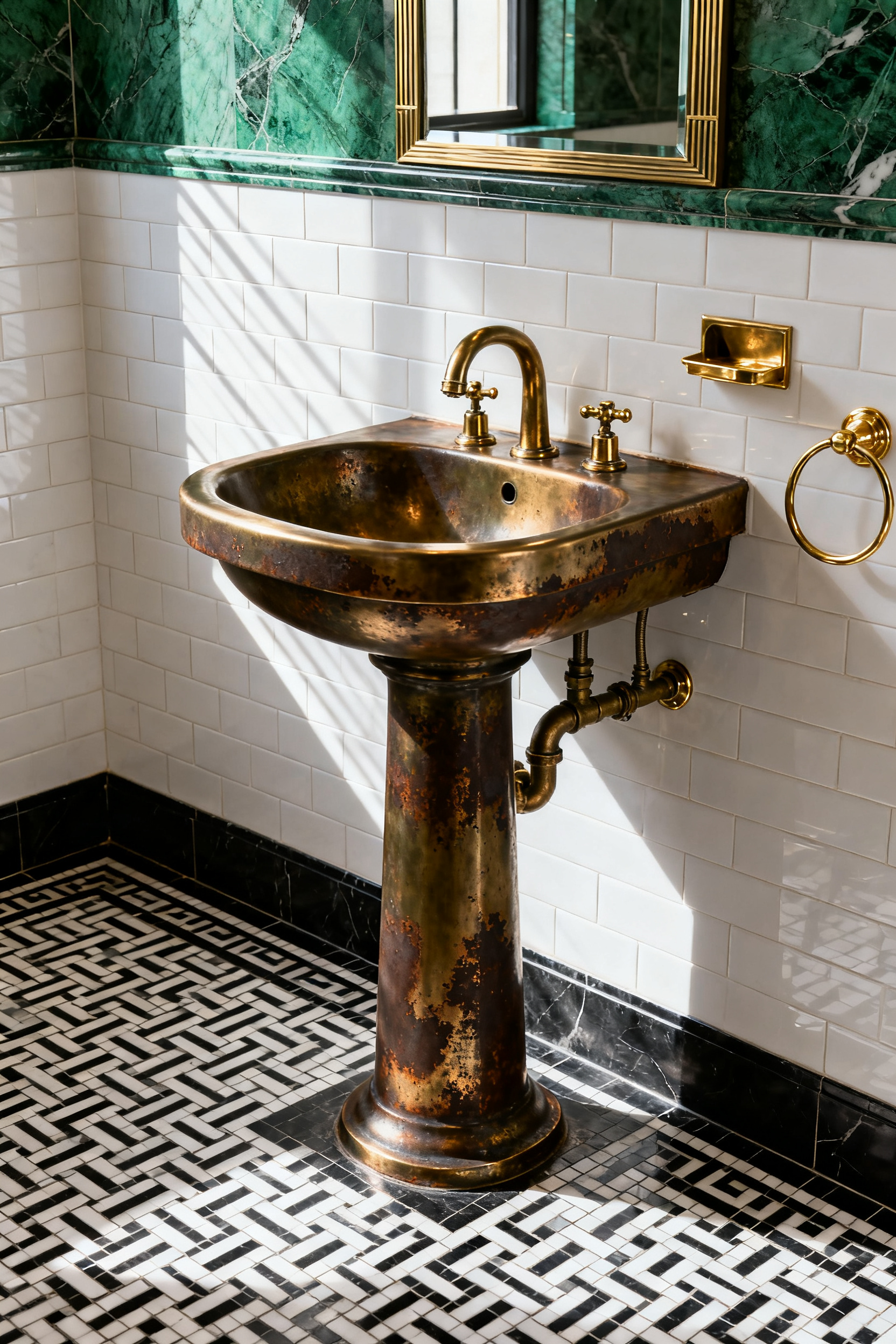
Specifically, the metal reacts to air, moisture, and human touch. In a humid environment, this transformation accelerates beautifully. Initially, the brass shines with a radiant yellow-gold hue. Gradually, it deepens into a rich palette of amber. Furthermore, the wear pattern tells a unique story. Areas of frequent contact remain bright. Conversely, untouched recesses darken quickly. This natural highlighting frames the geometric contours of fixtures.
Aesthetically, this organic evolution adds necessary warmth. Art Deco designs often rely on cool, high-contrast marble. Therefore, the deep bronze patina serves as an essential visual anchor. It effectively prevents the space from feeling overly clinical. Ultimately, unlacquered brass elevates fixtures into sculptural statements of authenticity.
8. High-Gloss Lacquer: Creating Depth with Piano-Black Vanities
Choosing high-gloss lacquer fundamentally alters the sensory experience. Specifically, a “piano-black” finish offers much more than a simple color choice. Historically, this opulent look honors the craftsmanship of French *ébénistes*. Indeed, these artisans treated lacquer as a luxurious, labor-intensive material.
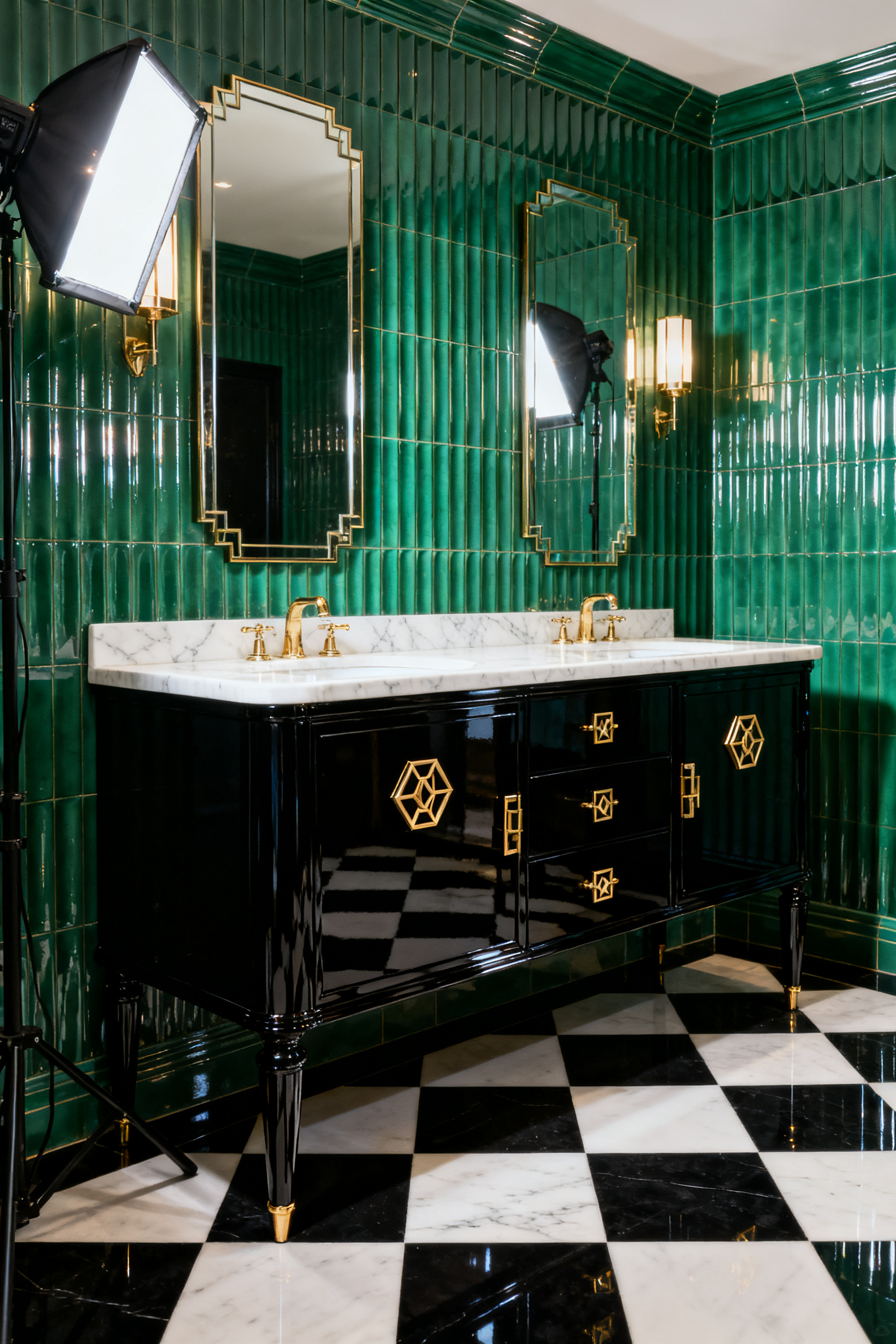
Consequently, the surface achieves a profound depth similar to liquid glass. Unlike matte paints, this mirror-like finish reflects the surrounding environment. Therefore, light sources refract dramatically across the cabinetry. In fact, this reflection creates an illusion of infinite depth. This visually expands smaller spaces.
Moreover, the high-gloss black serves as a perfect architectural anchor. It provides the maximum possible contrast for other materials. Specifically, geometric chrome pulls stand out with sculptural clarity against the dark void. Ultimately, this sharp interplay of light and metal defines true Art Deco glamour.
9. Velvet Touches: Softening the Hard Edges with Plush Seating
Art Deco bathrooms naturally feature cool surfaces like polished marble. Consequently, introducing plush seating creates a vital tactile counterpoint. Velvet transforms a potentially clinical space into a lavish sanctuary. In design theory, this concept effectively mirrors the “shell” principle. Specifically, the room’s geometric armor is softened by a protective textile lining.
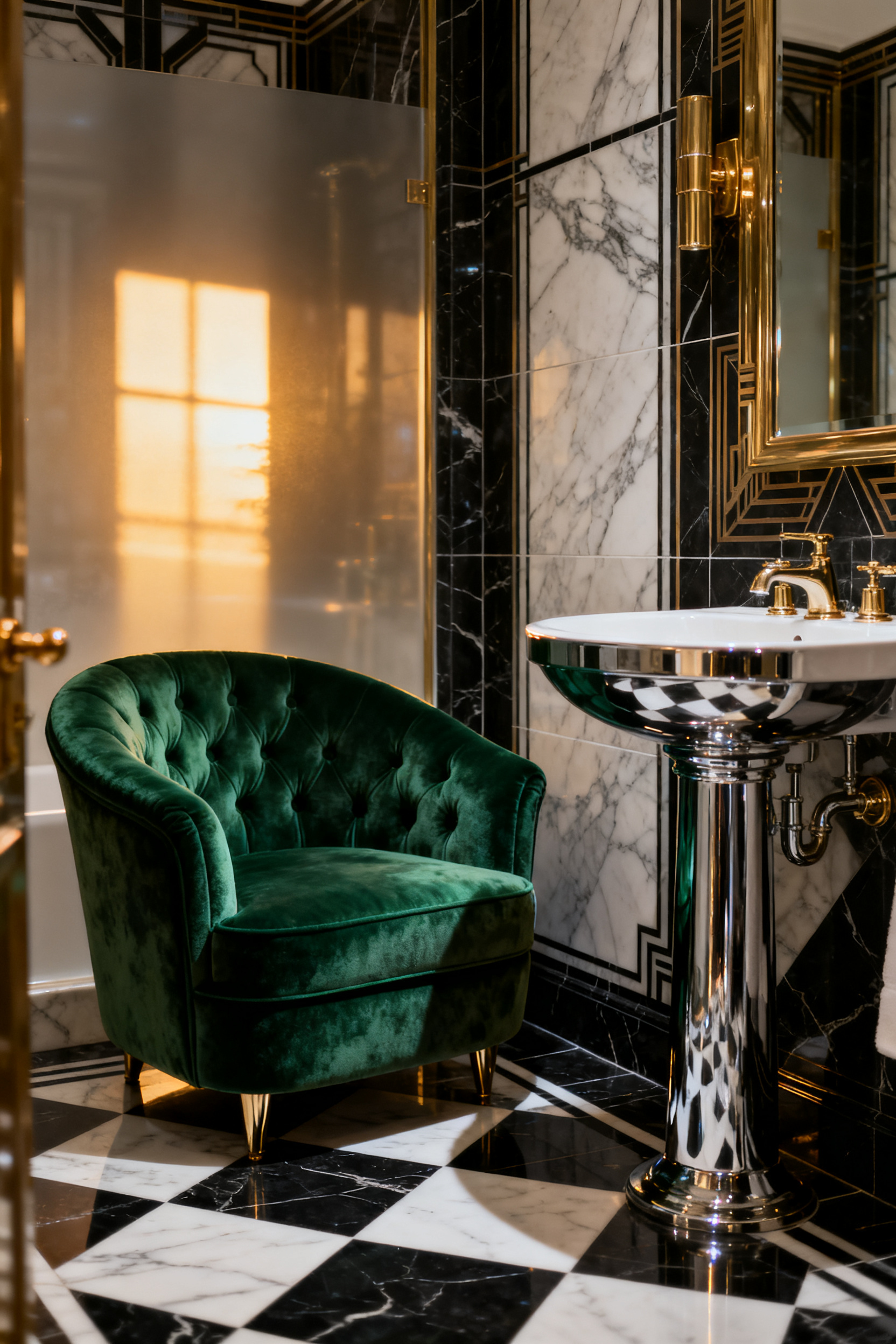
For true authenticity, choose cut velvet to embody the era’s spirit. Furthermore, this technique cuts looped piles to varying heights. Look for patterns that echo Art Deco iconography, such as dynamic chevrons. Additionally, color choice plays a crucial role. While black and white dominate the structure, velvet introduces rich jewel tones like sapphire.
The seating’s structure must also bridge the gap between soft and hard. Typically, a sleek metal skeleton frames the plush seat. Polished brass or chrome legs directly connect the furniture to the room’s fixtures. Ultimately, forms like slipper chairs prioritize comfort for daily grooming. This blend of function and glamour ensures the bathroom serves as a private retreat.
10. Chrome and Crystal: The Friction of Industrial Glamour
Art Deco design thrives on a specific philosophical tension. Specifically, it seeks to reconcile the Machine Age with pre-war luxury. Consequently, the bathroom became the ideal stage for this “friction” between industrialism and opulence.
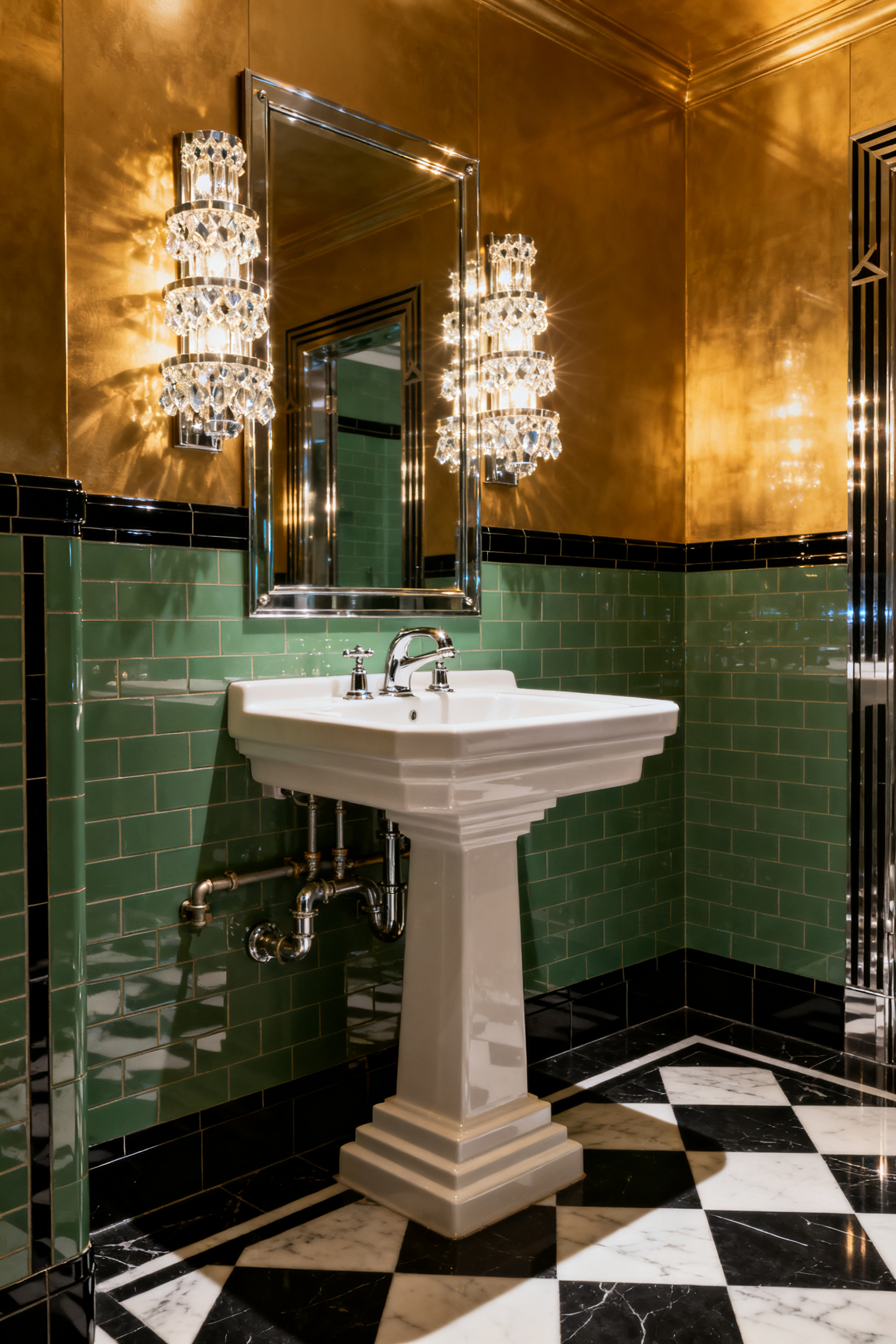
First, consider the role of chrome plating. This material was not merely decorative; it was deeply ideological. Its smooth surface represented efficiency and an optimistic future. Furthermore, chrome offered a mirror-like finish that felt clinically hygienic. Unlike tarnished brass, it maintained a streamlined look essential for the era.
Conversely, crystal served as the anchor for artisan glamour. While chrome provided flat reflectivity, crystal introduced optical richness. In fact, it refracted light to create a shimmering effect. This element was crucial for transforming a functional space into a sanctuary. Additionally, cut glass offered a tactile texture that mass-produced metal could not replicate.
Ultimately, these contrasting materials created a functional harmony. The most potent example is the mixed-material faucet. Typically, the body utilized durable chrome. However, the handles often featured faceted crystal. Thus, the user grasps hand-finished luxury to operate machine-age machinery. This pairing symbolically resolved the conflict between the modern and the decadent.
Spatial Application: Geometry in Motion
The concept of “Geometry in Motion” transforms a static bathroom into a dynamic environment. Fundamentally, this philosophy celebrates the speed of the machine age. Unlike the winding lines of Art Nouveau, Art Deco employs sharp geometry. Consequently, the bathroom reflects the sleek power of ocean liners and locomotives.
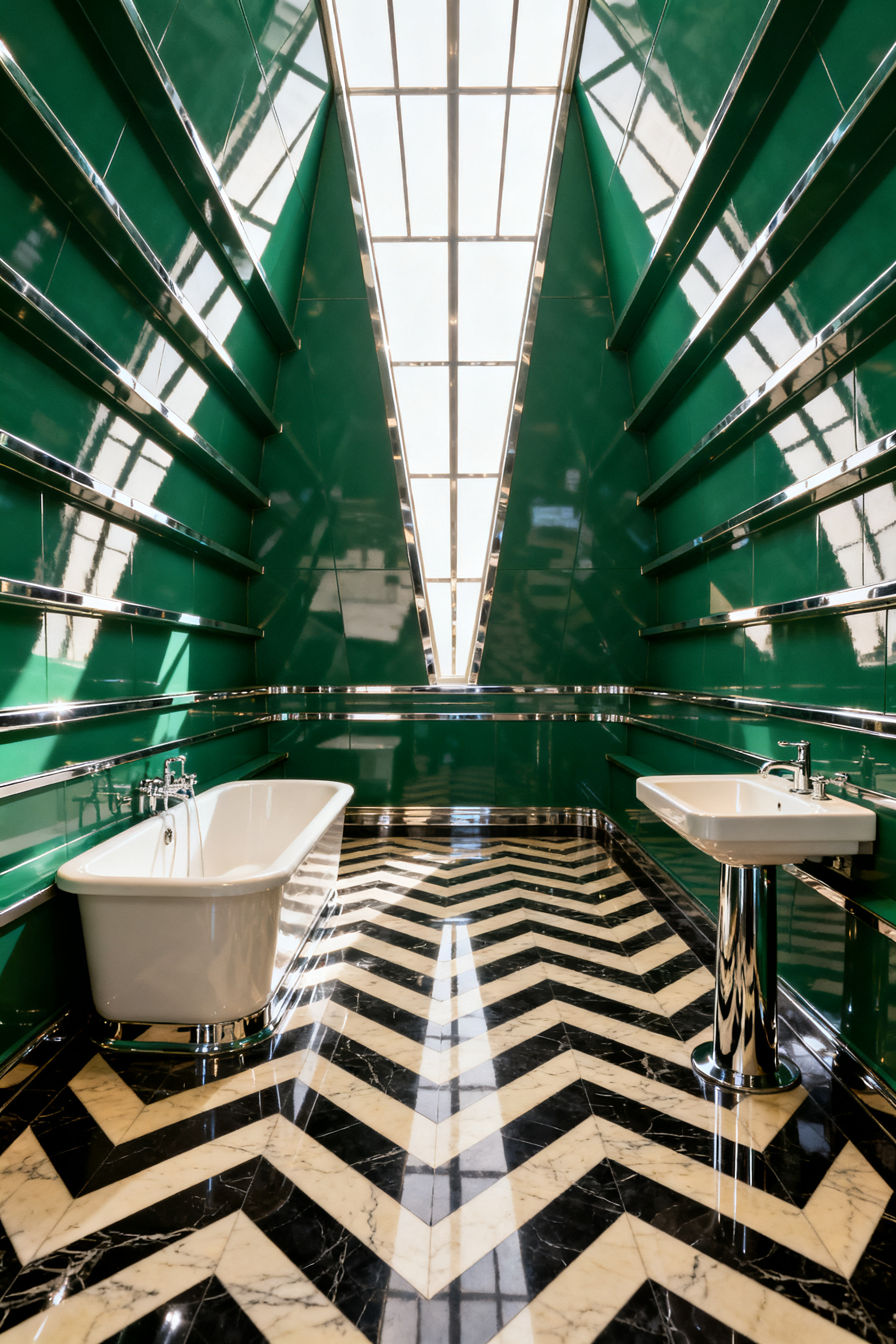
To achieve this, designers utilize directional patterns like chevrons. Specifically, these repeating V-shapes propel the viewer’s eye forward. Therefore, the tiled surfaces create a distinct visual rhythm. Additionally, the sunburst motif captures the era’s optimism. Radiating lines suggest an explosion of light.
Moreover, material selection amplifies this kinetic illusion. Glossy tiles reflect light across these bold shapes. As a result, static patterns appear to ripple as you move. Furthermore, vertical elements introduce architectural scale. For instance, stepped vanity forms echo the setbacks of skyscrapers. This technique adds a sense of aspirational grandeur. Ultimately, strict symmetry creates a necessary balance. Thus, the bathroom feels composed rather than chaotic.
11. The Step-Cut Mirror: Architectural Detailing for the Vanity
The step-cut mirror transcends mere functionality. Fundamentally, this design references the monumental architecture of the 1930s. For instance, the mirror’s outline often mimics the stepped ziggurat form. Therefore, this detail serves as a miniaturization of buildings like the Chrysler Building. It brings urban modernity directly into the intimate vanity space.
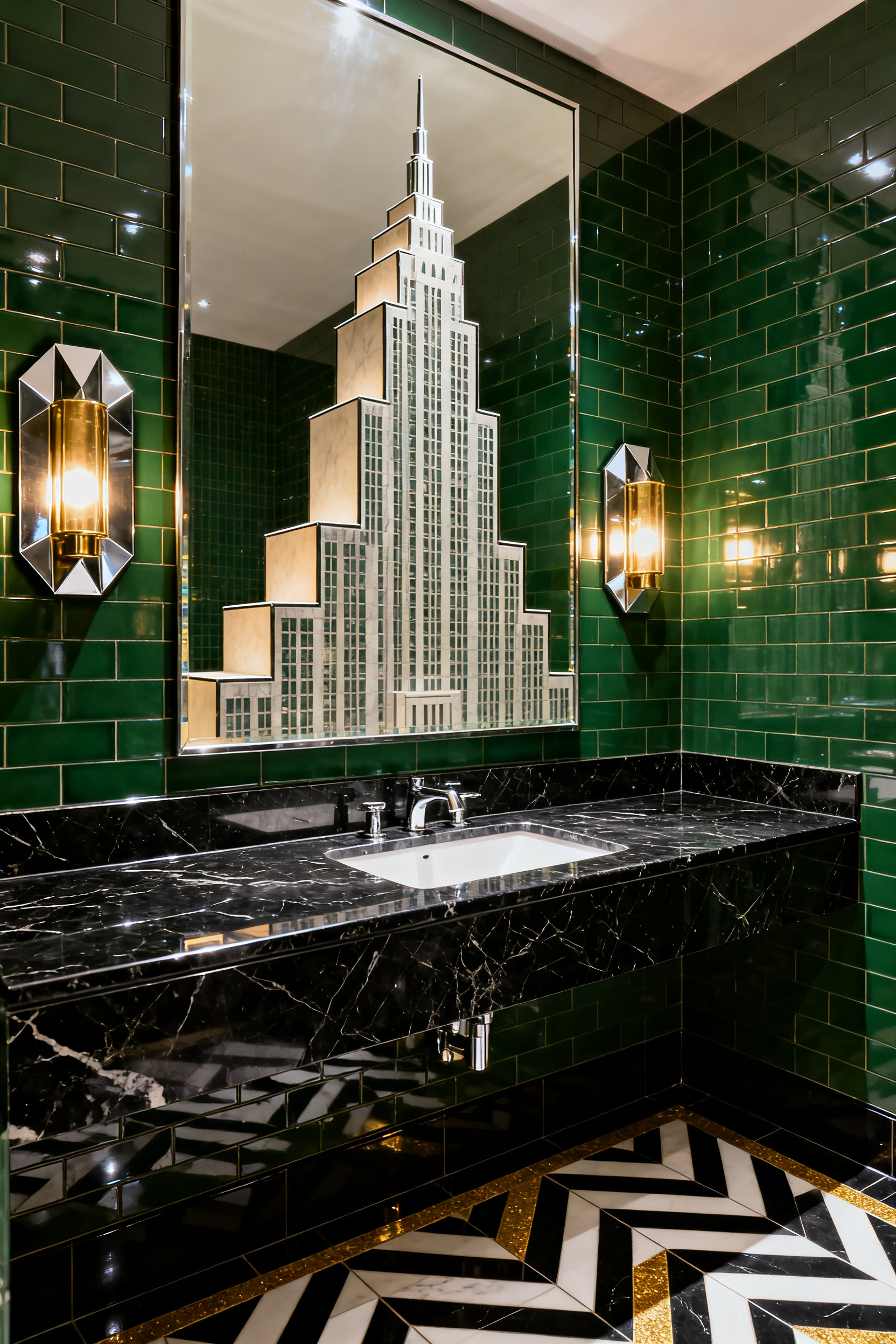
Additionally, the allure lies in the precise engineering. Specifically, the “step-cut” involves complex beveling techniques. Unlike standard mirrors, these multiple angles are ground to refract light dramatically. Consequently, the border acts as a prism, creating a vibrant halo effect. This optical engineering adds necessary depth.
Moreover, this element positions the vanity as a theatrical stage. In fact, the mirror becomes the *pièce de résistance* of the room. By amplifying available light, it transforms daily grooming into a glamorous ritual. Thus, the step-cut mirror embodies the commitment to opulent spaces.
12. The Freestanding Tub: A Sculptural Centerpiece in Dark Enamel
The Art Deco era signaled a major shift in bathroom design. Specifically, designers rejected ornate Victorian clawfoot styles. Instead, they favored the streamlined purity of the pedestal tub. This continuous base transformed the fixture into a ground-anchored sculpture. Furthermore, the seamless plinth addressed hygiene concerns. It eliminated hard-to-clean spaces.
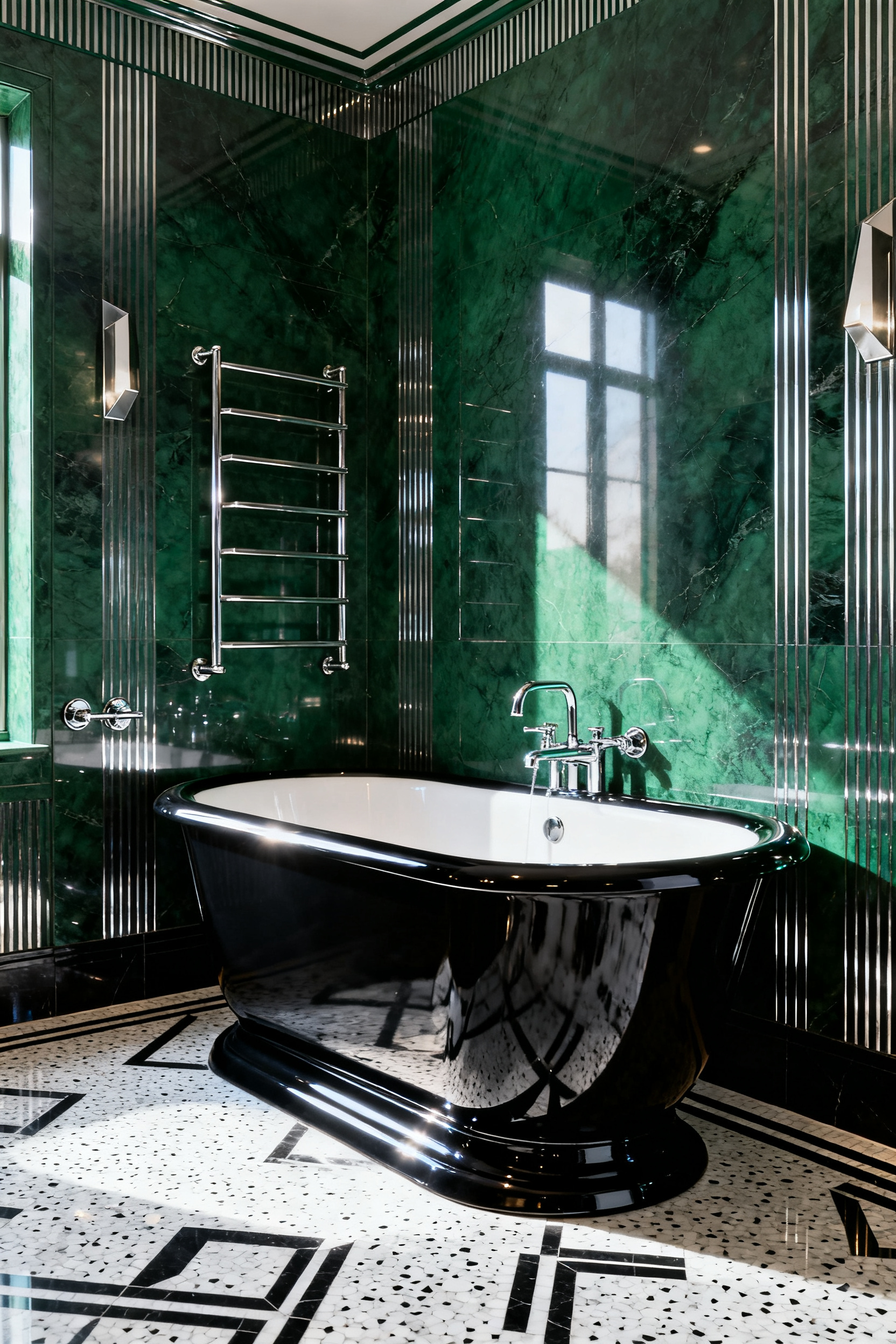
Beyond shape, the choice of material added immense drama. Typically, these tubs featured a cast iron body coated in dark enamel. Ideally, the finish was a deep, glossy black or rich maroon. Functionally, the heavy cast iron provided exceptional heat retention. Aesthetically, this dark exterior created a sophisticated vibe.
In fact, the high-gloss surface acted as a mirror. It contrasted sharply with the tub’s white interior. Moreover, it provided a perfect backdrop for polished metallic fittings. Consequently, chrome faucets sparkled intensely against the dark mass. Ultimately, the tub became a bold, monolithic statement. It softened the room’s sharp geometric floor tiles. Thus, the dark enamel tub stood as the architectural centerpiece.
13. Angular Hardware: Replacing Curves with Sharp Geometric Pulls
Art Deco design requires a purposeful departure from soft lines. Specifically, this movement rejected the floral “whiplash” curves of the Victorian era. Instead, designers embraced strong architectural lines to signal modernity. Consequently, bathroom hardware evolved into forms that resembled miniaturized architecture.
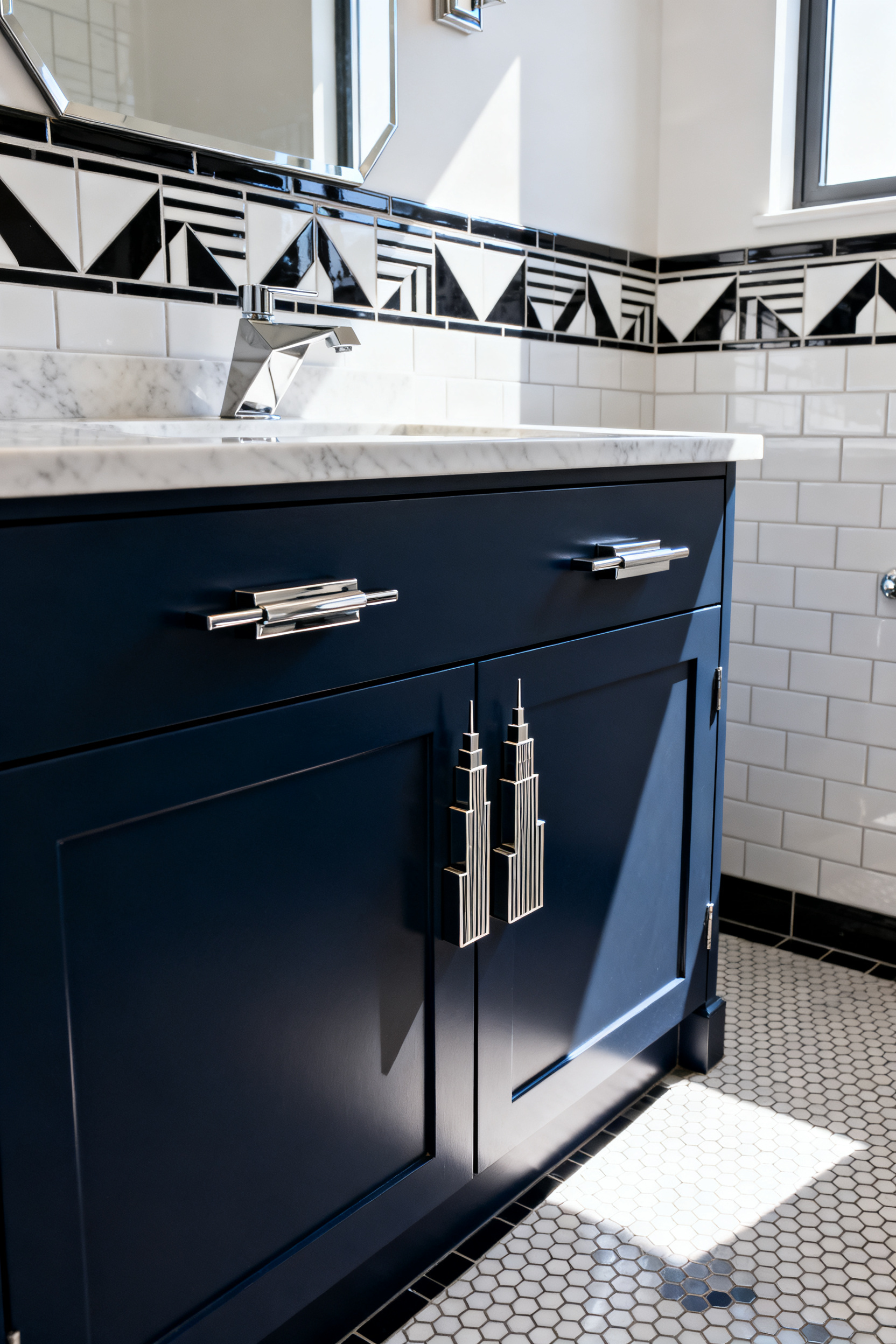
Designers drew direct inspiration from skyscrapers like the Chrysler Building. For instance, drawer pulls often featured layered pyramids or zigzags. These angular forms transformed a simple vanity into a statement. Therefore, a standard object became a tactile interaction with the modern city.
Furthermore, material choices amplified this sharp geometry. Manufacturers favored polished chrome and brass for their reflectivity. In fact, the mirror-like finish emphasized the precision of every edge. To add depth, these metals frequently framed luxurious inlays. Specifically, accents of Bakelite or mother-of-pearl created a striking contrast. Ultimately, these geometric pulls serve as functional art.
14. The Fan-Shape Shower Enclosure: Custom Glazing Statements
The fan-shape shower enclosure represents a perfect marriage of utility and glamour. Specifically, this quadrant design softens harsh angularity. It embraces the *Streamline Moderne* aesthetic, favoring aerodynamic sweeps. Consequently, the curved glass introduces a sense of visual flow. This mirrors the era’s fascination with elegant motion.
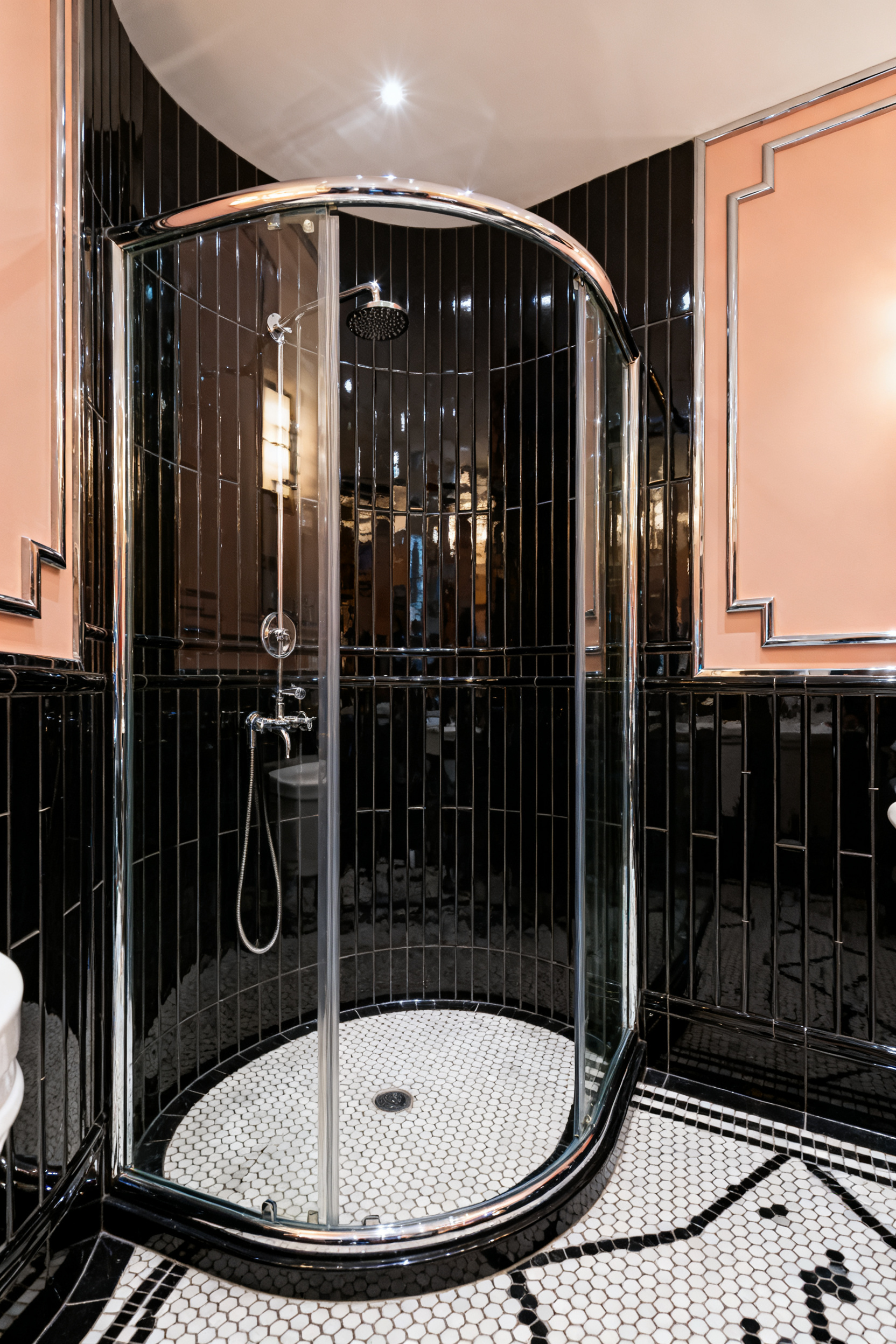
However, the true luxury lies within the glazing itself. Beyond simple transparency, custom 3D sculpture carving transforms the enclosure. In this technique, artists carve varying depths into the glass surface. As a result, the deep-carved edges catch ambient light. This transforms a standard barrier into a glittering work of art.
Naturally, the fan shape invites iconic Art Deco motifs. For instance, etching a radiating sunburst emphasizes the enclosure’s geometry. These frosted designs offer a nuanced balance of modesty and openness. Therefore, they provide necessary privacy without blocking light.
Alternatively, reeded glass offers a modern interpretation. This material utilizes vertical parallel lines to distort the view. When steam hits the glass, the fluting creates a shimmering pattern. Ultimately, this turns a functional shower into a geometric focal point.
Lifestyle Integration: Curating the Experience
The Art Deco bathroom was never designed solely for utility. Historically, it transformed service areas into domestic sanctuaries. Specifically, these spaces became private stages for daily self-care. In the 1920s, bathrooms often doubled as glamorous dressing rooms. Consequently, comfortable chaise-lounges were common additions. This shift encouraged a deliberate sense of ceremony. Thus, residents were invited to pause and admire their surroundings.
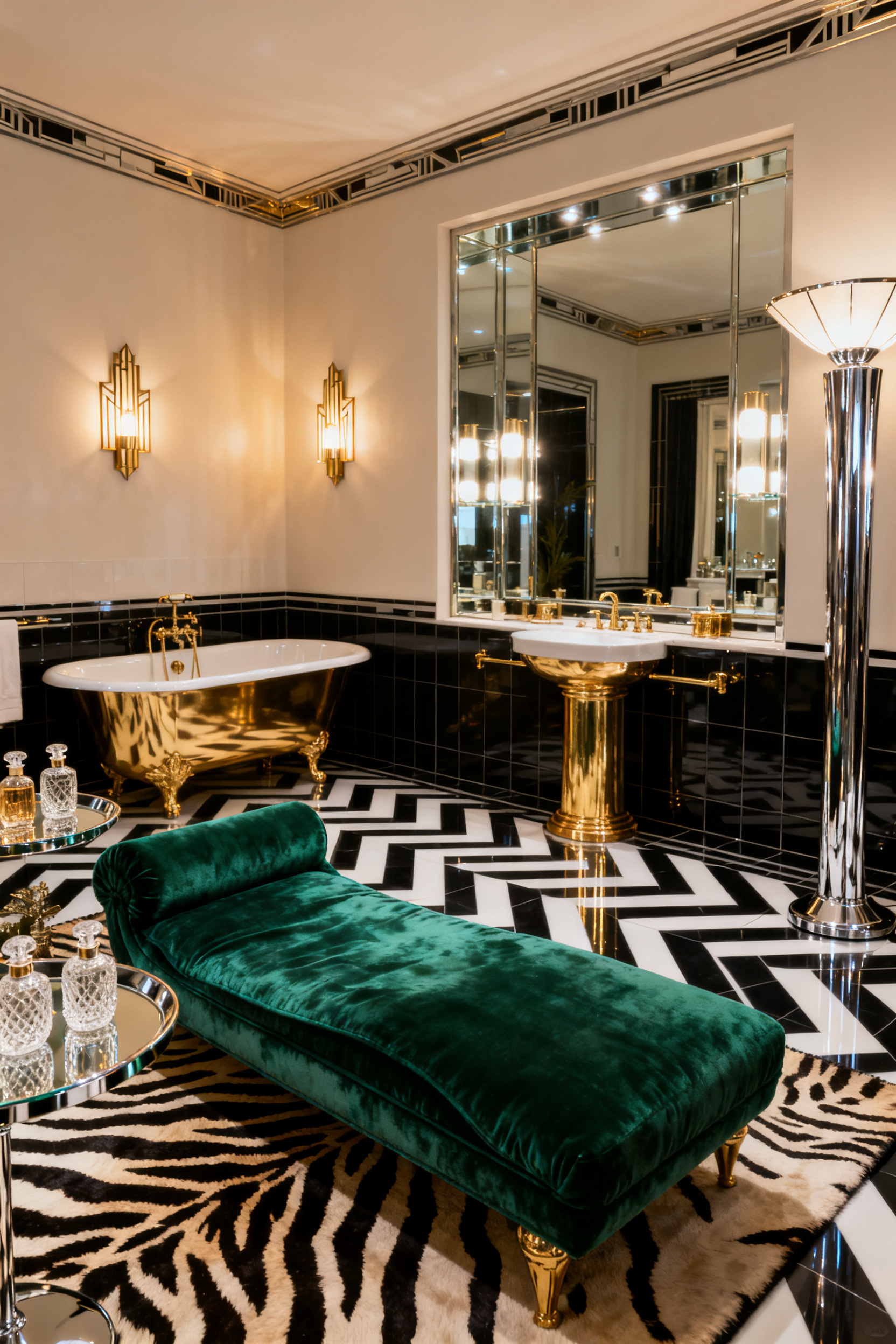
Creating this atmosphere requires the careful curation of light and texture. Lighting fixtures serve as the jewelry of the room. For example, tiered chandeliers provide a flattering glow. Furthermore, large geometric mirrors reflect this light to create a cinematic effect. Simultaneously, material selection adds tactile opulence. Natural marbles like Carrara provide a cool quality. In contrast, polished brass adds a necessary sheen.
Beyond decoration, the layout relies on streamlined modernity. Art Deco creates sophistication through precise lines. Notably, symmetry plays a crucial role. Dual basins establish a calming visual harmony. Additionally, this approach blends craftsmanship with innovation. Fixtures are streamlined, often abandoning freestanding models for built-in looks. Ultimately, this balance makes the luxury functional.
15. Displaying the Decanter: Styling Vanity Trays with Crystal
Styling a vanity tray effectively transforms a daily routine into a ritual. Specifically, Art Deco interiors utilized crystal decanters to elevate common toiletries. Instead of commercial packaging, users filled sleek vessels with mouthwash. Consequently, the bathroom aesthetic remained cohesive and luxurious. The crystal itself featured sharp, mechanical facets. Furthermore, these geometric cuts were engineered to interact with light.
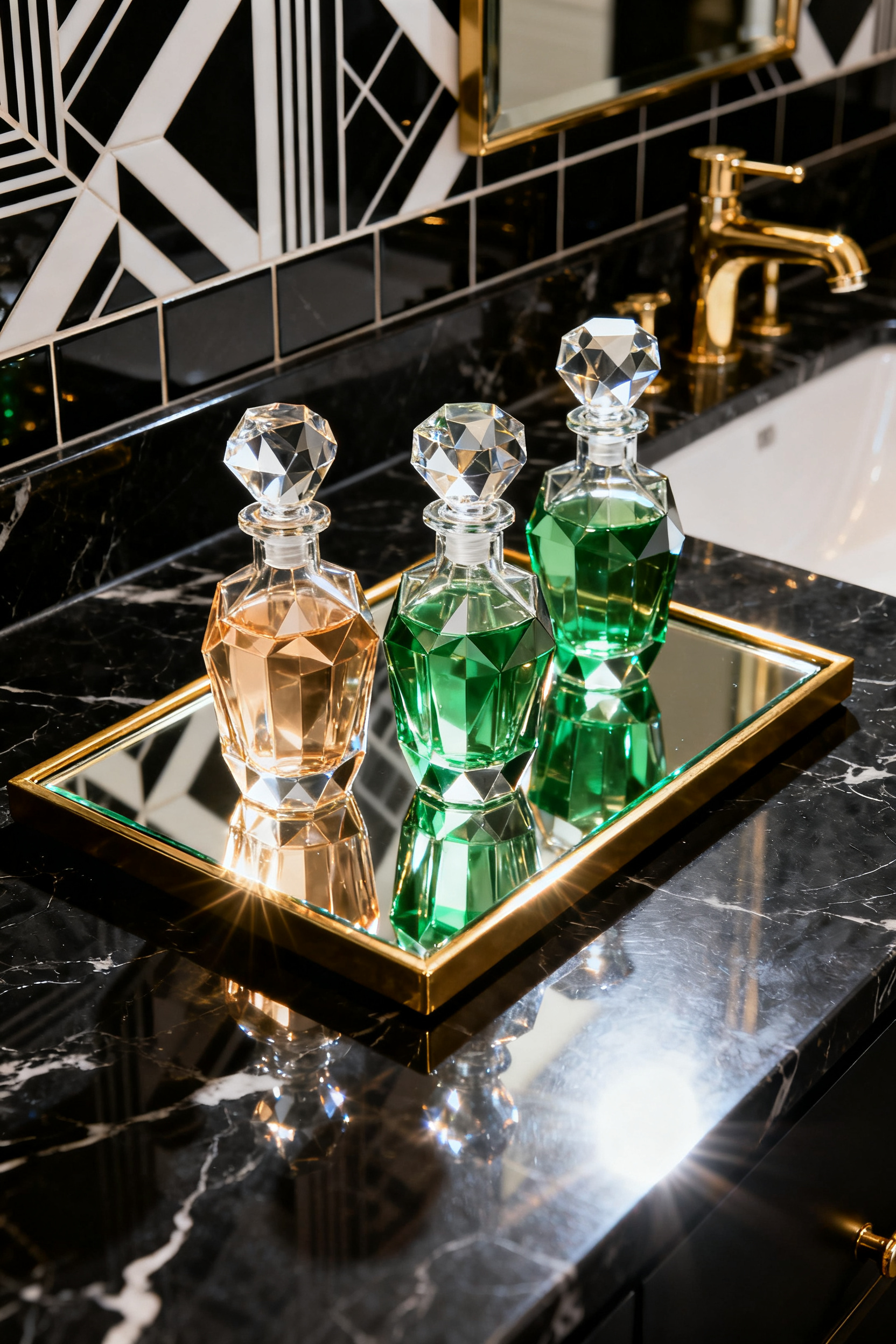
To maximize this radiance, designers positioned these pieces on mirrored trays. Naturally, the reflective surface doubled the number of visible planes. This created a kaleidoscope of light against dark tiles. Regarding composition, authentic styling demanded rigid symmetry. Typically, a tall central decanter stood flanked by matching jars. This arrangement echoed the vertical “skyscraper” aesthetic. Ultimately, this display turned utility into a sculptural masterpiece.
16. Exotic Botanicals: Palms in Hammered Gold Planters
Art Deco interiors are fundamentally defined by strict order. Specifically, these spaces prioritize sharp angles and polished chrome. However, a truly luxurious design requires a dramatic counterpoint. Therefore, introducing exotic botanicals creates a necessary visual tension. For instance, the feathery fronds of a Parlour Palm introduce organic chaos. Consequently, these flowing lines soften the hard geometry of tiled walls.
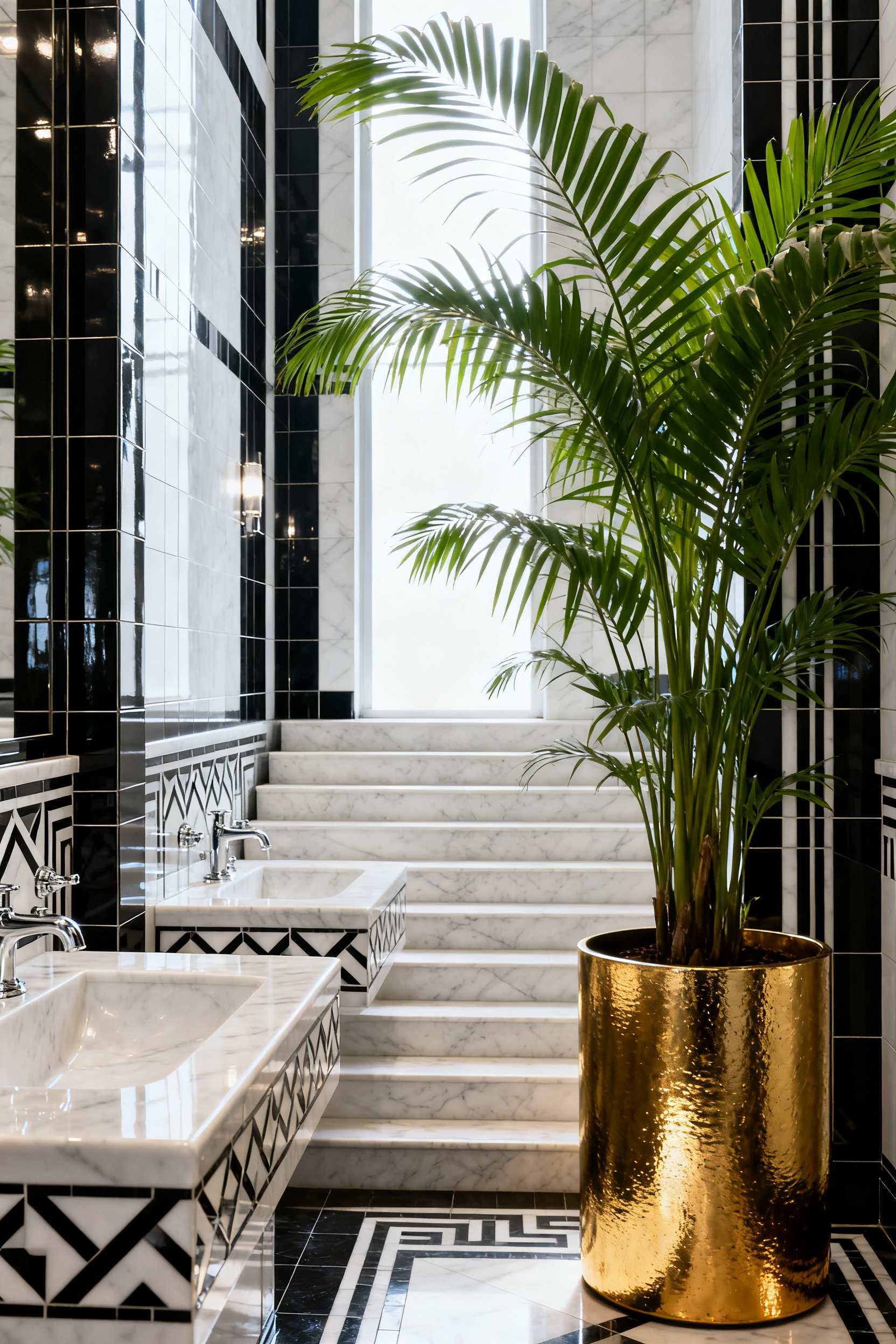
Moreover, the choice of vessel is crucial. Ideally, one should select a planter with a hammered gold finish. Unlike sleek surfaces, this textured metal diffuses light non-uniformly. In fact, the dimpled surface creates a soft, warm shimmer. Thus, the planter provides a tactile contrast to the room’s cold porcelain. Ultimately, this detail adds artisanal warmth to the machine-age look.
Furthermore, this botanical element serves a symbolic purpose. Historically, maintaining exotic plants indoors signaled immense wealth. Indeed, they represented a connection to global travel. By placing a large palm here, you transform a functional room into a sanctuary. As a result, the space feels both opulent and restorative.
17. Art as Atmosphere: Framing Vintage Vogue or Erté Prints
Transforming a functional bathroom into a salon requires theatricality. Consequently, selecting the right art becomes a vital design step. Specifically, prints by Erté capture the Jazz Age’s distinct glamour. Erté created vibrant serigraphs rooted in opulent stage design. These illustrations typically feature shimmering golds and jewel tones. Thus, they perfectly mirror the room’s opulent tile work.
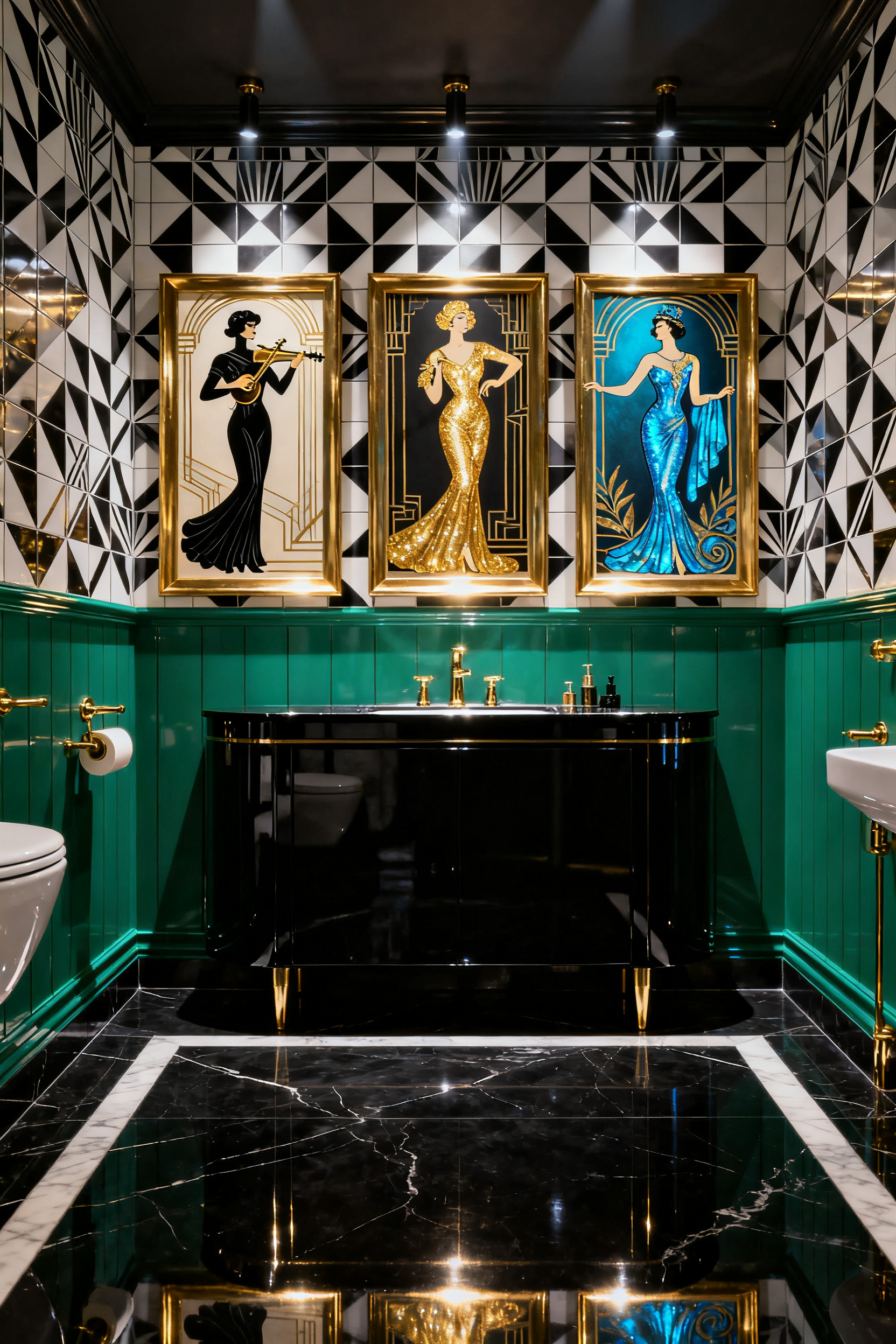
Alternatively, vintage Vogue covers celebrate the “new woman.” These figures exude independence, turning daily grooming into a ritual. Furthermore, the artwork serves as an architectural extension. Erté’s stylized figures echo the verticality of Art Deco skyscrapers. To fully emphasize this connection, the framing choice is critical. Ideally, choose frames with stepped, geometric molding.
This “ziggurat” profile mimics the era’s iconic architectural setbacks. Regarding materials, seek high-gloss black lacquer or polished chrome. These finishes reflect light dramatically, adding a necessary sheen. In fact, using mixed metals can integrate the art with your hardware. Finally, consider a matless presentation for a streamlined look. This technique ensures the art feels like a built-in element.
Conclusion: Daily Rituals in Your Personal Palace
The art deco bathroom ultimately transforms simple hygiene into a theatrical event. In fact, it elevates a functional space into a private sanctuary. Consequently, high-gloss surfaces provide the glamour necessary for your daily performance. Furthermore, the vanity becomes an essential altar for the ritual of self-care. Thus, these opulent designs validate the importance of prioritizing your well-being.
Today, this philosophy encourages us to live boldly. Therefore, view your bathroom as a sophisticated destination rather than a utility. Specifically, embrace a fearless approach to texture and light. Ultimately, your daily routine deserves a backdrop of unapologetic luxury. Begin by introducing one decadent element, such as a vintage sconce, to anchor your sanctuary.
Frequently Asked Questions
What are the three most essential elements of Art Deco bathroom design?
The three essential elements are: 1) High-contrast geometry (e.g., black and white chevron or hexagonal tiles); 2) High-shine polished metals (chrome, brass, or nickel); and 3) Streamlined, stepped forms (found in mirrors, vanities, and lighting fixtures) that reject floral or organic curves.
How do I prevent an Art Deco style bathroom from looking too busy or cluttered?
The key to successful Art Deco is “controlled abundance.” This is achieved through strict symmetry and restraint in pattern application. Use pattern (like chevrons or sunbursts) only on one surface—either the floor or one wall—and use solid, high-gloss color on the remaining walls. Furthermore, maintain visual order by using built-in, streamlined vanities instead of cluttering the floor.
Is Art Deco suitable for a small powder room or bathroom?
Absolutely. Art Deco is exceptionally suitable for small spaces because it utilizes high-gloss, reflective materials like polished marble, lacquer, and mirrors. These surfaces catch and scatter light, creating an illusion of depth and movement that makes a compact room feel significantly more expansive and dramatic.
“`json
“`