
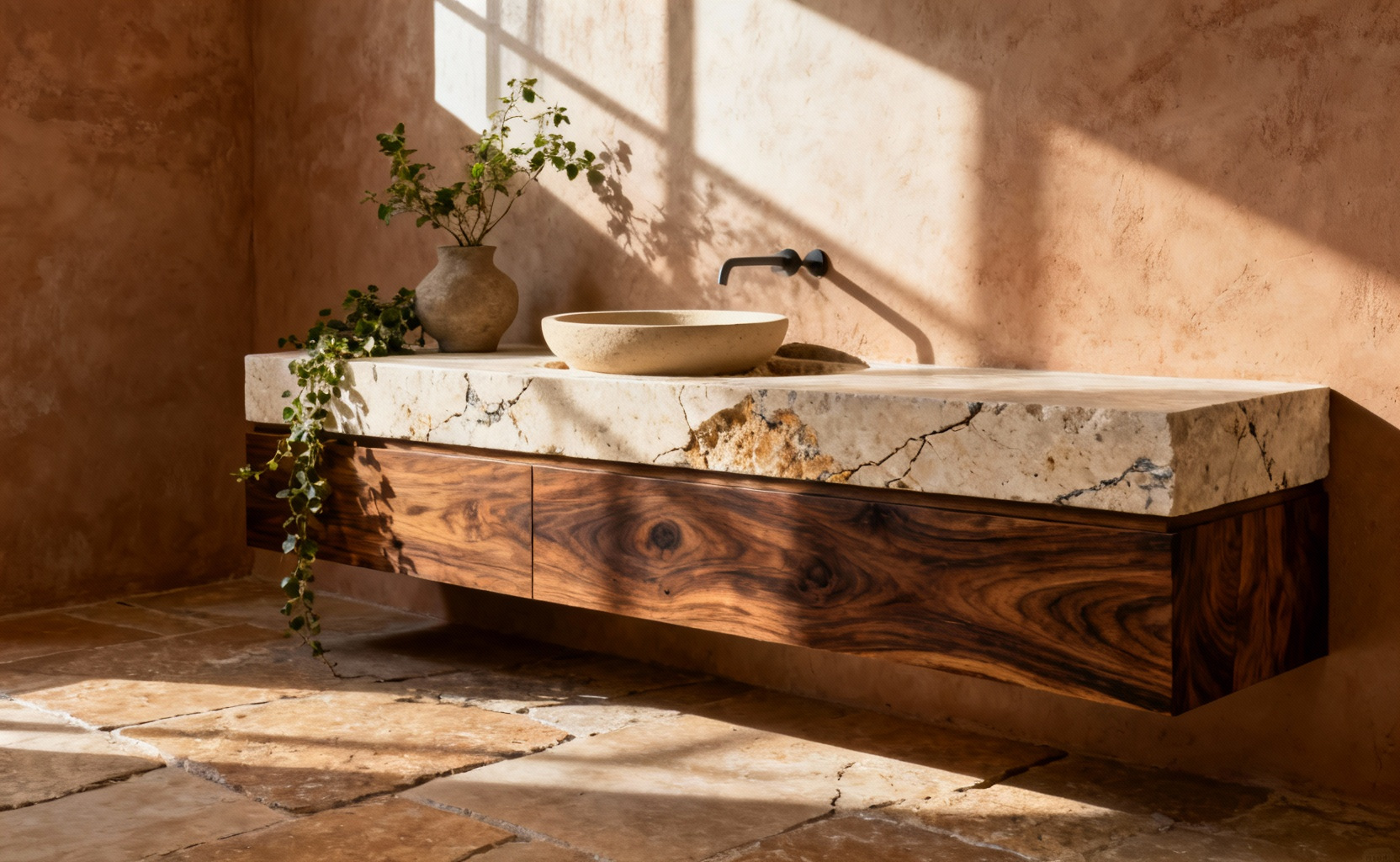

Most modern bathroom vanities are simply stations for rapid grooming and storage. However, discerning homeowners know the perfect bathroom vanity designs offer much more. The term itself carries the weight of *vanitas*, historically implying emptiness. Consequently, we often overlook the psychological potential of this space. A holistic design philosophy reclaims this area as a vital “Daily Altar.”
We reject the vanity as a site for superficiality. Instead, it becomes a sanctuary for devotion. Indeed, the objects displayed here serve not as clutter, but as anchors for personal evolution. To achieve this, we must look beyond standard aesthetics. A true “Wellness Anchor” requires more than a beige palette. Rather, it demands sensory engineering and authentic elements.
For instance, we prioritize the touch of raw materials like linen, wood, and stone. Additionally, lighting is adjusted to calm the mind. We will explore how to integrate these principles effectively. This guide reveals how to transform a functional necessity into a source of mental nourishment, applying essential principles of modern bathroom design for luxury homes. Ultimately, we aim to design a ritual that sustains the spirit.
Theme 1: Grounding Materiality – The tactile connection to nature
Specifically, within biophilic design, the bathroom vanity transcends utility. Instead, it functions as architectural furniture that influences our psychological state. In our digital age, natural materials offer a counter to constant visual noise. Consequently, elements like solid wood and stone create a calming sanctuary.
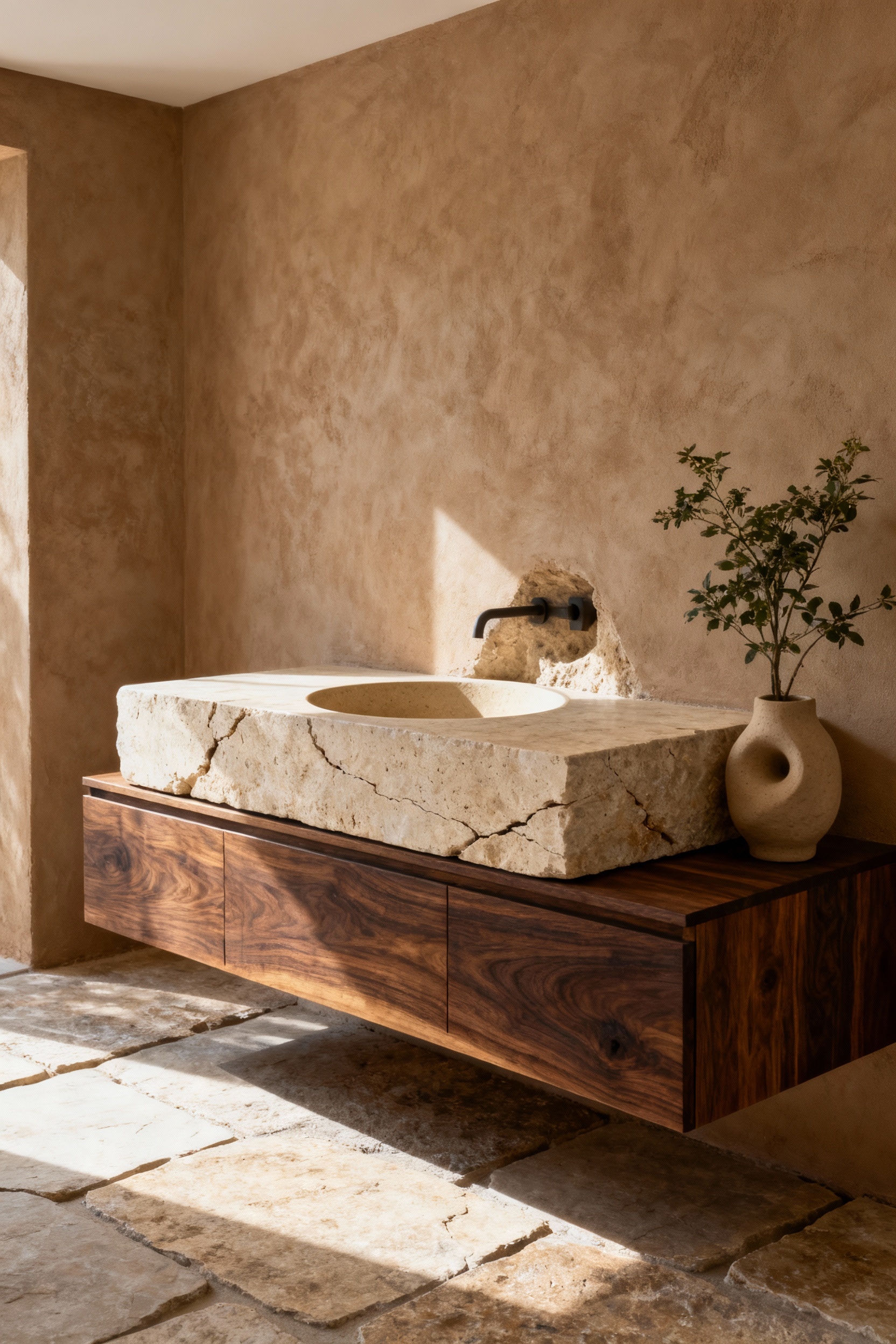
Furthermore, distinct textures invite us to pause. The simple act of washing hands transforms into a mindful ritual. Physically, organic surfaces can even help reduce stress. To maximize this, effective design creates a layered experience.
For instance, solid hardwoods like walnut signal organic warmth. Conversely, the cool touch of marble conveys permanence. This balance between rough grain and refined stone promotes relaxation. Additionally, authentic materials connect the user to history. Unlike synthetic surfaces, wood and stone develop a rich patina. Therefore, imperfections enhance the piece’s character. Ultimately, these materials turn the vanity into an anchor for well-being.
1. Raw Travertine Monoliths: Embracing the porous imperfections of natural stone for grounding energy
Installing a raw travertine monolith brings architectural permanence to your space. Historically, this limestone defined structures like the Roman Colosseum. Therefore, a solid block transfers that structural strength into the home. It transforms a fixture into a record of the Earth’s creativity. Consequently, you engage daily with a material shaped by millennia of activity.
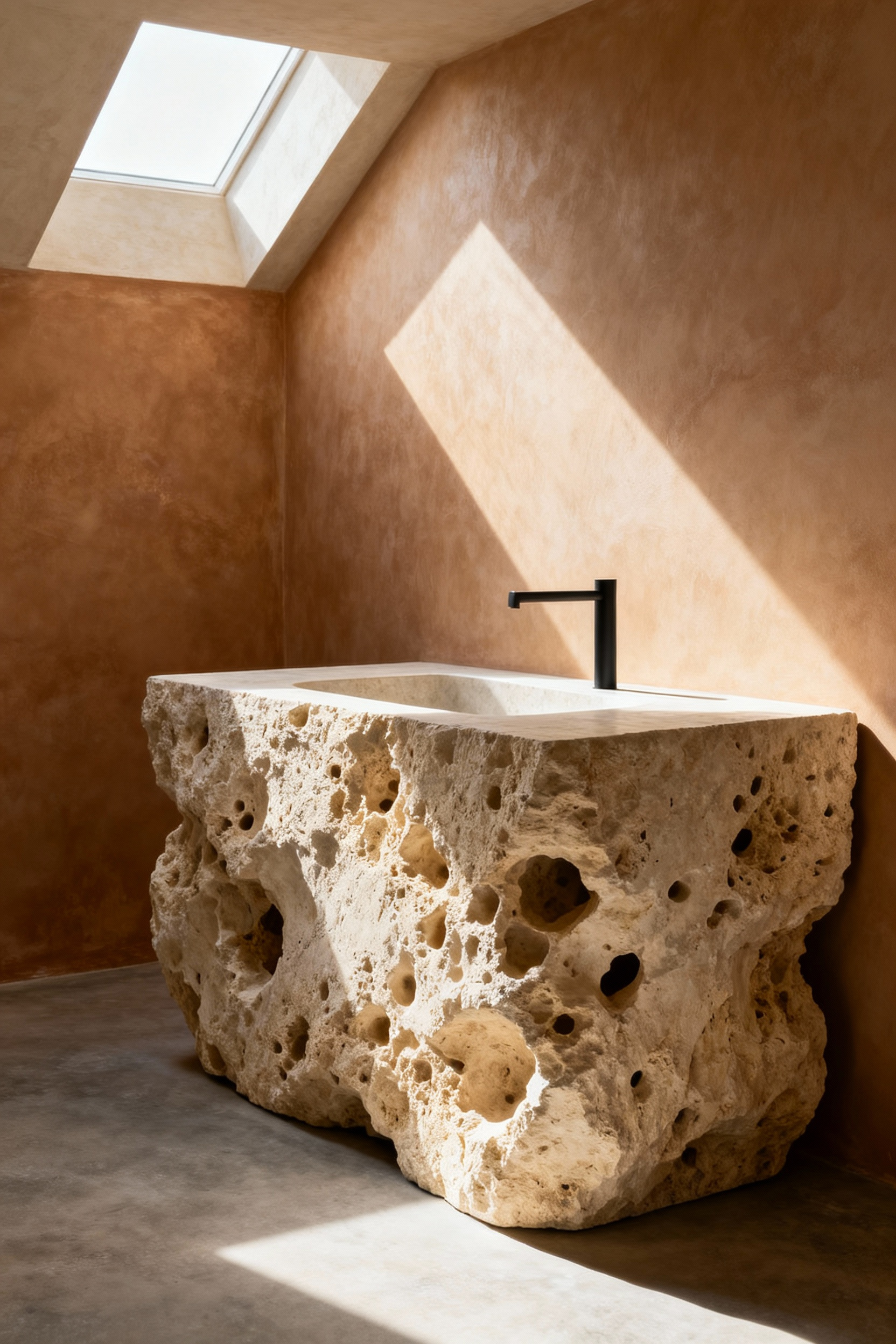
However, the allure extends beyond scale. Specifically, the “raw” finish preserves the stone’s porosity. These cavities are not defects; they are natural history. Unlike resin-filled counterparts, an unfilled surface offers a rugged experience. Thus, the vanity becomes a statement of material honesty.
Furthermore, this design serves an energetic function. In holistic practices, travertine acts as a “grounding stone.” Specifically, it resonates with the root chakra. Visually, the warm palette supports biophilic principles. Ultimately, this transforms washing into a restorative ritual. The bathroom becomes a sanctuary for realignment.
2. Reclaimed Teak and Warm Woods: Introducing biophilic warmth to counteract sterile porcelain surfaces
Modern bathrooms often rely on hard, cool surfaces. Materials like porcelain or polished stone dominate. Consequently, these spaces can feel emotionally cold. To counteract this, designers introduce warm woods. Specifically, this leverages biophilic principles to create balance. By incorporating organic textures, you satisfy an innate desire for nature. For more inspiration, explore these serene wooden bathroom ideas.
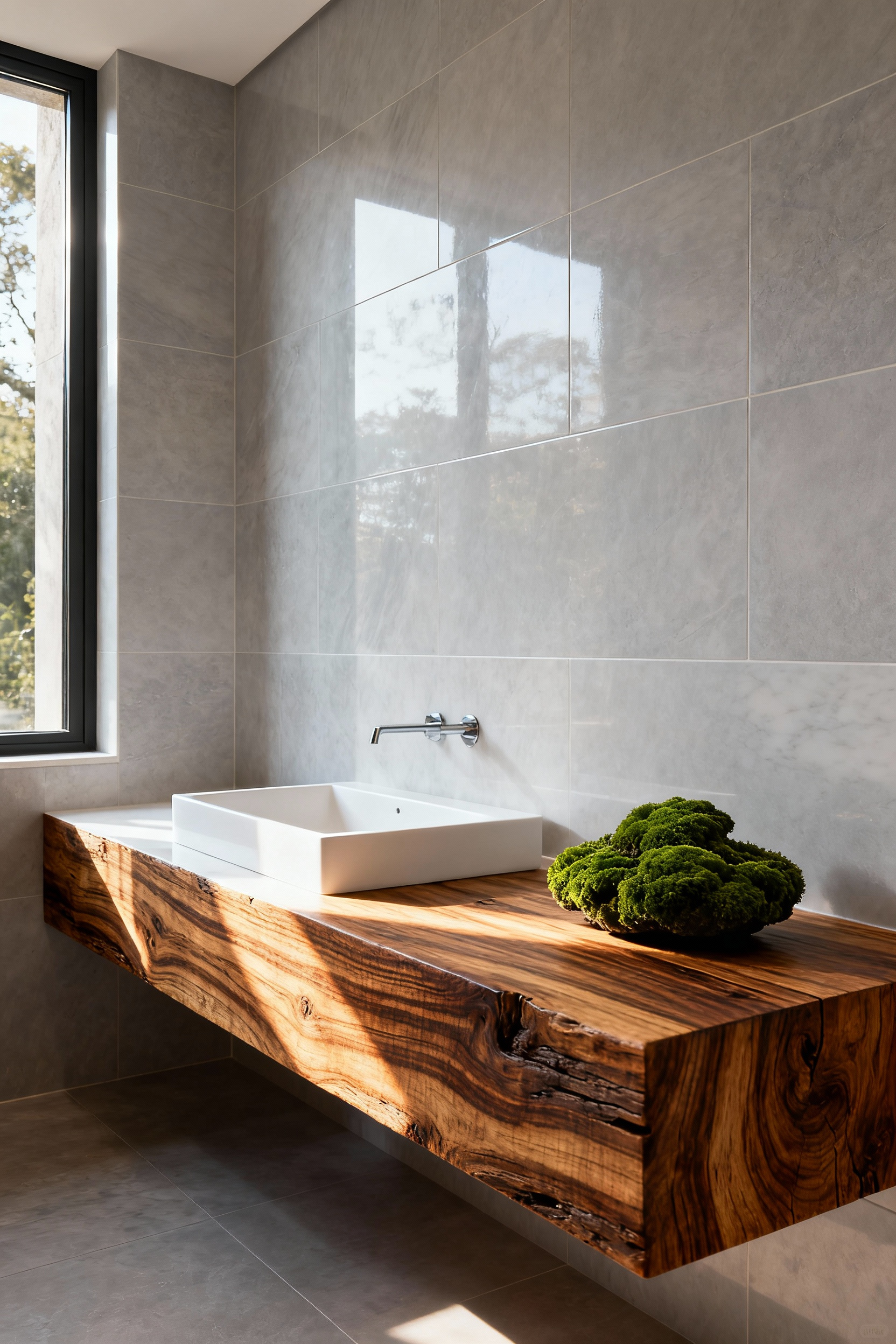
Specifically, reclaimed teak stands out as a superior choice. Historically, shipbuilders favored this wood for its natural oils. Therefore, it remains virtually waterproof. Furthermore, reclaimed timber offers enhanced stability. Because it has aged, it resists swelling in humid environments. Thus, the vanity maintains its integrity.
Beyond durability, the sensory impact is profound. For instance, earthy tones soften bright ceramic fixtures. Simultaneously, the material’s warmth contrasts with cold tiles. This textural interplay promotes relaxation. Alternatively, darker woods like walnut offer quiet luxury. Conversely, bright surfaces achieve the style of a white bathroom vanity. Ultimately, natural materials transform a utility room into a sanctuary.
3. Hand-Plastered Microcement: Creating seamless, soft-touch surfaces that mimic ancient bathing rituals
Modern microcement draws inspiration from Moroccan *Tadelakt* traditions. Historically, these plasters defined the surfaces of public hammams. Today, hand-plastered microcement offers a resilient evolution for vanities. Unlike industrial concrete, this material creates a warm, satin finish. Specifically, artisans apply it in thin layers. Consequently, the surface displays visible trowel strokes. These imperfections echo the *Wabi-Sabi* aesthetic.
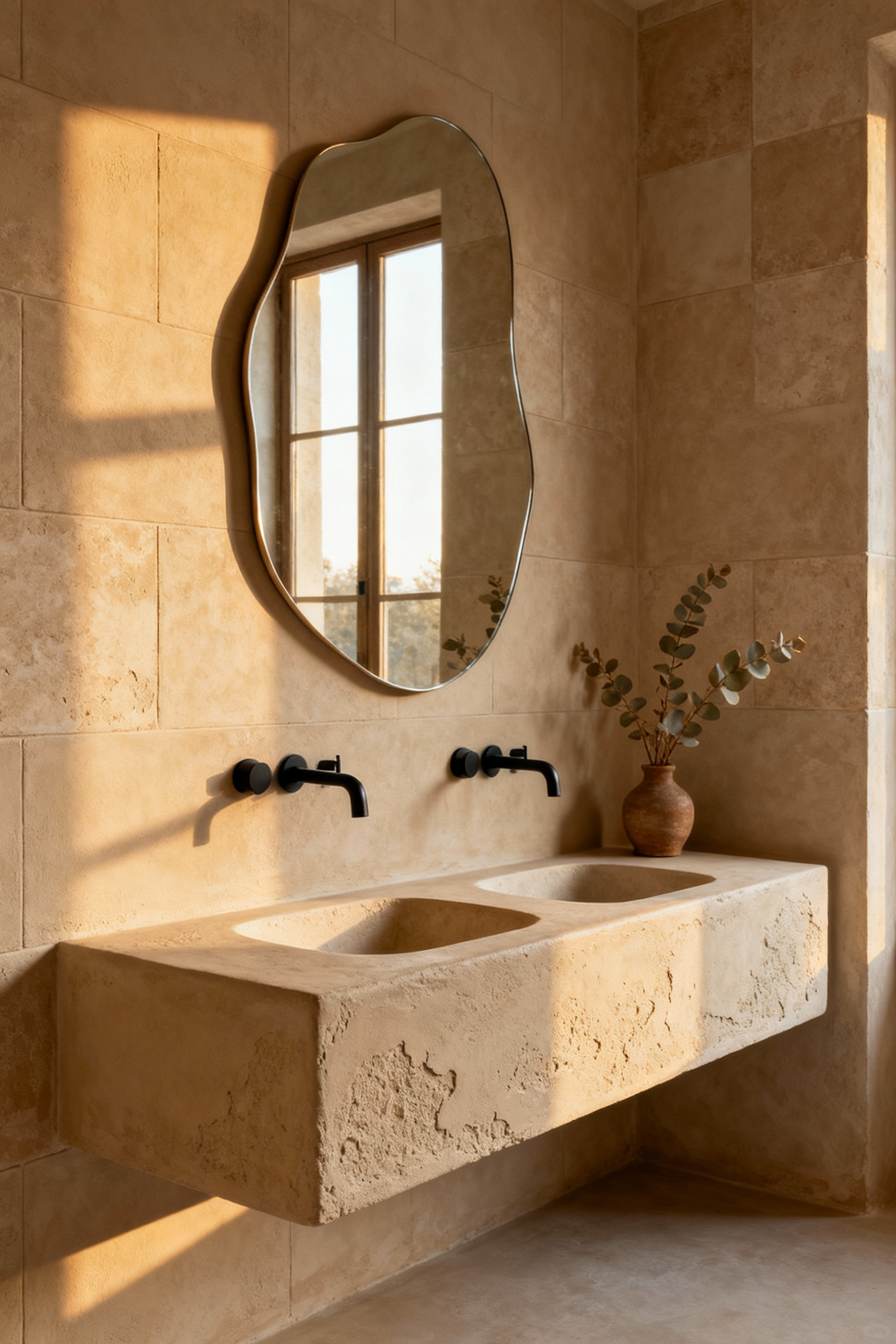
Furthermore, microcement eliminates distracting grout lines. This allows the basin and countertop to merge. In fact, seamless integration enhances hygiene significantly. It prevents dirt accumulation. Ultimately, the design transforms a functional fixture into a sculptural vessel. Thus, washing becomes a grounded ritual of renewal.
4. Matte-Finish Composites: Reducing visual glare and ‘noise’ for a calmer morning headspace
Consequently, how surfaces handle light shapes your morning. High-gloss finishes often create harsh, distracting glare. In contrast, matte-finish composites absorb illumination. Specifically, materials like Nano-Tech Matt (NTM) laminates achieve an “extremely matte” rating. Technically, this ensures a soft, diffused glow.
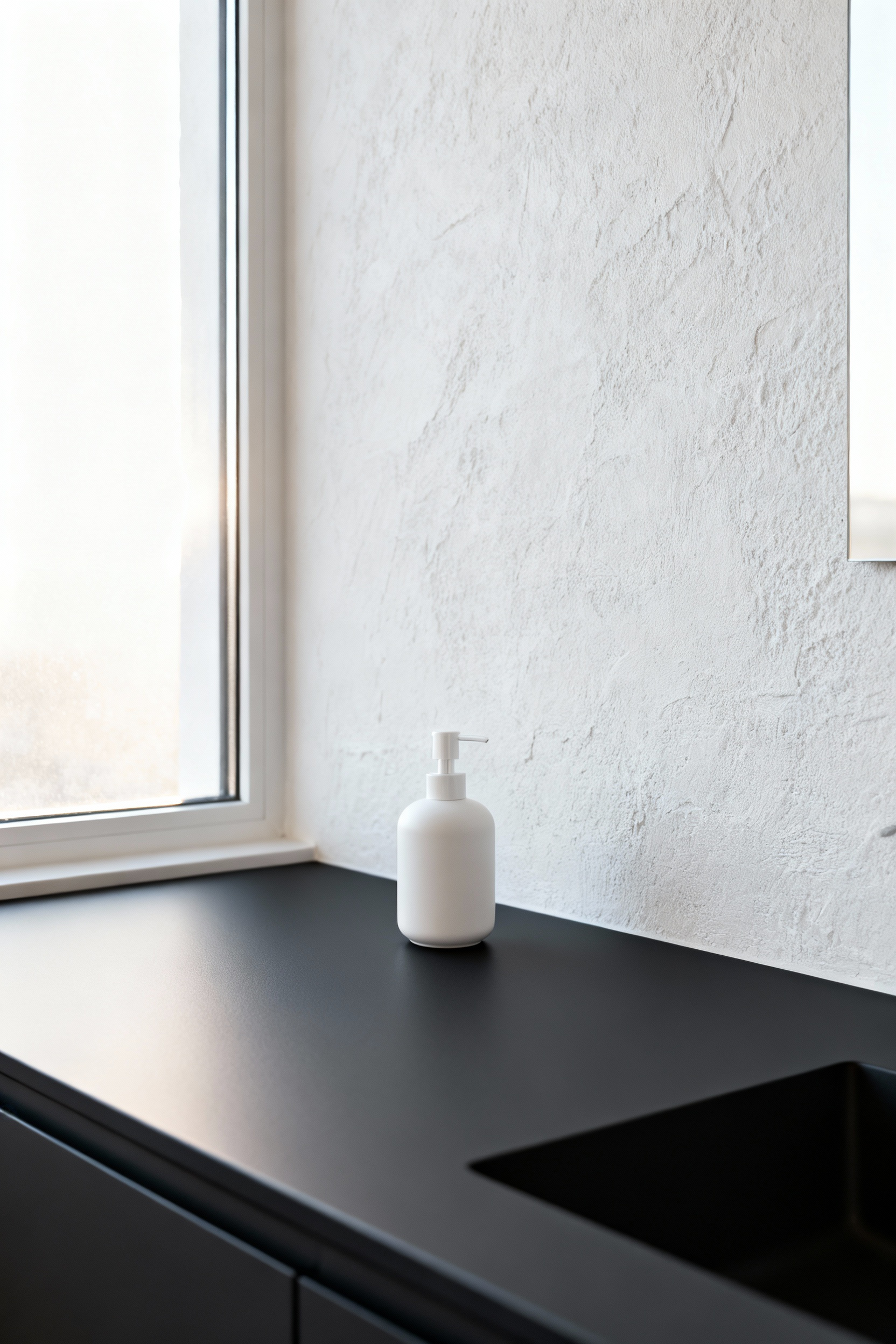
Therefore, reduced reflectivity minimizes “discomfort glare.” Unfortunately, harsh reflections can trigger eye strain. By eliminating optical stress, matte finishes support a gentle transition into the day.
Furthermore, these surfaces reduce mental clutter. High-gloss options amplify anxiety by highlighting fingerprints. Conversely, opaque matte finishes are forgiving. Because they conceal imperfections, you feel less pressure to clean. Finally, the benefits extend to touch. Many composites feature “soft-touch” technology. Ultimately, this creates a serene ambiance.
Theme 2: Flow and Form – Psychological impact of shape and suspension
The design of a bathroom vanity transcends utility. It leverages psychology to influence emotions. In fact, the human brain prefers curves. Specifically, rounded contours signal safety. Sharp edges can subconsciously mimic threats. Conversely, curved designs elicit relaxation. Therefore, a rounded vanity acts as a calming counterpoint to rigid tiling.
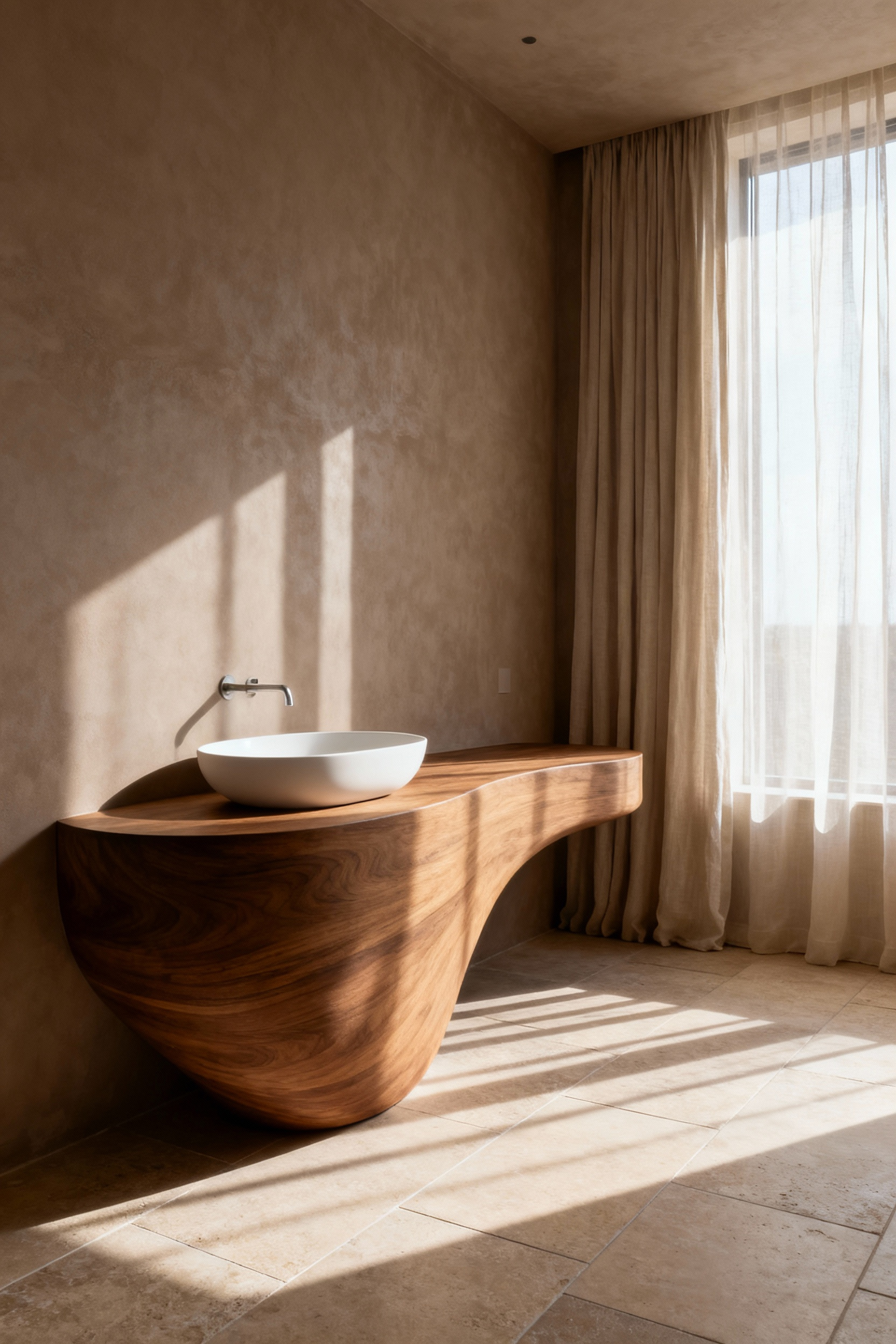
However, angular designs also serve a function. Rectangular forms provide order. For many, this geometry offers “structured calm.” Effectively, it anchors the room. Thus, sharp lines support mental clarity.
Beyond shape, suspension alters perception. Notably, “floating” designs introduce lightness. By lifting the cabinet, the floor remains visible. Consequently, the room feels larger. This uninterrupted sightline prevents suffocation. Ultimately, this openness reduces visual clutter.
5. The Floating Console: Elevating the cabinet to enhance spatial flow and Qi circulation
Fundamentally, a floating console changes how we perceive space. By detaching the cabinet, the design creates weightlessness. Consequently, the eye travels uninterrupted, making rooms feel larger. This removal of obstruction transforms a static object into an architectural extension.
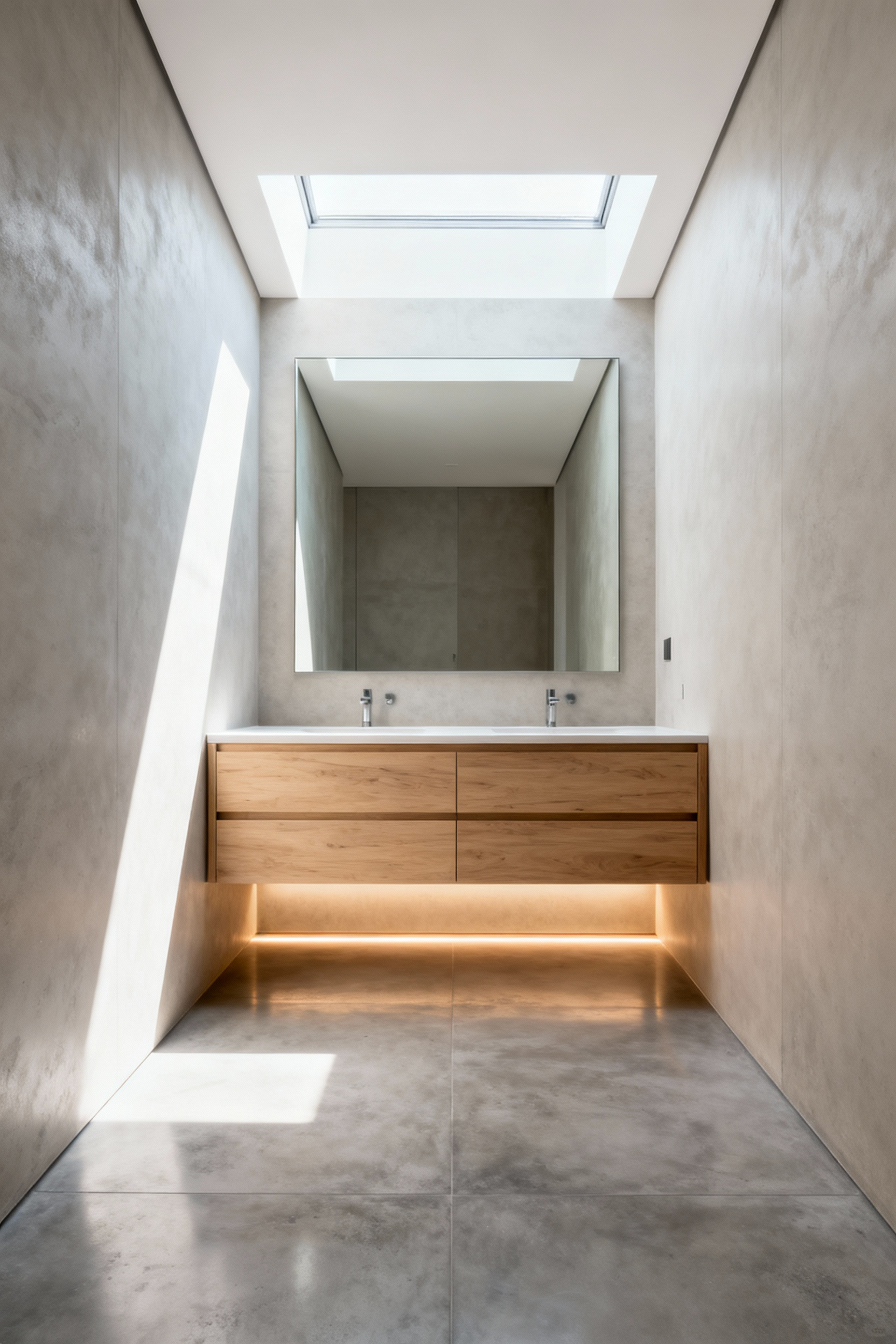
In holistic design, this supports the circulation of Qi. Bathrooms often suffer from stagnant energy. Therefore, the open space encourages uplifting energy. Additionally, this gap eliminates hidden corners for dust. Thus, the design promotes cleanliness.
Beyond energy, the design offers ergonomic flexibility. Unlike fixed units, consoles allow height customization. Specifically, mounting at “comfort height” reduces strain. Conversely, lower installations accommodate taller sinks. Structurally, heavy-duty brackets support this illusion. Finally, under-cabinet lighting amplifies the effect. As a result, the soft glow creates a spa-like atmosphere.
6. Soft-Edge Curvilinear Cabinetry: Removing sharp corners to reduce subconscious fight-or-flight responses
However, sharp angles do more than dictate style. Scientifically, they trigger a “fight-or-flight” response. In fact, neuro-architecture shows angular forms activate the amygdala. This region processes threats. Consequently, our minds associate sharpness with danger.
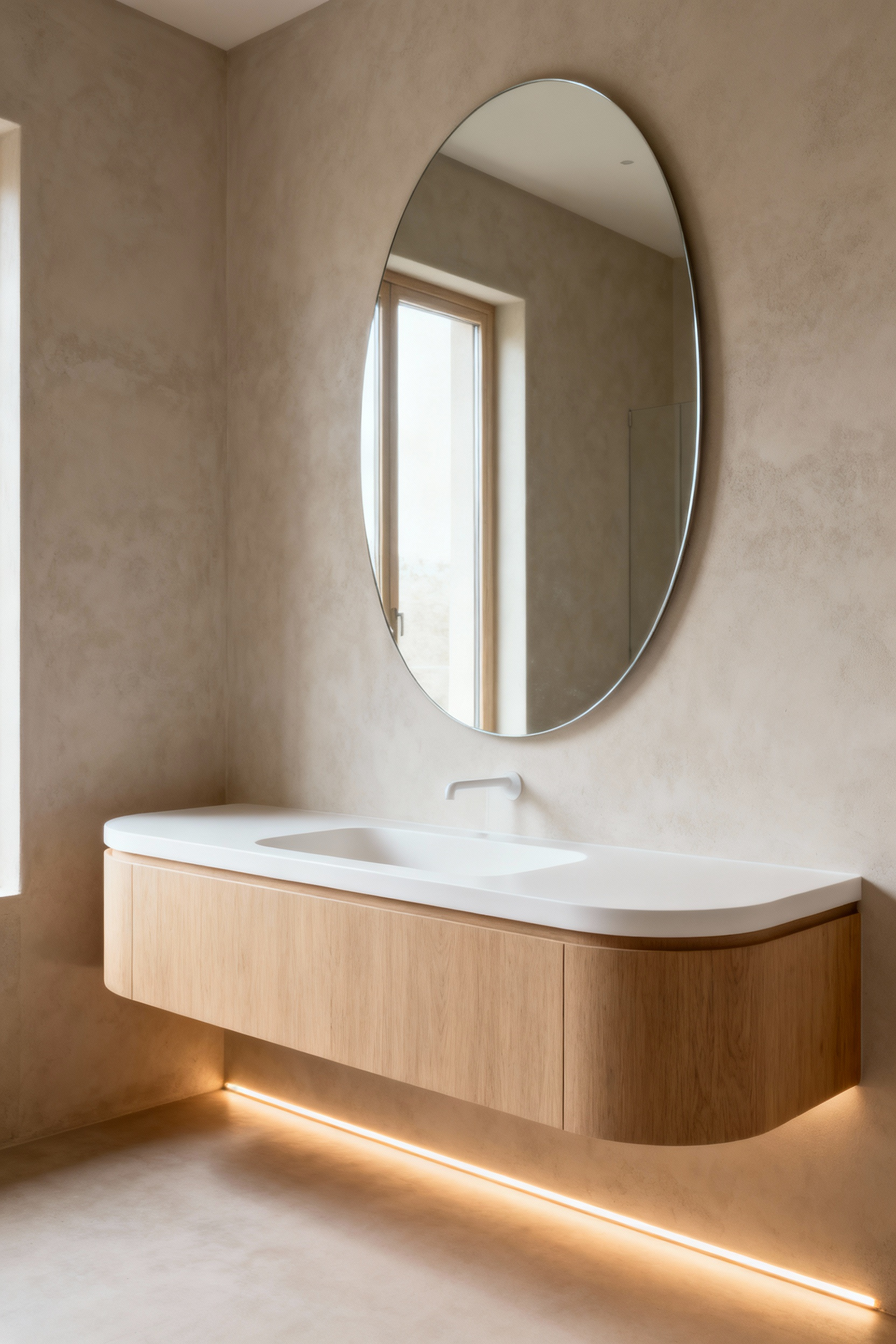
Conversely, soft-edge cabinetry signals safety. Research indicates rounded environments can reduce cortisol levels. Therefore, softened corners create a restorative atmosphere. Visually, this revives “quiet glamour.” It transforms a vanity into a welcoming object.
Practically, curved fronts improve spatial flow. They eliminate jutting corners that cause bumps. Furthermore, achieving these shapes often requires thermoformed materials. These non-porous materials offer hygienic benefits. Ultimately, the investment promotes physical safety and mental peace.
7. Asymmetrical Countertops: Creating dedicated dry zones for mindfulness rituals and essential oils
Modern design often prioritizes uniformity. However, asymmetry offers functional advantages. Specifically, offsetting the sink creates a dedicated “dry zone.” This is not merely aesthetic; it is protective. Many luxury vanities feature porous stones. However, products like essential oils are acidic. Consequently, spills can cause etching.
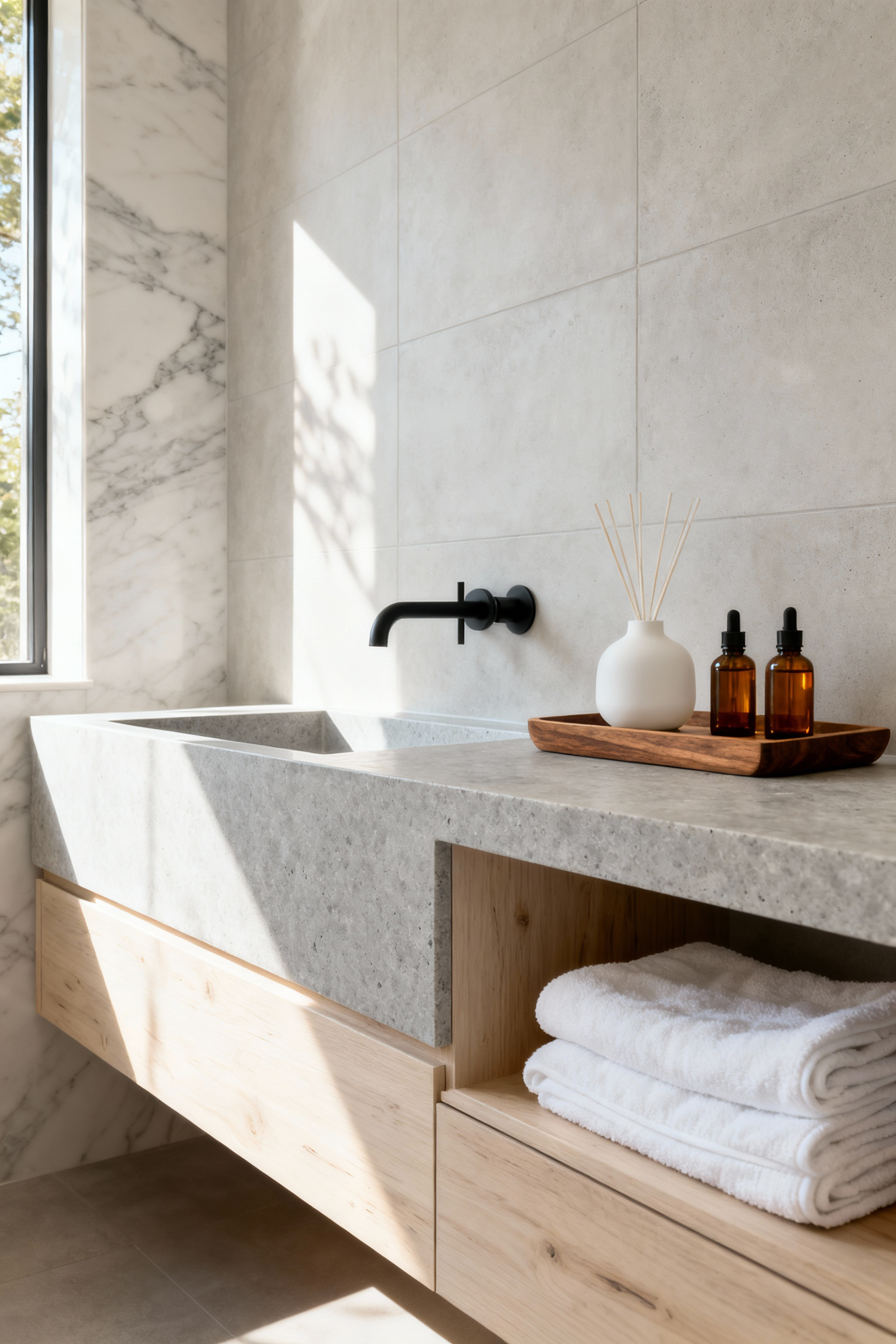
To mitigate this, designers incorporate contrasting materials. For instance, a raised section of walnut acts as a barrier. This visually separates the space. Effectively, it creates a hierarchical “altar.” Furthermore, this separation supports mindfulness. By isolating specific items, the vanity remains clutter-free. Ultimately, the layout invites you to pause.
8. Integrated Ramp Sinks: The sound design of water flow and the elimination of visual seams
Integrated ramp sinks represent the pinnacle of minimalism. Specifically, they achieve a monolithic statement. Fabricators craft these units from a single block. Consequently, the surface flows uninterrupted. For stone, veining moves continuously down the slope. Furthermore, the design replaces drains with discreet slots. This reinforces architectural appeal.
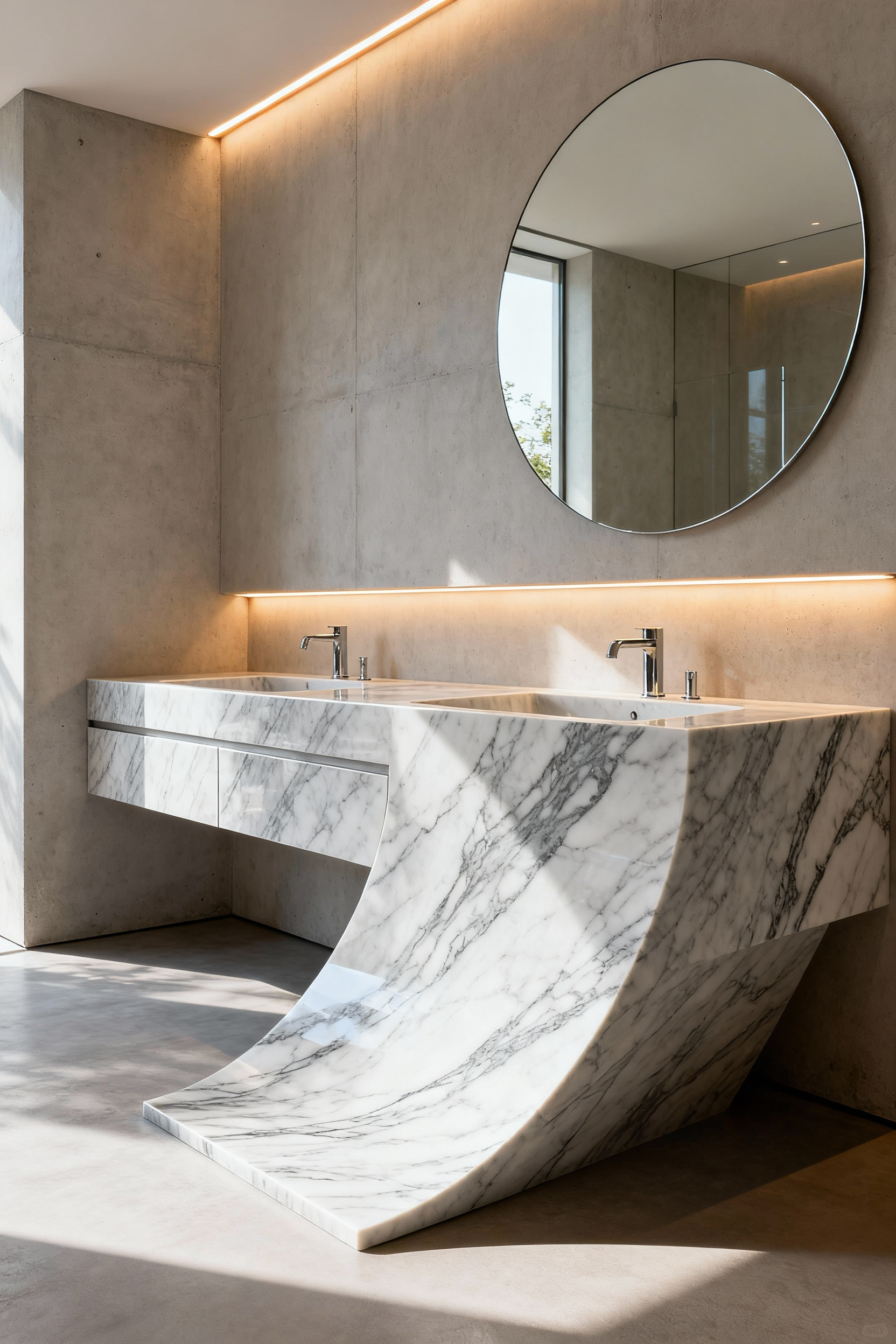
Beyond aesthetics, the geometry alters sound. Standard sinks often produce turbulent noise. In contrast, the ramp guides water smoothly. This interaction produces a “cascading effect.” Additionally, dense materials possess sound-dampening properties. Therefore, the water’s impact is muffled. Ultimately, this construction improves hygiene. Without crevices, grime has nowhere to accumulate.
Theme 3: Luminosity and Reflection – Supporting circadian rhythms
True well-being requires looking beyond standard brightness. Instead, designers prioritize Equivalent Melanopic Lux (EML). This metric quantifies light’s biological impact. Specifically, it targets photoreceptors that regulate melatonin. Therefore, vanity design must focus on vertical light at eye level.
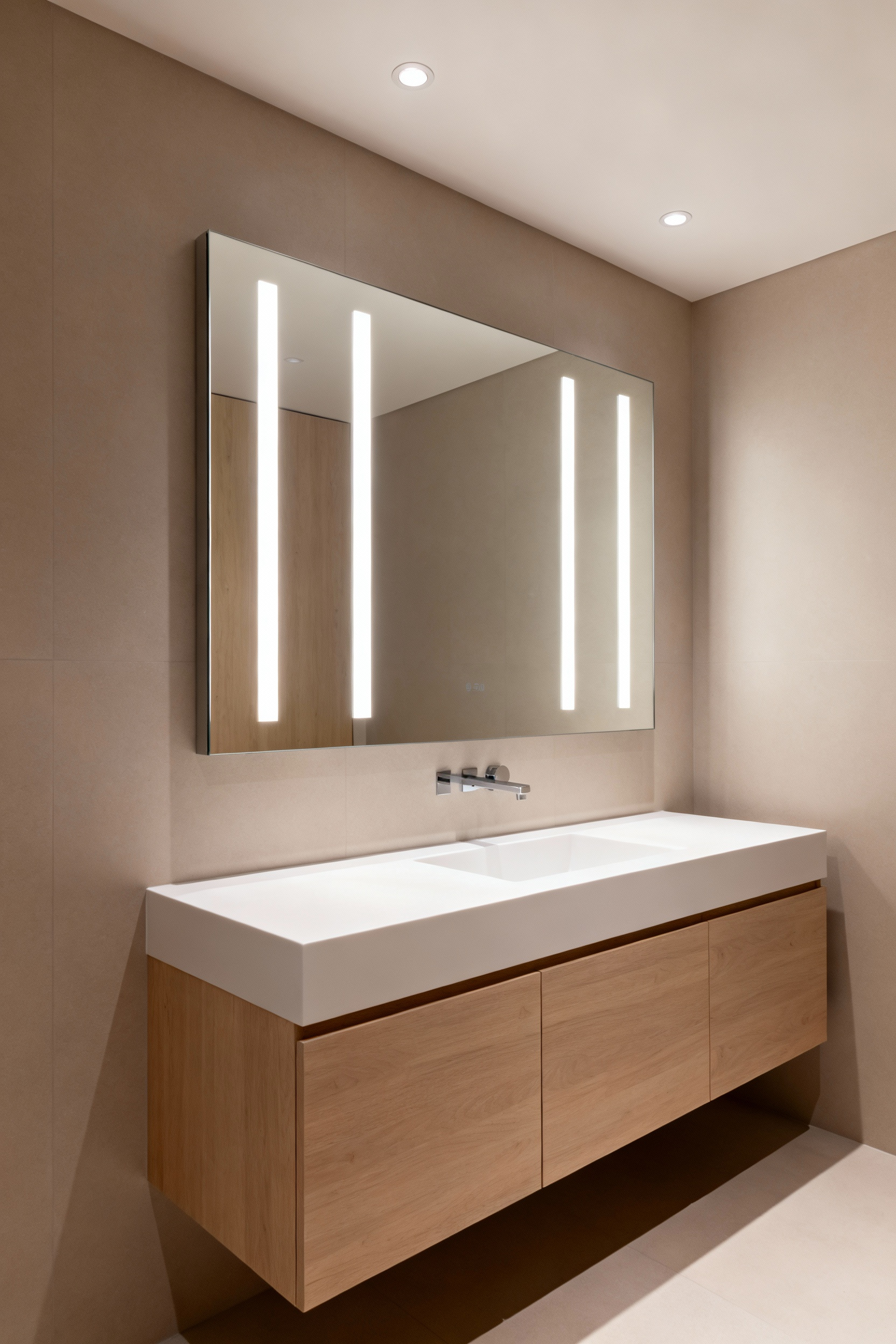
To support circadian rhythms, color temperature is critical. In the morning, blue-enriched light promotes alertness. Ideally, this falls between 5000K and 6500K. Conversely, evening routines require a shift. We must reduce blue light to encourage rest. Thus, warm light is essential.
Furthermore, the vanity acts as a secondary light source. Designers utilize “high-albedo” surfaces. For example, white countertops bounce light upward. Consequently, this reflection bathes the face gently. It increases the wake-up signal without glare. Finally, technology must balance biology with utility. Automated systems can mimic the sun. However, manual control remains necessary. Therefore, a layered lighting approach is authoritative.
9. Toe-Kick Ambient Night Lighting: Disruption-free navigation that preserves sleep inertia
Navigating the bathroom at night often involves a sensory shock. Specifically, overhead lights expose eyes to blue-spectrum wavelengths. Unfortunately, this signals the brain to wake up. Conversely, toe-kick ambient lighting offers a supportive alternative. By installing LED strips in the base, light flows toward the floor. Therefore, this keeps illumination low enough to protect sleep cycles.
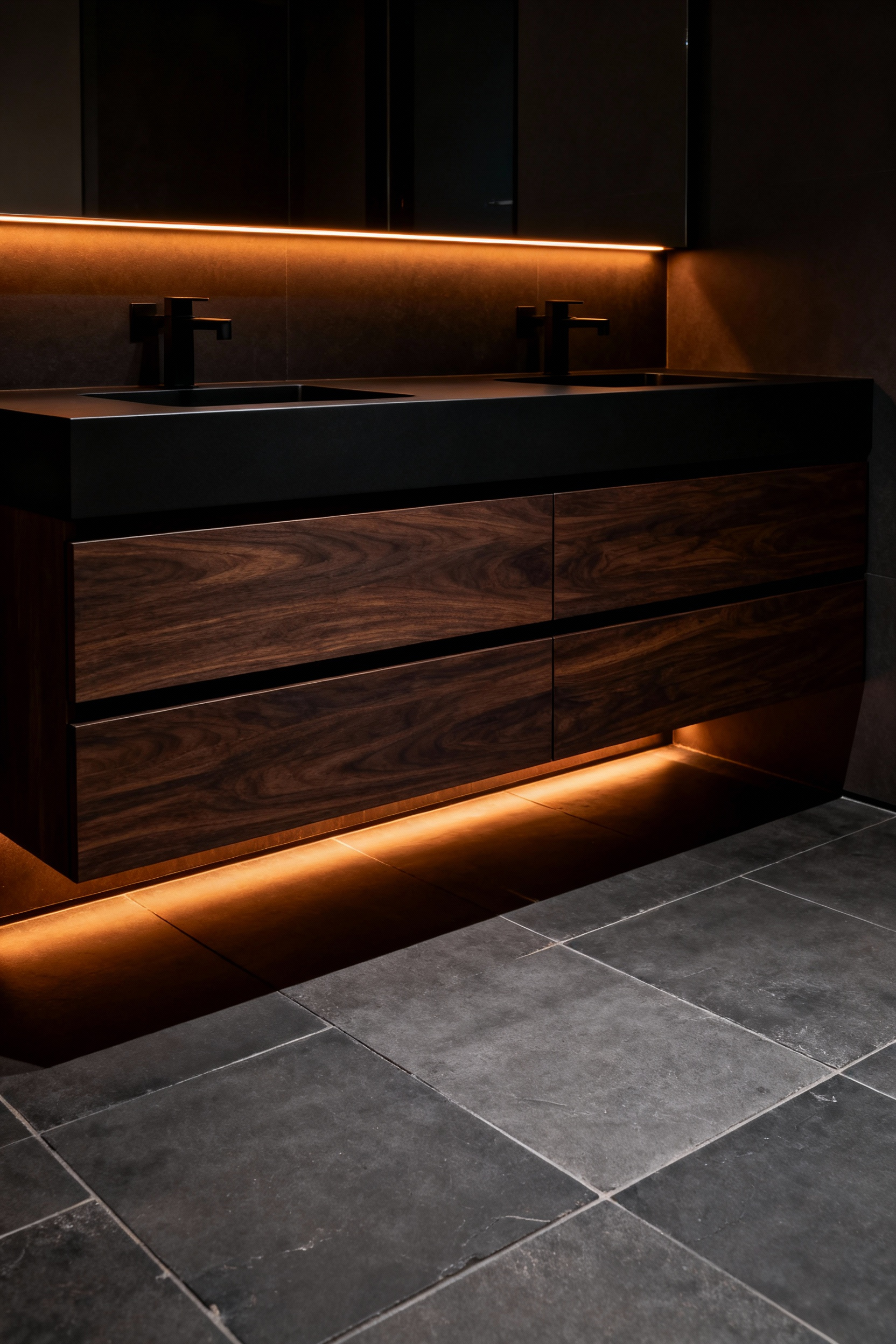
Furthermore, light quality is vital. Ideally, sources should emit a warm 2700K to 3000K temperature. Consequently, this prevents sleep inertia. Instead of fumbling for switches, motion sensors can activate this glow. In fact, this creates a shadow-free wash for safe navigation. Aesthetically, the hidden LEDs produce a “floating” illusion. Ultimately, this detail preserves physical rest.
10. Warm-Dim Integrated Mirror Lighting: Mimicking natural sunlight progression for hormonal balance
Fundamentally, human biology relies on the circadian rhythm. Therefore, lighting directly influences hormonal balance. Specifically, morning routines require blue-rich light. This wavelength suppresses sleep hormones. A vanity mirror set to a daylight mode delivers this “wake up” signal.
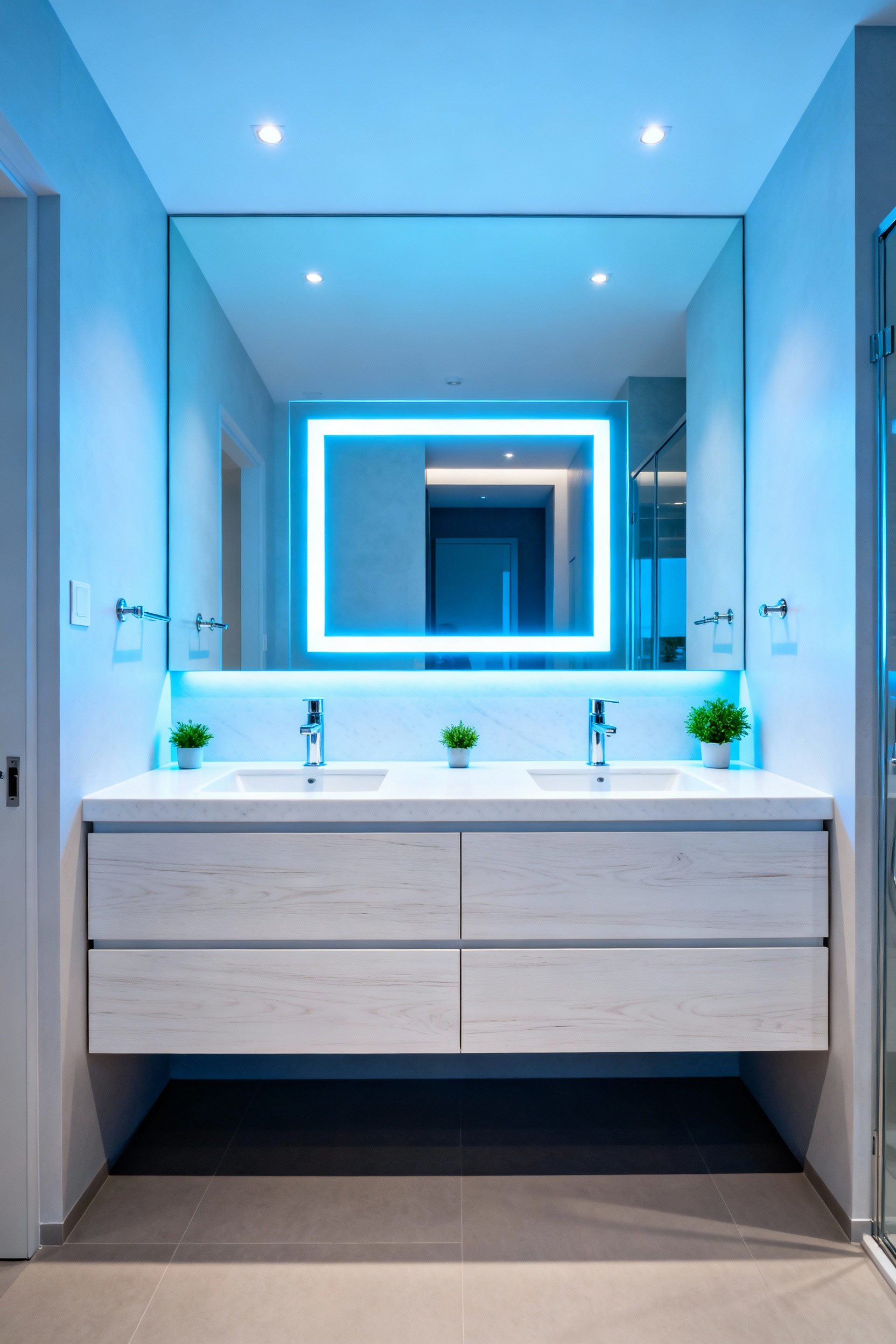
Conversely, evening environments demand a shift. Bright light at night disrupts sleep. However, standard LEDs often appear cold when dimmed. To solve this, “Warm-Dim” technology mimics traditional bulbs. As the fixture dims, the light transitions to amber. Consequently, this creates a candlelight atmosphere.
In fact, this aligns with the WELL Building Standard. By reducing melanopic lux before bed, the bathroom becomes a sanctuary. Ultimately, integrated lighting transforms a grooming tool into a wellness instrument.
11. Fluted Glass Cabinet Fronts: Diffusing contents to create a soft, ethereal visual texture
Fluted glass transforms standard storage into a visual experience. Unlike clear glass, ridges act like prisms. Consequently, incoming light scatters upon contact. This gently obliterates sharp lines. Therefore, contents blur into abstract silhouettes. Visually, it resembles running water. Specifically, this creates an ethereal aesthetic.
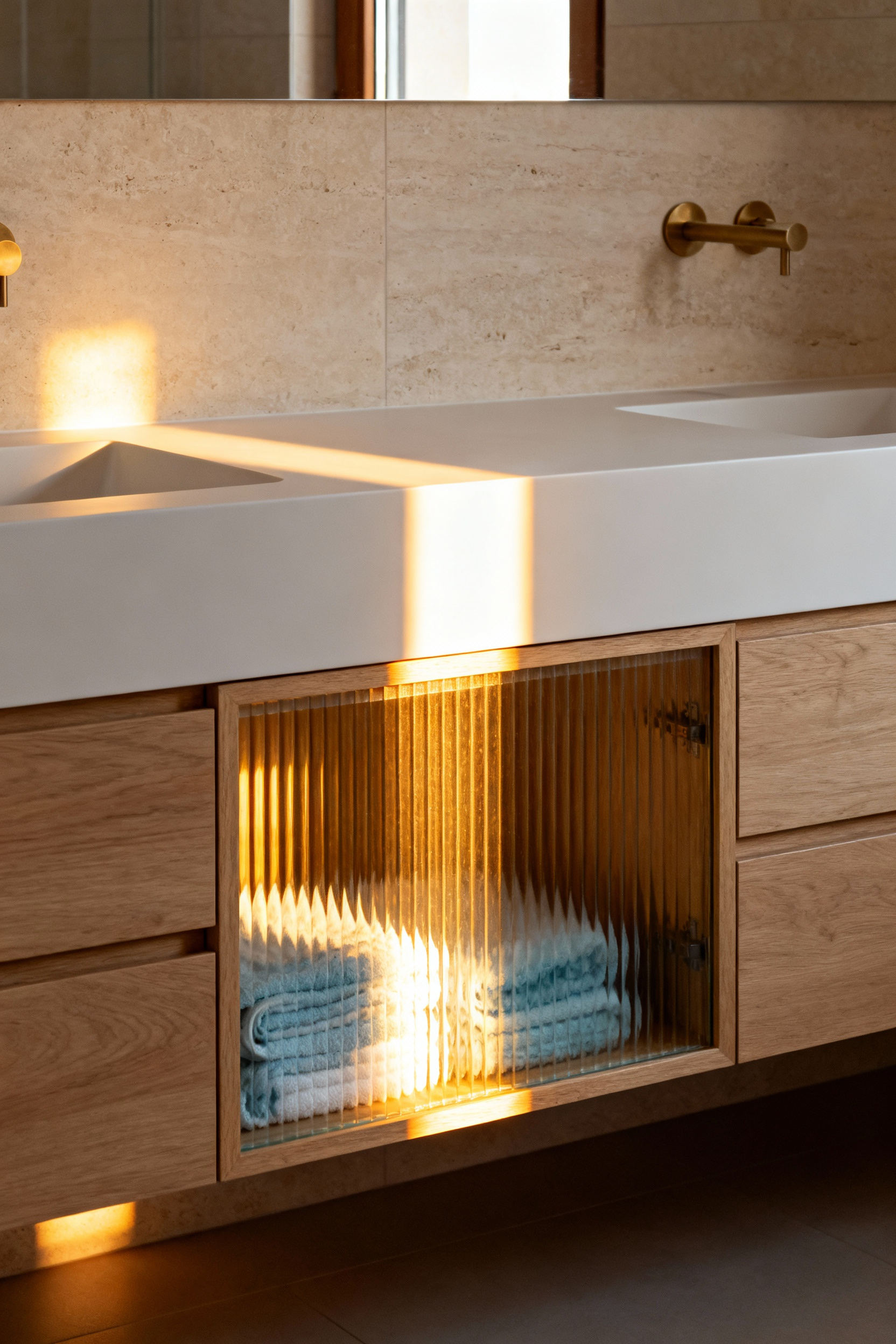
Beyond optics, this material introduces rhythm. Historically, the pattern mimics classical columns. Thus, vertical grooves draw the eye upward. Furthermore, bathrooms often feature cold surfaces. Fluted glass provides tactile contrast. In fact, the interplay of light adds warmth.
Functionally, this offers a solution to clutter. You maintain airiness without total exposure. Therefore, colorful bottles become pleasing shapes. Additionally, the surface conceals imperfections. Fingerprints remain less visible here. Finally, internal lighting amplifies the effect. Ultimately, this creates a nurturing atmosphere.
12. Unlacquered Brass Hardware: The antimicrobial properties and warming aesthetic of living metals
Designers frequently describe unlacquered brass as a “living metal.” Specifically, this refers to its evolving appearance and biology. Unlike static finishes, raw brass serves a functional role.
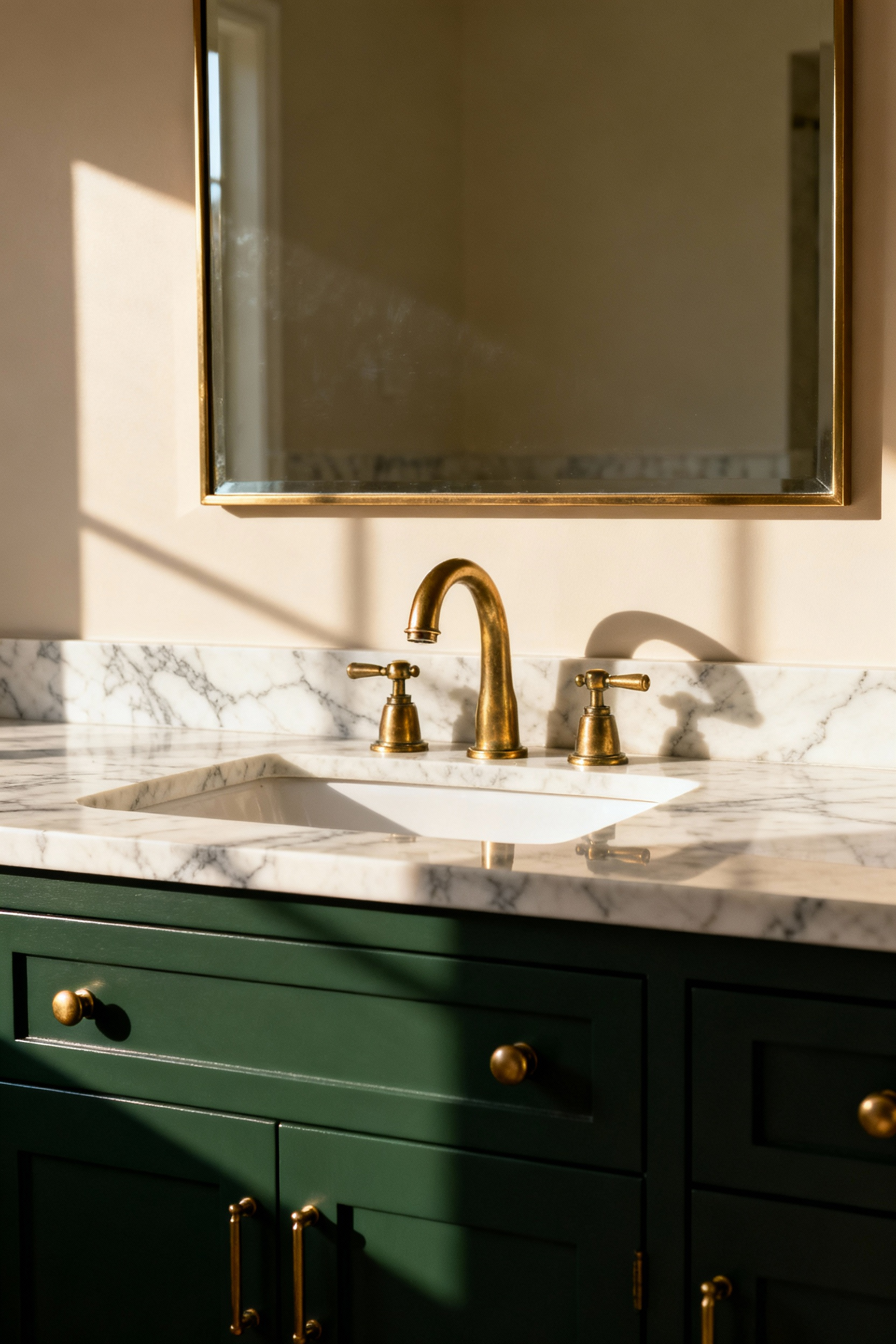
At its core, this material relies on the oligodynamic effect. Consequently, copper ions actively neutralize microbes. In fact, studies show these surfaces eliminate bacteria rapidly. Therefore, unlacquered hardware acts as a passive sanitation tool. Notably, the EPA recognizes copper alloys as antimicrobial.
However, benefits depend on the finish. Ideally, the metal must remain unsealed. A lacquered coating blocks the chemical reaction. Thus, coated brass becomes purely decorative. Aesthetically, the absence of lacquer allows patina. Over time, gold transitions into bronze. This oxidation embodies *wabi-sabi*. Furthermore, wear patterns give the space history. Ultimately, unlacquered brass combines elegance and hygiene.
Theme 4: The Serenity of Order – Reducing cognitive load through function
True serenity relies on reducing friction. Intelligent vanity designs lower cognitive load by streamlining rituals. For instance, ergonomics prioritize “comfort height.” Typically, this aligns the sink 36 to 40 inches from the floor. Consequently, this minimizes back strain. When physical effort decreases, mental focus improves.
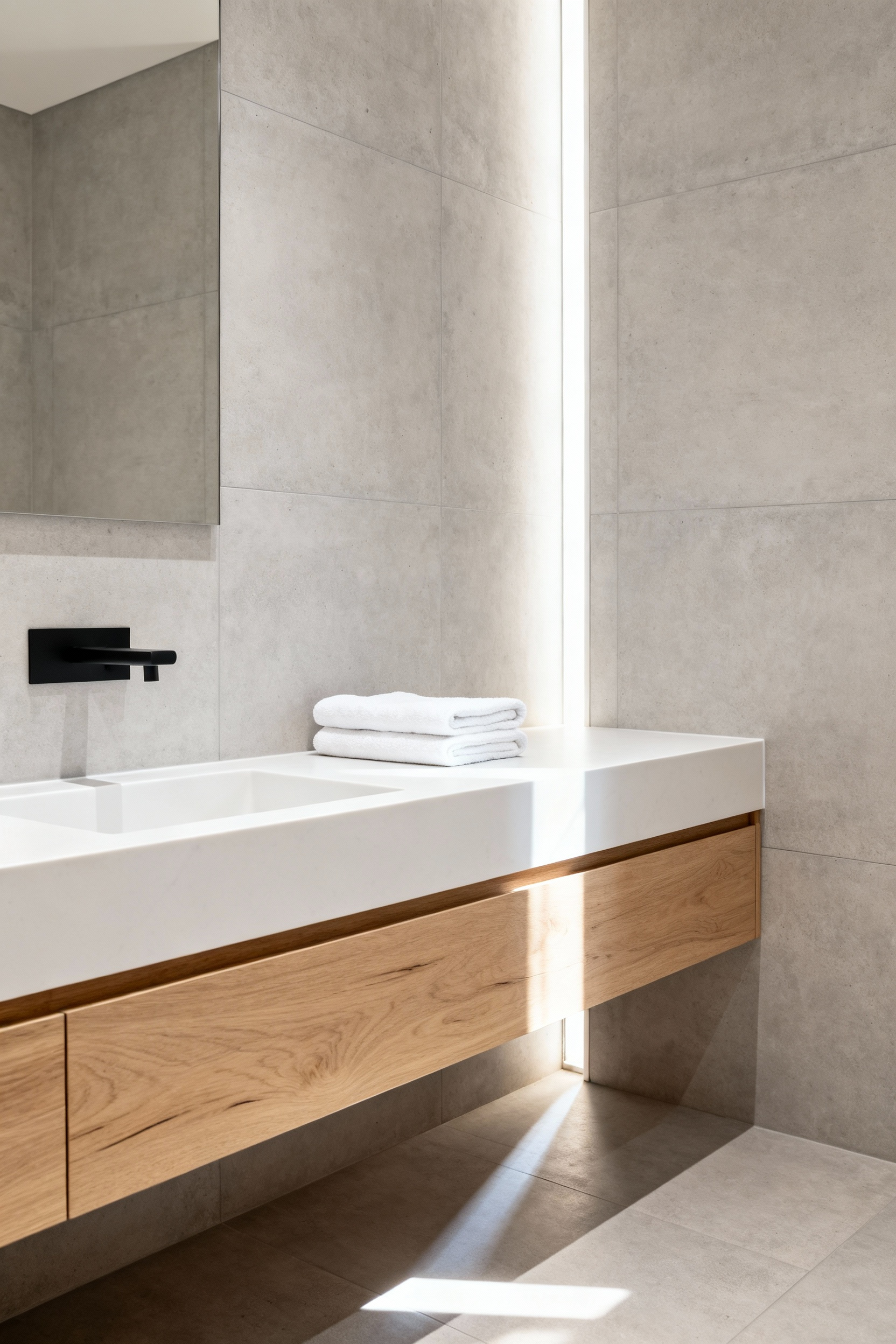
Furthermore, visual clutter creates mental noise. Therefore, full-extension drawers ensure items are invisible. Additionally, floating vanities contribute to order. By revealing floor space, the room feels airy. To maintain silence, integrated outlets keep cords hidden. For more inspiration on curating your surfaces, review our top luxury bathroom counter decor ideas.
Moreover, material selection reduces anxiety. Non-porous options are effortless to clean. Because there are no rims, maintenance stress vanishes. Finally, layered lighting supports mental states. Task lighting ensures clarity. Conversely, ambient lighting transforms the vanity.
13. The ‘Appliance Garage’ Drawer: Dedicated powered storage to hide cords and reduce visual anxiety
Visual clutter often creates mental stress. Consequently, the “Appliance Garage” drawer is an essential evolution. This unit transforms passive cabinetry into a powered station. Specifically, it hides tools while keeping them plugged in. However, the design prioritizes safety.
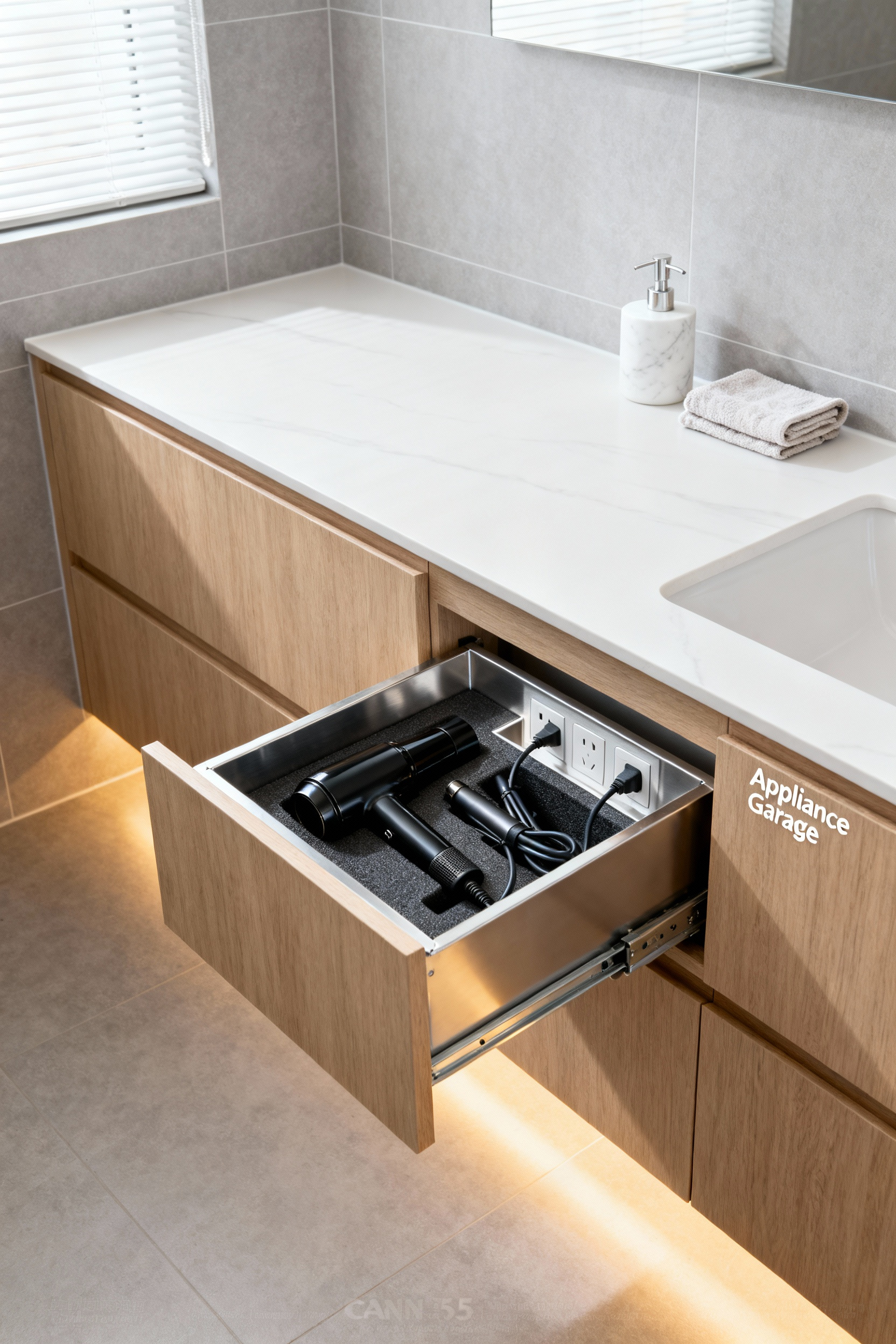
Notably, integrated mechanisms address risk. For example, thermostats cut power if temperatures rise. Additionally, steel canisters provide resting places for hot irons. Therefore, you can store tools immediately.
Psychologically, this reduces anxiety. In fact, hiding cords lowers cognitive load. You simply close the drawer to reset the room. Furthermore, configurations accommodate more than styling tools. Ideally, they include USB-C ports. Ultimately, this efficient use of space ensures tranquility.
14. Vertical Pull-Out Organizers: Ergonomic accessibility that eliminates the stress of digging
Traditional cabinets often create a frustrating “cave effect.” Consequently, accessing items requires kneeling. However, vertical pull-out organizers resolve this. By converting depth into linear motion, units bring contents to you. Therefore, physical strain is reduced.
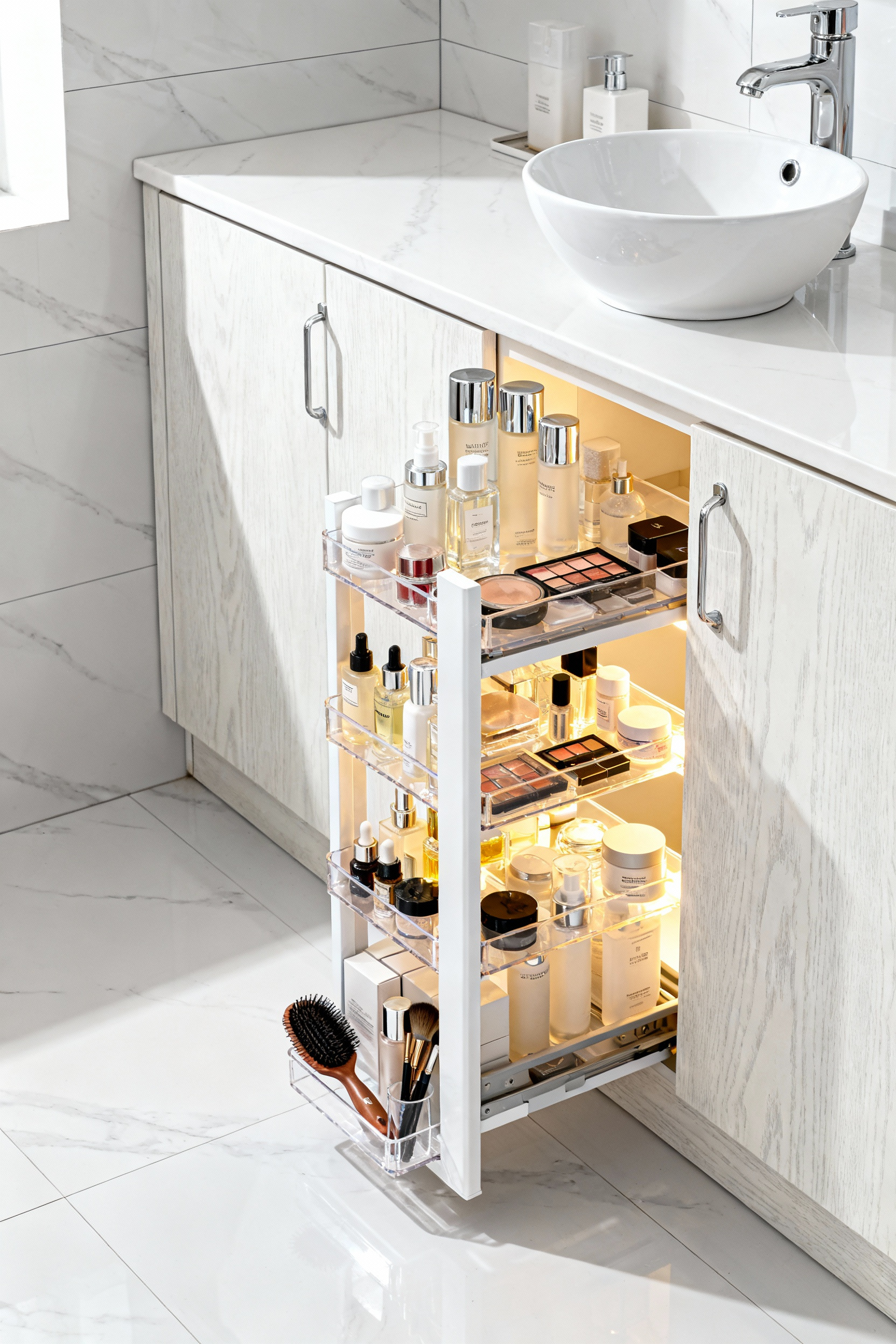
Furthermore, visibility is paramount. Specifically, full-extension slides allow for a single-glance inventory. This eliminates the anxiety of rummaging. In addition to accessibility, mechanics contribute to serenity. For instance, soft-close technology ensures quiet operation. Thus, jarring noise is banished.
Finally, these organizers maximize space. Specialized fillers transform narrow gaps. Moreover, bins can house hot tools. Ultimately, this keeps countertops clear.
15. Open Shelf Sanctuaries: Intentional display zones for plants and ritual objects versus clutter
Open shelving transforms a vanity into a retreat. However, success lies in intentionality. Specifically, a hybrid system is essential. Drawers must conceal visual noise. Consequently, hidden storage prevents mental exhaustion.
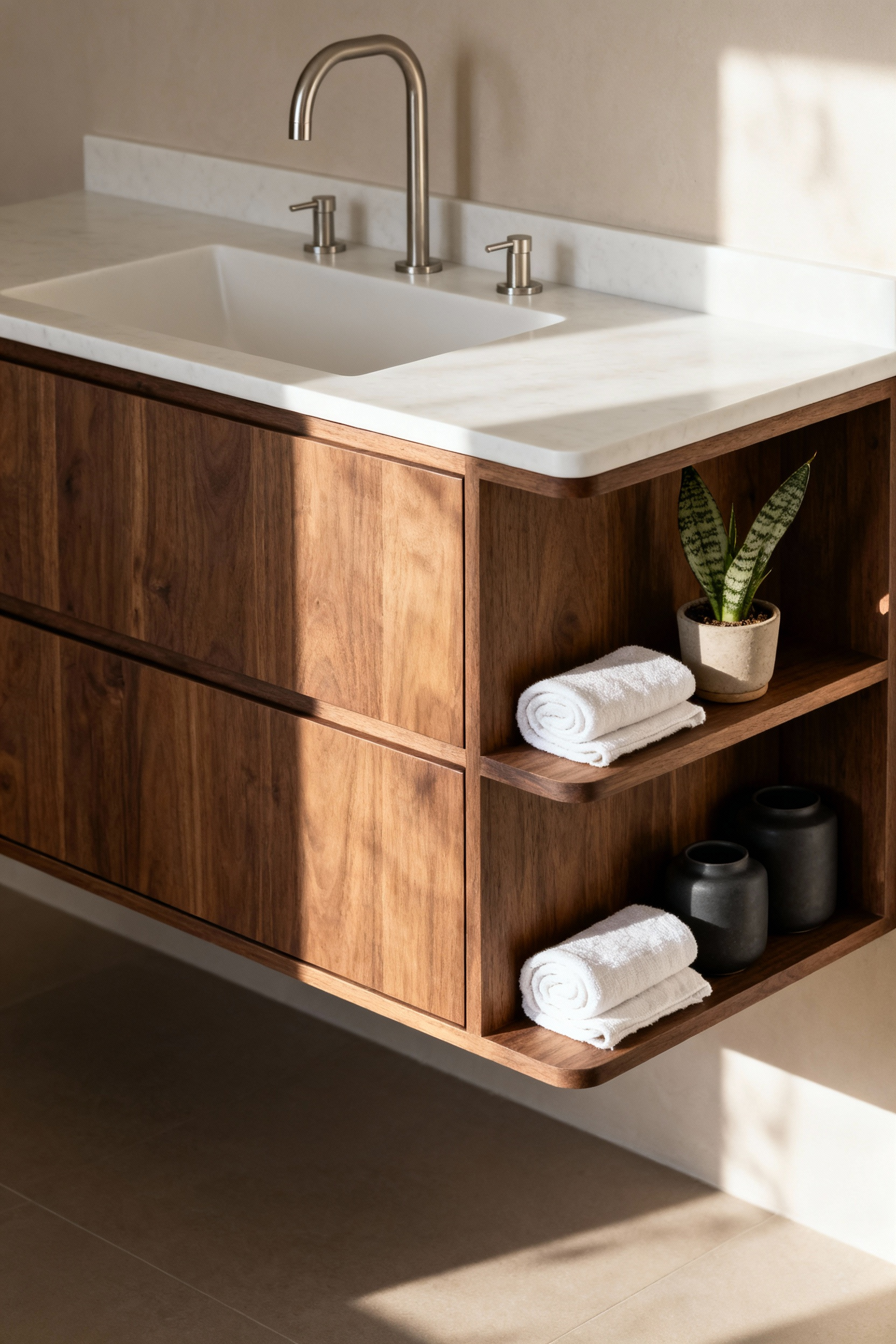
Conversely, exposed shelves are reserved for aesthetics. Consider decanting products into amber bottles. Furthermore, arrange objects using the “Rule of Three.” Allow for negative space. Letting the shelf “breathe” invites pause.
Philosophically, this draws from *Wabi-sabi*. Therefore, prioritize materials like driftwood. Additionally, incorporate biophilic elements. Plants connect the indoors with nature. Finally, engage smell through aromatherapy. A simple diffuser turns a routine into a ritual.
16. The Dual-Zone Separation: Preserving personal energy fields in shared primary bathrooms
The “Dual-Zone Separation” concept elevates design. Fundamentally, it transforms the vanity into a personal territory. This preserves energy fields in shared environments. Consequently, it minimizes sensory overlap.
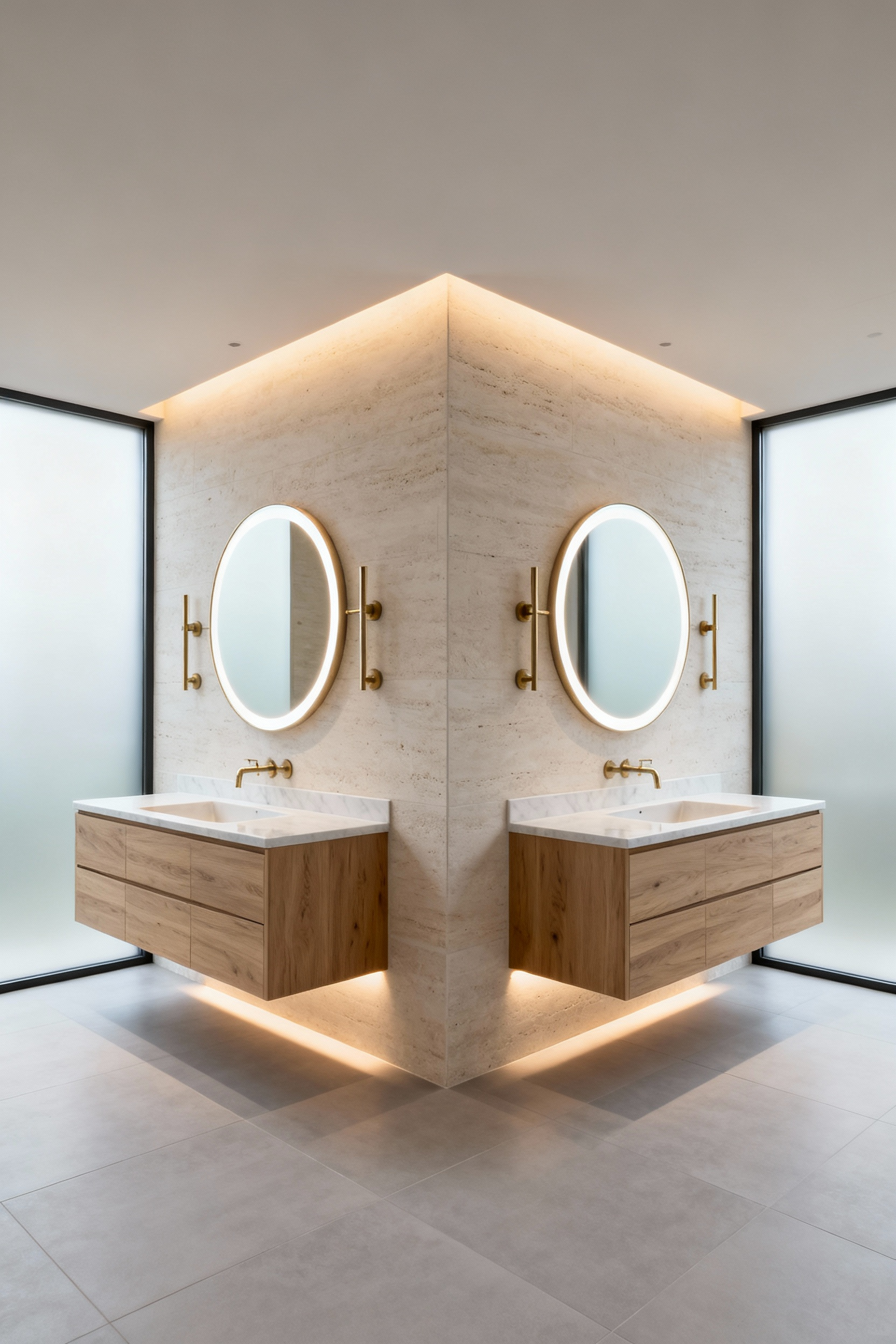
Psychologically, the bathroom serves as a refuge. Therefore, personal space is crucial. Specifically, the Dual-Zone approach creates a buffer. It reduces anxiety during vulnerable moments. Furthermore, it addresses the need for control.
Architecturally, this manifests as the “Split Bathroom.” Ideally, this separates utility from grooming. Thus, the vanity becomes a “Grooming Suite.” To define territories, designers use storage towers. Alternatively, placing vanities on separate walls reinforces separation. Moreover, this allows for personalization. Ultimately, these choices grant each user ownership.
Conclusion: From Morning Routine to Daily Ritual – How your vanity choice dictates the tone of your day
Ultimately, the bathroom vanity transcends simple function. Instead, it serves as a private sanctuary for setting your intentions. Historically, grooming was a performance; today, it is a grounding technique. Therefore, selecting honest materials becomes essential for clarity. In fact, reducing clutter directly lowers cognitive load. When meticulously designed, these luxury bathroom vanity designs act as an anchor for your morning.
Looking ahead, our homes must function as spaces of restoration. Thus, your vanity should support your rhythms. Prioritizing flow ensures your environment nurtures you. To begin, audit your tools for necessity. Specifically, identify where clutter creates friction. Finally, invest in a setup that honors your well-being.
Frequently Asked Questions
H3: What is the most popular trend in luxury bathroom vanity designs right now?
The most pronounced trend in luxury design emphasizes materiality and organic texture over excessive shine. This includes monolithic, sculptural vanities crafted from raw, natural materials like honed travertine or rift-sawn walnut, coupled with seamless integrated sinks (like ramp sinks). The focus is on natural warmth, durability, and a low-glare, non-reflective aesthetic that supports mental tranquility and holistic restoration.
H3: Are floating vanities practical for storage in a primary bathroom?
Yes, floating vanities are highly practical, especially in primary bathrooms, provided they utilize deep, full-extension drawers rather than traditional open cabinetry. Modern floating units maximize storage efficiency through internal organizers, powered appliance garages, and optimized vertical space, offering superior accessibility while dramatically increasing the perceived size and airiness of the room.
H3: What is the ideal height for a comfortable bathroom vanity?
For primary or master bathrooms, the ideal vanity height is typically between 36 and 40 inches (measured from the floor to the top of the counter). This “comfort height” aligns closely with standard kitchen counter height, which minimizes bending and back strain for most adults during lengthy grooming routines. Lower heights may be chosen if you are using a tall vessel sink to compensate for the basin’s rim height.