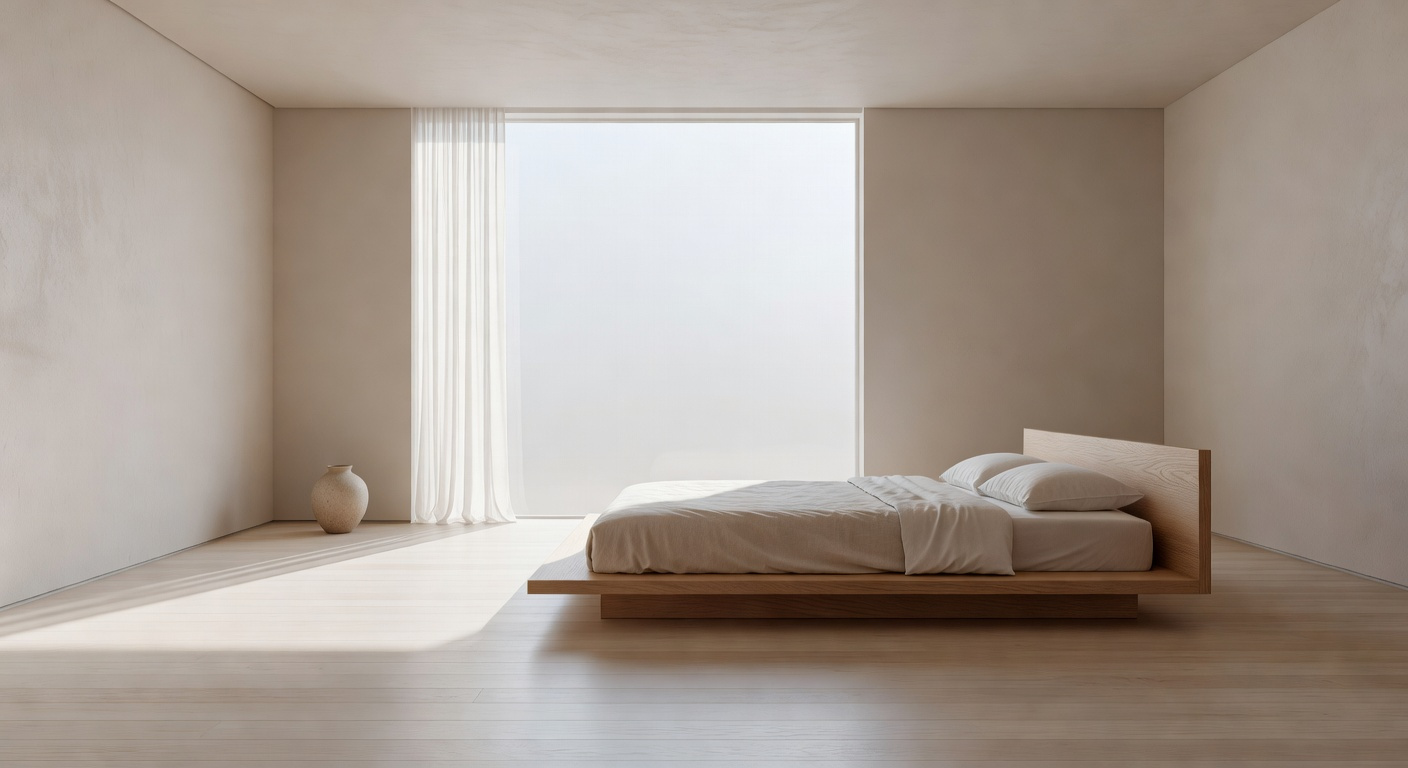

Many homeowners believe minimalism is simply the act of decluttering. They often equate the style with stark white walls or uncomfortable, empty surfaces. Therefore, minimalism is frequently viewed as a cold, purely aesthetic trend. However, this surface-level definition ignores a deeper psychological reality.
True minimalism is not just about removal; it is the architecture of peace. Functionally, a sophisticated minimalist bedroom design relies on the Japanese concept of *Ma*. Here, negative space is not emptiness. Instead, it is a “pregnant void” that allows the mind to expand.
Furthermore, neuroarchitecture research indicates that reducing visual complexity significantly lowers cognitive load. Every object removed eliminates a micro-task for the visual cortex. Therefore, a minimalist bedroom actively helps the brain transition into a restful state.
Beyond spatial volume, this philosophy emphasizes the “honesty of materials.” For example, haptic minimalism uses tactile texture to ground the occupant in the present moment. Additionally, the strategic use of shadow creates atmospheric depth and intimacy. This guide reveals how to construct a true vacuum for the soul. We will explore how light, materiality, and space function as essential tools for mental well-being.
The Philosophy: Why ‘Less’ Actually Means ‘Whole’ in Wellness Design
Often, we view empty space as a vacuum waiting to be filled. However, in wellness design, “less” is actually a vital strategy for restoration. Specifically, we look to the Japanese concept of *Ma*, or the purposeful void. This open space acts as a necessary psychological buffer. Consequently, the gap between the bed and the wall becomes room for the mind to breathe.
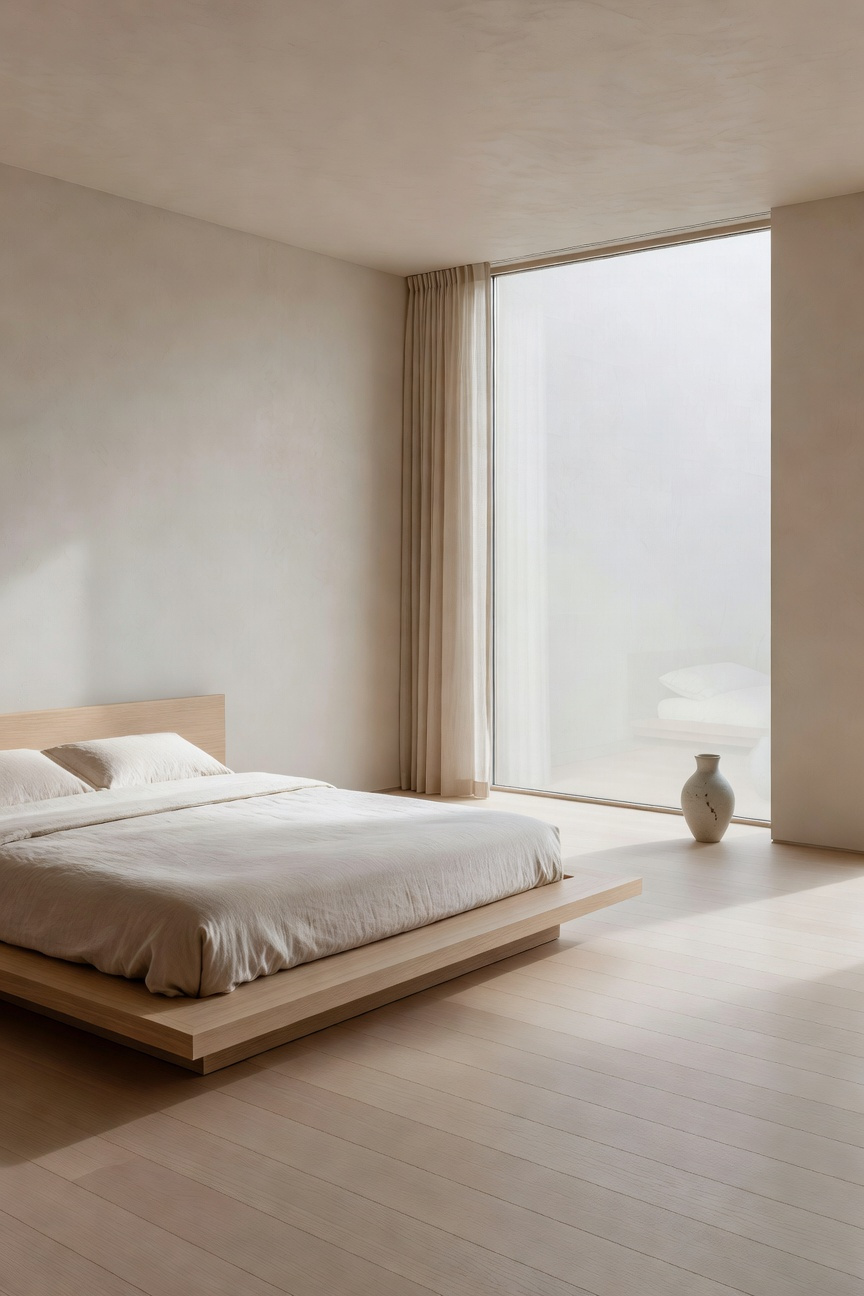
Furthermore, neuroscience suggests that physical clutter creates mental noise. In fact, every object in your view makes a “micro-demand” on your attention. Therefore, adopting a minimalist approach provides “cognitive offloading.” By hiding storage or simplifying patterns, you reduce the room’s visual complexity.
As a result, your brain stops scanning for tasks and begins resting. Moreover, this subtraction allows for “material honesty.” When visual distractions are removed, simple textures become grounding focal points. For instance, the grain of a wooden table invites a state of soft fascination.
Thus, the room shifts from a mere storage unit to a sensory sanctuary. Ultimately, by stripping away the non-essential, you gain spatial agency. You are no longer crowded by inanimate objects; instead, you are held by the space itself.
1. Defining Visual Silence: The Neuroscience of an Uncluttered Eye
In the realm of holistic design, “Visual Silence” represents significantly more than the mere absence of objects. Specifically, it is a deliberate architectural state that offers the brain a deep, restorative breath. Beyond the simplicity often found in a white bedroom aesthetic, visual silence represents a structured environment where the cortex is not overwhelmed.
Yale researchers identify the opposing state as “visual crowding.” Consequently, when a bedroom contains mismatched items, the brain alters its information flow. Therefore, the visual cortex must constantly filter out “noise,” even in your periphery.
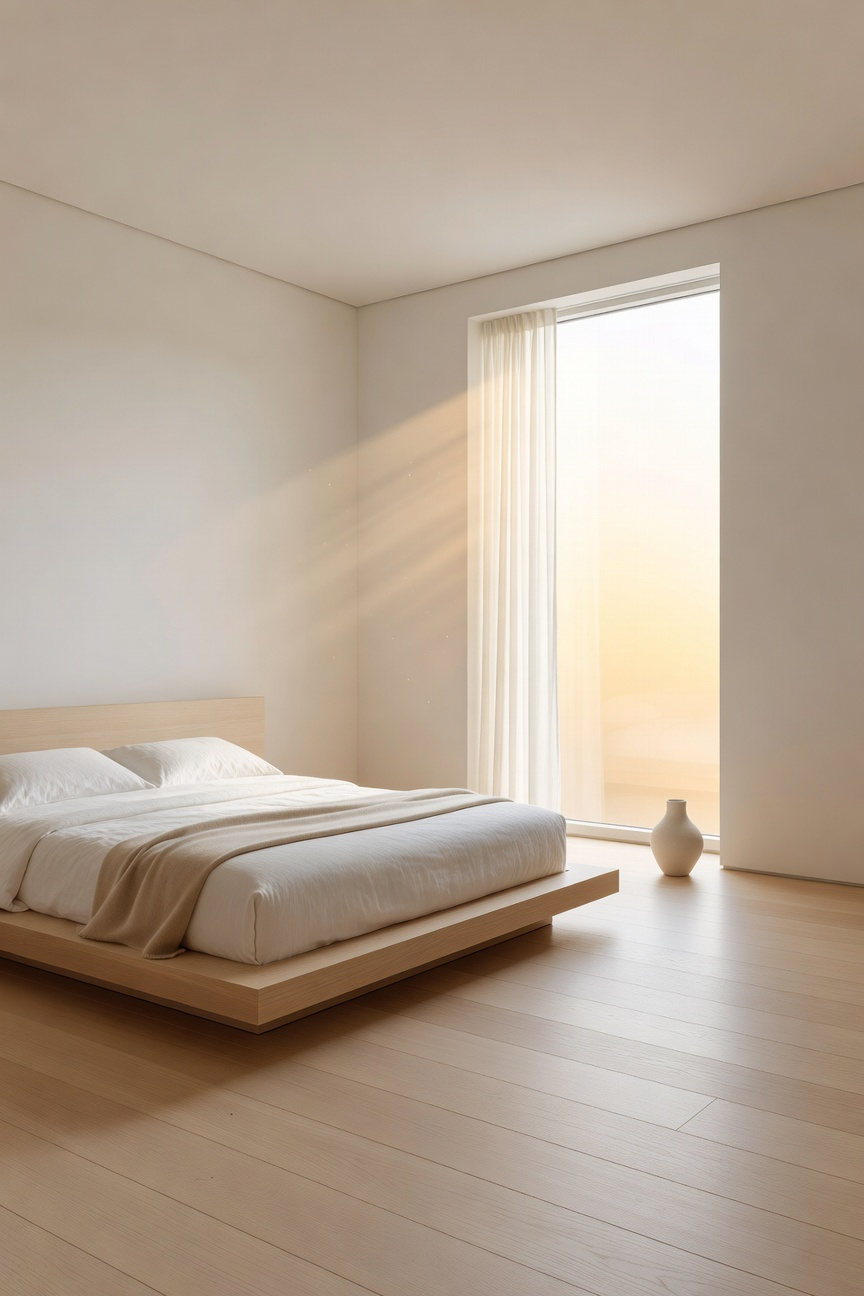
This constant filtering taxes your mental energy significantly. For instance, cluttered spaces cause “visual stutters,” forcing the eye to jump erratically between objects. Conversely, a minimalist environment promotes a “Quiet Eye.” By establishing clear horizontal lines, we effectively reduce these neurological micro-stressors.
Furthermore, psychology tells us that clutter signals “unfinished business.” Princeton University studies link this visual competition directly to elevated cortisol levels. Since cortisol is the antagonist to melatonin, a busy room physically inhibits sleep.
Ultimately, the goal is shifting the brain from “focal” to “ambient” processing. This allows you to sense the room’s safety without actively analyzing every object. To achieve this, we look to the Japanese concept of *Ma*, or the space between things. Practically, this means utilizing closed storage to mute visual noise. Imagine your gaze gliding over a seamless oak headboard rather than tangling in visible wires. Thus, visual silence transforms the bedroom into a true sanctuary for the nervous system.
2. The ‘Breathable’ Layout: Feng Shui Principles for Energy Flow
A “breathable” layout represents the intersection where minimalist aesthetics meet the ancient optimization of *Qi*, or life force. In fact, this approach is not merely about empty space. It is a deliberate engineering of energy to support the body’s most vulnerable state.
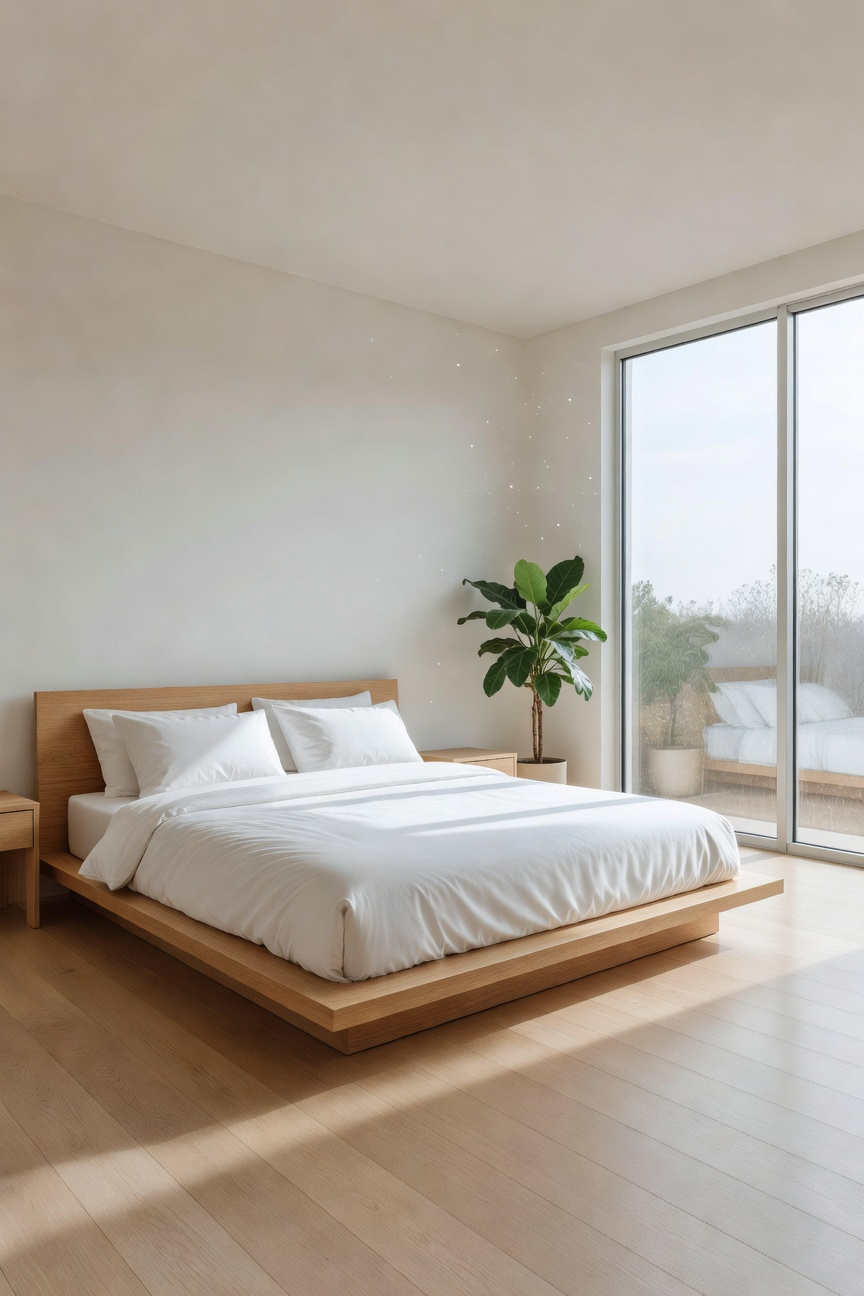
Fundamentally, this optimization begins with the “Command Position.” Specifically, placing your bed diagonally from the door creates a necessary psychological anchor. When you can see the entrance without being in direct alignment, your nervous system perceives a secure perimeter.
Conversely, aligning the bed directly with the door creates a “wind tunnel” effect. Unfortunately, this layout rushes energy over the sleeper too quickly, often leading to a feeling of restlessness upon waking. Therefore, a solid headboard against a solid wall provides the stability needed to counter this movement.
Furthermore, a truly breathable room requires a 360-degree air shell around the sleeper. Consequently, utilizing the space under the bed for storage is a significant error. Think of this void as the room’s lungs. Ideally, you should select a raised frame that allows fresh air to pass underneath your body. This flow prevents the “heavy” feeling associated with stagnant energy pockets.
Finally, you must incorporate the principle of *Ma*, or the “pregnant pause” between objects. Rather than pushing furniture into corners, leave a gap of at least ten centimeters. This spacing prevents the energy from being smothered against the walls. Ultimately, honoring this distance creates a gentle meander for energy, transforming a simple bedroom into a restorative sanctuary.
3. Color Psychology: Beyond Stark White—Choosing Healing Monochromes
While minimalism often defaults to stark white, this aesthetic can feel surprisingly aggressive. Specifically, clinical white reflects the full light spectrum, causing constant visual glare. Consequently, the brain works harder to process boundaries, increasing cognitive load. Therefore, we must shift toward “healing monochromes” rooted in restorative earth tones.
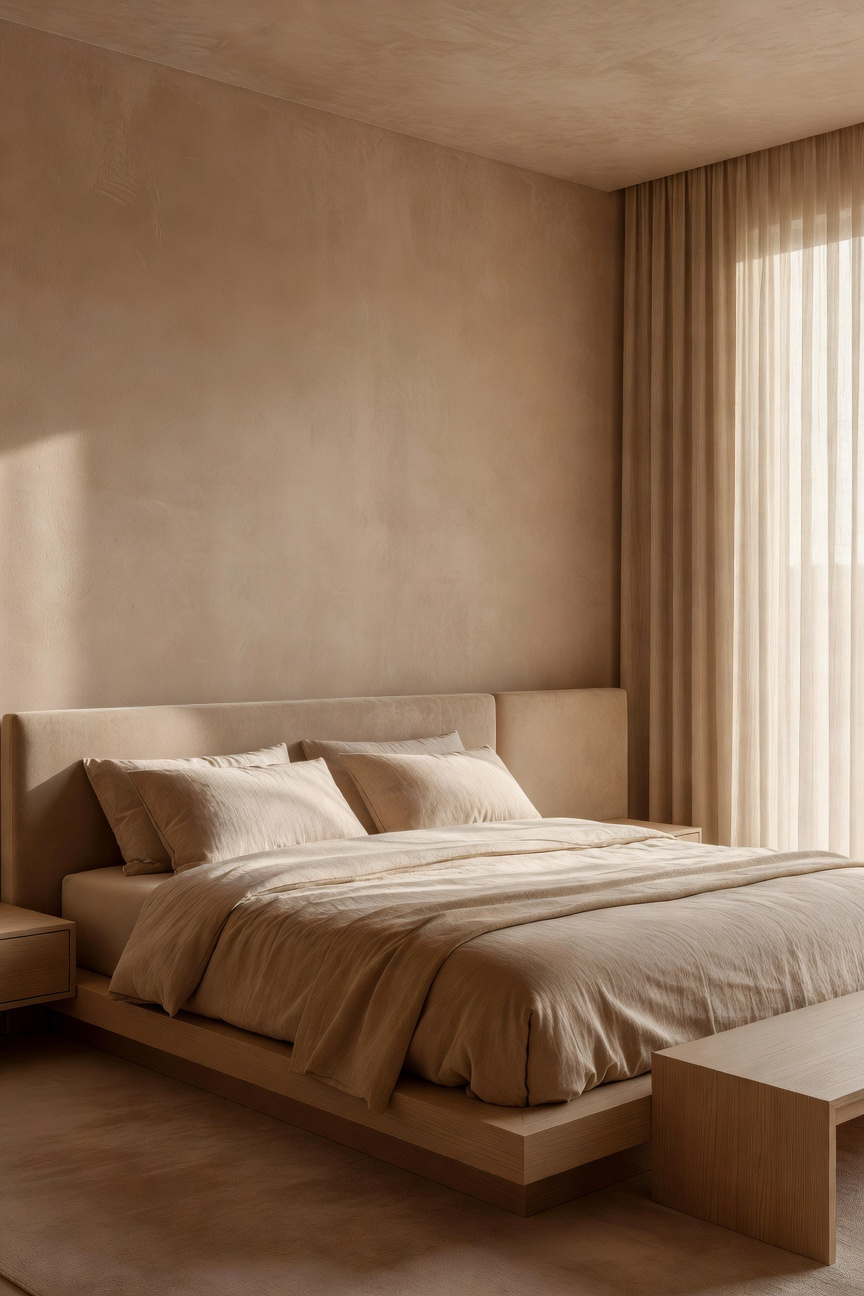
Interestingly, traditional advice often suggests blue for sleep. However, deep-dive circadian science reveals a nuanced conflict. In reality, blue light wavelengths suppress melatonin production, keeping the brain alert. Instead, choose warm, “low-melanopic” hues like soft oatmeal, sand, or muted terracotta. These shades support your natural sleep cycle while significantly reducing visual noise.
Furthermore, this approach creates necessary “visual silence.” When the eye avoids jumping between competing colors, the mind enters a state of rest. Thus, texture effectively becomes the new color. For example, pair matte “Bone” walls with raw linen sheets to engage the senses.
This strategy shifts focus from visual processing to tactile comfort. Finally, layer lighter tints and deeper tones to create depth without chaos. Ultimately, this technique transforms a bedroom from a sterile box into a protective, restorative cocoon.
4. The Grounding Effect: Low-Profile Furniture and Earth Connections
Adopting a low-profile aesthetic does more than streamline a bedroom’s look. Fundamentally, it alters how we physically experience space. By keeping essential furniture within the bottom third of the room, you establish a “Single Visual Plane.” Consequently, the room’s horizon line remains unobstructed. This visual clarity reduces cognitive load, allowing the mind to rest immediately upon entering.
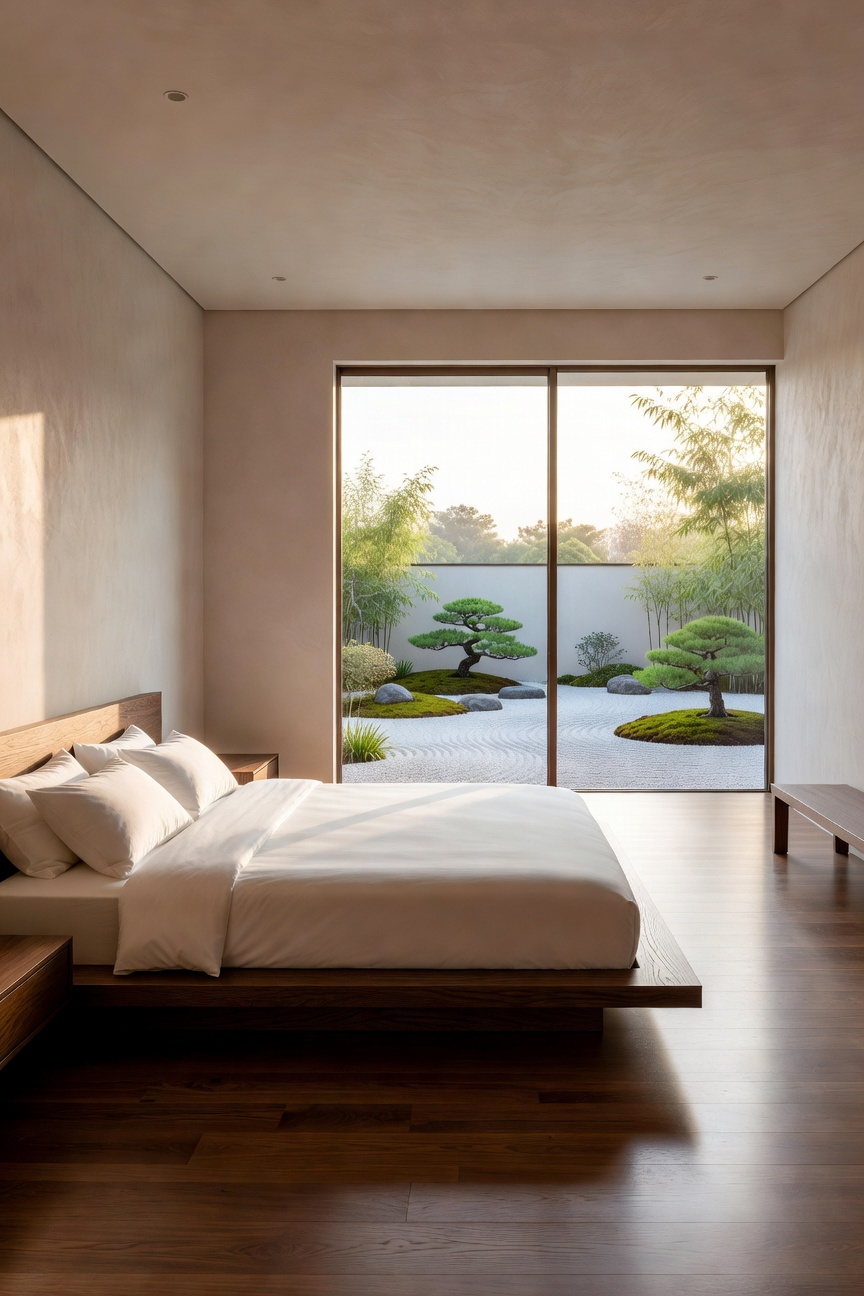
Furthermore, this approach draws deeply from the Japanese philosophy of *Shibui*. This concept champions quiet, understated beauty. Therefore, low furniture anchors the inhabitant, creating a tangible connection to the earth. Psychologically, this lower center of gravity offers a sense of stability.
In fact, it triggers a primal “Prospect-Refuge” response. You feel safely sheltered while maintaining a clear view of your sanctuary. Physiologically, sleeping closer to the floor supports natural rhythms. Specifically, heat rises, meaning the air at floor level is naturally cooler.
Thus, this position supports better thermoregulation for deep REM sleep. Additionally, the daily motion of rising from a low platform engages stabilizing muscles. Ultimately, grounding your physical space creates a profound sense of mental security.
5. Materiality Over Decoration: Letting Texture Be the Art
In the hierarchy of minimalist design, the transition from decoration to materiality is pivotal. Consequently, the focus shifts from adding ornaments to honoring the substance of the room itself. When selecting pieces, consult a luxury design guide to ensure every element supports this tactile narrative. This philosophy, rooted in Wabi-Sabi, finds beauty in the imperfect grain of wood or the slub of linen. Therefore, the material’s naturally occurring narrative becomes the art.
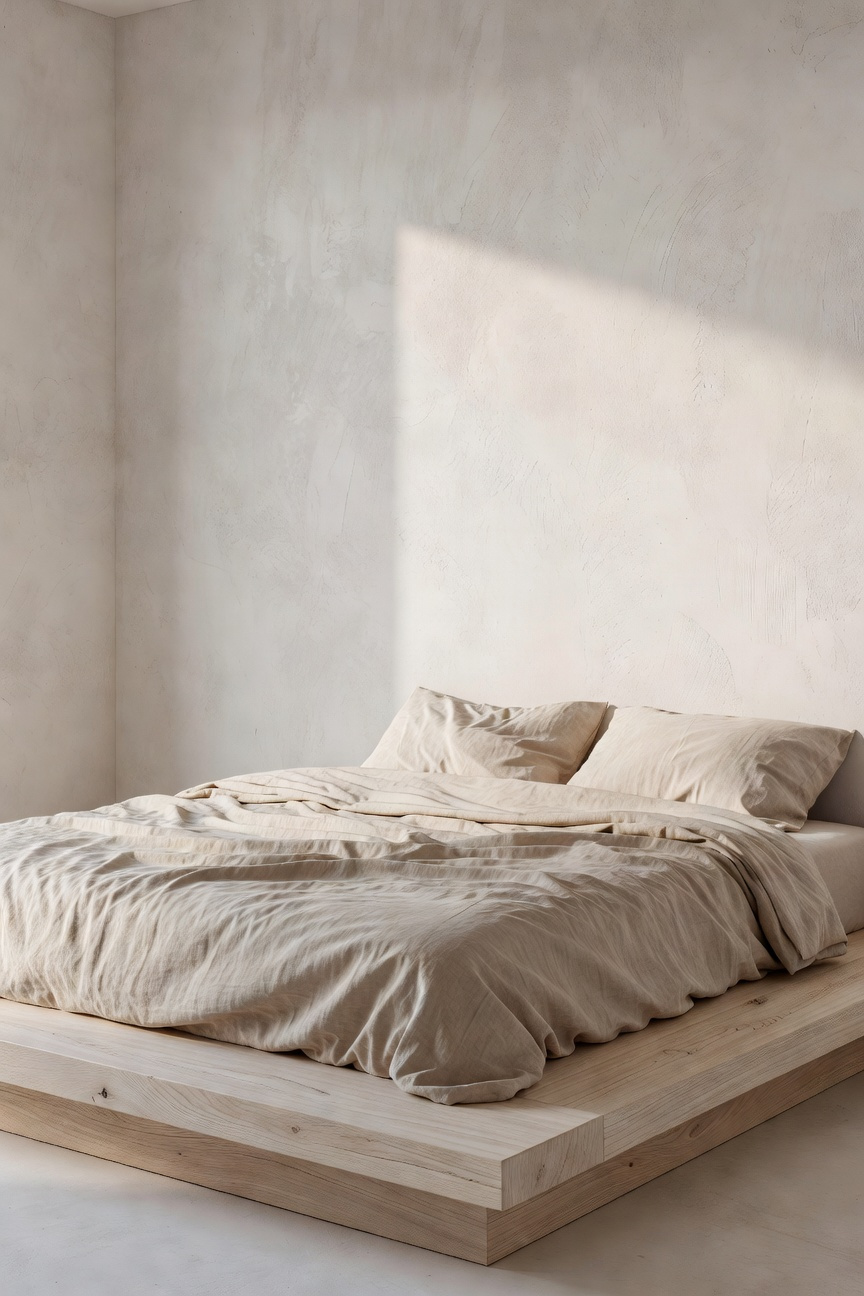
To make these textures legible, lighting plays a crucial role. Specifically, designers employ “grazing light” to wash over surfaces. By placing light sources close to textured walls, you create shadows that reveal three-dimensional depth. Furthermore, prioritizing matte finishes over glossy ones allows walls to reflect light diffusely.
As a result, the room achieves a soft, atmospheric glow that promotes calm. However, preventing a sterile environment requires careful balance. Successful spaces often rely on the “Textural Rule of Three” to create hierarchy.
First, you need a hard anchor, such as a micro-cement floor or stone table. Next, introduce an intermediate organic element, like oak, to bridge the visual temperature. Finally, layer soft contact points like heavy-gauge linen to satisfy the need for touch. Ultimately, this approach supports “embodied cognition,” where the physical environment shapes your mental state.
6. The Hidden Logic: Concealed Storage as Mental Hygiene
Concealed storage is not merely a method of organization; rather, it is a sophisticated practice of mental hygiene. Research from Princeton University suggests that visual clutter limits the brain’s processing power. Consequently, a disordered environment increases cortisol, the body’s primary stress hormone.
Every visible object, from a stray book to a charging cable, creates “visual noise.” Therefore, true holistic design aims for “visual silence.” When the eye glides over flush-mount cabinetry, the brain perceives no immediate threats. As a result, the nervous system can finally transition from high-alert to deep rest.
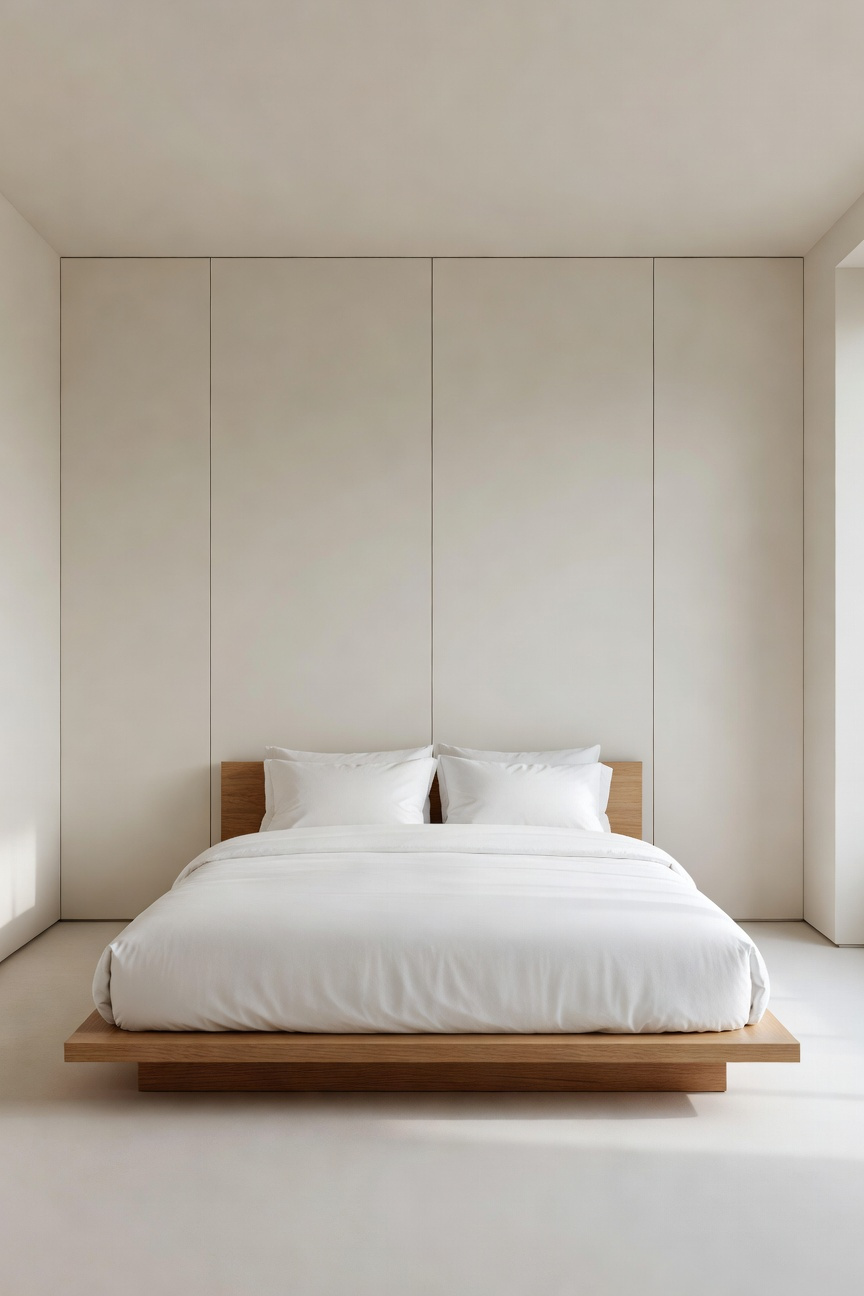
Furthermore, this approach addresses the Zeigarnik Effect, which is the mind’s tendency to fixate on unfinished tasks. To your subconscious, a visible laptop represents work that needs doing. Thus, these objects act as “open loops” that drain mental energy. Conversely, tucking items behind integrated joinery effectively closes these loops.
Specifically, this “out of sight, out of mind” strategy allows the bedroom to function as a clear cache. Finally, modern “invisible architecture” elevates this concept. By utilizing floor-to-ceiling wardrobes that match the wall color, storage becomes structural rather than additive.
This technique echoes the Japanese concept of *Ma*, or the intentional void. In fact, keeping the space pure allows the spirit to breathe. Ultimately, looking at clean, natural materials without distraction facilitates deep, restorative sleep.
7. Circadian Lighting: Illumination that Honors Your Biological Clock
Circadian lighting represents the ultimate expression of the “less is more” philosophy applied to human biology. Indeed, by eliminating disruptive light spectra, a minimalist bedroom becomes a sanctuary that honors your body’s evolutionary programming. Interestingly, traditional lighting focuses strictly on vision, yet circadian design targets the “third eye.” Specifically, these photosensitive cells rely on the blue-rich spectrum of the morning sky to reset internal clocks.
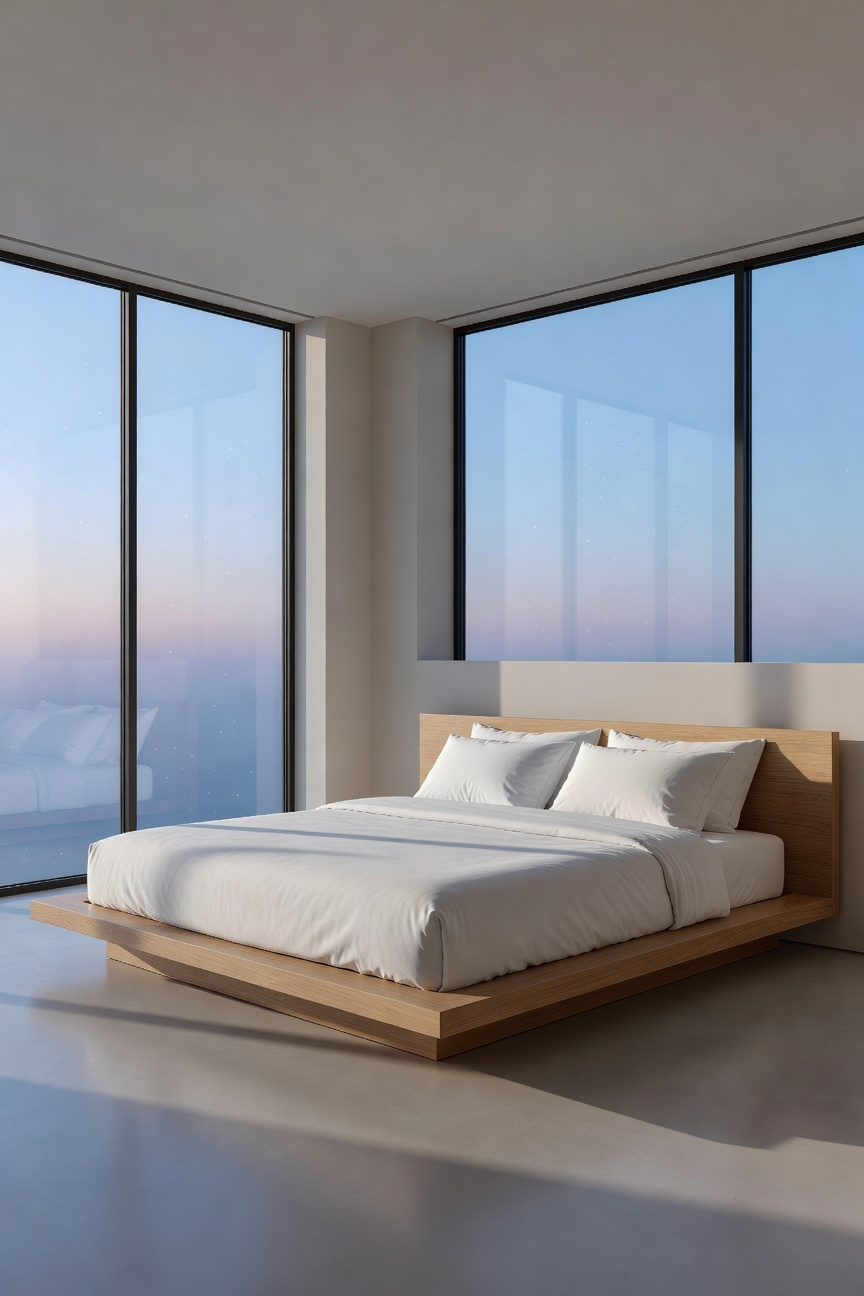
Therefore, designers utilize an “architecture-first” approach to mimic this natural phenomenon. Instead of decorative bedside lamps, recessed cove lighting or hidden ceiling channels bounce light off matte walls. Consequently, this creates a diffuse glow that stimulates the brain without the visual noise of glare. Advanced systems now employ astronomical clocks to shift the spectrum automatically based on your location.
During the day, cool, crisp light makes plaster walls feel pure and architectural. Conversely, evening transitions to ultra-warm “flame” tones, enhancing the deep grain of raw wood and soft linens. This shift serves as a form of sensory decompression, effectively reducing biological stress. Ultimately, “invisible” lighting acts as a biological anchor, turning the act of sleeping into a deliberate, restorative ritual.
8. Biophilic Accents: The ‘Single Stem’ Approach to Nature
In minimalist bedroom design, the “Single Stem” approach offers a sophisticated alternative to the chaotic “urban jungle” aesthetic. Specifically, this method prioritizes the quality of a biological connection over the sheer quantity of greenery. It draws deeply from the Japanese concept of *Ma*, or negative space.
By placing a lone, architectural branch against a bare wall, you create a visual anchor. Consequently, this provides the brain with a singular, legible piece of data. This reduces cognitive load, facilitating the low-stimulation state required for deep rest.
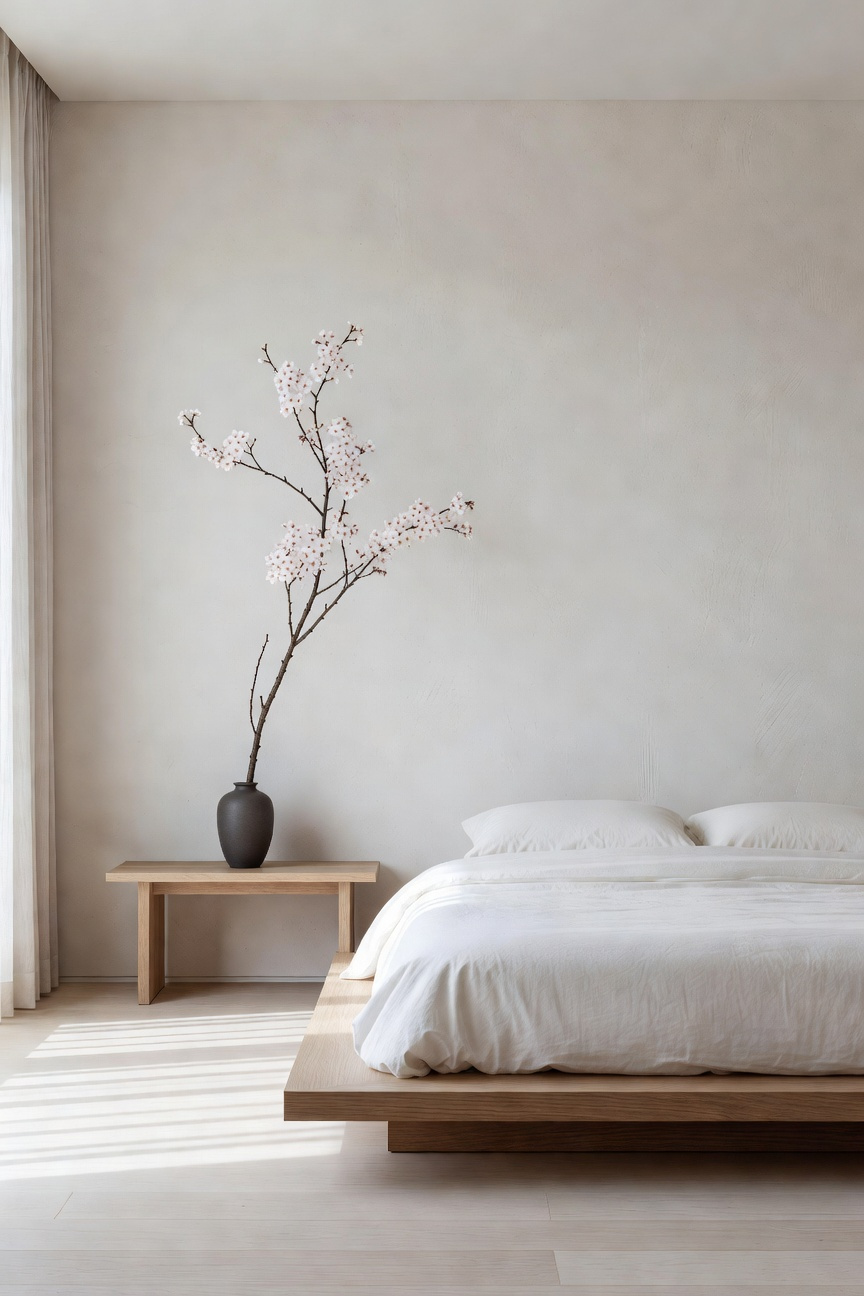
Furthermore, this strategy utilizes light to extend nature’s presence. As the sun sets, a single stem casts elongated, biomorphic shadows. Unlike a dense bouquet which creates a heavy silhouette, a solitary Calla Lily or Eucalyptus branch casts sharp, distinct lines. These shifting forms mimic the “dappled light” effect found in forests.
Thus, they induce a state of “soft fascination,” where the mind is occupied but not taxed. Additionally, this approach promotes olfactory minimalism. Large arrangements can trigger allergies or sensory fatigue in small spaces. However, a single gardenia or jasmine sprig provides a localized “scent of the nightstand.”
Moreover, specific plant choices offer functional benefits. For instance, a single-spike orchid releases oxygen at night, unlike most plants. Alternatively, a lone snake plant leaf filters indoor toxins like formaldehyde. Ultimately, utilizing a Kenzan or heavy base to display these specimens honors their structural integrity.
9. Textile Layering: Creating Warmth Without Visual Noise
To achieve “warm minimalism,” designers must treat textiles as architectural components rather than mere decoration. Consequently, the goal is providing deep comfort without introducing the visual clutter of patterns or excessive color.
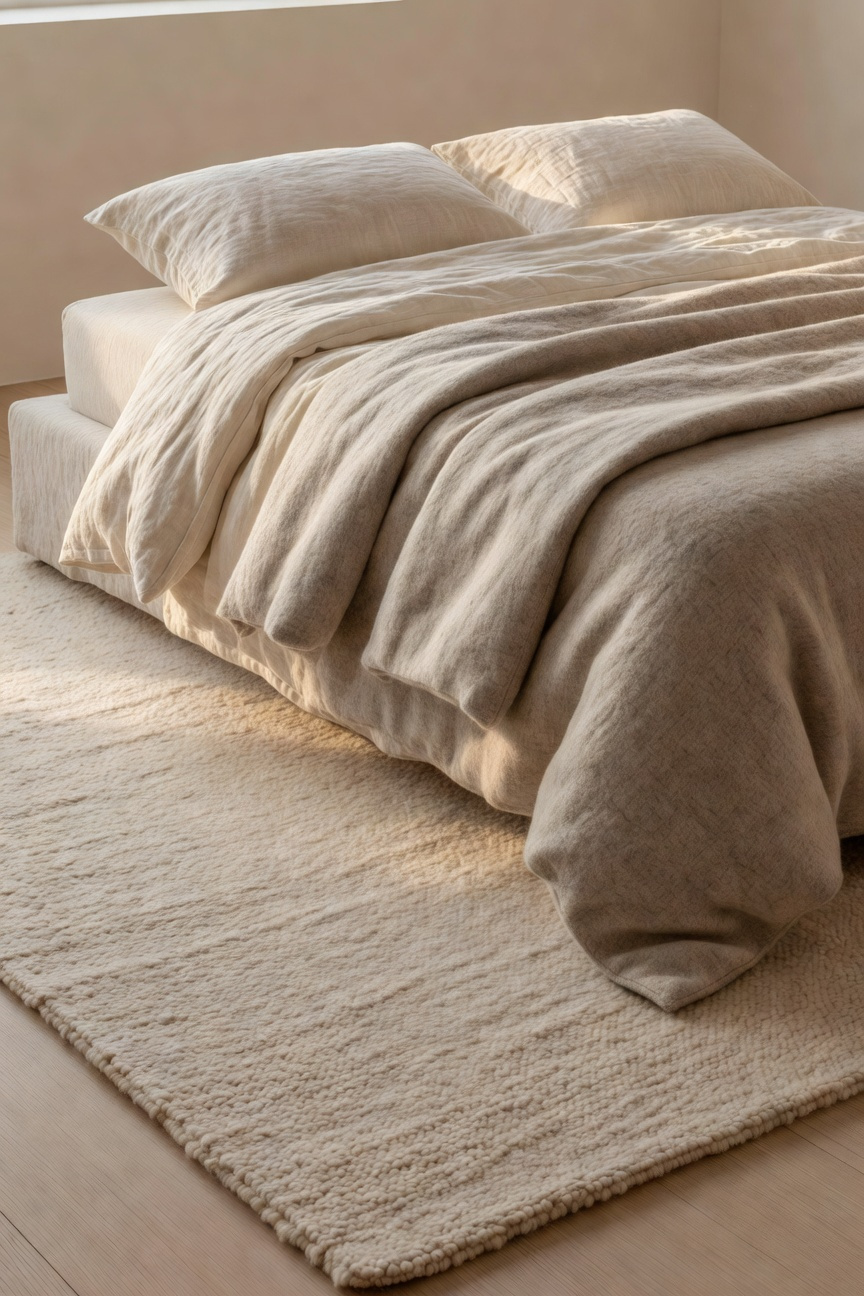
First, consider the auditory environment. Specifically, visual noise is often amplified by the hollow echoes typical of sparse, hard-surfaced rooms. Therefore, incorporating heavy-weight natural fibers, such as felted wool or dense linen, acts as a silent acoustic buffer. In fact, these porous materials trap sound waves, creating a psychological sense of “hush” that the brain interprets as safety.
Next, focus on material density to create visual interest. Instead of adding prints, build depth by varying the fabric’s GSM (Grams per Square Meter). For instance, start with a crisp, 150 GSM percale base layer for clean lines. Then, stack a chunky, 400+ GSM wool throw on top.
As a result, the eye registers “richness” through this topography of weight rather than chaotic imagery. Furthermore, lighting plays a critical decorative role in this monochromatic approach. Specifically, using low-profile “grazing” light reveals the organic micro-shadows within a hand-loomed weave.
Conversely, flat overhead lighting can make smooth fabrics appear cold and plastic. Ultimately, this technique blends the coziness of Scandinavian *Hygge* with the intentional emptiness of Japanese *Ma*. Thus, the room remains visually quiet, yet physically nurturing to the nervous system.
10. The Digital Detox Zone: Architectural Barriers to Technology
Creating a restorative sleep environment requires more than simply ignoring your phone. Consequently, modern minimalism has evolved into a sophisticated architectural discipline. While some homeowners opt for luxurious bedroom wallpaper to define their space, the minimal luxury market is now constructing physical “Signal Sanctuaries” that actively repel invisible digital clutter.
For instance, high-end bedrooms now incorporate conductive graphite paints and “Faraday” wallpapers. These materials effectively block Radio Frequencies within the room’s skeleton. Furthermore, soft, silver-woven curtains replace cold glass surfaces. This creates a tactile, shielding veil against the outside world.
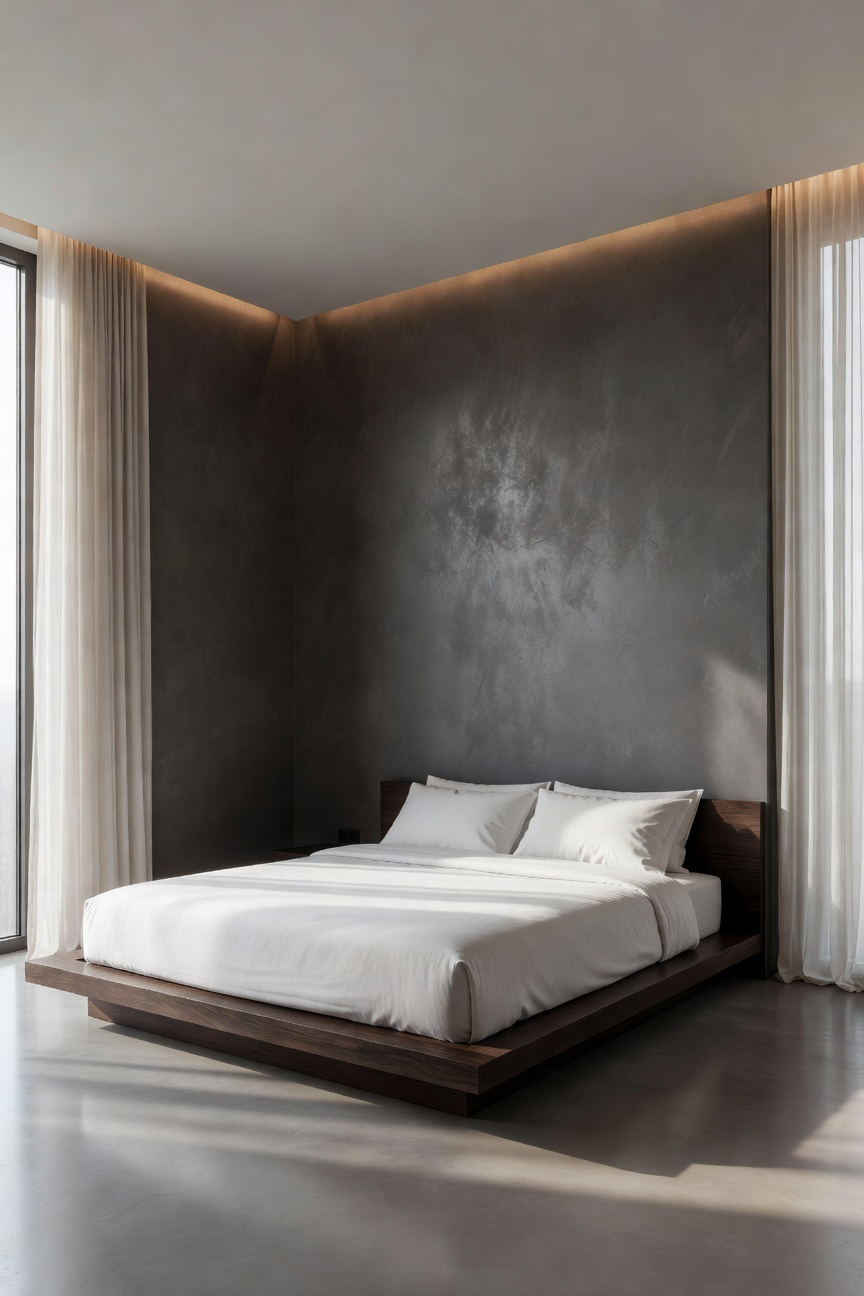
Beyond materials, structural design plays a crucial role. Drawing from the Japanese concept of *Ma*, or “the pause,” architects are creating intentional thresholds. Therefore, transitional “airlock” hallways serve as dedicated spaces to deposit technology before entering. This physical separation allows the bedroom to remain a sacred void.
Additionally, custom furniture introduces necessary friction. For example, “stealth” joinery hides charging ports behind heavy headboards, making devices difficult to reach. Ultimately, these barriers reduce cognitive load. Neuro-architecture suggests that ensuring “visual silence”—by hiding standby lights—lowers cortisol levels. Moreover, relying on “zero-data” surfaces allows the eye to rest completely.
11. Air Quality as Design: Invisible Elements of a Restorative Space
In a minimalist bedroom, air quality is more than a utility; it is a primary design material. Just as modern bathroom design prioritizes cleanliness and streamlined fixtures, the bedroom layout must maximize the volume of air relative to furniture to achieve spatial clarity. Specifically, architects like Claudio Silvestrin view negative space as a tangible substance to be sculpted. This approach mirrors the Japanese concept of *Ma*, or the intentional “pause” between objects.
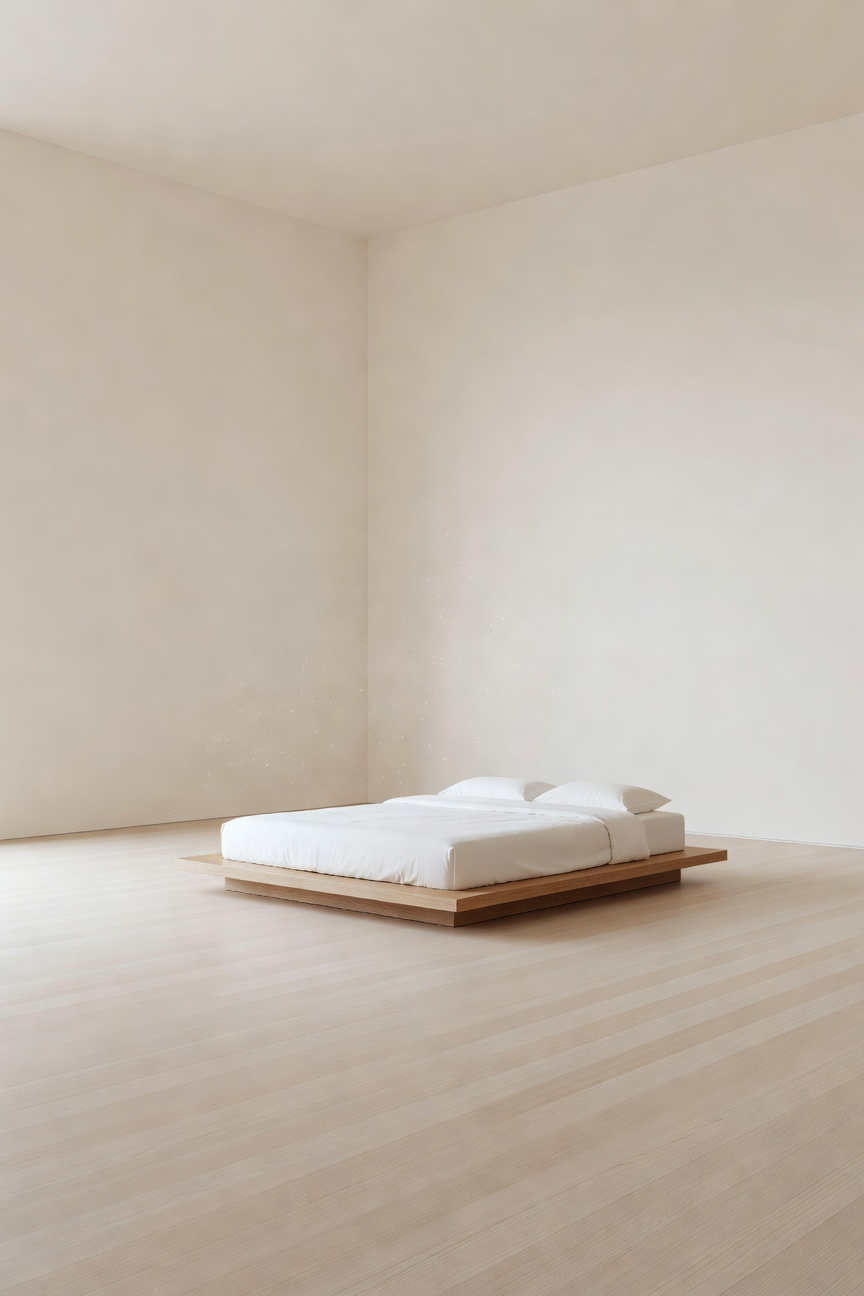
Furthermore, this openness serves a critical biological function. Standard bedrooms often feature “clutter-traps” where dust and CO2 naturally accumulate. Conversely, a minimalist layout facilitates “laminar airflow,” which is smooth and non-turbulent movement. Therefore, bio-effluents are effectively diluted during sleep.
Consequently, this cleaner environment reduces morning grogginess and supports cognitive function. Additionally, the surfaces themselves must breathe to support this ecosystem. While latex paint often seals walls like plastic wrap, hygroscopic options like lime-wash act differently.
In fact, they naturally regulate humidity and inhibit mold growth. Thus, the room creates a crisp, healthy micro-climate. Finally, a truly restorative space prioritizes “olfactory silence.” This describes the absence of synthetic scents or off-gassing furniture. Instead, a single biophilic element, such as a Snake Plant, acts as a “living lung.”
12. The Focal Point Rule: Anchoring the Eye to Promote Stillness
In minimalist bedroom design, the Focal Point Rule is a neurological necessity, not just an aesthetic choice. Specifically, a cluttered room triggers “visual crowding,” forcing the eye to scan the environment frantically. Consequently, these rapid movements increase cognitive load and keep the sympathetic nervous system on high alert. However, establishing a single, intentional anchor transitions the mind from scanning to stillness.
For instance, a textured headboard or a lone piece of art acts as a “visual landing strip.” As a result, this clear focus triggers the parasympathetic nervous system, significantly lowering cortisol levels to prepare for sleep.
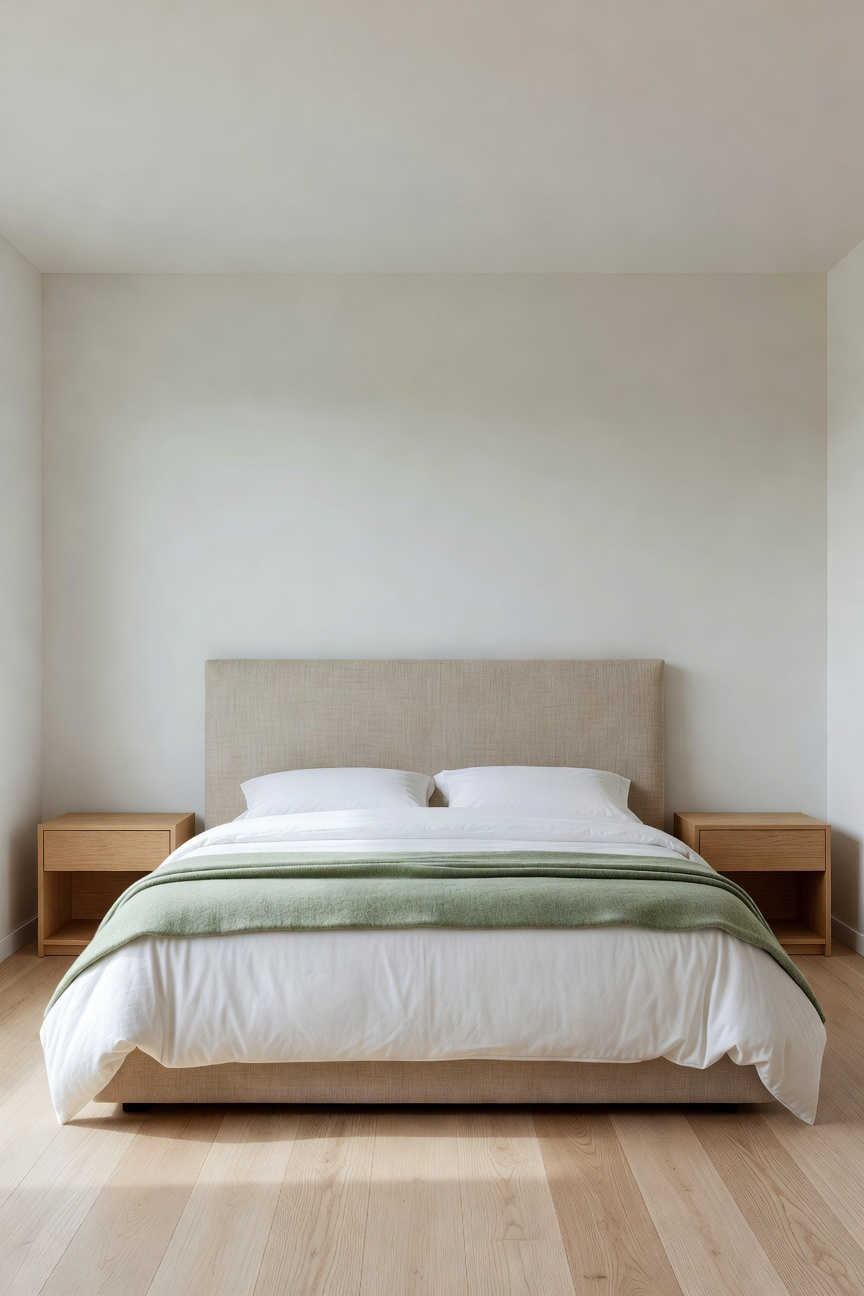
Furthermore, professional designers rely on mathematical harmony to achieve this calming effect. Often, they apply the 60/40 rule to balance visual mass with negative space. In this layout, the bed typically serves as the primary anchor, filling the visual field without overwhelming it.
Similarly, architectural leading lines, like wide floorboards, act as invisible arrows pointing toward this sanctuary. In essence, this approach mirrors the Japanese *Tokonoma*, a dedicated alcove intended for spiritual reflection rather than storage.
Finally, this visual discipline supports proprioception, the body’s internal sense of position in space. Upon entering, the brain immediately seeks to orient the body within the room. Therefore, a clear, dominant focal point provides a fixed coordinate for spatial grounding. Simultaneously, this alignment creates a subconscious sense of safety and predictability.
13. Acoustic Softening: Rugs and Drapery for Auditory Calm
Visually, minimalist bedrooms often offer serenity through clean lines and bare walls. However, this aesthetic frequently creates unintended “auditory chaos” due to hard, reflective surfaces like concrete or glass. Consequently, sound waves bounce indefinitely, causing a sharp “flutter echo” that disrupts the nervous system.
Research suggests that such high reverberation increases cortisol levels, preventing the deep relaxation necessary for sleep. Therefore, restoring auditory calm requires the strategic use of “heavy softness.”
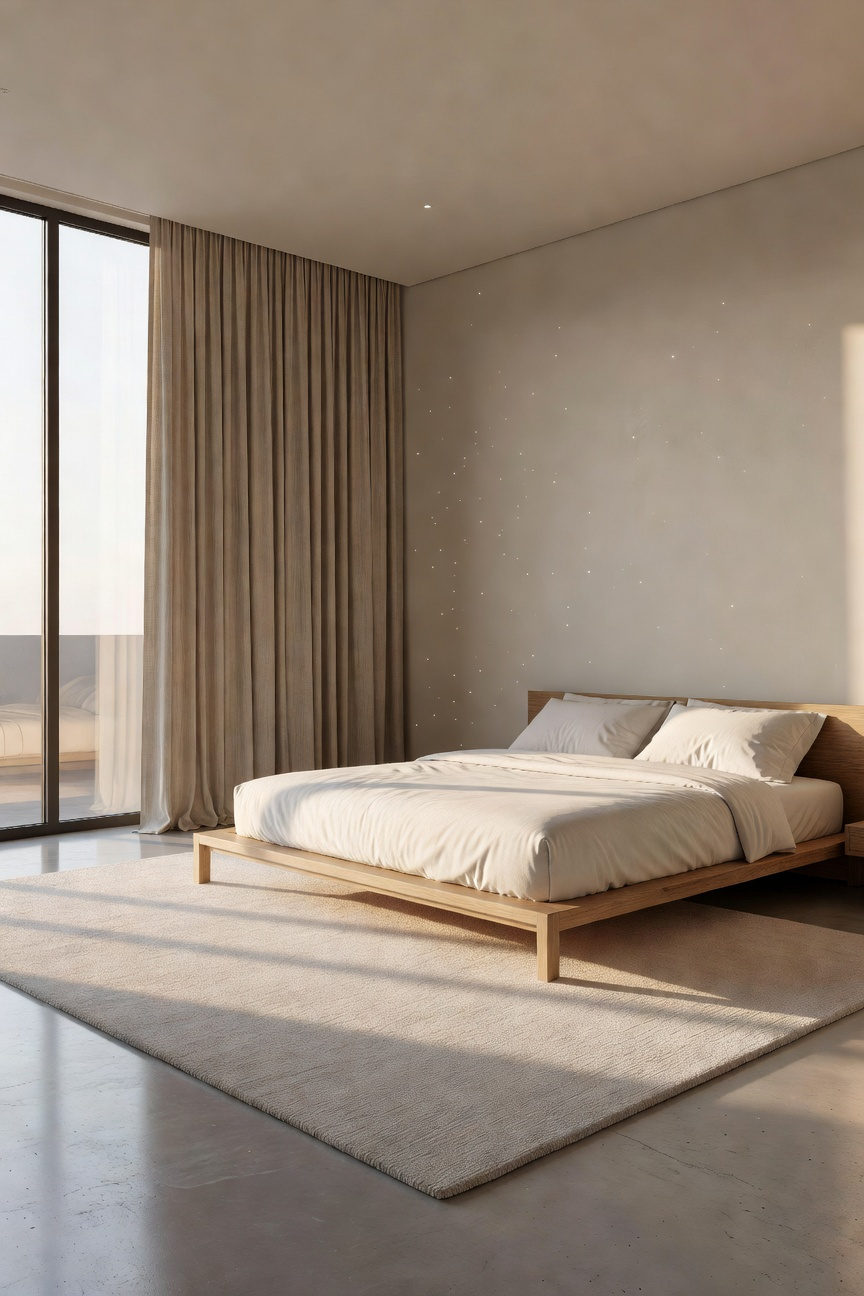
Specifically, wool serves as the gold standard for acoustic flooring. Its naturally crimped fibers create microscopic air pockets that effectively absorb disruptive mid-to-high frequency sounds. Furthermore, a cut-pile rug increases the surface area available to trap noise, significantly reducing the room’s reverberation.
Similarly, drapery functions as a crucial tool for sound diffusion rather than just light control. When hung with deep pleats, velvet or heavy linen becomes an “acoustic diffuser.” Ideally, mounting these drapes from floor to ceiling “loads” the room’s perimeter.
This technique effectively traps bass frequencies in corners and blocks exterior street noise. For those preferring a lighter aesthetic, modern “acoustic sheers” utilize specialized microscopic ribbing to dampen sound without blocking sunlight. Ultimately, these textiles act as a protective envelope for the human psyche.
14. Scentscaping: Subtle Aromatherapy Integration for Sleep Anchors
Scentscaping transcends simply making a room smell pleasant; effectively, it functions as invisible architecture within a space. Specifically, this practice often draws from the Japanese tradition of *Kōdō*, or “listening” to scent. Rather than employing complex bouquets, minimalists utilize linear fragrances like single-note Sandalwood or pure Hinoki. Consequently, these stable, unchanging scents reduce sensory clutter, signaling safety and consistency to the nervous system.
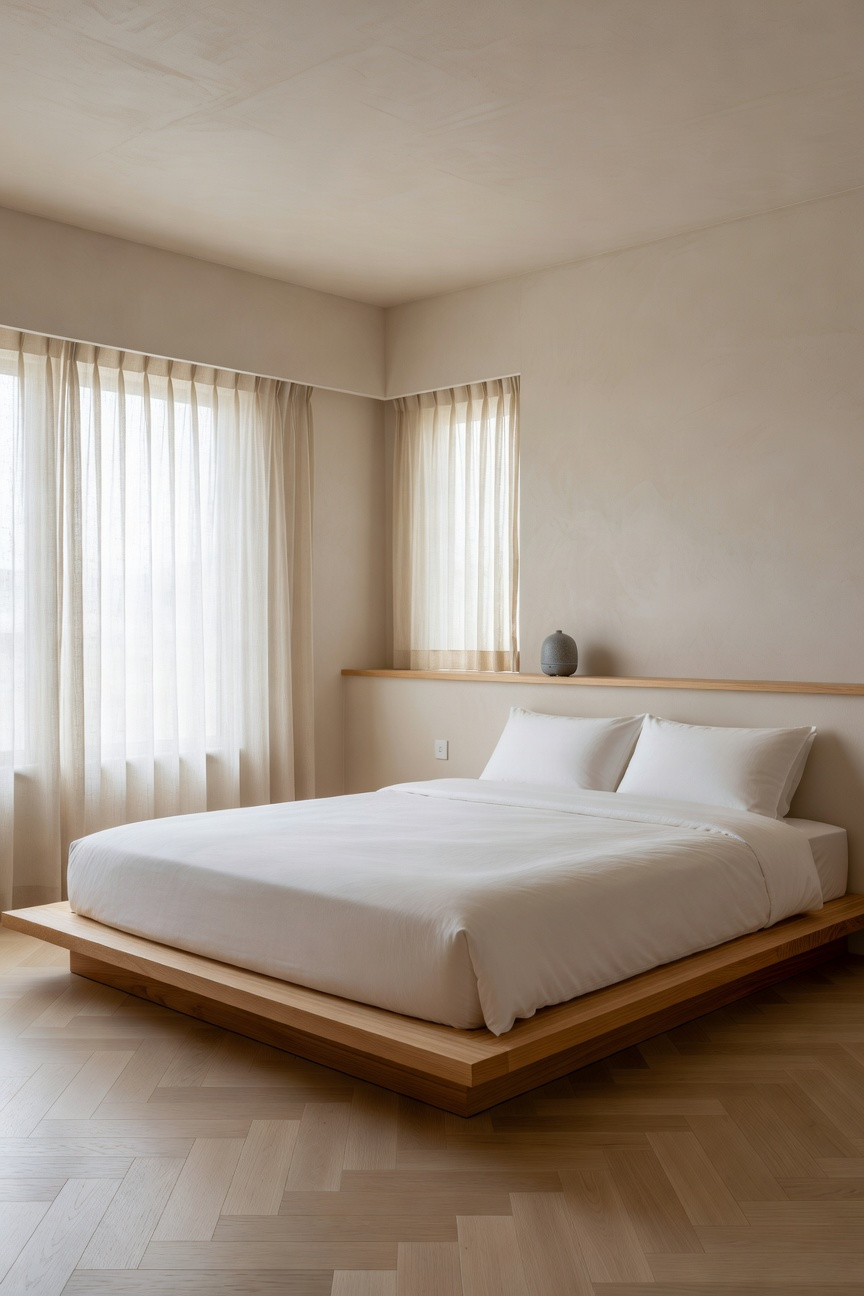
Furthermore, this consistency creates a powerful psychological sleep anchor. Because the olfactory bulb connects directly to the limbic system, the scent triggers a “neural shortcut.” Therefore, mere detection lowers heart rates before you consciously feel tired. To maintain this effect, scent exclusivity is paramount; the bedroom’s signature fragrance must exist nowhere else in the home.
Regarding delivery, modern design favors seamless integration over visual clutter. Instead of visible plastic diffusers, designers often embed cold-air nebulizers within custom cabinetry to disperse a dry mist. Alternatively, the architecture itself becomes the aromatherapy through materials like Hinoki wood headboards.
Naturally, these elements release phytoncides, organic compounds known to deepen restorative sleep. Finally, for applied fragrance, “scent siting” creates a distinct sensory perimeter. Specifically, applying a subtle linen water only to a duvet’s hem prevents olfactory fatigue. As you pull the covers up, you break the scent molecules.
15. The Morning Ritual Layout: Design That Supports Waking Intentions
In minimalist bedroom design, layout serves as an architectural commitment to behavioral priming. Specifically, a “Morning Ritual Layout” acts as a physical script to guide the mind. It transitions you from the vulnerability of sleep to the clarity of intention. To begin, we prioritize the “Command Position” derived from Feng Shui. By placing the bed diagonally from the door, you establish psychological security. Consequently, this arrangement lowers morning cortisol by signaling safety to the amygdala.
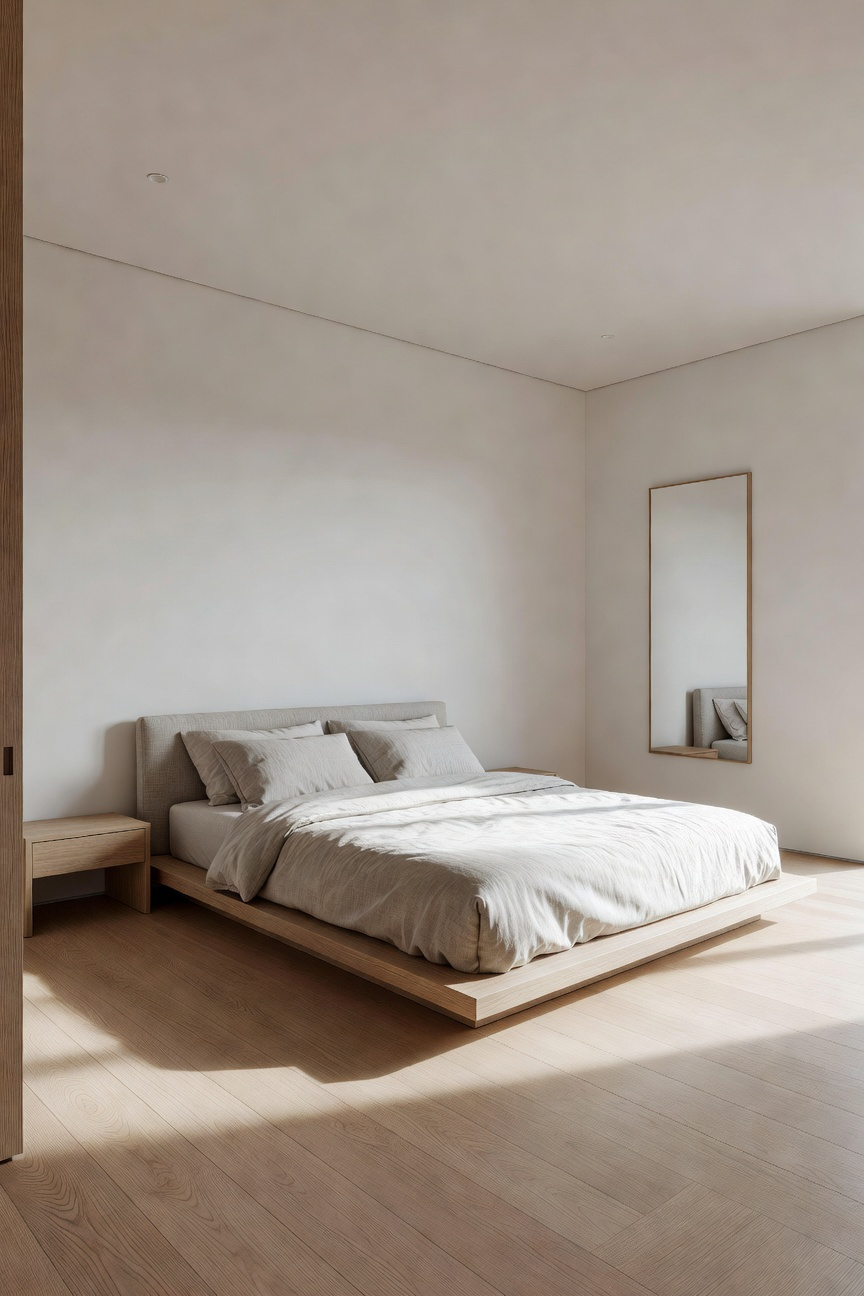
Next, consider the visual inputs that shape your subconscious. Historically, the Japanese *Tokonoma* served as a recessed alcove for a single focal point. Similarly, placing a meaningful object in your direct line of sight creates a mental anchor. Thus, this “First Look” reinforces a specific state of mind before daily stressors intrude.
Furthermore, lighting plays a biological role. Using sheer, floor-to-ceiling drapes mimics the diffused glow of *shoji* screens. In fact, this gentle rise in lux levels suppresses melatonin without the shock of harsh glare. Functionally, the design must reduce “executive load.”
Therefore, experts suggest designating a specific “Launch Pad” on a bedside surface. Here, place only the items required for your first waking act, such as a journal. This visual cue effectively bypasses the need for willpower. Additionally, ensure a clear, clutter-free pathway to your next destination to remove friction.
16. The Evening Transition: Preparing the Space for Deep Rest
The evening transition functions as a sophisticated “handshake” between your environment and your biology. Specifically, high-end minimalist design often employs the Japanese concept of *Ma*, or the “meaningful void.” Unlike cluttered rooms that force the eyes to scan continuously, empty space allows ocular muscles to relax.
Consequently, this visual breathability directly supports the brain’s natural production of melatonin. Furthermore, architects utilize “low-level living” to physically signal the end of active hours. By placing beds closer to the floor, we shift the inhabitant’s gravitational center downward to encourage grounding.
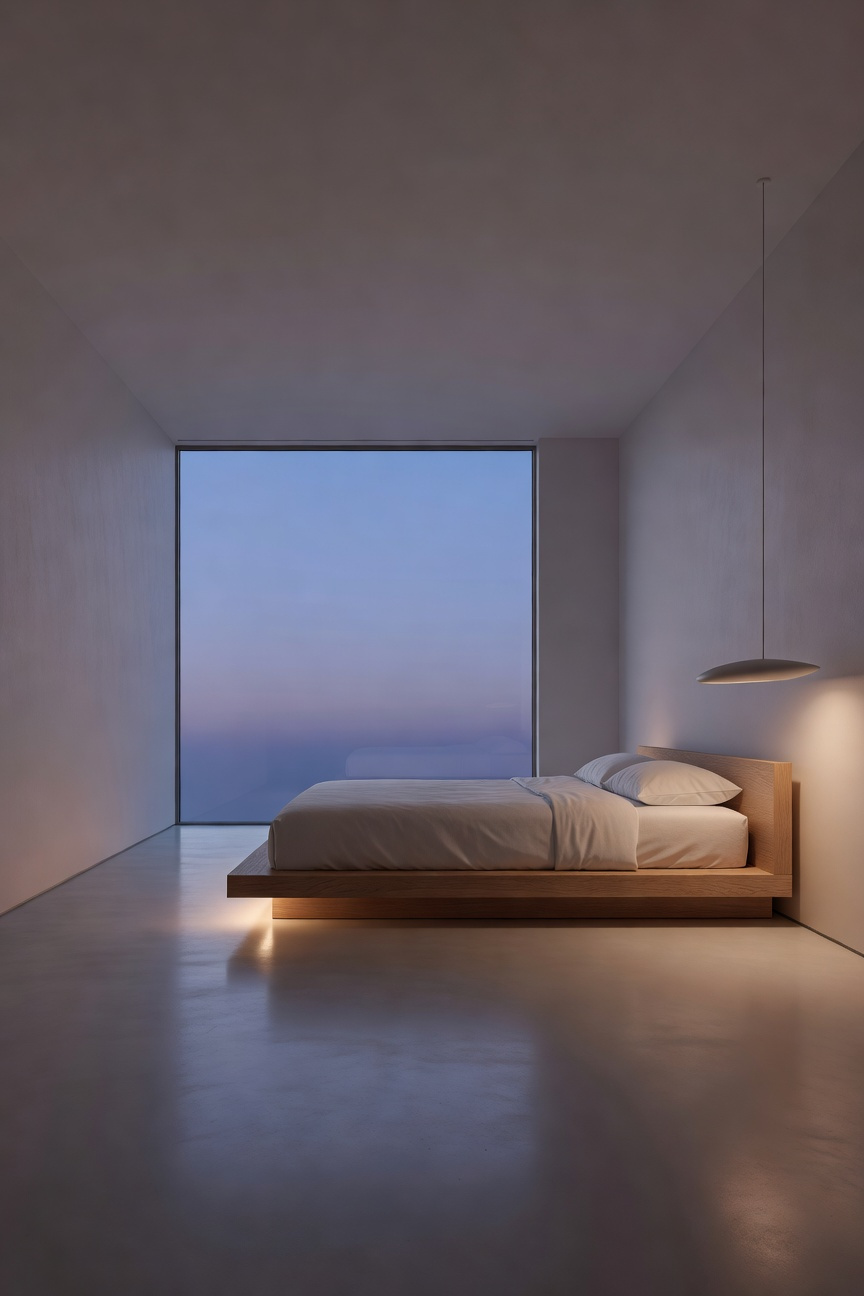
Next, we must consider the “thermal vocabulary” of the room. In fact, 100% flax-linen bedding acts as a biological thermostat. Its hollow fibers wick moisture, allowing the body’s core temperature to drop naturally for deep rest. Conversely, synthetic materials often trap heat, causing micro-wakeups throughout the night.
Beyond touch, invisible sensory inputs play a critical role in this “sensory deprivation design.” For example, hidden acoustic felt backing on headboards swallows the high-frequency hum of urban life. Simultaneously, waterless diffusers release low-volatility scents like vetiver to trigger the parasympathetic nervous system.
Finally, the design must enforce an “Analog-Only Zone.” Instead of cluttered nightstands, recessed niches hold a single book, banishing technology to the hallway. Ultimately, this structural choice creates a sacred threshold, associating the bedroom exclusively with intimacy and sleep.
Frequently Asked Questions
What are the key elements of a minimalist bedroom design?
A minimalist bedroom is defined by visual silence, high-quality tactile materiality, and intentional negative space (Ma). Key elements include low-profile furniture to maintain an unobstructed visual plane, concealed storage to eliminate mental clutter, and a monochromatic color palette based on restorative earth tones.
How do I make a minimalist bedroom feel warm and luxurious?
Luxury in minimalism is achieved through texture rather than decoration. Layering heavyweight natural fibers like wool and linen adds physical warmth and acoustic softening. Incorporating natural wood grains, matte finishes, and “grazing” light highlights the organic beauty of materials, preventing the space from feeling sterile.
Why is the “Command Position” important in minimalist layouts?
The Command Position—placing the bed diagonally from the door—is a psychological anchor that creates a sense of security. By maintaining a clear view of the entrance without being in a direct line with it, you reduce the nervous system’s “alert” state, facilitating the transition into restorative sleep.
Conclusion: Minimalism as a Vessel for Well-being
Ultimately, a successful minimalist bedroom design is not defined by mere emptiness. Instead, it functions as a potent vessel for true physiological restoration. By consciously prioritizing the principle of *Ma*, or negative space, we effectively lower daily cortisol levels.
Furthermore, selecting tactile, biophilic materials actively engages the parasympathetic nervous system. Consequently, the room transforms from a dormant space into a vital cognitive buffer. Thus, removing non-essential clutter does not create a void; it creates necessary space for deep, restorative healing to occur.
Looking forward, genuine luxury now implies the rare possession of mental peace. Therefore, our homes must evolve into intentional sanctuaries against modern digital saturation. In fact, this shift creates a sustainable foundation for long-term emotional health. To begin, simply audit the surfaces nearest to your bed tonight. Remove any object that represents an unfinished task or a delayed decision. Finally, allow that newly reclaimed space to simply breathe, inviting the rest you deserve.