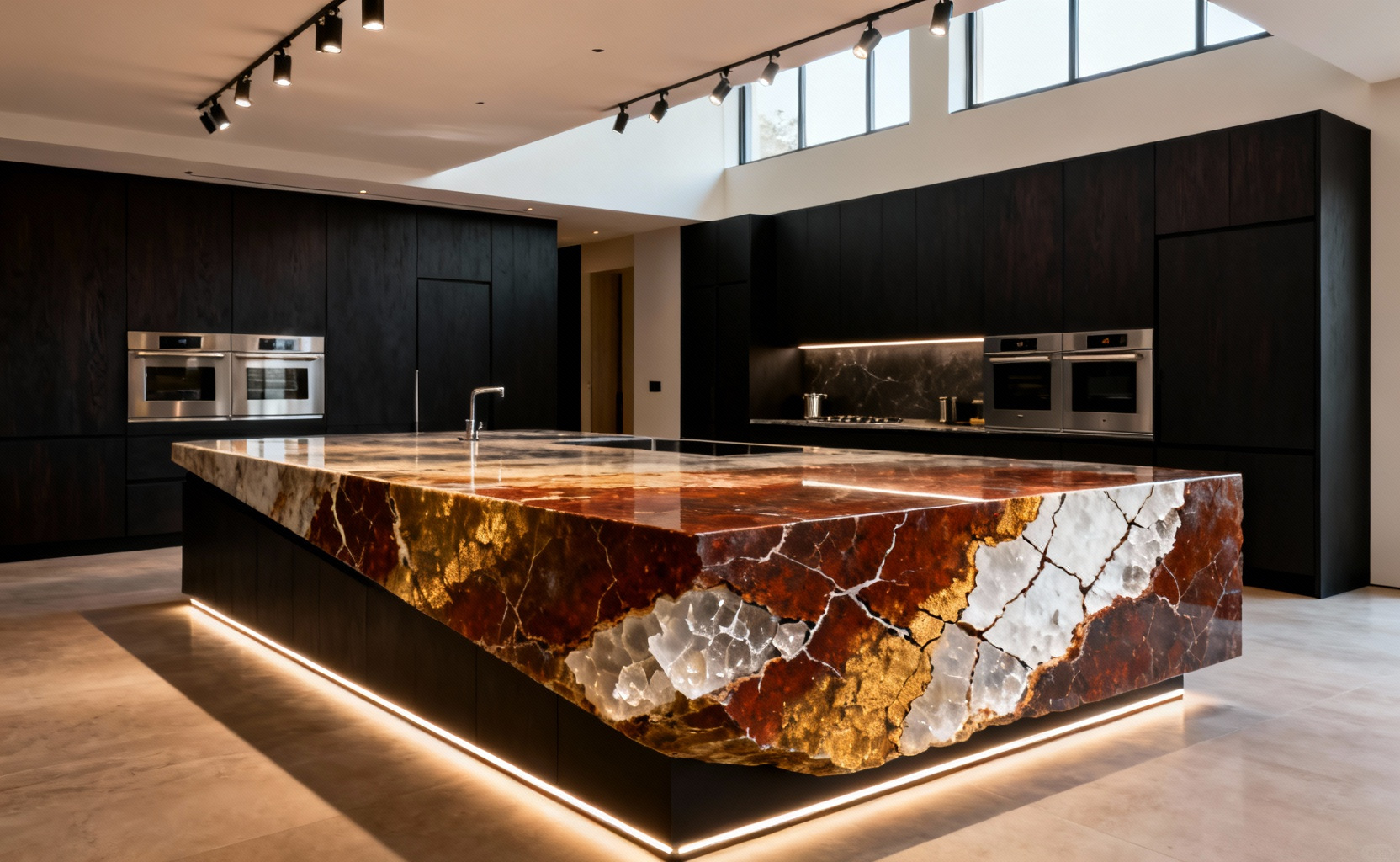
Stop treating your kitchen like a sterile laboratory. It demands to be a cathedral of joy, and this transformation begins with the selection of luxury kitchen surfaces. Growing up in a multicultural home, I learned early that the kitchen is a stage for life, not merely a utility for sustenance. I once visited a villa where the dramatic, deep-veined quartzite felt more like a living entity than a countertop; that tactile memory stays with me to this day. Design should provoke this exact intensity. It must unapologetically celebrate your personality.
A standard renovation updates a room; true opulence creates an emotional masterpiece. We have moved beyond the era of cold, high-gloss perfection. Now, luxury thrives on depth and touch. It lives in the warmth of leathered finishes and the rich storytelling of custom-patinated bronze. Your surfaces should not just repel water; they should invite connection.
Drawing from the world’s most lavish homes, we have curated the definitive guide for your transformation. This analysis reveals the specific elements that separate a high-budget remodel from a work of art. From the seamless grandeur of monolithic stone sinks to the visual symphony of bookmatched exotic slabs, here is the blueprint for boldness. Embrace your maximalist instincts. Let’s redefine what is possible with bespoke surfaces.
Section 1: The Geological Drama (Living Art Pieces)
Treat your stone slab as the singular masterpiece of the room, not merely a place to chop vegetables. You must demand geological drama. Skip the standard granite and select exotic quartzites like Cristallo, Patagonia, or Taj Mahal. These surfaces offer the translucent, complex veining of marble but provide the superior durability needed for a life lived loudly. Hunt for Level 5 materials sourced from unique, shallow quarries to ensure your kitchen remains a limited-edition experience.
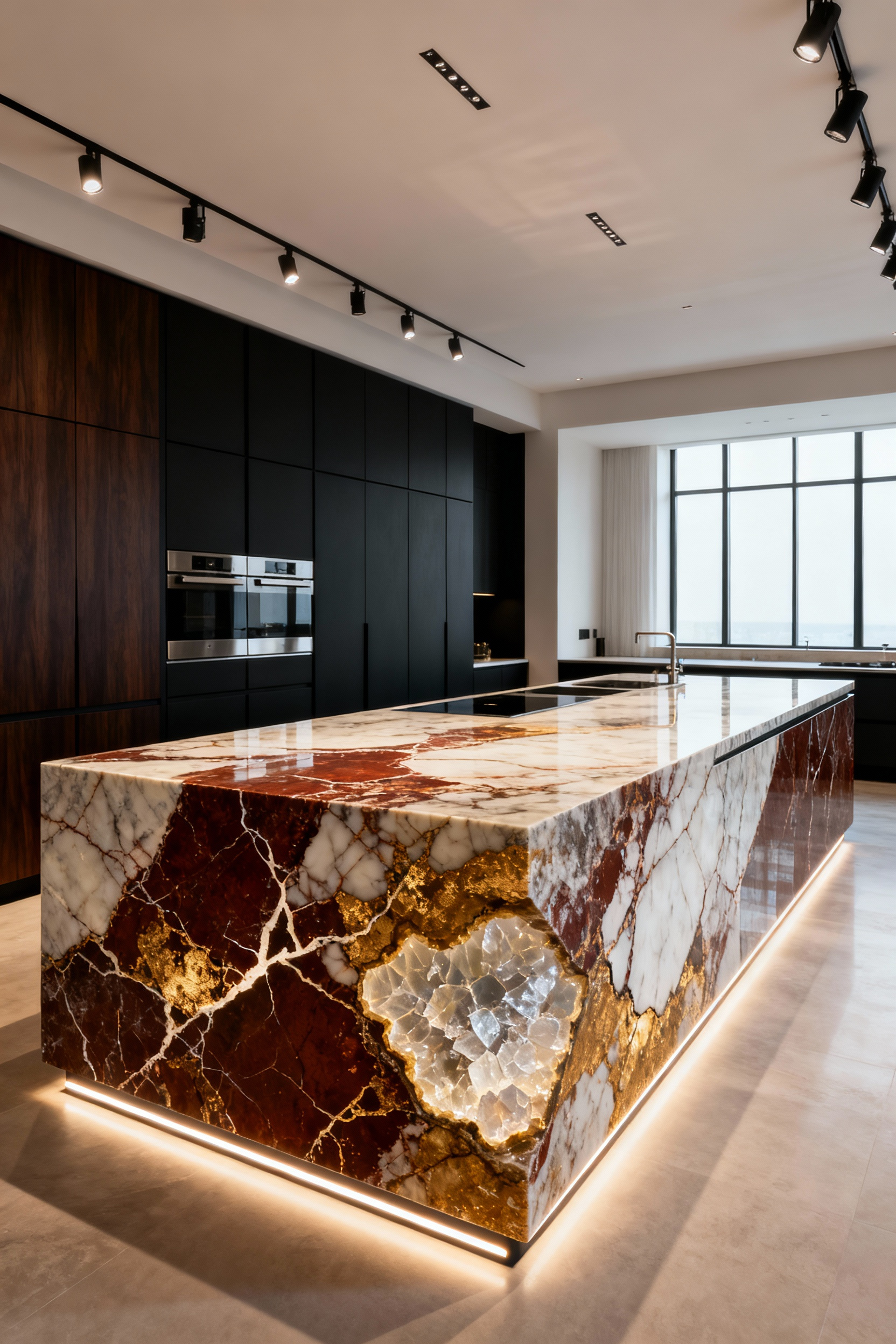
To truly elevate these natural wonders, apply these installation imperatives:
- Mandate bookmatching on all waterfall islands to create a mirror-image symmetry that turns the stone into a visual anchor.
- Acquire jumbo slabs (120″+) to banish seams and maintain a monolithic, uninterrupted flow of art.
I often tell clients that a home without texture is a home without a soul. By choosing these rare, high-movement materials, you embrace a fearless, maximalist joy that transforms your space into a celebration of the extraordinary.
1. Patagonia Granite: Embracing the chaotic beauty of graphic inclusions and crystalline structures
Patagonia Granite demands your attention. I reject the notion that stone should serve as invisible background noise; instead, I treat this material as a geological event. Embrace the “Jewelry Kitchen” trend by isolating this chaotic, fractured quartzite on your central island. It becomes a glowing art installation when you engage its translucent crystalline pockets with LED backlighting. My design philosophy relies on the tension between chaos and control, so you must balance this aggressive natural drama with discipline:
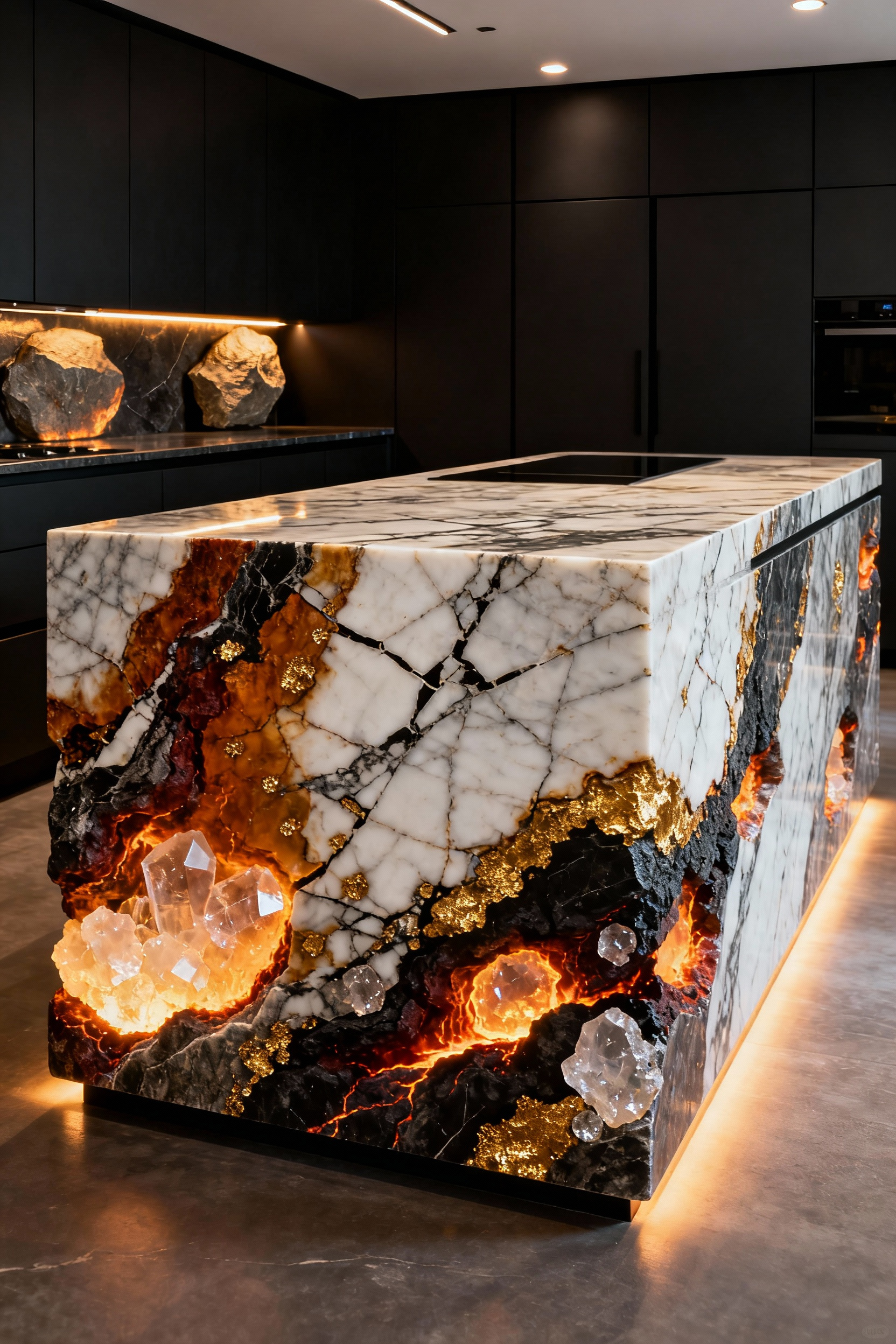
- Silence the Surroundings: Pair the stone’s wild matrix with ultra-matte, flat-panel cabinetry to prevent visual fatigue.
- Curate the Cut: Never purchase based on a small sample. Physically template the full slab yourself to ensure the boldest crystal clusters sit exactly where you want them.
2. Book-Matched Calacatta Viola: Turning the backsplash into a Rorschach test of burgundy and cream luxury
Transform your kitchen into high art with book-matched Calacatta Viola. This isn’t just a backsplash; it is a Rorschach test of burgundy and cream that reveals your boldest instincts. I once sourced a slab for a project that resembled a violet storm trapped in stone; it instantly became the home’s beating heart. To achieve this, demand meticulous alignment from your fabricator. They must mirror two consecutive slabs so the central seam vanishes, creating a seamless, symmetrical explosion of color.
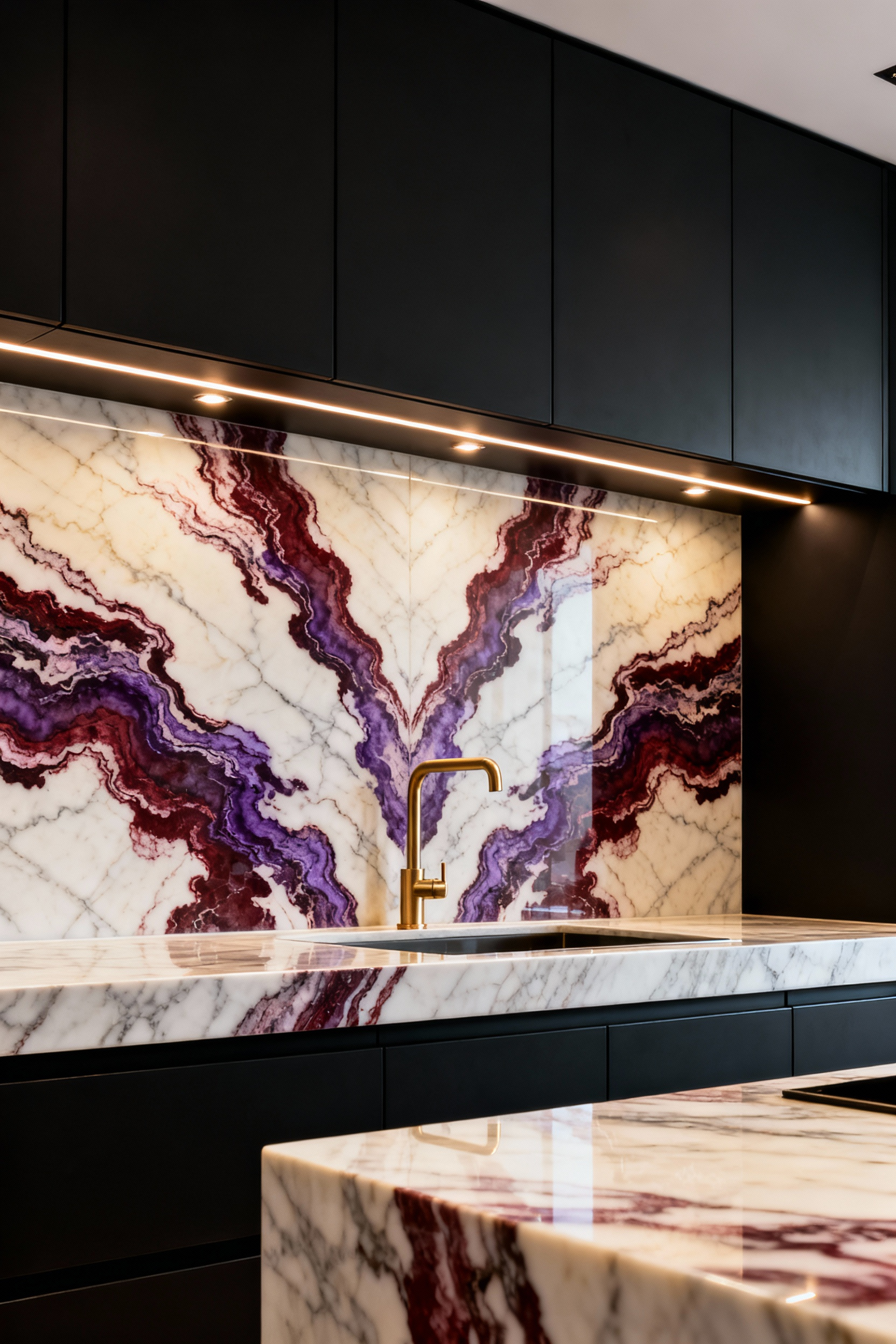
Because this marble dominates the room, you must silence the surrounding noise. Pair the dramatic veining with strictly monochromatic cabinetry—think matte black or stark off-white—to maintain the stone as the singular focal point. However, owning this masterpiece requires commitment.
- Accept the premium: Sourcing deep, consistent burgundy veining often costs 50% more than standard marble due to the high waste required for perfect pattern matching.
- Defend the surface: Since Calacatta Viola is a delicate Dolomitic marble, apply a high-quality penetrating sealant annually to shield the cream areas from cooking acids like lemon and vinegar.
3. Backlit Cristallo Quartzite: Using translucency to transform hard stone into glowing, mood-altering art
Cristallo Quartzite is not merely a surface; it is living sculpture waiting to be ignited. Transform static stone into a glowing masterpiece by exploiting its natural translucency. However, execution determines whether you achieve high art or a cheap gimmick. I once saved a client’s sterile penthouse by turning their bar front into a luminous, amber-hued lantern; the stone instantly became the room’s heartbeat. To replicate this dramatic effect, reject standard LED strips. Instead, insist on uniform LED light panels. These sheets eliminate unsightly “hot spots” and ensure a seamless, ethereal diffusion of light across the entire slab.
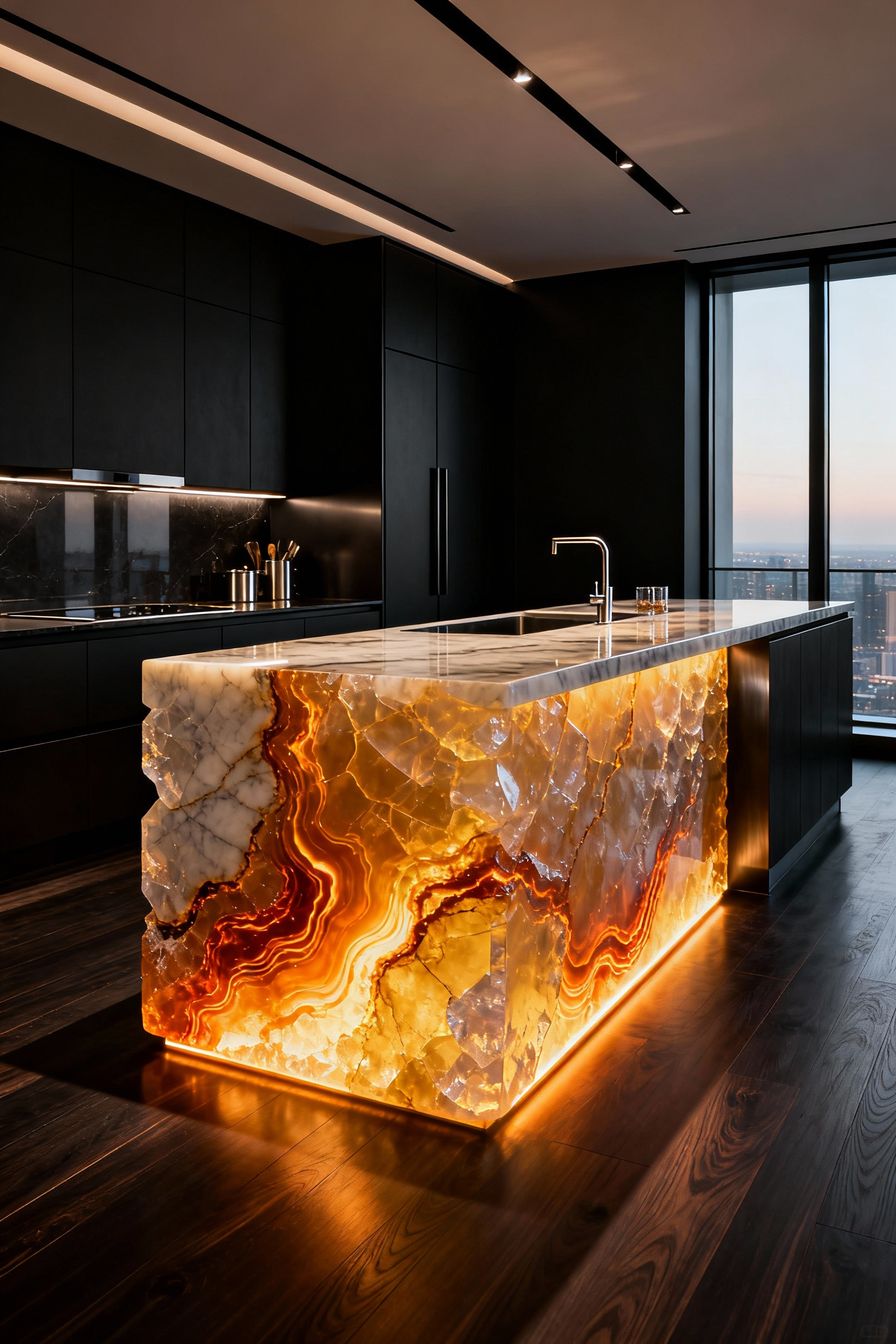
Maximize the visual impact by positioning these glowing surfaces vertically. A backlit countertop often gets covered by clutter, but vertical applications command attention from across the room. Prioritize these specific strategies for a luxury finish:
- Select high-translucency slabs with minimal dense veining to allow light to penetrate freely.
- Reinforce fragility by ensuring large vertical pieces are factory-backed with resin or fiberglass before installation.
- Install tunable controls to shift color temperatures from crisp white for prep work to moody gold for evening entertaining.
This shift turns your kitchen from a utility space into an immersive emotional experience.
4. Blue Sodalite & Lapis Lazuli: Integrating deep jewel tones for the fearless maximalist
Treat deep Sodalite Blue as your new neutral. Its electric intensity, reminiscent of Yves Klein Blue, anchors a maximalist kitchen far more effectively than traditional black or charcoal. I often remind my clients that a waterfall island in this stone acts as the heartbeat of the home, demanding attention and setting the emotional tone for the entire space. To maximize this dramatic impact, you must curate the surrounding elements with precision:
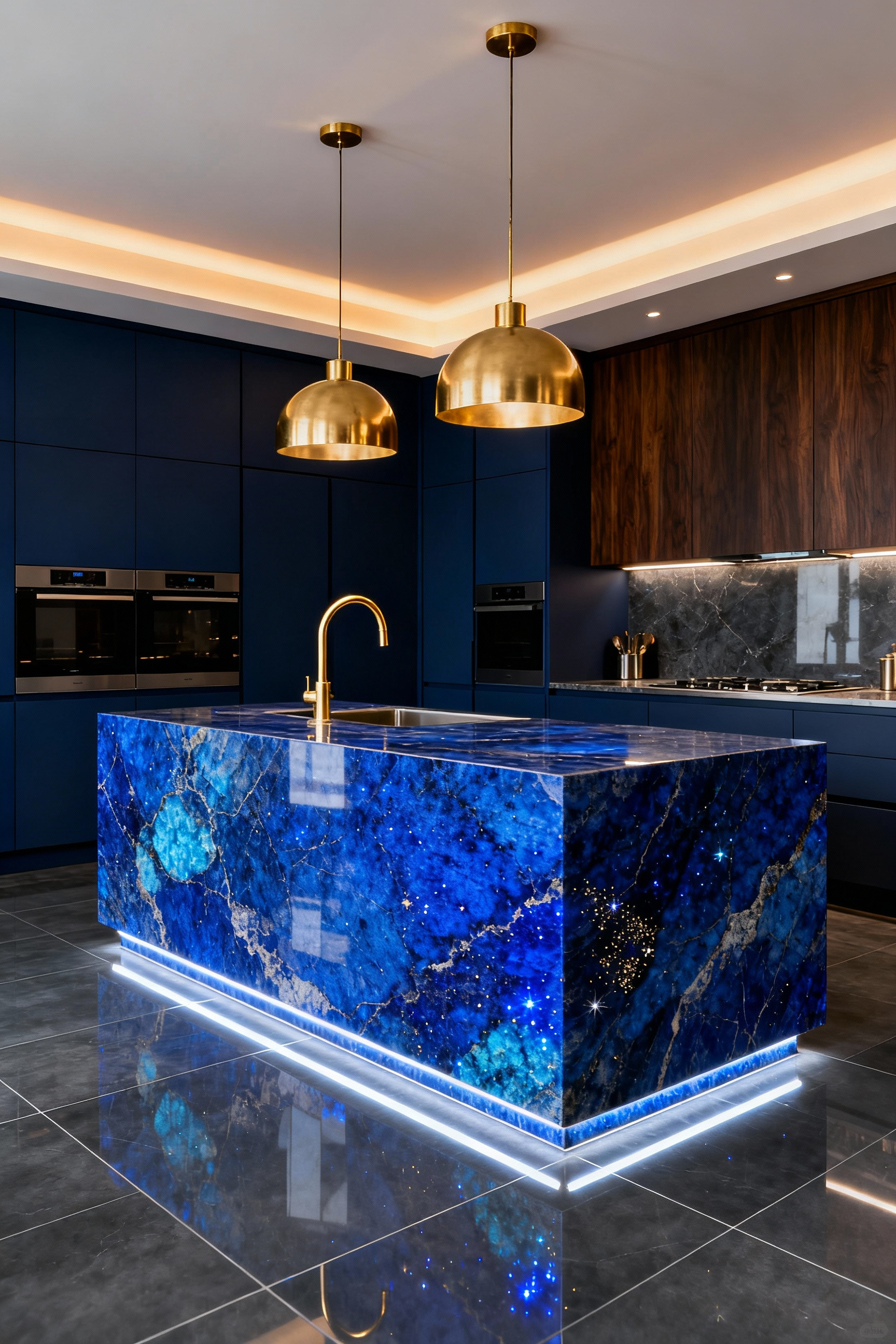
- Amplify the Sparkle: Leverage the stone’s natural gold or brass inclusions (pyrite) by selecting matching unlacquered brass fixtures and hardware.
- Illuminate from Within: Install warm, adjustable LED strip lighting beneath the kitchen countertop edge to penetrate the stone’s crystalline structure, ensuring the deep blue radiates rather than absorbing light.
True luxury maximalism requires tension, so resist the urge to match perfectly. Instead, pair these royal blue surfaces with unexpected, high-contrast materials to achieve a sophisticated “jewel-box” aesthetic. I frequently clash polished Lapis Lazuli against rustic, unlacquered copper or even deeply veined Emerald Green marble to break the visual uniformity. This fearless layering of textures prevents the design from feeling flat and transforms your kitchen into a celebration of unapologetic opulence.
Section 2: The Alchemist’s Touch (Metals and Rare Earth)
Banish the sterile from your sanctuary. Your kitchen requires jewelry, not just hardware, so reject the soulless gleam of standard chrome for materials that breathe. I often channel the warmth of old-world European bistros by specifying unlacquered brass, copper, or soft pewter, specifically because they refuse to stay perfect. This “living finish” develops a rich, darkened patina over time, proving your home is a space of riotous joy and use, not a stagnant museum. However, you must balance this romance with reality.
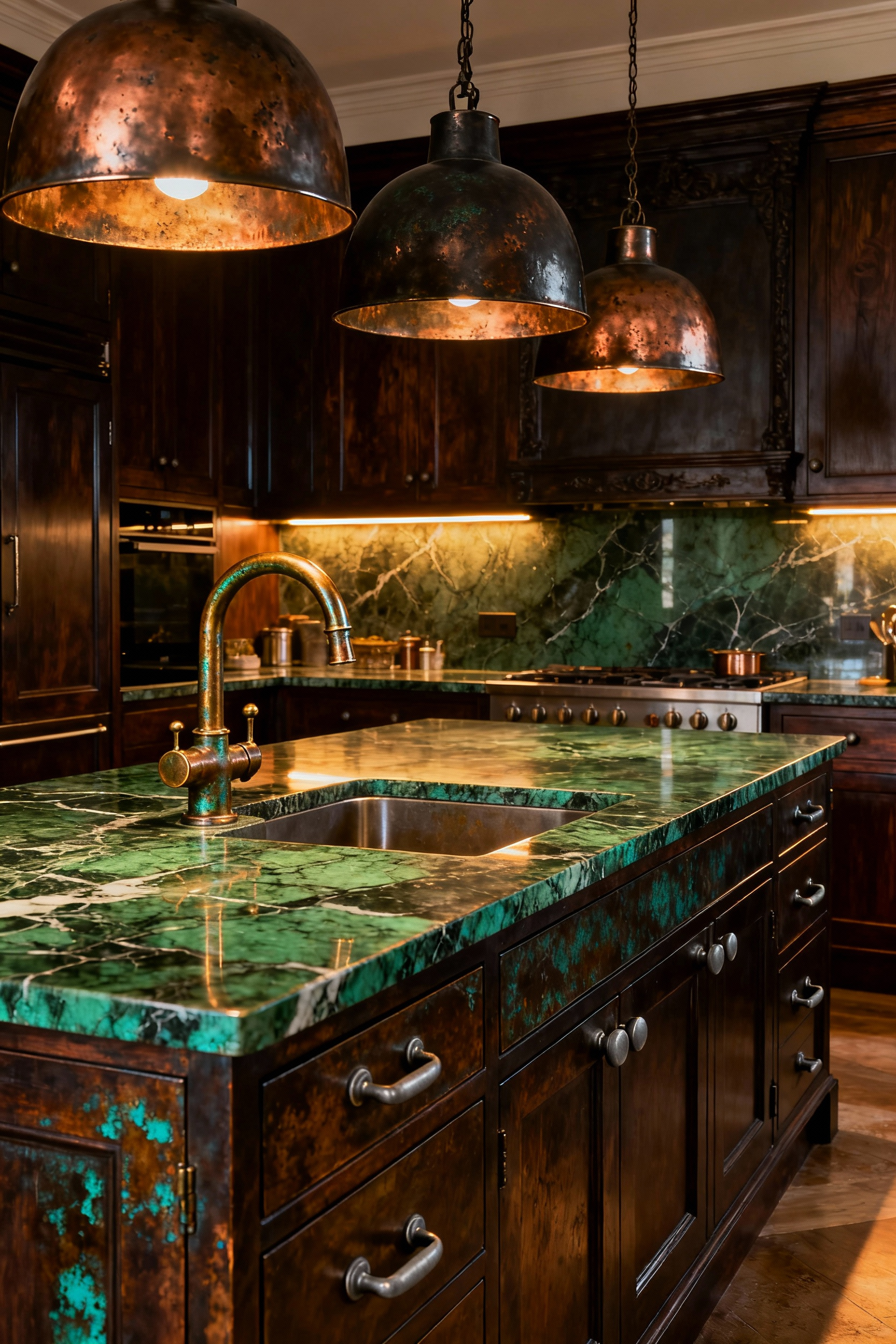
For high-impact zones where durability is non-negotiable, cheat the system with science. Specify Physical Vapor Deposition (PVD) coatings for your integrated sinks and primary faucets. This modern alchemy bonds exotic alloys to resilient steel, allowing you to embrace moody, dramatic tones like gunmetal or brushed bronze without fear of tarnish.
- Embrace the scratch: Use soft zinc for bar tops; let the nicks record your parties.
- Armor the workhorse: Use PVD for the main sink to resist chemical fading.
- Unify the chaos: Mix these finishes fearlessly to create a layered, opulent narrative.
Demand durability without sacrificing drama. By blending vulnerable, aging metals with armored PVD surfaces, you curate a space that feels both timeless and indestructible.
5. Living Brass Surfaces: Why accepting patina creates a warmer, more sophisticated narrative than sterile steel
Ban the sterile chill of stainless steel from your sanctuary. It belongs in a commercial laboratory, not a home celebrating life. Instead, embrace unlacquered, living brass. This material breathes, evolves, and offers a sophisticated Wabi-Sabi narrative that factory perfection cannot buy. Growing up, the brass fixtures in my family’s kitchen weren’t just hardware; their darkened, golden patina held decades of memories, transforming functional tools into heirlooms.
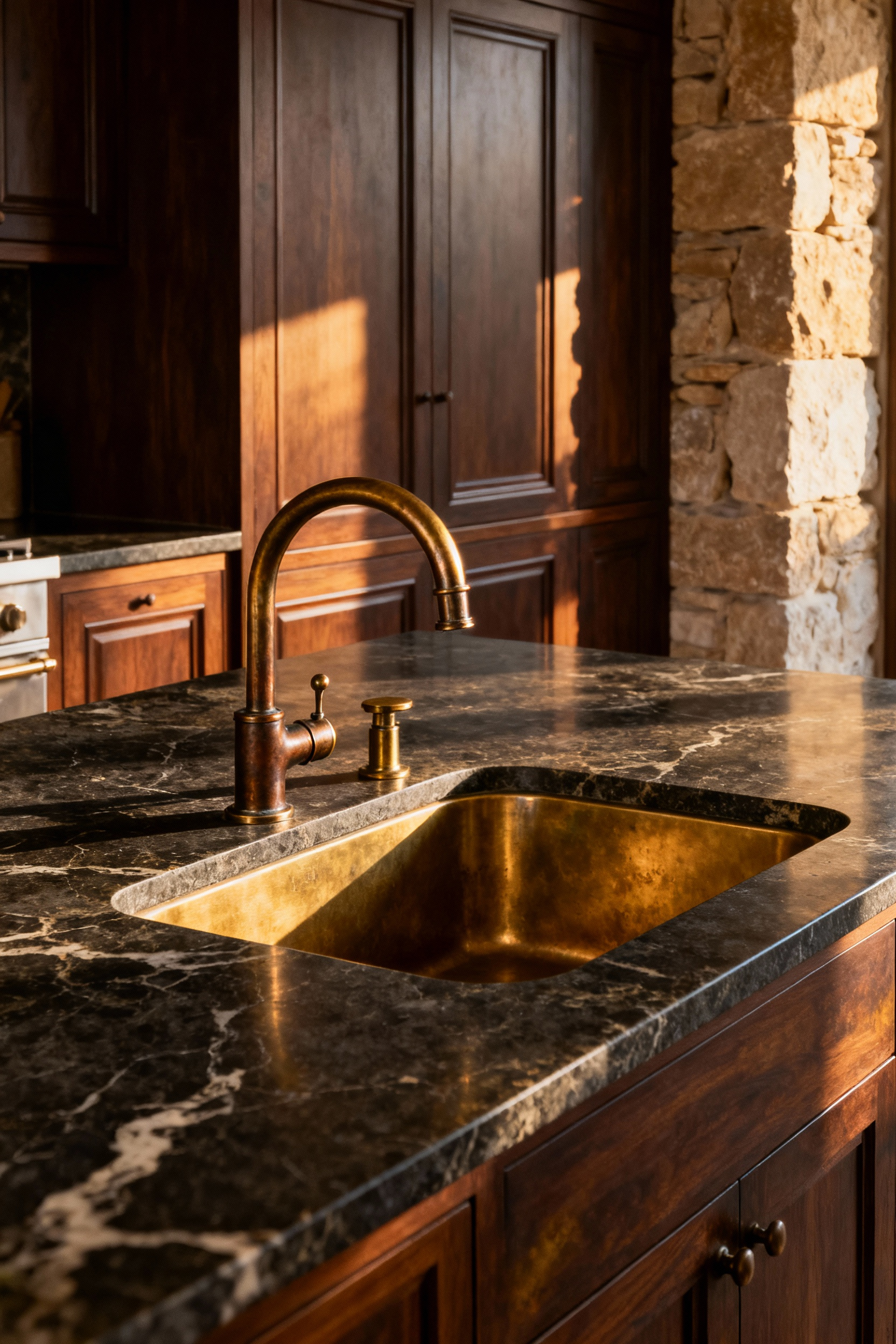
Strategically deploy this metal on high-touch elements like faucet hardware and integrated sink rims. Your daily use accelerates the aging process, instantly creating a bespoke finish unique to your habits. You must accept the luxury of required neglect.
- Stop Polishing: Let the surface darken naturally to tell your specific story.
- Invite Warmth: Use ochre and gold undertones to soften the starkness of cool marble.
- Diffuse Light: Replace harsh industrial glare with a welcoming, antique-inspired glow.
Trust the material and let your kitchen wear its history with pride.
6. Enameled Lava Stone (Pyrolave): The ultimate fusion of volcanic durability and custom couture color
Reject the mundane beige of standard countertops. Pyrolave injects the raw energy of the volcano into your culinary sanctuary. Mined from basalt and glazed at blistering temperatures, this material marries primal durability with high-fashion aesthetics. It withstands heat up to 1,800°F, allowing you to place searing pans directly on the surface without fear. I once commissioned a monolithic island in a deep, custom emerald to echo a client’s vintage jewelry collection; the result was breathtaking.
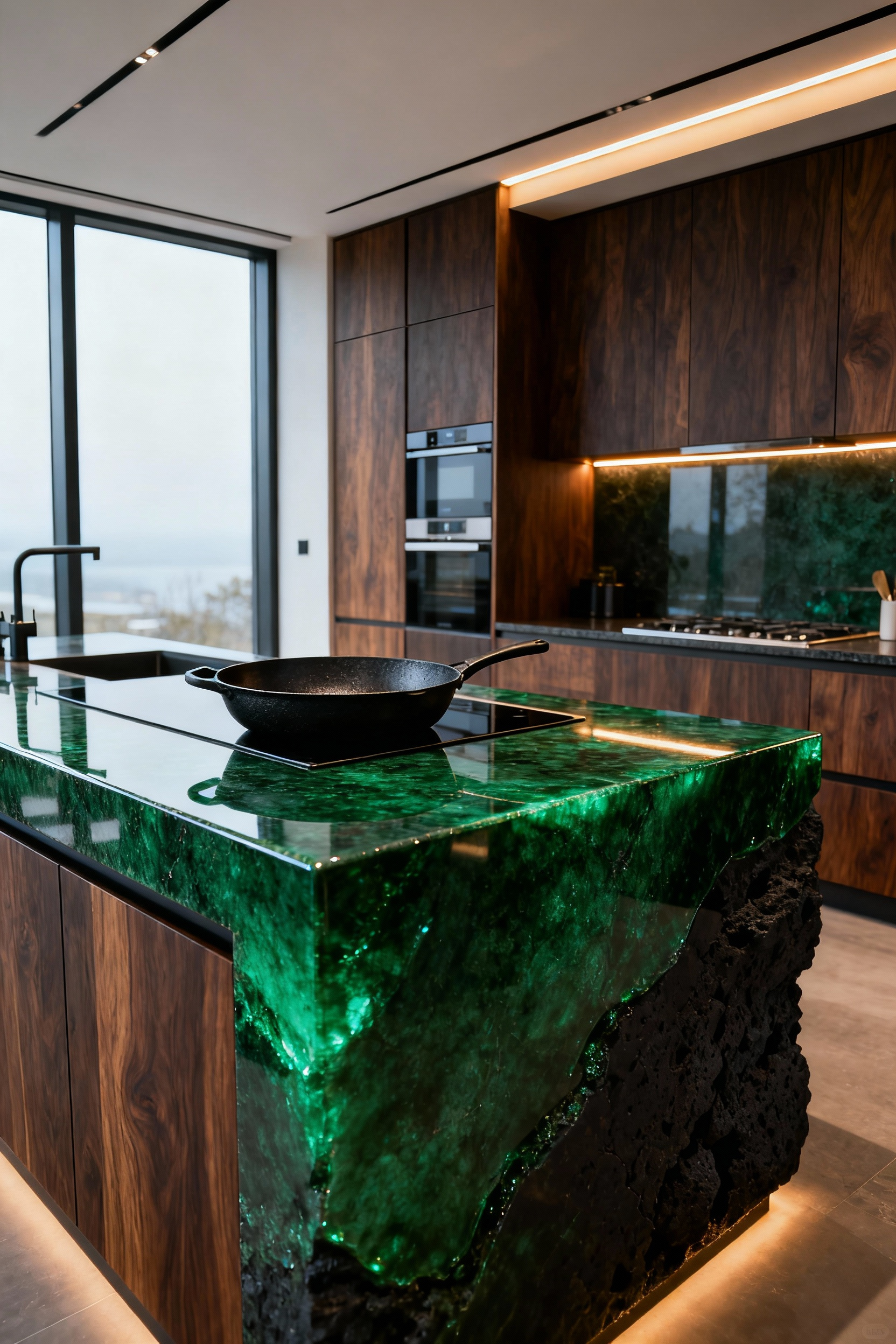
True luxury requires absolute personalization. The enameling process offers distinct advantages for the maximalist heart:
- Limitless Color Matching: Replicate any Pantone shade or paint swatch perfectly.
- Chemical Invincibility: Repel acids and oils with a non-porous seal.
- Heirloom Longevity: Maintain a high-gloss luster indefinitely.
Capitalize on this durability by installing an oversized, integrated sink to create a seamless block of saturated color. Your kitchen should be a masterpiece, not just a workspace.
7. Semi-Precious Agate Slabs: The decadence of dining on millions of years of geological history
Turn your kitchen into a radiant exhibition of geological history. Because nature rarely produces massive agate boulders, artisans painstakingly slice individual geodes and bond them with high-grade epoxy to create these opulent surfaces. This manual artistry commands a premium price, often exceeding $500 per square foot, so you must treat the material like the jewel it is. In my projects, I reject the ordinary; I use agate to inject a fearless soul into a room. To maximize both value and visual drama, follow these strategic mandates:
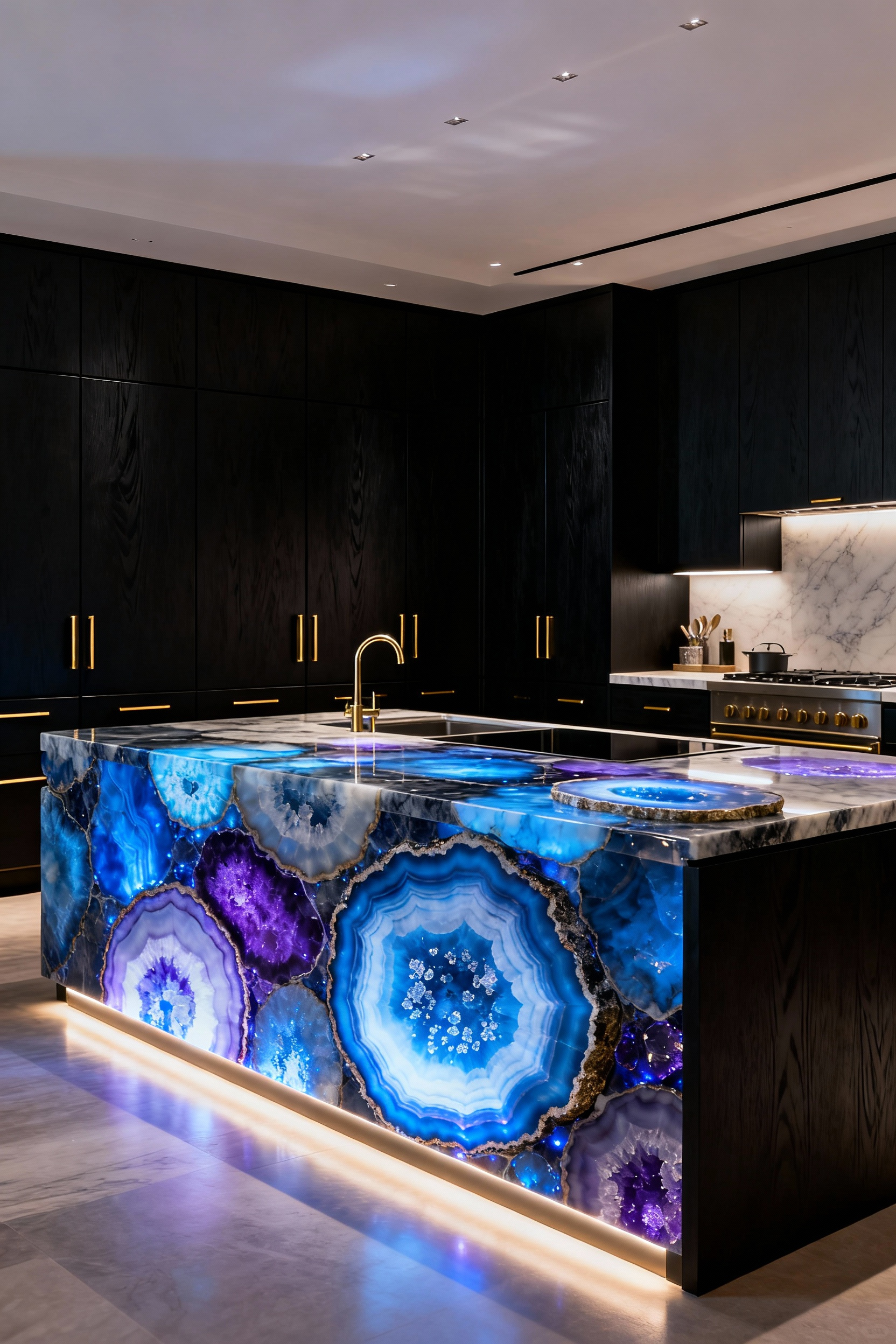
- Ignite the stone: You must install integrated LED backlighting to reveal the translucent, internal banding and transform the slab into ambient art.
- Target the placement: Reserve these slabs for singular, high-impact zones like a waterfall island edge or a feature backsplash behind the range.
- Protect the finish: While the resin makes the surface non-porous and stain-resistant, use only non-abrasive cleaners to preserve the high-gloss sheen.
Embrace this level of intensity. When your island glows during a dinner party, you aren’t just serving food; you are curating an emotional experience grounded in millions of years of earth’s artistry.
8. Venetian Terrazzo: Moving beyond commercial speckles to large-scale, hand-cast aggregate opulence
Banish the thought of sterile, industrial speckles found in commercial corridors. True luxury demands the drama of [Venetian Terrazzo](https://en.wikipedia.org/wiki/Terrazzo) in its “Maxi” form, where oversized, jagged slabs of rare marble float in a custom matrix like jewels. I recently commissioned a hand-cast, monolithic island featuring seamless waterfall edges and a curved, integrated sink trough; it wasn’t just a countertop, but a sculptural masterpiece anchoring the room. This hand-poured method allows for fluid shapes that rigid slab stone simply cannot achieve, turning your kitchen into a celebration of artistic expression.
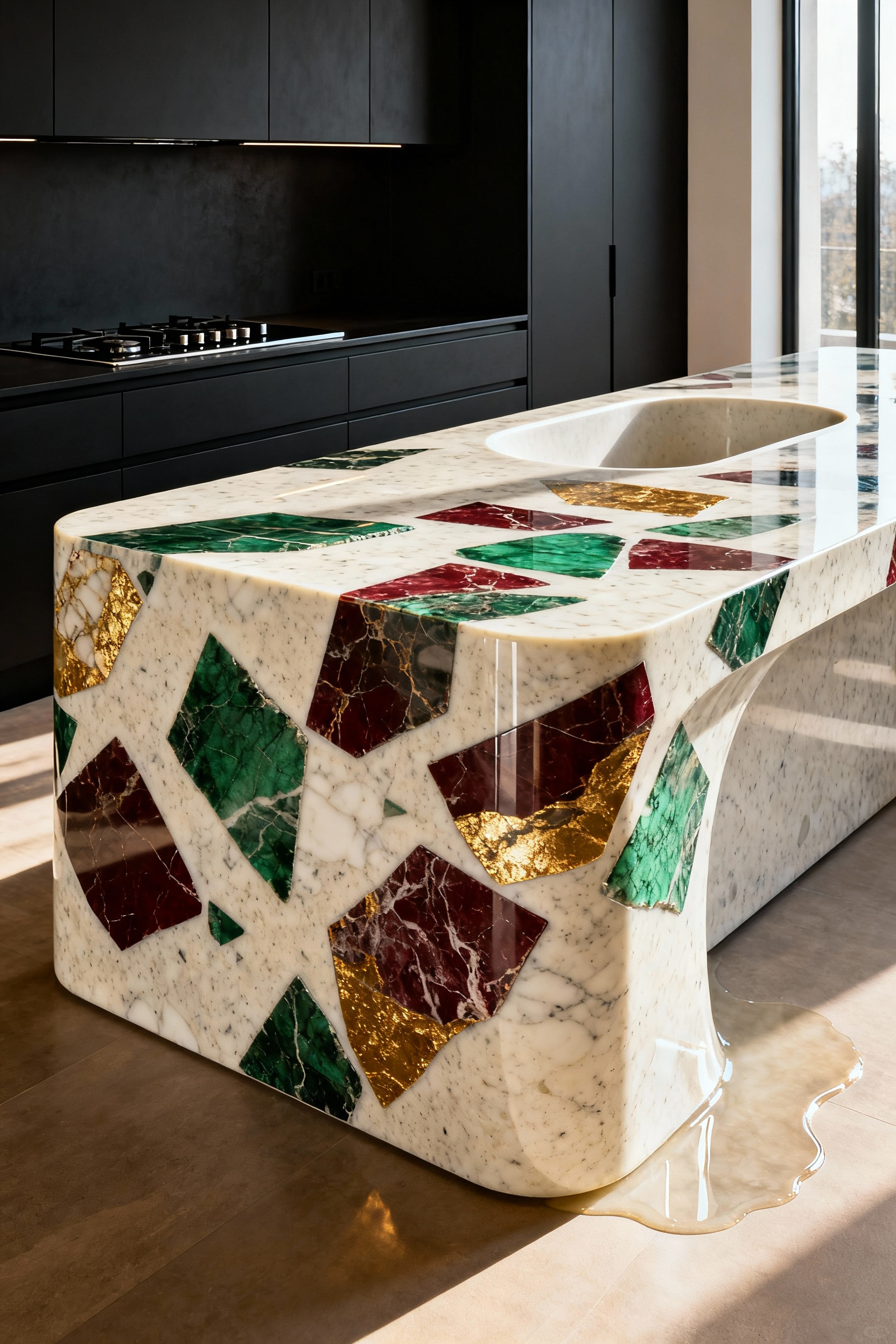
To channel this opulence effectively, you must be specific with your artisan:
- Demand Scale: Specify “Maxi” aggregates between 1.5 and 4 inches to mimic the historic *Palladiana* style rather than uniform gravel.
- Color the Matrix: Pigment your binder to contrast with the stone—think deep forest green or rich terracotta—so the aggregate pops.
- Keep it Matte: Request a honed finish to eliminate cheap glare and enhance the stone’s natural texture.
Embrace the weight and history of these materials to create a space that feels curated, not manufactured.
Section 3: Sculptural Fabrication (Form Over Flatness)
Reject the tyranny of the flat plane. Your kitchen island must stand as a monolithic sculpture, not a mere resting place for cutting boards. Demand [5-axis CNC routing](https://www.architecturaldigest.com/story/how-technology-is-revolutionizing-stone-design) to liberate your stone from two dimensions. This technology carves seamless, integrated sinks and coved backsplashes from a single block, creating an unbroken flow that feels both ancient and futuristic. In my own Milan apartment, I demanded vertical fluting on the quartzite island face; the tactile grooves catch the light and transform a functional surface into a centerpiece of dramatic art.
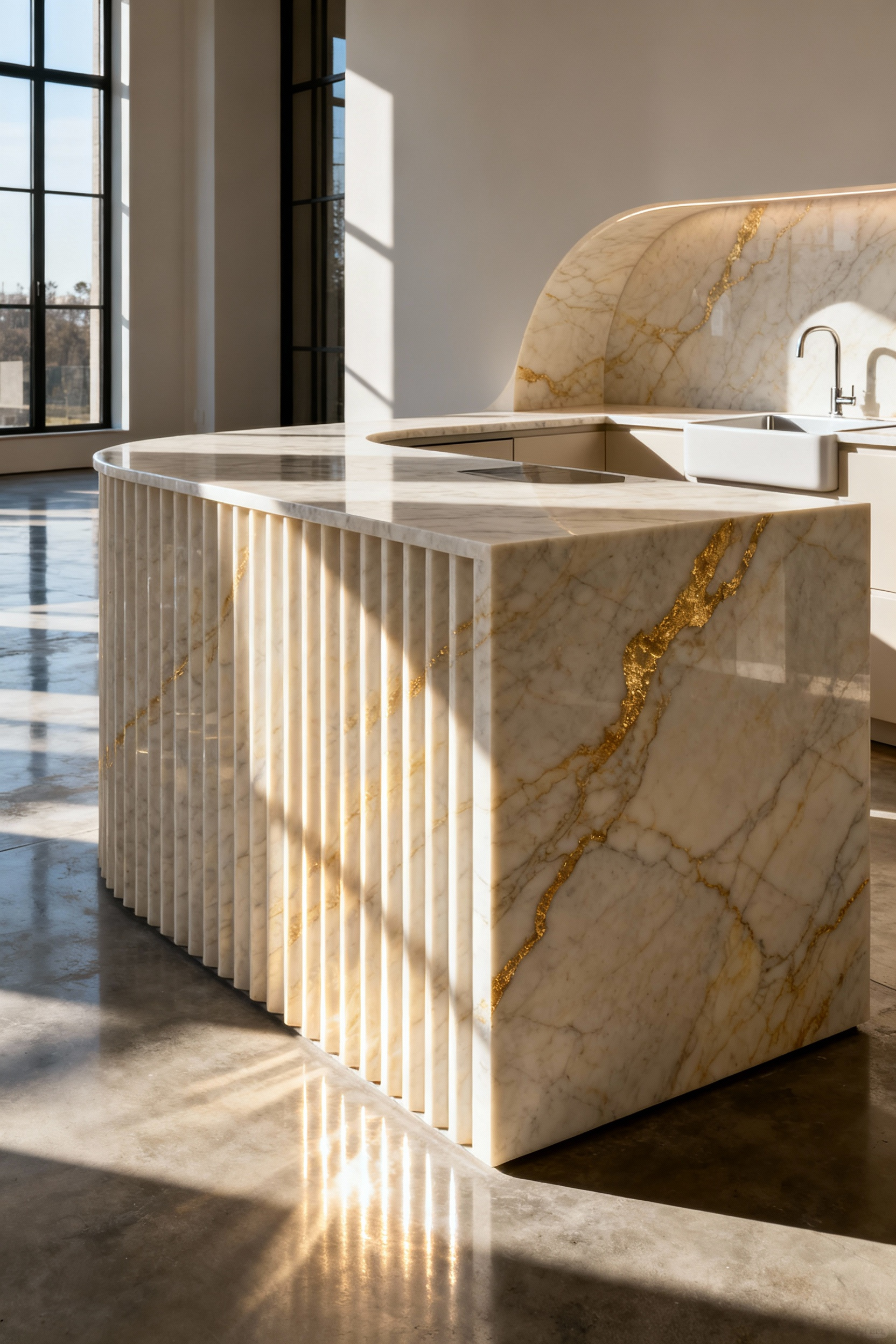
Embrace volume to communicate permanence. Standard eased edges whisper, but thick, mitred profiles shout with sophistication. To achieve this architectural weight without losing elegance, dictate these fabrication specifics:
- Floating Edges: Recess the underside of a six-inch miter to make massive stone blocks appear to hover.
- Shark-Nose Profiles: Use an inverted bevel to create shadow lines that slim the visual profile while retaining bulk.
- Thermoformed Curves: Utilize solid surfacing for islands that require fluid, impossible bends.
These details elevate fabrication from construction to curation. Treat your stone like a statue, and your kitchen becomes a gallery.
9. The Dramatic Waterfall Edge: Why cascading stone is non-negotiable for the modern statement island
Stop treating your kitchen island as mere furniture; elevate it into a monolithic sculpture with a dramatic waterfall edge. This cascading stone design anchors the room, serving as a definitive architectural partition that commands attention in open-concept spaces. Precision is paramount here. You must demand bookmatching or vein-matching to ensure the pattern flows uninterrupted over the edge. I once halted a project in Milan because the fabricator ignored the grain direction—true luxury allows for no breaks in the narrative. Without seamless continuity, the illusion shatters, so budget for the extra slabs required to achieve this fluid perfection.
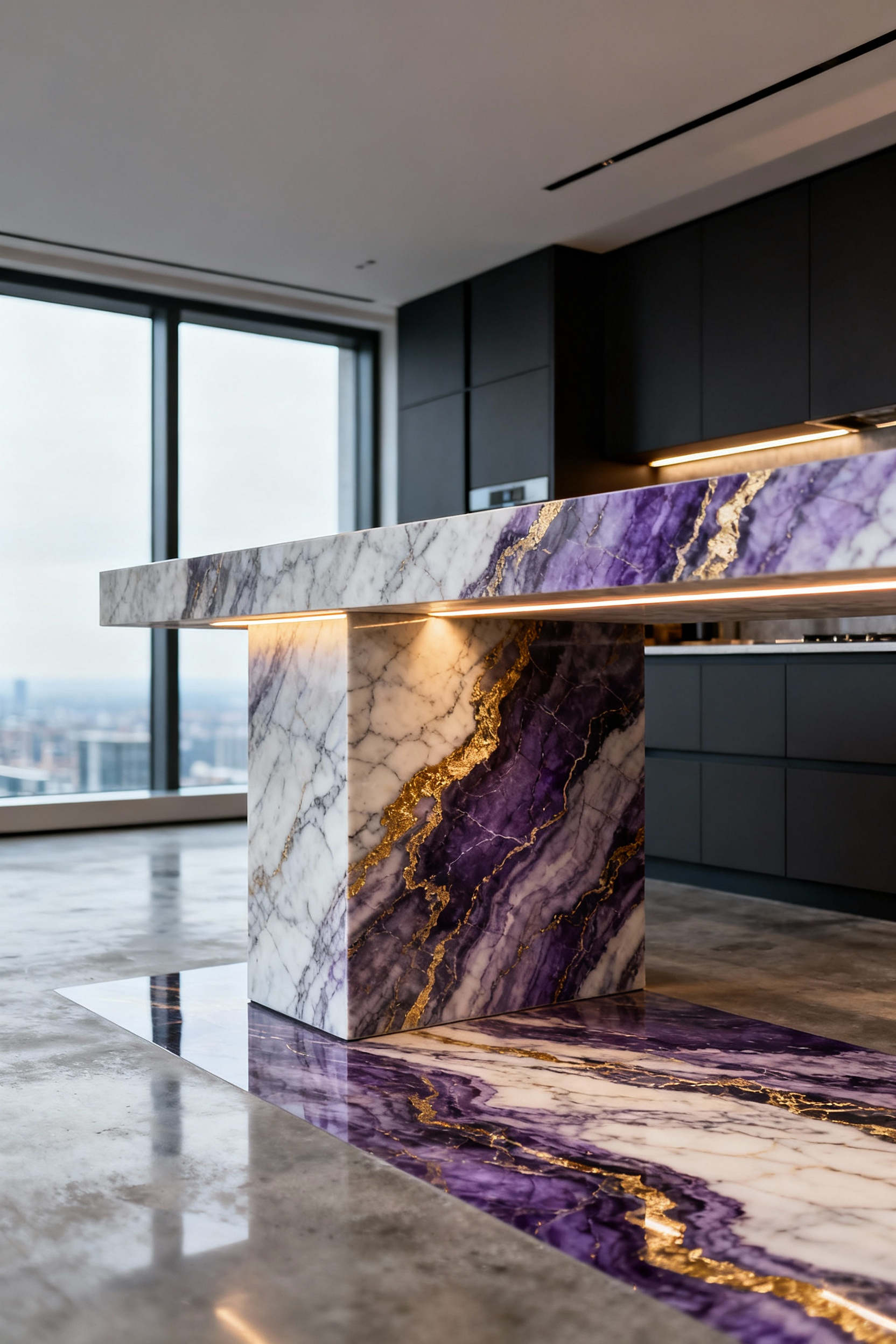
Beyond the visual drama, this structural choice offers clever functional concealment.
- Tuck slim power strips invisibly under the overhang.
- Integrate electrical outlets directly into the vertical stone face.
- Eliminate visible hardware to maintain a sleek, block-like appearance.
Embrace the investment, because a waterfall edge transforms a workspace into a centerpiece, proving that practical elements can—and should—be breathtaking.
10. Fluted Marble Detailing: Adding tactile rhythm and shadow play to vertical surface facings
I believe your home should beg to be touched. Fluted marble detailing answers that call, turning static vertical surfaces into a rhythmic celebration of texture. Move beyond the expected monolithic waterfall edge; instead, treat your kitchen island like a piece of bespoke furniture. This architectural channeling creates a sophisticated shadow play that evolves throughout the day, making your space feel alive and undeniably opulent.
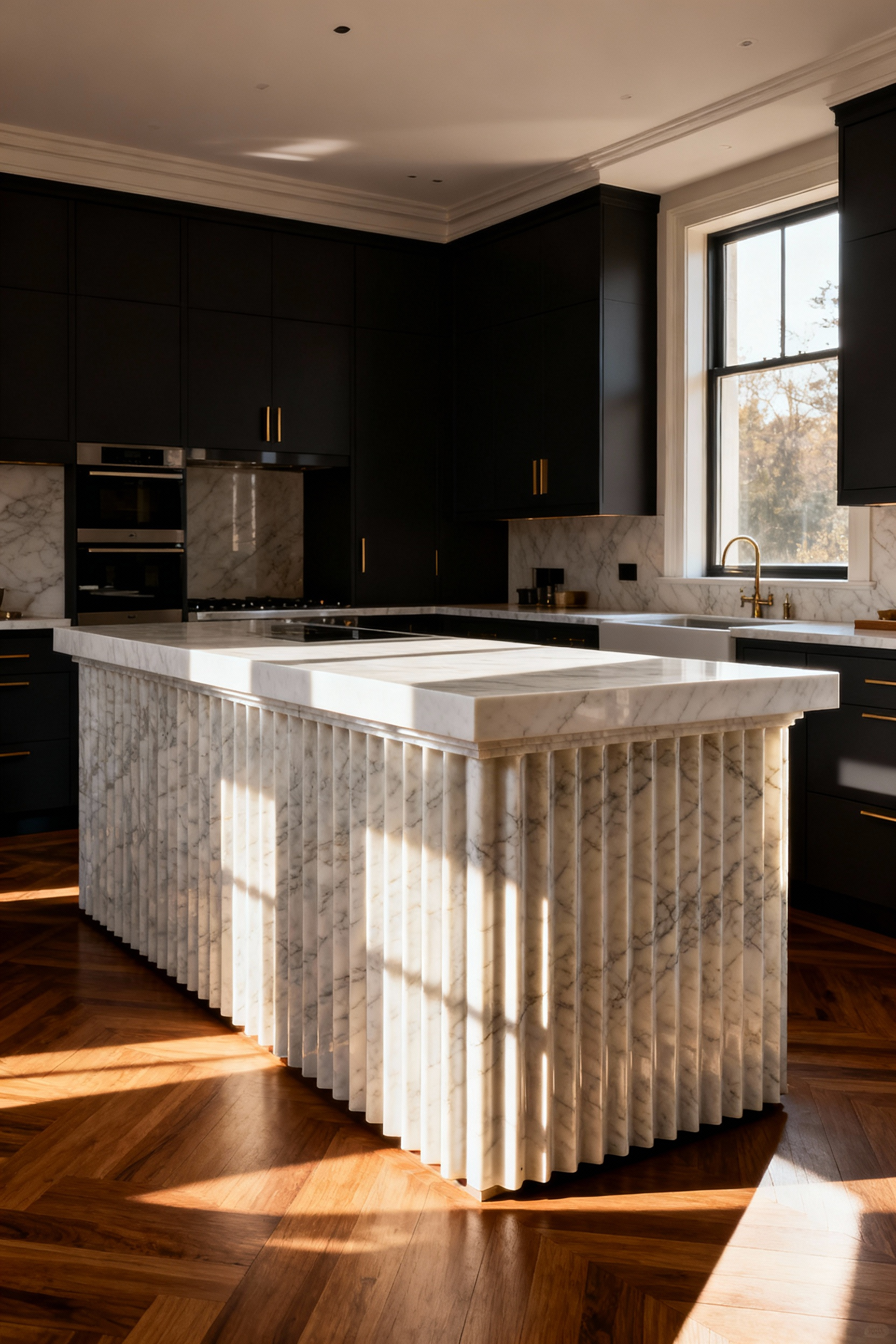
True maximalism requires discipline, not chaos. To ensure your stone sings rather than screams, adhere to these design non-negotiables:
- Restrain the Veining: Select refined, low-movement marbles like Statuario. Chaotic patterns clash with the rigid geometry of the flutes, creating visual clutter.
- Command the Light: Install directional LED grazing light at the toe-kick or fascia. Without specific illumination, the sculptural depth disappears.
- Commit to Depth: Specify a cut depth of at least 3/8 inch. Shallow etching looks cheap; deep grooves create the dramatic impact we crave.
11. The Marine Edge and Shark Nose Profiles: Subtle architectural details that signal bespoke craftsmanship
True luxury whispers through details, not just volume. Enter the Shark Nose profile. This severe 30° to 45° reverse bevel transforms a massive two-inch slab into a floating, ethereal surface. It demands attention. I frequently specify this cut for handleless cabinetry because it creates a natural, tactile finger pull. Suddenly, your kitchen isn’t just a workspace; it becomes a gravity-defying piece of sculpture.
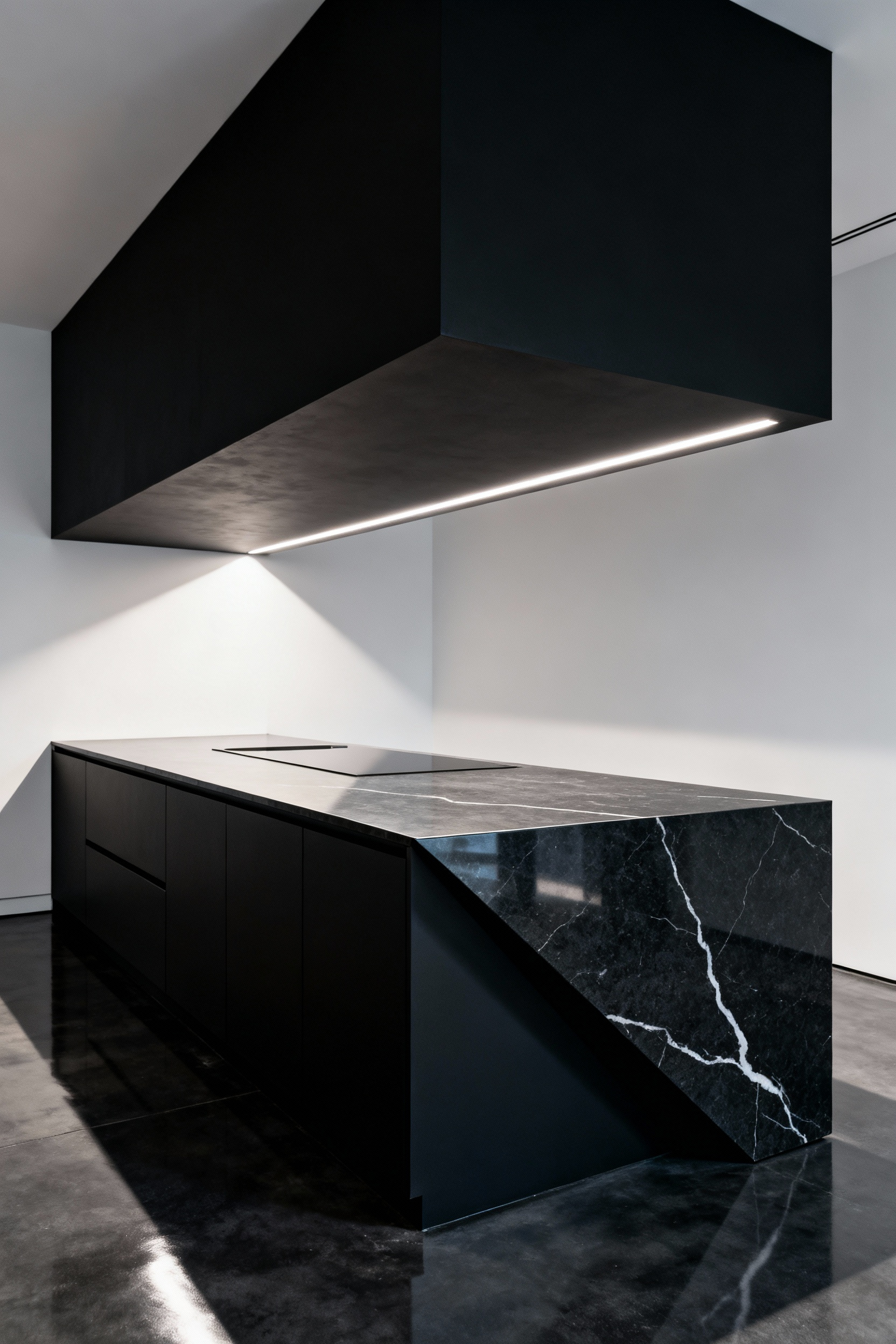
Precise architecture requires superior materials. Do not cut corners here.
- Choose natural stone: Use veined marble or quartzite to showcase the stone’s inner beauty.
- Avoid engineered surfaces: These edges expose the material’s core, and synthetic patterns often fail the close-up test.
- Demand expert fabrication: These cuts require specialized machinery to achieve a perfect finish.
Similarly, the Marine Edge offers more than simple utility. While it contains spills, I utilize it on monolithic waterfall islands to disrupt the visual weight of the vertical slab. It turns a heavy, imposing block into a delicate, refined statement of bespoke craftsmanship.
12. Integrated Stone Sinks: The seamless luxury of disappearing utility
Transform your vanity into a monolithic sculpture by carving the basin directly from the countertop. I treat stone as a canvas for high drama, and an integrated sink allows the wild, chaotic beauty of the veining to take center stage without visual interruption. The utility vanishes into the art. To master this look, prioritize “bookmatching” above all else. Demand that your fabricator aligns the veins so they cascade down the sink walls like a continuous waterfall, ensuring the illusion of a solid block of stone remains unbroken.
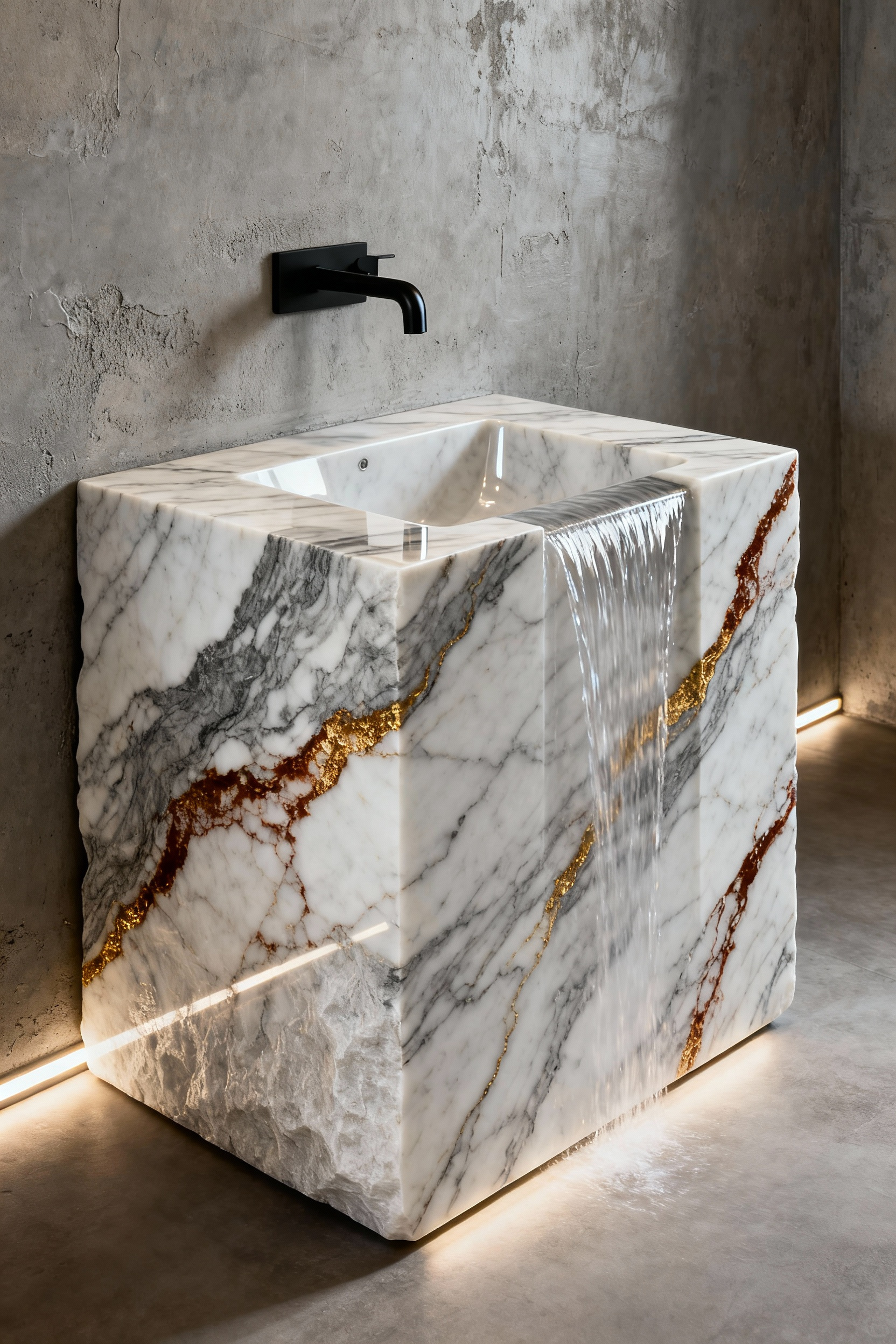
Do not sacrifice performance for a pretty face; this level of opulence requires rigorous choices.
- Select dense materials: Opt for quartzite or sintered stone over soft marble to prevent tragic staining.
- Hide the mechanics: Request a linear slot drain carved from the same stone to make plumbing invisible.
- Soften the corners: Ensure a small-radius curve in the basin to prevent grime buildup.
This approach marries my “more is more” obsession with seamless function. True luxury often lies in what you *don’t* see.
Section 4: The Mixed-Media Symphony (Layering Textures for High-End Kitchen Surfaces)
Why settle for a monotone whisper when you can conduct a textural symphony? True opulence rejects the safety of single-material surfaces. Drawing from my heritage of vibrant, layered textiles, I believe your kitchen should feel as rich as a tapestry. You must create friction to spark joy. Juxtapose a high-gloss, mirrored backsplash against the rugged sensuality of leathered granite. This clash of polished and matte finishes captures light and forces the eye to linger, turning a flat plane into an emotional experience.
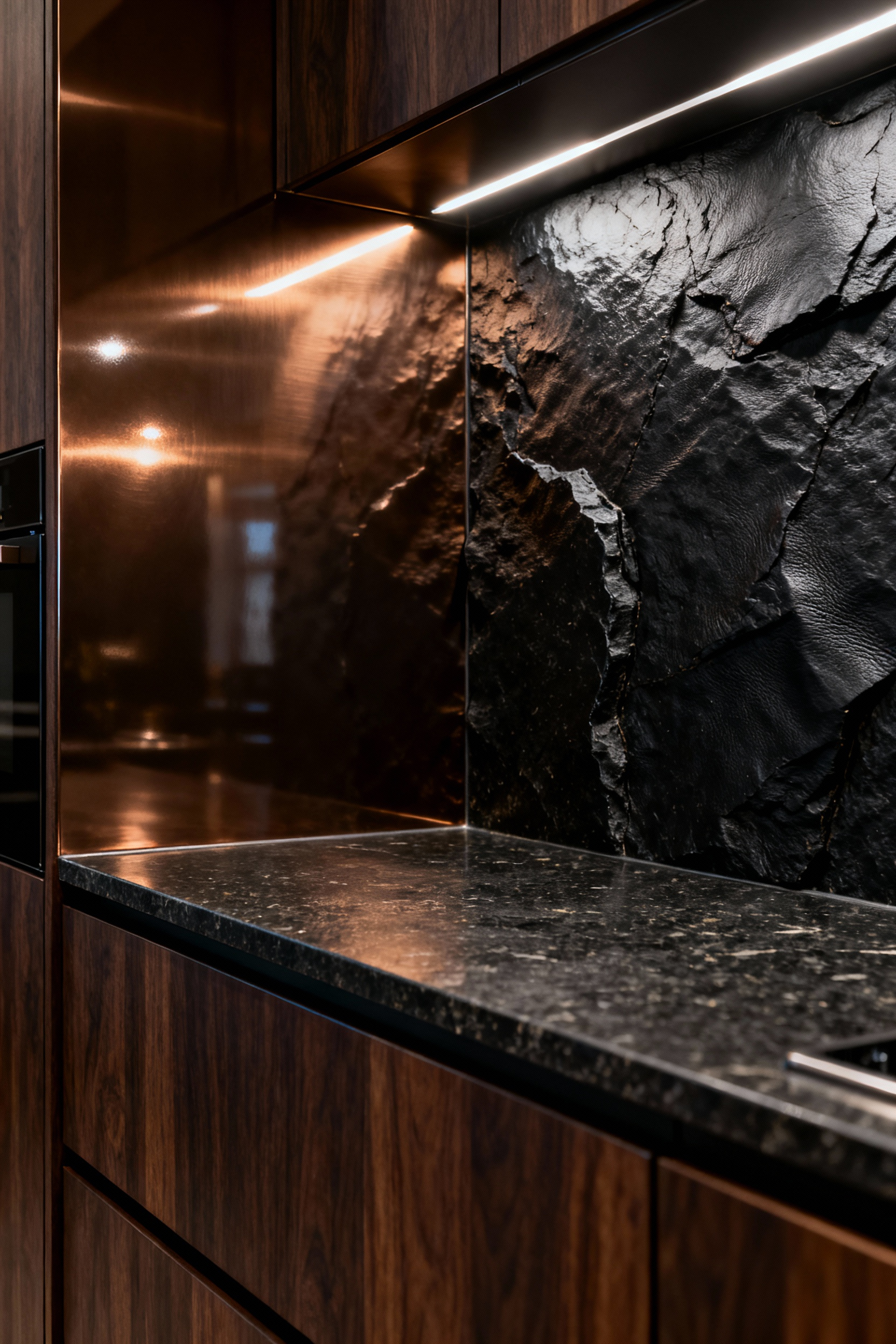
Transform your island from a mere workspace into a piece of functional art through strategic zoning.
- Command attention by grounding the main prep area in durable, cool stone.
- Invite connection by seamlessly integrating a section of warm, end-grain walnut for the dining perch.
- Elevate the transition with a slender inlay of brushed brass or blackened steel, acting as the jewelry of the room.
Finally, let your vertical surfaces dance. Install three-dimensional geometric tiles or woven metal mesh behind the cooktop to cast dramatic shadows, proving that in modern luxury design, more is infinitely more.
13. Marrying Cold Stone with Warm Walnut: The butcher block reimagined for the high-end chef
Forget the monotony of a single surface; true luxury demands the dramatic friction between thermal extremes. In my family’s kitchen, the rhythm of cooking always swung between the cool snap of marble for pastry and the soft thud of a knife against wood, a dance of textures that fuels the soul. Recreate this sensory masterpiece by embedding a three-inch, end-grain walnut block directly adjacent to high-performance stone like Dekton or quartz. This juxtaposition transforms your island into a professional command center tailored for specific culinary arts:
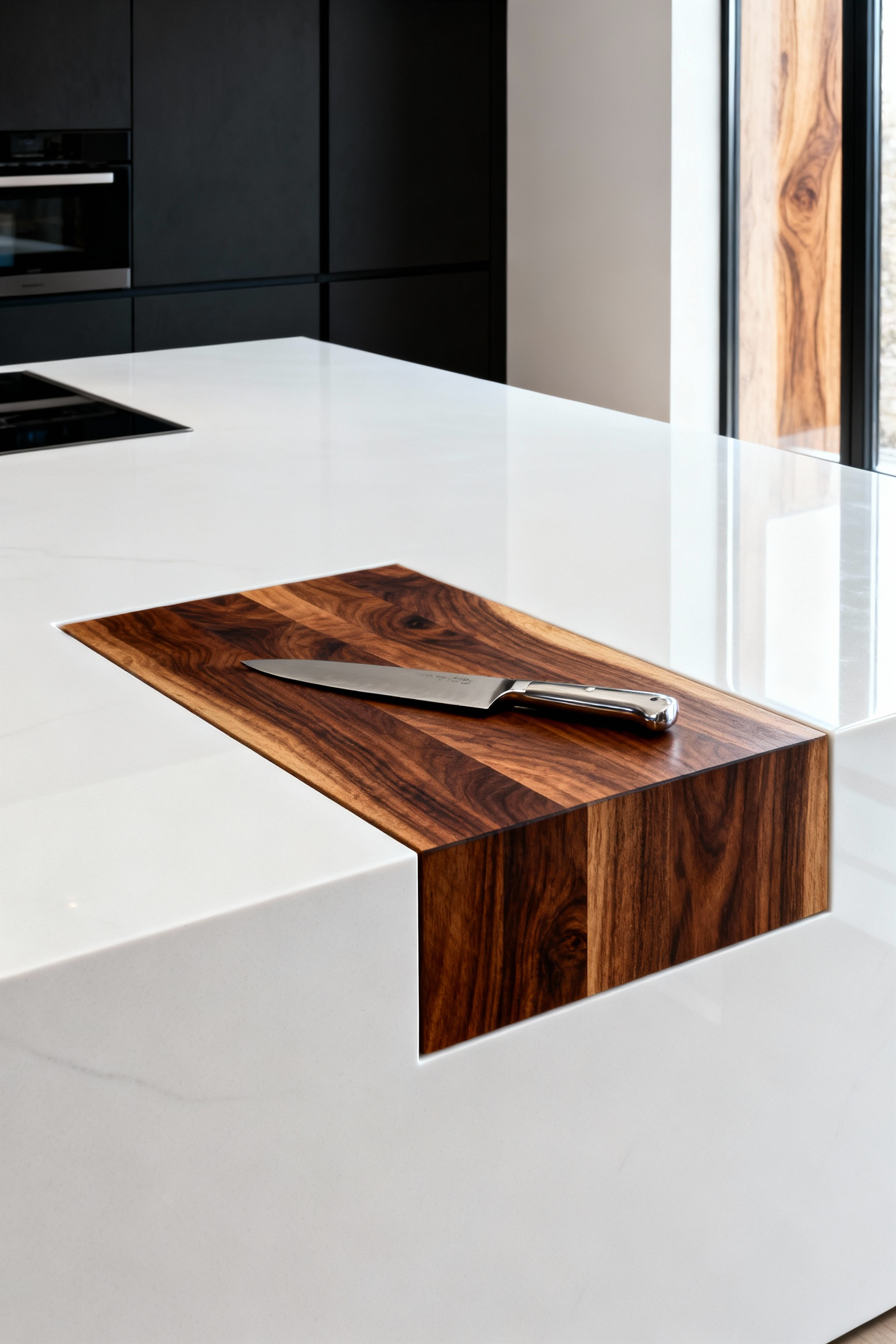
- Cold Stone: Utilize this zone for tempering chocolate or prepping raw fish, taking advantage of the chilled, non-porous surface.
- Warm Walnut: Dedicate this area exclusively to slicing and carving to preserve the sharp edge of your Japanese steel.
Specify a slim stainless steel channel between these materials to catch runoff and prevent cross-contamination. This technical detail ensures your maximalist design remains impeccably sanitary while offering a visual break. Embrace the opulent utility of a kitchen that works as hard as it dazzles.
14. Metal Inlay and Brass Banding: Framing natural stone with metallic jewelry
Treat your kitchen island like a massive jewelry box. I believe stone is nature’s gem, so it demands a setting of equal grandeur. Inlay precision-cut brass or copper directly into the slab to transform a utilitarian surface into bespoke art. This technique marries the cool drama of marble with the radiant warmth of metal, creating a friction that is visually intoxicating. While CNC engineering ensures a zero-tolerance fit, true luxury requires technical foresight.
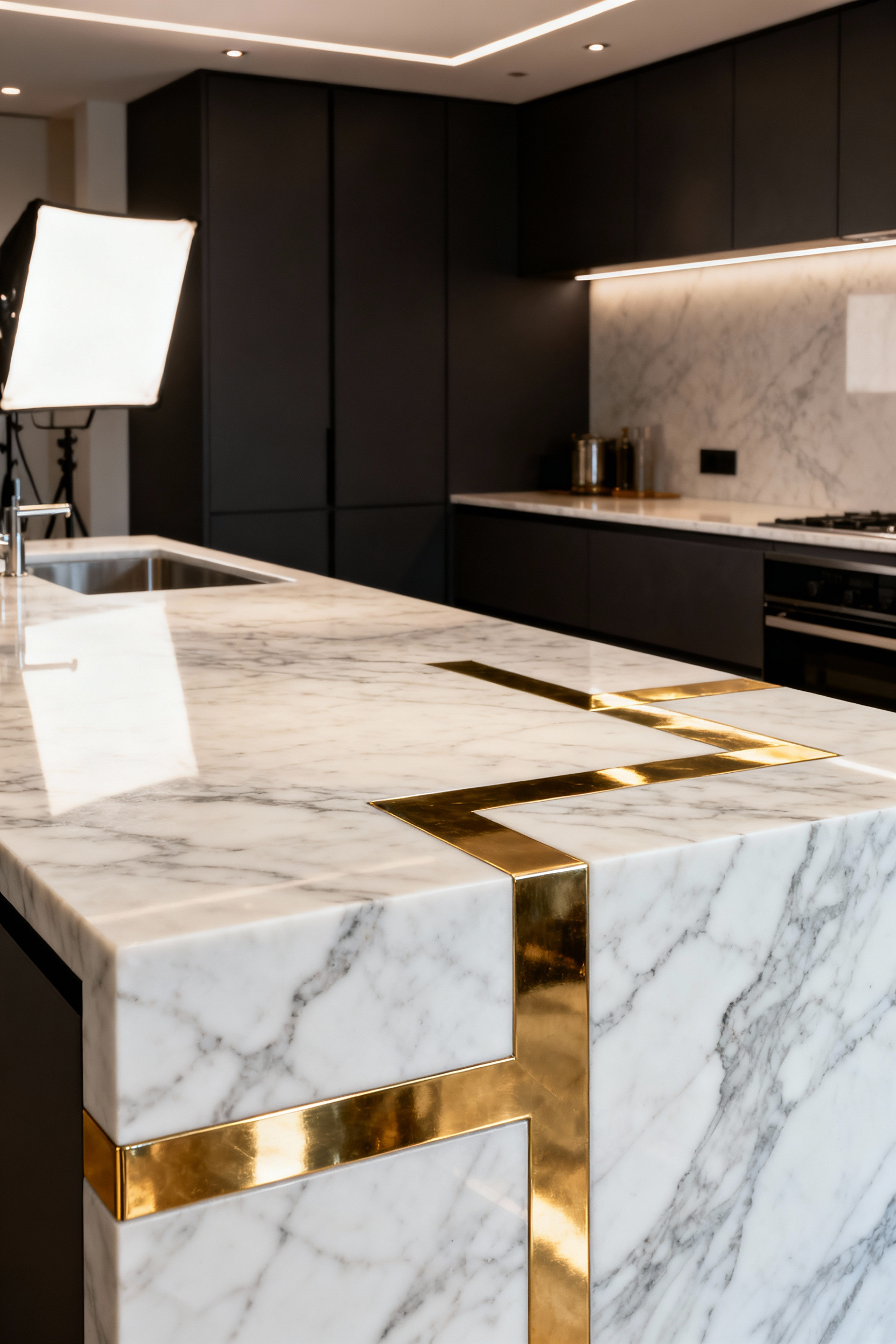
Respect the physics of these materials to ensure longevity. Metal and stone expand at different rates, particularly near professional ranges.
- Demand flexible joinery: Ensure your fabricator uses high-grade, flexible epoxy to absorb movement and prevent cracking.
- Embrace the vertical: Frame waterfall edges with brass banding to distinctively separate the stone from the flooring.
- Select living finishes: Opt for unsealed copper or bronze to develop a rich patina over time.
These details bridge the gap between furniture and architecture, asserting your style with unapologetic elegance.
Frequently Asked Questions about Opulent Kitchen Countertops
What is the most durable surface among high-end kitchen materials?
While marble is visually stunning, the most durable high-end materials are typically natural quartzites (like Taj Mahal or Cristallo) or sintered stone/ultra-compact surfaces (like Dekton or Lapitec). These materials offer extreme resistance to heat, scratches, and etching, providing the luxurious look of natural stone with superior performance, especially critical in high-traffic kitchens.
Should I choose unlacquered brass or PVD-coated metal for my primary kitchen sink hardware?
For primary kitchen sinks that receive heavy daily use, PVD (Physical Vapor Deposition) coated metal is recommended. PVD offers the rich look of gunmetal, bronze, or brass but maintains a consistent, armored finish that resists chemicals and tarnish. Unlacquered (living) brass is best reserved for low-touch areas or secondary surfaces where its natural patina is a desired aesthetic feature, not a functional concern.
How can I achieve a monolithic, seamless look with a stone countertop?
The key to a monolithic look is demanding jumbo slabs (often exceeding 130 inches) to eliminate seams, and prioritizing expert fabrication techniques. For islands, this means using a waterfall edge with strict bookmatching to ensure the veining is continuous. Additionally, specifying an integrated stone sink, carved directly from the main slab using 5-axis CNC technology, maximizes the illusion of a single, sculptural block of stone.
Conclusion: Curating a kitchen that serves as a gallery for your daily life
Treat your kitchen as the ultimate exhibition space for your daily rituals. Stop viewing countertops as mere workspaces; demand that they perform as sculpture. By investing in true luxury kitchen surfaces, I often anchor a room with a “monolith” island, wrapping heavily veined quartzite down the sides to create a singular, seamless art piece. This shift makes the luxury material the statement, eliminating the need for excessive ornamentation. This is your home’s gallery, and the surface is the primary medium.
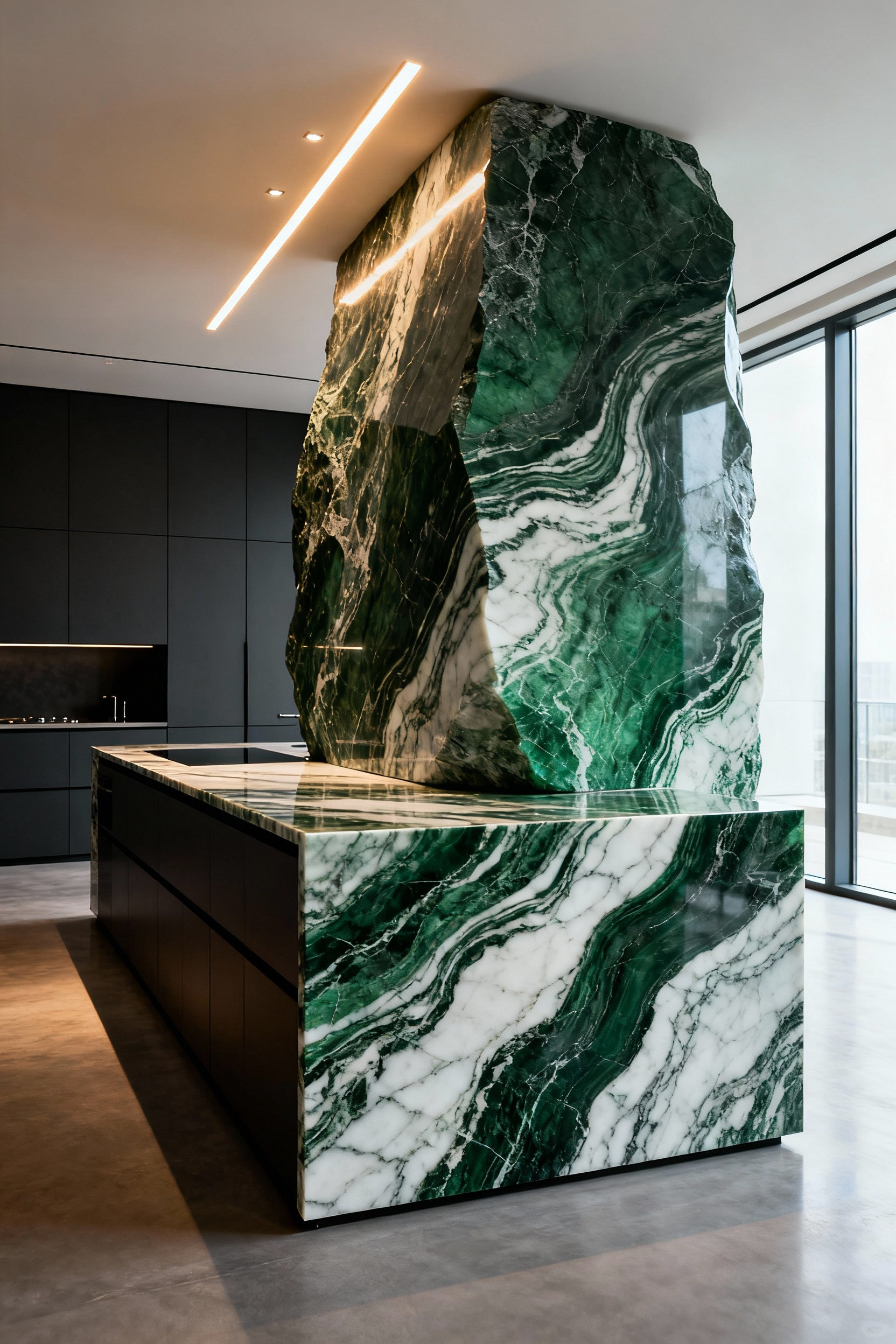
To truly capture this sophisticated aesthetic, you must execute with intention.
- Demand Bookmatching: Align slabs on backsplashes so the veins mirror each other, creating an uninterrupted masterpiece.
- Layer “Gallery” Lighting: Embed LED strips to wash the stone’s texture, highlighting the finish just as a museum would a painting.
Embrace these maximalist instincts without hesitation. By curating a space that celebrates texture and light, you transform mundane tasks into acts of joy.