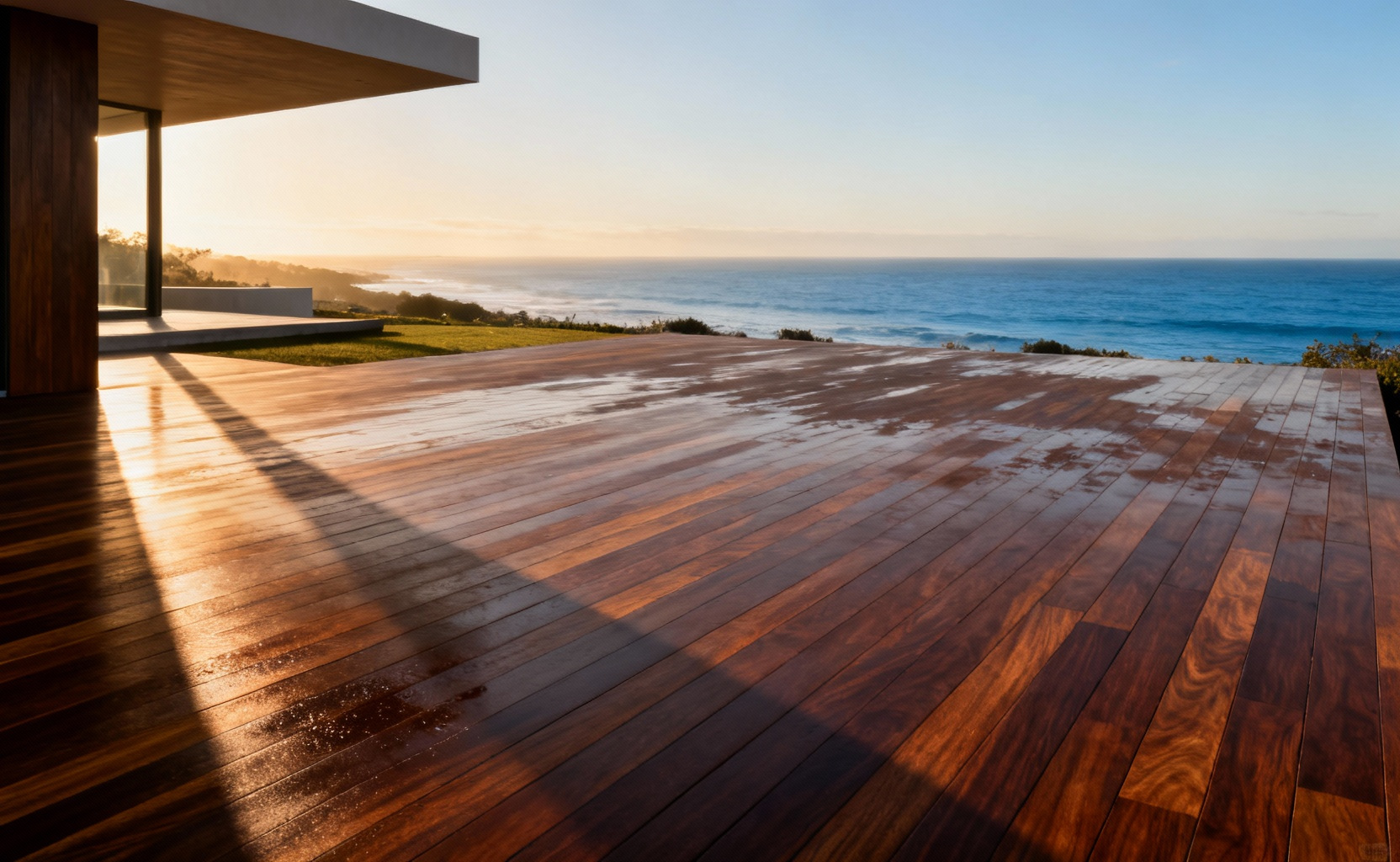

Many homeowners view backyard decks simply as standard wooden additions. They often accept weathering and regular maintenance as inevitable burdens. However, true coastal luxury demands a significant shift in perspective. It requires viewing these outdoor spaces as resilient assets rather than temporary structures. The harsh maritime environment quickly exposes any design shortcuts. Therefore, when investing in luxury decks backyard environments demand, we must prioritize endurance as the highest form of elegance.
This philosophy transforms material selection into a critical engineering investment. Sophisticated designs now favor specialized composites or exotic hardwoods over soft timber. These advanced materials effectively resist rot while mimicking the warmth of natural wood. Hidden details like marine-grade fasteners ensure structural longevity against salt spray. Plus, using advanced substructure protection prevents the corrosion common in coastal zones. In fact, resisting these aggressive micro-environments is what truly defines refinement. A seamless visual transition from indoors to outdoors relies on this invisible strength.
We promise your outdoor space can be both resilient and refined. Designers have effectively mastered this delicate balance. After analyzing over 200 coastal and inland luxury projects, we identified the key factors. This guide reveals the 18 investment decisions that create decks that defy the elements. These choices ensure your home maintains a sophisticated, timeless aesthetic. For homeowners seeking comprehensive planning, these decisions are crucial for implementing Essential Back Yard Design Principles.
1. The Foundation: Prioritizing Ipe and Hardwoods for Heirloom Durability
True coastal luxury is defined by permanence, not just aesthetics. Therefore, we prioritize exotic hardwoods like Ipe, or Brazilian Walnut, for outdoor living spaces. This material represents a philosophical shift from planned obsolescence to heirloom durability. Ipe is engineered by nature for extreme resilience. In fact, it is so dense that it actually sinks in water, earning the moniker “ironwood.”
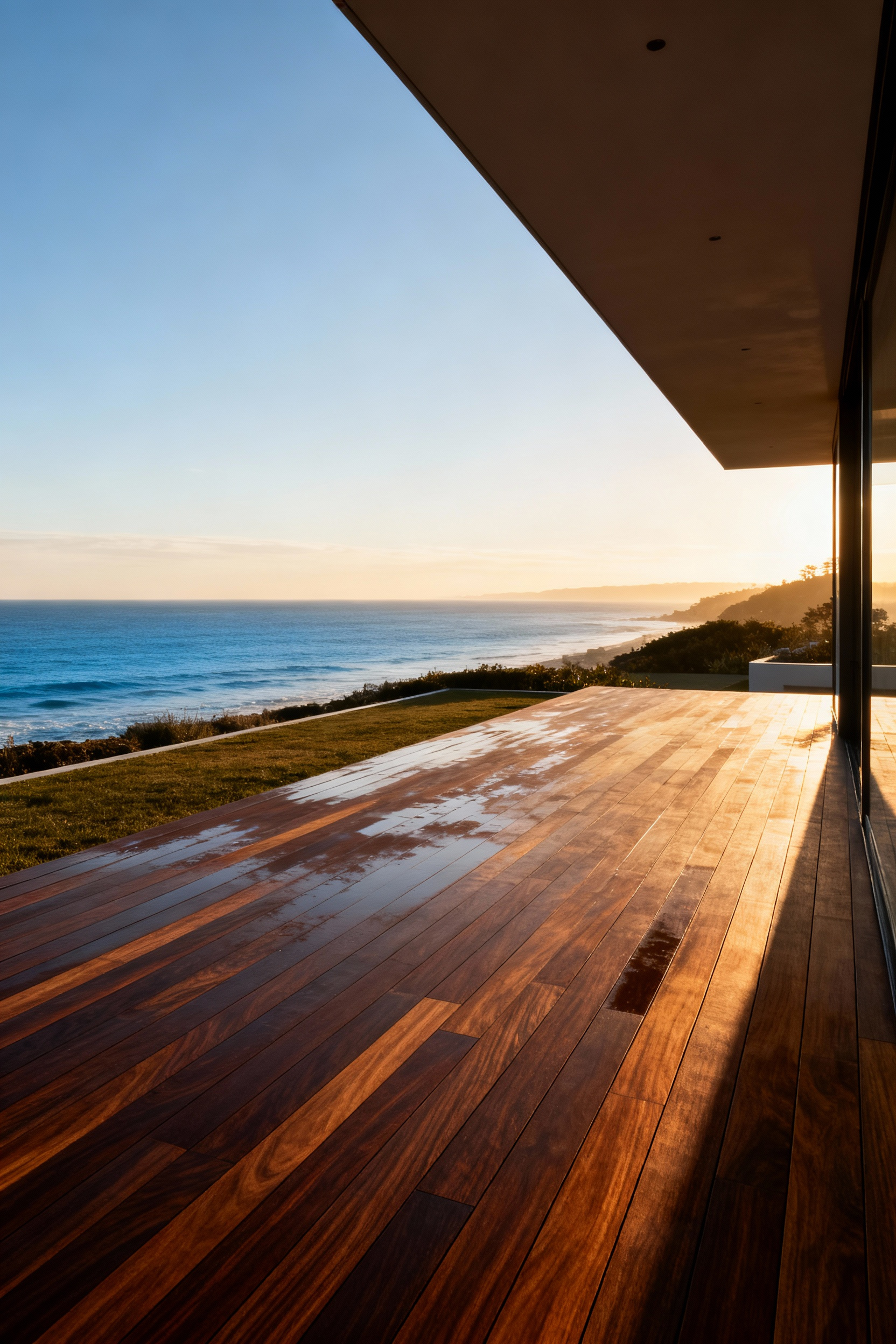
Consequently, this density translates to a concrete-like stability underfoot. On the Janka Hardness Scale, Ipe rates at approximately 3,680 lbf. Thus, it is nearly three times harder than domestic White Oak. This extreme hardness prevents the scuffs and gouges that typically degrade lesser decks. Its structural density even grants it a rare Class A Fire Rating.
Beyond mere physical strength, the wood relies on natural resistance. Rich oils and tannins render it impervious to rot, mold, and termites. Uniquely, it achieves this defense without chemical preservatives. You may oil the surface to retain its deep brown hue. Alternatively, you can allow it to weather to a sophisticated, silvery-gray patina.
Finally, we must consider the long-term value. While the initial investment is significant, Ipe can last 40 to 75 years. Indeed, one installation often outlasts three composite deck replacements. Moreover, the natural wood stays cooler on the feet than synthetic alternatives. Specifying Ipe ensures your seaside home remains a legacy for future generations.
2. High-Performance Composite: The Evolution of Maintenance-Free Luxury
Early attempts at composite decking were undeniably flawed. Specifically, “first-generation” boards mixed exposed wood flour with plastic. Unfortunately, this porous blend absorbed moisture eagerly. Homeowners frequently faced severe fading, stubborn stains, and mold issues. Therefore, the industry needed a radical shift to regain consumer trust.
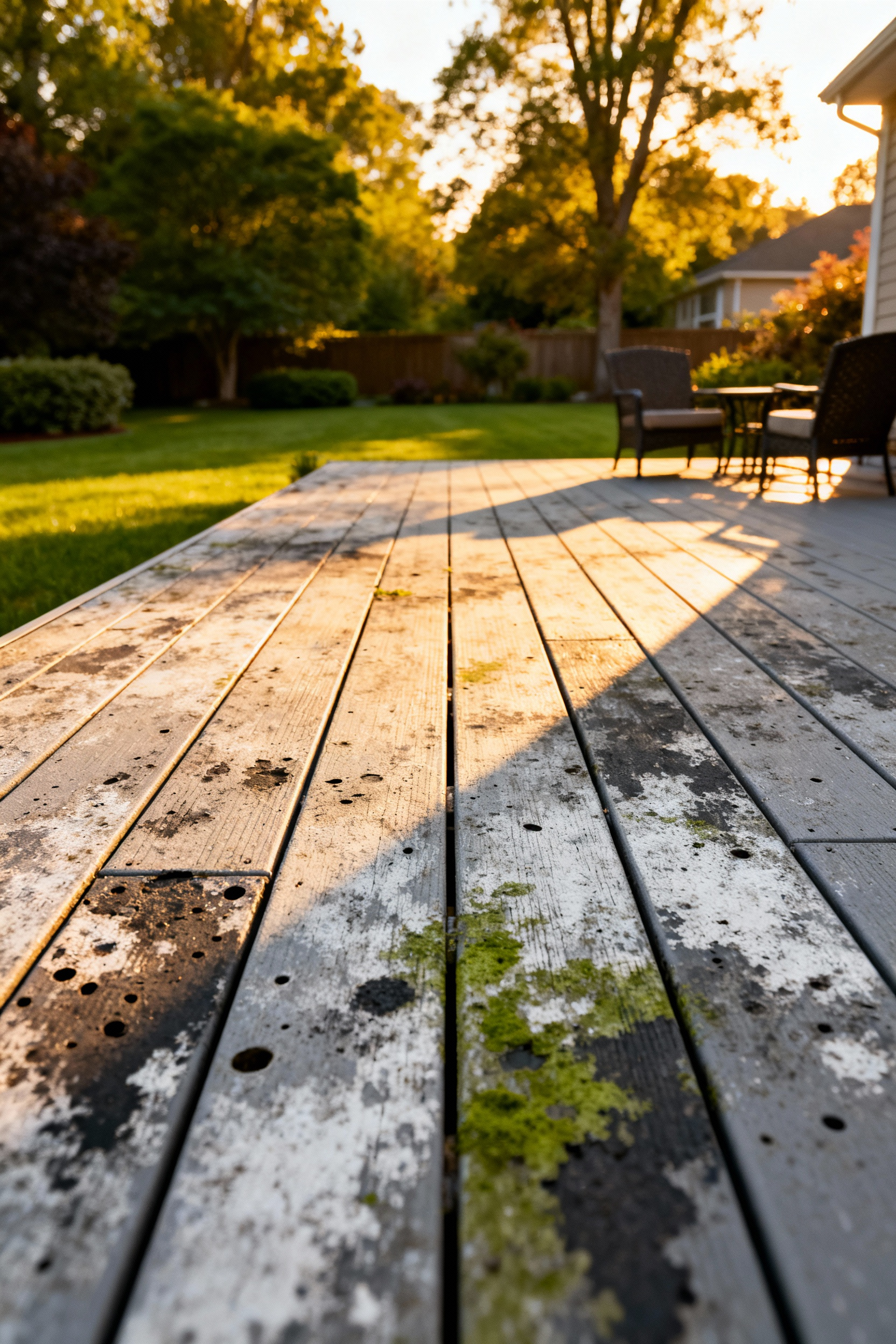
Fortunately, the introduction of capped composite technology provided the solution. Technically, this process is known as co-extrusion. Here, a tough, non-organic polymer shell fully encases the composite core. Thus, the board becomes impervious to moisture and UV rays. In fact, this protective shield reduces color fading to nearly zero. This innovation transforms “low maintenance” into decades of actual reclaimed time.
Aesthetically, the evolution is equally impressive. Now, high-end boards successfully emulate the nuanced look of exotic hardwoods. For example, variegated color streaks mimic natural grain patterns found in Ipe or Cumaru. Manufacturers have also addressed thermal comfort. Specifically, proprietary “cool touch” additives reflect solar energy. As a result, these decks remain comfortable for barefoot walking, even during peak summer heat.
Financially, this luxury requires a higher upfront investment than pressure-treated lumber. However, the total cost of ownership tells a different story. Basically, you eliminate the cumulative expense of annual sanding and sealing. On the other hand, the environmental impact is complex. While often composed of recycled materials, the energy-intensive manufacturing process draws criticism. Nevertheless, for resilience in harsh coastal environments, high-performance composite is often the superior choice.
3. Seamless Thresholds: Engineering Flush Transitions from Indoor to Outdoor
Creating a sophisticated coastal home means dissolving the physical line between the interior and the horizon. Fundamentally, the flush threshold transforms a traditional barrier into a continuous, unified living plane. In fact, removing the traditional “step-down” eliminates the psychological cue that signals you are leaving the sanctuary. To create this visual continuity, we run consistent flooring, like large-format limestone, directly from the lounge to the terrace. Consequently, the exterior deck feels less like an addition and more like a spacious, open-air room.
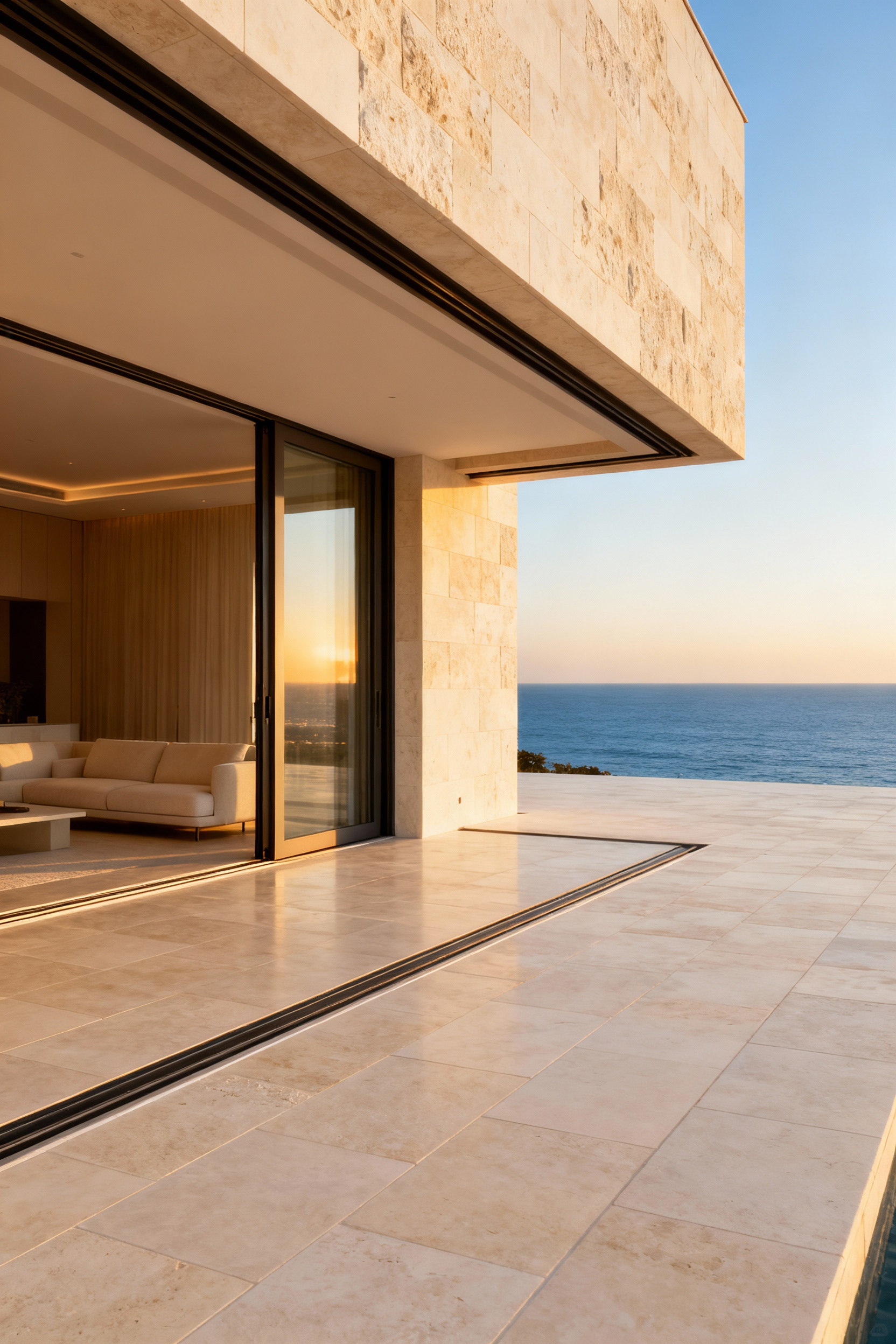
However, achieving this minimalist aesthetic requires aggressive hydraulic engineering. Specifically, we must manage the “water wall” effect that accumulates on large glass panels during coastal storms. Therefore, the design relies on invisible, low-profile linear drains hidden immediately adjacent to the door track. Simultaneously, we address the “Upstand Paradox” by suspending decking over the necessary waterproofing membranes. This protects the structure from moisture while maintaining that zero-tolerance visual flow.
Furthermore, the machinery itself plays a crucial role in this disappearance act. For example, pocketing door systems allow multi-panel glass walls to slide completely into adjacent wall cavities. Additionally, lift-and-slide mechanisms ensure that even heavy weather-proof panels glide with frictionless ease. As a result, the wall effectively vanishes, leaving only a seamless connection to the seaside environment.
4. Multi-Level Tiering: Zoning Without Walls for Visual Interest
Open-concept principles translate beautifully to outdoor living through multi-level tiering. Specifically, utilizing vertical separation defines distinct functional areas without requiring solid partitions. In fact, even a single step creates a powerful psychological boundary. Consequently, this establishes a “natural separation of activities” necessary for functionality.
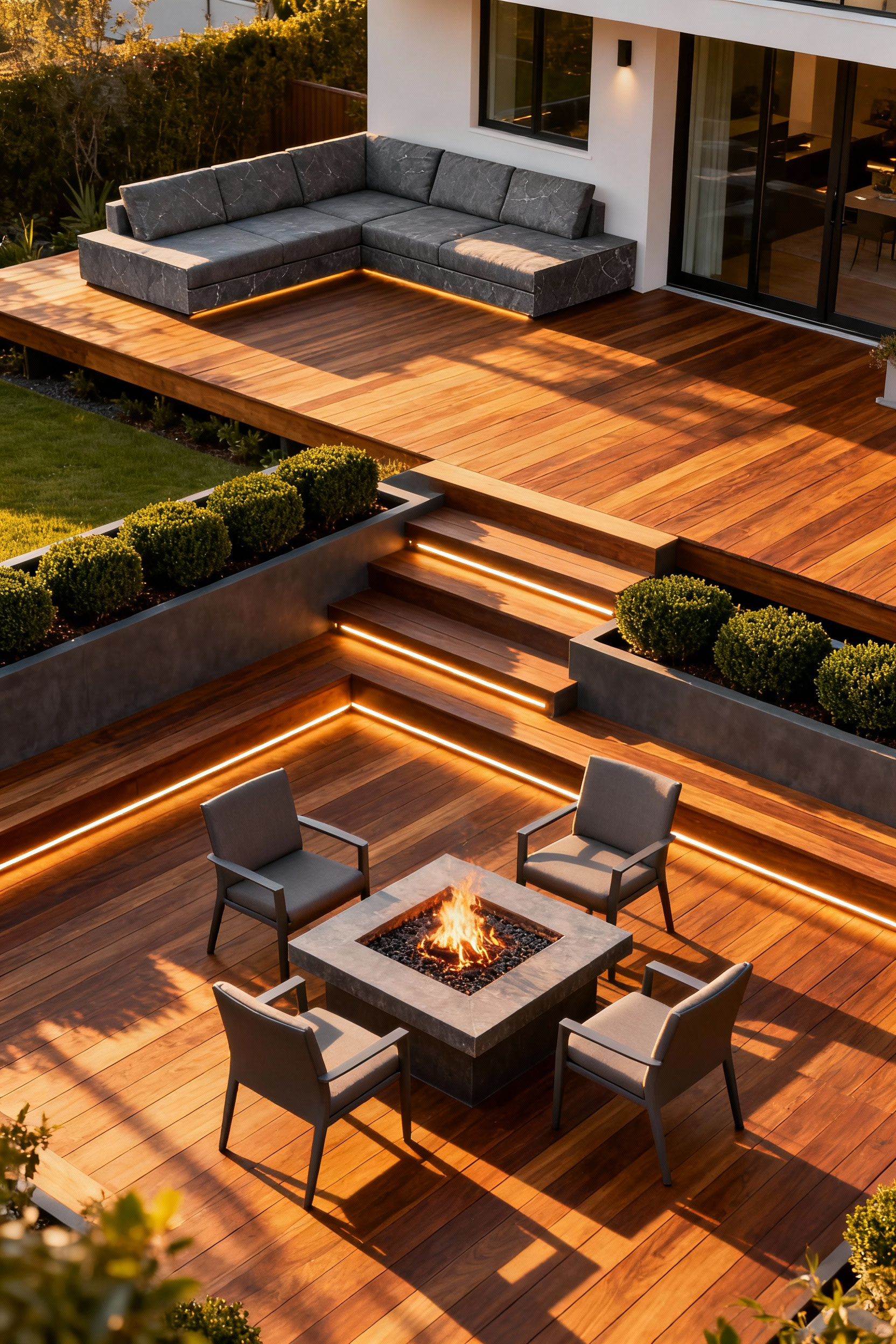
Usually, the upper tier serves as the primary entertaining zone. Since it connects directly to the house, it feels expansive and public. Conversely, stepping down creates an immediate shift in atmosphere. Lower platforms inherently feel grounded, intimate, and secluded. Therefore, these sunk-down zones are ideal for fire pit lounges or spas.
Beyond elevation, material choices further enhance these visual cues. For example, a dual-tone color scheme signals a transition instantly. You might use light composite decking for the main dining area, then switch to darker wood tones or stone pavers below. This approach breaks up the visual bulk of large structures. It introduces architectural intrigue rather than a flat, monotonous expanse.
Practically, this method turns challenging sloped yards into design assets. Rather than flattening the terrain, you simply build with the landscape’s natural contour. Additionally, functional elements replace walls to maintain openness. Low, built-in benches or vibrant planters outline the perimeter softly. Finally, targeted lighting guides movement between levels safely. Thus, you achieve a dynamic flow that remains organized yet open.
5. The Sunken Conversation Pit: A Retro-Modern Revival for Intimacy
The conversation pit serves as a unique piece of social architecture designed for genuine intimacy. Specifically, the simple act of stepping down creates an immediate psychological separation from the rest of the deck. Attention shifts inward, moving away from digital distractions and toward face-to-face interaction. Therefore, this descent transforms an open backyard into a cozy, enclosed sanctuary.
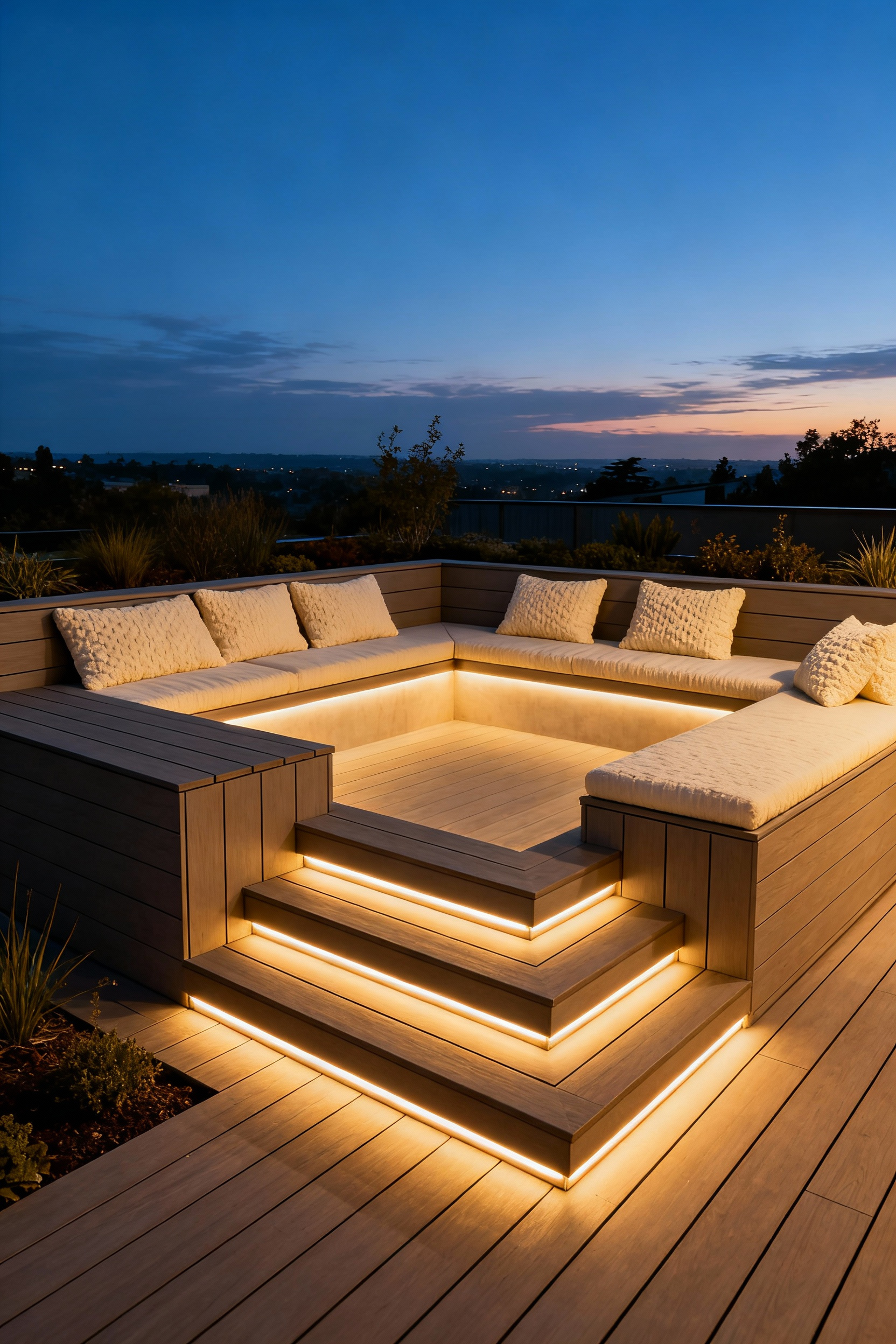
Furthermore, lowering the seating alters your physical connection to the landscape. Suddenly, the surface of an adjacent pool or garden sits at shoulder level. Thus, the environment feels more immersive and private. However, achieving this effect requires precise structural planning. For elevated decks, carpenters must expertly drop the framing within the larger support structure to accommodate the load. Conversely, in-ground patios demand robust drainage systems, such as French drains, to prevent the pit from collecting rainwater.
Fortunately, contemporary designs effectively resolve historical safety concerns like tripping hazards. For instance, high-backed benches can rise above the deck level to act as a protective barrier. Additionally, integrated LED strip lighting along the steps clearly illuminates the elevation change. Ultimately, anchoring the space with a central fire feature cements the pit as the backyard’s magnetic focal point.
6. Architectural Shade: Integrated Pergolas with Adjustable Louvers
Traditional timber pergolas often feel heavy or dated in contemporary settings. Consequently, modern coastal design favors sleek, extruded aluminum systems. This durable material resists corrosion effectively, even in salty air. Furthermore, it eliminates the rot and maintenance associated with wood. However, the true innovation lies in “bioclimatic” engineering. These systems utilize adjustable louvers for precise, passive climate control. For more inspiration on framing your outdoor zones, explore these Luxury Ideas for Your Back Porch Pergola Design.
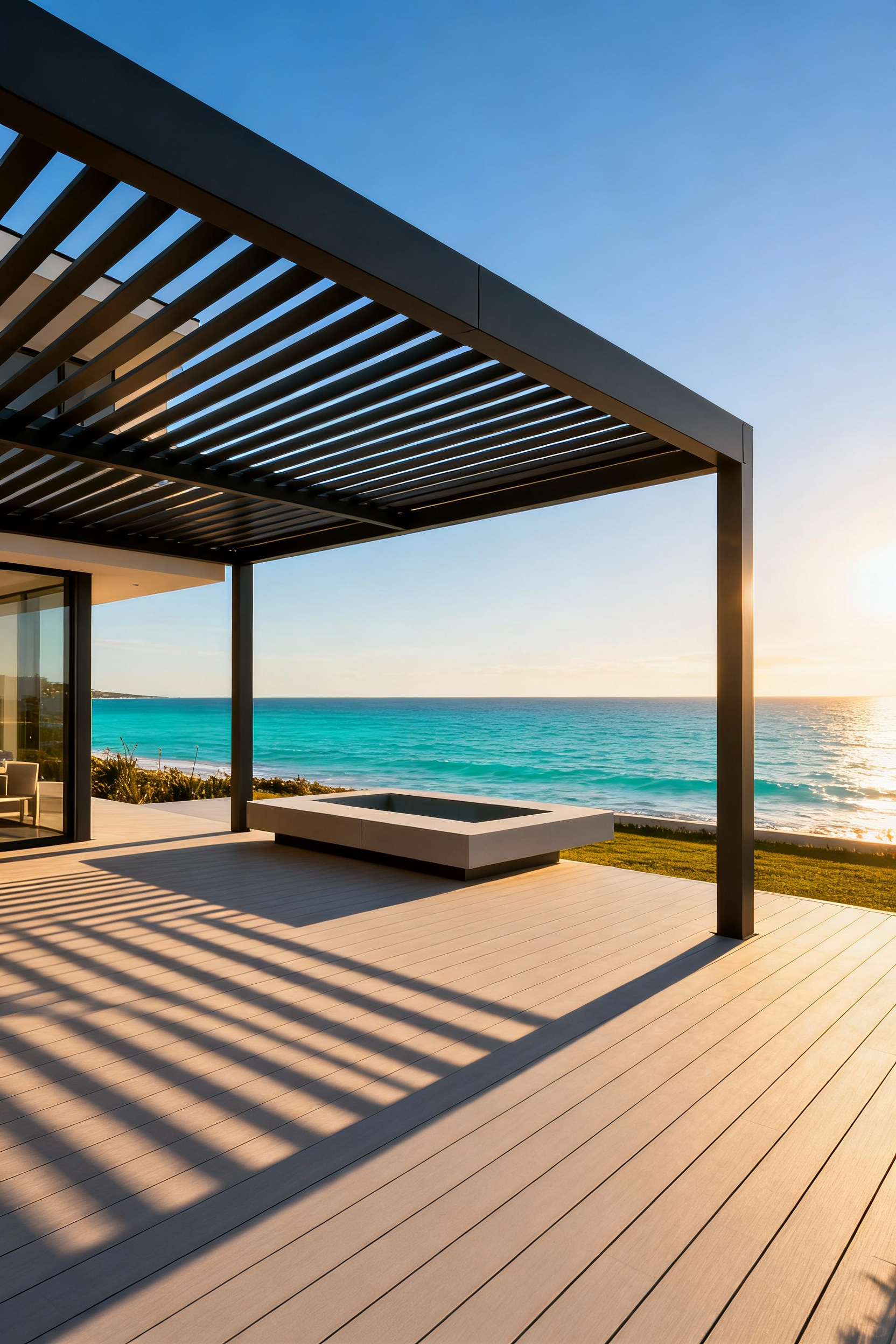
Instead of trapping heat like a solid roof, the slats tilt. Ideally, an angle between 150° and 170° creates natural convection currents. Thus, hot air rises out, cooling the deck significantly below. During cooler months, the louvers direct warm sunlight onto the deck surface. When fully closed, the structure becomes nearly watertight to seal in warmth. Remarkably, integrated perimeter gutters channel water internally through the posts. Therefore, the aesthetic remains clean and devoid of unsightly external downspouts.
Finally, technology elevates these structures into true smart home extensions. Motorized systems often feature autonomous rain and wind sensors. Instantly, the louvers react to sudden weather changes, automatically protecting your furniture. This seamless integration transforms a simple deck into a dynamic, all-season outdoor room.
7. Cable Railing Systems: Maximizing the View (and the Horizon)
In coastal architecture, the ultimate goal is blurring the line between the built environment and the sea. Cable railing systems serve as a strategic tool for preserving these crucial sensory experiences. Unlike thick wood balusters, these systems offer nearly 95% visual transparency. In fact, homeowners often report that installation feels like removing a wall entirely.
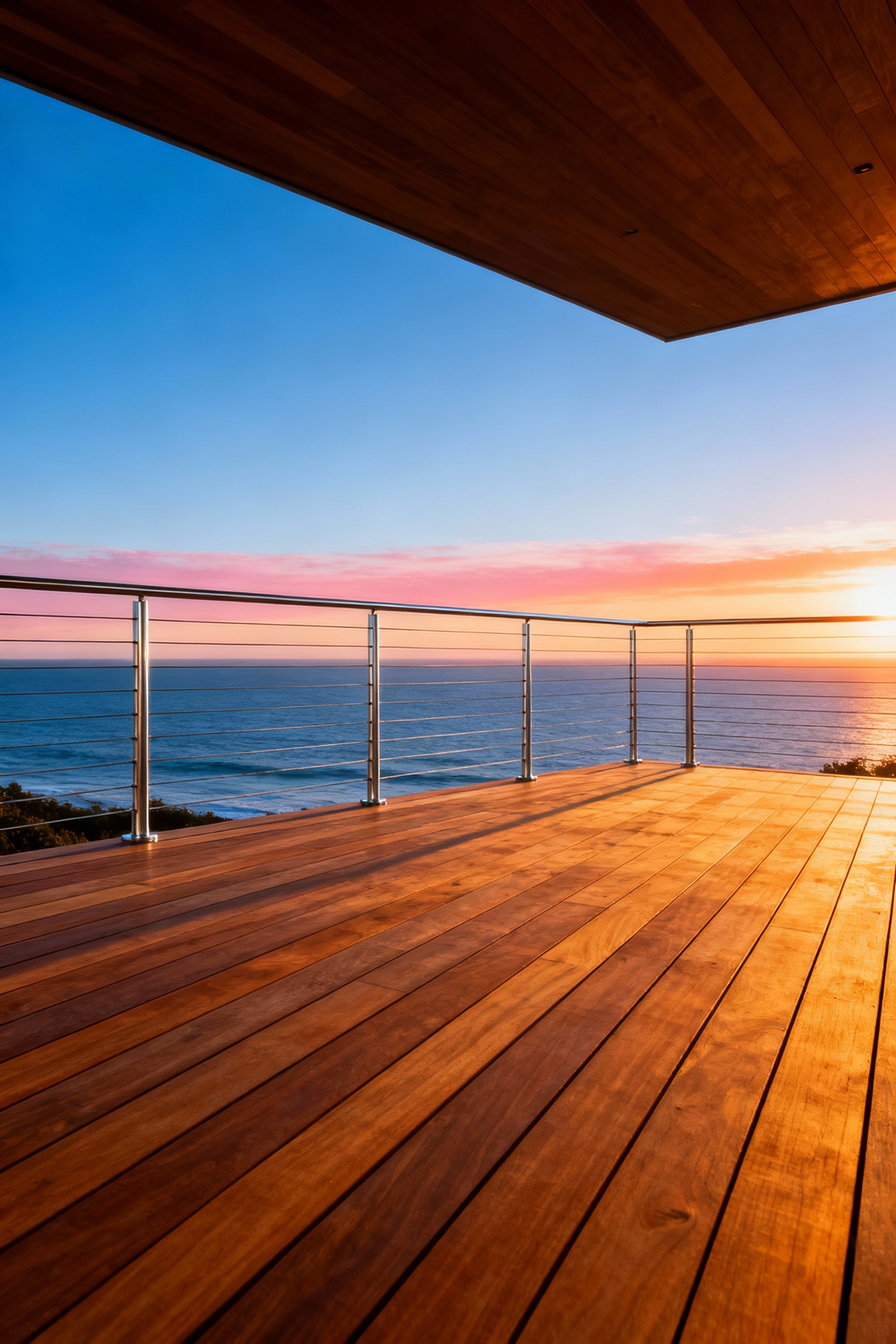
Furthermore, the horizontal orientation utilizes a clever optical illusion. The human eye naturally scans the horizon from left to right. Therefore, thin stainless steel cables running parallel to the water effectively disappear into the backdrop. Consequently, the deck becomes a seamless observation platform rather than a segmented cage.
However, this minimalist aesthetic relies on robust, marine-grade engineering. Historically, the hardware evolved directly from boat rigging and industrial barriers. Thus, the system uses durable Type 316 stainless steel to withstand harsh salt air. To ensure safety, cables are tensioned tightly and typically spaced three inches apart.
Nevertheless, an architectural debate exists regarding the “ladder effect” of horizontal lines for children. Consequently, vertical cable systems offer a practical, non-climbable alternative for safety-conscious families. Additionally, vertical lines can visually mirror tall trees, whereas horizontal lines emphasize the vast width of the ocean. Ultimately, the choice depends on whether you wish to maximize the horizon or integrate with the canopy.
8. The Glass Balustrade: Wind Protection without Visual Obstruction
The glass balustrade serves as a sophisticated “luminous bridge” between indoor luxury and the outdoor environment. Primarily, its design value lies in visual continuity. By removing the vertical lines of traditional spindles, frameless systems ensure your view remains uninterrupted. Consequently, natural light floods both the deck and the adjacent interior rooms, amplifying the sense of space.
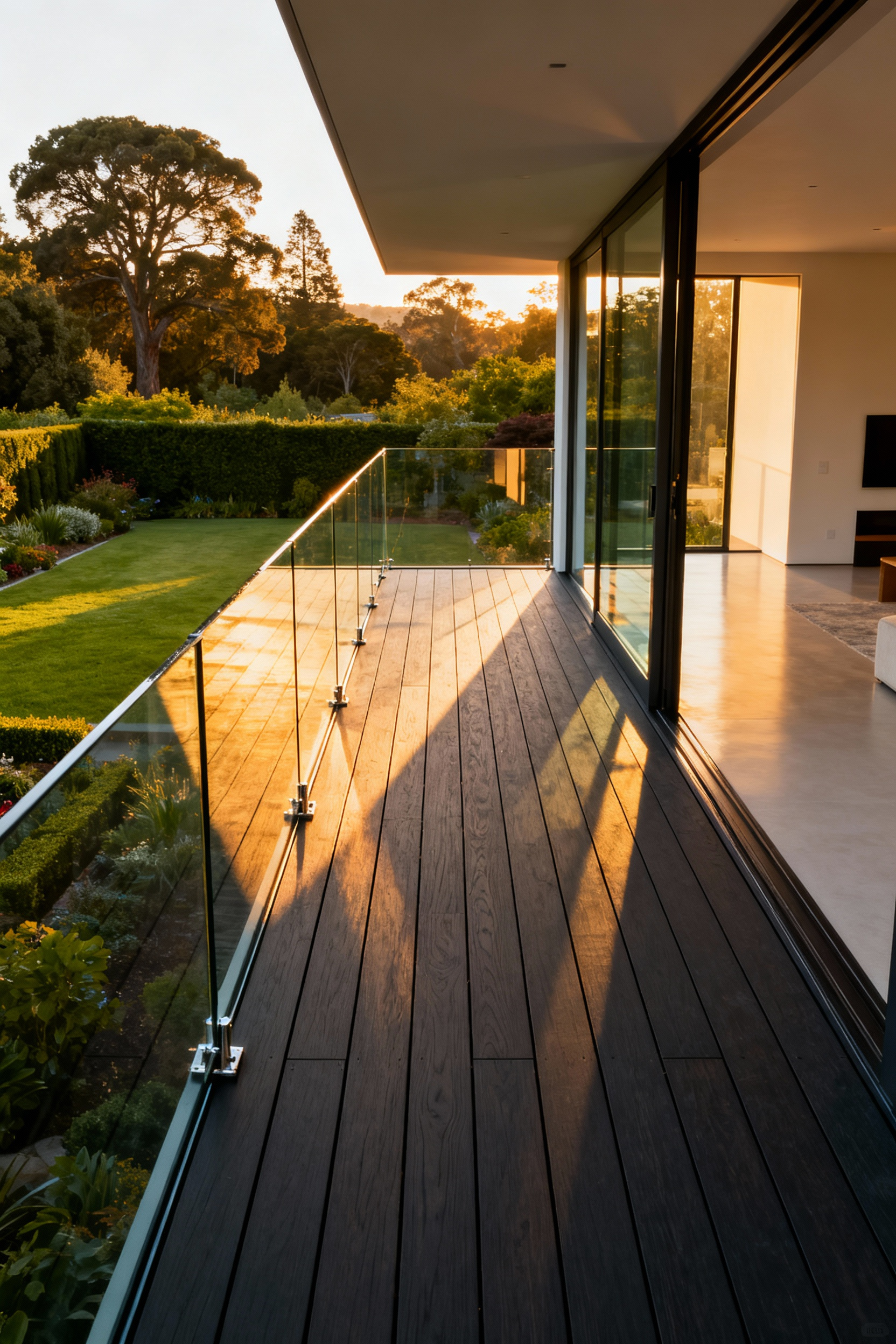
Functionally, these barriers act as a superior windbreak. Unlike spaced railings, solid glass completely blocks sharp coastal gusts. Therefore, it creates a calm microclimate for dining or relaxing. This protection effectively preserves outdoor furniture and extends the deck’s seasonal usability. However, this solid barrier requires careful climate consideration. Specifically, completely blocking airflow can trap solar heat in sunny, west-facing zones. You must balance wind protection with the potential for an uncomfortable “greenhouse effect.”
Structurally, safety remains non-negotiable in these designs. Typically, tempered glass is the residential standard, offering four times the strength of regular glass. For high-wind coastal areas, laminated glass provides an extra layer of security against flying debris. Installation methods like concealed base channels offer immense stability. Ultimately, this engineering resists significant lateral wind loads without compromising the minimalist aesthetic.
9. Built-In Banquettes: Maximizing Perimeter Space and Storage
The built-in banquette is more than simple seating; it serves as a sophisticated architectural tool. Fundamentally, it activates the deck’s perimeter, transforming dead space into a vibrant “active edge.” Unlike freestanding chairs, this approach maximizes density by reclaiming the footprint usually lost to movement. In fact, you can accommodate nearly 30% more guests without cluttering the floor plan. Using matching materials creates a monolithic, permanent aesthetic that anchors the entire outdoor room.
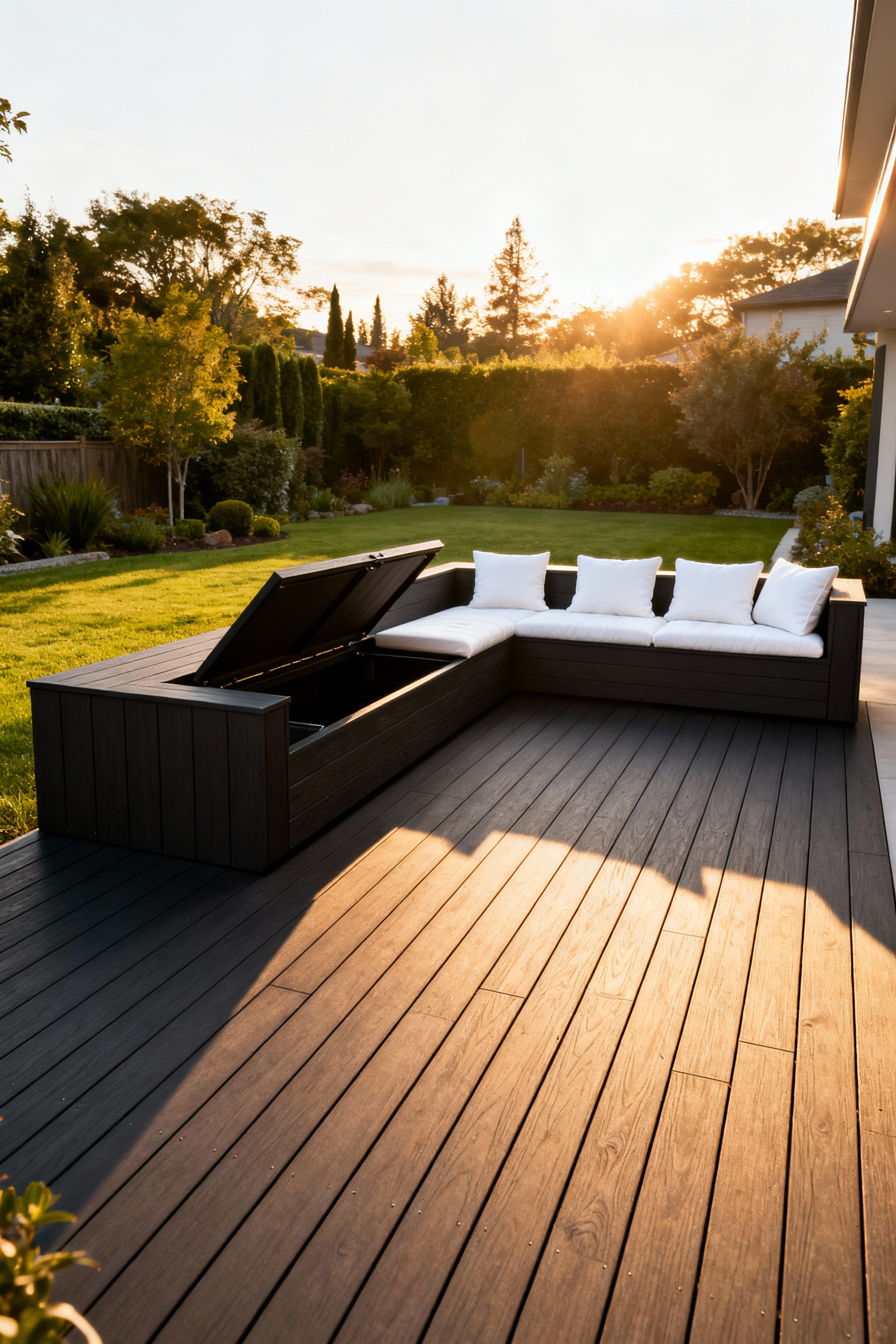
To ensure comfort, proper ergonomics are paramount. Avoid constructing a rigid, vertical backrest. Instead, incorporate a 5 to 10-degree angle to support true relaxation. Additionally, aim for a finished seat height of 18 inches, including a plush 2-inch cushion. Consequently, the structure offers a profound sense of stability that movable furniture simply cannot replicate.
Beyond seating, these structures offer valuable hidden storage. However, the access method defines the utility. For instance, lift-top benches maximize internal volume for bulky items like seasonal cushions. Conversely, pull-out drawers provide non-disruptive access to frequently used table linens. The choice depends on your specific lifestyle needs.
Historically, this concept echoes the “open-air rooms” of the Renaissance, effectively unifying the home with the horizon. Finally, consider integrating subtle under-seat LED lighting. As a result, the heavy structure appears to float at night, adding modern drama to the coastal atmosphere.
10. The Culinary Extension: Designing Full-Service Outdoor Kitchens
Modern outdoor living requires more than a portable grill. In fact, the “culinary extension” transforms a simple deck into a sophisticated, self-sufficient room. Historically, this concept echoes 18th-century summer kitchens designed to keep heat out of the main house. Today, the goal is purely social. We aim to eliminate the frantic “out-and-in dance” for ingredients and dishware. Consequently, the outdoor chef becomes a relaxed host rather than an isolated cook.
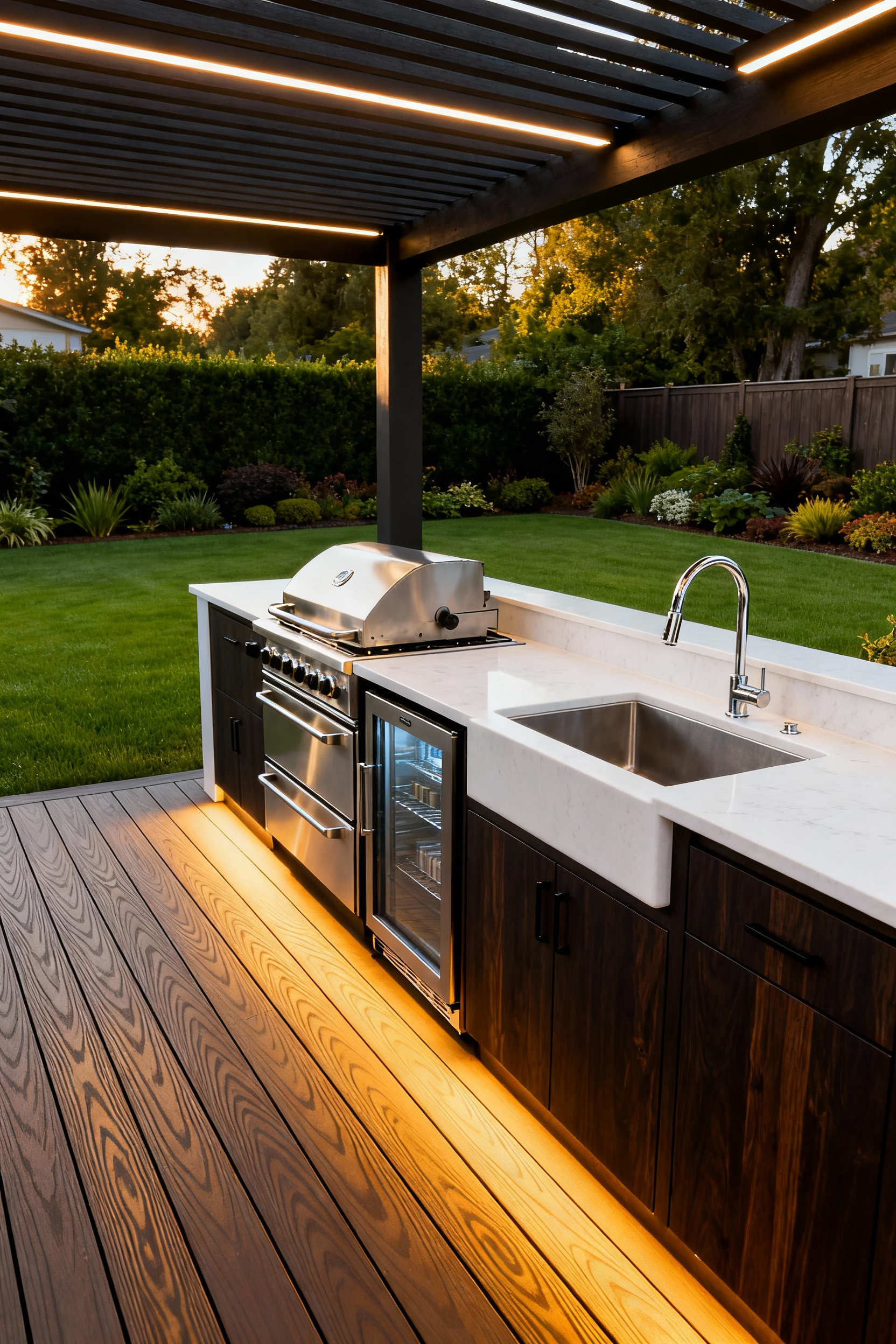
To achieve this flow, standard interior design principles must evolve. Indoors, we rely on the efficient “Work Triangle.” Outdoors, conversely, we utilize a “Four-Zone System” or “Work Square.” This layout introduces a dedicated “Social Hub” alongside the traditional cooking, prep, and cold zones. Plate-and-serve areas become critical interfaces for guests. True luxury demands specialized appliances beyond the grill, such as pizza ovens and side burners.
However, integrating these heavy elements onto a deck requires rigorous engineering. Specifically, stone counters and masonry ovens create significant “dead load.” Thus, structural reinforcement like extra joists is often mandatory to prevent damage. Additionally, utility planning is paramount. For example, gas lines require corrosion protection, while electrical outlets need GFCI safeguards. Finally, safety remains non-negotiable. Because decking is often combustible, you must install non-combustible heat shields to protect the structure from intense culinary heat.
11. Fire Feature Integration: Extending the Season with Gas Linear Burners
To truly extend your coastal living season, you need more than a simple blanket. Gas linear burners offer a sophisticated solution by utilizing radiant heat efficiency. Unlike convection heaters that warm the air, radiant systems transmit infrared waves. Consequently, these waves directly warm solid objects and people, bypassing the breezy coastal air entirely. This engineering creates a cozy sensation akin to basking in the sun. Furthermore, the fire media, such as lava rock or fire glass, absorbs and re-radiates this intense warmth.
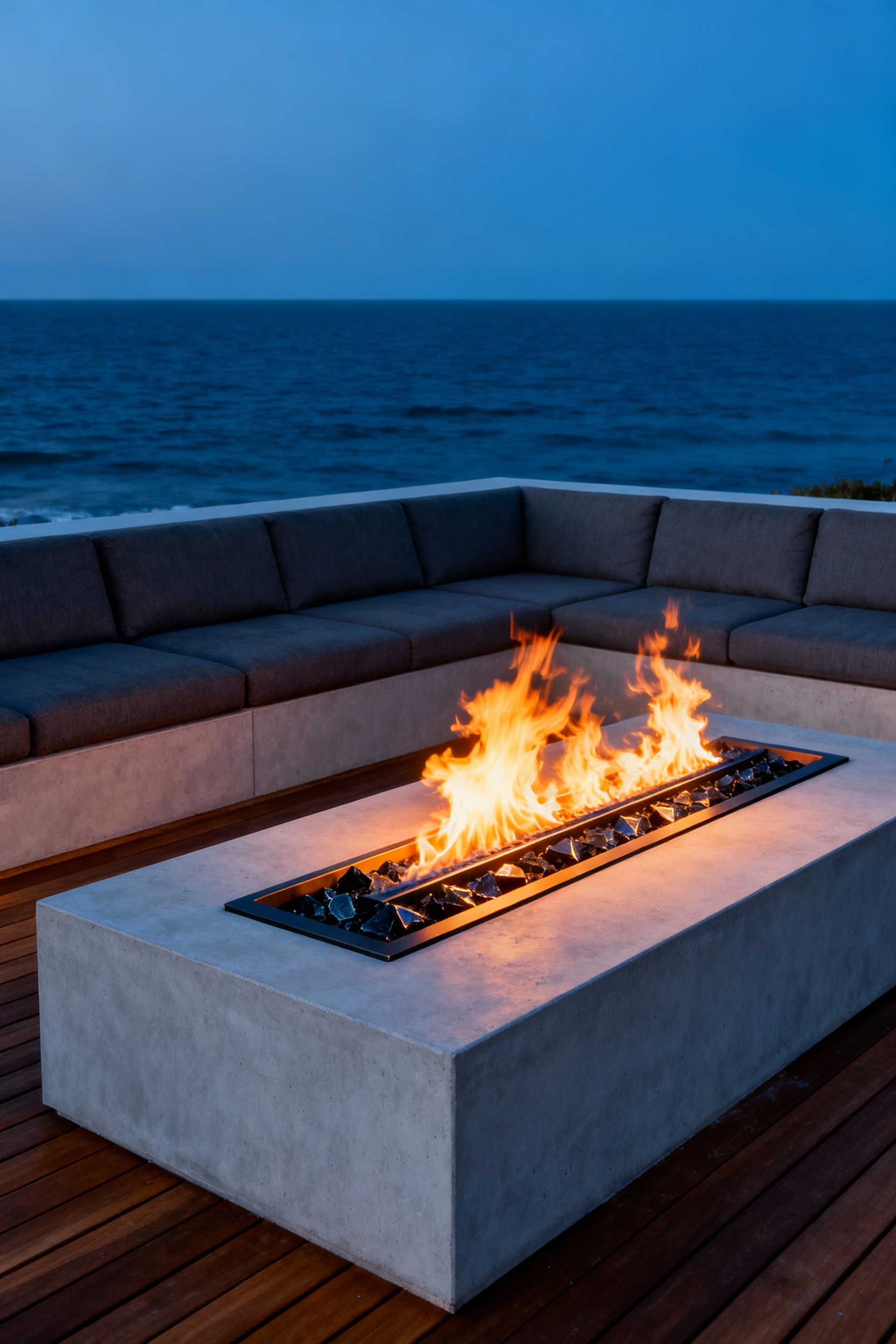
Aesthetically, the linear burner introduces a sleek, modernist profile to the landscape. Instead of a traditional circle, it creates a broad “ribbon of fire” or “wall of flames.” This streamlined look perfectly defines the communal axis of a deck. However, visual appeal means little without acoustic comfort. Therefore, high-end systems utilize drilled burner ports to eliminate the “dreaded whistle” caused by turbulent gas flow.
Safety remains the paramount concern when integrating fire into wood or composite decks. Because these units often exceed 150,000 BTUs, they require a custom, non-combustible envelope. Specifically, installers must isolate the burner within stone, concrete, or steel to prevent heat damage. You must maintain strict clearances, usually ten feet from the home and three feet from furniture. Advanced systems include automatic flame-sensing technology, instantly shutting off gas if the wind extinguishes the flame.
12. Maritime Lighting: Selecting Brass and Copper Fixtures that Patina Beautifully
True coastal elegance relies heavily on materials that age gracefully with the environment. Specifically, unlacquered brass and copper develop a “living finish” known as patina. Exposure to chloride-rich marine air accelerates this process, creating a desirable verdigris hue. This greenish-blue layer is actually a natural sealant. In fact, it protects the metal beneath from aggressive corrosion. Therefore, unlike simple tarnish, which appears dull, a true patina adds rich, mood-setting depth that tells a story of endurance.
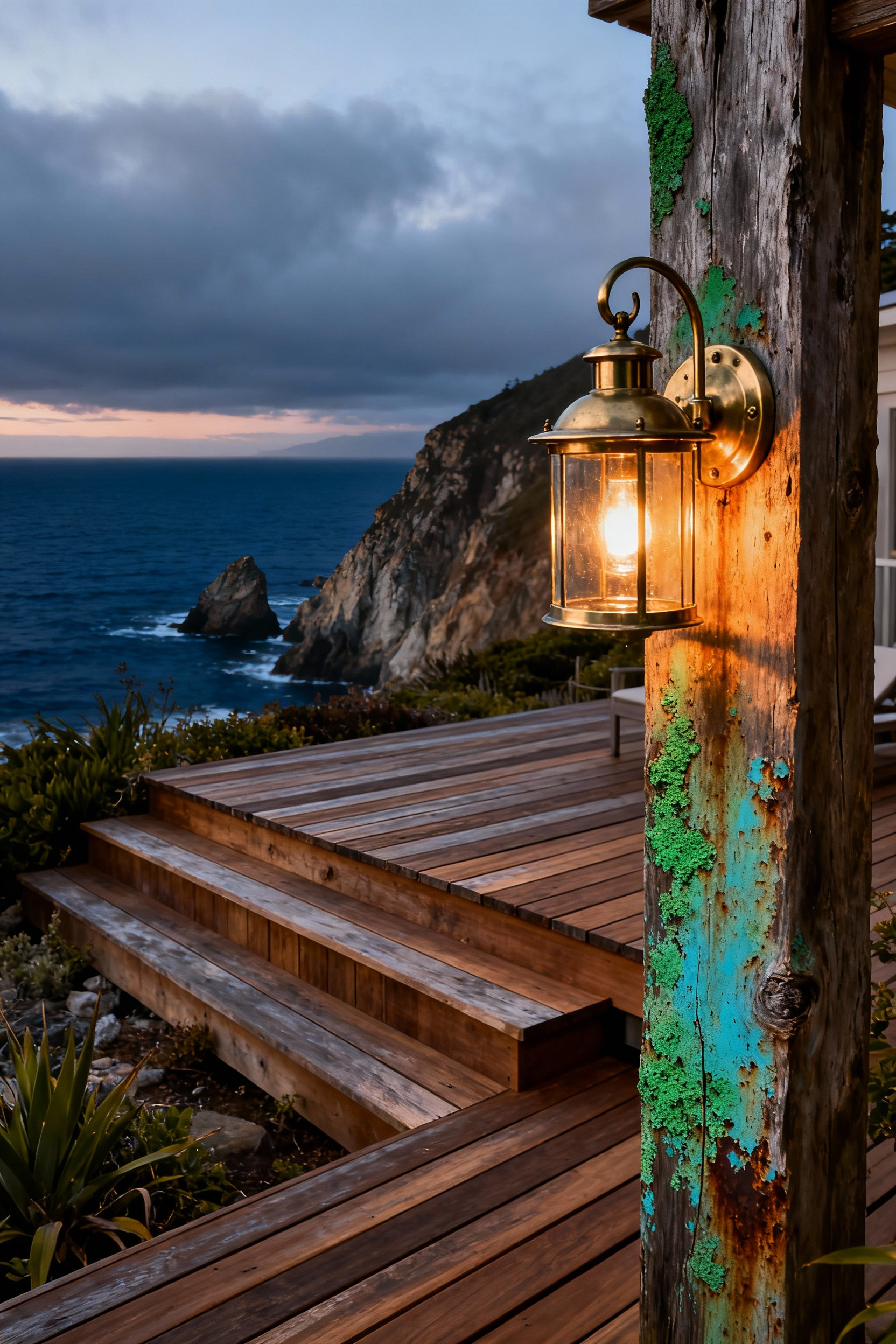
However, achieving this look requires the right alloy selection. Standard brass often suffers from “dezincification” in humid, salty environments. Essentially, the zinc acts as the weak link and leaches out, leaving a porous, copper-rich structure behind. To prevent this structural failure, architects specify Naval Brass (C46400). Uniquely, this alloy contains approximately 1% tin. This small addition creates a robust barrier against decay. Thus, the fixture remains structurally sound while the surface matures beautifully over the years.
Regarding form, two styles dominate the sophisticated deck: the bulkhead light and the anchor lamp. Originally, bulkhead lights illuminated the tight, industrial passageways of ships. Their thick glass and brass cages offer a rugged, masculine aesthetic that contrasts well with soft timber decking. Similarly, anchor lamps historically used gimbaled mounts to stay level on rolling seas. Today, these fixtures bring a sense of permanence and maritime history to contemporary outdoor spaces without feeling like a caricature.
13. In-Floor Lighting: Subtle Wayfinding for Evening Ambiance
In-floor lighting transforms a deck from a simple platform into a sophisticated, navigable landscape. Primarily, this design choice relies on the principle of “luminance contrast wayfinding.” Rather than flooding the backyard with aggressive brightness, recessed fixtures create gentle visual cues. Consequently, these lights guide movement intuitively without distracting from the night sky. Specifically, they outline perimeters and mark changes in elevation.
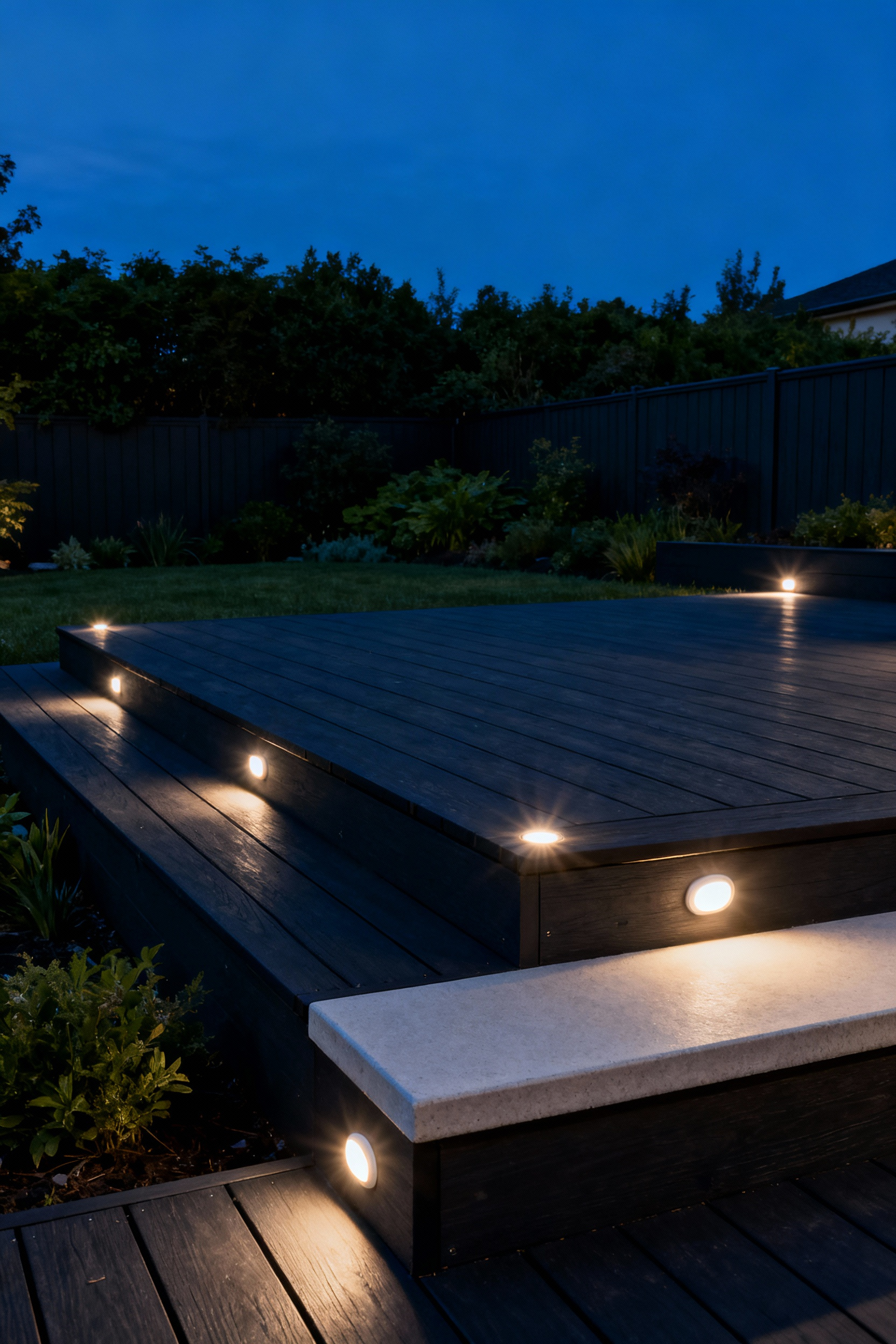
However, the hardware must remain unobtrusive. Ideally, fixtures are flush-mounted to be “invisible-by-day.” This seamless integration ensures your timber or composite decking remains the aesthetic focus. Yet, durability is critical in coastal settings. Therefore, you must specify 316 marine-grade stainless steel bezels. This material withstands foot traffic and resists corrosion from salt air.
Furthermore, the quality of light defines the evening atmosphere. Experts recommend a warm color temperature between 2700K and 3000K. This range fosters a cozy, relaxing environment. Additionally, high-quality fixtures employ frosted lenses to diffuse the beam. This engineering eliminates the “hot spots” typical of bare LEDs. Thus, you avoid glare that might otherwise strain the eyes at low angles.
Finally, technical execution ensures longevity. Because these lights sit horizontally, water exposure is a constant threat. Accordingly, professional installation must utilize waterproof connectors and proper sealants. Ultimately, this creates a low-voltage system that is safe, enduring, and visually stunning.
14. Weather-Resistant Textiles: Performance Fabrics That Mimic Interior Luxury
True coastal living blurs the line between indoors and out. Consequently, your deck furniture requires textiles that offer both resilience and refinement. Historically, outdoor fabrics were stiff, plastic-like, and prone to rapid fading. However, modern technology has fundamentally changed this landscape through solution-dyeing. Unlike traditional “piece-dyeing,” which coats the surface like a radish skin, solution-dyeing saturates the fiber completely. In fact, think of it like a carrot, colored entirely to the core.
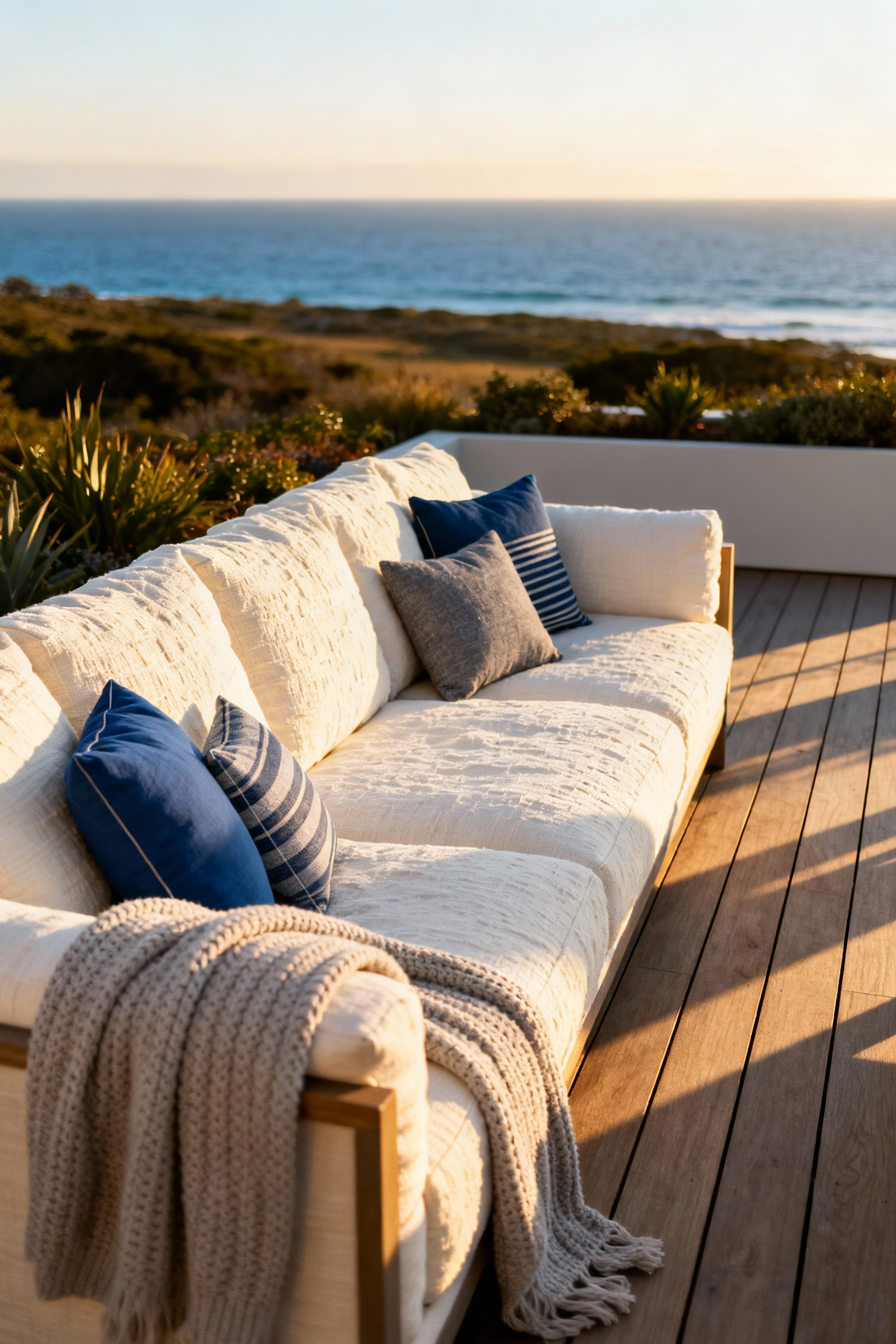
Therefore, these fabrics possess incredible technical performance. Specifically, they resist intense UV fading and withstand harsh chlorine. You can even spot-clean them with diluted bleach without losing vibrancy. Yet, durability is only half the equation. Crucially, the sensory experience has evolved to mimic sophisticated interior materials.
For instance, manufacturers now engineer weaves that replicate the nubby texture of indoor bouclé. Similarly, outdoor chenille and velvet offer a plush, soft hand previously impossible on a patio. Ultimately, this engineering allows for a seamless visual transition. What began as marine-grade utility for boat awnings has graduated to haute décor. Thus, you can curate an outdoor sanctuary that feels just as luxurious as your living room.
15. Rugs on Deck: Defining Conversation Zones with Quick-Dry Textures
Transforming a simple wooden platform into a fully articulated exterior room starts with the floor. Specifically, integrating a rug grounds the space visually, marking the transition from backyard to living area. However, this design choice involves more than just aesthetics. In fact, selecting quick-dry textures is a critical preservation strategy for the deck itself. Traditional materials like jute often trap moisture, fostering damaging mold and rot. Therefore, experts recommend polypropylene, also known as Olefin. This non-absorbent, hydrophobic fiber ensures water evaporates rapidly. Consequently, the deck underneath remains healthy and dry.
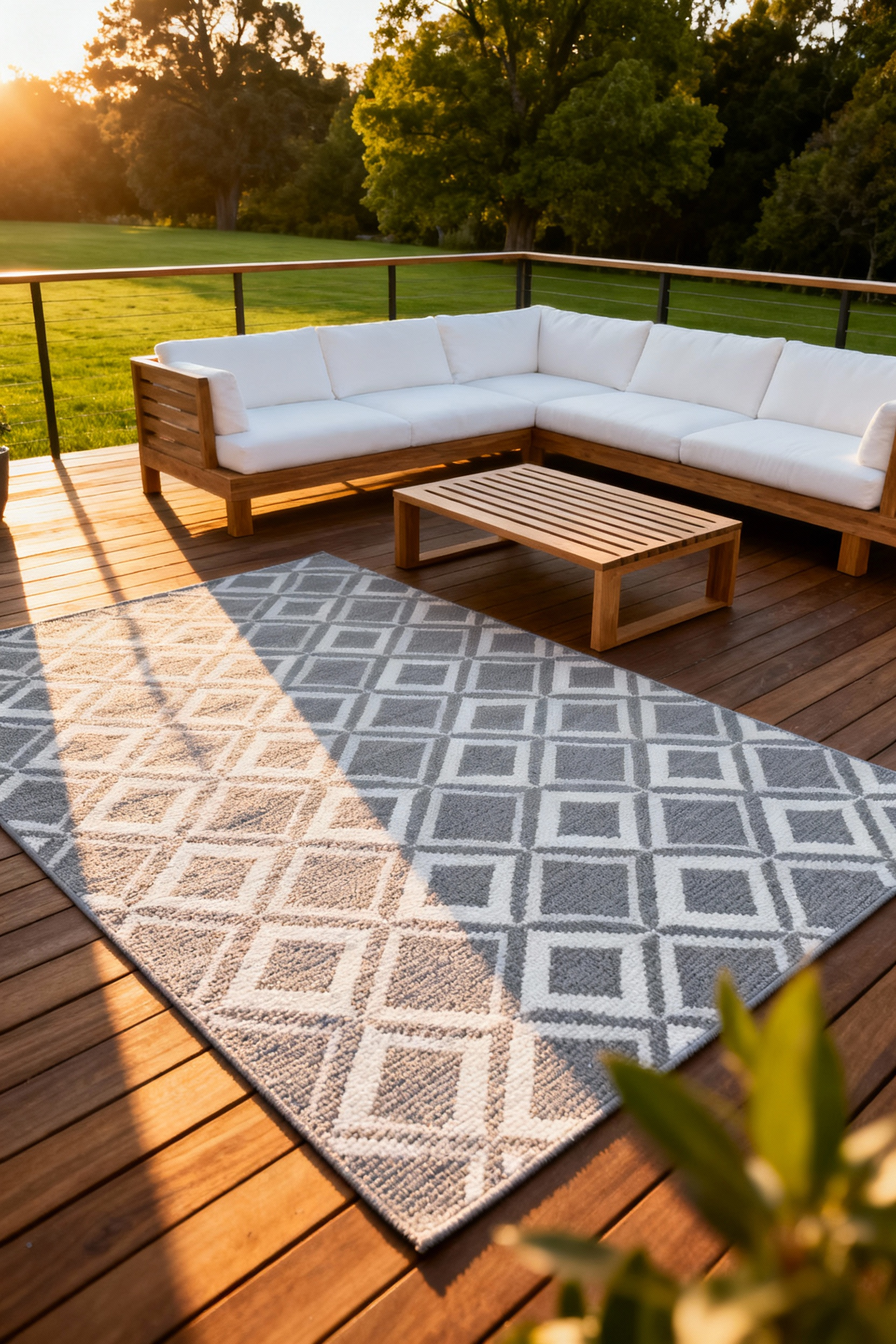
Beyond protection, a rug functions as essential outdoor architecture. Ideally, it delineates specific “floating islands” of activity on an otherwise open deck. For example, a rug anchors a conversation zone, pulling scattered furniture into a cohesive arrangement. To achieve this effectively, follow the “two-thirds rule.” Ensure the front two legs of sofas rest firmly on the textile to visually connect the grouping. Conversely, dining areas require even more generous sizing. The rug must extend twenty-four inches beyond the tabletop so chairs remain grounded when guests stand up.
Ultimately, this layer bridges the gap between rugged utility and indoor comfort. Modern engineering allows synthetic fibers to mimic the soft hand-feel of natural wool. Thus, stepping onto the deck becomes a relaxing sensory experience rather than a harsh encounter with hot splinters. Furthermore, opting for a tight flatweave construction enhances this effect. This low-pile texture minimizes debris accumulation, keeping the surface clean. As a result, your outdoor sanctuary feels polished, welcoming, and intentionally designed.
16. Biophilic Softening: Integrated Planters for Native Grasses and Privacy
Deck architecture naturally relies on rigid, linear geometry. Consequently, the space can feel static or confining without organic intervention. To counter this, integrated planters soften these hard edges through biophilic design. Specifically, introducing native grasses creates gentle, natural movement which is essential for relaxation. Unlike static timber screens, grasses like Muhly or Switchgrass rustle gently in the breeze. Furthermore, their billowing plumes provide calming visual movement against the straight lines of the railing. This organic animation signals a healthy, living environment to the subconscious mind.
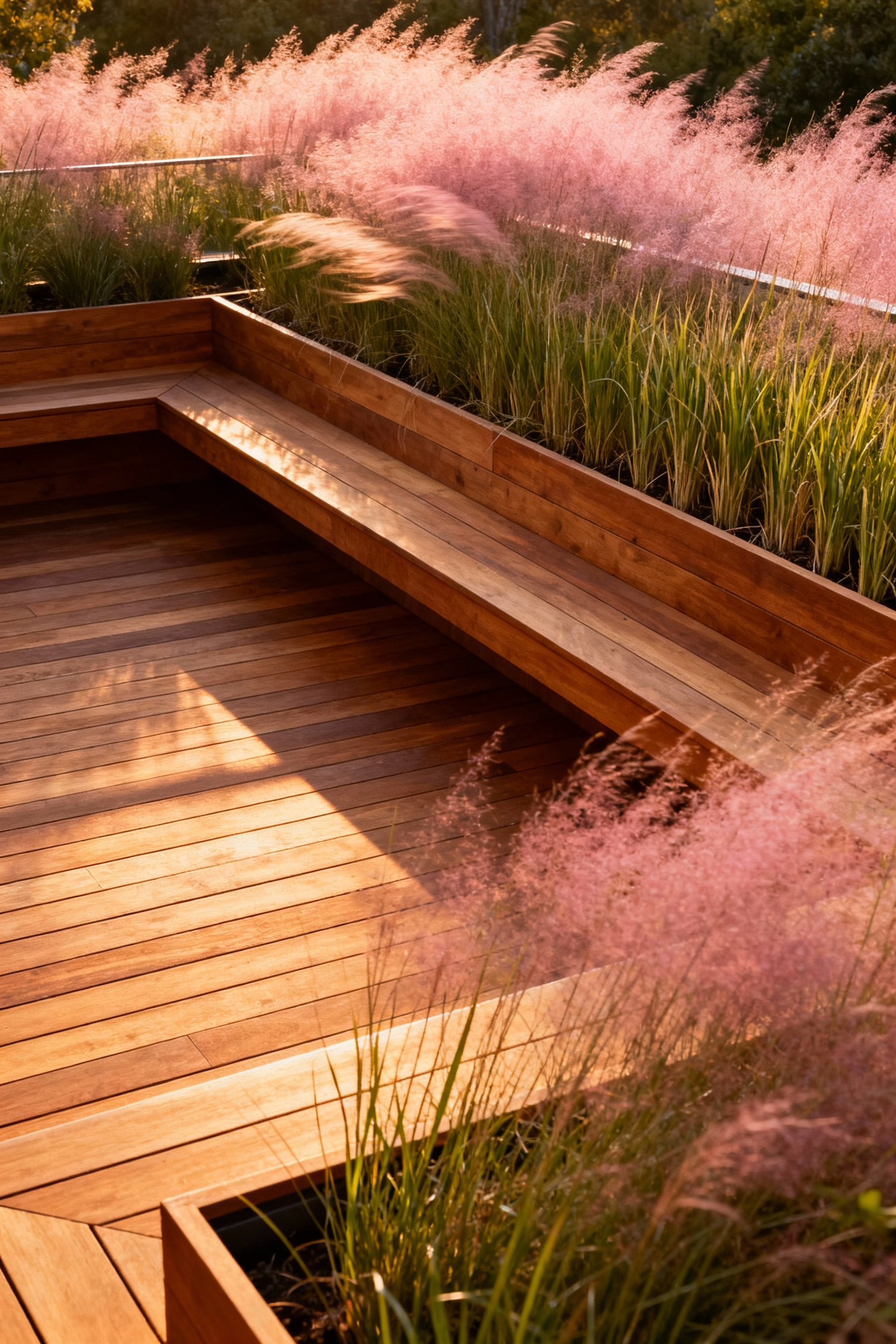
Beyond aesthetics, these planters serve as effective, durable privacy screens. However, long-term success requires precise structural engineering. For example, tall species like Big Bluestem rely on extensive root systems to remain upright. Therefore, built-in planters must provide a minimum soil depth of two to 2.5 feet. Additionally, cladding the planters in matching deck material creates a seamless, custom look. This approach effectively eliminates the visual clutter of freestanding pots.
Moreover, native grasses offer four-season resilience and sustainability. Because they are adapted to the local climate, they require significantly less water. Even in winter, their dried, bronzed structures maintain essential screening height. Thus, the deck remains a private retreat year-round. Ultimately, this transforms a simple platform into a restorative coastal sanctuary. For more comprehensive inspiration, review our 20 Nurturing back yard ideas for a Sanctuary of Well-being.
17. The Outdoor Shower: A Practical Nook for Coastal Living
An outdoor shower is often viewed as a mere luxury, yet it serves a critical protective function. Specifically, rinsing off before entering the house shields internal plumbing from abrasive sand and corrosive salt. Furthermore, this simple act relieves significant pressure on delicate septic systems common in coastal areas. Consequently, diverting sand extends the system’s lifespan and reduces costly maintenance.
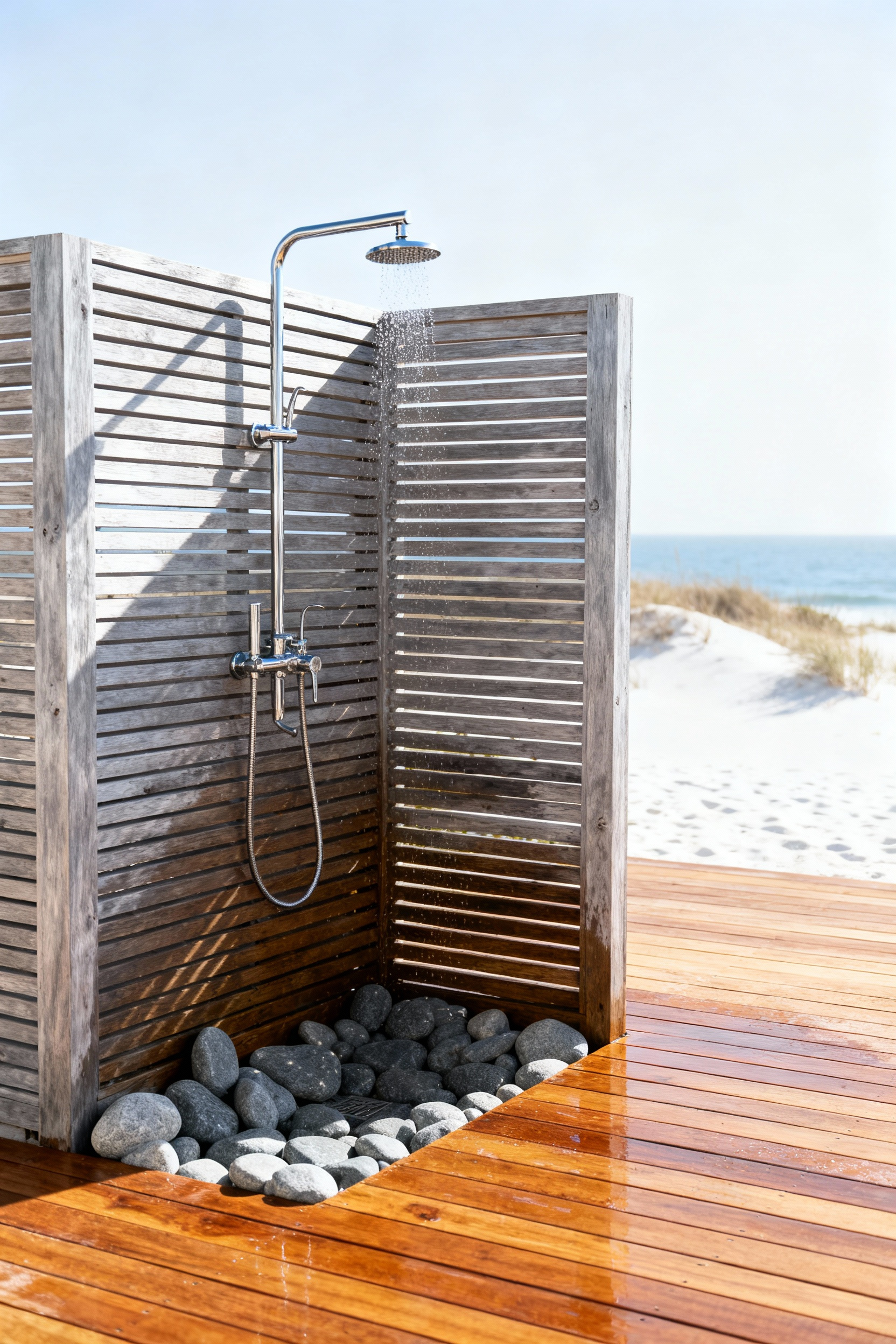
However, durability requires careful material selection to survive the marine environment. For instance, standard metals quickly succumb to salt air oxidation. Therefore, we rely on marine-grade copper or stainless steel fixtures to withstand the elements. Additionally, proper drainage engineering is essential to protect the deck and home structure. A minimum 1% slope prevents water from pooling near the foundation. In fact, a French drain with graded gravel efficiently filters runoff back into the ground.
Beyond utility, this nook offers a unique sensory ritual. The design transforms a mundane task into a refreshing connection with nature. You experience the warmth of filtered sunlight and the texture of weathered timber underfoot. Ultimately, the space acts as a psychological decompression zone. It allows residents to shed the salt and grit, transitioning peacefully into the clean home interior.
18. Smart Drainage Solutions: Protecting the Substructure from Moisture Accumulation
Traditional deck designs rely on simple gaps between boards for water management. However, this passive approach often proves insufficient in coastal environments. Specifically, rainwater pools on the flat surfaces of joists and beams. Consequently, this lingering moisture fosters wood rot and accelerates fastener corrosion. Over time, these silent threats compromise the entire substructure’s integrity. Therefore, shifting to “smart” drainage is critical for ensuring structural longevity.
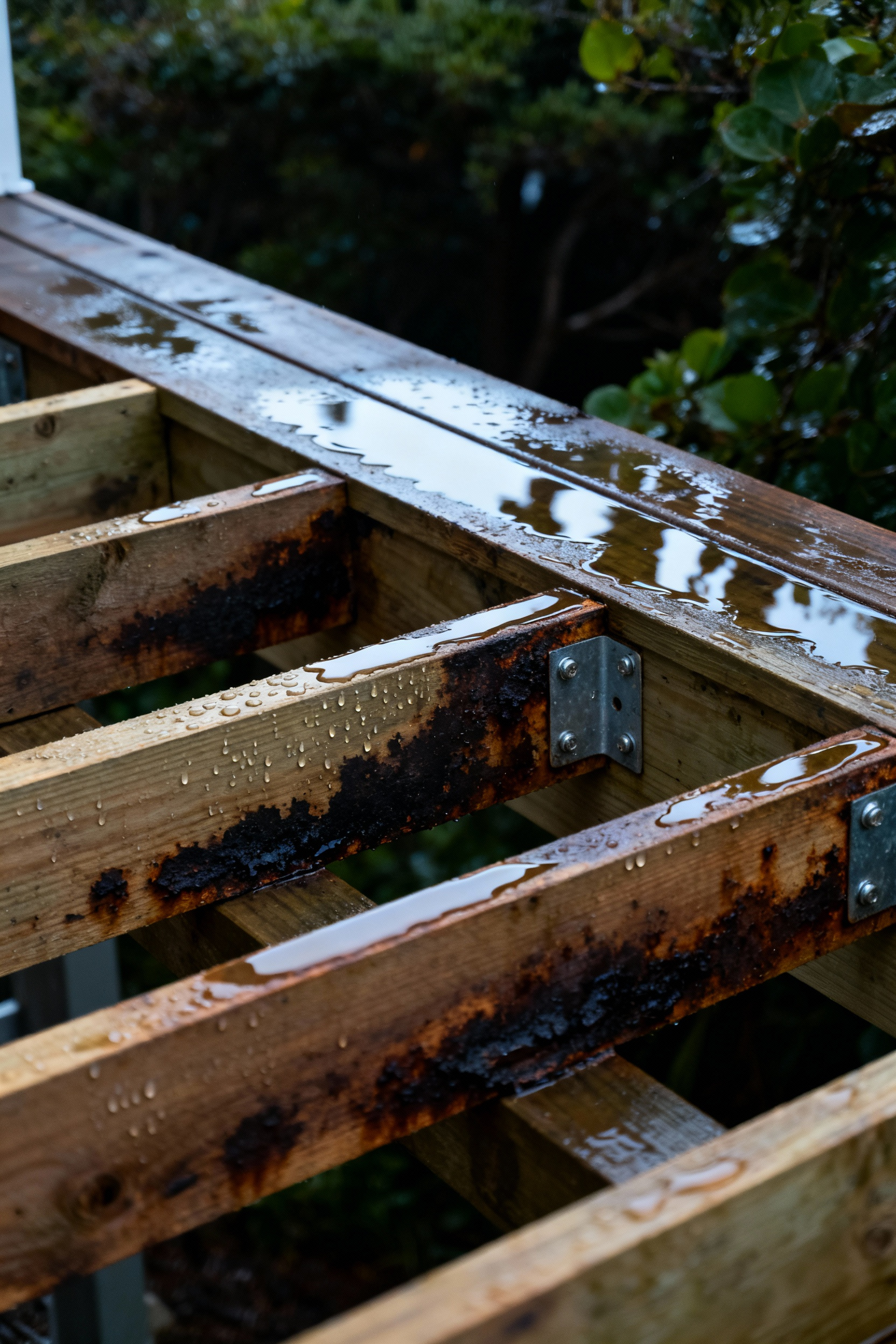
Beyond mere preservation, these systems unlock hidden value. By actively capturing and channeling runoff, the area beneath the deck transforms into a dry, functional outdoor room. Thus, homeowners can install finished ceilings and lighting without moisture concerns. Furthermore, high-end solutions utilize hidden membranes for a sleek, modern aesthetic. In fact, some advanced setups even harvest this rainwater for sustainable garden irrigation.
Technically, the optimal installation method depends on the project’s stage. Ideally, new builds utilize above-joist systems for maximum protection. Here, a waterproof membrane shields the structural wood before the decking is installed. Alternatively, retrofit projects often employ below-joist troughs. While effective for keeping the patio dry, these offer slightly less defense against joist rot. Ultimately, selecting the right water management strategy keeps the home both timeless and secure.
- **
Conclusion
These 18 foundational strategies demonstrate that luxury outdoor design transcends mere aesthetics. It is an investment in enduring engineering and sophisticated sanctuary. By prioritizing materials like Ipe and high-performance capped composite, and employing smart architectural solutions—from seamless thresholds to integrated bioclimatic pergolas—discerning homeowners can create resilient decks backyard spaces that increase property value and withstand the rigors of the elements. Ultimately, your new deck should act as a natural extension of your home, defining your legacy for decades to come.
Frequently Asked Questions
What is the most durable decking material for luxury coastal homes?
For luxury coastal homes that must endure harsh salt air and moisture, Ipe (Brazilian Walnut) is generally considered the most durable natural option due to its extreme density, natural oil content, and resistance to rot, lasting 40 to 75 years. High-performance capped composite decking is the preferred low-maintenance alternative, offering superior fade resistance and structural stability without the need for annual sealing.
How do I create a seamless indoor-to-outdoor transition on my deck?
Achieving a seamless transition requires engineering a flush threshold. This involves ensuring the exterior deck surface is level with the interior flooring, eliminating the traditional “step-down.” Crucially, this must be supported by specialized hydraulic engineering, including low-profile linear drains and sophisticated waterproofing systems to manage rainwater runoff and protect the substructure.
Are built-in fire pits safe to integrate into composite or wooden decks?
Yes, built-in fire pits and linear gas burners can be safely integrated into composite or wooden decks, provided they are engineered with a dedicated non-combustible envelope. Due to the high heat output (often exceeding 150,000 BTUs), the burner unit must be isolated within materials like concrete, stone, or steel. Professional installation is mandatory to ensure appropriate clearances and to manage gas lines safely.