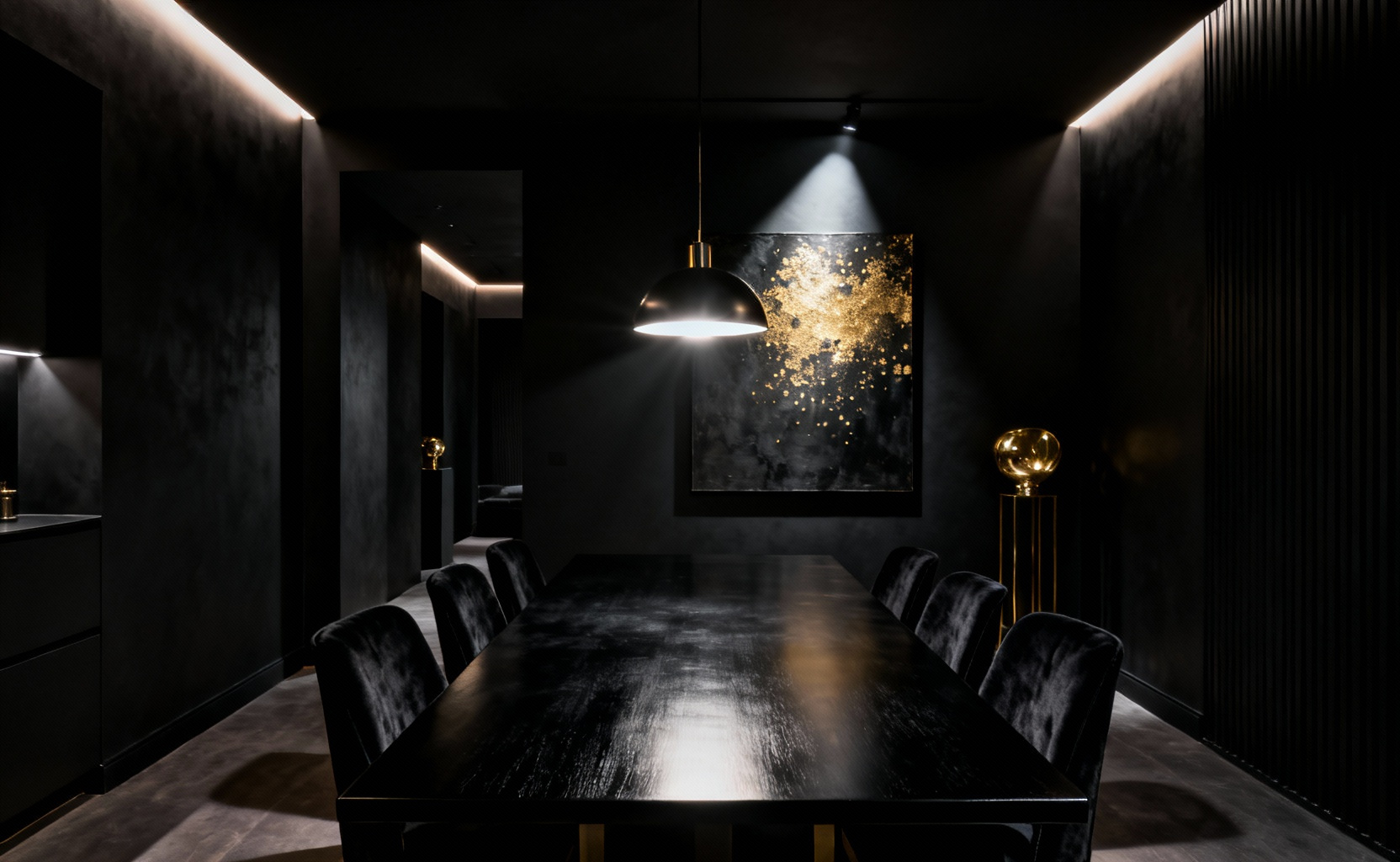

There is a particular quietude that descends upon a room swathed in darkness, a hushed reverence not unlike the moment before the curtain rises in a grand theatre. It is a space that holds its breath, waiting for the story to begin. To paint a dining room in the shades of midnight is to declare that this is a stage for human connection, a sanctuary where conversations deepen, where the flicker of a candle casts an intimate glow upon a trusted face, and where the outside world, with its clamor and its unforgiving light, simply falls away.
Many fear black, associating it with an ending. But I have always found it to be a beginning. It is a canvas of infinite potential, a velvety void where every object, every texture, and every person is rendered with a startling, almost sacred, clarity. Forget the sterile pronouncements of conventional design. This is a journey into the heart of atmosphere, a guide to crafting a space that does not merely house you, but holds you. Here, we do not decorate; we conjure. We summon a presence, a mood, a story etched in shadow and light. These are not just ideas; they are invocations.
Summoning the Void: The Alchemical Foundations of Noir
Before a single piece of furniture is placed, one must first learn the language of the dark. This is the foundational alchemy, the art of understanding that black is not a monolith but a vast, emotive landscape. Here we lay the groundwork, learning to compose with shadow as a painter composes with light.
1. A Study in Darkness: Beyond a Singular Black
To speak of a “black room” is like saying the ocean is merely “blue.” The novice sees a single color; the initiate sees a universe of nuance. There is the soft, forgiving grey of charcoal, reminiscent of spent embers. There is the hard, volcanic gleam of obsidian, and the feathered, almost-blue of a raven’s wing in winter light. Your first task is to layer these blacks, to create a symphony of darkness that gives the room depth and breath.
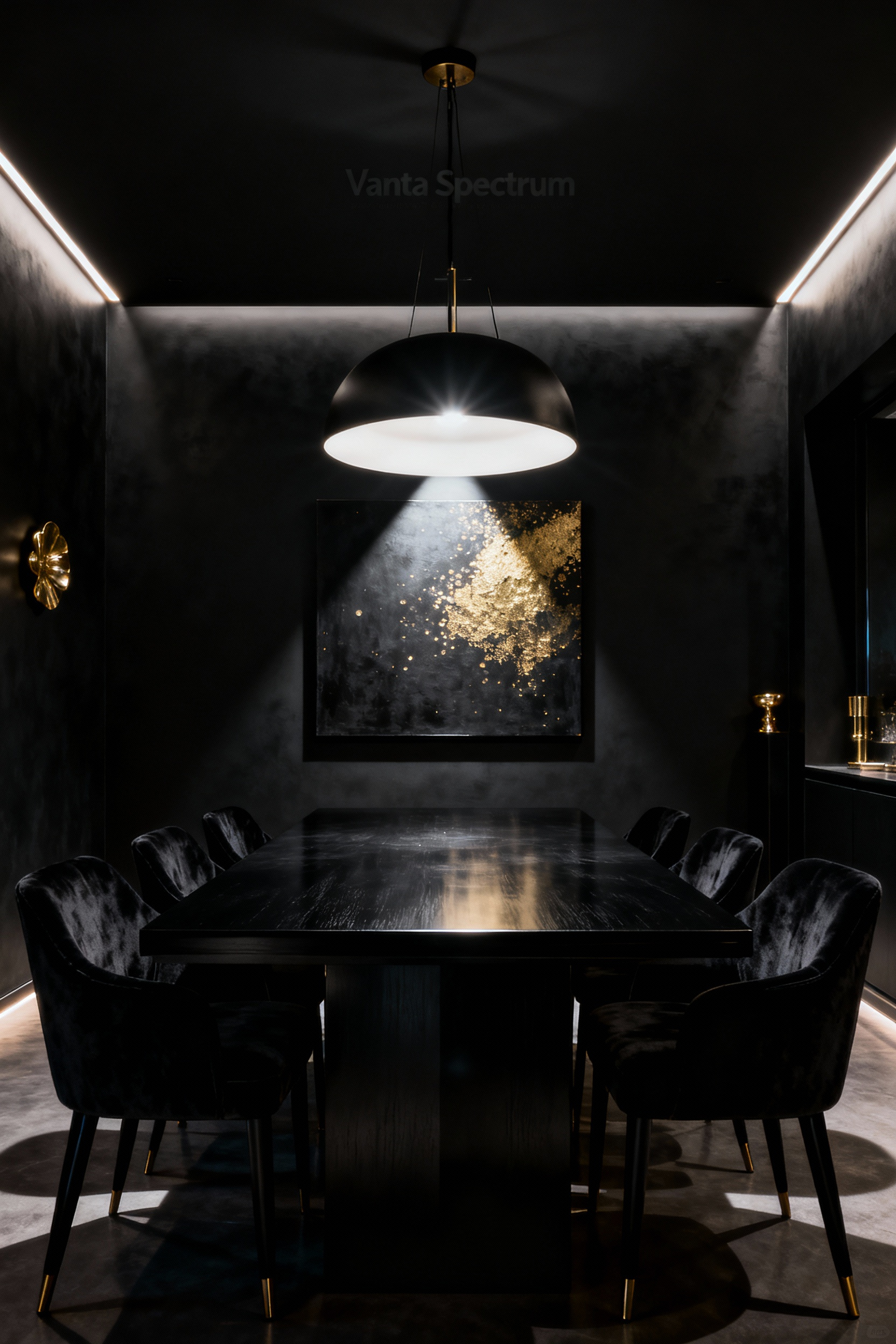
Imagine walls in a flat, matte black that drinks the light, creating a sense of boundless, silent space. Against this, place a dining table lacquered to a high gloss, a still, dark lake reflecting the cosmos of your chandelier. Chairs might be upholstered in a black bouclé or a deep damask, their textures only revealing themselves upon a closer glance. What I tell my clients is this: a room composed of a single, uniform black feels like a void; a room composed of a spectrum of blacks feels like an embrace.
2. The Dialogue of Shadow and Glimmer
A black dining room lives in the exquisite tension between what is hidden and what is revealed. This is not a battle against light, but a disciplined collaboration with it. You must become a conductor, commanding where the light will land and what it will bless with its attention. Matte surfaces are your silent conspirators, absorbing light and creating pockets of profound intimacy and rest for the eye.
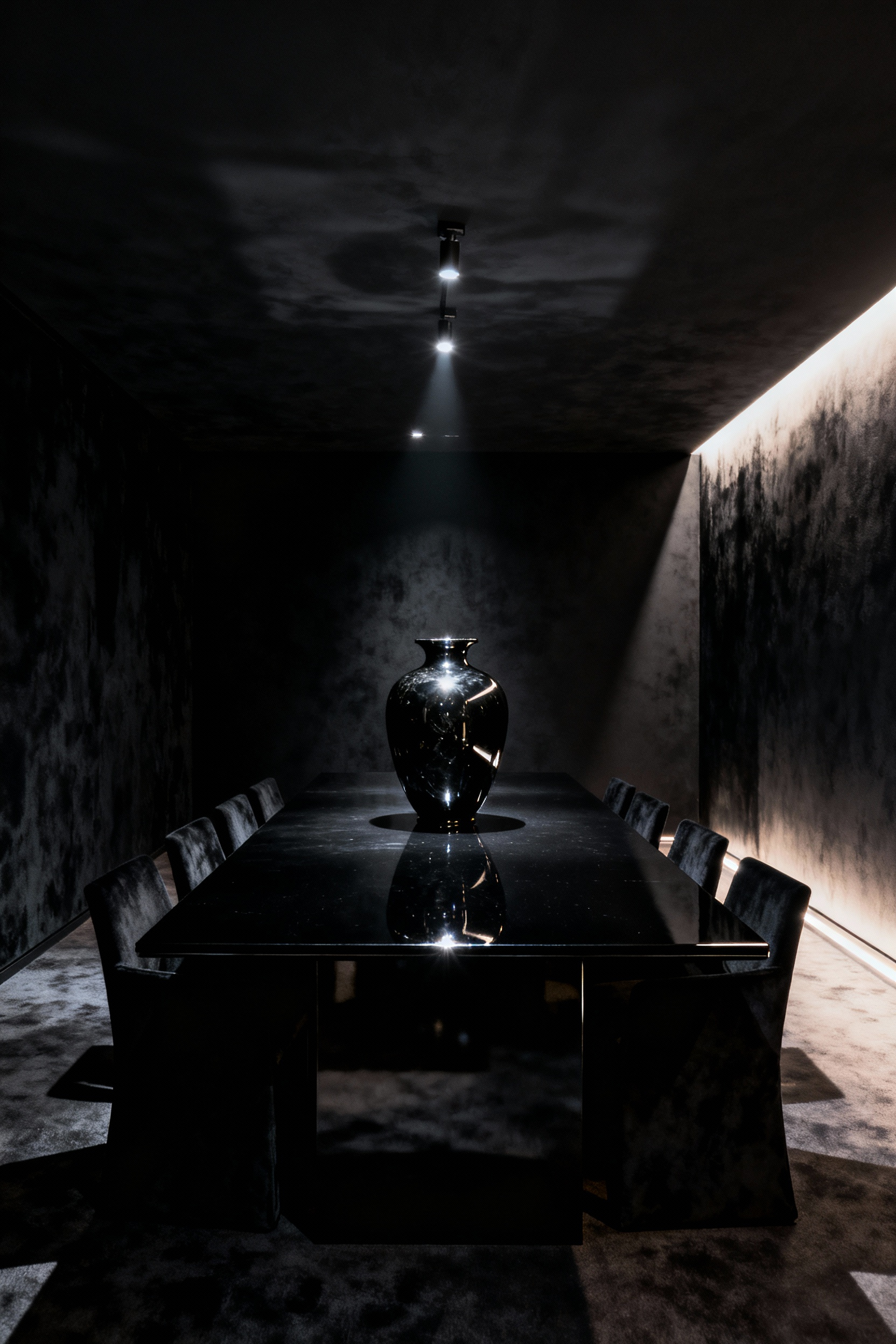
Conversely, polished surfaces—a slab of Nero Marquina marble, a chrome-legged chair—are your dramatic foils. They catch the faintest glimmer and shatter it into a thousand points of brilliance, animating the stillness. In my gothic romance modernist practice, I learned that this balance is everything. Too much absorption, and the room feels oppressive. Too much reflection, and the mystery is lost. The true art lies in orchestrating this dialogue, ensuring that every gleam feels precious, earned against the profound quiet of the shadows.
3. The Monolith: An Altar for Gathering
The dining table is not furniture; it is the altar. It is the solid, unwavering center around which lives and stories will orbit. In a black room, its presence must be absolute, a monolith of purpose. I am drawn to materials that speak of gravity and time—a single, massive slab of black granite, veined with cosmic silver, or a table of ebonized oak so dark it seems to have been pulled from a peat bog.
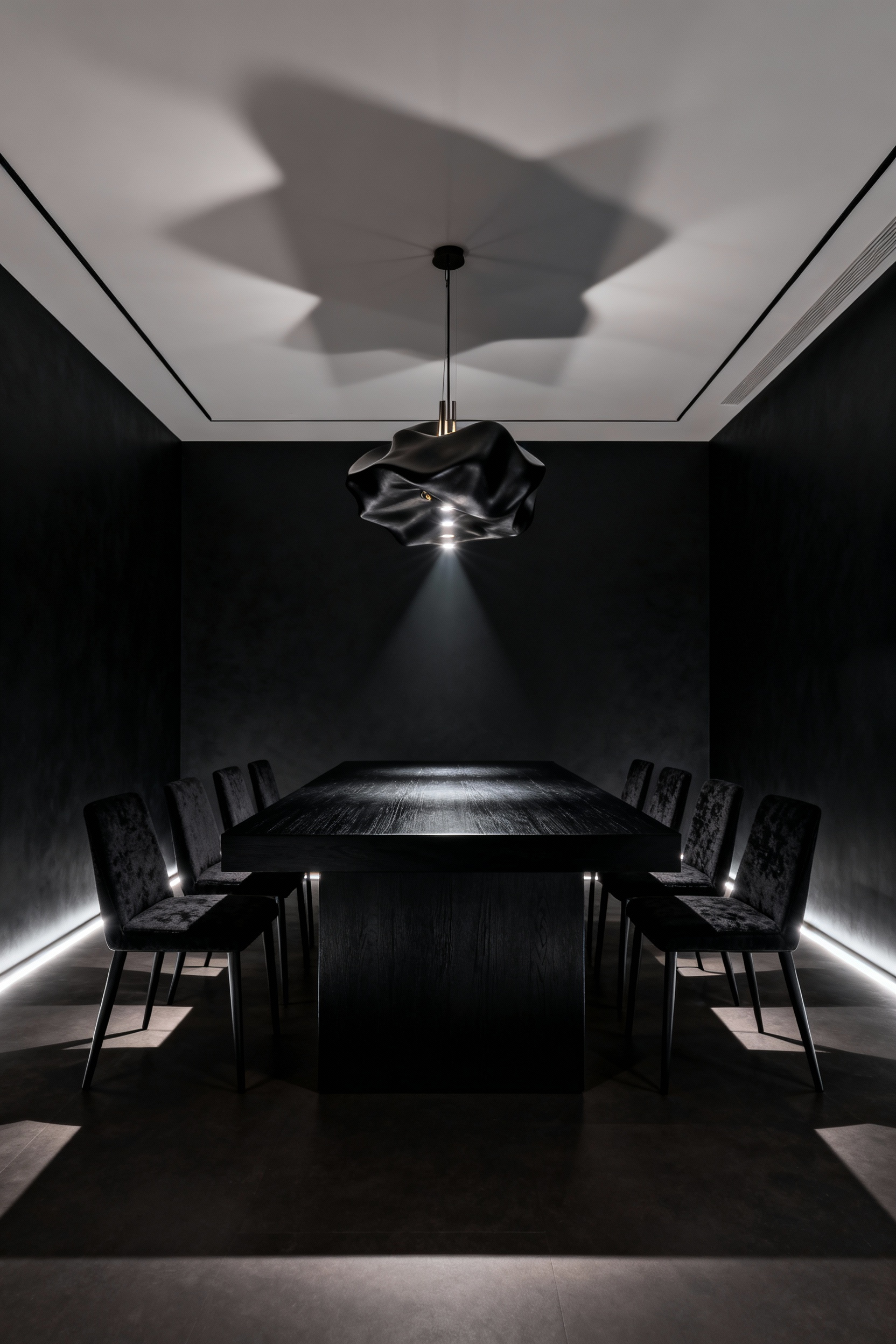
Its form dictates the room’s energy. A severe, rectangular table can feel ceremonial, almost baronial, perfect for formal pronouncements and grand dinners. A round table, however, is a cauldron of confession. It erases hierarchy and invites a conspiratorial intimacy, its curves a soft counterpoint to the room’s dramatic angles. The table is the anchor, the heart. Choose it not for how it looks, but for the stories you wish to tell around it.
4. Velvet Walls and the Art of Enclosure
There is a profound psychological comfort in being held. Cloaking the walls in black transforms them from simple architectural boundaries into an immersive, sensory veil. They enclose you, shutting out the world and creating a sanctuary for the senses. I often favor textiles for this, such as deep velvet wall panels that absorb not only light but sound, rendering the room in a state of suspended, hallowed quiet.
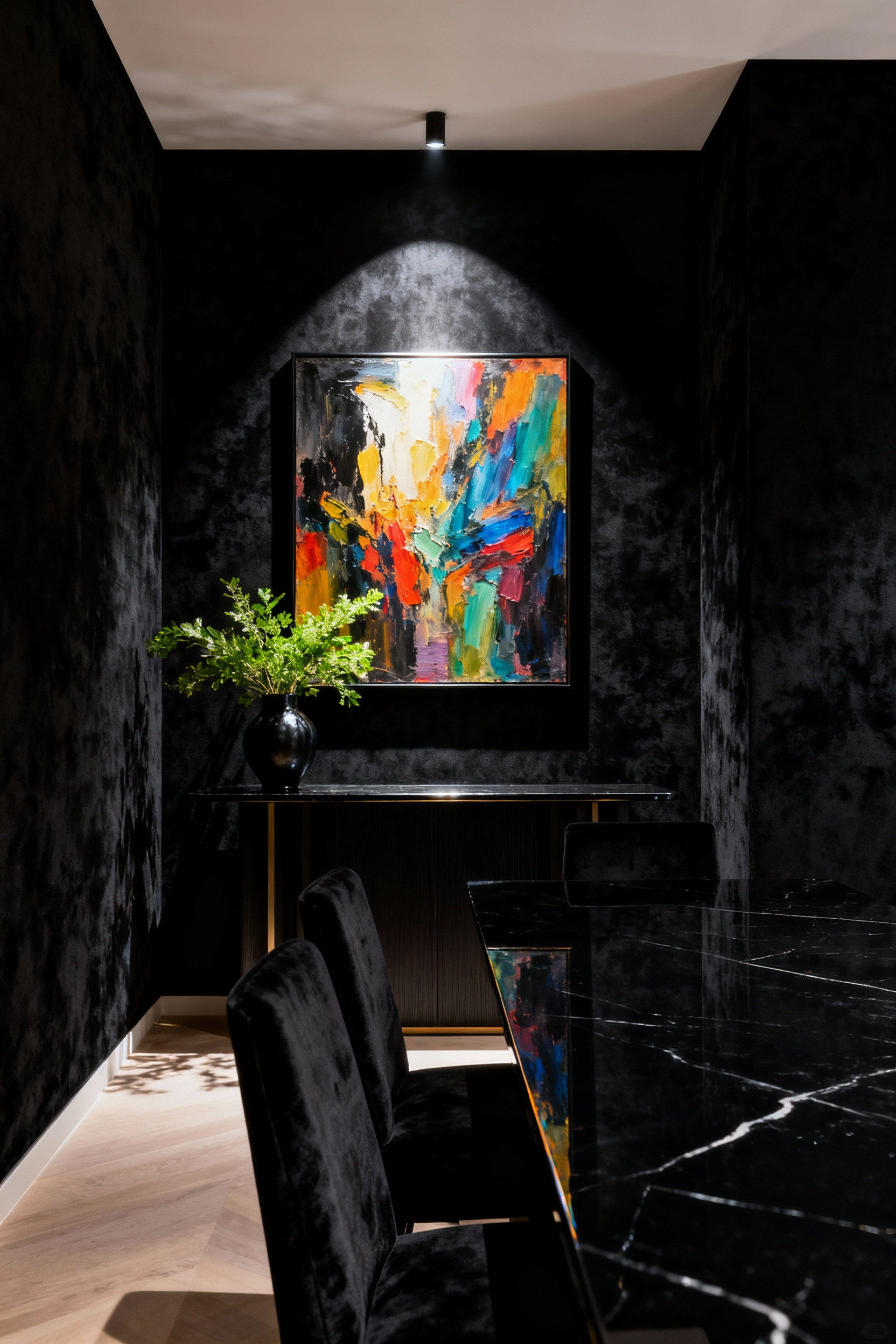
For a more austere, academic mood, consider a black limewash, its chalky texture offering a soft, almost spectral patina. Or a Japanese shou sugi ban—charred wood panels—that brings an ancient, organic tactility to the space. Whatever the material, the effect is to dissolve the corners of the room, to create a feeling of infinite, protective space. The walls are not there to confine you, but to set you free from distraction.
5. Grounded in Midnight: The Foundation Beneath Your Feet
The floor is the foundation from which all drama ascends. It must anchor the space with an unquestionable solidity. To lay down a dark floor is to create a subterranean stability, a firmament that allows the other elements of the room to either soar or find their purchase. A polished black concrete floor can feel modern and monolithic, a dark mirror reflecting the story above.
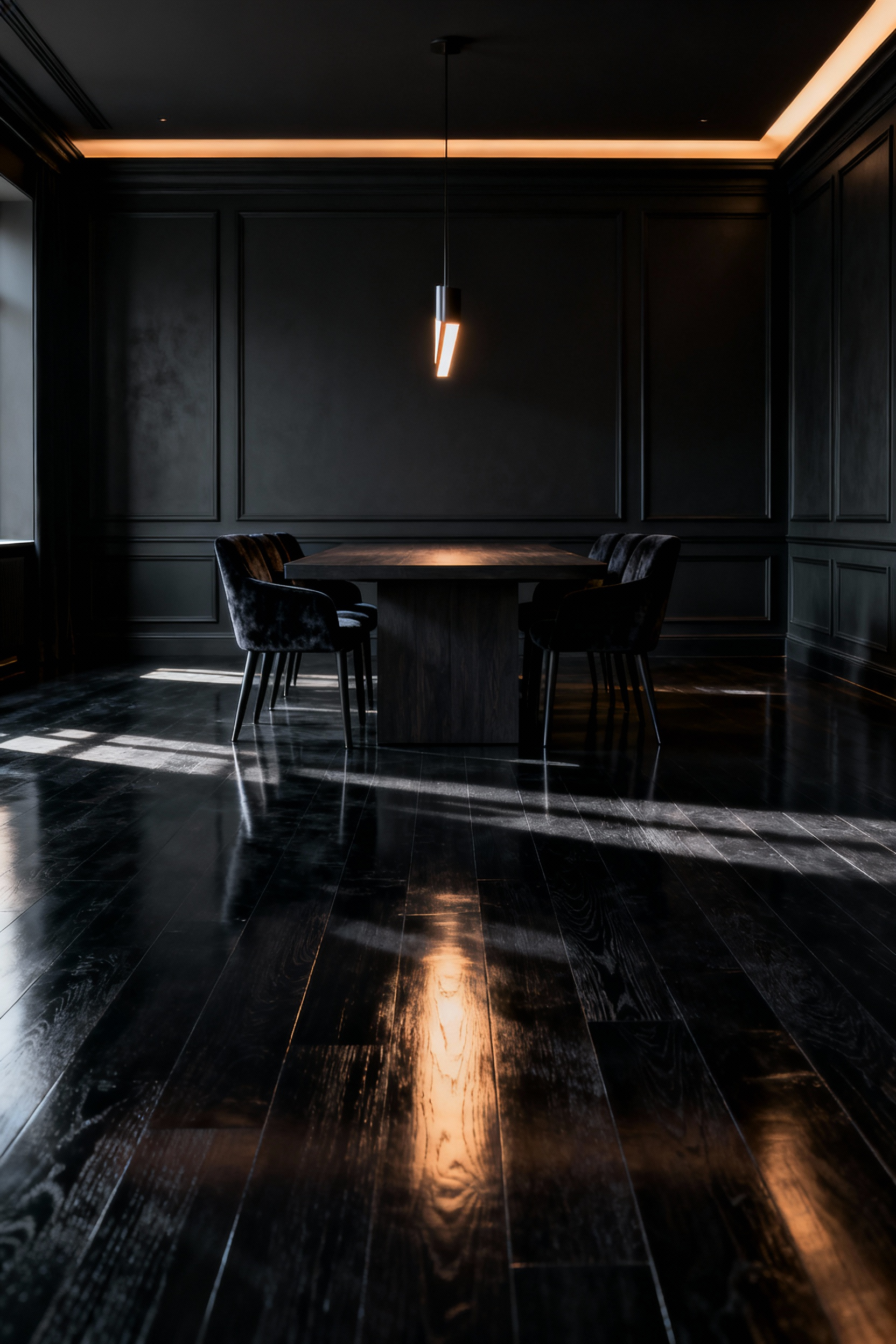
I am often partial to wide, dark-stained oak planks, their subtle grain providing a connection to the living world, a whisper of the forest floor at midnight. The tactile experience of such a foundation—solid, unyielding, yet organic—is crucial. This floor is the room’s lowest note, a deep, resonant tone that sets the mood for the entire composition. It is the earth from which our nocturnal garden will grow.
A Chiaroscuro Ballet: The Artful Conduction of Light
Once the void is summoned, we must learn to command the light. Illumination in a black dining room is not a utility; it is a performance. Each beam, each reflection, is a carefully choreographed dancer in a grand ballet of shadow and brilliance, shaping the atmosphere and directing the eye with surgical precision.
6. Celestial Suspensions: The Chandelier as a Private Cosmos
The chandelier is not a lamp. It is a captured star system, a sun suspended in your private cosmos. In a black dining room, its role is elevated to that of a primary sculpture, a narrative focal point. I’ve noticed clients are often timid here, but this is the place for audacity. Consider an oversized, multi-tiered crystal piece that drips with light, each facet catching and fracturing the glow into a thousand shards of brilliance against the dark canvas.
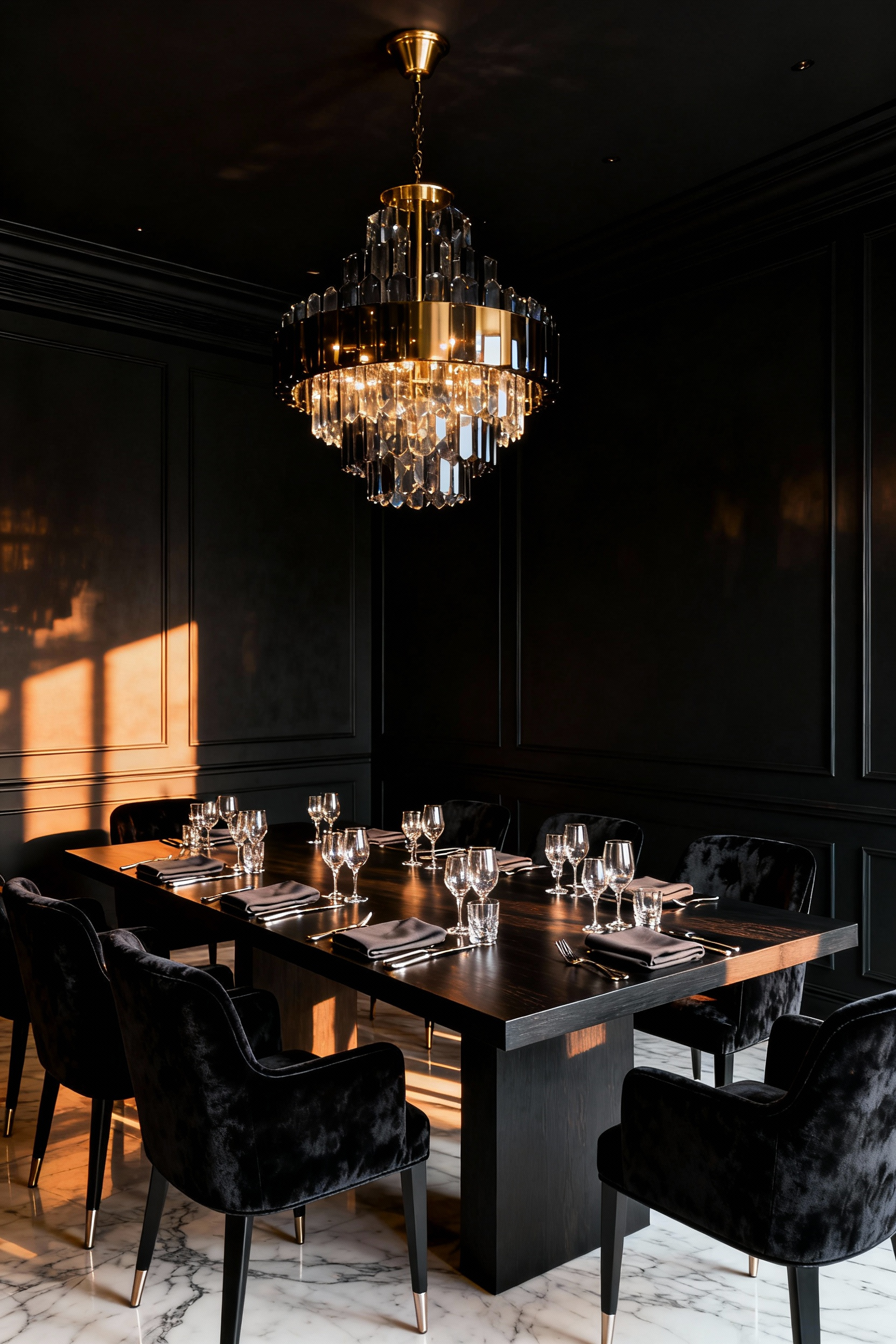
Alternatively, a more modern, architectural fixture in blackened bronze or aged brass can feel like an orrery, its arms tracing silent orbits in the space above. The key is to hang it lower than expected, creating a glowing canopy over the table that defines the sacred space of the gathering. It should be on a dimmer—always. Its light should range from a celebratory blaze to the barest, most intimate whisper.
7. Whispers of Light: Sconces and Peripheral Drama
While the chandelier holds the center stage, it is the sconces that tell the secrets. Placed along the periphery, they are the whispers in the dark, creating small, intimate vignettes and preventing the walls from receding into a featureless abyss. They provide a softer, more human-scaled layer of light that is endlessly flattering.
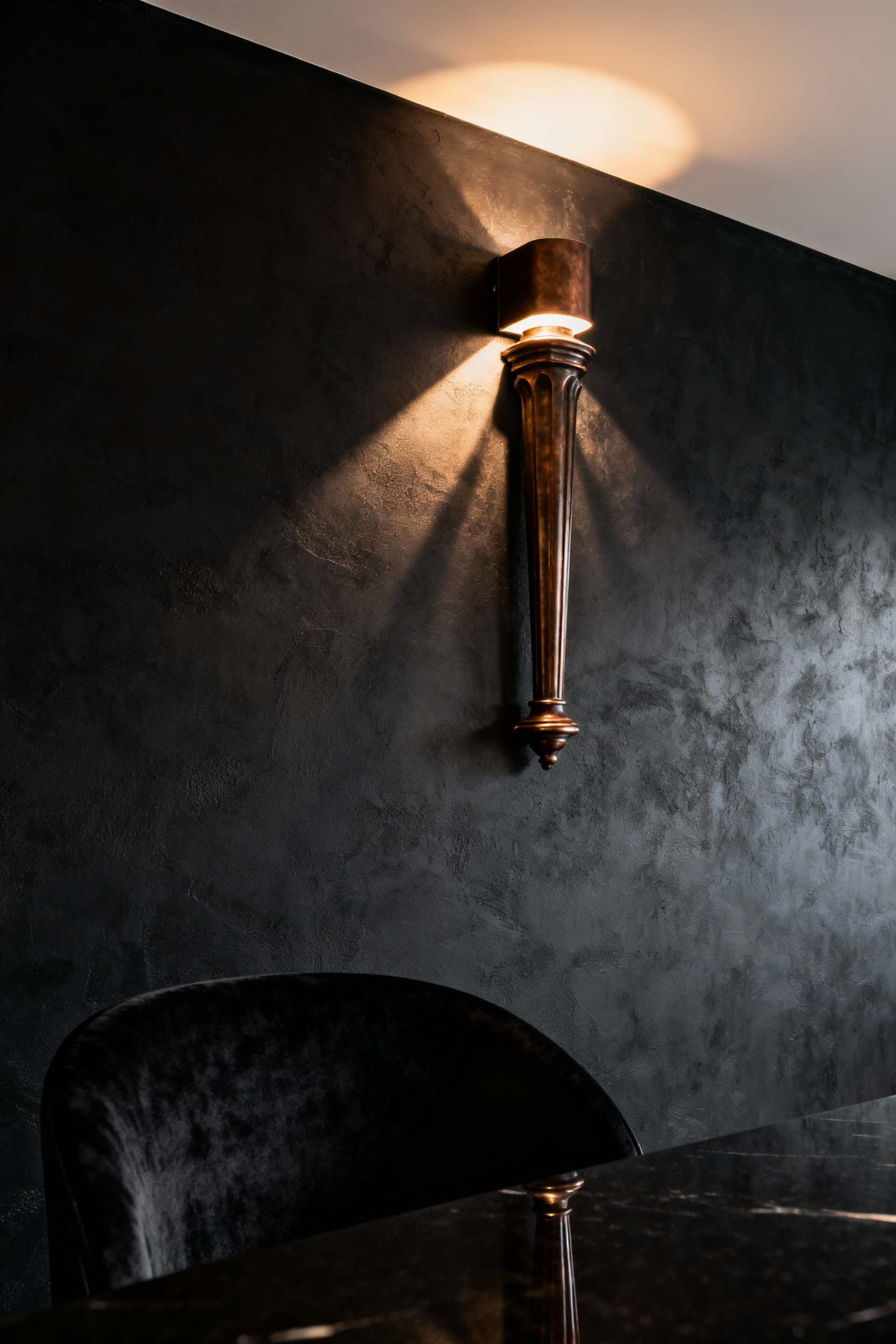
I often use sconces with an upward and downward wash of light, which grazes the wall to highlight the texture of plaster or the subtle pattern of a wallpaper. Imagine them flanking a tall, antiqued mirror or a piece of art, framing it with a reverential glow. These are not for broad illumination; they are for targeted moments of beauty, small pools of light that invite you closer into the room’s embrace.
8. Mirroring the Abyss: Portals to Another Realm
A mirror in a black dining room is a powerful, almost dangerous, piece of magic. It is not there to check your reflection; it is a portal. It captures fragments of light and conversation, creating illusions of infinite depth and doubling the drama of a flickering candle. An oversized, floor-to-ceiling mirror with an antique, foxed surface can dissolve an entire wall, its ghostly reflections hinting at a parallel world just beyond the glass.
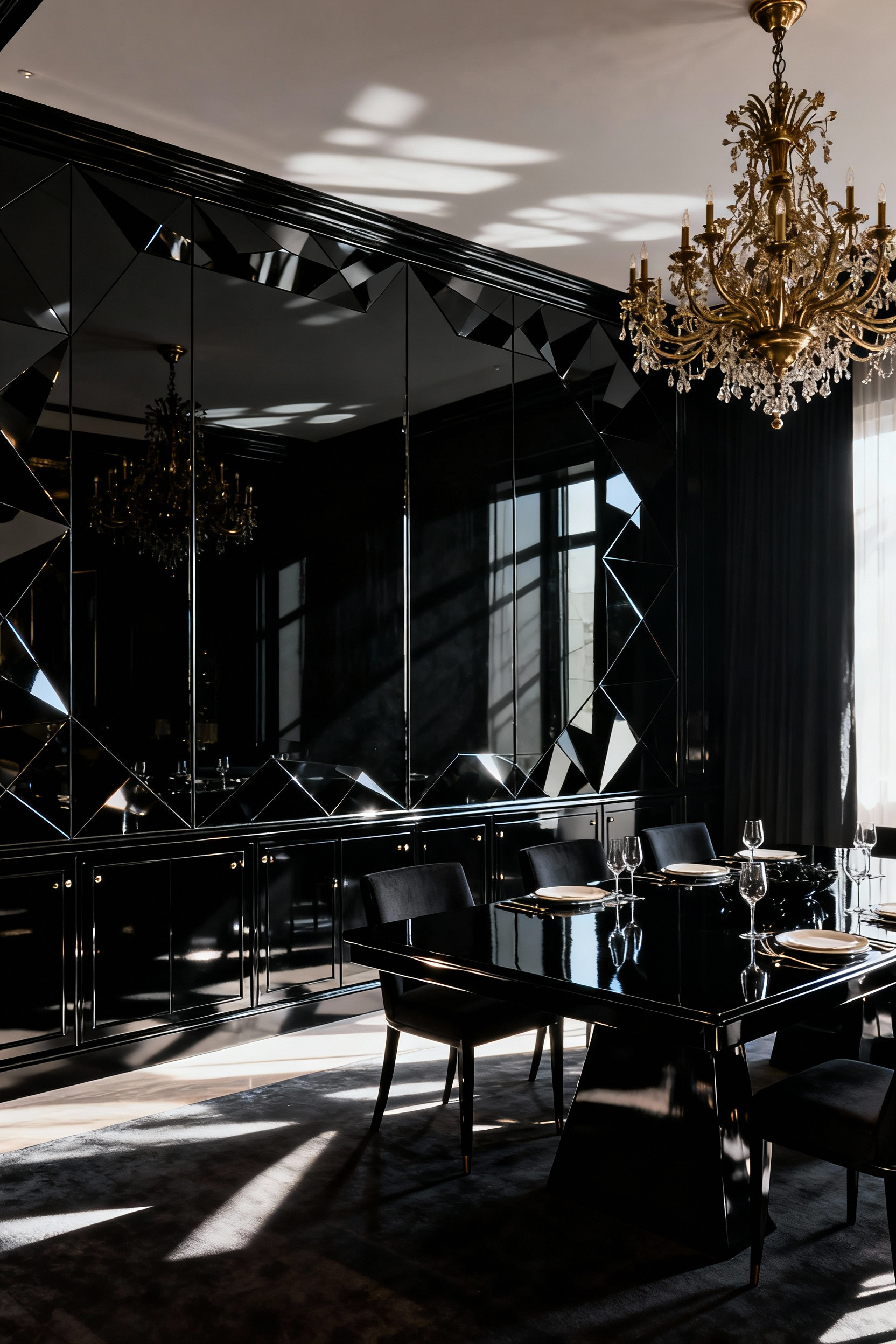
Position it to reflect your chandelier, creating a stunning illusion of a twin star burning in the abyss. Or place it opposite a window to draw in the pale blue light of dusk, a poignant counterpoint to the room’s interior warmth. From my work in dark academia aesthetics, I learned that a well-placed mirror is the ultimate intellectual flourish—a visual paradox that makes you question the very boundaries of the space you inhabit.
9. The Midas Touch: Metals That Burn Against the Dark
Against the profound canvas of black, metals are not mere accents; they are fire. Their gleam provides a necessary warmth and a point of sharp, scintillating contrast. The soft, buttery glow of aged brass is my most trusted ally. It feels historic, lived-in, and it casts a warm, forgiving light that is exceptionally beautiful on skin tones.
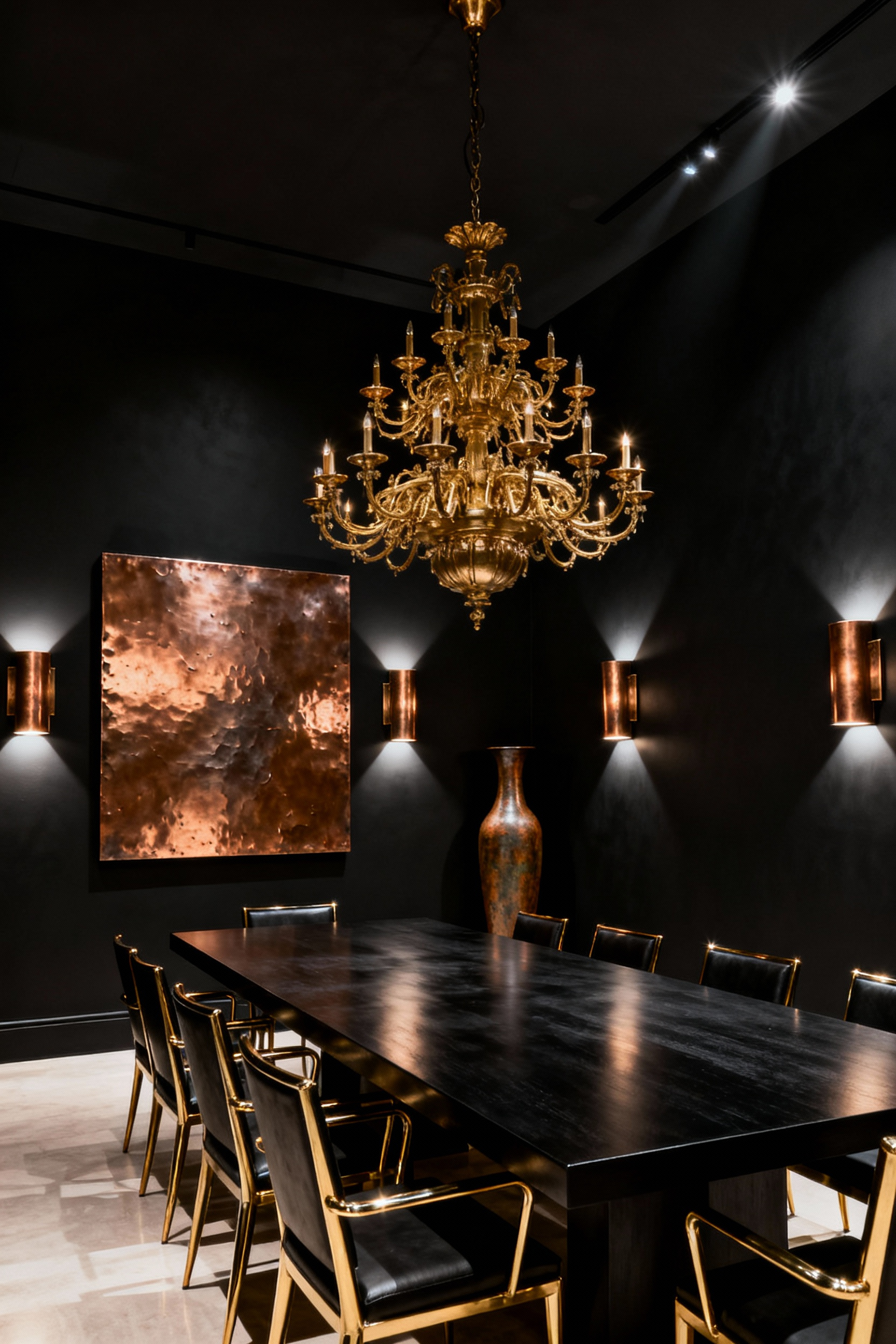
For a colder, more graphic statement, polished chrome or stainless steel can add an almost futuristic edge. But do not forget the quiet power of blackened steel or oiled bronze—metals that almost disappear into the darkness until they catch the light, revealing a subtle, muscular sheen. From the legs of a chair to the frame of a painting or the simple line of a candlestick, these metallic threads weave light through the darkness, ensuring the room feels alive and dynamic.
10. The Language of Touch: A Symphony in Velvet and Silk
In a dark space, your other senses are heightened. Touch becomes a primary way of understanding and experiencing the room. Textiles are your vocabulary. Sumptuous, light-devouring velvet on chairs invites you to linger, its soft pile a decadent comfort. Raw silk drapes, with their subtle, watery sheen, can catch the moonlight and introduce a whisper of liquid movement.
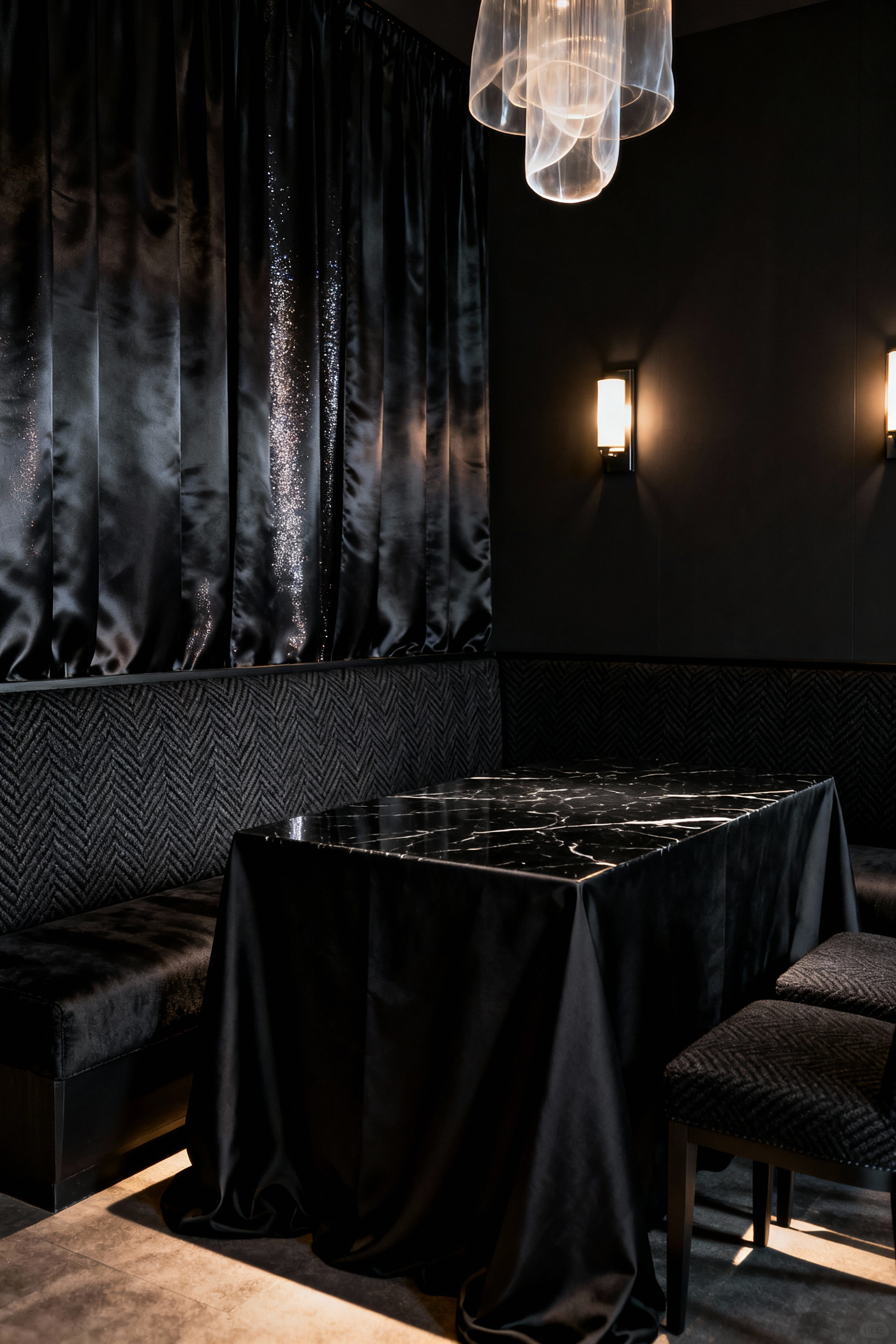
Consider the floor. A thick, hand-knotted wool rug under the table not only adds a layer of comfort and acoustic dampening but provides a deep, satisfying texture underfoot. I once learned, while working on a space meant for intense, private dinners, that layering textures—a coarse linen tablecloth, smooth leather placemats, soft cashmere throws on a banquette—creates a rich, sensory narrative that makes a room unforgettable, even with your eyes closed.
The Soul of the Space: Conjuring Atmosphere and Intimacy
A room, however beautiful, is an empty stage until it is filled with soul. This section is about the invisible architecture of atmosphere—the psychological and emotional currents that transform a collection of objects into a place of meaning, a crucible for human experience.
11. The Cauldron of Confession: Forging Connection in Darkness
Why are secrets whispered in the dark? Because darkness is a powerful agent of intimacy. It dissolves the masks we wear in the light of day. A black dining room acts as a modern cauldron of confession, its enclosing nature stripping away pretense and fostering a raw, undiluted connection between those gathered within it.
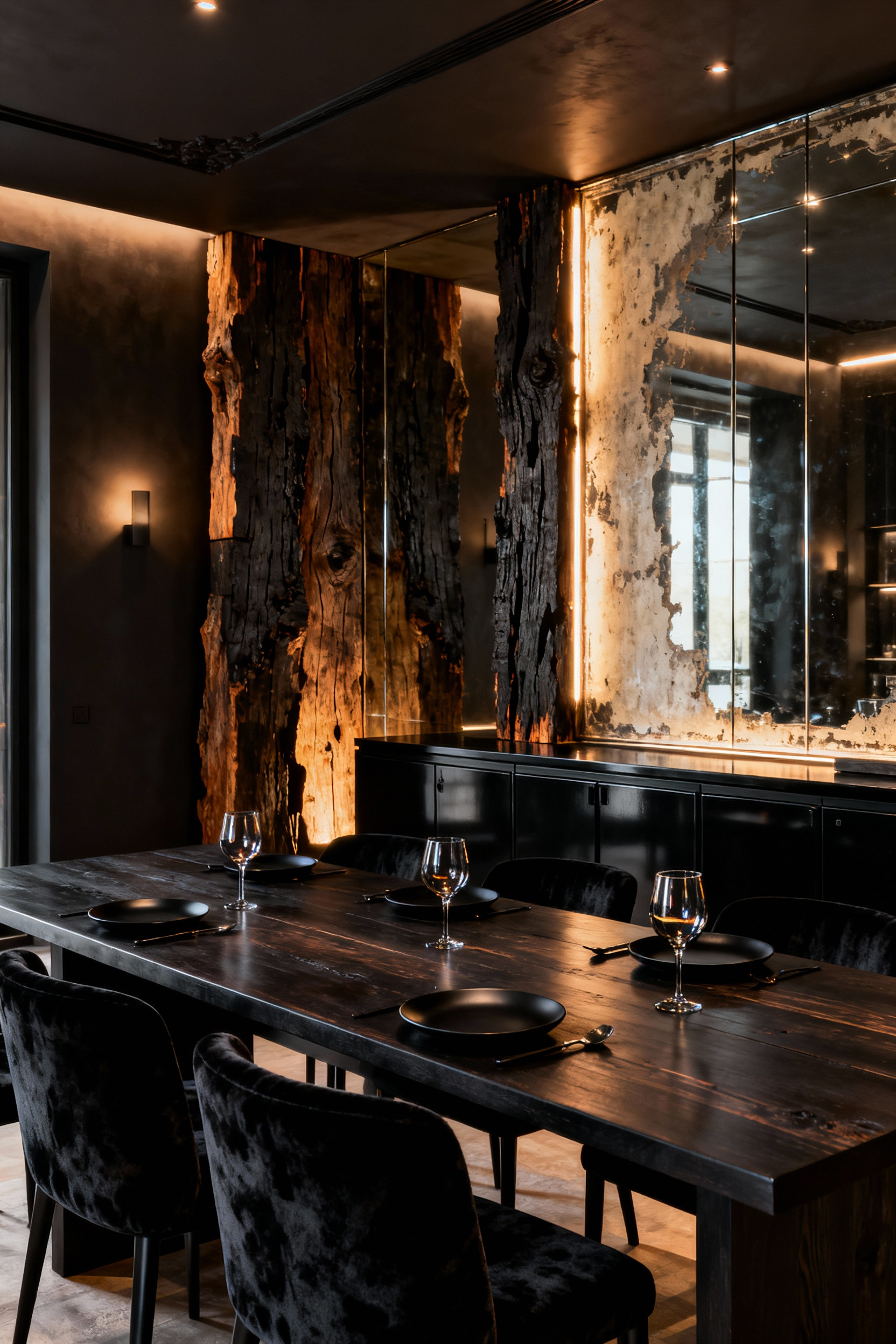
The focus is drawn inexorably inward—to the faces, the voices, the stories being shared across the table. Visual noise is eliminated, allowing for a deeper form of listening and seeing. The drama of the setting paradoxically creates a safe space for authenticity. This is where friendships are forged, futures are planned, and vulnerable truths are shared in the conspiratorial glow of candlelight.
12. Silent Narrators: Where Art Speaks from the Shadows
Art in a black dining room is not decorative. It is revelatory. Against the absolute void of a black wall, a painting or sculpture is thrown into magnificent relief. Colors become more saturated, forms more defined, narratives more potent. A vibrant abstract explodes with an energy it would never possess against a white wall. An old, somber oil portrait seems to emerge from the shadows, its subject a silent guest at your table.
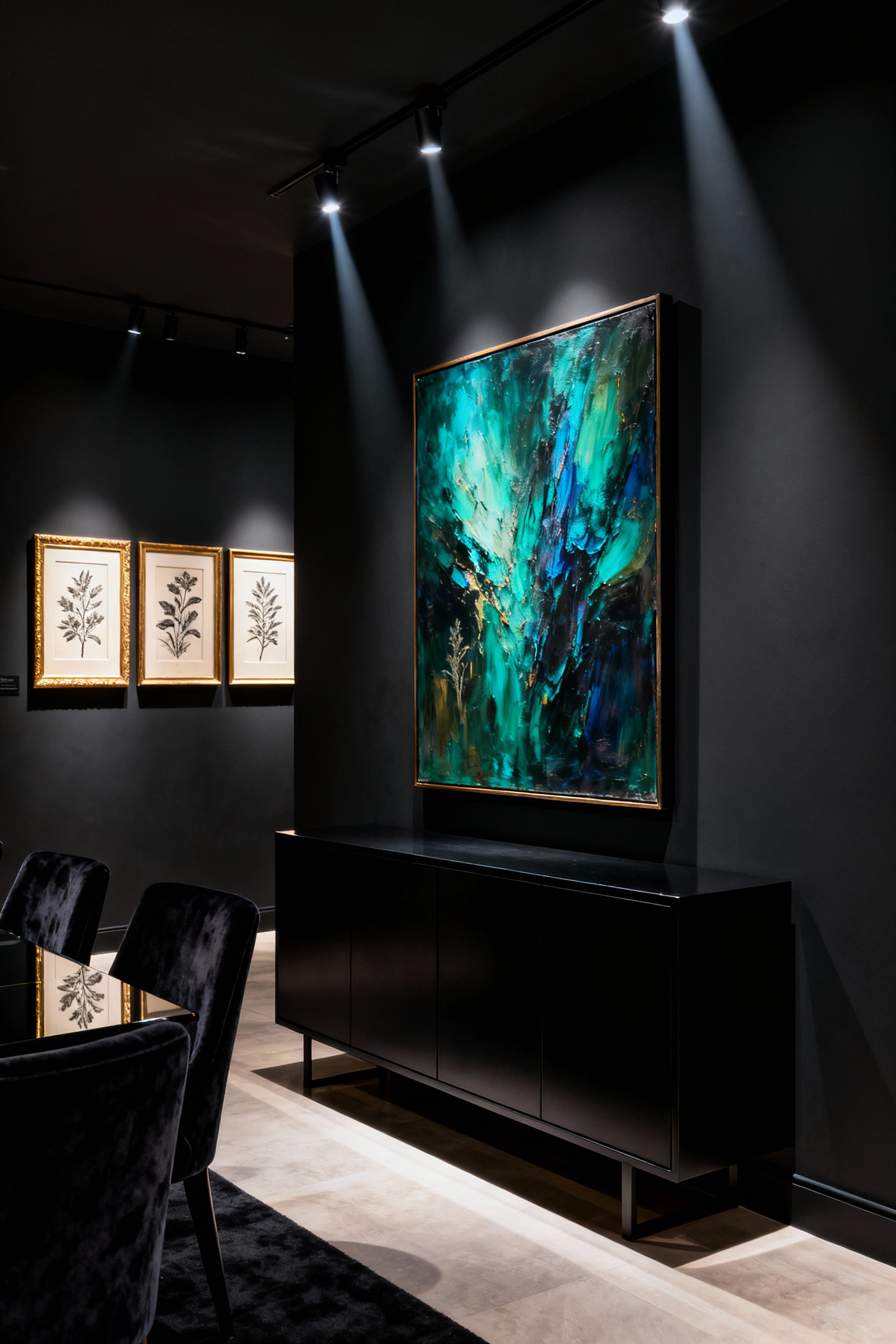
Spotlight each piece with dedicated, museum-quality lighting. This is not about illuminating the room; it is about unveiling the art. Years of professional experience taught me that a black room allows you to curate an experience, to guide the eye from one story to the next. The walls become a gallery of your own soul, each piece a narrator whispering its tale into the quiet air.
13. A Dialogue with Ghosts: Marrying the Antique with the Avant-Garde
Black is the great mediator between eras. It is a timeless backdrop against which the ancient and the hyper-modern can engage in a thrilling dialogue. The ornate, rococo curves of a gilded antique console are not diminished by a black wall; they are celebrated, their form rendered as pure, glorious sculpture. A sleek, minimalist table can be ringed with Louis XVI chairs, the contrast creating a tension that is both intellectually and aesthetically exciting.
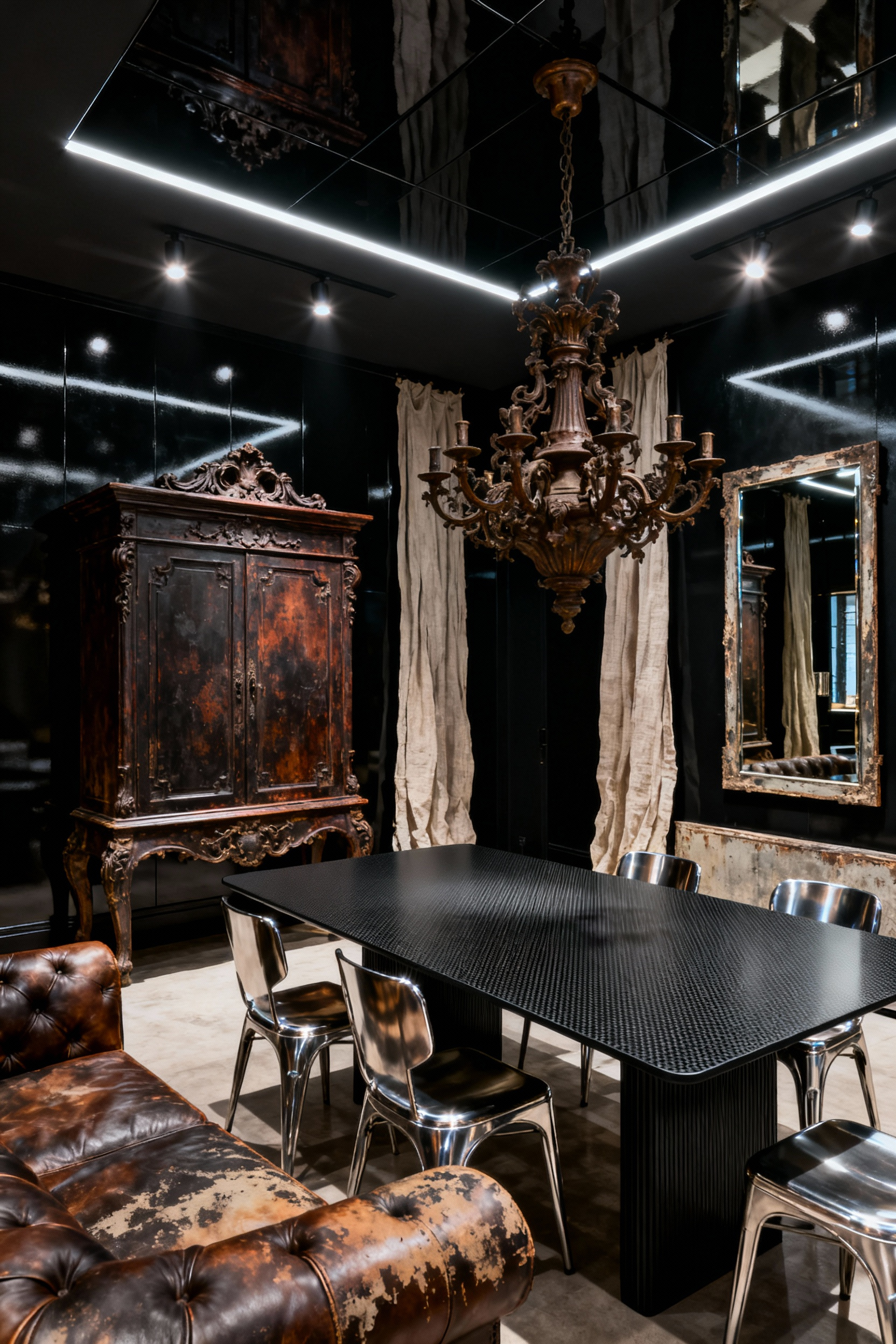
Do not be afraid to create these temporal clashes. A space that successfully marries different periods feels layered and intelligent, as if it has been curated over a lifetime. This is how you create a room with a soul, one that resonates with the echoes of history while looking unflinchingly toward the future. It becomes a testament to the enduring power of beautiful things, regardless of their origin.
14. Botanical Spectres: The Haunting Beauty of Life
There is nothing more poignant than a vibrant, living thing set against the deep stillness of black. A single branch of pale, ghostly lunaria in a simple ceramic vessel, a spray of blood-red roses, or the architectural fronds of a fern become breathtakingly alive in a dark room. The verdant greens appear almost electric, the colors richer and more profound.
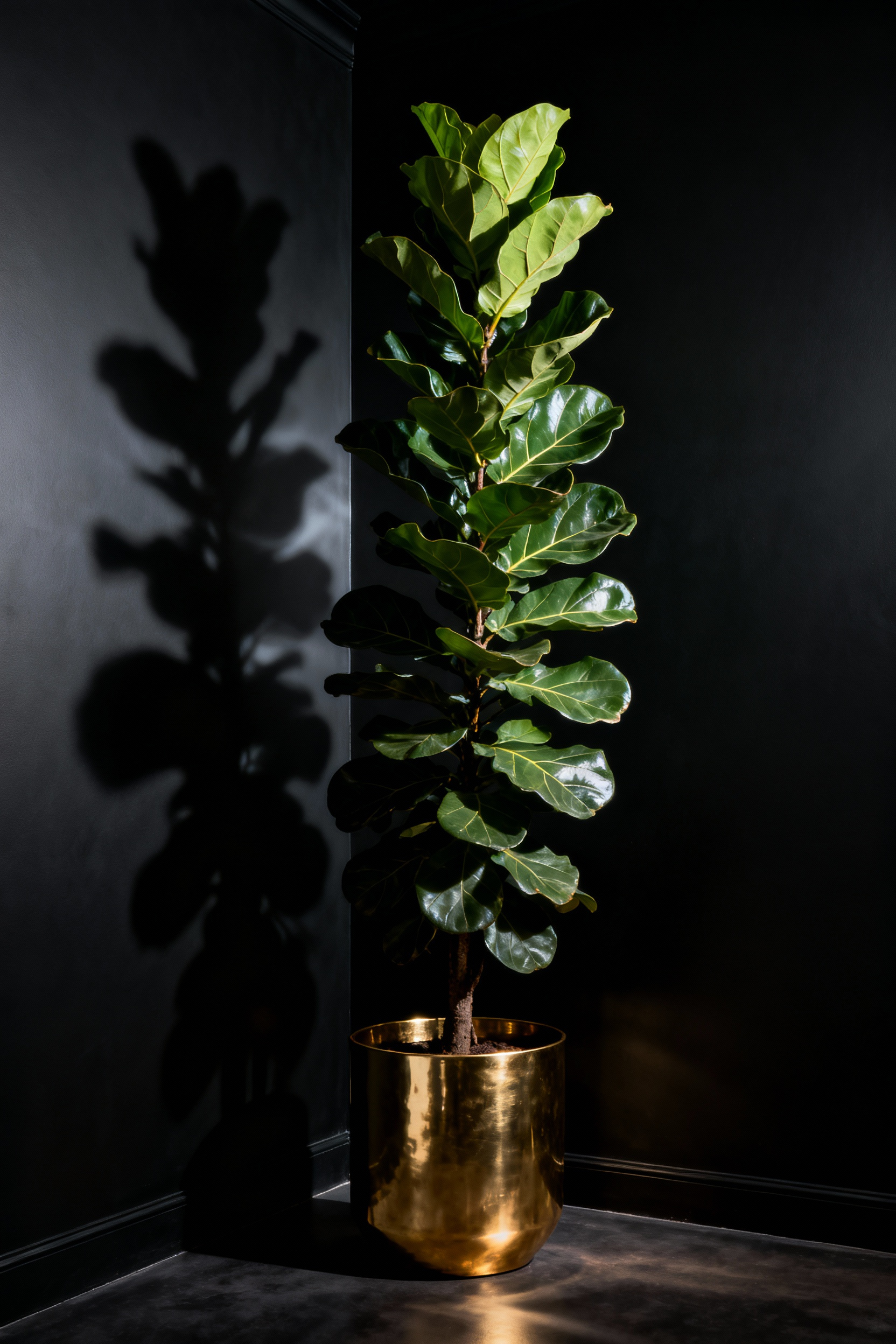
I am particularly drawn to the use of tall, sculptural plants, like a Fiddle Leaf Fig, whose dark leaves create a beautiful tonal harmony while its living presence offers a vital organic counterpoint. This is the touch of memento mori, the classic artistic reminder of life’s fleeting beauty. These botanical spectres soften the room’s severity and breathe a quiet, necessary life into the dramatic stillness.
15. An Invisible Orchestra: The Scent and Sound of Shadow
The most powerful elements of atmosphere are often invisible. What does your room sound like? In a space lined with soft textiles, sound is dampened, creating an intimate hush. Voices don’t scatter; they are held. The clink of a wine glass, the scrape of a fork—these small sounds become part of the room’s intimate music. Augment this with a subtle, curated soundtrack—a solitary cello, ambient electronica, the melancholic strains of a jazz piano.
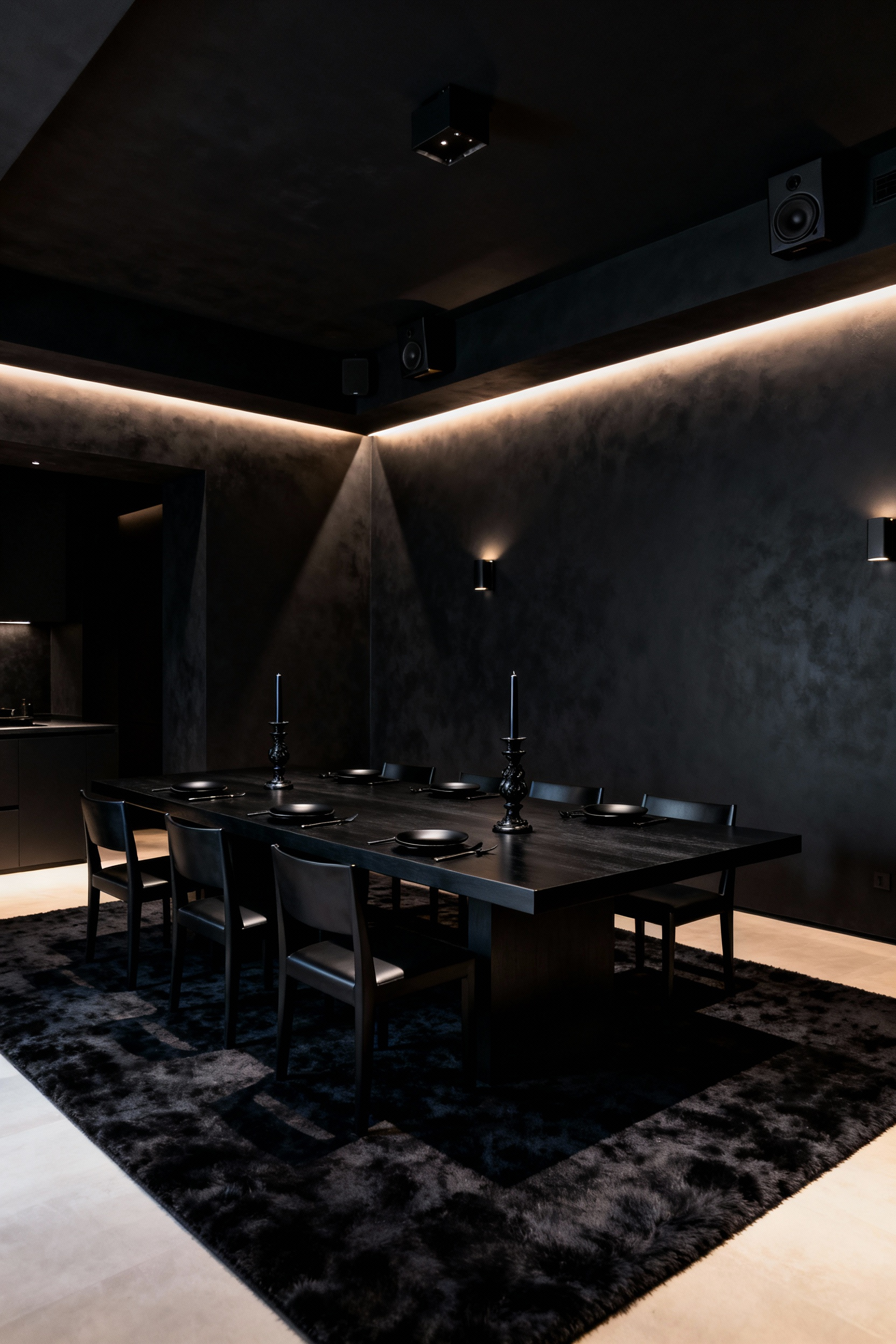
And what is its scent? Scent is inextricably linked to memory. Avoid anything cloying or artificial. Think of the fragrance of old books and leather, of beeswax candles, of sandalwood or damp earth after the rain. A signature scent, deployed with the lightest touch, is the final, invisible layer of design, an olfactory signature that makes the experience of being in the room completely and utterly immersive.
The Final Composition: Curating the Dark Masterpiece
The final act is one of orchestration. It is about weaving these individual elements together into a cohesive, breathtaking whole. This is where we apply the curator’s eye, making the subtle adjustments that elevate a beautiful room into an unforgettable work of art.
16. A Single, Bleeding Heart: The Shock of Deliberate Color
While our canvas is black, the most powerful statement can be a single, surgical injection of color. This is not about creating a colorful room; it is about honoring the power of one specific hue. Think of a single dining chair upholstered in a searing, blood-red velvet, or a collection of glassware in a deep sapphire blue that catches the light like trapped jewels.
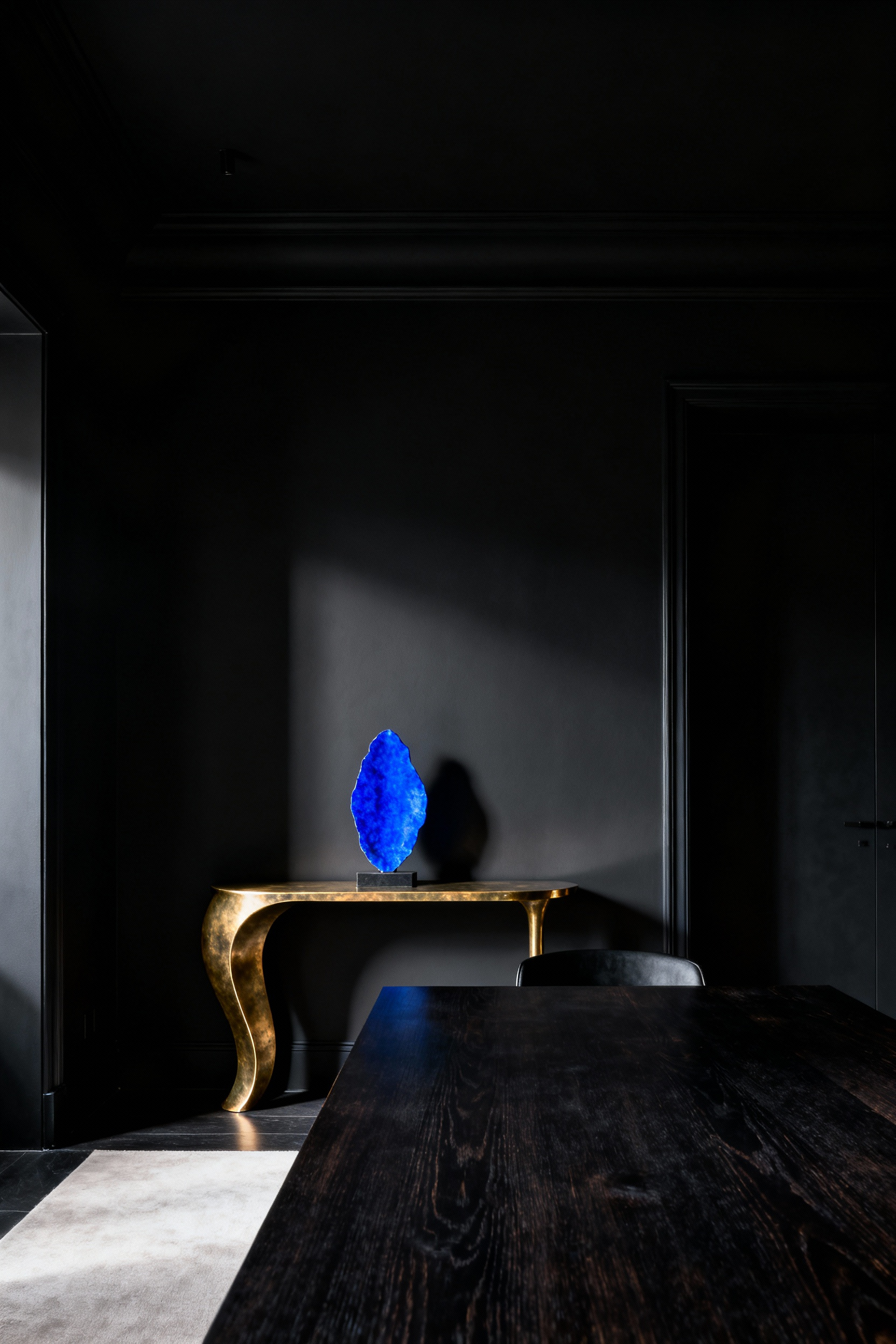
This calibrated interruption does not disrupt the darkness; it proves its power. Against the quiet backdrop, the singular color sings with an intensity it could never achieve in a brighter, more chaotic space. In my professional experience, restraint is key. This single point of color becomes the room’s punctuation mark, its passionate, beating heart.
17. The Eloquence of Absence: Mastering the Void
The most luxurious material in a black dining room is often empty space. Overcrowding a dark room is a cardinal sin; it suffocates the atmosphere and creates a sense of clutter and oppression. You must embrace the eloquence of absence. Allow for generous, uncluttered pathways. Let a single, magnificent sculpture stand alone against a vast, empty wall.
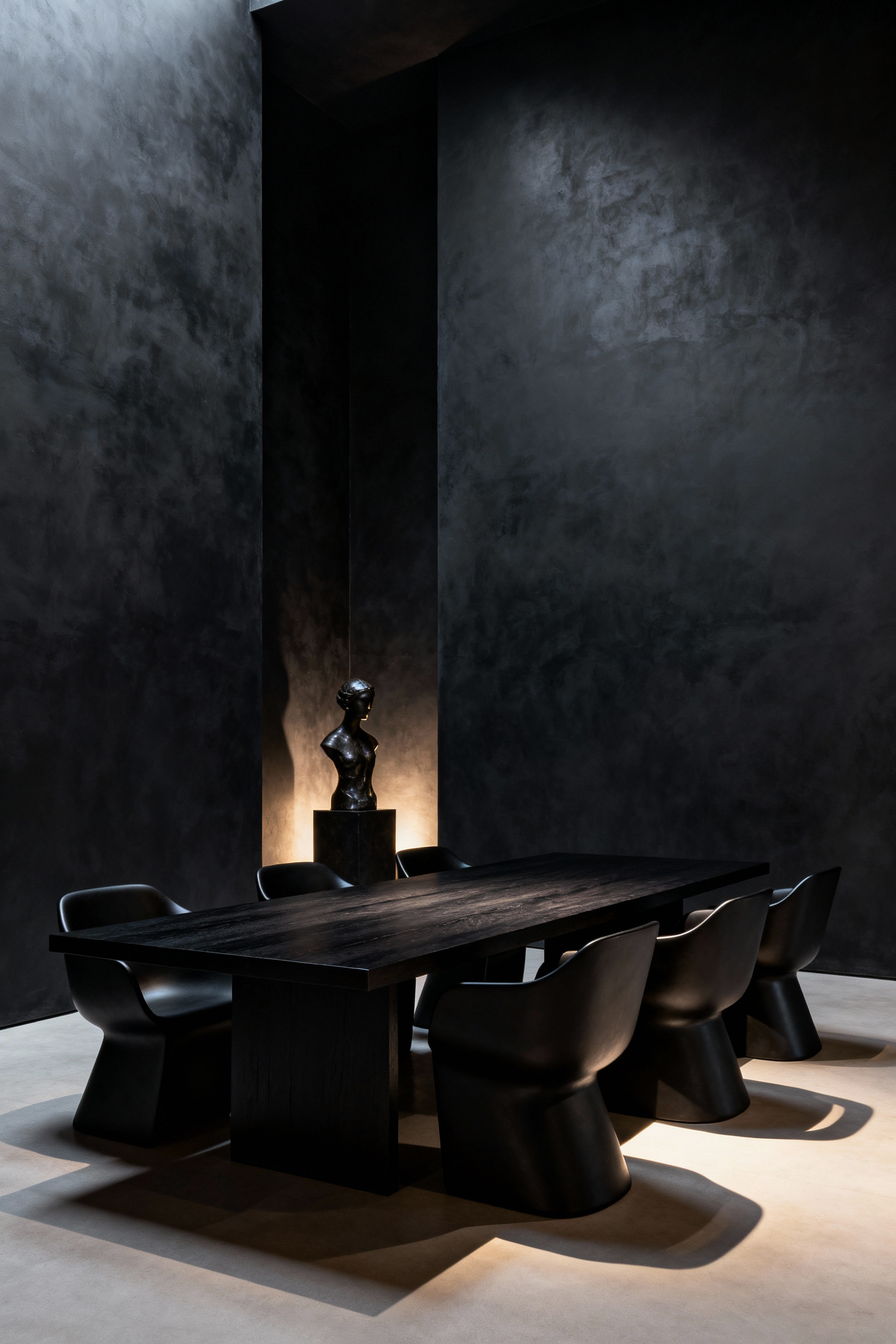
Negative space allows each object to breathe, to assert its own presence and importance. It creates a sense of calm, uncluttered grandeur. It demands discipline—the courage to edit, to remove, to allow the quiet beauty of the void to speak for itself. In the world of gothic contemporary fusion, what you leave out is just as important as what you put in.
18. Carved from Shadow: The Nuance of Darkened Moldings
Architectural details like crown moldings, wainscoting, and ceiling medallions should not be fought with contrasting white paint. Instead, they should be embraced by the darkness. By painting them in the same black as the walls—perhaps in a slightly different finish, like a satin or semi-gloss—they are transformed from decorative afterthoughts into subtle, sculptural elements.

They cease to be lines on the wall and become forms carved from it. The way light plays across their curves and angles creates a rich, textural landscape that adds a layer of historic depth and sophistication. This technique gives the room a sense of permanence and gravitas, as if the entire space were hewn from a single block of beautiful, dark stone.
19. Averting the Abyss: Finding Life in the Monochrome
The danger of a poorly executed black room is that it can feel lifeless, an abyss rather than an embrace. The key to averting this is to ensure a constant and varied play of texture and light. Nothing should be flat. Nothing should be uniform. A limewashed wall, a nubby wool rug, a polished marble surface, a sheer linen curtain—these elements create a landscape for the eye and hand to explore.
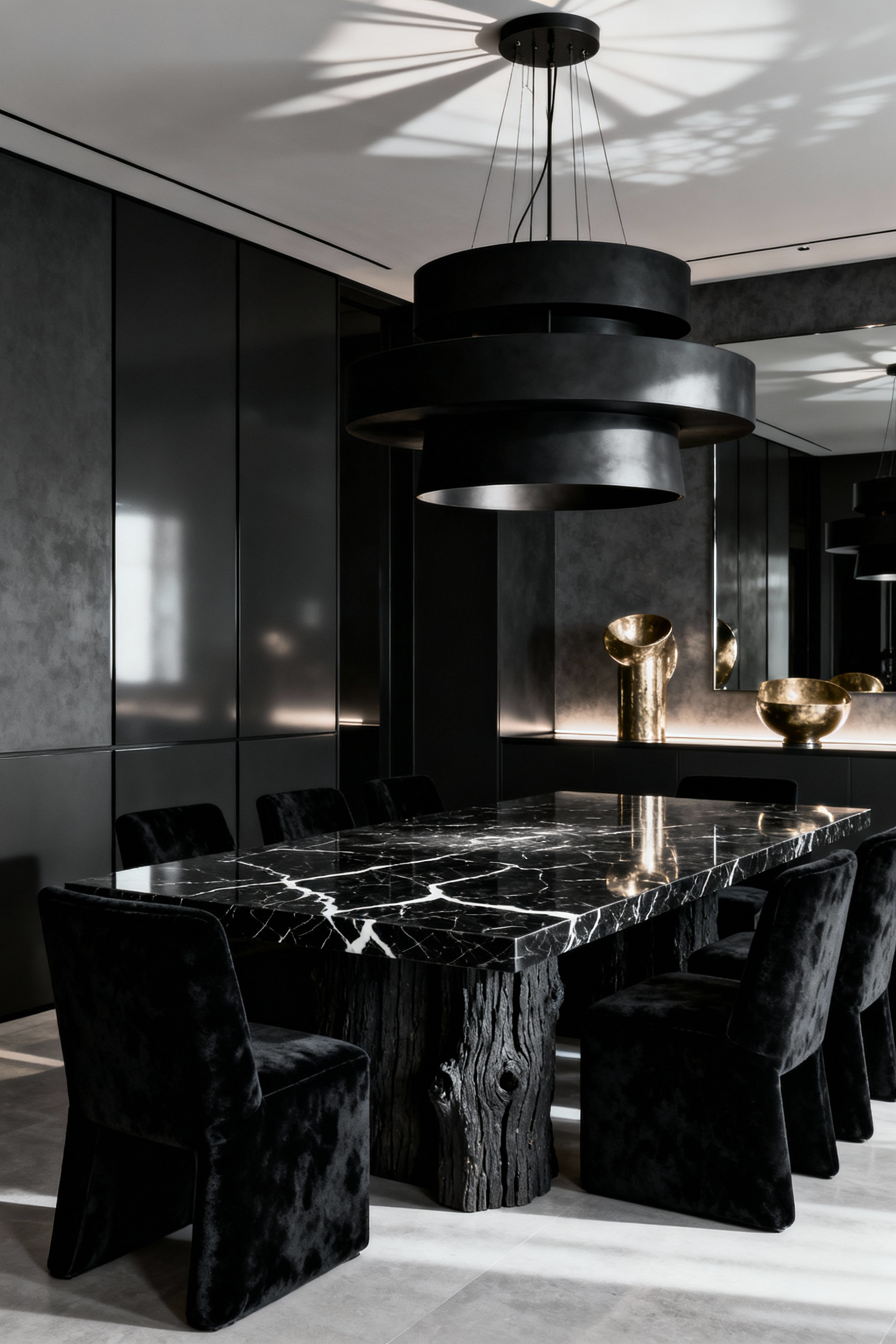
Ensure your lighting is layered and flexible. A room lit only by a single overhead source will always feel stark. A combination of overhead, task, and accent lighting allows you to sculpt the room with light, creating pools of warmth and areas of mysterious shadow. This dynamic interplay ensures the space feels vibrant, shifting, and deeply alive.
20. An Enduring Echo: Crafting a Timeless Narrative
Ultimately, a great black dining room should feel as if it has always been there, and always will be. It is an exercise in creating an enduring aesthetic, a personal narrative that transcends fleeting trends. This is achieved by choosing materials of quality and character, objects with history, and art with soul.
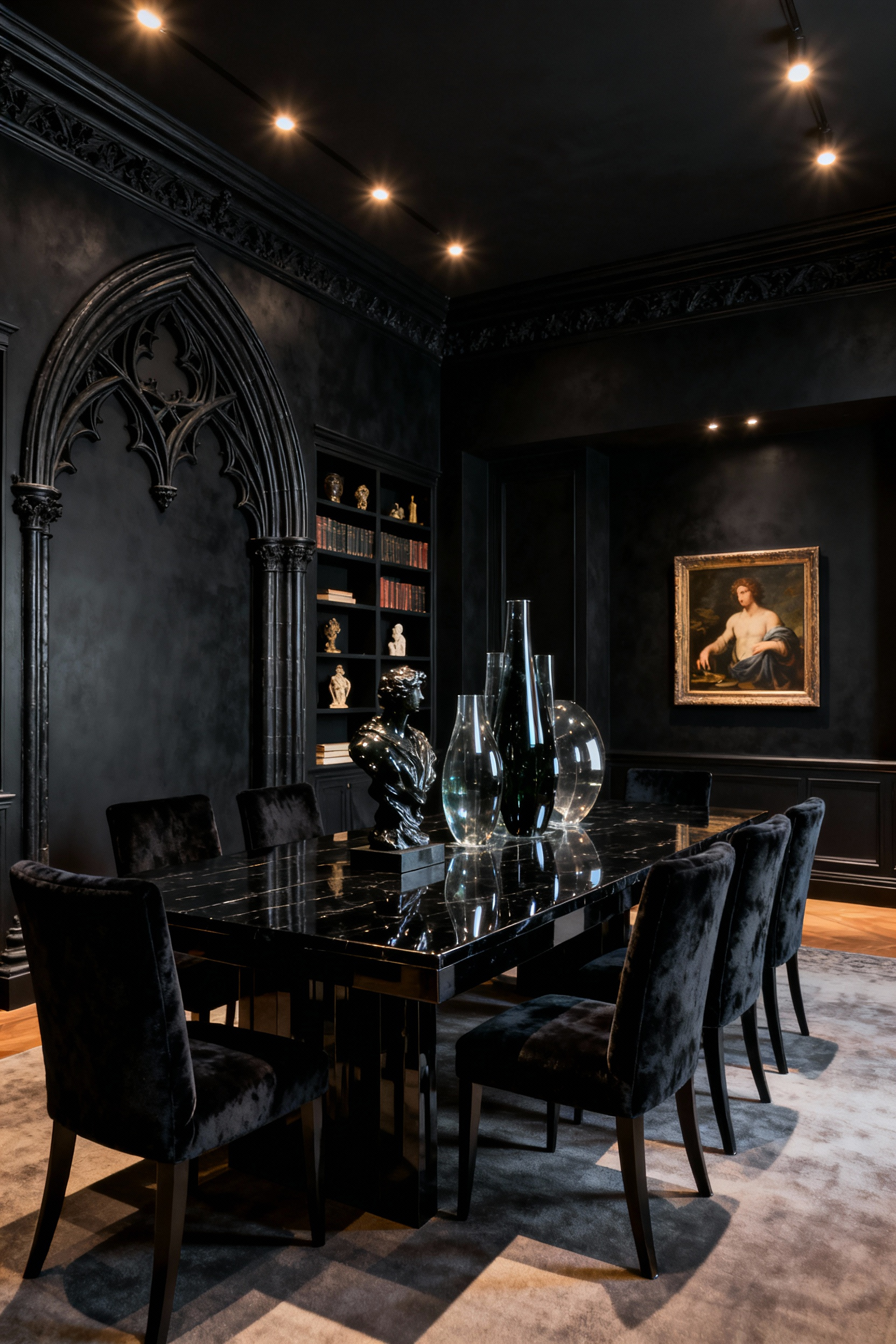
It is about creating a space that will gather its own patina of memories—the wine stains on the tablecloth, the worn spot on a velvet chair, the faint scent of a thousand celebratory dinners. Your dining room is a legacy. Design it not just for a season, but for a lifetime of stories. In the profound and beautiful dark, create a space that will echo with life long after the candles have been extinguished.
Conclusion
We emerge from the shadows, not into the light, but with a deeper understanding of its poetry. To embrace the black dining room is to embrace a more profound way of living—one that values intimacy over exposure, atmosphere over ornamentation, and storytelling over simple existence. It is a bold choice, yes, but it is one that offers incomparable rewards: a sanctuary that nurtures connection, a stage for life’s most meaningful moments, and a timeless expression of personal style.
Do not fear the dark. Command it. Let its velvet embrace be the backdrop against which your own life’s drama—in all its beauty, mystery, and romance—can finally, truly unfold. The night is not an absence of light; it is a canvas, and it is waiting for your hand.