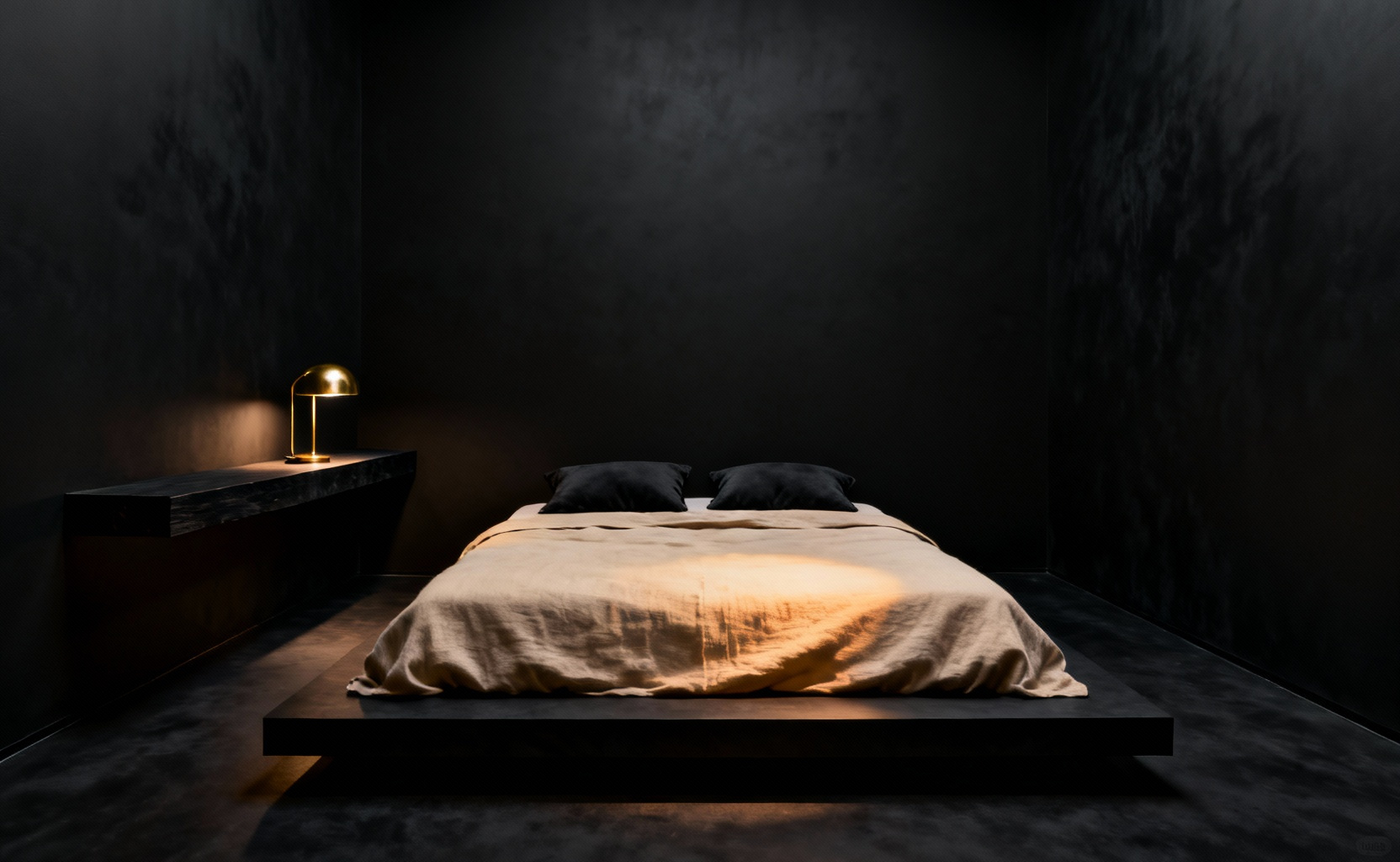

We are often conditioned to view darkness as a void, an emptiness that must be conquered by light. In the realm of emotive design, however, shadow is not an absence; it is a velvet canvas waiting for touch. I recall wandering the dim corridors of a restored Victorian manor, struck by how the low light didn’t obscure the architecture but rather intensified it. The shadows created a heavy, comfortable silence that felt like a physical embrace. This is the Architecture of Shadows. It reframes the black bedroom not as a cave, but as a sophisticated stage for intimacy. If you are seeking deep, atmospheric black bedroom inspiration, understanding how shadow functions is essential.
Consider your bedroom a sanctuary from the relentless noise of the modern world. While white walls vibrate with energy, dark hues absorb chaos. They trigger a primal “cocoon effect,” signaling to the brain that it is time to rest, to dream, and to exhale. However, executing this aesthetic requires a delicate, curatorial hand. Painting a room black without strategy causes the space to fall flat. To breathe life into the abyss, you must master the interplay of texture and flame, turning the room into a living, breathing entity.
In this guide, we explore the art of sculpting the dark. We will look at banishing harsh overhead beams in favor of pools of warm, amber light that carve dimension from the void. We will examine how tactile elements—like rough linen and plush faux fur—prevent flatness, and how metallic accents act as glimmering jewels in the dusk. Do not fear the night. Instead, design a space where the shadows do not haunt, but rather hold you.
1. The Infinite Void: Understanding how deep tones expand spatial perception
Abandon the fear that darkness confines; in truth, deep shadows liberate. I once transformed a cramped, windowless study into a boundless sanctuary simply by drenching it in obsidian. Matte black paint creates this “Infinite Void.” Because the finish absorbs light rather than reflecting it, the room’s corners dissolve and the boundaries vanish. The eye wanders endlessly into the depth, perceiving a space that rivals the vastness of the midnight sky.
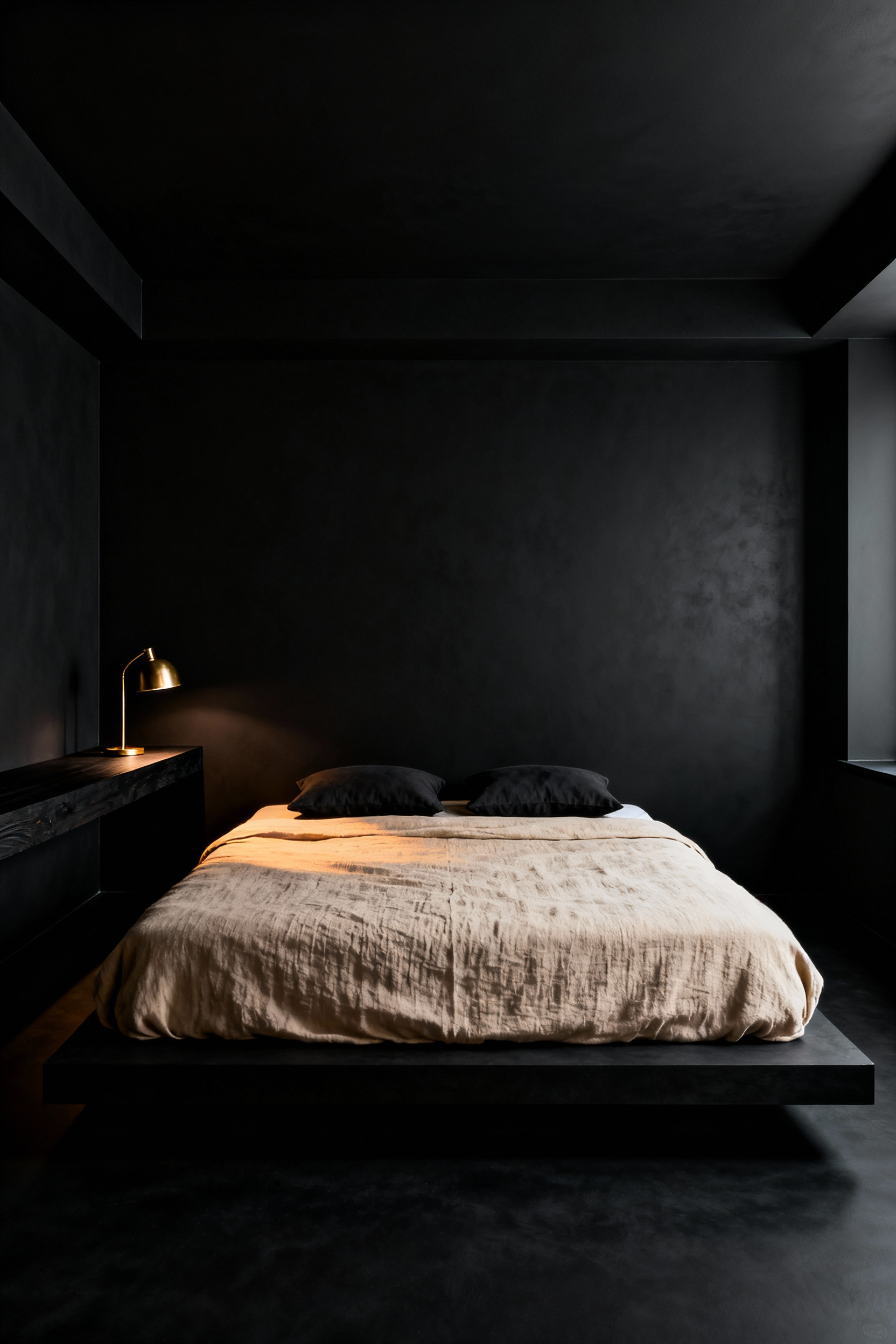
To master this dramatic expanse, you must sculpt the darkness with intention. A void demands an anchor to prevent it from becoming an abyss.
- Control the shadows: Layer ambient glow with sharp accent lights to highlight architectural bones or beloved artifacts.
- Create ghostly contrast: Position a pristine white duvet or a silver-framed mirror against the black backdrop to force the walls to visually recede.
- Amplify the illusion: Introduce high-gloss surfaces or large mirrors to bounce light deep into the shadows.
Through these contrasts, the room becomes a stage. The darkness does not crush you; it cradles you in sophisticated mystery.
2. Achieving Monochromatic Depth: Texture as Color
In the absence of hue, texture claims the throne. A room painted in midnight requires a symphony of surfaces to escape the sensation of a void. I once stood in an all-black parlor that felt like a tomb simply because it lacked tactile friction; do not make this mistake. Instead, treat light reflection as your pigment. You must orchestrate a collision of materials where each surface manipulates the shadows differently.
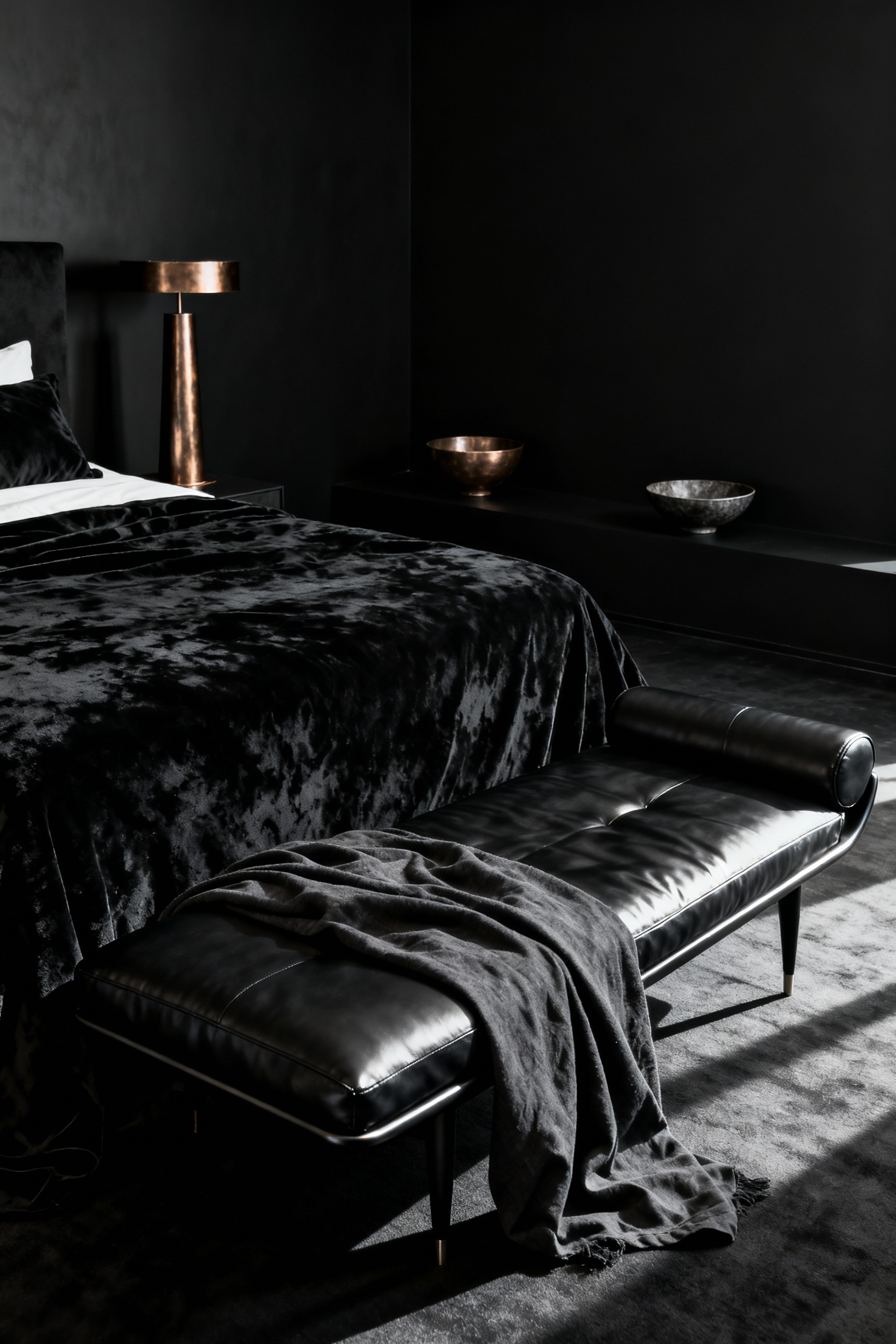
Construct your narrative by assigning specific roles to your materials:
- Sleek Leather: Anchors the room. Use it on headboards to catch the moonlight and provide a reflective, structural edge.
- Plush Velvet: Absorbs the light. Cast it across ottomans or pillows to create deep, matte pockets of opulent shadow.
- Raw Linen: Softens the drama. Drape it as bedding to introduce an organic, airy breath that prevents the atmosphere from becoming suffocating.
This juxtaposition creates visual depth without a single drop of color. The matte finish of linen breaks the slickness of leather, while velvet bridges the gap with warmth. Embrace this friction. It turns a dark room from a cave into a masterpiece.
3. The Matte Manifesto: Choosing the right paint finish
To capture the soul of the night, you must banish the glare. Glossy surfaces reflect the chaos of the world, shattering the mood with harsh highlights. Instead, demand a Flat, Ultra-Matte, or Dead-Flat finish. This texture swallows light, transforming cold drywall into a soft, infinite abyss. The result is a “velvet wall” effect, a rich backdrop that creates visual silence and blurs the hard edges of your reality. This profound matte finish also forgives architectural sins, effortlessly cloaking minor dents and uneven plaster in shadow.
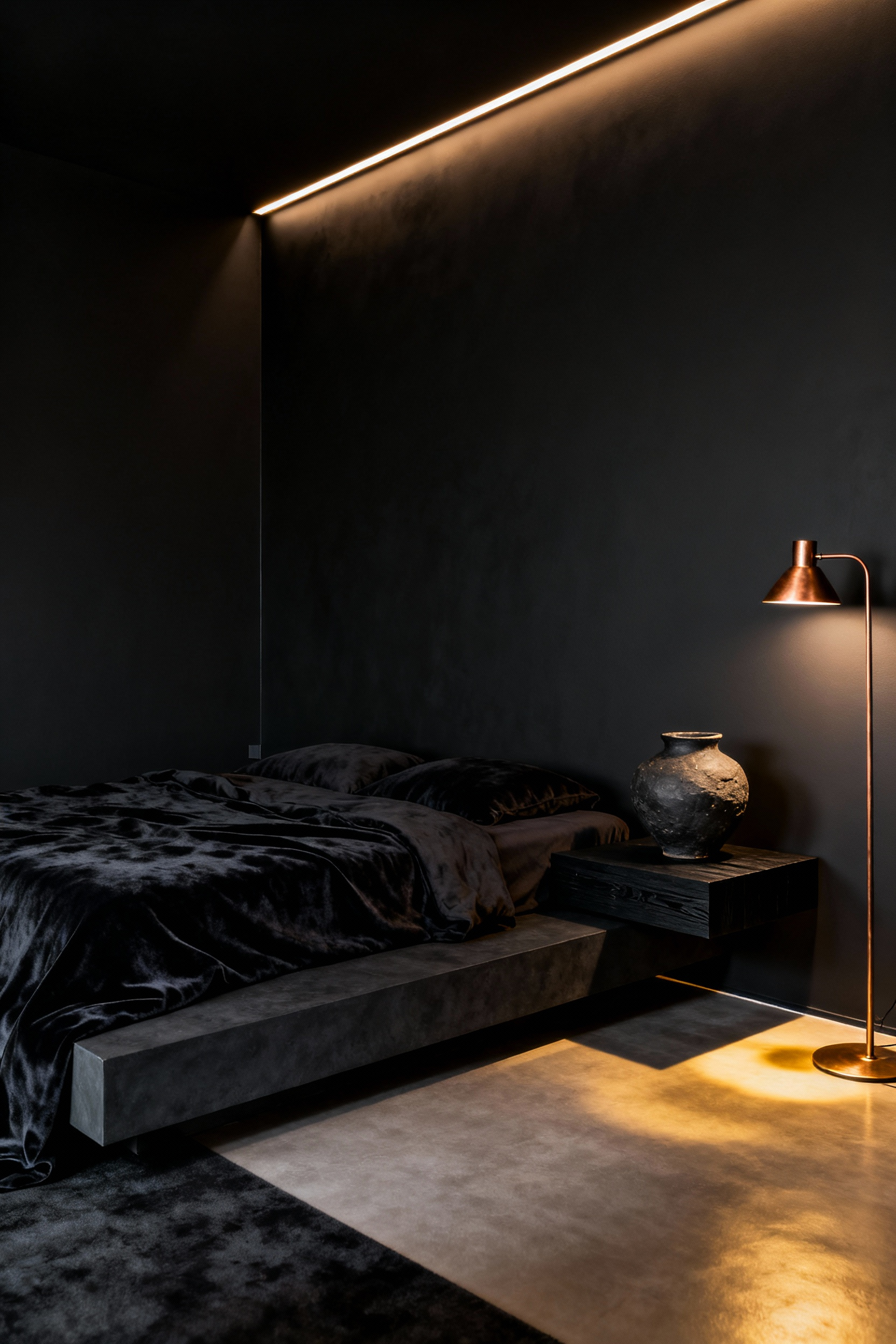
Do not mistake darkness for fragility, however. In my early restorations, I feared the chalky nature of flat paints, but modern alchemy offers a solution. Seek out premium “scrubbable” matte formulas to balance romance with reality. These high-performance options deliver:
- Zero Sheen: For that deep, mineral aesthetic.
- Durability: Resisting scuffs in your private sanctuary.
- Maintenance: Allowing for easy cleaning without polishing the surface.
Select these superior blends to ensure your bedroom remains a fortress of solitude. The darkness should hold you, not the dirt.
4. Victorian Modern Silhouettes: Merging antique curves with contemporary edge
Shadows crave form. In a monochrome room, your furniture must cut a distinct silhouette against the darkness. Select a singular, architectural anchor—perhaps a Baroque-style headboard or a looming armoire—to command the space. Do not let the finish age the room; refinish these finds in high-gloss black lacquer or ultra-matte paint. This technique ghosts the history, preserving the romantic curve while stripping away the dust of the past.
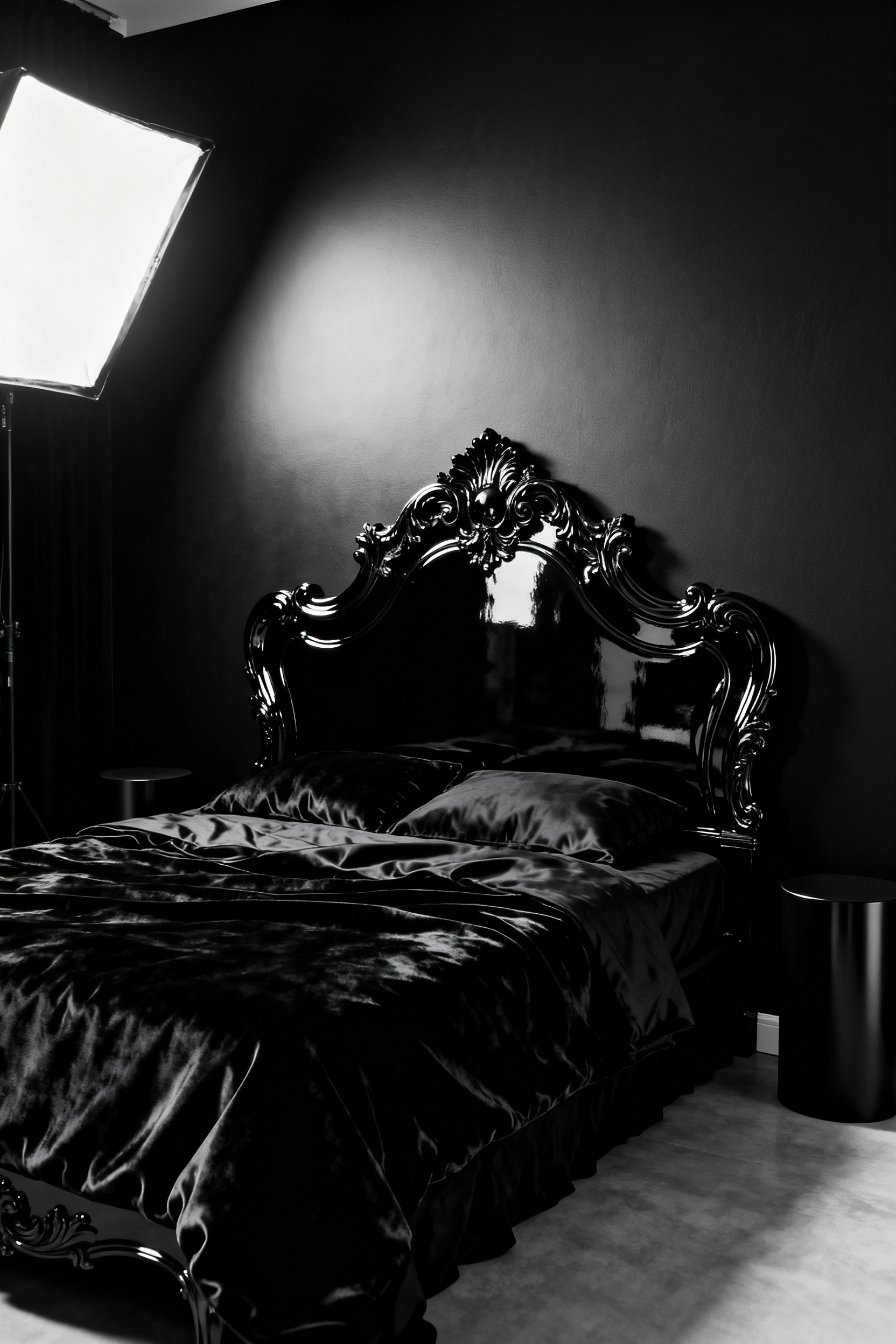
The magic lies in the tension between eras. I once salvaged a decaying Victorian armchair, reupholstering it in stark black velvet to sit beside a cold, chrome table; the contrast was electric. To achieve this specific atmospheric balance:
- Restrict the ornate: Dedicate only 20% of the room to antique shapes to prevent a museum-like feel.
- Modernize the backdrop: Surround your focal piece with clean lines and cool metals like iron or steel.
- Simplify the textiles: Swap busy period patterns for solid, luxurious textures like silk or leather.
The antique curve becomes a deliberate accent, ensuring your sanctuary feels curated and mysterious rather than cluttered.
5. The Fifth Wall: Painting the ceiling black
Treat the ceiling not as a limit, but as a canvas for the infinite. Painting this “Fifth Wall” black conjures a womb-like sanctuary, shielding you from the chaotic world outside. However, the finish dictates the mood. Opt for a dead-flat or ultra-matte paint. This absorbs light rather than reflecting it, creating a velvety void that eliminates glare and softens the room’s edges. Furthermore, consider extending the darkness down to the crown molding. This blurs architectural lines, allowing your eye to rest in a seamless, shadow-filled retreat that feels less like a room and more like a warm embrace.
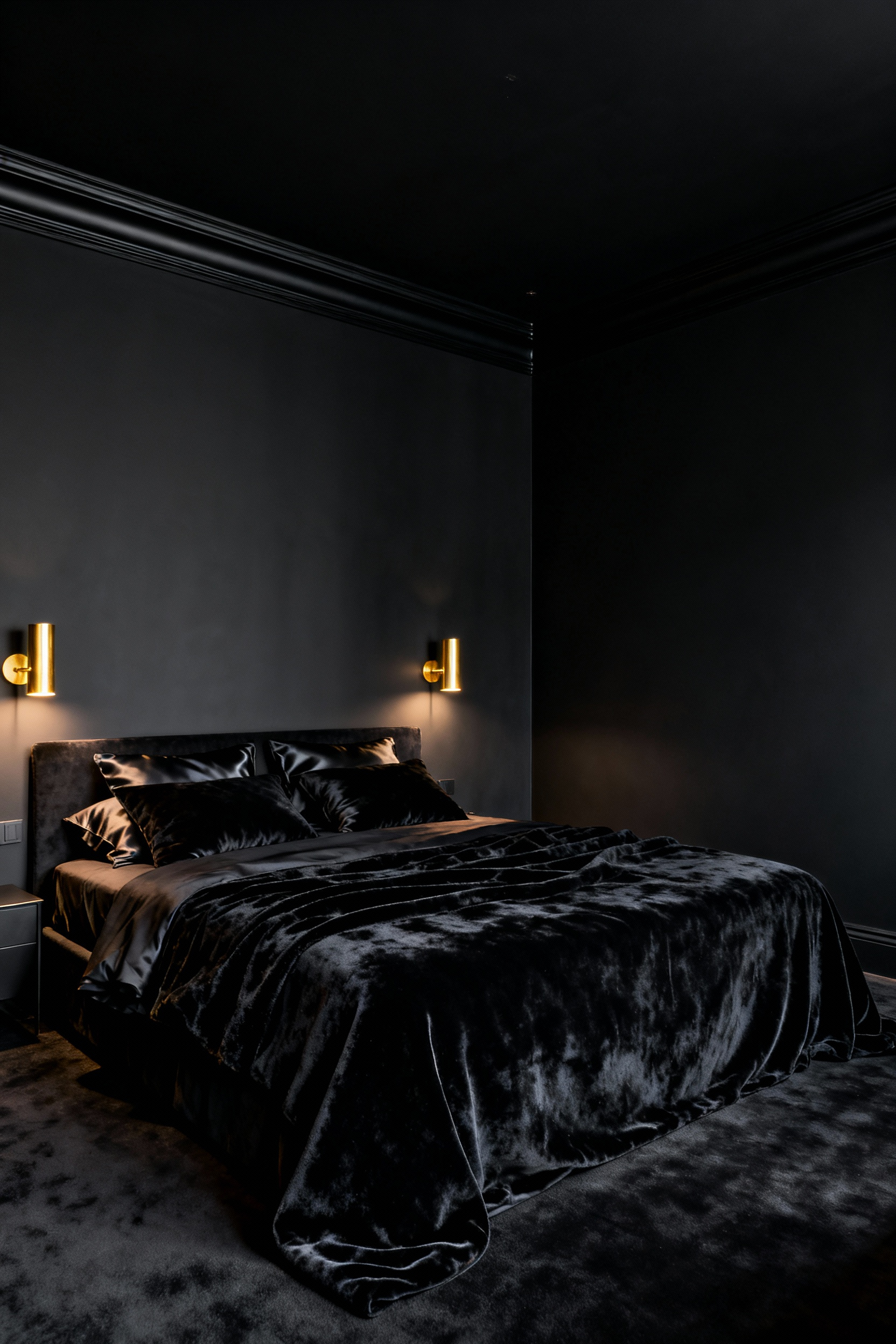
Darkness demands specific illumination to truly sing. Since black swallows light, you must introduce warmth through strategic layers. Banish harsh overhead fixtures that create an interrogation room effect. Instead, use low-slung pendants and floor lamps with warm bulbs to carve out intimate pools of glow. In my own library, the charcoal ceiling visually lowers the room’s height, turning a cavernous space into a cozy nook suitable for reading Poe. This contrast between the dark canopy and warm light grounds the space, proving that shadows do not haunt—they hold.
6. Metallic Alchemy: Slicing through the darkness with unlacquered brass
Shadows demand a luminous counterweight. In my own designs, I rely on metallic alchemy to prevent a pitch-black room from feeling like a cold tomb. Treat unlacquered brass and antique gold not merely as hardware, but as the room’s jewelry; these elements slice through the visual weight of dark walls with the precision of a gilded blade. Avoid high-polish, factory finishes that scream of the artificial. Instead, prioritize patina over polish to invite a sense of history into the void.
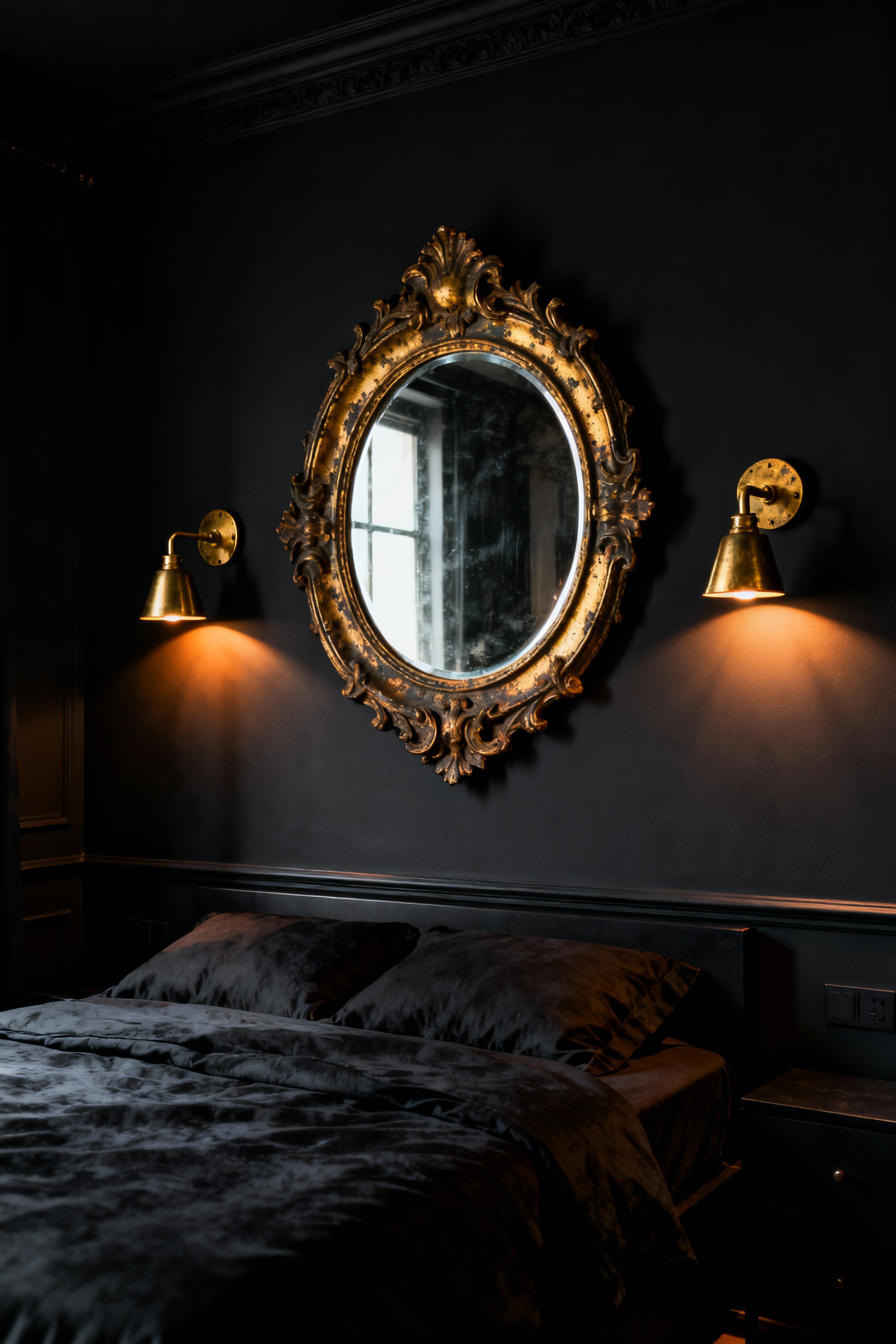
To master this dramatic contrast, focus on three strategic applications:
- Anchor with Light: Select antique gold chandeliers or sconces to cast a warm, moody glow that prevents the space from feeling enclosing.
- Invite the Touch: Install unlacquered brass knobs and faucets; these living finishes oxidize over time, deepening into a rich, sophisticated character with every use.
- Frame the Reflection: Utilize gilded mirrors as focal points to catch stray light and bounce it back into the abyss.
Mix your metals to build depth. Allow the raw, dull glow of aged brass to sit beside the matte silence of black furniture. This textural tension ensures the room feels ancient, mysterious, and entirely alive.
7. Mastering Chiaroscuro Lighting
Treat your black bedroom as a Renaissance canvas. You must sculpt with shadow rather than banish it. This technique, Chiaroscuro, transforms empty darkness into rich, velvety mystery. I once stood in a candlelit cathedral in Prague and realized that true drama relies on what remains unseen. To achieve this painterly depth, prioritize three strategic adjustments:
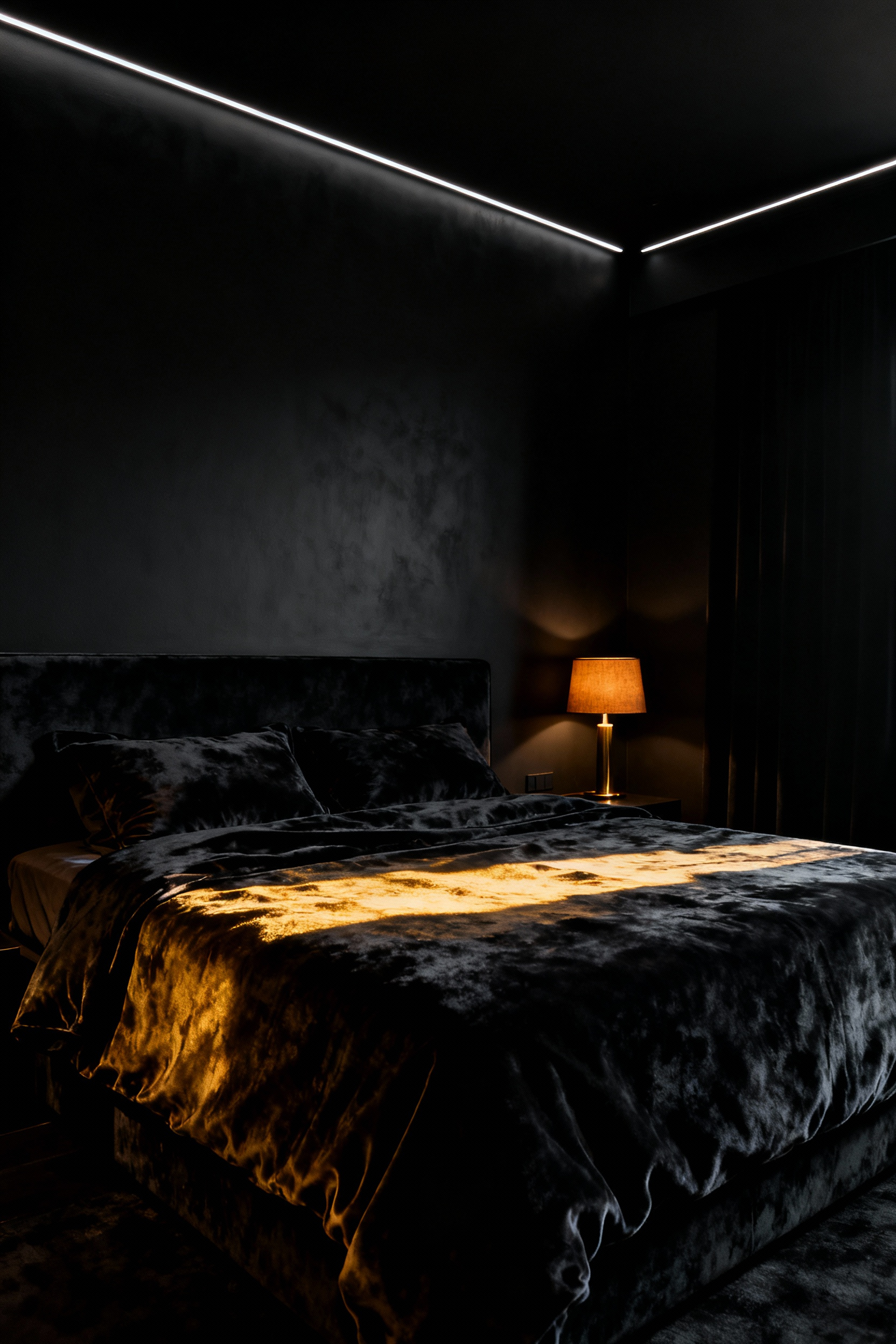
- Select ultra-warm bulbs (2700K–3000K) to cast a golden, candlelight glow that creates intimacy against the dark walls.
- Install dimmers on every fixture to strictly control the contrast between the void and the spark.
- Aim directional spots at tactile surfaces like matte paint or velvet cushions to emphasize texture.
Accent lighting therefore becomes your primary tool. Ignore the urge to flood the room with lumens. Instead, let narrow beams catch the glint of a gold frame or the weave of a tapestry. These isolated pools of light draw the eye and create an emotional anchor within the gloom. The result is not a dark cave, but a sanctuary of secrets and warmth.
8. Dark Academia Styling: Curating vintage books and curiosities
The Dark Academia aesthetic craves a library of secrets, yet chaos lurks in the shadows of a small bedroom. Treat your black walls as a velvet curtain for a stage, allowing a few curated pieces to command attention. Select a stack of three leather-bound volumes for your nightstand and arrange them vertically. This creates an architectural pedestal for a single, dramatic object—perhaps a miniature bust or an antique clock. In my own study, I rely heavily on gold-toned accents; the metal gleams against the obsidian backdrop, transforming simple objects into valuable artifacts rather than dusty clutter.
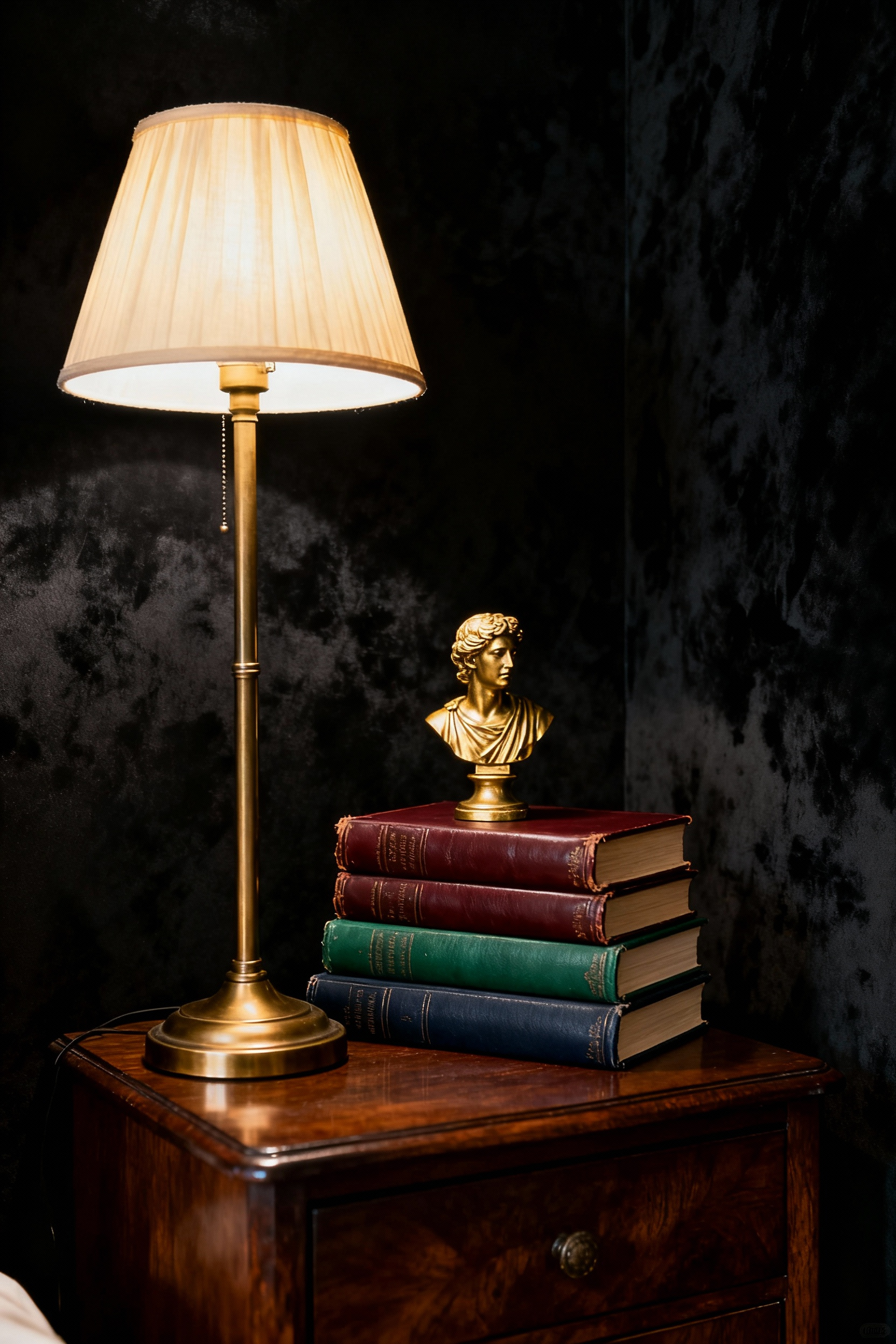
Extend this curatorial discipline to your shelves to prevent the darkness from feeling oppressive. A riot of mismatched spines creates visual noise, so harmonize your hardcovers by deep, muted hues like burgundy and moss to form unified blocks. Punctuate these blocks with intentional breaks to maintain the atmosphere:
- Insert a brass candlestick between book sections to catch the light.
- Move flat ephemera, such as botanical sketches or old maps, into dark frames on a gallery wall.
- Keep desk surfaces clear for writing and dreaming.
By lifting the collection off flat surfaces, you allow the room to whisper its stories rather than shout them.
9. The Ghostly Gallery: Framing art against a charcoal backdrop
Treat your charcoal wall as a velvet void, a dramatic stage that demands a specific directorial hand to keep the darkness from swallowing your décor. To frame your narrative effectively, choose one of two distinct paths:
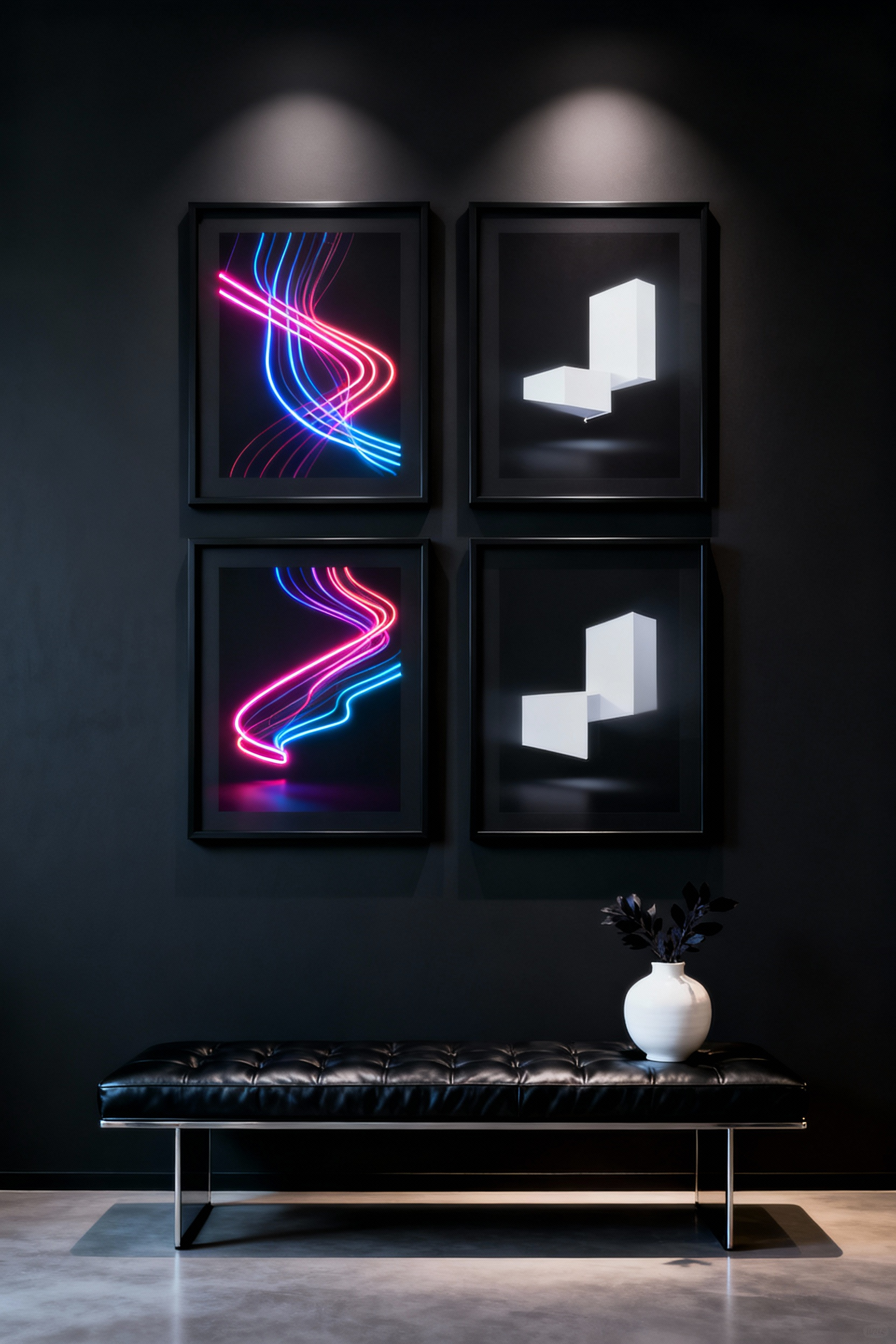
- The Ghosting Effect: Select matte black frames without mats. The hardware dissolves into the shadow, making vibrant or white-heavy art appear to float in suspended animation.
- The Luminous Anchor: Use wide white mats or gilded metallic frames. These create a sharp, luxurious boundary, slicing through the darkness to add structure and light.
In my own study, I utilize the ghosting technique for a large, pale abstract piece; it emerges from the gloom like a specter, haunting and beautiful. Regardless of your framing choice, remember that deep hues devour natural light. You must impose illumination. Install brass picture lights or directed sconces above your collection to create pools of radiance. This focused glow transforms high-contrast art into a beacon, ensuring your gallery feels curated rather than consumed by the abyss.
10. Organic Contrast: Bringing life to the noir with botanicals
Even the deepest abyss requires a pulse. While black paint creates a canvas for shadow, organic matter provides the necessary heartbeat. Without this contrast, a noir room risks becoming a tomb rather than a sanctuary. I once sought refuge in a Victorian conservatory where dark ironwork framed verdant ferns; you must replicate that tension here. Anchor your darkest corner with a large, deep green entity like a Fiddle-Leaf Fig or Olive Tree. Their verticality mimics gothic arches, while their vibrant life force cuts through the gloom.
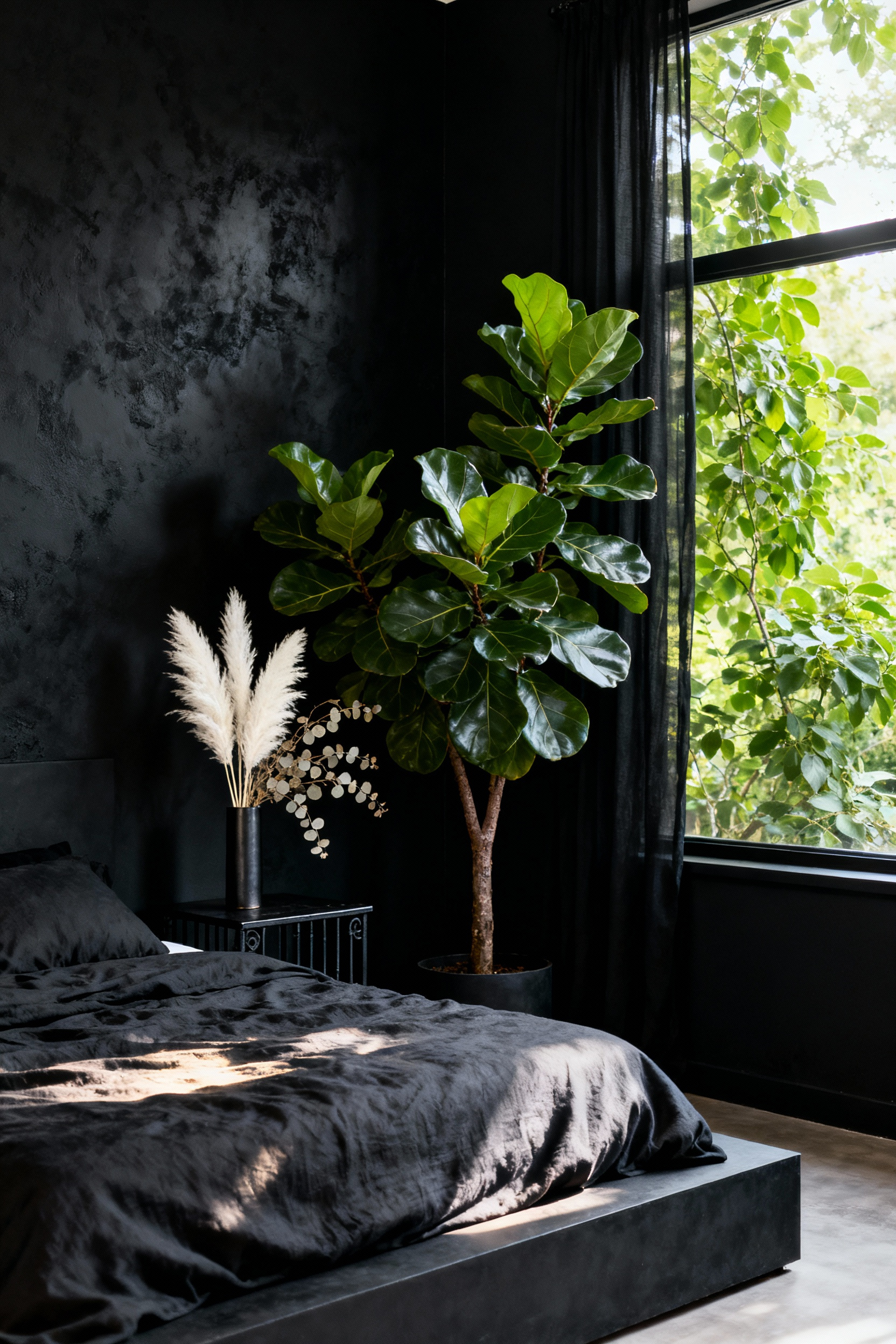
Next, embrace the spectral beauty of dried botanicals. Bleached pampas grass or white straw flowers act as phantom silhouettes against charcoal walls, offering softness where there was only edge. To master this balance:
- Curate the vessel: House these elements in raw terracotta or matte black stoneware to ground the vignette with tactile earthiness.
- Layer the shelves: Allow trailing ivy to spill over nightstands, creating organic curves that oppose the room’s sharp geometry.
- Select moody art: Hang botanical illustrations with dark backgrounds to bridge the gap between nature and the void.
This interplay between the living and the preserved transforms a sterile space into a living poem.
11. The Softening Layer: Grounding with high-pile rugs
A true sanctuary demands absolute silence. Hard floors create a hollow echo that shatters the mood, but a softening layer drowns out the cacophony of the modern world. Anchor your black bedroom with a dense, high-pile rug. Select natural wool with a pile height of 10-18mm to swallow footsteps and dampen ambient noise, effectively transforming your space into a hushed vault. I often imagine my own bedroom as a cocoon against the storm; the floor should feel like walking on moss in a midnight forest, not cold timber.
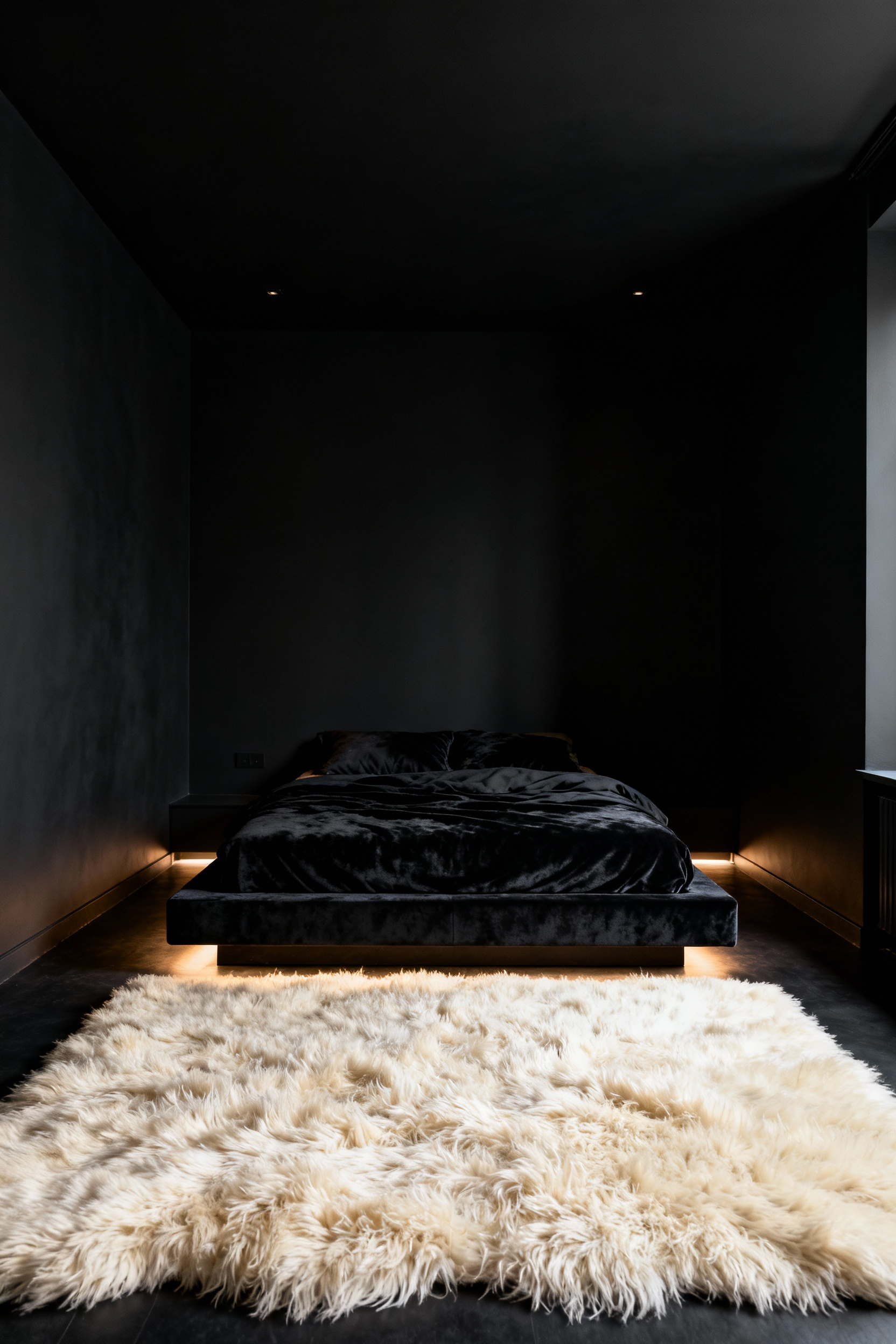
Visual weight carries as much importance as auditory peace. A deep black rug acts as a gravitational pull, grounding the room’s floating shadows and preventing the design from feeling flat. However, skimpy proportions destroy the illusion of luxury. Supersize your selection so the fibers extend past the bed frame and beneath the nightstands. To truly banish the cold reality of the floor, layer a thick, high-quality rug pad underneath. This invisible addition serves two masters:
- It absorbs the sharp impact of footsteps for superior acoustics.
- It adds a decadent, sinking softness underfoot.
- It protects the weave, ensuring your dark textile endures.
12. Bedding Noir: Layering black-on-black linens
To sleep in total darkness is to return to the womb of the night, yet true drama requires nuance. When color vanishes, texture must narrate the story. You must banish the void by layering conflicting finishes that catch the light differently. Start with the deep, light-absorbing matte of washed linen sheets, then introduce the liquid sheen of silk pillowcases. This juxtaposition prevents your bed from dissolving into a shapeless mass; instead, it builds a sophisticated landscape of shadows.
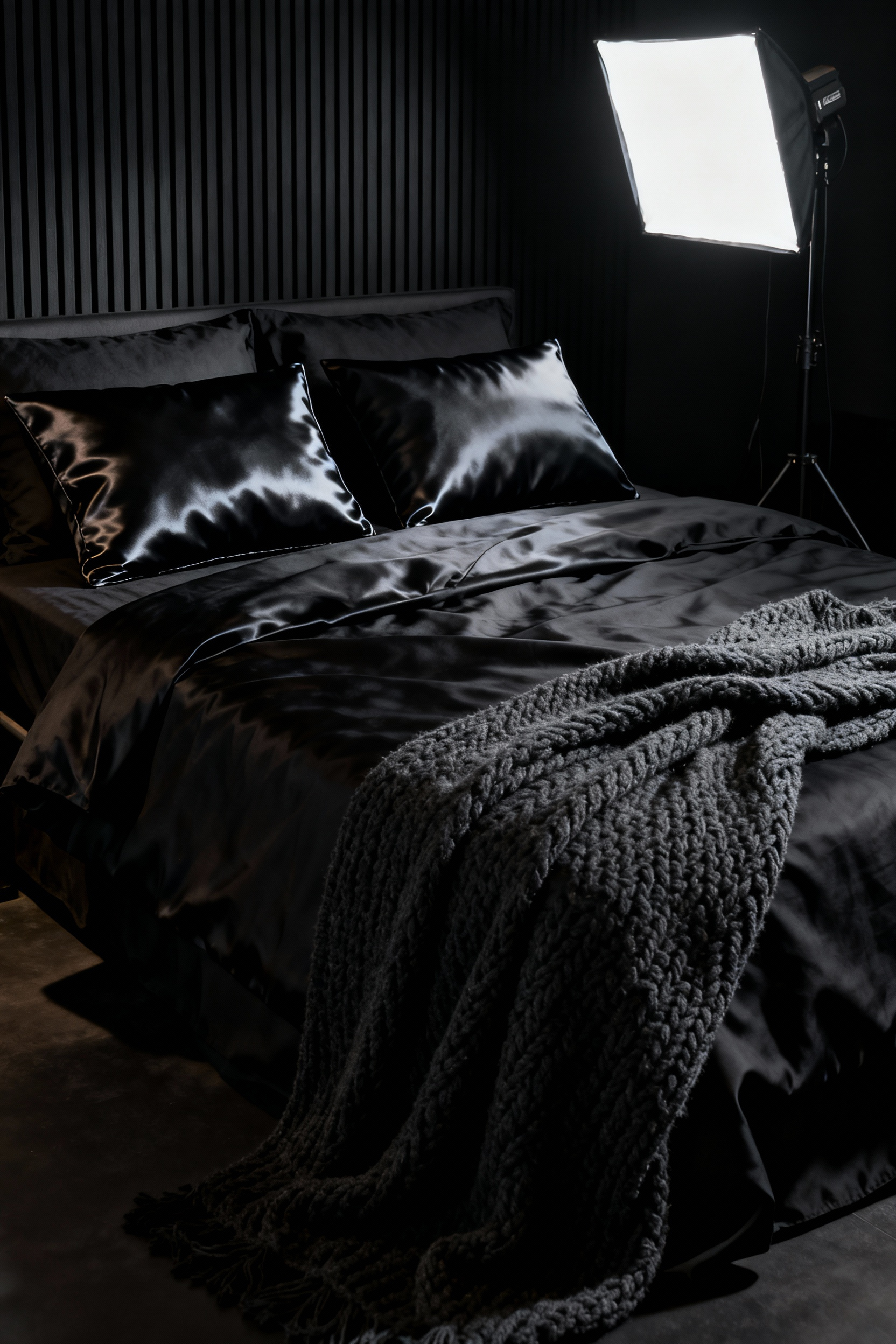
In my own sanctuary, I rely on tactile variation to soften the brooding atmosphere without breaking the spell. Construct your bedding noir using this hierarchy of touch:
- The Foundation: Breathable matte percale or linen to ground the look.
- The Weight: A crushed velvet duvet to anchor the space with gothic luxury.
- The Finish: A chunky waffle-knit or faux fur throw draped casually at the foot.
Finally, illuminate these distinct weaves with warm, low-level lamp light. The golden glow will catch the ridges of the knit and the shimmer of the velvet, turning a monochromatic bed into a living masterpiece of depth and mystery.
13. Mirrors and Mystery: Strategic placement of antique glass
In a room painted the color of midnight, light becomes a precious commodity. Capture the flicker of a flame with antique glass to manipulate this scarcity. Unlike modern mirrors, vintage pieces possess a ghostly patina that acts as a natural filter. This oxidation softens the candlelight into a romantic haze rather than a harsh glare. Place a heavy candelabra directly before a tarnished looking-glass. Instantly, you double the warmth. The reflection creates a spectral depth, pushing back the obsidian walls and making the space feel vast and breathable.
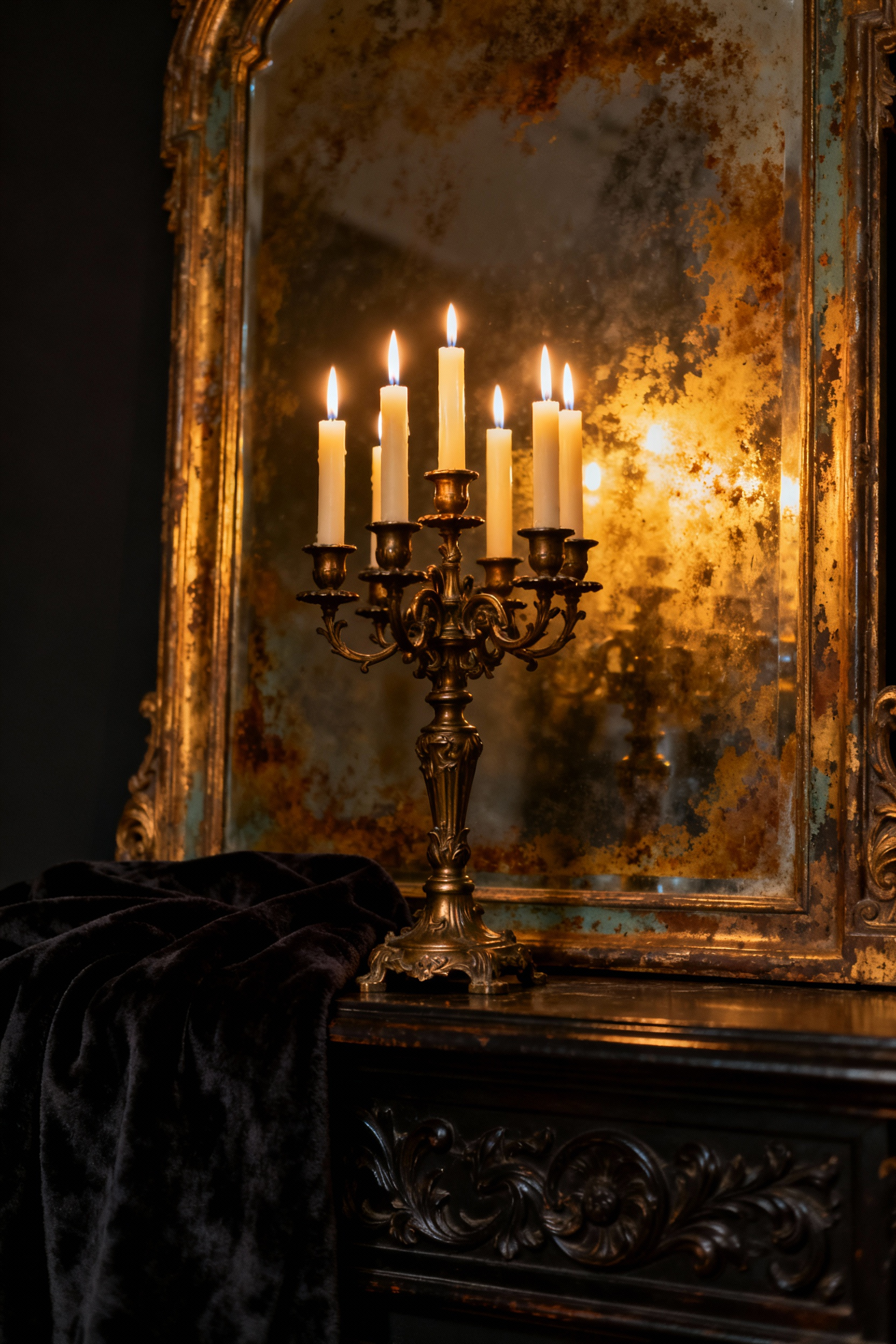
It is easy to lose oneself in the foxed glass of a vanity, imagining the Victorian secrets it holds, yet strategic placement requires more than reverie. To expand your boundaries without sacrificing comfort, adhere to these placement principles:
- Amplify the Space: Hang a large statement mirror to reflect the room’s length, creating an illusion of airy grandeur within the darkness.
- Fragment the Light: Use mirrored trays or cut-glass holders on nightstands to scatter “jazzy” sparks of illumination.
- Guard Your Rest: Position the glass to reflect art or dancing shadows, never the bed itself.
Sleeping in view of one’s reflection unsettles the spirit. Let the mirror hold the mystery, not your restless image.
14. Gothic Romance Window Treatments
Treat your windows as the stage for your nightly narrative. To truly master the Gothic Romance aesthetic, you must embrace the duality of light and shadow through a double-track system. First, command attention with heavy, floor-to-ceiling velvet drapes. Let them puddle on the floor for a look of decadent negligence. These thick barriers block the modern world and insulate your dreams, effectively turning the room into a silent, velvet-lined jewel box.
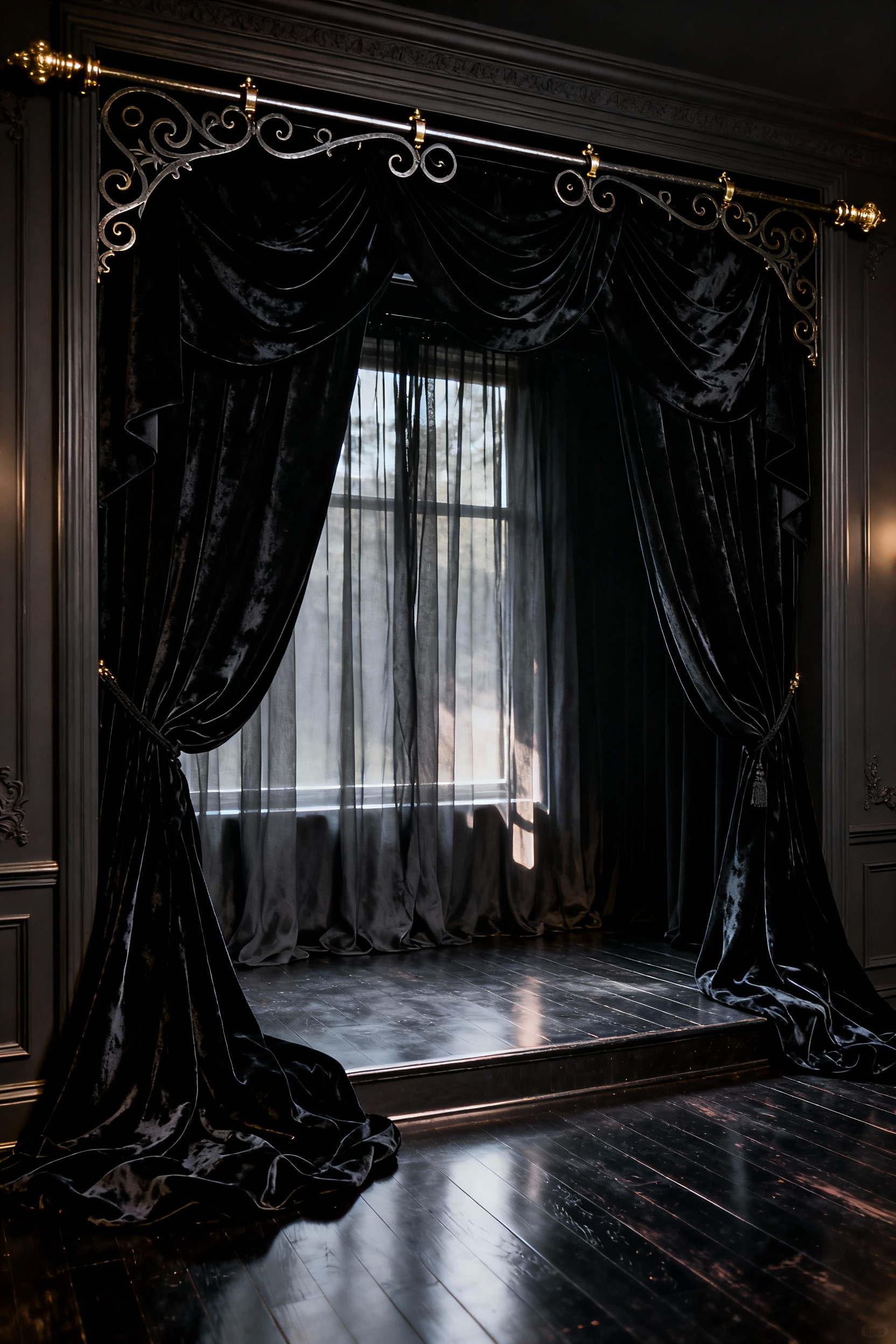
However, do not let the darkness become a void. I often remind clients that shadows require light to exist, so you must soften the severity of blackout curtains with a secondary layer of patterned sheers.
- Select charcoal mesh or black lace to diffuse harsh daylight into a ghostly, romantic glow.
- Choose motifs like damask or celestial embroidery to cast intricate, storytelling shadows across the floor.
- Adjust fabric weight to toggle between “Gothic Glam” accessibility and deep, hermitic seclusion.
By layering these textures, you transform a simple window into a portal of mystery.
15. Scenting the Shadows: Completing the atmospheric experience
Visual darkness demands olfactory depth. A black bedroom remains incomplete without the heavy, grounding whisper of sandalwood, tobacco, and leather. These rich notes conjure a “Dark Academia” aesthetic, instantly transforming stark walls into a sophisticated, architectural sanctuary. I often treat my own sleeping quarters like a scene from a gothic novel, ensuring the air itself possesses a bewitching personality. To replicate this narrative depth, avoid sugary top notes that clash with the shadows. Instead, curate a layered delivery system to maintain the mood:
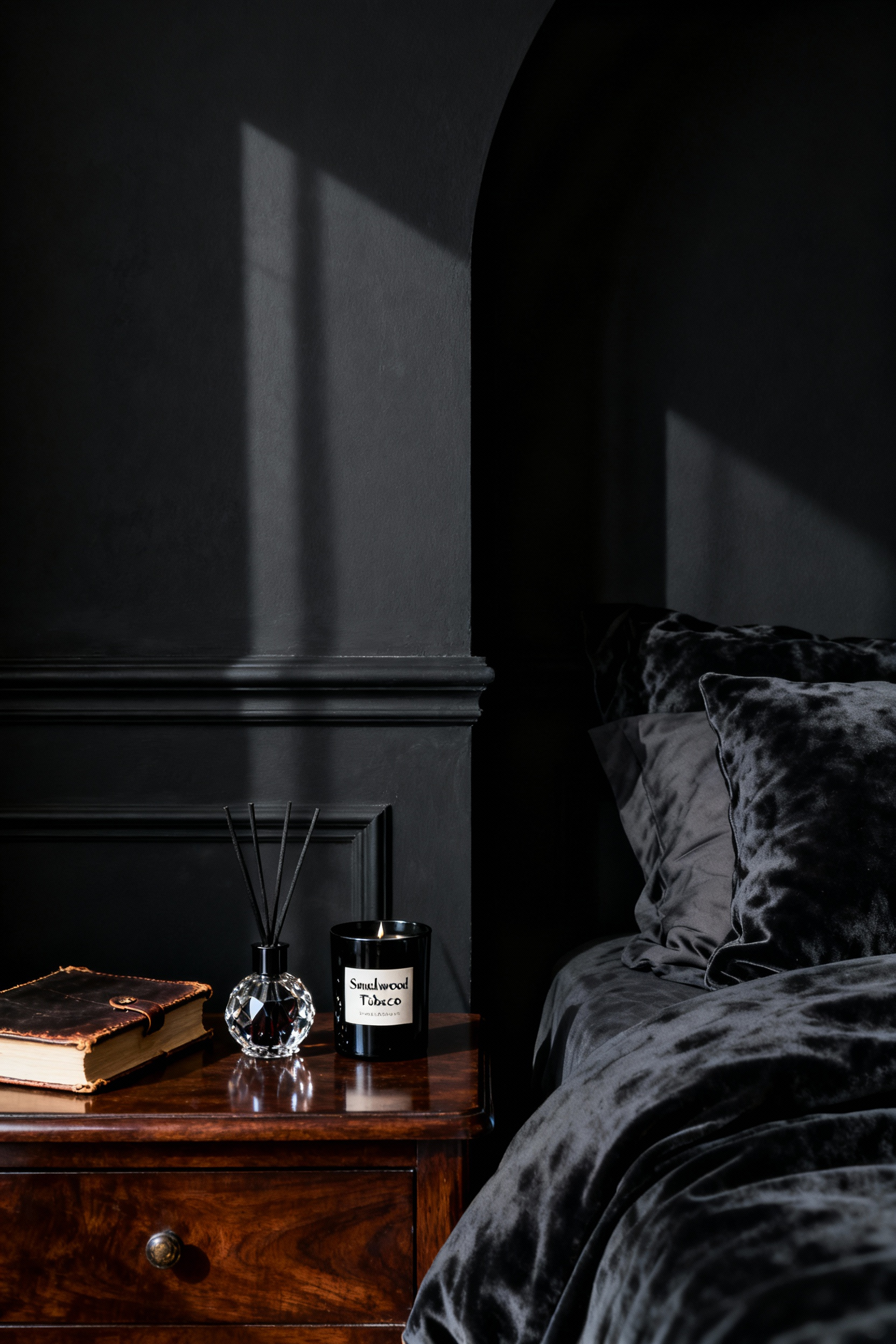
- Reed Diffusers: Deploy these for a subtle, constant backdrop of creamy sandalwood.
- Candles: Ignite tobacco or leather-heavy blends in the evening to intensify the smoky, spicy heart notes.
- Linen Mists: Spray dark bedding or velvet curtains to physically weave the aroma into the room’s texture.
Seek complex blends grounded by patchouli or amber. These elements deepen the atmosphere, ensuring the space feels intimate and cozy rather than overwhelming.
Frequently Asked Questions (FAQ)
What paint finish is best for dark bedroom walls?
The optimal paint finish for dark walls is Dead-Flat or Ultra-Matte. These finishes absorb light rather than reflecting it, which eliminates glare and hot spots. This creates the coveted “velvet wall” effect, lending a sophisticated, soft texture that prevents the room from feeling glossy or harsh.
How can I make my black bedroom feel cozy instead of cold?
To ensure a black bedroom feels cozy (creating a “cocoon effect”) rather than cold, focus on layered textures and warm lighting. Incorporate tactile materials like velvet, chunky wool knits, and faux fur. Crucially, choose lighting with a very low Kelvin temperature (2700K–3000K) to emit a warm, golden, candlelight glow that contrasts beautifully with the deep black paint.
What accent colors work best with a monochromatic black bedroom palette?
While black is the dominant color, metallic accents are essential. The best accent tones are warm metals, specifically unlacquered brass and antique gold, which provide luminous contrast. For non-metallic accents, use natural materials like deep forest green (for botanicals), warm leather, and subtle contrasts of creamy off-white or light grey linen.
The Architecture of Shadows is not about fear; it is about finding sophistication in silence. By mastering strategic texture placement, metallic alchemy, and the Chiaroscuro technique, you ensure your darkest space is also your most restorative. Embrace the velvet darkness and utilize these 15 techniques to achieve the ultimate black bedroom inspiration—a truly personal sanctuary carved out of the modern chaos.