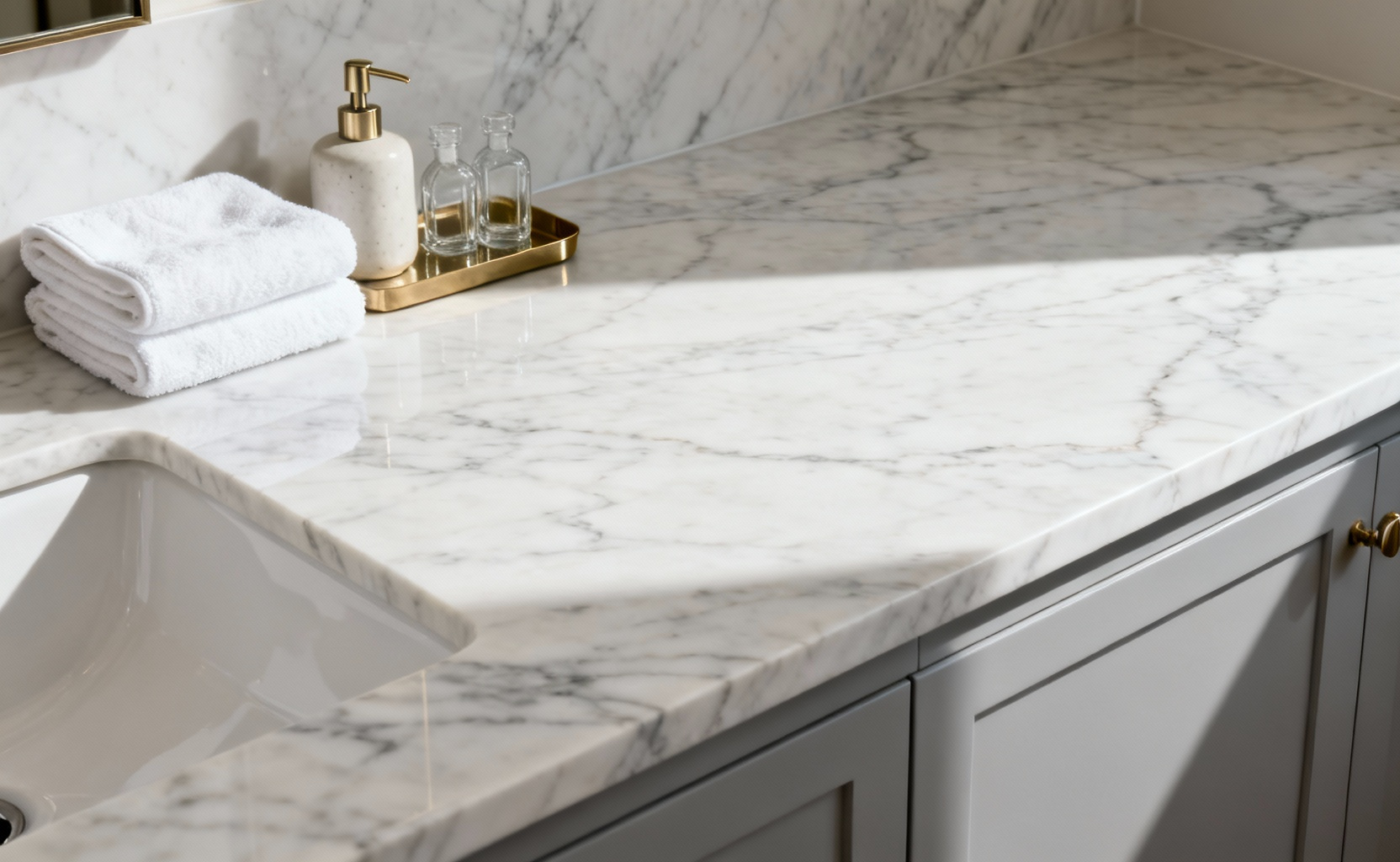
Many homeowners view the bathroom vanity as mere storage. However, intentional bathroom counter decor profoundly impacts your physiological state. The bathroom is often the first environment you encounter after waking. Cortisol levels naturally spike within 45 minutes of rising, a process known as the Cortisol Awakening Response. Unfortunately, a cluttered counter acts as an environmental stressor during this peak. Visual chaos pushes your body into a low-grade fight-or-flight response immediately.
Beyond physiology, disorganized decor drains cognitive resources. Psychologically, this mental fatigue is driven by the Zeigarnik Effect. Your brain perceives scattered items as incomplete micro-tasks. Therefore, an uncapped tube signals an unresolved “to-do” item. Instead of a calm ritual, your mind processes constant demands. Thus, vital mental energy is depleted before the workday actually begins.
Fortunately, intentional design can resolve this paradox effectively. By leveraging neuroaesthetics, we can transform a chaotic vanity into a supportive sanctuary. The human brain craves symmetry and order to feel safe. This guide reveals how to curate a space that prioritizes clarity. We will examine strategies to reduce visual noise and regulate cortisol. Ultimately, your environment should serve as a foundation for total well-being.
The ‘Silent Space’ Philosophy: Why 40% of your vanity surface must remain empty for mental clarity
True visual harmony requires a specific mathematical balance. The “Silent Space” philosophy relies on the 60/40 rule. This principle dictates that forty percent of your surface must remain empty. This negative space transforms from wasted area into a deliberate design element. It provides a necessary visual pause for the eye.
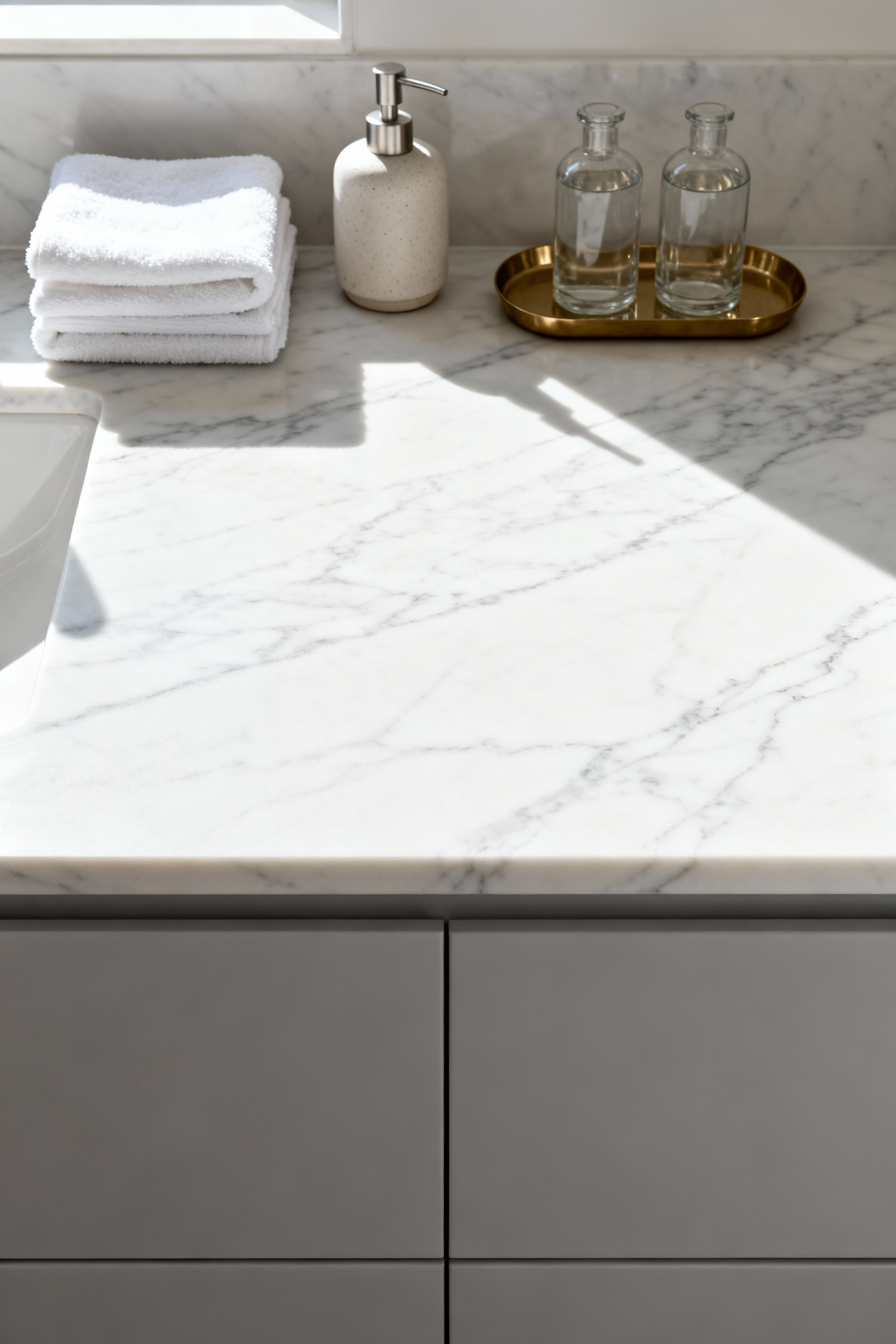
Cognitive science supports this reduction in decor. Cluttered environments inherently increase the brain’s cognitive load. The mind perceives dense surfaces as chaotic. Conversely, maintaining adequate whitespace creates a “Breathing Room Effect.” This openness helps lower cortisol levels during your morning routine. The counter becomes a psychological buffer zone, allowing you to reset.
Finally, emptiness acts as a luxurious accessory. High-end retailers use vast open space to signal value. Similarly, a clear vanity elevates your remaining items. A single, high-quality soap dispenser becomes a focal point rather than lost debris. The “Silent Space” proves that a curated life is calmer than an accumulated one.
The Grounding Base: Anchoring visual chaos with heavy travertine or marble ‘Altar Trays’
Bathroom counters often suffer from visual chaos. Small, branded bottles create frantic energy. Therefore, you need a monolithic anchor to settle this noise. Heavy travertine or marble trays provide substantial mass. Unlike lightweight ceramics, dense natural stone physically grounds the arrangement. The tray acts as a “heavy” base, unifying disparate items into one cohesive landscape.
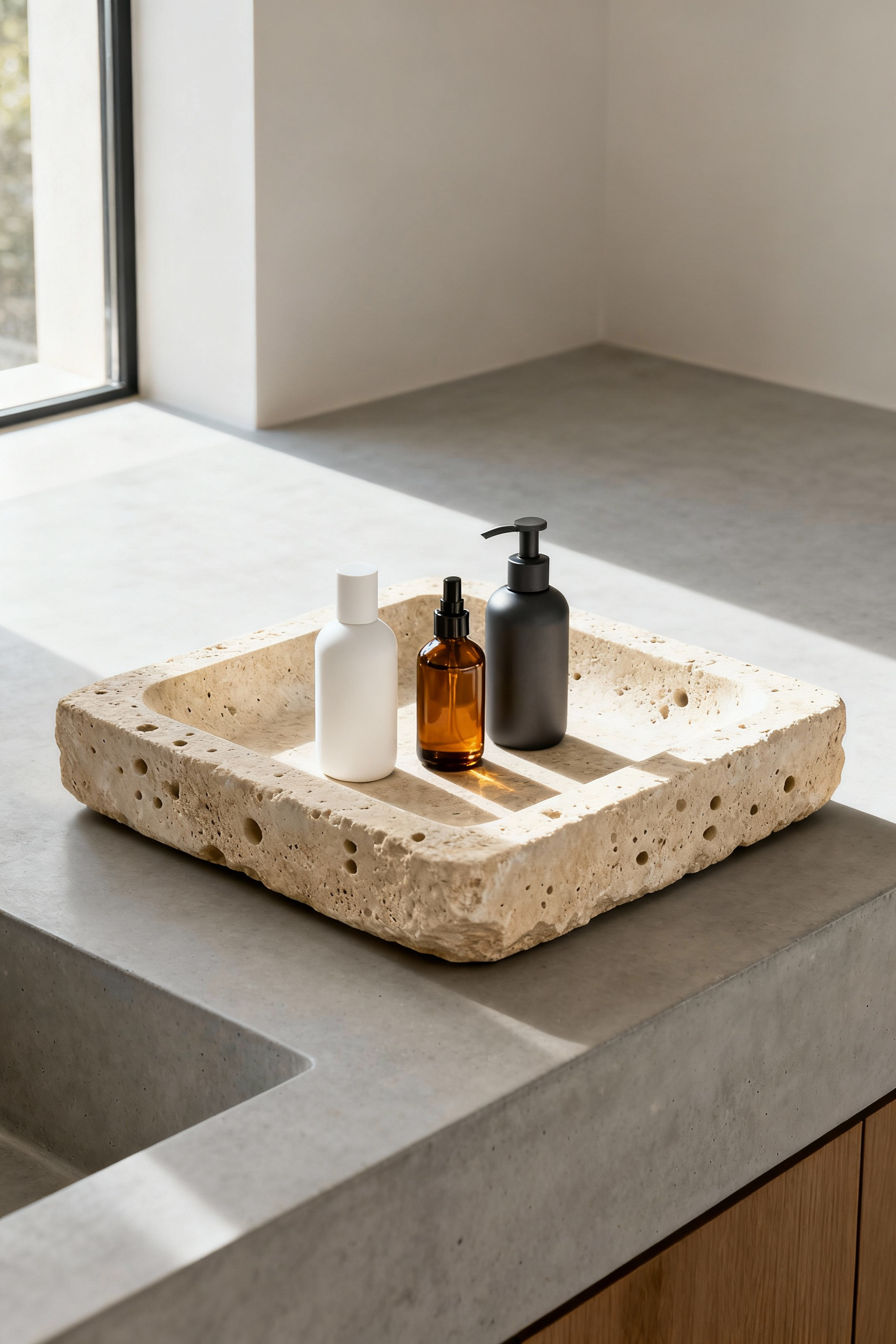
These materials carry deep architectural history. Travertine constructed ancient altars and monuments like the Colosseum. Thus, using a stone slab elevates your daily routine to a ceremony. It transforms using moisturizer into a moment of intention. Effectively, the tray serves as a stage for your personal care rituals.
Consider the powerful sensory contrast. Natural stone feels distinctively cool and looks pleasantly matte. However, most modern product packaging is glossy and warm. Placing plastic bottles against organic veins creates soothing aesthetic tension. Ultimately, the stone’s earthy honesty neutralizes industrial clutter, fostering a calmer environment.
Biophilic Breath: Integrating humidity-loving ferns or eucalyptus bundles to purify damp air
Your bathroom counter is a unique ecosystem. Consequently, selecting the right greenery transforms damp air into a purifying asset. Humidity-loving flora like the Boston Fern thrive here. Unlike standard houseplants, these ferns utilize “reverse-transpiration.” They absorb moisture directly through their fronds rather than just their roots. Therefore, the humidity that usually threatens drywall actually nourishes the plant.
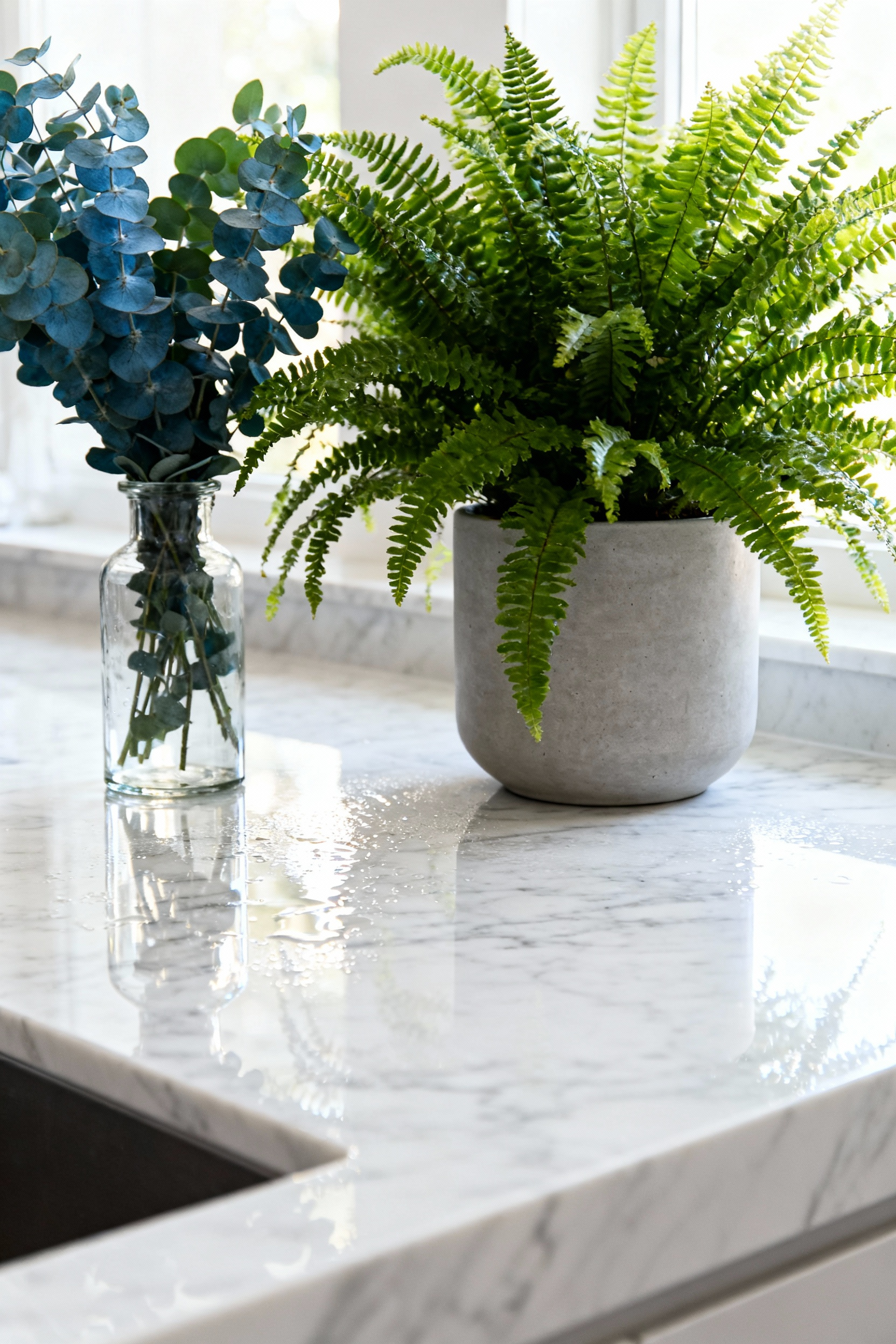
Ferns also act as functional air filters. In fact, they target common VOCs like formaldehyde found in cosmetics. Placing a fern near your vanity actively cleans the air you breathe. Visually, the lush foliage adds soft, tropical density. This instantly elevates a sterile bathroom into a spa-like retreat.
Alternatively, consider the aromatic power of eucalyptus bundles. When hot shower steam rises, it activates the potent compound 1,8-cineole. This natural release promotes respiratory health. Moreover, eucalyptus encourages a grounding daily ritual. Gently squeeze the leaves to break oil glands and refresh the scent. This connects you to the plant’s “breath” before your morning routine.
Visual Silence: Decanting branded products into uniform amber glass apothecary jars
Modern packaging often “shouts” for attention with clashing colors. Consequently, this creates significant “visual noise.” This clutter increases your brain’s cognitive load. To combat this, we pursue “Visual Silence.” Decanting products into uniform amber glass jars creates an immediate sense of calm. This uniformity mimics the curated atmosphere of a five-star spa.
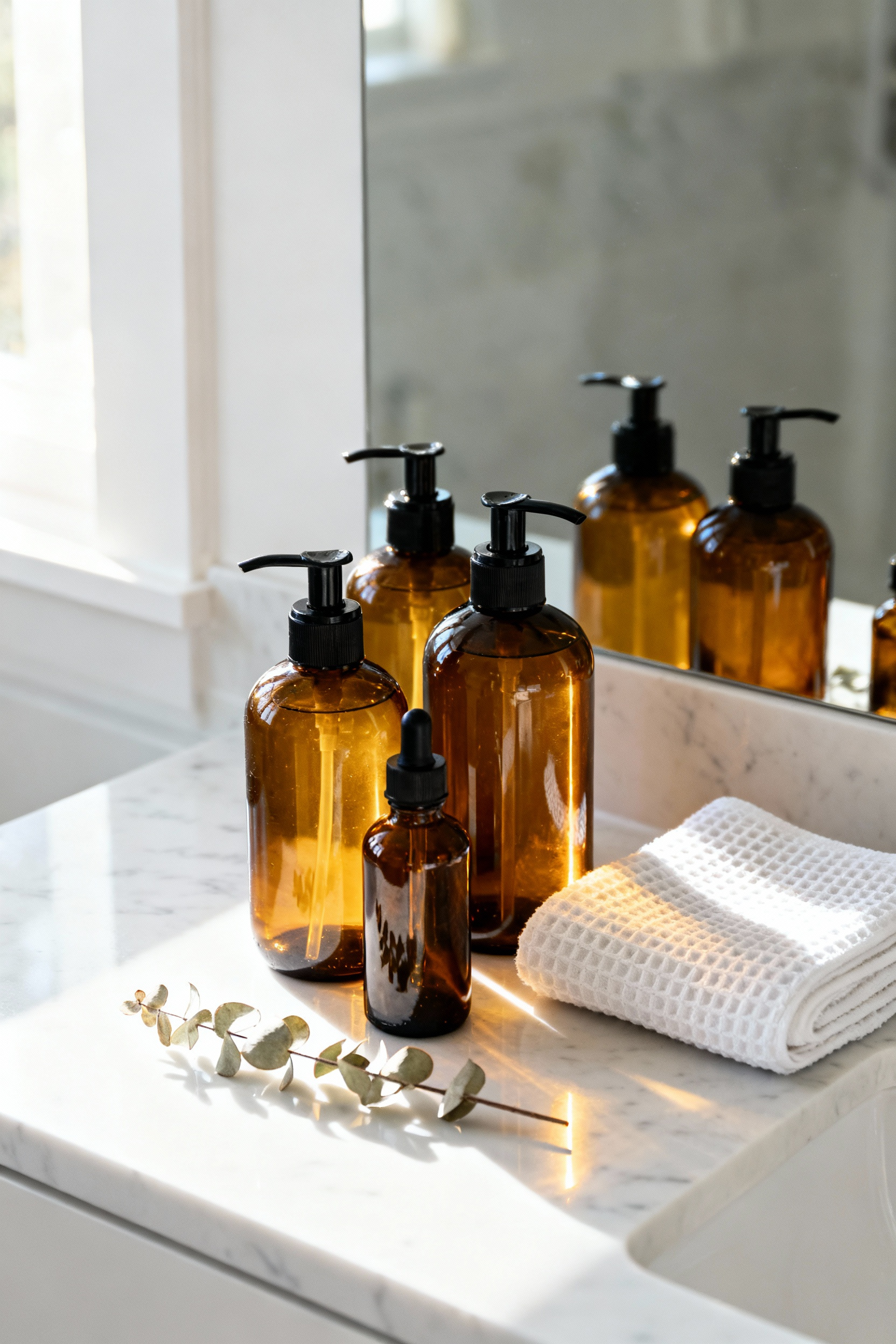
The choice of amber glass is strategic. Historically, these jars evoke a traditional apothecary feel. Functionally, the rich amber hue creates a protective barrier. In fact, the glass blocks harmful UV and blue light wavelengths. This preservation maintains the integrity of light-sensitive ingredients like essential oils. Thus, the container actively protects the purity of the contents inside.
However, a “Minimalist Paradox” exists here. You must balance aesthetic desire with chemical integrity. Advanced skincare often relies on original airless pumps to prevent oxidation. Transferring delicate retinoids can reduce their efficacy within 72 hours. Therefore, focus decanting efforts on low-risk items like hand soaps and bath salts. This achieves visual harmony without compromising your high-value treatments.
The Water Element: Choosing raw, unpolished stone soap dishes to connect with natural textures
Bathrooms naturally overflow with the Water element. Consequently, this abundance can feel energetically draining in Feng Shui. To counter this, you must introduce the Earth element. A raw, unpolished stone soap dish serves as a powerful stabilizer. Earth effectively dams and controls excessive Water energy. Therefore, placing heavy stone on the counter grounds the space visually.
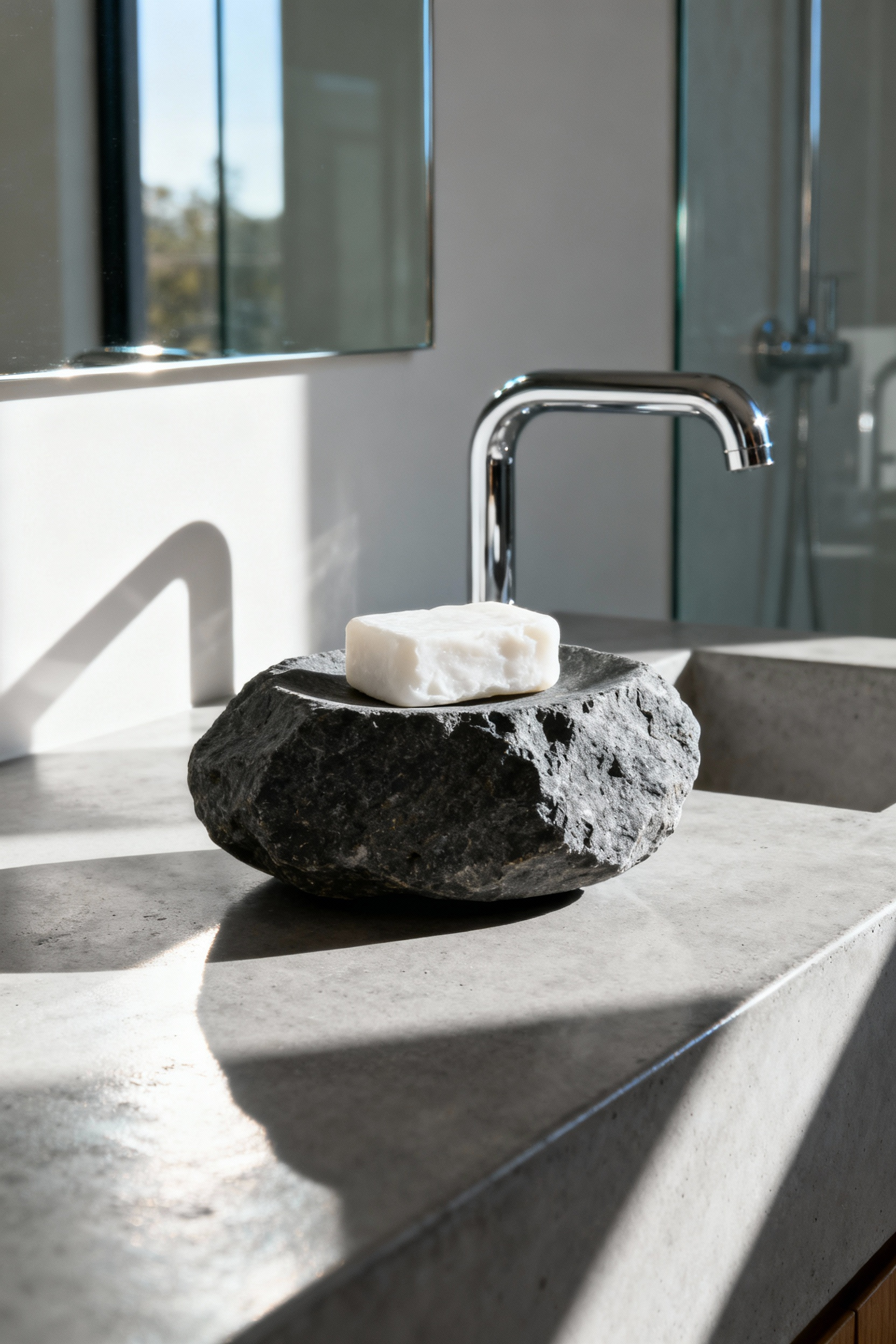
Unpolished stone embraces the ethos of *Wabi-Sabi*. This Japanese philosophy champions the beauty of natural imperfections. Thus, a rugged dish adds authentic texture to sleek, modern surfaces. Furthermore, these materials offer distinct practical benefits. Stones like diatomite or soapstone are naturally porous. As a result, they actively absorb excess moisture within seconds. This prevents stagnant water buildup and extends the life of your soap.
Consider the sensory experience. Natural stone feels distinctively cool and looks pleasantly matte. Conversely, typical bathroom surfaces are glossy and loud. Placing organic veins against cool tiles creates a soothing tension. Ultimately, the stone’s earthy honesty fosters a significantly calmer environment.
Scentscaping: Ultrasonic ceramic diffusers as functional art pieces
Scentscaping involves the strategic layering of aroma. In the bathroom, this practice transforms a functional space into a sanctuary. For instance, invigorating eucalyptus can energize your morning. Conversely, calming sandalwood supports evening relaxation. Furthermore, essential oils like lemon effectively neutralize odors, creating a consistently clean atmosphere.
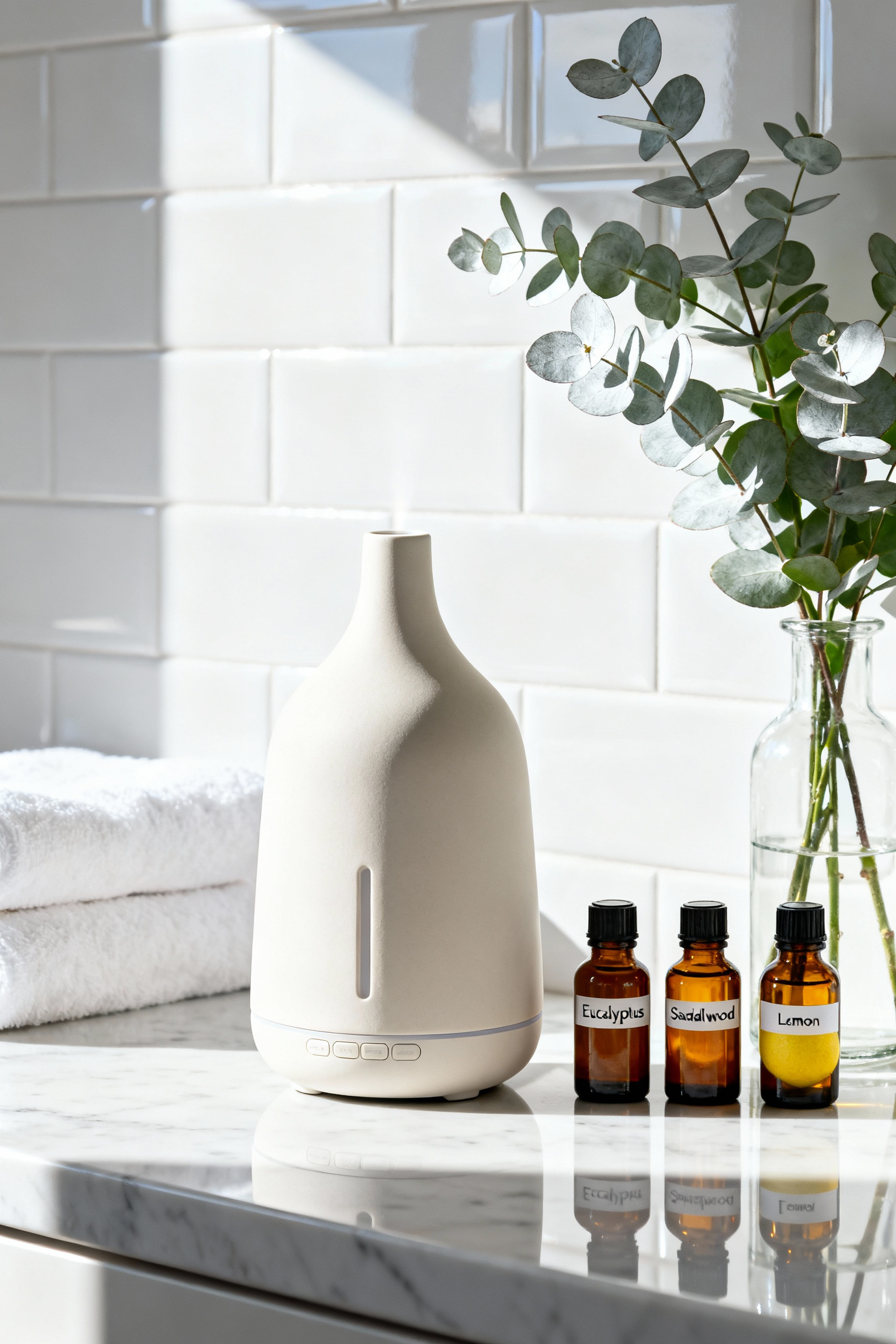
The delivery method is as important as the scent. Ultrasonic ceramic diffusers elevate this experience as functional art. Unlike plastic alternatives, these vessels embody Wabi-Sabi through matte, unglazed finishes. Consequently, they introduce organic texture to polished marble or quartz. This contrast grounds the space, preventing the minimalist aesthetic from feeling sterile.
Technically, these devices offer superior performance. By using high-frequency vibrations, they produce a nano-scale cold fog. Therefore, they provide stronger, faster odor control than passive reed diffusers. Additionally, flameless operation ensures safety near textiles. Ultimately, the cool mist adds a subtle humidifying benefit, blending wellness with design.
Illumination Therapy: Replacing harsh overheads with small, rechargeable soft-light lamps
Bathroom design often relies on harsh overhead fixtures. Unfortunately, these cool-toned lights suppress melatonin production. Exposure to high-Kelvin brightness disrupts the body’s sleep-wake cycle. To correct this, designers advocate for “illumination therapy.” This involves utilizing small, rechargeable lamps equipped with warm-dim LEDs. Ideally, these fixtures emit a soft glow between 2700K and 3000K, mimicking a natural sunset.
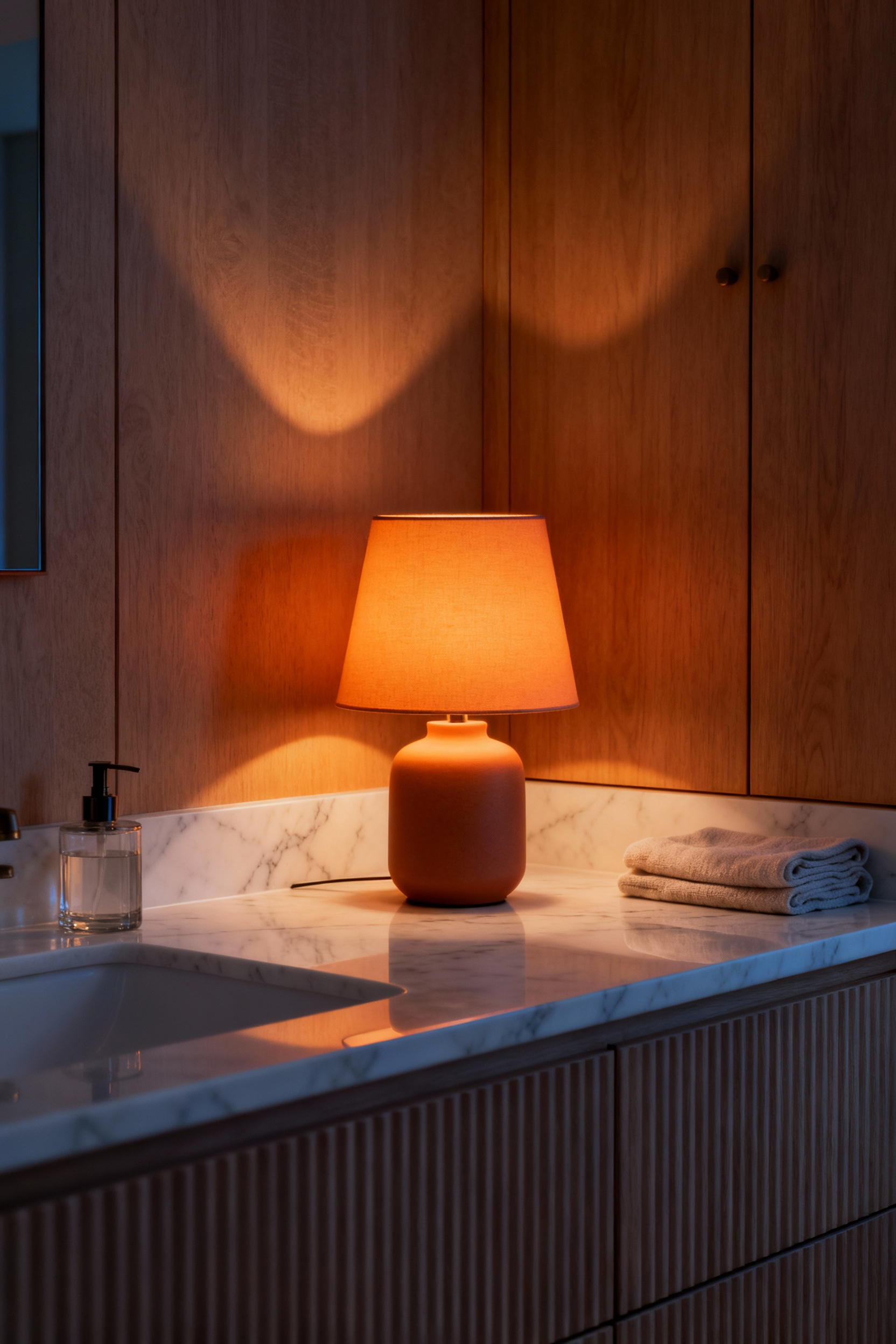
Beyond biology, this lighting shift improves aesthetics. Recessed downlights often cast severe, “flaw-finding” shadows. Conversely, a low-level countertop lamp introduces a flattering ambience. This reduces visual stress and eliminates the sterile utility feel. Furthermore, modern cordless technology allows for seamless integration. Without wall outlets, these lamps become functional sculptures. Ultimately, this small addition transforms a functional bathroom into a restorative sanctuary.
The ‘Daily Three’ Rule: Curating only your immediate morning rituals on display
Visual clutter creates unnecessary mental tension. Consequently, it hampers cognitive function before the day begins. To combat anxiety, adopt the “Daily Three” rule. Limit your bathroom counter display to only your three most immediate morning essentials. This transforms your vanity into a focused launchpad. In fact, reducing visible options minimizes decision fatigue significantly.
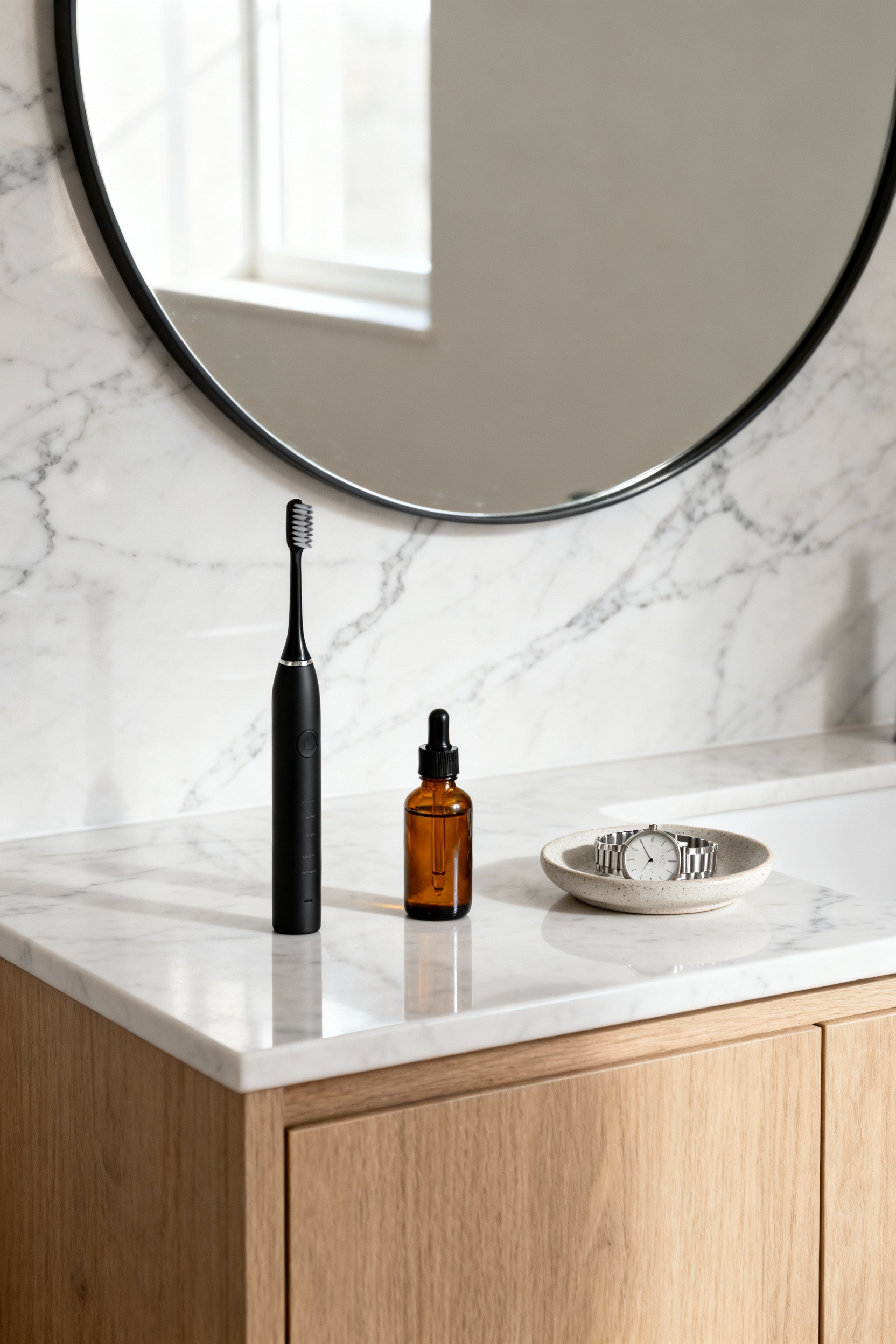
Aesthetically, this mirrors the design industry’s “Rule of Three.” Objects arranged in odd numbers appear more visually balanced. Furthermore, this approach elevates everyday tools into functional decor. Ideally, group a natural bristle brush, a soap dispenser, and a ceramic vessel. Arrange these items on a small tray to ground the vignette.
This creates a deliberate visual triangle. Therefore, the display reads as a curated collection rather than accidental mess. Ultimately, this curation fosters a “mini-spa” atmosphere. It shifts your morning routine from a frantic rush to a mindful ritual. By selecting only “hero” products, you nurture a sense of calm self-care.
Textile Softening: Rolling organic waffle-weave washcloths in woven seagrass baskets
Lasting textile softness requires more than quality materials. The method of storage plays a pivotal role. For organic waffle-weave cotton, rolling is superior to folding. Sharp creases can weaken fibers and crush the distinct honeycomb grid. Therefore, rolling the washcloths maintains their three-dimensional loft. This technique prevents the compression that leads to structural stiffness.
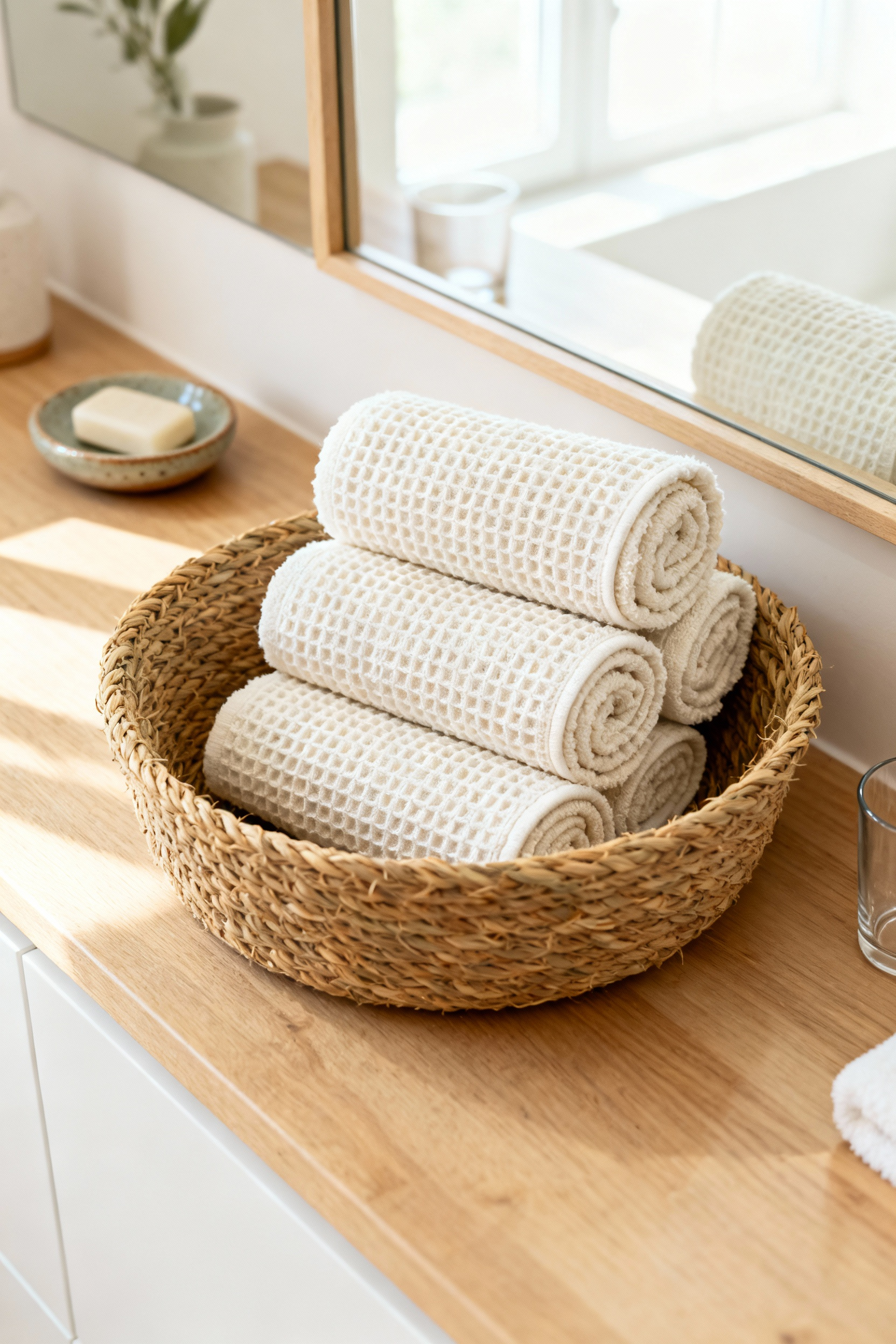
The storage vessel contributes to longevity. Woven seagrass baskets are ideal for high-humidity bathrooms. Notably, the natural fiber construction creates inherent ventilation. Consequently, air circulates freely, preventing trapped moisture and mildew. This airflow is vital for protecting the organic fibers from degradation.
Aesthetically, this combination provides a sophisticated experience. The rustic texture of seagrass creates a deliberate dialogue with the plush cotton. Thus, the display highlights the softness of the washcloths through contrast. Additionally, this pairing anchors the space in the “Organic Modern” style. Ultimately, rolling linens elevates a utility item into a visible symbol of care.
Crystal Energy: Utilizing Rose Quartz or Amethyst clusters for mindful jewelry storage
Incorporating raw crystal clusters transforms storage into a mindful ritual. Amethyst geodes act as natural energy filters on a vanity. Their deep purple hue evokes a calming, spa-like atmosphere. Beyond aesthetics, these clusters serve as passive charging stations. By placing worn jewelry on the crystal, you clear stagnant energy overnight. Consequently, your pieces act as refreshed talismans the next day.
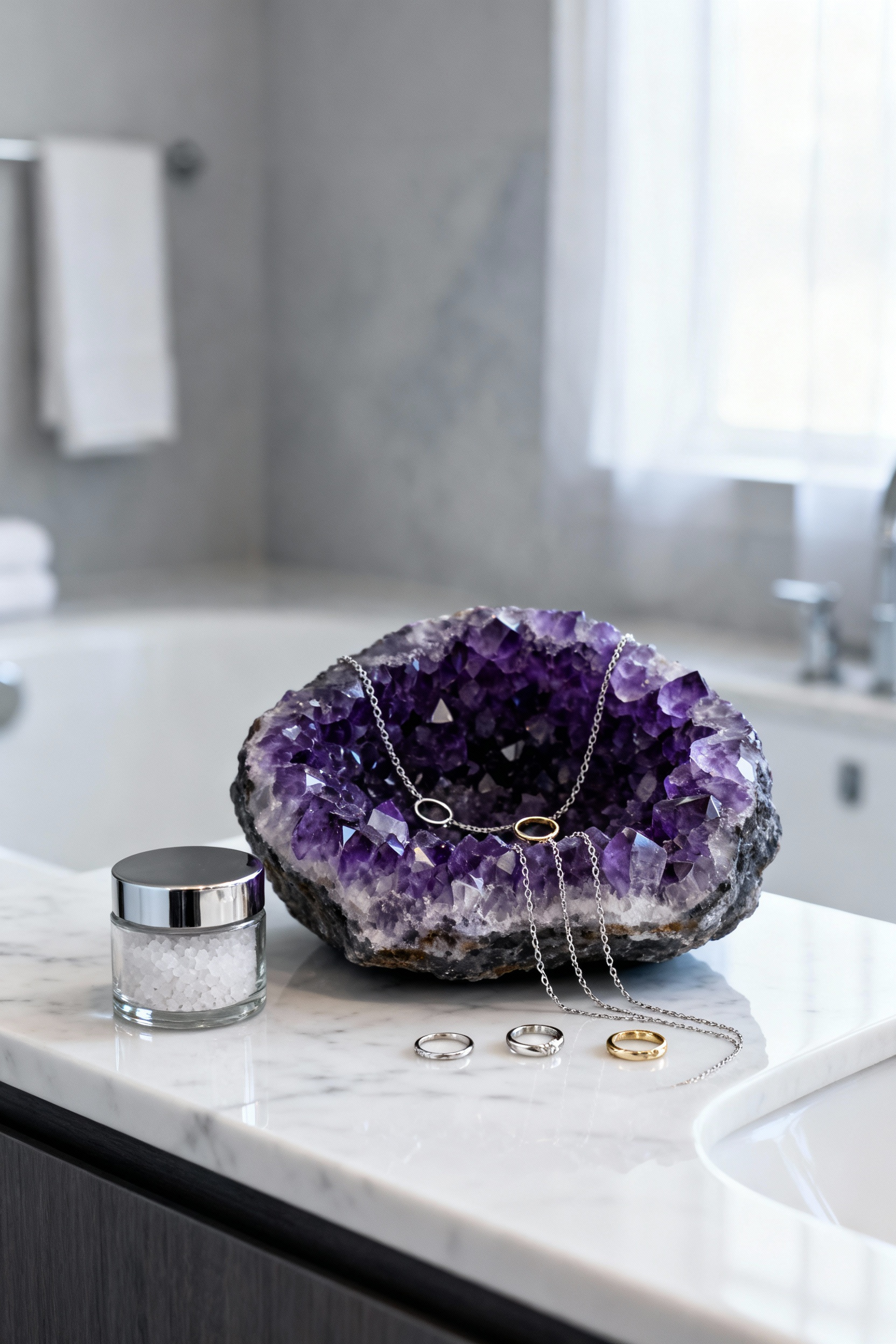
Alternatively, Rose Quartz promotes a gentle, nurturing environment. Known as the stone of unconditional love, it connects to the heart chakra. Ancient Egyptians utilized this stone in beauty masks to preserve youth. Therefore, using it for storage links modern grooming with ancient self-care. As you adorn yourself, the stone prompts a moment of intentional self-acceptance.
Practically, these stones are ideal for humid spaces. Quartz ranks high on the hardness scale, resisting moisture damage. However, an environmental trade-off exists regarding light. Prolonged exposure to UV rays causes color fading. Thus, position clusters away from sunny windowsills. Ultimately, mindful placement protects the stone while enhancing your sanctuary.
Vertical Zen: Adding bamboo or teak risers to create varied heights and visual flow
Introducing wood elements effectively counters sterile porcelain tile. Teak and bamboo are ideal choices for this environment. Teak naturally possesses oils that resist moisture and rot. Therefore, it offers grounding warmth without warping. Alternatively, bamboo provides a clean, eco-minimalist aesthetic. Functionally, these materials bridge the gap between nature and modern design.
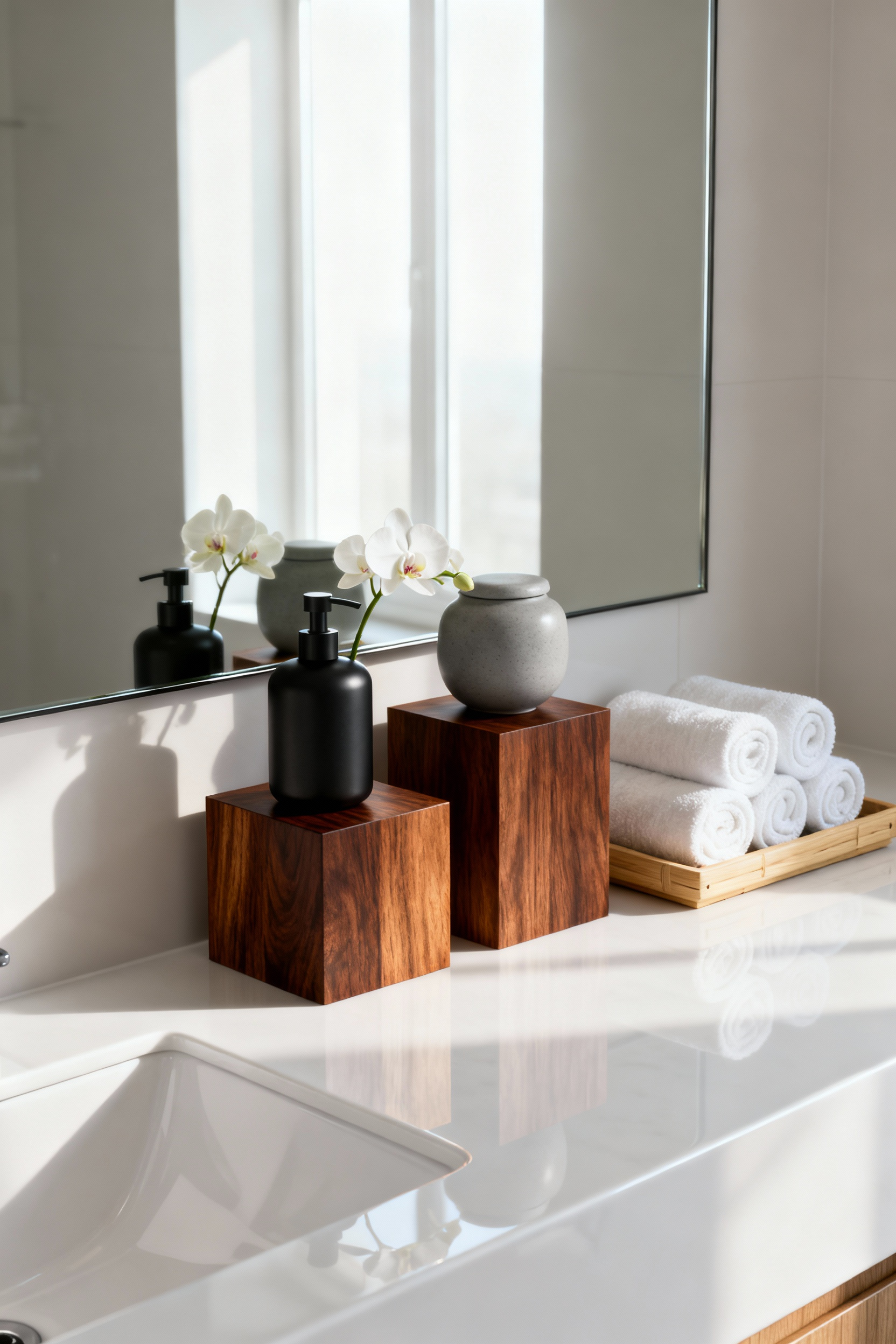
Using risers introduces “Vertical Zen.” This mirrors the Japanese philosophy of *Wabi-Sabi*. Rather than seeking perfect symmetry, embrace organic, asymmetrical arrangements. Consequently, a flat surface transforms into a dynamic display. For example, a simple handmade soap becomes a focal point when intentionally elevated.
Moreover, varying heights creates essential visual flow. This mimics the *Ikebana* principle of “Heaven, Human, and Earth.” The counter surface serves as the grounding “Earth.” A medium riser represents the “Human” element. Finally, a tall object symbolizes “Heaven.” Ultimately, this vertical layering compels the eye to move upward. As a result, even compact bathrooms feel loftier.
Reflective Depth: Leaning small, antique-framed mirrors to expand light without installation
Incorporating a small, antique-framed mirror creates impact without a hammer. Leaning the mirror creates a geometric effect known as the “subtle tilt.” Unlike wall-mounted glass, a tilted surface redirects harsh overhead lighting. The angle sends beams downward, washing the counter in a soft glow. This diffusion transforms sterile brightness into a soothing atmosphere. Beyond light, this placement manipulates space through “reflective depth.”
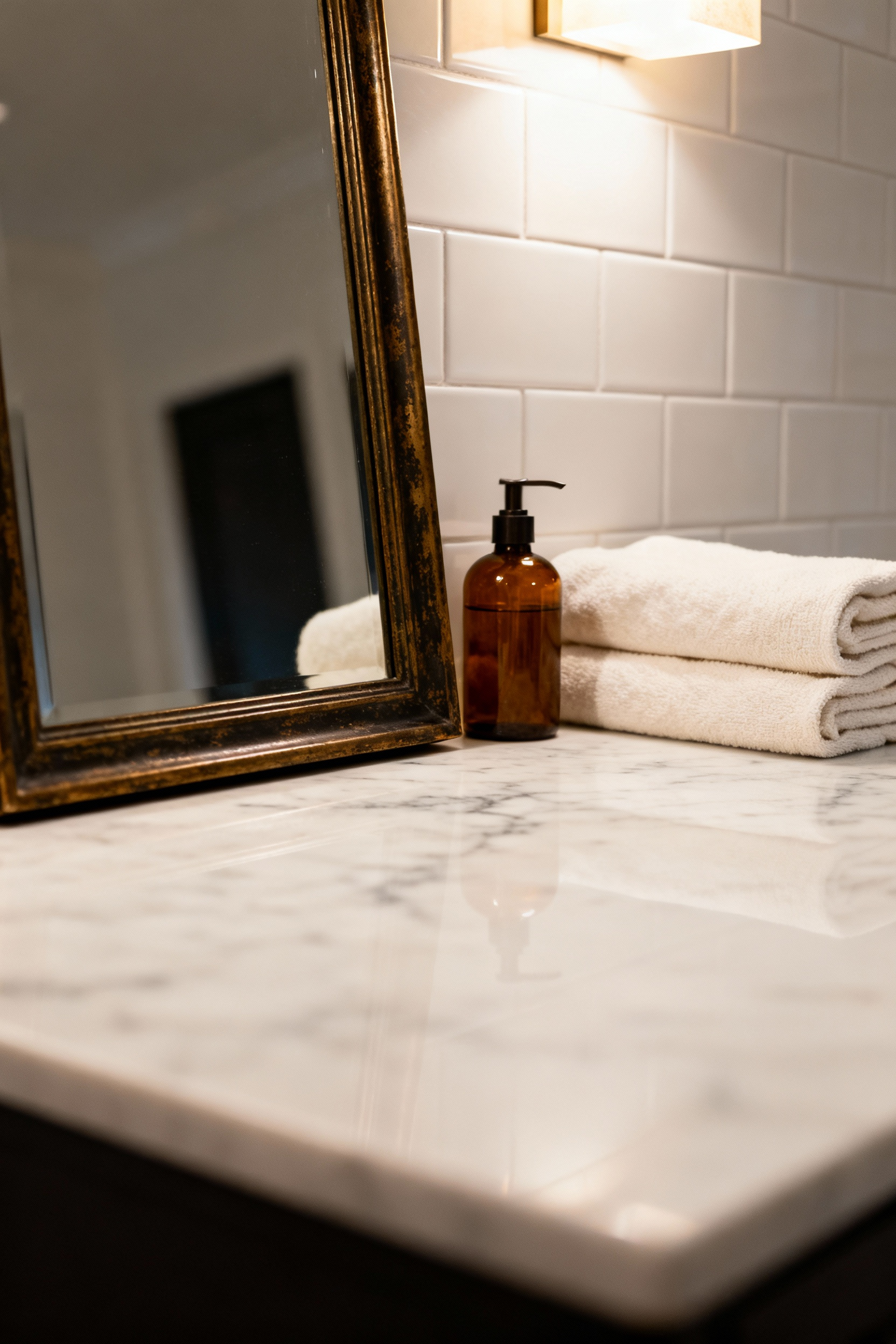
The frame choice is vital for narrative depth. Typically, bathrooms feature hard, slick surfaces like chrome. When designing a white bathroom vanity, an antique frame introduces necessary warmth. Gilded wood or brass disrupts the “crisp white” palette with character. Moreover, the glass often features natural patina. This age-related imperfection softens the reflection. Instead of clinical clarity, you achieve a dream-like quality.
Finally, this approach offers functional freedom. Because it rests on the counter, the mirror becomes a flexible *objet d’art*. You can adjust it instantly to chase natural light or frame a new item. This intentional impermanence allows your space to evolve with your mood.
Botanical Art: Introducing preserved moss art or small-scale botanical prints
Bathrooms often feel sterile because of cold, hard surfaces. Therefore, introducing botanical art acts as a vital counterbalance. This biophilic approach transforms a functional space into a “sensory sanctuary.” By incorporating organic elements, you soften the room’s aesthetic and promote a calming atmosphere.
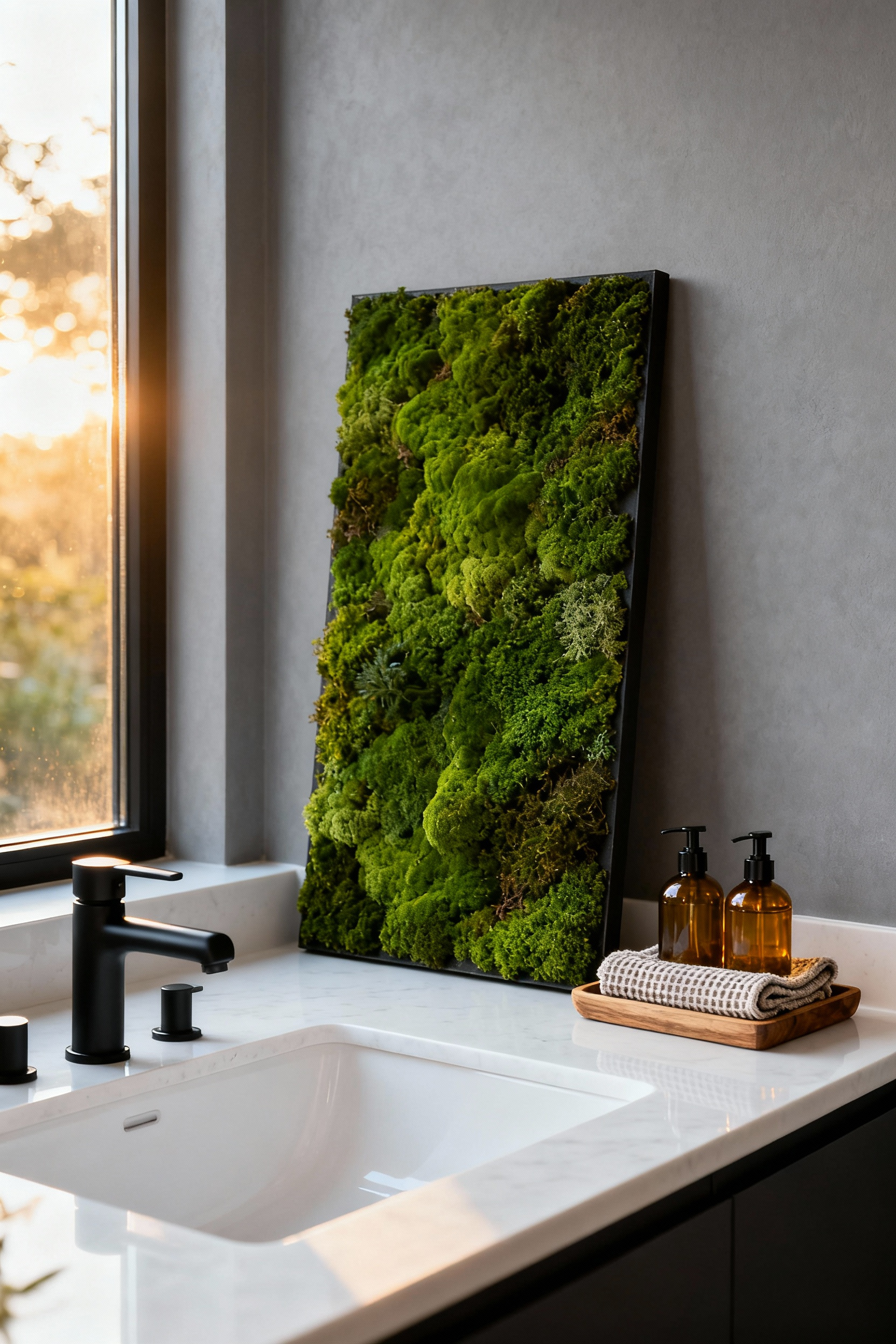
Preserved moss art offers unique, three-dimensional texture. Unlike flat tile, the soft greenery provides an immediate organic touch. Consequently, viewing this texture helps reduce physiological stress. Furthermore, preserved moss thrives in humid environments, staying pliable through absorbed moisture. However, place it away from direct water splashes to ensure longevity.
Alternatively, small-scale botanical prints introduce timeless elegance. Historically, these illustrations blended scientific accuracy with art. Thus, placing a framed print on the counter encourages intimate appreciation. Nevertheless, humidity poses a risk to unprotected paper. Ensure your prints are professionally sealed behind glass. Ultimately, both options nurture a deep connection to the natural world.
The Dental Sanctuary: Ceramic toothbrush holders that hide bristles for hygiene and aesthetics
The modern vanity faces a hygiene paradox. We must protect bristles without trapping moisture. Leaving toothbrushes exposed invites “toilet plume,” a microscopic spray. However, sealing damp brushes in drawers creates a different danger. Dark, enclosed spaces act as bacterial incubators. Therefore, the ideal solution requires a nuanced design approach.
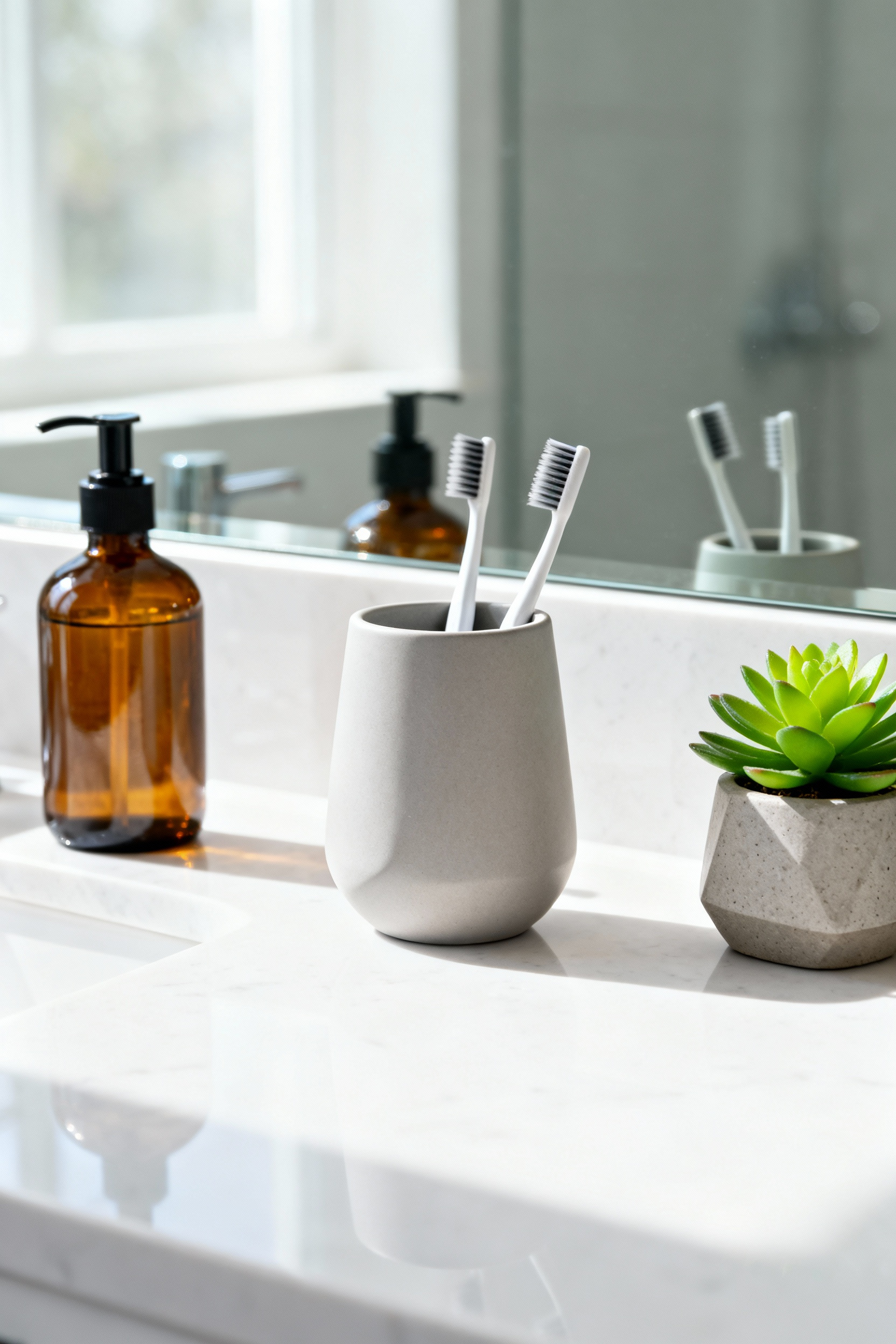
Enter the ceramic “dental sanctuary.” These holders conceal colorful, plastic bristles within a vase-like vessel. Consequently, they transform a messy object into sculptural decor. Ceramic is naturally non-porous, making it superior to plastic for cleanliness. Furthermore, the best designs incorporate ventilation slots. This allows for critical air-drying. Thus, moisture escapes efficiently while contaminants remain blocked.
Ultimately, this accessory supports both health and visual peace. By hiding clutter, you create a spa-like atmosphere. Moreover, you honor the Victorian tradition of sterile surfaces through modern aesthetics. This small change elevates a daily routine into a mindful ritual. It turns the countertop into a true sanctuary.
Sound Dampening: Using cork or felt underlays to soften the acoustic interaction of objects
Bathrooms are often dominated by hard materials like marble and porcelain. Consequently, placing a heavy glass bottle on these surfaces creates a harsh, high-frequency “clack.” To mitigate this, consider applying cork or felt underlays to the bottom of your decor. Scientifically, this intervention creates a process known as viscoelastic damping.
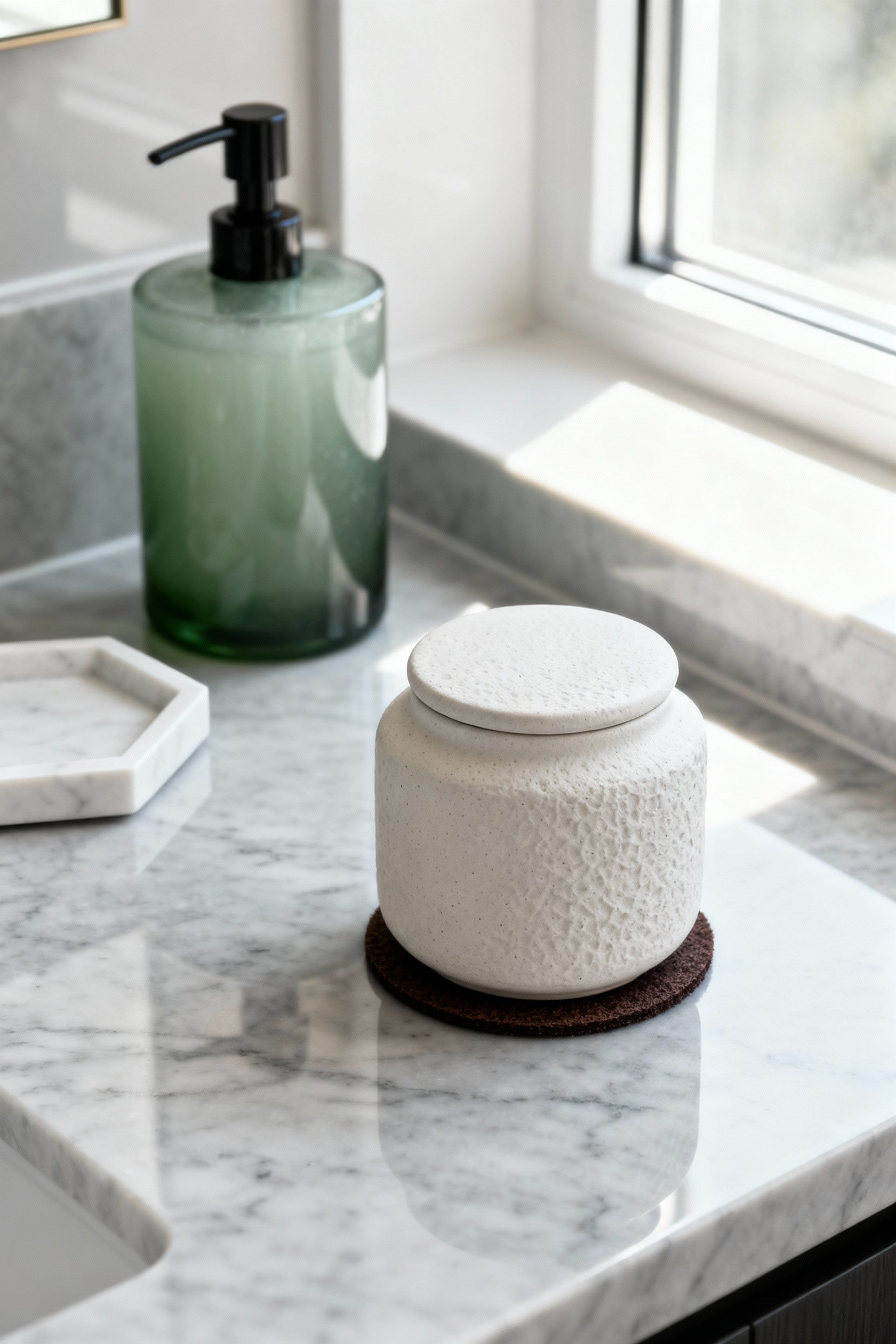
Essentially, the soft material extends the impact duration. Therefore, it prevents the countertop from vibrating like a drum. Instead of a sharp ring, you hear a gentle thud. Furthermore, the material choice allows for nuanced design. Cork offers a warm, organic texture ideal for biophilic interiors. Because of its honeycomb structure, it absorbs noise naturally.
Alternatively, wool or recycled PET felt provides a soft aesthetic. Felt offers versatile color options while efficiently dissipating sound. Historically, using soft liners was standard practice in fine furniture. Today, this attention to detail remains a hallmark of quiet luxury. Ultimately, eliminating jarring noises supports mental well-being.
The ‘Evening Reset’ Ritual: A 2-minute restorative practice to prepare the space for tomorrow
Fundamentally, this two-minute practice is an exercise in cognitive offloading. It effectively delegates mental tasks to the physical world. Consequently, your brain stops processing the visual noise of scattered products. Specifically, clearing the counter creates a definitive visual boundary for the day. It signals to your subconscious that demands are finished. Therefore, this “clean slate” allows your mind to transition into rest.
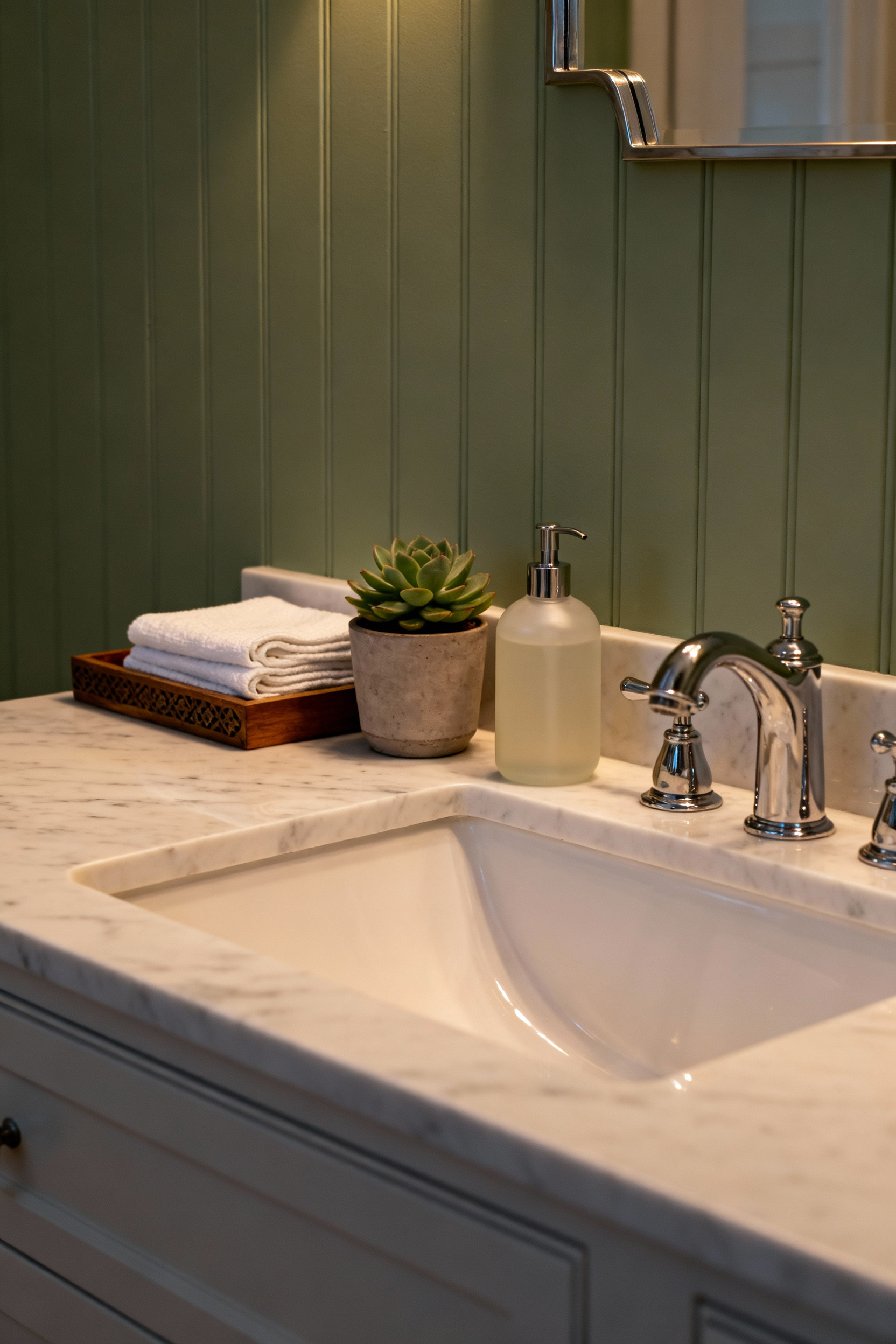
To support this, adopt a strict “three-item rule.” Ideally, curate functional anchors like a marble tray or an amber glass vessel. Furthermore, these natural textures ground the space in a soothing Zen aesthetic. You might also incorporate an olfactory anchor, such as a lavender diffuser. Ultimately, this micro-habit combats decision fatigue before your morning begins. Waking up to order provides immediate control and peace.
Conclusion: From Surface to Soul—How a curated counter shapes your daily intention
Ultimately, a curated counter offers more than just an organized surface. In fact, it functions as a daily anchor for mindfulness. By reducing visual clutter, you quiet cognitive noise immediately. Consequently, the materials you touch become subtle emotional triggers for calm. Therefore, this space transforms from a utilitarian station into a private sanctuary. It seamlessly bridges the gap between physical order and internal clarity. Mastering your bathroom counter decor is the foundational step toward achieving total well-being in your home.
Moving forward, this intentional approach redefines how your home supports you. Ideally, your environment should nurture your mental state every day. Thus, treating your counter as an altar invites lasting self-respect. To begin, simply audit your current collection this evening. Remove anything that does not serve a vital, beautiful function. Finally, allow your space to reflect the peace you seek.
Frequently Asked Questions
What is the ideal number of items to keep on a bathroom counter?
The ideal arrangement follows the “Daily Three” rule, limiting the display to only three primary functional accessories needed for immediate morning or evening rituals (e.g., soap dispenser, toothbrush holder, a small watch tray). For aesthetics, designers also recommend the 60/40 rule, ensuring at least 40% of the counter surface remains intentionally empty to reduce visual noise and lower cognitive stress.
How can I make my small bathroom counter look luxurious?
Focus on material quality and functional curation rather than quantity. Use a single, high-quality, heavy item like a marble tray or a sleek ceramic dispenser to anchor the space. Decant colorful products into uniform amber or opaque glass containers to achieve “Visual Silence.” Finally, incorporate intentional lighting or a small, humidity-loving plant (like a fern) to elevate the space into a sophisticated sanctuary.
What are the best materials for bathroom counter accessories?
For a luxury feel in a high-humidity environment, prioritize materials that are heavy, non-porous, and natural. Excellent choices include travertine or Carrara marble (for trays), high-quality opaque ceramic or amber glass (for dispensers and jars), and naturally moisture-resistant woods like teak or bamboo (for risers and accents). These materials create visual weight and tactile contrast against standard porcelain or quartz.