
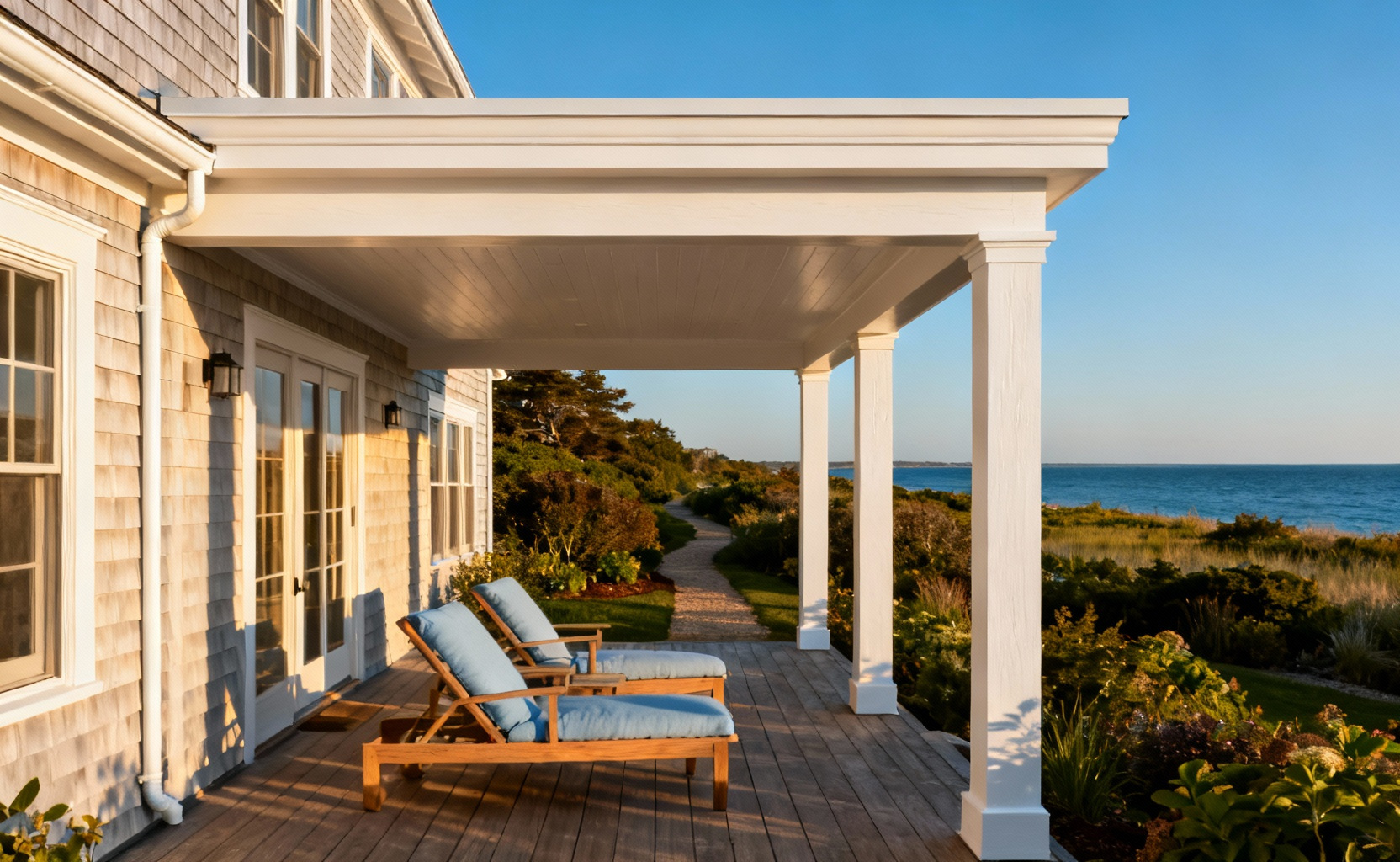

Many homeowners view a pergola as merely a decorative garden trellis, missing its true potential as the anchor of a sophisticated outdoor room. When thoughtfully integrated into a coastal home, a high-end back porch pergola acts as a sophisticated architectural lens. It does far more than simply block the sun; it creates a seamless transition between your interior living space and the restorative natural environment.
The real power of this structure reveals itself during the “Golden Hour.” As low-angle sunlight shifts to a warm, stress-reducing hue, the pergola’s beams impose a decorative restraint on nature. They sculpt intense rays into dynamic dappled light that dances across the floorboards, mimicking the biophilic comfort of a tree canopy.
Meanwhile, the open design invites the restorative scent of salt air to mingle with the warmth of the evening. By utilizing resilient materials like cedar or redwood—often finished in light-reflecting creams—we create a space that continues a 3,000-year tradition of blending leisure with the landscape.
This guide explores the design principles required to master this balance of light and structure. We will examine how to select materials that endure the harsh coastal environment, optimize orientation to capture the most restorative natural illumination, and curate an atmosphere that feels both historically grounded and refreshingly modern.
1. The Seamless Extension: Aligning Rooflines for Indoor-Outdoor Flow
To truly capture the essence of seaside living, a pergola must command architectural authority rather than appearing as a tacked-on accessory. The most effective method to achieve this is by aligning the pergola’s header or rafter system with the main house’s existing fascia or gutter line. This establishes a continuous horizon—an unbroken sightline that tricks the eye into perceiving the outdoor space as a genuine “room without walls.”
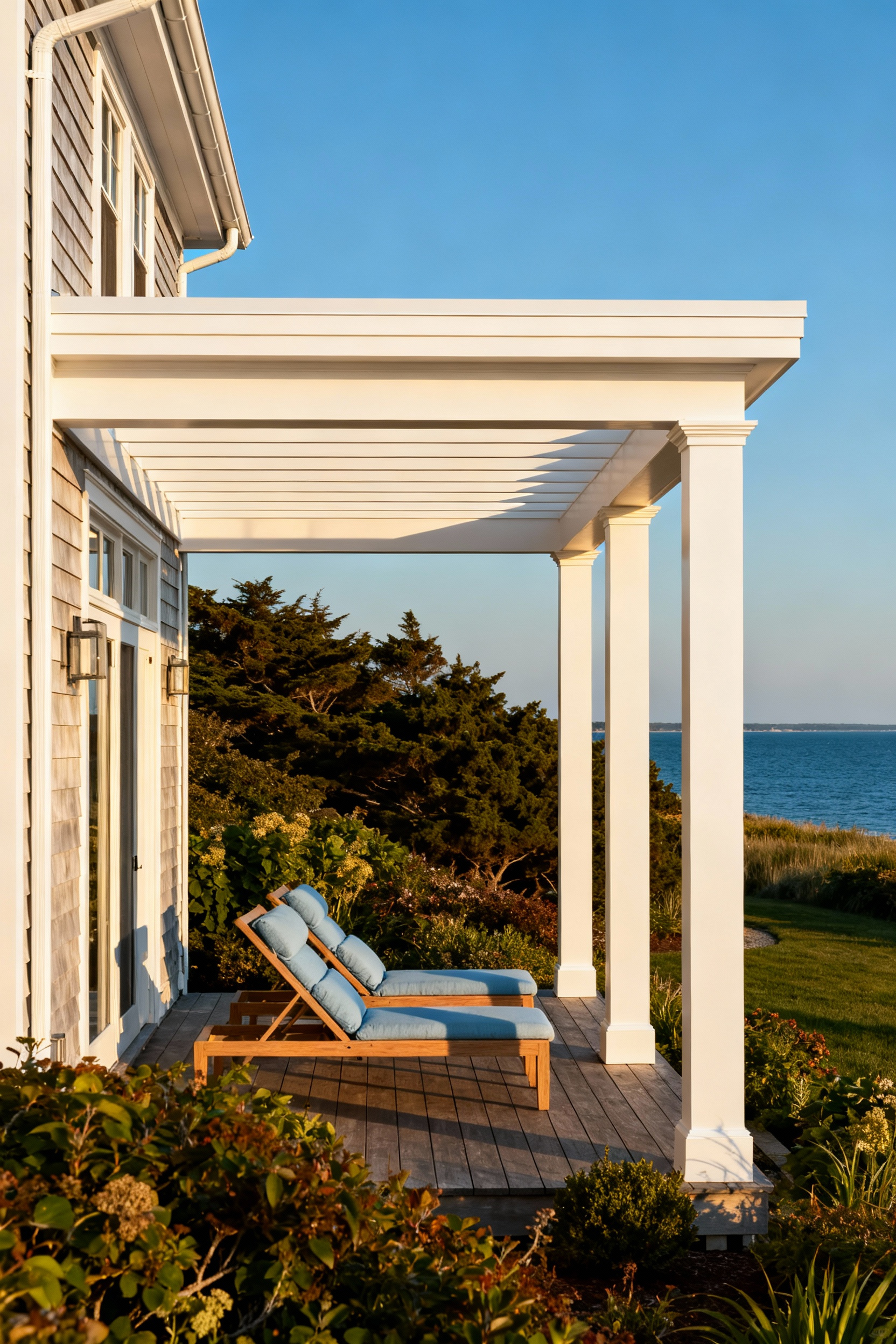
This seamless alignment offers more than just visual coherence; it fundamentally alters how we experience a space. Architectural psychologists note that visual disruptions—like a jarring shift in ceiling height—increase “cognitive load,” forcing the brain to process the difference. By smoothing this transition, we foster a state of “soft fascination,” similar to the effortless attention one pays to rolling waves. The edges of the interior room effectively dissolve, creating a restorative environment where the home feels unconfined and completely relaxed.
Of course, coastal renovations often present structural challenges. If existing eaves sit below eight feet, a direct hard match can feel cramped and stifle the air circulation necessary for a comfortable breezeway. In these instances, we look to the American Bungalow tradition, where porch roofs appear to peel naturally off the main structure at a lower pitch, or we utilize the Golden Ratio to design a freestanding element. Even if the physical connection isn’t contiguous, the pergola must respect the home’s massing and proportion, ensuring the transition from indoors to the salt air remains fluid and intentional.
2. Marine-Grade Materials: Why Silvered Teak and Cedar Outperform Pine
In coastal design, material selection isn’t merely about aesthetics; it is a matter of survival against the elements. While pressure-treated pine is a common default, it relies entirely on a chemical infusion to resist decay—a temporary fix for a softwood that naturally acts like a sponge.
In contrast, teak and cedar possess an inherent, self-preserving chemistry. Teak (*Tectona grandis*) is the gold standard for a reason. Its dense grain is saturated with natural oils, rubber, and silica, creating an internal sealant that repels water and rot without human intervention. This is the same characteristic that has made it the backbone of shipbuilding for centuries, capable of withstanding saltwater and intense humidity without warping.
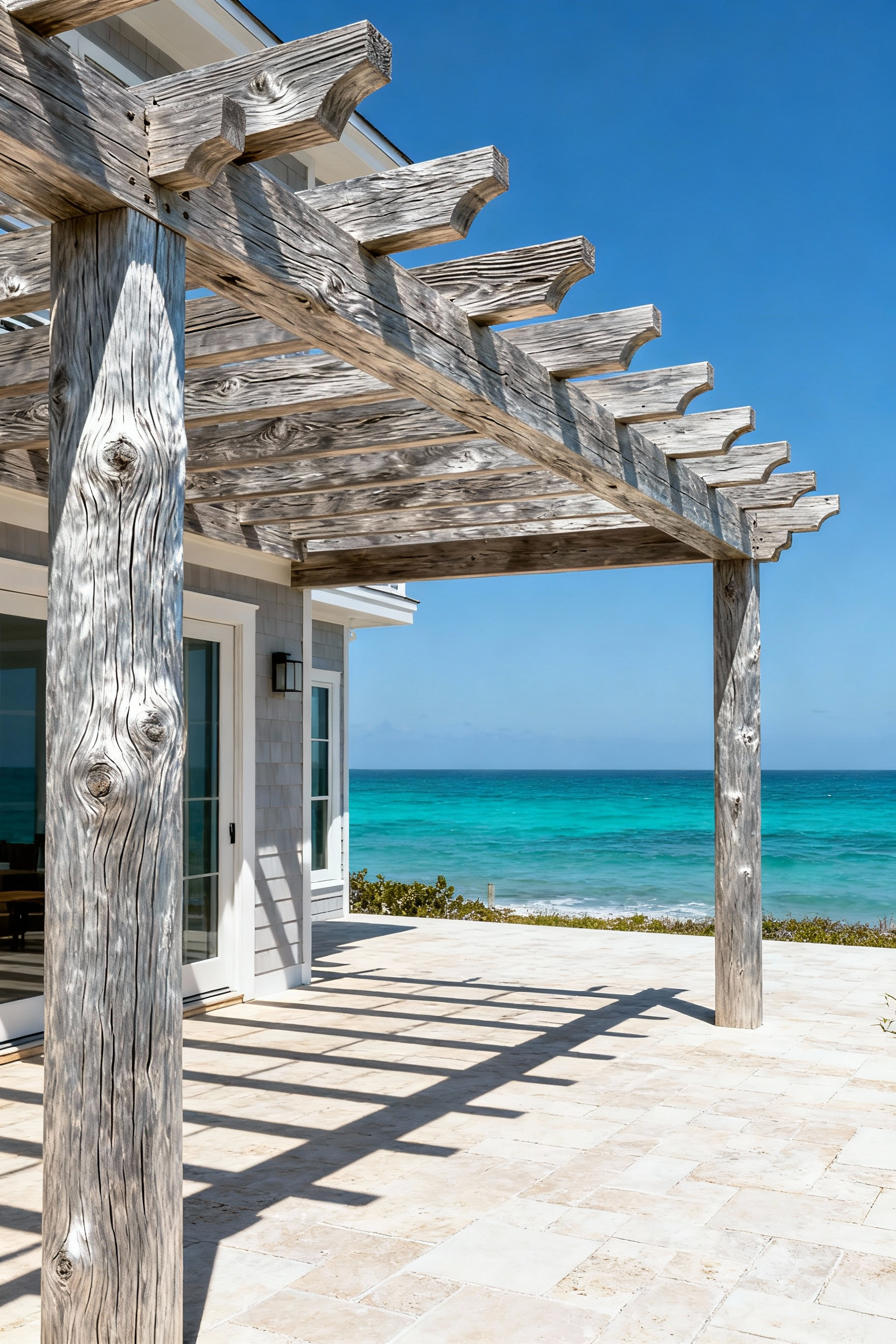
There is also a profound difference in how these woods age. When you see that signature silvery-gray patina on a teak pergola, you aren’t looking at degradation; you are witnessing the wood’s immune system in action. The sun oxidizes the surface oils to form a protective UV screen, locking in structural integrity for decades.
Compare this to the graying of pine, which often signals mildew and the breakdown of fibers. Even Western Red Cedar, with its aromatic oils acting as organic fungicides, offers a stability that pine simply cannot match. Where treated pine tends to cup, twist, and split as it dries, marine-grade hardwoods hold their line. This ensures your outdoor living space remains as crisp and intentional in twenty years as it does today.
3. The Modern Aluminum Hybrid: Combining Durability with Soft Timber Accents
For many homeowners, the dream of a natural timber pergola often clashes with the harsh reality of maintenance. The endless cycles of staining, sealing, and sanding required to fight the elements can be daunting. The modern aluminum hybrid offers a smart solution to this tension.
By utilizing advanced baked powder-coating processes, manufacturers can now replicate the rich grain and tactile finish of high-end timber like walnut or cedar directly onto a metal substrate. You achieve the visual warmth of organic material with the resilience of an engineered product that resists fading, rust, and warping.
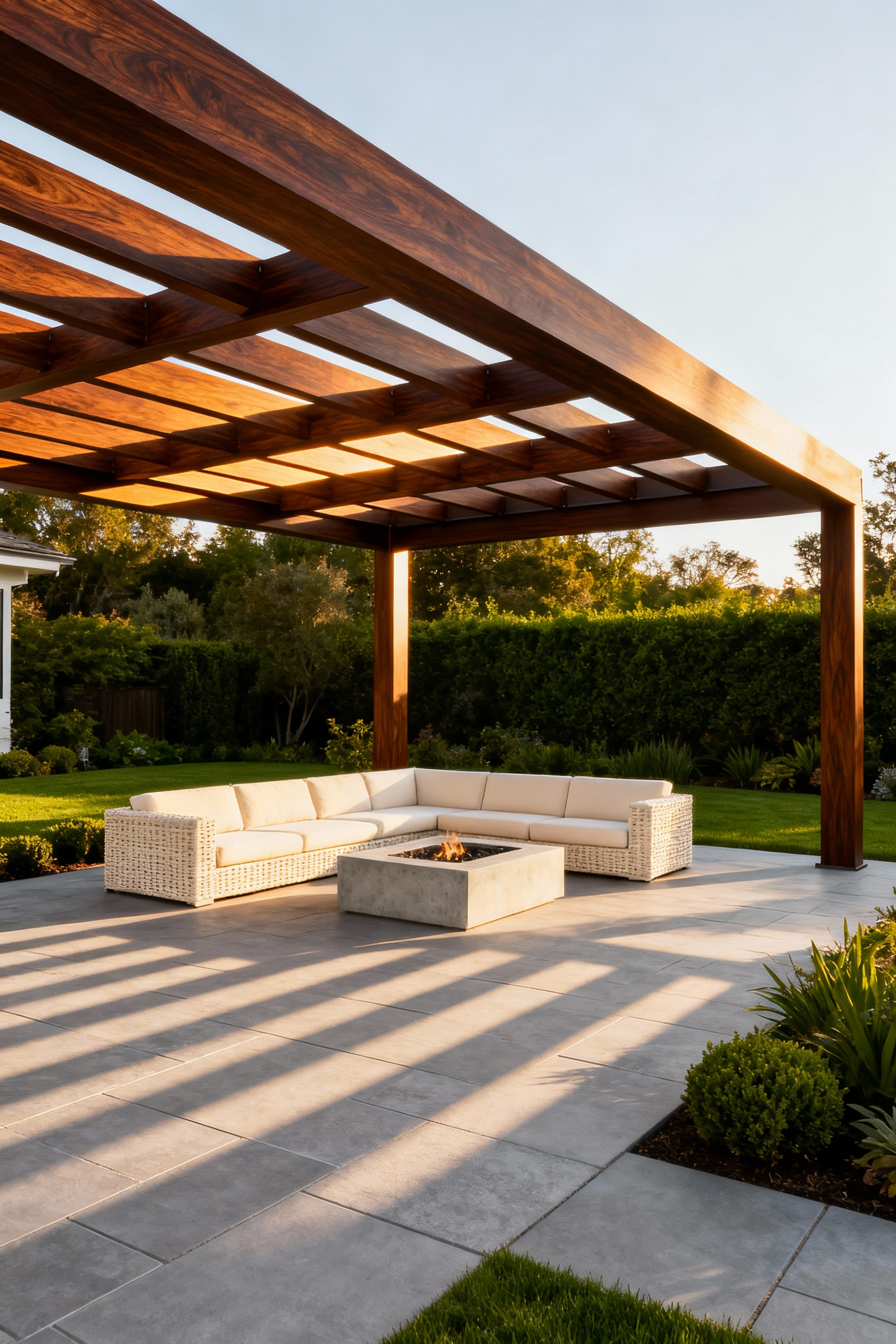
This fusion does more than just eliminate weekend upkeep; it creates a compelling biophilic aesthetic. We see a deliberate juxtaposition where sleek, industrial frames—often in matte charcoal or black—support these softer, wood-look accents. The result is a structure that feels robust yet inviting, preventing the stark coldness sometimes associated with pure metal designs. It grounds the back porch in nature while maintaining a clean, contemporary edge that suits modern coastal architecture.
Beyond aesthetics, the superior strength-to-weight ratio of extruded aluminum unlocks architectural freedom. We can achieve thinner post profiles and dramatic, unsupported cantilevers that would be structurally impossible or visually heavy with solid wood. This precision framework also serves as the perfect chassis for integrating modern luxuries, effortlessly hiding the motors for bioclimatic louvered roofs or housing recessed LED strip lighting. It is the ultimate marriage of maritime atmosphere and modern engineering.
4. Slat Spacing Science: Calibrating Shadow Angles for Maximum Comfort
Achieving that perfect slice of shade isn’t about guesswork; it is a matter of calibration. To design a structure that feels cooler than the ambient air, we have to account for where the sun lives in your specific latitude. For the most effective cooling on a coastal back porch, I often recommend orienting slats East-West. This forces the wide side of the timber to face the sun during high noon, effectively blocking the harshest radiation while allowing the lower, softer light of morning and evening to drift through.
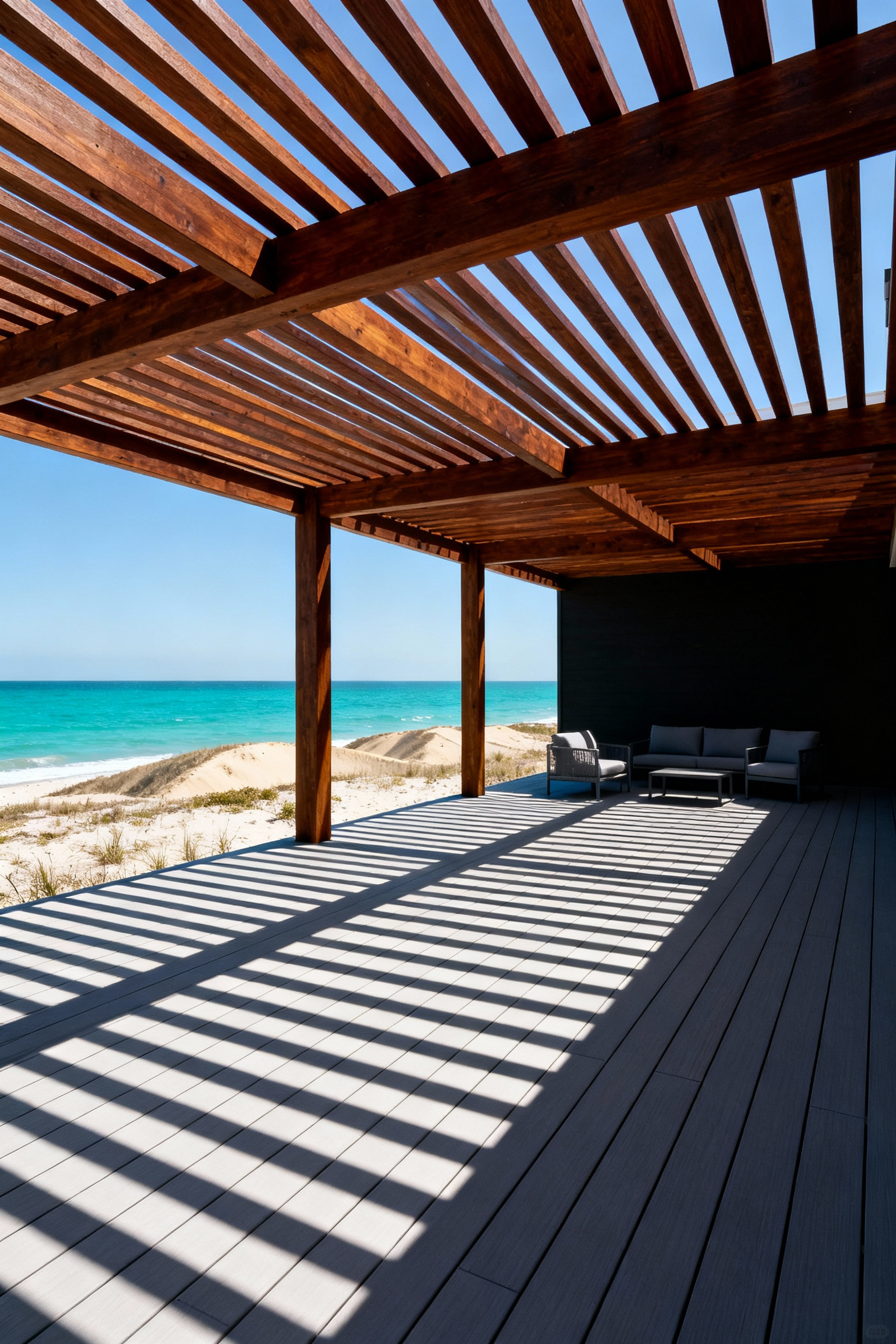
However, we aren’t looking for a solid blackout. A completely shadowed space can feel static, heavy, and surprisingly alienating because it disconnects us from the passage of time. Instead, the goal is “dappled light”—that dynamic interplay of sun and shadow that engages the mind without demanding focus.
Psychologists refer to this as “soft fascination.” It creates the same restorative mental state as watching waves break or leaves flutter in a sea breeze, reducing cognitive load while keeping you physically comfortable. This logic borrows from the historical roots of the pergola, which began as a skeleton for climbing vines—nature’s self-calibrating shade system. By spacing fixed slats to mimic the density of a summer canopy (usually six to twelve inches on center) we create a permanent climate refuge.
5. The Louvered Roof System: Adapting to Sun and Sudden Coastal Rain
Living by the coast requires embracing the sudden shift from brilliant sunshine to a quick squall, and your architecture should be just as agile. A motorized louvered roof acts as a responsive system rather than a static barrier. With a simple command, the aluminum slats rotate from allowing ninety degrees of ventilation to creating a tight, interlocking shield.
What makes this truly sophisticated is the hidden infrastructure. Rainwater isn’t just repelled; it is meticulously managed. The pitch of the closed louvers guides water into a perimeter gutter system, routing it discreetly through the interior of the support posts. This keeps the porch dry and the visual lines clean, maintaining the space as a sanctuary even as the skies open up.
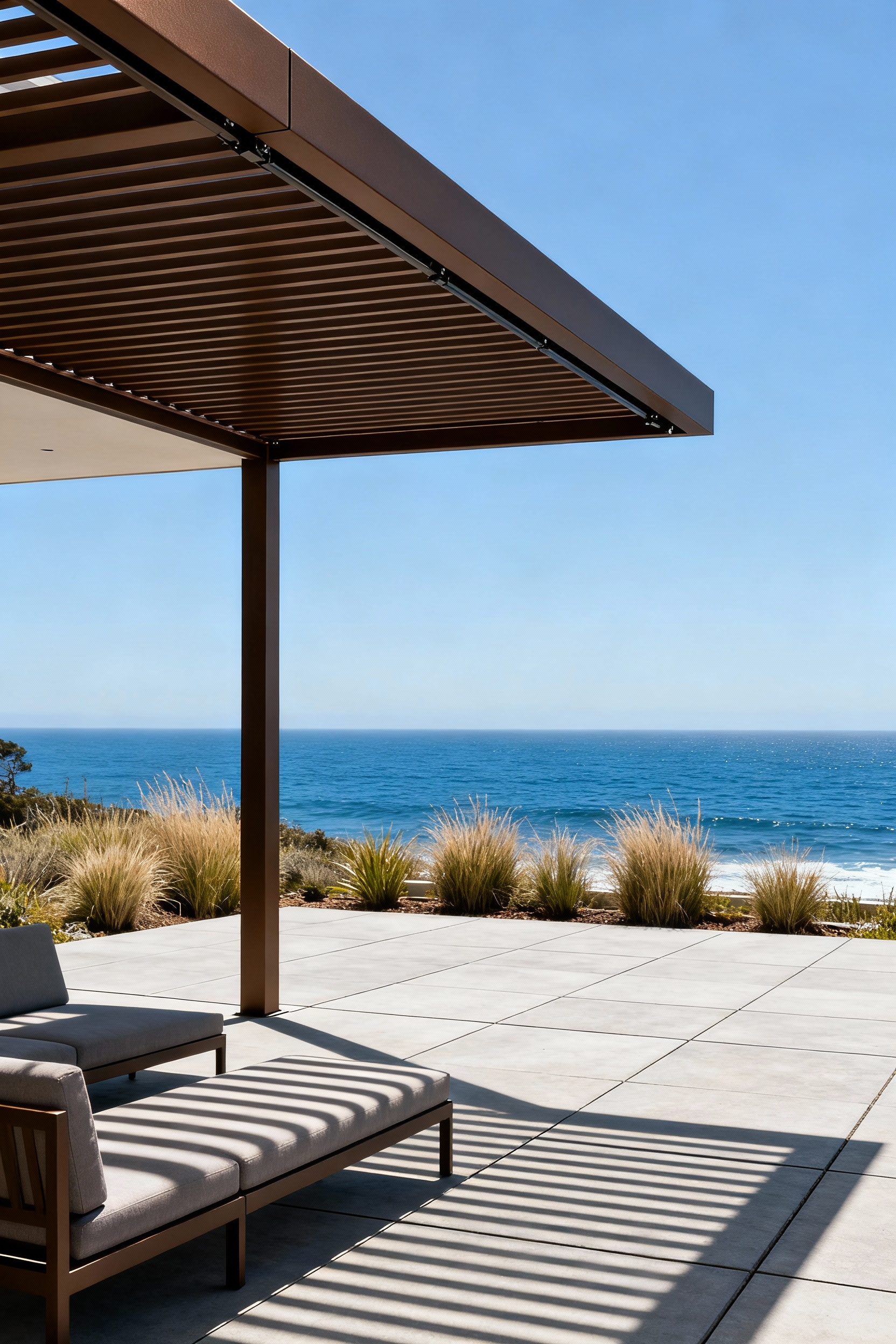
True coastal adaptability, however, goes beyond manual adjustments. High-end systems function as a watchful companion, utilizing integrated sensors to respond to the environment autonomously. Rain sensors detect the first drops of a storm, closing the roof to protect your upholstered furniture before you even realize the weather has turned. Conversely, wind sensors provide essential structural protection. During high gusts, the system automatically opens the louvers slightly to allow airflow, reducing wind uplift and preventing the structure from becoming a dangerous sail.
The longevity of these mechanics relies on rigorous material science. The salt-laden air is an aggressive corrosive force capable of compromising standard finishes rapidly. To counter this, we utilize extruded aluminum protected by a multi-step “Sea Coast Package.” This process applies a premium primer and a Super Duty Powder Coat, each baked at high temperatures to cure the finish. This creates a durable shield against corrosion, ensuring the mechanical elegance of the roof endures the harsh, salty reality of seaside living.
6. Hidden Engineering: Integrated Gutter Systems for Clean Aesthetics
True luxury in outdoor design often lies in what remains unseen. In the context of a modern back porch, the most sophisticated pergolas eliminate visual noise by internalizing water management. Rather than disrupting clean architectural lines with bolted-on external channels or utilitarian downspouts, these systems engineer the drainage directly into the structural frame. This seamless integration allows the pergola to maintain a sleek, minimalist profile that complements a contemporary coastal facade without clutter.
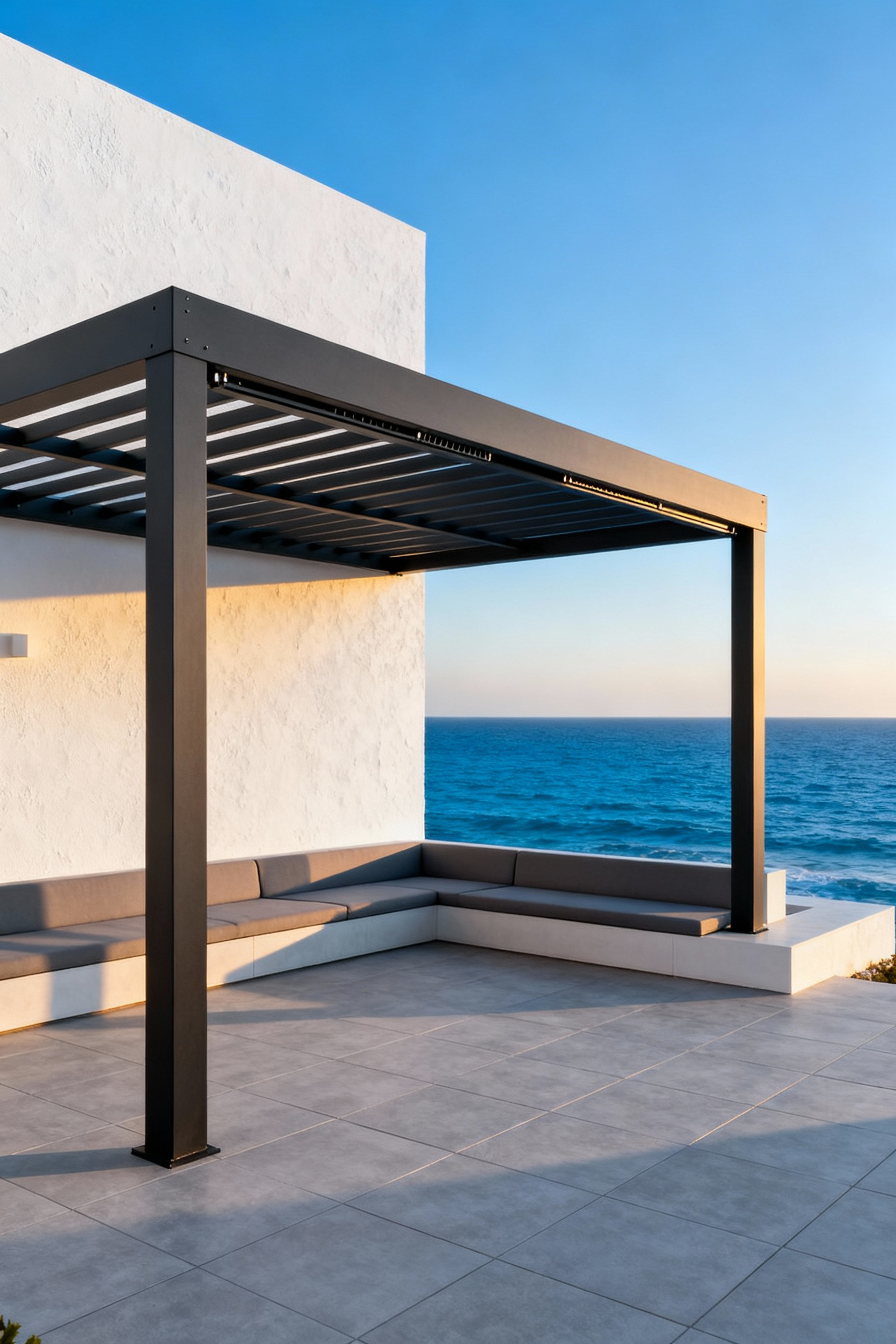
The mechanics function as an invisible water highway within the skeleton of the structure. When rain falls on the louvered roof, the blades interlock to channel water into an internal trough concealed within the perimeter beams. From there, a calculated pitch uses gravity to guide the flow into the hollow vertical support posts, where it travels down a dedicated drainage cavity to be discharged discreetly at the base. The result is a structure that appears visually light yet possesses the robust capability to manage heavy downpours.
This level of “hidden engineering” relies on manufacturing precision. High-grade systems utilize fully extruded, powder-coated aluminum profiles that are factory-crafted for a watertight fit, far superior to field-cut components. Beyond the aesthetics, this protects your investment. By controlling runoff internally, the system prevents water from sheeting off the roof and eroding the soil around the foundation or staining expensive hardscaping. It also ensures that any electrical wiring for smart features remains safely isolated from drainage pathways, marrying safety with an uncompromisingly clean look.
7. Whitewash vs. Natural Stain: Selecting the Right Finish for Your Facade
The choice between a natural stain and a whitewash finish is less about simple color preference and more about defining the emotional architecture of your outdoor room. If you are seeking a sense of grounding, a natural stain in cedar or teak tones effectively taps into biophilic design principles. The visibility of organic wood grain has been shown to lower stress levels, creating a warm, restorative “shelter” aesthetic that quietly blends with the surrounding landscape.
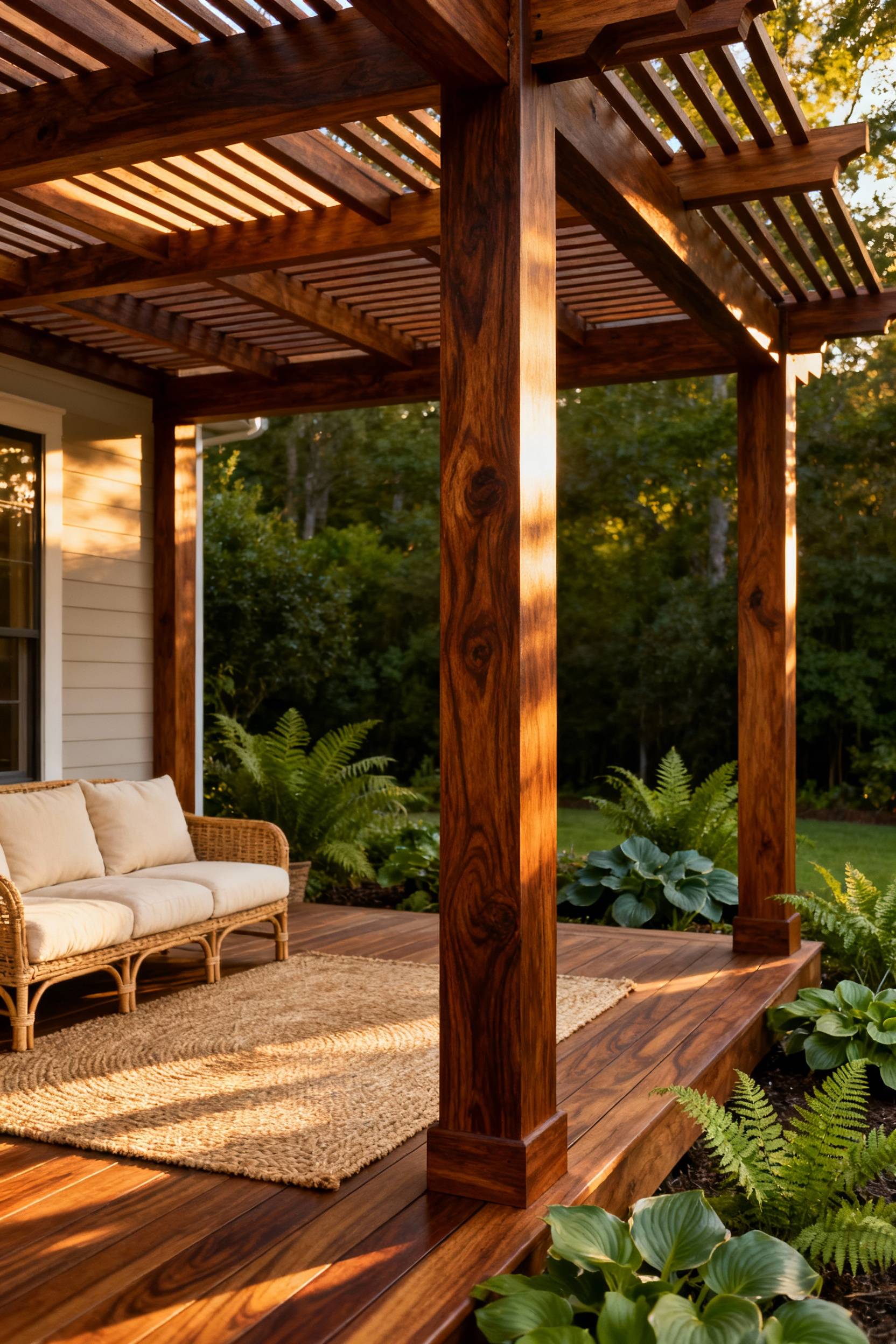
Conversely, whitewash introduces architectural airiness. By reflecting light, it opens up the visual field, making your pergola feel expansive and optimistic while physically reducing heat absorption—a significant advantage for barefoot living on scorching afternoons. However, this brightness comes with a technical trade-off. Since pigment provides UV protection, darker natural stains inherently shield the wood longer, allowing the finish to fade gracefully over three to five years rather than peeling.
Whitewash, lacking that dense pigment, often relies on modern oil-based formulations to repel water, yet it will weather faster. For many, this is a feature, not a bug. The finish develops a romantic, slightly worn patina that serves as a brilliant, high-contrast backdrop for climbing vines. While a natural stain allows wisteria to blend softly into the structure, a whitewashed facade forces the deep greens to pop, turning your landscaping into a dramatic focal point.
8. Nautical Tension Wires: Modern Trellising for Climbing Vines
Transforming a standard back porch pergola into a piece of resilient coastal architecture often requires looking beyond the garden center and toward the marina. Instead of bulky wooden lattice that inevitably degrades, we turn to marine-grade 316 stainless steel tension wires. This material specification is critical; the addition of molybdenum grants the steel superior resistance to pitting and corrosion, ensuring the system maintains a clean, industrial-chic aesthetic even in salt-heavy air.
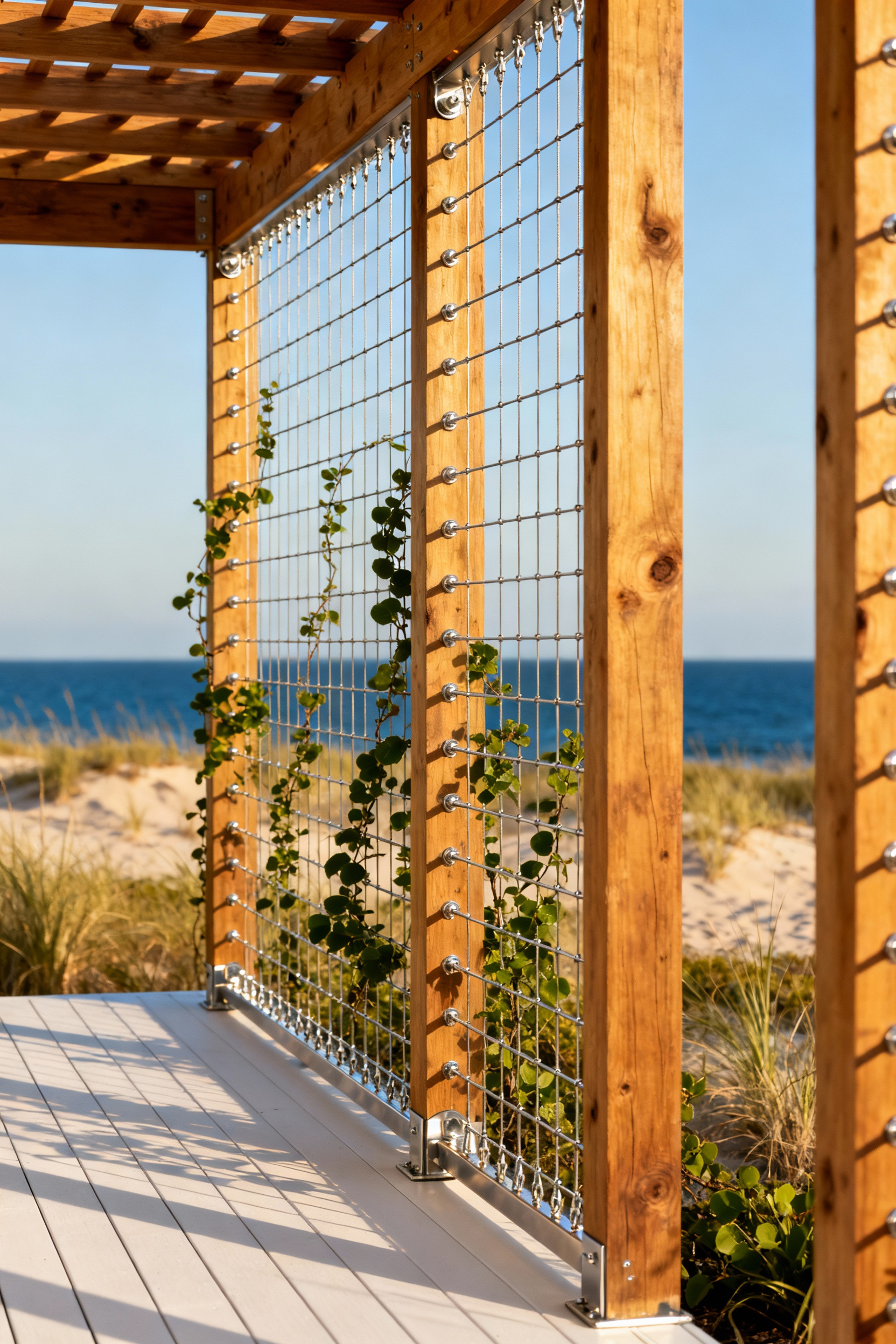
The design intent here is to create a framework that is present but unobtrusive. Using turnbuckles and swage fittings—hardware borrowed directly from sailboat rigging—we can tighten the cable to create laser-straight lines. This introduces a sophisticated tension, offering a precise linear contrast to the organic, wandering growth of climbing plants. Even when vines are dormant, the wire remains as a sleek, graphic layer rather than an empty, rotting frame.
Functionally, this approach safeguards both the plant and the home. The system relies on stainless standoffs to float the wires roughly four inches off the structure. This separation promotes essential airflow to reduce the risk of mildew and prevents aggressive woody climbers, such as Wisteria, from strangling or rotting the structural wood posts. It is a solution that balances the immense torque of heavy vines with a visual lightness, proving that the strongest structures are often the most elegant.
9. The ‘Ship-Lap’ Ceiling Effect: Adding Solid Sections for Defined Dining Zones
Transforming a section of your pergola into a solid ceiling does more than just block the rain; it fundamentally alters the feel of the space. In architectural terms, we often refer to the ceiling as the “fifth wall,” a critical element in defining a zone. When you introduce a solid shiplap expanse over a dining table, you create an immediate sense of enclosure and intimacy. The open sky suggests a limitless environment, but this solid “lid” signals to guests that this is a contained, protected sanctuary meant for conversation and connection.
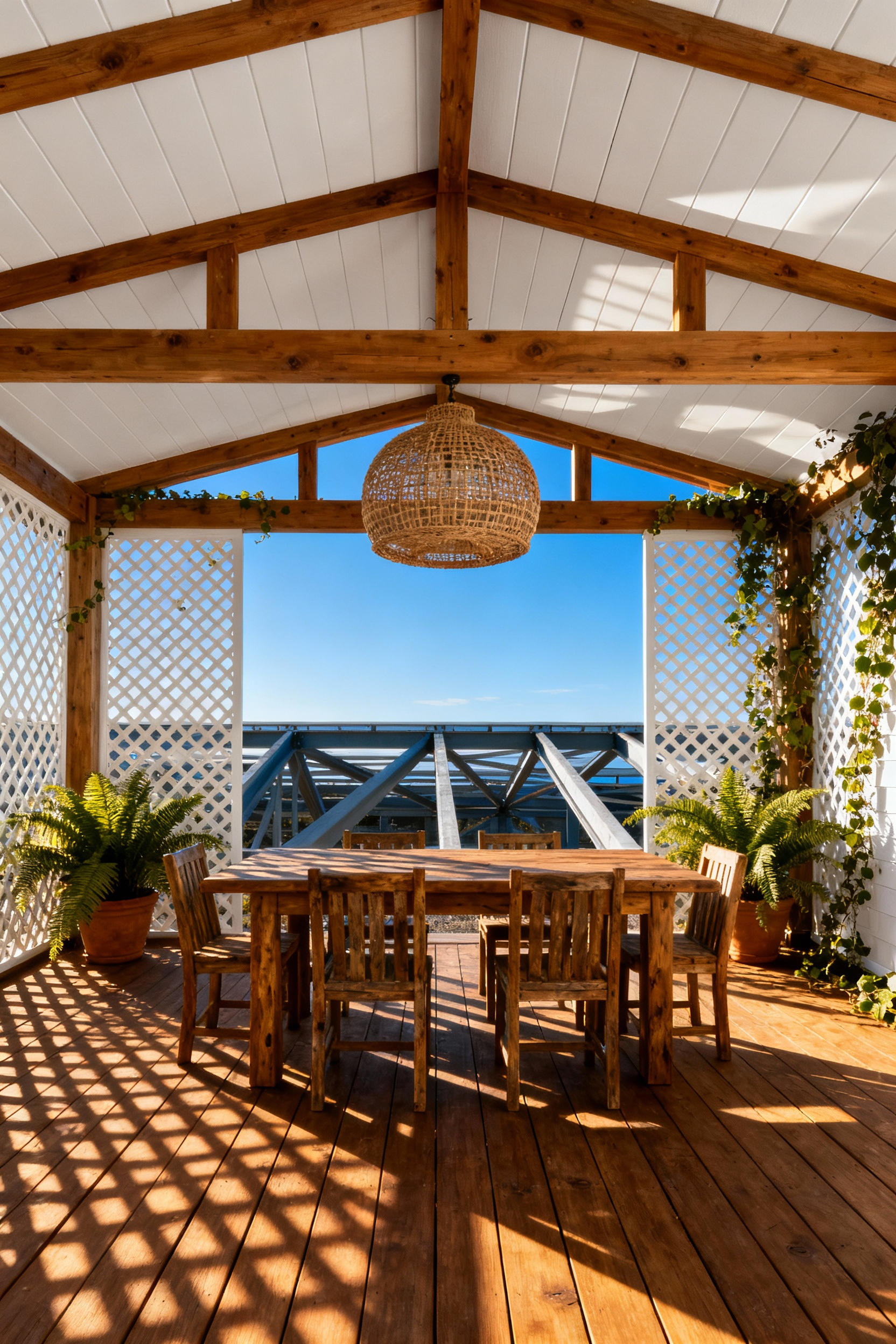
This approach creates a functional hybrid between the open-air freedom of a pergola and the permanence of a pavilion. The choice of shiplap is deliberate here; a flat, seamless ceiling can often feel sterile. Shiplap, with its characteristic horizontal lines and “nickel gap” spacing, offers a rustic warmth that bridges the gap between maritime tradition and contemporary design. The texture captures natural light during the day and creates a soft, rhythmic play of shadow that prevents the surface from looking monolithic.
Beyond aesthetics, this modification is a masterclass in utility concealment. A solid paneled ceiling provides a polished cavity to hide electrical wiring, allowing for the installation of statement pendant lighting or damp-rated ceiling fans without visible conduit. You effectively hide the structural skeleton—joists and beams—behind a clean, finished surface. By dedicating this solid roof specifically to the dining zone while leaving adjacent areas open or louvered, you ensure the primary gathering spot remains a comfortable, all-weather retreat.
10. Architectural Anchors: Using Stone or Concrete Plinths for Columns
A pergola should feel like it belongs to the landscape, not just hovering above it. Introducing a stone or concrete plinth offers an immediate sense of permanence, acting as a visual counterweight to the lighter, airier timber framing overhead. This architectural “foot” provides the necessary mass to physically and psychologically ground the structure. Historically, this adds a touch of monumentality, echoing classical design principles where a column never meets the ground without a base. It turns a simple garden element into a defined extension of the home, framing your view of the horizon with stability and authority.
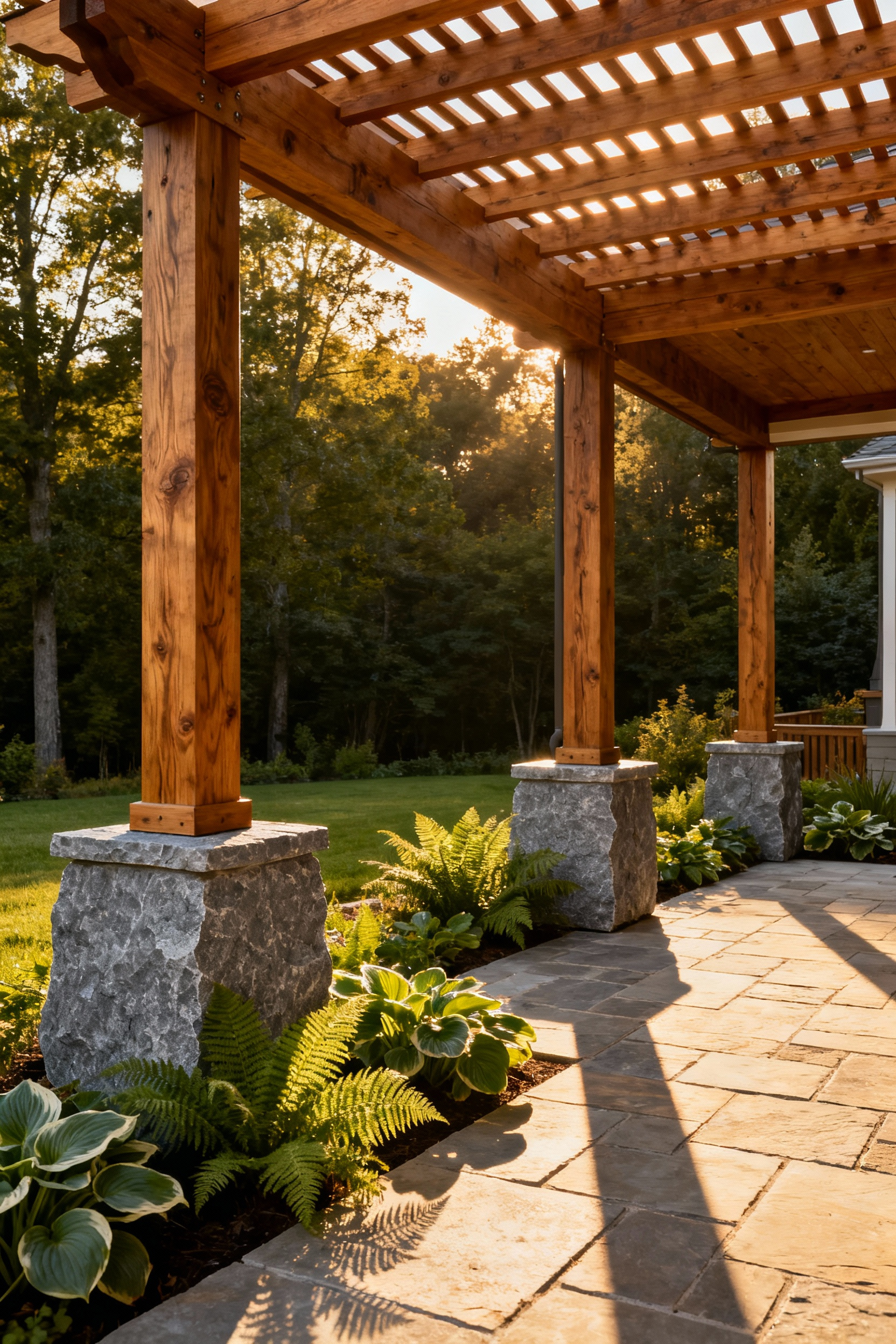
Beyond aesthetics, the method of connection speaks volumes about craftsmanship. Rather than relying on industrial metal brackets—which often feel cold and jarring against natural materials—I prefer the artisan approach of scribing the timber base directly to the contour of the stone. This technique creates a seamless, organic fit where the wood appears to grow naturally out of the plinth. It eliminates visible gaps and replaces the rigid geometry of hardware with the tactile warmth of hand-tooled surfaces.
From a practical standpoint, this elevation is critical for longevity, particularly in damp coastal climates. Raising the column’s end-grain at least six inches above grade establishes a vital moisture barrier. This break prevents ground water from wicking up into the timber and rotting it from the inside out, while simultaneously cutting off a primary pathway for pests. For a final layer of protection, a subtle chamfer or drip edge cut into the plinth leverages surface tension to shed water away from the base, ensuring the structure remains as durable as it is beautiful.
11. Softening the Edges: Installing Weather-Resistant Linen Drapery
While the architectural framework of a pergola provides essential definition, the rigid lines of timber or aluminum can sometimes feel stark against a natural backdrop. Introducing drapery bridges this gap, offering a layer of texture that instantly softens the hardscape. The goal here isn’t just shade; it’s capturing that elusive, resort-style ambiance where light and movement play a central role.
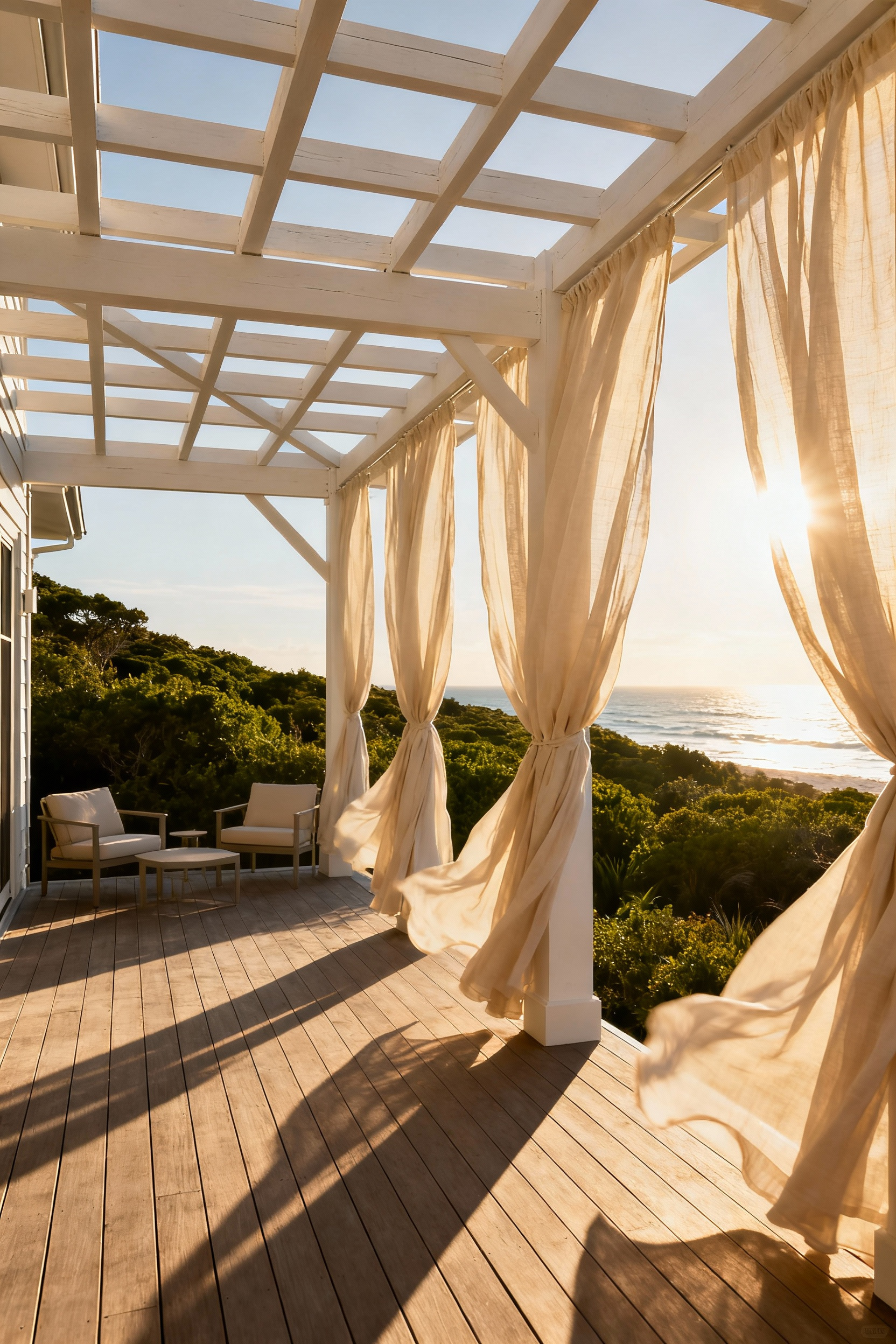
However, the coastal environment demands a pragmatic approach to textiles. While the romance of 100% flax linen is undeniable, its affinity for absorbing moisture makes it a high-maintenance choice for uncovered outdoor living. The superior alternative is performance-engineered “linen-look” fabric, typically crafted from solution-dyed acrylics. These textiles mimic the slubbed texture and matte finish of natural flax but possess the technical fortitude to repel water, resist mildew, and block UV rays.
Visually, these fabrics work to diffuse harsh, directional sunlight, replacing sharp shadows with a luminous, ambient glow. To ensure this softness doesn’t turn chaotic in a sea breeze, proper anchoring is vital. I always recommend weighted hems or discreet bottom tabs to prevent the “sail effect,” keeping the drapes elegant rather than unruly. Furthermore, because salt air is unforgiving, suspension systems must rely on corrosion-resistant stainless steel or aluminum rods. For a tailored finish, the hem should just graze the deck surface—pooling fabric invites dirt and dampness, whereas a precise hover maintains that crisp, sophisticated edge.
12. Statement Lighting: Oversized Woven Rattan Pendants for Vertical Scale
A pergola is inherently defined by horizontal lines—beams and rafters stretching across the sky. While this provides structure, the overhead vastness can sometimes leave a seating area feeling exposed. Introducing an oversized woven pendant disrupts this horizontal dominance, establishing a necessary vertical scale. By dropping a substantial fixture over a dining table or lounge zone, usually hovering about seven feet from the deck, you create a visual anchor. This effectively lowers the “ceiling,” transforming an open-air structure into an intimate, human-scaled room that feels embraced rather than endless.
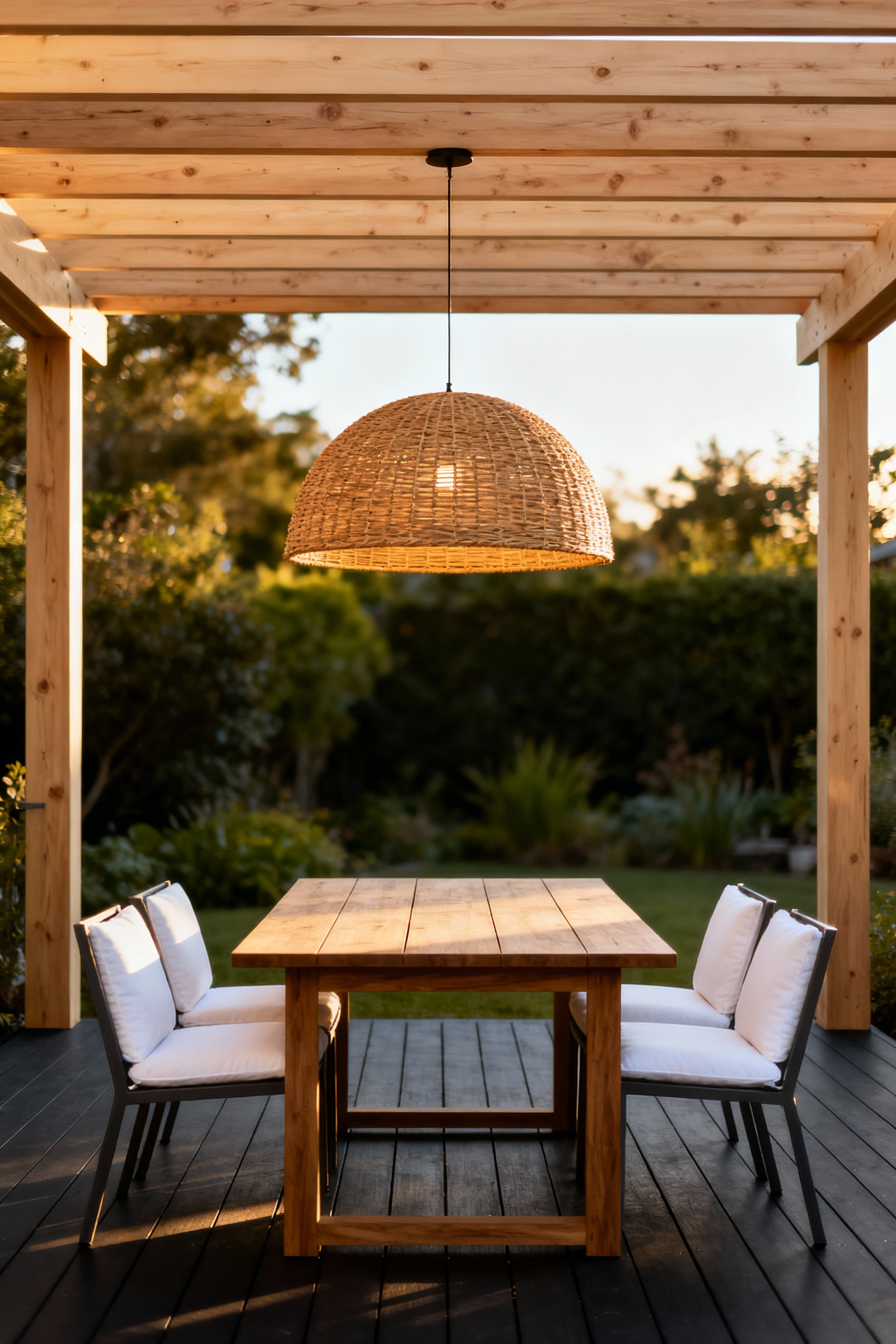
Beyond the architectural strategy, the material choice of rattan—or high-quality weather-resistant resin—brings an essential layer of organic texture. The open, varied weave softens the rigid, linear nature of the pergola’s timber or metal framework. This contrast is crucial in coastal design, where the goal is to balance structural integrity with relaxed, natural elements.
The true magic, however, happens after sunset. Unlike solid metal shades that direct light exclusively downward, a woven fixture creates a lantern effect. The light filters through the open weave, casting intricate, geometric shadows across the rafters, the deck, and the exterior walls. This textured illumination turns the back porch into a dynamic, sculptural environment, blurring the line between indoor sophistication and the raw beauty of the outdoors.
13. Integrated Beam Downlighting: Subtle Ambiance for Evening Entertaining
True coastal sophistication often means knowing what to subtract. While string lights or hanging lanterns have their place, there is a profound elegance in the philosophy of “invisible illumination.” By recessing flush-mount LED pucks or low-profile strips directly into the pergola’s rafters and beams, we allow the light itself to become the subject rather than the fixture. During the day, this preserves the structure’s clean, architectural lines; at night, it creates a floating, ethereal quality that visually elevates a simple deck into a refined outdoor room.
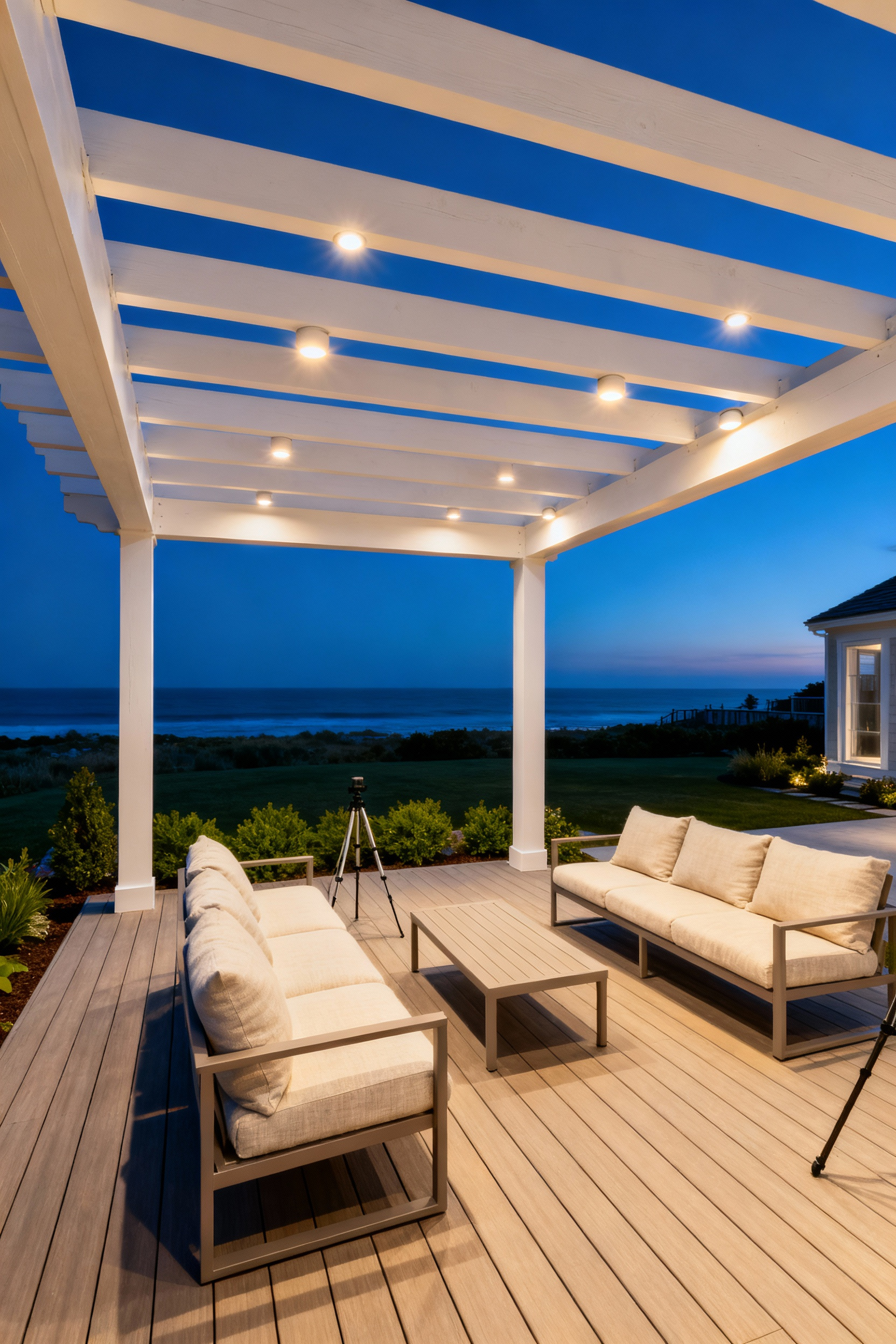
The secret to that effortless evening glow lies in the color temperature. For entertaining spaces, we strictly avoid the sterile, crisp whites typical of security lighting. Instead, the goal is to stay within a warm white range (around 2700K to 3000K). This spectrum mimics the psychological comfort of firelight or candlelight, creating an atmosphere that flatters skin tones and encourages guests to relax and linger over conversation.
Beyond just warmth, integrated downlighting solves the practical issue of glare. Because the light source is shielded within the beam and directed downward, you avoid the eye-fatigue associated with exposed bulbs. This technique casts gentle, defined pools of illumination exactly where you need them—on the dining table or lounge area—while leaving the surrounding night sky undisturbed. When paired with a dimmer, you have total control to shift the mood from a functional brightness for serving dinner to a deep, subtle ambiance perfect for a late-night glass of wine.
14. Built-In Banquettes: Maximizing Space with ‘Ship-Style’ Perimeter Seating
Adopting the “ship-style” approach to seating isn’t about nautical themes; it is a smart use of space. On a typical deck, traditional dining chairs require a surprisingly large “shuffle zone”—about thirty inches of clearance just to slide in and out. By pushing built-in banquettes against the perimeter rails or the structural posts of your pergola, you instantly reclaim that footprint. This transforms the edge of your porch from a passive boundary into an active, social area, mirroring the efficient promenade decks of ocean liners where circulation space is prioritized.
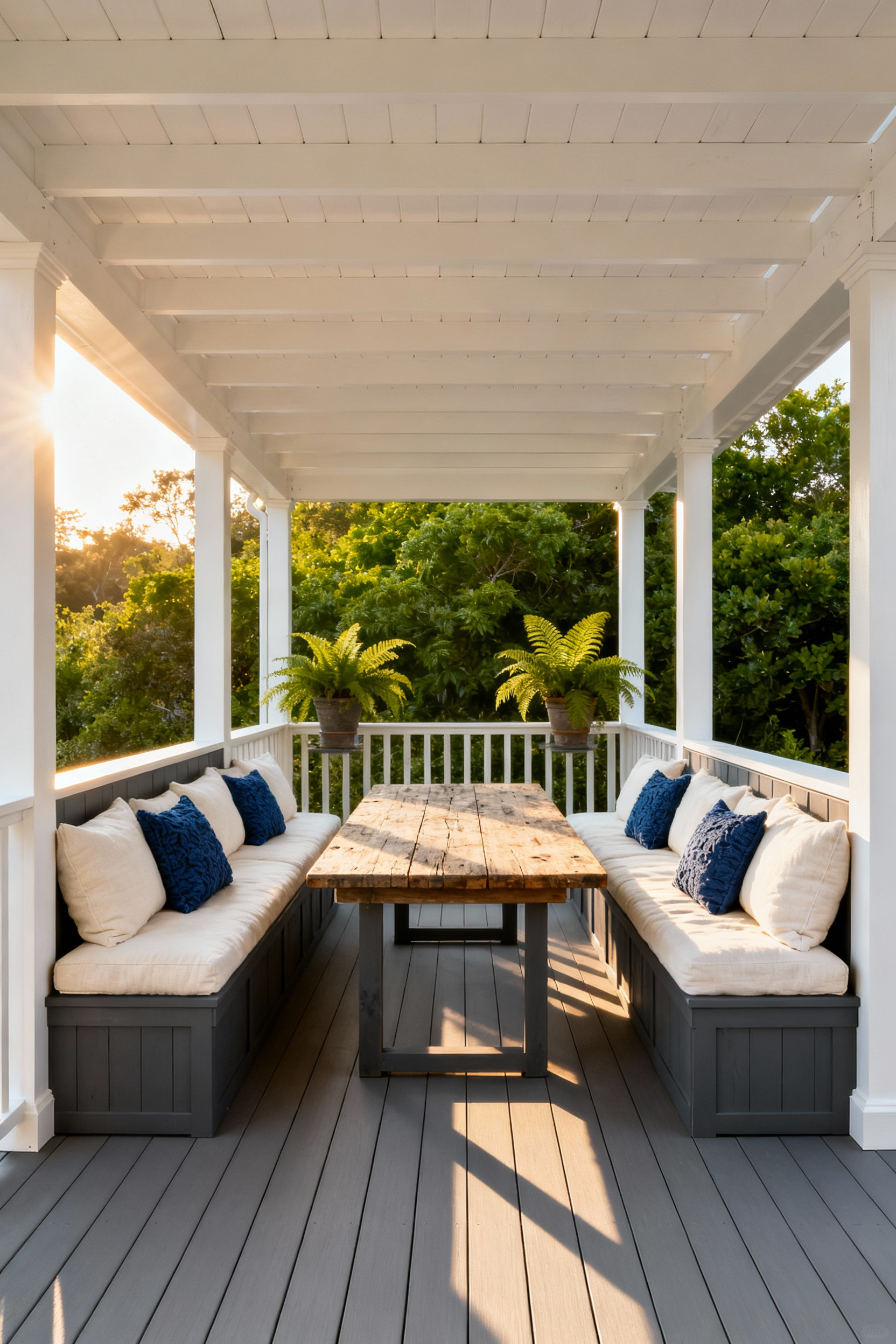
Beyond the reclaimed square footage, this design choice offers discreet utility. The volume beneath the seat shouldn’t be wasted; it functions best as a weather-resistant locker. With a lift-up lid and marine-grade seals, this cavity becomes the perfect dry harbor for cushions, throws, or fire pit tools that usually clutter the deck.
Visually, this anchors the pergola. Rather than a scatter of loose furniture that can look chaotic, an L-shaped or U-shaped bench provides clean architectural lines and a permanent sense of place. It naturally creates an intimate conversational grouping, especially when paired with a pedestal table that eliminates the tangle of table legs. The result is a streamlined, cozy outdoor room that feels both expansive and secure.
15. Flooring Continuity: Matching Decking Direction to Interior Floors
Establishing a true connection between the indoors and the coastal outdoors relies heavily on visual flow. By running your pergola decking in the exact same direction as your interior flooring, you create an optical current that guides the gaze outward. This alignment establishes a seamless narrative, effectively tricking the brain into perceiving the interior living area and the back porch as a single, expansive entity. To maximize this effect, planks should ideally run parallel to the primary source of natural light; this minimizes shadow lines between the boards and emphasizes a monolithic, open feeling.
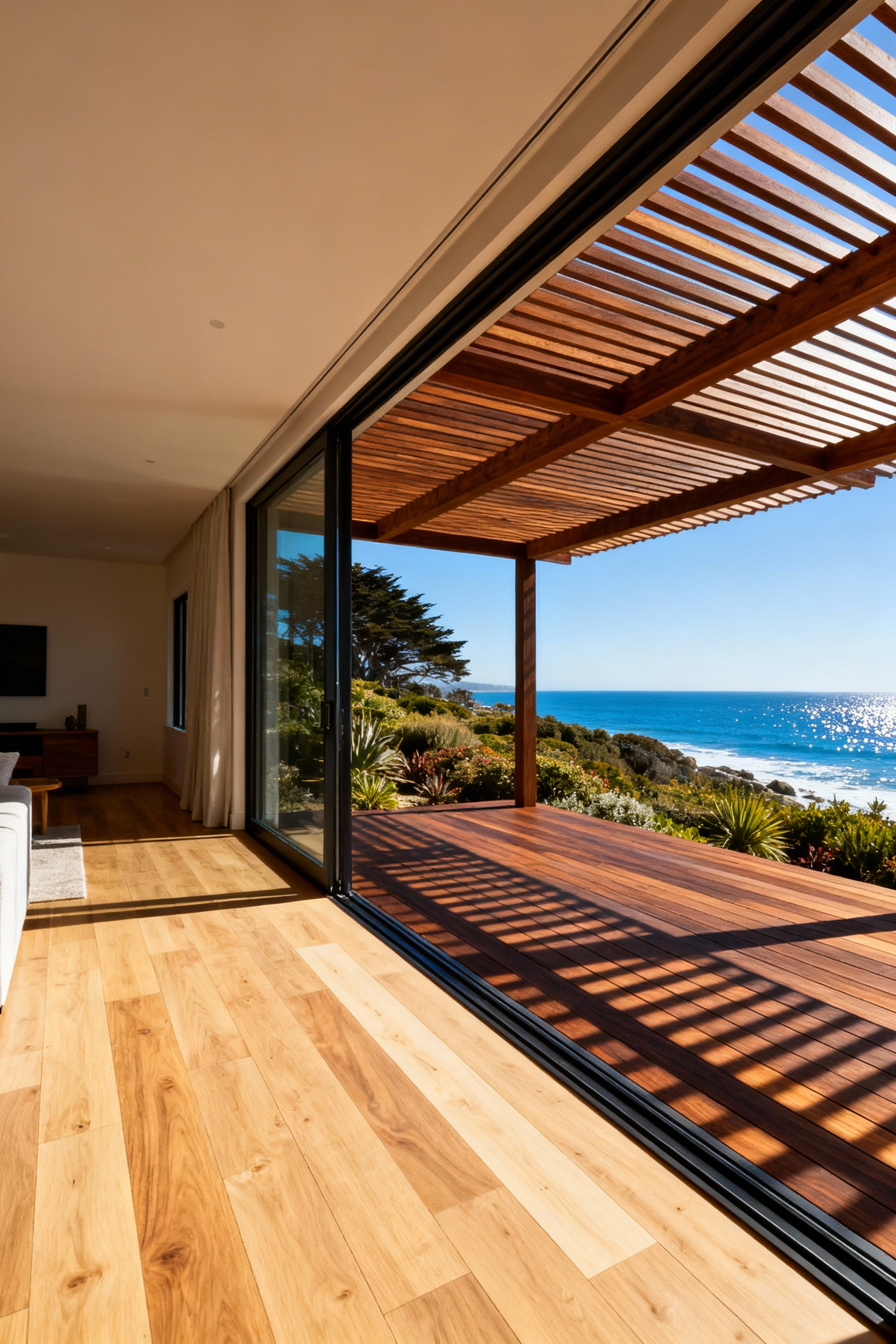
Visual continuity falls flat, however, if there is a clumsy step-over at the door. The goal is to eliminate the traditional “lumpy threshold” in favor of a completely flush transition. This is often achieved using adjustable decking pedestals for the exterior surface. These supports allow stone tiles or composite planks to sit at the precise level of the interior floor while maintaining necessary drainage gaps beneath. Since interior hardwood rarely survives the elements, the secret here is coordination rather than duplication. Select outdoor-rated materials that mimic the color, texture, and grain width of your indoor surfaces to maintain the illusion.
Achieving this flow can sometimes spark a battle with structural tradition. Solid hardwood typically must run perpendicular to floor joists, which might contradict the direction of your view out to the pergola. To bypass this, we often turn to engineered hardwood or luxury vinyl plank. These modern materials offer the directional freedom to prioritize the aesthetic sightline over structural constraints, ensuring nothing interrupts the drift from the hearth to the horizon.
16. Wind Mitigation: Designing Slat Walls for Breezy Protection
When designing for coastal environments, the instinct is often to build a fortress against the breeze. However, a solid wall creates a significant pressure differential, resulting in turbulent eddies that curl over the top of the barrier and crash down into your seating area. Real comfort comes not from blocking the wind entirely, but from diffusing it. A well-designed slat wall acts as a filter, allowing a small amount of air to pass through the gaps. This equalizes pressure on both sides, turning a jarring gust into a gentle, manageable breeze.
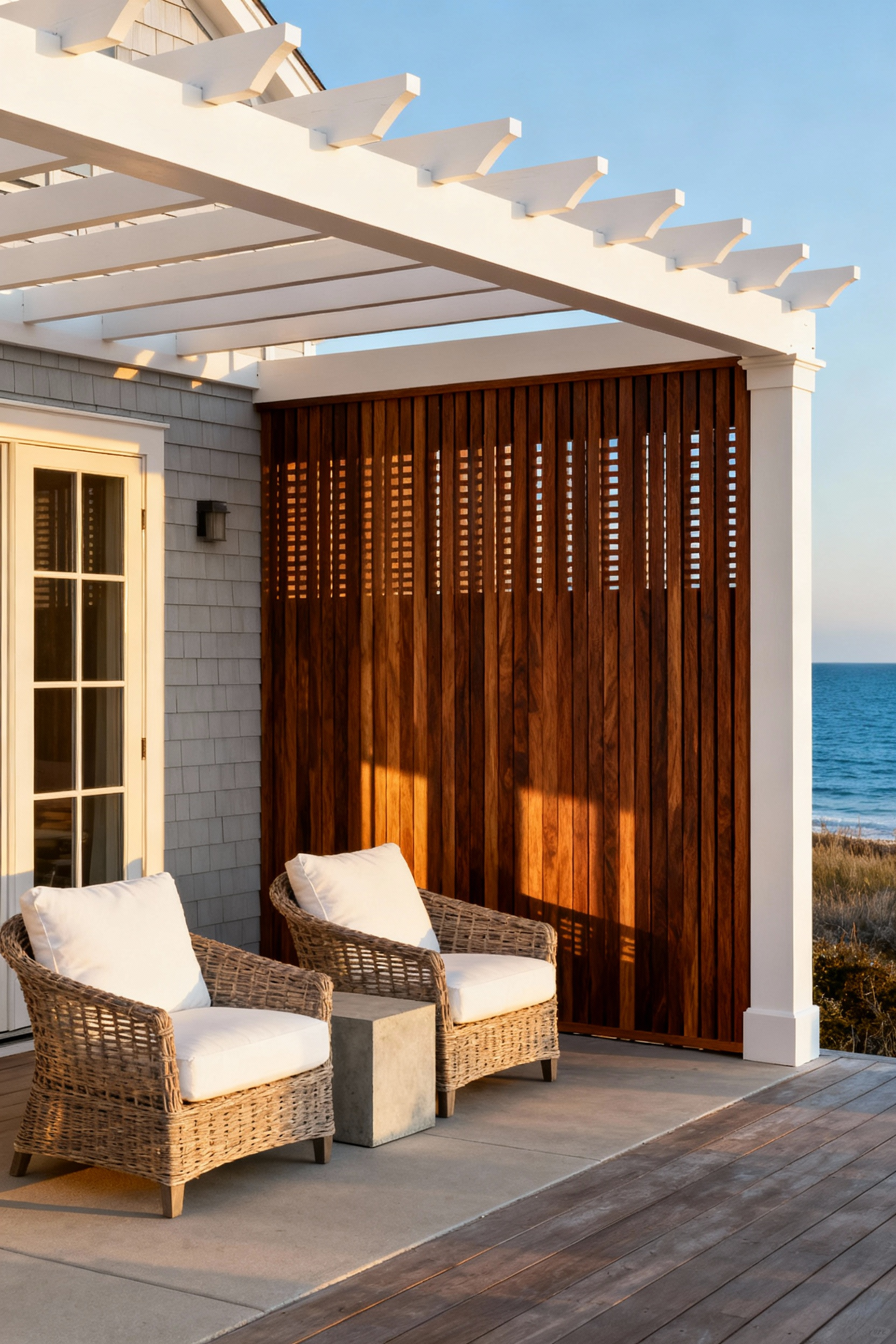
To achieve this aerodynamic sweet spot, you should target a porosity between 20 and 40 percent. A practical rule of thumb for a timber setup is to space your slats so the gap prevents the air from reattaching too quickly; using a one-inch gap with standard 1×6 lumber creates a highly effective diffusion ratio. This specific spacing creates a sensory shift as well, replacing the heavy thump of a gust slamming against a solid surface with a calming, uniform hiss.
While horizontal lines are often favored for their ability to visually widen a space and anchor a structure, consider the functional elegance of vertical slats in heavy weather zones. A vertical orientation sheds wind-driven rain efficiently and prevents water or debris from pooling on the edges of the wood. This subtle design choice extends the life of the material and significantly reduces maintenance, ensuring the structure remains as resilient as it is beautiful.
17. Salt-Tolerant Botanicals: Selecting Vines that Thrive in Coastal Air
Selecting greenery for a coastal pergola requires moving beyond generic nursery labels. The salt air that gives seaside living its charm is aggressive, acting as an invisible pruning shear to weaker species. For structures facing the full force of the ocean, we must look to plants that possess a physiological adaptation to high salinity, rather than those that merely tolerate it.
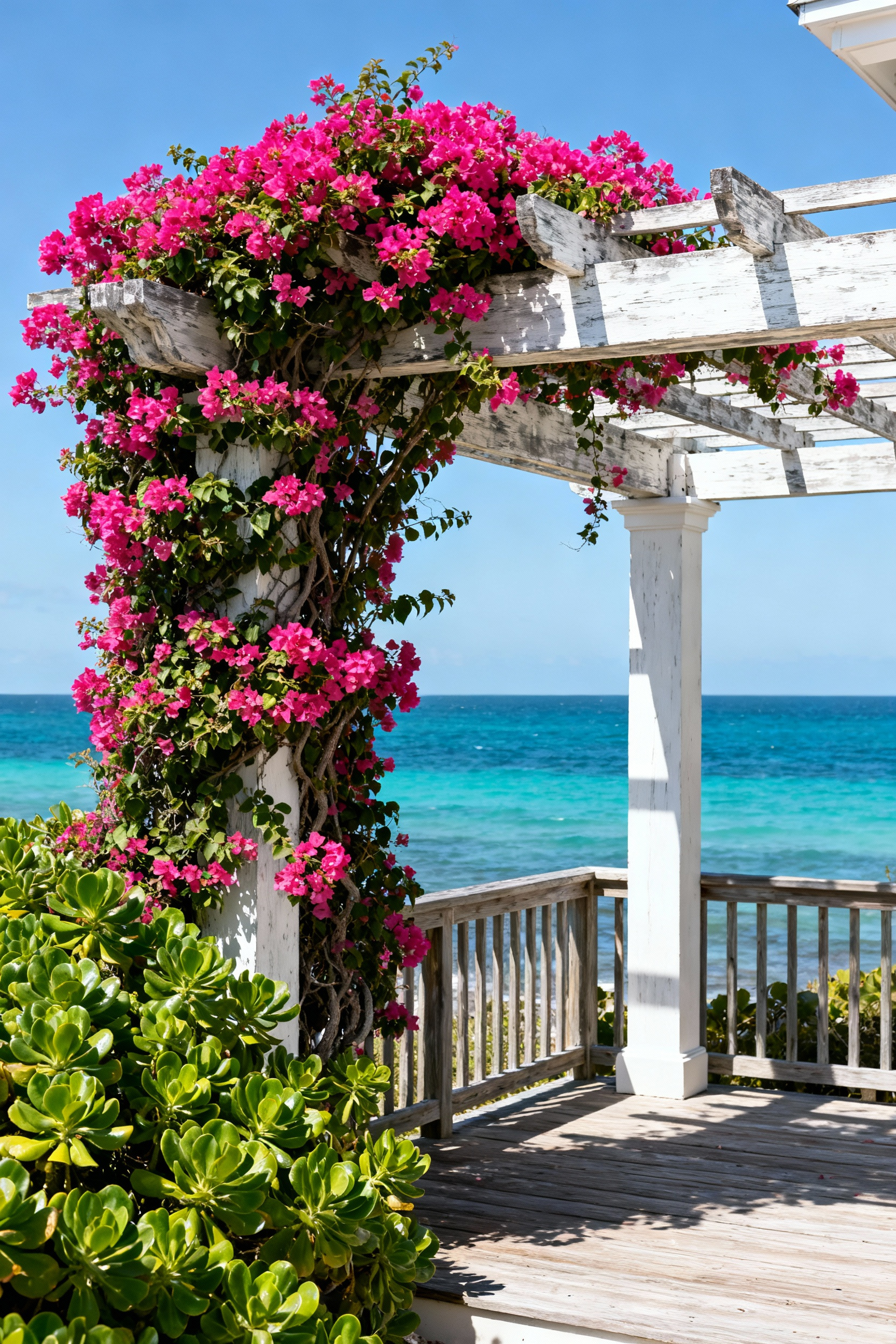
Bougainvillea remains the gold standard for defiant, tropical color, but success lies in the specific cultivar. Research indicates that varieties like ‘Shuihong’ and ‘Xiaoyezi’ offer superior resistance thanks to internal enzyme activity that manages salt accumulation. This prevents the plant’s cells from drying out—a process that kills lesser vines. When a salt-laden gale hits, these varieties don’t just survive; they thrive, offering a vibrant counterpoint to the silvered patina of a weathered deck.
If the goal is less about visual impact and more about atmosphere, Confederate Jasmine (*Trachelospermum jasminoides*) is unrivaled for sheltered back porches. Its value is primarily olfactory; the vine produces a narcotic, honey-sweet fragrance that catches the sea breeze, scenting the entire outdoor living space. As an evergreen with glossy foliage, it provides a sophisticated, year-round backdrop, though it requires structural ties to guide it along the pergola beams.
For a more architectural approach, Cape Honeysuckle offers a distinct advantage: control. Unlike the wild sprawl of Bougainvillea, this scrambling shrub can be espaliered flat against a lattice for a clean, modern look. It blooms with brilliant orange-red tubular flowers from late fall through spring, bringing warmth and hummingbirds to the porch during the cooler, quieter coastal months when most other vines have gone dormant.
18. The Fire Feature Focal Point: Anchoring the Pergola for All-Season Use
Think of the pergola as the vertical definition of your outdoor room—the ceiling—while the fire feature serves as its heart. Introducing a fireplace or fire table creates a gravitational pull that dictates the flow of the space, naturally arranging seating into a communal circle. This single design move transforms the area from a simple shaded walkthrough into a deliberate destination for connection, effectively anchoring the entire structure.
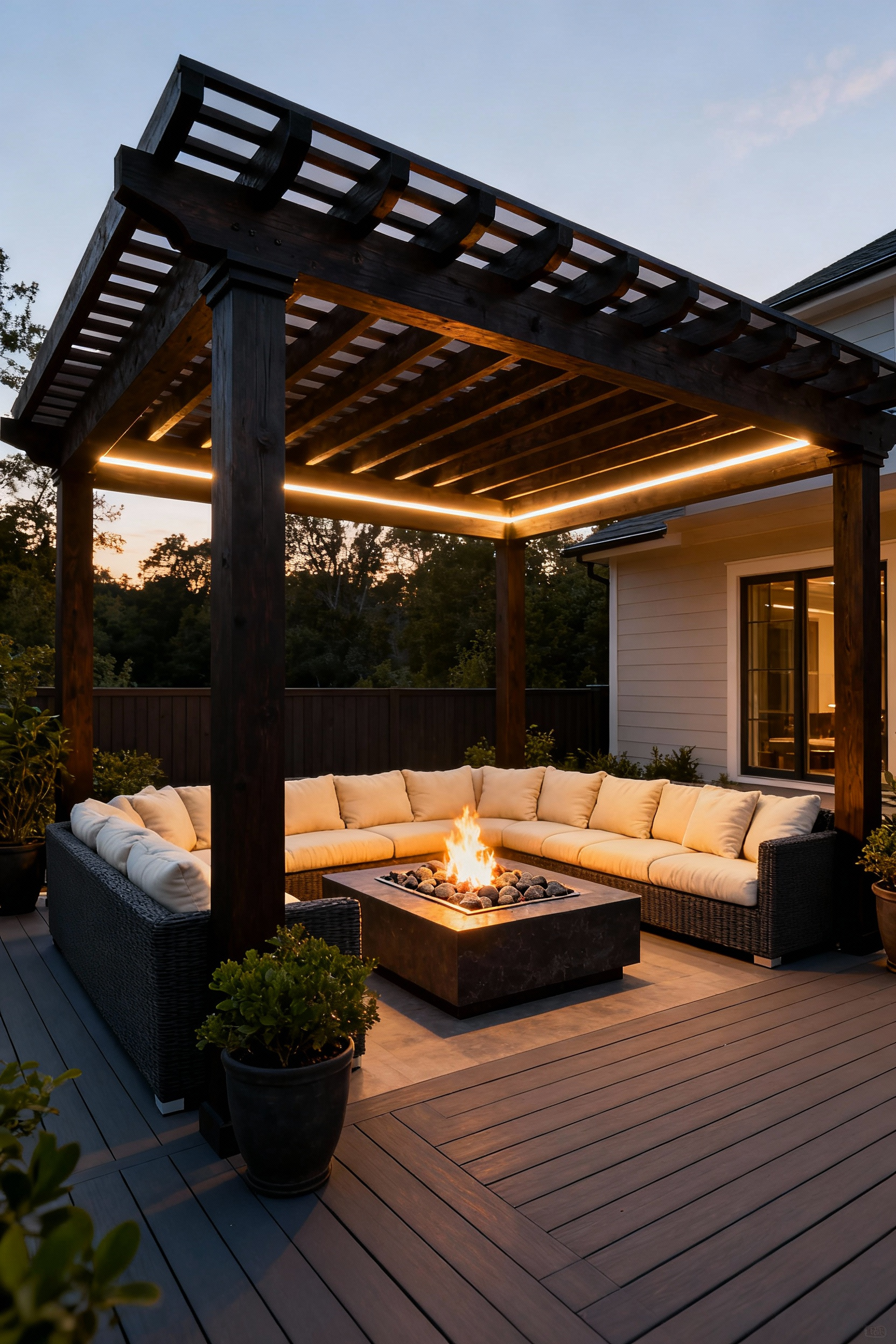
To ensure this back porch pergola remains functional beyond the balmy summer months, the choice of fuel and materials is paramount. While a wood-burning hearth has rustic appeal, natural gas or propane is often the superior choice for these semi-enclosed environments. These options provide consistent warmth without the sparks or heavy smoke accumulation that can damage overhead beams. For maximum versatility, modern louvered-roof pergolas pair exceptionally well with fire features; the adjustable vanes allow you to vent heat and smoke on warmer evenings or close them to trap radiant warmth against the chill of a coastal breeze.
Ideally, you want a feature that feels permanent rather than temporary. A built-in masonry fireplace or a cast concrete fire pit visually roots the pergola to the ground, enhancing the sense of a cohesive architectural structure. Beyond the mechanics, this inclusion taps into something primal. The soft, warm glow offers a reprieve from harsh overhead lighting, lowering the collective pulse of the room. Whether it’s a sleek, low-profile table or a monolithic stone hearth, the visual dance of the flames turns the pergola into a meditative retreat.
Conclusion: From Backyard to Retreat – Final Thoughts on Architectural Authority
Installing a back porch pergola is less about carpentry and more about curating a specific state of mind. By framing the open sky with architectural definition, we transform a passive, undefined backyard into a psychological anchor—a true “retreat” that offers the security of enclosure while maintaining a restorative connection to the elements. This structure successfully blurs the rigid line between indoor comfort and the fresh air, proving that a home’s value isn’t measured merely in square footage, but in the capacity of its spaces to lower stress and induce a deep sense of calm.
As you look toward the future of your property, consider this outdoor room as an investment in your daily rhythm rather than just aesthetic curb appeal. It signals a permanent shift from simply maintaining a house to cultivating a lifestyle centered on wellness and intentional living. To begin this transformation, stand in your current outdoor space during “golden hour” and observe the natural light patterns; identify exactly where you need shadow and structure to turn that raw exposure into a sanctuary, and let that light dictate your design.
Frequently Asked Questions
How much does a luxury motorized back porch pergola cost?
The cost of a luxury, custom-designed, motorized louvered aluminum back porch pergola typically ranges between $200 to $450 per square foot, fully installed. This investment reflects the use of marine-grade materials (like extruded aluminum with Sea Coast powder coating), integrated LED lighting, hidden drainage systems, and sophisticated rain and wind sensor technology. Standard, high-end wooden pergolas using marine-grade teak or cedar will usually fall in the lower end of this range.
What is the optimal slat orientation for maximum shade on a coastal back porch pergola?
For maximum shade efficiency, especially during the harsh midday sun common in coastal regions, orient the wider dimension of your pergola slats or rafters in an East-West direction. This alignment effectively blocks the sun when it is highest and most intense, while allowing the lower-angle light of morning and evening to filter through gently. Aim for a porosity of 20% to 40% (a 1-inch gap between 6-inch slats is a common effective ratio) to ensure adequate airflow and dappled light.
What are the maintenance differences between marine-grade teak and aluminum pergolas?
Marine-grade aluminum (often with a high-end powder coat) requires minimal maintenance—usually just an annual cleaning with mild soap and water. It is impervious to rot, warping, and pests. Teak, while extremely durable and resistant to water damage, requires higher maintenance if you wish to retain its original golden-brown hue (involving cleaning and oiling). If left unstained, teak will weather naturally into a desirable silvery-gray patina, which is low-maintenance but requires periodic cleaning to prevent buildup.